The basic idea is that if you have the change of basis [u]_E = B [u]_B, and you're given T only wrt B, i.e. [A]_B then you know only how to compute [A]_B [u]_B. We can however transform it using [u]_B = B^{-1} [u]_E to get [A]_B B^{-1} [u]_E. However this still outputs a vector in the basis B, to go to E we need an additional change of basis T(u) = B [A]_B B^{-1} [u]_E -> [A]_E = B [A]_B B^{-1}.
#linear-algebra
2 messages · Page 303 of 1
 languid wigeon
,help ,,
 stoic pythonBOT
Command ,, not found!
Use the ,list command without arguments to see a list of commands.
languid wigeon
,list
stoic pythonBOT
My commands!
Use ,ls to obtain a briefer listing, and use ,help <cmd>to view detailed help for a particular command, or ,help to view general help.
If you still have questions, talk to our friendly support team here.
LaTeX Rendering
Render LaTeX code and configure rendering options.
tex: Render LaTeX code.
ctan: Searches the ctan
texdoc: Searches the texdoc
autotex: Toggle whether your LaTeX is automatically rendered.
preamble: View or modify your LaTeX preamble.
texconfig: View or modify your personal LaTeX rendering options.
guildpreamble: View or modify the guild's default LaTeX preamble
Guild Admin
Guild administration
config: View and set the guild configuration.
rmrole: Deletes the provided role
disable: Disable commands in this guild.
editrole: Create or edit a server role.
autoclean: Automatic deletion of messages in the current channel.
forgetrolesfor: Forget stored persistent roles for one or all members.
Page 1/4
 spare widget
thank you
languid wigeon
for ez ref
but i failed
nvm there's #latex-testing for testing
i shld hav mentioned this ealire
earlier
sor9y
coz , is ezer 2 type than $
you can use \to as a synonym of \rightarrow
,, T(u) = B [A]_B B^{-1} [u]_E \to [A]_E = B [A]_B B^{-1}
stoic pythonBOT
vin100
 spare widget
I seem to have made a typo in this should read B [A]_B B^{-1} [u]_E instesd of [u]_B in the third line
Eitherway, I think this should be enough for John to solve the exercise
languid wigeon
i'm been away trying a make a figure
it would be more efficient
needa test this in #latex-testing first
% https://q.uiver.app/?q=WzAsNixbMiwxLCJbVCh2X2kpXV9CIl0sWzIsMCwiVCh2X2kpIl0sWzEsMSwiZV9pPVt2X2ldX0IiXSxbMSwwLCJ2X2kiXSxbMCwwLCJbXFxjZG90XV9FIl0sWzAsMSwiW1xcY2RvdF1fQiJdLFsyLDAsIltUXV9CIiwyXSxbMywxLCJUIl0sWzMsMiwiPyIsMCx7Im9mZnNldCI6LTEsInN0eWxlIjp7ImhlYWQiOnsibmFtZSI6ImhhcnBvb24iLCJzaWRlIjoidG9wIn19fV0sWzIsMywiQiBbdl9pXV9CIiwwLHsib2Zmc2V0IjotMSwic3R5bGUiOnsiaGVhZCI6eyJuYW1lIjoiaGFycG9vbiIsInNpZGUiOiJ0b3AifX19XSxbMSwwLCI/IiwwLHsib2Zmc2V0IjotMSwic3R5bGUiOnsiaGVhZCI6eyJuYW1lIjoiaGFycG9vbiIsInNpZGUiOiJ0b3AifX19XSxbMCwxLCJCW1Qodl9pKV1fQiIsMCx7Im9mZnNldCI6LTEsInN0eWxlIjp7ImhlYWQiOnsibmFtZSI6ImhhcnBvb24iLCJzaWRlIjoidG9wIn19fV1d
[\begin{tikzcd}
{[\cdot]_E} & {v_i} & {T(v_i)} \
{[\cdot]_B} & {e_i=[v_i]_B} & {[T(v_i)]_B}
\arrow["{[T]_B}"', from=2-2, to=2-3]
\arrow["T", from=1-2, to=1-3]
\arrow["{?}", shift left=1, harpoon, from=1-2, to=2-2]
\arrow["{B [v_i]_B}", shift left=1, harpoon, from=2-2, to=1-2]
\arrow["{?}", shift left=1, harpoon, from=1-3, to=2-3]
\arrow["{B[T(v_i)]_B}", shift left=1, harpoon, from=2-3, to=1-3]
\end{tikzcd}]
A modern commutative diagram editor with support for tikz-cd.
stoic pythonBOT
vin100
 languid wigeon
that's a standard unit vector
https://en.wikipedia.org/wiki/Standard_basis

In mathematics, the standard basis (also called natural basis or canonical basis) of a coordinate vector space (such as
        R


        n


{\displaystyle \mathbb {R} ^{n}}
or
        C

 ...
or standard basic vector
in the canonical basis
 true jacinth
is a vector an $n\times 1$ matrix ?
stoic pythonBOT
[do.nɜt.sɑ̃.pe.ε.lεs] (Donuts)

 zinc timber
it's coordinate representation, yes
but whenever going from 'vector' to 'matrix' always know that there's an implicit basis that has been fixed
true jacinth
Oh ok thanks for the answer
 dawn ocean
true jacinth
is a vector an $n\times 1$ matrix ?
dawn ocean
true jacinth
is a vector an $n\times 1$ matrix ?
technically you can have a 1xn matrix too that represents a vector
 fringe fjord
Technically all matrices of any size are "vectors" in the sense of being elements of a vector space.
Beyond that we're talking about conventions for how to use the objects to represent more interesting things, rather than inherent facts about what the objects are.
Among those conventions, the standard isomorphism between R^n and the space of n×1 matrices is so useful that it's common to act and speak like it's not even there, and we can use e.g. a single variable letter to stand for both an element of R^n and its corresponding n×1 matrix, and leave it to the reader to understand which of them we need from formula to formula.
 pure path
Hey guys, so I am have a question about how do I verify that a kernel matrix with the resulting transformation as seen in the picture is linear?

Here is for formula

The min and max must be that I cannot go out of the bounds in the kernel matrix
 meager harness
how do i do b and c

 vestal magnet
Hey guys, any help will be appreciated. Need to find minimum c here. p(x) is a polynomial with highest power of 2. And the normal is the integral of px*px same values
 languid wigeon
you mean $$ \lVert p \rVert = \int_{-1}^1 |p|?$$
stoic pythonBOT
vin100

 stuck tendon
meager harness
how do i do b and c
stuck tendon
meager harness
how do i do b and c
You can't find the ONB since you don't know the basis of eigenvectors for the eigenspace corresponding to eigenvalue 2. The diagonal matrix equivalent to A would be diag(2,2,3) or permutations of this.
For c I believe you can't find A
stoic pythonBOT
vin100
 vestal magnet
^^

So it’s the second one I believe
It’s above R
So no need to worry about complex numbers
was trying to define p(x) as Ax^2+bx+c and then go on with that
didn't gave me a solution
languid wigeon
math is more than problem solving. it's a study of patterns through abstractions.
vestal magnet
unless I'm missing something
languid wigeon
you know Hölder's inequality?
 languid wigeon
sorry to ask this: which classical inequalities do you know? say AM-GM? Jensen?
,rotate
stoic pythonBOT
 vestal magnet
uhm, actually its my second semester so don't think we learned any so far, only began this course
languid wigeon
i'm asking this coz using Cauchy-Schwartz (special case of Hölder's ineq)
with $p = q = 1/2$,
stoic pythonBOT
vin100
 vestal magnet
oh, this?
 vestal magnet
and how you keep on with that?
languid wigeon
we've $$\lvert \langle p, q \rangle \rvert \le \lVert p \rVert_2 \lVert q \rVert_2$$
stoic pythonBOT
vin100
 languid wigeon
vestal magnet
and how you keep on with that?
languid wigeon
vestal magnet
and how you keep on with that?
oh i missing out your given condition that $p(x)$ is a polynomial.
stoic pythonBOT
vin100
 languid wigeon
i'm thinking about $p$ as a function in general
stoic pythonBOT
vin100
 vestal magnet
sorry im bad at math typing
stoic pythonBOT
vin100
 languid wigeon
polynomial belong to R2[x]
if that's the vector space then $p$ can be a constant
stoic pythonBOT
vin100
 languid wigeon
p(x) is a polynomial with highest power of 2
if the degree of $p$ with respect to $x$ is $2$, then I hav to look into your work
stoic pythonBOT
vin100
 vestal magnet
sorry? im confused
languid wigeon
nvm just forget me question
but Cauchy-Schwartz, Hölder are well-known inequalities
vestal magnet
Yeah but is Cauchy-Schwartz really help here?
vestal magnet
Yeah dont think so either
its ok no prob
no other way you can think of to solve that?
not sure what i'm doing wrong
languid wigeon
since $p$ is restricted to degree-two polynomial
stoic pythonBOT
vin100
 languid wigeon
the calculations LGTM, but can be shortened
vestal magnet
LGTM?
languid wigeon
observe that the domain of integration is symmetric about $x = 0$
stoic pythonBOT
vin100
 languid wigeon
look good to me
languid wigeon
,,\therefore \int_{-a}^a x^{2k+1} = 0
stoic pythonBOT
vin100
 vestal magnet
Yeah, saw that
languid wigeon
you can simply discard these terms
vestal magnet
yeah make sense
stuck tendon
vestal magnet
^^
Will Cauchy-Schwarz not work? Take q=1. |<p,1>|^2 <= norm(p) norm(1) or something
vestal magnet
yet i still cant find the minimum for C
languid wigeon
$$\int_{-a}^a x^{2k} = \frac{2a^{k+1}}{k+1}.$$
stoic pythonBOT
vin100
 languid wigeon
,,\left\lvert \int_{-1}^1 p \right\rvert = \frac23 \lvert A+3C \rvert
stoic pythonBOT
vin100
 languid wigeon
,,\left\lVert\int_{-1}^1 p^2\right\rVert^2 = \frac{2}{15} (3A^2+5B^2+10AC+10C^2)
stoic pythonBOT
vin100
 languid wigeon
you're finding a constant $k$ independent of $A$, $B$ and $C$ such that for all $A$, $B$ and $C$,
$$\left\lvert\int_{-1}^1 p \right\rvert \le k \lVert p \rVert.$$
stoic pythonBOT
vin100
 languid wigeon
that's equivalent to asking
$$\max_{|A|,|C| \le 1} \frac{\sqrt{30}}{3} \frac{\lvert A+3C \rvert}{\sqrt{3A^2+10AC+15C^2}}.$$
stoic pythonBOT
vin100
 languid wigeon
the denominator reminds us of an ellipse
i'm gonna invert the fraction and make some change of variables
languid wigeon
~~no, ~~you need to make use of the equality case
oops sorry
,,\left\lvert\int_{-1}^1 p^2\right\rvert = \frac{2}{15} (3A^2+5B^2+10AC+10C^2)
stoic pythonBOT
vin100
 languid wigeon
$$\lVert p \rVert = \left\lvert\int_{-1}^1 p^2\right\rvert^{1/2}$$
stoic pythonBOT
vin100
 languid wigeon
but that would change the max problem stated
if you require that $p$ must be a degree two polynomial
stoic pythonBOT
vin100
 languid wigeon
that is, $A \ne 0$, then the problem would be much more complicated
stoic pythonBOT
vin100
 languid wigeon
otherwise if you allow $A = 0$, then the fraction to be optimized would simplify to $\sqrt2$
stoic pythonBOT
vin100
 languid wigeon
that's the equality case in C-W
,, \forall \alpha \in \Bbb{R}, \lvert\langle \alpha,1 \rangle\rvert = \left\lvert\int_{-1}^1 \alpha\right\rvert = 2\lvert\alpha\rvert
stoic pythonBOT
vin100
 languid wigeon
,,\lVert \alpha \rVert_2 = \sqrt2 \lvert \alpha \rvert
stoic pythonBOT
vin100
 languid wigeon
,,\therefore \lvert\langle 1,\alpha \rangle\rvert = \lVert 1 \rVert_2 \lVert \alpha \rVert_2
stoic pythonBOT
vin100
 languid wigeon
,calc (2/3)/sqrt(2/15)
stoic pythonBOT
Result:
1.8257418583506
,calc sqrt(30)/(3*sqrt(2/5))
stoic pythonBOT
Result:
2.8867513459481
,calc 5*sqrt(3)/3
stoic pythonBOT
Result:
2.8867513459481
 round condor
Let P be a self-adjoint projection on a complex inner product space. Show that H := I − 2P
is an isometry.

cam anyone confirm if I've done this right
mainly wondering about the 5th line from the top and below
 rain finch
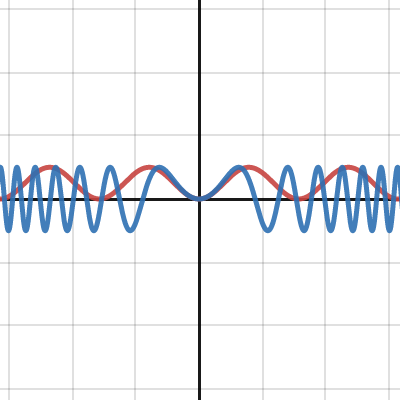
sin^2 x = sin x^2 ???
round condor
@rain finch sin^2(x) = (sin(x))^2, sin(2x) != sin(x^2), in general.
 lone flume
sin^2(x) = sin(sin(x))
 slow scroll
rain finch
sin^2 x = sin x^2 ???
slow scroll
rain finch
sin^2 x = sin x^2 ???
also wrong channel. further questions should go in #prealg-and-algebra #precalculus
rain finch
round condor
<@775033021371252767> sin^2(x) = (sin(x))^2, sin(2x) != sin(x^2), in general.
sin^2 (x) != sin (x)^2 ?
round condor
sin^2(x) = sin(x) * sin(x) = (sin(x))^2
ignore the bit about sin(2x), i misread your question
 rain finch
round condor
https://www.desmos.com/calculator/8bbgh0l9cb
rain finch
round condor
https://www.desmos.com/calculator/8bbgh0l9cb
great, thank you bro
 whole zodiac
What is the difference between a hermitian inner product and an inner product on a complex space
I'm not sure that I see the difference
round condor
whole zodiac
I'm not sure that I see the difference
you asking me?
round condor
question i posted was somewhat related
whole zodiac
oh i didnt see yours
round condor
so i thought you might have been asking me
whole zodiac
I know what a hermitian adjoint matrix is but not a hermitian inner product is
whole zodiac
round condor
hermitian is self adjoint right
yeah
round condor
i don't know
maybe you could help with my question though haha
ill copy it cause its quite aways up
Let P be a self-adjoint projection on a complex inner product space. Show that H := I − 2P
is an isometry.
whole zodiac
Sorry idk
round condor
rip
languid wigeon
vestal magnet
Hey guys, any help will be appreciated. Need to find minimum c here. p(x) is a p...
If $p(x) = Ax^2 + Bx + C$ with real coefficient, and the vector space of degree-two real polynomials is equipped with the 2-norm on [-1,1], then the minimum constant $k$ such that $$,\left\lvert \int_{-1}^1 p \right\rvert \le k \lVert p \rVert$$ holds should be $\sqrt2$. Some direct computations leads to this maximization problem $$\max_{|A|,|C| \le 1} \frac{\sqrt{30}}{3} \frac{\lvert A+3C \rvert}{\sqrt{3A^2+10AC+15C^2}}.$$ By introducing the change of variables $$\begin{cases} U &= A + 3C \ V &= 3A-C \end{cases}$$, we get $$\frac{5\sqrt{30}}{3} \frac{1}{\sqrt{\min_{t \in \Bbb{R}} 42+2t+3t^2}},$$ with $t = V/U$. This quadratic polynomial has negative discriminant and it attains its minimum $125/3$ if and only if $t = -1/3$, but that corresponds to the case when $U + 3V = (A+3C)+3(3A-C) = 10A = 0$. To finish, the minimum value of $k$ needed is $$\frac{5\sqrt{30}}{3} \cdot \frac{1}{\sqrt{\frac{125}{3}}} = \cdots = \sqrt2.$$
stoic pythonBOT
vin100
 languid wigeon
,w {{1, 3}, {3, -1}}^(-1){{3, 5}, {5, 15}}{{1, 3}, {3, -1}}^(-1)
stoic pythonBOT


 Requested by vin100#3191
 grave garden
Guys are canonical basis and standard basis the same thing ?
 limber sierra
probably yes
grave garden

I wonder what would be the kernel and image of this mapping ?

Wolfram gives this as solution
 dusky epoch
@grave garden consider that you do not need to solve this entire ODE to find ker(T)
all you need to know is which values of $a, b, c, d$ make it so $$4T(ax^3 + bx^2 + cx + d) = 0$$
stoic pythonBOT
Ann
 vestal magnet
@languid wigeon Thank you, sorry for disappearing, it was 2am here
I got a follow up question, say we have given Inner product and operator S.
why <Su, Sv> is an Inner product only if S is injective map?
dusky epoch
if S isn't injective you lose positive-definiteness
vestal magnet
But why? I mean, if Sv = 0 then Sv is the vector we are looking upon and not v itself, isn't it?
if that's what you mean
dusky epoch
denote your new inner product with [,] so that [u,v] := <Su,Sv>
then for v in Ker(S) you have [v,v] = 0
vestal magnet
and v is different then 0
ok I got confused earlier
thank you for explaining me!
spare widget
Losing the definiteness reminds me of a seminorm
I guess one can get a seminorm of such an inner product
vestal magnet
Also, any idea how I do that, I got this result but not sure how to find the ker now
 dusky epoch
what result
vestal magnet
This
 dusky epoch
,rccw
stoic pythonBOT
 stoic pythonBOT
Ann
 dusky epoch
so the kernel of T^t phi is...?
vestal magnet
How you do that Math text
and uhm, I should find which p give me 0? meaning polynomials with power less than 2?
this is what I'm confused about
zinc timber
spare widget
I guess one can get a seminorm of such an inner product
assuming you still have semidefinite ness
vestal magnet
I mean ain’t it for the specific phi only? And I need to find which phis belong to the ker? @dusky epoch
vestal magnet
So was I right? Is the needed kernel here are polynomials - “a0+a1x”
dusky epoch
what was the domain of T?
vestal magnet
R[x]
dusky epoch
so that's a yes
vestal magnet
Yeah
dusky epoch
then no, linear polynomials are by far not the only thing in your space
for all $n \geq 3$ you will have $2x^n - n(n-1)x^2 \in \ker(T^t\varphi)$
stoic pythonBOT
Ann
 vestal magnet
How did you get that?
dusky epoch
looked at which linear combination of x^n and x^2 wound vanish upon double differentiation and subsequent evaluation at 1
 vestal magnet
dusky epoch
for all $n \geq 3$ you will have $2x^n - n(n-1)x^2 \in \ker(T^t\varphi)$
vestal magnet
dusky epoch
for all $n \geq 3$ you will have $2x^n - n(n-1)x^2 \in \ker(T^t\varphi)$
Aren’t there more solution? Like x^4-2x^3?
 copper heath
I know that the span of a set of vectors is the set of all of their linear combinations, but is this well defined for a single vector?
Like, is the span of a single vector just the set of all vectors you can get by scaling it? Since, essentially, it's the linear combination of that vector with the zero vector
Please tell me if I'm thinking about this the wrong way
copper heath
copper heath
Like, is the span of a single vector just the set of all vectors you can get by ...
My intuition tells me that if this was true, the span of a single vector would be a straight line passing through that vector, extending in both directions
dusky epoch
yes that is true
the span of a single vector is the straight line passing through it and the origin
copper heath
okay thank you!
so how does span relate to column/row space?
the span of a column vector on its own is clear, but is the column space like the union of all of the spans of every column?
dusky epoch
no
it is however their sum
assuming you know what the sum of two subspaces of a vector space refers to
copper heath
I don't actually, I've never seen a "sum" in relation to vector spaces
You can sum two vectors, but how do you sum two vector spaces? Aren't they just sets?
Wait.. is the sum of two sets, the set of all their sums?
Assuming that's correct, the column space of a matrix is the set of all possible linear combinations of its columns?
dusky epoch
yes to both your last questions
copper heath
Wow, that's super cool, makes total sense now
tysm!
 wintry steppe
Let $T: P_n \to P_n, (T(p))(x) = p(x+\alpha)-p(x), \alpha \in \bR, \alpha \neq 0$, be a linear map.
$P_n$ is the set of all polynomials of degree less than or equal to $n$.
Could somebody help me find its kernel and image?
$P_n$ is the set of all polynomials of degree less than or equal to $n$.
stoic pythonBOT
mate

 raven badger
For standardized vectors, the cosine similarity is the same as the dot product, no?
stuck tendon
wintry steppe
Let $T: P_n \to P_n, (T(p))(x) = p(x+\alpha)-p(x), \alpha \in \bR, \alpha \neq 0...
$ \ker T = {p \in P_n: T(p)(x) = 0}$ and $\textrm{im } T = {T(p): p \in P_n}$
stoic pythonBOT
1345631
 wintry steppe
stuck tendon
$ \ker T = \{p \in P_n: T(p)(x) = 0\}$ and $\textrm{im } T = \{T(p): p \in P_n\}...
wintry steppe
stuck tendon
$ \ker T = \{p \in P_n: T(p)(x) = 0\}$ and $\textrm{im } T = \{T(p): p \in P_n\}...
thank you, could you help me find it? i usually know how to approach such problems but i am struggling with this one
raven badger
Been a long time since last I did it, so I've forgotten how to; But did you do the Gaussian thingy, where you reduce it?
What'd you get?
wintry steppe
c is correct because you have
x1 + x2 + x3 = 1
x2 + x3 = 1
that means x1 = 0.
but thats all we can tell, x2 and x3 could be anything, its only important that their sum is 1. if you set x2 = t (t is any real number), then x3 must be 1 - t. and thats it, infinitely many solutions
d is incorrect because you have
x1 + x2 + x3 = 1
x2 + x3 = 1
x3 = 0
that means x3 = 0, x2 = 1, x1 = 0. unique solution
 hexed burrow
If [A,B^2]=0 does this imply [A,B]=0?
Thanks yeah I've been thinking about it a bit more and I don't think it implies it
wintry steppe
[-, -] typically means the commutator
 quartz compass
hexed burrow
If [A,B^2]=0 does this imply [A,B]=0?
quartz compass
hexed burrow
If [A,B^2]=0 does this imply [A,B]=0?
if B rotates 90 degrees in the xy plane and A rotates 90 degrees in the xz plane then clearly A,B don't commute so [A,B] != 0. But B^2=-I and is a scalar matrix so it commutes with all matrices so [A,B^2]=0.
wintry steppe
matrices A, B, X are n by n.
if A = X^(-1)BX, how can i find X?
 torpid moat
How do we show that a state is entangled (i.e., cannot be written as the tensor product of two separate qubits)?
For example, the EPR-pair $\frac{1}{\sqrt{2}}(|00\rangle+|11\rangle)$
stoic pythonBOT
thestonethatrolled
 quartz compass
torpid moat
How do we show that a state is *entangled* (i.e., cannot be written as the tenso...
quartz compass
torpid moat
How do we show that a state is *entangled* (i.e., cannot be written as the tenso...
I believe there are algorithms out there to determine if a multivector is a blade or not, since a blade is a multivector that's factorizable by the outer product. Just the geometric algebra phrasing of this same problem. I don't think there's like a simple determinant you can just check or something like that to see
I don't know how good the algorithms are, like I mean do they just put a bunch of variables on them, multiply them together, and then try to see if the system of equations is consistent
idk I would look into it more cause I'm curious but I'm about to head out
torpid moat
quartz compass
I believe there are algorithms out there to determine if a multivector is a blad...
i think for an EPR-pair we can just prove it by contradiction.
Sketch:
Suppose that we have $\frac{1}{\sqrt{2}}(|00\rangle+|11\rangle)=|\alpha\rangle\otimes|\beta\rangle$ such that $|\alpha\rangle=\alpha_0|0\rangle+\alpha_1|1\rangle$ and $|\beta\rangle=\beta_0|0\rangle+\beta_1|1\rangle$.
So, then we have $|\alpha\rangle\otimes|\beta\rangle=\alpha_0\beta_0|00\rangle+\alpha_0\beta_1|01\rangle+\alpha_1\beta_0|10\rangle+\alpha_1\beta_1|11\rangle$. This leads to a contradiction since ket{01}, ket{10} is an orthonormal basis.
stoic pythonBOT
thestonethatrolled
 quartz compass
I don't know how good the algorithms are, like I mean do they just put a bunch o...
quartz compass
quartz compass
I don't know how good the algorithms are, like I mean do they just put a bunch o...
yeah that's what I meant by this here
but I thought you were asking in general, not just this easy special case
torpid moat
i was asking in general. but i guess you gotta start with the easy case first
quartz compass
yeah that's why I said what I did
I believe I've seen this described as the multivector classification problem of determining if a multivector is a blade (or versor or other things)
 subtle gust
alr can anyone plz give me an intuitive explanation to the kernel and range of a linear transformation 🙂
i understand what kernel is
can't say the same thing abt range tho 🙂
if we have a linear transformation T V-->W ker(V) is just the set of vectors in V that are mapped to the 0 vector in W
 subtle walrus
the range is everything that can be 'reached' by your linear transformation
subtle gust
subtle walrus
the range is everything that can be 'reached' by your linear transformation
in V or in W?...
wait so
subtle gust
wouldn't it just be the whole W?
subtle walrus
not necessarily
subtle gust
why would it only be part pf ot
subtle gust
subtle walrus
like consider the map that sends everything to 0
ah
subtle walrus
its linear, but the range is just 0
subtle walrus
or a better example you can embed a low dimensional space in a higher dimensional space
subtle gust
like
subtle walrus
{T(v) | v in V}
subtle gust
ker(V) is {x belongs to V : T(V)=0}
subtle gust
confused rn tbh
subtle walrus
{w in W | there exists a v in V such that T(v) = w}
subtle gust
subtle walrus
{w in W | there exists a v in V such that T(v) = w}
yeah that makes more sense to me for some reason
subtle walrus
subtle walrus
{T(v) | v in V}
well, this is the set of all T(v) as v ranges over V, but T(v) lives in W
hm
maybe {T(v) in W | v in V} makes it more clear
subtle gust
subtle walrus
well, this is the set of all T(v) as v ranges over V, but T(v) lives in W
still confused as to how W is related ....
like
we're describing the vectors in V
that span a certain part of V?
wait that's wrong
subtle gust
subtle walrus
{T(v) | v in V}
T(v) is the transormed vector from W
subtle walrus
indeed
subtle gust
so v exists in both W and V?
subtle walrus
v is in V
T(v) is in W
the set builder notation works like
{elements that make up your set | some condition}
subtle walrus
you said T maps from V to W
subtle gust
subtle walrus
you said T maps from V to W
oh
subtle walrus
so T takes in a vector in V and spits out a vector in W
subtle gust
nvm :0
subtle gust
subtle walrus
so T takes in a vector in V and spits out a vector in W
yeah
subtle walrus
and the range is if you imagine plugging in every possible v in V
subtle gust
i was confused cuz i thought it was from W to v 🙂
subtle walrus
and collecting all the outputs (which are in W) into a set
subtle gust
yeah got it
tysmm
last question
how would we actually compute this
if we have v=(x1 x2 x3)^T for ex
subtle walrus
but generally you just plug in a vector like (x_1, x_2, x_3) into to T
and see what happens
subtle gust
subtle walrus
there are theorems about this
we don't cover them prob lol
we just cover ker and range
subtle walrus
if you just have the definition of range, there is no reason to take span
subtle gust
course is already content heavy
subtle walrus
but if you have a basis of V, you can just compute the images of the basis vectors under T
and that will be a generating set of the range
subtle gust
subtle walrus
but if you have a basis of V, you can just compute the images of the basis vecto...
oh i remember seeing a q abt that
anyways, tysm truly appreciate ur help
wouldn't have gotten it without u
subtle walrus
just the definition of range isnt unique to linear functions btw
you can talk about this for any function
(but not of the kernel)
subtle gust
subtle walrus
just the definition of range isnt unique to linear functions btw
yeah my prof said it's actually analogous to the range of functions
but we only cover linear transformations soo
wintry steppe
wintry steppe
Let $T: P_n \to P_n, (T(p))(x) = p(x+\alpha)-p(x), \alpha \in \bR, \alpha \neq 0...
just reminding you of this beautiful problem on range and kernel :) could somebody help?
spare widget
$p(x+a) - p(x) = \sum_{i=0}^n b_i ((x+a)^i-x^i) = b_n ((x+a)^n-x^n) + \sum_{i=2}^{n-1}b_i ((x+a)^i - x^i) + b_1a$
stoic pythonBOT
criver
 spare widget
wintry steppe
just reminding you of this beautiful problem on range and kernel :) could somebo...
spare widget
wintry steppe
just reminding you of this beautiful problem on range and kernel :) could somebo...
Degree decreases by 1
So you know that it's at least not full rank
For the rest you should look at the binomial expansion
Then group the terms from the expansion to get the linear combinations of the coefficients
Basically write down the matrix for this thing
wintry steppe
spare widget
Then group the terms from the expansion to get the linear combinations of the co...
thank you ;)
torpid moat
basic question: if i want to measure the first qubit in my state $|\chi\rangle=\dfrac{1}{2}(|0\rangle(|\phi\rangle+|\psi\rangle)+|1\rangle(|\phi\rangle-|\psi\rangle))$, would the probability of the measurement outcome $0$ just be $\dfrac{1}{2}(1+\innerproduct{\phi}{\psi})$ and for outcome $1$ be $\dfrac{1}{2}(1-\innerproduct{\phi}{\psi})$?
So basically applying $\norm{(|0\rangle\langle0|\otimes{I})|\chi\rangle}^2$ for outcome $0$ and $\norm{(|1\rangle\langle1|\otimes{I})|\chi\rangle}^2$ for outcome $1$?
stoic pythonBOT
thestonethatrolled
 wintry steppe
yo this a good place to ask about weird matrices? I was having some trouble interpreting my answer
 hoary void
wintry steppe
yo this a good place to ask about weird matrices? I was having some trouble inte...
hoary void
wintry steppe
yo this a good place to ask about weird matrices? I was having some trouble inte...
Yes it is
wintry steppe
Alright cool thanks. My system has a pool of 8 different values and a series of 10 possible actions that alter specific values in tandem. It aims to, when introduced with an 11th outlying disturbance, calculate the lowest possible number of each of the 10 adjustments required in order to balance each value back to 0. My current method is using an online solver via Gauss. I don't believe I can accept negative values for required number of adjustments. Fractional results will be accounted for by simply multiplying the outlying action as many times is required. This will need to be done about 15 separate times so any help forming a solid method would be greatly appreciated thank you!


 half ice
Your message talks about "actions" and "altering values" and "an outlying disturbance" and "adjustments" but then you post a system of equations. We can't read your mind on this one fam

 tranquil steeple
wintry steppe
number 21 and below
tranquil steeple
wintry steppe
number 21 and below
wrong channel
wintry steppe
tranquil steeple
wrong channel
which
tranquil steeple
wintry steppe
which
languid wigeon
another PSQ 😦
dusky epoch
PSQ?
dusky epoch
lolwat
"problem statement question" sounds like it could describe every possible problem out there
languid wigeon
someone invented this term for questions that has no context other than the problem itself.
dusky epoch
so a self-contained question?
spare widget
I think it's just a term for people over at math stack to be dismissive when they believe the one asking "has not tried hard enough"
torpid moat
in other words: https://dontasktoask.com/

 cedar dew
can anyone link a (preferably video) proof for why row rank = column rank, the wikipedia article and other proofs i found went wayy over my head :(
cedar dew
nevermind, found one :)
but I'm still open to any good new proofs so hmu if you have any
spare widget
torpid moat
in other words: https://dontasktoask.com/
I don't think it's that
spare widget
torpid moat
in other words: https://dontasktoask.com/
Also the analysis in this sounds pretty terrible. It's based on the premise that everyone is asking the above question intentionally or not with some "ulterior motives".
The author is overthinking it
torpid moat
spare widget
The author is overthinking it
ya definitely haha. it's usually a link that's overly shared in applied computer science servers
 plain robin
idk if its the most fitting channel, but im just gonna ask here, i have a group(picture). when i do this multiplication operation:
[1] ⊙ [1]
i wont get = [1], right? since that would be the result if i had the residue class [0]_5. is it then [0] or [4]? 
 subtle walrus
plain robin
idk if its the most fitting channel, but im just gonna ask here, i have a group(...
subtle walrus
plain robin
idk if its the most fitting channel, but im just gonna ask here, i have a group(...
what is ⊙?
 subtle walrus
well, then [1]*[1] = [1*1] = [1], surely?
also note that [0] isnt in that group at all
with it, it wouldnt be a group
plain robin
subtle walrus
with it, it wouldnt be a group
yea, that makes sense :D
thank you
cedar dew
if a n x n matrix is invertible, it's rank would be n, right?
spare widget
yes
cedar dew
ok ty
 spare widget
grave garden
How do i solve d and e guys
spare widget
grave garden
How do i solve d and e guys
Write the equation as (x,y,z)^T A (x,y,z) = 0
grave garden
spare widget
Write the equation as (x,y,z)^T A (x,y,z) = 0

Is this correct ?
Not my solution
spare widget
idk
grave garden
spare widget
idk
I see
spare widget
The idea seems to be correct at least, idk about the computations
In mathematics, a quadric or quadric surface (quadric hypersurface in higher dimensions), is a generalization of conic sections (ellipses, parabolas, and hyperbolas). It is a hypersurface (of dimension D) in a (D + 1)-dimensional space, and it is defined as the zero set of an irreducible polynomial of degree two in D + 1 variables (D = 1 in the...
See this also: https://solitaryroad.com/c413.html
languid wigeon
,w diagonalize {(1, -1, 0), (-1, 2, -1), (0,-1, 1)}
stoic pythonBOT
 Requested by vin100#3191
tranquil steeple
grave garden
Requested by vin100#3191
tranquil steeple
grave garden
That is Laplace, 2nd order finite differences, with Neumann boundary conditions, and belongs to $\tau_{1,1}$-algebra (diagonalized by DCT-2)
stoic pythonBOT
Sven-Erik
 tranquil steeple
https://en.wikipedia.org/wiki/Eigenvalues_and_eigenvectors_of_the_second_derivative#Pure_Neumann_boundary_conditions_2 https://en.wikipedia.org/wiki/Discrete_cosine_transform#DCT-II
A discrete cosine transform (DCT) expresses a finite sequence of data points in terms of a sum of cosine functions oscillating at different frequencies. The DCT, first proposed by Nasir Ahmed in 1972, is a widely used transformation technique in signal processing and data compression. It is used in most digital media, including digital images (s...
Explicit formulas for eigenvalues and eigenvectors of the second derivative with different boundary conditions are provided both for the continuous and discrete cases. In the discrete case, the standard central difference approximation of the second derivative is used on a uniform grid.
These formulas are used to derive the expressions for eigen...
spare widget
Interesting interpretation. I would have never made the connection.
spare widget
Indeed the matrix is the 1D version with 3 grid points and Neumann conditions at the boundaries.
tranquil steeple
eigenvalues given by $\lambda_j=f(t_j)$ where $f(t)=2-2\cos(t)$ and $t_j=(j-1)\pi/n$ and $n=3, j=1,\ldots,n$
stoic pythonBOT
Sven-Erik

 stiff latch
In our Skript we had this definition and proposition and in the proof for that proposition what i didnt get was why exactly Vi is T-invariant, it feels like i don't understand what properties a base for which T is a upper triangular matrix exactly has.
Could someone lead me the way and/or fill that gap ?
 wintry steppe
if {v_1, ..., v_n} triangularizes T, then T(v_k) is a linear combination of v_1, ..., v_k
wintry steppe
wintry steppe
Alright cool thanks. My system has a pool of 8 different values and a series of ...
@half ice Apologies for the miscommunication, the rows contain the values manipulated, set = 0 to calculate the quantity of each column required if x11 is introduced to have no change in each value. If anyone is adverse in matrices I'd appreciate any tips.
 slate hatch
Is AB = BA if they are square matrices?
wintry steppe
not necessarily
wintry steppe
$$\begin{pmatrix}0 & 1 \ 0 & 0\end{pmatrix}$$ and $$\begin{pmatrix}0 & 0 \ 1 & 0\end{pmatrix}$$ give a counterexample
stoic pythonBOT
TTerra

 wintry steppe
I'm so lost 💀
wintry steppe
💀
 celest ore
does A^k = PD^kP^-1 imply D^k = PA^kP^-1? I have some messed up notes, I'm not sure if this is a valid property
stoic pythonBOT
BLUE BYE!
 celest ore
 native rampart
$A^k= PD^k P^{-1} \implies P^{-1} A^k P = (P^{-1})(P D^k P^{-1})(P)=D^k$
native rampart
$A^k= PD^k P^{-1} \implies P^{-1} A^k P = (P^{-1})(P D^k P^{-1})(P)=D^k$
thanks for the clarification. if there were no power involved for A and D, would my original statement stand?
celest ore
oh you're right, thanks
slate hatch
How do I rotate things around a specific point?
spare widget
slate hatch
How do I rotate things around a specific point?
Translate so that point ends up at thd origin -> rotate -> translate back
 blissful coral
why is a 1 added in affine transformation matrix?
For example:
$$\begin{pmatrix}R & b \ 0 & 1\end{pmatrix}$$
dusky epoch
\\ for new line
grave garden
spare widget
See this also: https://solitaryroad.com/c413.html
I see
stoic pythonBOT
Ra's Al Ghul
 dusky epoch
the point is that the last column, with the shift vector and the 1, is necessary to make matrices work for affine and not just linear maps
the vectors have a 1 attached to them too
blissful coral
Would the matrix multiplication not work without the new line?
 dusky epoch
jic the horizontals are not fraction lines, they are simply decorators for a block matrix
slate hatch
If I have three vectors in R3, that are linearly independent; will they span all of R3?
dusky epoch
yes they will
slate hatch
dusky epoch
yes they will
Thanks, 🙂
I love this server
Everyone is always so helpful
grave garden
tranquil steeple
https://en.wikipedia.org/wiki/Eigenvalues_and_eigenvectors_of_the_second_derivat...
Thanks Sven and criver too !
I was busy, just free rn and come checking thing, dun mind me XD
 quiet wren
Hello, I have a question. When I want to express a vector as a linear combination of some basis vectors say v = au_1 + bu_2, why is a the inner product of v with u_1?
 tribal willow
how do i prove addition is associative without proving that multiplication distributes over addition?
spare widget
quiet wren
Hello, I have a question. When I want to express a vector as a linear combinatio...
<v, u1> = a <u1, u1> + b <u2, u1>
tribal willow
$x + (y + z) = (x + y) + z \Rightarrow x + (y + z) - [(x + y) + z] = 0$
stoic pythonBOT
anamono
 tribal willow
then i can distribute the -1 over the brackets but wouldnt i first need to prove that multiplication distributes over addition
or am i approaching this wrong
quiet wren
spare widget
<v, u1> = a <u1, u1> + b <u2, u1>
thanks I seee
tribal willow
tribal willow
or am i approaching this wrong
for context im trying to prove this
 dusky epoch
tribal willow
or am i approaching this wrong
dusky epoch
tribal willow
or am i approaching this wrong
you are approaching this wrong
you get associativity and commutativity of addition for free by virtue of your set being a subset of C by construction
dusky epoch
what needs to be checked is that this set is closed under addition, multiplication, and reciprocals
tribal willow
how does condition 6 work?

i understand 1-5, just a bit confused on why we need to introduce a value n
i see how introducing n does the proof, i guess just conceptually not sure if theres some alternative method without introducing some n
quartz compass
it's sort of just being lazy to not write it, like maybe it helps to see alternatively you can rationalize the denominator by multiplying by the conjugate
$$\frac{1}{a+b\sqrt{2}} = \frac{1}{a+b\sqrt{2}} \frac{a-b\sqrt{2}}{a-b\sqrt{2}} =\frac{a-b\sqrt{2}}{a^2-2b^2}$$
stoic pythonBOT
Merosity
 tribal willow
and then you decompose the fraction?
wait
no you just multiply by x then you get a^2 - 2b^2 / a^2 - 2b^2 = 1
right?
quartz compass
I don't quite get what you're asking
I'm just trying to give you a natural way to pop out the n=a^2-2b^2 that they mysteriously pull out of thin air
quartz compass
otherwise I'd do the proof basically the same way
celest ore
This problem asks me to find the basis for W perpendicular. The answer is {[2, -1, 3]} shouldn't it be {[2 -1 3]} instead? As in W perpendicular should be spanned by a row vector instead of a column vector since [2 -1 3][x, y, z] = 0?
 dusky epoch
well you will be right if you refuse to use the standard inner product on $\bR^3$ to identify $\bR^3$ with $(\bR^3)^*$ and think that anyone who does so deserves capital punishment
stoic pythonBOT
Ann
 dusky epoch
in all seriousness this feels like hairsplitting
celest ore
I didn't quite get what you're saying
dusky epoch
you can pretty much safely ignore it
wintry steppe
celest ore
This problem asks me to find the basis for W perpendicular. The answer is {[2, -...
W consists of column vectors already
wait misread ignore
dusky epoch
$W^{\perp} = { u \in \bR^3: \forall w \in W, \ang{u,w} = 0 }$ and the standard inner product is defined by $\ang{u,w} = u^Tw$
stoic pythonBOT
Ann
 dusky epoch
<_, _> expects two column vectors as input
celest ore
oh okay thank you
spare widget
I guess the point is that usually row vectors are assumed to be covectors
 stuck tendon
 raw ridge
Seems more suitable for #prealg-and-algebra. See pins
raw ridge
still please help bro
tribal willow
why does every subfield of C have characteristic zero
dusky epoch
because so does C
tribal willow
oh
then why does C have char zero?
the sum of n 1’s that equals 0 is n = 0
wait
oops
lmao
raw ridge
sick
wintry steppe
raw ridge
find the coordinates of the points B and C from the given equation.. because AB = BC, find the euclidean distance of BC and then use that to find the coordinates of A. with the coordinates of A and D (which is already given), u can then determine the equation of the line AD
 bitter solstice
does $a³=b³ \Rightarrow a = b$ for complex numbers too?
 candid echo
could somebody help me with an eigenvector question please?
stoic pythonBOT
gabi the ancient
 candid echo
ive made some progress but im not sure if im entirely correct here
bitter solstice
bitter solstice
does $a³=b³ \Rightarrow a = b$ for complex numbers too?
like, for a and b being complex numbers
stuck tendon
bitter solstice
like, for a and b being complex numbers
No it doesn't. Consider 1 and e^(2ipi/3)
bitter solstice
oh
bitter solstice
stuck tendon
No it doesn't. Consider 1 and e^(2ipi/3)
so what operation is the inverse of the cube for complex numbers? like, what do I use to solve equations?
stuck tendon
bitter solstice
so what operation is the inverse of the cube for complex numbers? like, what do ...
There's no inverse. The function f(z)=z^3 is not injective
stuck tendon
bitter solstice
so what operation is the inverse of the cube for complex numbers? like, what do ...
To solve equations you would use periodicity of complex exponential
candid echo

 stuck tendon
so something like z^3 = 1 = e^(2kipi), so z=e^(2kipi/3) for k in Z
candid echo
this is the progress that ive made but it just seems a little off, if someone is able to help me thatd be greatly appreciated!
bitter solstice
are all constant functions periodic?
 stuck tendon
bitter solstice
are all constant functions periodic?
stuck tendon
bitter solstice
are all constant functions periodic?
Yes
 gray dust
bitter solstice
are all constant functions periodic?
gray dust
bitter solstice
are all constant functions periodic?
in fact a constant function is p-periodic for any p
candid echo
candid echo
is anyone able to help me out here pls?
 gusty axle
candid echo
is anyone able to help me out here pls?
gusty axle
candid echo
is anyone able to help me out here pls?
Every part?
candid echo
just b please
and my answer for c is also a little iffy
because for part c, by diagonalizability test, i feel like it would depend on what values a b and c are? if a = b = c = 0, then isnt the geo multiplicity = algebraic multiplicity for lambda = 0, and hence diagonalizable?
but then if one of a,b,c != 0, then it fails that so it isnt diagonalizable?
 trim helm
part c is correct i think, it should only be diagonalizable only when it is zero matrix, otherwise you would have 1 distinct eigenvalue when you need 3 for it to be diagonalizable
candid echo
the only reason im iffy about part c is because the question asks if it is or if its not, meaning a yes or no, but i wasnt sure if giving a response by cases would be valid
trim helm
i think there is one more eigenvector for b), when a=0, b=0 but c≠0
candid echo
and for part d, we could go about this by doing A^k = P^-1 D^k P, which would mean A is diagonalizable, but by part c, we said it depends by case so its really iffy
candid echo
trim helm
i think there is one more eigenvector for b), when a=0, b=0 but c≠0
right, but this would still mean infinite eigenvectors for lambda=0 wouldnt it?
trim helm
something seems off for your a=b=c=0
it should have exactly 3 eigenvectors for a=b=c=0, not infinite
candid echo
it should have 3?
if a = b = c = 0
then A would be the zero matrix right?
so then wouldnt the eigenspace for A be Null(A) which is Ax = 0
but then if A is the zero matrix, then the solution set to Null(A) is every vector in R^3? and so is the solution to the eigenspace, meaning there are infinite eigenvectors
or have i missed something?
gusty axle
Yeah there are infinite eignevectors but only one eigenvalue
But I just learned this the other day so I'm probably not the best person to talk to
candid echo
i see np! thanks for the help
yeah so since theres only one eigenvalue (lambda=0), my answer was infinite eigenvectors for lambda=0 no matter what a b and c are which means the hint would be useless(???)
gusty axle
I think there's generally infinite eigenvectors for a given eigenvalue, but I don't have my notebook on me right now
So don't quote me on that
candid echo
gusty axle
I think there's generally infinite eigenvectors for a given eigenvalue, but I do...
right, except for if the solution set is just the zero vector im pretty sure
celest ore
How would I go about proving this False?
 wintry steppe
by finding a counterexample. as a starting point, you obviously want to consider eigenvectors corresponding to distinct eigenvalues
 nova canopy
candid echo
right, except for if the solution set is just the zero vector im pretty sure
nova canopy
candid echo
right, except for if the solution set is just the zero vector im pretty sure
yes, there are always 0 or infinite eigenvectors, as any multiple of an eigenvector is also an eigenvector. part b) really should ask "how many linear independent eigenvectors are there for each eigenvalue (or which is the same: What dimension has the subspace of the eigenvectors).
trim helm
yeah thats why i was thinking they dont want you to write infinite eigenvectors for b)
trim helm
its easy, the eigenvectors are the standard basis vectors
since every vectors can be represented by standard basis vectors
i think thats what you are supposed to write for a=b=c=0
candid echo
so if a=b=c=0, then the eigenvectors are the standard basis vectors?
would someone be able to walk me through a complete answer that depends on a,b,c? I'm still not quite following.,.
subtle gust
Alr anyone care to explain the relationship between rank, determinant and linear independence /;
So what i understand is
If a matrix is full rank then its det is non zero and is therefore invertible
But i still don't quite understand how rank is related to lin independence
I mean if a matrix is full rank then its rows and cols are lin indep
But pretty sure there's more to know
wintry steppe
det is only defined for square matrices, but rank makes sense for any
full rank is equivalent to having linearly independent columns, and if the matrix is square, this is also equivalent to having non-zero determinant
since row rank and column rank are equal (for any matrix), you can similarly deduce things for the rows
spare widget
tranquil steeple
That is Laplace, 2nd order finite differences, with Neumann boundary conditions,...
I remembered you mentioned this. Is it the DCT-2 (as opposed to other types of DCT) specifically because of the Neumann boundaries? Also I couldn't find anything on tau_{1,1} algebras, do you have a reference?
I also looked into the Dirichlet-Neumann, and Neumann-Dirichlet cases on wikipedia. Those seem to be for cases where the Dirichlet and Neumann conditions are at both "ends". I am assuming this generalizes to cases of Dirichlet conditions "inside" the domain by splitting into a Neumann-Dirichlet, Dirichlet-Dirichlet, and Dirichlet-Neumann cases. To be more precise, by inside the domain I mean by substituting a row and column of the matrix by 0s and a 1 on the diagonal, i.e. C+ (I-C)L(I-C). Where C is a diagonal matrix with a 1 where there is a Dirichlet grid point.
Do you have any idea whether the eigenvalues are computable in 2D (L induced by the standard 5-point stencil discretisation of the Laplacian with Neumann boundary conditions at the "ends" and is diagonalized by the 2D DCT) for the general case C + (I-C)L(I-C). In 1D the Dirichlet points partition the domain, but this is not the case in 2D, so I am not sure whether this is analytically computable. To be precise I am looking for an analytical underestimate of the lowest eigenvalue in the 2D case for C + (I-C)L(I-C).
tranquil steeple
I will answer in parts 🙂 Yes dirichlet-dirichlet is tau0,0 dirichlet-neumann is tau0,1 neumann-dirichlet is tau10 and neumann-neumann is tau1,1 You have some basic explanation of this in https://arxiv.org/abs/2010.06199 especially Table 1 on page 8 where you have symbols and grids for eigenvalues and eigenvectors of all these variants (Bozzo and di Fiore paper in references is the original paper on this) Here is another paper on tau matrices where the modulus of the shifts are larger than 1 (from stochastics, random walks etc) https://www.2pi.se/publications/pdf/p13.pdf For 2D you just do one dimension at at time and then use Kronecker, since it is separable. If you use FE instead of FD it is a big more complicated but there are analytical solutions there too, see last example in https://www.2pi.se/publications/pdf/p8.pdf
I will read your text a bit more carefully tonight (but I expect an explicit formula for your smallest eigenvalue should be doable)
spare widget
For reference I am asking about a regular grid, so FD
tranquil steeple
👍 are you aware of the concept of the "spectral symbol" related to sequences of matrices? Because that is the function that describes the spectrum of every matrix in the sequence of matrices of increasing size. So for Laplace FD, 2nd order central, it is f(t)=2-2cos(t). If you have Dirichlet-Dirichlet then the grid is t_j=j*pi/(n+1) which will give you all eigenvalues exactly by f(t_j) And if you change BC you just use a different grid t_j, but the symbol remains the same. and in 2D you just have: f(t_1,t_2)=f(t_1)+f(t_2) and you will sample with t_j^(1)=j*pi/(n_1+1) and t_j^(2)=j*pi/(n_2+1)to get the exact eigenvalues for the 2D problem (which is the matrix kron(Tn_1(f),I_n2)+kron(I_n1,T_n2(f))) where T_n(f) is the Toeplitz matrix of size n generated by f (and modify this matrix if you have Neumann or other BC)
here https://en.wikipedia.org/wiki/Eigenvalues_and_eigenvectors_of_the_second_derivative#The_discrete_case you see $4\sin^2(t/2)$ which is the same as $2-2\cos(t)$
stoic pythonBOT
Sven-Erik
Compile Error! Click the  reaction for more information.
(You may edit your message to recompile.)
 tranquil steeple
An intro to this stuff can be found in the Introduction of https://www.2pi.se/thesis.pdf or look in more detail in https://libgen.is/search.php?req=garoni&lg_topic=libgen&open=0&view=simple&res=25&phrase=1&column=def
Library Genesis is a scientific community targeting collection of books on natural science disciplines and engineering.
spare widget
I am not aware of it no. But I think that what I get is a bit more complex than Dirichlet-Dirichlet. I basically have a Neumann boundary on a rectangle's boundary, but I also have Dirichlet boundary points inside. I couldn't find much on this latter modification. So if I have the 5-point stencil Neumann-Neumann L, the Dirichlet boundaries on the "inside" result in C + (I-C)L(I-C)
I am not even sure that the eigenvalues can be derived analytically from the above. Its continuous counterpart has Dirac deltas instead of the C, e.g. Duchon's paper on interpolation.
tranquil steeple
spare widget
I am not aware of it no. But I think that what I get is a bit more complex than ...
I think it is still doable, one would need to split up the domain in subparts of the matrix
maybe not analytically but definately a good bound
spare widget
In 2d the inner points don't necessarily split it
tranquil steeple
do you have a code that generates the matrix?
spare widget
In 1D they do, so it reduces to Neumann-Dirichlet, Dirichlet-Dirichlet, and Dirichlet-Neumann. But in 2D you can have "isolated points" on the inside.
spare widget
tranquil steeple
do you have a code that generates the matrix?
C + (I-C)L(I-C)
L is the Neumann-Neumann 5 point discretisation of -Laplacian
C is a diagonal matrix with either a 1 or 0 on the diagonal
So it essentially replaces a column and row of L with 0s and puts a 1 on the diagonal for C_ii = 1
If it's a single point then it's trivial and one gets the 1 eigenvector
But C doesn't have to have a single 1
I have looked at the eigenvalues numerically of such matrices
The lowest depends on the number and configuration of the points in C
tranquil steeple
So the symbol for L would be: f(t)=(-30+32cos(t)-2cos(2*t))/12
spare widget
I can tell you its spatial counterpart:
$\begin{bmatrix} 0 & 1 & 0 \ 1 & -4 & 1 \ 0 & 1 & 0 \end{bmatrix}$
stoic pythonBOT
criver
 spare widget
It's basically the kronecker sum of the 1d second derivative fd approximations
in x and y direction
The above is the stencil
In mathematics, the discrete Poisson equation is the finite difference analog of the Poisson equation. In it, the discrete Laplace operator takes the place of the Laplace operator. The discrete Poisson equation is frequently used in numerical analysis as a stand-in for the continuous Poisson equation, although it is also studied in its own right...
tranquil steeple
oy you meant the 5point stencil in 2D i thought you meant the 5 point stencil in 1D
spare widget
e.g
The D matrix but it must be modified to have the Neumann boundaries, and them the inner Dirichlet ones
yes, 2d is the issue
Since I get a pentadiagonal matrix
tranquil steeple
then the symbol is just 4-2cos(t1)-2cos(t2) and the eigenvalue lie of this 2D surfave spanned by t1 and t2 and you C is a low-rank correction
spare widget
With interspersed 0 rows and columns with a 1 for C_ii = 1
tranquil steeple
how big part of C is 1?
spare widget
The C can be rather high rank correction
It really depends, but it can be all the way up to C = I from all the way down from C = 0
tranquil steeple
C is 1 for like an interval on one of the boundaries of interioir points of the domain?
spare widget
It's just a diagonal matrix corresponding to an indicator function, i.e. it turns grid points with c_ii = 1 into Dirichlet ones
tranquil steeple
yes but it corresponds to point in the original domain
it can be for any point there?
spare widget
yes, for any set of points
spare widget
let me try to find them and link them, but they are in the continuous case, so not extremely relevant
Jean Meinguet, Multivariate interpolation at arbitrary points made simple, Journal of Applied Mathematics and Physics (ZAMP), vol. 30, pp. 292-304, 1979
This discusses the interpolation problem in the continuous case
but it makes assumptions I do not have to make in the discrete case
I don't think the paper would be very helpful for what I mentioned though
It also generalizes the L to powers of the Laplacian
tranquil steeple
and you are interested in the smallest eigenvalue depending on how many 1s that are in C?
(and the structure of where these 1s are)
spare widget
I am interested in an underestimate of the smallest eigenvalue, specifically because I wanted to use it in: https://restrin.github.io/files/eos2016.pdf
It's not only the number of 1s in C that matter unfortunately, I have found that the eigenvalues change even depending on their configuration.
tranquil steeple
yep
spare widget
That should be clear too, since one can choose C for example to partition the domain in arbitrary ways like in the 1D case. But the harder problem is when the domain isn't partitioned and there are isolated 1s in C
I am aware that C can be decomposed in rank 1 modifications and then modifying L. It's not very practical though.
Either way, it's maybe too tedious so feel free to ignore it. Thank you for the references on the tau algebras.
tranquil steeple
spare widget
Either way, it's maybe too tedious so feel free to ignore it. Thank you for the ...
It will be in the back of my mind, I have downloaded the references + saved discussion please keep me updated if you get some results
 final summit
If we have an equation Av = 0, where A is an m x n matrix and v is a vector in R^n, I know we can solve it using Gaussian elimination after getting it to RREF etc. but I was wondering if that equation is equivalent to
BAv = 0 where B is an appropriately sized matrix
A, B have known values, v is unknown
or are they only equivalent if B is invertible?
as in, Av = 0 => BAv = 0 always but BAv = 0 => Av = 0 only if B is invertible?
final summit
final summit
as in, Av = 0 => BAv = 0 always but BAv = 0 => Av = 0 only if B is invertible?
Is this statement correct?'
spare widget
So by Av = 0 -> BAv = 0 you mean that you are given v in thd nullspace of A and asking whether BAv = 0?
Obviously, since BAv = B(Av) = B0 = 0
final summit
By Av = 0, I guess I am referring to the null space of A and BAv = 0 as the null space of BA
spare widget
Now let v such that BAv = 0
Then it means that it is from the nullspace of BA
But N(BA) >= N(A)
This means that BAv = 0 -> Av = 0 only if v in N(A)
Or if you want for any v, then only if N(BA) = N(A)
final summit
Hmm, yes I see
I think that makes sense
Thanks!
So does N(BA) = N(A) iff B is invertible?
so for example, N(A) = N(R) where R is the RREF of A, since we can left multiply by elementary matrices which are all invertible?
spare widget
I am guessing yes
wait
ok, depends on A
since if A is non-square, and B is non-square, then neither are invertible in the usual sense
final summit
ah I see, but their null spaces might still be the same?
as in N(BA) and N(A)
So I guess we can say at the very least that if B is invertible, N(BA) = N(A)?
final summit
right I see, yes that's mainly what I was asking. I think I don't need the stronger iff statement
thanks!
spare widget
If we want N(BA) = N(A) then we want R(A) intersection N(B) = 0.
final summit
What's R(A) referring to?
final summit
Oh I see, the same as Col(A) right?
spare widget
It is clear that if B square and invertible then N(B) = {0} then R(A) isect N(B) = R(A) isect {0} = {0}
spare widget
final summit
Oh I see, the same as Col(A) right?
Yes
If A is square and full rank then B has to be invertible
If A is not full rank however, then R(A) is not the full space
Then you need B to map the non-zero vectors in R(A) to non-zero vectors
For N(BA) = N(A)
i.e. you can have N(B) <= N(A^T)
And then N(BA) = N(A)
For example consider A 3x3 that projects 3d points perpendicularly onto a plane. Then the whole line along the normal at 0 gets mapped to 0 (this is the kernel). Now you can take any B that maps this plane to another plane bijectively, and it doesn't matter what it does to the rest of the space.
$BA= \begin{bmatrix} 2 & 0 & 0 \0 & 3 & 0 \ 0 & 0 & 0\end{bmatrix}\begin{bmatrix} 1 & 0 & 0 \ 0 & 1 & 0 \ 0 & 0 & 0\end{bmatrix}$
stoic pythonBOT
criver
 final summit
Thanks, I'll have a think about this
spare widget
So the requirement seem to be N(BA) = N(A) <=> N(B) <= N(A^T)
For B invertible N(B) ={0} so N(B) = {0} <= N(A^T) always holds
But it's a requirement that is too strong
 night wren
Is the projection matrix for a subspace the same thing as a orthonormal basis for the subpsace?
spare widget
night wren
Is the projection matrix for a subspace the same thing as a orthonormal basis fo...
you mean projection matrix onto a subspace?
how is the subspace defined?
are you given the subspace in terms of span{v1,...,vn} where v1,...,vn are not necessarily linearly independent (they don't have to be orthonormal either)?
you can form the matrix V = {v1, ..., vn}
then P = VV^{+} projects onto R(V) (where V^{+} is the Moore-Penrose pseudo-inverse)
if v1,...,vn are linearly independent but V is non-square, then you can compute the projector as: P = V(V^TV)^{-1}V^T
i.e. V^{+} = (V^TV)^{-1}V^T
if V is square and v1,...,vn are linearly independent, then V^{+} = V^{-1}
so given a vector x you can find y as y = P x
and you can show that y in argmin_y |y - x|^2 s.t. there exists y = V w
notably this w is the solution of argmin_w |V w - x|^2, s.t. |w| is minimal

Mathematics Stack Exchange
True or false: The unique least norm solution to $Ax=b$ is the orthogonal projection of b onto $R(A)$
So, first isn't this the definition of least squares? The only incorrect thing I can think of ...
slate hatch
Is the rank of a matrix A, the number of pivot columns that it has?
spare widget
yes
it's also the number of linearly independent rows, or linearly independent columns that it has
night wren
spare widget
if v1,...,vn are linearly independent but V is non-square, then you can compute ...
what does it mean for V to be non-square
stoic pythonBOT
criver
 spare widget
the columns are linearly independent and V is non-square
if you need to compute V^{+} when v1, ..., vn are not linearly independent then you can use the SVD
if you need numerics for large matrices then you can use CGNR and solve min_w |Vw - x|^2 (it techniucally solves V^TV w = V^T x), and then compute y = Vw. If you set the initial guess w = 0, then it converges to the pseudo-inverse solution. That's how you can compute projections of vectors onto subspaces numerically.
@night wren Regarding your initial question. If v1,...,vn form an orthonormal basis for the subspace, then they are linearly independent. Then you can use VV^{+} = V(V^TV)^{-1}V^T = V * I * V^T = VV^T as projector onto the subspace
if they are linearly independent but not orthonormal, then V^TV != I, so you need to compute (V^TV)^{-1} or at least its action on a vector: V^{+} = (V^TV)^{-1}V^T
Finally if the vectors are not orthonormal, nor linearly independent (i.e. they form a frame/overcomplete basis) then you need the Moore-Penrose pseudo-inverse V^{+} which you can compute using the SVD: V = U S W^T -> V^{+} = W S^{+} U^T, or numerically you can use a CGNR solver to solve systems of the kind V^TV w = V^T b. If you set the initial guess w = 0, then the CGNR solver approximates the solution: w = V^{+}b.
You can also use the eigendecomposition of V^TV instead of the SVD of V: V^TV = Q S^2 Q^T -> (V^TV)^{+} = Q (S^2)^{+} Q^T -> V^{+} = (V^TV)^{+}V^T
stuck tendon
If p is a polynomial and A is a square matrix with complex entries that satisfies the equation p(A) = 0, then does $p(\lambda)$ represent the characteristic polynomial of A?
stoic pythonBOT
1345631
 stuck tendon
native rampart
p(lambda) could be the minimal polynomial
stuck tendon
native rampart
p(lambda) could be the minimal polynomial
Haven't really done minimal polynomials. Can I say that the roots of p(lambda) will be a subset of the set of eigenvalues of A?
native rampart
roots of p(lambda) will be the set of eigenvalues of A(well eigenvalues could be repeated)
stuck tendon
native rampart
roots of p(lambda) will be the set of eigenvalues of A(well eigenvalues could be...
Oh okay. Thank you
subtle gust
how would we prove this..

 hazy cape
Is there a fast way to calculate the eiegnvalues of a tridiagonal matrix?
spare widget
hazy cape
Is there a fast way to calculate the eiegnvalues of a tridiagonal matrix?
In linear algebra, a tridiagonal matrix is a band matrix that has nonzero elements only on the main diagonal, the subdiagonal/lower diagonal (the first diagonal below this), and the supradiagonal/upper diagonal (the first diagonal above the main diagonal).
For example, the following matrix is tridiagonal:
...
Are you implementing yourself? Otherwise just use ,for example, sparse in matlab (iirc you can get all eigenvalues nowadays for a banded matrix efficiently) or use BandedMatrices in Julia. Symmetrize it first if it is not symmetric
hazy cape
I’m trying to implement it in js
https://docs.scipy.org/doc/scipy/reference/generated/scipy.linalg.eigh_tridiagonal.html using this as a reference
tranquil steeple
I guess just make a symmetrization function and then translate http://www.netlib.org/lapack/explore-html/da/dba/group__double_o_t_h_e_rcomputational_ga14daa3ac4e7b5d3712244f54ce40cc92.html
Math.js is an extensive math library for JavaScript and Node.js. It features big numbers, complex numbers, matrices, units, and a flexible expression parser.
hazy cape
Mathjs doesn’t give the same results though
tranquil steeple
I have no idea, I have never even seen any javascript
hazy cape
Have you seen Java?
tranquil steeple
yes
hazy cape
It’s basically the same but dynamic
celest ore
quick question, why would this be false? Since AB is the identity matrix, therefore (AB) inverse is defined and equals = B^-1A^-1, doesn't that mean A inverse is defined as well?
 dusky epoch
who said A and B had to be square matrices?
celest ore
right
 brazen sinew
Hey guys, for part (ii) this is my work for one of the directions. Have i done enough to show uniqueness?

 wintry steppe
when you define g, you should specify how it acts on elements of V, not just on elements of S
i.e. you should be defining it by the equations near the end
 hard drum
Also to be slightly picky, f isn't a linear transformation there
hard drum
brazen sinew
And would that be enough to show uniqueness?
Yes up to some minor thing(s)
To give you an outline I'd reword it roughly as
-suppose we're given f:S->W where S is a basis
- Define g: V-> W by g(c1 s1 +... + cn sn) = c1 f(s1) +... + cn f(sn) [I'd mention why this is well defined]
-Show that any other linear h with h(s1) =f(s1) is the same as g (which you've p much done)
brazen sinew
Right, f is just a function
Would it be well defined because f is well defined for each vector s in S?
 viral olive
Small question there is in any given vectorspace only one orthonormalbasis
wintry steppe
not true
viral olive
thx
 tiny swan
Hello I need some help with part 2 of this problem in proving that the vectors are independent
 viral olive
you mean linear independent right?
I just so happened that i already answered that on my own paper and i can give following advice so if you look at the scalar <Sum of aivi,vj> i={1,...,k} for exampel this will equal 0. Important we assume the sum equals zero
All you have to proof then what happens to the scalar and why @tiny swan
hard drum
brazen sinew
Would it be well defined because f is well defined for each vector s in S?
It's because S is a basis.
So the "coordinates" c1,..., cn are unique
tiny swan
viral olive
I just so happened that i already answered that on my own paper and i can give f...
yeah I am not sure I understand, Ik it should be zero but I don’t know why
nvm I figured it out thanks!
viral olive
yeah didnt want to just flat out say it
Just tried to nudge you to the right direction
 pure crypt
Is it possible to have a linear transformation from R2 to R1 be One-to-one? If it is, can someone give me an example of one (cuz i can't think of one). And if not, then would you I prove it? Thanks.
viral olive
wait isnt one to one injective or does this term not exist in english?
spare widget
pure crypt
Is it possible to have a linear transformation from R2 to R1 be One-to-one? If i...
find [x1 y1] and [x2 y2] such that [a b] dot [x1 y1] = [a b] dot [x2 y2]
a * x1 + b * y1 = a * x2 + b * y2
->
a * (x1-x2) = b * (y2-y1)
without loss of generality assume that b != 0 (if b = 0, then for any [0 y1], [0 y2] y1!=y1 you get 0, so not injective)
then y2-y1 = a/b * (x1-x2)
and you can find infinitely many such
(e.g. fix x1, y1, then pick an arbitrary x2!=x1 and find a corresponding y2)
you cannot have injectivity with a non-trivial kernel
because non-trivial kernel means that you have a vector v !=0 such that Tv = 0 but also T0 = 0, and 0 != v
so no injectivity
pure crypt
ok gimme a sec, i'm just gonna try to understand this here proof
spare widget
if you have T : R^n -> R^m with n>m then it's clear that T cannot be injective
i.e. you cannot fit a box in a square
pure crypt
spare widget
you cannot have injectivity with a non-trivial kernel
wait can u explain how this shows the kernal is non trivial
pure crypt
spare widget
if you have T : R^n -> R^m with n>m then it's clear that T cannot be injective
is there a name for this theorem?
 noble swan
Do the details of Example 3 as follows:
(a) Verify that the four matrices in (7.14) are all orthogonal and verify the stated values of their determinants.
(b) Verify the products C = AB and D = BA in (7.15).
(c) Solve (7.16) to find the reflection line.
(d) Analyze the transformation D as we did C.

I'm struggling with understanding what in the world I'm supposed to do for part c & d
This is the work I did for part c, which just gave me a 0 vector. I'm unsure if that's what it wanted from me?

 waxen inlet
is f(x)=5 a linear function? It doesn't seem to satisfy additivity as it's always 5 for any x, yet there's a good amount of people claiming that a horizontal line is a linear function, just from a search on the web. Are all these people mistaken or is there something I'm missing?
slate hatch
If I have three matrices:
AB = C
is
B = CA?
 lilac sonnet
slate hatch
If I have three matrices:
AB = C
is
B = CA?
lilac sonnet
slate hatch
If I have three matrices:
AB = C
is
B = CA?
not in general
$$AB = C$$
$$A^{-1}AB = A^{-1}C$$
$$B = A^{-1}C$$
stoic pythonBOT
Nathan_
 spare widget
waxen inlet
is f(x)=5 a linear function? It doesn't seem to satisfy additivity as it's alway...
spare widget
waxen inlet
is f(x)=5 a linear function? It doesn't seem to satisfy additivity as it's alway...
it's just different terminology
in linear algebra you'd call it affine
but outside of that it's also not wrong to say that it is linear
it depends on the context and what you mean by linear
if you mean the definition of the linearity from linear algebra, then no f(x) = 5 doesn't pass through 0
if you just mean linear as in the meaning in terms such as piecewise-linear then sure, it is linear (in fact it's constant)
waxen inlet
what I see most often used is that a "linear relation" is defined by y=mx+b, so since a horizontal line has m=0 and some b, it satisfies the relation, therefore it's a "linear relation". Is a linear relation different from a linear map/function then?
spare widget
yes
linearity in linear algebra implies L(x+y) = L(x) + L(y) and L(ax) = aL(x)
basically you need your "linear" subspaces to contain 0
if you offset those, you can call them affine
though sometimes people just term that linear too
spare widget
waxen inlet
what I see most often used is that a "linear relation" is defined by y=mx+b, so ...
so think linear up to translation
i.e. if you shift it to pass through 0 you get the linearity from linear algebra
waxen inlet
perfect, I got it. Thanks
hard drum
pure crypt
is there a name for this theorem?
It's a corollary of rank nullity
pure crypt
hard drum
It's a corollary of rank nullity
oh ya, i've figured it out, but thanks though
hard drum
Oh sorry
pure crypt
hard drum
Oh sorry
lol dw, i appreciate the help
spare widget
start by writing a polynomial p(x) in Pn(R) wrt the monomial basis
then take a derivative of that, i.e. find p'(x)
then find the matrix that maps the coefficients of p(x) to the coefficients of p'(x)
idk what nobility means when referring to an operator
tribal willow
i think they meant nullity
spare widget
once you have the matrix that I mentioned above
you can find its null space
that would be the nullity
the rank would be the rank of the matrix
tribal willow
though in the context of nobility, id imagine rank and nobility are interchangeable in most hierarchical societies
spare widget
did you do what I suggested?
write p(x) and p'(x) here
the monomial basis for Pn is {1,x,x^2,...,x^n}
thus a general polynomial in Pn has the form p(x) = a0 * 1 + a1 * x + a2 * x^2 + ... + an * x^n
the map p(x) -> a = [a0, ..., an] gives you the coefficients in R^{n+1}
you are supposed to compute the derivative of p(x)
i.e. p'(x)
and then find its coefficients b = [b0,...,bn]
then find the expression of bi in terms of a0,...,an and from there figure out the matrix such that b = A a
once you have the matrix A you find the rank and nullity in the usual way
 quasi vale
Find the basis for Col(A), where A is the matrix for the linear transformation
subtle gust
quasi vale
Find the basis for Col(A), where A is the matrix for the linear transformation
Ah. Makes sense
Do i have to check if the resulting vectors are linearly independent tho?
And what do i do if they're not(
quasi vale
For Col(A), if vectors arent linearly independent, apply row operations, after RREF go back to the columns in the matrix which correspond to columns in RREF with pivots
 median jewel
so for some matrix A, if it and its transpose are invertible, is (A^-1)^T * A always symmetric?
wintry steppe
not in general
 dreamy iron
I have a hopefully quick question:
What is the name of this inner product / integral?

it gives you the laguerre polynomials
Also there's an inner product that gives you the legendre polynomials, does that inner product / integral also have a name?
zinc timber
dreamy iron
What is the name of this inner product / integral?
it's not standard but ig you call it L^2 [0, inf] inner product wrt weight function e^-x
 tidal wharf
you can think of L^2 as functions that are square-integrable, i.e. \int |f(x)|^2 d\mu(x) <\infty
for real valued functions, the inner product on L^2 with standard measure is \int f(x) g(x) dx
if you pick some function like e^{-x} you can also define a weighted inner product, \int f(x) g(x) e^{-x} dx instead
dreamy iron
this is sorta what you're referring to, i think? https://mathworld.wolfram.com/L2-Space.html
On a measure space X, the set of square integrable L2-functions is an L^2-space. Taken together with the L2-inner product with respect to a measure mu, =int_Xfgdmu (1) the L^2-space forms a Hilbert space. The functions in an L^2-space satisfy =intpsi^phidx (2) and ^= (3) =lambda_1+lambda_2 (4) ...
I've heard of L^p norm. i guess that's related-ish
tidal wharf
yeah L^2 is literally L^p with p=2
dreamy iron
what does the L stand for?
is it someone's name?
it's literally the 3rd sentence on the wiki page.
named after Henri Lebesgue
legesgue spaces, got it. got it.
thanks maths!
 molten ivy
If I did the first couple of steps correctly, I am at a point where I need to show that for all invertable endomorphisms A on a Vectorspace V with dimension n, there is a linear combination of (A, A², A³, ... , A^n) that = id_V
How the fuck do I show this
The original problem was to show that for any invertable endomorphism, there is a polynomial f with degree less than n, so that f(A) = A^-1
 empty hemlock
molten ivy
How the fuck do I show this
empty hemlock
molten ivy
How the fuck do I show this
How about simplifying the problem? Consider the case n = 1.
dusky epoch
@molten ivy are you allowed to use cayley-hamilton?
bc cayley-hamilton kills this question
stoic pythonBOT
waris
 stuck tendon
@burnt rapids Is e a variable or exp(1)? If e is a variable then consider case where e=3 and e=/=3.
 vestal magnet
Hey guys, any one know any good video explaining dual bases, dual transformation , etc..?
dusky epoch
stuck tendon
<@940970556935766016> Is e a variable or exp(1)? If e is a variable then conside...
where do you see any e?
spare widget
vestal magnet
Hey guys, any one know any good video explaining dual bases, dual transformation...

These are really tedious to make... I'm starting to lose steam. I'll make sure I finish this series, but I'm not sure how much I'll be able to manage afterward.
stuck tendon
dusky epoch
where do you see any _e_?
2nd row 2nd col is where I saw it. It looks like c now. Sorry
spare widget
vestal magnet
Hey guys, any one know any good video explaining dual bases, dual transformation...
if you have a basis F, with the columns of the matrix being the basis vectors, then the rows of F^{-T} are the vectors of the dual basis. Note that I have identified the functionals with the corresponding row vectors.
 burnt rapids
stuck tendon
<@940970556935766016> Is e a variable or exp(1)? If e is a variable then conside...
burnt rapids
stuck tendon
<@940970556935766016> Is e a variable or exp(1)? If e is a variable then conside...
looks like i computed the wrong rref.. this makes sense, thank u
vestal magnet
spare widget
https://www.youtube.com/watch?v=LNoQ_Q5JQMY&list=PLJHszsWbB6hrkmmq57lX8BV-o-YIOF...
ty 🙂
subtle gust
Y'all what is the det(adj(kA))
Is it
K^(n-2) (det(A))^n-1
Where n is the number of rows or vols our square matrix has
spare widget
adj(kA) = k^{n-1} adj(A) afaik
adj(A) = det(A) * M^{-1}
then det(adj(A)) = det(A)^n / det(A) = det(A)^(n-1)
det(b M) = b^n det(M)
then k^(n^2-n) det(A)^(n-1)
maybe I made a mistake but I get a power of n^2-n
adj(kA) = k^{n-1} adj(A)
I think this follows from the fact that adj(A) is made of subdeterminants of matrices of size n-1 x n-1
subtle gust
spare widget
> adj(kA) = k^{n-1} adj(A)
I think this follows from the fact that adj(A) is mad...
No no not adj(kA)
Det(adj(KA))
subtle gust
spare widget
> adj(kA) = k^{n-1} adj(A)
I think this follows from the fact that adj(A) is mad...
So if we take the det of this
Let X=k^(n-1) and B=adj(A)
Det(XB)
X^(n-1)det(B)
X^n-1 det(adj(A))
X^n-1 (det(A))^n-1
(K^n-1)^n-1 det(A)^n-1
K^(n-1)^2 det(A)^n-1
Right?
Weird tho idr it like this
It was a q on the midterm and i did it correctly but idr how 🥲
spare widget
subtle gust
No no not adj(kA)
sure but my point is that det(adj(kA)) = det(k^{n-1}adj(A)) = k^{n^2-n}det(adj(A))
subtle gust
spare widget
sure but my point is that det(adj(kA)) = det(k^{n-1}adj(A)) = k^{n^2-n}det(adj(A...
Hoq is the exponent n^2-n?
spare widget
subtle gust
Hoq is the exponent n^2-n?
the adjugate matrix is made up of n-1 x n-1 determinants
then adj(kA) = k^{n-1} adj(A) afaik
and you know that det(b M) = b^n det(M)
now set M = adj(A), and set b = k^{n-1}
then k^{n^2-n} det(adj(A))
 vale cape
Can someone enlighten me what topic should I begin studying for this assignment? I was already introduced with complex numbers to polar forms and polar forms to rectangular forms, but this one blew my head
 tribal willow
what’s the significance of W_i being one-dim?
 spare widget
find a matrix for L
stuck tendon
tribal willow
what’s the significance of W_i being one-dim?
W_i = span{a_i}. Since {a_1, ..., a_n} is a basis, it is linearly independent, and so none of the a_i are zero. It follows that {a_i} is also a linearly independent set, and it clearly spans W_i by definition. The union of the bases of the W_i is a basis of V
The sum is a direct sum because {a_1, ..., a_n} is a basis. The sum part follows from the fact that the set spans V, and the sum is direct since the set is linearly independent
spare widget
spare widget
find a matrix for L
then bring it to rref and find the kernel and range
tribal willow
stuck tendon
W_i = span{a_i}. Since {a_1, ..., a_n} is a basis, it is linearly independent, a...
i see, thanks
 clear kettle
spare widget
clear kettle
spare widget
Let L : R^n -> R^m
then you know it is a mxn matrix
so
say you are given something like b)
$L(\vec{u}) = \begin{bmatrix} u_1 + u_3 \ u_2 + u_4 \end{bmatrix} = \begin{bmatrix} 1u_1 + 0u_2 + 1u_3 + 0u_4 \ 0u_1 + 1u_2 + 0u_3 + 1u_4 \end{bmatrix} = \begin{bmatrix} 1 & 0 & 1 & 0 \ 0 & 1 & 0 & 1 \end{bmatrix} \vec{u}$
stoic pythonBOT
criver
 spare widget
I didn't assume anything
u2+u4 = 0u1 + 1u2 + 0u3 + u4
these things are equal
there's a simpler approach if you prefer
say you're given the rhs
[u1 + u3; u2 + u4]
then you can plug in u = e1, to get the first column, then u = e2 to get the second column, then u = e3 for third column, and u = e4 for 4th column
or you can do it like I did it, but setting 0s for missing elements
the row reduction is in order to find the kernel dimension and the range dimension for the above exercise
ker(A) = {v : Av = 0}