#linear-algebra
2 messages · Page 300 of 1
 fleet sun
 open locust
You did 😀
@fleet sun I have a related question
Question: We have theorems about linear transformations $A: U^{(m)} \to V^{(n)}$, and also transformations from $A: U^{(m)} \to U^{(m)}$ (i.e. from a vector space to itself). What happens with the case $A: U^{(m)} \to V^{(m)}$? (I.e., what if we have a transformation from a vector space to another vector space with the same dimension?) Do we need new theorems for that?
Or, maybe I should say: which theorems from the first two cases apply to the third case, and what are the minimum necessary modifications if any?
 stoic pythonBOT
joesmith1042
 fleet sun
well, if two vector spaces have the same finite dimension, they are isomorphic
open locust
Indeed.
fleet sun
so it's not essentially different from going from U to itself
open locust
I guess the one we just discussed wouldn't hold at all since we're not talking about the identity transform, nor change of basis.
In that way, it is essentially different
I suppose the implication is that if we go from matrices to transformations, we have to stipulate that even if we have a square matrix, that it represents a transformation from one space to that same space.
fleet sun
yeah
open locust
I.e. if we took the situation we were just discussing, even if a matrix were similar to the identity matrix, unless we stipulate this interpretation we couldn't say it represents the identity transform (perhaps this is obvious to most people but I wanted to get it down "on paper" so to speak).
fleet sun
By the way, I had a funny feeling about what I was saying before
and the fact is the only matrix similar to the identity matrix is the identity matrix
open locust
fleet sun
By the way, I had a funny feeling about what I was saying before
I don't think that's correct.
Er, I should clarify
Your statement about "the only matrix" is true for similar matrices, but not for equivalent matrices
But a lot of people don't make that distinction so I was glossing over that terminology difference
$A_2 = P A_1 P^{(-1)}$ iff $A_2$ and $A_1$ are similar. $A_2 = Q A_1 P^{(-1)}$ iff $A_2$ and $A_1$ are equivalent.
stoic pythonBOT
joesmith1042
 open locust
(where $P$ and $Q$ are invertible matrices)
stoic pythonBOT
joesmith1042
 fleet sun
right
open locust
If two linear transformations are isomorphically equivalent, then their matrices are equivalent. But I think we can only say the converse of that statement if we make the stipulation that I was mentioning before.
(not sure about my last sentence there actually, reconsidering it now)
fleet sun
I'm not sure what you mean by transformations being isomorphically equivalent
I could guess
T1: U1 -> V1
and T2: U2 -> V2
now if there are isomorphisms U1 -> U2 and V1 -> V2
such that the square of maps commutes
you could say T1, T2 are isomorphic maybe
open locust
@fleet sun I don't know what the "square of maps" is but I meant that $T_2 = P T_1 Q^{-1}$ in your example.
stoic pythonBOT
joesmith1042
 open locust
(where $P$ and $Q$ are the isomorphisms)
stoic pythonBOT
joesmith1042

 open locust
Nice picture, thank you!
fleet sun
Yeah I think it is the same as equivalence like you said
open locust
It is
So if we take the matrix equation $A_2 = Q A_1 P^{(-1)}$ where $Q$ and $P$ have the same dimensions and are invertible, then if we used $A_1$ as the identity matrix, there is certainly an $A_2$ that isn't the identity that satisfies that equation.
stoic pythonBOT
joesmith1042
 open locust
So I think we just proved: If a matrix is equivalent to the identity matrix, then it is a representation of the identity transform. (and vice versa)
Do you think that is correct?
fleet sun
Let me think about that
It's been a while since I was in linear algebra, need to brush up on this stuff
open locust
That's okay! Honestly my brain is a little tired from thinking about this right now
fleet sun
But I think yes you're right
open locust
Okay cool, thanks. I'll revisit this tomorrow and if I find I was wrong, I'll sign in here and let you know 😀
Thank you again for all the help, thinking, etc.
fleet sun
Wikipedia says
"Equivalent matrices represent the same linear transformation V → W under two different choices of a pair of bases of V and W, with P and Q being the change of basis matrices in V and W respectively."
open locust
Well... this takes us back to the beginning unfortunately.
To my original question.
I'm actually going to stop thinking about this now so I don't get more confused, I'm low on mental energy, I will revisit this again tomorrow including the Wikipedia article.
I'll let you know my thoughts then 😀 Have a good day or evening, whichever it is for you.
fleet sun
Sure, have a good one
 elfin grove
my prof says that if you are finding a basis for a plane, any two non parallel vectors will automatically span the vector space (plane). Why is this? And does this always apply?
 dusky epoch
a plane is a space of dimension 2, by defn
 hardy inlet
im not sure how to get this positive

 quasi vale
@hardy inlet Recall expansion of (a+b+c)^2
hardy inlet
is it that i assume?
quasi vale
Yes
hardy inlet
this calculation of -0.01 the same as <Av,v> right


Av.v is what thats an attempt at
and i did v.Av which should be the same
Im strugging with: Find an example of a positive matrix some of whose entries are negative.
 tame pond
You can take any upper triangular matrix with positive entries on the main diagonal, 0 on the lower, and a negative number on the upper
hardy inlet
i tried that earlier and got this, idk how this is positive, can it be factored or something

oh wait now this looks promising

isn't that (x-y)²?
 hard drum
ye
hardy inlet
cool thanks guys
hardy inlet
🤔 it doesn't say prove true, so would there be a counterexample?

 spare widget
If T is diagonalizable then this is the case
Since 1 / lambda is positive
idk about the non-diagonlizable case
And you can have invertible non-diagonalizable matrices
min_x |[A 1] x - b|^2
once you find the optimal x by solving
[A 1]^T[A 1] x = [A 1]^T b
then the residual is r = b - [A 1] x
Where x is the solution
fleet sun
I think I found the answer to this. But you can keep thinking about it if you prefer
spare widget
fleet sun
I think I found the answer to this. But you can keep thinking about it if you pr...
Am I tripping or does the question not make sense?
It's always I, no?
He argues about other bases, but a matrix transformation is of the form P^{-1}AP, so it's definitely always I even taking this into account.
If we have T(v) = v, the matrix for T is the identity regardless of the basis
P^{-1} I P = I doesn't really change that
So this is correct
fleet sun
As I understand, the condition he's talking about means the matrix can be row reduced into the identity matrix
spare widget
This is not
spare widget
fleet sun
As I understand, the condition he's talking about means the matrix can be row re...
what I glanced is the user believing that [I]_B1 and [I]_B2 are different
They are not
It's the same identity matrix
fleet sun
Well, consider the identity transformation from R^2 to itself, but where the domain uses the basis {(1,1),(2,1)} and the codomain uses the basis {(-1,1),(3,2)} or something
I don't think it will look like an identity matrix
spare widget
because that's not the identity transformation
What you are describing is a matrix that maps from B1 to B2
e.g. the P that I have
change of basis matrix
seems like some confusion regarding bases and what the identity map is
fleet sun
I think we have to conceive of the identity transformation as ignoring any choice of basis
it just sends v to v
but if the first v is written in one basis, and the second in another
that matrix doesn't look like the identity matrix
spare widget
fleet sun
but if the first v is written in one basis, and the second in another
That's not how this works
It's clear that [v]_B1 doesn't have to equal [v]_B2
This doesn't say anything about the identity
It just says that the coefficients in different bases of the same vector do not have to agree, but that's trivial
fleet sun
Don't matrix representations care about that though
spare widget
you can think of those as defined wrt some basis
But when you want to change the basis of a matrix it goes like this:
P^{-1}[A]_B1 P = [A]_B2
fleet sun
right
spare widget
And it's clear that with A = I
This is I regardless of the basis
Because P^{-1}P = I
And it should be clear that this needs to be the case
even without the above
Since you want T(v) = v
Well say [T(v)]_B1 = [A]_B1 [v]_B1 = [v]_B1
For all v
Then it's clear that A= I, and that's regardless of the chosen basis
fleet sun
I think the change of basis thing with P^-1 A P only has the effect of changing basis in the codomain
if you want to change in the domain as well it's like P^-1 A Q
matrix equivalence vs similarity
But I'm realizing I never really learned this stuff as well as I should have
hardy inlet
spare widget
If T is diagonalizable then this is the case
spectral theorem 

 fringe fjord
No, P^-1 A P changes the basis for both the input and the output of the linear transformation represented by A.
For P^-1 A P, the columns of P should be the new basis vectors expressed in the old coordinate system.
fleet sun
Yeah I said it wrong
I was thinking of this:
"The notion of equivalence should not be confused with that of similarity, which is only defined for square matrices, and is much more restrictive (similar matrices are certainly equivalent, but equivalent square matrices need not be similar). That notion corresponds to matrices representing the same endomorphism V → V under two different choices of a single basis of V, used both for initial vectors and their images."
fringe fjord
Oh right, if the doman and codomain are two different vector spaces (so it doesn't even make sense to use the same basis for both in the first place) then P^-1 A Q is what you want.
hardy inlet
If T*T = TT is T self-adjoint/hermatian?
fringe fjord
Yes, by definition.
hardy inlet
by definition of what, i know T=T* is the def of Selfadjoint but does that 2nd T have any issues
fringe fjord
No, you can replace equals for equals anywhere in an expression.
If T* and T are the same thing, they can't yield different things when multiplied by T.
hardy inlet
so this is sufficient in red?
 fringe fjord
Hmm, that seems to assume that T is self-adjoint instead of proving it.
No wait, it doesn't assume it.
hardy inlet
 fringe fjord
hardy inlet
If T*T = TT is T self-adjoint/hermatian?
fringe fjord
hardy inlet
If T*T = TT is T self-adjoint/hermatian?
Oh shit, I completely misread your question. Everything I said was nonsense, please ignore.

 fringe fjord
Once you have T*T = T², multiply by T from the right on both sides and use T²=I.
 hardy inlet
what does an orthonormal basis of P_2 look like? i feel like ive done it before with gram schmidt but dont wanna do it again
fringe fjord
What is P_2? I suppose polynomials of degree <= 2, but with which inner product?
hardy inlet
 fringe fjord
You could use a and bx as your first two basis elements, for appropriate normalization constants a and b. These are clearly orthogonal.
For the third, something of the form c(x²-d) would automatically be orthogonal to bx (because they are even and odd, respectively), and you can then solve for d to make it orthogonal to a. Finally normalize it by selecting c appropriately.
hardy inlet
im not sure where we need this orthonormal basis; i skimmed over the book and dont see anything about it
hardy inlet
so we have the list from another example in the gram shmit section; but what use it is

 lavish jewel
you can note the relationship between the squared singular values and the eigenvalues
hardy inlet
yeah i thought it was just the sqrt of the evs of A^T A
i dont see why the basis for A matters
lavish jewel
presumably to compute A^T A


 pastel mesa
This is my first time here so I am not completely sure how to do this, but could someone please help me get started on this problem?

 twilit anvil
what do you know about the determinants of similar matrices?
here, we can see A and B are similar matrices, so it might help to look in your notes or book for something related to similar matrices and determinants
pastel mesa
They are the same
Oh, I think I see, so I just need to find values for x that would make the determinant of A = 0?
I got it, thanks @twilit anvil !
 timid sage
So I've been looking at this question.

Am I right in thinking that (v-vp)^T is orthogonal to the nullspace of A?
twilit anvil
did you mean v-v_p? and what makes you think its orthogonal to A?
timid sage
twilit anvil
did you mean v-v_p? and what makes you think its orthogonal to A?
I don't have a good mathematical justification for it, but drawing the vectors involved shows a right angle

I've just projected v onto an arbitrary vector A instead of the basis for A's nullspace for simplicity
At this point I haven't worked out how to justify it, but it looks as if v-v_p is orthogonal to the arbitrary A
Which makes me think that for the actual question, v-v_p would be orthogonal to the nullspace of A
 wintry steppe
timid sage
Am I right in thinking that `(v-vp)^T` is orthogonal to the nullspace of A?
wintry steppe
timid sage
Am I right in thinking that `(v-vp)^T` is orthogonal to the nullspace of A?
Yes
algebraically we know every vector has an orthogonal decomposition, v = v_A + v_Aperp
so v-v_perp=v_A
timid sage
thanks
spare widget
Since vp is the projection of v onto the nullspace then (v-vp) is in R(A^T), so I think it's linearly dependent with the row-vectors of A and the rank doesn't change. What bothers me is why they mention that the nullspace is 2-dimensional, as this is irrelevant as far as I can tell. The rank of the new matrix is equal to the rank of A.
timid sage
Yeah thats it
For justification of my answer,
I can see that a space and its orthogonal complement make up a complete basis for R^n
So I can say that because (v-vp) is orthogonal to Null(A), it is therefore within the rowspace of A?
As the orthogonal complement of the rowspace of A is Null(A)
spare widget
Yes N(A) \perp R(A^T)
And N(A) + R(A^T) = R^n
$v_p = (I-A^{+}A)v \implies v-v_p = A^{+}A v \implies (v-v_p) \in R(A^T)$
stoic pythonBOT
criver
 spare widget
(v-vp) is the projection of v onto R(A^T)
timid sage
What's A^+? I haven't seen that notation before
spare widget
but since rank A = dim R(A^T) and (v-vp) in R(A^T) then then R(M^T) = R(A^T) -> rank M = dim R(M^T) = dim R(A^T) = rank A
spare widget
timid sage
What's `A^+`? I haven't seen that notation before
Moore-penrose pseudo-inverse
You define it like so:
timid sage
ah yeah
And I'd assume R(A^T) is the rowspace of A right?
I haven't seen that either
More commonly just R(A) or C(A^T)
spare widget
$A = U\Sigma V^T \implies A^{+} = V \Sigma^{+} U^T \ (\Sigma^{+}){ii} = \begin{cases} 0 & (\Sigma){ii} = 0 \ \frac{1}{(\Sigma){ii}} & (\Sigma){ii} \ne 0 \end{cases}$
stoic pythonBOT
criver
 spare widget
timid sage
And I'd assume `R(A^T)` is the rowspace of `A` right?
spare widget
timid sage
And I'd assume `R(A^T)` is the rowspace of `A` right?
yes
U\SigmaV^T being the singular value decomposition of A
spare widget
spare widget
https://en.wikipedia.org/wiki/Moore%E2%80%93Penrose_inverse#Projectors
This should be enough though
The point is that the projector on N(A) is I - A^{+}A
So
$v-v_p = v - (I-A^{+}A)v= (I-I+A^{+}A)v = A^{+}Av$
stoic pythonBOT
criver
 timid sage
Alright yeah
Thanks for all that
I'll need a sec to get fully across everything here lol
But yeah it looks good
spare widget
The main idea is that v-v_p is not linearly independent from the row vectors of A
So rank M = dim R(M^T) = dim R(A^T) = rank A
To show that it is not lin indep from them you can use that it is the projection of v onto R(A^T)
 plush dust
Hi guys, can you help me with this question?
 spare widget
use the fact that swapping two rows results in a -1 factor for the determinant
Then count the number of swaps necessary
plush dust
Ah yeah, right, thanks, so
spare widget
As an example swap v1 and v2
Then v1 and v3
Then v1 and v4
Etc
Until it ends up in the last row
plush dust
Its (n-1) swaps
spare widget
Yes
plush dust
Can you check this one also? Thanks in advance
 lavish jewel
is this an exam?
plush dust
A previous years once, for practice, I read the rules 🙂
lavish jewel
ok. yeah that seems correct
plush dust
Thanks, just I did a quick check witn B1 = {(1,0),(0,1)} and B2 = {(0,1),(1,0)}
Wanted to be sure that its correct answer
Little question, here p1(x) means space {1, x}, p2(x) means {1,x,x^2} and so on yes?
 lavish jewel
what i understand from this is that p_i(x) is some arbitrary polynomial


 plush dust
lavish jewel
what i understand from this is that p_i(x) is some arbitrary polynomial
plush dust
lavish jewel
what i understand from this is that p_i(x) is some arbitrary polynomial
Arbitrary polynomial in {1, x, x^2, x^3, x^4}?
lavish jewel
i don't see why that would be necessary
plush dust
Just its subspace of P(4), thats why I thought that way
lavish jewel
all they tell you is that the set {p_i(x)} forms a basis, so the p_i(x) are lin indep
you don't know anything else about them
plush dust
Ok
dusky epoch
 plush dust
lavish jewel
all they tell you is that the set {p_i(x)} forms a basis, so the p_i(x) are lin ...
plush dust
lavish jewel
all they tell you is that the set {p_i(x)} forms a basis, so the p_i(x) are lin ...
So, as its subspace and they are linearly independent, its basis should have dim = 3, which is the case C as I see
lavish jewel
yeah. you can check ann's image for more details
plush dust
dusky epoch
Thanks
plush dust
lavish jewel
yeah. you can check ann's image for more details
Ok 🙂
lavish jewel
and then you indeed notice that the solution includes a polynomial that was not part of the canonical basis
plush dust
You are about that x^3 have coefficient 2?
lavish jewel
mhm
plush dust
Ok, yeah, that thing I remember good, that coefficient do not play major role here hehe 😁
lavish jewel
i'm not sure what you mean by that
the key takeaway should really be that you only knew there were 3 lin indep polys, and that is all
plush dust
Nevermind, I got what you say)
lavish jewel
the solution could've been {e, pi + 20x, x^3 + 300x^2}
plush dust
Btw, its okay that there is no x^2 in the answer?
lavish jewel
that is exactly my point, so it seems you have not yet gotten it
P_4 has dim = 5, and from the definition of W given in the problem, W can be any dim 3 subspace of P_4
plush dust
Hmm, so the exponent of x is not the key part here
plush dust
Okay, so if understand right, as its subspace of W, its dimension should be at least 3 yes?
lavish jewel
what is a subspace of W?
plush dust
Wait, subspace is always only 1 dimension lower?
lavish jewel
nothing we are discussing in this problem should be a subspace of W, and there is nothing with dim >= 3
no
all of that is wrong
plush dust
Oh wait, as basis of W is 3 polynomials, its dimension is 3 right?
lavish jewel
mhm
plush dust
Ok, now I got it, only one thing, why B is not a basis?
Cuz of exponent of x?
Like in both places, its 1
lavish jewel
because the polys are not linearly independent
recall that the definition of a basis necessitates that the elements of the spanning set be linearly independent
so if the tell you "the basis has 3 elements", you immediately know the dimension is 3
but if you are given an arbitrary (spanning) set of 3 vectors, they don't necessarily form a basis
plush dust
Okay, I understood, thanks 🤗
lavish jewel
in this case, you can pick any 2 of the polys and take linear combinations of them to form the 3rd
 lavish jewel
doesn't seem so
plush dust
Hmm 
plush dust
Great
 neon lake
Is there a more intuitive way to determine the position between three planes rather than memorizing the positions based on ranks of the system formed by those planes?
 native rampart
Context?
neon lake

For instance, the last drawing represents the position of the 3 planes when the rank of the coefficient matrix is 3 and the rank of the augmented matrix is 3 too
spare widget
think about the dimension of the null-space
It is the dimension of the intersection (if any)
If the null-space is trivial (i.e. full rank) then all hyperplanes intersect into a single point
Specifically
Ax = b -> x = A^{-1}b
If A is not full rank then you have two options: non-trivial intersection, or no intersection
the dimension of the nullspace gives you the dimension of the intersection if any
So if rank is n-1 -> leaves out 1 dimension for the intersection -> the planes intersect in a line or they do not have a common intersection
n-2 -> the planes intersect in a plane or they do not have a common intersection
Whether there is a common intersection or not depends on the rhs - if it is in R(A^T) then there is a common intersection having the dimension of the nullspace,otherwise the intersection of all of the hyperplanes is empty
plush dust
Any ideas which one is correct? Im lost
 spare widget
Assume v in N(B) then Bv = 0
then ABv = A(Bv) = A0 = 0
Then it follows that v in N(AB)
This shows that N(B) <= N(AB)
Now let v in N(AB) -> ABv = 0
but A is invertible, so A^{-1}ABv = Bv = 0 -> v in N(B)
So N(AB) <= N(B)
From those two it follows N(B) = N(AB)
- Now let A be singular
It is clear that if v in N(B) then v in N(AB) since Bv= 0 -> ABv = 0
So N(B) <= N(AB) and 2 is false
plush dust
Wait, N is null space right?
spare widget
yes
plush dust
And v is?
spare widget
a vector
plush dust
arbitrary vector?
spare widget
v in S means that v is an arbitrary element of S
plush dust
Ok
 plush dust
spare widget
This shows that N(B) <= N(AB)
plush dust
spare widget
This shows that N(B) <= N(AB)
Lost in this part, can you explain once more?
 dusky epoch
you have your basis, yes?
you're writing the matrix of the derivative operator wrt the monomial basis for P3
 pseudo maple
im not sure if my basis is correct
dusky epoch
wym
pseudo maple
(0,b,2a)
dusky epoch
that's not a basis
Standard basis: 1, x, x^2, x^3
D(1) = 0 = 0*1 + 0*x + 0*x^2 + 0*x^3 => first column [0; 0; 0; 0]
D(x) = 1 = 1*1 + 0*x + 0*x^2 + 0*x^3 => second column [1; 0; 0; 0]
D(x^2) = 2x = 0*1 + 2*x + 0*x^2 + 0*x^3 => third column [0; 2; 0; 0]
D(x^3) = 3x^2 = 0*1 + 0*x + 3*x^2 + 0*x^3 => fourth column [0; 0; 3; 0]
do you understand this?
pseudo maple
thank you im having a read now
dusky epoch
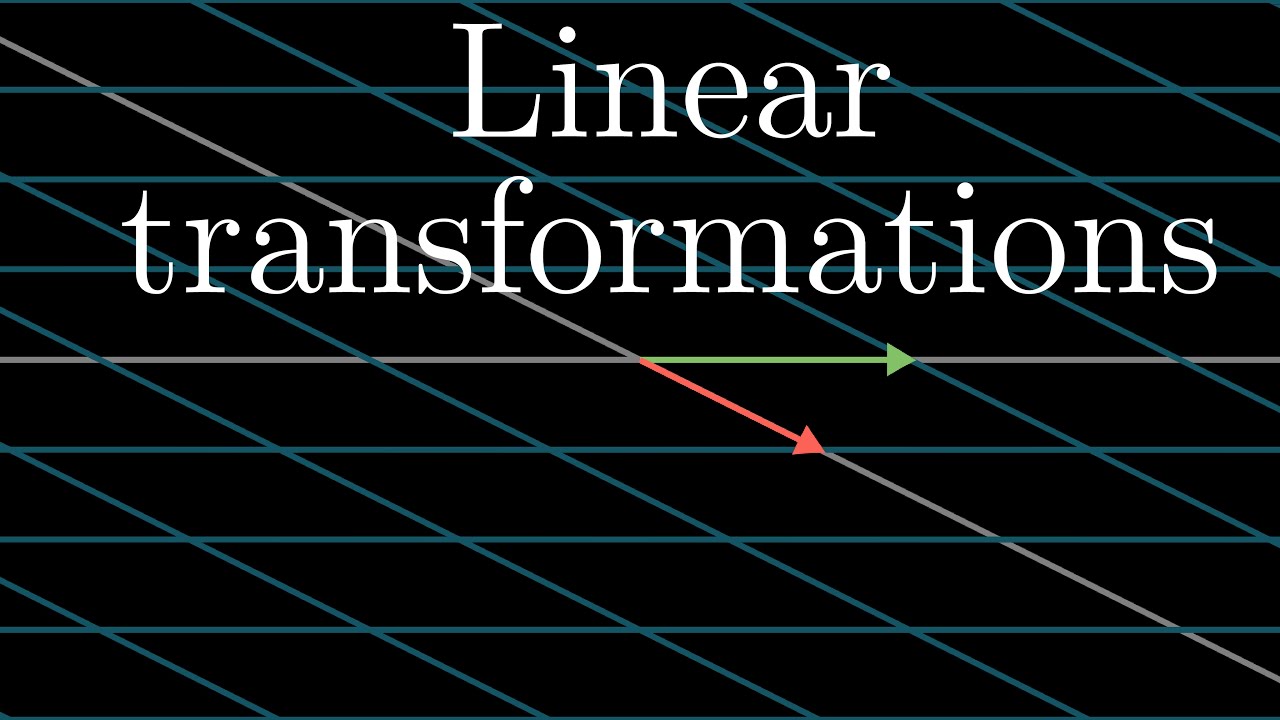
Quite possibly the most important idea for understanding linear algebra.
Help fund future projects: https://www.patreon.com/3blue1brown
An equally valuable form of support is to simply share some of the videos.
Home page: https://www.3blue1brown.com
Full series: http://3b1b.co/eola
Future series like this are funded by the community, through P...
may be worthwhile to watch this
pseudo maple
awesome thank you will do!
spare widget
plush dust
Lost in this part, can you explain once more?
A set S is a subset of a set P if for every v in S it follows that v in P. That is, if every element of S is an element of P then it's clear that P is a superset of S (it contains all of its elements).
N(D) = {v : Dv = 0}
It's clear that from Bv = 0 it follows ABv = 0
Thus if v in N(B) it follows v in N(AB) and thus N(B) <= N(AB)
 spare widget
plush dust
And did i got this correct answer?
spare widget
plush dust
And did i got this correct answer?
You should be able to check this yourself
how would you go about this?
Generally if you claim something is false then you should be able to construct counterexamples
plush dust
Just, as I remember, there is no any connection between determinant and matrix and its rank
Thats why I chose 2 false
spare widget
Try constructing counterexamples
For 1) you can try with diagonal matrices to make it easy
For 2 you can try having singular matrices with the same number of linearly independent rows
plush dust
ok
spare widget
1 counterexample is enough
 restive raft
plush dust
Just, as I remember, there is no any connection between determinant and matrix a...
restive raft
plush dust
Just, as I remember, there is no any connection between determinant and matrix a...
There is a small yet important connection with rank and the determinant, if the determinant is non-zero then the matrix has full rank. But if it is zero the rank could be anything less then full
plush dust
Is this right guys?

 stuck tendon
plush dust
Is this right guys?
stuck tendon
plush dust
Is this right guys?
It is
plush dust
Thanks
spare widget
It's better if you prove that it is right
wintry steppe
characteristic polynomial of A is p_A(t) = det(tI - A). how to prove it really is a polynomial?
spare widget
using the definition of the determinant
It involves only multiplication, addition and subtraction operations
wintry steppe
thanks, @spare widget :)
plush dust
Not sure about this one, is it correct?
 spare widget
plush dust
Not sure about this one, is it correct?
spare widget
plush dust
Not sure about this one, is it correct?
What have you tried?
Have you tried writing the general solution?
plush dust
I just removed all other possible variants
spare widget
Try writing the general solution
If you're not sure what I mean refer to a textbook in the section on solutions of augmented systems in rref form
e.g. hoffman and kunze
 spare widget
yes
plush dust
Yeah, did this
spare widget
So what did you get?
plush dust
e1, e2 and v0
spare widget
Yes what values
Either way, you get some e1, e2 vectors
Those vectors span some 2d subspace of R^4
plush dust
 spare widget
You can pick any other f1, f2 from said subspace and the only difference would be the coefficients
However if you were to take vectors outside of the span of the e1, e2 that you have, then that will not be a solution
And they emphasize e1, e2 being vectors from an arbitrary basis of R^4
It cannot be arbitrary
plush dust
Hmm, so its not correct answer
spare widget
plush dust
It must be a basis for the subspace spanned by the e1 and e2 you computed here
It is not a correct answer
spare widget
you really ought to try and understand things rather than try to guess it by eliminating answers
I guess that's what happens with multiple options exams
plush dust
I would like to, can you explain the statement B, cuz I cant understand the statement
spare widget
Do you know how the nullspace for a matrix is defined
plush dust
Just to compute null space dimension?
spare widget
N(A) = {v : Av = 0}
plush dust
Ok, yeah, know this
spare widget
and we know that N(A) = N(rref(A))
plush dust
So
spare widget
So what is the dimensionality of the solution space of Av = 0?
How many basis vectors do you need to define the solution?
plush dust
Its equal to n - rank no?
spare widget
It is equal to n - rank yes
spare widget
Wait no
plush dust
So nullity is 4 - 2 = 2 != 3
lavish jewel
in the original mat, not the augmented one
spare widget
Yes in A not tildeA
You already derived the vectors though
So you could have argied just from those
That since you had e1, e2 it's 2d
spare widget
plush dust
It even says null(A) if you look here
 wintry glen
Hi! The question is to show that if $A \subseteq B$ and $B$ is affine, then aff $A \subseteq B$. Is my proof below correct?\
Suppose $x \in$ aff $A$, then $x$ is an affine combination of vectors in $A$, and is thus an affine combination of vectors in $B$, since $A \subseteq B$. Then, as $B$ is affine, any affine combination of vectors in $B$ is also in $B$, so $x \in B$. Hence, aff $A \subseteq B$.
stoic pythonBOT
PhenomPlasma
 spare widget
Yes
pseudo maple
can anyone help me understand how they achieved this answer


Idk what im suppose to do with the T=x (d/dx) - x(d^2/dx^2)
but ik how to create matrix represntation for standard basis
fringe fjord
Apply T to each of the elements of the standard basis in turn; write down the coefficients of the result.
pseudo maple
cool, ill have a go thanks
pseudo maple
fringe fjord
Apply T to each of the elements of the standard basis in turn; write down the co...
how would i do that?
spare widget
Use the definition of T in b)
Then feed it 1, x, x^2
The point is
T(a x^2 + bx + c) = linearity = a T(x^2) + b T(x) + c T(1)
So once you know what happens to the basis you're done
 twilit minnow
how can you prove that if a matrix has a left inverse, it is also injective
pseudo maple
but how did that come about
 pseudo maple
spare widget
T(a x^2 + bx + c) = linearity = a T(x^2) + b T(x) + c T(1)
pseudo maple
spare widget
T(a x^2 + bx + c) = linearity = a T(x^2) + b T(x) + c T(1)
so i differentiate teh basis and then just plug it into this?
and then ill know the matrix
spare widget
??m
pseudo maple
sorry im rlly bad at this specific topic
spare widget
You need to compute T(x^2), T(x), T(1)
Using the definition of T
Once you do that you will get some polynomials of the form T(1) = a11 + a12 x + a13 x^2, T(x) = a21 + a22 x + a23 x^2, T(x^2) = a31 + a32 x + a33 x^2
The coefficients are then you matrix coef
But you have to compute T(1), T(x), T(x^2) to figure those out
The definition of T is in b)
pseudo maple
aah ok i think i get it, ill give it a go thanks
spare widget
pseudo maple
aah ok i think i get it, ill give it a go thanks
btw as I wrote them the matrix is the transposed
 broken notch
Can someone check my jupyter solution where I answer this problem
"(𝑒) Calculate the numbers 𝜅(𝐴),cos𝜃 and 𝜂 , which control the condition numbers for the problem (see note 17). Indicate the corresponding upper limit of the condition number for how change in 𝐴 affects change in the calculated 𝑥 in part (c).
Use this to explain how accurate you can expect the calculation of 𝑥 to be."
Bcs I am getting values that look wrong but I follow the procedure given to me to the teeth
plush dust
Can I use arbitrary numbers to prove or I need to prove by variables?
 lavish jewel
using arbitrary numbers is not a proof
hard drum
What is the definition of a linear transformation
plush dust
lavish jewel
using arbitrary numbers is not a proof
So need to prove by a and b?
lavish jewel
as potato says, you have to use the definition of linear transformation
plush dust
We mostly just tried to prove that sum of transformation is equal to transformation of sum
lavish jewel
in fairness, for b you can construct a counterexample. but for a, you need to do it in general
plush dust
And also that c * T(v) = T(cv)
hard drum
Yes, you have to prove that for all a,b in R^2 and all c in R we have that T(a+b) = T(a) + T(b) and T(ca) = cT(a)
i.e. exactly that T is linear
plush dust
So, basically, just prove the same with a and b
plush dust
Ok
lavish jewel
note that it won't suffice to use just a and b, since you have to show properties involving addition of vectors
so you'll need at least 4 scalars
(5 considering scalar multiplication)
 lavish jewel
this shows additivity, yes
 plush dust
Are these statements enough or I'm missing something? 😅
 lavish jewel
you didn't show part a though, presumably they want you to justify it
plush dust
Need to prove this prepositions?

Like as there is no 0 vector, there are not equal, none of them is scalar multiple of another, (skipping 4,5) => They are independent?
lavish jewel
it would be enough to evoke how polynomial addition works
and then the usual definition of "scalars not all 0..."
hardy inlet
You probably need to use the fact that a spanning set of length dimV is a basis
And to show S spans V u probably need to show a the linear combination that gets it.
$ax^2 + bx+ c = \alpha f_1 + \beta f_2 + \gamma f_3$
stoic pythonBOT
MattDog_222
 hardy inlet
for a concrete example if I wanted 21x^2 it would be 7f_1
plush dust
Ok, thanks
And maybe you can give a small hint, from what to start this exercise?

I'm just good at computations, not at proving 😅
 plush dust
And maybe you can give a small hint, from what to start this exercise?
plush dust
plush dust
And maybe you can give a small hint, from what to start this exercise?
As I understand, I need to prove these properties for task a)
 wintry steppe
Yeah you gotta prove thise 3
 silk valley
there's a slick way to prove sub-anything but i forget
spare widget
You have to prove that these 3 imply the axioms for something being a vector space
Because a subset of a vector space that is also a vector space is a subspace.
spare widget
Wait
spare widget
plush dust
As I understand, I need to prove these properties for task a)
This is not the exercise?
fringe fjord
It sure looks to me like it is.
spare widget
Then forget what I said, you can directly use this if it is not the exercise
spare widget
plush dust
And maybe you can give a small hint, from what to start this exercise?
I think he's referring to this
fringe fjord
It explicitly says: "Prove that U is a subspace ..."
spare widget
yeah I misunderstood that he has to prove the above definition
spare widget
spare widget
You have to prove that these 3 imply the axioms for something being a vector spa...
Disregard this
plush dust
Erm, so should I prove that 3 properties?
spare widget
You should prove the 3 properties for a)
plush dust
Good
spare widget
i.e. that they hold for a)
plush dust
wintry steppe
Isn't it like fu + fg = f(u+g) kinda
I think you are talking about transformation no?
plush dust
Hmm, maybe, not sure
wintry steppe
Because you're trying to show if you add them you get the same form
spare widget
You just have to prove that the 0 matrix isin U
That if you pick u,v in U
Then u+v in U
And alpha * u in U
plush dust
So, the first one is obvious, if a = 0, b = 0, we will have 0 matrix
spare widget
for example use a,b for u and c,d for v
Compute the sum
Then do two variable substitutions to get it in the desired form
For alpha * u do 2 variable substitutions too
plush dust
This way?
 spare widget
Yes
plush dust
And like we substitute ⍺ = [a + c] β = [b + d]
spare widget
yes
plush dust
We will have similar to the initial one, got it
 spare widget
You need to check scalar-matrix multiplication also
plush dust
spare widget
You need to check scalar-matrix multiplication also
I guess the same way yes?

Oh, I think its better to use variable instead of 5
wintry steppe
spare widget
Why did you not compute S^TAS
I did compute it three times I thought
spare widget
What they want you to do is S^TAS = alpha1 * B1 + alpha2 * B2 + alpha3 * B3, where B1, B2, B3 are the given basis matrices
spare widget
plush dust
Oh, I think its better to use variable instead of 5
yes
plush dust
And for task b)?
spare widget
wintry steppe
I did compute it three times I thought
Compute the product S^TAS
Note that A is symmetric 2 x 2
spare widget
I don't see the abc in your write up
wintry steppe
I haven't gotten there yet
 vital drum
i have a rather open-ended question: what's interesting about annihilators?
spare widget
plush dust
And for task b)?
choose a basis
There's an obvious one
Split the matrix as a sum of matrices multiplied by a and b
spare widget
wintry steppe
I haven't gotten there yet
Write out the product
Shouldn't be too hard
multiply 3 matrices
fringe fjord
wintry steppe
Please don't have these equals signs. They are lies: What is to the left of the = is not equal to what you have written to the right of it!
 spare widget
Compute S^TAS
Where for A you'd use [a b; b c]
Once you compute it you can decompose it
hardy inlet
can someone please check if these absolute values make sense (and the proof in general), I hate complex stuff.
 fringe fjord
spare widget
Compute S^TAS
fringe fjord
spare widget
Compute S^TAS
But that's what he did!
wintry steppe
I'm trying to find the basis in part a
spare widget
fringe fjord
But that's what he did!
He did?
wintry steppe
The kernel is just st (a b, b c) s
plush dust
spare widget
Split the matrix as a sum of matrices multiplied by a and b
Sorry for handwriting
 fringe fjord
spare widget
He did?
fringe fjord
spare widget
He did?
That looks to me like it's exactly what the handwritten part of his image is.
spare widget
wintry steppe
I see no abc anywhere here
spare widget
plush dust
Sorry for handwriting
you need a sum of two matrices
Take the initial matrix and write it as asum of 2, one containing only a, the other only b
Then finally take out a and b
fringe fjord
spare widget
I see no abc anywhere here
Basis underlined in red, S^T and S in green.

The general element is a linear combination of the basis vectors.
plush dust
spare widget
Take the initial matrix and write it as asum of 2, one containing only a, the ot...
Like this?

 fringe fjord
You keep posting that -- is there a difference between the copies you post that you want us to notice?
wintry steppe
Yes... at the bottom....
 wintry steppe
Sorry ill stop asking
plush dust
These two are the basis matrixes?
spare widget
Yes
plush dust
Great
fringe fjord
wintry steppe
Yes... at the bottom....
Oh right. What you have at the bottom now is not a "basis" but the matrix representation of the transformation L in the given basis for V. That is good as far as it goes.
plush dust
Two questions here:
In a) is the cofactor = 2
In b) in A and B I can use Laplace Expansion, but what to use for C?

 fringe fjord
Ah I see.
Comparing here, we do see a difference.
You seem to have swapped rows and columns when you wrote down the matrix.
hardy inlet
plush dust
Two questions here:
In a) is the cofactor = 2
In b) in A and B I can use Laplace...
idk what u mean but expand on row 1. u get 1 times the determinant of the bottom right 3x3, and then all zeros
and for the bottom right u get 1 * det(2,0;2;2) + a bunch of zeros
fringe fjord
On the other hand the typeset solution has the basis vectors in the wrong order, compared to the image with your handwriting on it ...
wintry steppe
So it's prob an exam solution error
plush dust
hardy inlet
idk what u mean but expand on row 1. u get 1 times the determinant of the bottom...
Its for B, but what to do for C?
spare widget
plush dust
Two questions here:
In a) is the cofactor = 2
In b) in A and B I can use Laplace...
Notice tha C has two equal rows
fringe fjord
wintry steppe
So it's prob an exam solution error
Right, but your solution ought to have been $\begin{bmatrix}0&0&0\1&9&6\0&0&0\end{bmatrix}$.
stoic pythonBOT
Troposphere
 spare widget
What happens when yoy have linearly dependent rows/cols?
What is the determinant equal to
plush dust
Determinant is 0!
wintry steppe
fringe fjord
Right, but your solution ought to have been $\begin{bmatrix}0&0&0\\1&9&6\\0&0&0\...
So I need to get the transpose.
fringe fjord
Yes. When you represent a linear transformation with a matrix, each column of the matrix represents the output of applying the transformation to one of the basis vectors.
hardy inlet
sry to repost but is the part below the red correct in its |absolute values| and square rooting arithmetic?
 fringe fjord
(It's a bit tedious that the notation in linear algebra has ended up being such that matrices operate on columns of coordinates instead of rows, which would have been easier to type -- but there's no helping that now).
wintry steppe
fringe fjord
Yes. When you represent a linear transformation with a matrix, each _column_ of ...
Bam!!! Sorry man if I'm dumb. I hate my school, we get exam problems Notting like our homework. So I'm trying to learn previous years problems. Tyty
lavish jewel
multiply vectors from the left 😌
spare widget
v^T M^T
fringe fjord
Yes, but matrix multiplication might have been defined such that it takes rows from the right operand and columns from the left. Far too late for that now, though.
lavish jewel
certainly
spare widget
they actually have the two conventions for differentiating in matrix calculus
It's very confusing
the conventions are transposes of each other
spare widget
spare widget
they actually have the two conventions for differentiating in matrix calculus
To be sure, not mult from the right by row vector, just transposes
plush dust
What matrix operations change determinant?
Multiplying by k -> det = k * det
Swapping rows or columns -> det = -det
Row operations -> no effect
What else can change it?
Inverse -> det = det * 1/det
native rampart
If A -> det
A^k -> det^k
plush dust
Oh yes, forgot about it, thats all right?
hardy inlet
is this algebra correct 🥺
 native rampart
plush dust
What matrix operations change determinant?
Multiplying by k -> det = k * det
Swa...
native rampart
plush dust
What matrix operations change determinant?
Multiplying by k -> det = k * det
Swa...
This should be multiplying one row or column by k
plush dust
And what if whole matrix is multiplied by k?
hardy inlet
is  bad
bad 
native rampart
k^(dim matrix)
native rampart
If matrix is 2x2 det -> k^2 det
plush dust
Ah, ok
spare widget
hardy inlet
is this algebra correct 🥺
Are you worried about the +-? The singular values are non-negative.
hardy inlet
oh right i kinda forgot about the \pm, but i was more concerned with the modulus/abs
spare widget
What's wrong with the modulus?
hardy inlet
is it maintained after the sqrt of the square
spare widget
Substitute r^2 = |x|^2, -> sqrt(r^2) = r
why would there be anything wrong with the modulus
vital drum
should i ask the question i asked earlier again or did ppl ignore it for good reason?
hardy inlet
i feel like it should be okay but absolute values are kinda weird sometimes so I wasn't sure
 pure crypt
Can someone give me a hint on how to do this? People are telling me its really easy but i don't see it.
 vital drum
let x be an element in both null(S) and null(T). what happens if you apply S+T or S-T?
spare widget
v in null(S) cap null(T) -> S(v) =0, T(v) =0 -> (S+T)(v) =0, (S-T)(v) =0 -> v in null(S+T) cap null(S-T) -> null(S) cap null(T) <= null(S+T) cap null(S-T)
Now do the opposite
To show the opposite inclusion
Then the two together imply equality
The opposite is a little more complicated since you get a system, but it's trivial to get S(v) =0 and T(v) =0 from it
pure crypt
oooh i see, ty ty
spare widget
what is n?
Is A square?
I am guessing columns
Let x be in the null-space of A
Then Ax = 0
let B be its left inverse
Then x = BAx = 0 -> x= 0 -> kernel is trivial -> full column rank
twilit minnow
A is m>=n
spare widget
did you get the idea for the proof
twilit minnow
yeah
twilit minnow
spare widget
did you get the idea for the proof
how about going the other way
rank(A) = n => left inverse
spare widget
(A^TA)^{-1}A^T
spare widget
Isn't the above enough? (A^TA)^{-1}A^T * A = I
stoic pythonBOT
pecfex
 spare widget
And you can argue that A^TA is invertible because A has full column-rank
vital drum
stoic python
**pecfex**
@wintry steppe here's a hint
spare widget
I am assuming you can do it with row ops, but I haven't thought about it
vital drum
vital drum
<@456226577798135808> here's a hint
also you're gonna have to use the commutative diagram
twilit minnow
spare widget
I am assuming you can do it with row ops, but I haven't thought about it
i havent actually learned it that way in class
wintry steppe
how did you know that it was equivalent to show that? @vital drum
vital drum
wintry steppe
how did you know that it was equivalent to show that? <@304589198508294145>
by exercise 17
spare widget
Well it is clear that (A^TA)^{-1}A^TA = I
twilit minnow
i dont see it
spare widget
B^{-1}B = I
 spare widget
The only thing you have to prove there is that A full column rank means A^TA is non-singular
vital drum
wintry steppe
part b is what you need
wintry steppe
I mean, how did you go from rank(T)=rank(L_A) to equivalently showing that phi_gamma(im(T))=im(L_A)?
vital drum
do you see it, jswatj?
spare widget
And I think you can prove tgis using the svd
wintry steppe
how did you know to do that?
twilit minnow
spare widget
Then x = BAx = 0 -> x= 0 -> kernel is trivial -> full column rank
also, the kernel of A is trivial in this case
right
spare widget
Knowing that the columns are lin-indep
wintry steppe
vital drum
do you see it, jswatj?
I see where it can be used down the line i think
stoic pythonBOT
pecfex
 vital drum
yes?
vital drum
no, it's the image of im(T) under phi
vital drum
i can type it out in case you still don't get it
wintry steppe
yeah im still sort of lost
cause this question came up as a theorem later in the book
so i need to understand it
vital drum
you know that im(T) is a subspace of W, right?
wintry steppe
Yup
wintry steppe
Oh
vital drum
phi is an isomorphism, that's why exercise 17 applies
wintry steppe
and im(T) is a subspace of W
vital drum
yea
vital drum
and now we prove that part by using the commutative diagram
wintry steppe
oh because
vital drum
 vital drum
more specifically this

the composed maps don't just have the same codomain, in fact they're the same map
that's what the diagram is saying
wintry steppe
wait but in our case aren't things different?
We're working with A=[T]_beta^gamma
and its only im(L_A)
how does that connect with their conclusion
wintry steppe
LMaooooo
I understand their conclusion cause the standard rep of beta outputs vectors in F^n and L_A sends them to F^m
same with the other side
vital drum
yea
wintry steppe
how does that relate to our case with phi_gamma(im(T))=im(L_A)?
vital drum
well what's phi(im(T))?
wintry steppe
Sorry
vital drum
i could have said it better
wintry steppe
vital drum
more specifically this
how did you use this conclusion to conclude they are the same
vital drum
you can start from there
wintry steppe
Okay
vital drum
vital drum
it's easy to see that im(T) = T(V), right?
also the person who reacted, isn't this just definitional? or am i wrong?
wintry steppe
Oh i think i see
rearrange for T
then phi_gamma^-1 L_A phi_beta = T
so plugging in V for both sides gives
wait no
u don't have to rearrange
u can just plug it in
cause phi_beta gives F^n
L_A(F^n) = im(L_A)?
and that's equal to phi_gamma(im(T))?
thats wild
wintry steppe
stoic python
**pecfex**
I get this now
vital drum
alright
wintry steppe
thats so crazy
 brazen sinew
Hey guys
Any strategies on how to start on this problem? Specifically, assuming S is infinite, how do i show that the given set is not a basis?
 hard drum
Have you shown that if S is finite then it's a basis? Try to see where you used finiteness and that should lead to it
Or you can consider a more familiar example, like F = S = R and some standard functions to get intuition
spare widget
What definition of basis do they use in your book?
I am assuming they have something about ghe sum being finite, in which case you can just give a function that wpuld require an uncountably infinite sum of indicator functions
brazen sinew
spare widget
What definition of basis do they use in your book?
A basis is a linearly independent set which spans the vector space
brazen sinew
hard drum
Have you shown that if S is finite then it's a basis? Try to see where you used ...
No, im not sure how to unpack/use the set chi_s for s in S
 sinful bane
 spare widget
brazen sinew
A basis is a linearly independent set which spans the vector space
spare widget
brazen sinew
A basis is a linearly independent set which spans the vector space
I haven't formally studied functional analysis so I can't say much, but your book may be using a definition of hamel basis, or schauder basis, or something else.
I am assuming your book has the words finite linear combination somewhere in there
Which you could use for a counterexample
wintry steppe
linear combinations are always finite
spare widget
Schauder bases have a countably infinite sum in there
wintry steppe
that's not a linear combination
spare widget
I have seen people refer to it as an infinite linear combination, but as I mentioned I have not studied functional analysis formally
wintry steppe
"linear combination" alone always means finite
pure crypt
Anyone know how to find the eigenvalues of a non-finite matrix?
 wintry steppe
this isn't a matrix
if you have a scalar c, you need to solve D(f) = cf for f
if you can find such a non-zero f, then c is an eigenvalue and f is an eigenvector. if not, then c is not an eigenvalue
pure crypt
wintry steppe
if you have a scalar c, you need to solve D(f) = cf for f
ok so in over words, this doesn't have any eigen values then? since no such "c" exists?
i did write down Dx = \lambda x down on my paper but i thought i was doing something wrong
so i was trying to do the whole det(D - \lambda I) = 0 thing
wintry steppe
pure crypt
ok so in over words, this doesn't have any eigen values then? since no such "c" ...
i didn't say anything about whether such a c exists
wintry steppe
pure crypt
so i was trying to do the whole det(D - \lambda I) = 0 thing
this doesn't work because the determinant of an operator on an infinite dimensional space is not well defined
pure crypt
ooh i see
pure crypt
wintry steppe
i didn't say anything about whether such a c exists
wait ok but if D(p) is the derivative of polynomial p, there shouldn't exist a constant such that D(p) = cp right? since u can't change the exponents of a polynomial by only scalar multiplication?
wintry steppe
yup, but you're forgetting one small exception
your reasoning works if c is non-zero, but what if c is zero?
pure crypt
oooh so the only eigenvalue for it would be zero
oh shit acutally that makes sense, cuz then in the form det(D - \lambda I), if lambda = 0, than the det = zero
i get it! Thanks a lot @wintry steppe
wintry steppe
no determinants!
pure crypt
okok fine
i just think about it like that cuz thats how i intuitively understand eigenvalues
 subtle gust
Hello ...
I need to know if this sentence is accurate
"There exist only one unique matrix L and one unique matrix U for every n such that A=LU and diagonal(L or U)={n,n,n..........n} for n=/0"
 tacit pelican
to do this you literally just add the rows $\begin{pmatrix} 0 \ 1 \ 0 \ 0 \ 0 \ 0 \ 0 \ 0 \ 0 \ 0 \ 1 \ 0 \ 0 \ 0 \ 0 \ 0 \ 0 \ 0 \ 0 \ 1 \ 0 \end{pmatrix}$ right
 stoic pythonBOT
sean

 fringe fjord
tacit pelican
to do this you literally just add the rows $\begin{pmatrix} 0 \ 1 \ 0 \ 0 \ 0 \ ...
fringe fjord
tacit pelican
to do this you literally just add the rows $\begin{pmatrix} 0 \ 1 \ 0 \ 0 \ 0 \ ...
Yes, that will work.
It's easiest to see that you get a basis if you follow the advice in the notes to insert your new rows between those you already have, such that the result is an upper triangular matrix with non-zero diagonal elements.
tacit pelican
alright thank you
 woeful saffron
Helloo, can someone help me pls? I need to prove that given A a point in space and v a vector in space, so there is only one representation of v starting at A. How can I do this?
plush dust
Guys hello, I'm a bit confused here, can you say from what I should start?

 lusty swallow
after a few days, I think he can solve that
because 2x2 matrix space and 4x1 vector space are isomorphic
subtle gust
hey everyone
i need to know if this sentence is correct or not ..
"There exist only one unique matrix L and one unique matrix U for every n such that A=LU and diagonal(L or U)={n,n,n..........n} for n=/0"
i'm writing smthng and i'm trying to be as accurate as possible
ummm anyone?
 eager grail
Does it feel correct to you?
open locust
I'm confused about the relationship between invertible matrices, change of basis matrices, and the identity transformation. I understand that a change of basis matrix is a matrix representation of the identity transformation, with particular "to" and "from" bases. I also understand that any invertible matrix can be seen as a change of basis matrix for one particular set of to and from bases. But it seems pretty clear that not every invertible matrix represents the identity transform. What am I missing here?
spare widget
wdym to and from bases
The identity map is T(v) = v
Whatever basis you use, it's the identity matrix
open locust
@spare widget Like, a matrix is a representation of a linear transformation given some bases
open locust
@spare widget I don't think it is
spare widget
[T(v)]_B = [I]_B [v]_B = [v]_B
But only the identity matrix maps any vector v to itself regardless of the basis B
open locust
@spare widget But if the matrix representation of the identity transformation is the identity matrix no matter what bases you choose, then every change of basis matrix is the identity matrix.
spare widget
I think you agree T(v) = v for any v represents the identity map?
open locust
Because a change of basis matrix is a matrix representation of the identity matrix with respect to particular to and from bases.
spare widget
open locust
<@218360314234798080> But if the matrix representation of the identity transform...
no
open locust
spare widget
I think you agree T(v) = v for any v represents the identity map?
I agree with this
spare widget
A change of basis matrix is such that
[v]_B2 = P [v]_B1
It says nothing about v irrespective of basis
It only gives the relationship for the coefficients wrt sone bases
spare widget
spare widget
[T(v)]_B = [I]_B [v]_B = [v]_B
Then do you also agree with this
open locust
@spare widget So a change of basis "transformation" is not the identity transformation?
spare widget
it is not
A change of basis matrix changes your basis
But [v]_B2 and [v]_B1 are the same vector written wrt different bases
e.g.
$\vec{v} = \sum_{i}\alpha_i \vec{e}i = \sum{i} \beta_i \vec{f}_i$
stoic pythonBOT
criver
 open locust
I think the thing that's confusing me is that if we write Tu = x, I always try to think of that as "basis-free", but it seems like it's not possible to do that.
spare widget
spare widget
[T(v)]_B = [I]_B [v]_B = [v]_B
But this isn't
open locust
@spare widget So why isn't the change of basis transformation the identity transformation? It doesn't move or change the vector it takes in.
spare widget
spare widget
$\vec{v} = \sum_{i}\alpha_i \vec{e}_i = \sum_{i} \beta_i \vec{f}_i$
I think you're mistaking the coefficients alpha for the vector v
The vector v is not the coefficients alpha
open locust
@spare widget What I'm saying is, I have a point in space. I do a "change of basis" transformation on it. Does it move the point, or no?
spare widget
the alpha coefficients are coordinates of v wrt E
The beta are coordinates of v wrt F
open locust
I understand that.
Does the change of basis transformation move the physical point in space, or no?
spare widget
A change of basis matrix operates on the coord representations
open locust
I didn't say matrix. I said transformation.
spare widget
open locust
Does the change of basis transformation move the physical point in space, or no?
It does not
open locust
Okay. So the transformation is the identity transformation.
open locust
How can it be that a transformation that takes a vector and doesn't change it, be something other than the identity transformation?
spare widget
Imagine
open locust
But we aren't using bases when we talk about transformations, right?
open locust
We're just saying stuff like, Tu = x, which you said can be expressed in a basis-free way.
spare widget
It x inches and y meters
open locust
So, our change of basis transformation T is Tu = u, right?
open locust
I know.
I'm not talking about specific bases here.
Tell me why the change of basis transformation does not take the form Tu = u in a basis-free setting.
spare widget
Your change of basis transformations are:
open locust
Please don't write anything about matrices in your next sentence.
spare widget
f1 = T1(e1,....,en), ..., fn = Tn(e1,....,en)
open locust
Okay, that makes sense.
open locust
Yes I'm with you.
spare widget
Now this T1 has coefficients
To be precise it looks like this
$\vec{e}i = \sum_j a{ji} \vec{f}_j$
stoic pythonBOT
criver
 open locust
Yes I'm with you.
spare widget
The matrix A is the change of basis matrix
open locust
We have defined this transformation with respect to particular to and from bases.
spare widget
as you saw it's n maps, and they consume multiple vectors
It's not what you're used to
T(v) = w
Instead it's ei = Ti(f1,...,fn)
spare widget
Well now write out v in the E basis
open locust
spare widget
as you saw it's n maps, and they consume multiple vectors
I'm not really sure if it's $n$ maps, this is the same thing as how any linear transformation has to be defined by its actions on particular to and from bases.
stoic pythonBOT
joesmith1042
 open locust
E.g. $\forall j \quad A(e_j) = \sum_{i=1}^n a_{ij} f_j$
spare widget
$\vec{v} = \sum_i \alpha_i \vec{e}i = \sum_i \alpha_i \sum_j a{ji} \vec{f}_j\ = \sum_j (A\vec{\alpha})_j \vec{f}_j = \sum_j \beta_j \vec{f}_j$

 open locust
@spare widget I follow you.
open locust
I just wanted to point out that this isn't different from what I'm used to, this happens with every single linear transformation.
spare widget
beta = A * alpha
But alpha and beta are the coefficients of the vectors wrt the bases E and F
They are not v itself
There's the notion of active transformation
Then you can do
open locust
@spare widget Well, what you're saying is just that the change of basis matrix acts on the coefficients of $v$ in the old basis, and produces coefficients in the new basis.
spare widget
[w]_E = [Av]_E which actually gets you another vector
stoic pythonBOT
joesmith1042
 open locust
Which is the same for any linear transformation, right?
open locust
Oh, except that the new coefficients aren't usually coefficients of $v$. They're usually coefficients for some new, different vector.
spare widget
[v]_F = A [v]_E
stoic pythonBOT
joesmith1042
 open locust
Right, I see how that's the difference.
Like, for any transformation Av = w , w isn't equal to v in general.
But, I'm still not sure why this says that the change of basis transformation is not the identity transformation. I understand everything you said and I agree with it.
But I could make exactly the same argument about the identity transformation, and say it all in the same order, with the words "change of basis transformation" replaced with "identity transformation."
Like, I take the identity transformation, and do the things with to and from bases, and in the end write Av = v, etc.
Do you see what I'm saying?
spare widget
A change of basis matrix acts on the coordinate representations
It doesn't modify the vector itself
open locust
@spare widget Every matrix only acts on the coordinate representations.
spare widget
The maps from which this matrix is derived are ei = Ti(f1,...,fn)
open locust
Given a pair of to and from bases, there is an isomorphism between the set of linear transformations from U^m to V^n, and the set of linear transformations from F^m to F^n
spare widget
open locust
<@218360314234798080> _Every_ matrix only acts on the coordinate representations...
yes, but some you interpret as modifying the vector, and those you interpret as changing its basis
active vs passive transformation
open locust
So if you take a vector in U^m, you have its coordinates with respect to the to basis. You multiply the matrix representation of A by that, and you get the coordinates with respect to the from basis.
Well wait a minute, the transformations from U^m to V^m never change the scalar multiples themselves directly, the transformation always acts on the basis vectors
spare widget
[v]_F = A [v]_E is nit the same as [w]_E = A [v]_E
open locust
@spare widget I agree with that statement
spare widget
To be sure the coef of [v]_F and [w]_E are equal
But they are to be interpret wrt different bases
open locust
Is it normal I feel confused about this? I don't really get how to nail this down
spare widget
$\vec{v} = \sum_j [v]_{F, j} \vec{f}_j = \sum_j (A[v]_E)_j \vec{f}_j \ \vec{w} = \sum_j (A[v]_E)_j \vec{e}_j$
stoic pythonBOT
criver
 spare widget
The first is change of basis
The second is an active transformation
Note the bases
open locust
Why is w still in terms of the original basis?
spare widget
Because we didn't use A as a change of basis matrix
We instead used it as a matrix modifying v
To get w
open locust
But we don't have any choice of how A is "used." It just has to follow the rules.
spare widget
[w]_E = [v]_F
open locust
Like, (\forall j \in [m] \quad A(e_j) = \sum_{i=1}^n a_{ij} f_i)
spare widget
But those are two different vectors
stoic pythonBOT
joesmith1042
 open locust
That's how every linear transformation has to be defined, right?
spare widget
A(e_j) = \sum_i a_ij e_i
open locust
That's if you take the to and from bases to be the same.
spare widget
if you don't then you're implicitly putting in a change of basis
Then you mix the map wuth a change of basis
So you essentially compute PA instead of A
If you define your input and output to be wrt different bases then there is an implicit change of basis
If you define it wet the same basis, then this change of basis matrix is not there
open locust
This is the definition I'm working from.
 spare widget
well it's because you have potentially different vector spaces
So you have a change of basis matrix there too
open locust
@spare widget Yes, I'm trying to bring my definitions in line with the ones you are stating systematically
spare widget
It's the identity if you take the same basis