#linear-algebra
2 messages · Page 290 of 1
 zinc copper
.
We saw bases for multilinear forms first semester so the proof is quick
But it doesn’t really tell me anything
 zinc timber
@zinc copper general bilinear forms are not really an endomorphism
zinc copper
But both are identified with nxn matrice so there must be a connection somehow
I’ve learnt to take nothing as a coincidence in math anymore
zinc timber
bilinear could be from VxW
zinc copper
Si right now I mainly mean bilinear forms on V
zinc copper
So elements of V^* \otimes V^*
zinc copper
zinc timber
so you mean from VxV ?
Yeah
zinc timber

zinc copper
On VxW you’re right it wouldn’t be nxn
zinc timber
idk what kind of connection you are looking for
zinc copper
Me neither lol
zinc timber
if the bilinear form is +ve definite then it can be thought of as an inner prod
(also has to be symm)
zinc copper
I mean it’s not so much thought of as defined there is it 🤔
But yeah I’m looking for something else
zinc copper
Cause you get an associated endomorphism which you can describe explicitly by just looking at the matrix but I can’t assign meaning to this endomorphism relative to the bilinear form
zinc copper
zinc copper
Cause you get an associated endomorphism which you can describe explicitly by ju...
Is there even a name for this map/matrix
zinc copper
zinc timber
ig you can think of a bilinear form as an endomorphism of V\otimes V?
Yeah but then you don’t have nxn matrices
So different kind of identification
zinc timber
ye
zinc copper
I think this was somewhat on track I’ll see again on paper when I’m done eating
zinc timber
it's like you are applying the transformation before dot'ing them
like x.y but with x.By
zinc timber
"basis" change then you also need to change the basis of x
 spare widget
you can assume x is already there
zinc timber
probably not the right interpretation
spare widget
it's like pairing x from that new basis
with an y from the old
so you need to transform y to the new one
zinc timber
you are literally changing x then
zinc timber
like 'same coordinates' but in 'different basis' is longer x
spare widget
$([x]_B)^T[y]_B = ([x]_B)^TB[y]_C$
 stoic pythonBOT
criver
 spare widget
that's how I would interpret this
i.e. you're given a covector with respect to some basis, and a contravariant vector with respect to another, so you have to transform the contravariant vector to the same basis in order to be able to feed it to the covector
spare widget
then it goes to some subspace
zinc timber
transformation is much more accurate
zinc copper
Yeah my earlier interpretation is right I think: consider the unique endomorphism $\psi: V^* \to V^$ such that $\psi(e_i^) = \left<e_i, \bullet\right>$. Then its dual has matrix A in the basis $\mathscr{B} = {e_1,…,e_n}$
Not particularly enlightening but I’ve never found anything to be enlightening with dual morphisms anyways
stoic pythonBOT
𝓛ittle ℕarwhal ✓
 zinc copper
Hmm I guess in a sense a dual morphism can be extended to a bilinear form on V* x V
spare widget
That's what I mean by paiting the covector and contravariant vector
Typically that's considered a measurement of some sort in physics
The contravariant vector being the thing to be measured and the covector being your measuring device/sensor
 short stirrup
what do you mean? like a software to put the matrix into?
spare widget
short stirrup
what do you mean? like a software to put the matrix into?
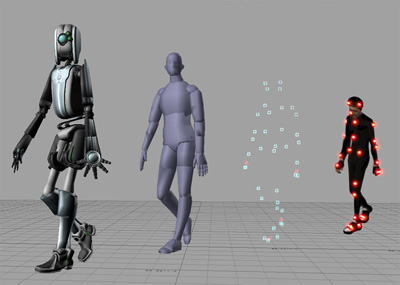
In 3D computer graphics, 3D modeling is the process of developing a mathematical coordinate-based representation of any surface of an object (inanimate or living) in three dimensions via specialized software by manipulating edges, vertices, and polygons in a simulated 3D space.Three-dimensional (3D) models represent a physical body using a colle...
zinc copper
spare widget
The contravariant vector being the thing to be measured and the covector being y...
right that makes sense
spare widget
then I interpret the matrix just as a change of basis or transformations of the contravariant vector
short stirrup
spare widget
https://en.wikipedia.org/wiki/3D_modeling
im not trying to create a complex model of the skateboard, just a representation of the length and width, maybe just a 3d rectangle the same length and width of the skateboard.
spare widget
short stirrup
im not trying to create a complex model of the skateboard, just a representation...
then apply the rotation matrix to the vertices of the rectangle
if you want to rotate it around its center, then you'll have to translate it to the origin -> rotate -> translate back to its original location
short stirrup
what software can i use to visualize that? i downloaded the free trial of matlab but im not sure if i can use that for this
 spare widget
short stirrup
what software can i use to visualize that? i downloaded the free trial of matlab...
spare widget
short stirrup
what software can i use to visualize that? i downloaded the free trial of matlab...
MATLAB should be able to do it too
short stirrup
alright, thank you.
 wintry steppe
Quick question regarding matrices: If I factor a matrix to yield 1's along the diagonal and zeroes elsewhere is it still considered an identity matrix?
 tranquil steeple
wintry steppe
Quick question regarding matrices: If I factor a matrix to yield 1's along the d...
tranquil steeple
wintry steppe
Quick question regarding matrices: If I factor a matrix to yield 1's along the d...
What do you mean?
spare widget
if you mean eigendecomposition, then QIQ^T = I, so you're technically factoring the identity matrix still
if you mean A = A * I = I * A, then this is clearly doing nothing
 vivid flume
wintry steppe
Quick question regarding matrices: If I factor a matrix to yield 1's along the d...
vivid flume
wintry steppe
Quick question regarding matrices: If I factor a matrix to yield 1's along the d...
As long as there are 1s along the diagonal and the other elements are 0s its an identity matrix
spare widget
what have you tried?
 bold ermine
spare widget
what have you tried?
bold ermine
spare widget
what have you tried?
should i send ss or something?
spare widget
nvm, someone's already helping you
 lavish jay
I'm probably constructing this matrix wrong because myanswer differs from the book one, my matrix is $\begin{bmatrix} 1/2 & 1/2 \ 1/3 & 2/3 \end{bmatrix}$
 stoic pythonBOT
Guilhotina ᓇᘏᗢ
 lavish jay
and also i don't think i understand leontief model correctly, the rows are the producers of goods and collumns the consumer of goods ?
 primal fable
is there a good visual interpretation to what's happening on in a linear transformation when the algebraic and geometric multiplicities are different?
my reason for asking this is an attempt to understand why you can't have a jordan canonical form even if the field is algebraically closed
 gleaming knot
Can't have a jordan canonical form even if the field is algebraically closed? What?
primal fable
lavish jay
I'm probably constructing this matrix wrong because myanswer differs from the bo...
you're only given the consumption, nothing about generation. you know that v (your economy state) must be an eigenvector of eigenvalue 1
so Av = v and you now need to solve for A
gleaming knot
As for visual interpretation, I'm taking a liking to comparing the generalized eigenspace with k[t]/(t^n)
primal fable
gleaming knot
Can't have a jordan canonical form even if the field is algebraically closed? Wh...
if I'm wrong here my bad, my interpretation was that you don't always have an eigenbasis for your domain but I might be mistaken and thinking that's equivalent to not having a JCF.
gleaming knot
So, having an eigenbasis is equivalent to saying the Jordan canonical form is a diagonal matrix
The cases where there are 1's on the off-diagonal is precisely the case of not having a basis of eigenvectors
primal fable
oo gotcha
primal fable
gleaming knot
As for visual interpretation, I'm taking a liking to comparing the generalized e...
think you could expand on this? I'm assuming this is quotienting by an ideal but I'm lost as to why that's connected
gleaming knot
k[t]/(t^2) for example is the k[t] module with basis 1 and t, where t times t is 0
This corresponds to any Jordan block of the form $\begin{psmallmatrix}\lambda&1\0&\lambda\end{psmallmatrix}$
stoic pythonBOT
Icy001
 gleaming knot
Where the k[t] module corresponding to $(k^2,T=\begin{psmallmatrix}\lambda&1\0&\lambda\end{psmallmatrix})$ (here $k$ is the ground field) is isomorphic to $k[t]/(t^2)$ (note that $(T-\lambda)^2=0$
stoic pythonBOT
Icy001
 gleaming knot
Geometrically the Spec of $k[t]/(t^2)$ is a "thickened" point
stoic pythonBOT
Icy001
 primal fable
hmmm, hopefully I'll get it after looking over some notes, gimme a hot second but regardless thanks!
lavish jay
How can I do it? The problem says : Show that for this matrix the Leontief equation** x - Cx = d** has a unique equation for every vector d if $c_{21}c_{22} < 1 - c_{11}$
 stoic pythonBOT
Guilhotina ᓇᘏᗢ
 lavish jay
i found the inverse of it
$\begin{bmatrix} 0 & \frac{1}{-c_{21}} \ 1 & \frac{-(1-c_{11})}{c_{21}c_{22}} \end{bmatrix} $
stoic pythonBOT
Guilhotina ᓇᘏᗢ

 gray dust
@brittle ingot #prealg-and-algebra
 brittle ingot
thank you
 mossy coral
Can someone explain why is matrix multiplication is not commutative but associative?
I understand why it is not commutative, but I dont understand how something can be associative but not commutative
 nocturne jewel
cause commutativity and associativity are different properties
with no actual connection b/w them
 distant schooner
seems to me like the step above (4) should be =, not <= right?

 hoary void
distant schooner
seems to me like the step above (4) should be =, not <= right?
hoary void
distant schooner
seems to me like the step above (4) should be =, not <= right?
no its pretty much just saying that something <= |something| (the middle term is what makes it need to do this)

u dot v doesn't have to be positive
distant schooner
oop didnt catch that
thanks
i thought it said 2(u.v)
didnt see that norm :((
 neon lake

I'm having trouble with this exercise. For anyone wondering it is not an exam I'm taking, but one from around 2011, so do not worry. This is its translation:
a) Calculate the values of parameter a so that the system is not independent (r(A)=r(A|B)= number of variables).
b) Is there a value of a for which x = 1, y = –3, z = –1 is the only solution in the system?
 torn stag
@neon lake One approach: Put the system into a matrix. Row reduce the matrix. Find values of a for which the reduced system has infinitely many solutions (is that what "not independent" means?).
neon lake
Yes, I tried to do that, the solutions of the triangular matrix I got were a=2, but solutions said a=2 and a=9 (there's a a-9 in the 2nd row of the same matrix and I dont know what it has to do...)
Here, look

 timid sage
neon lake
Here, look
timid sage
neon lake
Here, look
If you aren't sure of how to solve a problem, I often find the best first step is to graph it. In this case, what we're looking for is two values of a such that at least two of the three resulting planes are parallel.
If we graph this in 2d (leaving out the first column), we can see that for a=9, the lines that represent the second and third rows are parallel, which is a fast way to confirm its a valid answer

 karmic dagger

This is from discreet math, but it's linear manipulation
can anyone explain to me how the second line is achieved?
stoic pythonBOT
Arkid
 karmic dagger
and the next step after that
 neon lake
timid sage
If we graph this in 2d (leaving out the first column), we can see that for `a=9`...
neon lake
timid sage
If we graph this in 2d (leaving out the first column), we can see that for `a=9`...
Thanks
neon lake
karmic dagger
and the next step after that
Sorry for interrupting you
neon lake
I think Im done
karmic dagger
karmic dagger
if anyone can help clarifying this it'd be nice
 lavish jewel
it's because of the determinant
if you have a matrix M with determinant |M|, then scaling the matrix by c (i.e. you now have cM) yields |cM| = c^n |M|
where the matrix M is of size nxn
the vertical bars around the matrix denote the determinant
karmic dagger
so the straight lines surrounding the matrix mean det
lavish jewel
still i don't quite get what they did
 teal grotto
what about the first row of the matrix? i’m not following that part
lavish jewel
me neither

 teal grotto
now it’s even more confusing haha
karmic dagger
that makes sense yea
karmic dagger
I'll ask him then, the explanation you gave makes sense
and now I see too why it's confusing
lavish jewel
i know they want to boil it down to a case where taking the minors makes it easy
so they want to do it along the first col
karmic dagger
what about from to the second step of the second line
where he gathers the first column in the first row
lavish jewel
i don't understand your question
 lavish jewel
idk, that looks wrong to me too
karmic dagger
it's okay, still thanks a lot
lavish jewel
i get the impression they knew the result ahead of time and then did random nonsense to reach it
tranquil steeple
karmic dagger
A trick is to see that it is a circulant matrix, and eigenvalues are given by $f(t_j)=\cos(t_j)+\cos(2t_j)+\cos(3t_j)$ for $t_j=(j-1)2\pi/4$ and $j=1,2,3,4$
karmic dagger
What's the intention behind it?
tranquil steeple
You have the spectrum and can construct the charpoly from that 🙂
karmic dagger
Ah I see, that's a nice formula
stoic pythonBOT
Sven-Erik
 tranquil steeple
(changed n to 4)
 fringe sierra
mossy coral
Can someone explain why is matrix multiplication is not commutative but associat...
fringe sierra
mossy coral
Can someone explain why is matrix multiplication is not commutative but associat...
intuitively, associativity lets you move the parenthesis around without affecting the result, so you can do both $(a \circ b) \circ c$ and $a \circ (b \circ c)$. however you can't swap operands around, that's what commutativity lets you do.
matrix multiplication and function composition are two standard examples that are associative but in most cases not commutative. go ahead and try it out for yourself and it'll become more convincing
stoic pythonBOT
crossbeam

 normal void
To show that the transformation $T_\omega : \mathbb{R}^{MN} \rightarrow \mathbb{R}^{MN}$ given by the below equation is linear, I start off by showing that $T(u+v) = T(u) + T(v)$
 stoic pythonBOT
FantaSkink

 stoic pythonBOT
FantaSkink
 normal void
Am I on the right track?
stoic pythonBOT
FantaSkink

 mystic dagger
anyone knows a software to check if a basis is orthonormal?
wintry steppe
could anyone link me to some resource that explains the notaiton used here ?
 stoic pythonBOT
criver

 lime zinc
Let V be a vector space over C and T: V to V is a linear operator such that for v in V there exists n in N(naturals) satisfying T^n (v) = v. Show that T is diagonizable.
I tried to solve this like : As every transformation has matrix representaion so we can say A^n x= x or
(A^n-I)x=0 implies A^n=I , which tells us that all the eigenvalues of A are just nth roots of unity , which are distincts, so that means A is diagonizable implies T is
Is my solution ok?
 scenic fulcrum
No because n depends on x
lime zinc
scenic fulcrum
No because n depends on x
but for every n this still the roots of unity
scenic fulcrum
Ok and if I take
1 1
0 1
The eigenvalues are 1 which is also a root of unity
And in your exercise you have NOT A^n = I
What is n ??? It is not even defined
 bold sun
hey i need some help on this question part c

im so stuck like how would i show its surjective??
spare widget
Pick an arbitrary vector and find its corresponding polynomial
Surjective means that for any element of the codomain you can find its preimage
here it's fairly trivial
bold sun
hmm can i just use the 1 they gave like a0, a1,...an?
teal grotto
if you have a complex vector (a0, a1, ..., an), then how can you get a complex polynomial of degree at most n?
bold sun
noo im doing something worng
oh no it would just be the column vector 1,x,x^2,....xn right?
 halcyon spindle
I feel like your thinking too hard about this.
spare widget
try forming this
$\begin{bmatrix} 1 & x & \ldots & x^n \end{bmatrix} \cdot \begin{bmatrix} a_0 & a_1 & \ldots & a_n \end{bmatrix} = \sum_{i=0}^na_ix^i$
stoic pythonBOT
criver
 spare widget
this is just your coefficients multiplied by the basis functions
you know how in R^n you can write a vector as
$\vec{v} = \sum_i a_i \vec{e}_i$
stoic pythonBOT
criver
 spare widget
well here it is the same, except e_i are the functions 1, x, x^2, ..., x^n (your monomial basis)
you can in fact write the map S
as
$\frac{1}{k!}\frac{d^k}{dx^k}\biggr|_{x=0}$
stoic pythonBOT
criver

 elfin hawk

 halcyon spindle
How is f(x+y) = f(x) + (y)?
How is f(cx) = cf(x)?
No it’s not right.
 that not what you had before.
wintry steppe
lmao
halcyon spindle
Lol now everything is gone.
 grave garden
 zinc timber
minimal polynomial of A
that means the monic polynomial of least degree s.t. m(A) == 0
alternatively, it's the monic poly generating the ann(A) in F_A[x]
 cold temple


Can anyone help me to show this?
I checked in the Wikipedia, they used the young’s inequality
But I didn’t learn that in my courses
Is there any ways to start the proof?
Originally I want to try the mathematical induction
Can I just use basic knowledge of vectors and Cauchy Schwartz inequality to prove it?
bold sun
spare widget
the above will extract those
only saw this now i but ok that kind of makes sense-i haven't really learnt it as like writing it in terms of derivatives and factorials tho yet- Thank you though so much!!
zinc timber
@cold temple there's a typo
it should be $\sum |x_i y_i| \leq \norm{x}_p \norm{y}_q$
stoic pythonBOT
 zinc timber
and also, why can't you use young's ineq?
cold temple
zinc timber
and also, why can't you use young's ineq?
Oh yes I can use this as well
zinc timber
then?
cold temple
Then $\frac{1}{p}+\frac{1}{q}=1$
stoic pythonBOT
Trenton
 cold temple
The holder’s conjugate
Then perhaps I can use the natural log
So after taking ln, the power will be bring to the front
 cold temple
zinc timber
then?
cold temple
zinc timber
then?
I guess I can get something like this
zinc timber
assume $X_n = x_n/\norm{x}_p$ and $Y_n = y_n/\norm{y}_q$
stoic pythonBOT
 zinc timber
then apply young
cold temple
 cold temple
zinc timber
then apply young
cold temple
zinc timber
then apply young
Hopefully I didn’t get your message wrong

I’ve got a careless mistake
zinc timber
cold temple
upto this is correct
cold temple
Ok
zinc timber
notice that $\sum |x_i|^p = \norm{x}_p^p$
stoic pythonBOT
 zinc timber
so they will cancel each other out, that's the reason we normalized them
I hope rest is clear?
also, use _p or _q to enforce which norm you are using, otherwise it'll get confusing as there are multiple norms
zinc timber
cold temple
here
 zinc timber

cold temple
zinc timber
<:catthumbsup:614540188747563008>
Thank you so much!!!

zinc timber

 snow jetty
real and symmetric matrix = self - adjoint matrix or is there any difference? lol
lavish jewel
self adjoint is more general
but indeed, real symmetric matrices satisfy the definition

 left mural
Hi guys,
Disclaimer: This is a homework question.
Question: True or False. the nullspace of a 3X4 matrix cannot consist of only the zero vector.
I know of this theorem, except I don't know how to apply it :

 limber sierra
That theorem is not helpful for the question.
left mural
limber sierra
That theorem is not helpful for the question.
What would you suggest ?
limber sierra
do you think the statement is true or false?
left mural
limber sierra
do you think the statement is true or false?
I think that the statement is false because the nullspace of A(mXn) is closed under linear combinations. Although, I am not sure if this includes the zero vector.
oh wait
it's true isn't it ?
lavish jewel
do you understand why, though?
limber sierra
so you missed the entire question?
left mural
limber sierra
so you missed the entire question?
yes happens 😄 😅
left mural
lavish jewel
do you understand why, though?
yea. The nullspace is any sort of vector when multiplied by the matrix A equals zero
Ax=0
all right
left mural
the x can be anything in R^n and a zero vector too
limber sierra
so how do you know that there's a nonzero solution to Ax = 0?
lavish jewel
now think about the maximum rank a matrix can have, and the relationship between the row and column rank
limber sierra
by "nonzero solution" i mean
lavish jewel
and also about the rank-nullity theorem
limber sierra
no matter what matrix A you pick, there exists an x such that Ax = 0 and x is not the zero vector
left mural
lavish jewel
and also about the rank-nullity theorem
This thing ?
 lavish jewel
yes
limber sierra
if you haven't covered rank-nullity, instead imagine what your matrix must do to a basis (say the standard basis of ℝ⁴)
and then use linearity, i.e. aMx + bMy = M(ax+by)
using this, see if you can find a way to construct a vector that isn't 0, but when you multiply M by it, gives 0
left mural
lavish jewel
now think about the maximum rank a matrix can have, and the relationship between...
hold on, let me start with this: the max rank a matrix can have is one less than the total number of columns ?
limber sierra
the key step is noticing that ||your images must be in ℝ³, but you have 4 of them, so they must be linearly dependent||
||why does this let you conclude the statement is true?||
left mural
ok let me figure this out with the info given
Thanks guys I'll let you know if I need more help
wintry steppe
guys A is a matrix nxn in K field and P polynomial, S an invertible matrix and ofc S^-1AS. Is it true if i say that P(S^-1AS)=S^-1P(A)S ?
 dim ivy
Resolving the components of the vectors in the sense finding the vectors right?
 void cloud
anyone know how to approach this?

for (ii), i'm assuming the answer would be 6.099? since it's the entry with the largest magnitude in the first column
halcyon spindle
void cloud
for (ii), i'm assuming the answer would be 6.099? since it's the entry with the ...
Yes.
void cloud
halcyon spindle
Yes.
i'm not sure about (i) and (iii)
if there's no pivoting, then would the first pivot just be 0.2115 ?
halcyon spindle
These terms are new to me, so hold on a sec while I look it up.
void cloud

halcyon spindle
Take a look at this to help you. https://courses.engr.illinois.edu/cs357/su2013/lectures/lecture07.pdf. Sorry 😢 I am lazy to read it right now.
But it does look interesting.
torn stag
@tired lance Yes please. Write my dissertation on proving the Collatz conjecture please.
stoic pythonBOT
arcuzie
 fringe sierra
 final lance
is there a way to simplify A*A^T
final lance
is there a way to simplify A*A^T
is A a matrix and ^T transposition?
final lance
Yes @fringe sierra
 dreamy depot
Dumb question does $(\mathbb{N}, \mathbb{R})$ from a vector space ?
stoic pythonBOT
Zophike1
 wintry steppe
dreamy depot
Dumb question does $(\mathbb{N}, \mathbb{R})$ from a vector space ?
wintry steppe
dreamy depot
Dumb question does $(\mathbb{N}, \mathbb{R})$ from a vector space ?
depending if the natural set contains 0 or not
dreamy depot
wintry steppe
depending if the natural set contains 0 or not
yes we including zero
wintry steppe
yes i believe it is right
there are like axioms to know if something is a vector space or not
dreamy depot
Ye I know I was just double checking
 dreamy depot
yeah I figured 🙂
 peak lodge
how do i go about converting this into general form?
i know general form involves an orthogonal vector but i dont know how to get that from this
 nocturne jewel
peak lodge
how do i go about converting this into general form?
i know general form involv...
nocturne jewel
peak lodge
how do i go about converting this into general form?
i know general form involv...
what's general form in this context?
peak lodge
ax+by+cz = d although where [a,b,c] is orthogonal
nocturne jewel
that's a plane though
nocturne jewel
there's no such thing for R^3 lines
peak lodge
oh damn, did not know that
hmm
well this is the actual question. and im thinking it involves projection but having trouble with that line equation
 hoary void
peak lodge
well this is the actual question. and im thinking it involves projection but hav...
hoary void
peak lodge
well this is the actual question. and im thinking it involves projection but hav...
~~2 vectors:
- the vector orthogonal to the line's direction
- a vector through a point on the line and Q
What can you say about the actual length of the first vector mentioned? how might you find it using the second vector i mentoined?~~
peak lodge
1 is where im having trouble, i dont know how to get a vector orthogonal to x
peak lodge
like in general lets say i have a vector [5,8,7,9,0,1,2,3] how do i go about finding a vector orthogonal to this?
hoary void
yeah that's actually my bad. there are infinitely many vectors orthogonal to a vector in R^3 (and above). so im gonna do some more looking around and if i find a sol ill post it here
i was thinking of shortest distance between point and a plane in R^3
hoary void
 wintry steppe
I have A is a matrix nxn in K field and P polynomial, S an invertible matrix and we know SAS^-1 (similarity transformation). I found out P($SAS^{-1})=SP(A)S^{-1}$ is that true? Because my inital guess would be just P(A). Please someone help so I can prove it by induction
stoic pythonBOT
dim99
Compile Error! Click the  reaction for more information.
(You may edit your message to recompile.)

 stoic pythonBOT
Ann
 wintry steppe
thanks @dusky epoch
 lavish jewel
write down how the polynomial would look if the coefficients satisfy the conditions on V_a
that T is an isomorphism should tell you how many basis elements you need
 turbid hedge
uhhh... lol x_X
lavish jewel
what did you get for part 1, then?
wintry steppe
whats the difference between a square and symmetric matrix?
lavish jewel
a symmetric matrix is a special kind of square matrix
the matrix $\begin{bmatrix} 1 & 1 \ 0 & 1 \end{bmatrix}$ is square and not symmetric
stoic pythonBOT
Edd
 lavish jewel
mhm
wintry steppe
cool ty
bold ermine
can someone help me with this? I already asked this but I am still confused

for dimension isn't the formula n(n-1)/2 so the answer should be 10? cuz (5)(4)/2
but its 7? idk
and idk how you get the basis, im confused
lavish jewel
what formula is n(n-1)/2? i don't see how that comes up here
first, they tell you A is skew symmetric
the property you mentioned would be true if that were all the info, but you have extra conditions
after that, they tell you that the sum of the components of the first 2 rows of A above the main diagonal is 0
this means you have a sum of 7 elements = 0
one way to interpret this is as a hyperplane with normal [1,1,1,1,1,1,1]
this is 6 dimensional
then you have a similar condition on row 3, so now you have a sum of 2 elements = 0
again a hyperplane, this time with normal [1,1]; this is 1 dimensional
 radiant ridge
If i have a diagonal matrix that where the diagnoal elements are all distinct, is then the rational canonical form just the same matrix?
lavish jewel
always
radiant ridge
Is there a difference between rational canonical and rational normal form?
bold ermine
lavish jewel
after that, they tell you that the sum of the components of the first 2 rows of ...
oh so you subtract the ones which are making 0?
but why?
lavish jewel
those are already fixed, you can't choose those
bold ermine
yea so 6 elements are 0 right?
lavish jewel
mhm
bold ermine
lavish jewel
mhm
wait but what will be the dimension for the given matrix
lavish jewel
what?
bold ermine
lavish jewel
what formula is n(n-1)/2? i don't see how that comes up here
also i got this formula cuz in skew symmetric matrix aij=-aji so we have n-1 entries to consider we add up the number of entries, that is
1+2+⋯+(n-1)
lavish jewel
yes but that's not the case here
you have fewer degrees of freedom because of the extra constraints
you're ignoring the constraints
the dimension would AT MOST be the one you wrote just now
but as i showed you above, it's smaller
bold ermine
lavish jewel
one way to interpret this is as a hyperplane with normal [1,1,1,1,1,1,1]
i didn’t understand this
lavish jewel
for example
you are told that x + y + z = 0
this is the same as 1x + 1y + 1z = 0
which is the same as [x,y,z] dot [1,1,1] = 0
this last one is the equation of a hyperplane
bold ermine
but what does that have to do with this
lavish jewel
lavish jewel
you are told that x + y + z = 0
this
hyperplanes are n-1 dimensional
this exactly tells you the dimension of what you're looking for
bold ermine
i’m so confused
gray dust
@bold ermine apply edds logic to the conditions given by sums
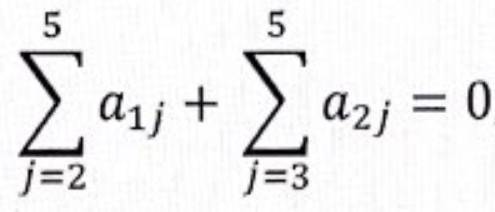
the 7 entries above sum to 0. we can write it as the eqn of a hyperplane with normal [1,1,1,1,1,1,1], which is 6 dimensional
 blissful vault
I really don't see it (highlighted part). Why is this useful? We can now write any vector in terms of the orthonormal basis, but I don't see why that is important. The next page is Gram-Schmidt Process. Linear Algebra Done Right btw.
 nocturne jewel
It gives an easier way to compute coordinate vectors
cause the ith component is just $\langle v,e_i\rangle$
stoic pythonBOT
Mosh
 nocturne jewel
so $v=[\langle v,e_n\rangle,...,\langle v,e_n\rangle]_B$ where $B:={e_1,...,e_n}$
stoic pythonBOT
Mosh
 nocturne jewel
whereas to write v wrt a non-orthonormal basis, it'd be harder to have a systematic way of computing the components
blissful vault
nocturne jewel
It gives an easier way to compute coordinate vectors
I had to chew on that. I think that makes sense. With a non-orthonormal basis, we don't have an easy way to write some vector in terms of it. With an orthonormal basis, we have a standard procedure.
nocturne jewel
yes
and that standard procedure is do a shit ton of inner products
which is usually actually easy to do
blissful vault
Got it. Thanks for the help.
 grim leaf
basically in the "vector space" sense, a "vector" is not necessarily a euclidian vector?
 nocturne jewel
yes
Vectors period are things that can be added together and scaled, and obey the axioms of vector spaces
to which R^n spaces are vector spaces
(assuming standard + and scaling)
 proud veldt
by decompose a positive definite Hermitian form into real and imaginary parts. How to show any two forms are equal if they have same imaginary part?
lavish jewel
you can use an empty set construction to show every element of it is linearly independent from all other matrices
i think that works, yeah


 zinc timber
lol

 lavish jewel
wikipedia has a very short snippet
An empty matrix is a matrix in which the number of rows or columns (or both) is zero.[73][74] Empty matrices help dealing with maps involving the zero vector space. For example, if A is a 3-by-0 matrix and B is a 0-by-3 matrix, then AB is the 3-by-3 zero matrix corresponding to the null map from a 3-dimensional space V to itself, while BA is a 0-by-0 matrix. There is no common notation for empty matrices, but most computer algebra systems allow creating and computing with them. The determinant of the 0-by-0 matrix is 1 as follows regarding the empty product occurring in the Leibniz formula for the determinant as 1. This value is also consistent with the fact that the identity map from any finite-dimensional space to itself has determinant 1, a fact that is often used as a part of the characterization of determinants.
lavish jewel
empty product 😌
zinc timber

lavish jewel
kinda like the 0 vector space being spanned by the empty set
zinc timber
ye
lavish jewel
i have never seen it used for interesting stuff though
zinc timber
interesting to philosophers
 languid sphinx
zinc timber
philosophers are like <:what:561568026210730004>
languid sphinx
zinc timber
philosophers are like <:what:561568026210730004>
Not really, just some extreme cases which either a) easy base case for induction or b) just for consideration of 'non-negative integers' vs 'strictly positive integers'
n=0 base case are even easier than n=1 base cases, if there is nothing to compute :D
I'm just asking to see because my primitives of the proof require 'linearly independent matrices' so I was wondering if empty matrix is part of it, if so it can be an example for the proof
zinc timber

lavish jewel
i don't think that makes much sense
the empty cases are vacuously true
even if the nonempty cases aren't
lavish jewel
we prove the matrix of all zeros is linearly independent (given some set, etc)
the base case of the empty matrix is obviously true
zinc timber
although idk if it affects the induction argument
lavish jewel
now let...
 frigid kettle

How come the 2nd question got an answer of 77mm. Can someone mind interpreting it?
teal grotto
zinc timber
although idk if it affects the induction argument
the n = 0 case doesn’t imply the n = 1 case here
frigid kettle
The question is,
A scene points at coordinates (400, 600, 1200) is respectively projected into an image at coordinates (24, 36) and the camera's principal point is at coordinates (0,0,f). Assuming the aspect ratio of the pixels in the camera is 1. What is the focal length of the camera?
frigid kettle
frigid kettle
The question is,
A scene points at coordinates (400, 600, 1200) is respectively...
How come the 2nd question got an answer of 77mm. Can someone mind interpreting it?
frigid kettle
Someone plz reply I'm desperately in need
lime zinc
How can i find the dimension of the space of linear operators on R^n , such that it maps v to w , where v and w are non zero vectors. Any hint? (By using operator form not matrix form)
lavish jewel
given nothing other than L:V->V, where V is R^n?
lime zinc
lavish jewel
given nothing other than L:V->V, where V is R^n?
just one thing more that linear operator maps v to w where v and w are non zero vectors
 dusky epoch
{A in L(V,V) | Av = w}
this?
and wym by using "operator form and not matrix form"?
lime zinc
dusky epoch
{A in L(V,V) | Av = w}
yes in mathematical form.
lavish jewel
so what i was gonna suggest was to pick a basis and then use matrices
but if i understood your question correctly, you want to talk of invertible matrices, which don't form a vector space
lime zinc
lavish jewel
but if i understood your question correctly, you want to talk of invertible matr...
but why?
dusky epoch
can i have an answer to my question
lime zinc
n^2-n
dusky epoch
no
lime zinc
dusky epoch
.
like writing it into matrix form
dusky epoch
so you reject any solution method that involves matrices or bases in any fashion?
lime zinc
dusky epoch
so you reject any solution method that involves matrices or bases in any fashion...
let me check question one more time.
dusky epoch
why not send the question here and let us see it for ourselves
 vocal isle
hey folks, I have 3 vectors in R3: n1, n2, n3. The values that make up n3 are given. I need to find n1 and n2. I know the following:
n1^T n3 = 0 (n1 is orthogonal to n3)
n2^T n3 = 0 (n2 is orthogonal to n3)
n1^T n2 = 0 (n1 is orthogonal to n2)
n1^T n1 = 1 (n1 is a unit vector)
n2^T n2 = 1 (n2 is a unit vector)
Now we have 5 equations and 6 unknowns which makes sense because there are an infinite number of basis vectors that are perpendicular to n3. However, I want to find just one solution by putting these equations in matrix [A]x = b form and solving using the pseudo inverse. In this case x would be in R6 and would be x = [n1;n2]
Can someone help me find the matrix [A] (5x6) and vector b (5x1) that does this?
spare widget
do you specifically need the pseudo-inverse solution or would any solution do?
because if any solution is fine then pick any vector that is non linearly dependent with n3
then orthonormalize it
and finally produce the other as the cross product of the two known ones
vocal isle
yes i need pseudo inverse sadly (long story)
spare widget
are numerical solutions ok?
if not then just do the SVD manually, or maybe using a symbolic solver
vocal isle
numerical solution is fine
(infact its preferred)
i'm intrigued by your idea of using the SVD. How do you expect that to work?
lavish jewel
this would be a lot easier if you just consider a basis for the plane orthogonal to n3
and then do gram schmidt
vocal isle
interesting!
I've never heard of gram schmidt, but it looks like it needs a matrix as an input. WHat matrix would that be?
lavish jewel
a matrix whose columns you want to make an orthonormal basis out of
the first column is kept as is, so you'd put n3 there
vocal isle
the only input info i have is n3 (3x1 vector)
lavish jewel
how do you know what pseudo inverses do if you don't know G-S
vocal isle
matlab has a pinv() function 😄
lavish jewel

if you know n3, you can make n2 by inspection
and n1 by taking their dot product
then all you need is to normalize n2 and n1
 vocal isle
lavish jewel
if you know n3, you can make n2 by inspection
vocal isle
lavish jewel
if you know n3, you can make n2 by inspection
i can do this by hand for some simple n3 vectors no problem
lavish jewel
and for complicated ones as well
vocal isle
but letting n1(3) = 1 for example, but i was hoping to code up a way to do this fo rany n3
lavish jewel
i think you have... bigger problems
vocal isle
if the determinat of the matrix is 0 it's not invertable
vocal isle
lavish jewel
i think you have... bigger problems
?
 amber osprey
Exercise 7.3. Let 𝑉 be the vector space, which consists of all differentiable functions 𝑓: [−1, 1] → ℝ. Which of the following quantities are subspaces of 𝑉?
(a) {𝑓 ∈ 𝑉 | 𝑓(0) = 0},
(b) {𝑓 ∈ 𝑉 | 𝑓(1) = 0},
(c) {𝑓 ∈ 𝑉 | 𝑓(−1) = 1},
(d) {𝑓 ∈ 𝑉 | 𝑓′(0) = 0}.
can someone throw me a bone
zinc timber
🦴
 lusty pumice
What does it mean for a set of vectors in a vector space to be closed ?
 subtle walrus
do you have more context?
lusty pumice
"The space of any finite set of vectors in a vector space is closed under addition and scalar multiplication"
But I don't know what it's referring to when it says closed
subtle walrus
a set is closed under addition/multiplication when those operations on the members of the set dont allow you to "leave" the set
so this is not true?
gray dust
is this the full question?
spare widget
vocal isle
but letting n1(3) = 1 for example, but i was hoping to code up a way to do this ...
It gives you one possible solution
 tough veldt
lusty pumice
but I have no idea what it was referring to
tough veldt
lusty pumice
but I have no idea what it was referring to
An operation is 'closed' within a set if that operation takes parameter(s) from the set as input and it output something that's also in that set.
You also say 'the set is closed under the operation' to mean the same thing
lusty pumice
gray dust
is this the full question?
Yeah
gray dust
lusty pumice
Yeah
do u have a pic
 royal tangle
Ty
amber osprey
zinc timber
🦴
very funny 
 icy blade

to do this, all i have to do is make a 3x3 matrix with them and if the det is not 0 they are linearly independent?
nocturne jewel
icy blade
to do this, all i have to do is make a 3x3 matrix with them and if the det is no...
That is sufficient yes
Since they are both TFAE statements that the matrix is invertible
 weary flare

just started learning lin alg on my own time and
im kinda confused on matrix multiplication
spare widget
$C_{ij} = \sum_{k=1}^{K}A_{ik}B_{kj}$
stoic pythonBOT
criver
 spare widget
What are you confused about?
weary flare
oh wait i think i figured it out
textbook that i was recommended was kinda confusing
spare widget
The definition or how one comes up with said definition
You can always try various textbooks
See which you like best for a specific topic
spare widget
idk about calc, but alongside analytic geometry it makes sense because you gain geometric intuition
As far as calc goes, probably makes sense studying it alongside mechanics
amber osprey
how do I take the gradient of this
 spare widget
amber osprey
how do I take the gradient of this
spare widget
amber osprey
how do I take the gradient of this
not #linear-algebra
but use the chain and product rules
amber osprey
it is literally an exercise in my linear alg course tho :/
spare widget
it's technically calculus
eitherway product and chain rule
Differentiate wrt a, then wrt b, then wrt c
spare widget
what is the definition of gradient?
spare widget
well look it up
spare widget

In vector calculus, the gradient of a scalar-valued differentiable function f of several variables is the vector field (or vector-valued function)
    ∇
    f


{\displaystyle \nabla f}
whose value at a point
    p


{\displaystyle p}
is the vector whose components are...

 spare widget
no
amber osprey
with the partial in b and c
spare widget
The gradient is a vector
what you wrote is a scalar
even provided you fix the db, dc
Look up the section I linked
spare widget
$\nabla f (p) = \begin{bmatrix} \frac{\partial f}{\partial x_1}(p)\ \ldots \ \frac{\partial f}{\partial x_n} (p) \end{bmatrix}$
stoic pythonBOT
criver
 spare widget
on your case p = (a,b,c), x_1 = a, x_2 = b, x_3 = c

 stoic pythonBOT
criver
 wintry steppe
amber osprey
wintry steppe
amber osprey
Why are you doing these additions tho?
amber osprey
yea that doesnt help me tho
spare widget
$\nabla f (p) = \begin{bmatrix} \frac{\partial f}{\partial x_1}(p)\ \ldots \ \frac{\partial f}{\partial x_n} (p) \end{bmatrix}$
wintry steppe
Yeah, you contrust a 3d vector
stoic pythonBOT
criver
 wintry steppe
Not do a summation
amber osprey
please remember I am not good at math telling me it is a vector does not help me
spare widget
amber osprey
yea that doesnt help me tho
Do you know how a R^3 vector looks like
spare widget
Ok, now instead of a,b,c put the partial derivatives there
wintry steppe
It's literally that
 wintry steppe
yeah
spare widget
lmao no
pdes means partial differetial equations
You need the product and chain rules
amber osprey
can you give me an example?
maybe for the first one

this is the chainrule right?
halcyon spindle
Yes.
spare widget
In this section we discuss one of the more useful and important differentiation formulas, The Chain Rule. With the chain rule in hand we will be able to differentiate a much wider variety of functions. As you will see throughout the rest of your Calculus courses a great many of derivatives you take will involve the chain rule!
amber osprey
y is the function f(a,b,c)?
spare widget
You should read a book or something
spare widget
It will be more productive
I don't think most people here will be willing to solve it for you, for didactic reasons
wintry steppe
amber osprey
I forgot
If you are already familiar with it, and you read it again, it will be easier to remember
halcyon spindle
amber osprey
I just want to know what is u and y here
Functions.
amber osprey
y is f(a,b,c)?
spare widget
ok, you want someone to spoon feed you the chain and product rule
amber osprey
telling me what y and u is, is spoon feeding?
wintry steppe
You can literally read the article that criver gave you in like, 5 minutes or so
spare widget
amber osprey
telling me what y and u is, is spoon feeding?
yes
amber osprey
ok 
wintry steppe
Read the article and if you have specific doubts we can help you to solve'em
 tired fossil
hey guys, does deta not equaling zero have something to do with this?

The determinant of A not being equal to zero
 restive raft
the fact the inverse exists is the important part

 frozen vigil
amber osprey
telling me what y and u is, is spoon feeding?
frozen vigil
amber osprey
telling me what y and u is, is spoon feeding?
suppose y=(x-1)^3
in this case
u=x-1
y=u^3
dy/dx=dy/du du/dx=d(u^3)/du d(x-1)/dx
frozen vigil
frozen vigil
dy/dx=dy/du du/dx=d(u^3)/du d(x-1)/dx
Something like this, maybe it help?
 oblique prairie
spare widget
https://tutorial.math.lamar.edu/Classes/CalcI/ChainRule.aspx
oblique prairie
spare widget
https://tutorial.math.lamar.edu/Classes/CalcI/ChainRule.aspx
@amber osprey just read this, it won’t take long and it will help
as long as you have some knowledge on derivatives that is
oblique prairie
also yeah people say you don’t need calculus for LA
but i sure do see a lot of calculus in my LA book
hoary void
what book
oblique prairie
linear algebra done wrong
hoary void
why wrong instead of right
oblique prairie
parody in a way
says in the first few pages
anyways this is kind of a discussion so 
#serious-discussion if you want

 native rampart
Is t supposed to be real?
icy blade
thats all the info i have sadly
stoic pythonBOT
Drink Drake
 native rampart
So pick $t_0, t_1$ such that
$t_0^2-t_1^2-a$ is negative
stoic pythonBOT
Drink Drake
 icy blade
why did you do (a+t)-(a+t)
icy blade
ok but what if i wanted to prove them seperately how would i proceed
native rampart
icy blade
why did you do (a+t)-(a+t)
If you are asking for motivation,we want to get a case where t^2 is negative
icy blade
i just dont understand for what values of t its not closed under vector addition
because a e R numbers so like how can it not be closed
native rampart
icy blade
i just dont understand for what values of t its not closed under vector addition
For all values of t,it will be in the set
But if t^2 were negative,there would be no such t
 native rampart
Oh wait t is a fixed constant,mb
native rampart
Set of reals
icy blade
ok nvm
so its still gonna be part of real numbers then
even if i mulitply by -1 or whatever
native rampart
$ca+ct^2=(ca+(c-1)t^2) + t^2$
stoic pythonBOT
Drink Drake
 nocturne jewel
@native rampart what are you even saying tbh
nocturne jewel
stoic python
**Drink Drake**
🤨
native rampart
Scalar multiplication will land you inside the set
nocturne jewel
No it wont
native rampart
Always
icy blade
so mosh what did you mean by If you add 2 elements, you dont get an element in V
native rampart
Ok,I am dumb
icy blade
me too bruh
native rampart
I was thinking t is a real variable
nocturne jewel
$a+t^2+b+t^2=a+b+2t^2$
stoic pythonBOT
Mosh
 icy blade
what does RHS mean
icy blade
why is it not part of V, how does what you wrote violated a e R
nocturne jewel
2 != 1
nocturne jewel
icy blade
why is it not part of V, how does what you wrote violated a e R
it.... doesn't?
a and b are real numbers
I just didn't feel the need to say that explicitly cause I'm implicitly taking polys from the set
icy blade
ok so what we have 2t instead of 1t what exactly does that change
icy blade
but why does it have to be 1 im so confused
icy blade
, shouldnt it be written on the right hand side then, it only tells us a e R
icy blade
i thought the right hand side was supposed to be like the rules for the set or something
nocturne jewel
if $a,b\in\mathbb{R}$, then $a+t^2\in V$ and $b+t^2\in V$
stoic pythonBOT
Mosh
 nocturne jewel
yes?
icy blade
yes
nocturne jewel
now $a+t^2+b+t^2=(a+b)+2t^2$
stoic pythonBOT
Mosh
 nocturne jewel
yes?
icy blade
yes
nocturne jewel
Now, does this match the form exactly as stuff in V?
Well, we check both terms
is a+b a real number?
icy blade
yes
icy blade
ok so basically if i got some stuff like this, after the va, sm it has to match the coefficients exactly
icy blade
ok but we dont have to match a,b because its said that it has to be real set
nocturne jewel
Now apply a similar process for scaling
icy blade
so like 2(a+t^2) = 2a which is part of a e R but 2t^2 does not match so its not closed under SM
stoic pythonBOT
Mosh
 icy blade
alright then, big brain stuff right here
nocturne jewel
$U:={a+ct^2|a,c\in\mathbb{R}}$ however, is a subspace of $\mathbb{R}[t]_{\leq 2}$
stoic pythonBOT
Mosh
 icy blade
still havent gotten the hang of subspaces yet but i will save that for later
nocturne jewel
It's just testing the 3 requirements
stoic pythonBOT
A brief description and guide on how to use me was sent to your DMs!
Please use ,list to see a list of all my commands, and ,help cmd to get detailed help on a command!

Wolfram Alpha doesn't understand your query!
Perhaps try rephrasing your question?
Click here to refine your query online
 Requested by Hack With Techno Boy#6902
dusky epoch
Requested by Hack With Techno Boy#6902
dusky epoch
wolfram alpha is not a do-your-homework tool
also your question isn't linear algebra
 timid hornet
dusky epoch
also your question isn't linear algebra
timid hornet
dusky epoch
also your question isn't linear algebra
hmm yea
timid hornet
dusky epoch
wolfram alpha is not a do-your-homework tool
:/ it is not my h.w.
it was a sample paper for iit enterance
spare widget
Does anyone have a suggestion for a numerical iterative method for quickly computing an underestimate of the smallest eigenvalue of a SPD matrix?
(I am aware of the power method, I would like something better)
 sudden stratus
Hi, I'm currently self-learning MIT's OCW linear algebra course and am pretty lost with one of their problem sets (here: https://ocw.mit.edu/courses/mathematics/18-06sc-linear-algebra-fall-2011/ax-b-and-the-four-subspaces/matrix-spaces-rank-1-small-world-graphs/MIT18_06SCF11_Ses1.11sol.pdf)
I was already having trouble understanding Problem 11.2b, but for part c) I completely don't understand how the dimension of the "column space" is 6. Could someone help derive this for me?
More importantly, I also don't get why the dimensions of the pseudo-"null space" and "column space" should add up to the dimension of the space of inputs to M. I suspect I'm lacking in some form of conceptual understanding...
lavish jewel
you need to take a step back
do you know what the dimension of a vector space is?
and have you seen the rank nullity theorem, or alternatively what strang calls the "fundamental theorem of linear algebra"
sudden stratus
I think I do. It's the number of elements in the basis?
sudden stratus
lavish jewel
and have you seen the rank nullity theorem, or alternatively what strang calls t...
the latter sounds familiar, but I can't recall it... I'll look it up!
lavish jewel
well, the column space is the vector space spanned by the columns of a matrix
so you can find its dimension by finding out how many lin indep columns a matrix has
sudden stratus
Right. The "column space" (in quotes, because even the question acknowledges it's not a real column space I think) that was derived in the earlier part of the question consisted of a matrix populated by variables, so I don't think I can do elimination to find the lin indep columns and thus the basis.
Besides, the matrix for the "column space" has 3 columns - so how can the dimension be 6?
Apologies for the long-windedness, and thanks for your input!!
lavish jewel
so
the formulation is a little tricky
you should instead think of it as some linear transformation T:V->V
where V is the vector space of 3x3 matrices
V has dimension 9
the transformation T:V->V is doing something to the matrices in V, and outputting only a subset of the matrices in V
presumably, this subset of V will be a subspace
if it helps you visualize it, you can treat the 3x3 matrices as vectors in R^9
then the transformation T:V->V in some basis is given by a 9x9 matrix
and the question involves the columns of this 9x9 matrix
not the columns of A
the reason they write "column space" is that they didn't give you any matrix
so they actually mean the image of the transformation $T: X \mapsto AX, ,, X \in \mathbb{R}^{3 \times 3}, ,, A = [...]$
the image and the kernel of T
stoic pythonBOT
Edd
 sudden stratus
Thank you so much for your response @lavish jewel! I took a while to digest it and had to do some googling here and there... but ultimately I think I get what you were trying to convey.
I really appreciate your help!!
vocal isle
 spare widget
vocal isle
spare widget
vocal isle
didn't we discuss that already
you can pick any orthonormal system with one of the vectors being n3
there are infinitely many such solutions
here's one possible solution with a numerically stable algorithm for computing it: https://jcgt.org/published/0006/01/01/
vocal isle
spare widget
here's one possible solution with a numerically stable algorithm for computing i...
Yep we did! And yes, I can absolutely do it this way. But I really want to find a linear algebra solution to this by solving for [Bt; n3t] [B n3 ] = I
spare widget
all of the suggested solutions are "linear algebra solutions"
vocal isle
and yes, you're right there's an infinite number of solutions (because there are an infinite number of paris n1 and n2 that are all orthogonal to each other and orthogonal to n3). But I only seek 1 (without preference). I'm really looking for a way to do this using linear algebra. I've already looked into Gram–Schmidt and that works as well once i define a set of linearly independant vectors n1 and n2
spare widget
But I only seek 1 (without preference).
did you read the paper I linked?
vocal isle
yes i have
spare widget
then you should be aware it gives you one solution
spare widget
Gram-Schmidt is linear algebra btw
vocal isle
and i was hoping specifically there would be a way of inverting B^T or something along those lines (using matrix algebra)
spare widget
I am unclear what linear algebra means for you, or what kind of solution you expect to get
spare widget
vocal isle
and i was hoping specifically there would be a way of inverting B^T or something...
there are infinitely many pseudo-inverses of it
that's the whole point of having infinitely many solutions
you can pick any solution (e.g. the one from the paper)
and produce any other by a rotation and potentially a reflection
vocal isle
ah yep, once you get n2 then you could easily multiply it by the rotation matrix about n3
and that would get you n1
spare widget
rather once you have n1 and n2
you can rotate bouth around n3
to get any other solution
spare widget
for solutions with different handedness you need a reflection too
vocal isle
vocal isle
let's say that the RHS of this equation wasn't the identity (but it was symmetric & positive definite). How could you solve for a solution of B?
in other words, i want to turn this isn't a complete abstract matrix algebra problem that has no connection to orthogonality
i'm looking for a proof something along hte lines of this (although it's problem statement is slightly different)
https://math.stackexchange.com/questions/2858299/solve-xtx-a-for-x

Mathematics Stack Exchange
How does one solve the equation
$$X^TX=A$$
for $X$ given $A$ is an $n×n$ matrix, $X$ is $m×n$, and $rank(A)<min(m,n)$?
I know this must be simple, but I have been wrestling with it for some t...
spare widget
you can do Cholesky for X^TX provided A is spd
lavish jewel
if A is symmetric, A = QDQ^T
then take the sqrt of each element in D
A = Q D^1/2 D^1/2 Q^T
then X^T = Q D^1/2
spare widget
won't this result in complex D^{1/2} in the general case?
vocal isle
and in the specific case where A = I then Q = I and D = I, right? So wont that mean that X = I ?
vocal isle
vocal isle
so is there a way i can solve for B using a similar method to the one you just used?
lavish jewel
oh, you know n3?
spare widget
it just shifts the problem to choosing a basis for the 0 eigenvalues
lavish jewel
you can make infinitely many solutions by picking n1 and n2 as an orthonormal basis for the plane orthogonal to n3
spare widget
you will have to make that choice regardless how you rewrite the problem
lavish jewel
yeah there is no unique way to do this
spare widget
if you add some additional constraint that is linearly independent then you can get a unique solution
it's what they implicitly do here: https://jcgt.org/published/0006/01/01/
it's also what you would do if you were to pick a vector linearly independent from n3 and applied Gram-Schmidt
then the remaining vector is defined up to sign
wintry steppe
what's the difference in "LA done right" "s.friedberg linear algebra" on the approach to the subject?
halcyon spindle
wintry steppe
what's the difference in "LA done right" "s.friedberg linear algebra" on the app...
I see friedberg as a more complete linear algebra book. Theory and computation where axler is just theory .
Also determinant is not done properly in axler from what I have heard.
Friedberg would be a better introduction to the subject than axler is what I am saying.
normal void
How do I show that $T(u+v)= T(u) + T(v)$ for an image convolution with a kernel?
stoic pythonBOT
FantaSkink


 lavish jewel
simple enough
you have your function defined for some input O
now substitute O = (U + V)
then distribute the omega term to both and split the sum
if you want something more esoteric, you can show that, after vectorizing the image O, the 2D convolution shown here is equivalent to multiplying a matrix with a 2 level block toeplitz structure
and matrix multiplication is linear
it might help to do it with a 1D case first, where the convolution is then represented by a toeplitz matrix without a block structure
 warm grotto

normal void
I'll try that, thanks man
 fallen karma
$||AB|| \leq ||A|| ||B||,$ where A and B are n-by-n matrices.
stoic pythonBOT
seth.delacroix
 fallen karma
Is there a way to do it in general, or can I pick a norm and then argue from equivalence of norms?
lavish jewel
these are operator norms?
induced by vector p norms, or?
because it's not true for some special norms like the max norm
lavish jewel
i think it's true for the norms induced by the p norms though
if you construct the operator norm as max_x norm(Ax) with norm(x) = 1, you can apply the definition twice
i.e. ABx, subs Bx = y and then apply the def to Ay, and then to Bx
 wind shore
so why is the answer E?

since i dont find any other vector that would also work, and i assume the 0 vector is also a scalar multiple of that vector
nocturne jewel
wind shore
since i dont find any other vector that would also work, and i assume the 0 vect...
0 is a scalar multiple of any vector
cause 0v=0
wind shore
nocturne jewel
0 is a scalar multiple of any vector
i agree. so why is E actually false?
nocturne jewel
Solve the system and find a basis for the kernel?
 novel marsh
How difficult is linear algebra to self teach with a prerequisite of calc 3?
hoary void
@oblique prairie
grim leaf
novel marsh
How difficult is linear algebra to self teach with a prerequisite of calc 3?
about as hard as any other math class tbh
if you've already learned calc 3 you've hopefully already touched on some linear algebra
like matrices and vector spaces and whatnot
novel marsh
How comprehensible are the concepts relative to calculus?
wind shore
nocturne jewel
Solve the system and find a basis for the kernel?
right which i think (-5,1,1,0) is the right vector, so E should not be false, so E is not the answer, but E is (nvm there is another vector that is part of the kernel that i overlooked, solved*)
 meager harness
<@&286206848099549185>

what i dont get is that there is supposed to be a matrix A that gets multiplied to f(t) and yields T(f(t)) but wouldnt there be t variables in there instead just a vector of constants f(a1) ... f(an)
teal grotto
no t is just a point in the domain of f. t is actually not necessary for this problem and only adds confusion.
gray dust
@meager harness we multiply the coordinate vector of f wrt the basis by A, not f itself
wintry steppe
For any transformation to be a projection, it just has to be endomorphic and idempotent right?
gray dust
@wintry steppe yes
wintry steppe
Thank you
tranquil steeple
wind shore
right which i think (-5,1,1,0) is the right vector, so E should not be false, so...
[-8,2,0,1]
 novel needle
Hi

what is the significance of k=/= i,j
wouldn't it be the same if it hadn't written k=/=i,j
stoic pythonBOT
Drink Drake
 novel needle
its the levi civita symbol
native rampart
Yea
novel needle
but then it says k=/= i,j doesn't that mean my i and j for each term has to be different ?
for example
novel needle
if i = 3 and j = 2
i would just get
e321e321+e322+e322+e323e323
here k = j
doesnt this violate k =/= i,j
native rampart
Yea,you skip cases of k where k is I or j
Something seems wrong with the equation you wrote
If i=j it's clearly wrong
And k!=i,j is not needed, because the term will reduce to 0 in those cases
$\sum_{k} \varepsilon_{ijk}^2 = 1, i≠j$
novel needle
native rampart
And k!=i,j is not needed, because the term will reduce to 0 in those cases
this i understand, i was just wondering what the significance of writing k=/= i, j is
stoic pythonBOT
Drink Drake
 native rampart
There's none
novel needle
mhmm i see thank you
native rampart
Where did you find this equation exactly
native rampart
stoic python
**Drink Drake**
This one seems like a cleaner version of your version
novel needle
i got this from a classical mech textbook
and physics textbooks usually make minor mistakes with math maybe
native rampart
Yea,or maybe the author didn't want students to expand terms that have j=k or i=k
Because they will reduce to 0 anyway
novel needle
yeah
native rampart
stoic python
**Drink Drake**
If you want a meaning for this(and hence your statement) this basically says if i and j are fixed different numbers, there's exactly one permutation as k varies over everything else
For example say i=2,j=3