#linear-algebra
2 messages · Page 284 of 1
 spare widget
 dusky epoch
am i the only one who has trouble understanding the answer options
spare widget
no, only 3 makes some sense as the question is asked
1 and 2 make no sense in the context of the sentence
 zinc timber
maybe AxB=0 is the option
spare widget
A x B = 0 means A,B are parallel, so it's still A= B = 0, so probably not it.
A dot B = 0 will work though for any A,B
Ah yeah, here we go
dusky epoch
zinc timber
maybe AxB=0 is the option
let OP tell us that
spare widget
$|A+B|^2 = |A|^2 + |B|^2 + 2(A \cdot B) = |A|^2 + |B|^2 - 2(A \cdot B) = |A-B|^2 \implies A\cdot B = 0$
zinc timber
yes
 stoic pythonBOT
criver
 spare widget
This tells you what. That only the diagonals of a rectangle can be of equal length I think
 stuck hornet
how to calculate basis of a matrix when eigenvalue is not given?
zinc timber
?
 night wren
Is V a subspace of V+W?
zinc timber
is {a,b} a subset of {a}?
night wren
not direct sum
zinc timber
my question still holds
zinc timber
night wren
Is V a subspace of V+W?
then you can try to answer it yourself
zinc timber
W a subspace of V?
night wren
V is a subspace of V+W
zinc timber
yes that's tivial
night wren
ur trivial
zinc timber
didn't you ask the 'other way around'?
 wintry steppe
I am not sure if this is the correct channel but I want to know about tensor analysis. I know fundamental linear algebra and up to undergrad engineering mathematics (computers). I want to know it through a book medium because I tend to not remember concepts well if I read it from a computer.
spare widget
wintry steppe
I am not sure if this is the correct channel but I want to know about tensor ana...
you can start with that, then you can try something more serious
it's fairly short
wintry steppe
thank you
 finite karma
I'm taking the eigendecomposition of a matrix and getting its transpose as a result
so decomposing X as ADA^T actually gives me X^T
is there some property of a matrix that might cause this?
the decomposition is in python btw, not manual
 finite karma
thats not the same
zinc timber
can you show your X
finite karma
yes, its
 zinc timber
that's not symmetric
finite karma
decomposition gives
 zinc timber
why are you doing ADA^T?
 finite karma
zinc timber
why are you doing ADA^T?
finite karma
zinc timber
why are you doing ADA^T?
 zinc timber
let me decompose my self
 lavish jewel
that sounds hilarious
zinc timber

first of all the matrix is not symmetric
so you shouldn't get a orthonormal basis to begin with
lavish jewel
the second matrix they sent is symmetric
but i still don't get which one they wanna evd
zinc timber
 finite karma
thx
zinc timber
lavish jewel
the second matrix they sent is symmetric
that was the result of ADA^T, which is supposed to be symmetric
finite karma
ive only been decomposing symmetric matrices as of late and brain farted lmao
lavish jewel
icic
 hardy inlet
we dont have to fully prove, only justify, but how do I explain this is false? (without determinants)
 dusky epoch
are you considering matrices over the real numbers or over the complex numbers?
@hardy inlet
idk if this is possible without invoking determinants though 
zinc timber
hardy inlet
we dont have to fully prove, only justify, but how do I explain this is false? (...
field is C?
hardy inlet
Its R or C
hardy inlet
i see
 hardy inlet
I just dont know how to do it without determinanta

I tried something like this earlier but its all borked
 hardy inlet
zinc timber
what do you see
hardy inlet
zinc timber
what do you see
oh, I meant "I see" why that works. Not that I see the matrix. latex isn't hard to read
 oblique prairie
in a basis, can one or more of the vectors be the zero vector?
 gray dust
@dusky epoch @hardy inlet doable w/o det, just tedious
gray dust
oblique prairie
in a basis, can one or more of the vectors be the zero vector?
this makes the set linearly dependent hence not a basis
oblique prairie
i’m trying to understand from ladw and i’m not really getting it, so do you mind briefly explaining why?
i’m trying my best lol
gray dust
whats ur def of linearly dependent
oblique prairie
oh shoot i just realized
because you can rearrange the term on one side
and make the zero vector = every other term
right?
and that would be a nontrivial combination
gray dust
whats ur def of linearly dependent
hardy inlet
gray dust
<@!183668144404037632> <@!205143587749494784> doable w/o det, just tedious
is what i did

oops latex error but ignore that lol
oblique prairie
gray dust
whats ur def of linearly dependent
a system is linearly dependent if the zero vector can be represented as a nontrivial linear combination
hardy inlet
correction*
 gray dust
hardy inlet
is what i did
gray dust
hardy inlet
is what i did
according to the logic theres a step implicitly done but not explicitly said which is bad
gray dust
whats x,y
 gray dust
oblique prairie
a system is linearly dependent if the zero vector can be represented as a nontri...
gray dust
oblique prairie
a system is linearly dependent if the zero vector can be represented as a nontri...
if a vector in a system is 0, assign it a nonzero weight
oblique prairie
what does that mean
gray dust
hardy inlet
better?
theres more
hardy inlet
 gray dust
theres some contradiction here
hardy inlet
yeah i misread the statement lol
zinc timber
you tricked me to give an answer
hardy inlet
no i
gray dust
we're assuming there exists an eigenvector (x,y)
zinc timber

hardy inlet
I thought it said there isn't a matrix
gray dust
and showing it has a nonreal eigenvalue
eigenvectors must be nonzero so theres another condition on x,y
namely x!=0 or y!=0
this is what allows u to divide by x,y in respective cases
 gray dust
not rly and its not equivalent to "or"
hardy inlet
ohhh ok
gray dust
(x,y) is nonzero if at least one of x,y is nonzero
hardy inlet
 gray dust
oblique prairie
what does that mean
gray dust
oblique prairie
what does that mean
when taking a linear combo, weight refers to the scalars put in front of each vector
my wording would go
suppose for sake of contradiction there exists an eigenvector v with a real eigenvalue lambda. it has the form v=(x,y) where x!=0 or y!=0
oblique prairie
ok i think i get it now thanks
gray dust
this has already been said
this makes the set linearly dependent hence not a basis
im using the given def of dependence to show WHY its dependent
hardy inlet
im having a brain fart. How do I get the eigenvector out of an eigenvalue
 molten pilot
are these typos or am I crazy?

 nocturne jewel
hardy inlet
im having a brain fart. How do I get the eigenvector out of an eigenvalue
nocturne jewel
hardy inlet
im having a brain fart. How do I get the eigenvector out of an eigenvalue
wdym?
you mean find the eigenspace?
hardy inlet
 nocturne jewel
there's not a lone eigenvector
hardy inlet
Is this good for the eigenpair 0, (0 1)
nocturne jewel
finding the 0-eigenspace is the same as finding ker(A-0I)=ker(A)
hardy inlet
Facts
nocturne jewel
but yes, your eigenspace is span([0,1]) in that case
since x=0 and y is free
so [x,y]=[0,y]=y[0,1]=span([0,1])
hardy inlet
i left out the eigenspace cause technically we haven't talked about those but I know what ur talking about yes

what does a Linear Operator T mean
 gray dust
@molten pilot kx already answered
molten pilot
he did the last 2 and then i noticed the first and I thought "maybe we're both crazy"
shouldn't that be just $\vec{x}$?
gray dust
molten pilot
shouldn't that be just $\vec{x}$?
yes
hardy inlet
So for this, my friend claims there are infinite subspaces because of the infinite scalar multiples; but I dont believe that. The eigenspace of the respective eigenvalues is a single subspace right; thats the definition of a subspace
 zinc timber
infinite eigen vectors, not subspaces
nocturne jewel
yes, eigenspace is a subspace
hardy inlet
ok thanks. I'll have to compute but there should be the spaces spanned by (1,0) and (0,1) right
idk if u guys can tell or not idk whats possible
but i assume its that cause its the mirror of that one example i had
nocturne jewel
there's at most 2 eigenspaces
hardy inlet
opposite of this right
 nocturne jewel
the 0-space and whatever else
nocturne jewel
hardy inlet
opposite of this right
that looks like nonsense given the question tbh
cause nowhere did you discuss sum of eigenvalues
hardy inlet
oops wait did i shit I hate latex one sec
thanks for pointing that out

was my answer for f tho. accidentally \include{blah.tex} on the wrong \item
 zinc timber
probably better would be to show that A-3I is non-singular
hardy inlet
uhh fancy words 😨
nocturne jewel
hardy inlet
I feel like this is just worded very poorly
pick u,v from the same eigenspace
QED cause they're in the same span
nocturne jewel
hardy inlet
was my answer for f tho. accidentally \include{blah.tex} on the wrong \item
yeah that's fine, could and should be flushed out though
Why can't a 2x2 matrix have 3 eigenvalues?
hardy inlet
yeah... im in a rush otherwise i'd flesh it out. Wait it can have 3??
nocturne jewel
If you're not gonna explicitly show the char poly
what?
when did I ever say that?
hardy inlet
"Why can't a 2x2 matrix have 3 eigenvalues?" implies the possibility that there may be 3
nocturne jewel
No
hardy inlet
ok so ur just saying I never proved it
nocturne jewel
You never gave justification that 1 and 2 were the only eigenvalues, no
brief comment on fundamental theorem of algebra is sufficient though
Like the only hole is "Why isn't 3 an eigenvalue?"
hardy inlet
is this correct enough
 zinc timber

hardy inlet
uh my friend said they got 3. (i got 4) am I wrong; are they wrong; or are we both wrong

Is the T(u) + T(w) \in U + W step justified by "the sum of subspaces" definition?

 wintry steppe
yes
hardy inlet
Ok thanks
zinc timber
hardy inlet
uh my friend said they got 3. (i got 4) am I wrong; are they wrong; or are we bo...
4 should be correct
hardy inlet
i think im slowly learning more
its painful; but im getting there
Is a reflection over x=y
T(x,y) = (y,x)
zinc timber
yes


 hollow finch
yeah thats good
for explicit clarity though, since its ambiguous here,
$A=\bigg[
\begin{array}{cc}
T(e_1)&T(e_2)
\end{array}
\bigg]$
assuming T(e1) and T(e2) are column vectors
o rip texit bot
 zinc timber
still offline?
hollow finch
guess so
zinc timber
sad
 outer goblet

so m equations and n unknowns means
m x n matrix
but rank m means that there are m unknowns
no?
hollow finch
number of columns is the number of unknowns
outer goblet
rank is the number of pivots
hollow finch
yes
hollow finch
if you mean row reduce, then no. the matrix stays the same size always.
but if you mean you start lobbing off and ignoring non pivot columns, then yeah it would be mxm i guess.
but we dont typically do that
outer goblet
but dimension of row space is m
hollow finch
yes that is true
 hollow finch
i think that means "range of the transformation given by the matrix A is F^m"
L_A is the notation for the transformation given by the matrix A iirc
hollow finch
F^m is basically the more general form of R^m. so yeah you can basically think of it as a column vector with m entries. rather than real numbers, though, the entries are the elements of some "field" F. the real numbers form a field.
outer goblet
ah okay thx
outer goblet
ye i got that
hardy inlet
Would this be a proof by contradiction?
 nocturne jewel
hardy inlet
Would this be a proof by contradiction?
nocturne jewel
hardy inlet
Would this be a proof by contradiction?
idk, try it and find out
hardy inlet
nocturne jewel
idk, try it and find out
good?

oops case 2*
gonna call 7 good; I've been dreading #6 though
 wintry steppe
T and S-1 T S have the same determinant, from there you can almost conclude
wintry steppe
hardy inlet
good?
also why would lambda = 0 imply z1 = 0 ?
hardy inlet
we cant use determinants
wintry steppe
oh alright

 nocturne jewel
 burnt hearth
heres my work and im pretty sure its yes but i cant put it into words
burnt hearth
heres my work and im pretty sure its yes but i cant put it into words
it's yes:
You can set the x component with ease, then pick the scalar for v_2 to fix the z component
burnt hearth
im not understanding the second part to fix the z component
nocturne jewel
[x1,0,x3]=[x1,0,2x1]+a[0,0,1]
@burnt hearth
you pick a to fix the fact the z component is 2x1 not x3
 brave cliff

How would I approach problem 3? I found the answer is no, and I believe it's bc it's no bc it doesn't cover non-integer values. However, while I can quickly glance and see that now, how would I mathematically prove that?
 quartz compass
you'd have to appeal to the list of axioms for a subspace, say which ones it fails in particular and why, which isn't too far off from what you've said
oblique prairie

i don’t really understand the highlighted part, can someone explain?
i’ve been thinking about it for a bit and i still don’t get it
wintry steppe
if you have a linear combination of v1 up to vp, you can express vk as a combination of the other ones to get a combination in terms of v1, ...., vp without vk
write it out
oblique prairie
ok
 trim galleon
let's say V={(1,0,0),(0,1,0),(0,0,1),(1,1,1)} with vj element of V, what would be vk here
oblique prairie
wintry steppe
if you have a linear combination of v1 up to vp, you can express vk as a combina...
i’m writing it out and i really don’t get it
i’m probably just doing it wrong
oblique prairie
trim galleon
let's say V={(1,0,0),(0,1,0),(0,0,1),(1,1,1)} with vj element of V, what would b...
i honestly don’t know sorry
trim galleon
is the set Lin. independent ?
gray dust
take any v in V
gray dust
write it as a combo of the v_j
wintry steppe
if $$v_k = \sum_{j \neq k} a_jv_j$$ then $$\sum_j b_jv_j = b_kv_k + \sum_{j\neq k}b_jv_j = \sum_{j \neq k}(b_ka_j + b_j)v_j$$
stoic pythonBOT
TTerra
 gray dust
write v_k as a combo of the other v_j
oblique prairie
trim galleon
let's say V={(1,0,0),(0,1,0),(0,0,1),(1,1,1)} with vj element of V, what would b...
oh shoot it’s v_4 = v_1+v_2+v_3 
 solid siren
donot bully the boi
trim galleon
so v_4 is the vector that makes the set linearly dependant right?
what happens if u remove the stupid annoying vector v_4
oblique prairie
it’s linearly dependent?
trim galleon
yes
oblique prairie
i am not sure really
trim galleon
so removing v4 u will get V={v1, v2, v3}
can any vj be a lin combination of other vj
oblique prairie
no
trim galleon
then the set became linearly in dependant
oblique prairie
why can you just remove v_4 though?
trim galleon
?
 lone arrow
if $v_n$ can be written as a linear combination of ${v_1, ..., v_{n-1}}$ then $v_n = b_1v_1 + \cdots + b_{n-1} v_{n-1}$, right?
stoic pythonBOT
∧res
 oblique prairie
yes ares
lone arrow
for some b_1, ... b_{n-1}
but then
$$a_1v_1 + a_2v_2 + \cdots + a_{n-1}v_{n-1} + a_n v_n = a_1v_1 + a_2v_2 + \cdots + a_{n-1}v_{n-1} + a_n (b_1 v_1 + \cdots + b_{n-1}v_{n-1}$$
stoic pythonBOT
∧res
 lone arrow
yikes
wintry steppe
sigma notation is a thing for a reason
lone arrow
yes
oblique prairie
but then
$a_1v_1 + a_2v_2 + \cdots + a_{n-1}v_{n-1} + a_n v_n = a_1v_1 + a_2v_2 + \cdots + a_{n-1}v_{n-1} + a_n (b_1 v_1 + \cdots + b_{n-1}v_{n-1}$
stoic pythonBOT
quantum
 lone arrow
i forgot a parentheses on the right, but anyway
lone arrow
the point is your thing is now written as a linear combination of the v_1,...v_{n-1}
so you didn't need v_n in the first place
oblique prairie
oh ok i think i get it now
i don’t know how to explain why i wasn’t getting it but i just wasn’t lol
thanks
lone arrow
lol np
oblique prairie

i’m not sure how to proceed, could someone help?
although i’m not really sure if i’m doing it correctly in the first place lol
 feral mountain
Don't assume the w's can be linearly combined to 0. The intuition is that they all lie on the same plane.
Instead find a linear combination of w's equal to 0
feral mountain
actually that equation that you get at the end will let you work it out
oblique prairie
wait don’t i kinda already have that
yeah
so what should i do next? other than maybe rephrase some stuff
feral mountain
find b's in terms of a's
wintry steppe
depending on what exactly your professor expects as an answer, you could provide a really simpler solution
 quaint pond
aye @feral mountain if you are good at linear can you look at my question in helpers
oblique prairie
wintry steppe
depending on what exactly your professor expects as an answer, you could provide...
i don’t have a professor, i’m doing this on my own time
what’s the easier way?
wintry steppe
oh alright
$dim(span({v1,v2,v3}) < 3$ and $w1,w2,w3 \in span({v1,v2,v3}) \implies w1,w2,w3$ are linearly dependent
stoic pythonBOT
Entelechy
 oblique prairie
unfortunately the book i’m using hasn’t taught that yet
wintry steppe
oh alright, do you understand it anyway ?
oblique prairie
no
quaint pond
Lol
wintry steppe
okay you'll come across these notations eventually, you can carry on your calculations 😛
quaint pond
Can you look at my question @wintry steppe
In helpers
Well it’s not actually a question
wintry steppe
okay I'll have a look
quaint pond
I need explanation to something
I didn’t understand the question at all
I tagged you @wintry steppe
oblique prairie
feral mountain
find b's in terms of a's
how exactly does the equation imply that $b_1+b_3=a_1$, $b_1+b_2=a_2$, $b_2+b_3=a_3$?
stoic pythonBOT
quantum
 quaint pond
Is that also linear algebra?
oblique prairie
yes
feral mountain
they could be unequal, but it suffices to find b in terms of a to satisfy those equations
quaint pond
I haven’t seen you in ages @feral mountain
feral mountain
yes recently I've felt like coming back on here
feral mountain
maybe, I gradually look through the help channels
@oblique prairie and after don't forget to notice that your b's can't be all 0
oblique prairie
feral mountain
<@!652336711325712386> and after don't forget to notice that your b's can't be a...
ok i got the bs in terms of as, how can i check to see that not all the bs are 0?
should i just set them all equal to 0 and see if the equation has a solution, knowing that no a can be 0?
stoic pythonBOT
@feral mountain
 oblique prairie
yeah i solved that already
oblique prairie
oblique prairie
should i just set them all equal to 0 and see if the equation has a solution, kn...
is that yeah a response to this?
feral mountain
yes
oblique prairie
ok
wintry steppe
Can i say that matrix of order n×n is invertible iff its rank is n ?
wintry steppe
Okay ty !
 fringe zodiac
Any ideas? I’m a bit lost here since A and B aren’t necessarily 0
 zinc timber
you are already given that A_iB=0 and these A_i forms a basis of W
dusky epoch
zinc timber
you are already given that A_iB=0 and these A_i forms a basis of W
you don't know that they form a basis nor do you need to
@fringe zodiac do you still need help with this?
zinc timber
true
 true jacinth
btw i never asked, should i ask set theory question here or is it not in linear algebra ?
dusky epoch
#discrete-math is better for that
true jacinth
ooh ok thx
wintry steppe
[Endomorphism’s reduction]
(for those interested and to exchange views about it)
Let f : ℝ —> ℂ be a bounded continuous function such that the space E = {Span(x —> f(x + k)) : k ∈ ℤ} is of finite dimension. What about f ?
wintry steppe
dusky epoch
do you mean "What can be said about f?"
Yes
dusky epoch
is this an assignment
 ebon raft
Consider the polynomial 𝑝 (𝑥) = 𝑎 + 𝑏𝑥 + 𝑐𝑥2. Set up a linear system of equations so that p passes through the last three data points. Solve the equation system using elementary row operations. Plot the result
time (min) 2,0 5,0 8,0 10,0 11,0
temp (◦C) 35,0 40,0 50,0 65,0 70,0
can someone help me start
wintry steppe
dusky epoch
is this an assignment
no, it's only to exchange views about it
(It’s an exercises that I have prepared during this year when we were on endomorphism’s reduction chapter and it’s an exercise extracted from ENS oral maths exam)
 distant wren

já tentei bastante mas não consigo encontrar o polinômio característico, alguém ajuda ?
wintry steppe
dusky epoch
my thought is that f is periodic with integer period
It’s a good intuition 😄, how did u think about that ? And can u write a proof for the case where dim(E)=1 and send it here ?
distant wren
lavish jewel
for 3x3 matrices, you can use sarrus rule
estou errando algum cálculo
dusky epoch
well if dim(E) = 1 then f satisfies f(x+1) = kf(x) for all x, and k not being a root of unity will make this function unbounded i think...
lavish jewel
in that case i don't know :x all i can say is to check it in wolfram or octave
wintry steppe
dusky epoch
well if dim(E) = 1 then f satisfies f(x+1) = kf(x) for all x, and k not being a ...
Yes, me I have this if dim(E)=1 :
Let g : x → f(x + 1). (f, g) is linked and f and g are nonzero (otherwise not interesting), so we can write g = μf for some real μ, then by induction we have f(x + k) = μ^{k}f(x) for any real x and any integer k, or by letting k tend to ±∞, |μ| = 1, and therefore f(x + 2) = μ^{2}f(x) = f(x) and finally f is 2-periodic.
wintry steppe
Now, we must study the general case 😄
 tacit dagger
https://www.youtube.com/watch?v=APKu4HOVrik at 2:18 doesn't "minimizing the quadratic" just simplify the expression and result with the same number? Also, any ideas how he got -b/2a? I'm generally confused by the steps to find dmin
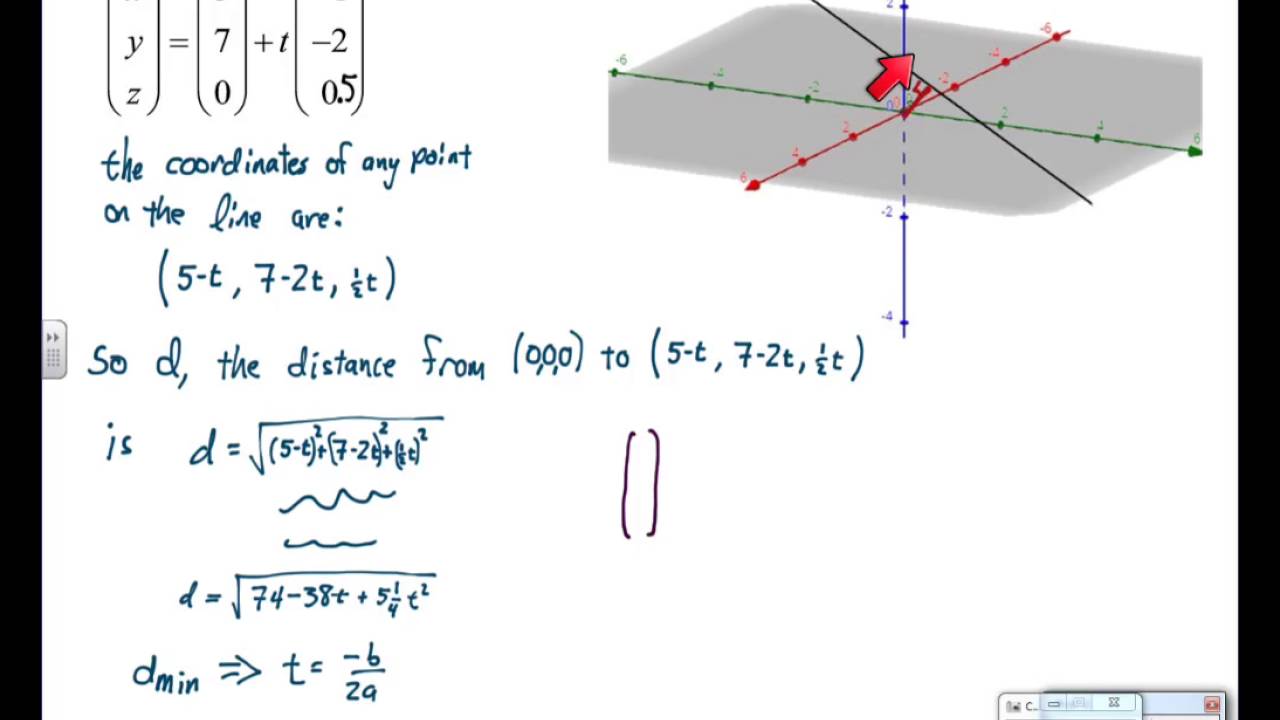
This video screencast was created with Doceri on an iPad. Doceri is free in the iTunes app store. Learn more at http://www.doceri.com
wintry steppe
How could I find the points P_1 found on line L_1 and P_2 found on L_2?
I have found the distance P_1P_2
Now I am supposed to use the fact that P_1P_2 is orthogonal to L_1 and L_2 to find points P_1 and P_2..
Any tips?
outer goblet

can some1 help me with e?
i found [T]_b by looking at the eigen values of T[e_n]
but idk how to find the actual basis
 quiet wren
Hey, quick question regarding ordering of PSD matrices
Suppose I have got this Hessian

and I restrict x1 and x2 as follows
 outer goblet
sorry server busy :(
quiet wren
outer goblet
sorry server busy :(
Whoever knows will reply. Regardless of my post
outer goblet
ok
zinc timber
@wintry steppe is question is not clear
zinc timber
outer goblet
wym by "eigen values of T[e_n]"?
outer goblet
like basis 1 0 0 , 0 x 0, 0 0 x^2
zinc timber
quiet wren
How can I justify the ordering in this case?
you mean elementwise order?
zinc timber
outer goblet
like basis 1 0 0 , 0 x 0, 0 0 x^2
pick the basis {1, x, x^2}
zinc timber
why are you calling it "eigen values"?
outer goblet
but not eigen vecters
cuz i found eigen values to this matrix
and tehy are correct
zinc timber
outer goblet
like basis 1 0 0 , 0 x 0, 0 0 x^2
these are the eigen vectors?
I didn't check

 zinc timber
ya you already have the eigen vectors, then pick those as the basis
i.e. {-1+x, x^2, 1+3x+8x^2}
alternatively you can also use "change of basis formula"
outer goblet
but this doesnt give me the correct [T]b
zinc timber
,w eigen value decompose {{1, 1, 0}, {3, 3, 0}, {4, 4, 2}}
stoic pythonBOT


 Requested by Ryuzaki#5323
zinc timber
Requested by Ryuzaki#5323
zinc timber

outer goblet
hahahaha
 wintry steppe
zinc timber
<@456226577798135808> is question is not clear
wintry steppe
zinc timber
<@456226577798135808> is question is not clear
i am supposed to determine the closests points on two lines
then i am supposed to use the relationship that P1P2 is orthogonal to both lines
 velvet moss
Think about projecting one line onto another
wintry steppe
If we have two vectors, v and u and w = av+ cu where c and a are real numbers, is it correct to state the following: "The value of v = A^{-1}w where A is a matrix" and that A has values ((v_x, vy), (u_x, u_y))?
Unsure how to write a matrix here, but (v_x, v_y) is the first columb and (u_x, u_y) is the second
wintry steppe
How can we find linearly independent vectors of a null space if we know the dimension and matrix representation of LT?
lavish jewel
extend the basis of the column space into a basis of the vector space V of which the columnspace is a subspace
wintry steppe
Okay
wintry steppe
lavish jewel
extend the basis of the column space into a basis of the vector space V of which...
Then i have to check its image under T is zero vector of codomain space right?
@lavish jewel
lavish jewel
mhm
wintry steppe
wintry steppe
Then i have to check its image under T is zero vector of codomain space right?
Is this correct?

Im trying to solve this que
wintry steppe
No
i just dont see how representing X^TX as Summation of x_i x_i ^T helps this proof
 wintry steppe
zinc timber
<#326138783181438976>
wintry steppe
zinc timber
<#326138783181438976>
this is a stats question?
i thought its linear algebra
 wintry steppe
ok pasted there thanks
 bold sun
hey i need some help with this proof q- i'm ever so stuck/confused

can some one plz help me out here- where would i even begin?
bold sun
anyone?
 blissful vault
6.a.13 in Linear Algebra Done Right. Is this talking about a general inner product or is it the usual dot product?
 spare widget
The usual dot product
spare widget
bold sun
can some one plz help me out here- where would i even begin?
you have the identity
$[v]_C = P [v]_B, , P^{-1}[v]_C = [v]_B$
stoic pythonBOT
criver
 spare widget
Let $[w]_B = A [v]_B$ then $PA [v]_B = P [w]_B = [w]_C$
stoic pythonBOT
criver
 blissful vault
spare widget
The usual dot product
blissful vault
spare widget
The usual dot product
I meant to write general inner product in R^2 vs usual dot product. How did you figure it was the usual dot product?
spare widget
Because they didn't specify a specific one
You can prove it for a general one if you want
Pick two basis vectors f1,f2
bold sun
umm we havent learnt dot product yett
spare widget
let their coordinates be defined wrt the canonical basis (1,0), (0,1)
Then form the metric tensor g_ij = fi dot fj
Then form the inner product <u,v> = g_ij u^i v^j
Where u and v are defined wrt the basis f
You can prove the same thing there too
So where was I at with 1u1's proof
$[w]_B = A [v]_B \implies PA [v]_B = P [w]_B = [w]_C \ DP [v]_B = D [v]_C = [w]_C \implies PA = DP$
stoic pythonBOT
criver
 spare widget
Then multiply both sides on the right by P^{-1}
bold sun
ooh ok that kind of makes sense but one question like how did you just come up with all of this like just by looking at it and how did you know oh let [w]b=A[v]b if you get me
bold sun
stoic python
**criver**
also here is this a definition or something
spare widget
I just picked an arbitrary element from V
bold sun
cuz you changed T to v
spare widget
And then I say w = T(v)
spare widget
The above doesn't hold for arbitrary A and D, the key part is that A = [T]_B, D = [T]_C
It's the same map
So if we say w = T(v)
Then this should hold regardless of the basis in which w and v areexpressed
So
$[w]_C = [T]_C [v]_C$ and $[w]_B = [T]_B [v]_B$
stoic pythonBOT
criver
 spare widget
You could also pretend that you are not given [T]_C at all, but rather that you want to find it
Then you would do:
$P^{-1}[w]_C = [w]_B = [T]_B [v]_B = [T]_B P^{-1}[v]_C \implies [w]_C = P [T]_B P^{-1} [v]_C \implies [T]_C = P [T]_B P^{-1}$
To me this feels a tad less tautological
stoic pythonBOT
criver
 spare widget
this tex bot refuses newlines for some reason
bold sun
lol ok that kindof makes more sense now just tryna get my head round it all fully
spare widget
The middle equality in the first expression is by definition of T_B
The left and right ones are by definition of the change of basis matrix P
Then you just multiply by P from the left
bold sun
spare widget
The middle equality in the first expression is by definition of T_B
you mean the one u did right at the beg the [v]_c=p[v]_b ?
bold sun
stoic python
**criver**
oh woops realised u were onnabout this one
ohh omg okk uno what i think im seeing it now-its making wayyy more sense
like thank you ever ever so much i appreciate it a lot honestly 🙂
i just need to do more practice tho on this topic too to fully get the hang of it all
 sick sandal
so i was struck yet again with an example against my intuition namely the decomposition of bilinear forms into symmetric and skew symmetric forms doesn't work in field of char=2 and i understand why but i have been seeing this char 2 field pattern much too often of things that simply work everywhere except there and my question is
why char 2 fields? is it just a coincidence? or am i missing something trivial about it
wintry steppe
because 1 + 1 = 0 messes a lot of things up
having 2 not be equal to zero is pretty nice
maybe there's a deep number theoretic reason with it being the only even prime
sick sandal
i suppose that would make sense
i just find it interesting how much difference it makes
wintry steppe
for your specific example, you could say that in characteristic two there's no difference between symmetry and skew symmetry
sick sandal
oh that makes more sense
i initially thought of how we usually prove it with $\frac{f(x,y)+f(y,x)}{2}+\frac{f(x,y)-f(y,x)}{2}$ where f is a bilinear form and realized we cant divide by 2 so it wont work tho now that im considering it it might not have been enough
stoic pythonBOT
James banash.
 sick sandal
but taking in my mind they're the same any non symmetric form wont be decomposed into there sum as it would be symmetric
cool
ty
 tired fossil
hello, just a quick quetsion, if dimension(kerT)=dimension(V), does it imply that kerT=V?
tired fossil
wintry steppe
this is true for any subspace, at least when V is finite dimensional
yes, it is to assume it is finite dimensional, thank you
also, another clarification, if V maps to W, W is a subset of V?
gray dust
wdym V maps to W
tired fossil
gray dust
wdym V maps to W
like V is the pre image of the transformation, sorry I am only using terminology from textbook
oblique prairie


why exactly do they define matrix vector multiplication like this? it seems like they just defined it as this random thing?
like why do they define Ax as T(x)?
gray dust
tired fossil
like V is the pre image of the transformation, sorry I am only using terminology...
V,W can be completely different spaces. one need not contain the other
tired fossil
gray dust
V,W can be completely different spaces. one need not contain the other
okay, that is why i had confusion, thank you so much
 halcyon spindle
oblique prairie
like why do they define Ax as T(x)?
halcyon spindle
oblique prairie
like why do they define Ax as T(x)?
For a linear map $T : V \implies W$, we want to find the image for a given x in V under T. If a finite basis for V is given, say $v_1,…,v_n$, we know any x in V can be represented as a LINEAR combination wrt to the basis. So x = $\sum_{k=1}^{n}a_kv_k$. Now T is LINEAR, so finding the image of x comes down to T(x) = T($\sum_{k=1}^{n}a_kv_k$) = $\sum_{k=1}^{n}a_kT(v_k)$. Amazing, all we need to know is see how T acts on the given basis to be able to find the image of x under T. So let $A = [T(v_1), …, T(v_n)]$ would be the matrix of T wrt to the given basis. So we just do define T(x) = Ax where Ax is defined as $\sum_{k=1}^{n}a_kT(v_k)$.
stoic pythonBOT
Plegasus
 halcyon spindle
Now if V = F^n and W = F^m, we have an mxn matrix and the so called matrix vector multiplication is just a linear combination as stated above.
 slow scroll
oblique prairie
why exactly do they define matrix vector multiplication like this? it seems like...
slow scroll
oblique prairie
why exactly do they define matrix vector multiplication like this? it seems like...
I can only echo what Pleg said here, but the idea is that this definition says that all of the information about a linear transformation is contained in the columns of its matrix representation, which tell you how the linear map acts on a basis.
This seems more natural than the "dot product of rows with columns" definition that is sometimes given anyway.
imo this is like one of the most important definitions in finite dimensional linear algebra.
also LADW very pog
slow scroll
i feel like it will probably seem less random as you go along
oblique prairie
i’ll just accept it as it is for now
halcyon spindle
why do you still see it as random?
 fallen karma
 slow scroll
i mean, if you have an arbitrary function R --> R, if I tell you what f(1) is, you have zero clue how to determine what f(x) is for arbitrary x. But if f is linear, f(1) completely determines f.
i.e. a single number determines an entire function R --> R between uncountable sets.
It is because of bases and linearity that linear transformations can be represented by finite arrays of numbers (in the finite dim setting).
I suppose the definition is "random" in the sense that we have chosen to represent the matrix as columns where a_k = T(e_1) instead of rows, or diagonals, or other arbitrary means. But with this definition, you can recover the usual "dot product of rows with columns" computational trick that you can't do if you chose to define matrix multiplication some other way.
halcyon spindle
Ah that is what they meant by random.
oblique prairie
halcyon spindle
why do you still see it as random?
i just don’t understand all this stuff very well yet
slow scroll
the big important part is that a linear transformation is determined by its action on a basis. The usefulness of that and the def of matrix multiplication will become more and more clear as you go along
tired fossil
I am having difficulty here, so, i am assuming i need to find that imT=0, but how would i do that?
 gray dust
why do u say imT={0}
gray dust
still, why?
tired fossil
because it tells me to use the dimension theorem, so that means that the nullity would be n or that the rank is 0
gray dust
if rank=0 then imT={0}. but recall how T is defined
tired fossil
by taking the transformation of p(x) if i am correct?
gray dust
sum of coeffs of p
gray dust
yes (u should show it), so its wrong to say imT={0}
tired fossil
gray dust
yes (u should show it), so its wrong to say imT={0}
so the dimension of the space itself must be n+1?
if i am correct here
gray dust
what space
tired fossil
Pn
gray dust
yes
tired fossil
ok, so that's where i am stuck, because i thought that it had a dimension of n which is why i was confused as to why i had dim(imT) of 1
but why would it be n+1?
gray dust
find a basis of P_n. count it
sick sandal
look at a simpler case seb
take n=1 or 2 for example
tired fossil
sick sandal
Pn means polynomials of degree n or less
i am having a monmet
isnt Pn= a_1+a_2x^1+...+anx^n-1?
if i am correct?
sick sandal
no
tired fossil
what am i missing here?
sick sandal
highest degree will be n
sick sandal
you're good
mistakes happen
tired fossil
im losthere, i know what is to be shown, but i dont even know how to start this proof
 lavish jewel
start by what it means for something to be in the null space of A
tired fossil
lavish jewel
start by what it means for something to be in the null space of A
Yes*, the basic solution
dusky epoch
how do you start a proof that one set is a subset of another?
tired fossil
dusky epoch
how do you start a proof that one set is a subset of another?
If it can be written as a linear combination of another
dusky epoch
no
there are multiple issues with that phrase, but what i was trying to appeal to is the basics of set theory
to prove A is a subset of B you prove that every element of A is also an element of B
 primal fable
If I'm in an algebraically closed field and M (square) is injective, is it true that M must be diagonizable?
i would imagine it would be since we do have (say n is the rank) n roots to the characteristic polynomial
preferably don't give me proof, I'm trying to figure it out myself, but I don't wanna go down a rabbit hole trying to prove something false
inb4 though
 lavish jewel
the answer is no
lavish jewel
what you wanna read about is defective matrices and jordan normal form
primal fable
oh man i think that might be over my head at this point 😅
spare widget
Is there anything that can be said about the inverse of a block matrix of the form
$M = \begin{bmatrix} A_0 & A_1^T & \ldots & A_m^T \ A_1 & 0 & \ldots & 0 \ \ldots & \ldots & \ldots & \ldots \ A_m & 0 & \ldots & 0 \end{bmatrix}$
stoic pythonBOT
criver
 spare widget
More specifically about the first block row of the inverse
Where A0 is not full rank
lavish jewel
if you assume the inverse exists and partition it into blocks of the same size as the A_i
hmm
consider a 3x3 block case first, for simplicity
$\begin{bmatrix} W_1 & W_2 & W_3 \
W_4 & W_5 & W_6 \
W_7 & W_8 & W_9 \end{bmatrix}
\begin{bmatrix} A_0 & A_1^T & A_2^T \
A_1 & 0 & 0 \
A_2 & 0 & 0 \end{bmatrix}
= \begin{bmatrix} I & 0 & 0 \
0 & I & 0 \
0 & 0 & I \end{bmatrix}$
stoic pythonBOT
Edd
 lavish jewel
then you get a couple of things that may or may not be useful
like W1A0 + W2A1 + W3A2 = I, W1A1^T = 0, W1A2^T = 0
spare widget
Yes, I did that part, unfortunately A0, A1, ..., A_m are not invertible
lavish jewel
do you know anything about the A_i? any symmetry?
spare widget
A0 is symmetric, the others not necessarily
spare widget
Yes, so it is a left inverse
lavish jewel
if it can exist in the first place, yea
lavish jewel
btw if A_i is not invertible, then M is not invertible
because you get linearly dependent columns
spare widget
Let me try to process that
lavish jewel
hmmm that's not what i mean, actually
spare widget
What if the A_i are not even square?
lavish jewel
what i mean is that A_i^T needs to have full column rank
and so the A_i have full row rank
except for A_0, all the other A_i^T need full column rank
spare widget
Full column or row rank?
spare widget
the A_i have full column rank yes, but not full row rank, I think there are 0 rows in the A_i if I didn't mess up something
spare widget
lavish jewel
except for A_0, all the other A_i^T need full column rank
How did you figure that out?
lavish jewel
you just look at the matrix and go "oh"
all of the columns past the block containing A0 are the same columns of the A_i^T, except padded with zeros
spare widget
Because you're looking out for 0 cols/rows?
spare widget
Ok I think I got what you mean
lavish jewel
and the columns here depend only on the columns of the A_i^T, because of the matrix structure
so if any A_i does not have full row rank, M is not invertible
spare widget
Ok let's assume they have full row rank I guess
If they don't I guess I get a singular matrix, have to think through this
lavish jewel
and you say A0 is symmetric, yeah?
spare widget
Yes, in fact it is positive semi-definite and has only one 0 eigenvalue corresponding to the eigenvector 1^T
i.e. it loses the mean value of input vectors
lavish jewel
ok
spare widget
at the outpit it cannot differentiate between vectors differing only by a constant
spare widget
lavish jewel
what i mean is that A_i^T needs to have full column rank
Just to make sure, you mean full column rank of [A1^T, ..., Am^T] as a whole
Otherwise I would get linearly dependent columns
That is, at most [A1^T,...,Am^T] can be square, num rows >= num cols must hold
lavish jewel
sure, but that also implies it for each one
spare widget
Sure, my point was that for each one is a weaker cond
lavish jewel
it's the same cond here
hmmm
i guess not
i guess this enforces some inequality between the number of blocks, the number of rows, and the number of columns
spare widget
and then there's some interplay in the A0 part but I let's leave that part alone for now
lavish jewel
these matrices have very few rows?
spare widget
Ai^T have very few columns
A lot of rows
So rows >= cols always holds for them taken together
lavish jewel
mhm
hmmm
yeah
well what i would do is consider a generic block inverse, call it W with blocks W_i
and WM = MW = I
and use both WM and MW to construct the blocks
many of the blocks should be pseudo inverses of the A_i
but something special should happen for the first block row and block column of W
spare widget
just taking the pseudoinverse ought to work?
lavish jewel
ought to work for what
spare widget
as in:
lavish jewel
whenever you have these expressions W4 A1^T = I and A1^T has full column rank, W4 is the pseudo inverse of A1^T from the left
lavish jewel
that's the very definition, isn't it?
spare widget
Amd the pseudo-inverse will exist as long as A1^T has full col rank
lavish jewel
you can construct it by taking the SVD of the A_i^T
spare widget
And similarly for right pseudo inverse and Ai
lavish jewel
mhm
the other thing i'm sure you're considering is that this matrix is the form of an outer product
there should be some way to exploit that
spare widget
lavish jewel
the other thing i'm sure you're considering is that this matrix is the form of a...
No, I hadn't thought of that
lavish jewel
you have a vector of block matrices, call it V
and your matrix M = VV^T
so i'm almost sure you can directly SVD the blocks of V to come up with something interesting
spare widget
yeah, Ive worked only with uu^T, I am not sure how that generalizes
But I get what you mean
lavish jewel
idk what exactly the better approach is off the top of my head, but i think this gives you something to play around with for a while
spare widget
Yes, thank you. I'll look into the details. This helped a lot.
lavish jewel
u doing data science or ML or something like that?
or maybe discretizing differential equations
spare widget
Yes it is from a PDE, although the only part that arose from a discretisation of a pde is A0, the rest arise from Lagrange multiplier constraints.
I looked deeper into the inverses, but unfortunately the moore-penrose one would not satisfy the first equation, so it's quite nasty in the sense that L also enters the W1, W2 etc terms. They get mixed.
 harsh pivot
 zinc timber
not linear algebra
wintry steppe
not linear algebra though it's correct
wintry steppe
( a + b )^2 = a^2 + b^2 + 2ab
( a - b )^2 = a^2 + b^2 - 2ab
( a * b )^2 = ( ab )^2
( a / b )^2 = ???
 restive raft

wintry steppe
sqrt( a / b )^2 = sqrt(x)
a/b=sqrt(x)
(a+b)^2 = a^2 + b^2
no
yes
(a+b)^2
same as (a+b)(a+b)
distribute
a*a=a^2
 spare socket
its not linear algebra what
spare socket
lmao
wintry steppe
ab + ba = 2ab
restive raft
get this rubbish out of here god damn
wintry steppe
b*b=b^2
restive raft
I think pre-school math is next door
spare socket

spare socket
dope
 tranquil steeple
wintry steppe
can i simplify that
tranquil steeple
wintry steppe
can i simplify that
go away
spare socket
ok
wintry steppe
because that wouldn't make any progression
i want to know if (a/b)^2 can be simplified
yes it can be
so i sqrt both
a^2/b^2
so a/b=sqrt(x)
mby take this dms
oblique prairie

what exactly does the book mean by this? like a complex number multiplied by a complex number?
idk i just don’t understand the question
wait maybe they mean T(x) = x(a+bi)
either way i wouldn’t mind further clarification just to be sure
wintry steppe
oblique prairie
wait maybe they mean T(x) = x(a+bi)
this is exactly what the book means
fallen karma
oblique prairie
Oh this is a very cool thing that has a great application in complex analysis.
stoic pythonBOT
moash

 subtle gust
plz ping when u reply
 wintry sphinx
subtle gust
is $$|A^n| = |A|^n?$$
wintry sphinx
subtle gust
is $$|A^n| = |A|^n?$$
well, first you have to define what matrix norm you're going to use
unless you mean entrywise absolute value?
subtle gust
wintry sphinx
well, first you have to define what matrix norm you're going to use
Ummm what?
I mean the determinant
My question basically is
Is det(A^n)== (det(A))^n
wintry sphinx
oh the determinant?
yeah it is
det(AB) = det A * det B
your equality immediately follows from this more general fact
tired fossil
sorry, i know i sent this yesterday, but a day later, i still don't understand this
 fallen karma
What direction do you want to do first
tired fossil
i really need help on how to start, because i can't evem figure out how to start this properly
tired fossil
fallen karma
What direction do you want to do first
colB subset of nullA
tired fossil
AB=0
fallen karma
Right. Do you recall that col B and range B are the same?
tired fossil
yes
fallen karma
So the way I'm thinking about it
Is that if I take a vector v, then Bv is in range B
But if it's in range B it's in col B
but if it's col B, then what?
tired fossil
then it is part of a set of linearly independent vectors?
tired fossil
then it is in nulla
fallen karma
if your in colB what other set are you in
yeah
And if Bv is in nullA, what is ABv=? for any v?
fallen karma
no
what does it mean to be in nullA
if a vector u is in nullA, then what does Au=?
tired fossil
=0
tired fossil
0
fallen karma
So it's true for any vector v that ABv=0, right?
If so, we say AB=0
see if you can get the other direction
tired fossil
with this question, i know we are trying to prove: f(x)=p(x+1)-p(x), but do i start with defining the transorfmation?

 fair plinth
Hi, could somebody remind please. I have an eigen value of multiplicity 3, I have found one eigenvector. How do I find the rest?
I have this formula: A h_2 = lambda h_2 + h_1 but I don't understand why it's true
(where h_1 is the eigenvector I found, h_2 is the second one, lambda is the eigenvalue for h_1)
sick sandal
look up generalized eigenvectors
fair plinth
Thanks
 grave kettle
how should i start learning linear algebra
sick sandal
grave kettle
how should i start learning linear algebra
mit has a full online course available for free with assignments ,videos and lecture notes tho you can always pick up a introductory level book and grind it out yourself
oblique prairie
 dusky epoch
is this your typesetting?
oblique prairie
so i know how to write what a linear transform from R to R would look like, just T(x) = ax, but idk what to do for a linear transform from R^2 to R^2
yeah
dusky epoch
may i suggest writing $\overset{?}{=}$ instead of $=?=$
stoic pythonBOT
Ann
 oblique prairie
yeah i guess i’ll do that next time, it was temporary anyways
oblique prairie
i know how to get the matrix for it, i was just trying to prove linearity
but idk how the function would look like exactly, if my wording makes any sense
like you know how a quadratic looks? i don’t know how this would look
stoic pythonBOT
Ann
 dusky epoch
$= (ax - by) + i(bx + ay)$
stoic pythonBOT
Ann
 oblique prairie
stoic python
**Ann**
oblique prairie
stoic python
**Ann**
so i guess just write T(x,y)^T = (ax-by,bx+ay)^T?
since i can’t work with imaginary numbers in this case
dusky epoch
sure you can
it's tantamount to just writing complex numbers directly in the basis {1,i} and not as coordinate columns
oblique prairie
ok thanks
 grave garden
Hii guys

Can you explain me with this hint using 3x3 matrix

I dun understand how they got it
grave garden
Ohhh
wintry steppe
How do I do the sum rule
zinc timber
?
grave kettle
where can i find good practice problems of linear algebra
zinc timber
textbooks
grave kettle
like?
zinc timber
I like Hoffman Kunge
subtle gust

all of those matrices are in REF right?
none are in RREF
ping if u reply plz. ty
oblique prairie
zinc timber
I like Hoffman Kunge
isn’t that like a really hard book
halcyon spindle
subtle gust
Look at the definition in your book/notes. However 2 of those are not in REF.
subtle gust
halcyon spindle
Look at the definition in your book/notes. However 2 of those are not in REF.
which ones...
they all seem to be in REF
zeros grouped at the bottom
leading entry is 1
and each leading one is to the right of the previous one
this is the def we have of REF in our book
halcyon spindle
As I stated before go to your notes for this. Or even google online for when a matrix is in REF.
It follows easily if you do.
subtle gust
halcyon spindle
As I stated before go to your notes for this. Or even google online for when a m...
yeah i was just checking .....
but which ones were u talking abt....
oh wait
nvm
halcyon spindle
subtle gust
zeros grouped at the bottom
You clearly said it here.
halcyon spindle
Yes.
spare widget
oblique prairie
isn’t that like a really hard book
It isn't. The right names are Hoffman and Kunze btw
halcyon spindle
Not linear algebra, try #prealg-and-algebra and google.
 maiden estuary
halcyon spindle
Not linear algebra, try <#326138737606262786> and google.
maiden estuary
halcyon spindle
Not linear algebra, try <#326138737606262786> and google.
Thank you, sorry btw
 rose pecan
can someone help me in arithmetic sequence?
 limber ginkgo
question:
If i have a matrix, and i map that into its normal form (jordan form) is that continuously invertible?
question is to prove a set of matrices is dense in L(R), but to change eigenvalues/determinants its easier to switch to its normal form
by continuously invertible i mean a homeomorphism
dont know if this goes here but alas
subtle gust
can anyone please explain how we can do this problem .....
 gray dust
@wintry steppe yes
wintry steppe
gray dust
<@456226577798135808> yes
thanks :)
subtle gust
subtle gust
can anyone please explain how we can do this problem .....
nvm
after hours of thinking what the hell i did wrong
and a few mental breakdowns
i realised i put 3 instead of -3 in the augmented matrix
linear algebra for me in a nutshell
i will respectfully go kms
peace y'all
 neon knoll
Hi there
How can you find a matrix which satisfies a already given kernel
in particular
 subtle gust
can anyone explain why this is false

 stoic pythonBOT
Potato

 haughty berry
grave garden
What notation does that $\mathbb{R}_n[X]$ mean ?
haughty berry
grave garden
What notation does that $\mathbb{R}_n[X]$ mean ?
It’s the set of all polynomials of degree n or lower over R
So like the set of polynomials in the form $\sum_{k=0}^n\alpha_k\cdot x^k$ where $\alpha_k\in\bR$
stoic pythonBOT
 haughty berry
(And the alphas can be 0, so the polynomial doesn’t necessarily have to have a degree of n, it can be less than n)
subtle gust
ay slurp
haughty berry
subtle gust
can anyone explain why this is false
Take the most simple case where the matrix is 0. So let’s say you want to solve
Ax = b
Where b isn’t 0, so you get
0x = b
0 = b
Which is a contradiction, so there is no solution
grave garden
haughty berry
So like the set of polynomials in the form $\sum_{k=0}^n\alpha_k\cdot x^k$ where...
I see thanks !
haughty berry
And the RREF of 0 is just 0, so it obviously has a row of zeros, but no solutions (this not infinite solutions)
subtle gust
haughty berry
And the RREF of 0 is just 0, so it obviously has a row of zeros, but no solution...
i see
it seems a bit contradictory tho
subtle gust
subtle gust
it seems a bit contradictory tho
to what i saw in class
i was told if the last row is all zeros then the system has inf many solutions
haughty berry
subtle gust
i was told if the last row is all zeros then the system has inf many solutions
This is false. It either has infinite or no solutions
In the case where it’s a homogeneous set of equations (so Ax=0) then no matter what it has infinite
subtle gust
haughty berry
This is false. It either has infinite or no solutions
i think they assumed the other rows are non zero
subtle gust
like
if the last row is zero
and the other rows are non zero
wouldn't this mean the system has inf many solutions
subtle gust
oh
subtle gust
haughty berry
In the case where it’s a homogeneous set of equations (so Ax=0) then no matter w...
yeah cuz the augmented matrix wouldn't be invertible
haughty berry
[ \begin{pmatrix} 1 & 0 \ 0 & 0 \end{pmatrix}\cdot x = \begin{pmatrix} 1\1\end{pmatrix} ]
stoic pythonBOT
 subtle gust
stoic python
subtle gust
stoic python
ummm aren't we supposed to include the right side in the augmented matrix?.....
like this would actually be
[ \begin{pmatrix} 1 & 0 & 1\ 0 & 0 & 1\end{pmatrix}]
stoic pythonBOT
moash
Compile Error! Click the  reaction for more information.
(You may edit your message to recompile.)
 haughty berry
Oh well if you’re referring to the augmented matrix as a whole, then yes, if a row has all 0s including the column to the right, then it does have infinite solutions
But
subtle gust
1 0 1
0 0 1
and therefore the last row would correspond to 0=1
and that's why it has no solutions
but if it were for ex
haughty berry
subtle gust
can anyone explain why this is false
This is also false because you could have something like
0 0 | 1
0 0 | 0
subtle gust
haughty berry
This is also false because you could have something like
0 0 | 1
0 0 | 0
oh
hmmmm
haughty berry
Yeah so sorry about above, I kinda just forgot what is meant by an augmented matrix 
subtle gust
haughty berry
Yeah so sorry about above, I kinda just forgot what is meant by an augmented mat...
np lol i have a midterm exam in 2 days and i barely know anything ❤️
oh lol
just saw an example of what u were saying in my prof's notes
interesting
 haughty berry
subtle gust
np lol i have a midterm exam in 2 days and i barely know anything ❤️
haughty berry
subtle gust
np lol i have a midterm exam in 2 days and i barely know anything ❤️
Good luck!
haughty berry
subtle gust
can we find a general formula for the determinant of the inverse of a matrix A in terms of the determinant of matrix A?
$A^-1=(1/det(A)) adj(A)$
stoic pythonBOT
moash
 halcyon spindle
subtle gust
can we find a general formula for the determinant of the inverse of a matrix A i...
halcyon spindle
subtle gust
can we find a general formula for the determinant of the inverse of a matrix A i...
det(A) = 1/det(A^-1).
subtle gust
$det(A^-1)=det(1/det(A))adj(A))$
stoic pythonBOT
moash
