
#linear-algebra
2 messages · Page 278 of 1
 stoic pythonBOT
 hardy inlet
Does the range of a matrix mean the set of all vectors that can be made from multiplying M by a column vector v?
something like this, but for a specific 4x4?

 gray dust
hardy inlet
Does the range of a matrix mean the set of all vectors that can be made from mul...
gray dust
hardy inlet
Does the range of a matrix mean the set of all vectors that can be made from mul...
yes
hardy inlet
Would this be correct?
 hardy inlet
Would this be correct?
hardy inlet
hardy inlet
Would this be correct?
this
 gray dust
hardy inlet
this
gray dust
hardy inlet
this
mostly. theres some bad notation
gray dust
rangeM is the set of all those products as a,b,c,d vary over real values
$\brc{M(a,b,c,d)^T:a,b,c,d\in\bR}$
stoic pythonBOT
RokabeJintaro
 hardy inlet
i sorta just moved it to a different spot, this good?
 gray dust
no, it completely ignores what i said about notation
rangeM is the set of all those products as a,b,c,d vary over real values
rangeM is the set written above
gray dust
is what i said about notation clear?
hardy inlet
no i meant this guy posted a grabify link that doesn't even have the domain changed
gray dust
its harmless
hardy inlet
is it not an ip grabber?
gray dust
ah yes i blanked. theyre banned
hardy inlet
anyways i sorta rearranged it but idk if I need to change part of my equation to reflect the definition
 gray dust
no rangeM is a set not a vector. ur notation suggests its a vector
the braces must be there each step to denote a set
hardy inlet
hmm i see
 gray dust
hardy inlet
gray dust
hardy inlet
ye. just make the R boldface
hardy inlet
these little ones that I just realized, or even the \mathbb{R}'s
 gray dust
make em mathbb
hardy inlet
is there a reason to use bf over bb

i just use the classic \newcommand{\R}{\mathbb{R}} and forgot to type the \ in the previous pictures
gray dust
mb by boldface i meant blackboard
hardy inlet
omg thats what that means lol
ik cal is caligraphy but didn't know blackboard
makes sense
 crystal mauve
helo guyss
hardy inlet
so where can I find that definition of rangeM because I dont see it in sheldon axlers book
crystal mauve
could anyone help me with this ex
 gray dust
its rly just from definition of range of function
gray dust
gray dust
its rly just from definition of range of function
the set of f(x) for all x in the domain
so (by viewing matrices as linear maps) rangeM is the set of Mv for all vectors v
crystal mauve
crystal mauve
could anyone help me with this ex
.
hardy inlet
im slightly confused by the notation in the stated problem not being the transposed row
 gray dust
its common to swap between writing vectors as tuples & columns
gray dust
then the matrix multiplication technically doesnt make sense
 wicked palm
you could write it as a row vector but move it over to the left of the matrix
then the result would be a row vector and you wouldn't need your transposes
gray dust
@wicked palm no
hardy inlet
so does this have a problem

oops i see a glaring problem that I don't have M on my second line
gray dust
no other than missing M
hardy inlet
oh wait the M doesn't need to be there
because that was solved for
its {(a,b,a,b)...} not {(a,b,c,d)...}
wicked palm
gray dust
<@!233993116418441216> no
why not? just transpose M and it works I think
gray dust
wicked palm
why not? just transpose M and it works I think
taking M^T works but maps are usually enacted as left-multiplying matrices so no
hardy inlet
the prof said my original 1 line equality was fine (the one with range not being a set). But Ive asked him if its supposed to be the transposes
since the question doesn't say the transposes
but Mv is a column so
gray dust
tranposes shouldnt get in the way of understanding
a vector in R^n is precisely that whether its written as a row or column
hardy inlet
well i definitely feel like i understand teh problem better now
cause i didn't think of it as a set before
even though I literally made it a set when it was a map lol

 peak plinth

Would this be a valid solution
I solved for the plane then made random coefficients and vectors to equal it
 nocturne jewel
peak plinth
Would this be a valid solution
nocturne jewel
peak plinth
Would this be a valid solution
I don't think that'd guarantee hold for other points
Hint: Find 3 points on the plane and 2 vectors on the plane
hardy inlet
i am convinced that this is true but I dont know how to even begin to show it. if dim range T=1 then only one element is nonzero right? (i dont think thats right.) And if you do T(....nonzero....) you get an output thats a1v1 a2v2... anvn, but all but one a_i is zero so its just scaled by a_i? 
 nocturne jewel
dimT doesn't make sense
 fallen karma
hardy inlet
i am convinced that this is true but I dont know how to even begin to show it. i...
fallen karma
hardy inlet
i am convinced that this is true but I dont know how to even begin to show it. i...
Explain why Tv=cv_i for some scalar c and vector v_i in V.
hardy inlet
nocturne jewel
dimT doesn't make sense
dim range T = 1*
hardy inlet
fallen karma
Explain why Tv=cv_i for some scalar c and vector v_i in V.
i suppose you moved the c into the transofrmation
T(Tv) = cTv
T(Tv) = T(cv)
implieis Tv = cv
nocturne jewel
T isn't injective
hardy inlet
darnit ur right
nocturne jewel
Hint: $T[v]\in Im(T)$
stoic pythonBOT
Mosh
 hardy inlet
Whats Im
nocturne jewel
Image
hardy inlet
T^{-1}?
stoic pythonBOT
Mosh
 hardy inlet
$Tv \in \operatorname{range}T = \operatorname{span}w = {aw : a \in \mathbf{R}}$
stoic pythonBOT
MattDog_222
 nocturne jewel
yep
so that means there exists a in K (we don't know what scalar field V acts over) such that T[v]=aw
hardy inlet
for the purpose of our class $\mathbb{F} \equiv \mathbb{C} \lor \mathbb{F} \equiv \mathbb{R}$
nocturne jewel
Ok, so you should still be using/saying F
stoic pythonBOT
MattDog_222
 nocturne jewel
cause F is generic scalar field
hardy inlet
ah yes i shall edit that
nocturne jewel
ie saying a in R is a loss of generality
nocturne jewel
but yeah, if dim(Im(T))=1, then there exists w in V such that Im(T)=span(w) since Im(T) is a subspace
(Ie, you just pick a basis for the image)
hardy inlet
i've got to tie in my equation thingy here in a minute, but do I need to include its a subspace or is saying the basis contains one element, and we'll call it w etc etc

rangeT = span w*
should i use a different letter than a? c is reserved for the result/conclusion
maybe r or s?
hardy inlet
i changed to alpha lol. "aw" didn't feel like a vector but αw does
 hardy inlet
is there a way to tag an equation in latex, basically the opposite of \notag
like put an (a) here or something
 nocturne jewel
No clue, however I'd say something like $T[T[v]]=T[bw]$ cause alpha is playing the role of scalar in the definition
stoic pythonBOT
Mosh
 nocturne jewel
or frankly you don't even need to explicitly say span(w) is that
hardy inlet
idk i think it helps with clarity. but ye i'll either use alpha beta c or a b c
 velvet cosmos
how do you know if something is onto and when something is one to one
wicked palm
if the image of the domain is the codomain and if f(x) = f(y) => x = y respectively
hardy inlet
Tw is also in w right, so do I said (beta gamma w_2) or somethiing

 spiral otter
What is W?
 hardy inlet
$W=\operatorname{span}\left{\begin{pmatrix}
1\
0\
-2
\end{pmatrix}
,;\begin{pmatrix}
0\
3\
6
\end{pmatrix},;\begin{pmatrix}
-4\
2\
3
\end{pmatrix}\right}$
stoic pythonBOT
MattDog_222
 hardy inlet
nocturne jewel
well anyway, it's pretty straight forward how to proceed
hardy inlet
nocturne jewel
well anyway, it's pretty straight forward how to proceed
sorry to @ but is this proper now. and should i handle the c \equiv gamma how I did, I shouldn't have c in the \align right?
 nocturne jewel
I mean it looks fine
You've shown there's a scalar in F st T^2=cT
Doesn't matter what the scalar name is
hardy inlet
oops I just realized I brushed Tw = aw under the rug
i think ima make a (4.11) that says Tw \in span w
peak plinth
@nocturne jewel
hardy inlet

 nocturne jewel
hardy inlet
nocturne jewel
hardy inlet
You're being redundant now
Once you said Im(T)=span w once, you don't need to again
hardy inlet
ok
nocturne jewel
Since Im is that, there exists a and b st Tv=aw and Tw=bw
hardy inlet
and did i need to define v\inV?
nocturne jewel
Well duh
hardy inlet
(oops i forgot xD)
nocturne jewel
You need to define anything you use
Fix v in V.
Then define w when you say Im is span
Then define a and b when you comment on Tv and Tw
hardy inlet
u mean like comment a and b (beta gamma) here?
 nocturne jewel
No
Personal opinion: Define what you will use in a computation in a systematic logical manner
Do the computation
Conclude
hardy inlet
define a like this? Sorry i'm confused on the fine details
 hardy inlet
nocturne jewel
T isn't injective
hardy inlet
nocturne jewel
T isn't injective
did my proof just fall apart D:
 nocturne jewel
No..
Like what I said
There exists a and b in F st Tv=aw and Tw=bw
Then T^2v=T(aw)=abw=b(aw)=bTv
hardy inlet
oh i see so the proof survives 😅
nocturne jewel
Cause you currently have random scalars appearing, which reads poorly imo
hardy inlet
nocturne jewel
Cause you currently have random scalars appearing, which reads poorly imo
agreed
 compact fractal
broooooo who knows how to do grade 8 math i ahve been stuck on this question forever. I need to find a formula for this
 compact fractal
what the heck
 limber sierra
this isnt linear algebra
compact fractal
my fault sry
hardy inlet
use a regular help-xx chanel
nocturne jewel
Not even a linear relationship
compact fractal
MY FUALT
compact fractal
hardy inlet
n(n+1)/2
bro thank u so much my friends and I were struggling
hardy inlet
n = # of flavors. not sure why you're supposed to know that formula in 8th grade lol. but i digress
 mystic frigate
can you do LDU decomposition if there's a diagonal entry that will equal zero
 wispy pewter
can you use linear in partial fraction decomp to find the coefficients ?
hardy inlet
Im confused what this is saying sorta


like do I not wrote the x x^2 x^3 in the basis and instead 1 1 1 1 = 1 2 3 and given the ordered basis 1, x, x² it equals (1, 2x, 3x²)? feels fuzzy
limber sierra
thats not exactly how bases work here
the vector in R that corresponds to the polynomial 1 + x + x^2 + x^3 is the vector [1, 1, 1, 1]
in general, a + bx + cx^2 + dx^3 is representtd by [a, b, c, d]
not [a, bx, cx^2, dx^3] (this isnt even a single vector in R!)
so your multiplication should look like

and [1, 2, 3] as an R^3 vector corresponds to the P_2(R) vector 1 + 2x + 3x^2 as expected.
does that make sense? @hardy inlet
hardy inlet
this?
 limber sierra
sure?
thats not exactly the computation you had before but yeah thats correct
well idk what the part in red means
"for"?
hardy inlet
the ordered basis
1, x, x²
$(1,1,1,1)$ of $x^0, x^1, x^2, x^3$ goes to $(1,2,3)$ of $x^0, x^1, x^2$
stoic pythonBOT
MattDog_222
 limber sierra
if you sum up the derivatives of 1, x, x^2, and x^3, you get 1 + 2x + 3x^2
thats what you did, you just wrote these in a different representation
as vectors of coefficients rather than as polynomials
right, thats the ideaa
hardy inlet
so basically i gotta reverse engineer this transformation matrix

and i wanted to try and understand how given a basis u get to the matrix
so I can undo it

 modern palm
what did u do
hardy inlet
do u know how to row reduce a matrix*
 wintry steppe
yeah but like this scalar part
is confusing me
can you provide me the answer
because i have 8 mins
hardy inlet
do u know RREF
wintry steppe
yeah
hardy inlet
make ur columns ur variables, augmented with the nonhomogeneous set of solutions
wintry steppe
but can you explain after giving me the answer real quick just cuz of times sake
hardy inlet
Sounds like a quiz/test to me
hardy inlet
why'd u wait till the last second to start it
modern palm
you essentially have 3 equations and 2 variables to solve for

 wintry steppe
I got it thanks
hardy inlet
👍
take it as a lesson to not procrastinate :P
overstresses you and you dont learn as much and it makes the assignment harder
critical thinking skills go ⬇️ when the brains under stress

im trying to think if P_3(R) makes sense or if it should be the reciprocals
Not sure, still runs under the previous assumptions
 hardy inlet
this feels like slop. looking for input
 modern palm
ohh I had the exact problem last semester in a test
 slow scroll
hardy inlet
this feels like slop. looking for input
slow scroll
hardy inlet
this feels like slop. looking for input
i think its fine. All you really have to do in a solution is present the bases, and show that the matrix representation for differentiation has the form you want
hardy inlet
i think the better way is this
 hardy inlet
this feels like slop. looking for input
hardy inlet
hardy inlet
this feels like slop. looking for input
i think this (this post) is a much better result than #5 (hyperlink)

 lavish jewel
looks ok, but you chose the P_4(R) basis before writing the outputs of the transformation
so you should swap the middle part with the first part
nope nvm, it's too early for me and my head is fried
hardy inlet
i redid 5 with a similar thing, but had to do some slop with preimages still
 lavish jewel
looks good
i just wonder when it says two new bases, does it want you to do the same again but fixing a basis for p3 first this time
hardy inlet
i mean example 3.34 had a different basis so i think im fine; but yeah i'll try and remember to ask the teacher
i did this backwards
I think its wrong

or maybe i messed up the numbers in the example
lavish jewel
hmm?
hardy inlet
if i have 75x² how do i put that in the transformation matrix, as 150 or 37.5
lavish jewel
37.5 seems right
hardy inlet
well then thats not the derivative
so idk if i defined it wrong or I am not putting the value in correctly
lavish jewel
which example are you working with?
hardy inlet
hardy inlet
I think its wrong
6x^3 + 75x^2 + 4x + pi
also i added an extra row of zeroes on accident there, its only 3 rows tall
hardy inlet
and im falling asleep lol
lavish jewel
what you can do to double check is put your basis as columns of a matrix
and multiply that by a vector with the coordinates in that basis
the result should be in the canonical basis
this allows you to double check whether you are expressing the vector correctly in the new basis
hardy inlet
words
lavish jewel
in this case, for example, x^2/2 is the basis element and 150 is its coordinate
and their product is 75x^2, which is the original vector in the canonical basis
so that checks out
hardy inlet

which makes sense sorta. its a little bass ackwards but
$A(1,1,1,1) = A(x + 1 \cdot \frac{x^2}{2} + 1\cdot \frac{x^3}{3} + 1 \cdot \pi) = \frac{d}{dx}(x + 1 \cdot \frac{x^2}{2} + 1\cdot \frac{x^3}{3} + 1 \cdot \pi) = 1 + x + x²$ true
stoic pythonBOT
MattDog_222
 lavish jewel
if it helps you, this is the same as letting the matrix D act on the canonical basis, but first doing a permutation and scaling (the one i mentioned earlier). this can be interpreted either as a new transformation acting on the canonical basis, which should be the original matrix for differentiation, or a new transformation that acts on the new basis. under an appropriate change of basis, they should be equivalent
so something like DB^-1


 grave garden
Ohh

 dusky epoch
why did you think it was LD?
peak plinth
I thought since there is a free variable
It’s LD
I’ve never dealt with R4 3 vectors before
dusky epoch
wait hold on
where did this matrix even come from in the first place
i think you may have been checking linear independence for the wrong set of vectors
peak plinth
I row reduced the matrix I made of the Vs
I did
1 2 -1 1 | 0
2 3 4 0 | 0
-1 -1 2 1 | 0
And then row reduced
To what I got
I just didn’t show my steps
But like I solved it plenty of different times
dusky epoch
hold on tho
peak plinth
Idk if I’m just tired or not getting it
dusky epoch
that sounds to me like you were checking the set { (1,2,-1), (2,3,-1), (-1,4,2), (1,0,1) } for linear independence.
hence why you have four variables... why would there be four coefficients when your set only has three vectors in it

 dusky epoch
if you were really using the definition of LD as you were instructed, you would start with the vector equation: $$x_1 \bd{v}_1 + x_2 \bd{v}_2 + x_3 \bd{v}_3 = \bd{0}$$
stoic pythonBOT
Ann
 dusky epoch
and then if you were to write this out componentwise,
you would get 4 equations in 3 variables
not 3 equations in 4 variables
peak plinth
What
I’m confused
How do I do that
How do you get 4 equations
Oh
4 equations
Got it
dusky epoch
you don't need to post the same image over and over again.
peak plinth
It’s by accident
I’m trying to post something else
Phone is glitching
Oh I’m an idiot
I see what I did wrong now
;-;;
Welp I guess that’s why it’s important to write it out as a linear combination

God bless @dusky epoch
 dusky epoch
have you already done part b
dusky epoch
so you have found the matrix of T?
peak plinth
 dusky epoch

i see no mention of the standard matrix of T
what is up with $\bmqty{1&2\1&-1}\bmqty{2&1\-1&1}$? what is that about?
stoic pythonBOT
Ann
 peak plinth
I thought that’s how you do it
I thought the standard matrix
2 1
-1 1
And then for
2x+7
-x+y
I took the coefficients
And then multiplied those
I thought that’s how you do it
 pseudo maple
does anyone know how to do integration in disguise
im so confused on the highlighted section
 dusky epoch
peak plinth
2 1
-1 1
dusky epoch
peak plinth
2 1
-1 1
yes that's the standard matrix of T
what's with that other matrix tho
by which you're multiplying it
 spice horizon
pseudo maple
im so confused on the highlighted section
spice horizon
pseudo maple
im so confused on the highlighted section
$\cosh{x} = \frac{e^x + e^{-x}}{2}$
stoic pythonBOT
[TEB] darthlothins
 spice horizon
I believe it should be fine to understand after this simplification
Also I would say the problem belongs to #odes-and-pdes
dusky epoch
@peak plinth so you have never used matrices to evaluate a linear map at a point?
also you chose not to explicitly write out "[T] = ..." even though you will need it for part c
peak plinth
Basically
Long story short, my midterm is tomorrow
Linear mapping is apart of chapter 3
I kinda crammed chapter 3
pseudo maple
spice horizon
$\cosh{x} = \frac{e^x + e^{-x}}{2}$
Thank you bestie!
pseudo maple
is this talking abouit integration by factor?
 wintry steppe
yea
 wraith monolith
Hi, guys, why if cx+dy+e=0, for some x,y, then M is not invertible? where A is 2-by-2 matrix and B is 2-by-1 matrix.
 wraith monolith
Yes
lavish jewel
let me think
if A is 2x2 and invertible, then B is a linear combination of the columns of A. let's call the scalars x and y, so that A[x;y] = B
if for this x and y we also have that cx + dy + e = 0, then the third column as a whole is in the span of the first 2
(i think i messed up the signs)
i think i meant A[x;y] + B = 0
then the columns are linearly dependent. i made a lot of assumptions there though. are you given any other info?
wraith monolith
Oh, thank you
I just saw on Reid's book, if cx+dy+e=0, then the projective transformation is not well-defined, i was guessing the matrix M may not be invertible, since somehow collinear exists or something
 lavish jewel
that seems unrelated
you're dividing by this term
or are you? what is this notation

wraith monolith
Yes,division I think
lavish jewel
then it's just looking to avoid division by 0
wraith monolith
Yes,I am assuming the reason is that if so,then the matrix M will not be invertible
lavish jewel
no, if the term is 0, you're dividing by 0
it's telling you the transformation is undefined
nothing about M
wraith monolith
The transformation which will not be defined refers to the transformation defined by M not the division one
lavish jewel
it says T there explicitly
it's talking about the transformation
and well, in homogeneous coordinates, which this is using for the projective space, M applies the same transformation as T
you can have M be invertible and T still be undefined
this is because in T, (cx + dy + e) has a division by 0
in the case of M, the matrix acts on vectors in homogeneous coordinates of the form [x,y,1], yes?
wraith monolith
Yes
lavish jewel
and this transforms into [u,v, cx + dy + e]
wraith monolith
Yeah
lavish jewel
and because we are in homog. coords, we divide by cx + dy + e so that the third element is equal to 1, since we're projecting on a 2D plane
when you do this division, you again divide by 0
just like in T
the problem is not M being rank deficient, it is the division by 0
 zinc timber
so B is 1×1 
lavish jewel
B is 2 x 1
zinc timber
oh ye mb
lavish jewel
anyway, this has nothing to do with M not being invertible
this represents a point at infinity, to be fair
that's part of the point of using projective coords
 north steeple
im not sure if thius is the right channel but
i have a set of points
and i need to find the center of them

for example, how can i get the center of all of these points
wicked palm
find the average of the x coordinates and the average of the y coordinates
north steeple
then?
wicked palm
that's it
wicked palm
unless you have some other definition of centre of course
wicked palm
yup, then my method is right

 dusky epoch
do you know what an orthonormal system is
wintry steppe
yea an orthonormal system is one wherethe dot product is 0 if and only if what ur dotting isnt equal to each other
dusky epoch
no, that's just orthogonal (albeit somewhat butchered still)
an orthogonal system is a set of vectors which are orthogonal to each other
wintry steppe
ah ok ok
dusky epoch
an orthonormal system is an orthogonal system where each vector also has length 1
are you having trouble checking your {u1, u2} against this definition?
wintry steppe
yea :/
dusky epoch
which part are you having trouble with?
wintry steppe
so i guess first i should show u1 and u2 have a magnitude of 1
which is done by showing
dusky epoch
ok sure
wintry steppe
ok so i did that
so then
we should dot them to see the dot product i assume
so i think we could do u1^T u2?
lavish jewel
sure, that works
lavish jewel
the what is orthogonal? just for clarity
wintry steppe
so now i guess my second question is what is Big U here?
u1, u2
{u1, u2} is an orthonormal system
lavish jewel
ok
wintry steppe
since u1 and u2 are orthogonal and each has a magnitude of 1
wintry steppe
wintry steppe
https://cdn.discordapp.com/attachments/495064710278938662/941789776695156756/Scr...
now going back to this im not sure what capital U is here
lavish jewel
they really don't mention it, but my best guess is that it's the matrix U = [u1 u2]
wintry steppe
ok so
what does I_2 mean?
i know I is the identity matrix
but what does the sub 2 mean?
lavish jewel
identity mat of size 2x2
wintry steppe
Free vector dot product calculator - Find vector dot product step-by-step
yes
i just used symbolab real quick
but it seems to be I_2
lavish jewel
i think you can benefit from thinking a bit about how you could have done the calculation quickly without a calculator
wintry steppe
yea ill think about it
P_u is actually more interesting tho
its alternating 1/2 and 0
wintry steppe
wintry steppe
https://cdn.discordapp.com/attachments/495064710278938662/941789776695156756/Scr...
also another thing im wondering is
how can Q_U = I_2 - P_U
they're different dimensions
lavish jewel
notice that $U^T U = \begin{bmatrix} u_1^T \ u_2^T \end{bmatrix} \begin{bmatrix} u_1 & u_2 \end{bmatrix} = \begin{bmatrix} u_1^T u_1 && u_1^T u_2 \ u_2^T u_1 && u_2^T u_2 \end{bmatrix}$
stoic pythonBOT
Edd
 wintry steppe
oh true ur right
since we know that
U_1TU_2 is 0
bc theyre orthogonal that makes sense
and U_1TU_1 makes sense bc its
4 * 1/4
and same with U_2TU2
lavish jewel
yep
wintry steppe
that makes a lot of sense actually
lavish jewel
it's like "define"
wintry steppe
cool tysm
so i got Q_u then ill verify that thats actually a mistake tho
it must be
lavish jewel
more or less like "this is important for some reason, so let's give it a short and sweet name"
yea
wintry steppe
so in terms of finding the closest point, i have no idea how to do that
wintry steppe
lavish jewel
as you noticed, UU^T is 4x4
yes its 4 x 4 i got alternating 1/2 0
lavish jewel
the important thing here would be to notice what UU^T means
have you seen orthogonal projections?
wintry steppe
its basically saying the range and the kernel are orthogonal right?
wintry steppe
lavish jewel
and I - UU^T projects onto its orthogonal complement
yes the quantity Q_U
i guess im having trouble seeing where this is coming together
if i had to guess, id say the 0 vector would work
but im not sure thats right
wintry steppe
oops
wintry steppe
yes
lavish jewel
the kernel then has dim 2
wintry steppe
yea
lavish jewel
anyway, UU^T does an orthogonal projection onto the span of U
so this allows you to compute the shortest distance & closest point
wintry steppe
r u saying then that the orthogonal projection is the closest point?
lavish jewel
yep. i encourage you to either read or show why
wintry steppe
but the thing is
the point that we have is a 4 x 1 vector
and our orthogonal projection UU^T is 4 x 4
dont the dimensions have to match?
lavish jewel
they do?
wintry steppe
i thought so but i might be wrong
wintry steppe
ohhh
lavish jewel
you apply the orthogonal projection to a vector
or find the orthogonal projection of the vector onto the span of {u1, u2}
however you wanna call it
wintry steppe
ah ok ok so
i got 3/2 2 3/2 2
that makes more sense
ill watch a video about this tho
wintry steppe
what happened was
i took linear over the summer in an accelerated class at a cc, but it was very surface level and problems were super easy (generic pearson)
now that im taking an advanced math elective building on this stuff
since i didnt have a good foundation
im struggling a lot rn
hence why the seemingly dumb q's haha
sorry about that, but thanks for ur patience and help, i appreciate it a lot
lavish jewel
since you already have some familiarity, then 3b1b's videos might help
i also like gilbert strang's vids
wintry steppe
yea some people have recommended that channel, ill take a look, thanks!
 fossil timber
anyone remember if (logx)^2 =. logx^2
lavish jewel
it doesn't. try #prealg-and-algebra
 still lodge
a vector space is just a set of elements, that we call vectors, that is closed under scalar multiplication and addition right
lavish jewel
the addition and multiplication also need to be "nice"
 still lodge
oh associativity commutativity identity inverses
lavish jewel
indeed
still lodge
ABELIAN VECTORS GRAPES
ok just wanted to double check without googling
now onto differentiable manifolds 
lavish jewel
right, abelian group under addition. but yeah, you can wiki any further details
still lodge
yeah TIL wikipedia is a really good resource when you dont have a textbook
hmmm
non euclidean vector spaces
i wonder
wait would a differentiable manifold be a non euclidean vector space
im making so many black box assumptions rn 
nocturne jewel
Vector spaces have operations that act how you expect them to act 
still lodge
ive realized that the further along you go in math, that becomes too much too expect lol
nocturne jewel
Yep
still lodge
mosh you know any topology?
nocturne jewel
Not really
 rose cipher
Anyone available? I've got a question.
 fervent ridge
Hi, I'm taking linear algebra this semester and I'm already lost on the first week. can you guys recommend any good YouTube channels to help? thanx!
 sick sandal
fervent ridge
Hi, I'm taking linear algebra this semester and I'm already lost on the first we...
sick sandal
fervent ridge
Hi, I'm taking linear algebra this semester and I'm already lost on the first we...

YouTube
Lecture videos from Gilbert Strang's course on Linear Algebra at MIT.
 spare widget
I am not sure this fits the channel, but I couldn't find a constrained mathematical optimisation channel, so I thought this fits best here.
I have a very simple problem: $\min_x v^T x$ under the constraints: $1^Tx = L, , x_i \in [0,1]$. That's a linear programming problem.
stoic pythonBOT
criver
 spare widget
I was wondering whether there's a good way to find a solution analytically, or should I just resort to an interior point method or something of the sort.
wintry steppe
do i need to know calc to learn linear algebra
gray dust
its largely unneeded
material wise the most u need is mastery of high school algebra & geometry intuition
zinc timber
spare widget
I was wondering whether there's a good way to find a solution analytically, or s...
analytically?
 quaint pond
Hey guys can anyone look at my question on linear algebra
zinc timber

 serene tide
sorry does this require Gaussian elimination

 fringe fjord
Gaussian elimination is one systematic way to go about it, but you can also just wing it if you prefer.
serene tide
also not sure where to take this anymore

c = 2 seems to give infinite solutions
and c = -2 gives no solutions?
nvm im stupid
 placid gate
I can not understand how this problem is proved (there was no answer in the book). Problem - let k be the smallest of numbers that det(F-r*I)!=0 for all r>k, then there exists c independent of r that norm (F-rI)^-1 <=c for r>k
zinc timber
spare widget
I was wondering whether there's a good way to find a solution analytically, or s...
did u mean like using Lagrange multipliers and Kunn-Tucker? think we'll end up with the same thing at the end 
zinc timber
placid gate
I can not understand how this problem is proved (there was no answer in the book...
can you show the problem?
placid gate
zinc timber
can you show the problem?
I do not understand how to estimate the inverse matrix norm
zinc timber
the first condition is equivalent to saying that the spectral radius is atmost k
field ℂ would have been easier to work with but anyway
you can assert that all real eigen values are less than k from the given condition
(absolute value)
zinc timber
zinc timber
the first condition is equivalent to saying that the spectral radius is atmost k
actually this is not true if we are only taking real r's
placid gate
zinc timber
actually this is not true if we are only taking real r's
the book dealt with matrices in the complex field
zinc timber
but you said r>k
lavish jewel
zinc timber
did u mean like using Lagrange multipliers and Kunn-Tucker? think we'll end up w...
this would also be my suggestion, kkt
zinc timber
lavish jewel
this would also be my suggestion, kkt
ye but we end up with the same problem anyway?
like it's a harder problem now 
zinc timber
simplex is way easier compared to kkt
lavish jewel
more variables cuz of slack?
does simplex work with ineq constraints? i dont remember
placid gate
zinc timber
but you said r>k
r integer, is used for the Taylor series
lavish jewel
also it's iterative
zinc timber
lavish jewel
more variables cuz of slack?
after adding slacks or surplus
zinc timber
(honestly I don't ever want to see kkt )
lavish jewel
lol
zinc timber
specially when you have to solve by hand 
placid gate
Is this kind of proof okay? If we take a spectral norm, then the inverse matrix is bounded and the norm depends only on k, but all norms in linear space are equivalent to a constant, so the inequality is satisfied for any norm
 zinc timber
looks like Bessel inequality
grave garden
Heyy guys
Is linear transform is like you turn a straight road into a perspective view ?
fringe fjord
No, that is a projective transformation, which is more general.
grave garden

How did they go from the last line of the first page to that last line of the new page ?
lavish jewel
it's already done in the previous page
they say (C^k)_p = the sum in sigma notation = the sum not in sigma notation
then you extend the same expression over all the indices p
this gets rid of the subindex p and replaces the scalar a_pj by the vector A^j
 brave lintel
I've been trying to wrap my head around this, but i'm struggling. can someone explain it to me please?
 dusky epoch
the list $u_1, u_2$ is linearly independent iff $u_1$ isn't a scalar multiple of $u_2$ and vice versa.
stoic pythonBOT
Ann
 brave lintel
I was a bit imprecise with my question
I understand that
but I don't know intuitively why it's true
 subtle walrus
say your vectors are $v_1$ and $v_2$, then they are linearly independen by definition iff there exist $\lambda_1$, $\lambda_2$ not both zero such that
$$\lambda_1v_1 + \lambda_2v_2 = 0$$
now we can say that $\lambda_1 \neq 0$, so we can divide by it and get
$$v_1 + \frac{\lambda_2}{\lambda_1}v_2 = 0$$
or
$$v_1 = - \frac{\lambda_2}{\lambda_1}v_2$$
i.e. $v_2$ is a scalar multiple of $v_1$
 subtle walrus
yes, i am trying to see it
stoic pythonBOT
Lochverstärker
 subtle walrus
but i dont know if this is 'intuitive', whatever that means
i think the intuitive reason is that the span of a single vector contains all its scalar multiples
brave lintel
oh
lavish jewel
geometrically, the span of a single vector is a line
or a set of rays
and as loch wrote, in the case of 2 linearly dependent vectors, this means v1 is one of these rays (or v2, depending which vector you take the span of)
brave lintel
stoic python
**Lochverstärker**
did you mean to write linearly dependant?
zinc timber
lol
spare widget
zinc timber
did u mean like using Lagrange multipliers and Kunn-Tucker? think we'll end up w...
No, I didn't mean KKT since I tried that already. I guess there's no simple way to get a solution.
zinc timber
simpler than simplex 
spare widget
interior point is simpler than simplex, but I'll probably just hack around something because the problem is not that simple
As in the linear problem is a subproblem of a linearized problem. I'll probably just do projected gradient descent.
spare widget
I figured out a simple algorithm that seems to work. But this channel is probably not appropriate for this.
 bold sun
hey um i need some help on this question part e)

ik its not a linear map but its not working when i show it
like this is what ive tried im guessing its wrong

cuz it shows it is- can some one help me out here on what i need to do/how to do it?
spare widget
bold sun
ik its not a linear map but its not working when i show it
why would it not be linear? It's linear in the coefficients
bold sun
part e i mean i tested it out in a graph and yh i dont think its a lin map ngl
spare widget
The 1, x, x^2 are the monomial basis functions
bold sun
yepp
bold sun
but the showing of it isnt working
bold sun
bold sun
like this is what ive tried im guessing its wrong
i did that here at the bottom
but it gave me the same thing
spare widget
T(a * (a0+a1 * x + a2 * x^2)) = (a0 * a + 1) + ... != a * T(a0 + a1x + a2 x^2)
Because you'll have 1s on the rhs
And you'll have +a on the rhs
You wrote it wrong in your example
bold sun
your using a as s.m and coefficient of polynomial bit hard to differentiate between them
spare widget
$T(\alpha a_0) = \alpha a_0 + 1 \ne \alpha a_0 + \alpha = \alpha T (a_0), , \alpha \ne 1$
lavish jewel
i would argue it's easier to see with addition
stoic pythonBOT
criver
 bold sun
stoic python
**criver**
bold sun
stoic python
**criver**
hmmm but the second bit im wondering why cant u just factor out th alpha?
spare widget
I can it's alpha * (a0 + 1)
lavish jewel
you could if you wanted, but that would give $\alpha(a_0 + 1)$
stoic pythonBOT
Edd
 spare widget
Which is not the same as alpha * a0 + 1 unless alpha = 1
bold sun
hmm ohh
lavish jewel
try doing it with addition
spare widget
Easiest way to check whether it's affine is to see whether it leaves the 0 element in place. If it doesn't and the rest is linear after then affine.
lavish jewel
you'll reach something like 2 = 1
bold sun
hmm i swear i tried that but i thought i could split up the 2 into 1+1 if ugm?
like what i did in my working above??
lavish jewel
no, that doesn't make sense here
you'll get something of the form $a_0 + b_0 + 2 \neq a_0 + b_0 + 1$
stoic pythonBOT
Edd
 bold sun
ooh okk lemme try that then
lavish jewel
those correspond to $T(a_0) + T(b_0) \neq T(a_0 + b_0)$
stoic pythonBOT
Edd
 lavish jewel
and one counterexample suffices
spare widget
Also note T(0) != 0
lavish jewel
spare widget
Also note T(0) != 0
this one is a dead giveaway, yeah
spare widget
It's one of the easiest necessary conditions to check
Even for nonlinear nonaffine stuff
Also when checking for subspaces, it's the first thing you should check
bold sun
ok so would it look something like this
 bold sun
spare widget
Also note T(0) != 0
bold sun
spare widget
Also note T(0) != 0
aah okk yhh
lavish jewel
what you wrote IS equal to T(u) + T(v)
spare widget
Be careful that in the T(0)!=0 test, the 0 on the lhs is from V, while on the rhs it is from W, where T:V->W, but in your case V=W so it's trivial
bold sun
lavish jewel
what you meant was T(u+v)
hmmm oooh okk lemme try that
lavish jewel
i get the impression you're not understanding why you're doing this
bold sun
yeah not fully and idk how to do t(u+v) then?
i mean i wached a load of vids and read alot into itt but yh
stoic pythonBOT
Edd
 lavish jewel
and now if it helps you, let $p_i = (a_i + b_i)$
stoic pythonBOT
Edd
 lavish jewel
since you already know how to transform that
bold sun
hmm so it would be T(p0+p1x+p2x^2)= (p0+1)+(p1+1)x+(p2+1)x^2
bold sun
(a0+b0+1)+(a1+b1+1)x+(a2+b2+1)x^2
lavish jewel
right
lavish jewel
bold sun
ok so would it look something like this
now compare to this
and you notice they are not equivalent
bold sun
aaah okk yhh i see it now
lavish jewel
this means that T(u) + T(v) \neq T(u + v)
bold sun
okk yh i get that
makes alot more sense- thank you so much
i think i definitely need more practice with this tho lol
lavish jewel
although in some cases one requires some clever tricks, the main idea is the same
you are given a definition
and you want to check if some object satisfies this definition
and here the definition at hand is that of linearity
so you just calmly check the properties one by one
how exactly you do this may vary
spare widget
I highly recommend Halmos' problem solved book. There's no better way to learn to solve problems than by solving a lot of well chosen problems.
bold sun
yhh tbh i didn't know exactly how to like the proper way so i was getting myself more confused and over complicating it lol -esp for these polynomials 1
bold sun
spare widget
I highly recommend Halmos' problem solved book. There's no better way to learn t...
thanks yhh ill check it out
spare widget
He has solutions and hints at the end
So you can't get stuck, though I'd recommend trying to solve the problems yourself before looking at the solutions
bold sun
this one right?
 spare widget
Yes
bold sun
ooh okk yh ill check it out thanks
spare widget
As you can see the linearity definition is on the cover 😛
bold sun
loll yepp i didnt even realise till u mentioned
grave garden
Hii guys
I forgot the formula or theorem which help you quickly to find determinant

Example we have this
Then we can take 3rd column and make it into 3×3 matrix
lavish jewel
my recommendation would be to use minors here, the last column looks easy
grave garden
I see
brave lintel
How does one find a proof strategy for anything
Im trying to do the exercises in axler
and its just pain
When you go to prove something, what is the thought process?
everything seems so unmotivated and out of nowhere
 reef roost
brave lintel
How does one find a proof strategy for anything
reef roost
brave lintel
How does one find a proof strategy for anything
Write down the definitions of the relevant concepts, and try juggling them into the final form you need. If you can’t do that, why? What piece of information are you missing? Think about various pieces of facts and theorems you know and what that tells you about the definitions, and keep trying stuff until you successfully get it where you want it. Also, almost every result in linear algebra can be found by just drawing a picture of arrows, so I strongly recommend that. For example, inner product will be the product of the distance of one vector say a and the distance of say vector b parallel to a.
The generalization of inner product to n-dimensions is motivated by considering law of cosines
brave lintel
reef roost
Write down the definitions of the relevant concepts, and try juggling them into ...
Well im doing linear algebra purely abstractly, but I never even thought of writing down definitions and theorems and seeing how they can mesh. I'll try that when Im next bothered to open it lol. thanks 🙂
reef roost
Oh the abstraction is absolutely beautiful, because then it applies to so many things. The arrows are mostly just a good way to hunt for results that are true for vectors and guess theorems that you can then set about proving. They’re a lot less obviously true for more abstract vectors than these arrows, which is why they’re so effective for this.
zinc timber
is there a pure LA proof of the fact that any 3x3 real matrix with positive entries has a positive eigen value
 magic light
if I have $$T(x,y,z) = (y, z-y, -x-y-2z)$$ and I want to find $$[T]^E_E$$
is it just the columns of the standard base E?
so for eample T(1, 0, 0) = 0, 0, -1 => the first column is 0, 0, -1?
stoic pythonBOT
blackmamba[they/them]
 spare widget
zinc timber
is there a pure LA proof of the fact that any 3x3 real matrix with positive entr...
spare widget
zinc timber
is there a pure LA proof of the fact that any 3x3 real matrix with positive entr...
Does det[A-I\lambda] = 0 always result in a cubic polynomial with real roots?
If yes then it's probably related to how the cubic roots discriminant looks like

In algebra, a cubic equation in one variable is an equation of the form
    a

      x

        3


    +
    b

      x

        2


    +
    c
    x
    +
    d
    =
    0


{\displayst...
anyone?
zinc timber
spare widget
Does det[A-I\lambda] = 0 always result in a cubic polynomial with real roots?
no I'm asking why it should have a positive eigen value, not just a real one
otherwise it's obvious
magic light
is it actually true?
zinc timber
yes
there are proof which are not LA based, I was just wondering about a purely LA proof
reef roost
magic light
is it just the _columns_ of the standard base E?
so for eample T(1, 0, 0) = 0, 0...
Yes
magic light
what about eigenvalue = 0?
zinc timber
at least one positive, so if one ev is 0, there should be other +ve eigen value
magic light
ah
magic light
I thought you said it's only positives
zinc timber
did I?
zinc timber
ok I'm writing it formally, Let $A$ be a $3\times 3$ matrix with \textbf{positive real entries}, then it has \textbf{a real positive eigen value}.
stoic pythonBOT
 zinc timber

magic light
hmm
before working hard though, is it similar to a simple 3x3 matrix? having only positive values
similar matrices have the same determinant
same eigenvalues
zinc timber
define simple
magic light
guys are the eigenvalues of A and A^T the same?
spare widget
$A=Q\Lambda Q^{-1}, , A^T = Q^{-T} \Lambda Q^T$
stoic pythonBOT
criver
 spare widget
so yes they should be the same
if A is non-square then you need to look at
A^TA and AA^T
zinc timber
${}^{-T}$ should be an valid operator
stoic pythonBOT
 zinc timber
magic light
well how do you know such Q exists ?
zinc timber
magic light
well how do you know such Q exists ?
such Q may not exist
you can use the char polynomial
p(x) = det(xI-A) = det(xI-A^T)
magic light
Why would that equality hold?
I mean, I know that it does
Even if I consider det(A)=det(A^T)
magic light
Yeah, but the characteristic polynomial is defined by det(xI-A) right?
zinc timber
yes
magic light
so why would they have the same characteristic polynomial?(I know they do, but why?)
zinc timber
zinc timber
p(x) = det(xI-A) = det(xI-A^T)
.
magic light
yeah but that's circular
zinc timber
det( (xI-A)^T) = det(xI^T-A^T) = det(xI-A^T)
magic light
why is that equal to det(xI-A)? Transpose has no effect on determinant basically?
zinc timber
det(Q) = det(Q^T)
zinc timber
yes
zinc timber
spray some water on whatever you are reading
 silver dew
zinc timber
spray some water on whatever you are reading
silver dew
zinc timber
spray some water on whatever you are reading
good idea thanks
spare widget
silver dew
guys which liner algebra textbook do you recommend?
Shifrin, but it includes calc and analytical geometry
Generally most things that are analytical geometry + linear algebra, or physics + linear algebra, or some engineering stuff have applications of the theory so it is typically more accessible
magic light
I have a misunderstanding and it keeps driving me crazy:
say I have this matrix and base B is
shouldn't C_i in base C be the matrix multiplied by B_i?

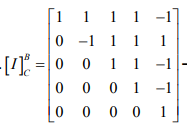
So $$ C_i = [I]^B_C * B_i$$
stoic pythonBOT
blackmamba[they/them]
 magic light
or am I imagining?
spare widget
Changing the basis for matrices requires a sandwich product by the change of basis matrix and its inverse
magic light
well yeah that's one way
but why can't I calculate this by hand also?
Isn't the point of the change of basis matrix to change... the base?
So if I multiply by B_1 =[1, 1, 1, 0, -1] it should give me C's representation of B1 right?
spare widget
Idk what Cs representation of B means here, but I know that you need a sandwich product
magic light
no way this is unsolveable w/o sandwich product
magic light
spare widget
Idk what Cs representation of B means here, but I know that you need a sandwich ...
representation of vector B_1 in base C
spare widget
Say you have a matrix B with coordinates wrt some basis f1,...,fn
Now say you're given a vector with coordinates wrt some basis e1,...,en
Then to compute the action of B on this vector
You need to transform from es coordinates to fs coordinates
Let this be achieved through P
So B * P * v, but now this vector is with coords wrt f
And you want it wrt e
So you add
P^{-1} * B * P * v
magic light
honestly, I am not sure what you're saying lol
magic light
I'm trying to find base C
spare widget
Has a coordinate representation that depends on the basis
spare widget
it's the same for matrices
magic light
but B_i is a base so its representation/coordinates is just 0s expect 1 at the i
spare widget
$B_e = T_{f\rightarrow e} B_f F_{e\rightarrow f}, , T_{f\rightarrow e} = F_{e\rightarrow f}^{-1}$
stoic pythonBOT
criver
 spare widget
Idk what is unclear, maybe someone else can help
magic light
magic light
https://i.imgur.com/I08NmKk.png
$$[b_1]_C = [1, 0, 0, 0, 0] => b_1 = 1c_1 + 0c_2....$$
stoic pythonBOT
blackmamba[they/them]
 magic light
https://i.imgur.com/ZtHqCSJ.png
magic light
magic light
https://i.imgur.com/ZtHqCSJ.png
B is written here
C is unknown
its a base
spare widget
Is B_i the i-th vector
magic light
yes
spare widget
magic light
its a base
A basis?
magic light
yeah.
spare widget
So they are linearly independent and there are n of those, where n is their dimensionality
What is I^B_C
magic light
well it's a private case of the transformation matrix
spare widget
So it's just some matrix
spare widget
And C_i = I^B_C * B_i
magic light
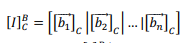 spare widget
so each column is made of the vectors B_i with coordinates wrt C
magic light
https://i.imgur.com/6FnBmF7.png
for every v
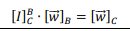


 spare widget
Yes that is correct
magic light
yes, that is the definition of this symbol
magic light
stoic python
**blackmamba[they/them]**
so why can't I do this
spare widget
What is C_i there?
Or rather what do you expect it to be
B_i is I assume the coordinates of b_i wrt the canonical basis
magic light
each v = a1b1 + a2b2.... anbn for the basis B and some a's from the field,
if v is b_i then its coordinates is just 0's except in i where it's 1
right?
spare widget
v wrt which basis
spare widget
b_i in the basis of b is e_i
magic light
yeah
spare widget
yes
magic light
so
can I take my matrix
multiply it by standard
and get the representation in C
of b_i
actually that is what I'm doing
spare widget
Can you take which matrix? What do you mean multiply it by standard? And what representation of C are we talking about?
magic light
C is unknown
B is a base
the matrix is the [I] I wrote
[b_1]_c = [1, 0, 0, 0, 0] => b1 = c1
spare widget
B is a collection of basis vectors with coordinates wrt the canonical basis, correct?
magic light
magic light
https://i.imgur.com/ZtHqCSJ.png
that I've written
spare widget
Yes, but the coordinates of the basis vectors are expressed wrt the canonical basis
Is that correct?
spare widget
magic light
no
So wrt what basis are the coordinates of B's basis vectors you listed
magic light
what do you mean
spare widget
If i write [1 2 3] and say that's vector v, I am in fact saying that these are v's coordinates wrt some basis. Usually the canonical one. So is this the case for the B_i.
magic light
you're not making any sense to me
I have a basis B
a transformation matrix / change of basis from B to C
and I want to find C
the main characteristic of the transformation matrix here is that multiply a vector in the vector field, represented in base B, is equal to that same vector in base C
spare widget
Is it true that $B_i = [\vec{b_i}]_e$
stoic pythonBOT
criver
 spare widget
?
spare widget
If I write v=[1 3 5] it's usually implied that this is v_e if a basis is not specified
spare widget
magic light
https://i.imgur.com/ZtHqCSJ.png
These are coordinates
They are wrt something
spare widget
They are coordinate reprrsentations of vectors
magic light
B is a basis, it what forms the coordinates
no, they're just vectors
they're vectors which span R^5
spare widget
these coordinates are expressed wrt some basis. I am assuming the canonical basis
magic light
they're not coordinates
what is the canonical basis?
1, 0, 0, 0, 0...
0, 1, 0, 0, 0...
spare widget
Yes
spare widget
that's thecanonical basis
magic light
Yes
spare widget
And when you write