#linear-algebra
2 messages · Page 275 of 1
 bold sun
ooh ok i kind of get that logic but the first one and second one already has x term and a constant if you get me?
 zinc timber
@thorn yacht why did you delete it?
 thorn yacht
Nvm my question: figured it out.
bold sun
we haven't learnt orthogonal vectors yet? whats that?
zinc timber
lol I was in the middle of reading
 spare widget
u^T v =0 -> u and v orthogonal
thorn yacht
zinc timber
lol I was in the middle of reading
Ah, sorry, I was just confused about some notation for the double dual vector space
spare widget
You probably have something about an orthogonal complement of a subspace in your textbook
bold sun
i just checked the notes n didnt see it in chapter 10 we only on 6

havent done any of that yet
spare widget
You can think of it as 2 vectors spanning a plane through the origin, and the orthogonal complement being a vector perpendicular to the plane
basically when you have Ax = 0
Then if the rows of A are linearly independent, they can be thought as basis vectors
And the solutions x lie in the orthogonal complement to those
That is if a row is a R^n vectors
bold sun
spare widget
Say the coefficients of the first poly are c1, and the second c2
okk slow down lol sorry so here is that what i did initially with the matrix stuff?
spare widget
And you have m linearly independent rows
Then you need to find n-m linearly independent vectors orthogonal to the m
And they will dpan you the orthogonal complement
let m<n
 native forum
bold sun
ooh ok i kind of get that logic but the first one and second one already has x t...
native forum
bold sun
ooh ok i kind of get that logic but the first one and second one already has x t...
look at the polynomial x, its outside of the span of p1 and p2 because you cannot reach it using a linear combination.
so you need to include p3 = x in your basis for P3
same goes for the polynomial p4 = 1
when you include it you will have their span as well and can construct any polynomial in P3
spare widget
Then your system is underdetermined and you can write the general solution in terms of n-m unknowns
Plug in something for those unknowns, that's how you get the first vector
Then add it as a row to A, ribse and repeat
Until you find all n-m basis vectors of the orthogonal complement
The plug in something part means you have freedom of choice btw
 proper cradle
Is there any method to do this one except taking specific vectors?
 bold sun
spare widget
The plug in something part means you have freedom of choice btw
bold sun
spare widget
The plug in something part means you have freedom of choice btw
lol uno i dont think ive learnt half the stuff uve mentioned here
spare widget
You've learned how to solve linear systems?
The above is just an interpretation of where the solutions of Ax = 0 lie
Pick a simple example
in 3d
(1,2,3), (1,1,0)
These two vectors span a plane, and any point of the plane can be written as
p(s,t) = s * (1,2,3) + t * (1,1,0)
Now say you want to find an orthogonal vector to this plane
Then you need a vector v which is orthogonal to both basis vectors
That is (1,2,3) dot v = 0, (1,1,0) dot v = 0
bold sun
spare widget
p(s,t) = s * (1,2,3) + t * (1,1,0)
waitt why are u doing this? the multiplying and coordinates?
spare widget
it's just a parametric definition of a plane
To give you some intuition
You can think of 1d spaces as lines through the origin
2d spaces as planes through the origin
bold sun
spare widget
it's just a parametric definition of a plane
oh havent done that yet
spare widget
well the idea is, if you have Ax = 0, and the rows of A are linearly independent, then they form a basis
Any solution of the above lies in the orthogonal complement of the spaces spanned by that basis
So if A is made of 2 3d vectors
Then this basis spans a plane through the origin
And the solution space being the orthogonal complement means that the basis vector for it is perpendicular to this plane
In you problem they essentially ask you to complete the basis, you can do so by finding a basis gor the orthogonal complement
So having a set of vectors a1,...,am
You can find a set of vectors b1,...,b_{n-m}
bold sun
wait look this is the only stuff ive learnt so far it dont talk about any of that
 spare widget
Such that ai^T bj = 0, and bk^T bl = 0
The last guarantees that the b are linearly independent
The former guarantees that they are also linearly independent wrt the as
spare widget
bold sun
wait look this is the only stuff ive learnt so far it dont talk about any of tha...
Then it's the right time to learn it
Because your problem is essentially asking for that
although it is possible to solve it purely algorithmically, it's probably not a good idea to skip over the understanding
But the purely algorithmic version is what I mentioned: Ax =0 -> find 1 solution, add the solution vector as a new row in the matrix, rinse and repeat
What this process does is it finds a new orthogonal vector to the previous ones at each step
So at the first step it finds an orthogonal vector b1 to all rows of A, and thus it cannot be linearly dependent
bold sun
spare widget
That is (1,2,3) dot v = 0, (1,1,0) dot v = 0
dot here means times right
spare widget
Then add b1 as a last row to A to get A1, now A1 x = 0 -> find solution b2 -> it is orthogonal to all rows of A -> cannot be linearly dependent,add it as a last row to A1 to get A2
$(1,2,3)\cdot v = 1v_1 + 2v_2 + 3v_3$
Matrix-vector multiplication can be written as the dot products of the rows with the vector
 stoic pythonBOT
criver
 spare widget
And the meaning of dot(u,v) =0 is that u and v are orthogonal, so u and v cannot be linearly dependent if both of those are non-zero
In geometric terms u and v are perpendicular
I am guessing the problem is meant to prepare you for whst's to come,as in make you think about the above
Or it could be just a problem that's there just for the sake of there being problems in the book 💩
Anyways you know the algorithm now, and I hope you got at least an idea of what thd meaning behind ssid algorithm is
bold sun
yeah it kind of makes a little bit of sense now- Thank you so much for everything!!
spare widget

MIT RES.18-009 Learn Differential Equations: Up Close with Gilbert Strang and Cleve Moler, Fall 2015
View the complete course: http://ocw.mit.edu/RES-18-009F15
Instructor: Gilbert Strang
Vectors are a basis for a subspace if their combinations span the whole subspace and are independent: no basis vector is a combination of the others. Dimension...
bold sun
Thank you- ill have a look at it 🙂
spare widget
Only 13 minutes
bold sun
spare widget
Only 13 minutes
and ok yes i watched it and that makes sense so thanks again!
 golden monolith
Ah yeah I see
proper cradle
proper cradle
Is there any method to do this one except taking specific vectors?
anyone?
 lavish jewel
proper cradle
anyone?
lavish jewel
proper cradle
anyone?
not really, because they are asking you which properties are true. you can spot the false ones by coming up with specific counter examples and plugging them in, but to show which ones are true, you need to show it holds for all vectors and all n
zinc timber
I can give you one hint to work on, calculate T^2
also you can write V as $Rv \oplus v^{\perp}$ if that helps
stoic pythonBOT
 spare widget
bold sun
and ok yes i watched it and that makes sense so thanks again!
spare widget
bold sun
and ok yes i watched it and that makes sense so thanks again!
I highly recommend this too: https://www.engineering.iastate.edu/~julied/classes/CE570/Notes/strangpaper.pdf
it's a fairly short read, but it should give you some motivation regarding what the course you're studying is about
bold sun
okk yeah thanks- ill read it in a bit
proper cradle
stoic python
okay
 subtle gust
Any good advice on doing proofs :)
I understand the questions that involve computing something
But i can't for the love of me understand proofs
Or like come up with them
spare widget
subtle gust
Any good advice on doing proofs :)
try going through some exercises in: Linear Algebra Problem Book by Halmos
he has detailed answers at the end
it takes practice I guess
there are books that are focused on proofs too so maybe that would help
my other advice is to pick several books up on linear algebra and see the different proofs
 twilit flower
Hello guys, I am a newbie in linear algebra. Can you please give me some advice on what I should focus on or how I should think of linear algebra?
 tacit storm
Any ideas?

 fringe fjord
First assume that beta is nonzero.
fringe fjord
Huh?
fringe fjord
The second row has to be beta times the first.
tacit storm
Is this because we are assume we have only one linearly independent vector
so the other is a linear combination of the first
fringe fjord
Yes, it is an explicit assumption that the rank of the matrix is 1, unless I'm misreading the image.
 crystal plover
Yo, what should I use to solve this?

My first guess is gaussian elimination but I'm not 100% sure
lavish jewel
that will work fine
you seem to have more variables than equations though, so keep in mind how this might affect your solution
crystal plover
yeah, i don't remember exact question, i didn't copy it to my paper and now i try to figure it out for a retake xd
it was probably something like "for what w something something"
 spare widget
 icy blade
where does the 2 * (-2c - b)... come from
icy blade
where does the 2 * (-2c - b)... come from
det(A) = dot(r1, cross(r2,r3))
where ri is the ith row of A and it is a 3x3 matrix
It's the part r11 * (r22 * r33 - r23 * r32)
icy blade
alr thx g
 humble oak
if the determinant of a matrix is non-zero, why is it that the matrix is linearly independent?
i've been taught that it's just a fact and i am not too sure why that is
 dusky epoch
one does not speak of a matrix being linearly independent
a set of vectors may be linearly independent or not
humble oak
a set of vectors yes
dusky epoch
one must not confuse a set of vectors and a matrix assembled from said set of vectors
but anyway, this all has to do with the myriad different ways to say "this matrix is invertible" in linear algebra which are all equivalent to one another
dusky epoch
you might consider reading up on the formula for the inverse of a matrix that involves determinants
and in particular the formula contains 1/det(A)
which hints at matrices only being invertible when their determinants are invertible
humble oak
would this be a seperate property from the "a set of vectors is considered linearly independent if only the trivial solution exists"?
hmmm
nvm i will go read those
dusky epoch
humble oak
would this be a seperate property from the "a set of vectors is considered linea...
there are multiple things wrong with this
humble oak
oh no
dusky epoch
first is painting linear independence as a matter of consideration
and then the whole "trivial solution" thing needs a lot of added details to make it make sense
spare widget
Ax = 0 only if x = 0 there you go
dusky epoch
then you have to say that A is a matrix with your vectors as columns
spare widget
Equivalent to the orthogonal complement of the space spanned by the row vectors being {0}
 icy blade
yea idk my teacher does not use Ax = b form
spare widget
The above is Ax=b form expanded
Whether you use
Matrix notation or the above is the same
icy blade
so is this solvable with REF? we have not gone over determinant properties
spare widget
idk what ref is
icy blade
reduced elechon form
spare widget
You'll just get sone denominator there too, so yes
But the easiest is to just compute the determinant
icy blade
what we usually do in class is get the bottom row to all equal 0 and then if its unique solution then the equation does not equal 0 like you said
but i cannot seem to get reduced elechon form without crazy fractions
spare widget
The point in the above is to make the last row non-zero
just use det!= 0
It's easier
tacit storm
Any hints
 spare widget
Take u from R^n, decompose in u = u_parallel + u_perp
Then negate u_parallel
u_parallel = k * v, k = dot(u,v), u_perp = u - u_parallel
u' = u_perp - u_parallel = u - 2 * dot(u,v) * v
 mortal isle
What does it mean to say v1, v2, and v3 are linearly independent
spare widget
It means that c1 * v1 + c2 * v2 + c3 * v3 = 0 only for (c1,c2,c3) = 0
assume this were not the case, and without loss of generality let c1!= 0
Then c2 * v2 + c3 * v3 = -c1 * v1
And thus v1 = -c2/c1 * v2 - c3/c1 * v3
But this means that v1 is linearly dependent with v2, v3
More precisely it lies in the plane spanned by v2,v3
At coordinates -c2/c1, -c3/c1
mortal isle
Wow. Thank you!
spare widget
MIT RES.18-009 Learn Differential Equations: Up Close with Gilbert Strang and Cleve Moler, Fall 2015
View the complete course: http://ocw.mit.edu/RES-18-009F15
Instructor: Gilbert Strang
Vectors are a basis for a subspace if their combinations span the whole subspace and are independent: no basis vector is a combination of the others. Dimension...
I fixed a minus sign that I missed
spare widget
mortal isle
What does it mean to say v1, v2, and v3 are linearly independent
To understand the practical importance of this maybe I should mention a corollary. If you have a vector u in the span of v1, v2, v3 and they are linearly independent, then there's a unique set of coordinates (c1,c2,c3) such that u = c1 * v1 + c2 * v2 + c3 * v3. If they were linearly dependent then there could be infinitely many coefficients representing the same vector. This may be undesirable in practice, e.g. when you want a unique representation. It could also be desirable to have many different representation of the same vector, e.g. if some data has noise, then instead of a basis you get an overcomplete basis/frame.
 midnight gust
I was just speaking to someone and they kept using the term eigenvector to mean basis vector
This person has been working in the field for a really long time so they must understand something I don’t
Is there a relationship between eigenvectors and basis vectors I don’t see?
fringe fjord
A basis consisting of eigenvectors (an eigenbasis) is very useful to have if it exists; that's a basis that diagonalizes the matrix (or map) you're looking at.
subtle gust
for homogeneous linear systems
the system can only have one solution (the zero vector) or infinitely many solutions
is there any other case?
dusky epoch
if your base field is R or C, then no.
 dapper gorge

The answer to this is to consider vector spaces over non-algebraically closed fields, right?
zinc timber
yes, you are in the right direction
dapper gorge
well then that's it
zinc timber
so what's the example you came up with
dapper gorge
I can't think of a nice example tbh, other than constructing artifical examples
i.e. examples where the characteristic polynomial factors, say in the real numbers, as x^mQ(x) where Q(x) is a product of irreducible quadratics
I'm thinking maybe in R^3 define a plane A. If x not in A send it to 0. If x is in A, rotate it in A (with a non trivial angle)
I think that's nicer
well you would define that on the basis. Two vectors on the basis define that plane, the third is sent to zero
 lilac lichen
Guys can anyone tell me where people discuss about 8th maths
dapper gorge
uhm idk tbh
(responding to ryu sama)
there is a two dimensional space such that T^2=-I, so T^2 acts as some kind of reflection
idk
lavish jewel
lilac lichen
Guys can anyone tell me where people discuss about 8th maths
probably #prealg-and-algebra
lilac lichen
Oh thx lemme check
zinc timber
dapper gorge
there is a two dimensional space such that T^2=-I, so T^2 acts as some kind of r...
what about rotations?
dapper gorge
no
zinc timber
say rotation of π/2 radians
lavish jewel

stoic pythonBOT
 dapper gorge
that's a rotation
zinc timber
so not nilpotent
lavish jewel
so far you both said rotate + project
dapper gorge
haha lol I thought it was something more misterious. Because I did say about rotations on a subspace and sending to zero on another subspace
lavish jewel
ryu's char poly is the result of a block diagonal matrix of rotations and projections
dapper gorge
I'm not good at coming up with specific examples anyway
lavish jewel
admittedly only for R^3, but it generalizes
zinc timber

lavish jewel
so you want some power of x and a product of irreducible quadratics
sounds about right
dapper gorge
haha no the thought process was fun
zinc timber
yes that should be a general construction
dapper gorge
btw
zinc timber
ok I'm giving away my example
lavish jewel
i think you need the rotated coordinates not to be projected
so maybe the rotations and projections need to be able to commute
at least pairwise?
dapper gorge
when solving polynomial equations we talk about field extensions and so on. What is the analog concept to vector spaces?
dapper gorge

lavish jewel
what's dmat 0
zinc timber
$\m{0 && \ && -1 \ & 1 & }$
stoic pythonBOT
 dapper gorge
yeah
lavish jewel
right
zinc timber
lavish jewel
what's dmat 0
diagonal matrix with first entry 0
lavish jewel
this is the same as $\Pi \circ R = R \circ \Pi$
stoic pythonBOT
19eddy4
 zinc timber
yes
dapper gorge
To determine this kind of maps we need just worry about 2 dimensional spaces when they are over R
zinc timber
yes
dapper gorge
but I think its not just rotations
zinc timber

dapper gorge
xd what
zinc timber
wym not just rotation?
dapper gorge
oh
I mean that the action of the linear operator on these 2 dimensional subspaces is not always a rotation
I'm thinking, but idk
dapper gorge
because the characteristic polynomial of rotations is x^2-2cost x+1=0, and there are many other forms for irreducible polynomials
true
dapper gorge
(cost -x)^2+sin^2 t=0 ?
lavish jewel
yeah ok
derp moment
you can try and see if you can rewrite other polys in this form
dapper gorge
is it just dilations with rotations?
We would need a+b and ab to be able to take arbitrary independent values. And the condition that the polynomial is irreducible is given by cos^2(t)(a+b)^2<4ab, which can always be satisfied taking arbitrary values for t
I think that's the case, yeah
well not exactly, because a or b could be negative, but we disallow that possibility. I think that's the argument
 stark acorn
Is addition of two non zero vectors consididered linear cobination
lavish jewel
yes
stark acorn
What would a Proof of thatlook like
this isnt an assignment
This is just for my own knowing
Let c1,c2...,ck be a scalar
Let v1,v2,.. vk be a vector
the vector in r^n
dusky epoch
??
what are you asking again?
"let v, w be two nonzero vectors. is v + w a linear combination of v and w?"
stark acorn
Oh im stupid
dusky epoch
and the answer is yes, obviously it is. it's 1v + 1w
stark acorn
Why is the addition of vectors called a linear combination?
dusky epoch
a linear combination of v and w looks like this: av + bw
(where a and b are scalars)
stark acorn
would that be a linear combination
dusky epoch
sure, the sum is a linear combination of your two matrices
the concept of 'linear combination' makes sense in any vector space
stark acorn
dusky epoch
a linear combination of v and w looks like this: av + bw
(where a and b are scal...
Thats exactly how 3Blue1Brown defined it
zinc timber
stark acorn
Thats exactly how 3Blue1Brown defined it
because that's the definition
 dusky epoch
no
stark acorn
Can someone help me see where my fault in understanding is so I can work on it more?
dusky epoch
your fault seems to be "a+b is a linear combination of a and b therefore any time i see 'linear combination of <blah>' im supposed to just add them"
zinc timber
probably u didn't understand the question
dusky epoch
you are supposed to write $\bmqty{-9\4}$ as a linear combination of $\bmqty{1\-3}, \bmqty{3\1}$ and $\bmqty{-1\2}$
stoic pythonBOT
Ann
 dusky epoch
no!
dusky epoch
dusky epoch
a linear combination of v and w looks like this: av + bw
(where a and b are scal...
.
accordingly, a linear combination of more than one vector, or matrix, or whatever, looks like that same sum, except that each term has a scalar coefficient attached to it
stark acorn
does that mean just multiple
dusky epoch
no
stark acorn
dusky epoch
accordingly, a linear combination of _more_ than one vector, or matrix, or whate...
im having trouble seeing the conection
dusky epoch
it's not "JUST ADD" or "JUST MULTIPLY" stop trying to reduce it to JUST something if you keep trying to do that youll NEVER stop being confused
idk how else to tell you this
dusky epoch
just some random vectors?
stark acorn
in Rn
dusky epoch
nothing to do with your problem?
stark acorn
yes
dusky epoch
and where did i claim "V+B is not a linear combination of V and B"?
are you sure you're not putting words in my mouth rn
stark acorn
dusky epoch
and where did i claim "V+B is not a linear combination of V and B"?
You did not
I am just asking to understanding
dusky epoch
so you are putting words in my mouth rn?
"How is V + B not a linear combination"
as if someone said it was not
stark acorn
I was under the impression that it needs a scalar to multiply to be a vector addition
 wintry steppe
Where do I learn about Lp spaces?
I don't think Axler, for example, will go over them
usually functional analysis
stark acorn
dusky epoch
as if someone said it was not
Im sorry if i offended you
proper cradle
Hey just quick test, If matrix A is symmetric then eigen vector of A is orthogonal?
proper cradle
zinc timber
no
Only if eigenvalues are distinct?
zinc timber
if the eigen values are distinct then eigen vectors are orthogonal
not the other way around
proper cradle
Okay
Unitary diagonalizable is true for normal matrix right and symmetry matrix are normal but here we are getting eigen vectors which are not orthogonal then how can we unitary diagonalize?
zinc timber
how are you getting eigen vectors that are not orthogonal?
proper cradle
zinc timber
how are you getting eigen vectors that are not orthogonal?
That’s the question, and you just told that it is not true for all symmetric matrix?
zinc timber
I didn't say if the eigen values are same then the eigen vectors can't be orthogonal
for example take M = I_2 then (0,1) and (1,0) are EV with ev 1 and they are orthogonal
(1,0) and (1,2) are also EV with ev =1 but they are not orthogonal
lavish jewel
they're asking about symmetric matrices, ryu
zinc timber
I2 is symmetric
zinc timber

proper cradle
If suppose A is symmetric and all the eigen vectors are not orthogonal then how we proceed for unitary diagonalizable?
proper cradle
proper cradle
If suppose A is symmetric and all the eigen vectors are not orthogonal then how ...
Is there exist such matrix?
zinc timber
if A is symmetric, you will always find a orthogonal basis
they are orthogonal if corresponding eigen values are different
if ev is the same then you look at the null(A-aI) and find a orthogonal basis of this
 wanton seal
The answer to the first part of this question is "Yes. Since Col A is a five-dimensional subspace of R5, it coincides with R5.". But we only have four pivot columns, meaning four linearly independent vectors in R5. Hence they aren't a basis in R5 and can't span R5 fully?
 proper cradle
zinc timber
if ev is the same then you look at the null(A-aI) and find a orthogonal basis of...
proper cradle
zinc timber
if ev is the same then you look at the null(A-aI) and find a orthogonal basis of...
Then unitary daigonalization is true for any diagonalizable matrix? Due to gram schmith
zinc timber
noo, diagonalizable does not mean it's unitarily diagonalizable,, you are mixing up things
if A is symmetric then A is unitarily diagonalizable,
proper cradle
zinc timber
if A is symmetric then A is unitarily diagonalizable,
Normal matrix are
zinc timber
yes normal matrices are
for example take the projection onto x axis along (1,1) then it's diagonalizable but not unitarily diagonalizable
proper cradle
Look, we are make U just picking the ev of matirx A if ev are not orthogonal then how we proceed that’s the dout
proper cradle
proper cradle
Look, we are make U just picking the ev of matirx A if ev are not orthogonal the...
For A=UDU*
 dim epoch
proper cradle
Then unitary daigonalization is true for any diagonalizable matrix? Due to gram ...
dim epoch
proper cradle
Then unitary daigonalization is true for any diagonalizable matrix? Due to gram ...
Gram Schmith gives you an orthogonal/orthonormal basis of a vector space, that's different from finding an orthogonal basis consisting of eigenvectors which you need to diagonalize a matrix
proper cradle
zinc timber
if ev is the same then you look at the null(A-aI) and find a orthogonal basis of...
So if they are not orthogonal then?
zinc timber
proper cradle
For A=UDU*
because in general case D = P^{-1}AP, if how ever A is happened to be normal, your P is orthonormal (can be made into one)
in that case P^{-1}AP=P*AP
proper cradle
zinc timber
if the eigen values are distinct then eigen vectors are orthogonal
You said that, if they are not orthogonal then how we change that vectors in orthogonal and why we can’t do that this process apply for any matrix?
zinc timber
i think you may hv mis interpreted my words
as you see eigen vectors are not unique
for example if v is an eigen vector then so is cv (c≠0)
proper cradle
zinc timber
in that case P^{-1}AP=P*AP
And $P=[ev_1 ev_2 … ev_n] $ if p is unitary then $ev_i$ are orthogonal
stoic pythonBOT
BLツ
 zinc timber
for example if v is an eigen vector then so is cv (c≠0)
zinc timber
zinc timber
for example if v is an eigen vector then so is cv (c≠0)
then v and cv is clearly not orthogonal as <v, cv> = c |v|²
proper cradle
zinc timber
then v and cv is clearly not orthogonal as <v, cv> = c |v|²
Yes it is true
zinc timber
all I said was if you don't mention the eigen values are distinct then you can't say eigen vectors are orthogonal, it doesn't however mean that you can't find eigen vector corresponding to same eigen values which are orthogonal for example the I_2 matrix
proper cradle
Alright got it
If GM>1 then we can always find orthogonal vectors for normal matrix right
zinc timber
now ask again what your doubt it
zinc timber
proper cradle
If GM>1 then we can always find orthogonal vectors for normal matrix right
yes
proper cradle
My doubt is if AM>1 since it is normal so AM =GM, so if we are not able to find all eigen vectors that’s are orthogonal so we need to construct others?
zinc timber
your matrix is normal then why won't you be able to find orthonormal eigen basis?
if the matrix is normal then you will always be able to find orthonormal basis wrt which the matrix is diagonal, that's the complex spectral theorem
wanton seal
wanton seal
The answer to the first part of this question is "Yes. Since Col A is a five-dim...
just bumping my noob question :^)
wintry steppe
Maybe a simple question, but if we want to prove something for inner products of $\langle x, x\rangle > 0$ and $\langle y, y \rangle < 0$, why can we assume that $\langle x, x\rangle = 1$ and $\langle y, y\rangle = -1$ "due to scaling"?
stoic pythonBOT
n/c
 dim epoch
because the inner product is a bilinear form
wintry steppe
Can you elaborate?
dim epoch
hence you can always find some scalar a to make it 1 for a* <x,x> and and pull it into the the product
to get new vectors
that make it 1 or -1
i think at least
lavish jewel
there is a mistake in what n/c wrote though
inner products are positive definite
<y,y> = -1 cannot be an inner product
wintry steppe
lavish jewel
inner products are positive definite
Not if we replace the axiom of positivity with <x,x> = 0 iff x = 0
lavish jewel
hmm?
dim epoch
wait i forgot about it being positive definite lol
 subtle walrus
you often deal with dot products that are not positive definite
wintry steppe
But anyway that's not the point of my question
subtle walrus
not sure if you use different terminology in english 
(also note that positive definite doesnt make sense in general fields)
lavish jewel
the one i often see is positive semidefiniteness, at least
this still excludes getting negative values
dim epoch
uuh
but either way if its bilinear
and we wanna prove something about the product itself
and not about the vector in the product
we can scale it
wintry steppe
So basically, we can define $\langle x,x \rangle = 1$ because $\langle x,x \rangle = \frac{\langle a, a\rangle}{|\langle a,a \rangle|}$..? Or something?
lavish jewel
pretty much, you could multiply the inner product result by some scalar so that the result is normalized
stoic pythonBOT
n/c
 lavish jewel
and this results in another inner product
dim epoch
i mean you're not really defining it but you can assume it without loss of generality in your proof
wintry steppe
Sorry that's what I meant yes
lavish jewel
are you working with indefinite inner product spaces?
wintry steppe
What are indefinite product spaces?
The exercise was just about changing one of the axioms to what I listed above
lavish jewel
inner product spaces where indefinite and semi definite inner products are used, kinda generalizations of inner product spaces
because in usual inner product spaces you do need positive definiteness
wintry steppe
I don't know what that means sorry
The axioms I'm working with for an inner product is (x,y) = (y,x), (x, y + z) = (x,y) + (x,z), (cx,y) = c(x,y), (x,x) > 0 for nonzero x, and (x,y) = (y,x)* (hermitian symmetry)
wintry steppe
I know
But there was a particular exercise in this chapter which told us to change (x,x) > 0 to (x,x) = 0 iff x = 0
lavish jewel
that's the same as positive definiteness
wintry steppe
What is this word, definiteness?
lavish jewel
exactly what you're writing
<x,x> = 0 if and only if x = 0
that's the definition
and <x,x> >= 0, and equality is only achieved if x = 0
the result is always positive, unless x = 0
 quaint escarp
hello, i hope i'm posting this in the correct topic.
What exactly am i doing here?
 zinc timber
ok that's a long question
hmm maybe not
for the first case, A is diagonalizable means the char eq has 2 distinct root or it's the constant multiple of the identity.
the char eq is given by x^2-(a+d)x+(ad-bc) so it'll have distinct root if (a+d)^2-4(ad-bc) > 0 ( not < 0 as that will give complex roots which we don't want)
and if B^2-4AC = 0 then it means both roots are equal, so it has to be constant multiple of the identity, which means b=c=0 and a=d
follow similar method for ii
@quaint escarp
quaint escarp
might take a while for me to understand lol
Thank you for your input 🙂
zinc timber

quaint escarp
me=
zinc timber
[-10 0 \ 0 10] = 
 oblique prairie

 earnest dock
Looking for help on my logic here
https://i.imgur.com/H3PBbXv.png
I have this transformation and this A and I want to prove that if A != zero matrix then Dim(Im(T_A)) = 2
my idea here is that no matter what matrix A is, you can find an X s.t AX=XA that is also non-zero, which means X is in Ker T_A, so Ker T_a has a dimension of 1 meaning Im(T_A) has a dimension of 2(since the overall dimension is 3 and DimKer + DimIm = DimV)
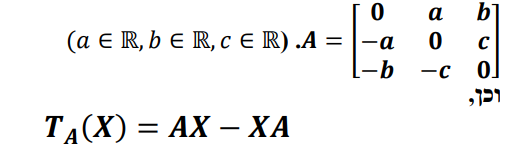
am I wrong here? X would be the antisymmetrical matrix with a,b,c=1
zinc timber
I can give you a different approach to this
try to find the kernel of the transformation and use first isomorphism theorem
see that kernel of T_A is the vs of all matrices that commute with A
be back in a sec
earnest dock
zinc timber
I can give you a different approach to this
I know there are different approaches, but I'm wondering if mine is correct because I wrote this down in the test.
zinc timber
FFS, hope no one saw
earnest dock
🙂
zinc timber

earnest dock
😉
 blissful creek

Hey for |U1-v|² what should i do there ?
I think they asked me to calculate thr firt two to use it there
proper cradle
solve (u1-v, u1-v) using inner product axioms
earnest dock
zinc timber
be back in a sec
can you tell me what you think of my solution?
zinc timber
earnest dock
Looking for help on my logic here
https://i.imgur.com/H3PBbXv.png
I have this tr...
your idea is similar to what I just said
problem is "there is an X s.t. AX=XA" doesn't mean that kerT has dim 1
earnest dock
has at least 1?
zinc timber
and also your V is M_3x3(R) here not R^3 so dimV = 9 not 3
earnest dock
is that the issue?
zinc timber
earnest dock
has at least 1?
dim is atleast 1 yes but not =1
 earnest dock
 earnest dock
would I need to prove that? 🤔
zinc timber
that's a known fact, but if you are not sure then you can try to prove it
ok so X is skew symm matrix and A is given
earnest dock
I wrote X explicitly
zinc timber
you need the find the dim of the matrices that commutes with A
zinc timber
earnest dock
Looking for help on my logic here
https://i.imgur.com/H3PBbXv.png
I have this tr...
you wrote A=[] not X=[]
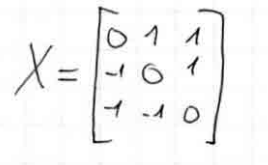 zinc timber
that's just one X
earnest dock
like
zinc timber
you need to find for all X
earnest dock
well the kernel is all AX-XA=0
zinc timber
ok tell me this, is A = [] what have you written with a,b,c is correct?
earnest dock
so AX=XA
zinc timber
you surely confused me, so
zinc timber
yes and what is A?
earnest dock
A is antisymmetrical
zinc timber
any?
zinc timber
ok so you don't even know what A is then how are you supposed to calc the dim?
like A could be zero giving you rank = 0
you need to fix A
earnest dock
earnest dock
Looking for help on my logic here
https://i.imgur.com/H3PBbXv.png
I have this tr...
no no the A is non-zero
that is part of the question details
A is non-zero, prove dim(T_A)=2
zinc timber

earnest dock
now it is known that dimV=3 as we're shown
and so we need to find AX=XA
so X= what I wrote will always give me that
zinc timber
huh
earnest dock
earnest dock
https://i.imgur.com/xtHH7Ja.png
^
the transformation is defined : T_A(X) = AX - XA
so T_A(X)= 0 => AX=XA
that's the kernel
zinc timber
so we only know A is non zero anti symmetric matrix
zinc timber
the better approach for this will be to see where A sends the basis then
earnest dock
since all vector fields have 0 it doesn't change the dimension
wait, please ryu sama, I'm trying to understand if my solution was correct because I want to appeal...
I got 0 points
(for the question)
zinc timber
no, you can't just say the dimension is atleast one so dim is 1
you have to show dim is actually 1
earnest dock
well it's exactly 1 because that's the only solution...
but I wrote it in general..
zinc timber
then you are literally skipping 5-10 steps of showing that's the only solution
and also you can't assert that there is one X s.t. AX=XA
earnest dock
earnest dock
https://i.imgur.com/xtHH7Ja.png
AX=XA, A is non-zero anti-symmetrical, X is non-zero anti-symmetrical
clearly this X is the only linearly independent solution here right?
zinc timber
it's like proof by assumption, assume it's true the it's true
earnest dock
yeah, I guess.
zinc timber
earnest dock
AX=XA, A is non-zero anti-symmetrical, X is non-zero anti-symmetrical
clearly th...
no it's not clear in any way, you have to show it
there's no loose ends in mathematics
earnest dock
I should've written that the only solution is X or X^T as I wrote it, but they're linearly dependent by definition(multiple of -1 of each other)
fk.
I guess it does deserve 0 points?
zinc timber
heck if you know there's even a non zero X s.t. AX=XA
zinc timber
earnest dock
I guess it does deserve 0 points?
yes
zinc timber
zinc timber
heck if you know there's even a non zero X s.t. AX=XA
like it's not even trivial to me and you are taking an exam
like if you really want a solution, I can guide u to one, but yeah your argument is not valid
zinc timber
blissful creek
which problem are you talking about
 zinc timber
@earnest dock here's an short argument, AX-XA has trace 0 always, so it cuts down one degree of freedom giving you 2
zinc timber
blissful creek
so where are you stuck exactly? the instructions are crystal clear
blissful creek
No like should i do u1-v and then the ||² or is there a fromule i should follow
earnest dock
thanks.
zinc timber
blissful creek
No like should i do u1-v and then the ||² or is there a fromule i should follow
like yeah
 dusk basalt
Given a polynomial, how does one find the companion matrix?. My proffesor just gave the campanion matrix without explanantion
zinc timber
that's how
 dusk basalt
thanks
So there is no way to go from the polynomial to the matrix form without?
Without already knowing the polynomial form.
zinc timber
dusk basalt
Without already knowing the polynomial form.
?
dusk basalt
So assume that you dont know the matrix A, how do you determine A given a polynomial?
dusk basalt
Well, what is give there is that you already know the form of A and then you prove by induction that A is the companion matrix op de polynomial P. (I understand that totally).
But let's assume that you don't know how A looked like, how would you then come up to that?

 wintry steppe

dusk basalt
zinc timber
oh let me send again then
well, I think you don't understand what I really mean. So let me explain once more. Say $p_A = t^n + a_{n-1}t^{n-1} +.....+a-O$. How would you find the companion matrix A?
stoic pythonBOT
Croq
 dusk basalt
zinc timber
dusk basalt
zinc timber
if u never knew that A is this
zinc timber
if it's still not clear to you by now, you just reverse the construction
zinc timber
zinc timber
given this
zinc timber
zinc timber
this is the companion matrix
dusk basalt
zinc timber
if it's still not clear to you by now, you just reverse the construction
Yes, I know that the reverse-order construction works (but just considering uniqueness)
I guess I am good, thanks though!
zinc timber
what uniqueness? companion matrix is unique
dusk basalt
I have been saying "assume". So act like you don't know A, how should A look like if $det(A-t*I) = p_A$
stoic pythonBOT
Croq
 dusk basalt
But I am good, thxx!
zinc timber
if you want a "general A" then will be PSP^{-1} where S is matrix I showed before
zinc timber
zinc timber
but that is no longer called the "companion matrix" because companion matrix have a specific form, which looks like this and this only
dusk basalt
zinc timber
but that is no longer called the "companion matrix" because companion matrix hav...
yess I agree, but how could you know it only looks like that if you didn't know how it looks like?

 stone fern
Just a quick question:
Is the matrix of a linear map f in the basis B the same as the matrix of the linear map f in the pair of basis (B, B)?
dusk basalt
Yes but only if the linear map is an operator
stone fern
operator, as in codomain = domain?
dusk basalt
stone fern
operator, as in codomain = domain?
yes exactly
If you talk generally about a linear map f, then the basis in the domain and codomain are different
stone fern
I meant codomain=domain from the beginning, sorry for poorly formulating the question
thanks
dusk basalt
no worries, you are welcome
 brittle gyro
So, I figured I have to calulate $| xx^T-yy^T |_2$, but I'm not sure how
 stoic pythonBOT
Sydd
 brittle gyro
Something like $\sup_{v \in S^1} | x^T v x - y^T v y |$ felt like the way but I just got stuck
stoic pythonBOT
Sydd
 zinc timber
what's the def of dist(S1, S2)?
dapper gorge
Is this formula of computational interest or nah?

I know there is another formula, but it involves a lot of determinants
zinc timber
nah
brittle gyro
zinc timber
what's the def of dist(S1, S2)?
distance between orthogonal projections onto subspace
zinc timber
no that's what I'm asking how are they defining the dist because to me it feels like it should be zero
because 0 is a common element
 trim bear
brittle gyro
zinc timber
no that's what I'm asking how are they defining the dist because to me it feels ...
trim bear
brittle gyro
zinc timber
no that's what I'm asking how are they defining the dist because to me it feels ...
every subspace S has an unique orthogonal projection, so the way you define dist between subspace is by setting it to be dist between the projections
for a one dimensional subspace like span{x} the projection is xx^T
 reef sierra
hey quick question, does this mean that a can be equal to any value when the rank of the matrix is = 3?
 fringe fjord
It's definitely not the case that the rank is 3 when a = 0, at least.
zinc timber
brittle gyro
Something like $\sup_{v \in S^1} \| x^T v x - y^T v y \|$ felt like the way but...
are you sure that this is what you are supposed to do?
 lime zinc
ant hint?

 lime zinc
zinc timber
rank A² < rank A³ <:thonkzoom:533366356536721418> <:thonkzoom:533366356536721418...
lime zinc
zinc timber
rank A² < rank A³ <:thonkzoom:533366356536721418> <:thonkzoom:533366356536721418...
Rank is increasing
zinc timber
so...
lime zinc
zinc timber
so...
If somehow we can get its jc form then we can find gm of 0
dusky epoch
rank(A^2)<rank(A^3) is literally impossible no matter what A is, lol
zinc timber
if it was > you can try to find a possible jcf
lime zinc
zinc timber
if it was > you can try to find a possible jcf
Yes
lime zinc
zinc timber
if it was > you can try to find a possible jcf
Lets consider this
zinc timber
look at the principal component of x
if B is the submatrix then B⁴=0 but B³=B⁴= 0 means that max size of jordan 0 block is 3
since B² ≠0 gives min size =3
can you construct the jordan form of B now?
lime zinc
Ok,I will try
zinc timber
don't worry about other eigen values
lime zinc
zinc timber
look at the principal component of x
I have no idea about this ( component. From)
zinc timber
dont worry about it
just think as if you are working with a matrix with char poly x^4
rest you can ignore
(it comes from the principle decomposition theorem)
lime zinc
zinc timber
just think as if you are working with a matrix with char poly x^4
This is only possible if matrix is a nilpotent matrix
lime zinc
zinc timber
yes and how does it look like?
All disgonal entries zero
But how you get here , i have doubt
lime zinc
zinc timber
disgonal? off diagonal??
Here our matrix is of order 9
Wait
And B is of order 4
zinc timber
since x^3 = 0 and x^2 neq 0 this means that B has a jordan block of size 3 with ev 0
lime zinc
zinc timber
since x^3 = 0 and x^2 neq 0 this means that B has a jordan block of size 3 with ...
So number of block in jc is gm of that eigenvalue ,so 0 has gm =3
zinc timber
since 4-3=1 then there's only 1 other jordan block of size 1
zinc timber
lime zinc
So number of block in jc is gm of that eigenvalue ,so 0 has gm =3
no 0 has gm 2
why do you think gm=3?
lime zinc
zinc timber
just think as if you are working with a matrix with char poly x^4
First thing is ,how you get this?
zinc timber
primary decomposition
(A-kI)^n cannot be singular unless k is an eigen value
you can write $V$ as $V = \mbb{R}[x]/(x^4)\oplus \mbb{R}[x] / ( (x-1)^2) \oplus \mbb{R} / ((x-2)^3)$
stoic pythonBOT
 zinc timber
in other words V has a generalized eigen basis
only the generalized eigen vectors corresponding to eigen value 0 can contribute in reducing the rank of A^k
lime zinc
So here i have to focus on x^4 because we want to find gm of 0?
lime zinc
stoic python
This is something new for me
lime zinc
Nop
zinc timber

ok so don't know if there's an easy way to say this
but say you have any jcf of that matrix
than any jordan block where the eigen value is not zero cannot have rank A^2 < rank A
so the jordan blocks with ev 1 or 2 will never loose rank as you raise the power
only block that will loose rank is the jordan blocks with ev 0
this is very easy to check as say $A = J_2(a) = \m{a & 1 \ 0 & a}$ then $A^2 = \m{a^2 & 2a \ 0 & a^2}$ and $A^3 = \m{a^3 & 3a^2 \ 0 & a^3}$
stoic pythonBOT
 lime zinc
zinc timber
so the jordan blocks with ev 1 or 2 will never loose rank as you raise the power
lime zinc
zinc timber
so the jordan blocks with ev 1 or 2 will never loose rank as you raise the power
This something interesting, is this applicable to any matrix?
zinc timber
well yes, if all eigen values of A are non zero then A^n always has full rank
A^n can loose rank if 0 is an eigen value (with am > 2)
i can make this statement more precise but nah
lime zinc
Thanyou @zinc timber , i think i should leave this question.
zinc timber
for an easy proof, say A^k has rank < rank A means A^k has 0 as an eigen value but all eigen values of A^k are of the form a^k where a is ev of a. so a^k=0 means a=0 so 0 is an eigen value of A
zinc timber
lime zinc
Thanyou <@468830761261203476> , i think i should leave this question.
your main question is still unanswered, were you able to solve it?
lime zinc
zinc timber
your main question is still unanswered, were you able to solve it?
Its ok @zinc timber , i will try it myself with my little knowledge
lime zinc
zinc timber
<:stareFlushed:833689610839523368>
First i think i should read primary decomposition
zinc timber
that's nothing ground breaking really
it's kinda similar to ax+by=1 if (a,b) = 1 from number theory
brittle gyro
zinc timber
are you sure that this is what you are supposed to do?
I must show $| xx^T-yy^T |_2=\sqrt{1-(x^Ty)^2}$ somehow
stoic pythonBOT
Sydd
 lavish jewel
you can try just expanding the terms first
you could also separate consider the case where x and y are lin dep and lin indep
brittle gyro
lavish jewel
you can try just expanding the terms first
expand in what sense? like $x=(x_1,x_2), y=(y_1,y_2)$?
stoic pythonBOT
Sydd
 lavish jewel
i meant expanding the two norm you have there
you can rewrite that as a sum of scaled rank 1 matrices
and then do a change of basis onto an orthonormal one
the expression you have there is a diagonalized matrix of rank at most 2, and this is related to the definition of the 2 norm of a matrix
zinc timber
I was thinking of a different approach but the calculation seems long so I'm dropping it
the 2norm of that operator is the largest eigen values as it's symmetric, say we know the angle between x and y then we can project any unit vector in the plane of x, y onto the vectors then they'll have magnitude cos(theta) and cos(theta+phi)
lavish jewel
i think the term in the square root is pretty much gonna be the result of doing gram schmidt
zinc timber
then we have to maximize the sum of their mag using basic calx
lavish jewel
cuz then you get a matrix diagonalized on an orthogonal basis, and the largest singular value is just the 2 norm of one of the basis vectors
zinc timber
lavish jewel
i think the term in the square root is pretty much gonna be the result of doing ...
this might actually work
lavish jewel
just a hunch to be fair, but since it's only rank 2, it should be fairly straightforward to do it this way
and you can still consider the rank 1 and rank 2 cases separately, doing the rank 1 one as a sanity check
(at a glance, yes, the rank 1 case checks out)
or you can do it ryu's way
i just immediately go "dat SVD" whenever i see a sum of rank 1 matrices
zinc timber
no mine is complicated
I have tried
unless someone points out a better way to calculate eigen values of xx'-yy'
brittle gyro
lavish jewel
i just immediately go "dat SVD" whenever i see a sum of rank 1 matrices
yeah that feels like a good gut feeling to have
gonna try these approaches in a bit
but thanks already, it's so nice to have these ideas thrown around here, it helps a lot!
stoic pythonBOT
In and Out
 lavish jewel
@wind anvil please check #prealg-and-algebra
 wind anvil
wintry steppe
wind anvil
wintry steppe
Let $P$ be the vector space of all real polynomials. Why is $(f,g) = f(1)g(1)$ not an inner product of $P$?
stoic pythonBOT
n/c
 wintry steppe
Because $f(1)g(1) = g(1)f(1) = (g,f)$, $(f,g+h) = f(1)[g(1) + h(1) = f(1)g(1) + f(1)h(1) = (f+g,f+h), (cf,g) = (cf)(1)g(1) = cf(1)g(1) = c(f,g)$
stoic pythonBOT
n/c
 stoic pythonBOT
n/c
 wintry steppe
And equality iff f is the zero polynomial.
wintry steppe
wintry steppe
And equality iff f is the zero polynomial.
this
are you sure?
Hahahah I'm so dumb.
thaaaaanks
 serene tide
can i get a hint on part 2, it seems really simple and im missing something basic

 indigo stirrup
Hi, this is a statement that got me confused. "Let vectors u and v be in R^n, vector b be in R^m, and A be an m x n matrix. If there exist scalars c and d such that c(A times vector u) + d(A time vector v) = vector b, then vector b is in the span of the columns of A, but is not necessarily in Span(u, v)." I have to answer either true or false, but I just don't know how to approach it. I first thought that any vector that is in Span(u,v) must be in R^n. If n and m are not equal, b is not in R^n, and therefore, not in the span of {u,v}. Would the above statement be true then? Thanks
zinc timber
serene tide
can i get a hint on part 2, it seems really simple and im missing something basi...
triangle inequality
|u| = |u -v + v|
serene tide
cool, thanks
wintry steppe
hey all is this a prediction or inference problem? determining which variables are relevant for predicting an output variable
i got it wrong and id be curious to hear ur thoughts
 sleek sundial
Anyone have a good resource on duals? Only thing I’ve had on it was in axlers LA
 tired fossil

he guys, does anyone know how to approach this problem?
for b)
this is the answer
 wintry steppe
@tired fossil You just need three polynomials which are linearly independent and of degree 0, 1 and 2
So you're given a list of polynomials, you should check if there are any redundancies
Or, if you can show that some combination of them are linearly independent, and span P_2, then that shows it is a basis too
tired fossil
wintry steppe
<@!397943109239177217> You just need three polynomials which are linearly indepe...
so, if they span P_2 and are independent, it is okay?
wintry steppe
@tired fossil That's the definition of a finite basis
First row is x + kz = 0 and last row is -kx + 2y + 3kz = 0. Then {kx + k^2z = 0} + {-kx + 2y + 3kz = 0} gives us 0 + 2y + (k^2 + 3k)z = 0
Then -2 * (y - z) = -2y + 2z = 0, and that with the new last row gives us 0x + 0y + (k^2 + 3k + 2)z = 0
 quaint steppe
are there any good video lectures about linear algebra on youtube? do you guys have any recommendations?
zinc timber
MIT lecture series by gilbert strang
quaint steppe
zinc timber
MIT lecture series by gilbert strang
Thanks
wintry steppe
how would i describe this in geometrical terms?

like what do 'geometrical terms' even mean?
lavish jewel
like a geometric figure
i recommend you do a couple of low dimensional examples and see if you can find the pattern
try R, R^2, R^3
for these cases, you can easily substitute the 2-norm of a difference of vectors for a simple algebraic expression
wintry steppe
lavish jewel
like a geometric figure
i guess im a bit lost about what the general form even looks like, do u have any resources on this?
we didnt learn this
@wintry steppe If I gave you the set {x in R : | |x - x_0 | | ≤ 1}
What is this set, given some random x_0?
a hyperplane right?
What is a hyperplane?
lavish jewel
you already took geometry
wintry steppe
its a subspace where the dimension is one less than n
lavish jewel
do you recognize the shape x^2 + y^2 = r^2?
wintry steppe
yea circle
lavish jewel
ok
now expand the expression you have for a generic pair of vectors x and x0 in R^2
do you know what the || || stands for?
wintry steppe
lavish jewel
do you know what the |\| || stands for?
Euclidean length right
/ norm
lavish jewel
we're in R^2
well i guess hypersphere is fine if you mean a 1-sphere here
BUT
they don't say = 1
it's <= 1
so it's a disk or a 2-ball
wintry steppe
ah ok so ur saying since its not = 1 we cant say its a hypersphere
lavish jewel
right
zinc timber
ball
lavish jewel
the sphere is only the boundary
zinc timber
lavish jewel
hmm?
zinc timber
closed ball? it this not what op is asking?
wintry steppe
lavish jewel
right
ok awesome tysm
wintry steppe
what shape are matrices typically used to represent?
wintry steppe
linear subspaces
that's a nice shape
this was the last one i was confused on and its bc ive never seen a matrix in a 'geometrical context' so i didnt know how to describe it
 wintry steppe
its this one^^
wintry steppe
just this Describe the following sets in geometrical terms.
zinc timber
intersection of flats is a new term to me 
wintry steppe
and then lists the four sub problems to solve which two were confusing
the first one i posted
and this one
zinc timber
i didn't know that, nice
sleek sundial
Is axlers treatment of duals good enough for a first class in diff geo
Asking cause that’s all I know
brittle gyro
Isn't $P^2=P$ and $| P | > 1$ a contradiction? Cuz if $v$ is an eigenvector of $P$ with $\lambda$ as eigenvalue then $P^2v=Pv \implies \lambda^2 v=\lambda v \implies \lambda \pm 1$, so we'd have $| P |=1$. Where am I wrong here??
 stoic pythonBOT
Sydd

 viscid lagoon
Let $V$ be a vector space over finite-dimensional $\mathbb{K}$ and $U \subset V$ be a subspace of $V$.
For $g \in (V/U)^{}$ define $Ig \in V^$ such that $(Ig)(v) := g(v+U)$ for all $v \in V$. The linear transformation $I: (V/U)^* \to V^$ is referred to as inflation. Show that $\operatorname{im}(I) = U^\perp$, where $U^\perp \subset V:= {f \in V^ \mid f(u) =0) \text{ for all } u \in U$
stoic pythonBOT
lewis
 viscid lagoon
(Note that V* is the dual space and V/U a vector space V by a subspace U (quotient space))


 viscid lagoon
<@&286206848099549185> I'd be glad if anyone could help me
wintry steppe
Can someone explain how unitary dilation works? Like how I could embed an operator $V(t) = e^{-iAt} \in C^{n \times n}$ (where A is antihermitian) into another unitary operator $U(t) \in C^{2n \times 2n}$
stoic pythonBOT
AdamF
 wintry steppe
Sorry if I phrased it wrong, but I've never heard of this
 viral magnet
wintry steppe
Can someone explain how unitary dilation works? Like how I could embed an operat...
viral magnet
wintry steppe
Can someone explain how unitary dilation works? Like how I could embed an operat...
maybe also ask in #advanced-analysis . Looks like unitary dilation is an operator theory concept
serene tide
how does part b really work?

i believe our professor just used b = <0 0 0>, however that makes nearly no sense to me
 nocturne jewel
serene tide
nocturne jewel
serene tide
right but we don't have specified values for b
 keen sierra
You can express the solution in terms of b.
If b = 0 then the problem is not very interesting. A is invertible so x would be zero.
serene tide
i dont think we're supposed to use gaussian elimination on the problem though
it was discussed today
guess i just dont understand what the problem wants
keen sierra
Maybe solve it in a more ad-hoc manner? The first row tells you that x3 = x2 - b1, and the third row tells you that x1 = (x2 - b3)/2. Substituting these into the second row allows you to solve for x2.
 indigo stirrup
It would be helpful if I can get help on this problem. "Let vectors u and v be in R^n, vector b be in R^m, and A be an m x n matrix. If there exist scalars c and d such that c(A times vector u) + d(A time vector v) = vector b, then vector b is in the span of the columns of A, but is not necessarily in Span(u, v)." I have to answer either true or false, but I just don't know how to approach it. I first thought that any vector that is in Span(u,v) must be in R^n. If n and m are not equal, b is not in R^n, and therefore, not in the span of {u,v}. Would the above statement be true then? Thanks
 spice ruin
So I know how to solve echelon form and all that, but I have a homework problem asking me to determine if a vector represented by a matrix is in the span of S. Im not sure how I should interpret this problem, I put the components of each vector in S on a corresponding row and solved, but I dont know how this implies if it is or isnt in Sp(S)

 halcyon spindle
spice ruin
halcyon spindle
spice ruin
From the looks of it you just need to determine if this system is consistent $\x_1+ 2x_2 -2x_3 = -9 \2x_1 -x_2 + x_3 = 12 \ 2x_1 + x_2 + x_3 = 8 \ x_1 + 3x_2 + x_3 = 1$.
stoic pythonBOT
Plegasus
 spice ruin
ah, that makes sense
 lament loom
not sure if this would go in linear algebra, but can someone explain to me why
$(\vec{b}-\vec{a})^2 = |\vec{a}|^2 - 2|\vec{a}||\vec{b}| + |\vec{b}|^2$
stoic pythonBOT
Leon
 lament loom
when we square something is that the same as taking the dot product of itself
I'm very confused on how all this dot produce cross product thing works
I find the $- 2|\vec{a}||\vec{b}|$ especially confusing
stoic pythonBOT
Leon
 halcyon spindle
lament loom
not sure if this would go in linear algebra, but can someone explain to me why
...
halcyon spindle
lament loom
not sure if this would go in linear algebra, but can someone explain to me why
...
Do you mean |b-a|^2?
lament loom
whoops
I think
I asked the wrong question
okay
what I meant to be asking is
how does the cosine law work with vectors?
 wintry sphinx
I don't believe what you wrote is true
lament loom
wintry sphinx
I don't believe what you wrote is true
yeah my bad
wintry sphinx
the law of cosines with vectors? could be stated as (a dot b) = |a| |b| cos theta
lament loom
I'm confused to how you arrive at that
wintry sphinx
a bit of rearrangement yields |b-a|^2 = |a|^2 + |b|^2 - 2 |a||b| cos theta
lament loom
I think I just took bad notes
okay yeah I see now
I think it's because I wrote (a-b)^2 = |a|^2 + |b|^2 - 2ab cos theta
the a-b should be |a-b| and the ab should be |a||b|
 desert ice


 quaint steppe
wrong channel but
 mystic frigate
it has to do with inverses if im not mistaken
quaint steppe
it is because -1/4 (the slope) is negative reciprocal to 4. Thus, 4 is the slope of the perpendicular line
mystic frigate
not 100% sure but the reasoning is that when you graph the functions, its something to do with how slope works
and then eventually they'll intercept on a point which the lines are perpendicular to each other
quaint steppe
Define $T \in \mathcal{L}\left(\mathbf{F}^{n}\right)$ by
$$
T\left(x_{1}, x_{2}, x_{3}, \ldots, x_{n}\right)=\left(x_{1}, 2 x_{2}, 3 x_{3}, \ldots, n x_{n}\right)
$$
(b) Find all invariant subspaces of $T$.
for this question I've found a proof online but there are some parts that I don't understand
stoic pythonBOT
jinichi
 quaint steppe

someone pls help me walkthrough to this proof
this is from sheldon axler, linear algebra done right book
zinc timber
quaint steppe
Define $T \in \mathcal{L}\left(\mathbf{F}^{n}\right)$ by
$$
T\left(x_{1}, x_{2},...
check what happens to the basis e_i
 spiral osprey
OK So I have started linear alegbra and so far it doesnt seem too bad.
But proffessor is making us come on campus to take exam and we only have an hour to do it.
She also of course wont be grading to solve the aug matrix's using ref rref etc.
My issue is what do you guys do in this situation where you need to calculator the matrix fast to get your variables?
Is there a faster process then just multiple/reducing rows to add or subtract to other rows?
lavish jewel
not by hand, no
quaint steppe
zinc timber
check what happens to the basis e_i
okayyyy
zinc timber
spiral osprey
OK So I have started linear alegbra and so far it doesnt seem too bad.
But proff...
it's an algorithm that you'll implement later, so it's good to know how it works but no, you won't be calculating solutions by hand with it in the higher level
brittle gyro
brittle gyro
Isn't $P^2=P$ and $\| P \| > 1$ a contradiction? Cuz if $v$ is an eigenvector of...
<@&286206848099549185> any insights??
dusky epoch
yes, all projectors have norm at most 1
 zealous flame
Prove that the column space of AB is contained in the column space of A. What
happens with B=transpose(A)?
I know that AB has column space contained in column space of A. Since it can be written as the linear combination of columns of A. But how to prove that column space of AA' = column space of A?
lavish jewel
same way
zinc timber
column space of AB = ABx, x\in V. take Bx=y
lavish jewel
associate the products from the right
zinc timber
I can't find an elegant argument for the second one but you can try to show C(AA') \subseteq C(A) and dim(N(AA')) = dim(N(A) and conclude they are same
maybe edd has something better
lavish jewel
the what
zinc timber
like a better argument to why C(AA') = C(A)
lavish jewel
can't you just rewrite the product as linear combinations of the columns of A and gather the coefficients?
zinc timber
lavish jewel
can't you just rewrite the product as linear combinations of the columns of A an...
can you elaborate, it's not obvious to me
 faint dune
We have a matrix A given and do the lu-decomposition with column pivoting. We try to get the PA = LU structure, where P is a permutationmatrix.
I only show the last part of the solution.

P3 = I btw.
Is the form (P2 L1 P2) always a triangular matrix?
I guess this is always the trick to insert Permutationmatrixes here, since two same permutationsmatrices multiplicated equal unit matrix.
wintry steppe
Question. I have an exercise in which I have a 3x3 symmetrical matrix A and it asked me to make A=LDU'=LDL^T and then based on that result to find an R matrix in order to make A=R^TR. How do I use the answer the matrixes L and D to find the R? I hope I make sense
 quartz compass
you can get a square root of a diagonal matrix by square rooting the diagonal and so $$A = L\sqrt{D} \sqrt{D} L^T = L\sqrt{D} \sqrt{D}^T L^T= L\sqrt{D} (L\sqrt{D})^T = R^TR$$ here I've defined $R=(L\sqrt{D})^T$
stoic pythonBOT
Merosity
 quartz compass
idk I might be making a mistake, I don't know if the eigenvalues are all positive, just that they're real uhh is it positive definite I'm a bit rusty I'm realizing
wintry steppe
well I will try that out. The A matrix is positive definite
quartz compass
oh ok then you're fine then
positive definite => positive eigenvalues so sqrt(D) as I've defined it works fine
wintry steppe
thanks!
quartz compass
yeah, you're welcome 👍
wintry steppe
why is beta_hat = arg min_beta RSS(Beta)
zealous flame
zinc timber
I can't find an elegant argument for the second one but you can try to show C(AA...
ya, I was thinking if we show that both have the same null space then by rank nullity theorem we can say they also have the same column space
but then again, how to prove they have the same null space?
zinc timber
hint: $\norm{Av}^2 = \ip{Av, Av} = \ip{AA^*v, v} = 0$
stoic pythonBOT
 zinc timber
@zealous flame
zealous flame

wintry steppe
im a bit confused on this thing


so my work for part one is correct i think


but i dont understand how to explain the second part
zinc timber
what is RSS again?
wintry steppe
residual sum of squares
wintry steppe
zinc timber
what is RSS again?
im not even quite sure what the arg min is :/
lavish jewel
there seem to be weird issues with what you posted
since the first equation isn't a function of beta hat
lavish jewel
at least to me, the notation makes no sense
wintry steppe
i thought so too but then when i expanded it, it seemed to work out
lavish jewel
all right after drinking some water i finally realized that beta_hat is the true solution, not the estimate
kinda weird
your arithmetic for the first part is correct
there's still some mistake in the notation they used, they mixed up beta and beta_hat somewhere
beta_hat being the result of the minimization depends on the rank of X
this overall looks poorly formulated
anyway, to answer your question, argmin_beta means that you look for the argument or parameter beta for which some function of beta is minimized
wintry steppe
lavish jewel
anyway, to answer your question, argmin_beta means that you look for the argumen...
hmm
i guess my question is
im not quite sure how to get that :/
/ how to find it
lavish jewel
that's a convex problem, you can minimize it by simply finding a point where the gradient is 0
wintry steppe
wintry steppe
https://cdn.discordapp.com/attachments/495064710278938662/938506103971516456/Scr...
well in it, it justs asks why beta hat is the arg min, so it gives us the solution and just asks to explain