
#linear-algebra
2 messages · Page 267 of 1
 limber kiln
 quartz compass
you can find the sum of solutions by expanding (x-a)(x-b) and observing what the coefficients look like
limber kiln
quartz compass
you can find the sum of solutions by expanding (x-a)(x-b) and observing what the...
I'm confused as to how to get this to (x-a)(x-b)
quartz compass
it's a quadratic that's factored, it has solutions a and b
don't worry about it for the moment if you're still confused by that, just expand out (x-a)(x-b) and we'll discuss it
limber kiln
so like (x-1)(x-(-2))?
quartz compass
no, just exactly what I have written with a and b
limber kiln
quartz compass
you can find the sum of solutions by expanding (x-a)(x-b) and observing what the...
so like what coeffients do you mean by this?
quartz compass
sorry that was like 20 minutes ago I gotta go
 wintry steppe
mero 
 quasi vale
@limber kiln for any quadratic ax^2 + bx + c = 0, the sum of the roots/solutions is c/a.
limber kiln
it was on my linear algebra practice exam
so thats why im asking it here @quasi vale
quasi vale
ok
limber kiln
just checking, should I reduce this again to 1/2(R2) so that i have a leading one?

 nocturne jewel
limber kiln
just checking, should I reduce this again to 1/2(R2) so that i have a leading on...
nocturne jewel
limber kiln
just checking, should I reduce this again to 1/2(R2) so that i have a leading on...
should: Yeah, probably
Need to: no
limber kiln
nocturne jewel
should: Yeah, probably
Need to: no
How would I do this without reducing, im bad at doing things like basic solutions
nocturne jewel
you'd still just get y=0
you just dont need to formally do the ERO 
2y=0 and y=0 are the same lines
limber kiln
so the solution itself is just y=0, i never clued into the fact that the right side was all zeroes 
nocturne jewel
yeah, y's your pivot and x and z are free
limber kiln
so like (x, 2, z) = 0?
nocturne jewel
y=0
limber kiln
ah
limber kiln
but y=0 is the basic solution
nocturne jewel
no
the general soln are vectors.
Ax=0, where A is that matrix, x is the general [x,y,z] vector, and 0 is the 0 vector
limber kiln
Ok, so let me get this straight, the answer to the question is [x,0,z]
limber kiln
ok thank you, I am struggling through this course
Thankfully the only linear algebra course for my cs degree
 teal grotto
it should be true that if V and W are normed vector spaces, V is finite dimensional, and T : V --> W is linear, then T is lipschitz, right?
 slow scroll
yes. ||T|| < infty lipschitz
teal grotto
how though
slow scroll
Uh I forgot let me think 
teal grotto
like, if v = a1v1 + a2v2 + ... + anvn in V, and ||v|| = 1, then i would need to put a uniform bound on |a1| + ... + |an|
oh
the set of all points v in V such that ||v|| = 1 should be compact
and i feel like the function which takes v to the sum of the absolute value of its coefficients should be continuous
slow scroll
can't you just say on the unit ball, if $v = \sum_i \alpha_i v_i$ for a basis $v_1, \dots, v_n,$
$$|Tv| = |\sum_i \alpha_i T(v_i)| \leq \sum_i |T(v_i)| $$
Take your lipschitz bound to be $L = \sum_i |T(v_i)|$
 stoic pythonBOT
kxrider
 teal grotto
no because thats not true right? should be
$$\lVert T(v)\rVert \leq\sum_i|\alpha_i|\cdot \lVert T(v_i)\rVert\leq\left(\max_i\lVert T(v_i)\rVert\right)\cdot\sum_i|\alpha_i|$$
also, nice background
stoic pythonBOT
c squared
 teal grotto
wait. this is kinda it tho right? because the abs value coeff sum should be a norm on V, regardless of a choice of basis, and all norms on finite dimensional vector spaces are equivalent
slow scroll
yea, it definitely suffices to check on the l1 metric. And i think the unit ball thing i was trying to do is unnecessary anyway (even though this does give a weaker condition to check continuity).
 zinc timber
@teal grotto $\norm{Tx-Ty}=\norm{T(x-y)}\leq \norm{T}\norm{x-y}$
stoic pythonBOT
 wintry steppe

nocturne jewel
🤨
wintry steppe
im just thinking
zinc timber
wintry steppe
im just thinking
what did I say something wrong?
zinc timber
teal grotto
i was basically just having trouble arguing it
that's the definition of induced norm anyway
wintry steppe
i'd like to comment this only works when ||T|| is finite, but you get that from the domain being finite-dimensional
idk
i didnt read the convo
zinc timber

wintry steppe
 wintry steppe
it means find a function T: R^4 -> R^2 with T(0, 0, 0, 0) = (0, 0)
but which isn't a linear transformation
limber kiln
imma be real with you chief, I have no clue how to do that, or like, even where to start
zinc timber
find a function
honestly any nonlinear will work
then subtract f(0,0,0,0)
or take the easy way

wintry steppe
you just have to come up with one, it's not really the kind of question susceptible to hints
i guess you could try to find a function T: R -> R with T(0) = 0 that isn't linear, and try to do something similar for R^4 -> R^2?
that's a possible starting point
limber kiln
ok
zinc timber
can I get an example where A neq 0, but exp(A) = I
 dusky epoch
zinc timber
can I get an example where A neq 0, but exp(A) = I
dusky epoch
zinc timber
can I get an example where A neq 0, but exp(A) = I
does that even exist 
 blissful vault
Just want to make sure. The definition of inner product here only allows for linearity (additivity and homogeneity) in the second slot when F = |R, right?
 zinc timber
dusky epoch
does that even exist <:thonk:406575732563902485>
zinc timber
dusky epoch
does that even exist <:thonk:406575732563902485>
idk really, that's the whole question
dusky epoch
blissful vault
Just want to make sure. The definition of inner product here only allows for lin...
for F=C you still get additivity in the second argument but homogeneity is replaced by conjugate-homogeneity
so yes
blissful vault
Thanks. Was wondering why it was so specific.
wintry steppe
zinc timber
can I get an example where A neq 0, but exp(A) = I
what is exp A
exp every component?
zinc timber
exponent of A
zinc timber
wintry steppe
exp every component?
no
zinc timber
,w matrix exponent
wintry steppe
yikes
stoic pythonBOT
 wintry steppe
o
does such an A exist is the question
no lol?
unless
all those other A cancel somehow
so if sum A^i/i! = 0?
zinc timber

 worldly bear
how do you even raise an exponential to a matrix
i remember learning about it in differential equations but it was all online so i didn’t understand any of.
 tidal wharf
if the matrix is diagonalizable then you diagonalize it since exponential of diagonal matrix is simple
otherwise you can try Jordan form or other decompositions that work even when the matrix is not diagonalizable
 frosty vapor

 rotund jetty
worldly bear
how do you even raise an exponential to a matrix
rotund jetty
worldly bear
how do you even raise an exponential to a matrix
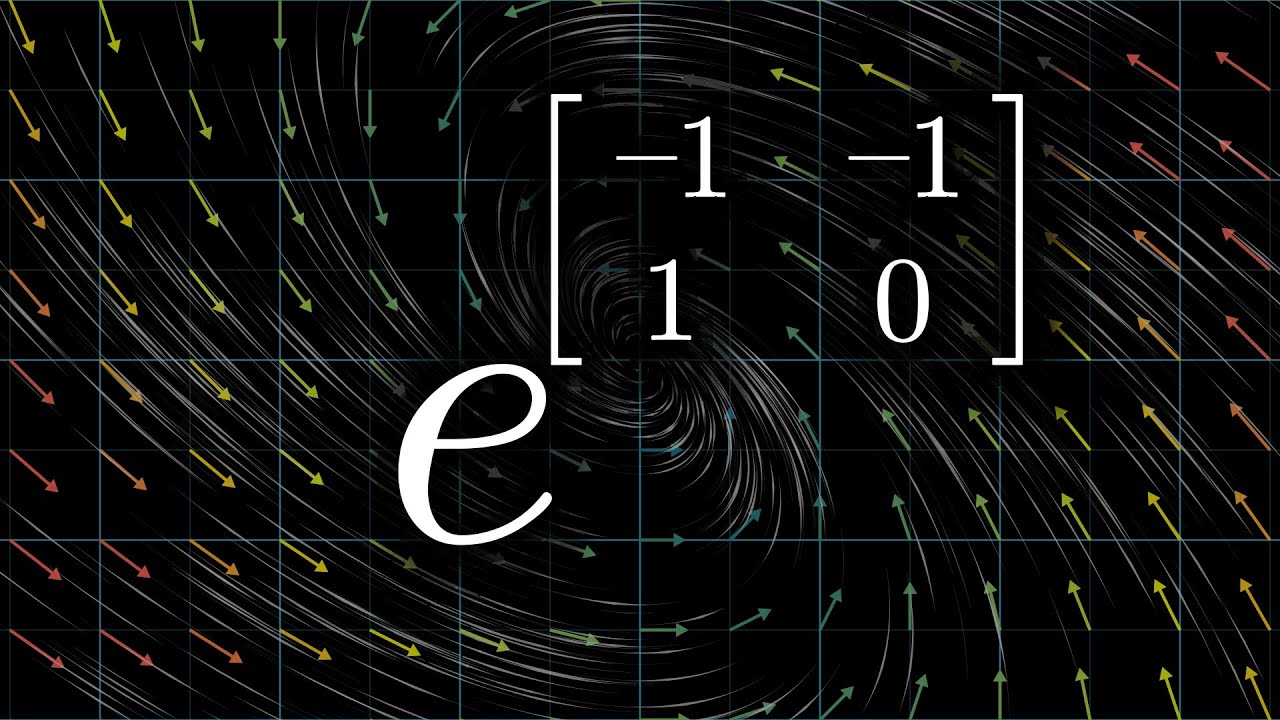
General exponentials, love, Schrödinger, and more.
Help fund future projects: https://www.patreon.com/3blue1brown
An equally valuable form of support is to simply share some of the videos.
Special thanks to these supporters: https://3b1b.co/mat-exp-thanks
The Romeo-Juliet example is based on this essay by Steven Strogatz:
htt...
 dusky epoch
 pliant atlas
this is not linear algebra, and also we don't do your homework for you.
 lavish jay
So what's the logic of this /?
 pliant atlas
@dusky epoch xd
 crystal hound
lavish jay
So what's the logic of this /?
crystal hound
lavish jay
So what's the logic of this /?
This is just a definition of the cross product
That gives you a vector that is orthogonal (perpendicular) to the vectors you’re cross producting
In LPs for geometric method Is your optimal soln point the first or last point your objective line touches when “sliding” the line up or down?
 hard drum
Also if you just define the cross product for i,j and k (with i x j = k, k x i = j, i x i =0 etc etc) then you get this by linearity
 halcyon spindle
I started by arriving that since AB is mxm matrix I was able to figure out that trace(AB) = $\sum_{k=1}^{m}\sum_{j=1}^{n}a_{k,j}b_{j,k}$. Also we have BA is nxn matrix and I found out that trace(BA) = $\sum_{j=1}^{n}\sum_{k=1}^{m}b_{j,k}a_{k,j}$. With that I just needed to show trace(AB) - trace(BA) = ($\sum_{k=1}^{m}\sum_{j=1}^{n}a_{k,j}b_{j,k}$) - ($\sum_{j=1}^{n}\sum_{k=1}^{m}b_{j,k}a_{k,j}$) = 0.
stoic pythonBOT
Plegasus
 halcyon spindle
Showing it equal to 0 is where I am stuck at, basically a manipulation of the sum. I been trying to figure out how to do this.
hard drum
the only difference is order of summation which can be swapped here (they are finite sums)
halcyon spindle
Ok I see, I look more into swapping for finite sum to understand why it works.
hard drum
One way is just to note that the sum is over all a_k,j b_j,k such that 1 <= j <= n and 1 <= k <= m
so they really are the same thing
 lavish jay
Why he multiplies to subtract ?
lavish jay
lavish jay
Why he multiplies to subtract ?
why not jus subtract
nocturne jewel
lavish jay
why not jus subtract
Cause it gives a way of finding inverses.
A is invertible iff it's the product of elementary matrices.
and elementary matrices are invertible, and their inverses are elementary matrices themselves
lavish jay
nocturne jewel
Cause it gives a way of finding inverses.
and if A is a matrix A^-1 . A = I ?
nocturne jewel
if A is invertible, yes.
 warm zealot
I see. I can see fortran being popular. I mean the syntax isnt awful. but yeah
 spring fulcrum
hey, i'm trying to find the rotation matrix of angle -45° around the axis (0, 1, 1)
i found this formula on wikipedia, but i was wondering if there's maybe an easier way to do this?
i thought maybe we could use the fact that the axis doesn't get rotated so R(0, 1, 1) = (0, 1, 1), therefore (0, 1, 1) is an eigenvector of R ? but idk how to continue from there

or should i just learn the formula
 fringe fjord
If you want to make your own derivation, one strategy could be to use Gram-Schmidt (or cross products or whatever) to extend (1/sqrt2)(0,1,1) to an orthonormal basis, giving a basis change to a system where your rotation goes around the x-axis.
spring fulcrum
fringe fjord
If you want to make your own derivation, one strategy could be to use Gram-Schmi...
thank you! it's exactly what i needed 
 oblique prairie
@ionic belfry you’re wasting everyone’s time by not saying your question in the first place
 ionic belfry
oh my bad
well
the question is
Solve the following matrix equation
i dont know how to write the numbers on here @oblique prairie
its a matrix equation where
X[2x3] = [2x3] matrix
how can you get X from that?
nocturne jewel
ionic belfry
Solve the following matrix equation
What's the actual question.....?
nocturne jewel
I mean a priori you know X is 2x2
ionic belfry
i know
nocturne jewel
so just write X as a general 2x2 matrix then set up a system of eqn
quartz compass
the middle column tells you good information
it means -1 of the first column + 0 of the second column
nocturne jewel
oh true
quartz compass
so [1;3] is the first column of X
ionic belfry
wait how
quartz compass
makes determining the second column easier, cause now you just have 1 variable to determine
in each entry
it might help to write out X=[a,b;c,d] then multiply it by the column vector [-1;0]
I use , to mean next entry in row and ; to mean new row to be clear
nocturne jewel
$X:=\begin{bmatrix}a&b\c&d\end{bmatrix}$
ionic belfry
hey can we go on a call
stoic pythonBOT
Mosh

 tranquil steeple
lavish jay
and if A is a matrix A^-1 . A = I ?
tranquil steeple
lavish jay
and if A is a matrix A^-1 . A = I ?
it can be other matrices too
 dusty pond
Can someone explain what this would be? I'm not exactly sure here

 gray dust
compare SoT vs ToS
dusty pond
yeah?
gray dust
one of em is 0, which one (prove it)? do u think the other's also 0? if so prove it, if not give a counterexample
 finite fiber
HI 🙂 I'm seeing definitions of the tensor product of vector spaces that start with the free product of vector spaces, and quotient it out by some linear relations, namely by the ideal generated by b_{a * v, w} - b_{v, a * w} = 0, b_{a * v, w} = a * b_{v, w}, and b_{v, w} + b_{v', w} = b_{v + v', w}, where I use b_{x, y} to mean the basis vector in the free product of vector spaces V and W, where x and y are any vectors in V and W, respectively.
My question is: Instead of starting from the free product of vector spaces, could one start from the product? That is, can I just take the usual product of vector spaces (the categorical product, if one wishes to use that terminology), and quotient it by some relation, to get again the tensor product?
 dusky epoch
"B is forthcoming in V"?
 wise oriole
Idk the word in English
dusky epoch
what language did you translate from?
wise oriole
Dutch
wise oriole
Oh generates ok ty and is it correct ?
dusky epoch
yes
wise oriole
Oké thanks (:
halcyon spindle
My problem in the book says construct a nonzero matrix A such that A^2 = 0. I was able to do it with [(a, 1)^T, (-a^2, -a)^T]. Now is there something more going on with this matrix in terms of linear transformation?
dusky epoch
$\bmqty{a & -a^2 \ 1 & -a}$
stoic pythonBOT
Kanga Gang Annihilator Ann
 dusky epoch
this?
halcyon spindle
yeah
 gentle marten
Hi, can anybody help explain to me why is this valid

so that's the question
so the way I would do this
is by doing this

But then i stuck and i go to a Professor to ask for the next step
He gave me this

but I don't understand why ||y||^2 can become 2, isn't it suppose to be -2
IIyII^2*
 lavish jewel
is what supposed to be -2?
dusky epoch
in $\bC^n$ the squared norm of a vector $(z_1, z_2, \dots, z_n)$ is in fact $\sum_{k=1}^n |z_k|^2$ and NOT $\sum_{k=1}^n z_k^2$.
so the squared norm of (i, i) is not -2, but +2.
stoic pythonBOT
Kanga Gang Annihilator Ann

 honest escarp
 gray dust
apply T to the usual basis of M_n
 shut orbit
can someone explain me why in the matrix that have i variable different from S= and getting '-', for example 1 + i become 1 - i.

thankyou!
lavish jewel
without further context, my impression is that they are projecting onto the set
one takes projections using the inner product, which in C^n can be written as y^* x, where ^* denotes complex conjugate transpose
 slim geyser
Guys how do i calculate 25ˆ23 mod 55
dusky epoch
do you know in general how to calculate exponents modulo something?
also this is not linear algebra
slim geyser
dusky epoch
do you know in general how to calculate exponents modulo something?
My mistake, it was given as hw in my lin.alg class. I guess i know in simple cases, but i cant manage to do this one
dusky epoch
here is a hint: calculate 25^1, 25^2, 25^4, 25^8 and 25^16 mod 55 in that order
tranquil steeple
slim geyser
My mistake, it was given as hw in my lin.alg class. I guess i know in simple cas...
I would just do mod(big(25)^23,55) in julia :--)
slim geyser
okay i guess theres probably a fast way to calculate 25ˆ4 mod 55 that i dont know of
dusky epoch
dusky epoch
here is a hint: calculate 25^1, 25^2, 25^4, 25^8 and 25^16 mod 55 in that order
each number in this sequence is the square of the last.
what i am suggesting is for you to square, reduce mod 55, square, reduce mod 55, etc.
lavish jewel
following what ann says, the usual approach is to make a table of powers of 2 of the desired number using the given modulo and compose the larger exponent from this
slim geyser
could i play on the fact 55=5x11 which are both prime?
stoic pythonBOT


 dusky epoch
,calc 20^2 mod 55
stoic pythonBOT
Result:
15
etc.
lavish jewel
the name is "fast exponentiation algorithm" or "binary exponentiation" depending on where you look it up, btw
i think crypto uses the former
slim geyser
aha okay. But this seems to only work if i have some easily squarable numbers such as 25, what happens if i have something not so pretty
slim geyser
lavish jewel
the name is "fast exponentiation algorithm" or "binary exponentiation" depending...
thanks! i was searching for it couldnt find it
dusky epoch
squaring is not very hard
if you know how to do long multiplication then squaring should not pose any issue to you
slim geyser
okay thanks
wise oriole
A element R {0} is this a correct notation. I wanna say that A can't be a zeromatrix.
gray dust
A element R {0}
???
A can't be a zeromatrix.
just say this
dusky epoch
$A \in \bR^{m \times n}, A \neq 0$
stoic pythonBOT
Kanga Gang Annihilator Ann
 dusky epoch
if you really want symbols
dusky epoch
yes it was
 sage ibex
I think they were trying to say ℝ^(m × n) ∖ {0}
 sleek sundial
Is there any class that's directly after linear algebra that isn't abstract algebra
nocturne jewel
Linear Algebra II
sleek sundial
._.
nocturne jewel
depends on the university.
sleek sundial
Is that like graduate level or something? We used axler and treil if that gives any idea of where we are
don't have a 2nd linear algebra class :/ only next one is graduate but i doubt i can take it or am qualifided
nocturne jewel
Nope, my university has the option of R^n LinAl and vector space LinAl as seperate courses.
sleek sundial
i guess im never seeing it again lol unless for some reason i decide to be a math major XD


 restive hinge
maybe not a problem worthy of the channel but am i messing up? i assume i have not found a counterexample to the cayley-hamilton theorem lol


i just can't find what the mistake is
ok i think WA is just buggy

 zinc timber
counter example of the cayley-hamilton theorem?
restive hinge
according to WA maybe 🤪
zinc timber
it's a theorem for a reason
restive hinge
well WA clearly found a counterexample so 🤪
ferdinand frobenius seething in his grave
 nocturne jewel
Nope, just did the calculation
still works perfectly fine.
You likely just messed up putting it into wolfram.
zinc timber
oh ye
nocturne jewel
Yeah you did
zinc timber
missing bracket
nocturne jewel
missing brackets for the (A-I) factor
zinc timber
nocturne jewel
Yeah you did
wasn't me
nocturne jewel
You referred to the person that thought they debunked cayley-hamilton
restive hinge
nocturne jewel
missing brackets for the (A-I) factor
ah yea
there we go
i knew it was something stupid
i guess dumb of me to assume W|A made a mistake instead of me
but i looked at it like 8 times
restive hinge
nocturne jewel
You referred to the person that thought they debunked cayley-hamilton
i promise i didn't actually think that lol
 storm sandal
Hey everyone, I'm a bit confused on linear programming. I was able to understand the basics, but I was wondering if someone could help me. Yes, this for homework. I don't expect you to do it for me, I simply want to understand it. Every resource I've used just doesn't help with my understanding...
Prove that any LP optimization problem can be transformed into the following form:$\\minimize 0 \cdot x\\subject to Ax = b, x \geq 0\\$If the LP is feasible, then it has an optimum value of 0. If the LP is not feasible, then it has an optimal value of infinity
Explain what is the dual of this LP. (I only sort of understand duals, but not really... the book I'm using is far too verbose and densely packed for me to gleam any information from for this)
Prove that if the primal is feasible, then the dual has an obvious optimum solution. (again, my book is incredibly verbose on this, and it uses several backwards-referencing proofs in order to prove this)
Compare the time bounds of the given algorithm with that of one you could build, which could solve any LP without knowing a dual solution (The algorithm provided is $O((m + n)^k)$ time. I think for this, simplex would be used?)
stoic pythonBOT
Foxify

 pliant kayak
Can someone give me an example to this definition?

this should be the definition of the span of S, which also is the set of all possible linear combination of S. Does someone have an analogy or a connection btw the two definitions? Or just an example of the definition I sent?
I don't have the right image in my mind
stoic pythonBOT
 dusky epoch
whoever wrote that ^ is misreading the set builder notation
fancy V is the set of all W such that S is contained in W and W is a subspace
pliant kayak
dusky epoch
fancy V is the set of all W such that S is contained in W and W is a subspace
yes exactly
dusky epoch
anyway to give a somewhat simple example
consider the space R^3, and S = {(1,0,0)}
ie S consists of just one vector, the unit vector pointing along the x-axis
its span will be the x-axis itself
however, many subspaces of R^3 contain the x-axis
you can imagine them geometrically as planes (if they're dimension 2) or the entire space (dimension 3)
 fickle citrus
storm sandal
Hey everyone, I'm a bit confused on linear programming. I was able to understand...
fickle citrus
storm sandal
Hey everyone, I'm a bit confused on linear programming. I was able to understand...
Hello, I think you should try to look into which parts you don't get (as that is not clear from what you are asking)
What book are you using, by the way? I would believe the standard is Bertsimas & Tsitsiklis
Anyway LP is somewhat not-quite LinAlg, but there is no place for it other than here perhaps
Explain what is the dual of this LP.
The dual should be gotten programmatically. I personally wouldn't say I understand duals, but you should be able to follow instructions in getting the dual of a standard LP.
(one way is by Lagrangians, so there's that if you'd like to derive it)
No one in #discrete-math will answer LPs
#discrete-math's topics does not include OR either
pliant kayak
dusky epoch
however, many subspaces of R^3 contain the x-axis
yes this makes sense, I just don't get the fact, that if {(1,0,0)} is in W, why is the span of S (the x-axis) the intersection of every W
like how does that implication work
(if it's one)
dusky epoch
span(S) is what all these subspaces have in common, to say things very very informally
pliant kayak
... but why? (this is exac what I don't get) Is it just per definition? (sorry for the spam)
pliant kayak
okay then, thanks a lot and sorry for bothering! ✨
 lime zinc
from given condition it is clear that A^7-I is its characteristic equation. given that
A^7-I =(A-I)(A^6+A^5+A^4+A^3+A^2+A^1+I)
so minimal polynomial will be A^7-I , and all the eigenvalues are distinct, so option D should be true but given that option A is true, (likes like they want to say that A is not diagonizble over R ) any hint ?
 quasi vale
@lime zinc Every operator on a real dimensional vector space has atleast one eigenvalue. Let a be the eigenvalue, so we know there exists a non-zero vector v such that Av = av. We know A^7 v = I v = a^7 v. From this, we have a^7 = 1. Since a is real, we only have one real solution and that is a=1. Now use the fact that A^6 + .... + I = 0 to come up with a contradiction.

 rich badger
yes
dusky epoch
okay, and what is giving you trouble here?
dusky epoch
the what?
 jagged solstice
I don't get what is the difference between a row vector and a column vector. The book i m studying from says that "The row vector is the 'transpose' of the column v".
What does the author mean by "transpose" here?

 jagged solstice
dusky epoch
it's that but for n × 1 and 1 × n matrices
jagged solstice
dusky epoch
it's that but for n × 1 and 1 × n matrices
How does this change the vector? If it doesn't change the vector, I suspect that there won't be needed a differentiation written like this
dusky epoch
whether a vector is a row or column matters when it comes time to multiply it by a matrix
if your vectors are columns they go on the right of matrices, if they're rows they go on the left
jagged solstice
Ohhh, thank you
And the representation on the x, y, z .. n axis is not changed for the vector, right?
nocturne jewel
nope, the ith coordinate is still the one in the ith position
 strange lion
How do you find a transformation matrix of this?

a=1,b=2,e=5,j=10,i=9 suppose. but theres still 3 variables: x,y,z
lavish jewel
the easiest way is usually to study what happens to the canonical basis
you transform each of the e_i vectors (columns of the identity matrix), see what you get out
strange lion
Shall I put 3 columns for the 3 variables? Then how do I multiply with the column vector of (x,y) ?
quartz compass
my mind kind of immediately factors out the column vector [x;y;z] from a matrix
as it is, doesn't look like R is a linear transformation unless that's a typo with z left out, cause it doesn't send 0 to 0
nocturne jewel
should be R[x,y,z] I think.
strange lion
That's what I was thinking. Otherwise it's not possible right?
That does make sense. It must have been R(x,y,z)
lavish jewel
oh i didn't even notice that until you pointed it out haha
quartz compass
I'm not really sure what the question is, the way it's written in the screenshot I kind of assumed the question is asking "write if these statements are true or false"
seems peculiar to assert R(x,y) = ... is a LT. otherwise
lavish jewel
indeed. where did you get those values for a,b,e,j,i, anyway?
can you show the full thing?
halcyon spindle
For the first part the sentence what does it even mean "can be considered as a different representation of the same space"? The author tell me what it means in the second part but I am still trying to understand what is meant in the first part.
 strange lion
quartz compass
seems peculiar to assert R(x,y) = ... is a LT. otherwise
strange lion
quartz compass
seems peculiar to assert R(x,y) = ... is a LT. otherwise
There's actually another matrix below that. The question asks to find some composite linear transformation stuff
Here it is
 gray dust
halcyon spindle
For the first part the sentence what does it even mean "can be considered as a d...
gray dust
halcyon spindle
For the first part the sentence what does it even mean "can be considered as a d...
the actual underlying sets of isomorphic spaces may be different but as far as vector space structure goes theyre essentially the same space
halcyon spindle
I see, so that would mean I can use all the stuff I have about V and the isomorphism between V and W to do the same thing with W. Likes bases, linear independence etc? if that make sense.
gray dust
yes
halcyon spindle
Thanks.
gray dust
ex: C & R^2, if considered as vector spaces over R, are isomorphic (map x+iy to (x,y))
so we can see C as a 2d space
storm sandal
fickle citrus
Hello, I think you should try to look into which parts you don't get (as that is...
Hello, all of it. I understand hardly any of it despite hours of studying. For some reason nothing in here clicks with my brain. I'm using CLRS (Introduction to Algorithms)
Last math course I took was several years ago, and we never talked about anything closed to linear algebra/linear programming
storm sandal
fickle citrus
> Explain what is the dual of this LP.
The dual should be gotten programmaticall...
Lagrangians is at least something specific I can look up... ;-;
Man, masters are stressful
I've been studying for days, assignment is due today, yet I don't understand a single thing on it
Ugh, I wish I had taken a higher-level math other than just algebra
 golden reef
How do i turn the equation of the line into parametric equations?

the line 3x+2y+3z = 1, 7x +5y + 9z = 4
would it just be the intersection of the two planes is the line?
quasi vale
i think they mean a line parallel to the line which is formed by intersection of the planes given
yeah
golden reef
oh i see
 sudden narwhal
Someone knows where I went wrong ? Wolfram alpha finds something else
 quasi vale
second line, in the determinant, last entry should be x+1
 dawn ocean
you dropped a negative at -(3+x-1)

i can't tell if the last entry of your matrix A in the diagonal is positive or negative
fickle citrus
storm sandal
Hello, all of it. I understand hardly any of it despite hours of studying. For s...
CLRS is an Algorithm book, not a linear programming book.
I realise I don't really have an undergraduate textbook for LP, hmm
I have springer access and so after looking through
https://math.stackexchange.com/questions/20643/linear-programming-books
I looked at Vanderbei's book and it seems like a good introduction
https://link.springer.com/book/10.1007/978-3-030-39415-8
(sadly it uses MATLAB of all languages)
Bertsimas and Tsitsiklis works as well, so you could go for that.
Since you don't get everything I actually think starting from basics will be good. If not, Wikipedia which does have the same basic material as the books but certain seems like, extremely fast.

Mathematics Stack Exchange
Do you know of a good book on linear programming? To be more specific, i am taking linear optimization class and my textbook sucks. Teacher is not too involved in this class so can't get too much h...
The book introduces both the theory and the application of optimization in the parametric self-dual simplex method. The latest edition now includes: modern Machine Learning applications; a section explaining Gomory Cuts and an application of integer programming to solve Sudoku problems.
storm sandal
fickle citrus
CLRS is an Algorithm book, not a linear programming book.
I realise I don't rea...
Indeed, it's an algorithm book. I'm taking Computer Science, and it's the only resource we have for the class.
Unfortunately, this is going to be a one-and-done thing that's due tonight. Despite spending the week trying to learn this and using as many resources as I could find, it's just not clicking. I'll probably lose 10% of my grade from this one assignment 🤣 I'm just not willing to pay a huge amount of money for a single assignment on something that may or may not help me (and especially since it's due tonight), and the "basics" (most basic things I could find on these topics) of this don't really click for me either
So, I think I'm a bit screwed for this assignment
Thanks for the help though, unfortunately I'm just too dumb
fickle citrus
Right, I'll at least ask you the simplest thing
storm sandal
I appreciate you looking through and trying to help me find resources
storm sandal
(Which I've looked at dozens of resources and I still don't know how to take the dual... I'm just kinda dumb on this particular subject I guess. Didn't have nearly this much issue with any of the other topics :/)
fickle citrus
Right, basically the dual is like a transposing of the entire LP, much like how a matrix is transposed
storm sandal
Whenever I try to find resources everything they say goes in one ear out the other, and nothing clicks for me
Ok, so turning a maximum into a minimum? Is there any other form of transposition?
fickle citrus
In typical not-pathological cases, dual of a dual is the same LP
Yes but simply max/min change is nothing exciting
For example a simple case is that $\min c^Tx$ = -\max -c^Tx$
stoic pythonBOT
ShatteredSunlight
Compile Error! Click the  reaction for more information.
(You may edit your message to recompile.)
 storm sandal
I assume that the c and the x are the variables here? What is the T?
fickle citrus
Transpose
Inner product
c is inner producted with x
The typical LP is
$$\begin{aligned}\min &&\langle c, x \rangle \
\text{subject to} && Ax\leq b\end{aligned}$$
storm sandal
What is the A?
stoic pythonBOT
ShatteredSunlight
 fickle citrus
So c is just a linear coefficient (so linear algebra comes in
A is a matrix, it is typical matmul-ed onto x (which is why linear algebra comes in again)
and b is a vector
The $\leq$ symbol is done element-wise. All rows of $Ax$ must each satisfy a corresponding element of $b$
stoic pythonBOT
ShatteredSunlight
 fickle citrus
Anyway all LPs are written this way or can be converted to this way
storm sandal
Trying to remember the matrix math from years ago... And we never learned any linear algebra so I'm being thrown into the deep end on that
fickle citrus
According to Wikipedia, this is the Dual
 storm sandal
I think I vaguely remember some of the matrix stuff we learned
fickle citrus
storm sandal
Trying to remember the matrix math from years ago... And we never learned any li...
You should brush up on LA if you want to do CS
storm sandal
I see 🤔
storm sandal
fickle citrus
You should brush up on LA if you want to do CS
I had planned on learning it on my own after my masters since I plan to get into that sort of more theoretical territory, but this course just kinda threw it at me with no preparation beforehand
fickle citrus
I mean, now that I think about it, it's not immediately obvious why LA is useful in CS
fickle citrus
More like applications
no clue about algorithmic
As a very 'raw' subpart, I'd say LA is useful for understanding R^n
And R^n is useful for any positioning system
For example, Ray tracing
The hot new part of machine learning uses linear algebra of course
If you'd like to do ML, then LA is not just 'useful,' it becomes a critical component
Because right now I see no pathway for non-linear machine learning without any linear component, at least right now
storm sandal
I've heard of this, but from the very basics of ML math I've seen, I hadn't seen anything like this, so that's good to know
 fickle citrus
According to Wikipedia, this is the Dual
fickle citrus
fickle citrus
According to Wikipedia, this is the Dual
Anyway back to this, notice the change in position of b, c. A just becomes A^T. Note y non-negativity that gets added in.
As I said, just a transpose.
storm sandal
So if I understand correctly
A transpose is swapping the columns and rows with one another, correct?
fickle citrus
linear coefficients means no funny coefficients
it's just linearly multiplied
It's just a number
storm sandal
Ahhh ok
fickle citrus
So $c^Tx$ is $\sum_{i=1}^{n}c_{i}x_{i}$
stoic pythonBOT
ShatteredSunlight
 storm sandal
I see. That's a bit of a weird notation, but it makes a lot more sense now
fickle citrus
By the way LP means the program is linear in x, nothing to do with c
c are just linear constants
But they could be quadratic part (independently)
For example if you want $a^2x_1 + ax_2 + bx_3$, the (a,b) is constant
stoic pythonBOT
ShatteredSunlight
 fickle citrus
This is an LP since the decisions $x$ are linear
stoic pythonBOT
ShatteredSunlight
 storm sandal
I see!
fickle citrus
Nonlinear programming isn't very exciting if it is non-convex, unless you like guessing or numerics maybe
storm sandal
But the linear coefficient of that restricts a to be a real number, correct? (I hope I'm not misremembering that term)
fickle citrus
Well I guess nonlinear optimisation happens a lot but the issue is theoretically there is no guarantee of optimality unless you find bounds/envelopes (again, another pain)
fickle citrus
storm sandal
But the linear coefficient of that restricts `a` to be a real number, correct? (...
Yes LPs are real.
So the coefficients cannot have imaginary components
By the way I would wonder how a complex generalisation looks like, but either way you need total ordering (to do 'min' meaningfully) so ... hmm
storm sandal
So for the minimize $0 \cdot x$
Subject to $Ax = b, x \geq 0$
What transformations would need to be made to any LP optimization problem to get to that point? I can't see a way to get from point a to point b here. What transformations are available to me in order to prove this?
stoic pythonBOT
Foxify
 storm sandal
Also, the feasibility statement of
If the LP is feasible, then it has an optimum value of 0

If the LP is not feasible, then it has an optimal value of infinity
doesn't make any sense to me for this optimization problem
storm sandal
I still don’t see how infinity is not feasible…
Tried doing some research but couldn’t find anything
storm sandal
fickle citrus
of that 0 * x LP
After a nap I'm feeling a lot more present. So would this mean that the dual of this is $0^Tx$ subject to $A^Ty = 0, y \geq 0$ as $c$ is $0$?
Going off the Wikipedia article you mentioned
If so, what is y then? 🤔
Wait...
Is y the minimization (in this case)?
stoic pythonBOT
Foxify
 storm sandal
Wait I think it would be $b^Ty$ subject to $A^Ty \geq 0$ as that's what it looks like in the primal column of that table you were mentioning
stoic pythonBOT
Foxify
 storm sandal
Since the 0 doesn't have that $T$ exponent, would it make it $b \cdot y$ subject to $A \cdot y \geq c$? Or is this not something you can do?
stoic pythonBOT
Foxify
 storm sandal
Am I just being stupid? 🤣
storm sandal
I was wondering if anyone could help me understand Problem 4a
 viscid lagoon
Let $V$ and $W$ be vector spaces over $\mathbb{K}$, and let $e_1, \ldots, e_s \in V$ for $s \in \mathbb{N}$. Define the linear mapping $f : V \to W$. Consider $f$ injective $(1)$ and $f$ surjective $(2)$. Does the following implication hold? $$\operatorname{span}\left(f(e_1), \ldots, f(e_s)\right) = W \implies \operatorname{span}\left(e_{1}, \ldots, e_{s}\right)=V$$ My guess is that it is true for $f$ injective, but incorrect for $f$ surjective. I might have found a counter-example for surjectivity, but haven't proven it for $f$ injective. I just wanted to somehow make sure that I'm not trying to prove something incorrect.
stoic pythonBOT
lewis

 torn stag
@viscid lagoon I agree.
viscid lagoon
Actually, does it really hold for injectivity.
oh wait, nvm, I think it does
Will I need to use the fact that $f$ injective if and only if $\operatorname{ker} f = {\vec{0}}$
stoic pythonBOT
lewis
 fickle citrus
storm sandal
If so, what is `y` then? 🤔
fickle citrus
storm sandal
If so, what is `y` then? 🤔
y is the decision variable of the dual.
fickle citrus
storm sandal
I still don’t see how infinity is not feasible…
"INF" is just a special value for non-feasibility.
For non-feasibility, it makes sense to assign infinite cost. For min cost, max cost is infinite, which is a special value and the most important thing for that is that it is defined by the relations INFTY > x for any x in the real numbers. (There is just about no other use/point to infty showing up afaik)
For max profit, the infeasible special symbol should then be -INFT
gray dust
viscid lagoon
Will I need to use the fact that $f$ injective if and only if $\operatorname{ker...
nah
viscid lagoon
I just realized, yeah
Is there an elegant way?
I have a solution, but I'm not sure whether it's the best
gray dust
can u show it
viscid lagoon
I haven't written it down
wait
@gray dust
but yeah, im not quite sure whether it's correct, or not
wait, sorry, there a major issues with this, ill correct it
gray dust
howd u get spanV=W
viscid lagoon
that should be it
So what I have is:\
$\operatorname{span} \left(f(e_1), \ldots, f(e_s)\right) = f(\operatorname{span}(e_1, \ldots, e_s)) = W \implies f(V) = W$ since $ \operatorname{span}(e_1, \ldots, e_s) \subset V$, so $f$ is even surjective. Due to injectivity, we receive that $V = \operatorname{span}(e_1, \ldots, e_s)$
stoic pythonBOT
lewis
 gray dust
viscid lagoon
So what I have is:\\
$\operatorname{span} \left(f(e_1), \ldots, f(e_s)\right) = ...
gray dust
viscid lagoon
So what I have is:\\
$\operatorname{span} \left(f(e_1), \ldots, f(e_s)\right) = ...
didnt expect u to apply f to sets but it works
viscid lagoon
is there another way?
gray dust
element chasing
viscid lagoon
so show that $V \subset \operatorname{span}(e_1, \ldots, e_s)$
stoic pythonBOT
lewis
 viscid lagoon
cuz the other way is trivial
gray dust
yes
viscid lagoon
So let $v \in V$
stoic pythonBOT
lewis
 viscid lagoon
how do i go on to show that it is contained in the span
gray dust
use assumption
viscid lagoon
so $f(v) \in f(\operatorname{span}(e_1, \ldots, e_s))$
stoic pythonBOT
lewis
 viscid lagoon
?
viscid lagoon
$f(v) \in \operatorname{span} \left(f(e_1), \ldots, f(e_s)\right) = W$
stoic pythonBOT
lewis
 viscid lagoon
?
gray dust
what does this mean?
viscid lagoon
uh
it means that f(v) can be written as a linear combination
of elements in the span
gray dust
explicitly write that combo
viscid lagoon
$f(v) = \sum_{j=1}^{s} \lambda_j f(e_j)$
stoic pythonBOT
lewis
 gray dust
can u see the end from here
viscid lagoon
oh wait, of course
we can apply linearity
and due to injectivity
we get that v = the sum
so it is particularly a linear combination of the span
of e_j
gray dust
yes
viscid lagoon
yeah, thank you
gray dust
np!
 hollow void
any property? or i should find det of this. it would take alot time
 dusky epoch
well the determinant is clearly 0 so that will be of no help to you
you might however want to do some tricks with the charpoly
 sick sandal
maybe start by finding the characteristics polynomial
 jade fractal
Hello everyone, can you help me with this problems. Thank you in advance.
 tranquil steeple
hollow void
any property? or i should find det of this. it would take alot time
tranquil steeple
hollow void
any property? or i should find det of this. it would take alot time
You can find permutation such that you know you have the same eigenvalues as the block diagonal matrix ```
1 1 0 0 0
1 1 0 0 0
0 0 1 1 1
0 0 1 1 1
0 0 1 1 1
then just compute the eigenvalues of the blocks
dusky epoch
oh that is pretty clever
hollow void
dusky epoch
well the determinant is clearly 0 so that will be of no help to you
how to kn ow that quickly. that it is zero
dusky epoch
you literally have three identical columns right there lol
hollow void
dusky epoch
you literally have three identical columns right there lol
shitt
hollow void
tranquil steeple
You can find permutation such that you know you have the same eigenvalues as the...
clever bro.
i cant comprehend this que. please explain. please
 nocturne jewel
hollow void
i cant comprehend this que. please explain. please
nocturne jewel
hollow void
i cant comprehend this que. please explain. please
do you know fundamental theorem of invertible matrices?
hollow void
nocturne jewel
do you know fundamental theorem of invertible matrices?
det non zero
nocturne jewel
that's one of the TFAE statements
hollow void

nocturne jewel
there's like 20.

 strange iron
do you know any good sites with exersise of integrals with solusion
nocturne jewel
strange iron
do you know any good sites with exersise of integrals with solusion
integrals aren't LinAl
hollow void
@nocturne jewel bro what's is product of 2 eigen vectors
 glossy swan
Anybody know the best linear algebra playlist on YouTube to learn it? Prof Leonard doesn’t have one
Wanted to study it before I take it winter semester
dawn ocean
@hollow void he was talking to the person below your pic not you
hollow void
dawn ocean
<@!861843597518438420> he was talking to the person below your pic not you
 sorry
sorry
ill not interfere
interfear
dawn ocean
i think i can help you with the question if you still need it tho
dawn ocean

all that is left is to figure out if it's a circle or ellipse. i susspect an ellipse you just need to rearrange some stuff to get it into a recognizable form
i hope you can see what i did @hollow void
 prime snow
Hiya I have a quick question about this definition/example, are the elements x_n sequences in this case?

i would post this in the advanced section but I don't have access to it
nocturne jewel
prime snow
Hiya I have a quick question about this definition/example, are the elements x_n...
yes
dawn ocean
you just react to the message with a green checkmark in #get-advanced-access
nocturne jewel
space of sequences forms a vector space w/ those operations
hollow void
dawn ocean
i hope you can see what i did <@!861843597518438420>
wow absolute genius
prime snow
nocturne jewel
space of sequences forms a vector space w/ those operations
so is it a vector space of sequences?
nocturne jewel
yes
prime snow
nocturne jewel
yes
brilliant that clarifies loads thanks!
nocturne jewel
If you need justification for it being a vector space just run through the axioms
commutativity and associativity hold from comm and asso of F, 0 vector exists, all sequences have an inverse, etc
hollow void
what indicates. if det is less than zero
dawn ocean
i completely misread your message
 wintry steppe
what are i and j
fringe fjord
Is d your answer or someone else's claim about which answer is correct?
zinc timber
exactly 15 means what? 15 distinct or counting multiplicities as well ?
dusky epoch
we're talking about degree here @zinc timber
zinc timber
zinc timber
exactly 15 means what? 15 distinct or counting multiplicities as well ?
I feel like the answer to this will matter
nocturne jewel
exactly 15 means... not 14 and not 16, exactly 15
zinc timber
why didn't i think of that, very enlightening
nocturne jewel
Well that's what you asked.
fringe fjord
The question asks for the degree of a polynomial. There's no usual concept of "multiplicities" there.
nocturne jewel
(x-r)^2 and (x-r)^3 both only have 1 distinct root.
torn stag
@viscid lagoon Your solution is what I had in mind. The fact that $f$ is injective and surjective means it is an isomorphism, so it is obvious then that $e_1, \dots, e_s$ span $V$.
stoic pythonBOT
IlIIllIIIlllIIIIllll
 zinc timber
ya ig I was tripping, 
but like $\mqty[\imat{5}]$ has one\textbf{distinct} eigen value, min poly degree is 1, not 5
stoic pythonBOT
 zinc timber
that's why I don't see how the answer is 100
fringe fjord
It isn't.
zinc timber
ya that's what I thought
halcyon spindle
I need to show if AB are invertible then A is right invertible and B is left invertible. Where B : V -> U, A : U -> W are linear.
I been trying to figure how how to show this, it would be a lost easier if I can assume either A or B is invertible to show the other other factor is left/right invertible. Though I am not sure if I can assume that since the invertibility of AB does not imply either A or B is invertible.
any take on this?
jade fractal
Can anyone tell me how to covert vector equation into general equation (R3)?
Or from canonical equation to general equation
fringe fjord
halcyon spindle
I been trying to figure how how to show this, it would be a lost easier if I can...
No you can't assume that. Try writing down what it means for AB to be invertible, though.
Then use the fact that composition is associative.
halcyon spindle
Thanks, I must be tired or something I don't know why I did not see it. I even wrote down what AB being invertible means.
fringe fjord
Can you show that here?
halcyon spindle
The last sentence I just wrote down. I literally had the answer in my face.
 fringe fjord
Exactly.
spring fulcrum
$Ker(A) \oplus Im(A) = E \Leftrightarrow Ker(A^2) = Ker(A)$ \
is it sufficient to prove that $Ker(A) \cap Im(A) = {0} \Leftrightarrow Ker(A^2) = Ker(A)$ ?
stoic pythonBOT
Sacha
 spring fulcrum
this is the definition i have for the oplus symbol (direct sum?)

what confuses me is why did they put it equal to E
nvm i think i get it
the symbol was used to mean "V is in direct sum with W", it didn't mean the actual direct sum
zinc timber

hollow void
fringe fjord
Is d _your_ answer or someone else's claim about which answer is correct?
Someone else (me)
Is claiming
hollow void
zinc timber
exactly 15 means what? 15 distinct or counting multiplicities as well ?
Well now I'm more confused 😳
hollow void
wintry steppe
what are i and j
Row column
wintry steppe
in the problem below ive solved part (a) by doing the following { i = (1, 0, 0), j = (0, 1, 0), k = (0, 0, 1) } <--- unit vectors for R^3 then made { d = i + j + k, u = i + j } took the dot product of { dv = | | d | | | | v | | cos(theta) } rearranged it { arccos( dv / (| | d | | | | v | |) ) = theta } then just solved for theta in part (b) its a bit tricky the vector v looks like {(0, 1, 1)} or just {j + k} however its coming off of vector u so would it be { v = (j + k) - u } or just { v = (j + k) } in the case {v = (j + k) - u}, the dot product is zero which means the vectors are orthogonal in the other case they are not they look pretty orthogonal to me the solution in the book is trying to assert otherwise NOTE: ive put { } around the mathy parts to try to make this question a bit more readable any help would be appreciated thanks
 lavish jewel
as you say, d = [1,1,1] and v = [-1,0,1]
and their dot product is -1 + 0 + 1 = 0, so they're indeed orthogonal
jade fractal
Can anyone help me with this problem?

 drifting scarab
@jade fractal What's you definition of a scalar product?
for the functional space
also did you already define the hermite polynomials in class
jade fractal
I think we learned
 sharp shell
Can someone explain why the amount of free variables is equal to the dim of the Null space of a matrix?
I just cant see the connection
nocturne jewel
suppose you have Ax=0 w/ A being nxn
Further suppose there are n-m pivots in the RREF (m free variables)
You can write each of the pivot variables as a function of the free variables
Subbing these isolated pivots into a general vector then expanding gives a subspace, the nullspace of A, as a span of vectors.
The dimension of this span will be m.
jade fractal
Can someone tell me how to find a plane that passes through one line and is parallel to another
lavish jewel
take two points on the line that must be contained in the plane. then pick one of the two and displace it by the vector that the plane must be parallel to
this gives you 3 points that you can use to find the plane's normal
jade fractal
yes, I already found plane’s normal
and the equation like ax+by+cz+d=0
how to find d
lavish jewel
an alternative formulation of the plane equation is n . (p - p0) = 0
where the . is dot product, n is the normal, p is a generic point x,y,z, and p0 is a fixed point on the plane
so in your formulation above, d = -n . p0
jade fractal
n is the normal of the plane yes?
lavish jewel
lavish jewel
where the . is dot product, n is the normal, p is a generic point x,y,z, and p0 ...
yes
jade fractal
and p and p0 are the point of the line passing through this plane?
like if we have L= <x,y,z> + t<a,b,c>
is p0 <a,b,c>?
lavish jewel
p0 is any poit in the plane. in your example, <a,b,c> is not necessarily in the plane
<x,y,z> is though
jade fractal
okay, therefore we can take any point like (1,0,0)?
lavish jewel
that depends on whether you want the plane to contain the line or only intersect it once
 jade fractal
lavish jewel
that depends on whether you want the plane to contain the line or only intersect...
jade fractal
lavish jewel
that depends on whether you want the plane to contain the line or only intersect...
I guess it intersects it once
finite fiber
Given two linear maps f, g: V -> V, is there a nontrivial condition for when ker(f+g) is in ker(f) \cap ker(g)? The other inclusion is obviously true, of course. I have so far that if (f+g)(v) = 0, then either v is in ker(f) (and thus in ker(g)), or v is not in ker(f), and thus f(v) = -g(v), so -g(v) (and obviously g(v) as well) is in Im(f), so v is in the intersection of the images. but this last part is a pretty weak result.
wintry steppe
I dont quite see why v has to be in in Im(f). But your second case implies that the intersection of images is non-trivial , so a sufficient condition would be that the intersection of images is trivial. However its definitely not a necessary condition, since if f=g then it's also true
finite fiber
Sorry, not v, but g(v).
 dapper jolt
hey, can i get some help on #13 please?
 dapper jolt
ok so like
i got 12
so i'm thinking go by contradiction?
if we have U1, U2, U3
if U2 contains U3 or something it just reduces to 12
but i'm not really sure how to proceed afterward
 analog nacelle
starting with the only if direction is probably a good place to start
starting with V_1,V_2,V_3 as subspaces with V_1 \subset V_3 and V_2 \subset V_3
dapper jolt
oh yeah i got that
analog nacelle
okay cool
analog nacelle
mhm
analog nacelle
Now, assuming the union is a subspace.
Then contradiction is a good way to go about solving it
one way to start is assuming neither V_2 or V_3 contain the other and take x \in V_2\setminus V_3 and y \in V_3\setminus V_2
dapper jolt
analog nacelle
one way to start is assuming neither V_2 or V_3 contain the other and take x \in...
we can make this assumption because of the previous problem right
analog nacelle
yes
then bc you aren’t working in F_2 (where this fails), you can choose a,b \in F such that a-b=1
now it’s just showing ax+y and bx+y are in V_1
dapper jolt
wait what's the a-b thing?
and why do we need to show that ax+y and bx+y are in V_1?
analog nacelle
so you can show V_2 \ V_3, V_3 \ V_2 \subset V_1
the a-b thing is a formality (related to the parenthetical in the question), you can just choose like a-b for a,b\in R or something
dapper jolt
hm okay so
if x is in V2 \ V3
and y is in V3 \ V2
x + y is in V2 \ V3 union V3 \ V2 = V2 union V3 ?
or is that incorrect
analog nacelle
it doesn’t help us show that they’re both contained in V_1, what I’d do is assume that ax+y and bx+y are not in V_1
note that x \notin V_3 and y \notin V_2
dapper jolt
right x is not in V3 and y is not in V2
do we have to do something like (ax+y) - (bx+y)?
that gives us x
analog nacelle
yes, that’s a good observation
now you just need to show that both components are in V_1 so then you can show x\in V_1
[the same argument works for x +ay and x+by to show that y \in V_1]
dapper jolt
okay hm
analog nacelle
analog nacelle
it doesn’t help us show that they’re both contained in V_1, what I’d do is assum...
yeah. so what does it mean if ax+y and bx+y are not in V_1?
dapper jolt
they're in V2 union V3?
analog nacelle
so how can you pull a contradiction out of that
dapper jolt
okay so
let's assume it's in V3
let's also assume bx + y is in V3
then by closure under addition
(ax + y) - (bx + y) = x should be in V3
which is a contradiction
analog nacelle
yes
dapper jolt
so ax + y is in V1
and we can do a similar thing for y
wait actually question; is it okay that we didn't consider if ax+y is in V2?
analog nacelle
no, but you can just do ax+y-ax for example
analog nacelle
bc closure by scalar product
dapper jolt
and then we can do the same thing for y
and then we're done?
showing that x and y are each in V1
analog nacelle
you just need to check that it’s still okay when V_2 \cap V_3 are nonempty
dapper jolt
wait what does that mean?
analog nacelle
so then you can show that V_2 \cap V_3 \subset V_1
dapper jolt
(what does \cap mean :p)
analog nacelle
intersection
dapper jolt
oh okay
analog nacelle
bc if the intersection is empty, you’re done, but it may not be empty
analog nacelle
yes
dapper jolt
do we assume there's an element z in V2 union V3?
analog nacelle
yes, as if there are no elements in their union, they’re both empty
so trivially, they are both contained in V_1
analog nacelle
oh yes
then z+y is not in their intersection, as z+y-z would otherwise be in V_2, which is a contradiction
analog nacelle
yes
dapper jolt
i'm not quite following the second part
analog nacelle
yeah sorry, I messed up the phrasing, I just said what you said about why z+y is not in the intersection
dapper jolt
ah yes i see
dapper jolt
okay so assume z not in V1
dapper jolt
wait okay so
z+y is not in V2 intersect V3
does that imply z+y is in V1?
hm how is that true?
if it weren't in V2 union V3 i'd understand why it'd have to be in V1
does it hold true for intersections though?
analog nacelle
it implies because V_3 \ V_2 \in V_1 and V_2 \ V_3 \in V_1
analog nacelle
no, but for completeness it’s good to show that the intersection is in V_1
dapper jolt
so V3\V2 in V1 and V2\V3 in V1 implies that V2 intersect V3 in V1
i'm not too experienced with proofs, but is this like a relatively common deduction to make?
analog nacelle
I’m bad at math give me one sec, it’s because z+y-z = y which is in V_1
dapper jolt
noooo you're amazing c: tyvm for your help :D
analog nacelle
yeah, I just got mixed up and realized the union of setminus is not the intersection, but the reason I mentioned most recently is why it’s in V_1
bc V_1 is closed under addition
dapper jolt
okay so
dapper jolt
analog nacelle
I’m bad at math give me one sec, it’s because z+y-z = y which is in V_1
can you like, work in the "reverse" (given an element, find two elements that add to get that element, and conclude that those two elements are a part of the subspace?)
actually i'm a bit confused now
we just added and subtracted z
i have to go now but thank you so much for your help :)
 left nebula

im not seeing an axiom that says vector-scalar multiplication has to be commutative
does it not need to be?
analog nacelle
wdym
left nebula
theres no axiom in my textbook that says av = va for all a in F and v in V
but i believe vector spaces do need to satisfy that, dont they?
analog nacelle
yes, I think this is just a consequence of scalar multiplication rather than vector space structure
well
if the field you’re working in isn’t weird
so no, it’s not a requirement for a vector space
but also va isn’t really a common notion
and most of the time, it will be the case that av=va
left nebula
so not in all vector spaces?
quartz compass
I don't think there's a definition of 'right scalar multiplication' in the vector space axioms in the first place
analog nacelle
yeah
analog nacelle
I think if you have V=\C (the complex numbers), right multiplication is v \dot conjugate(a) or something like that
quartz compass
but if you put a norm on your vector space you have $|a v| = |a| |v|$ which are scalars which commute so $|av|=|a||v|=|v||a|=|va|$ if you were to define it
stoic pythonBOT
Merosity
 quartz compass
personally I have never thought about it, I would just say av=va and not sweat it haha, maybe other people have some different idea, I'm definitely not the end-all-be-all
gray dust
quartz compass
personally I have never thought about it, I would just say av=va and not sweat i...
dw i trust u
quartz compass
gray dust
dw i trust u
I worry that people trust me 😮
gray dust
quartz compass
I worry that people trust me 😮
too late if u refuse my trust ull break my heart
quartz compass
ok, then in that case I take this as permission to lie without repercussion 😎
gray dust
quartz compass
ok, then in that case I take this as permission to lie without repercussion 😎
sparing feelings, thats the holiday spirit 
 zinc copper
isnt the second part only true when $\operatorname{car}K\neq 2$
 stoic pythonBOT
𝓛ittle ℕarwhal ✓
 zinc copper
cause otherwise symmetric and alternating forms coincide?
but not every multilinear form is alternating or symmetric in carK=2 i dont think
actually they just might be
 dapper gorge

Why is he talking about sizes and allows for negative values?
How do you then make the proper choice for the order of the vectors in the determinant (sign is changed)
So confusing...
ok I think I get it, but still confusing
 dusky epoch
which second line?
wintry steppe
Of Proof
dusky epoch
there are vectors u_1, ..., u_n in S \cup {v} such that sum[i=1,n] a_i u_i = 0 for some nonzero scalars a_1, ..., a_n.
is this the first part you don't get?
wintry steppe
dusky epoch
is this the first part you don't get?
Yeah i got it
dusky epoch
...
i don't understand.
i'm trying to locate where your doubt is
and your reply is not helping with that at all
wintry steppe
Actually my que is how can they multiply by a_1 inverse we dont know whether it is zero or non zero
dusky epoch
then why did you not say this is your doubt in the first place
why make me hunt it down

anyway, they say explicitly that they assume all the a's are nonzero
wintry steppe
dusky epoch
anyway, they say explicitly that they assume all the a's are nonzero
Where ??
dusky epoch
for some nonzero scalars a_1, a_2, ..., a_n
wintry steppe
Then it should be for all a_i !=0 i€[1,n] right ??
dusky epoch
yes and that is what is said...
wintry steppe
Okay thank you !!
wintry steppe
dusky epoch
why make me hunt it down
Sorry it wont happen again
 haughty berry
dusky epoch
> for some nonzero scalars a_1, a_2, ..., a_n
haughty berry
dusky epoch
> for some nonzero scalars a_1, a_2, ..., a_n
Out of curiosity though, this isn’t a good proof, no? Because the scalars can be 0, the definition of linear dependence is that at least one of the scalars must be nonzero, not all of them, right?
So you have to prove that a_1 is nonzero (otherwise if a_1=0, since S is linearly independent, all of the other scalars must be zero), and then you can multiply by the multiplicative inverse of a_1.
But the proof didn’t have that little part, and I don’t understand why…
dusky epoch
you can throw out all the terms with a_i=0
linear dependence guarantees at least one term will remain
haughty berry
Right, but that doesn’t mean you’re not throwing out v, right?
dusky epoch
yeah it does. if you had thrown out v you would have ended up with a linear combination of vectors from S only
thereby contradicting its LIness
haughty berry
Yeah, but I don’t understand why the proof didn’t add that part
The wording of the proof and the proof itself seem kind of confusing
lavish jewel
it should be clear enough from the notation though, since the u_i are taken from S union {v}
if you prefer, you could've written the linear combination as a weighted sum of vectors s_i in S plus a scaled version of v and gotten the same result, it's just a substitution. the way it is worded, the order of the u_i is not important either
haughty berry
lavish jewel
if you prefer, you could've written the linear combination as a weighted sum of ...
I don’t really understand your explanation?
I understand the proof, I just don’t think that it’s reasoned well because it’s missing a large chunk of the proof. Sure you can say that it’s clear, but the whole point of a proof is to prove something mathematically, not intuitively
lavish jewel
it's proven well there
you can do it directly by taking the definition of lin (in)dep. let $s_i \in S$, where $S$ is a lin indep subset of v.s. $V$. then $$\sum_i a_i s_i \neq 0$$ unless all off the $a_i$ are 0. if $S \cup {v}$ is lin dep, then $$\sum_i a_i s_i + w v = 0$$ for some some nonzero scalars $a_i$ and $w$. we rewrite this as $$\sum_i a_i s_i = -wv$$ so that $v$ is a linear combination of the $s_i$.
stoic pythonBOT
19eddy4
 lavish jewel
it's the same thing except what was shown in the image makes a substitution u_i \in S \cup {v} and exploits commutativity of addition (fair enough for a vector space over a field)
idk if that makes it clearer for you
haughty berry
lavish jewel
it's the same thing except what was shown in the image makes a substitution u_i ...
Again, I understand the statement and its proof.
But you’re adding explanations as to why the scalar of v isn’t 0, which isn’t present in the proof
lavish jewel
it's part of the definition of S being linearly independent
there is no need to state that
if the scalar for v is 0, so are all the others
nocturne jewel
Self-teaching quadratic forms:
Suppose I have 2 quadratic forms $f(x,y)=x^TAx$ and $g(x,y)=x^TBx$. Is there a way to find the solution set w/ just the matrices?
stoic pythonBOT
Mosh
 nocturne jewel
(w/ x being the vector [x,y] in the form)
zinc timber
by solution do you mean x'Ax=c?
nocturne jewel
all vectors x st f=g
zinc timber
x'(A-B)x=0
zinc timber
now depending on the rank you get yr sol
nocturne jewel
Ye but I can solve x^T(A-B)x=0 w/ multivar at that point
since it'll be the level curve of that quad form
wintry steppe
If I have some plane = ax0 + by0 + cz0 + d = 0 and a point parallel to this plane, call it P(x1, y1, z1). How do I find an orthogonal vector from the plane to point P ? where it will work for n dimensions. In other words, I need to find a point on that plane that I can use as my tip, to go to the tail, which would be P, but it's going to be orthogonal to the plane.
zinc timber
since it's another quad form, you need to find the zeros. One option might be to EVD is
the col corresponding to 0 ev's will be the solution
nocturne jewel
Ill look into evd, only know svd from 1st year linal
nocturne jewel
Yeah figured that was the acronym lol
zinc timber
yeah, but if you know svd, u must also know evd
nocturne jewel
scale the normal vector
zinc timber
because Quad forms are symmetric
nocturne jewel
zinc timber
yeah, but if you know svd, u must also know evd
Oh probably, I just dont think we ever called it that
zinc timber
yeah, idk what it's called either, I just call it evd
quartz compass
you could say diagonalization
zinc timber
evd feels fine honestly
nocturne jewel
Polar Decomp maybe?
zinc timber
nah polar is different
quartz compass
in this context you're literally diagonalizing the quadratic form, the eigenvectors making up the orthogonal matrix change of basis
nocturne jewel
My LinAl course never really went too much into decomps, just QR, Polar and SVD iirc
nocturne jewel
quartz compass
in this context you're literally diagonalizing the quadratic form, the eigenvect...
Oh that process is EVD?
quartz compass
sure
 night wren
does dim(V)=dim(W) iff V and W are isomorphic hold for infinite vector spaces?
slow scroll
night wren
does dim(V)=dim(W) iff V and W are isomorphic hold for infinite vector spaces?
ye, and they don't have to be banach spaces. This is true from a purely algebraic perspective. a bijection between their bases induces a isomorphism between the whole spaces, and conversely an isomorphism restricts to a bijection of bases
 novel marsh
Before going into linear algebra, what concepts should I have a good grasp on?
zinc timber
matrices, basic algebra is sufficient in my opinion
novel marsh
Thank you
gray dust
@novel marsh the following are not prerequisites but smooth the transition: systems of linear equations, matrix arithmetic, complex arithmetic, geometry intuition. what you DO need is mastery of high school algebra & some experience in proof reading/writing since most of LA is proof based
zinc timber
lime zinc
from given condition it is clear that A^7-I is its characteristic equation. give...
that's an interesting problem
zinc timber
quasi vale
<@!863703908576002061> Every operator on a real dimensional vector space has at...
though I don't see the solution
@quasi vale
quasi vale
we apply v on both sides of A^6 + .... I = 0, we get v + .... v = 0 which means v(the eigenvector) is 0 which is a contradiction
zinc timber
hmm but A^7-I is not the char polynomial
it's not specified,
only said that A^7-I = 0
$x^6+x^5+\cdots+1$ splits into factors. if the minimal polynomial is any one of these factor/prod of the factors then $m(x) | x^7-1$ i.e. $A^7-I = 0$
stoic pythonBOT
 quasi vale
its pretty late but meant to say 'odd' dimensional real vector space
zinc timber
yeah I can understand that, that's not where my problem is
even I'm stuck, I feel like option B should be true
but I'm really not convinced
the problem with your argument is that given $x^6+\cdots + 1= 0$ means even $(x-k)(x^6+x^5+\cdots+1) = 0$ so you don't get that 1 is an eigen valuee
stoic pythonBOT
 zinc timber

 wide mortar
hi guyss please i need some help i didn't understand where that particular and general solution come from ?

i mean i understand he may get the particular solution form the pivot but how he get the general solution(2,47)
quasi vale
@wide mortar Since x2 and x5 are free variables, they let x2 = lambda1, x5 = lambda2
Now solve the equations in 2.45 backwards, you get x4 = 1 + 2x5 = 1 + 2(lambda2)
Now using this x4 and x5, find x3
and then using x3,x4,x5, find x2
and so on
If u don't understand, I can write it out for you
in full detail
ok 1 sec
wide mortar
quasi vale
Now using this x4 and x5, find x3
thank you so much ❤️
quasi vale
u did it?
zinc timber
zinc timber
the problem with your argument is that given $x^6+\cdots + 1= 0$ means even $(x-...
solved
wide mortar
i m trying to , since x2 and x5 are free variables so x2= lamda1 , x5= lamda 2
hmm okay than if i substitue x2 and x5 with their value in third equation for exple i got x4= 2x5+1 ( 2lamda2 + 1 )
hmm great x3 than = -2+ 2(lamda2 + 1 ) -3*lamda2
quasi vale
x_5 = lambda_2
x_4 = 1 + 2lambda_2
x_3 = -2 + 1 + 2lambda_2 -3lambda_2 = -1 - lambda_2
 quasi vale
Okay so..
In the end, u should be able to get x_5 = lambda_2, x_4 = 1 + 2lambda_2, x_3 = -1 - lambda_2, x_2 = lambda_1, x_1 = 2 + 2lambda_1 + 2lambda_2
Now you can write x_5 = lambda_2 as 0 + 0lambda_1 + (1)lambda_2
x_4 = 1 + 0lambda_1 + (2)lambda_2
x_3 = -1 + 0lambda_1 + (-1)lambda_2
x_2 = 0 + (1)lambda_1 + 0lambda_2
x_1 = 2 + 2lambda_1 + 2lambda_2
so the first column(containing no lambdas) becomes [2 0 -1 1 0](starting from x_1, ending with x_5)
second column(containing lambda_1) becomes lambda_1 [2 1 0 0 0] (factor out lambda_1)
third column(containing lambda_2) becomes lambda_2 [2 0 -1 2 1] (factor out lambda_2)
@wide mortar Do u get it?
wide mortar
quasi vale
In the end, u should be able to get x_5 = lambda_2, x_4 = 1 + 2lambda_2, x_3 = -...
well i understand this part 100% anyway x_5= 0lamda_1 + 1lamda_2
so x5 will be = 0 * lamda_1 + 1 * lamda2 and x2 = 1 * lamda_1 + 0 * lamda_2
??
quasi vale
Not sure what u mean
x_2 = (1)lambda_1 + (0)lambda_2, yes, x_5 = (0)lambda_1 + (1)lambda_2, yes
But if u look at x_1, x_3, x_4 they have a constant part of 2,-1,1
so that's why we add a 0 to x_2, x_5
so x_2 = 0 + (1)lambda_1 + (0)lambda_2 and x_5 = 0 + (0)lambda_1 + (1)lambda_2
wide mortar
quasi vale
x_3 = -1 + 0lambda_1 + (-1)lambda_2
hmmmm great why you start each variable with the constant first x_4=1+.....
x_3=-1 +...
x2=0+...
x1= 2+...
quasi vale
just cause the answer given in the book starts with the constant
you can write the constant in the middle or in the end but it's better to write it in first
Have u seen the vector equation for a line in R^3?
it's something like r = (point) + k(direction vector)
so these constants make up the point
and the other columns make up the direction vector
wide mortar
actually i don't know what this type of demonstration are called (searching the particular solution and general solution ) since i v'seen it several time and i wanna explore more about this topic
gray dust
solving linear systems
wide mortar
@quasi vale thank you for you help i finally understand it ❤️ ❤️ ❤️
quasi vale
Np!
wide mortar
i appreacite a lot your effort thank you so muchhh ❤️
quasi vale
all good
novel marsh
gray dust
<@!841028001890304011> the following are not prerequisites but smooth the transi...
Ah okay, do you need calculus at all?
 stoic pythonBOT
