#linear-algebra
2 messages · Page 266 of 1
 worldly bear
gotcha
this is the first one ive had no clue how to start

i know the linear transformation shows that P is idempotent
but idk how that helps me
 zinc timber

I don't think you should approach this if you are not familiar with characteristic poly and min poly
worldly bear
i am
zinc timber
char poly isn't enough for an elegant argument
but otherwise ig you can argue that only possible eigen values are 0 or 1
worldly bear
how did you arrive at that
worldly bear
oh P^2 - P okay
zinc timber
so only possible eigen values are 0,1 we don't know yet if they are actually the eigen values, because we don't know it's the char poly
or min poly
that's why I said "possible"
worldly bear
well if 0 is an eigenvalue then A isnt invertible
worldly bear
yes
zinc timber
or just take P = 0
for the 3rd one, make a matrix with 0 and 1 on the diagonal
that rules out 3
worldly bear
so then its A or C
zinc timber
like example $A=\m{1&0\0&0}$
 stoic pythonBOT
 worldly bear
yes and A^2 is A
zinc timber
worldly bear
so then its A or C
yes
worldly bear
correct answer is C
zinc timber
ok so do you know invariant subspaces? and their matrix forms?
worldly bear
no i dont
zinc timber

worldly bear
we just went over the definition of subspaces and proving if a certain W was a subspace
zinc timber
and diagonalization?
zinc timber
ok so can the matrix A have an upper triangular representation?
nvm it's a hard approach as well
ok think of this now
kerA and R(A) are invariants under A right?
zinc timber
yes, so for any vector v in R(A) we again get A²v=Av=v
worldly bear
okay
zinc timber
like if v is the eigen vector
or something
I think you will be able to make a basis just by using these vectors and extending to the whole space then show it's diagonalizable
only thing you need to show is there are enough of them
worldly bear
yes bc sometimes we dont have enough vectors for the multiplicity of the eigenvalue
i think thats right
zinc timber
wish I could just use the fact that minimal poly divides x²-x
worldly bear
its okay if i dont have the resources to do this problem yet
 worldly bear
once i go back for the spring semester i will ask my professor what he thinks
if i have the resources to solve it or not
zinc timber

worldly bear
are you familar with the math gre?
zinc timber
gre?
worldly bear
yes, Graduate Record Examinations
zinc timber
no
worldly bear
some grad programs in the us require a score
worldly bear
im not sure if youre familiar with what the test covers, but im trying to take it without abstract algebra or multivariable calculus
since they dont offer it again before i have to apply to a program
zinc timber
will be tuff ngl
worldly bear
yeah so i am just hoping i can nail the calculus and diff eqs and some lin alg
and then maybe get lucky on a few other ones
zinc timber
ok I got a proof
We know that $R(A)$ and $N(A)$ are invariant subspaces of $A$. Now let $y\in R(A)$ then there is a $x$ s.t. $Ax = y$. that is $Ay = A^2 x = Ax = y $ this gives $Ay=y$. i.e. every vector in $R(A)$ is invariant. Now take a basis ${ y_1, y_2, \cdots, y_n }$ of $R(A)$ and then extend it to a basis ${y_i}\cup {z_i, z_2, \cdots, z_m}$ of the whole space $V$.
We have $$ Ay_i = y_i$$ $$Az_i = 0$$
so the transformation under this basis is given by $$\mqty[I_{n} & 0 \ 0 & 0_m]$$ which is diagonal $\square$
stoic pythonBOT
 worldly bear
thank you!
zinc timber

 empty ibex

how do i figure out the rank of M?
should it be equal to the number of pivots after row reducing A ie. equal to rank(A)
 dusky epoch
consider:
There is an invertible matrix M
dusky epoch
what is the rank of an invertible matrix?
empty ibex
oh 4?
 lavish jewel
that's more like it, yeah
empty ibex
thanks! that last bit wouldve been the death of me
hey does that mean M has to be a 4 by 4 square matrix?
lavish jewel
it can't be invertible and able to multiply A otherwise
empty ibex
okay
for part (e) would the answer be 1 more column such that we get a pivot on the last row, and thus adding b would help since we wouldnt get zero on the bottom right entry ie. can be expressed as a pivot?
lavish jewel
if you rrefd the (augmented) matrix at any point, you can just use that to find the answer
i can't think of a clever alternative atm
 hot willow
does anyone the reasoning behind why the eigenvalues of skew-hermitian are guaranteed to be imaginary?
dusky epoch
charpoly and hence eigenvalues are preserved on transpose, and are conjugated when you conjugate the matrix
$\lambda = -\overline{\lambda}$ iff $\lambda \in i\bR$
stoic pythonBOT
Kanga Gang Annihilator Ann
 dusky epoch
this is somewhat informal
stoic pythonBOT
jinichi
 dusky epoch
no, your wording is very off.
 quaint steppe
lol, i know now

 quasi vale
 wise oriole
How i can show that b is a bilinear image i know you just need to check the definition and i alr made another question like this but idk how i can check it for 2 x2 matrices?

sp is the span
zinc timber
wait we are mapping from V×V →ℝ then why us A1,A2 get's mapped to the span?
you sure that's span and not trace or something?
zinc timber

 nocturne jewel
You're the one that knows what it should be...
zinc timber
yeah check the problem
nocturne jewel
it's not defined in your course notes?
zinc timber
sorry no idea then
wise oriole
you never saw this notation ?
zinc timber
it's not about the notation
wise oriole
it is because you can interpret it in more than one way
i asked someone and he said trace
 spring pasture
Why is notation trace sp tho?
wise oriole
in dutch it's spoor
and if you translate that it's trace
so can someone help me plz
spring pasture
Yes ping helpers I gtg now
quaint steppe
do you guys know any material/books about linear algebra that contains exercises with answers?
quaint steppe
sorry didn't notice that channel

 stoic pythonBOT

 lavish jay
is this proof correct ?
lavish jewel
the basic idea seems ok, but i'm not sure why the norm bars vanished
or what these v^2 and u^2 mean
lavish jay
$\sqrt{u^2} = ||u||$
stoic pythonBOT
Guilhotina
 lavish jay
lavish jewel
or what these v^2 and u^2 mean
lavish jay
lavish jewel
or what these v^2 and u^2 mean
vectors
lavish jewel
right. you meant more like $\sqrt{u^T u}$
stoic pythonBOT
Edd
 nocturne jewel
$\norm{v}=\sqrt{\langle v,v\rangle}$
stoic pythonBOT
Mosh
 lavish jewel
mosh's is more correct, i just assumed you were working with the usual euclidean norm
lavish jay
nocturne jewel
you cant square a *vector*
ooo ok
i'll try again, witouh squaring vectors
lavish jewel
you have the basic idea right though, just be careful with that substitution for || v | |
lavish jay
nocturne jewel
you cant square a *vector*
but i can square dot products, right ?
lavish jay
so i think i got it right now
 lavish jewel
kinda sus
lavish jay
why ?
lavish jewel
there's a step where you squared both sides that is not valid
nocturne jewel
Also I'd frankly just follow the hint tbh
lavish jay
lavish jewel
there's a step where you squared both sides that is not valid
ok, bt why is not valid ?
lavish jewel
the inequality is not preserved because norm(u) - norm(v) is not necessarily nonnegative
mosh's suggestion to follow the hint is good, it's pretty easy that way
this other way looks like it requires reverse triangle ineq shenanigans
lavish jay
lavish jewel
this other way looks like it requires reverse triangle ineq shenanigans
oo ok
lavish jay
nocturne jewel
Also I'd frankly just follow the hint tbh
i will do by the hint so
thank you 💙
nocturne jewel
The hint basically makes it: apply the hint, basic algebra, QED
wise oriole
wise oriole
How i can show that b is a bilinear image i know you just need to check the defi...
you have any idea?
lavish jay
Am I in the right path ? I changed for a and v for b cause i was getting a little confused


the line that i put * was because i think i made a step wrong , but idk
 stable urchin
How would I go about finding the orthogonal projection matrix for S={<x,y,z>:2x-3y+5z=0}
 raw jolt
anyone is up to help?
 meager steppe
stable urchin
How would I go about finding the orthogonal projection matrix for S={<x,y,z>:2x-...
meager steppe
stable urchin
How would I go about finding the orthogonal projection matrix for S={<x,y,z>:2x-...
Isolate a variable , other 2 are free variables and then find the basis of null space from there
meager steppe
Combine the basis vectors to form the orthogonal projection matrix @stable urchin
stoic pythonBOT
Yeetus
 meager steppe
@urban magnet do u have a general idea of how to do this
Idk if the kernel has anything to do with it but you can prove they are linearly independent by putting the assumed basis vectors into matrix form and as row reducing to find that yiu get the identity matrix . Then u can conclude that it is linearly independent and thus a basis
@urban magnet
Yes that is the same thing now that I think about it
Bear with me I just finished taking LA lol
Wait isn’t C2 R2
What does C2 mean
 thin wing
C is the complex plane, heh
meager steppe
Oh I have no clue then I’m sorry
Like i(the imaginary number) is scale
Scalar
According to Google
So i assume it is a basis?
But not 100%

 nocturne jewel
Yeah, that's how you solve it.
meager steppe
Damn bro u type hella fast
 versed yew
no I mean how do you get
1 [12]
- [-4]
4 [-8]
nocturne jewel
do the matrix multiplication.
versed yew
ooooohhhhh
stoic pythonBOT
Yeetus

 fringe fjord
It does, since phi(e_i,e_j)=phi(e_j,e_i).
Yes, which becomes more obvious if you switch to a basis that diagonalizes the matrix.
stoic pythonBOT
Yeetus

 fringe fjord
It's not diagonalizable.
Try the first few powers, though; you should notice a pattern quickly.
fringe fjord
Yes, that should be a theorem somewhere in your textbook.
That's just the signs of the eigenvalues.
- or - or 0
Huh, that's a notion/representation of signature I haven't seen before. I would have written that signature as (-0+) or (1,1,1).
Namely "1 negative, 1 zero, 1 positive".
Right, so just the number of positive eigenvalues minus the number of negative eigenvalues. (Both counted with multiplicity).
Assuming the something is larger than 81, yes.
zinc timber
 jolly tapir
its just I
jolly tapir
zinc timber
its just I<:catThin4K:811354320460578896>
Not really
worldly bear
do you know how to multiply matrices?
i would compute B^2 and B^3 and see if you can guess what B^4 would be from that
zinc timber
nvm was thing of jordan blocks
jolly tapir
 worldly bear
and then find B^4 and see if your guuss was correct
jolly tapir
Yea
worldly bear
thats right
 dawn drum
How would I go about finding a basis for this subspace?

The solution is given as well but I can't follow it
^


Not sure where that matrix came from that he finds the null space of
 gray dust
@dawn drum pls dont multipost
dawn drum
didn't realize there was a dedicated linear algebra channel i'll close the help channel
zinc timber
yes that'll work
stoic pythonBOT
Yeetus
 spring pasture
dawn drum
How would I go about finding a basis for this subspace?
spring pasture
dawn drum
How would I go about finding a basis for this subspace?
Do u still need help?
dawn drum
spring pasture
Do u still need help?
I get where he got the matrix from now but not sure i fully understand it, if you have an explanation that'd be awesome
spring pasture
dawn drum
I get where he got the matrix from now but not sure i fully understand it, if yo...
Maybe you can tell me what you understood and I'll just confirm it
dawn drum
So if I let B = the left matrix with the 1's and C = the right one with the 2, this subspace contains 2x2 matrices such that BA - AC = 0
spring pasture
Okk
dawn drum
So that matrix is BA - AC with the standard basis matrices substituted for A and the null space gives you the solutions to that equation
spring pasture
Yes
dawn drum
thats the part I'm not quite sure of tho, like what is he solving for
could I rewrite that equation with an X somewhere

 spring pasture
stoic python
**it's Sam**
spring pasture
stoic python
**it's Sam**
Correction here for subscript those 1,2,3,4 are 11,12,21,22 instead
spring pasture
stoic python
**it's Sam**
So you have to compute this and AC as well then find BA-AC to get the 4×4 matrix given in answer
Can you find all those matrix multiplications? @dawn drum
dawn drum
Yeah, like I knew I had to do these calculations so I could get the answer I just didn't understand the steps I was doing, this explanation clarifies it tho thanks
stoic pythonBOT
it's Sam
 spring pasture
That's one way of getting it
dawn drum
dawn drum
could I rewrite that equation with an X somewhere
so as for what exactly I'm solving for, I'm solving for the a,b,c,d that make the equation equal 0 right?
dawn drum
and these would be the coordinates? or am I confused abt what coordinates are
stoic pythonBOT
it's Sam
 dawn drum
Ah ok makes sense
spring pasture
We just put this in there and get the basis for A
Take a paper and pen and try writing this down then you will understand it more
dawn drum
So for similar questions I'd go about this the same way right, substitute the matrix or vector in the subspace with a linear combination of the standard basis like this?
spring pasture
Yeah it works
 wintry steppe
just ask
 sacred palm
wintry steppe
just ask
sacred palm
wintry steppe
just ask
lets say the matrix is 3x5 and the det(a)= 3 for example and the question is asking that what is det(2a)=?
I know we have to bring the constant out but what will be the exponent?
2^? times 3= det(2a)
wintry steppe
determinant of a 3 by 5 matrix doesn't make sense
determinant is only defined for square matrices
if $A$ is an $n\times n$ matrix, then $\det (cA) = c^n \det(A)$
stoic pythonBOT
Kanga Gang Hyena TTerra
 lavish jewel
if you are already given this, all you have to do is substitute the adjoint of f into the inner product and show they are equal
if you have to derive it, lemme think about it for a second
then just substitute it
so we want an f* such that <f(x),y> = <x, f*(y)>
and the LHS equals <x,y> - i <x,v><v,y>
the inner product is linear in the first argument
sesquilinear in the second
or well, this could be backwards. how did you define it in your class?
and how is that standard hermitian inner product defined in your class?
because some sources flip which parameter is linear and which one gets conjugated
ok, linear in the first
the second gets conjugated
then we have that for some scalar c, <cx+y, v> = c<x,v> + <y,v>
since the inner product is linear in the first argument
that's what i used to take the i<x,v> out of the inner product brackets
i<x,v> is just some scalar
right
so what i would do next is the following
we now wanna work with <x, f*(y)>
that's what you have to show
idk how stingy you wanna be with it
nope
those are conjugates of each other
so what i was gonna say is that we know nice properties for the first parameter
to work with <f*(y), x> *, so to flip the parameters and conjugate the whole thing
but if you don't get tripped up by having to conjugate the scalars you take out of the brackets from the second parameter, that's fine as well
that's not an assumption
you wrote that your definition for <x, y> = xy*
so if <y,x> = x*y, then <y,x>* = (x*y)* = xy*
ah yes, that was my bad
i more often use the star for conjugates
lemme read
yes you have not conjugated everything
conjugation distributed over multiplication and addition
so for example, (x + i<y,x>)* = x* -i<x,y>
lemme check
<f*(y), x>* = <y+i<y, v>v, x>* = (<y,x>+i<y, v><v, x>)* = <x,y> - i <v,y><x,v>, yeah
i think you missed a conjugate here
for the <v,x> term
replace it with overbars in your notes to not mix it up 😛 it's just easier (lazier) to use * here
pretty much
try the 0 matrix and find out
matrices tht don't have full column rank
i won't be able to guide yoi through it cuz i have a meeting soon
stoic pythonBOT
Yeetus
 zinc timber
for eigen value $\lambda$ you have
\begin{align*}
& f(x) = \lambda x \
\implies& x-i\ip{x, v}v = \lambda x
\end{align*}
stoic pythonBOT
 lavish jay
I don't understand why with a point P and 2 direction vectors we can define an Plane in R3

 quartz compass
think of it this way, you only need 3 points to define a plane in 3D space
so having 1 point and 2 direction vectors is basically the same as that
it might be simpler to think about how a point and 1 direction vector defines a line first
lavish jay
quartz compass
it might be simpler to think about how a point and 1 direction vector defines a ...
My understand of that is the direction vector is normal to the line, so if we have one point and one direction vector,, we can find the line that passes by the point and has the same direction vector
is that right ?
quartz compass
direction vector is parallel to the line
if you construct a line this way, you're taking a point and then adding all scalar multiples of the direction vector to get all points on the line
for instance, let's say the point is the origin and the direction vector is (1,2), then your line would be t*(1,2) and this gets you all the points on your line
lavish jay
quartz compass
for instance, let's say the point is the origin and the direction vector is (1,2...
oooo right
quartz compass
basically if you want the line to not go through the origin you just translate this away
lavish jay
i confused n with d
quartz compass
similarly for a plane you can have t(1,2) + s(3,4) and now you have a plane through the origin for all s,t
translate this by a point, and there you have it
lavish jay
so thinking in that way and applying that logic a plane is defined by 2 lines ? and ends when the sum of the 2 direction vectors coincide with the vector PX ?
lavish jay
quartz compass
basically if you want the line to not go through the origin you just translate t...
by adding some constant or point
right ?
quartz compass
yeah that's what I mean when I say translate
adding a vector translates everything
lavish jay
For letter B , are both solutions valid ?

 dusky epoch
yes
lavish jay
thank you!!!
 vast iron
What does having repeated eigenvalues reveal about a matrix? If anyone could recommend (link? 🥺 ) any reading into it, I'd be grateful.
zinc timber
vast iron
What does having repeated eigenvalues reveal about a matrix? If anyone could rec...
it means that the matrix may not be diagonalizable but I doubt that's the answer you were looking for
vast iron
zinc timber
it means that the matrix may not be diagonalizable but I doubt that's the answer...
Thanks. Degeneracies are interesting in quantum mechanics, I was thinkingg they'd have some mathematical significance.
zinc timber
QM, then it's not finite dimensions. IDK then
lavish jay
At this exercise i've to compare the direction vector of the line with the directions vector of the plane, and if the value = 0 , perpendicular, 1 or -1 = parallel, correct ?

compare i mean multiply then
du and dv
u and v being the direction vectors of the plane
vast iron
lavish jay
At this exercise i've to compare the direction vector of the line with the direc...
For d to be parallel to the plane, dot product of d and the normal vector must be 0.
For d to be perpendicular to the plane, cross product of d and the normal vector must be 0.
Maybe there's a quicker way to do it but calculating dot and cross product doesn't seem too painful.
lavish jay
probbaly other say since this exercise is before the part of cross product, but i'll take note on this
vast iron
Notice that the cross product of d and ad, where a is a scalar, is 0.
Or, if the normal vector is a linear multiple of d, d will be perpendicular to the plane.
lavish jay
and normal vector you say normal vector of the plane ?
vast iron
Yeah by normal vector I mean the vector normal to the plane.
For example in the first part, normal vector is (2,3,-1) which is equal to d, so they're both in the same direction, therefore d is perpendicular to this plane.
I think this conversation is more suitable for #multivariable-calculus
quartz compass
zinc timber
QM, then it's not finite dimensions. IDK then
that's not true
zinc timber
what is?
quartz compass
you appear to be claiming everything in QM is infinite dimensional
 deft apex
why does a tangent bundle of a n-dimensional manifold have 2n dimensions?
 deft apex
why does a tangent bundle of a n-dimensional manifold have 2n dimensions?
deft apex
deft apex
why does a tangent bundle of a n-dimensional manifold have 2n dimensions?
or should i ask this in #diff-geo-diff-top ?
quartz compass
zinc timber
well that was an informal statement anyways
nothing informal about it, it was blatantly false
zinc timber
deft apex
why does a tangent bundle of a n-dimensional manifold have 2n dimensions?
yes, also because tangent space is a copy of the whole space centered at a point. so like if you collect them all you get two copies of space, giving you 2n dim (informal)
deft apex
yea lol i was looking for a formal definition
zinc timber
deft apex
or should i ask this in <#908108569688301649> ?
^
deft apex
ah ok thanks!
lavish jay
What i did wrong when drawing the line and why i'm getting 2 results for Xr and Yr ?


like if i use the parametrics when X = 0 Y should be equal to 1
but
if i use tht nx = np
x- y = - 3
the parametrics are correct, but why nx = np not ?
and if i use the parametrics mx < 0 but in nx = np mx> 0
quartz compass
I'm not quite sure how you're solving it but I'd use the fact that Q-R is perpendicular to the direction vector to solve it
by that I mean their dot product is 0, and you can solve for t directly
lavish jay
doing that i got that Xr = Yr but i would still got 2 values since Q-R = 2 - Xr = 3/2 -> Xr = -1/2
but PR = projection of V in L = 3/2 = R - P = 3/2 =Xr + 1 -> Xr = 1/2
aand solving for t i got the right answer
lavish jay
lavish jay
doing that i got that Xr = Yr but i would still got 2 values since Q-R = 2 - Xr ...
but why doing this way i got 2 different answers ?
and none of the are compatible with the nx = np just with the vector and parametric form
quartz compass
I don't follow what you're doing
it's too terse I don't know what any of your symbols mean
quartz compass
write out your solution where you get the "bad" stuff happen
and I'll point out where it goes wrong
lavish jay
The first thing i'm doing wrong is this line equation

And the other one is here, if I use the vector RQ i got a negative answer and it should be positive
 quartz compass
I just don't follow what you're doing sorry
maybe someone else can help
but you already have the solution how I'd solve it normally, I don't know what you're trying to do
lavish jay
quartz compass
I just don't follow what you're doing sorry
ok, no problem
lavish jay
quartz compass
but you already have the solution how I'd solve it normally, I don't know what y...
trying to find where i got the problem wrong and why
quartz compass
made this to play around, might be fun to play with https://www.desmos.com/calculator/hrtjzpc4a5
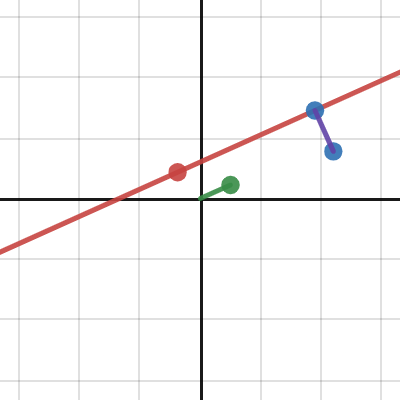
Desmos
I don't see what your train of thought is, I just see you combining stuff with no justification so I can't help with that, I'm not a mind reader
lavish jay
lavish jay
trying to find where i got the problem wrong and why
the way you pointed to solve, it was easy and correct but when i try to do it i got wrong
lavish jay
quartz compass
I don't see what your train of thought is, I just see you combining stuff with n...
thanks to point it out, i'll get better at expressing my thoughts
 viscid lagoon
Can anyone give me a hint on how to find a linear mapping with the following properties: \
Let $V$ be a vector space over $\mathbb{K}$ and $A \in \text{End}(V)$ a linear mapping such that
$$\ker(A) \subset \text{im}(A), ; \ker(A) \neq {\vec{0}}, ; \text{im}(A) \neq V$$
stoic pythonBOT
lewis
 lavish jewel
probably some flavor of an identity matrix with one or more columns replaced by all zeros, and permuted
lavish jay
@quartz compass i got what i was doing wrong, first i was mistaking the normal vector for the direction vector and the other erro was an algebra mistake
viscid lagoon
we haven't really introduced matrices
lavish jewel
ah you want a generic linear transformation
viscid lagoon
yeah
i've been thinking about it a lot, but i haven't come to a linear mapping that worked
lavish jewel
how about differentiation of polynomials of order <= n
say order 1
its image is in its kernel
sorry, backwards
it's kernel is in its image
viscid lagoon
differentiation of polynomials?
lavish jewel
mhm
viscid lagoon
that sounds quite complicated, hmm
viscid lagoon
yeah
 stable kindle
ok just take a projection, like the entire space onto a hyperplane, and then rotate the plane so it covers the kernel
composition
differentiation is fairly simple
viscid lagoon
stable kindle
ok just take a projection, like the entire space onto a hyperplane, and then rot...
so how exactly would that look like
like the linear transformation
stable kindle
compositions of linear transformations are linear
just flatten it and rotate
but yeah differentiation is neater
kernel is just constants, degree 1 polys go to constants
lavish jewel
it's a bit more difficult if the notation was meant to signify "strict subset"
stable kindle
still differentiation
viscid lagoon
yeah, right, im just not sure whether there is like a super neat solution because we actually haven't introduced differentiation fully formally, either
that's why im unsure on what to do
stable kindle
or just take 3D in the thing that i said
viscid lagoon
its not strict subset
lavish jewel
all good then
stable kindle
ok so we can use the 2D case
viscid lagoon
yeah, could you expand on that
stable kindle
consider the linear transformation from R^2 to R^2 that takes (1, 0) to (0, 1) and (0, 1) to (0, 0)
viscid lagoon
yea
stable kindle
the x-axis is turned 90 degrees clockwise into the y-axis
and the y-axis goes to 0
the image is the y-axis, and the kernel is the y-axis
viscid lagoon
so basically, ill need to do have some sort of piecewise mapping
stable kindle
piecewise??
stable kindle
look, visualise this: flatten the entire cartesian plane onto the x-axis
so then the kernel is the y-axis
viscid lagoon
yeah, but how would it formally look like
stable kindle
and then just turn the x-axis 90 degrees so it's overlaid on the y-axis
well
every element of R^2 is of the form a(1, 0) + b(0, 1)
so this would take (a, b) to (0, a)
stable kindle
it is
viscid lagoon
so (a,b) -> (0,a)
stable kindle
it's more natural, you only have to do one thing
viscid lagoon
but how is ker neq 0
viscid lagoon
stable kindle
so this would take (a, b) to (0, a)
just from this
stable kindle
(0, 0) -> (0, 0)
(0, 1) -> (0, 0)
(0, 2) -> (0, 0)
stable kindle
no because then the image is the x-axis
but the kernel is the y-axis
the point of the rotation is just to rotate the image so it overlaps the kernel
stable kindle
yeah
viscid lagoon
yeah, i get the concept now
stable kindle
there are a lot of things that fit this bill though, once again differentiation works and it's very easy to define on the polynomials
just a whole bunch of things
viscid lagoon
yeah, but i actually think this one is easier
with hyperplanes
idk, just my intuition
stable kindle
actually is differentiation just a weird type of projection
viscid lagoon
yeah
zinc timber
wait differentiation isn't a projection
stable kindle
yeah ok
zinc timber

zinc timber
yeah
viscid lagoon
wait, for the example, we actually even get ker(A) = im(A) if im not mistaken
right?
stable kindle
yes
viscid lagoon
i see
stable kindle
hah, yes
zinc timber
nah it doesn't satisfy ker subset im
stable kindle
wait
oh it's the wrong way round
right
and identity is prohibited bc they want non-zero kernel
zinc timber
tho what kanga roo said is already enough
sacred palm
 stable kindle
what have you tried

 slim geyser
Does the non existance of eigenvalues imply non existance of eigenvectors and vis versa?
 shut stag
All square matrices have eigenvalues, though some may not be real numbers. All eigenvalues have corresponding eigenvectors
slim geyser
ok i meant by non existance that there's no real eigenvalues
shut stag
complex eigenvalues will also have corresponding eigenvectors
slim geyser
but if i have no real eigenvalues, does that mean that i will also have no real eigenvectors?
shut stag
that is logically equivalent to:
All real eigenvectors implies all real eigenvalues
wintry steppe
real eigenvectors 🤔
 tranquil steeple
shut stag
that is logically equivalent to:
> All real eigenvectors implies all real eigen...
tranquil steeple
shut stag
that is logically equivalent to:
> All real eigenvectors implies all real eigen...
no?
shut stag
Oh. What's the contrapositive then?
quartz compass
make a 2x2 diagonal matrix with i and -i on the diagonal, the eigenvalues are not real but has real eigenvectors
tranquil steeple
just take i*Laplace FDM it is diagonalized by DST (real) and has only imaginary eigenvalues
quartz compass
considering we only care about eigenspaces, kind of weird to really discuss the eigenvectors this way anyways
stable kindle
nice
sacred palm
does anyone know what makes a matrix span another
like if their asking this. I know you put it as matrix and make it = to 0,5,6 row reduce ect but i get free varaibles for row 3

is the free variables meaning that it will span?
wintry steppe
I want to minimize the norm of A*x where the norm of x is equal to 1.

How could I do that?
A is known.
quartz compass
what is A
quartz compass
what dimension
wintry steppe
4x4
sacred palm
sacred palm
like if their asking this. I know you put it as matrix and make it = to 0,5,6 ro...
Bump thx
 glacial terrace
Hey, I don't understand why from the black circle then we have $[T]^\gamma_\beta = a_{ij}$
 stoic pythonBOT
mns
 nocturne jewel
you don't
glacial terrace
I believe it is related with this but I don't understand
 nocturne jewel
if T: V to W, then you can write any T[v] vector as a linear combination of a basis of W
glacial terrace
and then
nocturne jewel
Oh I think I see what you're getting at
Any linear transformation T can be written as a matrix transformation, $T[v]=Av$ where A is the matrix representation
stoic pythonBOT
Mosh
 nocturne jewel
now suppose $T[v]=[x_1,...,x_n]$
stoic pythonBOT
Mosh
 nocturne jewel
what is $x_1$ going to equal? Well, it'll equal the 1st entry of $Av$. If I define $A=[a_{ij}]$, then $x_1=a_{11}v_1+...+a_{1n}v_n$
stoic pythonBOT
Mosh
 glacial terrace
stoic python
**Mosh**
glacial terrace
stoic python
**Mosh**
hum
nocturne jewel
glacial terrace
Hey, I don't understand why from the black circle then we have $[T]^\gamma_\beta...
What the notation you circled is saying is that the jth basis vector from beta maps to that vector written as a sum
dawn drum

Why wouldn't this be a 'must' ?
is the only case where v doesn't belong to Span{u} if u is the zero vector?
stoic pythonBOT
Mosh
 nocturne jewel
this is not defined for the 0 vector / c=0
 lavish trout
How would I find the rational form a matrix given the minimal polynomial?
I know I have to identify the invariant factors but I'm not certain of how they should be chosen
dusky epoch
rational form?
wintry steppe
rational canonical form probably
zinc timber
the reduction process looked very complicated to me at least 
 hasty bolt
I have a lot of doubts in linear equations
 wraith canopy
How do tensors even work?
wintry steppe
the same way magnets do
zinc timber
wintry steppe
the same way magnets do

vast iron
wraith canopy
How do tensors even work?
They transform as tensors.
 autumn kraken
is <(8,1,1,2)> a vector space?
dusky epoch
does (8, 1, 1, 2) live in R^4 equipped with the standard addition and scaling operations, and do <these> mean span?
autumn kraken
<> means span yea
dusky epoch
okay then <(8,1,1,2)> is a subspace of R^4
and therefore yes, it is a vector space in its own right
 zinc timber
autumn kraken
zinc timber
autumn kraken
what were you trying to show with this?
 clever totem
I have the following task:

My idea was to show this by contradiction
but it just doesn't work
can anyone give a hint, if possible?
also, why does wolframalpha say that these are linearly independent?
the third vector is the only one with a non-zero element at the fourth slot.
 quartz compass
clever totem
can anyone give a hint, if possible?
quartz compass
clever totem
can anyone give a hint, if possible?
write out an arbitrary linear combination between the linear functionals that sums to 0, then look at how that specifically acts on elements of K[x] to show each of the coefficients must be 0
clever totem
Thank you
quartz compass
clever totem
also, why does wolframalpha say that these are linearly independent?
the third v...
I don't know what wolfram alpha is smoking here
autumn kraken
zinc timber
what were you trying to show with this?
that the matrix A is injective (or rather the linear map defined by matrix A)
sorry late response
 fluid lintel
in the euclidean space, given the quadric $x^2+z^2+2xy-1=0$ how can i find a plane such that the intersection is a reducible conic with rank 2?
stoic pythonBOT
Gaarco
 zinc timber
is it linear algebra?
fluid lintel
yes
at least, it's in my course linear algebra and geometry, and makes heavy use of linear algebra... this seemed the most appropriate channel
lavish trout
If $A$ is a fixed $n\times n$ matrix, and the function $f_A:V\rightarrow F$ is defined $f_A(X) = trace(A^tX)$. How do I show that $A\rightarrow f_A$ is an isomorphism from $V$ to $V^*$
stoic pythonBOT
TylerUno
 lavish trout
Linearity of the map is easy, but I don't know how to show bijectivity here
I'm thinking I have to come up with $n^2$ matrices $X_i$ such that $f_{X_i}$ spans $V^*$
stoic pythonBOT
TylerUno

 sage shale
sorry, just a quick question; if I have 2 vectors, a and -a, and I dot them; what should my product be?
quartz compass
take a guess
quartz compass
well, do you know what a dotted with itself is?
a dot product isn't going to be 0 unless the vectors are orthogonal
quartz compass
yeah good
sage shale
mag. a^2
quartz compass
-1 is a scalar and that factors out of the dot product
quartz compass
for instance if u,v are vectors and s is a scalar then $u \cdot (s v) = s ( u \cdot v)$
sage shale
what about something like (a -2b) dot (a+2b)?
stoic pythonBOT
Merosity
 quartz compass
you have to expand that out, dot product distributes over addition
sage shale
so that'd be mag a^2 -4b
quartz compass
no it won't distribute like that
lavish trout
what's the rank of a companion matrix?
is it n-1 iff det(A)=0?
I forget whether the constant term in the min poly was the same as the determinant
 warm zealot
I want to model matrices Operations in programs. I'm a computer science major. And none of the langs i know do well with this kinda thing. I've heard , R, Julia , python and fortran are really good for matrix operations
nocturne jewel
Numpy has linear algebra stuff in it iirc
nocturne jewel
idk what "types" are.
warm zealot
Oh right , math server lmao
Ok
So in python you can state x = 34
The data type of x is of an integer
i want to be explicit of what a data type a variable is
And i only see fortan that gives me that ability
nocturne jewel
#computing-software might be better then
lavish trout
python actually has types but the language doesn't make good use of it
Depending on what you're looking for out of typing, I think Julia is a great language because of its multiple dispatch
Also, if you're doing matrix computations, every language I know is able to handle that
or do you mean static vs dynamically typed?
if you just want static typing for speed, then ocaml is statically typed without the hassle of explicit declarations
otherwise, idk just use C/C++

 halcyon spindle
 viral otter
For b) is a projection problem, take v = B - A, w = C - A then project w onto v to get D.
zinc timber
@warm zealot what the prob actually?
warm zealot
zinc timber
<@373160837151719424> what the prob actually?
wdym
warm zealot
lavish trout
or do you mean static vs dynamically typed?
i am refering to strong and static typing
FORTRAN seems to be the only lang for that
zinc timber
u said you want to implement a LA library on your own
warm zealot
god no
zinc timber
why not julia?
warm zealot
i have nt looked into it much tbh
warm zealot
lol
zinc timber
noting's stopping you
thin wing
fortran is not something you'll want to use from scratch. There're old programs with too many lines of code you don't want to translate, so that's when you just learn Fortran.
warm zealot
ah
I mean, i have worked in a bunch of langs
i figured python or julia would be the most apt for what im doing
 warm zealot
lol thats not type saftey lol
zinc timber
if ain't broken, don't fix it
halcyon spindle
c++ stdlib should follow that.
warm zealot
C++ should have become D in 2001
halcyon spindle
I have heard of D, someone wrote a piece of code in D that I reference for something a while back. Tho #computing-software would be a better place for this.
 zinc timber
 sleek sundial
would this be true or false ?
sleek sundial
would this be true or false ?
is 0 self adjoint?
k that doesn't work
think about diagonalization
hmm ig there's an easier way
can you show that, for any operator $\text{null} T = (\text{range} T^*)^\perp$?
stoic pythonBOT
 sleek sundial
hm thanks for the hint I will try to work with it now  hopefully i can still think after today's final
 hard sequoia
is it ever worth it to solve a system of equations through gaussian elimination or Cramer's method over a non matrix method such as substitution or elimination
I've just been introduced to linear algebra and have found plenty of uses for vectors but I'm only a junior in HS and have no clue how I can implement matrices into stuff
zinc timber
well if you are up for solving 10x10 without using GE, you are welcome
and if your question is whether it's worth it to learn GE or not, answer is resounding yes, it absolutely is
stable kindle
GE is just elimination but you don't write the variables so it's faster, and also more systematic and methodical
if you learn it you'll see how similar it is really
hard sequoia
thank youuuu
 barren basin
warm zealot
when do you use fortran
barren basin
warm zealot
when do you use fortran
Fortran is often used in high performance computing and some other scientific research. If it's running on a super-computer, chances are that it was written in Fortran.
It's usually a question of C++ vs Fortran for such things and it depends on what sort of problem you're doing. Fortran is really good at arrays. If you can vectorize your problem, it's best in Fortran.
Other times people can describe their problem at a high enough level that they use Python and then there's Python libraries written in C++ or Fortran, such as numpy and scipi, that do the heavy lifting for you. Even Python compiled with Cython is too slow for most things. But you can use Python to call compiled libraries.
Julia is supposed to be fast like C but easy to read and write like Python. But many people haven't used it and the number of libraries are smaller.
glacial terrace

For instance f(x) = 2x
then we have $2\alpha_1 + 0\alpha_2 + \dots + 0\alpha_n = 0$ for $\alpha_1 \neq 0$ and $\alpha_i = 0$ we have a linear dependent combination?
stoic pythonBOT
mns

 mellow matrix
hi i need some statistics help but idk which channel i shld use
glacial terrace
but then f(x) = 2x contradicts the theorem?
zinc timber
glacial terrace
but then f(x) = 2x contradicts the theorem?
it contradicts nothing,
remember linear dependent means $\sum c_iT_i \equiv 0$ so checking only one vector is not enough. it has to be zero for all vectors.
stoic pythonBOT

 vocal isle
Hey folks I'm trying to formally derive the 2d rotation matrix using matrix algebra. But I get an incorrect result! Can someone help me?
 stoic pythonBOT
ok-hi
 wintry steppe
what's a determinantal map
stoic pythonBOT
ok-hi
 lavish jay
I have the line ax +by = c if X= 0 a point P would be (0 , c/b) How can i take this fraction out of the vector and transform the point P in a vector without fractions inside of it ?
or it's impossible ?
 sudden narwhal
Its not possible. I mean, whats wrong with fractions ?
or im not getting the question
lavish jay
sudden narwhal
Its not possible. I mean, whats wrong with fractions ?
nothing, i was just wondering if it's possible
and i think would let the problem easy
sudden narwhal
But you want to transform a point into a vector ?
lavish jay
sudden narwhal
But you want to transform a point into a vector ?
no, i'll use the point to find a vector
sudden narwhal
oh ok
lavish jay
my other point is B ( x0 , y0)
so the vector PB would be B - P that is equal to [ x0, y0 - c/b]
 dawn rain
Hi
if two square matrix of same order satisfy AB=BA
and with a known matrix A
can we find an algorithm to randomly generate matrix B
tranquil steeple
dawn rain
can we find an algorithm to randomly generate matrix B
If A has some special structure, sure, in general, no idea (but probably).
tranquil steeple
dawn rain
so what do you mean by structure
for example Toeplitz
dawn rain
ok even for Toeplitz how can we find any random B
tranquil steeple
for example take any two tridiagonal Toeplitz matrices
(maybe needs to be symmetric)
fringe fjord
If you can diagonalize A, then the matrices that commute with it are just the block diagonal matrices (with blocks corresponding to repeated eigenvalues) in the same basis.
tranquil steeple
dawn rain
ok even for Toeplitz how can we find any random B
or take any two circulant matrices
and as Troposphere said you can just do: ```
julia> A=rand(5,5)
5×5 Matrix{Float64}:
0.0217842 0.764532 0.944964 0.677879 0.169496
0.98743 0.732502 0.752653 0.744108 0.8975
0.825896 0.141405 0.636646 0.124738 0.194175
0.585379 0.988481 0.765741 0.457128 0.880165
0.319981 0.144375 0.218484 0.322586 0.366169
julia> eA=eigen(A)
Eigen{ComplexF64, ComplexF64, Matrix{ComplexF64}, Vector{ComplexF64}}
values:
5-element Vector{ComplexF64}:
-0.5290694981344779 - 0.03589927074372178im
-0.5290694981344779 + 0.03589927074372178im
0.09093440548537195 + 0.0im
0.4909957037257306 + 0.0im
2.6904379012161606 + 0.0im
vectors:
5×5 Matrix{ComplexF64}:
-0.587436-0.0im … 0.0598802+0.0im -0.428979+0.0im
0.369889-0.0339187im -0.447666+0.0im -0.624444+0.0im
0.38738-0.012014im 0.746747+0.0im -0.268499+0.0im
-0.542264+0.0950813im -0.443668+0.0im -0.560027+0.0im
0.24973-0.0358733im -0.203808+0.0im -0.200811+0.0im
julia> b=rand(5)
5-element Vector{Float64}:
0.41176032487920466
0.25539752089525225
0.6418943094848829
0.5956161922233203
0.6908559630129848
julia> B=eA.vectors*diagm(b)*inv(eA.vectors)
5×5 Matrix{ComplexF64}:
0.421163-0.39667im 0.133639-0.0390039im … -0.066218-0.291904im
0.0778646+0.253144im 0.567634+0.0227561im -0.0218183+0.184938im
0.114065+0.262776im -0.0737463+0.025082im 0.0621939+0.192896im
0.06193-0.375624im 0.149271-0.0309494im 0.109321-0.272641im
0.0108631+0.1722im -0.0581817+0.014674im 0.600906+0.125295im
julia> norm(AB-BA)
2.1109246901464725e-15
the code is after julia> on each line
dawn rain
ok thx
Another doubt
if A,B,C pairwise commute
can we say det(A^2+B^2+C^2) >= 0
A,B,C has all elements real
tranquil steeple
just did eigendecomposition of A, tok just some other random "eigenvalues"
tranquil steeple
dawn rain
ok thx
Another doubt
if A,B,C pairwise commute
can we say det(A^2+B^2+C^2) >= 0
...
A,B,C can all have a zero eigenvalue so det of thet sum can be 0 right
tranquil steeple
dawn rain
<@!620999012803149855>
I would think so, yes. But maybe there are some counter example?
dawn rain
tranquil steeple
and as Troposphere said you can just do: ```
julia> A=rand(5,5)
5×5 Matrix{Float...
yeah i was trying to find any by python so i needed that
but i couldnt find any
zinc timber
because that is indeed true
dawn rain
zinc timber
because that is indeed true
can you share any proof if possible?
zinc timber
if you are talking about complex matrices I can give you an outline on how to prove it
zinc timber
pairwise commute means they are simultaneously triangulable
so for $P^{-1}(A^2+B^2+C^2)P = (P^2+Q^2+R^2)$
stoic pythonBOT
 dawn rain
zinc timber
pairwise commute means they are simultaneously triangulable
dawn rain
zinc timber
pairwise commute means they are simultaneously triangulable
sorry i dont know what is triangluable
zinc timber
they are all triangular, so diagonals are of the form a^2
so you get $\det(P^2+Q^2+R^2) = \prod_{i=1}^n (p_{ii}^2+q_{ii}^2+r_{ii}^2)$
stoic pythonBOT
 zinc timber
which is indeed ≥0
vocal isle
vocal isle
Bump ^
dawn rain
zinc timber
which is indeed ≥0
can we say for n matrixs?
zinc timber
dawn rain
sorry i dont know what is triangluable
means there is a basis wrt which the matrix is upper triangular (or lower)
zinc timber
dawn rain
can we say for n matrixs?
of course, given they commute
this proof only works when they commute, otherwise doesn't
zinc timber
vocal isle
Bump ^
I have read it, don't know how to answer
dawn rain
zinc timber
of course, given they commute
thx
thin wing
vocal isle
Hey folks I'm trying to formally derive the 2d rotation matrix using matrix alge...
First of all you're result doesn't seem wrong, you just didn't prove x'=R(x). If theta was 90°, that means the dot product of x and x' is zero, which is correct since now they're perpendicular. Second of all, I think it's best to exploit the linearity of the problem, factor out the xⁱ coefficients and have the matrix act on the basis, x'=xⁱR(eᵢ). From there you'd show by picture that the corresponding rotation equations are e₁'=e₁cosθ-e₂sinθ, and e₂'=e₁sinθ+e₂cosθ, and put that in matrix form.
lavish jay
To do this exercise or the line is normal to the plane or it's one of direction vectors of the plane right ?

wait...
there's one more situation
but when the line is one of the directions vectors of the plane, does count as intersection ?
lavish jay
i think i got
if the dot product of the normal vector of the plane and the direction vector of the line = 0 then the line is tanget to the plane
so the angle between then is 0
if not the angle between then is pi/2 - the angle between the line and the normal vector
correct ?
nha it's incorrect the answer of the book is 88.4° mine is 88.6°
lavish jay
What does solve for c mean here ?

 stable kindle
find a c that works
lavish jay
thanky you 💙
lavish jay
lavish jay
What does *solve for c* mean here ?
is the answer to this: $c =\frac{vn}{||n||}$ where n is the normal vector of the plane, v is a vector that starts in the origin and goes to a point B and c a scalar ?
stoic pythonBOT
ᓇᘏᗢ Guilhotina ᓇᘏᗢ
 stable kindle
what does vn mean
lavish jay
stable kindle
what does vn mean
Dot product of the vectors v and n
stable kindle
ok
thin wing
stoic python
**ᓇᘏᗢ Guilhotina ᓇᘏᗢ**
Yeah I believe so.
 stable kindle
i mean it's basically just that v dot n = (p + cn) dot n = p dot n + c * n dot n = 0 + c * |n|^2
so c = (v dot n)/|n|^2
i think that's simpler
thin wing
stable kindle
i think that's simpler
Yeah, lol.
lavish jay
stable kindle
i mean it's basically just that v dot n = (p + cn) dot n = p dot n + c * n dot n...
I got confused here
stable kindle
where
lavish jay
P dot n + c * n dot n = 0 + c *|n|²
stable kindle
yeah
question tells you p is perpendicular to n
and n dot n = |n|^2 always for any vector n
thin wing
Yep, that's where you need a little experience to know to start there. Otherwise, my case is the naïve long way (Pythagorean theorem).
lavish jay
thin wing
Yep, that's where you need a little experience to know to start there. Otherwise...
yeah i went fot the same way
stable kindle
basically my thought process was:
'question tells us n is normal to p'
'what can i do with that?'
'i should dot n with p or something involving p in'
'hey there's an equation that has p in, v - cn = p'
'let's dot it up'
vocal isle
thin wing
First of all you're result doesn't seem wrong, you just didn't prove x'=R(x). If...
Hey thanks for the reply. I agree that I can easily solve it using geometry - but I really wanted to solve it using matrix algebra. It just occurred to me that equation 2 just says that the angle between then must be theta, but says nothing about direction. So I'd expect an answer to work for +- theta. I've been staring at it for hours now and I can't find out how to do it though 😭
vocal isle
thin wing
First of all you're result doesn't seem wrong, you just didn't prove x'=R(x). If...

I found it has to do with the dot product of Xr and X. Somehow this forces the result that R must be symmetric.
And the only symmetric rotation matrix in 2D is the identity (theta = 0). This makes me think that I shouldn't use the angle between two vectors formula because it doesn't account for direction and hence the only solution is the identity (trivial). I need a better way.
stable kindle
vocal isle
And the only symmetric rotation matrix in 2D is the identity (theta = 0). This m...
not true
theta = pi also has symmetric rotation matrix
 torn stag
@vocal isle Apply that matrix to the standard basis vectors $e_1$, $e_2$.
stoic pythonBOT
IlIIllIIIlllIIIIllll
 torn stag
@vocal isle You will see that it gives the correct rotation.
thin wing
vocal isle
Your conclusion is off. Writing everything out makes it clear that xᵀRᵀx = xᵀRx, doesn't imply Rᵀ=R.


 odd kite
I think you can still get there, just express ABx as something else @glad acorn
one the last line

 glad acorn
zinc timber
you can't use that directly here
glad acorn
zinc timber
you can't use that directly here
what do you mean?
zinc timber
how do you show a.ii
 zinc timber
try showing AB=BA
odd kite
left and right eigenvalues are the same
as such ii) could be shown much the same as i) except left multiplying with an A left eigenvector
zinc timber
odd kite
left and right eigenvalues are the same
you can also use this
 limber kiln
How would I do this or even start this?
 thin wing
limber kiln
How would I do this or even start this?
thin wing
limber kiln
How would I do this or even start this?
What's the determinant of a rotation matrix?
limber kiln
cos^2(theta)-(-sin^2(theta))?
thin wing
Yes, but you can simplify that.
limber kiln
1
thin wing
Yeah, compare that to det|A|
limber kiln
also 1
thin wing
It's not also 1?
thin wing
Yep.
limber kiln
Sorry, kinda slow today
thin wing
No prob, heh.
limber kiln
So is a rotation always det=1
thin wing
Pretty much.
limber kiln
Gotcha
thin wing
Since it preserves length.
limber kiln
thank you very much
vast iron
Which raises a fun question, what's det=-1?
thin wing
vast iron
Which raises a fun question, what's det=-1?
Well determinants measure the scaling of a n-volume unit after the corresponding transformation. So -1 would be like a rotation after a flip, I believe. (And of course by that logic skews could also have ±1 determinants).
 still lodge
yeah det of -1 is just a flip i believe
no actual scaling since it's just 1 still but the area it measures is flipped
limber kiln
So like, I'm trying to figure out what to start with here? Would I just start by getting a normal vector then making the equation using only the point (2,-2,-3)?
 limber kiln
well I just don't know where I would start with this
hot willow
limber kiln
So like, I'm trying to figure out what to start with here? Would I just start by...
We know what the direction vector that it needs to be perpendicular is right?
Since we know direction
Vector [1,-1,1] is direction of line
We know plane needs to be orthogonal to vector
General formula for plane is Dot product of direction vector it needs to be normal to and [x-a,y-b,z-d]
Which equals zero
limber kiln
One thing that confuses me is the x(t) = (18, -10, 1) + t(1,-1,1) I just dont understand what that is
like
what does t(1, -1, 1) mean
limber kiln
I'm in calc 1 right now
limber kiln
Ok
limber kiln
so like, (18, -10, 1) is the point and (1,-1,1) is the direction?
limber kiln
Ahhhh
hot willow
(18,-10,1) can be thought of as x value at t =0
limber kiln
Oh ok. Perfect
hot willow
Now we’re trying to find a plane
Right that
Is perpendicular
To line and passes through point right?
hot willow
Ok so the general formula
For a plane is
A(x-x1) + B(y-y1) + C(z-z1)=0
So the abc coordinates represent
The component of the direction vector
And the x1,y1,z1
Represent the point hr passing through
limber kiln
The component? so just (1, -1, 1)?
limber kiln
Gotcha
hot willow
Now what do u think x1,y1,z1 would be?
limber kiln
so in the end its gonna be 1(18-2), -1(-10+2), 1(1+3)?
limber kiln
18x-2? for that then?
hot willow
No just x -2
limber kiln
So like (x-2)+(y+2)+(z+3)?
hot willow
The + right behind y should be -
limber kiln
oh because its -1?
limber kiln
and thats my equation
hot willow
Yes
 strong bison
 limber kiln
logic is good, I wanna pass the test lol
strong bison
Looking for a solution to the following problem.
Effectively, I'm trying to find a matrix A such that I can isolate the the signs of the diagonal entries
Ah, and we can assume B is positive semidefinite
limber kiln
limber kiln
logic is good, I wanna pass the test lol
by that I mean, I would like to understand the logic but currently i do not
lavish jewel
strong bison
Looking for a solution to the following problem.
i'm under the impression this cannot be done in general
you can do it if you vectorize the matrix first and then define a matrix A acting on that, but it's more generally some sort of tensor product
hot willow
Oh yeah that looks tough or p hard to find a generalized form
Of doing that especially since the diagonal entries of B
Have to be preserved
vocal isle
thin wing
Your conclusion is off. Writing everything out makes it clear that xᵀRᵀx = xᵀRx,...
Wow thanks!! That blows my mind!
Ok then this takes me back to my original problem of solving for the rotation matrix. I had:
XT X Cos(theta) = XT R X
Is there a way to solve this to find R?
strong bison
lavish jewel
you can do it if you vectorize the matrix first and then define a matrix A actin...
wait a minute. I screwed up. My problem requirements are that B is actually a flattened vector  so B is an n^2 vector, and i'm looking for an A that is n^2 x n^2
lavish jewel
oh then that is perfectly doable
A is gonna be a diagonal matrix with n 1's along the diagonal, and everything else is 0
and you place these 1's so that they match the main diagonal
the exact location depends on how you "flatten" the matrix B, but
let's say we stack the columns, yeah?
strong bison
columns fine
I think I have to check the corresponding B value right?
i.e. 1/B_ii as long as B_ii isn't 0, and then make them all positive
 lavish jewel
you get the idea. not 1/B_ii tho
strong bison
oh?
strong bison
ah yes yes
strong bison
so I'm summing a few other things, this was a subproblem to a larger problem
lavish jewel
aight
strong bison
fingers crossed
lavish jewel
anyway, i think you got the idea 👌
 yes thank
fluid lintel
yes thank
fluid lintel
how can i find the intersection point of a line and a plane in the projective space?
the plane is $x+z=k$ and the line is $\begin{array}{lcl}2x-y & = & 2 \ kx+y+(k+2)z & = & 0 \end{array}$
stoic pythonBOT
Gaarco
 fluid lintel
with $k\neq-1\pm\sqrt{3}$ the plane and the line are parallel so they intersect in the projective space
stoic pythonBOT
Gaarco
 fluid lintel
I have to find the coordinates of that point
zinc timber
I need a counterexample of this - "If E1 and E2 are projections onto 2 independent subspaces, then E1+E2 is also a projection"
dusky epoch
independent subspaces?
zinc timber
I believe it means that they have trivial intersection
fringe fjord
Map (x,y) to (x-y,0) and (0,x+y), respectively.