
#linear-algebra
2 messages · Page 252 of 1
 noble swan
 zinc timber

we actually extend the concept of basis to the 0dim space
so in some way it is correct,
 still lodge
is this an appropriate restatement of cayley hamilton: the characteristic polynomial of a matrix A annihilates said matrix
noble swan
Gotcha, thanks for the help!
zinc timber
still lodge
is this an appropriate restatement of cayley hamilton: ```
the characteristic po...
ig
still lodge
i mean wikipedia has every square matrix over a commutative ring (such as the real or complex field) satisfies its own characteristic equation.
now idk what a commutative ring is (yet) but it sounds at least close to interchangeable
im just tryna find my own wording so it's easier to grasp

 stoic pythonBOT
shriller44
 still lodge

Mathematics Stack Exchange
In my math lectures, we talked about the Gram-Determinant where a matrix times its transpose are multiplied together.
Is $A A^\mathrm T$ something special for any matrix $A$?
zinc timber
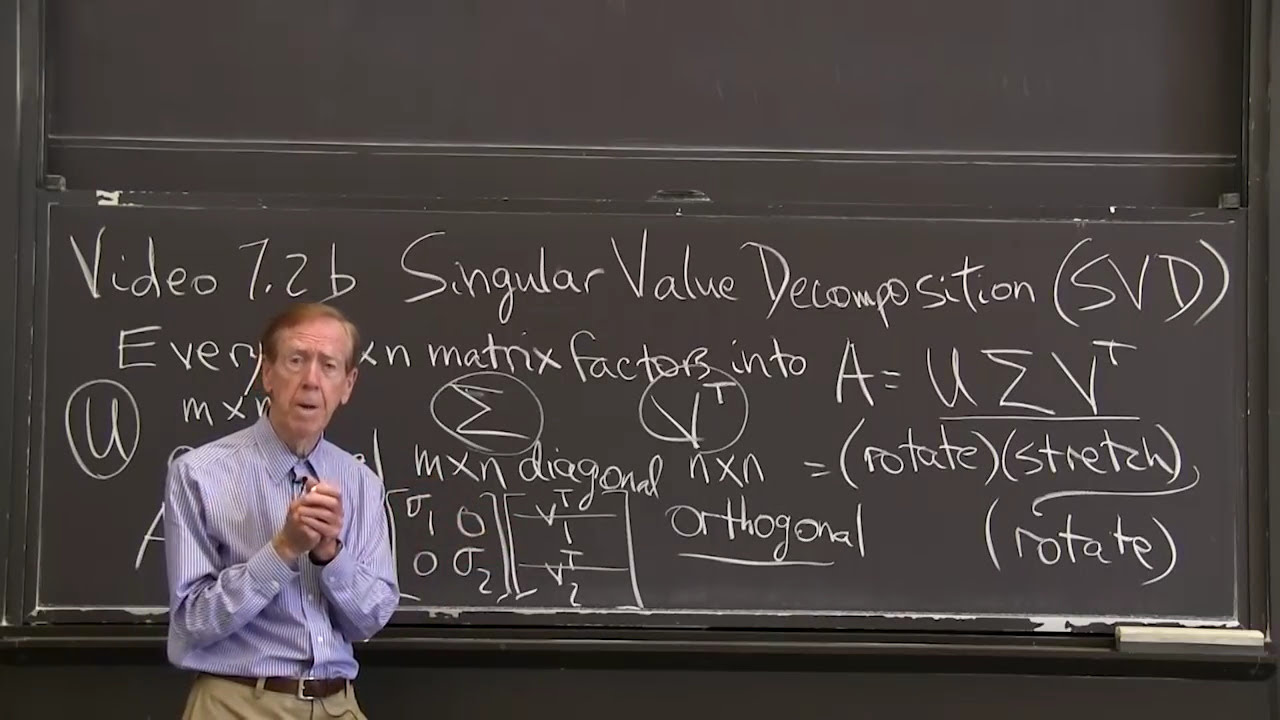
MIT RES.18-009 Learn Differential Equations: Up Close with Gilbert Strang and Cleve Moler, Fall 2015
View the complete course: http://ocw.mit.edu/RES-18-009F15
Instructor: Gilbert Strang
The SVD factors each matrix into an orthogonal matrix times a diagonal matrix (the singular value) times another orthogonal matrix: rotation times stretch tim...
 lavish jewel
AA^T and A^TA are symmetric, and therefore diagonalizable
 sinful valve
so yeah the idea is just getting the same orthogonal matrices
as in same sense as eigenvalue decomp before this was mentioned
just that that eigenvalues and vectors are taken as squared to get singular values
wait nah S^2 and U/U^T is the eigenvalues n vectors of AA^T
but we are interested in singular values of course
presumably theres more than this just method to do SVD but yeah its calm
still lodge
B is a 5 × 5 matrix with minimal polynomial (x - 1)(x − 2)^2
is it possible to determine the characteristic polynomial of B from this info
it's over complexes btw
zinc timber
No
still lodge
there are a limited number of possibilities though right
zinc timber
it could be anything of the following
\begin{align*}
(x-1)(x-2)^4 \
(x-1)^2(x-2)^3 \
(x-1)^3(x-2)^2
\end{align*}
stoic pythonBOT
Ryuzaki
 still lodge
alright cool that's what i thought, just double checking :)
now if a 5x5 matrix has minimal polynomial x^3, then that must mean that the characteristic is x^5 right...?
bc the only eigen value would be 0
 still lodge
well if it's min polynomial is x^3 can't it have two possible JCFs
either two blocks of single 0's or a block w two 0's and a 1
still lodge
ok then there's something wrong in my understanding can you elaborate pls
zinc timber
an eigen value of algebraic multiplicity m and geometric multiplicity k means there are k-1 blocks of 1x1 and one large jordan block of size m-k+1
let's take a simple example
say min = x² and chr = x³ then
$A=\mqty[ 0&0&0\0&0&1\0&0&0]$
stoic pythonBOT
Ryuzaki
 zinc timber
do you agree?
still lodge
yes
zinc timber
recognize the 1x1 and 2x2 blocks
yeah there is a 3x3 jordan block as you might have deduced
but remember that in the 3x3 block there are only 2 ones
number of ones = size of block - 1
so you get 3-1=2 ones, giving you rank 2
lavish jewel
i'm gonna have to learn this stuff at some point
but what are you calling rank here
zinc timber
rank of the entire matrix given min poly = x³ and char poly = x⁵
context was different here
lavish jewel
aight
still lodge
hmmm
still lodge
zinc timber
yeah there is a 3x3 jordan block as you might have deduced
i did not deduce this, why is there a 3x3
does the min polynomial kinda tell us what the largest block can be
^^that could be very wrong
zinc timber
what do you think the blocks should be
still lodge
2x2 and 1x1
zinc timber
still lodge
does the min polynomial kinda tell us what the largest block can be
no together with the chr poly it tells the exact size
ig you can find the max block size but not the exact size
@still lodge no no I was talking about the x⁵ and x³ case
still lodge
ohhhhhh ok yeah i was gonna say
zinc timber
u did deduce right?
still lodge
yeah
zinc timber
ok then number of 1's = ?
still lodge
but if you have the 3x3 block in the 5x5 matrix, couldnt the remaining slot(s) be a 2x2 or 2 1x1s?
and if you have a 2x2 block you have another 1
zinc timber
yeah but min poly discards the 2x2 block
still lodge
why
still lodge
ok this was still helpful ty <3
zinc timber
there will be 2x2 block giving rank 3
you were right
whole time I was thinking it's x²
 wise oriole
Can someone help me w this one
Question: Determine the pairs (a, b) ∈ R × R such that the system
respectively
(a) has no solution
(b) has a unique solution,
(c) has several solutions.
Show how you arrive at these conditions.


I found this but I don't know what to do now
zinc timber
can you tell me what is the condition for unique solution
wise oriole
(a,b) element R x R that?
zinc timber
no not that
the one involving the ranks of the augmented matrix
ok if you don't remember it then say our unknowns were x,y,z then the last row gives us
wise oriole
the question above that's the only thing we got
wise oriole
1 and -1?
wise oriole
0?
zinc timber
0=-2
zinc timber
so you see how you are supposed to derive the conditions?
wise oriole
but where did you get the (1-b²)z=-(a+2) from
zinc timber
the last column of your matrix
wise oriole
(b) has a unique solution then a can't be -2 and 2 / b can't be -1 and 1 right
for (c) has several solutions: b=1/-1 and a=-2
(a) has no solution if a is not -2
is this correct
zinc timber
for unique solution, it doesn't matter what a is, all you need to care about is 1-b² is not 0
wise oriole
Then a can be everything
zinc timber
yeah
wise oriole
How can I say that symbolic is that a element R
wise oriole
Oké thanks a lot
zinc timber
your other conclusions are also wrong tho
wise oriole
Yeah?
wise oriole
(1-b^2)a=-(a+b) or b is 1 and -1
zinc timber
see
infinite solution means that the last equation is degenerate. like 0=0. which values of a and b give you 0=0?
that should be the condition for infinitely many solutions
it just means you get no additional information from the 3rd equation
wise oriole
b = 1 or -1 you get 0 and a = -2 or am I dumb
zinc timber
yeah
wise oriole
Yeah bcs I’m dumb or yeah that is correct
zinc timber
correct, lol
wise oriole
Then why is it wrong you said
zinc timber
wise oriole
(1-b^2)a=-(a+b) or b is 1 and -1
bcz that's not what u hv written here
wise oriole
wise oriole
(a) has no solution if a is not -2
Ah oké Ty and is this correct
zinc timber
no solution if u get some kind of contradiction like 0= 1
b=±1 but a≠2 gives 0 = some non zero number
which is impossible
wise oriole
Then a can be everything but can’t be -2
zinc timber
ya
wise oriole
a ∈R / {-2} ?
wise oriole
maybe i have a quetion later but i'm ok for now thank you for your time
 ionic laurel
hi i have a few questions
The matrix A and (B^-1)(A)(B) then they have the same set of eigenvalues for every invertible matrix B <- This is true correct?
If 2 is an eigenvalue of A, then A-2I is not invertible. (I believe this is true as well)
If two matrices have the same set of eigenvalues, then they are similar (True? Not sure)
 pallid rampart
I found out that this is true if you let the vector space to be $\brc{f\in C^\infty([-\pi,\pi]):f(-\pi)=f(\pi)}$
stoic pythonBOT
Whoever
 still lodge
what's the difference between elementary divisors and invariant factors
 worldly bear
ive found the the characteristic polynomial of a 2x2 matrix A is x^2 - tr(A)x+det(A), and that for a 3x3 matric A, we have x^3 -tr(A)x^2 -det(A)
Is there a similar way to find the coefficient of the linear term of the characteristic equation of the cubic or is it not possible
 winter harbor
worldly bear
Is there a similar way to find the coefficient of the linear term of the charact...
winter harbor
worldly bear
Is there a similar way to find the coefficient of the linear term of the charact...
Yup, you can!
You write it in terms of the exterior powers of your matrix.
More specifically.
Let $A$ be an $n \times n$ matrix over a field $\mathbb{K}$ and denote $p_{A}(x) \in \mathbb{K}[x]$ its characteristic polynomial, then:
$$
p_{A}(x) = \sum\limits_{k=0}^{n} x^{n-k} (-1)^{k} \text{tr} \left(\bigwedge^{k} A \right)
$$
stoic pythonBOT
MISTERSYSTEM
 winter harbor
This is a consequence of something called the newton identities, which relates elementary symmetric polynomials and power sum symmetric polynomials.
This can also be derived by embeding your matrix into the splitting field of the characteristic polynomial and using something called vieta's formula.
You can do this because the minimal and characteristic polynomials are invariant wrt field extensions.
Mathematics Stack Exchange
Let $T$ be an endomorphism of a finite-dimensional vector space $V$. Let $$f(x)=x^n+c_1x^{n-1}+ \dots + c_n$$ be the characteristic polynomial of $T$. It is well known that $c_m=(-1)^m\text{tr}(\bi...
Mathematics Stack Exchange
Looking at wiki, I want to
$p_A (t) = \sum_{k=0}^n t^{n-k} (-1)^k \operatorname{tr}(\Lambda^k A) $
where ${\displaystyle \operatorname {tr} (\Lambda ^{k}A)={\frac {1}{k!}}{\begin{vmatrix}\operatorn...
I found these two stack exchange threads which might give a more in depth explanation.
worldly bear
so I just need to learn how to compute the exterior powers of a 3x3 matrix and then I will be able to write the characteristic polynomial just by looking at it nearly?
winter harbor
worldly bear
so I just need to learn how to compute the exterior powers of a 3x3 matrix and t...
Yeah
You actually just need the trace of the exterior powers tho
If the characteristic of your field is 0
there's an explicit formula
which relies on computing a certain determinant
but idk if it is worth it
worldly bear
I think it would be nice to just go straight to the characteristic polynomial without the typical steps of det(A - lambda*I) personally
winter harbor
worldly bear
I think it would be nice to just go straight to the characteristic polynomial wi...
There's an ''intrinsic way'' to define the characteristic polynomial of a given linear operator on a finite dimensional vector space without going into determinant stuff.
Axler presents this in a short ''paper'' entitled ''down with determinants''
which motivated him to write his book ''linear algebra done right''
but like
Computing characteristic polynomials like that is just...
why would you do that
The determinant is a tool made for computation
so like, if you really need to calculate something explicitly, go for it.
worldly bear
i found it
 pliant blaze
hi does det(-A) == det(A)
worldly bear
i like his opening two paragraphs already
winter harbor
pliant blaze
hi does `det(-A) == det(A)`
No
for instance
take the 2x2 identity matrix
the determinant of - I_2 is 1
pliant blaze
ahh ic
winter harbor
what is true tho
is that det(A) = c^n det(A) where n is the size of the matrix, i.e A is an n x n matrix.
so that det(-A) = (-1)^n det(A)
still lodge
If 𝑞(𝐴)=0, then 𝑞 is divisible by the minimal polynomial of 𝐴
why isnt this named lmao
this feels really important
@/MISTERSYSTEM ive done some problems since we last discussed this stuff and i think ive gotten better :)
 wintry steppe
it's not named because it's basically the definition of the minimal polynomial
winter harbor
Yeah, TTerra is right lol
Remember how I said F[x] is a PID for F a field and we define the minimal polynomial of a matrix A as the monic polynomial that generates the ideal
Ann(A) = {f \in F[x] : f(A) = 0 } ?
That's the idea nitez
winter harbor
still lodge
@/MISTERSYSTEM ive done some problems since we last discussed this stuff and i t...

Nice
wintry steppe
winter harbor
Remember how I said F[x] is a PID for F a field and we define the minimal polyno...
monic!!!!!!!!!!!!!!!!!!!!!!!!!!
still lodge
yeahhh i havent taken abstract alg yet so i only have a loose idea of what a field even is
but our original discussion prompted me to at least make note of it to look into over winter break
worldly bear
i feel better about not knowing what a field is bc 8 year old terance tau didn’t either 🥲
still lodge
terrence 2pi
still lodge
sorry to nag but
still lodge
still lodge
what's the difference between elementary divisors and invariant factors
nada?
 steel moon
for #1, im having trouble to find two matrices that dont satisfy closed under addition / multiplication

 steel moon
what is that tool you are using?
lavish jewel
the scalar mult part is also easy. take an identity matrix of size 2n+1 x 2n+1 and multiply it by -1
it's octave 😛
steel moon
interesting, is it some sort of computational tool for math?
steel moon
oh cool
for the purpose of this problem, one counter example for a property would suffice right?
lavish jewel
for the purpose of any problem in which they ask if something is true, one counter example is enough to say it isn't
steel moon
gotcha
and for the 2nd problem, we should show each set is a subset of the other right?
So something like let s in Span(S). then s is a linear combination of each of the elements in S
lavish jewel
should be enough to show that the elements in S are linearly independent
then mention the dimension of P3(R)
steel moon
each of the elements in S have x^3 in it
hm i guess i should expand it out firsrt
to show the elements in S are linearly independent, i would need to show theres a non-trivial linear combination that equals the 0 vector
oh whoops i got the definitions mixed up
thats for dependant
wintry steppe
Is anyone using the latest calculator from Texas Instruments which is the Texas Instruments C version? The one with the python programming that was released in the fall? If so, does it support Linear Algebra?
 forest quiver

My teacher meant "noncolinear" instead of "nonparallel" right?
Oh wait no he didn't if they were parallel it would become some sort of line equation
Wait,,, don't they mean the same thing with 2 vectors?
Ugh
 marble lance
What does noncolinear mean for 2 vectors? If you seem them as points, then any 2 points lies on the same line. If you see them as directions and you just mean colinear as they point in the same direction, then that is the same as parallel. So I think the right word here is nonparallel.
zinc timber
yeah you can say that they are non- parallel
$\vec{v}_1 = c \vec{v}_2$ is also another way of saying they are co linear, so, if there is no contant c satisfying this, they are non co-linear
stoic pythonBOT
Ryuzaki

 golden kindle
Anyone know good websites to practise linear alg problems
 merry imp
can i get a hint for this? i have an expression for the inverse of A-I by factoring A^k - I, but how can i use that to find the inverse of A+I?

 teal grotto
(-A)^0 + (-A)^1 + ... = (I - (-A))^{-1}
 quaint steppe
Hi everyone currently studying linear algebra
can someone further explain to me these example on why they are not invertible?

what does it mean 1 is not in the range?
 slow scroll
It means that there is no x such that f(x)=1
In general a function is invertible if and only if it is bijective.
quaint steppe
slow scroll
In general a function is invertible if and only if it is bijective.
but then x^2 is not surjective so it's not invertible?
stoic pythonBOT
Namington

 limber sierra
but as the image notes, $1$ is not in the range of the multiply-by-$x^2$ map
stoic pythonBOT
Namington
 limber sierra
so $f^{-1}(1)$ makes no sense
stoic pythonBOT
Namington
 limber sierra
hence an inverse cant exist
quaint steppe
okay i kinda understood it already for example 2, what does backward shift means?
lavish jewel
take all of the elements in the list and shift them one of the left
quaint steppe
does it mean like $R^3$ going to $R^2$ for example?
stoic pythonBOT
jinichi
 lavish jewel
if you start with (0,1,1,...) the transformation yields (1,1,0,...)
so they note that if you have a nonzero element in the first position, the transformation gives you 0, so it has a nontrivial kernel
quaint steppe
oh so basically the linear map backward shift rotates the input to the left and make the first input goes last?
quaint steppe
I'll probably gonna ask more questions later.
wintry steppe
Guys, I'm dealing with a rotation matrix rotating vectors by an angle 30 degrees about the z axis. I've found one of the eigenvectors which is (0, 0, 1).
but is it the same as (0, 0, 1)^T ?
Transpose of that vector?
I'd just say that eigenvector and the transpose of it are the same thing.
(0, 0, 1)^T = (0, 0, 1)
lavish jewel
they're not the same thing, but they are both eigenvectors of the matrix
call your matrix R and this vector v, with eigenvalue lambda
then v^T R = v^T lambda, and R v = lambda v
wintry steppe
I mean yeah one of them is column vector and the second is a row vector.
lavish jewel
this is in general not true btw
but a rotation matrix is block diagonal, with a block that has just a 1, so it holds in this case, for this eigenvector
wintry steppe
How can I show that they are both eigenvectors of the same eigenvalue?
lavish jewel
apply the definition of eigenvector twice
once from each side 😛
you can also stop for a while to consider what it means for one matrix to be the inverse of another, and then assume your rotation matrix is diagonalizable
if AB = BA = I, and you consider the matrix product and a bunch of dot products, it might become clearer
 zinc timber
orthogonal matrix doesn't necessarily mean rotation
sinful valve

what does he mean exactyl
the inverse is the same as the complex conjugate transpose
zinc timber
is that $AVV^{-1}=\hat{U}\hat{\Sigma}V^{-1}$?
stoic pythonBOT
Ryuzaki
 sinful valve
yes
its just another video i was watching on svd its really good just missing this one fact
zinc timber
looks like some kind of svd decomposition
sinful valve
yeah it is
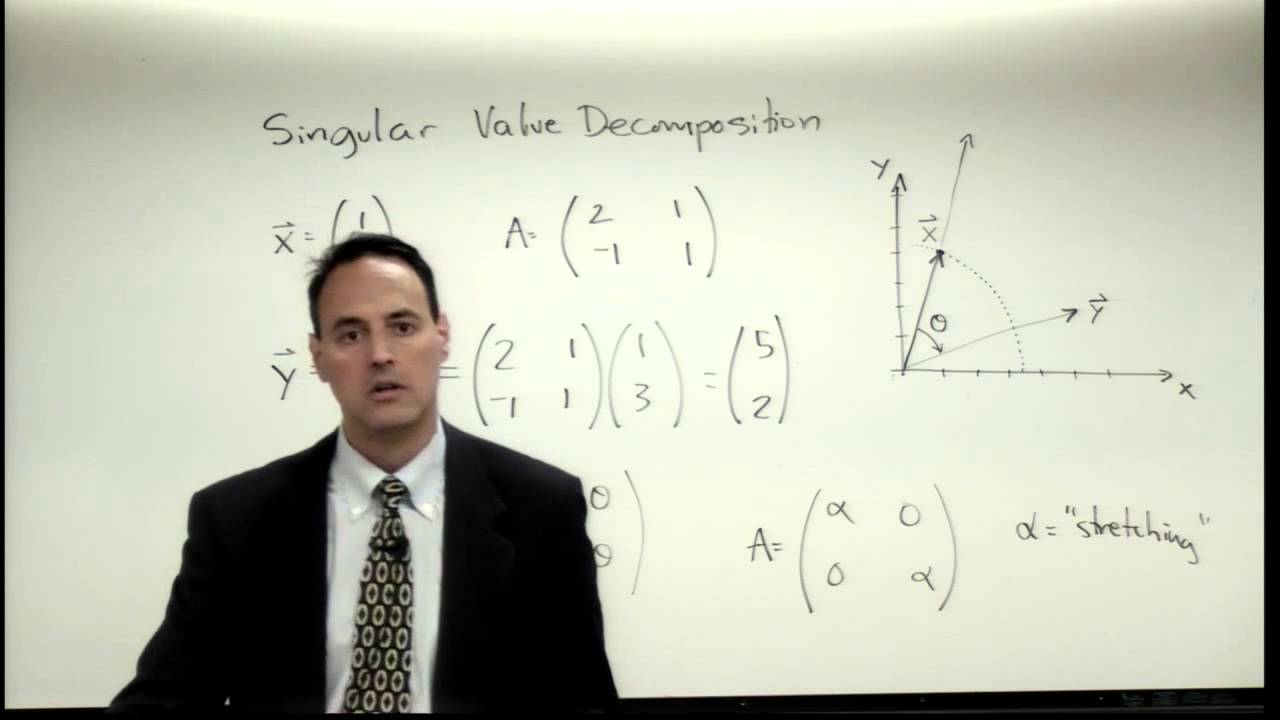
Perhaps the most important concept in this course, an introduction to the SVD is given and its mathematical foundations.
zinc timber
you need to tell the context before I can answer
sinful valve
this is the timestamp exactly
but hes just constructing the SVD
its just the * thing im not sure about
its often transpose
lavish jewel
probably that U and V are unitary matrices
so their inverse is their complex conjugate transpose
sinful valve
 zinc timber
Oh he already derived $AV = \hat{U}\hat{\Sigma}$ and then multiplying both sides by $V^{-1}$
stoic pythonBOT
Ryuzaki
 lavish jewel
right, and V is unitary, so V^-1 = V^H
sinful valve
yeah basically
lavish jewel
in some places this is written as V^*
sinful valve
unitary matrices i have never heard of ill have to check that
zinc timber
basically orthogonal but in the context of complex sapce
lavish jewel
it's the complex flavor of orthogonal matrices
lavish jewel
wdym
sinful valve
complex number version you mentioned
lavish jewel
they all mention that U and V are unitary. in the real case, they mention they are orthogonal
sinful valve
uh some didnt i dont remember but
yeah ill just see
is there any use case for the complex numbers in svd though?
lavish jewel
more than use case, you can't avoid it
when all the entries in the matrix are real though, the SVD will be as well
or at least it CAN be, since the svd is not unique
sinful valve
not unique as is in its general to any matrix you mean
zinc timber
means given a matrix, the u, v, s matrix will always be the same(upto permutation)
 sinful valve
yeah wikipedia said there is like 4 notations to use

that dagger looks cool tbf might use that
zinc timber
the dagger and + I use for pseudo inverse, never knew physicians use that for conj-transpose
lol
sinful valve
so in my guys video then
he has used a unitary matrix to include all real/complex basically
to make it general ig
cause my book only cares about real so it just say orthogonal
zinc timber
yeah
sinful valve
ight
zinc timber
you can get away with saying orthogonal if the space is real
sinful valve
when would you use an svd in complex space though
lavish jewel
whenever it's handy to use complex numbers
so usually engineering and physics applications
sinful valve
yeah thats fair in computer science i dont see many uses tbf
lavish jewel
also, the svd unique up to rotations
sinful valve
as far as i know at least
lavish jewel
unless you have repeated singular values, permutations won't show up
you might use it in CS as well, since stuff like rotations are easily done with complex numbers
at least in the more applied stuff like computer graphics
sinful valve
yeah this is for CG this content
the only complex numbers i cant think of are in the fast fourier transform
sinful valve
are you referring to quaternions
in cg
thats true tbf i havent done much on them but they seem like complex numbers
more of an extension of them to more dimensions
lavish jewel
i was talking more like rotations on a 2d plane, but sure
lavish jewel
you don't need quaternions either, strictly speaking
sinful valve
nah you dont
lavish jewel
but using them makes the computations easier
sinful valve
yeah its also gimbal lock or sumn
but i dont knwo much bout that
i just remember doing a non quat one you cant liek go all around without ebing cut off
like you get locked you cant freely rotate
zinc timber
yeah depending on the rotational system you use, it can happen
 winged prairie

hello, I was lloking at the solution for this problem but i do not understand how they can map some of the basis vectors to 0 because wouldn't that make the set of vectors that get mapped to w linearly dependent?

 stable kindle
wouldn't that make the set of vectors that get mapped to w linearly dependent?
why would it do that
wait ok no i think i see
zinc timber
you are looking at the finite version of the Hahn-Banach theorem
winged prairie
but is my intuiton corect?
stable kindle
i don't think it's quite correct
winged prairie
why
stable kindle
so why should it
make them linearly dependent
you can't map all the vectors that aren't in U to 0
but you can map the basis vectors that aren't in U's basis to 0
and then the remaining basis vectors, the basis vectors of U, determine the actual position of things
winged prairie
stable kindle
you can't map *all* the vectors that aren't in U to 0
i don't get this
my idea is that by doing the mapping shown in the picture
u map over all the basis vectors of U + the 0 vector
zinc timber
yr intuition is correct
winged prairie
so why does that not make it linearly dependent
stable kindle
why would it make it linearly dependent
also why is the 0 vector important
you can get the 0 vector out of the basis vectors
winged prairie
because any vector can be written as a linear combination of another
winged prairie
stable kindle
you can get the 0 vector out of the basis vectors
why
winged prairie
oh is it by the theorem which says that if u have a set of vectors that span a vector space
u can reduce it to a basis ?
winged prairie
if it has 0 it cannot be a basis
stable kindle
sorry back
winged prairie
dw
stable kindle
this list is linearly dependent because you can get a linear combination of those elements where not all the coefficients are 0, but they sum to 0
winged prairie
yes i agree
stable kindle
ok
so...
you can just remove 0
and then it's independent
it's like
why bother talking about 0
winged prairie
and you can remove the 0
stable kindle
0 always goes to 0
 stable kindle
??
winged prairie
like u confirmed
stable kindle
ok if you got something from that that's good
winged prairie
ye
stable kindle
i don't know what's happening here lol
winged prairie
i was confused but now i get it
dw haha
i wanted to understand if removing the 0 was possible
zinc timber
 hard drum

stable kindle
i don't understand
zinc timber
the heck q vegitable doing in liner algebra
@winged prairie also search Hahn-Banach theorem
for more info
winged prairie
any hint on how to do this, i don't wannt look at the solution right away
 hard drum
You can explicitly construct linearly independent vectors in L(v, w)
hard drum
I mean that's just a way to construct maps V to W so yes i guess

 dusky epoch
,w det {{1,-2,3,1},{0,2,4,-1},{2,0,1,2},{1,0,5,0}}
stoic pythonBOT


 stoic pythonBOT
 dusky epoch
,w det {{1,-2,1},{0,2,-1},{2,0,2}}
stoic pythonBOT
 still lodge
🤦♂️
 zinc timber
u got a generous teacher ngl
still lodge

 fresh canopy

I tried to use the Gramm Schmidt process to solve this problem, was that the correct approach?
zinc timber
can't read. what's the question?
 keen flame
what would be the vector of function f(x)=cos(2x) when [-pi,pi]?
fresh canopy
Gimme a sec I'll just post a screen shot
zinc timber
keen flame
what would be the vector of function f(x)=cos(2x) when [-pi,pi]?
????????????
fresh canopy
 zinc timber
and u hv to use GS orthogonalization fr tht?
hint: ||extend the basis to a basis of R⁴ then apply GSO||
fresh canopy
Thats the section it's in, so that's my assumption
ok I know I'm showing my L.A. iq here, but what do you mean extend the basis to a basis of R^4?
zinc timber
extend (v1,v2) witch is a basis of W to a basis of R⁴
lavish jewel
take u and v and come up with 2 more vectors such that all 4 are lin indep, and therefore span R^4
zinc timber
there are easier methods however
like $ \mqty[u^T \ u^T]\mqty[a \b \c \d] = 0$
...
tf?
lavish jewel
you left a space after the first $
fresh canopy
lavish jewel
take u and v and come up with 2 more vectors such that all 4 are lin indep, and ...
so I know if took u cross v, that would give me one more of the vectors I need to get to R^4, how would I get the 4th? could it just be arbitrary?
zinc timber
apparently I wrote 2 u's
lavish jewel

zinc timber

lavish jewel
fresh canopy
so I know if took u cross v, that would give me one more of the vectors I need t...
sadly the x prod is only defined in R^3
zinc timber
when I copied it only one \ was copied
fresh canopy
ahh, I didn't even think of that.
zinc timber
like wtf
 quasi vale
Is it true for operators that (ST)^n = S^n T^n?
lavish jewel
an alternative is to build a matrix with u and v as rows, and find its null space
ah
that's what ryu was getting at
lavish jewel
quasi vale
Is it true for operators that (ST)^n = S^n T^n?
in general, no
only if they commute
quasi vale
what i currently have is $(T - \lambda I)^{n}$ and $(\lambda T)^{-n}$. Is it true that $(\lambda T)^{-n} (T - \lambda I)^{n} = ((\lambda T)^{-1} (T - \lambda I))^{n}$
stoic pythonBOT
Sup?
 quasi vale
You guys may answer Heathus first, I'm sorry to interrupt.
zinc timber
in this specific example it's true
quasi vale
Thanks!
fresh canopy
I'm going to find the null space given V and U are transposed, please feel free to help others while I work on this.
Then we can see what happens next! 
zinc timber
fresh canopy
I'm going to find the null space given V and U are transposed, please feel free ...
that will be much more easier than extending the basis, then orthogonalizing
fresh canopy
ok good for my skill level that's the best choice 😉 Thank you
 true girder
Hello I'm struggling a bit with homework problems involving eigenvalues and eigenvectors. I understand how to do the full problem conceptually like ik the steps but the part where u do det(A) = 0 and have to solve for 0 im really not getting anywhere.
the help channels appear to be only for pre-uni hw so this was my safest bet
zinc timber
post the question statement and your work
true girder

i skipped the first step of writing the question but the matrix is all 1's accept the diagonal is all 2's
zinc timber
so u r struggling finding the characteristic equation?
true girder
ye
my prof said to not multiply anything out but for everything after the 1st det its all single values
zinc timber
it's just routine calculation
true girder
ik but for some reason im struggling with this. like which route is best for solving it
is the very bottom correct?
zinc timber
,w char poly {{2,1,1},{1,2,1},{1,1,2}}
stoic pythonBOT


 Requested by Ryuzaki#5323
zinc timber
Requested by Ryuzaki#5323
zinc timber
looks like you've messed something
true girder
ok the first part of line 2 is correct somewhere below it i missed something
fresh canopy
Looks like finding the null space of U^T and V^T was indeed the answer! Thank y'all so much.
My question is, how did we know that finding the null space of their transposes would be the orthogonal compliment of the those two vectors? Is that just always the case?
lavish jewel
the null space is by definition orthogonal to the row space of a matrix
this is because you can write matrix-vector multiplication as the result of taking dot products between a matrix's rows and another vector
say you have a matrix [u v]^T, where u and v are column vectors. this gives you a matrix that is size 2 x n
now multiply that by some vector x of size n x 1
the resulting vector is of size 2 x 1, and the elements of the vector are u^T x and v^T x
u^T x = u dot x
so if all the entries of the resulting vector are zero, the vectors that satisfy this are orthogonal to both u and v
furthermore, if these vectors are linearly independent from u and v (and they are, because they're orthogonal to them) you can use them to extend u and v into a basis of R^4
and now consider the subspace spanned by u and v, and the one spanned by the vectors you just found
any pair of vectors where one vector is taken from one subspace and the other, from the other subspace, are mutually orthogonal
fresh canopy
Thank you so much for breaking that down. That makes so much sense!
true girder

ok i figured out where i went wrong
but now i dont remember how to solve for x^3
ik the quadratic formula for x^2 and x^4
but this is where im gonna struggle
stable kindle
so for cubics you just want to stare at it until you find a solution
they won't give you a cubic with awful roots
in a question
so for example -1 should work here
true girder
i need a formula / system or ill be staring til im handed an F
stable kindle
-1
basically
you try 0, 1, -1, 2, -2, 3, -3
and if none of those work then you cry
lavish jewel
isn't it 1?
lavish jewel
well idk if you meant the factor or the root tbf
but lambda = 1 should make the poly 0
you can go from there. maybe divide the poly and then use the quadratic formula if needed
true girder

this video looks good
ye my math brain died in high school so now im just praying that i pass any required math for my major
but thx for the help!
ok so i played with it and the video did not help at all.
but ye 1 works
but how do i get the rest
there arent any like terms and all i can really do is factor out a lambda
ok so the only thing i noticed from just finding the answer online is that since the answer contains a (x-4).... one of the factors is actually 4 so maybe thats a hint
quaint steppe
Practicing some exercise in the book. Is my proof correct? Is there a better proof?

 sick sandal
quaint steppe
sick sandal
quaint steppe
can you elaborate further on your 1st proof im not sure i follow what you did,
as to how i would do it ||probably prove injectivity by assuming ST(u1)=ST(u2) and reach u1=u2 since injectivity is equivalent to invertiblility in finite dimensional spaces for some transformation(if dimemsions are equal for U and W )||
quaint steppe
sick sandal
can you elaborate further on your 1st proof im not sure i follow what you did,
...
this is new to me.That injectivity is equivalent to invertibility. For my first proof i just assume that since S is invertible and S(Tu) so the linear map here must also be invertible.
Idk if it's the right track.
 reef latch
doesnt invertibility require bijection
wintry steppe
sick sandal
can you elaborate further on your 1st proof im not sure i follow what you did,
...
injectivity is equivalent to invertiblility in finite dimensional spaces for some transformation(if dimemsions are equal for U and W )
the spaces could be infinite-dimensional in this exercise, so this might not apply. you'd need to go the extra step and show surjectivity as well
wintry steppe
quaint steppe
this is new to me.That injectivity is equivalent to invertibility. For my first...
how does this prove that ST is also invertible? you haven't explained why ST has an inverse, you just wrote down the definition of ST and said "and it follows that this is invertible"
you need to elaborate
this proves both parts anyways, btw
 steel moon
how would i go about creating a subspace in a?
 wintry steppe
visualize it :^)
steel moon
we want to show every vector in R^4 can be written as a sum of an element in W and some subspace
how can you visualize R^4 
wintry steppe
it might help to consider a hyperplane in R^3 first, where you can argue geometrically. then, see if you can transfer your reasoning over to a hyperplane in R^4
wintry steppe
steel moon
how can you visualize R^4 <:thinkies:827642567775748163>
weed
reef latch
3blue1brown
steel moon
😹
stable kindle
 reef latch

Visualizing high-dimensional spheres to understand a surprising puzzle.
Help fund future projects: https://www.patreon.com/3blue1brown
This video was sponsored by Brilliant: https://brilliant.org/3b1b
An equally valuable form of support is to simply share some of the videos.
Special thanks to these supporters: http://3b1b.co/high-d-thanks
Home p...
sinful valve
you know if i had a shape like on a graph right

with the original F already there
so i know the coordinates of start and end
how would i calculate transformation matrix to get there
reef latch
get the basis vectors?
reef latch
which vertices are that
basically you can construct basis vectors by drawing them on top of the F
sinful valve
[9.812, 10.1963302752294, 14.1855010660981, 13.4, 10.8298217179903, 10.6398305084746, 12.0611940298507, 11.7371879106439, 10.4931163954944, 10.2813455657492, 9.812],
[5.649, 8.39266055045871, 7.79957356076759, 6.91607142857143, 7.39059967585089, 6.74435028248588, 6.44328358208955, 5.95532194480946, 6.24530663329161, 5.5249745158002, 5.649]
you see the issue xd
reef latch
right so get the bottom left vertex, get the bottom right
sinful valve
can i like plug these into a linear equation though
these are just x, y pairing first array is x second is y
reef latch
subtract bottom right from bottom left, theres your horizontal basis
 quaint steppe
wintry steppe
this proves *both* parts anyways, btw
quaint steppe
wintry steppe
this proves *both* parts anyways, btw
sorry been busy. So, i can use this for the first proof?
sinful valve
in my book it says you can just line up the coordinates in an equation though will that not work
reef latch
sinful valve
these 2 you mean
yes and presumably the F starts out completely straight?
 reef latch
thats weird, whats with the big matrix
I guess I'm not familiar with whatever this is :)
sinful valve
 reef latch
oh wait, it's a transformation that includes translations?
reef latch
I see
sinful valve
so in that recent slide they have the column with some single vertex
on LHS with the trasnformed point
and they are solving teh matrix to get to it i think
where the matrix is the unknowns
in my example i think i would just have a fat column vector
reef latch
I guess the thing with the basis vectors wont work then
sinful valve
with [x1,y1, x2, y2...., xn, yn]
ill see if there is an online tool to solve this exact issue
reef latch
hmm, I feel like 3 points should be enough to characterize any affine transformation
still lodge
are there any named theorems besides cayley hamilton that i should know as an undergrad
reef latch
I hear Pythagoras Theorem is all the rage
reef latch
2 is enough for linear transform
reef latch
but like, you need to distinguish between a translation and a series of linear transforms
hence the third point
sinful valve
yeah I get that
uh just need to find out how to compute these things
by that then are you saying from my F
I need to get any 3 points of x and y
reef latch
probably!
winter harbor
still lodge
are there any named theorems besides cayley hamilton that i should know as an un...
You mean, in linear algebra?
Stuff you need to know (In my opinion)
Cayley-Hamilton Theorem
Steinitz Exchange Lemma and the Dimension Theorem (Existence of a basis and Uniqueness of dimension)
Spectral Theorem for Normal Operators (and its corollaries such as Spectral Theorem for Hermitian (Self-Adjoint) and real symmetric operators).
Rank-Nullity Theorem (First Isomorphism Theorem)
Lémme de Noyaux (a.k.a primary decomposition theorem)
Jordan Canonical Form Decomposition
Jordan-Chevalley Decomposition
Schur's Theorem (Schur's Decomposition)
SVD decomposition theorem
Rational Canonical Form and Smith Normal Form (maybe?)
Cholesky decomposition theorem
Cayley-Hamilton's Theorem
Stuff you maybe need to know (I guess).
Gershgorin Circle Theorem
Sylvester's Law of Inertia
Spectral Mapping Theorem
Witt's Extension Theorem and Witt's Decomposition Theorem
Hadamard's Inequality
Cartan-Dieudonné theorem
Idk, these are prolly all the linear algebra theorems I know that have a name I guess.
The "stuff you need to know" is prolly shit people go through in most intro to linear algebra classes I guess.
quaint steppe
I'm sorry if I'm constantly asking if my proof is correct. I don't have anyone to ask to. And i don't have a solution manual to check. So yeah Is my proof on this exercise correct?

I'm an undergrad and really new to college maths
fresh canopy

So for this problem, I know I can just set up "Ax=b" and multiply the right vector by the inverse to solve for "x", which would be the coordinates being requested. But is that the ideal way to solve it? Should i be using QR factorization for this problem?
winter harbor
Choose a basis $e_{1}, \cdots, e_{n} \in V$ of $V$ and let $T,U \in \mathcal{L}(V)$ be such that:
\begin{align*}
T(e_{1}) = 1
\
\
T(e_{i}) = 0 ; \forall i > 1
\end{align*}
and
\begin{align*}
U(e_{1}) = 0
\
\
U(e_{i}) = 1 ; \forall i > 1
\end{align*}
Then, notice that
$$
(T+U)(e_{i}) = 1 ; \forall i \geq 1
$$
And thus, $T+U = \text{Id}_{V}$ is the Identity on $V$, which is invertible.
\
\
Therefore, we have that the set of non invertible operators is not closed under addition and as such is not a subspace of $\mathcal{L}(V)$.
Notice that we are explicitly using the fact that dim(V) > 1 here in order to construct T and V.
Moreover
You can fill in the details yourself if you want
But T and U are well defined
Because we especified how the act on a basis of V
And we can use this to extend T and U to to whole of V by linearity like this.
And uniquely as such
I should be more precise on why your argument does not apply.
It is NOT true that every linear operator T : V -> V between finite dimensional vector spaces is invertible.
You could take, for example, the 0 linear operator.
But that are more interesting examples
Such as the ones I have constructed.
Nilpotent operators are another important class of operators which are not invertible.
stoic pythonBOT
MISTERSYSTEM
 winter harbor
What is true tho
quaint steppe
winter harbor
It is NOT true that every linear operator T : V -> V between finite dimensional ...
ohhhh so what does this mean?
 winter harbor
That's what I was about to say
As a consequence of the rank-nullity theorem
If an operator T : V -> V is injective, then it is invertible.
Or if it is surjective, then it is invertible.
But not every linear operator between finite dimensional vector spaces satisfy these criteria.
For example, 0 : V -> V which takes a vector v in V and does 0(v) = 0 is not injective nor surjective.
quaint steppe
winter harbor
But not every linear operator between finite dimensional vector spaces satisfy t...
ohhhhhh
thank you very much
im taking notes
 vital pagoda
one of the things which define a normed space is that $| x | = 0 \iff x = 0$ where $x \in X$ where $X$ is a vector space
but i dont understand why that's needed
is there an example of something which satisfies the other two norm axioms but doesn't satisfy this one?
stoic pythonBOT
Joy!
 winter harbor
Yup, there are.
vital pagoda
isn't it obvious from the definition of the modulus that this will be the case though?
 gray dust
take the constant 0 map
still lodge
random unrelated interjection - i asked about the studying role before but what is/how do i get permastudying (i saw it on system)
gray dust
ask for it. want it now?
vital pagoda
smh
ok yeah the constant 0 map does indeed satisfy the other two while violating positive definiteness
im still not fully comfortable with the idea of a norm tbh, does it get more natural once you learn topology?
winter harbor
Let $(X, \mathcal{B}, \mu)$ be a measure space, where $X$ is a set, $\mathcal{B}$ is a sigma algebra on $X$ and $\mu : \mathcal{B} \rightarrow \mathbb{R}{\geq 0} \cup {+ \infty}$ is a measure on $X$.
\
\
Let $1 \leq p < + \infty$. We define the real vector space:
$$
L^{p}(\mu) = \left{f : X \rightarrow \mathbb{R} : \int\limits{X} |f|^{p} , d \mu < + \infty \right}
$$
We can prove that for any $f \in L^{p}(\mu)$ we have that the function defined as:
$$
|f |{L^{p}} := \left(\int\limits{X} |f|^{p} , d \mu \right)^{\dfrac{1}{p}}
$$
Satisfies all the other product of a norm. I.e, the triangle inequality (here known as Minkowski inequality). It is positive homogeneous and we have that $| f |{L^{p}} \geq 0$ for every $L^{p}$ function.
\
\
But, we have function with $|f |{L^{p}} = 0$, but $f \neq 0$. Basically, if $f$ is 0 almost everywhere (i.e 0 everywhere up to a set of null measure), then $|f|_{L^{p}} = 0$ even if $f \neq 0$.
Oof
vital pagoda
damn yeah buddy I'm still a few months away from learning about measure spaces
winter harbor
This example comes from functional analysis.
Yeah
I couldn't think of a good example on finite dimensional vector spaces
The 0 one is prolly the easiest
stoic pythonBOT
MISTERSYSTEM
 vital pagoda
whats interesting is that what inspired my question is the proofwiki proof of the p norm on the p sequence space being a vector space norm
vital pagoda
ahahahaha
vital pagoda
bruh just when i thought the rabbit hole doesnt get any deeper
winter harbor
I can't think of any non zero pseudo norm which is not a norm.
Btw
The thing with L^p spaces is that we usually identity functions that agree almost everywhere.
vital pagoda
yeah i looked at the definition of the pseudo norm and immediately II . II_0 popped in my mind
stable kindle
proofwiki is kinda weird
winter harbor
So that we in fact have a norm.
And not a pseudonorm
This is usually a technical detail
 lofty topaz
is this a vector subspace ?
 still lodge
what are the requirements for something to be a subspace
lofty topaz
1 include zero vector
2 closure under vector addition
3 closure under scalar multiplicatioon
winter harbor
These 3 conditions are equivalent to
1 it is a non empty subset
2 closure under vector addition
3 closure under scalar multiplication
still lodge
i mean youre right but no need to be condescending, it can be helpful to check if 0 vector is included as a way to eliminate the other 2 sometimes
stable kindle
still lodge
i mean youre right but no need to be condescending, it can be helpful to check i...
?
winter harbor
We need the subset to be NON EMPTY in order for it to be a subspace.
stable kindle
no i was saying i was about to ask a stupid question
i wasn't saying your q was stupid
still lodge
oh
stable kindle
right
still lodge
then yeah
lofty topaz
still lodge
i mean youre right but no need to be condescending, it can be helpful to check i...
but are these of two vector subspaces ? I'm struggling with a notation of proof
still lodge
i mean you seem to have two sets there
so it depends on the particular instructions...?
lofty topaz
I need to prove for every set if it is a subspace
reef latch
iirc a subspace is closed under linear transformation
sinful valve
i dont think the method is working tbf

this one i solved the values
but somethign is off
im not even sure if this is even possible
 nocturne jewel
reef latch
iirc a subspace is closed under linear transformation
nocturne jewel
reef latch
iirc a subspace is closed under linear transformation
subspace is closed under addition and scaling
to which similar properties are linearity
sinful valve
is there any other way to find the parameters of an affine trasnformation
given the start and end shape

like we have this F right and i computed the transformation for a using that method
but the matrix didnt move it correctly not sure why
what is the standard method of getting the affine matrix uesd in a transformation
 glad acorn
I have no idea how to work on this question
 reef latch
seems like it should be orthogonal to the other two basis vectors
 glad acorn
reef latch
seems like it should be orthogonal to the other two basis vectors
glad acorn
reef latch
seems like it should be orthogonal to the other two basis vectors
It dosen't work. For example, <-6/5,-2/5,1,0> is the vector orthogonal to the other but it's not the answer. okay I've figured out the method.
 tribal fossil
-> Prove that every m × n matrix over the field F is row-equivalent to a row-reduced matrix.
-> Let e be an elementary row operation and I be the m × m identity matrix. Prove that for every m × n matrix A, e(I)A = e(A).
Hey someone help me prove these two theorems??? pls
still lodge
can someone help me understand why a matrix (let's say B = {1 1}{0 1}) acts as a change of basis from B to E where E is the standard basis pls
ive been trying to get this into my head since fucking freshman year and it still doesnt click
just a discussion would be v nice
zinc timber
@glad acorn has it been resolved?
zinc timber
tribal fossil
-> Prove that every m × n matrix over the field F is row-equivalent to a row-red...
obviously
still lodge
yeah i was gonna say, isnt that like... the definition of those things...?
tribal fossil
i mean my teacher asked for a neat proof
zinc timber
given a matrix, u apply row operations blah blah and u get a row reduced matrix
so original matrix~the row reduced matrix we have just calculated
still lodge
ig you could do some visual stuff?
zinc timber
do I need to?
still lodge
still lodge
just a discussion would be v nice
also pls 👉 👈
zinc timber
I would have but I'm on my phone now, hard to type, I'll try once I get back to my pc
still lodge
<3
any chance on an ETA? i'll be here for a while but will probably close discord for a while
zinc timber
ok i'll whatever I can for now
say in 2D you have 2 LI vectors (1, 1) and (1,0). say I want to use them as my new coordinate vector. so any (x,y) vector in 2D can be written as a•v1+b•v2
i.e. the vectors (1,0) and (0,1) which was our old basis can be represented in terms of the new basis v1, v2
so let the the new coordinates of e1, e2 be
$a v_1 + b v_2 = e_1 \
c v_1 + d v_2 =e_2$
stoic pythonBOT
Ryuzaki
 zinc timber
Now this can be written in the compact form
$\mqty(v_1 & v_2 ) \mqty(a & b \ c & d) =\mqty( \imat{2})$
stoic pythonBOT
Ryuzaki
 zinc timber
now you can solve for a,b,c,d with it
similarly given we know the coordinate wrt one basis we can transform them into another just by multiplying the inverse of the basis transformation matrix
still lodge
so ig it's bc of how that matrix of the new basis vectors (or rather each basis vector) acts upon our basis E...?
quaint steppe
Hi again, practicing another exercise in the textbook. Is my proof correct? Can it be proved better?
 zinc timber
no
you are supposed to show a invertible lt exists given S is injective
but here u assumed the existence
quaint steppe
all rightt
zinc timber
hint: || extend to a basis ||
teal grotto
quaint steppe
if S is injective, then take a basis {u1,…,uk} of U. then extend this to a basis {u1,…,uk,v1,…,vr} of V (where of course k = dim U and k + r = dim V). try to define a new function T determined solely by the new basis of V
quaint steppe
teal grotto
if S is injective, then take a basis {u1,…,uk} of U. then extend this to a basis...
Thank you. I kinda get it already. I also saw the proof online
 viscid lily

I have constructed the matrix with importance scores, but dont know how to solve to get the page rankings
Can anyone guide me?
zinc timber
 cobalt tartan
Wanted to doubel check something: Given an arbitrary inner product, does that change how matrix mulitplication works? I.e, say that my inner product is <u, v>, then is matrix multiplication now applying <u, v>, or is it still applying the "standard" dot product?
zinc timber
didn't understand what your question is exactly
cobalt tartan
So say that you define an inner product over R3, $<x, y> = x_1y_1 + 2x_2y_2 + 4x_3y_3$
stoic pythonBOT
Liria ^(;,;)^
 stoic pythonBOT
Ryuzaki
 cobalt tartan
Then normally, when you do matrix multiplication of $AB$, you're applying the standard dot product between the rows of $A$ and the columns of $B$
stoic pythonBOT
Liria ^(;,;)^
 zinc timber
for that you must have a positive definite matrix Q
cobalt tartan
Then in this IPS over $R^3$, when we multiply $A$ and $B$, do we apply the standard dot product, or do we apply this inner product?
stoic pythonBOT
Liria ^(;,;)^
 cobalt tartan
zinc timber
so you mean a inner product induced by a matrix?
cobalt tartan
zinc timber
so you mean a inner product induced by a matrix?
Yes, I believe that is my question
As this is the definition of inner product in my textbook
 zinc timber
actually no, matrix multiplication is universal
nocturne jewel
IP acts on the vectors, so idk why you're worried about its effect on matrices
when matrices arent the vectors
lavish jewel
probably cuz they noted the result of matrix mult is an array of dot products
cobalt tartan
Yea
lavish jewel
but when you need to interpret it as such, it'll be apparent
cobalt tartan
And so matrix multiplication, even though it looks like a series of dot products, isn't really so?
lavish jewel
it won't just be the composition of 2 linear transformations, but explicitly written as a matrix whose elements are inner products
zinc timber
it's a composition of LT's (in their matrix form). The basis is already taken into account in the matrix representation so you don't need to apply it again while multiplying
cobalt tartan
ok
lavish jewel
for a nice symmetric pos semi def matrix M, if you want to compose something whose elements are inner products w.r.t. that matrix, you'd get a matrix whose elements are of the form u^T M v, and then you could factor it as U^T M V or something
but then that no longer has the interpretation of composition of linear transformations
so, not a "matrix" in the usual sense
zinc timber
yeah but when you try to multiply with the adjoint, then it'll be different. but I'll not go into the rabbit hole for now
wintry steppe
cobalt tartan
Yes, I believe that is my question
Hey Liria if you don't mind me asking what book is that?
cobalt tartan
Some prof at my school wrote a textbook specifically for our linear algebra courses
wintry steppe
I see thanks.
 zinc timber
For a symmetric bilinear form (which is a symmetric matrix) we must have $a_{ij} = a_{ji}$ given $i\neq j$
stoic pythonBOT
Ryuzaki
 zinc timber
means you are only free to choose arbitrary value for matrix where j>= i
 keen mirage
ahhh yeah
zinc timber
that answers your question?
still lodge
is it accurate to say that the alg multiplicity of an eigenvalue is the degree of the part of the polynomial in which said lambda sits (ik this is worded weird) and the geometric multiplicity is how many vectors make up it's nullspace..?
keen mirage
zinc timber
that answers your question?
yeah
symmetric bilinear form correspond to symmetric matrix
zinc timber
still lodge
is it accurate to say that the alg multiplicity of an eigenvalue is the degree o...
though your terminology is not accurate, I get what you are trying to say. Yes it is the case
still lodge
i can do problems with it i just wanna make sure the wording in my head is right so merci
*or at least the idea behind it
and a matrix is defective is the alg multiplicity of any of its eigenvalues is greater than the corresponding geometric multiplicity
zinc timber
If
\begin{align}
p(\lambda) = (\lambda-\alpha_1)^{k_1}(\lambda-\alpha_2)^{k_2}\cdots(\lambda-\alpha_n)^{k_n}
\end{align}
then $k_i$ is the algebraic multiplicity of the eigen value $\alpha_k$ and the geometric multiplicity is $\dim \text{ null } (T-\lambda_iI)$
stoic pythonBOT
Ryuzaki
 still lodge
yep that is what i meant, epic
is there a faster way to do this than rational root thm

that's easy enough to apply but tedious ofc
stoic pythonBOT
 Requested by Ryuzaki#5323
zinc timber
Requested by Ryuzaki#5323
zinc timber

stable kindle
yeah i was thinking 3 from the start
still lodge
yeah i'll just pull out WA on my exam no biggie
stable kindle
just stare at it until you see something that looks good
zinc timber
,w formula for cubic equation
 still lodge
because it is shit
stable kindle
no like even shittier than usual
anyway here's how you actually solve cubics
basically
try 0, 1, -1, 2, -2, 3, -3
and if none of them work then you're doomed
still lodge
yall got any way to intuit how many roots it might have
stable kindle
it will always have at least one root of the form 0, 1, -1, 2, -2, 3, -3, by Kai's Conjecture
then just do the long division trivially
and you can tell pretty easily if it'll have more
still lodge
bleh fine
quaint steppe
What does this fancy R means?
 zinc timber
range of T2
quaint steppe
all right thank you
still lodge
ive asked this before but... what's the dif between invariant factors and elementary divisors
ik the latter depends on our choice of minimal polynomial
are invariant factors just each distinct elementary divisor of every possible minimal polynomial (in cases where you dont know the minimal polynomial ofc)
 granite kraken
I solved this question using adjunct matrices but my professor said to solve it without using adjunct matrices. Does anyone see a possible solutions start or tips to this problem?
 lavish jewel
if A is diagonalizable, the matrix exponentiation is pretty simple, one need only exponentiate the diagonal matrix of eigenvalues
then you can factor out the matrices of eigenvectors to the left and right, leaving you with a sum of diagonal matrices of the form of the polynomial
ionic laurel
Hi I have a question
If you have two bases B and C
would the change of coordinates matrix from B to C be the inverse of C to B and vise versa?
B to C is the inverse of C to B
C to B is the inverse of B to C
lavish jewel
yes
lavish jewel
in general, you put the basis vectors as columns of a matrix M
ionic laurel
the inverse of B to C is is C to B
but I did not know if the converse would be true
thank you nonetheless
lavish jewel
then if x are the coordinates in that basis, we have that v = Mx, so that v has coordinates x in the basis M
if you do it backwards, then you get that M^-1 v = x, and now v is the coordinate vector for x in the basis of the columns of M^-1
 raven parrot
Is there an easy way to LU Factorize a nxm matrix? The method I know and use is to RREF to get U, but in the process, get values for L.
lavish jewel
by hand, that's about the easiest
 swift minnow
Hi i need help
If A,B are squared matrix, and AxB is unsymmetrical so A and B are transposed
marble lance
To disprove it, you just need to give a counterexample
swift minnow
do you have any example? i have tried
i didn't find any
is it a proof or disproof
marble lance
@swift minnow Sure
Consider any symmetric matrix
Then take one of the entries not on the diagonal
And +1 to it
And then take the same entry and -1 to it
The two matrices you get won't be symmetric
But their sum will be
 mystic dagger
is this conclusion right?

like, h(x)=-h(x) breaks the definition of function right
stable kindle
mystic dagger
like, h(x)=-h(x) breaks the definition of function right
nope
let h(x) = 0
mystic dagger
it would be the x-axis right?
and the only function that obeys h(x)=-h(x)
yes bc 0=-0
oh i got it
thank u
swift minnow
marble lance
But their sum will be
can you give me an example?
marble lance
I told you how to construct an example just now
swift minnow
so is it a disprove?
swift minnow
marble lance
But their sum will be
i asked you the wrong question at start and i guess you answered it , my apologoy.
i edited the question
i typed the wrong question
marble lance
Is the new question: If A and B are square matrices such that AB is not symmetric, then A = B^T?
Or what do you mean by A and B are transposed?
I don't get it
swift minnow
it means that a x b = b x a
that's what i mean by transposed
a x b = anti symmetric
marble lance
I don't think you are using terminology correctly
Can you send a screenshot of your actual question?
swift minnow
Ye thing is that’s in a different language 😅
wintry steppe
Hello I have a possible LA question in #computing-software 😄 any help is appreciated
granite kraken
Anyone got any clue how to start this problem,
 zinc timber
let p=algebraic multiplicity of the eigen value
 finite plume
Where have I done wrong? The correct answer is sqrt(186)/2.
 finite plume
Wouldnt it be (2, -1, 5) then? On P1P2.
granite kraken
granite kraken
Anyone got any clue how to start this problem,
Can anyone help?
 dim epoch
ryuzaki gave you a hint
 umbral void
If I have an $n\times n$-matrix with integers on the diagonal and 1s on the "immediate parallels" of the diagonal, can I say something about its signature?
To be more precise, I mean matrices like
[ \begin{pmatrix} a_1 & 1 & 0 \ 1 & a_2 & 1 \ 0 & 1 & a_3 \end{pmatrix} ]
and by signature, I mean $#$ positive eigenvalues $- #$ negative eigenvalues
stoic pythonBOT
expectTheUnexpected
 umbral void
i.e. this
 zinc timber
can immediately think of Gresgorion thm, other than that, I'll have to think
winter harbor
You mean Gershgorin Circle Theorem?
zinc timber
winter harbor
You mean Gershgorin Circle Theorem? <:stare:826920038623346729>
yeah but that won't be of much help I think
there's also one convoluted method usigng strum sequence
umbral void
Ok, I guess I'll just not write a general formula then would have been nice, but I suspect that it's hard

 umbral void
oh no, recursion
zinc timber
 umbral void
was to be expeceted
zinc timber
then you can put v=0 and check for sign changes
zinc timber
I'wd like to know anything better myself