#linear-algebra
2 messages · Page 244 of 1
 winter harbor
You can talk about monoidal categories
Which are categories endowed with a certain product, which we usually call a tensor product.
 stable kindle
ah is that the generalised concept
winter harbor
And it satisfies properties which are analogous to associativity and having a unity element
stable kindle
no, yeah
that's exactly what i mean
wrt. groups the identity is the trivial group
winter harbor
Vector spaces endowed with its usual tensor product are a monoidal category, in fact a symmetric monoidal category
stable kindle
and you can show associativity up to isomorphism
winter harbor
Sets endowed with Cartesian product too
The category of monoids endowed with direct sum is also a monoidal category
There are tons of examples
 gray dust
stable kindle
can you have like. a set of all groups?
gray dust
stable kindle
can you have like. a set of all groups?
no but we speak of Grp
winter harbor
Yeah, Grp would be the category of groups
stable kindle
what about just finite groups
gray dust
category of groups with group homos as homos
stable kindle
i feel like you could definitely have a set of all finite groups
winter harbor
winter harbor
stable kindle
i feel like you could definitely have a set of all finite groups
It is not a set, it is a category tho
stable kindle
why is it not a set
stable kindle
all the elements are of finite order, how can you get any paradoxes
surely no recursion
gray dust
kai, distinguish class vs set
gray dust
russell
stable kindle
there can't be russell for the set of finite groups
surely
the set of finite groups is infinite
but all of its elements are finite
so it cannot possibly be in itself
or anything like that
 left snow
there are assumptions in category theory that aren't really like
the same
when you try to fit the metaphor of sets and classes
winter harbor
left snow
https://youtu.be/JOp7mH72Jlg
you can try this

This lecture is part of an online course on Category theory
This is the introductory lecture, where we give a few examples of categories and define them.
The lectures were originally part of a graduate algebra course, and give a quick overview of the basic category theory that is useful in algebra.
Recommended textbook: "Categories for the wo...
winter harbor
stable kindle
none of this is explaining anything
Alright
stable kindle
can any of you say with 98% certainty that you could literally sit down and, in the specific case of defining a set of all finite groups, point to a contradiction
left snow
if you insist on calling it a set then yes it will result in problems
stable kindle
i know what russell's paradox is, btw
stable kindle
and you also can't have a set of all sets bc the cardinality would be greater than the cardinality bc like 2^C < C and 2^C < C, using the power set
how do we extend that
stable kindle
left snow
he addresses some solutions to this
yeah, i'm solving it with solution 1
bounding the size of the objects
winter harbor
Consider the proper class $\mathcal{U}$ of all sets. Consider the subclass:
$$
\text{Fin} := {S \in \mathcal{U} , \vert , \text{S is finite} }
$$
We will prove $\text{Fin}$ is a proper class. Indeed, suppose $\text{Fin}$ is a set, then for any $A \in \mathcal{U}$, we have that ${A}$ is a finite set, i.e ${A} \in \text{Fin}$. So if $\text{Fin}$ was a set, we would have that the union:
$$
\mathcal{C} = \bigcup {A} \subset \text{Fin}
$$
Is also a set, but $\bigcup{A} = \mathcal{U}$ is a proper class, a contradiction ; $\square$
God damnit
 stoic pythonBOT
MisterSystem
 winter harbor
stable kindle
it's hidden two layers down lol
winter harbor
stable kindle
it's hidden two layers down lol
Wdym?
stable kindle
like
the constraint that the elements are finite order isn't sufficient
since the elements of the elements can be infinite
so the elements can contain the entire thing
stable kindle
no i think this is valid
winter harbor
But yeah, the problem is that if we take any set
stable kindle
it makes sense, whenever you have recursion you can get wild
stable kindle
ok
winter harbor
But you see, we have to be careful dealing with categories.
stable kindle
what if we make the additional constraint that all the elements, and the potential elements of the elements, and the elements of the elements of the elements, and so on, all have finite orders
winter harbor
Uh, to be fair I don't even know how one would make this precise
Or if this can be made precise
So I can't answer :/
 dusty pond
not sure what to do here, could someone walk me through these questions? thanks so much!
 winter harbor
Ofc
First
Notice the following
If we have a polynomial p in F[x] and I take p(T) for T some endomorphism of V
Then p(T) and T commute!
dusty pond
yeahh
winter harbor
Can you see this?
Nice
We will use this
We will prove (a) by induction. Let $k \in \mathbb{N}$, then $W$ is invariant under $T^{k}$. Indeed, for $k=1$ it follows by hypothesis.
\
\
Suppose now $W$ is invariant under $T^{k-1}$ for some $k \in \mathbb{N}$. Then, $\forall w \in W$ we have that $T^{k-1}(w) \in W$, since $W$ is $T$ invariant, this implies $T(T^{k-1}w) \in W$ and so $T^{k}(w) \in W$ and $W$ is invariant under $T^{k}, \forall k \in \mathhbb{N}$.
\
\
Now, suppose that a subspace $W$ is invariant under $T,U \in \text{End}{\mathbb{F}}(V)$. Then it is invariant under $T+U$.
\
\
Indeed, $\forall w \in W$, we have that $T(w) \in W$ and $U(w) \in W$, so $T(w) + U(w) \in W$ and $(T+U)(w) \in W$. So $W$ is invariant under $T+U$.
\
\
Finally, consider $p(T) = \sum\limits{k=0}^{m} \alpha_{k} T^{k}$. It is easy to see that if $W$ is invariant under a certain endomorphism $U$, then it is invariant under $\alpha U, \forall \alpha \in \mathbb{F}$.
\
\
Notice how $p(T)$ is a sum of terms of the form $\alpha T^{k}$ and we proved $W$ is invariant under each $T^{k}$, and thus is also invariant under each $\alpha_{k} T^{k}$. Since $p(T)$ is a sum of operators under which $W$ is invariant, then $W$ is invariant under $p(T)$ as well ; $\square$.
Here's how part (a) goes.
stoic pythonBOT
MisterSystem
Compile Error! Click the  reaction for more information.
(You may edit your message to recompile.)
 winter harbor
There are prolly some typos I guess.
But this is the idea
You just need to make the proof cleaner.
dusty pond
omg this is super helpful - thank you so much!!!
winter harbor
Do you know how to apply part (a) to prove part (b)?
Think about this for a second
And if you get stuck
dusty pond
not sure rn, but looking over it i think i can
winter harbor
winter harbor
Then p(T) and T commute!
Try to use this
dusty pond
thanks!
 queen slate
Hey Mathematical Homeslices, how much of linear algebra can I reasonably get from Khan Academy's course?
winter harbor
Some amount, yeah.
Keep in mind
It does everything under R^n
Doesn't go over a bunch of stuff like the formal definition of a vector space, thus doesn't go over stuff like dual vector space, quotients and other more abstract constructions
It also doesn't go over stuff related to invariant subspace decomposition and diagonalizable matrices.
So it doesn't talk about the spectral theorem for normal operators
Doesn't talk about the Cayley-Hamilton theorem
Doesn't talk about Jordan Canonical Form
It talks about more basic stuff
And is good at what it does
At least that's what I remember when I watched it 2/3 years ago
queen slate
winter harbor
At least that's what I remember when I watched it 2/3 years ago
Thank you, I just went ahead and snipped that comment and saved it as a PNG called "Rest Of Linear Algebra." I know that's not true either, but it's a start.
winter harbor
Good luck with your studies!
 sick sandal
well i dont think you can ask to pay people
and if you have an issue with a certain question just send it and ask whats bothering you with it
 wintry steppe
you know how you can visualize scalars as points on a line or 1D vectors and visualize vectors as arrows in space, is there a similar visualization/geometric intuition for rank 2 tensors?
 lavish jewel
not really, maybe componentwise?
but a tensor is a transformation
it's related to some geometric concepts, but that's about it
you could try to characterize it through the action it performs
but it itself, not really
 tight grail
thank god there's a linear algebra channel
wintry steppe
is the inner product a tensor?
lavish jewel
it also depends on what you call a tensor
unfortunately there are many definitions depending on who you ask
winter harbor
wintry steppe
you know how you can visualize scalars as points on a line or 1D vectors and vis...
What do you mean by a rank 2 tensor? There's some confronting definitions in the literature. By a tensor of type $(p,q)$ on a finite dimensional vector space over a field $\mathbb{K}$ we mean a $(p+q)$ multilinear map:
$$
T : \underbrace{V \times \cdots \times V}{\text{p times}} \times \underbrace{V^{\ast} \times \cdots \times V^{\ast}}{\text{q times}} \rightarrow \mathbb{K}
$$
I've seen in the literature people referring me to a type $n$ tensor as a $(n,0)$ tensor, as a tensor of type $(0,n)$ or as a type $(p,q)$ tensor for which $p+q=n$.
\
\
In any case, since we are dealing with finite dimensional vector spaces, we can identify $V$ with its dual, and think about rank 2 maps as bilinear forms:
$$
T : V \times V \rightarrow \mathbb{K}
$$
Which can thus be identified with a matrix $A$ for which $T(u,v) = u^{t} A v$.
stoic pythonBOT
MisterSystem
 wintry steppe
lavish jewel
it also depends on what you call a tensor
wintry steppe
lavish jewel
it also depends on what you call a tensor
don't multiple definitions of tensors define the same mathematical object?
lavish jewel
no
winter harbor
Sso sometimes in the literature, you will see rank 2 tensors being referred to as bilinear forms/matrices
winter harbor
wintry steppe
don't multiple definitions of tensors define the same mathematical object?
If you are referring to a tensor by what I defined above
Then an inner product on a real vector space is indeed a tensor.
wintry steppe
then the inner product is a tensor right?
winter harbor
Yeah
But not on a complex vector space
Because hermitian inner products are sesquilinear
Not bilinear
A real inner product is defined as a symmetric, positive definite bilinear form on a vector space.
So it is a type (2,0) tensor
I.e, has contravariance 2 and covariance 0
wintry steppe
winter harbor
So it is a type (2,0) tensor
oh that kinda makes sense
winter harbor
In any case, this is the definition of a tensor that usually comes up in differential geometry and analysis
There's also something called the tensor product of two vector spaces, or more generally two modules over a commutative ring.
Which is a different concept
Ofc these are related
But tensor products ultimately generalize the concept of a tensor as a certain (p+q) multilinear map.
wintry steppe
stoic python
**MisterSystem**
wait what product is that? that X
winter harbor
wintry steppe
wait what product is that? that X
Just cartesian product
wintry steppe
ah okay
winter harbor
In the usual sense
Sometimes it is referred to as direct product
In the context of algebra
 ionic laurel
Hello
Can anyone help me clarify a question I have about subspaces?
If H is the solution set of the x vector in a linear system, and the parametric vector form of that is not parallel to the 0 vector, then it cannot be a subspace correct?
Like it is not passing through the origin*
Sorry if my question is confusing*
winter harbor
No, it is not.
You are correct, the solution set for Ax=b is usually going to be an affine space, but not a subspace.
For b≠0
ionic laurel
so its like
the solution set to my linear system has one free variable
but it also has scalars that are added onto it
if i had x1 x2 and x3 where x3 was free then x1 would be like x3 + 1 for example
that scalar at the end means that it doesnt run through the origin so it isnt a subspace correct?
winter harbor
Np
 dark brook
What would be the easiest way of findind the inverse matrix of ?
 stable kindle
I = I * I
lavish jewel
the hint would be to use the definition of nul(A) and linearity of A
for example, recall that A(x+y) = Ax + Ay
and that if a vector is in the null space of A, then Av = 0
 sour cloud
im confused tho theres two matrices in Nul(A) ?
lavish jewel
what's the problem with having the null space be spanned by 2 vectors though?
this just means that any vector v = aw_1 + bw_2 satisfies Aw = aAw_1 + bAw_2 = 0, aAw_1 = 0, bAw_2 = 0
sour cloud
so v = 0 ?
lavish jewel
no, that's precisely the point
they're telling you that A[0,1,-1]^T = 0 and A[1,2,0]^T = 0
that's precisely what Nul(A) = span(...) means
sour cloud
by why are we using NUl(A) = span() to find the other three vectors to the Ax equation?
lavish jewel
because of linearity...
i'll give you an example, but you really will need to go review your definitions
you are told that A[0,3,0] = [-3,3,-6]
and also that A[0,1,-1] = 0 and A[1,2,0] = 0
by linearity, you can just add the 3 vectors together
A([0,3,0] + [0,1,-1] + [1,2,0]) = A[0,3,0] + A[0,1,-1] + A[1,2,0] = [-3,3,-6] + [0,0,0] + [0,0,0] = [-3,3,-6]
so [0,3,0] + [0,1,-1] + [1,2,0] = [1, 6, -1] is another solution to the equation
sour cloud
so your adding Ax with the two matrices in Nul A ?
lavish jewel
i added x with the two vectors in Null A
but any linear combination of the vectors spanning Null A works
for exactly the same reason: linearity and the definition of the null space
you need to go review those 2 definitions
sour cloud
ohhh ok i get it now
ok
thank you
so for the first solution i got [-2, 5, -7]
but since your adding the vectors i only got two solutions tho
lavish jewel
i cannot do anything more for you, i already explained how to find infinitely many solutions
you will need to go review what span means as well
sour cloud
first solution i did [-3, 3, -6] and second solution i used [0,3,0] since they are equal to each other
oh ok
queen slate
Hey @sour cloud , if you get this figured out, can you give me an idea of what it's asking? I'm new to linear algebra.
sour cloud
sure!
queen slate
Thanks, starting from the top, what is NulA?
dark brook
Can you find the inverse matrix of a matrix thats already on the RREF notation?
lavish jewel
sure, if after RREF you find the matrix has a full set of linearly independent columns
but note that the inverse of the RREFd matrix is not the same as that of the original
dark brook
Ahh okay. I've got the RREF(A) equals to I_n, but it only explains that there is existing an inverse matrix of A
lavish jewel
yep
dark brook
Seems like I need to start from scratch - seems like an easier options than finding / having the linearly independent columns
lavish jewel
what you can do is to deal with an augmented matrix
if you take your matrix A and augment it to [A I], where I is an identity matrix of the same size of A, then if you RREF the rows so that A becomes an identity matrix, the place where the identity matrix originally was turns into A^-1
dark brook
That sounds really fancy
We are quite new to this linear algebra stuff, so maybe I'll just stick to the book
And I don't quite seem to get how you even would do it like that (sorry)
lavish jewel
well
every time you do row operations on a matrix, this is equivalent to multiplying the matrix A by some matrix, let's call it R (for "row operation")
so something like RA
when you do one row operation after another, it's the same as composing several of these operations, which for matrices is the same as multiplying several matrices together
so Rn Rn-1 Rn-2 ... R2 R1 A
and these matrices (Rn Rn-1 Rn-2 ... R2 R1) multiply A to turn it into an identity matrix
meaning ( Rn Rn-1 Rn-2 ... R2 R1 ) = A^-1
by augmenting A into [A I], when you multiply by (Rn Rn-1 Rn-2 ... R2 R1), this is distributed to both blocks of the augmented matrix
so you get [(Rn Rn-1 Rn-2 ... R2 R1)A (Rn Rn-1 Rn-2 ... R2 R1) I]
and since (Rn Rn-1 Rn-2 ... R2 R1) = A^-1, this turns into [I A^-1]
just as we wanted
sour cloud
wait quick question how do you find a vector? if we dont have Nul span and it was just the matrix and T(v) (linear transformation) ?
sour cloud
i dont know how to write matrix here lol
lavish jewel
invert the matrix directly or iteratively (if possible)
sour cloud
wdym ?
also it can be any matrix this is an example cuz i was curious on how to find a vector like this
lavish jewel
do gaussian elimination or invert the matrix, idk what else to say
sour cloud
but what do you do with T(v) then ?
the transformation is R^3 -> R^3
ok i found one like this:

 bold sun
hi okay i need some help please if thats okay

i just sont get thiss
like what is it even asking me to do and how? its a bit wordy too
and where did they get the v from?
im just lost
stable kindle
any arbitrary v in R^3 i assume
bold sun
?? arbitary?
oh ok
so how do i do it? do you have any idea
do i just say how ab will be a 3x3 matrix so will ba and a^2 and b^2
lkke they all end up as 3x3 matrixes when multiplied?
stable kindle
the transformations, not the matrix products
bold sun
but how are we transforming it??
were multiplying it?
ngl this transformation thing is confusing me
basically i just read this example dont really get it but it looked like they did the transpose of it

it was in the lect notes but i didnt get the b one or c one ? like did they just transpose it like why are they sating r3 is r2
bold sun
stable kindle
the transformations, not the matrix products
??
oooooh okk multiplying is a type of transformation right?
sick sandal
linear transformation can be represented as a matrix , it basically does the job of T as it sends a vector from 1 space to another
bold sun
huh wdym linear transformation (sorry if its a dum question)
sick sandal
oh...my bad
i guess you're going through it backwards
 teal grotto
bold sun
hi okay i need some help please if thats okay
teal grotto
bold sun
hi okay i need some help please if thats okay
what do you think T_{AB} would be? just take a guess
sick sandal
take is as such for now
if the matrix A is a mapping from R^2 to R^2
AB will also me a mapping that works similar to something familiar relating to functions( can you guess what it is?)
bold sun
teal grotto
what do you think T_{AB} would be? just take a guess
idk a 9 by 9 matrix....i dont get this whole transformation thing
teal grotto
why do you say 9 x 9?
bold sun
oh 3x3 woops
teal grotto
right
so if AB is a 3 x 3 matrix
what would the corresponding linear transformation T be?
bold sun
r3 to r3
teal grotto
if Ax is T_A(x), then ABx is ...
bold sun
idk sorry
teal grotto
It should be T_{AB}(x) = ABx
sick sandal
treat them as functions :3
 torn stag
The definition of matrix multiplication is $T_{AB} = T_{A}T_{B}$.
stoic pythonBOT
IlIIllIIIlllIIIIllll
 bold sun
teal grotto
It should be T_{AB}(x) = ABx
bold sun
teal grotto
It should be T_{AB}(x) = ABx
okayyyy........
teal grotto
stoic python
**IlIIllIIIlllIIIIllll**
thats not really definitional
torn stag
almost a definition.
gray dust
it's a fact that follows from the def of matrix multiplication & matrix reps of linear maps
teal grotto
torn stag
almost a definition.
eh, it takes a bit of work to build that up, which is what 1u1 is trying to do
sick sandal
AB is similar to but not really a composite function starting with B and then A for every vector introduced on it
gray dust
if matrices $A,B$ represent linear maps $T_A,T_B$ respectively then the matrix product $AB$ represents the composition $T_A\circ T_B$
sick sandal
maybe that will help digest the idea
stoic pythonBOT
RokabeJintaro
 gray dust
you can prove this by def of matrix multiplication & matrix rep
gray dust
i say you CAN prove it, as in it's not an 'immediately' given fact but it follows from definitions, not that you should take the time now to actually do it
bold sun
ooohh okk sorry
gray dust
the point is that the above fact gives intuition for viewing matrix multiplication
 dusky epoch
gray dust
i say you CAN prove it, as in it's not an 'immediately' given fact but it follow...
dusky epoch
gray dust
i say you CAN prove it, as in it's not an 'immediately' given fact but it follow...
roketto you need to remember help-seekers dont listen to anything but The Answer™️ /hj
bold sun
i actually do uko- i want to learn the process too to learn it an answer isnt always enough
or i will fail in the actual exams ...whenever that is ...if i dont get it.....
anyways so what am i trying to do im still lost....
bold sun
wdym ?
my courses are linear algebra calculus and analysis probabilty and business microeconomics (that was only optional module) and comp classes for this semester
so i think this matriceis is what we doing now part of lin al
not sure abt linear transformations?
i dont thinnk ive done it yet
dunno if i will
but im trying my best to keep up and understand everything thats taught cuz im finding this all really hard and overwhelming ngll
sick sandal
hmm correct me on anything i might explain poorly
so lets put it this way , each matrix corresponds to what you would call a linear transformation i wont define it or go into it but it works like a function and takes a given vector from 1 space say V to another say W in this case T: V-->W or T(v) just like you would work with a function
now this transformation can be represented as a matrix A or B that can take functions from say R^2 to R^3 in this case the number of colums would represent the initial dimension for reasons i wont dive into ,all you need to understand for now is that the 2 matrices A and B when multiplied work just like you would with 2 functions f and g ,only difference being we call them linear transformations and just like fg or f o g is a composite of functions same thing to A and B as each of them represent our so called "function" T namely TA and TB so T_AB would simply be represented by...well TATB and since A represents TA and B represents TB it would simply be T_AB=AB and works as T_AB(v)=ABv
 limber sierra
holy run-on sentence
 orchid delta
Hi I am struggling to learn linear algebra. We use Sheldon Axlers Linear algebra done right as our text book. I tend to go over the definitions and work my way through the chapter but then I come to the exercises and i do not understand how to even attempt the questions. I would highly appreciate any and all advise on how to approach studying this module
limber sierra
to summarize the point: theres a special class of functions called "linear transformations". these are what linear algebra is named after.
matrices are, in a sense, "alternate notation" for linear transformations, in that they exist in one-to-one correspondence with linear transformations. A matrix with m rows and n columns maps from an m-dimensional vector space to an n-dimensional vector space.
the point is that matrix multiplication and applying linear transformations are the same thing
this is why matrix multiplication is defined the way it is in the first place
bold sun
sick sandal
hmm correct me on anything i might explain poorly
so lets put it this way , each...
oh okk i got till the thid last line lol before getting little confused
i kind of get it
bold sun
limber sierra
this is why matrix multiplication is defined the way it is in the first place
ohh okk
so is a and b originally a transformation like what was it origionally if it is?
sick sandal
orchid delta
Hi I am struggling to learn linear algebra. We use Sheldon Axlers Linear algebra...
i mean if you are studying axler im assuming you are more interested that just using linear algebra
understand the theorems , try to prove them and make sure you know how you can use them
limber sierra
A and B are the matrices that represent those transformations
bold sun
so ta= a?
limber sierra
equality isnt quite accurate, T_A is a function while A is a matrix
but they represent the same thing
bold sun
oh....
 gleaming knot
Honestly my professor never separated the notation T_A and A while learning linear algebra myself
bold sun
and a function is something that has been transformed?
orchid delta
sick sandal
i mean if you are studying axler im assuming you are more interested that just u...
Is axler enough to get this understanding or should I supplement my studying with other books?
gleaming knot
No, a function is a function, the same concept you know and love
sick sandal
i know axler is a 2nd pass that ignores determinants
limber sierra
to clarify
T_A = A is misleading since T_A and A are fundamentally different things
sick sandal
so might be a good idea to use a supplement if its your 1st time doing LA
limber sierra
(if you program, its kinda like comparing the int 2 and the float 2.0, i guess?)
but T_A(v) = Av is true for all vectors v
 nocturne jewel
[T_A]=A is the notation I was shown with the input/output spaces bases on the brackets
limber sierra
the left hand side, T_A(v), means apply the function T_A to the vector v
the right hand side, Av, means multiply v by the matrix A
(on the left)
orchid delta
sick sandal
so might be a good idea to use a supplement if its your 1st time doing LA
ahhh thank you. I was starting to feel hopeless
limber sierra
the point is that these are the same process
sick sandal
so its like f(x)=x^2? 
limber sierra
sick sandal
so its like f(x)=x^2? <:thonk:406575732563902485>
thats not linear, but sure, same idea
you might have a function like:
sick sandal
ye just the overall idea
bold sun
ooh
limber sierra
[T\begin{pmatrix}v_1\v_2\v_3\end{pmatrix} = \begin{pmatrix}2v_1 - 3v_3 \ 0 \ v_1 + v_2 \ v_2/2\end{pmatrix}]
stoic pythonBOT
Namington
 limber sierra
T would be a linear transformation from ℝ³ to ℝ⁴
(or perhaps F³ to F⁴ for F an arbitrary field, but same idea)
so the matrix representation of T would have 3 rows and 4 columns
bold sun
okk yh
limber sierra
to determine the entries of those rows and columns, we typically look at what T does to a standard basis
bold sun
so do we only look at the rows for the no that goes on r
like what if both rows and colums have changed?
limber sierra
i dont understand the question.
 subtle walrus
limber sierra
(or perhaps F³ to F⁴ for F an arbitrary field, but same idea)
subtle walrus
limber sierra
(or perhaps F³ to F⁴ for F an arbitrary field, but same idea)
oh yeah, whats the mutliplicative inverse of 2 in a field of characteristic 2
bold sun
limber sierra
T would be a linear transformation from ℝ³ to ℝ⁴
here you changed r3 to 4 by looking at the rows right
so i was saying the no that goes on top of r is that for the rows
limber sierra
the notation ℝ^n just means "the set of vectors containing n real entries"
bold sun
and also in your example the no of rows changed what if no of colums change or both numbers of rows and columns change
limber sierra
matrices are not members of ℝ^n (unless they're 1xn matrices, i.e. column vectors)
so the question is moot
its like saying "f(x) = x^2??? well, what if x is a hippopotamus!?"
bold sun
limber sierra
the notation ℝ^n just means "the set of vectors containing n real entries"
oh didnt know that i thought its what u used to describe the transformation
limber sierra
we're not talking about hippopotamuses
we're talking about numbers
and similarly, in this case, we're not talking about arbitrary matrices, we're talking about specifically column vectors with however many entries
i feel like youre missing some prerequisites here, try rereading earlier chapters
bold sun
i kinda did.....ive done all notes and qs whilst going along for practice so till like here so that included prev topics
but i got stuck here cuz it wasnt explained well at all- it was the 3 examples i showed thats what it sed then it moved on to other topics and propostions
 bold sun
look its here about transformations

then few pages later they mentioned about the composites.....

i think those 2 are the only 2 things i needed for the q tho
sick sandal
if you understand it now ,works out fine :3 maybe he assumed you are familiar with vector spaces and linear transformation
which im assuming is coming soon
bold sun
vector spaces are the axioms right like v+0=v or v+(-v)=0 ? i think we did that but thats more to do with vectors not matrixs
not linear transformations- aint done that
 median ocean
@winter harbor so I Just compute the determinant first?
sick sandal
vector spaces contains a field of scalars, a set of V objects called vectors and 2 rules of addition and scalar mulitplication with certain properties
bold sun
yh we did that with vectors like we did the propsitions
so uko would this be right then for the first bit this is what ive understood so far in how to do it t(ab) is r^3--->r^3 where tab(v) is avbv?
bold sun
ok so ive misunderstood somewhere
sick sandal
if g=x^2 and f=x+1
you would not say
gof(3)=3^2*(3+1)
you would say its (3+1)^2 or g(f(x))
same thing applies here
bold sun
what dies the cirle stand for?
sick sandal
bold sun
what dies the cirle stand for?
just a notation for composite
bold sun
so that would be a(bv)?
bold sun
sick sandal
just a notation for composite
oh ok
sick sandal
same thing as ABv yes :3
 bold sun
sick sandal
same thing as ABv yes :3
bold sun
sick sandal
same thing as ABv yes :3
oooh okkk so do i do the same thing with the rest so for example ba is r^3-->r^3 again but it would be tba(v)= bav this time
cuz we do a first
sick sandal
yep you got it 
bold sun
ooooh okk im gnna make notes on this im my own words then try the rest of the q..... i thnk i get it now
thank you ever soooo much
winter harbor
median ocean
<@!246402438737821697> so I Just compute the determinant first?
Yeah, just calculate the determinant of C.
bold sun
ummm im soo sorry but now i dont get this its part of transformations...but diff

i manged to do a and b using what i just learnt like its eqaul to ax so i did that
but i dont get c
left snow
c is asking you to verify that the transformation is linear
you can let (x = \cvec{a \ b}) and (y = \cvec{c \ d}) and show that (T_A(x+y) = T_A(x) + T_A(y))
stoic pythonBOT
ricey
 left snow
show that it holds for all (a), (b), (c), and (d)
stoic pythonBOT
ricey
 bold sun
so i use a(x+y)= a(x)+a(y) right like do i use their value of a
left snow
i think you have to show for all vectors x and y
sick sandal
ye
just take 2 arbitrary vectors x and y ( and show it holds for all x,y)
as mentioned
bold sun
so like this ignore the messy writing n background
 gleaming knot
The writing of the logic needs work
sick sandal
could be more formal but yep pretty much it
bold sun
i dont do formal...something i need to work on
gleaming knot
I wouldn't say formal vs. not formal, I rather split it into makes sense vs. doesn't make sense
You did the right calculations but your proof does not make sense
bold sun
and then is the second bit saying a lambda x is equal to lmmbda ax
gleaming knot
A verification and a proof that two things are equal is the same thing
bold sun
like regardless of the place lambda is put
left snow
i think it would be acceptable to submit this, albeit it's not very rigourous
left snow
gleaming knot
A verification and a proof that two things are equal is the same thing
i was taught that verify means to check
so i wouldn't bother proving the linearity here
gleaming knot
Hmm?
To verify that 8 is a solution to x+3=11
and to prove that 8 is a solution to x+3=11
left snow
i substitute x = 8
gleaming knot
is exactly the same question
left snow
for the first one i would substitute x = 8 to check that it works
for the second one i would solve for x
gleaming knot
Nah if you solve for x you are actually proving the converse
that if x+3 = 11, then x = 8
sick sandal
why are they the same thing? im also used to verify and prove being seperate questions
left snow

Mathematics Stack Exchange
Can the terms "Verify" and "Prove" typically be taken as synonymous when reading math texts or in discussion with mathematicians?
If not equivalent, then what are the definitions of "Verify" and "...
gleaming knot
Look at "Verify Goldbachs' conjecture for all even integers less than 1 million"
[sic]
 vivid field
How would I go about finding the domain and codomain ? Im confused
 gleaming knot
Let's take off the 1 million part
Verify Goldbach's conjecture?
That's the same difficulty as proving (or disproving) Goldbach's conjecture hmm
is it not?
sick sandal
isnt that the whole PvsNP situation
gleaming knot
Same question yeah?
left snow
gleaming knot
That's the same difficulty as proving (or disproving) Goldbach's conjecture hmm
idts though verifying would be way easier compared to proving from the ground up
sick sandal
its more
prove you can solve this soduko
left snow
if you just dumped numbers into it
sick sandal
or
bold sun
bold sun
and then is the second bit saying a lambda x is equal to lmmbda ax
okk i tried the same logic for that bit and it worked- Thank you bothhh
sick sandal
verify the solution
gleaming knot
have you all seen "the shortest paper ever"?
left snow
oh yeah that is indeed more apt
gleaming knot
for the proof that a conjecture proposed by someone was false

That's a full proof that Euler's conjecture is false, a proof that there exists a solution, etc etc etc
left snow
yeah but we aren't showing that it's false are we
gleaming knot
It's equivalent to proving that there exists a solution to the equation
Look, prove is not a word from another mysterious world
To prove something means to demonstrate it is true, logically
left snow
yeah but neither is verify
gleaming knot
If all it takes is a calculation, that's all it takes then
left snow
verify just means to check
gleaming knot
Check that it is true
left snow
and here he is checking that yes it works for all vectors x and y
so i don't see why his solution is not ok
gleaming knot
If you manipulate both sides of an equation and get 0=0 for example, is that a valid check?
If you assume a statement is true and you show that it implies a true statement, you haven't verified the statement at all
sick sandal
i think the main idea is that verifying is a less rigorous version of proving
left snow
verify means
given these cases
test that the statement holds
and here the cases is all x and y with real entries
and he has shown that linearity does hold
gleaming knot
That's just a difference in the typical types of problems with "verify" and "prove" in them
But you can swap the word "verify" and "prove" and retain the same meaning
sick sandal
so here is what im thinking
does the tv work? verify it! i turn it on "yep it works "
prove it works i have to then explain in details why its working
if i press the power but i am then recieving a picture from the screen sound works and there seems to be no issue or assume the tv doesnt work which means it wont turn on or show anything but i turned it on then its indeed working!*
i am very open to know why this is wrong
gleaming knot
Turning it on also proves it works (at least at the time you turned it on) 100%
left snow
i feel like to prove that the tv works
i would have to show that the circuit diagram works
but to verify that the tv works
i just turn it on lmao
gleaming knot
Have you ever had to prove the existence of something?
left snow
yeah of course
gleaming knot
What's the proof like
In many cases it's just "Here's an example, it works, the end"
limber sierra
this just seems like a semantic misunderstanding
left snow
but i think in this matrix question
left snow
verify works
limber sierra
"prove statement P" and "verify that statement P is true" mean the same thing
"prove statement P(x) is true for x = 7" and "verify that P(x) is true for x=7" also mean the same thing
but its more common to hear "prove" in the former case and "verify" in the latter
just... because
its just a language trend
left snow
limber sierra
but its more common to hear "prove" in the former case and "verify" in the latte...
yeah this is what i was taught
gleaming knot
And if your verification OR proof has a serious logical error, it fails to be a verification OR proof
left snow
and i don't think it's fair to say that his verification doesn't make sense because he has achieved the question's needs
gleaming knot
There's nothing that's a verification that's not a proof
left snow
where is the logical error in his proof though?
gleaming knot
He started by assuming A(x+y) = Ax + Ay
left snow
sure it doesn't look formal but i don't think it's fair to say that it "doesnt make sense"
gleaming knot
Already a fatal error
 shrewd thistle
Anyone know how to solve this?
 left snow
oh
gleaming knot
She* oops
left snow
ok
ok fair enough
she should've presented it as left = ... right = ...
because left = right then qed
sick sandal
prove
x^2-x has a solution of x=1
find x as if i dont know it
verify x=1 is one of the solution
substitute x
gleaming knot
Exactly
left snow
ok fair enough
sick sandal
what am i missing 
left snow
didn't catch that
limber sierra
prove
x^2-x has a solution of x=1
find x as if i dont know it
this is unecessary
to prove that x=1 solves x² - x, it suffices to just plug in x=1
youre talking about deriving the solution
not proving it
gleaming knot
I only got worked up when I heard 2 people claim, what it seemed to me, that logical errors in a verification are okay [because we don't expect students to use correct logic in math unless they're taking a proof-based class]
limber sierra
(sometimes you do have to verify that your derivation actually produced a valid answer, e.g. you didnt introduce extrenuous solutions or whatever)
bold sun
left snow
she should've presented it as left = ... right = ...
because left = right then q...
okk lol ill change it to that 🙂
limber sierra
(but thats covered in grade school algebra so it should go without saying in #linear-algebra )
(though basically every manipulation in LA is invertible so... whatever)
gleaming knot
limber sierra
(though basically every manipulation in LA is invertible so... whatever)
Screams in multiplication by 0
limber sierra
how often are you multiplying by 0 in LA
gleaming knot
How about taking the derivative of a polynomial!
limber sierra
its not valid in any sort of row reduction/canonical form/whatever
bold sun
left snow
i briefly skimmed through so my bad on that
lol its okay thanks tho
limber sierra
eigenvalues explicitly disallow it
gleaming knot
What about multiplication by any matrix in $M_n(\bR)-\GL_n(\bR)$
stoic pythonBOT
Icy001
 limber sierra
that happens more often but a "typical" matrix in M_n(F) is invertible
with very high probability as n gets large
gleaming knot
Hmm to call that a manipulation though...
hmm...
What manipulations does one do in linear algebra besides row reduction and inverting a matrix and stuff
winter harbor
Depends on what you even mean by a manipulation.
It's not as it has a formal definition.
limber sierra
finding eigenvalues, canonical forms, that kinda thing
winter harbor
At least, in this sense.
gleaming knot
Linear algebra is fun
It's also the cornerstone of modern math because apparently mathematicians have not found an easier thing to reduce all their questions to than linear algebra
winter harbor
Finite dimensional vector spaces are just nice
gleaming knot
I have a lattice question that might be appropriate for this channel 👀
I'm stuck on proving that $L^{\vee\vee}\subseteq L$ for an integral lattice $L$
stoic pythonBOT
Icy001
 gleaming knot
where $L^\vee\coloneqq{v\in L\otimes\bQ:\langle v,x\rangle\in\bZ\text{ for all }x\in L}$
stoic pythonBOT
Icy001
 gleaming knot
An integral lattice $L$ is a free finite rank $\bZ$-module with an integer-valued symmetric bilinear form
stoic pythonBOT
Icy001
 winter harbor
Wait, so I suppose $\langle \cdot, \cdot \rangle : L \times L \rightarrow \mathbb{Z}$ is the symmetric bilinear form you are referring to, right?
stoic pythonBOT
MisterSystem
 gleaming knot
yep
winter harbor
Ok
And then we consider elements of the tensor product of L and Q
Which satisfy some property related to this bilinear form
Question
How exactly is this bilinear form defined for elements v in the tensor product of L and Q?
gleaming knot
It's extended by bilinearity
$\langle \frac 1nv,\frac 1mw\rangle=\frac 1{nm}\langle v,w\rangle$
stoic pythonBOT
Icy001
 winter harbor
Yes, and by proving that (L^vee)^vee is a subset of L I suppose actually means that we can embedd (L^vee)^vee in L, right?
gleaming knot
We can embed it in L tensor Q
stable kindle
limber sierra
how often are you multiplying by 0 in LA
14 times a day
winter harbor
Because taking (L^vee)^vee we would be dealing with elements in L tensor Q tensor Q
stable kindle
it's extremely satisfying
whenever i'm struggling to diagonalise some horrible matrix
just multiply by 0
boom
problem gone
stoic pythonBOT
Icy001
 gleaming knot
I just thought of the idea to choose a basis for both L and L^\vee
This could work
(integral basis of course)
winter harbor
We have to be a bit careful here
Because we can't really talk about (L^vee)^vee being a subset of L, as sets these are completely different.
So we want to construct an embedding of (L^vee)^vee into L
gleaming knot
They both live in L tensor Q canonically
winter harbor
Yes, after doing some identifications.
In any case, it is still just easier to construct an embedding between (L^vee)^vee and L
Them argue via some isomorphisms
winter harbor
That we have (L^vee)^vee as a subset of L if we instead view these as living inside another space or whatever.
stoic pythonBOT
Icy001
 gleaming knot
but $\frac 12L\nsubseteq L$
stoic pythonBOT
Icy001
 winter harbor
Yes
But we can identify 1/2 L via its isomorphic image
By the embedding
This is essentially the same thing you are trying to do
gleaming knot
The way I defined L^\vee
It's a lattice inside L tensor Q
L is also a lattice inside L tensor Q
that allows us to treat vectors in L and L^\vee on the same footing as vectors in L tensor Q
winter harbor
gleaming knot
L is also a lattice inside L tensor Q
Yes, by considering it as its isomorphic image via the map q -> q tensor 1
So really doesn't matter
gleaming knot
yep
winter harbor
These are just technical details
The thing is that by dealing with embeddings
Is that dealing with linear maps is far more flexible
Than dealing with set theoretic relations
gleaming knot
It's flexible but...
I said that $\frac 12L$ can "embed" into $L$ via the multiplication by 2 map
stoic pythonBOT
Icy001
 gleaming knot
but for this question, if $L^{\vee\vee}$ turned out to be $\frac 12L$, then that would be a counterexample to the claim
stoic pythonBOT
Icy001
 gleaming knot
(via all the canonical identifications of the lattices with their images in L tensor Q of course)
winter harbor
I don't see how? But whatever.
gleaming knot
because 1/2 L has vectors not in L
so it would not be true that "v is in L^{\vee\vee} implies v is in L"
winter harbor
gleaming knot
where $L^\vee\coloneqq\{v\in L\otimes\bQ:\langle v,x\rangle\in\bZ\text{ for all ...
Is there a name for this construction?
Where is this problem from?
gleaming knot
Yeah, it's called the dual lattice
A paper I was reading defined $N$ to be minimal positive integer such that $\frac N2\langle x,x\rangle\in\bZ$ for all $x\in L^\vee$ and I wanted to check for myself that $N$ is the same as the absolute value of the determinant of the bilinear form matrix of $L$
and got stuck on the proof of the proposition I mentioned along the way
winter harbor
gleaming knot
A paper I was reading defined $N$ to be minimal positive integer such that $\fra...
Wait, is this definition of N correct?
gleaming knot
Ahh oops
winter harbor
Yeah, it doesn't refer to N at all
stoic pythonBOT
Icy001
 winter harbor
Nice
Ok
The original problem seems nicer to solve lol
I will think about this for a bit 
gleaming knot
Yea, let me know if you get anything! I also almost solved my problem, I just need to convince myself that you can always make a dual integral basis for L^\vee such that <ei, \eps_j> = \delta_{ij}
where e_i is an integral basis for L and \eps_j is the hypothetical dual integral basis for L^\vee
 fickle citrus
What does that mean
 brave lintel
Why is the multiplying matrix by matrix together useful
stable kindle
matrices correspond to linear transformations
multiplication of matrices corresponds to getting the transformation that's two transformations combined
fickle citrus
Do you mean $x^{T}y$ or you mean an inner product from vector space of matrices
stoic pythonBOT
ShatteredSunlight
 brave lintel
stable kindle
multiplication of matrices corresponds to getting the transformation that's two ...
brave lintel
stable kindle
multiplication of matrices corresponds to getting the transformation that's two ...
So in that sense its analogous to matrix composition
brave lintel
yes thats what i meant
brave lintel
ok, ty. It just seemed unintuitive because it doesn't involve matrices of the same dimensions, like composition does
thanks!
stable kindle
no
fickle citrus
stable kindle
i think they mean AB
oh wait I thought there was a 'dot' word somewhere, I think I'm seeing words that weren't sent :(
brave lintel
fickle citrus
oh wait I thought there was a 'dot' word somewhere, I think I'm seeing words tha...
i made a mistake, thats on me
stable kindle
even ones of not the same dimension
stable kindle
fickle citrus
oh wait I thought there was a 'dot' word somewhere, I think I'm seeing words tha...
yeah they edited it
fickle citrus
_>
brave lintel
i was not aware
gleaming knot
gleaming knot
where e_i is an integral basis for L and \eps_j is the hypothetical dual integra...
Dah of course there is such a dual basis, just take it in $L\otimes \bQ$ for the given bilinear form....
stoic pythonBOT
Icy001
 gleaming knot
so that's my problem solved
gleaming knot
Have you ever solved a matrix vector equation before?
nocturne jewel
yes
T[v]=Av
it's stated in the screenshot that A is T's standard matrix
That question also wasn't directed at you.
It's not your question...?
It's not your question...
you're not roy347
gleaming knot
Some messages deleted...
median ocean
can someone help me part 2 part a I don't remember how to do it.
 sour cloud
gleaming knot
Have you ever solved a matrix vector equation before?
sour cloud
gleaming knot
Have you ever solved a matrix vector equation before?
yes i have but idk why im getting this incorrect
do i just choose a vector from the matrix and set it equal to T(v) ?
nocturne jewel
median ocean
can someone help me part 2 part a I don't remember how to do it.
definition of basis
sour cloud
nocturne jewel
You solve T(v)=[18,-26,-21], which is the system Av=[18,-26,-21]^T
do i choose any row in the matrix?
sour cloud
ohhhhh ok
wait sorry im confused how am i using matrix ?
do i do this equation for each row in the matrix ?
do i need reduced row echelon form ?
got it wrong 😢
i put [20, -30, -36]
and it was incorrect
nocturne jewel
how do you write Ax=b into an augmented matrix..?
nocturne jewel
Ok... but did you row reduce the augmented matrix?
or just the co-efficient matrix?
sour cloud
just the matrix that was provided to me lol
nocturne jewel
that's why
sour cloud
was i supppose to do something before?
nocturne jewel
You need to write the linear system as an augmented matrix then row reduce, like any other linear system
sour cloud
ok
 sour cloud
nocturne jewel
You need to write the linear system as an augmented matrix *then* row reduce, li...
sour cloud
nocturne jewel
You need to write the linear system as an augmented matrix *then* row reduce, li...
so this is the augmented matrix : ```
[ 1 1 -4 18
-1 1 4 -26
0 4 1 -21]
ill just do rref since im good at it
nocturne jewel
Ok, but do RREF on a 2x2 system instead, it's quicker
nocturne jewel
sour cloud
so this is the augmented matrix : ```
[ 1 1 -4 18
-1 1 4 -26
0 4 1 -21]
```
yes.
so row reduce that
sour cloud
ok
median ocean
I solved it and got
-3/2
1/2
5
nocturne jewel
$c_1+c_2=3-5 \ c_1-c_2=4-5$
stoic pythonBOT
Mosh
 sour cloud
i got [ 1 0 0 2 0 1 0 -4 0 0 1 -5 ]
nocturne jewel
sour cloud
i got ```
[
1 0 0 2
0 1 0 -4
0 0 1 -5
]```
minus sign is fucked up somewhere
sour cloud
?
nocturne jewel
2-4-5!=3
sour cloud
i put [2, -4, -5] and it was right
nocturne jewel
oh I was looking at Krusty's system, my bad
sour cloud
thank you sm!
 nocturne jewel
convert [1,2,3] wrt B into a vector wrt the canonical basis
nocturne jewel
$[1,2,3]_{\mathscr{B}}^T=1b_1+2b_2+3b_3$
stoic pythonBOT
Mosh
 nocturne jewel
by definition of co-ordinate vectors
 nocturne jewel
yeah, not checking the algebra though
will check the fact you said 0+0+3=0
and 1+2+3=0
median ocean
So do I just Solve the matrix:
1 2 3 0
1 -2 3 0
0 0 3 0
nocturne jewel
????
nocturne jewel
stoic python
**Mosh**
.
median ocean
oh nvm then
median ocean
huh
median ocean
ok then no 0
nocturne jewel
just use definition of co-ordinate vectors, which I posted
 nocturne jewel
yes
median ocean
so it would be
6
2
3
stoic pythonBOT
Mosh
 median ocean
thats it, thats the answer for part c?
nocturne jewel
yes.
median ocean
for 3 do i write it like this
1 1
1 -1
2 0
1 4
0 0
nocturne jewel
transpose it, then you have the matrix.
vivid field
Hi, So ive gotten this far and I am trying to find the values of the parameter t for which the system has a unique solution. Can someone provide what direction I go from here. I used cramers rule.
 nocturne jewel
Ax=b has a unique solution for all b iff A is invertible by FTIM
 sour cloud
hey quick question how do you find T(v) if the vector isnt given to us?

i cant do reduced row echleon form since its only x1 and x2
vivid field
nocturne jewel
Ax=b has a unique solution for all b iff A is invertible by FTIM
Not sure what you mean. I know that there is a unique solution for all b If A in not singular. Im confused on if that is all I need to do.
nocturne jewel
what do you know about det(A) if A is invertible?
vivid field
its not 0
nocturne jewel
yes, so you need det(A)!=0
median ocean
@nocturne jewel if I transpose it then wouldn't it just turn to
1 1 2 1 0
1 -1 0 4 0
 nocturne jewel
yes.
vivid field
Okay! So in this case, A will have will unique solutions when t is equal to all real numbers excepts 2/3.
Because if t=2/3 than determinate is equal to 0
nocturne jewel
🤨 check your det(A) expression again
nocturne jewel
$(3t)(5t)-(5)(12)$ is det(A)
stoic pythonBOT
Mosh
 nocturne jewel
row reduce then write the basis.
median ocean
so i rref it?
vivid field
So I would just set that to 0 and find the values ? I got t=2, and -2 ?
If that was all I had to do to find values of t did I just waste my time....bruh
nocturne jewel
yes, t=+-2 makes A non-invertible
vivid field
I really need to upgrade my understanding of linear algebra terminology. Sometimes, I just dont know whats being asked of me so I just do the ole relaible......determinant or RREF
nocturne jewel
if you can find FTIM show up, that's usually a good sign, yeah
median ocean
i row reduced and got
1 0 1 5/2 0
0 1 1 -3/2 0
nocturne jewel
you can reduce that more
median ocean
really i thought this was the lowest it can go
vivid field
If "S" is a set of all 2x2 singular matrices...
That means any 2x2 singular matrices that I can come up with will be elements of set "S" right ?
Just getting the terminology clear
And also...do 2x2 matrices contain an additive identity matrix such as the zero vector ? Or actually I should ask.. does "S" contain that ?
nocturne jewel
vivid field
And also...do 2x2 matrices contain an additive identity matrix such as the zero ...
R^(2x2) is a vector space, you're asking if the space of singular matrices forms a subspace of it
sour cloud
@nocturne jewel do you know how to do mine i kept getting it incorrect.
nocturne jewel
Write v as a linear combination wrt the w vectors.
median ocean
aint no way i can reduce it anymore
sour cloud
how do you write v as a linear combination?
vivid field
nocturne jewel
R^(2x2) is a vector space, you're asking if the space of singular matrices forms...
Yes, so does S contain an additive identity matrix and can you describe it. What are the properties ?
 fringe arch
median ocean
<@!145755720413872128>h so this is the answer?
1 1 2 1 0
1 -1 0 4 0
fringe arch
median ocean
<@!145755720413872128>h so this is the answer?
1 1 2 1 0
1 -1 0 4 0
Yeah man
 hollow finch
sour cloud
how do you write v as a linear combination?
hollow finch
sour cloud
how do you write v as a linear combination?
its just a system of equations
if we suppose that $v=c_1w_1+c_2w_2+c_3w_3$ then thats a system of three equations in three unknowns.
stoic pythonBOT
nix (@ me for the love of euler)
 teal grotto
Really late but I finally have an answer just in case.
It suffices to count the number of $m$-dimensional sub-spaces of $\mathbb{F}_p^n$. We do this in two different ways.
Firstly, the number of $m$-dimensional sub-spaces of $\mathbb{F}_p^n$ is bounded above by $|\mathcal{P}(\mathbb{F}_p^n)|=2^{p^n}$, since the collection of all $m$-dimensional sub-spaces is a subset of $\mathcal{P}(\mathbb{F}_p^n)$.
Let $X$ represent the number of $m$-dimensional sub-spaces of $\mathbb{F}p^n$. Let $W$ be one such $m$-dimensional sub-space . Since $W$ is isomorphic to $\mathbb{F}p^m$, then there are a total of $p^m$ vectors in $W$, thus the number of ways to choose a basis for $W$ is given by $\prod{k=0}^{m-1}(p^m-p^k)$, since each collection of $m$ linearly independent vectors in $W$ generates the same sub-space $W$. It follows that $X\cdot\prod{k=0}^{m-1}(p^m-p^k)$ is the number of ways to choose a linearly independent set of size $m$ in $\mathbb{F}_p^n$.
Alternatively, we have that $\prod_{k=0}^{m-1}(p^n-p^k)$ also counts the number of ways to choose a linearly independent set of size $m$ in $\mathbb{F}_p^n$.
We obtain our result as
[\prod_{k=0}^{m-1}(p^n-p^k)=X\cdot\prod_{k=0}^{m-1}(p^m-p^k)]
so the number of sub-spaces of $\mathbb{F}p^n$ of dimension $m$ is given by
[\prod{k=0}^{m-1}\frac{(p^n-p^k)}{(p^m-p^k)}=\frac{(p^n-1)(p^m-p)\cdots(p^n-p^{m-1})}{(p^{m}-1)(p^m-p)\cdots(p^{m}-p^{m-1})}]
and we see that [\sum_{m=0}^{n}\prod_{k=0}^{m-1}\frac{(p^n-p^k)}{(p^m-p^k)}] counts the number of sub-spaces of $\mathbb{F}_p^n$.
stoic pythonBOT
c squared
 winter harbor

 teal grotto
winter harbor
<:eeveeKawaii:556858499930259471> <:eeveeKawaii:556858499930259471>
teal grotto
winter harbor
<:eeveeKawaii:556858499930259471> <:eeveeKawaii:556858499930259471>
lol same
wintry steppe
hi, what’s algebra ?
teal grotto
wintry steppe
hi, what’s algebra ?
Algebra (from Arabic: الجبر, romanized: al-jabr, lit. 'reunion of broken parts, bonesetting') is one of the broad areas of mathematics, together with number theory, geometry and analysis. In its most general form, algebra is the study of mathematical symbols and the rules for manipulating these symbols; it is a unifying thread of almost all of ...
 solemn lotus
the space of all real polynomials is infinite-dimensional, right? the basis would be defined something like (x_1, x_2, ...)?
teal grotto
yea
its a hamel basis even, since each polynomial can be written as a linear combination of finitely many basis elements
 teal grotto
what if n is even and dim S_1 = dim S_2 = n/2
or more generally, what happens if S_1 and S_2 intersect non-trivially
 last girder
i see that now but if a vector space V has a basis of n vectors then every basis of V must have exactly n vectors. So why doesnt the union of basis 1 and basis 2 always guarantee a basis = n
teal grotto
you're missing the two key points of a basis. not every collection of n vectors is a basis (its not even guaranteed that B_1 U B_2 will have n elements)
they need to be both linearly independent and spanning
if my vector spaces intersect non-trivially, B_1 U B_2 either wont be spanning or linearly independent
teal grotto
last girder
an example: lets work in V = R^3 and let e_1 = (1,0,0), e_2 = (0,1,0) and e_3 = (0,0,1)
let S_1 = span(e_1, e_2) (this is the x-y plane)
S_2 = span(e_1) (this is the x-axis)
Then dim(S_1) = 2, dim(S_2) = 1 and 2 + 1 = 3 = dim(R^3) and
B_1 = {e_1, e_2} and B_2 = {e_1} are bases for S_1 and S_2 respectively, but B_1 U B_2 = {e_1, e_2} is not a basis for R^3
last girder
ahhh
i see it now
i appreciate the help 🙂
but i have one question about what you said earlier
teal grotto
sure
last girder
teal grotto
or more generally, what happens if S_1 and S_2 intersect non-trivially
what does it mean when two subspaces intersect "non-trivially?" The point at which they intersect is the non trivial solution?
teal grotto
two vector subspace S_1 and S_2 intersect trivially if S_1 intersect S_2 = {0}
phrased differently, the zero vector is the only vector that S_1 and S_2 share in common
last girder
so if the zero vector is one off n vectors that S1 and S2 share in common, they intersect non trivially
teal grotto
S_1 and S_2 could share infinitely many vectors in common
but S_1 and S_2 intersect non-trivially if there is at least one non-zero (or non-trivial) vector that S_1 and S_2 share in common
 teal grotto
what have you tried
solemn lotus
if you have $A$, $B \in \bR^2$ such that $\cancel{\exists} c \in \bR\ cA = B$, how do you prove that ${A, B}$ spans $\bR^2$?
stoic pythonBOT
CoolShot
 median ocean
@solemn lotus Do I just write it like this
(1, 1, 2, 1)
(1, -1, 0, 1)
Then row reduce?
solemn lotus
?
wintry steppe
solemn lotus
if you have $A$, $B \in \bR^2$ such that $\cancel{\exists} c \in \bR\ cA = B$, h...
it's not true. take A = (0, 0) and B = (1, 0).
solemn lotus
sorry forgot to mention A, B ≠ (0, 0)
winter harbor
solemn lotus
sorry forgot to mention A, B ≠ (0, 0)
Let $A = (a,b)$ and $B = (a',b')$ and consider the matrix:
$$
M
\begin{bmatrix}
a & a' \
b & b'
\end{bmatrix}
$$
Notice that since the columns are linearly independent, then $M$ is non singular which implies that $\forall y \in \mathbb{R}^{2}$, $\exists ! x \in \mathbb{R}^{2}$ for which $Mx = y$.
stoic pythonBOT
MisterSystem
 winter harbor
That's one way to do it.
Another way to do it
Is just using the fact that R^2 has dimension 2
winter harbor
solemn lotus
sorry forgot to mention A, B ≠ (0, 0)
And you requirements imply that A and B are linearly independent.
And since a basis is a maximal linearly independent set and we know the dimension of R^2 beforehand.
It must the base that A and B form a basis
thus, equivalently, they are a linearly independent set that span R^2
solemn lotus
gotcha, ty
wintry steppe
Just to clarify: If $U$, $W$ are subspaces of $V$ and $U$ and $U\oplus W = V$, then every element/vector $v\in V$, $w \in W$ is linearly independent, right?
stoic pythonBOT
justini
 gleaming knot
I think so, using plus with circle is also asserting that their intersection is zero
Implicitly
bold sun
hey i kinda need a little bit of help basically im combining the printed lecture notes with the ones i made like in the lectures but i dont get this how is 0 -0.5 the same as 2 1
i put a star on it

i tried some working in pencil but its not giving me the same answer like i dont get why he did that step saying 0 -0.5 + lambda 4 3 is equal to 2 1 plus lambda 3
can some one explain?
bold sun
oooh he sed they were the same
gleaming knot
I can confirm that (0, -1/2) is different from (2,1), HOWEVER
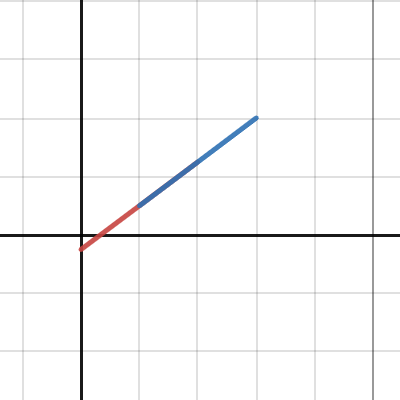
The line (0, -1/2) + lambda*(4,3) is the same as the line (2,1) + lambda*(4,3)
dusky epoch
(0, -1/2) and (2, 1) differ by a multiple of (4, 3)
bold sun
in the lect notes it just has 2 1 plus labda 4 3 as the answer
bold sun
yh lol so i dont really get it
dusky epoch
any vector in the form (2, 1) + λ * (4, 3) can be written as (0, -1/2) + λ' * (4, 3) as well
and vice versa
dusky epoch
bold sun
would both give the marks?
assuming your teacher isn't an incompetent piece of garbage, yes.
bold sun
but how did they get there?>
 dusky epoch
sounds like they might have just gone for the y-intercept as their base point
bold sun
gleaming knot
https://www.desmos.com/calculator/x9pf31svxh
aah okk
bold sun
bold sun
but how did they get there?>
like i dont get what the multiple is for same line?
like i cant multiply cuz anything time 0 is 0 and if i add 2 then id get (2, -0.5+2) which is which is (2, 1.5) not (2,1) if ugm
gleaming knot
Did you play around with my cute thing?
You can the numbers in the range for t in both things on the left
gleaming knot
Did you figure out how it works?
bold sun
wdym? i just substituted nos in
gleaming knot
Did you figure out how what it's showing on the right corresponds to what you type in on the left
bold sun
yh it extends the line or shrinks it
gleaming knot
Ya
bold sun
the lager the values the longer the line?
gleaming knot
Try changing the equation now
bold sun
to?
bold sun
kk
gleaming knot
Play around with it and have make observations and try to figure out how it works
 strange delta
 bold sun
gleaming knot
Play around with it and have make observations and try to figure out how it work...
bold sun
gleaming knot
Play around with it and have make observations and try to figure out how it work...
the line is parallel if i change that
gleaming knot
Ya
How can you predict where exactly the line ends up
based on what you change (0, -1/2) to
also if you change (0, -1/2) to (2,1) what happens
can you find other vectors besides (2,1) where the same thing happens
bold sun
gleaming knot
also if you change (0, -1/2) to (2,1) what happens
thats the same line
bold sun
gleaming knot
based on what you change (0, -1/2) to
bigger values the more the parallell
bold sun
gleaming knot
can you find other vectors besides (2,1) where the same thing happens
where its the same as (0 -1/2)
thats scale factors of the numbers right
gleaming knot
Test your hypotheses
bold sun
omg it isnt scalar factors that mean on same linee
gleaming knot
:)
gleaming knot
Keep playing around until you find something
bold sun
like keep changing the (0, -0.5)
gleaming knot
yes
bold sun
nothing is workinggggg
bold sun
okk i got 4 and 2.5
gleaming knot
Nice
bold sun
dunno how it realtes tho?
gleaming knot
Well keep playing then
bold sun
cuz one is times 2 another is times 2.5
gleaming knot
Until you can reliably make another one
bold sun
im just gnna end up with similar logic uko
gleaming knot
It's not the right logic yet