#linear-algebra
2 messages · Page 235 of 1
 fringe haven
 stoic pythonBOT
Marikyuun
 fringe haven
I just want a starter
 sonic osprey
Just show it's equal to its own transpose
fringe haven
Thank you
 steel prairie
Does anybody know if there is a way to solve linear system(or actually find the value of expression) given lambdas with the matrix like in picture in some way which is faster than $O(n^2.4)~$.

 tranquil steeple
steel prairie
Does anybody know if there is a way to solve linear system(or actually find the ...
tranquil steeple
steel prairie
Does anybody know if there is a way to solve linear system(or actually find the ...
If $\lambda_{2n-2}=1$ you have a circulant and can just use FFT. Look in the book Iterative methods for Toeplitz systems by Michael Ng for your case if $\lambda_{2n-2}\neq 1$ 🙂
stoic pythonBOT
Sven-Erik
 tranquil steeple
I would assume using a circulant preconditioner would work great here.
steel prairie
holy, man, i'm grateful, actually it's something like Hankel matrix, but I couldn't even find this except from the wiki of circulant matrix. and it actually can be solved in square time
tranquil steeple
steel prairie
holy, man, i'm grateful, actually it's something like Hankel matrix, but I could...
for circulants the full eigen decomposion is trivial, so solving the system is very cheap
tranquil steeple
steel prairie
holy, man, i'm grateful, actually it's something like Hankel matrix, but I could...
I have a lecture in one minute, but if you want to discuss this stuff later just ask
steel prairie
fine, i'll think about it, have a good day
 fossil niche
Hi guys, I just got introduced to the concept of bases. Can anyone teach me how to solve this question?

 wintry steppe
Can someone help me with this? I'm unsure how to approach this homework question
 lavish jewel
have you already seen cross products?
wintry steppe
Did not see cross products
lavish jewel
i see. the question is a bit weird in that there are infinitely many solutions, but ok
all you have to do is find vectors whose dot product with the given one is 0
you could do this by trial and error and inspection
for example, the vector [1,0,1] works here
and now you need another vector that is also perpendicular to the given one, and linearly independent from [1,0,1]
wintry steppe
lavish jewel
i see. the question is a bit weird in that there are infinitely many solutions, ...
Yes, I was a little confused but thanks to you, I was able to solve it! Thank you so much
 tall rock
hello, may i ask what should i take before taking linear algebra?
its only the first week of my class and i'm very lost. i only brought my knowledge of matrices here and the problem is all about proofing, which i have 0 experience in doing those kind of problems
 nocturne jewel
Well if you're struggling with proofs... intro to proof course
tall rock
is that discrete mathematics?
nocturne jewel
No clue, but knowing matrices is already a fine thing so like... just review deduction, induction, contradiction, contraposition etc
 ebon lily
tall rock
hello, may i ask what should i take before taking linear algebra?
ebon lily
tall rock
hello, may i ask what should i take before taking linear algebra?
start by watching 3 blue1brown's playlist it will make the proofs 10 times easier to understand
best way to understand matrices is to not get them involved at all
tall rock
ebon lily
best way to understand matrices is to not get them involved at all
im not sure what do you mean by that?
ebon lily
basically a matrix can be thought of as a linear transformation where the basis vectors of the initial vector (x,y) (called i cap and j cap)land on some coordinates which are the columns of the matrix
ebon lily
tall rock
im not sure what do you mean by that?

Beginning the linear algebra series with the basics.
Help fund future projects: https://www.patreon.com/3blue1brown
An equally valuable form of support is to simply share some of the videos.
Home page: https://www.3blue1brown.com/
Typo correction: At 6:52, the screen shows
[x1, y1] + [x2, y2] = [x1+y1, x2+y2].
Of course, this should actually b...
just start this and you will understand what happens geometrically when you multiply matrices, finding inverse what does it all do
tall rock
ebon lily
just start this and you will understand what happens geometrically when you mult...
i'll try that thanks
 wild fulcrum
what kinds of proof problem?
normally when starting linear algebra, it gets you solve some system of equations to introduce you to matrices
steel prairie
tranquil steeple
I have a lecture in one minute, but if you want to discuss this stuff later just...
Yeah, one more question occured: is there any convenient in terms of complexity way to get (any) annihilating polynome of toeplitz matrix which degree strictly less than 2*n.
It occured when I tried to solve equation Ax=b where A is toeplitz. It can be solved if A is not singular just by inversing in n² time, but I actually don't understand what should I do in such case. Btw even equation with singular matrix can be solved since initial problem is from competitive programming...
And finding annihilating polynome would be sufficient in such case to solve the initial problem, but I can't come up with solution. So, is there a way to find such polynome or is there a way to solve such system (any solution of linear system would be sufficient) with singular toeplitz matrix in square-ish time
tall rock
wild fulcrum
normally when starting linear algebra, it gets you solve some system of equation...
This is a past test paper, and they just gave these kind of question for number 3 and 4. I'm not sure where to even begin to answer those kind of question
 wild fulcrum
seems not too far from what would normally be taught in class
like for q4 you would normally have done some rref on rectangular matrices and realised that i suppose?
tall rock
wild fulcrum
like for q4 you would normally have done some rref on rectangular matrices and r...
Tbh i'm not sure that I'm catching up to the class enough 😂
tranquil steeple
steel prairie
Yeah, one more question occured: is there any convenient in terms of complexity ...
maybe this is useful? https://arxiv.org/abs/2104.02497 If you have some actual example of the Toeplitz matrix you are interested I might be able to answer better. I usually work with banded matrices, but also sometimes full ones.
I have not read the paper I linked, but title sounded like something useful for you
tall rock
anyone knows where to start? i don't quite understand the question either

 marble lance
Are they equal or is the one a subset of the other? That's what they want to know @tall rock
tall rock
and what do i need to learn about that? i really don't know anything about this
marble lance
Do you know what the notation means?
tall rock
i only know that the upside down "U" works like an and
but i don't understand the meaning of the function either
marble lance
Hmm
Okay
You should go read back and learn more about the definitions before trying this question
So the upside down U is an intersection
The intersection of sets is the collection of elements that belong to all of the sets
And f(X) where x is a set means the image of x under f, so that is the set
f(X) = {f(x): x in X}
So go look for those definitions in your book and get comfortable with them first
tall rock
hmmmm okay
tall rock
um, i'm embarrassed but i can't find those in my notes, and about book... i don't have it yet..
 nova siren
I’m an undergraduate math student and have recently learned about determinants, and while i am comfortable with the computational part, I still have no idea how the rigorous definition using symmetric groups relates to the notion of ‘scaling’
Any intuition as to how mathematicians came up with that would be much appreciated.
lavish jewel
maybe the definition using eigenvalues/singular values is more intuitive
wintry steppe
det T is the area of T(unit hypercube)
nova siren
@wintry steppe yes I know that, but can’t see how that relates to the rigorous definition
@lavish jewel eigenvalues still haven’t been introduced in class, but I’ll do some digging.
Thanks!
@tall rock your question has already been addressed in stack exchange
tall rock
nova siren
<@295205390445051907> your question has already been addressed in stack exchang...
oooh ill go and check it up
wintry steppe
Not sure this belongs here but it does involve linear algebra: Basically I'm proving that for this specific problem that Z is unbounded. I was just wondering if it's the case that Z is always going to be un-bounded when Non-basic Variables > Basic variables in terms of the amount of them is always true.... Because it essentially leaves no possible leaving basic var? Or is there a case where NBV > BV but it can be bounded still
 slow scroll
what is Z?
nocturne jewel
slow scroll
what is Z?
Integers I assume
slow scroll
maybe, but if thats the case idk how to make any sense out of this question
its kinda unusual to see integers come up in linear algebra in the first place ¯_(ツ)_/¯
 zenith junco

why is this false?
if its a linear trans then it means it is one to one and on to

what
is T is one to one --> t is linear trans?
if t is onto --> t is linear trans?
oh
what
so if i know t is linear trans and ONE of a,b,c holds then i know the other a,b,c holds too?
but
i have to know it is a linear trans right?
zenith junco
zenith junco
so why is this false
but
can ugive me an example where t is a linear transformation but none of those statements hold
T(v) --> 0
is that
a linear trans
yeah it is
i bet
 hard drum
Yes, T mapping everything to 0 is linear
zenith junco
T(v + w) = 0 + 0 = 0 = T(v) = T(w)
ookokoo
thanks
im at a library studying but im hungry should i get food or finish my homework
U HELPED ME THOI
❤️
hard drum
How far in the future is "tonight"
zenith junco
its 3pm rn 😩
but
i have so much hw to do for 3 sections
n i barely started the first section
like an idiot


how do i do this
i dont understand how to find nul or rank bases
 noble swan
Can somebody help me conceptualize this? I'm not sure how to start this

 iron drum
I'm looking at this derivaition and for some reason don't know what they did here. Can someone help me out?
 zenith junco
😔
iron drum
?
 muted solstice
can someone help me understand difference between Singular Value Decomposition (SVD) and PCA? When to use which one and how are they related?
slow scroll
iron drum
I'm looking at this derivaition and for some reason don't know what they did her...
those equations in terms of the determinant of A are cramers rule if you've heard of it. If we're assuming nothing, then deriving those equations amounts to tediously solving that system of four equations.

 gray dust
zenith junco
gray dust
zenith junco
idk what thm 2.6 is, but what we can do w/o referring to notes is write (2,3) as a linear combo of (1,0),(1,1) & use linearity of T
zenith junco
wait
zenith junco
gray dust
idk what thm 2.6 is, but what we can do w/o referring to notes is write (2,3) as...
i dont know how to do that
gray dust
what exactly
 gray dust
see thm 2.6 in your book
from context i think it's about the existence of certain linear maps
zenith junco
i dont understand
how thm6 even helps

i dont even understand how the soln got that basiss
 winter harbor
noble swan
Can somebody help me conceptualize this? I'm not sure how to start this
winter harbor
noble swan
Can somebody help me conceptualize this? I'm not sure how to start this
Use the fact that {u,v} is a basis for R^2, write down w as a linear combination of u and v; then use the fact that linear transformations preserve linear combinations.
 steel moon
for this are we solving a system of equation x + yi = -7 - 3i
and xi + y= 5 + i?
 zenith junco
nvm i guess i understand q11 now
winter harbor
steel moon
for this are we solving a system of equation x + yi = -7 - 3i
and xi + y= 5 + i...
Yes
steel moon
i am stuck on this because of the i variable
gray dust
Q11 is a case of thm 2.6 for $V=\bR^2,~W=\bR^3$, a basis $v_1=(1,1),v_2=(2,3)$ of $V$, and $w_1=(1,0,2),w_2=(1,-1,4)$
stoic pythonBOT
Dreadful Encore of Twisted Karma
 gray dust
@zenith junco
steel moon
x = -7 -3i - yi and then we plug it into the second equation
but then it feels complicated from there
zenith junco
stoic python
**Dreadful Encore of Twisted Karma**
is it a basis bc its lin indep????
gray dust
{v_1,v_2} is a basis of R^2 since it's lin indep & span{v_1,v_2}=R^2
we'd rather you not offer money for help
if you have a question just ask it here
 stable swift
Okay it's just I have some disabilities and get super stuck and hate being like a Leech
Trying to learn not copy but it helps to do something right a kineti. Learning style so I have some confidence in what to study also
steel moon
steel moon
x = -7 -3i - yi and then we plug it into the second equation
does anyone have any tips for this
winter harbor
Let $x,y \in \mathbb{C}$ be such that $x+iy = -7-3i$ and $ix + y = 5+i$.
\
\
Therefore, we can multiply the first equation by $-i$ and get:
$$
-xi+y=7i-3
$$
Now add both equations
$$
2y = 8i+2 \implies y = 4i+1
$$
This then implies $x = -4i-3$
stoic pythonBOT
MisterSystem
 winter harbor
@steel moon
You solve it the same way as a linear system of equations
All the tricks work even if you are working over C
They work for any field really
steel moon
thanks
i was over complicating it
another question i had is that this tells us that the transformation induced by A on v sends v to the 0 vector, and on w scales it by a factor of 8? but i am having trouble connecting diagonalize to this, and what it represents

diagonal means it only does scaling right
gray dust
D is a diagonal matrix containing the eigenvalues of A
winter harbor
steel moon
another question i had is that this tells us that the transformation induced by ...
Think about the eigenvalues and eigenvectors of A.
Is w an eigenvector for A?
Being diagonalizable means that A is similar to a diagonal matrix
And this diagonal matrix contains which information about A?
steel moon
it can tell us the eigenvalues
steel moon
8 is an eigenvalue'
winter harbor
The fact that A has a non trivial kernel implies what about its diagonalization?
steel moon
is kernal the null space?
winter harbor
Yeah
steel moon
i dont remember anything about how it relates
gray dust
phrased differently, v!=0 and Av=0=0v. what does it say about eigenvalues?
steel moon
0 is an eigenvalue
gray dust
D is a diagonal matrix containing the eigenvalues of A
yes so 8,0 are eigenvalues. what choices are candidates for D?
 silent dune
for (b) here is what I did the right way to show it cause apparently it does exist but I dont think I did anything wrong

 winter harbor
silent dune
for (b) here is what I did the right way to show it cause apparently it does exi...
winter harbor
silent dune
for (b) here is what I did the right way to show it cause apparently it does exi...
Yeah
All you have to do is apply the definition
I.e
b is in the null space of A iff A(b) = 0
If your calculations are correct
Then it is alright
silent dune
right on thanks
 shell kindle
Can someone explain how this is in row echelon form?? I thought every nonzero entry in each row needed to be a 1.

 azure bridge
shell kindle
Can someone explain how this is in row echelon form?? I thought every nonzero en...
azure bridge
shell kindle
Can someone explain how this is in row echelon form?? I thought every nonzero en...
this is row echelon form, not reduced row ehcelon form, the leading entries need to be 1 only if it is reduced
shell kindle
azure bridge
this is row echelon form, not reduced row ehcelon form, the leading entries need...
That's what I thought, but then Chegg tells me that this isn't in Row Echelon Form, so which one is it?

How is that matrix ^ not in Row Echelon Form??
azure bridge
huhh that is in row echelon form but not REDUCED
leading entry of row echelon form doesnt have to be 1
only reduced form needs to be 1
 teal grotto
would anybody mind explaining the proof for least squares minimization on this page?
stoic pythonBOT
c squared
 teal grotto
here is a picture in case

oh wait
its because of the previous part that they just showed. things have reasons
shell kindle
azure bridge
leading entry of row echelon form doesnt have to be 1
So Chegg is wrong, right??
nocturne jewel
yeah, dont use Chegg either way
Chegg is just people who might not even be qualified to answer, answering to get money
teal grotto
teal grotto
here is a picture in case
does anybody see why the minimum is uniquely attained when A is injective?
failing to see why but i feel like it should be obvious again
wintry steppe
there's only one minimum value, so if it occurs at z and z', then Az = Az', and by injectivity you get z = z'
(if this sounds like nonsense then it's because i didn't read the whole screenshot)
teal grotto
stoic python
**c squared**
its because of this
 lone crow
Would any1 be willing to help me understand how to do my algebra homework? I missed 2 classes and my prof didnt record the lecture so its really hard to figure this out. There is only 5 questions I need to get done
These are the leftover questions if any1 can help teach me that would be great :D

 manic blade
which ones do you think you cant do
lone crow
manic blade
which ones do you think you cant do
All of them
I had a friend teach me 5 and 6
so actually its just 2,3,4
I dont have anything to work with and Im struggling to teach myself
 half ice
 manic blade
also note

2a) with this given definition, u*u = 1
try to use the properties for 2b and 2c
answer for 2b) is 0 2c) is -8
try to see how thats the answer
stoic pythonBOT
oralcumshot
 manic blade
for 3 im getting the feeling we might have to try multiple possible vectors of u and v such that it follows the given conditions
for 4 note that when two vectors are perpendicular, their dot product equals 0
so your goal is to find two vectors u,v such that: u * v = 0, u * w = 0, and v * w = 0
ill try to come up with something for 3, but brute force is to try every vector for u,v such that | | u | | = 3 and | | v | | = 2
tall rock
does it work if i say:
C={1,2,3}
D={1,2,3}
E={1,2,3}
and
C={1}
D={1,2}
E={1,2,3}

or what is the correct way to prove this?
 limber sierra
thats an example
not a proof
to prove this, you need to show it for ALL sets C, D, and E
so you cant just come up with specific examples
to help you get started: "X is a subset of Y" means every element of X is also an element of Y
so you know the following:
- every element of C is an element of D
- every element of D is an element of E
and you want to use this information to prove:
- every element of C is an element of E
so take an arbitrary element of C (call it x). why is x in E?
@tall rock
wintry steppe
does the proof go like this: element a belongs to C, therefore, it belongs to D, and since it belongs to D, it must belong to E., just a statement answer?
tall rock
limber sierra
so take an arbitrary element of C (call it x). why is x in E?
Sorry i am very new to proofing, and I'm not sure where to start. I understand what you are saying but what do i write down?
What i have written is
Let:
P=C subset D
Q=D subset E
Prove : R=C subset E
So make truth table for P^Q->R?
limber sierra
you dont need to assign everything propositional symbols
let me repeat
you know the following:
- every element of C is an element of D
- every element of D is an element of E
and you want to use this information to prove:
- every element of C is an element of E
so take an arbitrary element of C (call it x). why is x in E?
wintry steppe
limber sierra
you dont need to assign everything propositional symbols
can we prove it using venn diagrams
tall rock
I was thinking of that too
limber sierra
no
just explain why x is in E
proofs are explanations why something is true
like having a persuasive argument with a very nitpicky person
lavish jewel
use the definition of subset twice
tall rock
So should I say:
Let C={x}
Since C is a subset of D, that means D={x}
And then D is a subset of E, so that also means E={x}
Because we know C={x} and E is also {x}, so C is a subset of E ?
stoic pythonBOT
Edd
 limber sierra
C is not necessarily equal to {x}
if C = {1, 2} then C is never equal to {x} for any x
stop using specific examples
i want an argument that works no matter what C is
stoic pythonBOT
Cursed
 tall rock
I am very confused sorry 🙏🙏🙏
limber sierra
yes
limber sierra
your argument is wordy, but correct
but it feels kinda weird to answer when im trying to help someone else.
wintry steppe
i am actually studying this topic
i can say i started studying this recently
so i am eager to answer questions related to this topic
gray dust
just take care not to answer leading questions on one’s behalf
wintry steppe
gray dust
just take care not to answer leading questions on one’s behalf
ok then i won't try to involve in any question if it is specific and one is already trying to answer it.
tall rock
$x \in C, by statement C subset D, then x \in D, and D subset E, means x \in E, since x \in C and E, therefore C subset E$
stoic pythonBOT
Cursed
 limber sierra
thats the argument, yes.
maybe flesh it out with a few more words
but you have the right idea
tall rock
okay thanks!
 teal flume
Can I ask something about Geometric Algebra here? If not where can I ask?
steel prairie
tranquil steeple
maybe this is useful? https://arxiv.org/abs/2104.02497 If you have some actual ...
Welp, it's actually answer to my question but my roommate in uni helped me to understand that actually my idea with annihilating polynomial isn't correct at all. And even solving this system wouldn't be sufficient. So, i want to tell about initial problem and my attempts to solve it, so you may give some ideas.
Given the matrix A NxN and cell i, j in A, A^2, A^3, ..., A^{2n-1} I need to return i, j cell in A^{2n}.
Main and obvious idea is hamilton-cayley theorem: if we can get some annihilating polynomial of A with degree not more than 2n we would win. So, lets denote given cells as t1, ... t2n. Lets say f(x) = c_0 + c_1x + ... c_{n-1}x^{n-1} + x^{n} is our annihilating polynomial, then we can assume that f(A)=O, furthermore: f(A)*A^k=O for k = 1 to n - 1
Actually we don't really need whole A here, rather than t-vector. So we have c^T * (1, ..., t_n-1) = -t_n, ..., c^T * (t_n-1, ..., t_2n-2) = -t_2n-1, which is a linear system that can be rewritten as toeplitz matrix, which i showed in the first message. But there are two problems:
1)I dont understand how to solve this system in case of singular matrix
2)Even if I could there is no guarantee(or at least i dont see a way to prove it) that it would actually be coefficients of annihilating polynomial.
And the strangest to me, that i never used A in my ideas, even though it is given to me, but I dont see a way to use it, since A is random and almost everything we can compute is cubic which is surely not acceptable.
And i'm sure that it's a problem around toeplitz matrix because it's fully dependent on the fact that it has d=2n-1.
So, if you have any ideas how to approach this problem, please give me a hint

 short magnet

Super quick question
the Dunford decomposition of A is :
D = diag(1,1,1,0) and (A - D) right ?
limber sierra
tall rock
Is this how to use induction?
i cant follow exactly what youre doing, but it doesnt look right.
you prove the base case, and then start the inductive step
but then randomly let k = 2 halfway through
which you cant do
the inductive step needs to work for any k
tall rock
then what do i do once i found N(k+1) ?
hard drum
Show that N(k+1) is even given that N(k) is
limber sierra
youll need to use the fact that k² - k is even somehow
a hint: you have k(1+k). can you do some manipulations to "force" k² - k + [something] to appear?
tall rock
limber sierra
a hint: you have k(1+k). can you do some manipulations to "force" k² - k + [some...
perfect square?
limber sierra
be more specific.
stoic pythonBOT
Cursed
 tall rock
this?
limber sierra
no...
okay, let me give some hints
we have k(1+k)
we want to end up with something that contains k^2 - k
lets start by expanding k(1+k), because thatll give us our k^2 term
expanding it gives k² + k
okay, but we want k² - k, not k² + k
thankfully, theres a trick we can use: adding 0
can you proceed from here?
or do you need a bit more guidance
tall rock
hmm, i'll try, may i know what is this trick name?
limber sierra
adding 0
adding 0 to an expression doesnt change it
but it can let us change the way we "write" it
now note that 0 = k - k
does that give you an idea?
limber sierra
there we go
so now looking at this
remember our inductive hypothesis: k² - k is even
so we can write it as, say, 2m for an integer m
hence this becomes 2m + 2k
do you see why this is even?
limber sierra
but why
tall rock
since they have a factor of 2
limber sierra
right
2m + 2k = 2(m+k)
so we have 2 multiplied by some integer (since m and k are both integers)
thats an even number!
hence (k+1)² - (k+1) = 2(m+k) is an even number.
this completes the induction and therefore the proof (for positive n)
what about negative n? can you think of a quick way to extend this result to negative n?
tall rock
for negative n, the value will still always be even, and since 2m = k^2 -k, you'll end up with positive value?
limber sierra
the value will still always be even
why?
the m stuff was from our proof of the inductive step
limber sierra
which assumed the inductive hypothesis held
do you know why induction works? like, why it makes for valid proofs
have you heard the "domino" analogy?
tall rock
nope
limber sierra
the idea with induction is
you prove something true for a "base case", and then prove, whenever its true for one number, its true for the next
so if the statement is true for 0, its true for 1
if its true for 1, its true for 2
and so on
this is likened to "knocking over dominoes"
the inductive step "sets up your dominoes" so one will knock over the next
and the base case is like "knocking over the first domino"
what your proof did is:
- show the base case, n=0, is even
- show that, whenever a particular case k is even, so is k+1
this lets us prove it for n=0, then n=1, then n=2, then n=3, then...
but you might notice that it only works for positive integers
(and 0)
we havent proved it for negative numbers yet
fortunately, theres an easy way to adapt it to work for negative integers
think, whats the difference between n² - n and (-n)² - (-n)?
tall rock
we have n^2 + n situation that we can make it into another n^2 - n +2n ?
limber sierra
right, so (-n)² - (-n) differs from n² - n by 2n
but 2n is even
and we know from the proof for positive n that n² - n is even as well
hence n² - n + 2n is even too
but n² - n + 2n = n² + n = (-n)² - (-n), as you observed
so whenever the n case is even, so is the -n case
this proves it for all integers n.
since we already knew it worked for n=0, n=1, n=2, n=3...
and now it also works for their negatives
-0, -1, -2, -3, ...
tall rock
i somehow got it, but not sure how to do it again for different things. this still looks like black magic to me tbh
thanks man, you really saved me from math illiteracy altho im still illiterate haha
 zealous lagoon
What does order 1 mean?
 tranquil steeple
zealous lagoon
What does order 1 mean?
tranquil steeple
zealous lagoon
What does order 1 mean?
That the values are approximately 1 (they are not order 10, or order 100)
If A would have been ill-conditioned you would have some very large numbers in A^{-1}
zealous lagoon
tranquil steeple
That the values are approximately 1 (they are not order 10, or order 100)
So values like 3 and 4 is order 1 but if there were values like 11 15 it would have been Ill conditioned?
tranquil steeple
no, O(100) would sill be well conditioned
ill conditioned would be like 1E10 or something
If you use higher precision data types then a condition number like that would not be a problem
lavish jewel
a lecturer here always says stuff is poorly conditioned if the condition number is > 1
guy must precondition his breakfast
tranquil steeple
🙂
stable swift
Find a matrix $A$ such that
$$A^3=\left[\begin{array}{cc}
1 & 0 \
26 & 27 \
\end{array}\right].$$
stoic pythonBOT
burga
 winter harbor
Yeah, you are multiplying A * A * A in the usual matrix multiplication way
stable swift
im unfamaliar what diagnolize
stable swift
but thanks
tranquil steeple
and the diagonal of the "middle" matrix is given by just looking at A^3
winter harbor
stable swift
im unfamaliar what diagnolize
You could also do this via a system of equations too
stable swift
so will A be 3 matrix or just 1 matrix that multiplies by itself 3 times
stable swift
got it
winter harbor
And we want to find A
tranquil steeple
stable swift
im unfamaliar what diagnolize
are you familiar with eigenvalues and eigenvectors?
 stoic pythonBOT
burga
Compile Error! Click the  reaction for more information.
(You may edit your message to recompile.)

burga
Compile Error! Click the reaction for more information.
(You may edit your message to recompile.)

burga
Compile Error! Click the reaction for more information.
(You may edit your message to recompile.)

burga
Compile Error! Click the reaction for more information.
(You may edit your message to recompile.)
 stable swift
$$A=\left[\begin{array}{cc}
1 & 0 \
$\sqrt[3]{26}$ & 3
\end{array}\right]$$
stoic pythonBOT
burga
Compile Error! Click the reaction for more information.
(You may edit your message to recompile.)
 stable swift
Is that right?
stable swift
$$A=\left[\begin{array}{cc}
1 & 0
$\sqrt[3]{26} & 3
\end{array}\right]$$
stoic pythonBOT
burga
Compile Error! Click the reaction for more information.
(You may edit your message to recompile.)

 zinc timber
$ before \sqrt
$$A=\left[\begin{array}{cc}
1 & 0
\sqrt[3]{26} & 3
\end{array}\right]$$
stable swift
$$A=\left[\begin{array}{cc}
1 & 0
\sqrt[3]{26}$ & 3
\end{array}\right]$$
stoic pythonBOT
Ryuzaki
$$A=\left[\begin{array}{cc}
1 & 0 \
\sqrt[3]{26} & 3 \
\end{array}\right]$$
```Compilation error:```! Extra alignment tab has been changed to \cr.
<recently read> \endtemplate

l.57 \sqrt[3]{26} &
                    3 \
You have given more \span or & marks than there were
in the preamble to the \halign or \valign now in progress.
So I'll assume that you meant to type \cr instead.

Preview: Tightpage -1310720 -1310720 1310720 1310720
[1{/usr/local/texlive/2020/texmf-var/fonts/map/pdftex/updmap/pdftex.map}]```
burga
Compile Error! Click the reaction for more information.
(You may edit your message to recompile.)
 stable swift
$$A=\left[\begin{array}{cc}
1 & 0
\sqrt[3]{26}$ & 3 \
\end{array}\right]$$
stoic pythonBOT
burga
Compile Error! Click the reaction for more information.
(You may edit your message to recompile.)
 stable swift
$$A=\left[\begin{array}{cc}
1 & 0 \
\sqrt[3]{26}$ & 3
\end{array}\right]$$
stoic pythonBOT
burga
Compile Error! Click the reaction for more information.
(You may edit your message to recompile.)
 zinc timber
$$\begin{pmatrix} 1 & 0 \ a & 3 \end{pmatrix}$$
stoic pythonBOT
Ryuzaki
 stable swift
Im trying to explain in english how to show my work for here
is my answer for A correct?
zinc timber
No
 zinc timber
stable swift
what did i do werong
zinc timber
stable swift
what did i do werong
cube rooting a matrix is not the same as cube rooting individual elements
stable swift
F
 real granite
are you familiar with matrix multiplication?
 tranquil steeple
you only did one multiplication
zinc timber
stoic python
**Ryuzaki**
u can start from here tho
 little scarab
Exercise 1.1.3: Regarding 2x = 5 as the equation 2x + 0y = 5 in two variables, find all solutions in parametric form.
How does this work? I get in general you let x = s and then solve for y, but I don't really see how that works with 0y
lavish jewel
backwards. let y = s
real granite
stable swift
you're on the right lines, you just need to multiply again by that 3rd matrix
little scarab
lavish jewel
backwards. let y = s
then x = 1/2(5-0s) ?
lavish jewel
and what does that tell you about s?
maybe it would help you to write the equation in a more familiar form
$\begin{bmatrix} 2 && 0 \\ 0 && 0 \end{bmatrix} \begin{bmatrix} x \\y \end{bmatrix} = \begin{bmatrix} 5 \\0 \end{bmatrix}$
stoic pythonBOT
Edd
 wintry steppe
What are inner-product preserving maps called?
stable swift
Is there a latex command to solve my problem by multiplying the equations
tranquil steeple
stable swift
Is there a latex command to solve my problem by multiplying the equations
Have you derived an expression for A^3? Then I can post here so you see if you have it correct.
 verbal pivot
wintry steppe
What are inner-product preserving maps called?
verbal pivot
wintry steppe
What are inner-product preserving maps called?
maybe you are thinking of orthogonal maps?
wintry steppe
verbal pivot
maybe you are thinking of orthogonal maps?
Those are for real vector spaces apparently.
I want the general term.
isometry?
Should I go with unitary maps?
wintry steppe
wintry steppe
isometry?
Those are for metrics.
i've seen it used for inner products
mostly in riemannian geometry books
Hmmmmmm
stable swift
$$A=\left[\begin{array}{cc}
1 & 0 \
2 & 3 \
end{array}\right]$$
stoic pythonBOT
burga
Compile Error! Click the reaction for more information.
(You may edit your message to recompile.)
 wintry steppe
"inner product preserving" is nice and non-ambiguous anyways
wintry steppe
wintry steppe
"inner product preserving" is nice and non-ambiguous anyways
LoL, nice.
Yeah, I guess I'll stick with it.
tranquil steeple
stable swift
$$A=\left[\begin{array}{cc}
1 & 0 \\
2 & 3 \\
end{array}\right]$$
that is one out of nine solutions
lavish jewel
doesn't the inner product induce a metric anyway
stable swift
\hmmmmmmmmmmmmmmmmmm
tranquil steeple
burga did you get that A^3 is ```
[ a*(a^2 + bc) + b(ac + cd), b*(d^2 + bc) + a(ab + bd)]
[ c*(a^2 + bc) + d(ac + cd), d*(d^2 + bc) + c(ab + bd)]
yea
tranquil steeple
stable swift
yea
if you look in the element 1,2 you should see that b=0 is the solution you seek, now plug that in everywhere
tranquil steeple
pluggining in b=0 makes things not too messy any more
tranquil steeple
stable swift
real easy to mess up
and remember that a^3=1 has three solutions, it is not just 1
but yes the resulting solutions are rather messy
little scarab
lavish jewel
and what does that tell you about s?
honestly not sure
maybe that any value of s is allowed?
lavish jewel
yep
little scarab
So how does this result translate to the question ("find all solutions in parametric form")? x = 2.5, y = "anything"?
or well, any real number?
lavish jewel
one way is, for example, [1,0] + s[0,1] for any s
silent dune
for (b) I'm confused can there be different equations of the plane or only one? I got one equation but it wasn't the same
 hard drum
There can be multiple equations if you put it as e.g. r = r_0 + λa + μb, although if you put it in the form r.n = c (equivalently ax + by + cz = d) it'll be unique up to factors
silent dune
so regarding the actual matrix, do I have to have 1's in the pivot columns or I don't?

like if I didn't have to have 1's I could just ignore the 1/2 of row1 and then my equation would be different so maybe that was just my issue before?
 thorn shore
second matrix, last row of that should be 0 -1 -1 -2 b3-b1, right?
silent dune
see thats where my issue is, but that pic has a mistake or two
my equation of the plane will be diff if I do it that way
 thorn shore
oh im saying that your elimination of the third row got messed up
silent dune
my 2nd row is the issue actually I forgot
it should be b2 - 2b1
but my third row should be fine
thorn shore
how so
thorn shore
well if you want to eliminate the stuff in the first column in the original matrix, you'd just subtract the first row from the second and third, yeah?
silent dune
when I did the row reductions
silent dune
I know
but the issue is
the plane would be different
thats why I was confused if there is only one plane
thorn shore
you can have multiple equations
silent dune
our prof just said this was the thing so I wasn't sure
 thorn shore
if you have ax+by+cz=0, 2ax+2by+2cz=0 is the same plane
silent dune
His answer doesn't make sense to me since row2 is just b2 - b1
but I have
ax + by + cz = 0 or 2ax + by + cz = 0
thorn shore
is the pic you just sent the teachers notes?
silent dune
silent dune
our prof just said this was the thing so I wasn't sure
this yes
I'm assuming they just did r2 = r2 - r1, then r1 = 1/2 r1, then r3 = r3 - 2r1, then r3 = r3 - r2 for 0's
hence why row 2 had b2 - b1, rather then b2 - 2b1
winter harbor
Have you met linear maps/linear transformations already?
You can think of matrices just as an array of numbers which have some weird algebra structure (sum and multiplication of matrices and multiplication by scalars)
But I don't think that's a pretty fruitful way to view them.
wintry steppe
i think if someone knows what a linear map is, then they would know what a matrix is
:^)
short magnet
Is the matrix of size two that's all ones diagonalizable over Z/2Z ?
zenith junco
could someone please explain this to me

here is the solution that i dont understand

this is the correct question mb
how do we know span(S union T) = W +U
hard drum
Well, what are the elements of span(S union T)?
stable swift
(a) Prove that every square matrix $M\in\mathbb{R}^{n\times n}$ can be expressed as the sum of a symmetric matrix
and a skew-symmetric matrix. (This is essentially exercise 2.69 on page 53 of your text.
Notice that all three parts are required to complete this problem.)
Assume A is a square matrix.
We can derive the equations
/a) A+A^T is symmetric.
b)A-A^T is skew-Symmetric
(A+A^T)^T = A+A^T
/(A-A^T)^T = -(A-A^T)
stoic pythonBOT
burga
Compile Error! Click the reaction for more information.
(You may edit your message to recompile.)
 stable swift
I cant format this properly or figure it out
i got most the work done
just cant format
short magnet
So, basically
suppose that A can be written as : A = R + S where R symmetric and S skew-symmetric
now apply the transposition, we then get : $$ A^T = R^T + S^T $$
stoic pythonBOT
Der Gegenstand ist einfach.
 stoic pythonBOT
Der Gegenstand ist einfach.
 short magnet
i.e. : $$ A^T = R - S $$
stoic pythonBOT
Der Gegenstand ist einfach.
 short magnet
now we have : $$ A = R + S , \ A^T = R - S $$ , thus $$ R = \frac{A + A^T}{2} , \ S = A - R = \frac{A - A^T}{2} $$
stoic pythonBOT
Der Gegenstand ist einfach.
 short magnet
So now that we've found what R and S might look like, we can go back to do the proof directly
Let A be a square matrix of size n, and $$ R = \frac{A + A^T}{2} , \ S = \frac{A - A^T}{2} $$
stoic pythonBOT
Der Gegenstand ist einfach.
 short magnet
You can easily verify that R is symmetric and S skew-symmetric
and that A = R + S
thus every matrix can be written as the sum of a symmetric and skew-symmetric matrix
The idea behind this proof is useful, and shows up in many areas
(ex : Show that every function can be written as the sum of an odd and an even function)
stable swift
Thanks for the time @short magnet
it looks more complex vs my original
Prove that every square matrix $M\in\mathbb{R}^{n\times n}$ can be expressed as the sum of a symmetric matrix
and a skew-symmetric matrix.
Assume A is a square matrix. \
A can be written as : A = R + S where R symmetric and S skew-symmetric \
Transpose the equation to get $$ A^T = R^T + S^T $$
Therefor R is symmetric, and S skew-symmetric, thus :
$$ R^T = R , S^T = -S $$ or
$$ A^T = R - S $$ \
$$ A = R + S , \ A^T = R - S $$ , thus $$ R = \frac{A + A^T}{2} , \ S = A - R = \frac{A - A^T}{2} $$
Let A be a square matrix of size n, and $$ R = \frac{A + A^T}{2} , \ S = \frac{A - A^T}{2} $$
\ proves that every square matrix can be written as the sum of a symmetric and skew-symmetric matrix
stoic pythonBOT
burga
 stable swift
i wonder what I did wrong
wintry steppe
you could shorten the entire proof to just this part tbh
 stable swift
no shortening
stable swift
I got 8 pooints off on an assignment I had 100% answers to becuase I didnt explain with enough english
short magnet
you can use them directly
wintry steppe
it doesn't ask you to prove that the only way to write a matrix as a sum of a symmetric and skew symmetric matrix is (A + A^T)/2 and (A - A^T)/2
it just asks you to show there's a way
hard drum
you can still shorten it and explain everything
short magnet
You do the analysis of the problem in draft
wintry steppe
so take my screenshot, show that your matrices are symmetric and skew-symmetric, and you're good
short magnet
yep
stable swift
yea you're right
stable swift
Recall that a matrix M ∈ R
n×n is “orthogonal” if MMT = In, where In is the n×n identity
matrix. (a) Explain why the rows of any given orthogonal matrix are mutually perpendicular. (b)
Explain why each row of any given orthogonal matrix has unit length
for A I was thinking that the rows of any othogonal matrix are mutually perpendicular because they must be transpose vector and for b must be a real number
................. the rows of any given orthogonal matrix are mutually perpendicular because they are inverses of eachother and it is a transposition (?). Each orthogonal matrix has unit length to ensure it is a real number (?)
short magnet
erm, try writing out the product in the form of a sum,
you'll get the answers to both questions
stable swift
to write out the product in the order of a sum,
short magnet
yes, what is the i,j-th component of MMT ?
 short magnet
if $$ M = (m_{i,j})i,j $$, then for all i,j, the i,j-th component of MMT is $$ \sum_{k=1}^{n} { m_{i,k} m_{j,k} } $$
stoic pythonBOT
Der Gegenstand ist einfach.
 short magnet
now, if i = j then we have :
$$ \sum_{k=1}^{n} { m_{i,k}^2 } = 1 $$ (Left-hand side equals right hand side ..)
stoic pythonBOT
Der Gegenstand ist einfach.
 short magnet
do you see now why each row has unit length ?
stable swift
not in particular
short magnet
(the i-th row is $$ (m_{i,1},..., m_{i,n}) $$ )
stoic pythonBOT
Der Gegenstand ist einfach.
 short magnet
what is the norm of a vector ?
stable swift
The rows of any given orthogonal matrix are mutually perpendicular because _______. Each row has unit length because magnitude must be postitive and real?
hard drum
why does the magnitude being positive and real mean it's of unit length?
short magnet
it is true that the magnitude of a vector is positive and real
but going by what you said, all vectors would have magnitude of unit length
(magnitude is what I meant by norm here btw..)
perhaps you've misunderstood some fundamental ideas, and that's what's getting in your way here
stable swift
yea
im really trying to answer the questions in english
but then math takes me differently
short magnet
you can't do everything in english when doing math though
stable swift
so any orthogonal matrix has unit length because, for it to be perpendicular to any other matrix ____
is that a good start?
and the rows are mutually perpendicular becuase when you set the i and j equal to eachother, as shown in your equation, youll see its a transposition
short magnet
I really suggest going through your course material and working through it slowly
Because you've jumbled many ideas there
short magnet
If you have the fact taht
stable swift
its too much time
12 hours not able finish 1 question
no bigger demotivating vs that
short magnet
relax mate
stable swift
and I do good on my last assignment, but not enough english so I get a D
short magnet
don't put yourself down like that
stable swift
just being real
short magnet
It's a normal situation to be in
stable swift
ive been trying tell myself i can do this
short magnet
It's a struggle
 gritty swift
stable swift
12 hours not able finish 1 question
gritty swift
stable swift
12 hours not able finish 1 question
i spent like 4 hours today on one question lol
short magnet
But you can always get through it as long as you have the time
gritty swift
its normal
gritty swift
@stable swift can you talk? we can hop in vc and I can help you with linear algebra
gritty swift
ok
stable swift
ive made some progress today using latex
but my stuffs all half finished or unexplained
each row of any given orthogonal matrix has unit length because they must have real equivalences to be multiplied?
 empty egret
Sorry for the sudden message but I really need help with this.
Suppose that v1, v2,..,v5 are all vectors in R^5. Let A = {v1,v2,v3,v4,v5}. Suppose Ax = 0 only has the trivial solution. What does the rref of A look like?
I understand that this matrix is m x n where m = n = 5 so should the rref just have pivots in every row and the rest is all zeros?
gritty swift
empty egret
Sorry for the sudden message but I really need help with this.
Suppose that v1,...
the rref should be the identity since A is invertible
oh wait no
empty egret
I am very confused, sorry
hard drum
Uli is right. Now by turning A into its RREF A, we'll have an equation of the form Ex = 0 from Ax = 0
Can there be any free variables?
 sharp radish
Find the matrix for a 120◦rotation about the axis defined by the vector r = (1,1,1).
what are some ways to approach this problem
hard drum
Extend it to a (probably right handed) basis and find the matrix wrt that basis
then change basis
sharp radish
that sounds really messy
do I have to make use normal basis
I was looking up solutions online
and apparently the matrix is like [ [0 0 1] [1 0 0] [0 1 0]] (row based notation)
but I don't know understand how people are getting this answer
empty egret
hard drum
Can there be any free variables?
no
since it only has the trivial solution, no?
so would the rref look something like : [1 0 0 0 0;0 1 0 0 0;0 0 1 0 0.;0 0 0 1 0;0 0 0 0 1]?
gritty swift
stable swift
here's my attempt at explaining it, we know the i,j entry of MM^T will be the dot product between the i'th row of M and the j'th row of M. for i not equal to j this gives zero, meaning the row vectors are orthogonal and when i equals j it gives one, meaning the i'th vector dotted with itself is length one, hence it is of unit length.
if you aren't comfortable with matrix multiplication check out http://matrixmultiplication.xyz/ and watch the beginning of https://youtu.be/FX4C-JpTFgY where strang talks about 4 ways to view of matrix multiplication
stable swift
thanks for those links
im trying to relearn it , I saw some youtube but this will help
ive never seen this visualizer before
gritty swift
yeah the visualizer is how i remember the i,j rule for dot products
noble swan
The question is to find the standard matrix T that causes this transformation. I'm not sure how I'm supposed to figure this out?
 gritty swift
write out a transformation from (x,y) to (x',y') rotated by 3pi/2, then convert that to matrix notation
you should get x' = ax + by and y' = cx + dy which can be written with a matrix since its a linear combination
(where a,b,c,d are given by trig functions)
noble swan
Hmm, I'm thinking I haven't been taught yet
gritty swift
ok 1 sec lemme figure it out
many people memorize this so could be that you're expected to remember it
well, you could also look it up https://en.wikipedia.org/wiki/Rotation_matrix
oh wait i know how to see it
the unit vectors
(1, 0) is transformed to (cost, sint)
(0, 1) is transformed to (-sint, cost)
which gives you the two rows of you matrix
noble swan
Ahhh, and then I can plug in 3pi/2 for t?
gritty swift
yeah
gritty swift
no it explains how to view matrix multiplication visually in terms of basis vectors
gritty swift
by finding where (0, 1) lands after the transformation, sry my trig is rusty lemme try to explain
oh
its just a 90 degree rotation of (cost, sint)
hard drum
empty egret
no
Correct. So every column must have a leading 1. But leading 1s occur on different rows, so it's exactly the identity matrix
gritty swift
since if you tilt your head on the side (0, 1) looks like (1, 0) meaning it must land on (cost, sint) in "head tilted" coordinates, then we rotate backwards by 90 degrees getting (-sin t, cos t) at least thats my bad way of looking at it, if you were better with trig you could derive it directly @noble swan
gritty swift
no not the derivative, the rotation by 90 degrees clockwise
nvm i'm explaining badly
gritty swift
gritty swift
by finding where (0, 1) lands after the transformation, sry my trig is rusty lem...
this is what it is
noble swan
Oh, that's a cool coincidence, then
gritty swift
 gritty swift
noble swan
Oh, that's a cool coincidence, then
gritty swift
noble swan
Oh, that's a cool coincidence, then
there are no accidents
(not 100% sure this is the same but i think it is)
noble swan
Wait, so is there actually a meaning in that row 2 is the derivative of row 1?
gritty swift
well, if you take x(t) = (cost, sint) as the position which traces out a circle
the derivative x'(t) is always tangent to the circle, in other words at a right angle from the position
noble swan
Ahhh, gotcha, thanks for the help!
gritty swift
np
empty egret
hard drum
Correct. So every column must have a leading 1. But leading 1s occur on differen...
Ah, thank you!
empty egret
Show that if {v1,v2...vn} spans a space then {v1,v2...vn,w} does too.
How do I do this?
nocturne jewel
empty egret
**Show that if {v1,v2...vn} spans a space then {v1,v2...vn,w} does too.**
if {v1,...,vn} spans the space, and w is in the space, what can you say about w?
 covert folio


I didn't use the fact that $\varphi% is injective at all, is this an issue? I can't see why it is needed.
empty egret
nocturne jewel
if {v1,...,vn} spans the space, and w is in the space, what can you say about w?
That it is part of the space that {v1,...vn} spans?
If that were the case, how would I show it?
 dire thunder
empty egret
If that were the case, how would I *show* it?
dire thunder
empty egret
If that were the case, how would I *show* it?
any linear combinations of first set is of the form a_1v_1+...+a_nv_n
now what if i take a_1v_1+...+a_nv_n+0w?
empty egret
Not entirely sure how to put it in words
but it's within the span since w = 0
well
w*0 = 0
dire thunder
yes the point is that any linear combination from the first set is in span of second set
since the vectors are the same
dire thunder
yw
manic blade
covert folio
is there other info for the phi linear map?
covert folio
This is the original question

I have the others done, but im not sure if im missing something by not using anything about injectivity in my argument for c
sonic osprey
What's your argument for c?
covert folio
covert folio
Oh here it is @sonic osprey
sonic osprey
How do you know that the phi(v_i) are linearly independent?
manic blade
not sure if this helps, i have a sol that uses the injective fact but its really not needed
since phi is injective, then Kernel(phi) = 0
sonic osprey
@covert folio
manic blade
shit i forgot how to use latex
covert folio
Oh i see, I could pick two elements of the same coset if the map is not injective
sonic osprey
Yeah exactly, the phi(v_i) are not necessarily distinct
So you can't say that they're linearly independent
covert folio
Oh, then why do I keep thinking that the linear independence on T is enough to force them to be independent?
manic blade
$$ \psi^-1{T} $$
sonic osprey
I mean, any subset of T is definitely linearly independent
stoic pythonBOT
oralcumshot
 sonic osprey
use #latex-testing
but its just that phi(v_i) may have repeated elements from T
and so there's no way those could be linearly independent
covert folio
ah ok that makes perfect sense
manic blade
phi^(-1) (T) is a subset of V, so if phi(phi^(-1) (T)) = 0 then phi^(-1) (T) = 0 since phi is injective
let T = {t1, ... , tk}, since T is lin independent, phi^(-1) (T) = phi^(-1) (c1t1 + ... + cktk) = 0 will have solution c1,...,ck = 0, so {phi^(-1)(t1), ... phi^(-1)(tk)} is lin independent
im not sure if this is correct
but it looks that the injective fact isnt really needed in my sol
 dire sorrel
how do you know if a point lies on a plane?
 dusky epoch
depends on what form the equation of your plane is in.
dire sorrel
z=f(x,y)=xln(y)-(x^2)y
lavish jewel

dusky epoch
so you have an equation for it, is what you're saying
well
as in
you don't have a parametric equation
is what i meant but didn't say clearly enough
anyway it's just a matter of plugging your point into the equation
dire sorrel
no dont have parametric, say if there was point (1,1,1), i know how to get tangent to surface but not if the point is on surface or not
wild fulcrum
z=f(x,y)=xln(y)-(x^2)y does not translate to f(x,y)=xln(y)-(x^2)y-z
dusky epoch
dire sorrel
no dont have parametric, say if there was point (1,1,1), i know how to get tange...
the latter is easier.
much easier.
it's the same as determining whether a point in the plane lies on the graph of y=f(x)
just plug its coordinates into the equation of your surface.
if you get a true equality then your point lies on your surface, if you don't then it doesn't.
it's that easy.
dire sorrel
righto cheers
ebon lily
zenith junco
@hard drum in this question does "distinct vectors" mean they are all 3 are linearly independent of each other or it is possible that v3= av1+bv2 (a and b are scalars) and if they are linearly independent then the span should always come out as 3 right?
hard drum
It is possible they are linearly dependent, yes
ebon lily
ok thank you
hard drum
e.g. v1 = (1,0), v2 = (1,1), v3 = (0,1) yeah
ebon lily
3 blue 1 brown's videos are amazing i don't even need sets for that question
hard drum
oh fair, I didn't actually like his stuff on linear algebra that much for whatever reason
ebon lily
sure maybe not the best but i never understood an idea of a vector space his videos helped me understand the importance of those 8 axioms and the beauty of it all
 glad acorn
one of my answer is wrong but I cannot figure out which one is it
 limber sierra
strange, i cant either
maybe im brain farting
but those answers all seem correct
 lapis light
Hi, I'm learning how to calculate the eigenvalues and eigen vectors.
I understand the process of calculating eigenvectors after getting the eigen values but not where the eigenvalues are derived from with 3x3 matrices...
 dusky epoch
same here they all seem correct @glad acorn
glad acorn
dusky epoch
same here they all seem correct <@623872515755868201>
yeah this is a tricky question I have asked my tutor and he told me to think twice
lapis light
Eigenvalues and eigenvectors are under the term "linear algebra" aren't they
lapis light
Okay, just making sure I wasn't asking in the wrong place 😬
lapis light
limber sierra
which part of the shown steps confuse you?
Just the end
Where did -1, 2 and 8 come from
limber sierra
solving this equation
 lapis light
With 2x2 matrix you have a quadratic equation which you solve and it gives you 2 answers
limber sierra
yes, and here its a cubic
lapis light
Oh so I gotta figure out how to solve the cubic equation
dusky epoch
it's partially factored
lapis light
Right - it's just they state that it's 2 because of (2-symbol)
dusky epoch
(2 - lambda)
lapis light
lol
dusky epoch
(2-λ) is a factor of the LHS it's as simple as that
limber sierra
when does 2 - λ = 0?
when does (4 - λ)(3 - λ) - 20 = 0?
lapis light
my brain not working today
lapis light
limber sierra
when does 2 - λ = 0?
when does (4 - λ)(3 - λ) - 20 = 0?
Oh right. Those are two separate equations? Wouldn't it have to equal 0 in the end
limber sierra
you can solve ab = 0 by determining when a = 0, and when b = 0.
lapis light
Just plugging 8 into the lambda
Original: (2-8)[(4-8)(3-8)-5x4]
Reduce: (-6)[-4 x -5 - 20] = -6 * 0
Ahhh I seeee
So the process of solving a cubic equation should lead me to the three possible answers
I understand how 2 in retrieved though
Me and maths don't go well together although I hope to break down the idea that some people just aren't "mathematically minded"
Cause, stereotypically, I'm not mathematically minded but I think it just takes time and lots of questions, lol
Cheers 😄 @limber sierra @dusky epoch
 limber sierra
no
 quasi vale
Since one row of S is full of zeros and S and T are row equivalent, shouldn't atleast one row of T be zero?
limber sierra
suppose two rows of (T) are identical.
quasi vale
Ok and?
If two rows of T are identical, we can cancel one out with row operations and then since one row of S is full of zeroes, we can apply row operations on T and have another one of its rows full of zeroes and so we have 2 rows of zeroes in T, so it does satisfy the given condition. No?
limber sierra
But (T) itself has no zero rows
(T) might have zero rows after being row reduced, but that's not (T) itself
That's a row equivalent system to (T)
@quasi vale
 limber sierra
Solving the above system
We get that x = 0 and y = -z
That's all the info we have, so we pick an arbitrary value for the undetermined info
lapis light
Solving?
quasi vale
@limber sierra Ah okay. So initially, before row operations applied, T might have no rows of zeroes
limber sierra
Right, that's my point
lapis light
Atm I'm trying to calculate those values but using a different eigenvalue so the answers aren't the same
quasi vale
Thank you!
lapis light
 limber sierra
Your =0 part of each equation disappeared somehow
In any case, finish solving. That's a linear system of equations so you should be able to solve it
lapis light
I've skipped some steps here it seems
limber sierra
(solving linear systems is like... A big part of linear algebra)
(you should know how to do it)
 limber sierra
Huh
lapis light
Blue indicates I haven't done it
lapis light
Linear systems is on there too - I just couldn't find anything that corresponded to that specific term
It's been a while since I've done that, I'll be honest
lapis light
limber sierra
I mean you can use high school techniques as well
It would be better to learn solving linear systems I think
 astral cove
i want to code this math solution , where do i start in understanding how to do this one ? https://stackoverflow.com/a/57280136

Stack Overflow
I've got coordinates of 4 points in 2D that form a rectangle and their coordinates after a perspective transformation has been applied.
The perspective transformation is calculated in homogeneous
zealous lagoon
I’m a bit confused about when det=0 and det approx = 0. So textbook says when det is exactly 0, it either has no solution or infinite solution and it is singular and I’ll conditioned

Actually I’m just confused about the ill condition part
They’re both Ill condition but what does it mean in terms of being able to solve a system of equation?
lavish jewel
having a large condition number means there is a unique solution, but it is difficult to find it because the system is super sensitive to changes in input values
little scarab
Find all solutions of the following system of linear equations:
3x−2y= 5
−12x+8y=−20
I think the solution is probably a line but not sure how to solve?
substitution etc doesn't really work because the first is a linear multiple of the second i think?
lavish jewel
you can use subs
the second row is indeed -4 times the first, so you can replace it with just 0 = 0
parameterize one of your variables, say y = t, and solve for x
little scarab
ahh
okay, thanks!
also a general Q. when playing around with an augmented matrix trying to solve a system, how do you know if the system is inconsistent?
lavish jewel
you'll get a row with something like [0 0 0 ... c], for some nonzero c
which is telling you the equivalent to 1 = 0
little scarab
lavish jewel
you'll get a row with something like [0 0 0 ... c], for some nonzero c
so if you can get a row to 0 0 0 ... c, regardless of the values on other rows, the system is inconsistent? (unless c is 0)
lavish jewel
yes, because it means your system is row equivalent to one that requires 0=1
little scarab
yup, makes sense
zealous lagoon
lavish jewel
having a large condition number means there is a unique solution, but it is diff...
What is condition number?
lavish jewel
the ratio of the largest vs smallest singular value
the smallest singular value is 0 when a matrix is singular
short magnet
let E be a vector space of dimension n and u be a cyclic endomorphism (equivalent to there existant a basis where the matrix of u is a compagnon matrix to a polynomial, and also to there existant an x in E such that $$ (x,u(x),...,u^{n-1}(x) )$$ is a basis of E ..). I want to show that if u is cyclic then there exists a polynomial P such that $$Com(M)^T = P(M) $$.
stoic pythonBOT
Der Gegenstand ist einfach.
 short magnet
My initial idea was using the fact that for a cyclic endomorphism u
rank(u) = n or n-1
for rank(u) = n it is evident, but I was stuck on the case rank(u) = n-1
(btw M = Mat(u) in a canonical basis)
so my second thought was using : $$ (XI_n - M) Com(XI_n - M)^T = I_n det(XI_n - M) $$
stoic pythonBOT
Der Gegenstand ist einfach.
 short magnet
XI_n - M is non inversible in a finite subset S of a field K (K = R or C here)
we know that the inverse of a matrix is a polynomial of the matrix itself
so perhaps if I inverse here, I'll get a polynomial of XI_n - M times the characteristic polynomial of M
I kind of want to establish an equality over K\S, then transfer it into a polynomial equality
then evaluate it in 0 to get the final result
but I think it's more complicated than that .. Since Com(XI_n - M) is a matrix over Mn(K[X])
is the idea even sound ?
slow scroll
short magnet
let E be a vector space of dimension n and u be a cyclic endomorphism (equivalen...
what is what is the "compagnon matrix to a polynomial?"
and what is P(M)?
oh, well P(M) is just the polynomial evaluated at M ofc
still have no clue what you mean by "compagnon matrix to a polynomial" tho
short magnet
In linear algebra, the Frobenius companion matrix of the monic polynomial
    p
    (
    t
    )
    =

      c

        0


    +

      c

        1


    t
    +
    ⋯
    +

      c
...
It's a matrix
that has all ones under the main diagonal
and the coefficients of a polynomial on the last column
its characteristic polynomial is exactly the monic polynomial expressed using those coefficients
slow scroll
so by Com(M) do you mean the companion matrix of the char poly of M?
short magnet
Oops
forgot to change notation
:"
It's the Minor of M
(lemme check if that's what its called in english)
Yep
Com(M) is the Minor of M
slow scroll
hmm minor means determinant of some submatrix of M. So just any minor?
zealous lagoon
lavish jewel
the ratio of the largest vs smallest singular value
Thank u
short magnet
..., I just found out it's called Cofactor
my bad !
(the matrix of minors)
Cofactor matrix

this
slow scroll
ah
wintry steppe
Let $\pmb{\mathrm{I}}_n$ denote the $n\times n$-dimensional identity matrix and let $\pmb{\mathrm{J}}_n$ denote the $n\times n$-dimensional matrix which has 1's on all its entries. Show, that [(a\pmb{\mathrm{I}}_n+b\pmb{\mathrm{J}}_n)^{-1}=\frac{1}{a}\left(\pmb{\mathrm{I}}_n-\frac{b}{a+nb}\pmb{\mathrm{J}}_n\right)] Not really sure on how to show it for the general $n \times n$ case, so could use a hint.
stoic pythonBOT
SpeedRunSmurfTime
 short magnet
calculate Jn squared
I think it's gonna give you n Jn
then do the product of aIn + bJn with the matrix they gave you, and see if it gives you the identity matrix.
wintry steppe
yep that makes sense
 empty ibex
How do I do (b)? I can get up to A=det(A)I-tr(A)A , but dont know where to go from there

 wanton spoke
write out I and A in their matrix forms and manipulate their coefficients
I'd suggest gathering all the A in the lhs for instance before that too
wintry steppe
Hey guys I asked this question a few days ago and figures it would be better to include the actual problem to give more context to my question:
 wintry steppe
Not sure this belongs here but it does involve linear algebra: Basically I'm pro...
wintry steppe
wintry steppe
Not sure this belongs here but it does involve linear algebra: Basically I'm pro...
.
 west saddle
So in my class we are just learning about rowspace and basis rowspace
If I have basis rowspace(A)=3
how come the answer in the back of the book for rowspace(A) will show a different amount of vectors (Ie. (0,1,0) or (0,1,0),(1,0,1)
west saddle
<@&286206848099549185>
limber sierra
"basis rowspace(A)=3" doesnt make sense to me
do you mean the size of the basis of the rowspace is 3? if so, and if the answer in the book contradicts that, then someone's wrong.
since all bases of the same space have the same size.

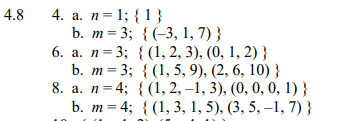 limber sierra
finding n and m is a different problem than finding the number of elements in the basis
west saddle
ok
limber sierra
n and m tell you what ℝ-space the row/column space is a subset of
or equivalently, how many entries each of the vectors have
when n = 1, each vector has 1 entry; when n = 2, it has 2 entries; when n = 3, it has 3 entries
west saddle
correct
limber sierra
this is unrelated to the number of vectors in the basis.
limber sierra
if the row/column space was all of ℝ³, yes
but that isnt the case in your examples
the row/column space in your examples is a subspace of ℝ³
(or some other ℝ^n)
west saddle
So for # 6 why are only two vectors chosen
limber sierra
because bases need be linearly independent
west saddle
is that because the two vectors is the mininal spanning set
limber sierra
if you row reduce the matrix A in (6), you'll observe that one of the rows "zeroes out"
yes
west saddle
ok 1 last thing for that #6,
The reason that rowspace uses the RREF is because the bottom row is 0's, since columnspace doesn't have a column space of zero's you use the original matrix
<@&286206848099549185>
limber sierra
with row space, you can use the resulting reduced rows
since row operations preserve row space
row operations do not preserve column space
you can still use them to determine the "position" of the required column vectors
but you need to use column vectors from the original matrix
(or, alternatively, you could transpose the matrix, "row" reduce it, and then transpose back)


