#linear-algebra
2 messages · Page 229 of 1
 teal grotto
i guess if V = F[x], then it kind of works, since polynomials are defined in a nice way
but yea in the general case, i can't really think of anything
 weak needle
Without axiom of choice, there are infinite dim vector spaces whose dual is zero
teal grotto
do you have an example in mind?
weak needle
What do you mean?
teal grotto
like an example of an infinite dim vector space whose dual is zero (without aoc)
weak needle
There was a pretty explicit construction, but I can’t recall it off the top of my head, sorry
teal grotto
no worries
 raw pilot
posting here, hope that's okay:
A 3x3 matrix w/ Nul(A) = Span([x,x,x],[x,x,x])
Assume a vector v = [x,x,x] is a solution to Ax=b
Ax = [x,x,x]

Find 3 vectors different from v which are also solutions of this equation
I'm not sure how to tackle this. I understand that we know what 1 b is, and that the nul (A) lets the Ax=0. how do i piece this together to find the other solutions? are the other 3 vectors A?
 half ice
Span([x,x,x], [x,x,x]) is an odd thing to write. Did this paste correctly?
raw pilot
i replaced the values with x
 hard drum
for concreteness let's let u,w be linearly independent vectors in Nul(A) so Au = 0 = Aw and Nul(A) = Span(u,w)
consider taking linear combinations of the vectors you've already got (i.e. u,w,v)
(or for example, do you know the proof that if a matrix A has Nul(A) = {0}, then the solution to Ax = b is unique? Why does that fail here?)
raw pilot
ill give it another go with these tips, thank you!
hard drum
np
 zealous junco
can someone explain why X is in the range of V means that X = VB, note here the b_i are unit vectors so they can't just be any matrix B

Also for context $X = \sum_{k=1}^r c_k a_k b_k^\star$ where $a_k$ is also vector of unit norm
 stoic pythonBOT
Anticipation
 zealous junco
c_k is a scalar
and the $\mathcal{T}(u)$ there refers to the toeliptz matrix of vector u
stoic pythonBOT
Anticipation
 zealous junco
nvm i got it, i think this b_i is not a unit vector
zealous junco
Ok, another question from above: Let W a LxL be positive semidef and B as NxL. Let's say B is full column rank. how do you show there's always an E, positive semidef in NxN so that W = B* E B
 short magnet
Let V be a finite subspace of R[X] the space of polynomials with real coefficients. Show that V contains basis wherein all polynomials are of distinct degrees.
Any hints for tackling this question?
zealous junco
i think one way is to argue like this. First say V has dimension n, then list out a finite basis of V. Each vector must be a finite degree polynomial, so there must be a finite maximum degree over all basis vectors, say N. For each vector e.g. x^2+3x+2, form it as a row [0.....0 1 3 2] in a matrix in R^{nxN}, then row reduce that matrix and since the pivots are at distinct column, you got your basis
lol probably theres an easier way, something like a contradiction, maybe..
im not sure about exact definitions so correct me if im wrong, but i think u can say V is isomorphic to a n-dimensional subspace of R^N, or something like that. In that case, you would be done already
short magnet
Hmm, perhaps that might be the case. I'll try that approach, hope it works ^^. Thanks!
Would induction on the dimension of V be somehow possible?
for dim V = 1 it's obviously true
suppose it's true for dimV = n and let's prove it for n+1
and then I'll try to write V as a direct sum
perhaps by taking a polynomial P with maximum degree from V
then let S supplement Vect(P) in V
and apply the hypothesis to S with dimension n
so we get a basis of S with distinct degrees
and add P to it?
why would that basis not contain a polynomial of the same degree as P?
zealous junco
sorry, i don't quite understand what you mean in the argument. I think induction on dimension of maximal degree seems awkward here
zealous junco
ahh
short magnet
and then in order to apply the hypothesis we take the polynomial of maximum or minimum degree out
in an attempt to get a space of dimension n
zealous junco
ok i think i see your point. I'll think about how it can work
zealous junco
Ok, I think i got it. So you have an additional vector right
short magnet
yes
I want to show the proposition is true for dimV = n+1
so I want to write down V as V = S + Vect(P)
(direct sum)
zealous junco
Ok let V be spanned by v1,…,vn ,a
short magnet
yes
zealous junco
Apply the hypothesis on v1,…,vn, then order the degree of v1,…,vn as deg v1<…<deg vn
Then for a, suppose it has degree same with one of the v1,…,vn
zealous junco
Then just remove that degree from a by subtracting vi from it
short magnet
yep
zealous junco
Yea
short magnet
or
zealous junco
There’s at most n steps basically
short magnet
if they are unitary
then deg (a-vk) <= deg a - 1
so a - vk is in the span of v1,...,vn
thus a is also. Which is absurd!
so it follows that the degree of a is distinct from the others!!
thanks : )
zealous junco
Yea that works too
short magnet
there is also a second part to this question, which is the existence of a basis with polynomials of same degree : )))))
anyways, thank u ^^
actually, it follows easily from the first one
just add the polynomial with the maximum degree to all the others
shrugs
 acoustic holly
sup !
Suppose i have an n x n matrix P such that P commutes with all other n x n matrices
i.e for all A, AP=PA
i have to prove that P is a scalar matrix
i managed to prove that P is necessarily diagonal
but im having trouble showing that all the diagonal entries of P are the same scalar
here btw our matrices are defined on a random field K
ah nvm i got it
multiplying from the left by a diagonal matrix will multiply the i'th row by the i'th diagonal entry
multiplying from the right by a diagonal matrix will multiply the i'th column by the i'th diagonal entry
since AP=PA then all the diagonal entries are necessarily equal
and boom i have my result
hard drum
One way to do this is to use induction and consider the matrix with 1 1 on the top row and 0 elsewhere as that shows that the top two entries on the diagonal are the same
 forest quiver
hard drum
One way to do this is to use induction and consider the matrix with 1 1 on the t...
forest quiver
hard drum
One way to do this is to use induction and consider the matrix with 1 1 on the t...
Yo do you have a quick second ?
Oh wait you are not that person nevermind
sorry
I will just post this here

This is something I wrote for my paper on linear models in Demographics
I mean this is something you see in Linear algebra
but is it a linear model?
There is an exponent...
Is it fair to include this idea in a paper about LINEAR models ?
 last holly
still linear
i think there was a thread about this earlier
you can convince yourself with induction (a bit overkill), if a transformation is linear, the same transformation applied twice is linear (base case)
as it continues to be closed under addition, multiplication, and has a 0 vector
forest quiver
last holly
you can convince yourself with induction (a bit overkill), if a transformation i...
Yeah that's what I am doing
I am plotting some points from this rn
and they are all in a straight line
But they aren't the same distance apart
that's interesting
 nocturne jewel
Ax=b is a linear system
AAx=Ab is also a linear system, just whose co-efficient matrix is A^2 and constant vector is Ab
repeat for all of N
you can have exponents and still be linear
forest quiver
nocturne jewel
Ax=b is a linear system
AAx=Ab is also a linear system, just whose co-efficient ...
But I was thinking


After applying the same linear transformation many times, I got a straight line with my output vectors
Like I know it makes sense its a linear transfromation
but is this always the case?
aren't there some transformations that rotate vectors 45 degrees clockwise for example?
Like then I won't get a straight line
I will get a circle depending on the vector I put into the transformation
am I making sense or is this just BS
 wintry steppe
I believe you get a straight line because your columns add to 1
wintry steppe
Something to do with how population doesn’t vary, only proportions do
What are you plotting, anyway
nocturne jewel
Looks like you're doing Markov chains.. which yes, the vectors are probability vectors
forest quiver
Wait this is markov chains?
last holly
steady-state vector yea
forest quiver
Wow what have I stumbled into
last holly
it's common for them to be introduced early just as a taste
forest quiver
wintry steppe
What are you plotting, anyway
population change
but I keep the ratio between people who emigrate and people who stay the same in both of my locations
 agile sky
you're not exactly dealing with markov chains as A does not satisfy the necessary conditions to be a transition probability matrix, unless that's just a mistake
forest quiver
Good cuz idk what that is
agile sky
It's a stochastic process that utilizes similar ideas to what you're working on, if you like this sort of stuff you should look into. I don't think it would be necessary to have a lot of background in probability theory to understand it and apply it in situations like these
forest quiver
agile sky
It's a stochastic process that utilizes similar ideas to what you're working on,...
Yeah I am sure I will look into it
Thanks
 rustic panther
Anyone knows how to do this?

 dusky epoch

Wikiwand
In mathematics, the Smith normal form is a normal form that can be defined for any matrix with entries in a principal ideal domain . The Smith normal form of a matrix is diagonal, and can be obtained from the original matrix by multiplying on the left and right by invertible square matrices. In particular, the integers are a PID, so one can al...
this help?
@rustic panther ive managed to figure it out for this matrix, in case the wikipedia article didnt help
 dusky epoch
you should not be getting any fractions in here so unfortunately no youre not on the right path
there's a crucial difference between normal row-reduction and reduction to smith normal form:
in the latter, you're allowed to do column operations
rustic panther
Yeah I realised I can't just blatantly go R_1 = 1/4 R_1
this isn't RREF
Jordan form changes if I take fractions like that I think
rustic panther
@dusky epoch how do I proceed with ECO here
 dusky epoch
subtract multiples of cols 1 and 2 from each other until you get a 2 somewhere, then use that 2 to zero out the middle row
then switch some rows around
 zinc copper

 worn hawk
If I have det(A) and det(B) , is there a way to compute det(A+B)?
 marble lance
No
wintry steppe

Mathematics Stack Exchange
Can
$$\det(A + B)$$
be expressed in terms of
$$\det(A), \det(B), n$$
where $A,B$ are $n\times n$ matrices?
I made the edit to allow $n$ to be factored in.
marble lance
Note thay the methods there are for special cases or where you also know what A and B are
 whole lark
In probabilities : having « i » events mutually independent isn’t the same as saying that each two are independent ?
wintry steppe
So $\bigcap_i E_i = \emptyset$
stoic pythonBOT
The Library of Babel
 wintry steppe
Is this what you mean by i events mutually independent
 fickle citrus
That's kinda...not ideal notation
wintry steppe
What is usually used
fickle citrus
You need $i\neq j$ typically
stoic pythonBOT
ShatteredSunlight
 fickle citrus
Anyway all those implicitly assume countability I think
wintry steppe
Yeah this is true for finite sets of events
fickle citrus
A bit clunky but essentially you should have some basic $A\neq B$ for sets $A$ and $B$
stoic pythonBOT
ShatteredSunlight
 wintry steppe
fickle citrus
You need $i\neq j$ typically
wintry steppe
fickle citrus
You need $i\neq j$ typically
But I don't think you do
I think my notation is clear enough, although maybe nonstandard
fickle citrus
wintry steppe
But I don't think you do
ok sure, yeah I think your notation does a lot of assumptions
wintry steppe
Fair
fickle citrus
Like, are collections of 3 allowed, yes no?
wintry steppe
Oh god I give up
fickle citrus
It's simpler to introduce more notation
So just $A$, $B$, $A\neq B$ then intersect is empty
stoic pythonBOT
ShatteredSunlight
 wintry steppe
I don't know if we're on the same page
According to Wikipedia the generalized intersection can be written like I did
fickle citrus
That's not my issue
fickle citrus
whole lark
In probabilities : having « i » events mutually independent isn’t the same as sa...
But anyway, back to this, it is not the same
fickle citrus
stoic python
**The Library of Babel**
My issue with this is that it's vague, although I don't think it quite answers the question too
wintry steppe
I was just asking if that's what they meant by i events mutually independent
wintry steppe
fickle citrus
But anyway, back to this, it is not the same
Is your issue just with finiteness?
fickle citrus
That cannot be what they mean by mutually independent because mutual independence has a very usual definition that does not mean disjointness of events
fickle citrus
Yup
wintry steppe

Anyway the answer is here
Independence is a fundamental notion in probability theory, as in statistics and the theory of stochastic processes.
Two events are independent, statistically independent, or stochastically independent if the occurrence of one does not affect the probability of occurrence of the other (equivalently, does not affect the odds). Similarly, two rand...
fickle citrus
stoic python
**The Library of Babel**
If I were to just add, I'd either use the top (so there's an end), have it very clear what $i$ can be or literally use $\cap_{i\in S}$ for some $S$
stoic pythonBOT
ShatteredSunlight
 fickle citrus
Basically dangling $i$ are not good 😦
stoic pythonBOT
ShatteredSunlight
 wintry steppe
Yeah you're right that is clearer
fickle citrus
👍
 lusty sphinx
Hello!
could you help me to solve this
determine whether the following lines are parallel or secant and check it graphically

help please, I need it today
 tawny harbor
 limber sierra
lusty sphinx
limber sierra
lusty sphinx
this question is better suited to #prealg-and-algebra or #precalculus
or one of the 10 questions channels
that said, as a rule, find the slope; same slope = parallel
negative reciprocal slope = perpendicular, im not sure what secant means here
(probably a mistranslation?)
lusty sphinx
limber sierra
(probably a mistranslation?)
yes, probably
 blissful vault
Does this check out, and what I could I do better writing wise?

I accidentally over indexed the eigenvalues by adding 5
 frosty vapor
yeah the extra 5 yes
and each coefficient a_j is nonzero anyways because eigenvectors are nonzero
so the part where u let lambda not be in the set could be simplified/made more clear to just mentioning this as well
oh u said its not possibke ok
blissful vault
Ya I was trying to exclude the possibility of eigenvalues outside of 0,1,2,3,4
frosty vapor
thats good
blissful vault
I feel like this problem would be way more straight forward if I worked with matrices and got a characteristic polynomial.
frosty vapor
hmm
blissful vault
for some reason I was blanking out when working with the system of equations. I guess I was hung up on how each system of equations was equivalent to the next. Might be just my own problem lol. I feel like it is easier to see how things are equivalent when working with matrices.
frosty vapor
yeah it would be more direct yes
im like blanking a little bit but the last few parts seem unclear to me
blissful vault
frosty vapor
im like blanking a little bit but the last few parts seem unclear to me
Is it the part where I say "the final system of equations is equivalent to a_lambda being non-zero and aj = 0 for j not equal to lambda"?
frosty vapor
yeah that kinda sounds weird
cus like the eigenvectors are nonzero anyways
its not that finding zeroes means that the other values are Not zero
they were nonzero to begin with
blissful vault
frosty vapor
yeah that kinda sounds weird
Agreed. I'll think this over and rewrite that last part in the morning.
frosty vapor
yeah everything up to that looks fine
but the conclusion seems odd
but good
glad to read over this lol its been a while
i think also you might want to show how u get the eigenfunctions from the eigenvalues each(?)
blissful vault
frosty vapor
i think also you might want to show how u get the eigenfunctions from the eigenv...
Do you mean for each eigenvalue how I associated it with the corresponding set of eigenvectors?
frosty vapor
yea
blissful vault
I think I did hand wave that a little. Should I do a proof for each eigenvalue : 0,1,2,3,4?
frosty vapor
yeah probably it should be a quick computation u dont need to be too crazy about it
blissful vault
Thanks a lot for the help. Peace! I'm going to head to bed.
frosty vapor
np
zealous junco
let $W \in \mathbb{C}^{L\times L}$ be positive semidefinite and $B \in \mathbb{C}^{N \times L}$. When is it the case that for any $W$ there is an $E \in \mathbb{C}^{N\times N}$ positie semidefinite so that $W = B^\star E B$
stoic pythonBOT
Anticipation
 zealous junco
i assume B needs to be rank max(N,L) but would like explanation, thanks
(positive semidef here also means symmetric)
zealous junco
Solved
short magnet
What would be the best way to quickly calculate the dimension of the space of cubic splines (i.e. we fix a subdivision of [0,1] : 0=a_0 < ... < a_n = 1, and let f be of class C^2 such that it's restriction to any interval [a_k, a_k+1] is a polynomial of degree three. This f is said to be a cubic spline !). I have tried to construct an isomorphism (polynomials of degree three can be totally defined by 4 points from which they pass using Lagrange interpolation) but that extra smoothness condition, which requires continuity for derivatives, is really troublesome.
Hermite interpolation seems like it'd be a solution, but it's a bit more involved
I found a proof of sorts whilst googling but it uses terms I'm unfamiliar with like contraintes and stuff.. when I'm just looking for an elementary proof; i.e. I'm looking to construct some sort of isomorphism, but I can't think of one..
what would be the quickest way to calculate the dimension of that vector space?
zealous junco
I think its n+3 dof, or in other words dimensions
unless I'm misunderstanding, the first subinterval has 4 degree of freedom (dof) and the C^2 condition means the points of connection btwn intervals makes each next spline have only 1 dof. you can see this by the requirements that the function's left endpoint value and first, second derivatives must equate the ones for the previous function's right endpoint
consequently if you require C^3, the dof (dimension) will reduce to 4 as expected, because the only cubic that joins C^3 with a previous cubic is the function itself.
short magnet
that makes sense..
I guess I'll just justify it instead of proving it rigorously. That'd be enough :""3
thanks for your time and answer though, I appreciate it greatly!
 steel moon
hey
raw pilot

so assuming we let the vectors in the nul span = u and w respectively
i took a linear combination of uwv and got

and i dont know where to go from here
dusky epoch
what's that matrix meant to be?
raw pilot
thats the reduced matrix from u,w,v
the v being given, and u,w the vectors in the span
dusky epoch
and... why would you need that?
raw pilot
had help earlier that suggested i should do that
dusky epoch
all you're looking for here is any vectors of the form $$\bd{v} + \alpha\bd{u} + \beta\bd{w},$$ where $\alpha$ and $\beta$ are (nonzero) constants of your choosing
stoic pythonBOT
Ann
 dusky epoch
that's... it, really.
no need for any matrix-bashing.
also, who and where suggested it?
 raw pilot
i mightve misunderstood the suggestion, it was earlier in this channel
dusky epoch
care to link the message?
raw pilot
dusky epoch
yeah that did not entail any matrixbashing
raw pilot
my bad haha my 
raw pilot
dusky epoch
yeah that did not entail any matrixbashing
and thank you so much for the help i got it right 🙂
hard drum
I assume T is a linear operator from V to W, where V, W are vector spaces ?
if so, yes, the kernel is defined as a subset of V
But it also happens to always be a subspace of V which you can prove (directly / by subspace test)
 spare crystal
In the solution to this problem


why can't the minimal polynomial of M be x^2 + x + 1?
 vivid atlas
Can somebody explain "No set of m-dimensional vectors can have
more than m mutually linearly independent columns, but a matrix with more than
m columns may have more than one such set."?
 glacial mango
vivid atlas
Can somebody explain "No set of m-dimensional vectors can have
more than m mutua...
glacial mango
vivid atlas
Can somebody explain "No set of m-dimensional vectors can have
more than m mutua...
You can have a 2x4 matrix where the first two are an l.i. set and so are the last two (m=2).
wintry steppe
spare crystal
why can't the minimal polynomial of M be x^2 + x + 1?
a real polynomial of odd degree has to have a real root, and the roots of the minimal and characteristic polynomials are the same
so the minimal polynomial of M has to have a real root
x^2 + x + 1 doesn't
something like that
gut tells me there's a simpler reason
spare crystal
oh i see that makes sense
yeah i guess the solution skims over it so maybe there is a simpler reason? but that seems simple enough
wintry steppe
yeah it's just the lack of explanation in the solution makes me think i could be overthinking it
wintry steppe
So like , if you just did T: R^4 -> R^5 would that mean you technically just made a vector pop into the 5th dimension mathematically. I'm having a very hard time visualizing this lmao
Like from my understanding T: R^2 -> R^3 would basically just make a line on a piece of paper pop into 3D suddenly.
 sonic osprey
They're functions, not really pictures
Like, you can consider the function T: R^2 -> R^3 that sends everything to zero, in other words, T(v) = 0 for all v in R^2
(you can and should confirm that this is linear)
wintry steppe
Oh yeah true, well lets say its not the zero vector
sonic osprey
This isn't a line and is only a point in R^3
wintry steppe
or a point
sonic osprey
My point is that this is true for maps from R^4 to R^5 too
The image doesn't need to be 4-dimensional inside of R^5
It can be a point, a line, a 3D space or 4D
wintry steppe
like if it was [ 5, 10 ] - > [ x , y , z ] wouldnt it appear visually to suddenly pop into that dimension
sonic osprey
I don't think that really makes sense
It is true that a function from R^2 to R^3 takes something with two dimensions and outputs something with 3 dimensions but
I don't think I would call it popping into that dimension
wintry steppe
Right, but visually when you see a vector that isn't the zero vector in R2 it just looks like a line, then it would appear to pop out in a 3D direction after being transformed instantly. It wouldn't slowly rotate into 3D unless you had an animation
sonic osprey
I think its weird to think of it like that
It's just a function that takes in something 2D and spits out something 3D
wintry steppe
Ofc you would your a math person
jk lmao
Also yeah I see what you're saying that 5D could include lines and planes and all kinds of stuff. I was imagining like the same object just suddenly appearing in each dimension due to a LT
Like a 2D apple suddenly morphing into a 5D one
sonic osprey
I mean my earlier point is that a 2D space like R^2 doesn't necessarily get mapped to a plane in R^5
like the example earlier, linear transformations can squish things down so that 2D space becomes a point
wintry steppe

Get 4D Toys for:
iOS http://4dtoys.com/ios
Steam http://4dtoys.com/steam (VR or Mouse&Keyboard)
Showing 4D Toys and an explanation of how 4D objects would look like and bounce around from the perspective of a 3D being.
Kinda what I was trying to explain , basically these are just animated transformations right
wintry steppe
sonic osprey
like the example earlier, linear transformations can squish things down so that ...
Ohh yeah thats true, but you're also thinking of it "squishing" which ... visually is an animation also I believe
sonic osprey
I mean, I don't know if I would call those transformations in the usual sense
All the things are a function of time so that for every time t, you get something in R^4
wintry steppe
Thats true. I think you're right that the way its generated isnt what I was talking about HMMM
okay so what about this


The cubes are still all there, but they are instantly transformed into 4D visually
even though they moved position
sonic osprey
These are just 3D slices of 4D space
It seems what they're doing it just looking at [w,x,y,z] and varying z to give you the different slices
wintry steppe
No, in the game if you throw something at that "empty" space it would detect collision, its still there in the 4th dimension
we just see slices in 3D
sonic osprey
Oh I was thinking of a different part of the video
where he moves the slider up and down with the spheres
wintry steppe
Oh no lmao
sonic osprey
But kinda the same thing is happening here
What they show is a single 3D slice of 4D
and when the collision happens, the cubes move out of that slice
wintry steppe
Yeah... I feel like this is also still a bad example cause of the way the games engine accounts for time, and the fact its a 3D environment trying to visualize a 4D object
lmao
sonic osprey
I'm not really sure what you're trying to give an example for
wintry steppe
I honestly dont even know , I Just learned about transformations and had a weird visual idea of it lmao
sonic osprey
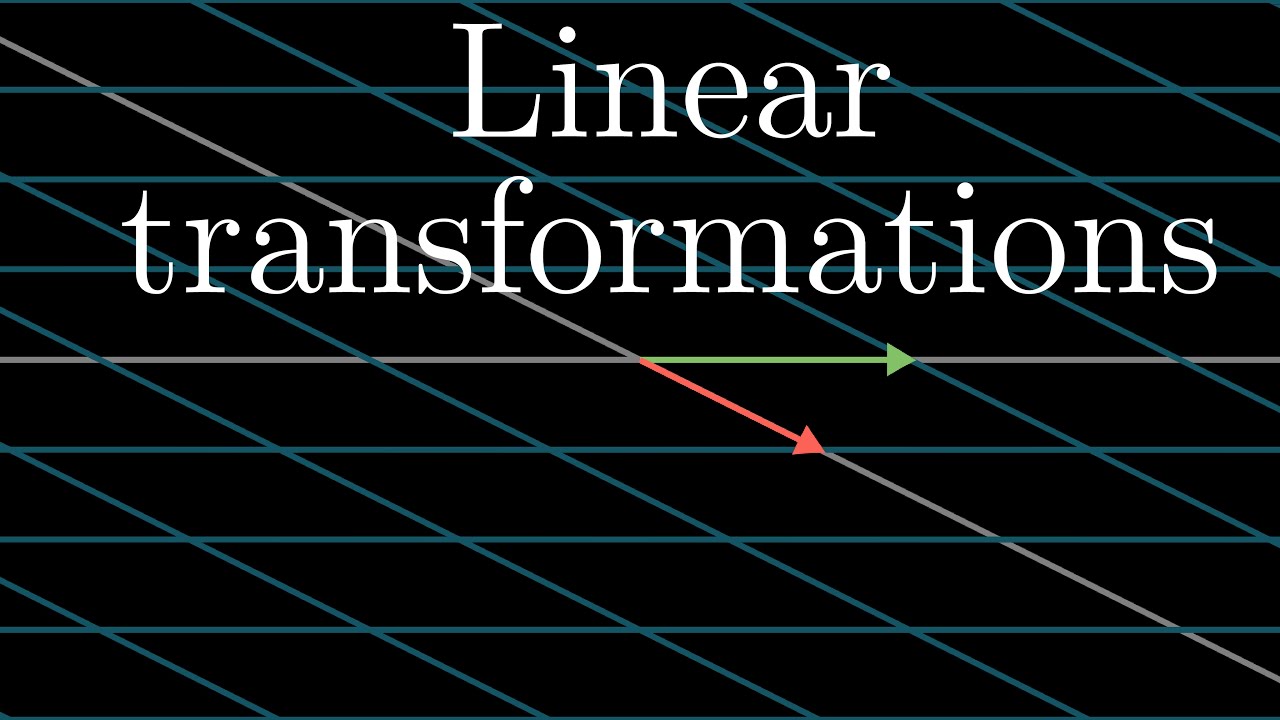
Quite possibly the most important idea for understanding linear algebra.
Help fund future projects: https://www.patreon.com/3blue1brown
An equally valuable form of support is to simply share some of the videos.
Home page: https://www.3blue1brown.com
Full series: http://3b1b.co/eola
Future series like this are funded by the community, through P...
maybe something like this could help
but it only really talks about transformations from R^2 to R^2
wintry steppe
Yeah i was trying to find one where he goes across dimensions but I dont see one lmao
I think he mostly focuses on transforming within the same dimension which is understandable
 lyric dawn
hello, i think this is true but i dont know how to prove it. let say i have a matrix L of size k x n. where k > n. lets say the rank of L is p. necessarly p < n.
i want to show that there exist a matrix L' of size p x n such that ||Lx||_2 = ||L'x||_2 for all x
zealous junco
u can try using QR decomposition, and R is upper triangular so the dependent rows of L becomes zero
And Q preserves length
 dawn mesa
Do you have to visulize linear algebra to be able to understand Linear algebra?
last holly
Yes and no
I don't know anybody personally who can visualize 6 dimensions freely
But building intuition in 1, 2 and 3 helps reason about the rest
Use geogebra and other tools to help
Strang says he's really bad at visualizing
But I'd take that as professional modesty
(he may mean, there are people out there that can do it much better than he can)
 flint pivot
dawn mesa
Do you have to visulize linear algebra to be able to understand Linear algebra?
flint pivot
dawn mesa
Do you have to visulize linear algebra to be able to understand Linear algebra?
personally I don't but I also know how to visualise it so I don't know how it would seem to someone who doesn't
 next dune
is knowing linear algebra past SVD important for industrial work in data science
theres a numerical linalg class that im thinking about taking that goes over fundamental matrix types, rounding error, condition and stability but i dont know if it would be practical for me
nocturne jewel
dawn mesa
Do you have to visulize linear algebra to be able to understand Linear algebra?
I mean... certains things yes, however once you get into vector spaces it's near impossible to visualize imo
dusky epoch
yes
wintry steppe
guys does this means same thing? u and v are vectors
 wintry steppe
ty
glacial mango
?
 jagged marsh
can three 2 dimensional vectors (three vectors that are in the same plane) be linearly independent assuming non of them are colinear?
aka, can you make any two dimensional vector with a linear combination of two non-colinear vectors?
glacial mango
jagged marsh
can three 2 dimensional vectors (three vectors that are in the same plane) be li...
No. The maximum number of l.i. 2D-vectors you can have is 2 (pretty sure).
glacial mango
jagged marsh
aka, can you make any two dimensional vector with a linear combination of two no...
Yes, this should be easy to prove using the determinant.
nocturne jewel
wintry steppe
guys does this means same thing? u and v are vectors
slight nuance, however the bottom one is a specific example of the top one
fickle citrus
Won't be much different until the generalisations come in
 ocean sequoia
^ figured where they are at wouldnt matter
also @jagged marsh you can prove that without using the determinant @glacial mango
row rank must be equal to column rank
hard drum
This is v fundamental - a key theorem used in even defining dimension in the first place is that linearly independent sets are no larger than spanning sets, and hence any set of 3 vectors in R^2 is linearly dependent as {(1,0),(0,1)} is spanning
ocean sequoia
I think you meant linearly dependent
normally wouldnt nitpick that but given thats a bit fundamental to what the question was is figured I would
This is v fundamental - a key theorem used in even defining dimension in the first place is that linearly independent sets are no larger than spanning sets, and hence any set of 3 vectors in R^2 is linearly dependent as {(1,0),(0,1)} is spanning
ocean sequoia
yea i figured again not trying to be a pendant just v important here
think your explanation was very good
hard drum
ofc dw! Cheers
ocean sequoia

hard drum

wintry steppe
guys i'm starting university soon and i'm doing review from last year

does anyone know how to solve these type of problems ? i forgot them 😭
im desperate lollll
last holly
Do you remember matrix multiplication?
wintry steppe
yea
ocean sequoia
do you remember how to solve system of equations?
wintry steppe
nope
ocean sequoia
what about guassian elimination
wintry steppe
yep
wintry steppe
i forgot 😃
ocean sequoia
well what would you guess be
nocturne jewel
The matrix representation of a transformation is to make the columns of the matrix the output vectors in the same order as the input vectors
ocean sequoia
wait is that what he is doing? am im helping him wrong here?
nocturne jewel
it wants the matrix representation then to determine if f is injective
ocean sequoia
yea I just skimmed it wow my fault
wintry steppe
wait im confused now
ocean sequoia
im so sorry
nocturne jewel
so for example, in 1 you have the basis {[1,0]^T, [0,1]^T}
we know f([1,0]^T) =[1,2]^T
so you will make the 1st column of the matrix the output co-ordinate vector
since [1,0]^T is the first basis vector
wintry steppe
wha
wintry steppe
nocturne jewel
so you will make the 1st column of the matrix the output co-ordinate vector
what does this mean
nocturne jewel
you know matrices have columns?
wintry steppe
yea
nocturne jewel
the 1st one, will be the output from the transformation of the 1st basis vector
wintry steppe
OH
nocturne jewel
(in the basis of the output space, but it's just using canonical bases rn)
nocturne jewel
nocturne jewel
the 1st one, will be the output from the transformation of the 1st basis vector
likewise the 2nd column will be the output from the 2nd basis vector being transformed
etc
for the dimension of the input space
ocean sequoia
do you understand what you need to do Mahiii
nocturne jewel
so for example, what's A for 1?
ocean sequoia
^
ocean sequoia
@wintry steppe
stoic pythonBOT
Mosh
 wintry steppe
what does it mean when a function is one on one?
 restive raft
every output of the function is associated with a unique input
ocean sequoia
in other words if f(x) = f(y) then x = y
nocturne jewel
wintry steppe
what does it mean when a function is one on one?
It means that the kernel of the transformation (the set of vectors which map to 0) is trivial, so f(x)=0 only if x=0
However here we know we can write $Ax=0$ so we want only the trivial solution to that, which is a condition of invertibility on A
stoic pythonBOT
Mosh
 nocturne jewel
so f is one to one (injective) iff A is invertible
 weak needle
If the zero vector along with the two vectors you mentioned are all in the nullspace, can you think of good candidates for w,z,w’ and z’? (Hint:w’ may be obtained by translation via nullspace vectors (apologies for the previous wrong hint))
raw pilot
weak needle
If the zero vector along with the two vectors you mentioned are all in the null...
i got it, thank you!
 vivid field
I’ve been doing some practice with rref form and I’ve been taught that I can only use addition when replacing rows, however I’ve seen many videos on YouTube where people are subtracting rows. Is this also allowed ? Apologies if this is a dumb question.
last holly
Subtraction is addition basically. It helps to think of it as addition though (addition of negative multiple)
It makes more sense when the row operations get represented by elementary matrices
Just more concise
It helps for proofs to break down things into additive and multiplicative inverses sometimes too
And computationally it's more concise too
ocean sequoia
vivid field
I’ve been doing some practice with rref form and I’ve been taught that I can onl...
have you seen that you can scale vectors still ala multiplication? if so its the same as multiplying by negative one
then adding
 rancid kindle

Trying to prove W is a subspace of V
not sure what to do with the 2A_12 = 3A_21
usually we just have x_1 and x_2 in R
half ice
It's a rule that the matricies have to follow. To be a member of W you must have 2A{12} = 3A{21}
@rancid kindle
rancid kindle
where and how would I use that in my answer, is where i'm confused
dusky epoch
prove that if two matrices satisfy this rule then so does their sum
that gives you closure under addition
half ice
Might be easier to say that all matricies in W look like:
a 3t
2t b
For some real a,b,t
flint pivot
dusky epoch
prove that if two matrices satisfy this rule then so does their sum
thats way easier than I thought wow
dusky epoch
yeah it is easy ive just seen a lot of ppl without much experience in basic proofs falter on these
short magnet
let E be a euclidian real vector space, $$ \alpha,\beta, \gamma \in \mathbb{R}, ; a \in E $$ Solve the equation : $$ \alpha \langle x, x \rangle + \beta \langle x, a \rangle + \gamma = 0 $$
stoic pythonBOT
Der Gegenstand ist einfach.
 short magnet
obviously, we could simplify it a bit by discussing if alpha = 0 or not and dividing by alpha
and by assuming a unitary
but I just don't know where to begin with this ..
dusky epoch
is E finite-dimensional
dusky epoch
do we have a basis for it on hand
dusky epoch
well then this reduces to $\alpha x_k^2 + \beta a_k x_k + \gamma = 0$ for $k = 1, \dots, n$
stoic pythonBOT
Ann
 short magnet
we even have an orthonormal basis
dusky epoch
yeah i'm talking about an orthonormal basis and the coordinates of x with respect to it
short magnet
I see
so now
we have an equation of the second degree
(a system of them)
that simplifies it greatly
thanks! : )
wait a second, this actually reduces to : $$ \alpha \sum_{k=1}^{n} (x_k^2)+ \beta \sum_{k=1}^{n}{a_k x_k} + \gamma = 0 $$
stoic pythonBOT
Der Gegenstand ist einfach.
 short magnet
which is completely different
a solution to that system (with gamma' = gamma/n) is a solution to your system of equations but the reciprocal is not necessarily true
stoic pythonBOT
Der Gegenstand ist einfach.

Der Gegenstand ist einfach.

Der Gegenstand ist einfach.
 vivid field
Could someone check to see if I did this correctly. Trying to determine values of h and k when the system has no solution, a unique solution and many solutions. Intuitively this is what I came up with.

 pearl turret
Can someone explain what im supposed to do on proble, 19

 azure gate
The system is consistent
So you have to find value(s) of h for which the system has a unique solution
short magnet
Okay, another question in euclidian spaces.. let $$ a_1,...a_n \in \mathbb{R} $$ and f such that $$ \forall x_1,...,x_n \in \mathbb{R} : s.t. : \sum_{k=1}^{n}{x_k^2} = 1 ; : f(x_1,...,x_n) = a_1 x_1 + \dots + a_n x_n $$
stoic pythonBOT
Der Gegenstand ist einfach.
 short magnet
find the maximum of f
the statement about the sum of x_k squared being one is the same as the norm(X) = 1
with X = (x1,...,xn)
we can even write f(X) = transpose(A) X
so f(X) = <A,X>
Cauchy-Schwartz tells us that f(X) <= norm(A) = sqrt( sum of a_k squared)
but that is just a bound that isn't attained (I think..)
how do I find the maximum of this function
 grim bridge
there's an absolute value missing in your inequality though
pearl turret
azure gate
The system is consistent
So you have to find value(s) of h for which the system ...
The book says the correct answer is h ≠ 2
and i see how t oget that
but i dont get what it means
azure gate
pearl turret
and i see how t oget that
For h=2 the system has no solution
So any other value makes it consistent
pearl turret
what does consistent mean maybe I'm stuck on that
atleast one solution
so basically in that one itrs
1x + hy = 4 and 3x + 6y = 8
?
there are values of x and y that make that true for the constants given
azure gate
pearl turret
what does consistent mean maybe I'm stuck on that
By consistentency we basically mean that the system has at least one solution
pearl turret
azure gate
By consistentency we basically mean that the system has at least one solution
Are these matrices just systems of equations from elementary algebra?
azure gate
Yes
limber sierra
(though they might be over another field)
 valid wigeon
Learn OpenGL . com provides good and clear modern 3.3+ OpenGL tutorials with clear examples. A great resource to learn modern OpenGL aimed at beginners.
im a bit confused on this part
what does it mean by "position vectors"
are they different from normal vectors?
hard drum
often if a point is assigned a set of coordinates, say, (0,0,2),we might call the corresponding vector (treating R^3 in this example as a vector space) the position vector of that point
nocturne jewel
valid wigeon
what does it mean by "position vectors"
position vector just means "measured" from the 0 vector
lyric dawn
zealous junco
u can try using QR decomposition, and R is upper triangular so the dependent row...
its perfect, thank you !
 dull dome
@dusky epoch pinging
dusky epoch
yeah
okay so
a basis is basically... a more general version of a coordinate system
if you worked with R^3, your vectors are almost always expressed in the standard basis {i,j,k}
or {i,j} in R^2
a collection of vectors forms a basis of your space if every vector in the space can be expressed in terms of your collection, with no redundancies
i hope this makes some sense
dull dome
dusky epoch
i hope this makes some sense
I get it.
But what I need to understand is why we go to do this?
I mean what is the motivation for defining basis, sub-space
dusky epoch
as i said
bases are generalized coordinate systems
idk how you'd like the concept of subspaces to be motivated however
last holly
dull dome
I get it.
But what I need to understand is why we go to do this?
I mean what is ...
Why is it useful to learn sets then?
It's useful to have structures to reason about collections of vectors.
Useful is an understatement here
dull dome
last holly
It's useful to have structures to reason about collections of vectors.
That kinda makes sense
vivid field
I started my linear algebra course 2 days ago and unfortunately it’s all online no lectures and just textbook use. I’ve noticed that it’s taking me a long time in the process of putting augmented matrix’s of a number of systems in to row form or row reduced form. It’s not the arithmetic but rather knowing how to just takes the most efficient steps to do so. Is there a specific order in doing this or am I just very slow at this.
last holly
vivid field
I started my linear algebra course 2 days ago and unfortunately it’s all online ...
consider this like learning a new language
i'm a native spanish speaker and can grasp a lot of what portuguese and italian speakers say, but if i wanted to try to be functional in them i'd need to really dig in to the frame of thinking of those languages
similarly, in the beginning it's enough to "look" at linear algebra from a distance and know what's going on vaguely. but to be conversant in it really is a whole set of different modes of thinking
in short, don't be discouraged. it's very normal. but also linear algebra is very useful so it's worth it
vivid field
Thanks so much for that explanation. I loved the analogy. I hope to develop that mode of thinking in my journey through this subject @last holly
nocturne jewel
what
??
- dont randomly ping me/other users
- I have no clue what you mean
can you post a picture of the notation?
 harsh halo
Assume A is a 6 x 5 matrix and Ax = 0 has a unique solution. Show that the columns of A do not span R^5.
nocturne jewel
Ok...
harsh halo
This question statement is wrong I think because the columns of A are not in R^5
am I right?
harsh halo
so this question is coming from my first year linear algebra class where we haven't even defined vector spaces or bases and only talked about matrices (and there correspondence with systems of equations and linear combinations), linear combinations, and just now span
harsh halo
harsh halo
Assume A is a 6 x 5 matrix and Ax = 0 has a unique solution. Show that the colum...
so if this where R^6 instead, obviously we can't have 5 vectors spanning the whole space because it is of dimension 6
nocturne jewel
yes
harsh halo
but this is too much terminology for where my class is at right now
is there anything special about the setup for me to use
nocturne jewel
extremal properties of a basis says the cardinality of a set less than the dimension means it isnt a spanning set
harsh halo
yea but this is from a pset which assumes you don't know what a bases is (and dimension)
nocturne jewel
right ye
harsh halo
so I'm thinking there's some underlying structure to the setup that let's you do this more easily
"the setup" as in Ax = 0 having a unique solution where A is a 6 x 5 matrix
nocturne jewel
can you use/have you learned rank-nullity theorem?
harsh halo
no we haven't even covered the abstract definition of a vector space let alone linear maps
nocturne jewel
yeah rank-nullity just stems from learning the standard subspaces formed by a matrix
wintry steppe
Is it true that basis of kerT is a subset of basis of domain space ?
ocean sequoia
the kernel of a linear transform from V -> W is a subspace of V
 lavish jewel
sounds about right
 torn hornet
you can extend the basis of ker(T) to a basis of the whole space.
but the basis of ker(T) wont be a subset of any arbritary basis of the space
ocean sequoia
think about it this way T(v) and T(u) = 0 with u and v being vectors in the domain
you can use that to show T(u + v) = T(u) + T(v) = 0 + 0 = 0
and its also pretty obvious its closed under scalar multiplication
wintry steppe
torn hornet
you can extend the basis of ker(T) to a basis of the whole space.
Then the extended basis of kerT will it be a standard basis of that domain space
torn hornet
not necessarily
wintry steppe
Okay so there exist basis of domain space which is the superset of basis of kerT?.
 gray dust
wintry steppe
Okay so there exist basis of domain space which is the superset of basis of kerT...
gray dust
wintry steppe
Okay so there exist basis of domain space which is the superset of basis of kerT...
yes that's a rewording of
you can extend the basis of ker(T) to a basis of the whole space.
wintry steppe
Okay thanks !
 dark carbon
how would i solve this
dark carbon
idk wherre else to put it so
lavish jewel
so go to the algebra channel
lavish jewel
then try the multivar calc channel
 versed forge
guys how do u know if a matrix is commutable
last holly
try it
try multiplying a some matrices AB and then BA
see if they're the same
(unless you mean commutative under addition  )
)
(should be simple enough to try with 2x2 matrices)
if you find one counter-example you're done
if you can't, see if you can generalize it to make sure it's solid
versed forge
ok
 raw linden
Assume that we have m eigenvectors x1, ..., xm to A with associated eigenvalues λ1,…, λm. Assume further that the vector u is a linear combination of the eigenvectors, ie. that u = c1 x1 + ⋯ + cm xm where cj∈R. With the help of arithmetic rules for matrices, we can then calculate:
Au = ??
Help please I'm very tired of this problem
dusky epoch
do you know what an eigenvector is?
dusky epoch
and you are told that we have these eigenvectors x_j, and their corresponding eigenvalues lambda_j, for j = 1 to m
would you not agree that $Ax_j = \lambda_j x_j$
stoic pythonBOT
Ann

 raw linden
shouldn't it be $Au = \lambda u$
stoic pythonBOT
SuperXL07
 raw linden
?
dusky epoch
no
u itself is not an eigenvector of A
and we have no lambda-without-an-index anyway
raw linden
first I answered that $Au = (lambda_1,..., lambda_m) (x_1,..., x_m)$
stoic pythonBOT
SuperXL07
Compile Error! Click the  reaction for more information.
(You may edit your message to recompile.)
 dusky epoch
this is nonsense
raw linden
maybe I got it now let try then I will come back, one moment
raw linden
$Au = \lambda_1 x_1 +, ..., +lambda_m x_m$
stoic pythonBOT
SuperXL07
 raw linden
$Au = \lambda_1 x_1 +, ..., +\lambda_m x_m$
stoic pythonBOT
SuperXL07
 raw linden
is that correct?
dusky epoch
no
you are forgetting the coefficients c_j that you had started with
$u = \sum_{j=1}^m c_j x_j$
stoic pythonBOT
Ann
 dusky epoch
you will have $Au = \sum_{j=1}^m \lambda_jc_jx_j$
stoic pythonBOT
Ann
 raw linden
the answer have to match with the following conclusion:
This means that we can interpret multiplication with the matrix A as meaning that we scale the parts of u that are parallel to the respective eigenvector, and that the eigenvalues are our scaling factors.
are 100% sure that this is the right answer?
sorry to be annoying
dusky epoch
yes i am 100% sure
we go from c_j x_j to lambda_j c_j x_j
scaling doesn't kill the c_j that was already present
raw linden
I answered like that because in the book they wrote like following: Note that if x is an eigenvector of A corresponding to λ then so is kx, for each real number k ≠ 0. Self-vectors corresponding to a certain intrinsic value are thus not unique, but only the direction of the vector matters. Note also that we can interpret the matrix multiplication Ax as a scaling of the eigenvector x with the eigenvalue λ.
dusky epoch
okay look
you just completely ignored the coefficients that the x_j had before multiplication by A
you can't do that, alright???
 boreal crane
Thats a really cool exercice that was in my Exam
 wintry steppe
is it possible to prove a matrix is unitary by calculating just the determinant? the determinant is 1 but i dont know if that's enough to justify it being unitary
dusky epoch
no it's not enough
you can have a matrix with determinant 1 that isn't unitary
$\bmqty{7 & 10 \ 5 & 7}$
stoic pythonBOT
Ann
 wintry steppe
what else do i have to do? is finding the determinant even necessary?
dusky epoch
it's not necessary, no
wintry steppe
ah, so it's just a second subquestion within the question i got
dusky epoch
to prove a matrix is unitary, you need to show that it satisfies the definition of a unitary matrix
wintry steppe
it doesnt really clarify it that well, thank you
hard drum
What definition of a unitary matrix are you using hazy?
wintry steppe
no idea
the question told me to prove it's unitary and then said "find the determinant"
so i thought i had to find some specific value on the det to prove it
turns out that's not the case at all
hard drum
It's pretty important to know the definition of smth if you're going to use it ig
wintry steppe
im willing to go with UU^H = I
hard drum
Ye finding the det doesn't help (altho it can prove a matrix isn't unitary)
Yeah exactly
And so the best way to check if it is unitary is just to calculate UU^H
lavish jewel
is the matrix square?
hard drum
That's what Ann meant by checking it satisfies the definition
wintry steppe
yes
hard drum
(Well hazy said it had determinant 1 so it must be square for that to make sense ig)
lavish jewel
just double-checking, cuz UU^H = I isn't really enough
nocturne jewel
Are unitary and isometry synonymous then?
cause that looks like the requirement for isometry
 somber bronze
hello everyone! I was wondering if i could see the subspace of 2x2 matrices such as to have the second row equal to 0 (let's call it W) as the core of the following linear application:


 crude falcon
somber bronze
crude falcon
somber bronze
ops, remove that equal in the linear application, ker has c+d equal to 0
if anyone wants to help please mention me, thanks in advance!
 viral cargo
@somber bronze Oh, so you're mapping 2x2 matrices to R?
(trying to understand your linear application)
It's just (a b | c d) -> c + d
somber bronze
viral cargo
<@142989638502580224> Oh, so you're mapping 2x2 matrices to R?
i have to find the dimension of the subspace where 2x2 matrices have the second row equal to 0, i tried to find a solution using the linear application i wrote
somber bronze
viral cargo
It's just (a b | c d) -> c + d
yes i wrote by mistake that it is equal to zero but i changed my message later
viral cargo
Yes, your linear application's kernel is said subspace. But if you have a basis for it, you already have the dimension?
Also assuming you meant the sum of the second row is equal to 0, because the way I would read what you said is matrices where second row entries are 0
somber bronze
viral cargo
Also assuming you meant *the sum of the second row is equal to 0*, because the w...
i meant the sum of the second row is equal to 0
I found the basis because from the nullity + rank theorem I know that the size of the starting space is equal to the size of the ker + the size of the image. Since W = 4 (2x2 matrix space) - 1 (dimension of R) = 3 I tried to see if a possible basis was the one I wrote
i just wanted to know if i answered correctly to the question of "find the dimension of W", and maybe if a faster way was possible
viral cargo
Well, this does verify the dimension of your basis
somber bronze
thanks for confirming!
viral cargo
Usually I would find a basis for the subspace then show it is a basis (span/linear independence)
then dim = card of basis by definition
 leaden tide
I'm having trouble with this problem. We have $p$ a projector (= idempotent linear map) in a vector space $E$, and the two subspaces $F_1 = {v\in L(E),\exists u\in L(E), v = u \circ p }$ and $F_2 = {v\in L(E),\exists u\in L(E), v = u \circ (\text{id} - p)}$. The problems asks to show that these two subspaces are supplementary (= their sum is direct (intersection is {0}) + their sum is L(E) as a whole), but I can't show the first part, any pointers?
stoic pythonBOT
Syst3ms

 rugged knot
If a is invertible and c is nilpotent, is a-c always invertible?
dusky epoch
sure, you can write $a - c = a \cdot (I - a^{-1}c)$
stoic pythonBOT
Ann
 dusky epoch
a^-1 c is nilpotent with the same nilpotence index as c itself, thus I - a^-1 c is invertible
@rugged knot
 neat olive
why wouldn't this be row-echelon form? every leading non zero number in a row below the first is to the right

the below is all true, no? so it has to be row-echelon, but webassign doesn't think so
-All nonzero rows are above any rows of all zeros
-Each leading entry of a row is in a column to the right of the leading entry of the row above it
-All entries in a column below a leading entry are zeros
last holly
That's weird
half ice
Row echelon isn't universally agreed, check your professor's notes. However yes, you agree with Google here.
wintry steppe
so why would D be the right answer here?

 robust pond
wintry steppe
so why would D be the right answer here?
robust pond
wintry steppe
so why would D be the right answer here?
were talking about in #chill fyi lol
i told ppl to come here but ya know
fickle citrus
wintry steppe
so why would D be the right answer here?
I kinda don't agree with the wording, and I'd say solving a linear system is the same as finding parametric description. I however do agree with the 2nd part of D.
You can solve a system if it admits a solution, and you cannot solve a system if it does not admit any solution, and these occur
if and only if
you can parametrise a system if it admits a solution, and you cannot parametrise a system if it does not admit any solution
so I'm not sure what they want to refer to when they say 'true' or 'false'
wintry steppe
fickle citrus
I kinda don't agree with the wording, and I'd say solving a linear system is the...
why can you not parameterise it if it does not admit a solution tho?
fickle citrus
The usual case for no solution is inconsistency, like x=0 x=1
so there is no real number that can satisfy both x=0, x=1
If there is no real number that can do it, there is no way to parametrise
 restive hearth
What's the most efficient method to calculate the determinant of a matrix? I currently use Laplace expansion as a recursive function in my code but it runs at O(n!). I'm trying to implement row reduction but just looking around it seems to run at O(n^3), which is better than my previous implementation, but I think that better and more intuitive solutions do exist. There is also LU decomposition  Anyone has any idea on what I can do?
lavish jewel
unless your matrix has further structure, stuff like LU, QR, or other decompositions are about as good as it gets
restive hearth
lavish jewel
unless your matrix has further structure, stuff like LU, QR, or other decomposit...
Ah I figured, I guess I could try making the workload lighter by hardcoding determinant calculations for smaller sized matrices
And maybe check for shortcuts like upper/lower triangular matrix diagonals
Thank you 🙂
 grand fog
Hello, is the 3b1b and ocw enough to learn linera algebra?
lavish jewel
no, you'll need to read a book and/or attend a lecture at some point
that's only complementary content
they don't even cover any exercises beyond small, toy examples
they're more for people that have already acquainted themselves with the concepts beforehand
grand fog
lavish jewel
they're more for people that have already acquainted themselves with the concept...
what about for ML
lavish jewel
that depends on whether you wanna understand what you're doing or just use it
to only use it, you can read blogs and random junk
to understand it and make new stuff for new applications, you need to know what you're doing. then you'd need to study about linear algebra, statistics, and optimization
grand fog
Ah i see. Thank you
grand fog
lavish jewel
to understand it and make new stuff for new applications, you need to know what ...
What do you think about the exams and the problem sheet OCW offers?
lavish jewel
they can help practice
short magnet
if you're looking for a book then Linear Algebra Done Right by Sheldon Axler is good imo.. Although the exercises are mostly calculations and all, it's none the less well written and there are YouTube videos to complement your journey.
it also isn't'that long
I also think that OCW problem sheets aren't enough if you really want to get your feet deep into linear algebra
 oblique cargo
any way to visualize higher dimension vector space or abstract vector space such as K[X] or M_n(K)
it might increase my problem solving speed at linear algebra exercices
short magnet
For M_n(K), I guess I just "visualize" the way it transforms basis vectors of K^n
it really depends on the context..
I don't really know how I'd visualize K[X].. I mean, I can't think of it as some sort of transportation or anything. You could certainly think of polynomials as sequences that are "almost nulle"
i.e. the sequence becomes null after reaching a certain n
OR. You could treat it as an euclidian domain
instead of considering the coefficients. You could think of it in an arithmetic way.. All polynomials are products of irreducible polynomials similarly to how all integers are written uniquely (with fixed order) as a products of prime numbers
this way of thinking extends well to rational fractions
I don't think that there is some sort of way to visualize them, or even a way of visualizing them that encapsulates their applicability.
it's perhaps better to continue treating them as abstract objects, and learn to treat them the right way at the right time. Which is something that can be done, I think, by working through many different problems ^^
short magnet
Michael Artin's Algebra has solid chapters on linear algebra. There is also Linear Algebra Done Right by Sheldon Axler. It's a way more approachable than Artin's... If you're good in french then : Xavier Gourdon's Les Maths en tête : Tome Algèbre is superbe!
Best thing is, you can couple it with his Tome d'analyse for some topology and analysis (functional and real analysis )
 deft apex
If you are looking for a book wi5 a lot of problems I hear Anton is decent
short magnet
If you are okay with ones in french, just DM me and I'll hook you up with lots of problems to work through ^^
I think Axler is computation enough as it is
Yep
it goes into it
just in the end
basically, when the determinant is introduced early on, according to Axler, then we tend to use it to prove many statements and theorems
so Axler puts it aside
and uses different methods of proof
that don't use the determinant
and only introduces it in the last chapters
^^
I mean, if you're familiar with basic proofs (direct, induction, contraposition, contradiction ...) and have done some proofs
are familiar with some basic set theory and all that
I think you should be okay
let me take a quick look at the book to refresh my memory
I'll get back to you rn
Lots of undergraduate books initially review proofs, sets...etc
anyways, I think you should be alright
as long as you're armed with some solid background on set theory and proofs.
I mean, there isn't much to learn in logic and sets initially
it's better to just get a handle on the basics and refine your abilities in linear algebra, calculus...etc
otherwise you wouldn't have much to work with
much to prove..
what I'm saying is that you'll be doing more of them right now ^^
yeah
grand fog
Thx gusy
 torn stag
The linear algebra book here is good: https://mtaylor.web.unc.edu/notes/linear-algebra-notes/
 lean acorn
Hello I was wondering if anyone has any resources that talk about topics in linear algebra but through the lens of category theory? By topics in linear algebra I mean things like tensor product, bilinear/multilinear forms, direct sum, dual space, etc. For class I have to research how category theory can explain them or how what they fall under in category theory.
half ice
All entry books in category theory will contain these as examples
 fickle meteor
I have a trouble for understanding this one. First, to clarify a typo, the $p_\alpha$ should really be $p$ at the end of the second line of the proof. And Second, my professor defines affine spaces to be cosets. But I don't know why all these affine spaces can share a same $p$ added to different subspaces? I know two cosets $u+P$ and $v+Q$ are equal iff $P=Q$ and $u-v\in P$, but how this is proven in this particular setting?
 pearl turret
 stoic pythonBOT
Luna⭐
 pearl turret
If I have this matrix in reduced echelon form, how can I tell if it is consistent and/or unique?
half ice
I'm finding Leinster is digestible @lean acorn
@pearl turret
Consider writing each line back into the equations they represent. The answer will hit you real fast if you do
half ice
Well, now you should be able to do it by looking at the matrix. There's more variables than equations
pearl turret
oh
half ice
Unique solutions = every row has a pivot
half ice
Sorry see the edit
Actually I'm wrong. Unique solutions is when you row reduce down to identity
lean acorn
half ice
I'm finding Leinster is digestible <@210299833192284174>
Thank you! This is much easier to read than some of the other resources I found
pearl turret
half ice
Actually I'm wrong. Unique solutions is when you row reduce down to identity
Do you think you can help me with pivot positions?

Im asked to find the pivot positions on this
half ice
Gotta row reduce first
half ice
Then a pivot is any column with only a 1
 half ice
 fickle meteor
I have a trouble for understanding this one. First, to clarify a typo, the $p_\a...
fickle meteor
fickle meteor
I have a trouble for understanding this one. First, to clarify a typo, the $p_\a...
Ok i now get the answer. Because $p\in P_\alpha = p_\alpha + U_\alpha$, we have $p = p_\alpha + u$ for some $u\in U_\alpha$, and so $p - p_\alpha = u\in U_\alpha$ and so $p+U_\alpha = p_\alpha + U_\alpha$
stoic pythonBOT
Luna⭐
 nocturne jewel
pearl turret
what is he asking for then
nocturne jewel
pearl turret
what is he asking for then
The question is if that system has solutions or not
 willow crag
Question, if eigen decompositions usually order the eigenvalues by size, must the the eigenvectors not be normalised for this order to matter to begin with?
dusky epoch
no
 lucid glacier
You don't even need a notion of norm if doing regular decomposition
willow crag
Oh ok, but if utilised directly as a consideration of variance along the vectors (Like PCA/EOF), it's still the case?
I mean, if a vector isn't normalised I guess it has some kind of scaling that the eigenvalues do not account for, but perhaps that factor is equal among all the vectors
 tranquil steeple
willow crag
Question, if eigen decompositions usually order the eigenvalues by size, must th...
tranquil steeple
willow crag
Question, if eigen decompositions usually order the eigenvalues by size, must th...
For many structured matrices the ordering of eigenvalues is a very hard problem (I am actually writing several papers on different approaches right now). We do not yet know how to order the eigenvalues to the true ordering, but we have a couple of approaches that seem to yield the same result. We have however not been able yet to scale it up to actually verify it. (this is not for general matrices, and standard solvers always sort the eigenvalues in non-decreasing order of the real part)
tranquil steeple
willow crag
I mean, if a vector isn't normalised I guess it has some kind of scaling that th...
what do you mean? eigenvectors are not unique.
willow crag
tranquil steeple
what do you mean? eigenvectors are not unique.
Yea, but I thought that would then require the eigenvalues to be nonunique accordingly.
But from I can find, I think understand the vectors wrong, and I guess they should be seen as a direction/rotation rather as a part of the scaling
tranquil steeple
willow crag
Yea, but I thought that would then require the eigenvalues to be nonunique accor...
The eigenvalues are unique. Think of it like $Ax=\lambda x$ for a specifik eigenvalue $\lambda$, then you can take som scalar $a$ and have $aAx=A(ax)=a\lambda x=\lambda (ax)$ and then $y=ax$ is just some other scaling of $x$ and $Ay=\lambda y$
stoic pythonBOT
Sven-Erik
 tranquil steeple
You could keep $aA=B$ and $a\lambda=\gamma$ and have $Bx=\gamma x$ where $\gamma$ is an eigenvalue of this new matrix $B$
stoic pythonBOT
Sven-Erik
 tranquil steeple
And there are situations where people do not scale the eigenvectors with the 2-norm. I think for Markov procsses it is often used the 1-norm, and I work on an application where we need to "unnormalize" numerically computed eigenvectors with a very specific scaling
willow crag
Ah, ok, so it's all bound by the eigenproblem, like you described, right? So that's why the scaling doesn't really matter
I think maybe I overthought it a bit then
I didn't think that markov processes used eigendecompositions, but then again it's not something I've barely ever touched upon
tranquil steeple
for markov processes you usually are interested in the eigenvector associated with the smallest (or zero) eigenvalue
I do not know much about it either, but that is how I have understood it
(here is the only experience I have with it https://www.sciencedirect.com/science/article/pii/S0024379521002408)
Same thing for Fokker-Planck and Master equation discretizations
willow crag
tranquil steeple
(here is the only experience I have with it https://www.sciencedirect.com/scienc...
Well you certaintly understand it better than I do, haha. On a sidenote, don't know if that's ScienceDirects way of doing it, but I like the way the equations are aligned with the paragraphs
But anyway, thanks for the help Sven-Erik. I'll get writing again
tranquil steeple
willow crag
But anyway, thanks for the help Sven-Erik. I'll get writing again
np 🙂 and there might be applications of like PCA and in ML etc where you need the eigenvectors to be normalized. I do not know.
lavish jewel
more simply, btw, the eigendecomposition of a matrix can be written as a sum of rank 1 matrices
and addition is commutative
so no, the order doesn't matter as long as you swap the columns and rows accordingly
tranquil steeple
lavish jewel
so no, the order doesn't matter as long as you swap the columns and rows accordi...
Yes, the order can matter if you work with matrix sequences.
lavish jewel
sure, and also for actual computations of nitty gritty things
but just looking at a single matrix on a piece of paper...
tranquil steeple
Well, for example a circulant matrix, there is a proper true ordering of the eigenvalues (up to a circulant shift) and it is not in a monotone ordering
lavish jewel
wdym by proper ordering?
tawny harbor
Is there any case that we can get eigenvalue by norm of its eigenvector?
tranquil steeple
lavish jewel
wdym by proper ordering?
according to the spectral symbol
lavish jewel
you could still shuffle the eigenvectors and eigenvalues accordingly and get the same result
that's more convention that anything
lavish jewel
tawny harbor
Is there any case that we can get eigenvalue by norm of its eigenvector?
not directly, no. iteratively, yes. if you know the norm of the eigenvector and multiply it again by the matrix, the change in the norm will tell you the eigenvalue
tranquil steeple
lavish jewel
you could still shuffle the eigenvectors and eigenvalues accordingly and get the...
Sure, but then it is according to the "rearranged symbol" (if we look at the circulant case) and then you lose a lot of information, which can be utlized in different algorithms.
lavish jewel
you didn't lose any info, it's just that all software is set up on the same convention
you make the problem more annoying, definitely, but not wrong
tawny harbor
lavish jewel
not directly, no. iteratively, yes. if you know the norm of the eigenvector and ...
What I did was power method, there I started with an arbitrary vector v_1, then basically v_n = A * normed(v_n-1)
tranquil steeple
lavish jewel
you make the problem more annoying, definitely, but not wrong
As I said, "true" ordering, which is not the same as "correct" ordering 🙂
tawny harbor
And the norm of the convergent vector seems to be the eigenvalue
tawny harbor
Yup
tawny harbor
Can you reference me on that?
tawny harbor
tawny harbor
Can you reference me on that?
I'm looking to read on why this occurs
tawny harbor
lavish jewel
just be careful with the sign
Sign of?
lavish jewel
of the eigenvalue
it could be complex, too, but if you take the norm, you'll only get the magnitude
tawny harbor
I see, thanks
lavish jewel
In mathematics, power iteration (also known as the power method) is an eigenvalue algorithm: given a diagonalizable matrix
    A


{\displaystyle A}
, the algorithm will produce a number
    λ


{\displaystyle \lambda }
, which is the greatest (in absolute value) eigenvalue ...
you can check the references there
the idea is that if a matrix has a dominant eigenvalue, it'll dominate the others after several multiplications
you can take a random vector and decompose it into a superposition of the eigenvectors of the matrix
lavish jewel
when you multiply the vector by the matrix, the component parallel to the largest eigenvalue has its amplitude increased more than the others. by normalizing at each iter, you're making all the other components decay to zero, leaving only the largest one
it's super slow if the largest eigenvalues are very similar, and won't work if 2 or more of the largest vals are the same
zealous junco
it will still work tho, i think. just will converge into the subspace but not to ± some vector
lavish jewel
sure, that's what i meant
zealous junco
ah ok, i just wanted to check
tawny harbor
I'm not sure why people then use Rayleight quotient 🤔
lavish jewel
for what?
 lavish jewel
precisely for the reason i stated earlier
this way gives you the correct sign/phase
lavish jewel
you can double-check yourself that this gives x^H M x / x^H x = lambda x^H x/ x^H x = lambda
whereas the iteration is rather | M x | / | x | = | lambda |
it's not needed tho
you could inspect a single component of the vector and just divide it by its previous value, due to how scalar multiplication works
but this way has an averaging effect
i'd guess it's more stable
tawny harbor
👍
tranquil steeple
You might want to check out this paper too: https://epubs.siam.org/doi/abs/10.1137/0720002?journalCode=sjnaam
Improving the Accuracy of Computed Eigenvalues and Eigenvectors
I'm trying to make the concept of linear transformations on a normed space being 'close' to each other
I thought of defining a metric by using the norms on some basis (idek if it would be well defined tho)
Is there smth like this already that's well established
I thought about the operator norm but i'm not sure if it will give me.what I want
Also I mostly just care about automorphisms
tranquil steeple
lucid glacier
I'm trying to make the concept of linear transformations on a normed space being...
 astral hare
I've come across a question that says give an example of T(transformation) such that T^4=-1, but what do they mean when they say a transformation is -1, Im guessing its a misprint and that they mean the negative identity, anyone know anything?
lucid glacier
some books/people denote the identity by 1
lucid glacier
tranquil steeple
maybe https://www.maths.manchester.ac.uk/~higham/narep/narep161.pdf
the beginning seems to assume some matrix norm
astral hare
Yeah thats what I was thinking but they've been using I the whole time
lucid glacier
weird
tranquil steeple
lucid glacier
the beginning seems to assume some matrix norm
I dont know anything about it, just heard about the types of problems in some talks
maybe it does not apply
lucid glacier
this isn't for an optimisation problem so probably not the direction I need
but thanks anyways
tranquil steeple
lucid glacier
this isn't for an optimisation problem so probably not the direction I need
So, what are you trying to do? 🙂
lucid glacier
Eh well it's a bit roundabout but i'm trying to make precise the idea of shifting a convex/simplical cone in R^n a little such that it's totally irrational (it doesn't intersect any points of Z^n except 0), and show that if you change a cone in this way the sail (the boundary of the convex hull of the points of Z^n inside the cone) only changes far away from the origin.
tranquil steeple
lucid glacier
Eh well it's a bit roundabout but i'm trying to make precise the idea of shiftin...
Good luck 🙂 Never heard of sails
 west saddle
So with doing gaussian
if I am following all of the rules correctly, no matter what path I choose, I should get a unique answer when it is in REFF?
I feel like I'm following the rules, but I can't seem to get the right RREF
west saddle
<@&286206848099549185>
I've done this problem a few different times, but i can't seem to get what i need to cancel out cancel out
 sick schooner
Anyone know a great website for learning linear regression?
 stark acorn
I dont get what I am doing wrong

Free system of equations calculator - solve system of equations step-by-step
this is soooo fustrating
i figured it out
stupied me
 wind shore
is the b^Ty<0 term a dot product or matrix multiplication? also in general, a vector coming out from R^n, is it nx1 or 1xn?
 lavish jewel
both
a row vector times a column vector is the same as a regular matrix multiplication
the resulting matrix is 1x1, so it's a scalar. you can also double check that if you write the sum, it's the same as a dot product
usually vectors are taken as columns unless stated otherwise
wind shore
gotya so I guess it's equivalent here in this pdf right? the term y^Tb is a scalar
 lavish jewel
that just looks wrong
the A^T y they put there is undefined
and also the y^T b
they probably meant y in R^{m x 1}
wind shore
yeah seems that way
I guess that would only explains
@lavish jewel anyways appreciate the help
 desert rapids
So here is a problem which I have solved, but I am still a bit confused with the line (in the problem statement), 'In particular, x,y,z,w are coplanar
Is it asking us to show that they have to be coplanar? This doesn't seem like a necessity
 hard drum
It's asking you to prove the statement in the preceding sentence and is then remarking that this also means they are coplanar, i believe
desert rapids
Huh
So it is saying that they form a parallelogram iff they coplanar?
@hard drum
hard drum
no, but if they do form a parallelogram, they must be coplanar
hard drum
because a parallelogram is planar

