#linear-algebra
2 messages · Page 208 of 1
 limber sierra
 radiant yarrow
Are there prereqs I need to study before getting into LA?
 native rampart
radiant yarrow
Are there prereqs I need to study before getting into LA?
native rampart
radiant yarrow
Are there prereqs I need to study before getting into LA?
You need to be able to solve systems of linear equations
radiant yarrow
limber sierra
high school algebra
I did that. I studied till calc 1
limber sierra
well its just you said you knew what fields were
so i assumed youd know of common examples of rings
but i guess not
radiant yarrow
I read about fields in the appendix
I just know it's a set of elements with + and * operations which give out a result in the same set
limber sierra
okay then the important takeaway is
when we talk about a vector space V over a field F
we mean that your scalars come from F
and your vectors from V
when we write something like ℝ⁴ with no further information, this typically means the vector space ℝ⁴ over the field ℝ
so your scalars are any real number
and your vectors are composed of 4 real numbers
but if we said "the space ℝ⁴ over ℚ" instead, here our vectors are unchanged
they still consist of 4 real numbers
but now our scalars have to be rational
so sqrt(3) would be a scalar in ℝ⁴ over ℝ, but not in ℝ⁴ over ℚ
(hence you can multiply by sqrt(3) in the former, but not the latter)
limber sierra
this actually gives rise to radically different vector space structures
radiant yarrow
Ohh 
limber sierra
for example, i can express ANY vector in ℝ² (over ℝ) by taking the following equation:[
a\begin{pmatrix}1\0\end{pmatrix} + b\begin{pmatrix}0\1\end{pmatrix}
] and setting $a$ and $b$ to appropriate values (this is called a ``linear combination")
 stoic pythonBOT
Namington
 limber sierra
but i would NOT be able to do that in ℝ² over ℚ
for example, $\begin{pmatrix}\sqrt{2}\0\end{pmatrix}$ would be impossible to express
stoic pythonBOT
Namington
 limber sierra
since $\sqrt{2}$ is not a scalar and so i cannot set $a$ to it
stoic pythonBOT
Namington
 native rampart
Well do 1(√2,0)
native rampart
Take that as a basis element
limber sierra
yes, im trying to show that ℝ² over ℚ has strictly greater dimension
sigh
the point is that ℝ² over ℚ has a fundamentally different structure
since we cant express all its vectors by just taking "linear combinations" of 2 vectors
radiant yarrow
 okayy...
limber sierra
in fact, if you do the algebra, it turns out you need infinitely many vectors
(this is what i meant by "infinite dimensional" earlier)
the axiom of choice asserts the existence of such a set for any vector space, but its typically unconstructible
radiant yarrow
Oh so the set of vectors isn't bounded?
limber sierra
its size isnt bounded by a finite number
radiant yarrow
Ohh okayy
limber sierra
but again, this is different from "standard" ℝ² (over ℝ)
in ℝ² over ℝ, we only need 2 vectors

(this is known as the "standard basis"; there are many other choices of basis, but this is the simplest.)
this is mathematically important since it turns out
you can figure out EVERYTHING a linear transformation does
JUST by looking at what it does to these "basis vectors"
this makes linear transformations in ℝ² over ℝ "simple to study" comparatively
since we only need to look at what they do to 2 [linearly independent] vectors
whereas in ℝ² over ℚ, we would need to look at what they do to infinitely many vectors to fully determine them
which, as one can imagine, isnt really feasible
(the study of ℝ over ℚ is closely related to galois theory.)
(the space is so messy that you cant use the "nice" techniques of linear algebra as readily)
aside: this idea of studying transformations of a space by looking at what they do to some "generating element" (i.e. some elements you can recover the entire space from, like (1 0) (0 1) in the above examples) comes up many times in algebra
we say "homomorphisms are determined by how they act on generators"
thats beyond the level of #linear-algebra , but its important to mention
since it emphasizes that this idea is actually very deep and useful
radiant yarrow
Okay I read through it twice slowly now, and I think I get it
 digital bobcat
Can anyone help me with developing an intuitive understanding of the bra and ket in the dirac notation?
Or maybe suggest a resource which does that.
 lavish jewel
you can think of bras as being in the dual space of a vector space
and the kets are vectors in that vector space
a simple example in R^n would be to consider kets as vectors in R^n, while bras are transposed vectors in R^n
noting that the scalar product of 2 vectors v and w, v dot w, can be written also as v^T w, you could say v^T is a bra, while w is a ket
since v^T is a linear form that takes a vector w in R^n and maps it to the field R
for inner products of square integrable functions, bras would be e.g. integration of some kernel, and bras would be square integrable functions
stoic pythonBOT
Ann


 stoic pythonBOT
!superficialsicko

 dawn fractal
there
native rampart
That should be A*
dawn fractal
yeah
 quartz compass
I assume you just wrote A because it's hermitian
dawn fractal
so close to being Hermitian though, idk
native rampart
Anyway you know (A-\lambda I)v=0 implies (A-\lambda*)v=0
dawn fractal
A is Hermitian as in the given
stoic pythonBOT
!superficialsicko
 native rampart
Yes
dawn fractal
right, different notations
stoic pythonBOT
!superficialsicko
 dawn fractal
i dont follow
lavish jewel
an alternative way would be to consider x* A x and use associativity
native rampart
You know <Av,Av>=<A*v,A*v> because A is hermitian
lavish jewel
that's a really messed up path, interesting
native rampart
Then just write <Av-cv,Av-cv> and <A*v-c*v,A*v-c*v> and compare both
lavish jewel
wouldn't <v, Av> = <Av, v> be easier?
native rampart
Probably
lavish jewel
cuz anyway the one you wrote will show lambda squared are real
native rampart
But,That gives you a useful result for normal operators in general
 marble lance
lavish jewel
cuz anyway the one you wrote will show lambda squared are real
marble lance
lavish jewel
cuz anyway the one you wrote will show lambda squared are real
My dumbass almost wrote but if lambda^2 is real then so is lambda.
lavish jewel
epic i^2 moment
marble lance

native rampart
lavish jewel
wouldn't <v, Av> = <Av, v> be easier?
Ok, That just gives you the answer
 broken sun
Hello. How can I show that the double orthogonal complement of a finite-dimensional subspace of an inner product space is the subspace?
 dusky epoch
are you sure this is true as stated?
are you sure you want only the subspace to be findim, and not the ambient space?
dusky epoch
let me see if i can find my functional analysis notes from last year...
showing $W \subseteq (W^{\perp})^{\perp}$ is comparatively easy if you just write out the definitions of everything (though i suspect you in particular would find this hard too)

 dawn fractal
lavish jewel
wouldn't <v, Av> = <Av, v> be easier?
dawn fractal
lavish jewel
wouldn't <v, Av> = <Av, v> be easier?
not sure if this is what you meant by lambda squared being real
i got the first equality by writing it out as the Euclidean inner product
lavish jewel
what cursed notation. by v_i^2 i'm guessing you meant |v_i|^2, because the v_i are complex
lavish jewel
this, what buncho wrote, gives you the solution directly. c* = c for real c
in what you have, even after correcting the missing conjugates, you get that lambda^2 is real, which doesn't directly help you
you then have to study the relationship between lambda^2, the eigvals of A^2, and lambda, the eigvals of A
dawn fractal
yeah, lambda could've been complex while having a real square
lavish jewel
indeed
dusky epoch
dusky epoch
showing $W \subseteq (W^{\perp})^{\perp}$ is comparatively easy if you just writ...
okay so apparently the real thing to prove here is that double orthogonal complement equals the original if your subspace is closed
from which your result will follow since all finite-dimensional subspaces of an inner product space are closed
("closed" here meaning closed in the topological sense)
broken sun
dusky epoch
showing $W \subseteq (W^{\perp})^{\perp}$ is comparatively easy if you just writ...
Yes. Although I may not be smart enough, in my opinion, that direction is obvious, isn't it?
broken sun
What does "mkay" stand for?
lavish jewel
it's a stylized "ok"
radiant yarrow
ok
broken sun
dusky epoch
okay so apparently the real thing to prove here is that double orthogonal comple...
Is it possible that we do not use topological concept here?
dusky epoch
don't think so
dusky epoch
if it was elementary linear algebra then theyre probably assuming the ambient space to be findim too, but you did not
broken sun
dusky epoch
if it was elementary linear algebra then theyre probably assuming the ambient sp...
No, it was not assumed there.
broken sun
dusky epoch
really?
Yes.
broken sun
dusky epoch
can you send me the textbook
Its ebook?
dusky epoch
broken sun
Its ebook?
please
dusky epoch
broken sun
Its ebook?
stop
dusky epoch
broken sun
Its ebook?
reply
dusky epoch
broken sun
Its ebook?
pinging
dusky epoch
broken sun
Its ebook?
me
dusky epoch
broken sun
Its ebook?
every
broken sun
dusky epoch
please
Sorry for last pinging.
dusky epoch
okay im done here
broken sun
I did not want to ping you in the last message; I mistakenly edited it.
If I must not ping you, then how can I reply to a specific message of yours?
dusky epoch
you can turn off the ping in a reply.
broken sun
How?
dusky epoch
 broken sun
dusky epoch
you can turn off the ping in a reply.
broken sun
dusky epoch
you can turn off the ping in a reply.
Let me check.
 north hedge
lmao
 wintry steppe

Yes, they're independent.
but I have to show that for every sin(x) and for every cos(x).
since they're not constant.
any ideas?
lavish jewel
my google fu says that if $a \cdot \sin(x) + b \cdot \cos(x) = 0$, then $a \cdot \sin(0) + b \cdot \cos(0) = 0$ and also $a \cdot \sin(\pi/2) + b \cdot \cos(\pi/2) = 0$
stoic pythonBOT
Eρρa
 lavish jewel
since the linear combination should yield the 0 function, yeah?
but from those two special cases, you can see this implies a = b = 0
wintry steppe
fu?
wintry steppe
Yeah, yeah.
placing special numbers to it.
I did it too.
But didn't convince me.
you know.
Just placing special numbers on it.
dusky epoch
0 means the zero function
lavish jewel
the definition of the 0 function is that it is 0 for any value of x
dusky epoch
meaning a and b have to be such that a sin(x) + b cos(x) = 0 for all real x, all at once
and in particular it must be true for x=0 and for x=pi/2
lavish jewel
what we did was show that you only get the 0 function if a and b are 0; otherwise, you get a nonzero value at at least 1 point, and then it is not a zero func
wintry steppe
next time, @lavish jewel will throw me a big giant zero function if I'd ask sth. in terms of zero function again.
wintry steppe
dusky epoch
and **in particular** it must be true for x=0 and for x=pi/2
okay, but don't we have to go through all possibilities?
Okay, in that case we got. 0, 0.
lavish jewel
that's already enough
dusky epoch
no, nobody says we "have to" do anything
i mean, if you want to spend literal forever examining continuum-many equations that's on you
lavish jewel
those two cases show it's impossible to get 0 from sin and cos at x = 0 and x = pi/2 if a and b are not both 0
we only needed 2 points to show that a and b have to be zero for the result to be 0 at those specific points
if a and b are not both 0, then you have a counter example to a sin (x) + b cos (x) = 0, and none of the following analysis matters
wintry steppe
okay. got it.
lavish jewel
cuz you couldn't even apply the definition of linear independence to this in that case
wintry steppe
lavish jewel
if a and b are not both 0, then you have a counter example to a sin (x) + b cos ...
yeah.
lavish jewel
and everything is fucked
lavish jewel
tteppann
dawn fractal
if an n-by-n matrix A is Hermitian, then how do i prove that eigvectors corresponding to distinct eigvals are orthogonal relative to the Euclidean inner product?
say x1,...,xn and y1,...,yn are the respective coordinates of arbitrary eigvectors x and y corresponding to distinct eigvals
quartz compass
take two eigenvectors u, v with different eigenvalues and look at $u^\dagger A v$
stoic pythonBOT
Meρρa
 dawn fractal
i came up with <x,y> = sum_{k=1}^n x_k\overline{y_k} at the end
quartz compass
you can evaluate it in two different ways
dawn fractal
hm, idk what $u^\dagger A v$ is
stoic pythonBOT
!superficialsicko
 quartz compass
conjugate transpose
dawn fractal
i did it using the basis of C^{nx1} though
quartz compass
take the complex conjugate of the entries and transpose it, just one of many notations to represent this, it's not too serious
u is a column vector
it's an eigenvector of A
dawn fractal
for any two distinct vectors in the basis of C^{nx1} = V, the image under f (Euclidean inner product) is always 0
but <v,v> for any v in the basis of V is always equal to 1
dawn fractal
i meant for any two distinct vectors in the basis, not for any two eigenvectors corresponding to distinct eigvals
quartz compass
don't think about the components of the eigenvectors, it's not going to be useful for this proof
dawn fractal
oh
dawn fractal
stoic python
**Meρρa**
so i would have $$\begin{bmatrix}u_1\\vdots \u_n\end{bmatrix}^* A\begin{bmatrix}v_1\\vdots \v_n\end{bmatrix}$$
lavish jewel
you can use vdots
dawn fractal
figured
stoic pythonBOT
!superficialsicko
 stoic pythonBOT
Meρρa
 quartz compass
now you can evaluate it two ways by making A act on u or v to get different eigenvalues
dawn fractal
$u^* Av = u^* (\lambda v)$
\$u^* Av = (u^* A^)v = (Au)^ v = (\gamma u)^* v = \overline{\gamma} u^* v$
here
dawn fractal
right
quartz compass
also the overline is unnecessary over the eigenvalue
stoic pythonBOT
!superficialsicko
 dawn fractal
yes, because they are both reals
quartz compass
yeah, good so now you're nearly done with the proof
dawn fractal
hm
$u^* (\lambda v) = \lambda (u^* \ v) = u^* Av = \gamma u^* \ v?$\
but $\lambda$ is distinct from $\gamma$
stoic pythonBOT
!superficialsicko
 quartz compass
in particular focus on this: $u^* (\lambda v) = \gamma u^* v$
stoic pythonBOT
Meρρa
 quartz compass
as a hint, you can think of $u^*v$ as just being a scalar
stoic pythonBOT
Meρρa
 dawn fractal
because it's a 1x1 matrix
let me think
the definition of orthogonality for vectors x,y is that <x,y> = 0
quartz compass
stoic python
**Meρρa**
nah just look at this, you don't have to think about any linear algebra
it's just an equation with scalars in it effectively now
dawn fractal
all i'm seeing is some sort of 'associativity' and 'commutativity' going on
quartz compass
$u^* (\lambda v) = \gamma u^* v$
stoic pythonBOT
Meρρa
 quartz compass
write the left side in terms of $u^*v$
stoic pythonBOT
Meρρa
 quartz compass
like right now lambda is in between there
stoic pythonBOT
!superficialsicko
 dawn fractal
stoic python
**!superficialsicko**
dawn fractal
stoic python
**!superficialsicko**
in here
quartz compass
ok so divide by $u^*v$ since it's a scalar
stoic pythonBOT
Meρρa
 dawn fractal
isn't that a contradiction though
dawn fractal
now to connect this with orthogonality
dawn fractal
nonzero
quartz compass
you can't divide when it's zero
dawn fractal
i answered ur 2nd question lmao
dawn fractal
nonzero
quartz compass
if it's nonzero then you have a contradiction though
dawn fractal
..yes..
quartz compass
so it must be 0
dawn fractal
but we didn't define vector division though
we don't have that
but even if u didn't ask me to divide
lavish jewel

dawn fractal
i would've still concluded they were the same eigenvalues
quartz compass
dawn fractal
but we didn't define vector division though
what are you talking about
it's a scalar
dawn fractal
i mean
quartz compass
?
dawn fractal
how do i even explain that in my proof
quartz compass
there's another way to say it but the fact that you are having trouble with it being explained this way doesn't make me want to say it
you could subtract it to one side and factor it out
$(\lambda - \gamma)u^*v = 0$
stoic pythonBOT
Meρρa
 quartz compass
now you know $\lambda - \gamma \ne 0$ so you can divide it and get $u^*v = 0$
stoic pythonBOT
Meρρa
 quartz compass
but this is still a scalar
lavish jewel
btw watch out for the case of equal eigenvalues there
quartz compass
we assumed from the start they were distinct
lavish jewel
ah
dawn fractal
Alright, my thanks
quartz compass
compute some more examples with this stuff
dawn fractal
i was expecting it to be similar to the proof of the problem i asked about earlier here
and it was
quartz compass
you seem to be unsure about what a lot of this stuff actually is, like when you were talking about vector division
quartz compass
dawn fractal
and it was
yeah good, it is pretty similar luckily
dawn fractal
quartz compass
you seem to be unsure about what a lot of this stuff actually is, like when you ...
i just didn't think of it more creatively i suppose
quartz compass
haha all good, but now you know, pretty fun proof really
 dusky epoch
this looks more like multivariable calculus than linear algebra
but other than this it's just a matter of finding all the partial derivatives & arranging them into the jacobian matrix, & then evaluating it all at (-2,1)
 swift agate
dusky epoch
but other than this it's just a matter of finding all the partial derivatives & ...
swift agate
dusky epoch
but other than this it's just a matter of finding all the partial derivatives & ...
Okay so the first step should be to find the partial derivatives of the 4 different terms in F(x)?
lavish jewel
pretty much
 verbal vessel
Can anyone help me? I have 3 LA questions

Show if R_i < |a_ii| for all i, then A is invertible
dusky epoch
something something eigenvalues?

Wikiwand
In mathematics, the Gershgorin circle theorem may be used to bound the spectrum of a square matrix. It was first published by the Soviet mathematician Semyon Aronovich Gershgorin in 1931. Gershgorin's name has been transliterated in several different ways, including Geršgorin, Gerschgorin, Gershgorin, Hershhorn, and Hirschhorn.
lavish jewel
can also look up diagonally dominant mats
 zealous junco
native rampart
zealous junco
native rampart
What have you tried?
 glass cedar
i need some help on recurrent sequences.
Let's take the fibonacci sequence first
using this matrix formula

then

which is very useful in computer science, as raising to a power can be done in logarithmic time complexity
I have noticed that more recurrent sequences have this type of formula for the nth term (multiplying the first few terms by a certain constant matrix)
now the questions i have are
- do all recurrent sequences have this type of formula
- how do you find the formula
ping if answered or if you think i should have posted this question in another channel (maybe a more advanced one?)
quartz compass
if they're linear recurrent sequences, yes
quartz compass
probably best to think about how the formula for fibonacci sequence is made
it's the exact same idea really
multiply the matrix out and look at why corresponding terms are equal
glass cedar
i'm gonna ask a dumb question
how is the one for fibonacci made
i don't have a path for finding it, just the formula
quartz compass
quartz compass
multiply the matrix out and look at why corresponding terms are equal
do this
glass cedar
oh oh alright
native rampart
F_n=(1)F_(n-1)+(1)F_(n-2)
F_(n-1)=(1)F_(n-1)+(0)F_(n-2)
stoic pythonBOT
Buncho Dragons
 native rampart
This is the easier form to digest
glass cedar
and we chose a vector with 2 elements because any fibo number is written in terms of the previous 2 elements?
native rampart
Yes
glass cedar
wow alright that's awesome
makes sense
so now to make sure i got this right
if we have the seq $$A_n=A_{n-1}+A_{n-2}+A_{n-3}$$
then it's safe to say
$$\begin{pmatrix} A_n \ A_{n-1} \ A_{n-2} \end{pmatrix}=\begin{pmatrix} 1 & 1 & 1 \ 1 & 0 & 0 \ 0 & 1 & 0 \end{pmatrix} \begin{pmatrix}A_{n-1} \ A_{n-2} \ A{n-3} \end{pmatrix}$$
stoic pythonBOT
ℨєɟɟ̶ค𝔯
 native rampart
Yes
glass cedar
thanks!
wintry steppe
i dont understand this statement: "if we have $ax=b$ then if $a=0$ and $b \neq 0$ then $0x = 0 = b$ which is false for any value x, and so there is no solutions"
stoic pythonBOT
zeffs
 wintry steppe
so if b is 0 then there is no solutions because a would also be 0
 short coral
Consider a 2D XY plane. Is rotating XY plane by 90 degrees a Linear transformation?
Consider a 3D XYZ plane. Is rotating XY plane by 90 degrees but keeping Z axis constant a Linear transformation?
wintry steppe
idk you tell me
can you write out these functions?
is it at least intuitively clear? do your rotations r satisfy r(x + y) = r(x) + r(y) and r(scalar*x) = scalar*r(x)?
wintry steppe
can an equation with something on left and right side of equal sign ever have one solution?
wintry steppe
 stable kindle
if a is 0, then ax is 0 for all x
stable kindle
if a is 0, then ax is 0 for all x
can i have an example o this?
stable kindle
0 x 1 = 0
wintry steppe
yes but $b \neq 0$
stoic pythonBOT
zeffs
 wintry steppe
but then $"if we have $ax=b$ then if $a=0$ and $b \neq 0$ then $0x = 0 = b$ which is false for any value x, and so there is no solutions"$ doesnt make sense to me
stoic pythonBOT
zeffs
Compile Error! Click the  reaction for more information.
(You may edit your message to recompile.)
 wintry steppe
because we cant have a = 0 and b not equal to 0
wintry steppe
but why would a linear system ever have that?
stable kindle
a system doesn't need to have solutions
wintry steppe
if $a \neq 0$ then it has the unique solution x = b/a for any value of b
stoic pythonBOT
zeffs
 stable kindle
sure, why not
 minor bluff

Someone help on q7 pls
I can't find the linear transformation its really frustrating
Okay so I figured out the answer but idk how on earth it worked
 nocturne jewel
minor bluff
Okay so I figured out the answer but idk how on earth it worked
nocturne jewel
minor bluff
Okay so I figured out the answer but idk how on earth it worked
$[5,-3]=5e_1-3e_2$
stoic pythonBOT
Mosh
 nocturne jewel
yeah cause T is linear
minor bluff
A linear transformation can be represented by a matrix right
nocturne jewel
yes
minor bluff
Why can't we just find that matrix and apply it to (5,-3)
nocturne jewel
You can
minor bluff
To find the image
nocturne jewel
left multiply the matrix representation to the vector in question gives the same as just applying T
$T[v]=(T)_\beta^\alpha v$
stoic pythonBOT
Mosh
 nocturne jewel
for bases alpha and beta
minor bluff
Hmm I've not actually seen that notation yet
The most I've done is T(x)=Ax
Is this the same thing
nocturne jewel
if A is the matrix representation of T, yes
minor bluff
Ah right okay
So I realised what I did
I got confused because I found the matrix A for e1 to y1 and it was different for the one for e2 to y2
But its a linear combination of the two isn't it
Which is the same as a linear combination of e1 and e2 due to linearity
Yeah I see now, thanks for your help
nocturne jewel
$A=\begin{bmatrix}2&-1\5&6\end{bmatrix}$ in this instance
stoic pythonBOT
Mosh
 nocturne jewel
not sure how you got a matrix that represents T with only 1 of the vectors
minor bluff
Basically I got the same as you x_1(2,5) +x_2(-1,6)
Which is the same as what you got
wintry steppe
is it always favorable to represent a systems of equations in augmented matrix form?
nocturne jewel
what do you mean favorable?
wintry steppe
in my textbook it says i can solve a system of equation using EEO(Elementary Equations Operations) but it seems as tho i cant find much information about this online, however it also says i can perform ERO(Elementary row operations) if i convert the system of equations into matrix form
nocturne jewel
They should be synonymous I'd think
wintry steppe
ero 
but if they synonymous why do we need to convert the linear system into matrix to do gaussian elimination?
nocturne jewel
you dont need to
wintry steppe
oh its just easier?
nocturne jewel
augmented matrix just removes the fluff of writing out the variables every line
You can keep it as a system, but each line is going to have every variable
wintry steppe
so i could just do the matrix form instead of equation form typically
nocturne jewel
yes
wintry steppe
so forward elimination can also be performed on a system and not just matrices
nocturne jewel
anything you can do to an augmented matrix you can do to a system.. as they are equivalent representations
wintry steppe
gauss elimination consists of forward elimination and then doing back substitution right?
nocturne jewel
Gauss Jordan, yes
wintry steppe
isnt gauss jordan forward elimination then backward elimination
or am i mixing them up
nocturne jewel
that's what you just said. .
wintry steppe
my book has different definitions of backward elimination and back substituin
 hollow garnet
Gauss part is the Row Echelon part whereas the Jordan part is the Reduced Row Echelon part
wintry steppe
is there a difference between forward elimination and forward reduction?
native rampart
How does your book define forward reduction and forward elimination?
 main ivy
Hey everyone, first time linear algebra learner here. I'm trying to cram as much as I can conceptually before starting a grad program that I have no idea how I got accepted to. I'm learning about linear algebra through a udemy course, but sometimes I feel like they leave some important rules or concepts out. My question is in regards to finding the determinant of this 5x5 matrix. https://imgur.com/a/fqMoNK3
From my udemy course, if two rows in a matrix are the same then the determinant is 0. If i need to bring my matrix into row echelon form and in this example I do R4 - R5 -> R4 and R5 - R4 -> R5 then these last two rows are just the negation of each other. Then if I multiply either row by -1 the two rows will be the same and I would have a determinant of 0. I know this is not the case, but WHY is it not the case? What rule prevents me from doing this for any matrix determinant?
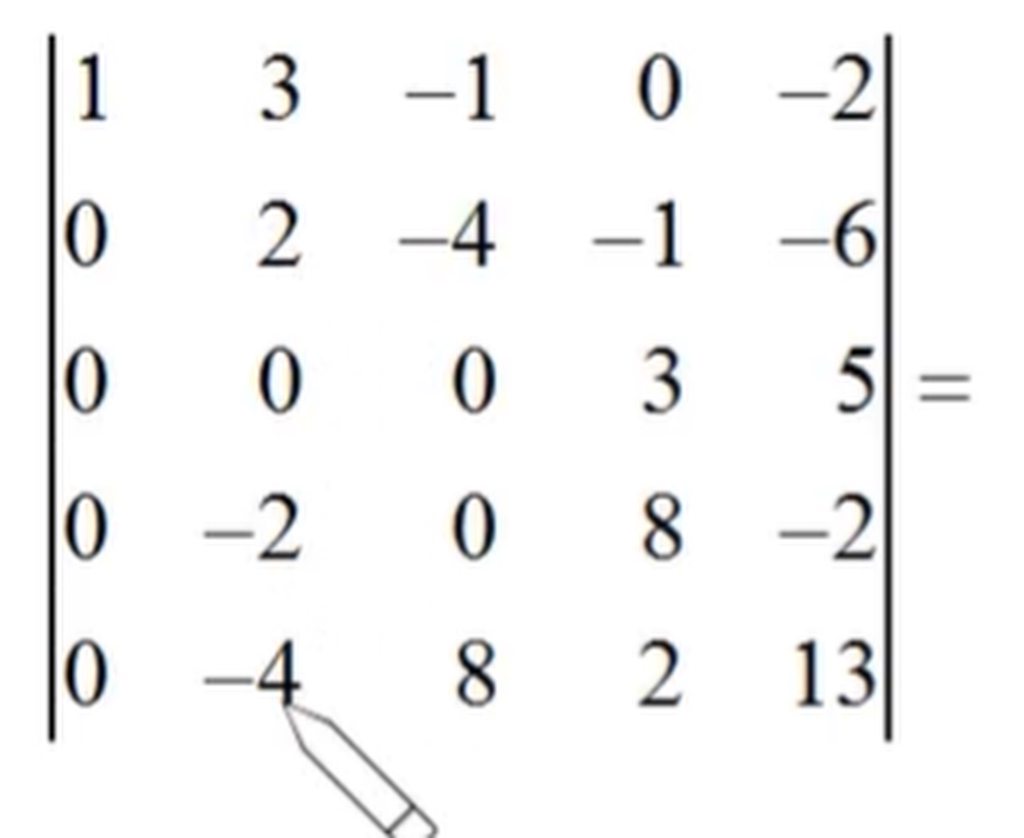 native rampart
When you do R_4-R_5->R_4 your R_4 changes
So R_5-(new R_4) != R_5-R_4 in most cases
You can't do two elementary row operations simultaneously
You have to do one at a time
main ivy
An amazingly important detail my course has left out - row operations happen one at a time.
native rampart
Row reducing a matrix is the same as solving a system of linear equations in a sense
main ivy
Another thing I've wondered, must I start a row operation with the row I intend to supplant? So I can do R_3 - R_2 -> R_3, but can I do R_2 - R_3 -> R_3?
native rampart
You can
Think of linear equations
If you have
x+y=1 R1
2x+y=2 R2
Then
x+y=1 R1
(x+y)-(2x+y)=-1 R1-R2
Is an equivalent system
A matrix is just this but in a more abstract form
A system of linear equations
By equivalent system I mean the new system and original system have the same solutions
If a matrix A is row equivalent to matrix B,then
Ax=0 and Bx=0 will have the same set of solutions if a solution exists
main ivy
Got it, this makes sense
native rampart
main ivy
Another thing I've wondered, must I start a row operation with the row I intend ...
That's not one elementary row operation tho. It's a combination of -R_3->R_3 and R_3->R_3+R_2
An elementary row operation is always of 3 forms:
- swap rows
2)R_i+cR_j->R_i
3)R_i->cR_i
If it's not in these three, it's not elementary
main ivy
the second point can be addition or subtraction (addition of a negative) no?
Or is that then two operations?
main ivy
Then I'm lost on how R3 - R2 -> R2 is not one operation. I am subtracting a row from another row and storing within a row occurring in the operation.
native rampart
native rampart
If a matrix A is row equivalent to matrix B,then
Ax=0 and Bx=0 will have the sam...
This has to be 0,not for any general c mb
native rampart
main ivy
Then I'm lost on how R3 - R2 -> R2 is not one operation. I am subtracting a row...
You have to fix R_2 and add a multiple of R_3 for that to count as a row operation
Remember it's R_i ->R_i + c R_j
Here i=2,j=3
main ivy
Meaning then I have to perform some operation on R_2 and store within R_2 for it to remain as one single row operation.
native rampart
Do you include R_3-R_2->R_2 when you say "operation on R2"?
main ivy
no, because r_3 is the row in which an operation is being performed on, but the result is being stored into r_2, which I've been wondering if it is acceptable as a row operation
native rampart
Well,There are many operations you could do on R_2,like you could do R_2+aR_1+bR_3->R_2 if there are 3 rows
Not elementary
main ivy
right, so that's the key term here. r_3 - r_2 -> r_2 is not an elementary row operation?
native rampart
Yes,it is not
native rampart
native rampart
An elementary row operation is always of 3 forms:
1) swap rows
2)R_i+cR_j->R_i
3...
Check if the row operation is in this format. If not,It is not elementary. There are no other ways in which you get a elementary row operation
Mostly because we define only those operations as "elementary" row operations
main ivy
When bringing a matrix into row-echelon as a simple method to find the determinant, what effect do elementary operations have on the determinant?
Suppose in my operations I perform 2R_1 - 3R_2 -> R_1. Do I then need to multiply my end result determinant by 1/2 and 1/3 to cancel the effect of having multiplied my rows by the inverse constants?
native rampart
That's 2 elementary operations but w/e(2R_1->R_1 and R_1-3R_2->R_1)
Swapping of rows changes the sign of determinant
R_i+cR_j->R_i doesn't affect the determinant
cR_i->R_i scales the determinant by c
That's det(new matrix)=c det(old matrix) for cR_i->R_i
main ivy
got it
 native rampart
Take a wild guess
 modern relic
thanks
wintry steppe
what does ran mean
dusky epoch
do you have some context
dusky epoch
it probably means range but i want to make sure
dusky epoch
yes...
wintry steppe
not good with the english terms
dusky epoch
idk why you're reluctant to show me exactly where you saw the ran notation
wintry steppe
 dusky epoch
okay yeah it's range
 verbal wedge
for a positive definite matrix, is it true that all the entries down the main diagonal must be positive?
aka the trace of a positive definite matrix is always > 0
dusky epoch
those are not equivalent
the trace, being the sum of the eigenvalues, is of course positive
but that alone isnt enough to conclude that each diagonal entry is positive
however it is true that the diagonal entries are positive
because $a_{ii} = \ang{Ae_i, e_i}$
stoic pythonBOT
Ann
 verbal wedge
ah yeah my second statement was incorrect


 dawn fractal
x and y being column vectors
dusky epoch
$x^*y = \sum_{j=1}^n \overline{x_j} y_j$ actually. and under your definition, $\ang{x,y} = y^*x$, not $x^*y$.
stoic pythonBOT
Ann
 dusky epoch
conventions differ as to which argument in the inner product gets conjugated. i think physicists generally conjugate the first and mathematicians the second? but don't quote me on that.
dawn fractal
basically they are complex conjugates of each other
that's where i was confused
so idk how they are equal
dusky epoch
are you sure the theorem was $x^*y = \ang{x,y}$?
stoic pythonBOT
Ann
 dawn fractal
yes
dusky epoch
and are you sure it's the y's that got conjugated in the definition?
dawn fractal

number 5


third pic talks about how Euclidean inner product is the f in Example 36 but with all a_i = 1
dusky epoch
third line in remark 37 should have F = R...
this book's full of misprints it looks like
dusky epoch
then talk to your prof
dawn fractal
so it should be a typo
dusky epoch
thm 45 item 5 should have y*x
stoic pythonBOT
!superficialsicko
 dawn fractal
right?
 dusky epoch
careful, you're implicitly assuming this addition they've defined is associative
which it is not
stable kindle
ok i don't see how i'm assuming that lol
dusky epoch
well ok no
stable kindle
all i see is distributivity
dusky epoch
i guess you're assuming the distributive law
which doesnt hold either
because of the infinities
stable kindle
right
dusky epoch
but i think explicitly breaking assoc is easier
try the two different ways of parenthesizing $\infty + \infty + (-\infty)$
stoic pythonBOT
Ann
 stable kindle
so if we assume distributivity, contradiction because x = 0 = -x, but by assumption x and -x aren't in R, so does that do it
oh ok
yeah, there's no associativity
dusky epoch
$(\infty + \infty) + (-\infty) = \infty + (-\infty) = 0 \ \infty + (\infty + (-\infty)) = \infty + 0 = \infty$
stoic pythonBOT
Ann
 dusky epoch
these are not equal, therefore addition isnt associative, therefore no hope to be a vector space

 dusky epoch
normal means A commutes with A* right
stoic pythonBOT
!superficialsicko
 dusky epoch
hermitian => real eigenvalues does not require normality iirc
dawn fractal
indeed
dawn fractal
ive already proven that in a previous item
dusky epoch
hm
dawn fractal
i was wondering whether to use inner products or not
if not, how i can make use of these three facts
using associativity perhaps, but..
native rampart
If T is normal and c is an eigenvalue,then c* is an eigenvalue of T*
dawn fractal
sooo
native rampart
dawn fractal
but if i can prove that then good
How would that finish the proof?
native rampart
Do you know spectral theorem?
dawn fractal
- $AA^* = A^*A$\
- $Ax = \lambda x$ for some nonzero (eigen-)vector $x\in\C^{n\times 1}$\
- $\lambda = \overline{\lambda}$
yep
stoic pythonBOT
!superficialsicko
 dusky epoch
there are ways of doing lists in TeX
specifically you want the enumerate environment
here's how to do it:
dawn fractal
ik that lmao
dusky epoch
oh
native rampart
Then write your matrix of T in an orthonormal Eigenbasis
dawn fractal
its faster this way tho
native rampart
Take conjugate transpose to get T*
dawn fractal
A is unitary diagonalizable iff A is normal
native rampart
If c=c* for all eigenvalues you have that the two matrices are equal
dawn fractal
is that the spectral theorem?
native rampart
Yes
dawn fractal
native rampart
Then write your matrix of T in an orthonormal Eigenbasis
can i make use of $\C^{n\times n}$ standard basis?
stoic pythonBOT
!superficialsicko
 dawn fractal
i dont think we have that theorem
stoic pythonBOT
!superficialsicko
 dawn fractal
native rampart
Then write your matrix of T in an orthonormal Eigenbasis
dawn fractal
native rampart
Then write your matrix of T in an orthonormal Eigenbasis
would i need to use gram-schmidt for that?
im lost lmao
native rampart
stoic python
**!superficialsicko**
You know U*AU is the matrix of operator in some basis?
The basis consists of columns of U
native rampart
You know representation of operators as matrices requires you to choose a basis?
And change of basis formula helps you to find the representation in a different basis
dawn fractal
ah u mean representations of linear operators, yes
native rampart
Yea that
dawn fractal
native rampart
And change of basis formula helps you to find the representation in a different ...
yes
native rampart
native rampart
The basis consists of columns of U
You ok with this?
Now this being unitary means the basis is orthogonal
And the basis is Eigenbasis because the matrix is diagonal in that representation
dawn fractal
native rampart
The basis consists of columns of U
why is that
also are u talking about this
 native rampart
Yes,That
dawn fractal
each col of U corresponds to an element from B1 written with a coordinate matrix relative to B2
but those are the same bases
?
native rampart
native rampart
The basis consists of columns of U
Also,This should be U^-1 I think
If that's confusing,Take the columns of U
Since U is invertible they form a basis
Let this basis be B_2
Now try seeing what B_2PB_1 will be where B_1 is your standard basis
I think you will end up with U or U^-1 not sure which one
dawn fractal
oh, are you actually talking about since A is (unitary) diagonalizable, there's a basis for C^{nx1} containing A's eigenvectors?
native rampart
Yes
dawn fractal
oh u should've led with that lmao
i was confused as to how u obtained an eigenbasis from U
or U*
dawn fractal
native rampart
Since U is invertible they form a basis
ok, i.e. a basis for the colspace of U
dawn fractal
native rampart
The basis consists of columns of U
so yes
native rampart
You know U is unitary implies the basis formed from col space is orthogonal?
dawn fractal
was also confused since u didnt specify what the basis is a basis for
native rampart
mb
dawn fractal
native rampart
You know U is unitary implies the basis formed from col space is orthogonal?
nope
i dont see that directly
native rampart

Mathematics Stack Exchange
So I'm trying to understand why the columns of a unitary matrix form an orthonormal basis. I know it has something to do with the inner product, but I don't fully understand that either (we learned...
dawn fractal
ok, but im afraid id have to prove that too along with A being Hermitian
just to refresh, heres what i need to prove
maybe post the entire problem for context, but this channel is currently occupied
stoic pythonBOT
!superficialsicko
 native rampart
dawn fractal
just to refresh, heres what i need to prove
native rampart
dawn fractal
just to refresh, heres what i need to prove
Your thing follows easily if you show your version of spectral theorem is equivalent to "every normal operator has an orthogonal Eigenbasis"
dawn fractal
operators having bases? that's new for me
i.e. linear transformations (on the same vector spaces) having bases
native rampart
Ok,Just ignore that I am being dumb
dawn fractal
idk if this proof is supposed to be long anymore lmao
native rampart
idts
native rampart
dawn fractal
operators having bases? that's new for me
as in there is a basis such that the representation matrix in it is diagonal
Just read up on the various forms of spectral theorem
This follows directly from one particular form
native rampart

Just read this when you come back
@dawn fractal
(ping so that you can find this easily)
dawn fractal
will do
wintry steppe
what does this sign mean?

context?
probably "not equals"
post the full image
nvm you got your answer in #math-discussion
quartz compass
it's $\rotatebox{-90}{$\pi$}$
stoic pythonBOT
Meρρa
 wintry steppe
ye
 quaint flint
Is calc workshop best resource for learning linear algebra
dusky epoch
>calc workshop
>linear algebra
dusky epoch
okay so their name is just misleading, got it
quaint flint
Any thoughts
I’ll have an midterm this Friday afternoon and want to get a very good score
Chapters 1 and 2 in lay and McDonald
quartz compass
quaint flint
Any thoughts
I think you should ask a specific question about a linear algebra problem you've attempted to work on but can't figure out
quaint flint
I don’t have any specific question
My question to begin with was a broad open ended one
In that what’s a good online resource to get a comprehensive understanding of linear algebra for my midterm
@wintry steppe
 vast iron
I liked Gilbert's lectures, you can probably find (at least elementary stuff) at MIT open courseware. It's better to work through a textbook though imo.
short coral
Suppose for matrix A which is of dimension n*n, it's given that COL SPACE = NULL SPACE
What can you say about A^2 ?
What can you say about A^2 * X , where X is a non zero vector?
wintry steppe
short coral
Suppose for matrix A which is of dimension n*n, it's given that COL SPACE = NULL...
i can say a lot about A^2, and also a bit about A^2 * X where X is a non zero vector
wbu?
do you know what COL SPACE and NULL SPACE mean?
short coral
wintry steppe
do you know what COL SPACE and NULL SPACE mean?
Col space = Set of Linearly independent column vectors
Null space = Set of Linearly dependent column vectors
lavish jewel
that's not right
wintry steppe
column space = span of the matrix's columns
null space = the set of x with Ax = 0, A being your matrix
dusky epoch
a space is not the same as its basis
lavish jewel
gang appearance of tteppann
wintry steppe
considerable
 coarse marsh
is a zero matrix Symmetric?
wintry steppe
coarse marsh
is a zero matrix Symmetric?
Do you know what a symmetric matrix is?
wintry steppe
A matrix is symmetric iff it is equal to its transpose yes
coarse marsh
coarse marsh
is a zero matrix Symmetric?
so this should be true?
cause i just got an 0 for saying it is
wintry steppe
The transpose of a nxn zero matrix is itself
so those are symmetric
if it was a nxm zero matrix then its not symmetric
coarse marsh
it's a 2x2 zero matrix
wintry steppe
talk to your teacher then
wintry steppe
Is there any weird trick for this? ik this is true cuz T-9I injective else 9 would be eigenvalue, therefore also surjective cuz operator and finite dim. Is there another way or are the specific numbers just red herrings?

 verbal pivot
pretty sure the numbers are just red herrings (This is a question from Axler's book right?)
wintry steppe
yea Axler
wintry steppe
lol that's a troll question
minor bluff
is orthogonally diagonalizing a matrix the same as diagonalizing it as normal?
because P^-1 = P transpose right
minor bluff
<@&286206848099549185>
 weak needle
minor bluff
is orthogonally diagonalizing a matrix the same as diagonalizing it as normal?
weak needle
minor bluff
is orthogonally diagonalizing a matrix the same as diagonalizing it as normal?
An orthogonal diagonalisation of a matrix will also be a normal diagonalisation, but not the other way around
 misty storm
how would I go about finding uA and uB?

feels wrong to ping helpers for what I think is an easy question
verbal pivot
misty storm
how would I go about finding uA and uB?
uhh, what does uA even means?
misty storm
well, u is a vector, and A is a base for the linear space V
I'm not entirely sure what to make of it
a similar practice exercise showcases this
 verbal pivot
ah, so by $u_A$ you mean u in terms of the basis A?
stoic pythonBOT
b2unit
 misty storm
so coordinates in respect to a basis, maybe?
misty storm
verbal pivot
ah, so by $u_A$ you mean u in terms of the basis A?
I suppose, yes
the test is in a week and I'm trying to make sense of all of this stuff
verbal pivot
well supposing it is (you should revise if this is indeed correct), then the straightforward way of solving for the coordinates, is to solve the system of equations created by the equality $\lambda_1 v_1 + \lambda_2 v_2 + \lambda_3 v_3 = u$ (where the lambdas are the coordinates and the v's are the basis vectors), if you express the vectors in terms of the canonical vectors (in this case, those are ${1,x,x^2}$), then you will obtain a system of three equations and three unknowns (the three lambdas)
stoic pythonBOT
b2unit
 verbal pivot
but sometimes, finding the coordinates is easier than that
misty storm
thanks
misty storm
stoic python
**b2unit**
- What should I be googling for?
2.The coordinates which lambda represent would be x^2,x^1 and x^0? basically?
so, in the case of this exercise: 3 -6 +5?
verbal pivot
uh rather than googling it would be better to compare it with your class notes or the textbook that you are using, but if you want to google anyways,a good search term to begin with would be "coordinate and change of basis" I think
verbal pivot
misty storm
so, in the case of this exercise: 3 -6 +5?
the lambdas would be the coordinates you want to find, if you are saying 3 -6 +5 because those are the coefficients of u then that reasoning would be incorrect, 3 -6 +5 are the coordinates of u with respect to the canonical basis {1,x,x²}
misty storm
right
and I want to find u with respect to A rather than it's canonical basis, is that right?
verbal pivot
well, assuming that u_A means that, then yes

that's the system
(I wrote it out on paper since I forgot how to do the vectors in latex lol)
 bitter cape
I'm having a little trouble figuring out bijection. Can someone help me understand two examples? (That'd be [T(x, y) = (0, 0) and T(x, y) = (2x, y)]
[Please. Also, not saying both are, but two examples to understand the reasoning, cause I've been unable to so far]
 lilac stratus
bitter cape
I'm having a little trouble figuring out bijection. Can someone help me understa...
lilac stratus
bitter cape
I'm having a little trouble figuring out bijection. Can someone help me understa...
I don't understand what you're asking ? You're asking if both of these maps are bijections ?
bitter cape
lilac stratus
I don't understand what you're asking ? You're asking if both of these maps are ...
Uhum
lilac stratus
ok so a map f: X -> Y is bijective if:
- f is injective, meaning that two distinct elements can't have the same image, i.e f(x) = f(y) implies x = y
- f is surjective, meaning that for any y € Y, there exists x € X such that f(x) = y, so basically "every element is reached"
Here, I assume T goes from R² to R² ?
bitter cape
lilac stratus
ok so a map f: X -> Y is bijective if:
- f is injective, meaning that two distin...
It does, yes
I understand it on a theoretical level, but been having trouble matching this to the actual questions/examples
lilac stratus
Ok so first let's look at T: R² -> R², (x, y) |-> (0,0).
Does every element of R² seems reached ?

bitter cape
No 😂
lilac stratus
Right, so that means it is not surjective.
So it can't be bijective, right ? 
(not it isn't injective either, do you see why ?)
bitter cape
Uhum. This one is a little easier since it's so 'final' with the (0, 0)
lilac stratus
ok then let's look at the second map T: R² -> R², (x, y) |-> (2x, y)
 gray adder
Hi, Can anyone guide me with polyphase filters used for decimation and interpolation?
lilac stratus
First is it surjective ? If I take (a, b) € R², is there some (x, y) € R² such that T(x, y) = (2x, y) = (a, b) ? @bitter cape
(hint: ||this reduce to solving two distinct one variable equations||)
 thorny plume
can someone tell me how they converted that equation into that vector form?
 dusky epoch
it's a bit of a sleight of hand, but it appears they are implying that b should satisfy 3b_1 + b_2 = 0
which can be considered as a system in its own right, with 2 unknowns and 1 equation

 wise wyvern
aha
dusky epoch
also is this translated from another language
because "non-negatively defined" just sounds super wrong to me
wise wyvern
yea most likely.
On wikipedia it says non-negative means > 0
positive would be >= 1
lavish jewel
backwards
wise wyvern
i mean all elements in the matrix would be > 0
dusky epoch
that's so bad
dawn fractal
nonnegative means >=0
dusky epoch
no, this isnt what positive-definite means
you can have a matrix contain some negative entries and yet remain positive-definite
wise wyvern
oh sorry yes, >= 0
dusky epoch
positive means >0, nonnegative means ≥0
wise wyvern
correct
this class isnt fun. The professor translated all the materials and homework so it is very confusing
the class is like programming and neural networks, but the final exam practice is only linear algebra
dusky epoch
translated from what language, if you don't mind sharing
wise wyvern
polish
dusky epoch
...okay that was closer than i thought itd be
i thought it might've been translated from russian
lavish jewel
i mean, ML deals very much with linalg
wise wyvern
it does, but these problems weren't part of the course
lavish jewel
aha
wise wyvern
my only complaint is that the exam is really obtuse and not very related to the course.
stoic pythonBOT
!superficialsicko
 dawn fractal
lavish jewel
an alternative way would be to consider x* A x and use associativity
dawn fractal
lavish jewel
an alternative way would be to consider x* A x and use associativity
i ended up doing this but encountered the above problem
stoic pythonBOT
!superficialsicko

 spark marlin
I had a question, I worked through a proof sketch but ended up with $c_1$ in place of $c_0$. Did my lecturer make a typo or am I wrong here. I used induction on k for $P_k(z)$
 stoic pythonBOT
Panda_Bear59
 stoic pythonBOT
Ann
 dawn fractal
oh right, from definition of norm
but <v,v> is only 0 when v is 0
so that is not 0
ty
dusky epoch
spark marlin
I had a question, I worked through a proof sketch but ended up with $c_1$ in pl...
you should have c_n not c_1
spark marlin
ah i was thinking that too, but was trying to make c_0 work. So it is a typo?
dusky epoch
it is a typo yes
thorny plume
is orthogonally diagonalising this matrix the same as diagonalizing it as normal, since its symmetrical?
oh wait, nvm its not symmetrical is it
dusky epoch
it's not symmetric, unless you insist 6 = 0
thorny plume
now that its symmetrical, diagonalizing it as normal is the same as orthogonally diagonalizing right
wintry steppe
you have to adjust the eigenvectors to have norm 1
and if you have repeated eigenvalues, you have to choose orthogonal eigenvectors
otherwise theyre already orthogonal
wintry steppe
A^k means AxAx...A k times
What do you think they are asking?
They first ask you to calculate a few small powers of those matrixes
so makes sense they ask you for a general expression for their powers after
lavish jewel
dawn fractal
i ended up doing this but encountered the above problem
that's the whole point, no?
v*v is not zero, but the eigenvalue minus its complex conjugate is
wintry steppe
for example if D is the following matrix
[0 1]
[0 0]
then D⁰ is identity, D¹ is D and D^k for k>=2 is the 0 matrix
dawn fractal
how do i prove that if a square matrix A is diagonalizable, then A has a square root?
wintry steppe
dawn fractal
how do i prove that if a square matrix A is diagonalizable, then A has a square ...
if you had a diagonal matrix, can you find a square root of it?
dawn fractal
i do know that $I_nI_n = I_n$
stoic pythonBOT
!superficialsicko
 dawn fractal
but diagonal matrices are simply identity matrices multiplied by scalars
wintry steppe
Well, the whole point of diagonalizing
is that it's easier to work with diagonal matrices
do you know how to calculate the square of a diagonal matrix?
dusky epoch
dawn fractal
how do i prove that if a square matrix A is diagonalizable, then A has a square ...
a real square root?
dawn fractal
simply squaring the diagonal entries
dusky epoch
you will need its eigenvalues to be ≥0 if you want a real square root
otherwise it's not guaranteed
 native rampart
Take the matrix in the Eigenbasis,now consider the diagonal matrix whose diagonal entries are square root of the original one
i.e.,$b_{ii}=\sqrt{a_{ii}}$
stoic pythonBOT
Buncho Dragons
 dawn fractal
not sure which eigenbasis u are referring to here
native rampart
Diagonalise A
Say D=PAP^-1(D is diagonal)
Now consider C a diagonal matrix such that c_{ii}=\sqrt{d_{ii}} for all i
dusky epoch
ah, so you're working in C
native rampart
P^-1 B P will be your square root
by sqrt{d_{ii}},I mean an element c such that c^2=d_{ii}
dawn fractal
native rampart
by sqrt{d\_{ii}},I mean an element c such that c^2=d\_{ii}
ofc.
dawn fractal
native rampart
P^-1 B P will be your square root
im not bright enough to easily get this though
native rampart
C^2=D
Because of how we defined it
(P^-1 C P)(P^-1 C P)=(P^-1 C^2 P)=(P^-1 D P)=(P^-1 P A P^-1 P)=A
lavish jewel
this looks ok, but you made the notation cursed
they already used B for something else in the problem statement
just be careful with that
native rampart
One sec,I will change it
dawn fractal
ok i have tried using the fact that cols of AB are l.c.'s of cols of A and others but i am lost

im thinking it has something to do with which columns correspond to columns with leading 1s in the RREF
but idk how to determine that
WLOG suppose rank A <= rank B. So min(rank A, rank B) = rank A
i need to prove that rank AB <= rank A then
native rampart
range (A),where A is a matrix is the set of vectors y such that y=Ax for some x
range(A) also happens to be a vector space
lavish jewel
when doing matrix-vector products, you can represent the result as a linear combination of the columns of A, where the weights of the columns are the elements of a vector x
so Ax is a linear combination of column vectors in A. these column vectors are the spanning set of range(A)
dawn fractal
wdym by 'weight'
dusky epoch
coefficients
wintry steppe
is there such a thing as elementary equations operations?
Like we have elementary row operations?
limber sierra
the elementary row operations represent the common ways you manipulate equations in a linear system
so theyre kind of the same thing
but no, no one uses the term
elementary equations operations
wintry steppe
my book does in a small section but i cant find any info on it online
also is forward elimination and forward reduction the same?
limber sierra
well its just the general principle of
you can do something to both sides of an equation

 coarse sandal

Im not sure how to approach this problem
What does it mean that A and B are matrices whose reduced row echelon forms are both Identity?
does it mean that A and B are both identity matrices?
or just when we RREF do they become Identity matrices
weak needle
coarse sandal
or just when we RREF do they become Identity matrices
This.
 rustic moon
stable kindle
_ _
rustic moon
stable kindle
_ _
Oh I just did this one, this is a good one to do
coarse sandal
weak needle
This.
How would you go about proving this?
Would you show that A and B are invertible because they are can be RREF into Identity matrix?
rustic moon
coarse sandal
Are you familiar with what RREF means for matrices? Basically if I have the augmented matrix [A | b] this represents the x such that Ax = b
nocturne jewel
coarse sandal
Would you show that A and B are invertible because they are can be RREF into Ide...
they are invertible by that property
rustic moon
^^
coarse sandal
oh
rustic moon
To find the inverse you rref until you get the identity on one side and the inverse in the other
nocturne jewel
yes, fundamental theorem of invertible matrices
coarse sandal
because both A and B are invertible, then AB is also invertible
thus (AB)x = 0 only has a trivial solution
weak needle
Yes you got it
coarse sandal
thus exactly one solution
rustic moon
👏
coarse sandal
thank you
nocturne jewel
well it says $E_{32}E_{21}b$
stoic pythonBOT
Mosh
 nocturne jewel
multiply them together
what?
what you just said makes no sense
E_32 is a 3x3...
i have no clue how you've gotten a matrix is a scalar
stable kindle

lemma (the previous exercise): let A and B be subs of V; then A union B is a sub of V iff B is a sub of A wlog, as:
the if is trivial
conversely assume A union B is a sub of V and that there exists a in A but not in B, and b in B but not in A.
then a+b must be in A union B
but if a+b is in A, then (a+b)-a is in A, ie. b is in A. similarly if a+b is in B, then (a+b)-b is in B, ie. a is in B. contradiction.
therefore there must be either no a in A not in B, or no b in B not in A. qed
_ _
now to prove the actual statement: let A, B and C be subs of V; prove that A union B union C is a sub of V iff two of A, B, C are subs of the last.
case 1: one of the subs is a sub of another. wlog let C be the sub of B. then A union B union C is just A union B.
case 1a: then if B is a sub of A, then B and C are the subs of A and the union is a subspace, in accordance with the statement.
case 1b: if A is a sub of B, then A and C are subs of A and the union is a subspace, in accordance with the statement.
case 1c: if A is neither a sub of B nor B a sub of A, then by the lemma the union is not a subspace, in accordance with the statement.
wlog, if two are the subs of one, then the union is a subspace, in accordance with the statement. however, if one is the sub of another but the last is neither a sub of the second nor the second a sub of the last, then the union is not a subspace, in accordance with the statement.
then the only case left is:
_ _
case 2: none are the sub of any other; then neither A union B nor A union C nor B union C are subs of V. we must show there is a+b+c not in A union B union C to fulfil the prophecy.
lemma: there is a in A not in B or C, and b in B not in A or C, and c in C not in A or B
this is because if every a in A is in B or C, then A is a subset of B union C.
if A is a sub of neither B nor C, then there is g in B but not C and h in C but not B.
then g+h is in neither B nor C, so A is not in B union C, contradiction.
therefore A is a sub of either B or C, but this is also a contradiction as this is case 2.
wlog, by the second lemma we can have non-empty sets D, E and F:
let D be all a in A not in B or C; let E be all b in B not in A or C; let F be all c in C not in A or B.
case 2a: if e+f is not in A, given that e+f is never in B union C, d+e+f is not in A union B union C. then the union is not a subspace, in accordance with the statement.
case 2b: if e+f is in A, e+2f cannot be in A. given that e+2f is never in B union C, d+e+2f is not in A union B union C. then the union is not a subspace, in accordance with the statement.
this proves the statement.
i really hope this is right lol
this was sorta fun but i am almost certain there was a better, shorter way without so much case juggling


 sudden narwhal

 heavy crown
if I know that A is matrix of order m x n , and rank(A) = n
how do I show that C(A) = R^m ?
lavish jewel
what is C(A)?
heavy crown
column space of A
lavish jewel
then the column space cannot be R^m, unless m = n
heavy crown
lavish jewel
then the column space cannot be R^m, unless m = n
true, because rank(A)=n then A is invertible, and because it's invertible it means it's square matrix
lavish jewel
that's not true in general
you can have rank n, but m > n
and then the matrix is not invertible
heavy crown
hmm
I missed one detail in the question like
The Given was: A is of order m x n, and for every Ax=b there's singular solution.
Prove that A is square matrix and that C(A) = R^m
lavish jewel
and what are you told about A?
heavy crown
that's it hmm
so I tried answering this like this:
specifically for b={0} vector there's also singular solution.
That means rank(A)=n
right?
lavish jewel
you still haven't told me what they tell you about A
so i can't say anything
the question alone is not enough
heavy crown
that's all they said it's just one liner 😦
I'll try translating it word by word sorry one moment
Let A be a real matrix of the order m x n, and assume that for every b ∈ R^m, the linear system Ax = b has a singular solution.
Show that C(A) = R^m and that A is square matrix.
 tribal moss
Nice name username
heavy crown
tribal moss
Nice name username
thanks I tried my best 
lavish jewel
ah, they gave you the extra info that every Ax = b has a singular solution
that was missing before