#linear-algebra
2 messages · Page 204 of 1
 flint jackal
 dire thunder
what
i mean
there is no real difference for points and vectors at least for finite dimensional case
like each vector for finite dimensional case is just n-tuple (x_1, \ldots, x_n)
which can be viewed as point in F^n
 dreamy iron
Could you explain a bit more please. I’m still not following.
dire thunder
what is not clear in that we define span() = {0}?
flint jackal
dire thunder
which can be viewed as point in F^n
Are you referring to the coordinate space, $$R^{n}$$?
 stoic pythonBOT
dldh06
 dreamy iron
I get that span() ≡ {0}. I understand that it is defined to be this way.
The span of the empty list is defined to be the singleton set containing the zero-vector, i.e., the most trivial of vector spaces.
What is span({0})?
dreamy iron
=={a0 : a \in F }
dreamy iron
so {0}
dire thunder
yes
thus span of empty set and span of set containing only zero vector match
so you are correct here
flint jackal
dire thunder
field is not obliged to be R
What exactly is the difference between field and R?
dire thunder
in your claim of span emtpy set = span {0}
dreamy iron
So the span of the two objects we’ve been discussing are in fact equal:
span() = {0} = span ({0}).
dire thunder
flint jackal
What exactly is the difference between field and R?
field is type of algebraic structure and R is one of these algebraic structures
yes
dreamy iron
dire thunder
so you are correct here
Well that was easy. THANK YOU.
dire thunder
dire thunder
field is type of algebraic structure and R is one of these algebraic structures
simply saying F is any set with two operations such and "zero" and "identity" such that it behaves like R with its addition, multiplication and 0 wand 1
for example Q is also field
and C is field
dreamy iron
flint jackal
What exactly is the difference between field and R?
Some hopefully helpful intuition building. https://thinkzone.wlonk.com/Numbers/NumberSets.htm
Real and complex number sets
flint jackal
dire thunder
field is type of algebraic structure and R is one of these algebraic structures
So I looked up field space and R space. Is field space technically within R space or am I understanding that wrong?
dreamy iron
A field is any set, and any two operations on that set, that obeys a selection of 11 axioms: https://docs.google.com/spreadsheets/d/11rri7XubkLaX6ZXxDDhuE0y79u_Of34fSLOXxNebev4/edit

Google Docs
public
Field Axioms
+
- : 𝔽 x 𝔽 → 𝔽,*
- : 𝔽 x 𝔽 → 𝔽
1.,closure,6.,closure
2.,associative,7.,associative
abelian group axioms,Group Axioms
3.,identity,8.,identity
4.,inverse,9.,inverse
a ≠ 0
5.,commutative,10.,commutative
11.,distributive
Vector Space Axioms
( a vector space V over a f...
The canonical examples of fields are:
- The real numbers
- The complex numbers
- The rational numbers
- The set of all rational polynomials.
flint jackal
I've only dealt with vector space so field space is a new concept to me
dreamy iron
well, the scalars in a vector space have to come from a field, by definition.
so inadvertently you’ve dealt with fields
dreamy iron
flint jackal
I've only dealt with vector space so field space is a new concept to me
They’re easy-ish to get started with. Try and prove zero times any number is zero using the field axioms only. Should take about thirteen lines at most.
how do you define a multiplication on F^n?
and also get a field.....?
dire thunder
for F^2 you have something C-like
dreamy iron
n>= 3 ??
dire thunder
 flint jackal
dreamy iron
They’re easy-ish to get started with. Try and prove zero times any number is zer...
flint jackal
dreamy iron
They’re easy-ish to get started with. Try and prove zero times any number is zer...
Isn't this basically true all the time because of basic multiplication rules, 0 times anything is always zero?
stoic pythonBOT
Commander Vimes
 dreamy iron
flint jackal
Isn't this basically true all the time because of basic multiplication rules, 0 ...
dreamy iron
flint jackal
Isn't this basically true all the time because of basic multiplication rules, 0 ...
Yes, of course it’s true. Now prove it using the field axioms.
stoic pythonBOT
Commander Vimes
 dreamy iron
There’s an analogous proof for vectors:
-1 v =?= -v
dire thunder
yes
dreamy iron
flint jackal
Isn't this basically true all the time because of basic multiplication rules, 0 ...
The basic rules of multiplications are really basic lemmas of multiplication, and lemmas need proof.
dreamy iron
dreamy iron
So the span of the two objects we’ve been discussing are in fact equal:
span(...
Anyway. Thanks for you kind attention #linear-algebra . I will meditate on this result.
flint jackal
dreamy iron
The basic rules of multiplications are really basic lemmas of multiplication, an...
I don't understand any of this terminology. The most I've dealt with was the basic linear algebra, where we do SVD, eigenvalue decomposition, Gram-Schmidt, orthogonal projection, etc. That basic stuff
dire thunder
linear algebra usually does not treats fields much
it just admits them as having nice property
fields are treated in abstract algebra and analysis
flint jackal
So all those topics, I stated, I understand real world applications where they could be used. SVD for image compression, Gram-Schmidt to create orthogonal vectors. But the one topic I learned was LU decomposition. I asked my professor how is was useful, but they couldn't think of one on the spot. What kind of applications would LU decomposition be used in? Besides forward and backwards substitution?
@dire thunder Perhaps you could enlighten me on how LU decomposition is useful?
flint jackal
Is that the only thing that LU decomposition is useful for?
 lavish jewel
when it can be used, it is faster than many other methods of solving linear equations
for computational efficiency, you'd use it whenever you can
many decompositions are useful for this reason. when a matrix has a special structure, a particular decomposition makes it easier to handle. it might seem trivial off the top of one's head, but matrix-vector products happen by the truckload when dealing with data, graphics, physics simulations, etc., and one usually has to invert them in some sense
 halcyon pollen
guys what's numerical analysis?
lavish jewel
the study of numerical techniques for obtaining solutions of continuous problems?
 broken sun
Hello. Is there any example of a matrix in an infinite dimensional vector space such that it is not similar to its transpose?
 dusky epoch
operators on infinite-dimensional vector spaces tend not to be described with matrices
 zealous junco
why does the sequence A_k converge? if we assume Q_k converges to plus or minus I

likewhhy does $\lim_{k\to \infty}A^{(k)}$ exist
stoic pythonBOT
Anticipation
 zealous junco
would something like showing $|A^{(k)}|$ is cauchy work?
stoic pythonBOT
Anticipation
 zealous junco
have no idea tbh
broken sun
dusky epoch
operators on infinite-dimensional vector spaces tend not to be described with ma...
Ok. Please replace "matrix" with "operator".
Hello. Is there any example of an operator in an infinite dimensional vector space such that it is not similar to its transpose?
broken sun
No, transpose
dusky epoch
you want an operator $A$ that is not similar to $A^$, where $A^$ is the unique operator satisfying $\ang{Ax, y} = \ang{x, A^*y}$
stoic pythonBOT
Ann
 dusky epoch
(this A* is called the adjoint even in real infdim spaces)
i'm tempted to say that the forward shift operator on $\ell^2$ may fit your description, though i'm not 100% sure...
stoic pythonBOT
Ann
 broken sun
The space need not to be a product space; I meant "transpose", not "adjoint"
dusky epoch
how are you even defining the transpose without an inner product then
broken sun
If $T: X \to Y$ is a linear map; its transpose $T^t: Y' \to X'$, prime denotes dual space, such that $T^t(f)=f \circ T$.
stoic pythonBOT
MathPhysics
 dusky epoch
okay then how are you defining similarity
what does it mean for T to be similar to T^t
they're operations with different domains and codomains
broken sun
You can take the domain and codomain the same
dusky epoch
an infdim space need not be isomorphic to its own dual
so again, what would it mean for T and T^t to be similar or not
broken sun
Assume that they are the same.
dusky epoch
what do you mean
dusky epoch
i'm still trying to figure out what you want, because i'm getting a little lost and tongue-tied
broken sun
The meaning of similarity is not clear?
dusky epoch
it sounds to me like whether or not two operators are similar an operator is similar to its own transpose may depend on which isomorphism you choose between X and X'
broken sun
I am confused.
dusky epoch
like, ok, we have two operators, $A: X \to X$ and $B : X' \to X'$ and we wish to define what it means for $A$ and $B$ to be similar
stoic pythonBOT
Ann
 dusky epoch
as-is, similarity only makes sense (to me) if we take two operators with the same domain and codomain
and ask whether there exists an automorphism phi of the space such that conjugating one operator by phi gives the other
but we cannot ask this same question for our A and B, because they're operators on different spaces
even if we assume X is isomorphic to X', this still requires fixing an isomorphism p between X and X', and asking whether or not A and p^-1Bp are similar
and at the moment i am not convinced that this is independent of our choice of p
broken sun
Assume that the vector space and its dual are isomorphic.
dusky epoch
i am already assuming that
... fixing an isomorphism p between X and X' ...
there isn't just one of these, you know
broken sun
You say the definition of "transpose" depends on the isomorphism map?
dusky epoch
no
i'm saying that the definition of similarity between an operator on the primal space and an operator on the dual space depends on the isomorphism we choose
broken sun
Sorry, I meant similarity.
dusky epoch
????
broken sun
broken sun
You say the definition of "transpose" depends on the isomorphism map?
I meant "similarity".
dusky epoch
dusky epoch
i'm saying that the definition of _similarity_ between an operator on the primal...
then see this again
need i repeat myself?
broken sun
Why does that depend?
dusky epoch
so let's say we have two arbitrary isomorphisms $p, q: X \to X'$, and the same operators $A: X \to X$ and $B: X' \to X'$ as before.
and let's say $A$ is $p$-similar [resp. $q$-similar] to $B$ if $A$ is similar (in the ordinary sense) to $p^{-1}Bp$ [resp. $q^{-1}Bq$].
my question is: is $p$-similarity equivalent to $q$-similarity?
stoic pythonBOT
Ann
 dusky epoch
even if it is, that's something i would like to see a proof of.
broken sun
dusky epoch
so let's say we have two arbitrary isomorphisms $p, q: X \to X'$, and the same o...
Why not? Do you have any counterexample?
dusky epoch
do not confuse my casting doubt on a statement for an assertion of its falsehood.
though after writing it out it looks like the answer is yes, since $$p^{-1}Bp = r^{-1}(q^{-1}Bq)r,$$ where $r = q^{-1}p$...
stoic pythonBOT
Ann
 dusky epoch
okay
fine, we can speak of similarity between T and T'
the forward shift operator on $\ell^2$ may still fit your description
stoic pythonBOT
Ann
 dusky epoch
for clarity, i'm considering $\ell^2$ as the space of all real sequences $(x_1, x_2, \dots)$ such that $$\sum_{k=1}^{\infty} x_k^2 < +\infty,$$ and i define the forward shift operator as $T(x_1, x_2, \dots) = (0, x_1, x_2, \dots)$
stoic pythonBOT
Ann

 crude falcon
hey I'm calculating the eigenvectors associated to an eigenvalue, after reducing the corresponding matrix i get that rank(A) = nº variables, I computed then the cartesian equations associated to that matrix, is the solution vector associated to this system the eigenvector?
or do I need to compute the parametric equations too?
crude falcon
<@&286206848099549185>
dusky epoch
it's not exactly clear what you're talking about
crude falcon
its about computing the eigenvectors associated to an eigenvalue, for that you compute (A-zId)x=0, and the solution of that system is supposed to be the eigenvector right
(z being the eigenvalue)
dusky epoch
so you have a matrix A and an eigenvalue z... yes, the eigenvectors are by defn the solutions of (A-zI)x = 0
that's it
crude falcon

this is my problem, I end with a (0,0,0) vector, with can't be an eigenvector right?
dusky epoch
are you sure you have the right eigenvalue?
what is your matrix and what eigenvalue are you considering for it?
crude falcon
the eigenvalues I got are : 3,2 and 6

in the example I showed the eigenvalue that I'm using is 3
dire thunder
,w eigenvalues {{3,-1,1}, {-1,5,-1},{1,-1,3}}
stoic pythonBOT


 Requested by Commander Vimes#4407
dusky epoch
Requested by Commander Vimes#4407
dusky epoch
okay
dire thunder
well sorry if i sniped
dusky epoch
so you have $A - 3I = \bmqty{ 0 & -1 & 1 \ -1 & 2 & -1 \ 1 & -1 & 0}$
stoic pythonBOT
Ann
 dusky epoch
how exactly did you get that third row in your reduced matrix?
i think you messed up the arithmetic while doing row reduction somewhere
crude falcon
okay I'm seing now the error
I used -1 -1 0 in the 3rd row
instaed of 1 -1 0
nvm
broken sun
dusky epoch
for clarity, i'm considering $\ell^2$ as the space of all real sequences $(x_1, ...
And why is this operator not similar to its transpose?
dusky epoch
its transpose is backward shift which isn't injective
broken sun
dusky epoch
its transpose is backward shift which isn't injective
Why is its transpose the backward shift?
dusky epoch
you can do the calculations
broken sun
dusky epoch
you can do the calculations
How?
dusky epoch
for each natural number $k$ let $e_k$ be the sequence in $\ell^2$ consisting of a 1 at position $k$ and 0 elsewhere, and let $\hat{e}_k$ be the element in $\ell^2$ which maps each sequence in $\ell^2$ to its $k$'th term
stoic pythonBOT
Ann
 dusky epoch
and consider the isomorphism p between these which sends each e_k to its corresponding ê_k
and consider what $\hat{e}_kT$ might be
stoic pythonBOT
Ann
 dusky epoch
(where T is the forward shift, of course)
you should get that $\hat{e}k T = \hat{e}{k-1}$
stoic pythonBOT
Ann
 dusky epoch
and $\hat{e}_1T = 0$
stoic pythonBOT
Ann
 broken sun
And, an operator similar to an injective operator must be injective?
dusky epoch
yes
dusky epoch
why are you thanking me when i haven't had the chance to answer your latest question
broken sun
I got it.
dusky epoch
ok
...wait, so do you need an explanation of why injectivity is preserved across similarity or not
broken sun
Yes, but it is obvious, isn't it?
dusky epoch
it is
take two similar operators $A$ and $B = \varphi^{-1} A \varphi$ and suppose $A$ is injective (which is equivalent to saying $Ax \neq 0$ when $x \neq 0$)
stoic pythonBOT
Ann
 dusky epoch
then $Bx = \varphi^{-1}A\varphi x$
stoic pythonBOT
Ann
 dusky epoch
since phi is an automorphism we have phi x ≠ 0
since A is injective we have A(phi x) ≠ 0
and since phi^-1 is an automorphism we have phi^-1(A phi x) ≠ 0
broken sun
We cannot say the composition of injective maps is injective?
dusky epoch
or you could say that too if you want
 wintry steppe
Hey guys, what do I have to do here?

I only know that the rotation counterclockwise is (0 -1 ) (1 0)
 quasi prawn
U are looking for the function (in this case a linear illustration (not sure about the phrasing here as we call it "lineare Abbildung" in germany)) that will take an input vector v (2 dimensional) and rotate it counter clockwise by 90 degrees. A matrix can be seen as a tool to perform a linear illustration , as when u rightwise multiply the matrix with a vector this will perform a certain manipulation on the vector. Thus in your case you are looking for a 2x2 matrix that, when rightwise multiplied by a 2 dim. vector, will rotate that vector counterclockwise by 90 degrees.
As u stated correctly this matrix is
(0 -1)
(1 0)
which is the solution to the question.
Do you understand why it is exactly that matrix that gets the job done or do you need an explanation?
wintry steppe
I understood it fully, but I dont unterstand the last sentence in my question
quasi prawn
@wintry steppe to give you the general formula for rotating any 2dimensional vector by any angle, this would be the matrix needed:
(cos(alpha) -sin(alpha) )
(sin(alpha) cos(alpha))
whith alpha being the angle by which the vector is supposed to be rotated by. With alpha=90 degrees (thus cos(90)=0 and sin(90)=1) this evaluates to the matrix above
wintry steppe
quasi prawn
U are looking for the function (in this case a linear illustration (not sure abo...
(Im also german but translated it myself 😄 )
quasi prawn
Meaning of last sentence: Find the 2x2 matrix that performs the linear illustration f (which as described in the first sentence depicts from R^2 into R^2) on a given 2 dimensional vector v
quasi prawn
wintry steppe
(Im also german but translated it myself 😄 )
OK:D I dont think german is allowed here so lets keep it in english:D
wintry steppe
Sure! Now I understand the question fully, thank you but I think the question is to hard for me to solve and maybe I will skip this one
quasi prawn
Well you have already solved it ^^ No problem and good luck
wintry steppe
Yes but I dont know what to put in f(u) = Au. But nevermind thanks for your help 🙂
 next vapor
Let F be a field, A an nxn matrix over F and p(x) a polynomial in F[x], show that there exists a polynomial q(x) with degree less than n such that p(A)=q(A)
so if degree of p is n then i can just use the division algorithm along with cayley hamilton to get the result
but not sure how to go about this if the degree is less than equal to n
 digital solstice
does anyone here know the intuition behind the magnitude of the cross product, why is it equal to the area of a parallelogram? and also, i noticed that it's a necessary defining condition for the cross product to be distributive, what i mean is that if you start with the assumption that the cross product is distributive (along with a couple other properties about the cross products of the unit vectors i, j and k) you end up implying that its magnitude is the area of the parallelogram spanned by the two vectors, and i wonder why thats true exactly
wintry steppe
@empty copper Hi, so can you help me with the inequality?
 elfin meteor
i'm looking for a tutor for Linear Algebra. I'll be paying $30~60 an hour. If you DM me, please turn on the setting to accept messages from nonfriends, or else I cannot reply. Or, send me friend request to accept.
 dawn fractal
@digital solstice if it still is on ur mind here's a link to a Youtube vid I found helpful

This covers the main geometric intuition behind the 2d and 3d cross products.
Help fund future projects: https://www.patreon.com/3blue1brown
An equally valuable form of support is to simply share some of the videos.
Home page: https://www.3blue1brown.com/
*Note, in all the computations here, I list the coordinates of the vectors as columns of a...
you'd probably need to watch this vid before that though
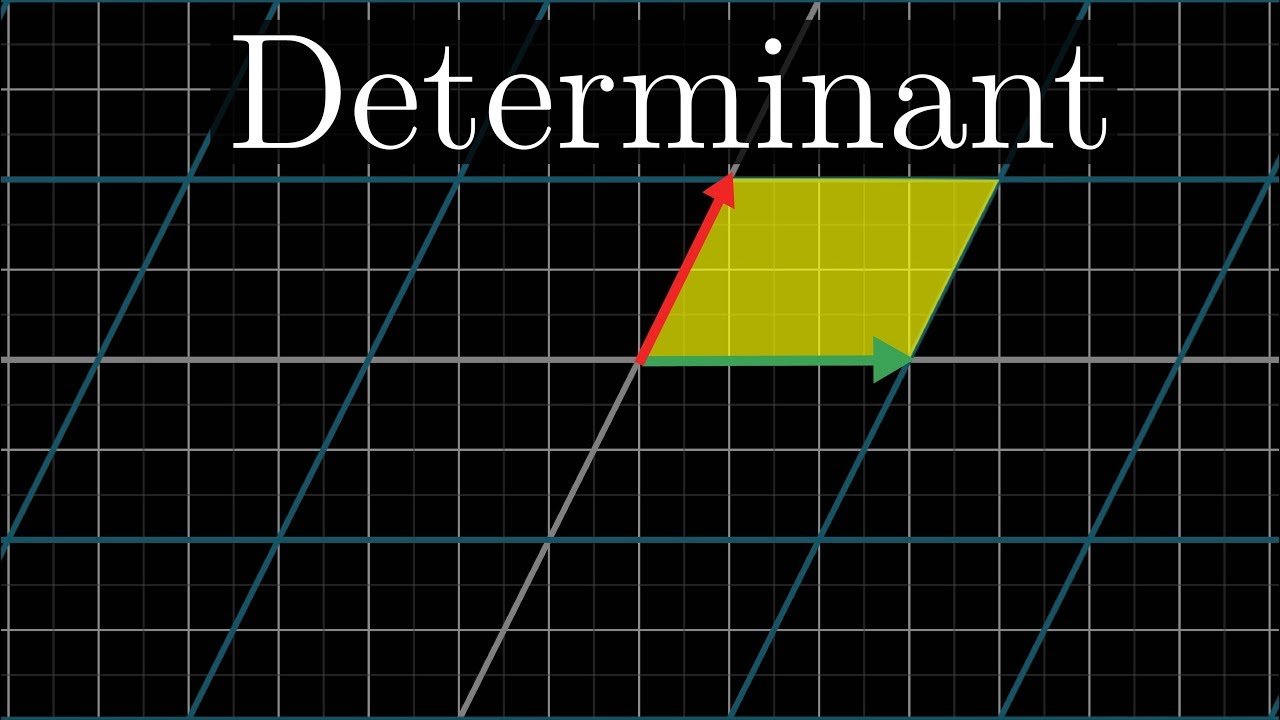
The determinant measures how much volumes change during a transformation.
Help fund future projects: https://www.patreon.com/3blue1brown
An equally valuable form of support is to simply share some of the videos.
Home page: https://www.3blue1brown.com/
Full series: http://3b1b.co/eola
Future series like this are funded by the community, throug...
dire thunder
elfin meteor
i'm looking for a tutor for Linear Algebra. I'll be paying $30~60 an hour. If yo...
i guess it would be nice if you would also indicate what level of LA you are interested in
elfin meteor
right, thanks
basic to around medium level. fairly simple stuff revolving around eigens, but i need dumbed-down intuitive explanations

 wintry steppe
Will this proof work for the => direction? Sorry for long paste.
wintry steppe
delete the source messages
wintry steppe
elfin meteor
i'm looking for a tutor for Linear Algebra. I'll be paying $30~60 an hour. If yo...
watching 3b1bs "the essence of linear algebra" might save you a lot of money.you should definitely try it out
elfin meteor
i did. loved it
it's hard to explain
for the current assignment im doing, the topic seems to be overly easy. so much that it makes me anxious
wintry steppe
@wintry steppe done, sorry
elfin meteor
the only challenge is needing to explain it at a super-elementary level, where i'm also anxious that i might miss something
wintry steppe
idk but maybe youre just understanding the concepts so good that the task isnt har for you.i found most of my hw in LA1 quite simple too
 nocturne jewel
elfin meteor
i'm looking for a tutor for Linear Algebra. I'll be paying $30~60 an hour. If yo...
nocturne jewel
elfin meteor
i'm looking for a tutor for Linear Algebra. I'll be paying $30~60 an hour. If yo...
Or just post questions you're stuck on and save yourself some money 
wintry steppe
Can anyone look at my proof and tell me if it works?
 native rampart
Go on
wintry steppe
guys i am not understanding something
When calculating the
Legendre momentos of a MxN array (image in this case)
many sites say it is this way
https://gyazo.com/04423e0600a12dd9513df531eb162b30
So
for the pixel[0][0], the legendre moment is L_00?
i mean, does each pixel have its own Legendre moment?
wintry steppe
@azure trout I posted it asbove
 azure trout
 frosty vapor
lmao
native rampart
stoic python
**n/c**
The assumption is null T_1 is a subset of null T_2. There's no necessity that T_2x=0 implies implies T_1 x=0
dawn fractal
in fact, it's the other way around, by definition of subset
more precisely, x in null T_1 implies that x is in null T_2
writing that any map S will work might sound contradictory to what you need to prove
dawn fractal
when writing another image of a vector under a map, use another variable, like w_j
it's fine to use a different index (e.g. j) for the second summation
wintry steppe
... Why?
dawn fractal
because w_i is the same thing all throughout your proof
you don't need it confused with the other w_i
dawn fractal
you'd be implying that T2vi = wi = T1vi
when doing by-cases proof u have to state it explicitly
Case 1.
.
.
Case 2.
.
.
and remember to state explicitly what you're proving at the end of each case, or at the end of the whole proof if it's one consequent
.
.
Hence T2 = ST1
wintry steppe
I don't understand this notation at all.

Whose entries Aj,k are defined by Tvk = A1,k w1 + ... + Am,k wm
How do I find A1,k and so on?
It seems circular that the Aj,k entry is defined as that
Since I need to use the Aj,k entry to find the Aj,k entry.
nocturne jewel
You find the transformed vector under the basis of the output space, then the column of the matrix is just those scalars
so take your v_k and apply T to it and you'll get a vector in W
that means you can write it as a linear combination of W basis vectors
the scalars of the linear combination become the column of the matrix
with the fact that the kth v vector will be placed in the kth column
wintry steppe
@nocturne jewel But this doesn't tell us how to find the matrix.
Are we reading the same thing?
Whose entries Aj,k are defined by Tvk = A1,k w1 + ... + Am,k wm
Yeah, this definition makes 0 sense.
uh
Tv_k is an element of W, so it's a linear combination of w_1, ..., w_m with unique coefficients (since w_1, ..., w_m is a basis). we define the kth column of A to be those coefficients.
what's wrong with that?
nocturne jewel
I mean what I said is equivalent / uses co-ordinate vectors
nocturne jewel
The definition is perfectly fine
wintry steppe
slightly edited for clarity
we define the kth column of A to be those coefficients.
I seem to be missing this sentence from the definition.

?

Yes, so?
nocturne jewel
that's what terra said
wintry steppe
do you agree that for each k there exist scalars A_{1, k}, ..., A_{m, k} such that this is true
yes or no
furthermore do you agree that these are unique
Of course, but that's not what the definition says to write the column k of the matrix M as
The word column is literally never used
nocturne jewel
$T[v_1]=A_{1,1}w_1+...+A_{m,1}w_m$ means the 1st column of the matrix would be $[A_{1,1},...,A_{m,1}]^T$ since $k=1$ in this instance
wintry steppe
 stoic pythonBOT
moshill1
 wintry steppe
A_{j, k} means the entry in the jth row, kth column.
I know that
But then it's written as if the entry of Aj,k is Tvk
????????????????????????????????????????????????????????????????
nocturne jewel
it's not
wintry steppe
How's it not?
nocturne jewel
Cause it never says that
 nocturne jewel
yeah, then the scalars are of the form A_{j,k}
wintry steppe
the entries of the matrix ARE NOT the Tv_k themselves. they are the SCALARS in the linear combination in terms of w_1, ..., w_m that Tv_k equals
nocturne jewel
whose entries Ajk are defined as the scalars of the linear combination
nocturne jewel
It's not
(maybe not how I would personally write it, but that's cause I learned it with co-ordinate vectors)
wintry steppe
$A_{j, k} = w^j(Tv_k)$ qed
stoic pythonBOT
狼人
 wintry steppe
where w^1, ..., w^m is the dual basis to w_1, ..., w_m
there you go
this is as concise as it could possibly be
 in not knowing dual basis
 wintry steppe
the solution to n/c's confusion is for them to switch to a better book
This is so confusing
If I want to make the differentiation map of polynomials with real coefs from deg 2 to deg 1 into a matrix
A basis for the P2(R) is (1,x,x^2) and a basis of P1(R) is (1,x)
nocturne jewel
yes
wintry steppe
I know?
nocturne jewel
$D(1)=0=0\cdot 1+0\cdot x$
stoic pythonBOT
moshill1
 stoic pythonBOT
moshill1
 nocturne jewel
so the 2nd column is [1,0]
wintry steppe
But you need to input a basis vector into the map
nocturne jewel
Yeah, and I did that
wintry steppe
So what did I do?
wintry steppe
We defined a polynomial to be a list
lavish jewel
i think their D(...) notation was more like a divergence sorta thing
D(0,0,x^2) = [0,0,2x]^T, for example
giving the benefit of the doubt
weird notation, but ok
wintry steppe
Okay wait
We could do it like this instead
D(1,0,0), where (1,0,0) represents 1 * 1 + 0 * x + 0 * x^2
nocturne jewel
right
wintry steppe
D(0,1,0) where 0 * 1 + 1 * x + 0 * x^2
nocturne jewel
yes you can write the functions as their co-ordinate vectors
wintry steppe
And D(0,0,1) where 0 * 1 + 0 * x + 1 * x^2
But now, how do we get a list of length 2 back? If we define a polynomial to be a list
nocturne jewel
cause it outputs to a 2 dimensional space
wintry steppe
@lavish jewel ?
lavish jewel
you will get a 2 dimensional subspace regardless
wintry steppe
nocturne jewel
cause it outputs to a 2 dimensional space
Yeah but how do we know which place to truncate in the list
lavish jewel
it doesn't matter
wintry steppe
For example, D(1,0,0) = D(0,0) but how would you know?
lavish jewel
the dimensionality or rank or whatever you wanna call it won't change
nocturne jewel
cause $\mathbb{R}[x]_{\leq 1}$ has a basis ${1,x}$
stoic pythonBOT
moshill1
 nocturne jewel
so your output vectors will be written as a linear combination of basis vectors, in which there are 2
lavish jewel
yeah, that was already correct, if each of those is a column
wintry steppe
Yes
lavish jewel
just make it clear your D(...) is a vector-valued function that puts the input vector as coefficients of a 2nd order poly and then takes its derivative in some special way
nocturne jewel
$D[f]=\dv{x}f \to D[(f)_B]=A(f)_B$ where $B={1,x,x^2}$ and A is the desired matrix
stoic pythonBOT
moshill1
 wintry steppe
But I don't see how the basis of the codomain impacts it
lavish jewel
you want the output to be made up of coordinate vectors in the codomain's basis
you'll have to do an extra transformation into the correct basis
wintry steppe
Look, if T(x,y) = (x + 3y, 2x + 5y, 7x + 9y)
So T in L(F^2, F^3)
What is the difference if we use the standard basis for F^3 or some other basis?
lavish jewel
the same way any change of basis works
wintry steppe
Haven't learned about that
lavish jewel
e.g. you have a vector [1,0,0] in the canonical basis
but for whatever reason you are told to use the basis [5,0,0], [0,10,0], [0,0,-1]
the coordinates of that vector whose coords were [1,0,0] in the canonical basis are now different w.r.t. the new basis
wintry steppe
But what about the matrix?
lavish jewel
you need to transform it
either directly when you write it, or by multiplying it from the left by a transformation of some sort
wintry steppe
How do you do it directly?
lavish jewel
you look at it and go "oh, i have to transform it"
i don't have a good example because it's the sort of stuff one should see immediately
if you don't, you'll have to take an extra step
nocturne jewel
 acoustic zodiac
I'm a bit confused with matrix notation
acoustic zodiac
I'm a bit confused with matrix notation
post your question if you want help
acoustic zodiac
Alright
So this is the way basis are transformed according to my notes

Where

And the same for the ones with the hat
But in the case of vectors

So I have two questions
wintry steppe
@lavish jewel How would the differentiation map from P2(R) to P1(R) look like if P1(R) had basis 2,2x or something instead of 1,x
lavish jewel
you'd have to divide by 2.2
for example
in more complicated cases, you have to multiply by an inverse mat
acoustic zodiac
1: In the first case, each basis vector is written by itself, without components. But how would you write that up in the case of a real basis? Do you just make every column a basis vector, like you would with vector components?
2: Why is the inverse being used in the case of transforming vectors?
 mortal locust
hello
I have a question
if u have a matrix A and find it’s eigenvalues, and then u plug in one of the eigenvalues (call it lambda) into A-lambda*I
that matrix should be non-invertible right?
since det(A-lambda*I)=0
 brisk fractal
yes
mortal locust
am I making a stupid mistake then
 brisk fractal
also, the kernel of A-lambda*I is just the eigenspace corresponding to lambda
mortal locust
wouldn’t the matrix at the bottom be invertible since it has 3 pivot positions
brisk fractal
If the eigenspace is nontrivial then the map cannot be surjective
Because you calculated the eigenvalues wrong I believe
I don't think you wrote down the correct characteristic polynomial
mortal locust
oh right
I forgot to subtract 1
ok so stupid mistake was true ok got it thanks needed another pair of eyes
brisk fractal
I believe it's (2-a)((3+a)²-1)
brisk fractal
👍 
elfin meteor
does anyone know if it's true that, if a matrix has conjugate complex eigenvalues, the matrix is a rotational matrix?
 odd kite
elfin meteor
does anyone know if it's true that, if a matrix has conjugate complex eigenvalue...
odd kite
elfin meteor
does anyone know if it's true that, if a matrix has conjugate complex eigenvalue...
This is false
elfin meteor
thank you
odd kite
none of these are rotation matrices $$\begin{pmatrix}0 & -2\2 & 0\end{pmatrix},;;;\begin{pmatrix}
e^{-i\theta} & 0\0 & e^{i\theta}\end{pmatrix},;;;\begin{pmatrix}0 & -1 & 0 & 0\1 & 0& 0 & 0\0 & 0& 2 & 0\0 & 0& 0 & 2\\end{pmatrix}$$
stoic pythonBOT
Timon
 digital solstice
dawn fractal
<@428281518843232256> if it still is on ur mind here's a link to a Youtube vid I...
digital solstice
dawn fractal
<@428281518843232256> if it still is on ur mind here's a link to a Youtube vid I...
i already saw that video but i dont think it answers my question in particular
dawn fractal
My questions might be better answered on here
I was trying to find a connection between this theorem and 3b1b's vid on change of basis:

https://www.youtube.com/watch?v=P2LTAUO1TdA&list=PLZHQObOWTQDPD3MizzM2xVFitgF8hE_ab&index=15
at 11:03, he discusses "How to translate a matrix"
ofc, u have to watch the vid to know what im gonna talk about
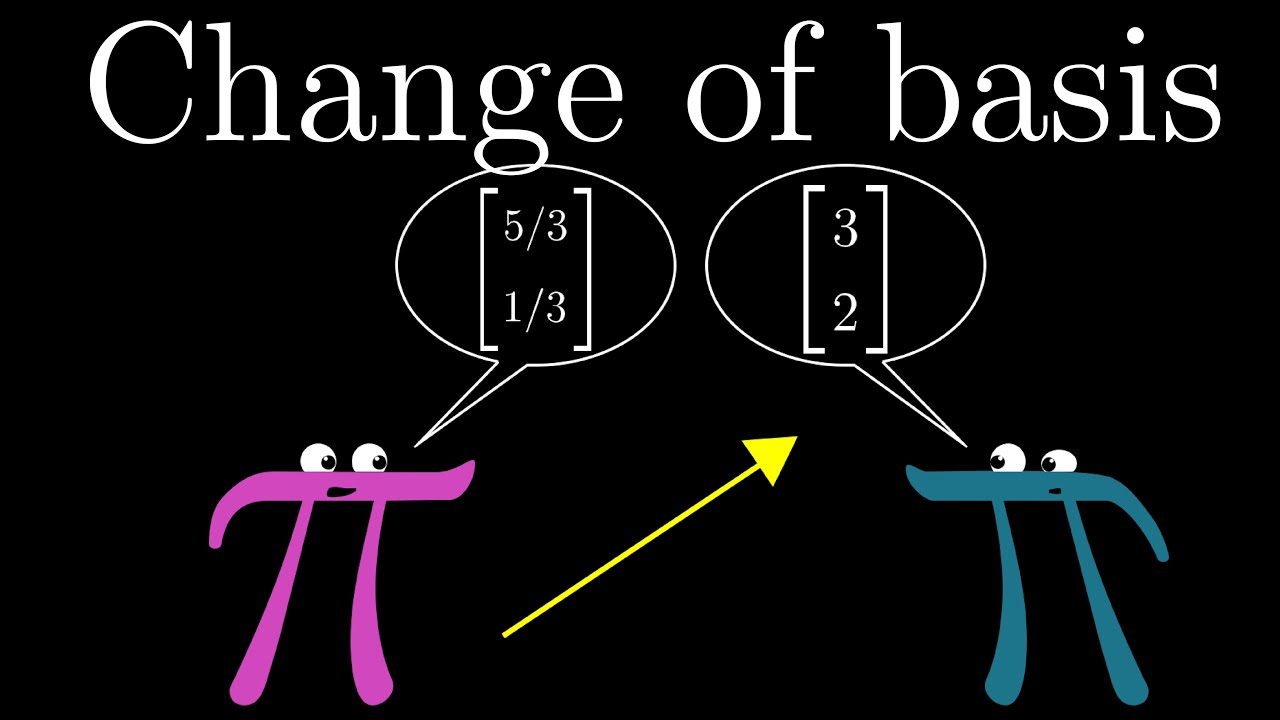
How do you translate back and forth between coordinate systems that use different basis vectors?
Help fund future projects: https://www.patreon.com/3blue1brown
An equally valuable form of support is to simply share some of the videos.
Home page: https://www.3blue1brown.com/
Future series like this are funded by the community, through Patreon, w...


- did i make all the connections between the vid and Theorem 10 correctly?
- does any change of basis matrix (B1, B2 are bases of R^2) correspond to some linear operator on R^2?


 weak blaze
Thanks a lot👍
dawn fractal
dawn fractal
1) did i make all the connections between the vid and Theorem 10 correctly?
2) d...
<@&286206848099549185>
dreamy iron
Hi #linear-algebra 😄


I have an Axler QQ: why does the lemma about spanning lists being reduced to form a basis say nothing about finite dimensionality?
native rampart
He implicitly assumes VS is finite dimensional
dreamy iron
The partner of that particular lemma, the one about linearly independent lists makes a point to call out the fact that the vector space is finite dimensional.
native rampart
For example ,R is spanned by the set of irrational numbers along with 1 as a Q vector space
native rampart
native rampart
He implicitly assumes VS is finite dimensional
Ok, it's more like he assumes choice
native rampart
native rampart
For example ,R is spanned by the set of irrational numbers along with 1 as a Q v...
It's not obvious that R as a Q vector space has a basis if you don't assume choice
dreamy iron
native rampart
For example ,R is spanned by the set of irrational numbers along with 1 as a Q v...
Wait, what‽
There a A LOT of irrationals...
native rampart
Yes
dreamy iron
So that list is like VERY LONG?
native rampart
That list is infinitely long
dreamy iron
good lord
native rampart
It's not obvious there's a basis for that list
There are people who think there is
dreamy iron
So if you assume choice, any infinite dimensional vector space can have a SPANNING list reduced to a basis ??
native rampart
Yes
 dreamy iron
native rampart
Yes
dreamy iron
native rampart
Yes
But that basis is still infinitely long?
I don’t know enough functional analysis to keep up with this....
native rampart
Yes
dawn fractal
dawn fractal
1) did i make all the connections between the vid and Theorem 10 correctly?
2) d...
bumpu
 soft abyss
Maybe a dumb question but, is there a generic matrix I can multiply another Matrix by to make all the lower diagonal elements 0
?
native rampart
0
wintry steppe
Can a spanning list really be reduced to a basis in infinite dimensional case? The proof i know for existence of a basis does not involve reducing a spanning list
wintry steppe
soft abyss
(and leave the upper diagonal elements alone)
No. Suppose there is such M = [x y] [z w], then in particular works for A= [1 0][1 1] but then can show M = [1 0][-1 1]. But that M doesnt work for every matrix (this is the case for right multiplication)
actually even easier: you would have IM = I So M = I
wintry steppe
and i should have taken less time to solve it
 strange delta
for part v wasn't this already shown in part ii because the null is kernel and the col is the image?

 spiral star
well, almost. you just have to take the isomorphism back to R_3[x] and R_2[x]
strange delta
spiral star
well, almost. you just have to take the isomorphism back to R_3[x] and R_2[x]
wdym
lavish jewel
one of the two things deals with coordinate vectors. the other deals with polynomials
spiral star
 strange delta
do you know where i can find this on the book linear algebra done right?
well read more about it
spiral star
you already applied this when you solved (i)
you apply such an isomorphism every time you write vectors in basis coordinates
now you do the opposite and convert from basis coordinates back
dawn fractal
what does "the rank of AB is at most the rank of A and B" mean in inequality form?
wintry steppe
rank(AB) <= min(rank(A), rank(B))
in case you're asking "how do i write this as an inequality"
 dawn fractal
oh ty
strange delta
is it because the basis spans R^4 at this point because we can literally make anything out of the basis ?
wintry steppe
B has rank 4 meaning it's column space is a 4-dimensional subspace of R^4, i.e., all of R^4
the rref tells you this
strange delta
ah yeah
and how was he able to deduce the nullity(b) = 0
well i can kinda just eye it and see any possbile x will just be equal to zero
and hence the null(B) = {0}
wintry steppe
sounds good
 agile lion
How to solve this please?
 wintry steppe
a nice way to check linear independence in this case is to put the vectors together into a 3x3 matrix and take the determinant
 gentle briar
so for the 1st part i got r can be anything but 0 in the real numbers
for part 2 and 3 i am a bit confused
 jagged pendant
Jordan normal form
3 to n get killed
(0 1)
(0 0)
^2
= 0
(0 1)
(0 0)

n=5 example (we're using VC as well if this makes no sense)
 wary sinew
Using Cayley Hamilton theorem
flint jackal
strange delta
and how was he able to deduce the nullity(b) = 0
It's because the matrix is full rank and based on the Rank-nullity theorem rank(B) + nullity(B) = n, where n is the number of columns in a m x n matrix

 nocturne jewel
$0=a_1v_1+a_2v_2+...+a_nv_n$ when $a_1=...=a_n=0$
stoic pythonBOT
moshill1
 nocturne jewel
$f(0)=f(a_1v_1+...+a_nv_n)$
stoic pythonBOT
moshill1
 strange delta
yes agreed
nocturne jewel
wait no, that's wrong
strange delta
i'm wrong or your wrong?
nocturne jewel
My answer is wrong cause it doesnt show that only the scalars all 0 make 0
strange delta
what i meant to show there is the transition from the first set to the second
strange delta
and since we know the first sets a_i are equal to zero
nocturne jewel
only when writing the 0 vector
strange delta
isn't the defintion of linear independent just
$0=a_1v_1+a_2v_2+...+a_nv_n$ when $a_1=...=a_n=0$
stoic pythonBOT
redd
 nocturne jewel
yes, you never wrote that
you wrote for a general element in V, which is span not independence
Assume {f(v1),...,f(vn)} is a dependent set, show that's a contradiction
strange delta
but in the question we assume the first set is linearly independent don't we
so i can automatically assume a_i = 0
nocturne jewel
yes, and that will show that all scalars 0 will make the 0 vector
but that doesnt meant they're indep
${v,2v}$ is clearly dependent, but $0=0(v)+0(2v)$
stoic pythonBOT
moshill1
 strange delta
hmm
the way i normally show independence is showing it's under addition and multiplication
nocturne jewel
what?
strange delta
nvm, do you know a way to do this question?
nocturne jewel
nocturne jewel
Assume {f(v1),...,f(vn)} is a dependent set, show that's a contradiction
.
strange delta
nocturne jewel
.
when showing that would it be similar to how i attempted the question
nocturne jewel
it'd show that only the set of scalars {0,0,...0} would work
which is what is desired
acoustic zodiac
What is the reasoning behind defining a conjugate transpose as (where $A^\dagger$ is the conjugate transpose):
$<u|A^\dagger(v)>=<A(u)|v>$
stoic pythonBOT
rcatalang
 acoustic zodiac
Assuming it's a linear application and not a matrix
wintry steppe
I would like to understand this idea for the matrix of a vector x in V in basis B, where x = x1 v1 + ... + xn vn. xi in F,=
And we can view any vector x in V as defining a linear map x : F -> V, where 1 gets mapped to x, and lambda gets mapped to lambda * x
Where 1 is the standard basis element of F
agile lion
wintry steppe
a nice way to check linear independence in this case is to put the vectors toget...
What to do after taking the determinant?
wintry steppe
well, the determinant will tell you whether or not it's linearly independent
det A = 0 if and only if the columns of A are linearly dependent
wintry steppe
guys, acording to this

what is L_mn??
like, mn loop through the pixels of the image?
Or it is the degree?
odd kite
no, the image is f(x,y). m n are indices which identify a particular moment
@wintry steppe
wintry steppe
so every pixels needs its moment?
 viral isle
Completely new to linear algebra. How do I convert this problem into linear algebra equations: (1/2)at^2 + v0 + c0 is distance of object from observer at time t, where a is acceleration, v0 is initial velocity and c0 is initial distance from observer.
At 1 second, object is 20 metres from observer, 2 seconds it is 55 metres away, 3 seconds it is 110 metres away
Is it simply:
0.5a v0 c0 20
2a v0 c0 55
4.5a v0 c0 110
dawn fractal
v0t or v0? @viral isle
viral isle
v0
I think I'm wrong because v0 and c0 all being 1 means I can't get it into Reduced Row Echelon Form since they'd all end up being 0s or 1s
@dawn fractal
stoic pythonBOT
!superficialsicko
 viral isle
oops, I actually had 4.5a
Edited
Thanks
I'm still not sure it's correct because when I try to get it into reduced row echelon form my v0's and c0's are always identical
dawn fractal
use Gauss-Jordan elimination method
viral isle
I currently have:
1 2 2 40
0 3 3 25
0 8 8 70
dawn fractal
then what
viral isle
I'm unsure how to proceed tbh
dawn fractal
do the same thing u did from the first step
viral isle
ok
dawn fractal
where u reduced the other entries in the first column to 0
do that for the 2nd column
viral isle
My first step was to take the first row from the second and third to get the 0s
but if I do that now won't it just but numbers back in the first column's 2nd and third rows?
dawn fractal
that's basically what we're doing
now u need to make sure column 2 has a leading 1 in row 2
but we're working with a smaller matrix now
ignore the first column and row for now
then consider the matrix obtained from that
viral isle
oh
dawn fractal
essentially make row 2 equal to 0 1 ... ...
and row 3 equal to 0 0 ... ...
and after that, make row 3 equal to 0 0 1 ... (or 0 0 0 ..., otherwise )
dawn fractal
dawn fractal
essentially make row 2 equal to 0 1 ... ...
do this by dividing row 2 by its 2nd entry
viral isle
1 2 2 40
0 1 1 8.33
0 8 8 70
viral isle
Then eight times row two from three, I guess?
1 2 2 40
0 1 1 25/3
0 8 8 70
dawn fractal
yes, subtract row 3 from that
viral isle
1 2 2 40
0 1 1 25/3
0 0 0 (200/3)-70
dawn fractal
yep
viral isle
So dumb question, but how can 0 0 0 = anything other than 0?
dawn fractal
we're actually searching only the first 3 columns for leading 1s
yes
this is why i asked if u were sure about v0
im familiar with the formula (1/2)at^2 + v0t + c0 = distance
not (1/2)at^2 + v0 + c0
viral isle
yep, it's definitely the latter
dawn fractal
viral isle
So dumb question, but how can 0 0 0 = anything other than 0?
it means the system has no solution, so there's something wrong with your setup
probably a typo
and forgot to type t after v0
try it
replace v0 by v0t
and the system will be consistent
viral isle
Hmm, that might be it
viral isle
we have only been shown the elimination steps, not how to put formula into linear algebra equations form. I thought it was a simple as what I was doing but assumed I was wrong because I kept getting an answer on the right in the third column with all 0s, as we have done here
Guess it's good to know I was on the right track
Feel like I just wasted your time though
Thanks for your help, I'll check with the teacher on Monday
 rough aspen
Hi I feel like this is a really easy question but I'm getting it all wrong. Could I get some assistance thank you
 dreamy iron
Hi #linear-algebra.
If I have a vector space V, with subspace U. And I have a linearly independent list of vectors is U, how do I know the linear independence is preserved in V.
This feels intuitively true, but I don’t actually know how to prove it.
Like obviously if ONLY the trivial combination is the only way to get the ZERO vector in U....I need it to be the case that the trivial combination is also the ONLY way to get the ZERO vector in V.
And the two, V and U are over the same field.....
dusky epoch
i mean
the defn of linear independence doesn't quantify over vectors of the space you're in
but rather over tuples of coefficients
like, any linear combination of your list (of vectors in U) will still be in U
and it's not like U and V have different zero vectors anyway
dreamy iron
So a list of linearly independent vectors forms a span. The span is a subspace of the ambient vector space....
Yeah....i don’t think that does it....
 limber sierra
why is span coming up?
dusky epoch
any list has a span
limber sierra
you dont care about span, you care about linear independence
dreamy iron
limber sierra
why is span coming up?
I’m shooting in the dark
limber sierra
ie the equation $a_1v_1 + a_2v_2 + \dots + a_nv_n = 0$
stoic pythonBOT
Namington
 limber sierra
if $v_1, v_2, \dots, v_n$ are linearly independent, then this implies $a_1 = a_2 = \dots = a_n = 0$
stoic pythonBOT
Namington
 dreamy iron
Im still following
limber sierra
this is preserved regardless of whether you talk about a subspace or the whole space
dreamy iron
limber sierra
this is preserved regardless of whether you talk about a subspace or the whole s...
Do I need to prove this?
limber sierra
since a subspace is over the same field by definition
its immediate
your possible coefficients (ie possible values of a_1, a_2, ... a_n) are the same
since subspaces have the same base field as the vector space
dreamy iron
Yes. Since same field
limber sierra
so the equation carries over without any changes
and has the same solutions
namely, just a_1 = a_2 = ... = a_n = 0
hence we still have linear independence
dreamy iron
I believe every thing you are saying. It’s just crazy that I’ve not seen Axler prove it.
I don’t know. Maybe Im just being paranoid
limber sierra
its kind of an obvious fact
considering a different subspace does nothing to the linear independence equation a_1v_1 + ... + a_nv_n = 0
(assuming v_1, ..., v_n are still in your subspace)
so itll have the same solutions
hence linear independence is preserved.
lavish jewel
you can think of the space as giving some properties to the vectors. if changing the subspace does not change the vectors, linear independence is shown via exactly the same equation, no changes at all.
dusky epoch
what if you operate on an absolute "no such thing as obvious" maxim
dreamy iron
If I tried to show that a set B is linearly independent in U and linearly Dependent in the ambient V....i should get a contradiction, right?
limber sierra
you would struggle to show that
dreamy iron
Lol. Okay
limber sierra
if you managed to show it, that would be a contradiction, yes
if im understanding you correctly
dusky epoch
just as you would struggle to show 2+2=5 
lavish jewel
i'm pretty sure such a scenario would imply that U isn't a subspace of V
dreamy iron
i mean...i could try and contradict that 2 plus 2 equals 5
limber sierra
dusky epoch
just as you would struggle to show 2+2=5 <:kekw:752021756650455061>
this is the face of someone unenlightened to the glories of characteristic 1
dreamy iron
Any way. Thanks for your kind attention. I will write down “it is obvious”
limber sierra
truly tragic that they dont know what theyre missing
dusky epoch
F_1 moment
limber sierra
alas
such is the harshness of life
man now i wanna make an arxiv april fools paper
"Applications of Commutative Algebra to the Ring of One Element"
which just proves a bunch of comm alg theorems in the special case of the trivial ring
(each proof, of course, is "Trivial.  ")
")
dusky epoch
all modules over the zero ring are isomorphic
 snow jetty
did I understand correctly what does the Gram matrix mean?
 lavish jewel
the gram matrix, for a given matrix M, is M^T M (over the reals)
dusky epoch
@snow jetty yes
lavish jewel
yep that looks ok
snow jetty
lavish jewel
the gram matrix, for a given matrix M, is M^T M (over the reals)
Oh yes, indeed, it works if the scalar product as the abstract "bilinear application" and the M lines as the basis. thanks. didn't think about that
dusky epoch
bilinear form with extra properties (symmetry and posdef)
snow jetty
dusky epoch
bilinear form with extra properties (symmetry and posdef)
Yes, in fact the dimension of bilinear applications for R^3 must be "9", but how can they be constructed?
snow jetty
I mean: according to the theory, the set of bilinear applications over a vector space V (Bil(V) aka "f:V->V, bilinear") is also a vector space. And its dimension is dim(Bil(V)) = (dim(V))²
dusky epoch
...yes? what does that have to do with your previous question?
snow jetty
dusky epoch
...yes? what does that have to do with your previous question?
Like suppose I have R³, so how can I define the basis?
dusky epoch
basis of what
snow jetty
of Bil(R³)
dusky epoch
well
you could define nine bilinear forms $p_{ij}$ ($i,j \in {1,2,3}$) by requiring that for all $i,j,k,l \in {1,2,3}$ you have $$p_{ij}(e_k, e_l) = \delta_{ik}\delta_{jl},$$ where $\delta$ is the kronecker delta
in essence, each form sends one of the 9 possible pairs of basis vectors to 1, and all the other pairs to 0
does this make sense?
stoic pythonBOT
Ann
 dusky epoch
alternatively, you could also write this definition as $p_{ij}(x,y) = x_iy_j$
stoic pythonBOT
Ann
 snow jetty
dusky epoch
does this make sense?
snow jetty
dusky epoch
does this make sense?
yes probably, there will be like the "dual basis" of {e1, e2, e3}, and then I make the product of the "covectors", for every possible combination, and it will be like the basis of (Bil(V))
dusky epoch
if you wish...
lavish jewel
ngl, idk why we ended up here when we started at Gramian
snow jetty
lavish jewel
ngl, idk why we ended up here when we started at Gramian
😅 because for every bilinear we have its own Gramian...
The scalar product is just a particular case like M^T * M
snow jetty
Yes, indeed, I didn't even consider the distinction before 😮
The ones that are VxV -> K
 snow jetty
they said that should be the basis. trying to understand the ⦻ sign...
 lavish jewel
looks like outer product/kronecker product
but this Bil(v) seems to be a map, not a form
is it now V x V -> V?
(i might be wrong)
snow jetty
They still mean a form VxV. But I think I understand, omg it's so easy in fact 🤯
The basis will be just {x1y1, x1,y2, x1y3, x2y1, x2y2, x2y3, x3y1, x3y2, x3y3}
snow jetty
Yes but... I thought like it should be a composition of matrices or something like this... but in fact it is impossible to define a matrix for a bilinear form
Because it takes** two damn vectors** and it is a linear map only if one of them is fixed if I understand correctly
this stuff is way too abstract
 faint lintel
Can someone give me a good resource on determining when an operator is normal vs self adjoint vs unitary
So it's normal if TT* = T*T
If we have an orthonormal basis of V consisting of eigenvectors of T then T = T* (self adjoint)
And then if it's normal and the eigenvalues for all those eigenvectors are have absolute value 1 then it's unitary?
zealous junco
pretty sure
if theres an ON basis of V with eigenvectors of T, then T can still be normal
faint lintel
Is the only self adjoint unitary operator the identity matrix?
Cause we'd need such an operator to be TT* = T*T = I
But also T = T*
So then T^2 = T*^2 = I
Oh so then either the identity or negative identity matrix are the only unitary self adjoint operators
I think?
zealous junco
no i dont think so
take for example householder transforms
visually u see its a reflection so its its gonna be diagonalizable, and unitary since it doesnt stretch anything
and its easy to verify
faint lintel
Householder Transform?
zealous junco
Basically a reflection on any hyperplane
faint lintel
I see
 faint dune
proofing positive definit of the L2 scalar

I'm not sure if I see it right, but the p(x)^2 is always positive, so the integral is only 0 if p(x)^2 is 0.
But now I have a slightly different scalar product definition


Can't I argue with the same way, and just say p(x)^2 is positive and has to be 0 therefore ?
Because the proof in the script is a little bit weird and unnecessarily complicated, not sure where my problem is.
wintry steppe
well, you'll get p(x_i) = 0 for each i. what are the assumptions on p and on the x_i's?
 rain drum
hi, can somebody tell me, do u know some kind of book, that has exercises for jordans canonical form with results? i would appreciate it thank u ❤️
wintry steppe
friedberg insel spence
rain drum
it seems good, thank u
 twilit minnow
can someone explain row echelon form to me? apparently this is in REF but i read that there has to be a row of all zeros below entries
 odd kite
you read wrong
faint dune
Its about Lagrange Polynoms, interpolation. p is element of Polynom Space of degree n
faint dune
wintry steppe
well, you'll get p(x_i) = 0 for each i. what are the assumptions on p and on the...

This was the proof in the script, which even looks wrong to me at line 3.10
the coefficient aj is missing before the lj and the result would be two sums, one over i and one over j at the end of the aj^2.
The proof is based on the idea that the lagrange polynoms lj are a basis, so linear independant.

 minor bluff
is the row space of a matrix a span of all its row vectors?
 sand apex
Is strang or axler better in your opinions?
question really boils down to why isnt axler listed in resources when it seems to be a popular choice in schools
minor bluff
ah okay ty
odd kite
if you're looking more in the applied/computational direction Strang may be better, and may be better overall, put if you're looking for pure math maybe look at Axler
yeah
Axler has a bent against determinants which isn't great so you'll have to learn about those elsewhere
sand apex
didnt axler come up with his method of determinants?
odd kite
idk, his book is famous for not using determinants
odd kite
but otherwise is has a nice clean presentation that's good from a pure math perspective
sand apex
yeah i appreciate the rigorous foundations of spans, directsums and such as presented in his texts - it builds off from these concepts
wintry steppe
sand apex
why would he do that
dawn fractal
this is the function defined

i don't get the 1st sentence

in particular, the 2nd equality
lavish jewel
dawn fractal
this is the function defined
in this definition, you have f(x,y)
lavish jewel
dawn fractal
i don't get the 1st sentence
here, f(y,x), so the x is conjugated instead of the y
after that, just use your regular complex conjugate properties
it distributes over products and sums
and a_i is real, so it is not affected
lavish jewel
yes
lavish jewel
what
dawn fractal
hmmm
lavish jewel
i think you mixed up the subindex i with the imaginary unit
dawn fractal
there
lavish jewel
still
dawn fractal
wdym
lavish jewel
$\sum_n a_n x_n y^*_n$
stoic pythonBOT
Edd
 lavish jewel
the star there is complex conjugate
dawn fractal
i literally meant $xi$
stoic pythonBOT
!superficialsicko
 dawn fractal
and $yi$
stoic pythonBOT
!superficialsicko
 lavish jewel
like multiplied by i?
dawn fractal
yes
lavish jewel
well, are x and y real or complex?
i think in this scenario they are in general complex
lavish jewel
so $\text{conj}(i\cdot x) = -i \cdot \overline{x}$
lavish jewel
x_i is of the form x + i b
dawn fractal
i literally meant 0+xi and 0+yi
lavish jewel
ok, sure, but that's not what you have in the text above. just so you know.
stoic pythonBOT
Edd
 lavish jewel
stoic python
**Edd**
lavish jewel
stoic python
**Edd**
this is always valid btw, even if x is real
sure
sure, if n = 1 you have $a_1 x_1 \overline{y_1}$
stoic pythonBOT
Edd
 dawn fractal
so is f(0+xi,0+yi)=a_1(0+xi)(0-yi)?
lavish jewel
sure
dawn fractal
ok
lavish jewel
just to reiterate though, that is not the form of the x and y up there
dawn fractal
i was asking about the specific case
lavish jewel
ok
dawn fractal
so real conjugate of a+bi is -a+bi?
lavish jewel
real conjugate
dawn fractal
?
lavish jewel
i have never heard of that
maybe it's defined in some scenario, but i have never seen that
dawn fractal
dawn fractal
i don't get the point of adding "complex" to conjugate of a complex number
as in "complex" conjugate
lavish jewel
maybe to denote that it only makes sense for complex numbers
dawn fractal
hm
dawn fractal
stoic python
**Edd**
is this by definition?
lavish jewel
you can prove it
it isn't a definition
it's a consequence of the definition and properties of the complex conjugate
dawn fractal
let's say all x_i's and y_i's are respectively of forms a+bi and c+di
then f((x_1,...,x_n),(y_1,...,y_n)) = a_1x_1(c'-d'i) + ... + a_nx_n(c^(n)-d^(n)i)
lavish jewel
i don't understand your notation there
lavish jewel
wintry steppe
dawn fractal
wait
basically the first sentence follows from f being an inner product?
since f(x,y) = conjugate of f(y,x)
lavish jewel
isn't it backwards?
dawn fractal
wdym
lavish jewel
you're trying to show that this is an inner product
dawn fractal
ah
dawn fractal
stoic python
**Edd**
i still don't follow from this
i'm not much acquainted with complex numbers
lavish jewel
now factor out a -i
dawn fractal
-i (a-bi)
lavish jewel
and if x = a + bi, what is a - bi?
dawn fractal
conj x
lavish jewel
there you go
dawn fractal
but i don't see any i in the summation
lavish jewel
me neither. this is for the expression you made up
dawn fractal
the imaginary number i mean
lavish jewel
this is the general form of the example you made up, for whatever reason
dawn fractal
so how do i show the first equality
lavish jewel
i didn't know if you meant to use $x, y \in \mathbb{C}^n$ as in the original problem, or if $x, y \in \mathbb{R}^n$
stoic pythonBOT
Edd
 lavish jewel
you show the first equality the same way we just did
first, show that the complex conjugate distributes over sums
then, show it distributes over products
and that's it
dawn fractal
so to do that i need to add the terms of the summation first?
to get a complex number
lavish jewel
use an ersatz sum that is simpler
let w_n = a_n x_n y^*_n be a generic complex number a_n + i b_n
work with the sum of w_n's first to show what happens if you complex conj the whole sum
and then show what happens if you conjugate one individual w_n
the way they present this just in passing kinda implies these are things one should've learned before. i guess now is as good a moment as any for you to do so 😛
dawn fractal
that's just my prof assuming xD
i haven't learned complex numbers in-depth before college, only a bit
sum of w_n's vs only one w_n?
lavish jewel
yeah
if you show the conjugate goes into each summand individually, you don't need to bother with the sum anymore
so show it goes into the sum, and then apply it to one element to see what happens when you conjugate a product
past this point i would suggest you go to #real-complex-analysis
dawn fractal
i see
lavish jewel
what type of "modulus" are we talking
you could use an inequality
if you absolutely must split it, all you can do is provide a bound
since the result depends on how x is represented as a linear comb. of the matrix's row space/domain and its orthogonal complement
smth like |Ax | <= |A|_(induced 2 norm) |x|
otherwise, decompose x in the basis of the row space and factorize A somehow
but if you have A and x, the easiest is to multiply first, take norm after
wintry steppe
Let T : R^3 -> R^4 be a linear map such that T(1,0,0) = (1,0,1,0), T(0,1,0) = (0,1,0,1), and T(0,0,1) = (1,1,1,1). Find a basis for null T and range T
I think it's clear that a basis for the range of T is (1,0,1,0),(0,1,0,1)
And a basis for null T would be (1,1,-1)
(I think)
How would I make sure these answers are correct, if they are?
native rampart
Use rank nullity
wintry steppe
I don't know what that is
native rampart
rank(T)+null(T)=3 here
wintry steppe
Yeah, so that's one sanity check
dusky epoch
well the range of T is spanned by the values of T at (1,0,0), (0,1,0) and (0,0,1)
wintry steppe
Which is good
dusky epoch
for the nullspace you can just write out the explicit formula for T and find the nullspace as the solution set of T(x)=0 [treating this as a linear system]
wintry steppe
That's what I did I think
So to write the matrix for Tv, where v in R^3, I had this
$\begin{bmatrix} 1 & 0 & 1 \ 0 & 1 & 1 \ 1 & 0 & 1 \ 0 & 1 & 1 \end{bmatrix} \begin{bmatrix} a \ b \ c \end{bmatrix} = \begin{bmatrix} a + c \ b + c \ a + c \ b + c \end{bmatrix}$
stoic pythonBOT
n/c
 wintry steppe
Because 1,0,0, 0,1,0 and 0,0,1 form a basis for R^3
I just looked where they are sent by Tv and put them as the columns of the matrix
And a,b,c is an arbitrary vector in R^3
So then for the null space, we want a + c = b + c = 0, which gave me (1,1,-1)
For the basis of the null space
native rampart
Yes
wintry steppe
But how do I make sure it's correct?
native rampart
So you need a+c=0 and b+c=0
dusky epoch
wintry steppe
But how do I make sure it's correct?
doublecheck your work? idk
native rampart
Implies a has to be -c and b has to be -c
dusky epoch
triple check
native rampart
That's it
wintry steppe
How do I double check it"
dusky epoch
you doublecheck a piece of your own work by going through it again and reading every step out loud making sure you know exactly why each step was taken and why it is all correct
this should be done only a certain time after writing it, so as not to lull yourself into a false sense of security like "oh i know this is ok"
lavish jewel
if you got the spaces right, you should be able to check they satisfy all the definitions.you can also pseudo invert stuff in the image back onto the row space
wintry steppe
So basically
I need to check that ${ a_1(1,0,1,0) + a_2(0,1,0,1) : a_i \in \mathbb{R} } \subseteq \mathrm{range~}T$ and $\mathrm{range~}T \subseteq { a_1(1,0,1,0) + a_2(0,1,0,1) : a_i \in \mathbb{R} }$
stoic pythonBOT
n/c
 wintry steppe
And similarly for null space?
And then also that they're linearly independent, but that's obvious
?
dusky epoch
i mean yeah you could do this
neither check is really all that hard
it's more bookkeeping than anything
dusky epoch
every vector of the form (a1, a2, a1, a2) is the value of T at some point
wintry steppe
I need to let x = (a + c, b + c, a + c, b + c) right?
dusky epoch
?
dusky epoch
you are showing that every vector of the form a1(1,0,1,0) + a2(0,1,0,1) is the value of T at some point
more concretely in this case it happens to be equal to T(a1, a2, 0)
thats all you need
wintry steppe
What?