#linear-algebra
2 messages · Page 202 of 1
 north hedge
 wintry steppe
Let $U$ be a subspace of $V$. If $U \neq V$, then $\dim U < \dim V$. Suppose that $U \neq V$. We know that $\dim U \le \dim V$. Suppose that $\dim U = \dim V$. Then let the basis of $V$ be $u_1,\dots,u_n$ and the basis of $V$ be $v_1,\dots,v_n$. Append vectors $v_j,v_{j+1},\dots,v_{j+k}$ to the basis of $U$ such that $U = V$.
We then know that $\mathrm{span}(u_1,\dots,u_n,v_j,\dots,v_{j+k}) = V$ and that all vectors in this list are linearly independent, as none of the $v_i$ were in $U$ for them to not be equal. But observe that the length of this list is $n + j + k$, but we know that length of $\dim V = n$, so we have that $n = n + j + k$ which implies that $j + k = 0$. Clearly, $j,k > 0$ which implies that $j = k = 0$ which is a contradiction to the assumption that $U \neq V$ as this would imply that the two subspaces are equal without appending any vectors to $U$ from $V$. Thus, $\dim U < \dim V$.
Does this proof work?
 stoic pythonBOT
n/c
 wintry steppe
<@&286206848099549185>
wintry steppe
Can anyone check my proof?
 hard drum
Would it not be more straightforward to do the contrapositive i.e. if dim U = dim V then U = V?
 dusky epoch
@wintry steppe you should be explicit about the fact that "if U != V then dim(U) < dim(V)" is a goal, not an assertion. it reads as an assertion rn.
and also you need V findim as a hypothesis. if V is infinite dimensional it can have infinite dimensional proper subspaces.
also, "the" basis? there's (almost) no such thing as a vector space with one and only one basis.
also what's that with appending vectors to the list of u's "such that U = V"?
and why is this new list LI?
also the length of your new list isn't n+j+k, it's n+k+1.
 empty copper
What's the question?
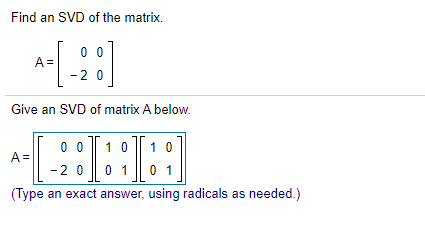
 shadow gyro
Can the characteristic polynomial of an Endomorphism be defined without any choice of Basis or usage of matrices?
 lavish jewel
vici, that is not an SVD
you will have to read the definition to see why, but first of all, you have a 0 vector on the leftmost matrix
by definition, the SVD has an orthonormal basis for the image of the original matrix as well as its orthogonal complement (i.e. in an M x N matrix, the leftmost matrix is M x M with M orthonormal columns) as the leftmost matrix, and yours doesn't
since the 0 vector is linearly dependent
 flint jackal
@waxen flume Also the reason you're getting A is because you're multiplying by the identity matrix. Any matrix times the identity matrix, you get the same matrix, kinda like any number multiplied by 1, you get itself
 nocturne oracle
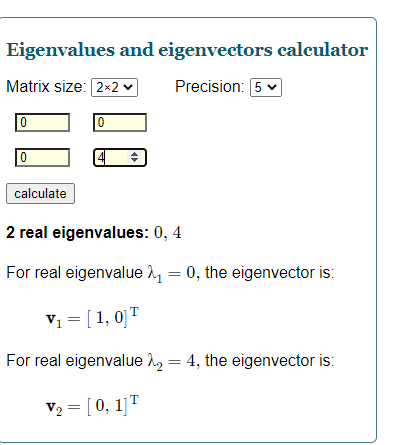
0
 waxen flume

I redid my work
but now im stuck on finding u_2
because if i do 1/0 its division by 0 obviously
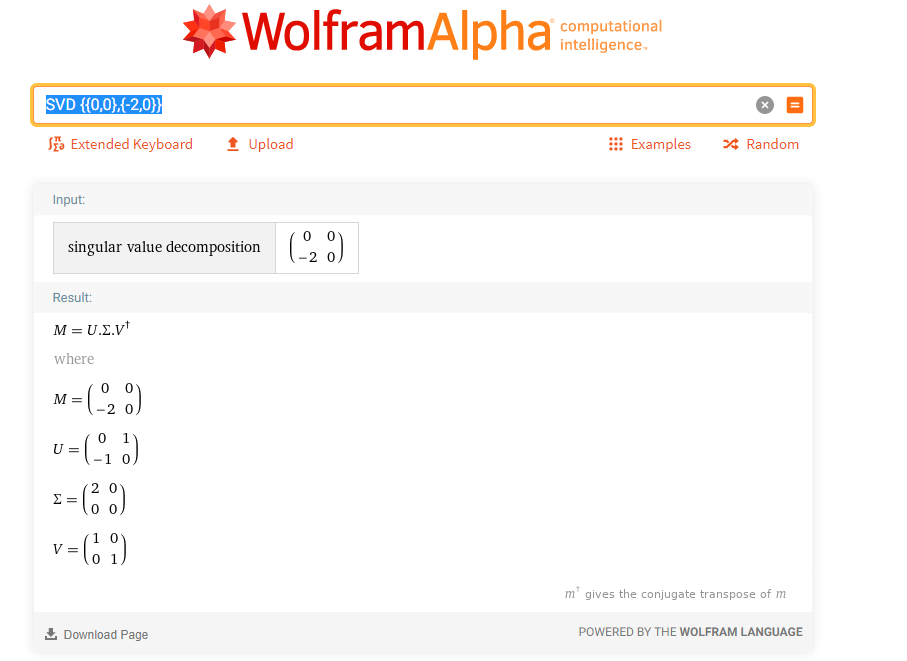
what is wrong with my Us
I dont get it
flint jackal
Do AA^T, plug in the eigenvalues and that's the U matrix
waxen flume
?
flint jackal
You did A^(T)A, and found the eigenvalues for the V matrix, do the same process except AA^(T)

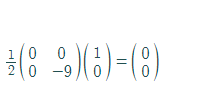 flint jackal
Or you can do the method I said too, it works
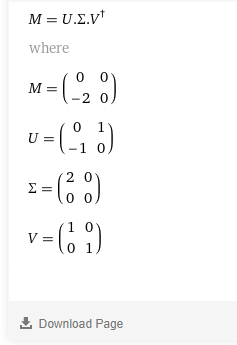 flint jackal
Those vectors are in the span of U
waxen flume
i guess they did it wrong
because when i did it in my calculator
i got the same as wolfram

BUT
for the second U column
this makes no sense
because
1/0 * [A] * [v2]
flint jackal
Which is exactly why I said do my method, because you don't get a divide by 0 error
If you do it my way
waxen flume
whats your method
flint jackal
AA^(T), plug in each eigenvalue, find the eigenvector corresponding to that eigenvalue, and that's the U matrix
 flint jackal
Work it out yourself and you'll see that it's not equal
It's the same concept as A * B != B * A
 flint jackal
Plug in the eigenvalues and find the eigenvectors
didnt know that
@waxen flume How long have you been doing matrix multiplication/linear algebra to not know that?
waxen flume
i got
waxen flume
flint jackal
> didnt know that
<@312632830230396940> How long have you been doing matrix mult...
we dont talk about that

 flint jackal
You messed up when finding the eigenvector for 4
You forgot a negative sign
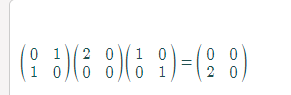
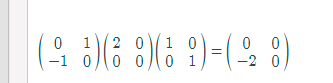
You do need that negative sign, because if you don't, when you do UΣV, you get a positive 2 in the A matrix instead of negative 2
 flint jackal
Multiply UΣV, and see what you get
 flint jackal
I'm telling you, do it by hand
 flint jackal
Because it needs to be a -1 to produce a -2 in the A matrix
waxen flume
okay
but i did the whole eigen system process
and i didnt get any -1 in my eigen vectors
 flint jackal
Technically, you used the negative. You choose the 0 to be negative
If you choose the 1 to be negative, that's how you find it or you trial and error to find out which term should be negative
waxen flume
there has to be a reason why 1/sigma * A * V_i didnt work in my case
there's gotta be easier way to compute this lol
flint jackal
Because the σ was a 0
That's why it didn't work
Or if you know, the eigenvectors should be orthogonal so you can guess the missing vector
And you're normally not going to do SVD like that, unless you're doing image compression. Other decompositions are faster. Those are just problems to help you understand the concept of SVD
flint jackal
LU decomposition, V * Λ * V^-1 (which is eigen decomposition)
waxen flume
thanks @flint jackal
flint jackal
LDU is another one
waxen flume
im gonna watch more examples of the svd decomposition
flint jackal
It's simple if you do the process I told you, it's tedious but you can get all the vectors easily
waxen flume
the thing is with your process for the U part
i got the eigenvalues/vectors
but that negative im clueless on still
flint jackal
Or to find the U matrix, you can do (A * Vi) /(Norm(A * Vi))
but that negative im clueless on still
@waxen flume Like I said, if you multiplied out UΣV, and did not get A, that means one of the vectors has the wrong sign
flint jackal
Yeah
Normally, a SVD problem shouldn't have that many 1s but because it was a simple question that produced matrices of 1s, just trial and error
flint jackal
Linear algebra is easy
waxen flume
Normally yes, but the computations can be tedious.
its definitely easier than calculus 2 and 3
flint jackal
Normally yes, but the computations can be tedious.
@waxen flume Which is why you should use a calculator for matrices bigger than a 3 x 3
 novel hamlet
How do you make jordan decomposition
waxen flume
 frosty vapor
rip in peace
frosty vapor
rip in peace
why
 novel hamlet
waxen flume
my eigenvalues are -3, -4, -5, 0
does that make it negative definite?
novel hamlet
waxen flume
my eigenvalues are -3, -4, -5, 0
does that make it negative definite?
No, its negative semi definite
waxen flume
novel hamlet
No, its negative semi definite
thanks.
 zealous junco
ye
novel hamlet
kinda forgot how to calculate nullspace
been 9 months since i needed that last time
zealous junco
you get rref form right
and like when you see any number to the right of pivot 1
then those numbers could be set to anything
not really helpful i guess unless it reminds you of the method
novel hamlet
yeah found out how to do it, im trying to do some jordan decompositions
and im tilted af on these
wtf happens in these jordan youtube tutorials
 novel hamlet
oh ffs, this is for when we know A
zealous junco
but this just looks like
eigendecomp
which is a special case
just solve for eigenvalues and find eigenvectors, then you find p
note P contains the 2 eigenvectors as columns
novel hamlet
back to youtube i go
 nocturne jewel
Computing kernel is the same as solving for the homogeneous system Ax=0
novel hamlet
that youtube was not really helpfull, since i need to do B=PAP^-1
and in that case I had A
nocturne jewel
$\begin{bmatrix} 3&4&0\3&4&0\end{bmatrix}\to\begin{bmatrix} 3&4&0\0&0&0\end{bmatrix}$
stoic pythonBOT
moshill1
 nocturne jewel
so the eigenvectors are vectors [x,y] which satisfy 3x+4y=0
novel hamlet
yeah i have done eigenvalues for my matrix M now i just needd to figure out how to do jordan for it
wait a second, couldnt i do it this way take M -> eigen values diagonally = middle matrix in jordan -> do nullspace and get P and then inverse P to get P^-1?
oh yes its all coming together now
flint jackal
novel hamlet
wait a second, couldnt i do it this way take M -> eigen values diagonally = midd...
If you put the eigenvalues in a diagonally matrix, it'll be an n x n matrix, right? Won't it have dim(ker(A)) = 0?
novel hamlet
wait a second, how i determine for 3x3 matrix if one of the 2 eigenvalues is double eigen?
 surreal otter
doesnt matter
you put them in too from what I know
similar to repeated roots of a polynomial
novel hamlet

i got this situation i know my Jordan should have -1,-1,-0,5 or -1,-0,5,-0,5
but im unsure on how to determine the correct choise (spoiler it is the first one)
surreal otter
by hand, that is?
novel hamlet
yeah
surreal otter
could try Newton-Raphson
novel hamlet
or any reasoning i could use to justify selecting one
flint jackal
@novel hamlet Can you post your original problem? I want to see what the goal/problem is
 flint jackal
And that's what it says to use? Jordan decomposition?
novel hamlet
no method spesified as long as i can get it to jordan normal form and get that decomposition out of it
surreal otter
pardon my ignorance, but isnt that just diagonalizing?
novel hamlet
I prefer to call it diagonalization with extra steps
surreal otter
so what are your steps so far?
novel hamlet
calculate eigenvalues for A, then proceed to calculate Ker(A-eigen x I)
then combine null spaces to matrix P
surreal otter
I meant as in your working
novel hamlet
i managed to do eigenvalues for A, but im only getting 2 instead of 3 i need
surreal otter
probably one that is repeated
flint jackal
There's a repeated eigenvalue
novel hamlet
yes, but i dont know how to determine wich one is repeated
surreal otter
solving the cubic is a good start
flint jackal
,w solve -x^3 - 5/2 x^2 - 2 x - .5 == 0 for x
stoic pythonBOT


 Requested by dldh06#2659
 flint jackal
Well, it's the -1 that's repeated
surreal otter
novel hamlet
you can form it to this
yup, was looking for that, now you know which one is repeated
novel hamlet
yeah this should help, next i just need to do Ker(A-(-1)I)
 novel hamlet
how did you get that-1.5?
novel hamlet
oh i got typo
flint jackal
@novel hamlet Your Characteristic Polynomial is wrong
novel hamlet
yeah i accidentally put wrong value
noticed it already
hmmm, come to think of it the nullspace of that is trivial
wait this method does not work


cant go via ker(A-eigen x I) route here
i dont get why J gets that poisitive 1 on 2nd row
frosty vapor
waxen flume
why
oh nothing lol i was just poking fun ahah ur good. SVD has D for decomposition so i thought it was funny to see svd decomposition in the same way as rip in peace. ur good lol
lavish jewel
singular svd value decomposition
novel hamlet
edd, yuou got any idea where im getting it wrog?
flint jackal
novel hamlet
edd, yuou got any idea where im getting it wrog?
Are you still doing that problem?
novel hamlet
yeah, cant figure out, since null space is trivial
and not 100% sure where that positive 1 comes from
since if null space is trivial this whole thing does not work out
novel hamlet
flint jackal
Are you still doing that problem?
do you know how to get P when we know A and J for A=PJP^-1
flint jackal
Isn't P, just the eigenvector matrix?
novel hamlet
no, at least when you look the above photo, from wolfram the eigenvectros dont hit anywhere
flint jackal
I haven't done much with with Jordan decomposition so not sure
novel hamlet
usual algorithm for this would be, get eigenvalues for A, get ker(A-eigen x I)
and J comes from egenvalues of A and is diagonal P is some kombination of null spaces
but since my null space is trivial this thign does not work
flint jackal
novel hamlet
but since my null space is trivial this thign does not work
What do you mean by this exactly?
novel hamlet
I'd get 0,0,0 as my vector and that does not appear as column anywhere on PJP^-1
for matrix P
flint jackal
Not 100% sure then, sorry
novel hamlet
please somepne ping me if you could help
lavish jewel
what's the q
novel hamlet
lavish jewel
what's the q
what Q?
lavish jewel
question
novel hamlet
jordan decomposition for

I have done eigenvalues and got the J
but when i try to do ker(A- eigen x I) i get that the result is trivial
when using eigen = -1
 lavish jewel
i'm afraid i can't help
lavish jewel
i don't know what a jordan decomp is 😛
 gray dust
lavish jewel
i don't know what a jordan decomp is 😛
gray dust
lavish jewel
i don't know what a jordan decomp is 😛
decomp using jordan normal form
novel hamlet
yeah basically get jordans normal form (done) and then find common eigenvectors for P and then invert P
using

where A is square matrix € C and lambda is eigenvalue of it € C
 faint lintel

I am confused as to how the matrix transformations on the left of each 3 x 6 matrix work in relation to the right hand side
Like the first change
how does 1,2 and 3,2 change by the right hand side remains as the identity matrix
like the first operation is adding the left most column to second column
But then the second transformation of adding row 1 to row 2 changes the right hand side matrix
I don't get it
Yea I'm stuck for 2c

<@&286206848099549185>
flint jackal
faint lintel
like the first operation is adding the left most column to second column
Not entirely sure why those operations are legal but can't combine columns like that because the first column is x while the second is y, you just can't have (x+y) in the column
 golden kelp
novel hamlet
when using eigen = -1
golden kelp
novel hamlet
when using eigen = -1
I haven’t tried the question but if you get λ = -1 then you need to consider ker(A - - I) = ker(A+I), I think you’ve done ker(A-I)
faint lintel
flint jackal
Not entirely sure why those operations are legal but can't combine columns like ...
yea me either but that's what the book says >_>
 flint jackal
 edgy kelp
https://i.imgur.com/kXtIJis.png
edgy kelp
https://i.imgur.com/kXtIJis.png
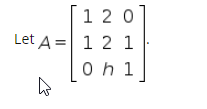
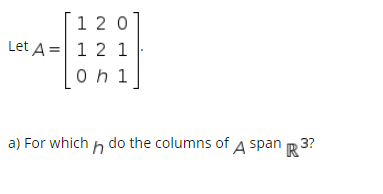
Row reduce like normal, except you'll have an h term
golden kelp
r2= r2-r1 seems like a good start
edgy kelp
[1;2;0;0;h;1;0;0;1]
The idea is to get the h in a position where it would have an effect on the pivot in last column
golden kelp
That’s not rref
edgy kelp
No I know
golden kelp
One second
 flint jackal
edgy kelp
[1;2;0;0;h;1;0;0;1]
flint jackal
edgy kelp
[1;2;0;0;h;1;0;0;1]
Separate with commas and semicolons
novel hamlet
golden kelp
I haven’t tried the question but if you get λ = -1 then you need to consider ker...
Gona try dat next just finishibg my food
 golden kelp
Step 2 is r3 = r3 - r2
edgy kelp
oh i see
flint jackal
golden kelp
You should try again, there's errors in the first step
golden kelp
No there isn’t
flint jackal
There is
flint jackal
Element 2,3 should be -1
golden kelp
flint jackal
Element 2,3 should be -1
Why?
golden kelp
I am correct my friend
golden kelp
edgy kelp
This is homogenous right willrum
If h is not 0
 weak blaze
Hello
Prove that the determinant and trace of the linear transform A are independent of the base selection in the range set of the transformation.
golden kelp
If h=0 there is nontrivial kernel
weak blaze
weak blaze
Prove that the determinant and trace of the linear transform A are independent o...
İs there anyone solve this?
edgy kelp
Ah okay @golden kelp
golden kelp
weak blaze
Prove that the determinant and trace of the linear transform A are independent o...
You can do this a couple of ways. You can show that the characteristic polynomial is independent of basis and then the fact that the constant term in the characteristic polynomial is the determinant and the coefficient of x^(n-1) is the trace
weak blaze
Hmmm
I don't know much about the characteristic polynomial.
Can you explain Liitle more? :)
weak blaze
Ohhh thank you so much 👍👍
 snow jetty
weak blaze
Can you explain Liitle more? :)
snow jetty
weak blaze
Can you explain Liitle more? :)
A Matrix M has an eigenvector v if M*v = λv, where v is a vector and λ is a scalar. This means that Mv - λv = 0 and the vector belongs to Ker(M - λI).
snow jetty
That's why a characteristic polynomial has all eigenvalues as roots. As it is exactly det(M-λI) which is zero if you plug in an eigenvalue.
snow jetty
👀 ps
It's about proving that two similar matrices have the same characteristic polynomial and determinant?
weak blaze
snow jetty
A Matrix M has an eigenvector v if M*v = λv, where v is a vector and λ is a scal...
Aha ı got it. Eigenvectors and eigenvalues are in the last chapter in the book I'm working on. But you explained it well. I think in this way, we can see that the trace is calculated independently from the range set.
golden kelp
snow jetty
It's about proving that two similar matrices have the same characteristic polyno...
Have the same determinant and trace. I mean what you said was correct but the question wasn’t about the eigenvalues per se
weak blaze
I will learn eigenvalues and eigenvektor
snow jetty
snow jetty
It's about proving that two similar matrices have the same characteristic polyno...
That's because A and B are similar iff there is invertible P s.t. P^-1 * A * P = B
In fact, A and B do the same application. P "rewrites" the vector into another basis
And P^-1 gets back to the initial basis.
And det(A^-1)=1/det(A) for inversible A.
That can be proved by considering the determinant follows det(AB) = det(A)*det(B). You can prove it if you consider det as a multilinear function (just a long calculation with a lot of Σ)
That's why similar matrices have same determinant
weak blaze
But the problem is not about having the same determinant. Sorry maybe ı got you wrong
snow jetty
As to the characteristic polynomial: consider det(M - λI). Then consider det(P*(M-λI)*P^-1).
weak blaze
snow jetty
As to the characteristic polynomial: consider det(M - λI). Then consider det(P*(...
Okayyy okayyy now ı get you
Woow that's so Cool way if you are right
snow jetty
(let me think, I am improvising 🙃 )
snow jetty
Yes indeed you can do so.
snow jetty
snow jetty
As to the characteristic polynomial: consider det(M - λI). Then consider det(P*(...
This 👆 is the same expression as det(P^-1 *M * P - λΙ)
weak blaze
Yeah I understood how proof it is. So now I have to study eigenvalues and eigenvectors. Good by and thanks a lot 🙏
snow jetty
weak blaze
Yeah I understood how proof it is. So now I have to study eigenvalues and eig...
👍
edgy kelp
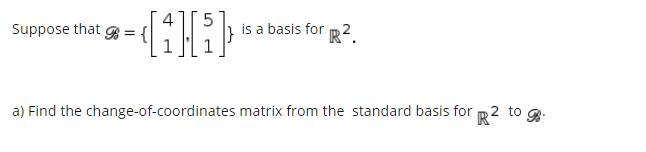
Does anyone know how to find this change of coordinates matrix
Is it just [4;5 , 5; 1]
flint jackal
edgy kelp
https://i.imgur.com/jycF0VN.png
Don't you need to find the inverse?
wintry steppe
the one you said goes from the new basis to the standard so ^
Suppose $U_1,\dots,U_m$ are finite-dimensional subspaces of $V$ such that $U_1 + \dots + U_m$ is a direct sum. Prove that $U_1 \oplus \dots \oplus U_m$ is finite-dimensional and [ \dim U_1 \oplus \dots \oplus U_m = \dim U_1 + \dots + \dim U_m. ]
stoic pythonBOT
n/c
 wintry steppe
First we will show that if $U_i$ are finite-dimensional subspaces of $V$ for $i = 1,2,\dots$, then so is their direct sum. We will use induction.
Clearly, $U_1$ is finite-dimensional, and so its direct sum with no other subspace is finite-dimensional. We assume that $\displaystyle\bigoplus_{i=1}^k U_i$ is finite-dimensional for some $k \ge 1$. This implies that it has some basis, say $e_1,\dots,e_n$. Then, if $U_{k+1}$ is a finite-dimensional subspace of $V$ with basis $f_1,\dots,f_k$ such that $U_{k+1} \cap \displaystyle\bigoplus_{i=1}^k U_i = {0}$, then clearly $U_{k+1} + \displaystyle\bigoplus_{i=1}^k U_i$ is direct and has basis $e_1,\dots,e_n,f_1,\dots,f_k$, which is finite-dimensional.
We will now show that [ \dim \bigoplus_{i=1}^m U_i = \sum_{i=1}^m \dim U_i. ] We example the left-hand side: Suppose the bases of $U_i$ are given as
\begin{align*}
U_1 &= (e_{11},\dots,e_{1x_1}) \
U_2 &= (e_{21},\dots,e_{1x_2}) \
& \vdots \
U_m &= (e_{m1},\dots,e_{1x_m}).
\end{align*} We are given that the sum of the $U_i$ is direct, and therefore [ \dim \bigoplus_{i=1}^m U_i = \dim (e_{11},\dots,e_{1x_1},\dots,e_{1x_m}) = x_1 + \dots x_m. ] We now examine the right-hand side. We have, by definition, [ \sum_{i=1}^m \dim U_i = x_1 + \dots x_m, ] and so we are done.
stoic pythonBOT
n/c
 wintry steppe
Does this proof work? I know it's kind of long sorry
 lapis osprey
Can someone explain how to solve this question? I am not sure what to do.
 faint lintel
You want to find a vector v such that Pv = v
well lets do some rearranging
Pv - v = 0
(P - I)v = 0
v is non-zero
so you want to find non-zero vectors v such that (P - I)v = 0
and then remember that it's a probability vector
so you have to normalize it
@lapis osprey
Ok now I have my own question

the last part of part c
answering this conceptual question of notions of diagonalization
Very lost
faint lintel
<@&286206848099549185> plz part c in that question above ^
Ok I think I have it
is it because symmetric matrices in R are orthogonally diagonalizable?
ie nxn matrices over R are symmetric iff they are orthogonally equivalent to a diagonal matrix?
wintry steppe
<@&286206848099549185> Can someone look at the proof I posted above?
Why is this a proof?

I don't see how that proves that there does exist a unique linear map that does exactly that
gray dust
@wintry steppe this only defines a suitable T. it's really up to us to show T satisfies the above. we must also show T is unique, ie if T & S are maps satisfying the above then T=S
gray dust
the map is provided in the 'proof'. it's now our job to show it actually satisfies the above properties
wintry steppe
I don't know if I can agree with that
We're not shown that it will always be the case that such a map will exist
gray dust
we ARE. it's explicitly defined right there
wintry steppe
No?

 warped cape
technically you do need to show that T is well defined, and that it is a linear map
but both are obvious, since v_i are a basis
gray dust
i already pointed out we must show T satisfies the above properties
they're caught up on explicitly defining T
gray dust
there are 2 parts to showing some object satisfying some property exists
warped cape
every x in V can be written as a linear combination of the basis vectors, so T(x) = T(c_1v_1 + … + c_nv_n) = c_1w_1 + … + c_nw_n, and that is the definition of the map
gray dust
explicitly define/provide the object, then show it satisfies the desired property
so to do the existence part of the proof, we must define T in such a way that we can then show T satisfies the desired properties
wintry steppe
warped cape
every x in V can be written as a linear combination of the basis vectors, so T(x...
But we don't know this can be done??
gray dust
the 'proof' just defines T. we're left to show T satisfies the properties
gray dust
wintry steppe
But we don't know this can be done??
by definition of basis, any x in V is a unique linear combo of the vj's
wintry steppe
I know that
warped cape
which part do you not know it can be done?
it literally just defines what the image of each vector in V is
and that's all that a map is
gray dust
@warped cape if you're being so tight about well defined, you failed to mention the linear combo is unique ensuring Tx is unique
warped cape
that is true
wintry steppe
Again I'm just saying we don't know that we can write it in terms of a linear combination in W
gray dust
let x in V. since the vj's are a basis of V, there exist unique scalars c1,...,cn where x=c1v1+...+cnvn. then c1w1+...+cnwn is a uniquely defined vector in W, and we choose to define Tx as that
 verbal pivot
wintry steppe
Again I'm just saying we don't know that we can write it in terms of a linear co...
verbal pivot
wintry steppe
Again I'm just saying we don't know that we can write it in terms of a linear co...
Keep in mind, you're not writing an element of V as a linear combination in W, you are defining a map, a correlation between elements of V and elements of W
gray dust
this uniquely defines Tx for each x in V, thus defining T as a map V->W
 hollow willow
If I wanted to reduce the following into a basis

I would make a matrix with each row representing one element (matrix) as follows:
1 0 0 0 1 1
0 1 1 0 0 0
0 1 0 1 0 0
1 1 0 0 0 0
0 0 0 0 1 0
0 1 0 0 0 0
0 0 0 1 0 0```then I would reduce the matrix.
I am looking for reassurance that I have the right idea.
gray dust
@hollow willow redo row 4 but yes
hollow willow
gray dust
<@!412739317887139840> redo row 4 but yes
ahh yes typo on my part but I'm glad I got the idea right. I wasn't sure if I would rewrite them as rows or columns
gray dust
doesn't matter, we can row reduce em as rows or col reduce em as cols
 dawn fractal

I need help with Question 4
[v]_B1 is the coordinate matrix of v w.r.t. B1
Let $v\in V.$ From the definition of coordinate matrix,
$$[v]{B_1} = [\alpha_1 \ ...\ \alpha_n ]^T$$
and
$$[v]{B_2} = [\beta_1 \ ...\ \beta_n ]^T$$
for all $\alpha_i ,\beta_i\in\mathds{F},\ i\in\mathds{Z}_{n+1}^*.$
stoic pythonBOT
!superficialsicko
 dawn fractal
idk where to proceed from here
dusky epoch
$\bZ_{n+1}^*$?
stoic pythonBOT
Ann
 dawn fractal
by that i mean the set {1,2,...,n}
stoic pythonBOT
Ann
 dusky epoch
anyway you will also need the change of basis matrix
dawn fractal
the question was asked before that topic
so how could i proceed without using that
i mean, is there any relation between alpha_i and beta_i?
scratch that question
here's a new one
how do i prove that
$${B_2}P{B_1}[v]{B_2} = [v]{B_1}?$$
stoic pythonBOT
!superficialsicko
 dawn fractal

i already have an intuition for what change of basis does to vectors in R^2 when i want to write them as a linear combination of the new basis vectors, but
i can't grasp the concept in general
dusky epoch
it's gonna take some index fuckery and keeping careful track of summations
dawn fractal
so to prove the theorem i need the fact that every vector v in V is a (unique) l.c. of vectors in B_1 or of vectors in B_2?
and not by actually explicitly proving the theorem
wintry steppe
Finding the eigenvalues of a matrix is easy, but finding those for transformations for some reason is so much more complicated for me

anyone know how to tackle this?
dusky epoch
for what values of lambda does f' = λf have a nonzero solution?
dusky epoch
this is a differential equation
wintry steppe
Ooh
wintry steppe
How do I go about solving this?

 halcyon pollen
guys i got this doubt
are gaussian elemination and row echelon form are the same?
oh they're the same lol
dusky epoch
no, they are related but they are not the same
halcyon pollen
like ?
In mathematics, Gaussian elimination, also known as row reduction, is an algorithm for solving systems of linear equations. well i googled it
confused 😅
dusky epoch
"gaussian elimination" refers to the process
"row echelon form" refers to a form matrices can be in
halcyon pollen
oh so what's gaussian elimination is generally?
dusky epoch
?
do you want me to describe the gaussian elimination algorithm in full or something
halcyon pollen
well kind of confused but it's a process right and generally what does that does?
just say it simple i'm not asking it in brief
dusky epoch
it's a sequence of row operations applied to the (augmented) matrix of a linear system in order to solve the system
wintry steppe
Process that lets you solve a system of linear equations
dusky epoch
if you ask me it's just a certain kind of algebraic manipulation except it's written in a more streamlined format
halcyon pollen
yeah now got it thanks 😄
wintry steppe
gaussian eleemeenation
novel hamlet
let A be square NxN matrix (A€C), find smallest k€N that Rank A^m = rank A^k, for all m > k, how should i approach this?
 strange delta

for part b) how comes the span of p_1, p_2, p_3 is equal to this

i get the (x-2)^2, (x-2)^3, but idk why (x-2) and 1 is in the span
dusky epoch
it doesn't say "Show {p1, p2, p3} is a spanning set for V", does it?
i mean, ok, hold on
$p_1(x) = (x-2)^2, p_2(x) = (x-2)^3, p_3(x) = x(x-2)^2$
stoic pythonBOT
Ann
 dusky epoch
(x-2) and 1 are not in V
 strange delta
ah ok
dusky epoch
@wintry steppe try some rotation and reflection matrices maybe?
wintry steppe
what is the matrix of moments associated to legendre polynomios?
halcyon pollen
guys what's crout's method?
flint jackal
halcyon pollen
guys what's crout's method?
Google is your friend, I suggest that you look that up and read about it. But from my research, it looks like it's a algorithm for LU decomposition
halcyon pollen
yeah LU decomposition method learning it
flint jackal
It looks like Crout's method returns a lower triangular matrix and a unit upper triangular matrix
halcyon pollen
yeah well i don't get this

LU Decomposition
Instructor: Ben Harris
View the complete course: http://ocw.mit.edu/18-06SCF11
License: Creative Commons BY-NC-SA
More information at http://ocw.mit.edu/terms
More courses at http://ocw.mit.edu
i'm referring to the MIT courseware video tbh
i think i'll watch another video
confused enough lol

actually how they're calculating ?
flint jackal
Calculating what exactly?
halcyon pollen
well never mind lol i were confused in the row operations
understood the LU decomposition 😄
novel hamlet
Can someone tell how rank(a) works with A^m
Since rank a =< min (z,y) where a €R z*x
 limber sierra
you introduced a lot of variables without clarifying what they are
are a and A meant to be the same thing? what are x, y, z?
novel hamlet
A is same just phone autocorrect
Z and y are the dimensions of matrix a
X was just typo
 modern palm
I know I have to prove the 10 axioms. But I’m not sure what an element of V would look like?

For example, how does u+v look like
wintry steppe
an element of V is a positive real number
dusky epoch
with vector addition being ordinary multiplication
modern palm
so if u = 2 v = 3, then u+v = 2*3=6 and uv=3^2 = 9
modern palm
oh right.
dusky epoch
you will need to distinguish 3 as an element of your vectorspace and 3 as a scalar
granted, this construction is a bit unorthodox but its purpose is to illustrate that vector spaces do not always look familiar
modern palm
okok thank you
so elements of V are single positive real numbers so it can't be like (2,3), but are still considered vectors.
wintry steppe
you could write them like (6) if you want
strange delta
how do we know that the only solution for the spanning set is c_1,c_2,c_3 = 0

oh actually nvm thats a dumb question
is this question just the definition of a basis, just do reduce row echelon and pick the pivots with 1 and the columns that correspond to the basis, don't really know how to approach this
 wintry steppe
insofar as it should be done using the definition of a basis, yes
try for small matrices first
you do not need to do any row reduction for this problem.
Mat_{nxn}(R) is that same thing as R^(n²)
strange delta
wintry steppe
Mat_{nxn}(R) is that same thing as R^(n²)
same as a polynominal field?
gray dust
wintry steppe
Mat_{nxn}(R) is that same thing as R^(n²)
yes they both denote the n by n matrices over R
wintry steppe
hmm usually R^(n²) would denote lists of n² elements over R. which are indeed the same thing as vector spaces
gray dust
oh i read that as R^(nxn) while you meant tuples. but yes they're isomorphic
strange delta
welp i tried to do the question
but pretty sure i proved absolutely nothing

big f
damn 2nd line doesn't even make sense
meant to say it's a basis of r^n
wintry steppe
V consists of matrices, not polynomials...
so your basis should consist of matrices
strange delta
how should i denote my matrices?
nocturne jewel
Not as monomials
strange delta
like when i'm writing them out as a span
nocturne jewel
$E_{i,j}$ is standard notation for the elementary matrix with 1 in the (i,j)-entry 0 else
stoic pythonBOT
moshill1
 wintry steppe
give them the answer 
nocturne jewel

wintry steppe
no, because Mat_{nxn}(R) doesn't contain polynomials
its elements are matrices
so your basis should consist of matrices
 wintry steppe
this is only a basis for the space of diagonal matrices, but you're on the right track
not sure what "where S is an identity matrix" means since it's a set of matrices. you've checked linear independence - good - but why does this span?
a basis of V is, by definition, linearly independent and spans V
strange delta
i was trying to say when they added up it makes a diagonal matrix
but i don't think i needed to say that
it's kinda self explanatory
novel hamlet
how do i get eigenspace of matrix A if i have done row reduce and i got eigenvalues?
wintry steppe
if c is an eigenvalue find ker(A - cI)
novel hamlet
yeah i know of that method, but that is probably worst idea since i have to use R to do this
I know i can deduce the matrix eigenvectors from this
but i have forgotten how
 strange delta
wintry steppe
this is only a basis for the space of diagonal matrices, but you're on the right...
strange delta
wintry steppe
this is only a basis for the space of diagonal matrices, but you're on the right...
i've got an idea, list every single matrix not just the diagonal and show that it's linear independent
novel hamlet
wrong matrices
wintry steppe
strange delta
i've got an idea, list every single matrix not just the diagonal and show that i...
every single matrix? be more precise, i'm sure that's not what you mean
strange delta
like E_1x1, E_1x2,..E_1xn
and all the way so when they add up
they make a filled up matrix
and i can show linear independence and so it's a matrix
works?
wintry steppe
you tell me
strange delta
yes
strange delta
wintry steppe
you tell me
thought you was the teacher here 
wintry steppe
gray dust
tera's making sure you know definitions and using them correctly, not holding your hand
 vague rampart
I don't understand this question. It is mostly the basis that I am confused about (I have read quite a few places and watched videos). I am not completely sure about egenvectors either. (egenvektorer=egenvectors)

I think I am supposed to make vectors out of the columns
limber sierra
can you find the eigenvectors of A?


 flint jackal
Find λ
vague rampart
2 and 0
flint jackal
You should have 3 roots
 flint jackal
So say for instance $λ_1 = 2$. Do $A - λ_1 * I$
stoic pythonBOT
dldh06
 vague rampart
null space?
flint jackal
Kernel
vague rampart
ahhhh
flint jackal
They both mean the same
vague rampart
ok i understand kernel somewhat. i just learned about it though.
flint jackal
Work out what you think you do, and post your work and I'll see if it's right or not and help you that way
vague rampart
so here i have a reduced echelon and the koordinates. then i would get the kernel through that, right?
 flint jackal
Which value of λ did you do first?
 flint jackal
No need for determinate
vague rampart
yea but what i posted before should be the lambda=0 then
flint jackal
vague rampart
so here i have a reduced echelon and the koordinates. then i would get the kerne...
Is this your answer that you found or the book/solution key?
flint jackal
vague rampart
so here i have a reduced echelon and the koordinates. then i would get the kerne...
So this matrix is correct but the solution is wrong. Set that equal to 0 and then solve for the values
So for the first row, it would be $1x_0 + 0x_1+ 0x_2 = 0$, correct?
stoic pythonBOT
dldh06
 flint jackal
You understand how I got that for the first row?
 flint jackal
Ignore the λ
vague rampart
ok
 vague rampart
Just $A\vec x=\vec 0$?
stoic pythonBOT
Sim
 vague rampart
and we get the kernel from that, because that is the standard way to get the kernel?
flint jackal
Specifically, $(A-λ_1)\vec x=\vec 0$
stoic pythonBOT
dldh06
 flint jackal
vague rampart
and we get the kernel from that, because that is the standard way to get the ker...
flint jackal
vague rampart
and we get the kernel from that, because that is the standard way to get the ker...
Yes
vague rampart
but i thought i should ignore the lambda... shouldn't lambda occur somewhere in what you wrote?
flint jackal
Those λ are the roots, when you did $det(A - λ*I)$
stoic pythonBOT
dldh06
 vague rampart
ah yes it is zero now. i see
flint jackal
So for instance, the first one you did. You did $λ_1 = 0$
stoic pythonBOT
dldh06
 flint jackal
stoic python
**dldh06**
flint jackal
stoic python
**dldh06**
Then use this
vague rampart
yea, so i get to keep it for the other one
but i am slightly confused that we are gonna have two kernels then
flint jackal
2 kernels but the one with repeat roots (λ = 2 because it's a repeated root), you can create two different vectors from the same kernel
For when $λ_1 = 0$, get this, understand?
 stoic pythonBOT
dldh06
 flint jackal
I did $x_2 = 1$
stoic pythonBOT
dldh06
 vague rampart
this is helpful
flint jackal
Do the same for $λ_2 = 2$
stoic pythonBOT
dldh06
 vague rampart

ok, so now i have two kernels, right? i am slightly unsure about that we a dealing with two different x vectors
wintry steppe
two kernels??
flint jackal
vague rampart
Do it one step at a time, show your work for $(A - 2 * I)x = 0$ first, because I'm confused on how you got to the second line
vague rampart
wintry steppe
two kernels??
idk T_T
stoic pythonBOT
dldh06
 vague rampart
 flint jackal
Not exactly, you can still reduce it a bit more
Also, when you find the kernel, it should be in Reduced Row-Echelon Form
vague rampart
ah so it is zero on two rows. so i it supposed to be reduced echelon?
flint jackal
Yes, exactly
When you have this, what should the solution be? The set of equations like we did for the first value of λ

 flint jackal
You're missing one more set
vague rampart
i only had two lambdas
flint jackal
And that first line is incorrect
vague rampart
so we just can't know for this one? so we put the two solutions together to know?
 vague rampart
ok
flint jackal
Now because we have a lot of free variables, we can't say $x_0 = 0$ $x_1 = 0$ $x_2 = 0$
stoic pythonBOT
dldh06
 vague rampart
ofc. gotcha
flint jackal
Make one of the variables equal to 0, and the other 1, and that's one eigenvector for when λ = 2
Then because λ = 2 is repeated, switch the 0 and 1 to get the other eigenvector
vague rampart
yes so now i have two eigenvectors
flint jackal
So $x_0 = 0$ $x_1 = 1$ $x_2 = 1$, is one vector and the other vector is $x_0 = 1$ $x_1 = 0$ $x_2 = 0$
stoic pythonBOT
dldh06
 vague rampart
wasn't the other one like this?
 flint jackal
It's not $x_1 = -x_2$, it should be $x_1 = x_2$
stoic pythonBOT
dldh06
 vague rampart
hmmm i feel a bit stupid atm
 flint jackal
vague rampart
flint jackal
vague rampart
That's the matrix, right?
vague rampart
ah no this was the previous one
oki
yea then i agree with (1,0,0) or (0,1,1) if it was only for the last one
flint jackal
So you should have all of your eigenvectors with the eigenvalues
vague rampart
ok 3 vectors.
flint jackal
So the problem was the basis consisting of the eigenvectors, correct?
 flint jackal
So you found the eigenvectors, which is the basis
vague rampart
so i make a span of the 3 i found?
flint jackal
Yep, exactly
vague rampart
and then nothing more?
flint jackal
Nothing more, because it asked for the eigenvectors, which you found
flint jackal
No problem
 nocturne jewel
 safe locust
not sure how to do this, anyone willing to help?
safe locust
not sure how to do this, anyone willing to help?
do you know Least Squares solutions?
safe locust
nocturne jewel
do you know Least Squares solutions?
no?
not sure what that is
i think i need to project it but im not sure what to do
flint jackal
You need least squares method
surreal otter
Hiya, I was wondering if anyone could point me in the right direction with this; I am trying to generalize my notion of transforms and functionals to linear maps/operators and was wondering if someone could help me make the connection between these. So I know what a linear operator is now, and that it has a matrix representation (which you get by letting it act on the basis vectors of the initial vector and then find with respect to the second vector´s basis- correct me if Im wrong). I´ve been introduced to coordinate transforms, and within that intro we were given a transformation matrix which is unitary. How might I visualize this in terms of a linear operator? Im kind of new to this generalized approach so i cant yet fully visualize it. Below is an example of a matrix ive been given which i want to connect with the operator concept:
 flint jackal
safe locust
ight
flint jackal
safe locust
ight
If you don't know about least squares, I suggest you watch this https://www.youtube.com/watch?v=WABC6wmuLOk&list=PLkZjai-2Jcxlg-Z1roB0pUwFU-P58tvOx&index=28&ab_channel=JeffreyChasnov. Also, you were kinda right about projection but not exactly
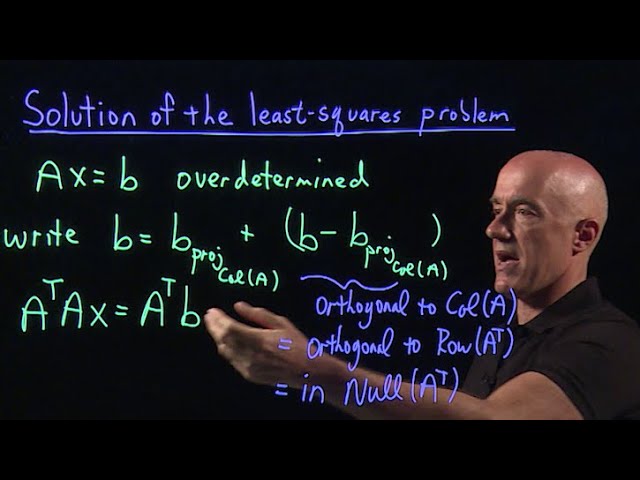
How to solve the least-squares problem using matrices.
Join me on Coursera: https://www.coursera.org/learn/matrix-algebra-engineers
Lecture notes at http://www.math.ust.hk/~machas/matrix-algebra-for-engineers.pdf
Subscribe to my channel: http://www.youtube.com/user/jchasnov?sub_confirmation=1
 tawdry bramble
If x^TAx=x^TUDU^Tx where A is symmetric and D is diagonal, does x^T have the same dimensions as U?
If not would x^TU=(U^Tx)^T?
wintry steppe
How do I show that S(T_1 + T_2) = ST_1 + ST_2
Where S, T_1, T_2 are linear maps?
I can show that (S_1 + S_2)T = S_1T + S_2T
But we only defined addition of maps (S + T)v = Sv + Tv
And so I am not sure how to do this way
nocturne jewel
(S+T)(v) is a linear combination of vectors, assuming both S and T act from V to W
so if S is linear, then you can apply linearity again
flint jackal
tawdry bramble
If x^TAx=x^TUDU^Tx where A is symmetric and D is diagonal, does x^T have the sam...
What is this in relation to?
 crisp cloud


 onyx zinc
If I had a short proof from my linear algebra class is this the right spot to ask if someone can look at it and verify?
wintry steppe
yes
onyx zinc
Cool! here's a pdf; there are 4 proofs, each about a page long. Our class is using Otto Bretscher linear algebra with applications 5th edition.
thank you so much!
If you only have time to look at the first one that would be more tan enough help, I don't want to hog anyone's time
tawdry bramble
I need help showing that if A is positive semi-definite, then there exists a matrix B such that A=BB.
tawdry bramble
<@&286206848099549185> im going to cry
tawdry bramble
That is true if B is symmetric, which I think it is since A is symmetric since A is positive semi-definite. Unless, I'm wrong about that
dusky epoch
arent all symmetric matrices diagonalizable or something
tawdry bramble
Yeah, I have because A is positive semi-definite, then x^TAx\geq 0 for all xin R^n
A=UDU^T where UU^T=I
If A=B^TB then D=(BU)^T(BU), but I don't know how to get to that without assuming what I'm trying to show
lavish jewel
backwards
D is diagonal, so you can easily say D = sqrt(D) * sqrt(D)
then just associate U sqrt D
tawdry bramble
You can take square roots of matrices?
lavish jewel
yes
and particularly for diagonal matrices, you just take the square root of each element
you can prove that yourself, it isn't difficult
tawdry bramble
Thanks
lavish jewel

tawdry bramble
What if D=C^2 and B=UCU^T?
lavish jewel
you're making a mess
i'm in a meeting right now though, hopefully someone else can give you a hand
you only need B = UC tho
 sleek spruce
wait
can someone tell me why the rhr is used
i asked a long time ago but forgot about it
when looking for orthogonal vectors
how do we determine which vector to use
since there are two orthogonal vectors
the positive and negative
i understand how to get the multiplication table for i * i and j * j and etc
but i don't understand why some are negative
zealous junco
Its like a physis convention, you use right hand rule as convention to choose what it means by positive value
zealous junco
to for example encode which direction something rotates in
sleek spruce
but if you have two vectors cross producted
aren't there two different vectors
that could arise
as there's two different orthogonal vectors
zealous junco
well depend on the order of crodd product, like AxB = -BXA
but thats consistent with RHR
sleek spruce
is this like linear algebra
like orientation?
wait
this is linear algebra
bruh
this is vector calc
so is this linear algebra
zealous junco
um i guess it is yea but just 3D linear algebra
 minor bluff
Could someone explain what the R^n and R^m notation actually means? I'm so confused about it because I'm not sure what it represents, I thought it was like the dimensions of a matrix or vector but I'm not sure 🤔
 sleek spruce
dimensions
it's the dimensions of the vector
iirc
so like R^3 mapped to R^2 means mapping 3d to 2d
I may be incorrect but that's what I recall
minor bluff
sleek spruce
so like R^3 mapped to R^2 means mapping 3d to 2d
So would that be a 3x3 to a 2x2 matrix
sleek spruce
I don't really remember if they have to be square matrices
I just remember that they're two separate dimensions
If i proceed anymore, i may confuse you so I'll stop here for the best
minor bluff
sleek spruce
I don't really remember if they have to be square matrices
Yeah I'm confused about this
 spiral star
R^n and R^m are vector spaces
a linear map does map between vector spaces and is linear
R^n is the set of n-tuples of real numbers and R^m is the set of m-tuples
the associated matrix must have m rows and n columns
so if x is in R^n then Ax is in R^m
minor bluff
Hmm I think I understand a bit better now - so each one is a vector space with m x n rows right
minor bluff
Is it one matrix transformed between 2 vector spaces?
spiral star
the matrix is just convenient notation for the linear map T
in this context
the matrix is a way to represent a function
if you want, you can say that T transforms R^n to a subspace of R^m
that just means you apply T to all elements of R^n
minor bluff
spiral star
the matrix is a way to represent a function
Ahhh so can I think of it as a transformation that maps x to Ax ?
spiral star
yea, T maps x -> Ax
minor bluff
spiral star
vector spaces dont have rows or columns
The first q asks how many pivot columns are in A, but I don't understand how this would be related to vector spaces if vector spaces don't have rows or columns
spiral star
its just related to A
the question is equivalent to asking whether T is an injective map
but this is the case exactly when the image has the same dimension as the domain
the columns of A are the images of basis vectors
so this is also equivalent to asking whether A has n linearly independent columns
and that is the number of pivot columns
minor bluff
So just to make it clear, n and m of a matrix have nothing to do with R^n and R^m right
spiral star
they have something to do with them
the dimension of the vector spaces determines the number of rows and columns of A
minor bluff
How?
spiral star
if you have T: V -> W with dim(V) = n and dim(W) = m, then any associated matrix A will have m rows and n columns
minor bluff
so in this case, x has n columns and Ax has m rows?
spiral star
what is x
minor bluff
x in R^n
spiral star
if x is in R^n then Ax is in R^m
i think you should go back to matrix multiplication
minor bluff
I think I sorta understand it, thank you for your time :))
I think I got confused because for some reason I'm thinking of vectors as having rows and columns which is wrong
wintry steppe
Question:
When finding a standard basis of a subspace in P2. 2 conditions must be satisfied.
- The vectors have to be linearly independent
- They have to span the entire subset.
However, I've read somewhere that the basis vectors have to span the entire space of P2 (not just the subspace).
Is this true, and is this specifically for subsets of polynomials?
@wintry steppe if you want a basis for P2 it has to span P2. If you want for a subspace it has to span the subspace.
Dosen't matter if it's a subspace of P2? In other words, the vectors dosen't necessarly have to consists of x^2, x and a constant.
 marble lance
P1 is a subspace of P2, and a basis for P1 would be {1, x} which spans P1 not P2.
wintry steppe
Makes sense, thanks
 slate siren
$x=\sqrt{1}$
stoic pythonBOT
kanga
 wintry steppe
I got a question, again.
W = p(x) = a + bx^2
How to form an orthogonal basis from subspace W, in P2?
dusky epoch
do you mean W = {a + bx^2 | a, b in R}?
wintry steppe
Yes
dusky epoch
and orthogonal in what inner product?
wintry steppe
 dusky epoch
okay
{1, x^2} is clearly a basis for W, so orthogonalize it
using that ^ as your inner product
dusky epoch
you literally defined W as the span of those
wintry steppe
Can't seem to understand the basics
:p
nvm, I'm slow
Okay @dusky epoch How do you go from that orthogonal basis to an orthonormal basis? Do you have to normalize it?
dusky epoch
{1, x^2} isn't orthogonal
but yes, after you orthogonalize, if you want not just an orthogonal but an orthonormal basis then you will only need to normalize each vector.
but you set out to just get an orthogonal basis, not an orthonormal one. so technically you don't need that.
wintry steppe
ok, thanks
wintry steppe
dusky epoch
but you set out to just get an orthogonal basis, not an orthonormal one. so tech...
I know, it was just a follow up question, just to map everything in my head.
dawn fractal
does this mean _B1P_B2 is equal to its own inverse here?
why does _B3P_B4 become equal to (_B1P_B2)^-1 and not simply _B1P_B2 ?

where _B3P_B4 is the transition matrix from B4 to B3
and m(f)_B2,B4 is the matrix representation of f relative to B2 and B4
gray dust
@dawn fractal looks like a typo. the leftmost matrix should be _B1P_B2. now the inverse of a transition matrix is another transition matrix causing the 'reverse' change of basis, so _B1P_B2=(_B2P_B1)^-1 which is what i think they meant to say
dawn fractal
any particular name for this theorem?
dawn fractal
gray dust
<@!244755340653101067> looks like a typo. the leftmost matrix should be _B1P_B2....
same thought
 sonic aurora
guys
can someone please provide a solution to this

actualy no i solved this haha

for question 1
gray dust
dawn fractal
any particular name for this theorem?
i'd call it a formula for the matrix representation of a linear map under a change of basis of the domain & codomain
dusky epoch
sonic aurora
can someone please provide a solution to this
we don't give out answers here.
sonic aurora
ok thank you
dawn fractal
gray dust
i'd call it a formula for the matrix representation of a linear map under a chan...
ok thx
gray dust
sonic aurora
write W as the span of a set of vectors then use any procedure to pick out a basis of W and hence find dim(W)
dawn fractal
@sonic aurora you can use the membership rule of W to form the basis
e.g. a basis of P_3(R) is {1,x,x^2,x^3} =: B
and every vector v in P_3(R) is a (unique) linear combination of the elements of B
v = a(1) + b(x) + c(x^2) + d(x^3)
so to form the basis you just need to express each vector w in W as a linear combination of the terms in w in W
gray dust
they dm'd me asking for a full solution. i don't think they intend to read any of this
dawn fractal
and of course prove that that potential basis is a basis by proving it is linearly independent
@sonic aurora
it's why i have my privacy settings turned off xD
gray dust
they're banned
dawn fractal
sad
gray dust
@dawn fractal i won't say specifically, but the severity can be compounded by poor attitude etc
wintry steppe
Question:
What is the length of a polynomial vector?
Is it sqrt of inner product(vector, vector)?
😄
gray dust
since they went 'under the table' to me after just being told not to do so, i placed a longer ban
limber sierra
wintry steppe
Question:
What is the length of a polynomial vector?
Is it sqrt of inner product...
vector spaces a priori dont have a notion of "length"
you can give them one, but you have to specify how
the method youre referring to is getting an induced norm from an inner product
but of course, this requires you to have an inner product on your vector space
strange delta
to show an isomorphism do i need to show injectivity, surjectivity and also linear mapping?
 limber sierra
which you dont have "automatically" either
limber sierra
strange delta
to show an isomorphism do i need to show injectivity, surjectivity and also line...
yes.
strange delta
hmm
limber sierra
but you already did all that in (a), (b), (c)
(d) is just "putting it all together"
limber sierra
right.
strange delta
would the right answer be it's not because b,c is not mapped in the image
limber sierra
right, it's not surjective because its image is not all of $\mathrm{Mat}_{2\times 2}(\bR)$; for example, $\begin{pmatrix}1&1\1&1\end{pmatrix}$ is not in the image
stoic pythonBOT
Namington
 strange delta
yeah
limber sierra
because the "b" and "c" entries are always 0.
strange delta
i don't get the need for the other lines, isn't the 1st line already sufficient to state the kernel?
 dawn fractal
u wouldn't be able to set a=d=0 without the 2nd line
 hoary osprey
thats just the defining the kernel for the map
nocturne jewel
1st line is definition
2nd line just evaluates the linear mapping
3rd line is the kernel for this specific mapping
strange delta
yeah makes sense
if we have dim v> dim w
then there exist no linear map that is surject & injective right
wintry steppe
no injective one from V to W, and no surjective one from W to V. so certainly no invertible one either way
stoic pythonBOT
slimevesus

 acoustic zodiac
Is there a reason as to why a change of basis is defined as:
$$e^*_i = c^j_i e_j$$?
I suppose it's because every vector of the new basis is ultimately just a linear combination of the vectors of the previous basis; is this reasoning somewhat correct?
stoic pythonBOT
rcatalang

 quartz compass
that is exactly correct
there has to be an invertible linear transformation between bases
acoustic zodiac
Nice, thanks!
quartz compass
you're welcome
 wanton fiber
sometimes, when finding the inverse of a matrix, my gaussian elimination steps are all mathematically correct, but the inverse i obtain is wrong
why is that?
how do i know the correct steps?
 hollow garnet
example?
wanton fiber
hollow garnet
example?
this is the correct answer


and the above is mine
both follow the same steps but in a different order. but shouldnt the answer still be the same
 wooden wave
for part c, I get that (cf)(3) = cf(3) = c+cf(-5), but I don't understand why that doesn't work. why do we expect cf(3) to also be 1 + cf(3)?

I think I'm missing something about (cf)(3) = cf(3), what does (cf)(3) really mean in comparison to cf(3)?
hollow garnet
wanton fiber
because you made a mistake
wintry steppe
(cf)(3) is defined as cf(3)
hollow garnet
-2+1 = -1 which is not 1
wintry steppe
even better, 0 \neq 1 + 0 (re rohak's question)
nocturne jewel
Yeah I was about to say 0 isnt in option c
wooden wave
wintry steppe
even better, 0 \neq 1 + 0 (re rohak's question)
hmm I don't understand what you're trying to say here
nocturne jewel
For it to be a subspace it needs the 0 vector (0 function in this case)
wooden wave
ohhhh yea, gotcha
wintry steppe
it's probably the first thing you should check if you're ever given a "is this a subspace?" question
wooden wave
I meant it as kind of a vehicle to explain cf(3) here doesn't equal (cf)(3)
wintry steppe
that's the definition of (cf)(3) 
wooden wave
why is it that we expect 1+ cf(5) though
isn't c * f(3) literally multiplying the output of f(3) by c
wintry steppe
we shouldn't expect that to be true. take c = 0.
it's literally not true. the set here isn't a subspace


