#linear-algebra
2 messages · Page 200 of 1
 winter harbor
Because to apply zorn's lemma
You first have to show the set you are working with is non empty
 wintry steppe
i just didnt want my message to be too long and get ignored cuz of that 😅
so didnt write all detail
thanks anyway tho
 wintry steppe
its like in some sense the module has smaller characteristic than the ring it is over
wintry steppe
Hey guys, yesterday here you said something is wrong with the c. I still didnt get it

Should the c in 2 and 3 not been written down?
its based on this question


 dusky epoch
do you know what it means for two vectors to be orthogonal
dusky epoch
yeah so do the calculations
dusky epoch
use the linearity of the dot product
and your knowledge of what an orthonormal set is
if you are willing to wait about 20 minutes i can write out a possible way for you to begin
 coral geyser
sure!
im just curious so like
(a.b)c
where a,b,c are vectors
dot product is not associative right
coral geyser
yeah
dusky epoch
the output of a dot product is a number not a vector
coral geyser
yeppp
coral geyser
yeep
coral geyser
@dusky epoch 🙂 whenever ur free it would be really helpful if you could guide me for that question
i feel like small properties i have taken for granted has come back to bite me haha
ill go revise that then
dusky epoch
$(\bd{u} - \bd{b}) \cdot \bd{b} = \bd{u} \cdot \bd{b} - \bd{b} \cdot \bd{b}$
 stoic pythonBOT
Ann
 dusky epoch
you can also show that $$\bd{b} \cdot \bd{b} = (\bd{u} \cdot \bd{a}_1)^2 + (\bd{u} \cdot \bd{a}_2)^2$$
stoic pythonBOT
Ann
 coral geyser
oooo
second ones interesting
how did u see the second one btw
like what was ur intuition etc
like ofc given their info we need to use their orthonormality etc
cause what i did
was multiplied the two given equations
 stoic pythonBOT
Meliodas

 marble lance
What is 1?@coral geyser
coral geyser
oh
crap
u cant so sorry
thats wrong
i just broke the dot product up which u cant do there LOL
urrhh
 lavish jewel
what you're asked to do is an orthogonal projection
you can look up how to do vector projections with dot products
coral geyser
How did u know it was a vector projection
@lavish jewel
alsooo

can someone check why i am wrong

need to find the shortest distance
answer is sqrt 6
lavish jewel
so they tell you v = c + d, ye? with c parallel to a, and d perpendicular to a
coral geyser
yep
lavish jewel
this is the same as saying $v = g \cdot a_{\text{parallel}} + h \cdot a_{\text{perpendicular}} $, for scalars $g,h$
stoic pythonBOT
Edd
 lavish jewel
which you should recognize as a linear combination of a_parallel and a_perp
furthermore, a_parallel and a_perp are linearly independent
or rather, orthogonal by definition
lavish jewel
sure
coral geyser
so v = g . a + d . a ?
lavish jewel
no
coral geyser
but doesnt that imply that v = c?
lavish jewel
you completely ignored what i said
coral geyser
so sorry
lavish jewel
i won't give you the full explanation cuz i'm lazy rn. just notice that the vector c is equal to g a_parallel, going by the notation i wrote above
in some sense, what you're doing here is a change of basis
from the canonical basis to this new one that has a as one of its basis vectors
how do you know how much of v goes in the direction of a? you take a scalar projection
coral geyser
yeah
lavish jewel
so you can do v - g a_parallel
if you remove the component of v that is parallel to a, the remainder is naturally orthogonal to a
this is trivial to see if you let h a_perp = - v + g a_parallel
cuz you get v = g a_parallel + h a_perp = g a_parallel -- v - g a_parallel = v
and you can check that a_perp = -v + g a_parallel is perpendicular to a_parallel with some manipulations
lavish jewel
should be something like a_perp dot a_parallel = a_parallel^T(- v + g a_parallel) = -g + g a_parallel^T a_parallel, and since a_parallel and a_perp will have to be unit-norm for the projections to work, that is equal to -g + g = 0
making them perpendicular, as desired
smth like that
 next vapor

Mathematics Stack Exchange
I am currently reading Guillemin and Pollack's Differential Topology, and the following claim is made without proof:
Given a linear isomorphism $E: \mathbb{R}^k \to \mathbb{R}^k$, with $k>2$ and
can someone explain the first answer on here
specifically how they got the equalities for E(w1) and E(w2) im just not seeing it
 fast vector
next vapor
specifically how they got the equalities for E(w1) and E(w2) im just not seeing ...
fast vector
next vapor
specifically how they got the equalities for E(w1) and E(w2) im just not seeing ...
Not quite sure what the conjugate of a vector should be (taking entry-wise conjugates of a vector is not independent of the basis), but if you insert v1+v2 into E, drag out the addition, and use the fact that they are eigenvectors, you get the first equation.
next vapor
oh theyre just working backwards from E(v+v_bar) is lambda v + lambda bar v bar
i think
fast vector
I don't see how that is backwards, but yes
next vapor
fast vector
Not quite sure what the conjugate of a vector should be (taking entry-wise conju...
yea that makes sense thank you
 novel hamlet
what matrix for 3x3 swaps R1 with R3?
novel hamlet
yeah that checks out
i just gotta do polar decomposition for 3x3 matrix
and realized if i swap r1 with r3 i can use it
A = OB, where O is ortogonal and B is positively semidefinite matrix
guessing I is orthogonal
basically do this:

Im not sure why i was told this requyires a lot of matrix calculations
since my initial matrix is

and i can just swap r1 and r3 to get positively semidefinite matrix
and get polar decomposition
or am i missing something?
 broken sun
Hello. Let $C$ be the vector space of all continuous real functions on $[-1,1]$ and $\phi$ be the linear functional on $C$ defined by $\phi (f)=f(0)$. Is there a $g \in C$ such that $\phi (f)= \int _{-1}^1f(x)g(x)dx$ for every $f \in C$?
stoic pythonBOT
MathPhysics

 native rampart
Yes
Because given a functional phi on an inner product space V
There is a unique vector g such that
phi(f)=<f|g> for all f
For proof, consider f and g in an orthonormal basis
Set g=phi(e_1)e_1+phi(e_2)e_2...
Where {e_1,e_2...} Is the orthonormal basis
@broken sun
broken sun
And then?
native rampart
That integral is an inner product
broken sun
Ok. But why $\phi (f) = < f , g >$?
stoic pythonBOT
MathPhysics
 native rampart
Because we chose g that way
native rampart
native rampart
Set g=phi(e_1)e_1+phi(e_2)e_2...
Try evaluating <f|g> with this g
And then try evaluating phi(f)
native rampart

Ok,This might not be correct since we don't know an orthonormal basis always exists in an infinite dimensional space
lavish jewel
i was thinking a dirac delta works, but it's not in C lol
wintry steppe
Could anybody explain me this?

In mathematics, Gaussian elimination, also known as row reduction, is an algorithm for solving systems of linear equations. It consists of a sequence of operations performed on the corresponding matrix of coefficients. This method can also be used to compute the rank of a matrix, the determinant of a square matrix, and the inverse of an invertib...
 limber sierra
what part are you struggling to understand?
wintry steppe
Reduced Row Echelon
 ebon veldt
wintry steppe
Reduced Row Echelon
ebon veldt
wintry steppe
Reduced Row Echelon
Wiki also have a page on that btw
wintry steppe
I mean, I'm seeing these type of notations for the first time.
 limber sierra
we took the matrix A and attached an identity matrix
are you being taught matrix inversion before knowing what an identity matrix is? that seems bizarre
limber sierra
as in like, how do you even know what youre trying to find if you dont know the identity
wintry steppe
I know what Identity matrix is.
wintry steppe
limber sierra
we took the matrix A and attached an identity matrix
Ah! Then, it's fine.
How do we get this?
 coral geyser
after all ur EROs
limber sierra
a reduced row echelon form of a matrix is one satisfying the following properties:
- It is in row echelon form, meaning:
-- All rows consisting of only zeroes are at the bottom
-- The first nonzero entry ("pivot") of each row is to the right of all pivots above it - All of its pivot variables are 1
- Every entry above a pivot variable (in the same column) is 0
wintry steppe
coral geyser
after all ur EROs
ERO? What does that mean?
 hollow garnet
elementary row operations.
limber sierra
the goal is to apply gaussian elimination to the matrix [A | I]
by the definition of reduced row echelon form, if A is invertible, youll eventually get a matrix [I | B]
B is the inverse of A.
(if A isnt invertible, youll necessarily end up with a zero row when row reducing it)
(so youll never be able to get an identity on the left)
ebon veldt
wintry steppe
ERO? What does that mean?
Probably start with solving some system of linear equations if you aren't comfortable with that. E.g. solve
3x_1+4x_2=7
2x_1+3x_2=9
using Matrix
limber sierra
its probably easiest to explain this with examples
fortunately there are very very many in textbooks and on the internet
google "matrix inverses gaussian elimination" or similar
wintry steppe
Oh wait! Did we just write B (the inverse of A) followed by Identity matrix?
limber sierra
not sure what you mean exactly
like if i asked you, "put this matrix into reduced row echelon form"

would you be able to do that? (if given pen + paper and a few minutes)
since thats all thats really going on here
wintry steppe
I mean, is the B here the inverse matrix of A?
 limber sierra
yes.
it's what we got when we put the matrix i posted into reduced row echelon form
wintry steppe
Okay, so we're doing an operation on [ A | I ] and it finally yields us with inverse, am I right?
limber sierra
assuming A is invertible in the first place, yea
if A isnt invertible, theres no way youre gonna get the left part into an identity matrix
so you wont be able to find an inverse
(which makes sense, as its, you know... not invertible)
limber sierra
basically every linear algebra textbook and course will come with extensive material on gaussian elimination/row reduction/RREF
and more stuff isnt hard to find via googling
wintry steppe
Okay, thank you very much!
native rampart
Does axiom of choice imply the existence of a orthonormal basis?
ebon veldt
ebon veldt
Probably start with solving some system of linear equations if you aren't comfor...
learning how to do equations like these should be first step before learning how to find inverses
limber sierra
native rampart
Does axiom of choice imply the existence of a orthonormal basis?
yes; this is a good exercise in zorns lemma
(if your vspace is f.d. you dont need it though)
wintry steppe
ebon veldt
learning how to do equations like these should be first step before learning how...
Yeah, I know these and have solved couple of problems.
Actually, I'm looking for a quick trick for finding matrix inverses (as you know, finding co-factors, determinants take up a lot of time)
ebon veldt
Then its exatcly the same steps you do to put on A on RREF form
assuming you did those equations using Matrices
wintry steppe
Okay, thank you very much!
Guys Im still stuck at this

Whats wrong on my paper? I mean did I showed that the set is a subspace of R3?
 marble lance
That makes sense
Your presentation is bad tbh
It's hard to follow
It is a subspace for c = 0 and not for any other c
But from your proof, it's very hard to tell when c is 0 and when it's not
wintry steppe
yeah i just tried to do the same thing like I saw on a youtube video on this
marble lance
Split your proof into two parts
One for c = 0 and show it satisfies all the subspace conditions
And one for c ≠ 0 and show it doesn't satisfy all the conditions
wintry steppe
marble lance
<@456226577798135808> can you translate the question?
one investigates for which ... the amount:
is a subspace of R3
wintry steppe
marble lance
One for c = 0 and show it satisfies all the subspace conditions
but why proving it twice? i can only prove that c=0 because x=0
so 0+0+0=c
marble lance
Idk what you mean
I think you mean a subspace must contain the zero vector, so from that we see that c must be 0 to satisfy that condition
Then you are right
But you didn't say any of that
marble lance
You just said 0 = c with no explanation of why other values don't work
 crude falcon
if I have 2 basis for 2 subspaces, and the vectors of those 2 basis combined are linearly dependant, does that means that the two subspaces are the same?
wintry steppe
marble lance
But you didn't say any of that
is it now clear?
 marble lance
@crude falcon no
@wintry steppe no, you are not explaining what you are doing. Use words.
wintry steppe
Give an example of a nonempty subset U of R^2 such that U is closed under addition and under taking additive inverses, but U is not a subspace of R^2.
I think U = {(x + 1, y + 1) in R^2 : x,y nonzero} works
marble lance
How is that closed under inverses?
wintry steppe
Maybe it doesn't work
wintry steppe
marble lance
<@456226577798135808> no, you are not explaining what you are doing. Use words.
"A subspace must contain a zero vector. To prove that we are using the X and give it the value 0. When the value 0 is given, c is 0. Any other value for X makes c not 0"
Is that ok?
wintry steppe
Do I even need that to show that R3 is a subspace of the given equation for which c should be the element of R
marble lance
I don't understand
wintry steppe
I mean do I need to make clear why making X to 0 to get c=0 is not the only way to turn c=0 for this question:
what is V?

Thats the right one sry
wintry steppe
wintry steppe
what is V?
there is no V. i placed the wrong thing in there
wintry steppe
wintry steppe
there is no V. i placed the wrong thing in there
Do you know what it means for something to be a subspace?
yeah but i didnt quite understood it. I just know that Ive to follow the 3 rules
one of the rules is the it is closed for scalar multiplication
yeah thats what i did in 3.
wintry steppe
wintry steppe
Whats wrong on my paper? I mean did I showed that the set is a subspace of R3?
here.
yea if its subspace then (0,0,0) has to belong to it
so need to have 0+0+0=c
so only possible value for which it can be subspace is c=0
so you just need to verify whether for c=0 that is subspace
but thats what I did. I used 0+0+0=c as a verification that c=0
oh I think you mean that in order that c=0 it needs to follow the rules and agree with those to be a subspace
 quartz compass
how are you defining conical coordinates
spherical coordinates is close to what I'd consider conical coordinates already
just link the wikipedia page @normal gulch
 wicked palm
are these not what you're looking for?
 quartz compass
I think he wants to invert this for r, mu, nu
wicked palm
ah ok
quartz compass
well for starters r= sqrt(x^2+y^2+z^2) just solving for r from that
I suppose similarly using the surfaces of constant mu and nu we can do something similar
wicked palm
take the dervatives and stick it in a jacobian is probably the first thing I'd do
quartz compass
I was just telling you how you could solve for it
probably because this coordinate system is kinda ugly
although it does look like it seems to have some uses for some stuff

see these?
you can use these to solve for r, mu, nu in terms of x,y,z,b,c
first one is easiest, just square root
second and third are the same equation effectively so that's convenient
 coral geyser
AB is b-a

 coral geyser
yes probs because what you entered isnt a matrix
 olive grotto
they want one digit answer
quartz compass
quartz compass
I was referring to this
these are formulas for x,y,z in terms of r, mu, nu
b, c are just fixed constant parameters
if you want to invert them then you need to solve for r, mu, nu in terms of x,y,z
if this is confusing you, you should probably practice on other simpler coordinate system transformations first
like for instance going between rectangular and polar coordinates
let's try it now
$x= r \cos \theta$ and $y=r \sin \theta$
stoic pythonBOT
Merosity
 quartz compass
now show me how you solve for $r$ and $\theta$ in terms of x and y
stoic pythonBOT
Merosity
 quartz compass
we can mimic what they do in the conical coordinates article
start by writing an equation for a curve of constant r and curve of constant theta
quartz compass
stoic python
**Merosity**
start with those two equations
how can you eliminate r or how can you eliminate theta?
@normal gulch alright take a break from what you're doing, let's discuss what does a curve of constant r or curve of constant theta look like intuitively?
think of what we're doing this way,
we're looking at coordinate lines
so x=1 is a curve a constant x
y=7 is a curve of constant y
and these look like straight lines
yeah you're a programmer/3D artist of some kind right?
oh, pixels? what makes you interested in weird 3D coordinate systems
yeah I'm familiar with them, much more intuitive than using RGB
ok so let's go back to thinking about changing between rectangular and polar coordinates, describe in words what the coordinate lines look like for both these coordinate systems
sort of
there are a bunch of lines, one for every value of x and value of y
I guess maybe we should back up a bit further
what is a coordinate system?
if I just give you a 2D plane there's no way of determining where points are on it until you start drawing lines on it
so you have to draw a bunch of lines all over it, and it's nice if we have a unique way to refer to a point as well

yeah
yeah that's one kind of line
yeah and that's the other kind
so in this grid, what does x=4 look like?
in this picture
it's not a point, it's a line
it's all the (x,y) points with x=4
so is it a horiztonal or vertical line?
it won't
it'll be vertical
(4,y) is all the points so that means you can test like
(4,0) is the point on the x-axis
but it contains (4,1), (4,2), (4, -11), etc
infinitely many points lie on this line
that's what x=4 means as a line
a way you can decide if a point is satisfied by an equation is take a point like (3,2) and see if it satisfies x=4, well we plug in 3=4 and since it's false it doesn't lie on the line.
we can try another point like (4,7) and see that 4=4 is true, so it's satisfied
we're completely ignoring the y component of our point
but that's ok
understanding this at this easy level is the same way you need to understand it to understand the change of coordinates for conical coordinates
the x-axis is horizontal
the equation x=4 is all points that have their x component equal to 4
which is a vertical line
the x-axis is the line y=0
the y-axis is the line x=0
seems backwards but it makes sense if you start graphing points
draw the lines x=-3 and y=2 and draw the point they intersect at
well I wanted to see a picture
of the lines x=-3 and y=2
cause next we're going to go to polar coordinates and so the same kind of thing
I guess that works, but kind of cheating
so now what does polar coordinates look like, now we no longer use an xy grid
we use r and theta to locate points
so start by drawing the curves r=2 and theta = pi/4
I'm using radians
take your time I've gotta go for a bit
wicked palm
here's desmos in polar coordinates which might be helpful https://www.desmos.com/calculator/mehynksjhn
we'll hide it then lol
still a good exercise to go through it by hand!
 mild current
I am currently in HS and preparing for entrance exams like JEE
So, tje linear algebra ,though included in the syllabus, have very limited theorems
For e.g. to find A^-1 , we are taught to use A^T/det(A), which makes the computations much harder if one doest know the Gaussian Elimination
So, what I am asking is are there any other theorems that could make the compuations easier
 nocturne jewel
A^-1 isnt equal to that iirc
mild current
Mostly, the harder questions are about finding the value of a matrix with a huge ass exponent
nocturne jewel
$A^{-1}=\frac{1}{det(A)}adj(A)$
stoic pythonBOT
moshill1
 nocturne jewel
where adj() denotes the adjoint matrix
mild current
@nocturne jewel oh okay, I just got kinda confused. Thanks
wintry steppe
finding the value of a matrix with a huge ass exponent
these are usually susceptible to diagonalization/JNF in my experience
if you (are allowed to) know that
mild current
@TTerra well the exams are basically mcqs, so it doesnt matter what method one is using as long as the answers are correct
If it helps would like to see some questions tropes used in the exam?
wintry steppe
you could post them
mild current
@wintry steppe just a sec
nocturne jewel

mild current


 nocturne jewel
,rotate
stoic pythonBOT
 mild current
srry for being late, the net is just freaking slow
I just need to know the theorems and methods to make the computations faster and easier
Thank you for your time
 lapis hemlock
can anyone pls solve this??


 mortal juniper
lapis hemlock
can anyone pls solve this??
mortal juniper
lapis hemlock
can anyone pls solve this??
pls post on the correct channel
for this matrix are there any values of k that there are infinitely many solutions
 lavish jewel
infinitely many sols for which problem
lavish jewel
going only by this, if you call the above matrix A
 lavish jewel
and you mean solutions to Ax = b
if you're sure it can be written as you did before, any value of k makes the matrix rank 3
omitting values for which the expressions are undefined
lavish jewel
all ks give infinitely many sols
mortal juniper
since all the col are linearly independent
lavish jewel
there is no way the 4th column in what you gave is independent of the first 3
that would mean you have a basis with 4 lin indep vectors for R3
mortal juniper
lavish jewel
all ks give infinitely many sols
hmm im not so sure about that because when k=0 and k=+-sqrt0.5 it gives me inconsistent soolution
lavish jewel
then your simplification was wrong
wintry steppe
What's wrong with this proof that the set of periodic functions from R to R with period p form a subspace of functions from R to R? If we let V = {f | f : R -> R, and for all real x there is exists some real p such that f(x + p) = f(x)}.
Now we let f in V. Then f(x + p) = f(x), and clearly if we define 0(x) = 0, then 0(x + p) = 0(x) = 0, so 0 in V.
Then let f, g in V. Then f(x) + g(x) = f(x + p) + g(x + p) = (f + g)(x + p) (by definition) and (f + g)(x + p) = (f + g)(x), so f + g in V.
Then let a in R. Then by definition, (af)(x) = af(x). It follows that since f in V, af(x + p) = af(x), so (af)(x + p) = (af)(x), which implies that af in V.
Thus, it is a subspace.
However, looking at some solutions online, it seems to not be a subspace.
Where did I go wrong?
lavish jewel
mortal juniper
this one
are you sure this is correct?
cuz this one says "k can be anything"
mortal juniper
The calculator will find the row echelon form (simple or reduced - RREF) of the given (augmented) matrix (with variables if needed), with steps shown.
lavish jewel
at least that's what i think at a glance
lavish jewel
in that matrix that has an identity onthe left side, the column with ks in it is always dependent on the other 3
so one of the two things you're doing is wrong
mortal juniper
ah i see
so if i assume k != 0 it can be rref
and if k=0 it has infinitely many solutions am i right?
because it cant be GJE
 brazen venture
wintry steppe
What's wrong with this proof that the set of periodic functions from R to R with...
brazen venture
wintry steppe
What's wrong with this proof that the set of periodic functions from R to R with...
this is not do your homework channel pls rephrase ur qn
wintry steppe
@brazen venture ?
@brazen venture How do you expect me to rephrase my question?
I gave my proof, I am asking why it's incorrect
mortal juniper
wait so is it k=0 becos i dont get it
wintry steppe
it seems correct to me @wintry steppe , maybe what you found online is that the set of all periodic functions is not subspace? if period is fixed, i believe its correct.
@wintry steppe The supposed counter example is (f + g)(x) = sin sqrt(2)x + cos(x)
 hoary osprey
if the period isnt necessarily the same then its not a vector space
wintry steppe
Oh
if you consider only rational periods it'll be a subspace tho
So basically
My proof works if p is the same for f and g
yeah
well
Or if one of the periods is contained within the other
But other than that, it doesn't
depends what you exactly mean by a function having period p
exists real p such that for all real x, f(x + p) = f(x)
no
that means that it is periodic
Yes?
it's not same thing to be periodic
and to be periodic with period p
but
wintry steppe
wintry steppe
exists real p such that for all real x, f(x + p) = f(x)
p non-zero
else every function satisfies that
novel hamlet
How do I prove that | |AB| | =< |A| |B|
Double || strikes again
Ffs
Where |●| is matrix operator norm
A€R^NXM, B€R^NXK
 faint dune
I have always troubles to work with scalars.

Nvm I got it.
with distributiv rule of scalars I can do that step.
 zealous junco
novel hamlet
How do I prove that | |AB| | =< |A| |B|
zealous junco
novel hamlet
How do I prove that | |AB| | =< |A| |B|
Ok so you know $|Av| \leq |A| |v|$ for all v where $|v| = 1 $ because $|A| = \sup_{|v| = 1}|Av|$
novel hamlet
yeah that is logical
zealous junco
my bad let me rewrite
novel hamlet
small googling leads me to math stackexchange and with this kind of proof

but then the comments speak of some really unfamiliar products so im not sure if this is applicable
zealous junco
Ok so first $|A| = \sup_{v \in \mathbb{R}^n} \frac{|Av|}{|v|}$ which means $|A||v| \geq |Av|$
stoic pythonBOT
Anticipation
 zealous junco
then $|AB| = \sup_{|v| = 1}|ABv| \leq \sup_{|v| =1} |A| |Bv| = |A|\sup_{|v|=1}|Bv| = |A| |B|$
stoic pythonBOT
Anticipation
 zealous junco
basically what the google did and u can pull out the A because you treat Bv as a vector
and apply $|A||v| \geq |Av|$ on it
stoic pythonBOT
Anticipation
 zealous junco
replace sup with max
novel hamlet
ah that seems much more familiar
I got one more question for polar decomposition A = OB
is the only requirement for B to be positively semidefinite?
or is this unique decomposition
zealous junco
leme check my notes i kind of forgot
novel hamlet
kinda not trusting wikipedia

since the calculation had warning that it requires heavy calculations
zealous junco
I believe that is true since we have $B = V\Sigma V^\star$
stoic pythonBOT
Anticipation
 zealous junco
so lets say $x^\star B x = x^\star V \Sigma V^\star x$, now i think $x^\star VV^\star x$ is always positive
novel hamlet
lol, HW assingment: warning this requires a lot of calculation
me: an educated quess and 2 minutes later = done

I was just really sceptical about this solution
stoic pythonBOT
Anticipation
 zealous junco
and sigma only has nonnegative singular values so it scales positively
wintry steppe
Does this contradiction argument work? If U_1 U U_2 is a subspace of V, then one of U_1 or U_2 are contained within one another
We assume that U_1 not subset U_2 and U_2 not subset U_1, yet assume U_1 U U_2 is a subspace of V. Since U_1 not subset U_2 and U_2 not subset U_1 there exists x such that x in U_1 but not in U_2 and there exists y such y in U_2 but not in U_1. Then this implies that x,y in U_1 U U_2 and since U_1 U U_2 is a subspace, x + y in U_1 U U_2. And so x + y in U_1 and x + y in U_2
But this means that x in U_1 and y in U_1, as U_1 is a subspace of V. But we said that one of those can't be in U_1 so we have reached a contradiction.
 tranquil vortex
wintry steppe
tranquil vortex
wintry steppe
<@&286206848099549185>
marble lance
@wintry steppe looks good but idk why you are so vague in your contradiction
You specifically said y is not in U1 and that x is. So you don't need to say 'this means that x is in U1' because we already know that. Instead you can give a little more detail to explain why y is in U1, and that that is the contradiction
wintry steppe
Oh sure. Because U_1 U U_2 is a subspace, and we know that x, y is in the union. A subspace is closed under addition, and therefore x + y must be in the union as well. This also means that x + y must be in each of U_1 and U_2
And because x + y in U_1 and in U_2, and they're subspaces means that x, y in both U_1 and U_2, which is our contradiction as we assumed that to not be the case
marble lance
Why does that mean x and y are in U1 and U2?
wintry steppe
Because U_1 and U_2 are subspaces, and each are closed under addition of vectors.
marble lance
Okay, seems like you understand
wintry steppe
I hope so 😄
marble lance
Specifically, I wanted you to say x = (x+y) -y, and x+y and y are in U2 so x must be too
wintry steppe
Ah yeah, that makes it more obvious.
Since (x + y) are in the unions so it must be in each subspace, and they're closed under scalar multiplication so -y and y are in U_2, and by closure of addition (x + y) - y = x is in U_2
 prime nebula
zealous junco
prime nebula
zealous junco
dont have much time to explain but a form of rotation is givens rotation
in R^3 its just rotation a plane while fixing an axis
 stable kindle
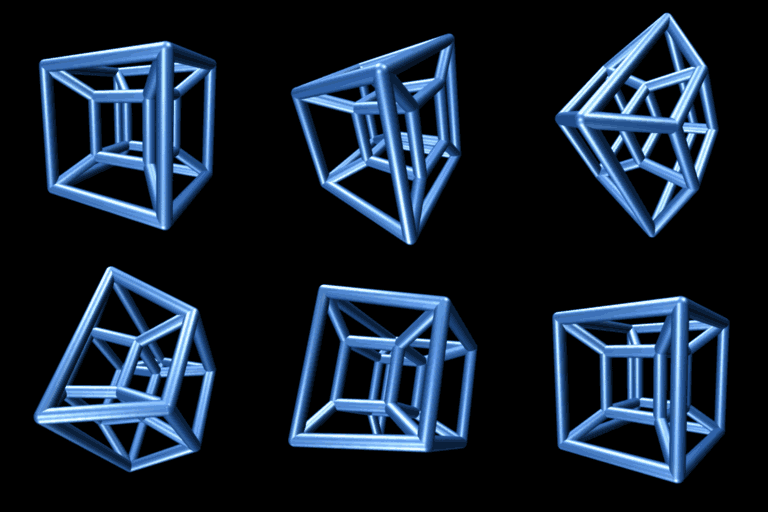
so in n = 2m dimensions something can rotate in m directions simultaneously
for example in 4 dimensions you could rotate in two perpendicular-ish planes simultaneously
pls
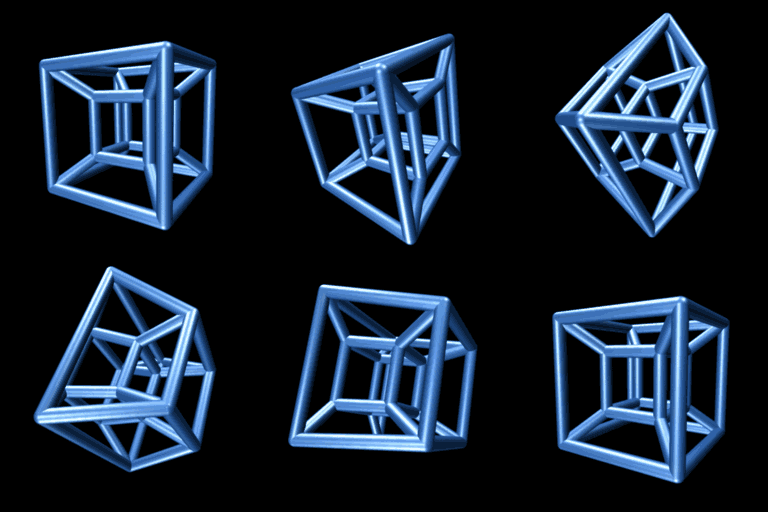
ah there we go
wicked palm
Look at em go
stable kindle
but yeah there's always two invariant planes
in 4 dimensions
and in 2m+1 dimensions, there's m invariant planes + 1 invariant axis
so i was hoping it was nice but my reasoning was flawed and really it looks quite ugly
but probably the special cases are quite neat
anyway here's some links
wicked palm
For 3D a good way to derive the matrices is to fix a single axis and then rotate in each plane and then combine the matrices to rotate in any plane
Or use quarterions like a hero
 high dock
is a 6 week linear algebra class a good idea? provided i read up on it beforehand
nocturne jewel
high dock
is a 6 week linear algebra class a good idea? provided i read up on it beforehan...
depends what's covered / how quick it is
wintry steppe
what would you even cover in 6 weeks 
nocturne jewel
this a vector
wintry steppe
week 1: definition of vector space, basis, replacement theorem
week 2: linear maps, rank-nullity, correspondence of fdvs/linear maps with R^n/matrix mult
week 3: determinants
week 4: diagonalization
week 5: JNF
week 6: inner products

easy
wintry steppe
jordan normal form
 frosty vapor
that is really fast tterra sob
quartz compass
week 1: gaussian elimination
week 2: gaussian elimination
...
week 6: eigenvalues
novel hamlet
any fast way to define if matrix is positive semidefinite?
 balmy phoenix
computationally fast or human fast?
novel hamlet
eihter, i have matrix with SVD done by hand and i need to convert to Polar decomposition
 balmy phoenix
Well, assuming it's hermitian I suppose, you can just throw numpy or something at it to get the eigenvalues for a matrix that small
novel hamlet
idk what is hermitian
balmy phoenix
if you're trying to avoid a computer, which is fair, I admit I don't know a great method for fast semi-definiteness
balmy phoenix
novel hamlet
idk what is hermitian
(has real eigenvalues)
novel hamlet
well i gotta show my work for prof
my initial idea was good but i failed to realize that the matrix is not positively semidefinite
balmy phoenix
ah, in that case, it's probably easiest by hand to compute the eigenvalues, since I think you'll need those anyway
novel hamlet
oh wait wrong

i tried to do this way
but this is not positively semi definite

altough the eigenvalues are positive
balmy phoenix
hmm? positive semi-definite just means the eigenvalues are non-negative I thought (though I could be forgetting definitions)
lavish jewel
positive semidefinite means x^T A x >= 0 for all x
novel hamlet
yeah that is what i tought too
lavish jewel
such a condition is defined for symmetric matrices
since you can factor them as B^T B
novel hamlet
i see, guess that is where i made the mistake
i forgot it is for symmetric only
plan B is to figure out how to take sqrt from
 novel hamlet
somehow quessing it is
 balmy phoenix
lavish jewel
positive semidefinite means x^T A x >= 0 for all x
balmy phoenix
lavish jewel
positive semidefinite means x^T A x >= 0 for all x
right, sorry, I was thinking of an implication, mb
lavish jewel
i'll admit i'm too lazy to doublecheck, the last eig vec looks correct tho
novel hamlet
actually no, its not symmetric either
lavish jewel
the matrix above looks symmetric to me
 lavish jewel
that is not what square root of a matrix is
novel hamlet
yeah guessed so much
lavish jewel
one definition, using the diagonalization is that
 lavish jewel
if A = Q D Q^-1, then sqrt(A) = Q sqrt_elementwise(D) Q^-1
wintry steppe
M is a square root of A iff MM = A
lavish jewel
then sqrt(A) * sqrt(A) = A, since Q^-1 Q = I and the diagonal elements of sqrt(D) get squared
indeed, as carla says
oh, maybe that IS a sqrt
that's a weird one
but just go ahead and test it
wintry steppe
its usually not unique
 lavish jewel
so it isn't 😛
novel hamlet
wolfram being wolfram
lavish jewel
use octave
novel hamlet
whats that?
lavish jewel
free matlab
stable kindle
two notes that are 13 semitones apart, iirc
lavish jewel
novel hamlet
I tried it im horrible with it
and i only got 2 hours to figure this out
or since they are peer reviewdi could just try to slide on it
wintry steppe
stable kindle
two notes that are 13 semitones apart, iirc
you mean 12?
lavish jewel

free typo for you and everything
that's one way of taking a square root: by diagonalizing
novel hamlet
okay so that is my B on polar decomp
lavish jewel
since sqrtA = Q sqrt(D) Q^T, sqrtA * sqrtA = Q sqrt(D) Q^T Q sqrt(D) Q^T = Q sqrt(D) sqrt(D) Q^T = Q D Q^T = A
note that since A is symmetric, Q is orthonormal
and so Q^-1 = Q^T
novel hamlet
could i have used my SVD i have done to get this?
lavish jewel
yes, since the SVD of a symmetric matrix equals the EVD of that matrix
 lavish jewel
U and V in A = U S V^-T are equal due to the symmetry
so U = Q , S = D, V^T = Q^T
you can show it by noting that the SVD is gotten precisely from the EVD of a matrix of the form B^T B or B B^T
if symmetric, these two are the same, and so U and V are the same
novel hamlet
i got confused
lavish jewel
i wave my hands wildly and leave the proof to the reader
matrix symmetric, evd = svd
novel hamlet
so that my SVD there is same as QDQ^t?
lavish jewel
yes
gimme a sec to show you

just beware of the computer precision
one thing in the matrix D from the EVD is like x10^-16, that's just a 0
another says 1.2 e+0.1, thats 1.2 x 10 = 12
also the SVD is conventionally ordered from largest to smallest singular value
you'll have to shuffle the columns of U around to match Q
and the rows of V to match Q^T
lavish jewel
SVD is U S V^T
but in this case yes
what are O and B supposed to be
what properties
novel hamlet
O is orthogonal matrix and B is positively semidefinite
lavish jewel
U is orthonormal, so that's done
if A is pos semi def, then so is S
idk how to handle V^T off the top of my head
lavish jewel
then already saying SVD is QDQ^T was wrong
the matrix A you have right now IS symmetric
or do you wanna do this in general?
i'm just gonna wikipedia this
it says you start with A = U S V^T
the polar decomp is A = (U V^T) (V S V^T)
that is some gourmet shit

 lavish jewel
i'm getting too sleepy to check
you can test yourself if your ((A^T A)^0.5)^2 = A^T A
novel hamlet
wich should lead to this monstrosity?

RIP
math

if im not wrong should go like this?
 empty copper
Eiki Shiki AKA Yamaxanadu from Touhou
novel hamlet
I see you are a man of culture as well
 faint lintel

Not sure how to do this
First I want to show that UU* is self-adjoint
idk how to do that though
wait nvm I know how to show it's self adjoint
it's the part of showing the inner prodiuct <T(x), x> is greater than 0 for all non-zero x that trips me up
quartz compass
proof I have in mind is similar to showing it's self adjoint
maybe show your proof real fast that it's self adjoint
quartz compass
good in that middle step there <U*(x), U*(x)>
faint lintel
that only shows it's >= 0 tho
not > 0
cause U, and therefore U*, are arbitrary
so what if x is non-zero but U*(x) = 0
that's where I'm stuck
quartz compass
oh, well then maybe it's false, if it's an arbitrary linear transformation what's stopping you from just picking U=0
faint lintel
Hm
lavish jewel
it does seem false in general, unless V is explicitly said to be the image of U
quartz compass
I figured this is part d of a larger problem where they say more context about it
faint lintel
That's what I was thinking but I thought i had missed something
quartz compass
post the whole thing
 lavish jewel
yeah that doesn't look right
quartz compass
maybe they meant to say invertible instead of arbitrary
faint lintel
it seems like the best result you can get is positive semi-definite
faint lintel
ugh I guess I'm emailing my teacher
ok I guess for part e
is T the same T as in part d?
or just arbitary T?
 sage ibex
Same would make sense
faint lintel
 lavish jewel
it would have to be the same T as before
faint lintel
I have this exercise in my book
sage ibex
Otherwise you won't get phi(x,x) non negative
lavish jewel
otherwise its also false
lavish jewel
that problem seems kinda poorly written
sage ibex
Yeah you need same because you need the positive semi definiteness
lavish jewel
unwelcome me please
sage ibex
Also e part implies that d part should have invertible U
Because if U has non trivial kernel then norm of things in kernel wrt phi would be 0
 hollow ruin
it must just be impossible
coral geyser
when we do row operations and add scalars of one row to another determinant doesnt change.
But if its the same Row, isnt it equivalent to R_6 = 4R_6
doesnt that mean that det (B) = 4 (det(A))

 void relic
I agree with you
coral geyser
yeah the answering thing on that is kinda scuffed i had to keep changing answers to see which is right haha
faint lintel
yea you're right @coral geyser
 pallid rampart
Seems like the question is automatically generated
 pseudo thicket

what is the difference between N(A) and basis of N(A) in this example?
for column space and basis as well
 strange elm
 native rampart
If A is nxn matrix,then det(cA)=c^n det(A)


 dense whale
parallelepipeds in between two parallel planes and with same base would have equal volumes. This can be proved with basic geometry; idk why you'd linear algebra to do it.
btw
I've read recently that " A simple eigenvalue is regular" and I want to know what is a regular eigenvalue. I did search on google and other places but no luck. Some mention regular graph or something but not "regular eigenvalue".
 tawdry bramble


I'm trying to show that for a vector v and line given by A+tD that v-proj of v on the line is orthogonal to D.
lavish jewel
isnt the projection going to be parallel to D by definition?
oh, you mean for a particular problem setup, not in general
lavish jewel
just take the definition you have up there
tawdry bramble
The projection always give v-proj to be orthogonal to what it's being projected on?
I mean that makes sense if I understand this right
Also, is this definition of the projection just shift our origin to A?
lavish jewel
parallel, not orthogonal
though this line projection is not like that, on second inspection
wintry steppe
I'm asked to prove that the set of functions from R to R is the direct sum of the set of even real valued functions and the set of odd real valued functions
But how can that be, since there are real valued functions that are neither odd nor even?
limber sierra
you can still make those functions by taking a sum of an odd and even function
wintry steppe
How would you make e^x?
limber sierra
direct sums allow, well, sums of the elements
well if i tell you that it'd kinda be giving the answer away 😛
here's a hint
suppose f(x) = g(x) + h(x) for g even, h odd
then we should have f(-x) = g(x) - h(x)
and so f(x) + f(-x) = 2g(x)
rearranging, we get $g(x) = \frac{f(x) + f(-x)}{2}$
stoic pythonBOT
Namington
 limber sierra
this tells us what the even part should be
can you do the same sort of thing to figure out what the odd part, h(x), should be?
(hint: solve for h(x) and then substitute in what we got for g(x))
verify that the g(x) and h(x) we found are in fact even and odd, respectively, and that f(x) = g(x) + h(x)
and you're done
limber sierra
wintry steppe
How would you make e^x?
aside: this is just ||cosh(x) + sinh(x)||
and that'll match with the construction i just suggested you do above
wintry steppe
@limber sierra But when I have to show that {f : R to R} subset set of even fns + set of odd fns
Then I can't do that, because I have to write that g(x) = (f(x) + f(-x))/2 and h(x) = (f(x)) - f(-x))/2
But what if f is not even or odd like that
limber sierra
write f(x) = g(x) + h(x)
maybe youre misunderstanding the definition of direct sum? direct sums allow you to take sums of elements from each space
g(x) is an even function and h(x) is an odd function
so g(x) + h(x) is in the direct sum of {even functions} and {odd functions}
wintry steppe
I know that
But to show that it is a direct sum
I need to do three things
$U_e + U_o \subseteq { f : R \to R}$
stoic pythonBOT
n/c
 wintry steppe
${ f : R \to R} \subseteq U_e + U_o$
stoic pythonBOT
n/c
 wintry steppe
$U_e \cap U_o = { 0 }$
stoic pythonBOT
n/c
 wintry steppe
Correct?
So the justification for the first one would be that it is obvious, as the sum of any two functions with domain R and codomain R will have domain R and codomain R
The second one, I am not so sure about. We can say that f = g + h, where g = f/2 + f(-x)/2 and h = f/2 - f(-x)/2
But this seems strange.
lavish jewel
even functions should be orthogonal to odd functions, it shouldn't be too hard to show that these are orthogonal complements
wintry steppe
I can't do that @lavish jewel
native rampart
I think smt to do with $\int_a^{-a} f(x) dx$=0 if f is odd
stoic pythonBOT
Buncho Drunk
 native rampart
and product of odd and even functions is odd
wintry steppe
I can show that the integral is true, but why does that help us here?
native rampart
If U and V are orthogonal subspaces,their intersection is 0
Let 0=u+v where u in U and v in V
Then (0,v)=(u,v)+(v,v)
(v,v)=0
v=0
wintry steppe
What is (0,v) supposed to mean?
native rampart
I mean the inner product <0|v>
wintry steppe
Oh the dot product?
native rampart
Yes
wintry steppe
That's a interesting way but I need to do it without using the inner product unfortunately
It hasn't been introduced yet
native rampart
Let f be both even and odd
Then f(-x)=-f(x) since f is odd
f(-x)=f(x) since f is even
For all x
wintry steppe
But they could be different functions?
native rampart
Which implies f(x)=-f(x) implying f(x)=0
No,We are taking f to be both odd and evn
wintry steppe
What?
native rampart
i.e.,f is in the intersection
wintry steppe
Ohh
Okay
Yeah that is nice
Thanks
How do I show that the list 1,x,...,x^n is linearly independent in the set of polynomials with coefficients in some field?
We can write that a_1 + a_2 x + ... + a_n x^n = 0
And it's clearly true, but I don't know how to show that a_i must all be 0
native rampart
That is part of the definition of formal polynomials
If a_0+a_1x+...a_nx^n=0 then a_0=a_1=a_2=...=0
wintry steppe
But that wasn't written in the textbook
I think I've found a way
I can let a_0 + a_1 x + ... + a_n x^n = 0
Then we differentiate n times to get n! a_n = 0
Since n is nonzero
Otherwise it's trivial
We get that a_n = 0
So we're left with a_0 + a_1 + x ... + a_n-1 x^n-1 = 0
Then we differentiate n - 1 times to find a_n-1 = 0
And so on
lmao I think this works?
wintry steppe
Prove or give a counterexample: if $U_1, U_2, W$ are subspaces of $V$ such that $V = U_1 \oplus W$ and $V = U_2 \oplus W$ then $U_1 = U_2$. Here is my proof: Assume $V = U_1 \oplus W$ and $V = U_2 \oplus W$, but that $U_1 \neq U_2$. As $U_1 \neq U_2$, there exists $u \in U_1$ such that $u \notin U_2$. It follows that $u \in V$ as $U_1$ is a subspace of $V$. This also implies that $u \notin W$, as otherwise we could write the zero vector $0_v = u + (-1) \cdot_s u$, where $-1$ is the additive inverse of the multiplicative identity in $V$, as well as linear combinations of this equation. In other words, the zero vector would not be unique, and so $V \neq U_1 \oplus W$. Therefore, $u \notin W$.
Thus, $u \in U_1 \oplus W$ but $u \notin U_2 \oplus W$, as $u \notin U_2$ and $u \notin W$.
Thus, it cannot be the case that $U_1 \oplus W = U_2 \oplus W$, which is a contradiction.
stoic pythonBOT
n/c
 wintry steppe
Does that work?
native rampart
Well that statement is false
Take V=span{e_1,e_2}
U_1=span{e_1},U_2=span{e_1+e_2} ,W=span{e_2}
@wintry steppe
wintry steppe
That's interesting but then where does my proof go wrong?
 warped cape
at the end, (u\not\in U_2) and (u \not\in W) doesn't imply (u \not\in U_2\oplus W)
stoic pythonBOT
Muf
 wintry steppe
How?
native rampart
Let u be in A and v be in B and x not be in A or B
warped cape
native rampart
U_1=span{e_1},U_2=span{e_1+e_2} ,W=span{e_2}
for example here, e₁+e₂ is in U₁⊕W, but not in either of them
wintry steppe
5x_1 - 4x_2, x_2 is linearly independent right, given that x_1 and x_2 are linearly independent
Since we have 5a_1 x_1 + (a_2 - 4) x_2 = 0
And c_1 x_1 + c_2 x_2 = 0 implies c_1 = c_2 = 0
So we can just let c_1 = 5a_1 and a_2 - 4 = c_2
Just a sanity check
warped cape
c₂ should be a₂-4a₁
wintry steppe
oops but yeah
faint lintel

Isn't this wrong?
the "other value" is 0

"u" is this closest vector
v_1 has to be an orthonormal vector
so we take (3, 0, -4)
normalize it
and get (3/5, 0, -4/5)
then <y, v_1> = 10*3/5 + 0 - 5*4/5 = 2
so we get u = 2*(3/5, 0, -4/5)
but the correct answer is 2 * (3, 0, -4)
why?
 undone lake
hey ! can i have a bit of help figuring what's Z_2 ?
 wintry steppe
sure
have you heard of either groups, rings, modular arithmetic or integer division?
undone lake
mmmh i know a little about groups and rings but that's it !
wintry steppe
Z_2 is {0,1} with 1+1=0 and 1*1=1 and im lazy to type the other relations
undone lake
is it a ring ?
wintry steppe
well its a field so yes
undone lake
ooh yes my bad
wintry steppe
you dont know integer division?
undone lake
like we see it when we're like 10yo ?
undone lake
yeah i did it with polynomials, same thing actually
undone lake
yup
wintry steppe
can prove that
r(a□b) = r(a) □ r(b) where □ = +, ×
so u can have a ring this way
uh this maybe confusing for you
undone lake
mmmh a bit to be honest
wintry steppe
its like a clock
undone lake
like modulos ?
undone lake
i get that
wintry steppe
yea so uh
ok Z_n is {0,..., n-1} with
the operstions this way
compute in Z
then remainder modulo n
its gonna be a ring, sometimes a field
wintry steppe
yes you do
undone lake
thank you so much !
undone lake
i find 2^n vectors, it seems all right
wintry steppe
Is there a easy way to show that all basis of a (infinite dimensional) vector space have same cardinality? (if it is true)
wintry steppe
<@&286206848099549185>
undone lake
wintry steppe
but did you *j*u*s*t*i*f*y* it?
2 possibilities for each scalar, n times because of u1...un and they have different representation. idk if it's enough
wintry steppe
Something being a basis means that theres unique way to write every vector of the space as a linear combination of that basis
so number of elements of space is the number of linear combinations of the basis yea
quartz compass
how does the development you're familiar with depend on real or complex numbers?
warped cape
something something anti-symmetric n-linear functional that maps identity to 1
wintry steppe
anti-symmetric?
warped cape
swap two rows/columns and you get -
wintry steppe
never heard that called anti symmetric, but alternating
wintry steppe
warped cape
i think if it's linear then they are equivalent
according to wikipedia yea
warped cape
yea ik i saw it on wiki once
and did convince myself it's true
can't find it again though :/
wintry steppe
In mathematics, a bilinear form on a vector space V is a bilinear map V × V → K, where K is the field of scalars. In other words, a bilinear form is a function B : V × V → K that is linear in each argument separately:
B(u + v, w) = B(u, w) + B(v, w) and B(λu, v) = λB(u, v)
B(u, v + w) = B(u, v) + B(u, w) and B(u, λv) = λB(u, v)...
they call antisymmetric skew symmetric
warped cape
aaaa right
 dusk sage
Guys am I right when I say that the l2 norm of a matrix A is the largest eigenvalue of A*A, where * indicates that A is transposed??
lavish jewel
square root of that
dusk sage
ok thank you
wintry steppe
can u diagonalize this?

i get lambda^2 + 1 = 0 when trying to obtain the eigenvalues of A but that doesnt yield two eigenvalues
nocturne jewel
wintry steppe
can u diagonalize this?
what's A^2?
wintry steppe
[-1 0; 0 -1]
nocturne jewel
right, which is diagonal
so raising A^2 to an integer power is easy
and 32=2*16
wintry steppe
so diagonalize A^2 and then raise to the power of 16?
nocturne jewel
so you have $A^{2n}=(-1)^nI$
stoic pythonBOT
moshill1
 nocturne jewel
since $A^2=-I$
stoic pythonBOT
moshill1
 wintry steppe
alright
nocturne jewel
so when n=16, you get A^32
wintry steppe
how would i go about doing this

i did the inner product for each quantity in the span and they all equal 0 meaning theyre orthogonal but idk how thatd help
i think thats true by definition anyway, i just dont know how to find a basis
 sleek spruce
how do you know which direction a cross product vector will go
because it can have either positive or negative direction
because they're both orthogonal
it states to use the right hand thumb rule
but that doesn't really justify anything
 nocturne oracle
do you want reason for why the rhr is used
 spiral star
wintry steppe
how would i go about doing this
spiral star
wintry steppe
how would i go about doing this
 wintry steppe
spiral star
wintry steppe
spiral star
thank u, ended up doing the gram schmidt process anyway
spiral star
what
why
was that asked of you?
if it wasnt asked then you made this exercise 10 times more annoying then it had to be
you can read off the answers without any computation
its like a 1 minute exercise
wintry steppe
i mean thats what the example did in my lin algebra textbook for the same problem lol
spiral star
:dan:
wintry steppe
isnt the whole point of the gram schmidt process to form an orthogonal basis
spiral star
yes
wintry steppe
so why wouldnt that work then
spiral star
of course it works
spiral star
but gram schmidt doesnt pay off at all here
computing the orthogonal basis takes more work than just reading off the answers here
when you have the orthogonal basis you still havent shown anything about the given vector sets
but you already computed a bunch of inner products
i only had to check it for (E)
because for the other ones it was obvious without any computation
so in total it just required 3 inner products and they are easily computed from the linearity of integrals
 tropic turret
Hello,
can someone give me some tips & tricks for finding eigenvalues and eigenvectors?
Tips for characterize polynomial and diagonalize will help as well.
Thanks!
crude falcon
I have this linear map: f(x,y) = f(x+y,x), if I want to calculate f(x+y) what it would be?
nvm
wintry steppe
it wouldn't be
 reef prism
@tropic turret you'd want to watch 3blue1brown videos on that and search up some visualizations
wintry steppe
3blue1brown doesnt show much computation
Trick question: Let M be the space of n×n K-matrices and T: M->K given by T(m) = determinant(m). Is T linear?
How do I justify that no list of four polynomials spans the set of all polynomials with degree 4 or less?
get a basis for that space. it will have 5 elements. it is well known that all spanning sets have cardinality >= that of any basis.
Oh duh
Length of linearly independent list ≤ Length of spanning list
How do I show that the set of functions with domain positive integers and codomain some field F is infinite dimensional?
span(F^∞) = (a_1f_1 + a_2f_2 + ... | a_i in F} but I think this is hand wavy
wintry steppe
Suppose there is a finite list that spans it see if you can get a contradiction
@wintry steppe
I know that's what I tried but I don't know how to go about it without hand waving. I did something like: let n in N be the smallest list of vectors such that a_1f_1 + ... + a_nf_n spans F^∞