#linear-algebra
2 messages · Page 189 of 1
 keen coyote
but since it's least square doesn't b not equal Ax
so then you can't write b as something in the range of A with svd
 keen coyote
so then you can't write b as something in the range of A with svd
keen coyote
keen coyote
so then you can't write b as something in the range of A with svd
nvm nvm
 wary lily
 strong bison
Is there a fast way to solve this big matrix?
strong bison
Is there a fast way to solve this big matrix?
yes, using CAS
 lavish jewel
keen coyote
nvm nvm
lavish jewel
keen coyote
nvm nvm
yeah, you only get the component of b that was in the column space of A
the other one gets mapped to the 0 vector
you need to specify b = bs + bn and x = xs + xn
some of those get mapped to 0, others not
 dire thunder
wym by "solve matrix"
 bitter shuttle
What is the projection of some vector v on a unit vector u
How come it’s not just they inner product multiply by u
wary lily
|u| cos(theta) = (u . v)/|v|
that's the "shadow" of u on v
the magnitude
that's multiplied with v since v is unit already
in case it isn't unit, you divide it by |v|
which result in this formula:
 lavish jewel
that's the same as they wrote up there, just with u swapped with v
apparently they ran into some case in which (v dot u) u with unit u didn't work?
strong bison
wary lily
yes, using CAS
what's CAS?
strong bison
dire thunder
wym by "solve matrix"
Gaus Jordan Elimination to get S_0, S_1, etc expressed in variables
lavish jewel
RREF it using your favorite software
otherwise, the rows actually look kinda friendly
you can start from the second to last equation parametrizing stuff and back-substituting
strong bison
RREF online calculator shows this

as final answer
but doesn't make sense does it?
lavish jewel
did you augment the matrix?
wary lily
nah, it's square
lavish jewel
otherwise, at least you know for sure the problem has a solution
wary lily
first row appears to be headers
 lavish jewel
this kinda seems to say there is no solution, then?
strong bison
it does
lavish jewel
i'm hypoglycemic at the moment, so if anyone has more insight than i do, feel free to correct me
lavish jewel
that's what it looks like to me lol
strong bison
hmmm might have to take a step back and check the equations i made the matrix with
wary lily
I was wondering tho, when a system has n variables and n+1 equations, for it to have a solution, at least one row needs to be a multiple of another, right?
then that row doesn't apply any constraints and we get down to n euqations.
lavish jewel
either a multiple or in general a linear comb., yes
lavish jewel
that's pretty much what the definition of "consistent" means
dire thunder
just think about linear eqs in terms of dimensions of domain and codomain of linear map
 waxen flume

For part b, if the set of 3 vectors are linearly independent then they form a basis
does that make it sometimes or always?
lavish jewel
are vectors always lin indep?
waxen flume
no.
lavish jewel
sometimes?
waxen flume
yeah
lavish jewel
so, sometimes 😛
waxen flume
thanks @lavish jewel
lavish jewel
no prob
 solid flower
is $n=4$ in both $z^4=(re^{i\theta})^4$ and $z^{\frac{1}{4}}=(re^{i\theta})^{\frac{1}{4}}$?
 dusky epoch
why are you raising theta to the 4th power 
dusky epoch
$(re^{i\theta})^4$
 stoic pythonBOT
Ann
 dusky epoch
also to fix the error you need to write \& and not just &
solid flower
ah
lavish jewel
what is n supposed to be?
solid flower
the number of roots
stoic pythonBOT
ahmad_11
 solid flower
dusky epoch
$(re^{i\theta})^4$
solid flower
dusky epoch
$(re^{i\theta})^4$
there we go , thx
any ideas?
maybe im just thinking of it the wrong way
basically the question is if you have something like find all the roots of z^4=16, then yea n=4 and theres 4 roots but if its something like (1+sqrt(3)i)^1/2 why are there 2 roots to that
dusky epoch
every complex number other than 0 has two square roots
it's an immediate consequence of fta
solid flower
right
lavish jewel
maybe a substitution would help make it more clear?
say you have z^4 = w
the solutions of that are the z = 4throot(w)
solid flower
right
that makes sense
and if you have z^1/4=w then the solutions to that are z=w^4
lavish jewel
i guess doing it backwards requires you to be careful
if you are already given one of the roots for that, there is only one way to raise that to the 4th power
but you have to be aware there are 3 other roots that will give the same result
since the two problems are linked
so it depends on whether you start with z or with w how you go about it
lavish jewel
why haha
lavish jewel
this is your chance to make up for it
lavish jewel
that's the spirit
my personal experience has always been pretty similar. find a cool new topic, realize i don't know anything or i had a ton of misconceptions, cry myself to sleep, start understanding the stuff, enjoy the profits
i guess sometimes that's just how it goes
lavish jewel
i'm a lowly engineer
doing a phd, which probably puts my math level somewhere around like 1st or 2nd year undergrad mathematician at best
lavish jewel
signal processing
solid flower
xD nice

 lavish jewel
@wheat prairie which part do you mean?
 wheat prairie
i just don't know how the first simplification was done
lavish jewel
$\hat{\Phi} w = \begin{bmatrix} \Phi w \\ \sqrt{\lambda}I_m w \end{bmatrix}$, yeah?
stoic pythonBOT
Edd
 lavish jewel
if you subtract $\hat{y}$ from this you end up with $\begin{bmatrix} \Phi w - y\\ \sqrt{\lambda}I_m w \end{bmatrix}$
stoic pythonBOT
Edd
 lavish jewel
now you multiply this from the left by its transpose and you're done
ah, with a factor of 1/2, apparently
@mortal juniper i cannot give you the answer, but i can help you think of a special case. what happens if the rank of the matrix A is r < n < m?
 mortal juniper
in that case we cannot cross multiply the matrices right?
lavish jewel
wdym cross multiply
lavish jewel
dot product?
lavish jewel
that's not a dot product tho, if A is a matrix
dusky epoch
@brazen venture we don't speak mandarin here, sorry
 brazen venture
sry i was explaining
solid flower
mud?
dusky epoch
you said something that began with cao ni ma which to my knowledge is the chinese equivalent of "fuck your mom"
lavish jewel
maybe they were explaining how to do that
lavish jewel
i don't understand what you mean
 little crater
Not sure if this counts as linear algebra but if I have 3 vectors and I know they share some plane, how does one find that plane?
 tulip glacier
is null space equivalent to trivial solution?
mortal juniper
little crater
Not sure if this counts as linear algebra but if I have 3 vectors and I know the...
you can use the Gram-Schmidt process
lavish jewel
@tulip glacier nope
that's kinda cursed, you don't need to go that far
bringing a shotgun to a knife fight
tulip glacier
huh cursed?
lavish jewel
i was answering poropichu and brandon
little crater
what is Gram-Schmidt process? sorry this was just something from a calc course so it might be out of my league
lavish jewel
just make or take 2 lin indep vectors
and take their cross product
this gives you the plane's normal
tulip glacier
lavish jewel
i was answering poropichu and brandon
lol
little crater
I was told to find the determinant of <1,2,3>,<3,4,5>,<6,7,9>
tulip glacier
isnt both null space and trivial solution solving for Ax=0?
mortal juniper
just wondering if after gram-schmidt process, can {v 1, v2, v3, v4}
be normalized to become an orthonormal set?
 native rampart
Yes
mortal juniper
how do i show the proof for it
little crater
You all are speaking in tongue to me ;V
is this something you learn in linear algebra though?
 wintry steppe
mortal juniper
how do i show the proof for it
wintry steppe
mortal juniper
how do i show the proof for it
What do you wanna prove?
mortal juniper
becos i cant really show my prof how to prove this statement
lavish jewel
tulip glacier
isnt both null space and trivial solution solving for Ax=0?
the trivial solution always exists for that. the null space always contains the 0 vector. it can contain other stuff too, though, depending on the matrix
wheat prairie
lavish jewel
now you multiply this from the left by its transpose and you're done
but then if we transposed the column vector where does the transpose come from. I mean it is imp for dimensions to match but I don't follow the math
little crater
mortal juniper
becos i cant really show my prof how to prove this statement
the whole gram-schmidt process
mortal juniper
its on google
little crater
yeah ik but i was just curious if you learn that in linear algebra
tulip glacier
lavish jewel
the trivial solution always exists for that. the null space always contains the ...
lol my school didnt even bother to differentiate them for me... 
lavish jewel
wheat prairie
but then if we transposed the column vector where does the transpose come from. ...
oh, you meant you didn't know where any of it came from
wheat prairie
yeah sorry xD
lavish jewel
the 2 norm squared of a vector can be expressed as x^T x
you can see that carrying that product out will give you the sum of the squared elements of x
so if x = phi w - y, it gives you the sum of squared differences
if you minimize that, that is the "least squares solution"
wheat prairie
oh no i know this part...
lavish jewel
the solution that minimizes the sum of squares of the differences
so which transpose did you mean?
wheat prairie
like i know how the summation of square differences is transformed to matrix
i just don't understand how to deal with vector of matrices like here
lavish jewel
it's the same thing
phi w, even tho phi is a matrix, yields a vector
since it's multiplied by w
wheat prairie
stoic python
**Edd**
you mentioned multiplying this by its transpose, the simplificatoin of this confuses me
sorry if my question was unclear
lavish jewel
if you pay close attention, that vector has another vector as the first element, and yet another vector as the second element
so writing it like that really means it's a really long vector
or a "block vector", as some call it
alternatively, if you treat it as if it were a vector containing two elements u and v, then you can do x^T x = u^Tu + v^T v
where u and v are the stuff up there
you know, phi w and sqrt(lambda) I w
wheat prairie
so sort of instead of multiplying the whole thing we split it up
lavish jewel
i mean, the whole thing IS multiplied
just like you would normally multiply any x^T x
wheat prairie
yeah i just mean since this is basically like the dot product you can split it up
lavish jewel
first element squared plus second element squared, etc
wheat prairie
yeah exactly and here in the simplifcation it is two elements squared, namely phi*w -y and sqrt(lambda)I * w
right?
i think i got it now, thanks!
lavish jewel
aight
 ember shard
What does onto and one to one mean?
I kinda of know some of their characteristics, but I'm not entirely sure what it means for a matrix to be either
 hazy sparrow
3blue1brown spoiled me
linear algebra is just linear transformations of space
all the visual intuitions make so much sense
but now every other video that i watch lacks the visuals and just show the steps
wintry steppe
how can i proof something is a dot product?
lavish jewel
ember shard
I kinda of know some of their characteristics, but I'm not entirely sure what it...
onto or surjective would mean the columns of the matrix span all of the output space R^m
dusky epoch
wintry steppe
how can i proof something is a dot product?
the verb is "to prove", and you prove that it satisfies the definition of an inner product
lavish jewel
one to one would imply the matrix is square and full rank
dusky epoch
namely, you need to show that your "something" is a function which takes two vectors as input and returns a number as output and satisfies the following:
- linearity in the first argument: <ax + by, z> = a<x,z> + b<y,z>
- symmetry: <x,y> = <y,x>
- positive-definiteness: <x,x> ≥ 0 for all x, & is 0 only when x itself is 0
wintry steppe
dusky epoch
the verb is "to **prove**", and you prove that it satisfies the definition of an...
ye, prove. But i mean, i have here the conditions it must satisfy, but idk how to start
 ember shard
lavish jewel
onto or surjective would mean the columns of the matrix span all of the output s...
ember shard
lavish jewel
onto or surjective would mean the columns of the matrix span all of the output s...
Is there a way to visualize this?
wintry steppe
first condition is < af + bg, z > = a < f, z > + b < g, z >
dusky epoch
yeah that's linearity
also uh... if you're writing in latex please use \langle and \rangle
@wintry steppe linearity follows directly from the fact that the derivative and integral are both linear
lavish jewel
ember shard
Is there a way to visualize this?
i have no good way of showing this, because a matrix maps (some part of) R^n to R^m
wintry steppe
dusky epoch
<@456226577798135808> linearity follows directly from the fact that the derivati...
ah because integral (a * something) = a * integral (something)?
dusky epoch
that's what i said yes...
wintry steppe
can i do the same even if i have a sum on the first part of the dot product?
hazy sparrow
can someone help me understand the idea behind the inverse matrix? i understand it sort of "undos" a matrix, but i don't know how it ties in with the idea of a determinant and span
i tried watching videos but they just recite formulas and don't show what is happening in linear space
dusky epoch
wintry steppe
can i do the same even if i have a sum on the first part of the dot product?
im not sure what you mean
are you under the impression that you're not allowed to use the linearity of the integral when there are other things in the formula even if those things don't affect it?
wintry steppe
no. i mean, i know the constant can exit the integral. from on my dot product <x,y>, for the linearity, x become a*f + b*g
do i just need to substitute?
wintry steppe
okey. now, for the conjugated one
if a is a constant
what is a conjugated?
or am i missing something?
 lavish jewel
are you working with complex numbers?
lavish jewel
then the complex conjugate of a real number is the same real number
wintry steppe
ok so this is extended for C?
lavish jewel
mhm
wintry steppe
forget it, i understand myself xd
like, it is written with the conjugate cuz it isnt restricted to R
so can i just say this will be satisfied as well? like the left part?
assuming we are working on R
dusky epoch
i mean, you could prove your thing is symmetric
or you could go through the same legwork twice for linearity in both arguments
if you wanted
wintry steppe
that is because multiplication is (?) like a * b = b * a
dusky epoch
commutative
wintry steppe
so to prove the left side, i did (a * f + b * g) * z * t^2 bla bla bla
dusky epoch
.-.
dusky epoch
that isnt the issue
the issue is that you're signing yourself up to do all the same work all over again
wintry steppe
🤷♀️
lavish jewel
for reference, their username is "i don't know what's going on" 😛
wintry steppe
and that is relevant because..........? xd
what ever. The next thing to prove is... idk the name in english. "hermiticity"? i dont know. <x, y> = conjugate <y, x>
and again, if i am not working with complex numbers, it should be the same, right?
lavish jewel
that's what ann said earlier about symmetry
wintry steppe
yes, but i dont know how to prove it is symetric. The reason it is is because the product is conmutative, isnt it?
lavish jewel
it is called symmetry for the reals, conjugate symmetry/hermitian symmetry for the complex
over the reals, yes, it has to do with multiplication being commutative
wintry steppe
okey okey
and the last thing is to prove it is positive defined
but idk. First i though about the sign of the functions. t^2 and t^4 are always positive, but f and g could be positive and negative, so the product remains negative
can u give me a hint?
lavish jewel
read carefully. positive definiteness is for g = f
dusky epoch
this really feels like making a mountain out of a molehill
all these properties are like... obvious for the most part
wintry steppe
just saying. maybe things u dont know are obvious for others. Stop saying these trash comment that aport nothing to a help channel
lavish jewel
easy there, ann did give you all the tools and definitions all the way up there. i have only been re-reading that to you
just keep working on your stuff at your pace
wintry steppe
he/she didnt gave me anything ^^'
dusky epoch
if you dont know someone's pronouns you can say "they", just saying
though i am a she
and yeah i gave you the definitions (and even the names!) of the 3 properties you need to prove
wintry steppe
i dont care what u are tbh
dusky epoch
😒
mkay.......
i mean look
if you look at your formula
then swapping f and g around will not change anything
hows this not obvious
wintry steppe
dusky epoch
yeah that's linearity
this is the only name u gave me. And if u are so clever, u have may notice eng is not my main language, so i dont study math on english, so i dont know the names
dusky epoch
dusky epoch
namely, you need to show that your "something" is a function which takes two vec...
you ignored this then?
wintry steppe
actually yes, i missed that comment, sorry
dusky epoch
and hows it not obvious that symmetry + linearity in 1st argument automatically implies linearity in 2nd argument too
dusky epoch
meh
 nocturne oracle
dont tell me what to do @lavish jewel
 glossy parcel
 lavish jewel
looks ok, yea
 north steeple
ok just wanted to make sure
native rampart
How did you get that basis?
lavish jewel
i'm also curious, because (1,0,1), (0,1,0) seems a lot easier to find 😛
hazy sparrow
found this interesting proof of inverse matrices
 native rampart
That's kinda the normal proof


 storm totem
need some help can anyone do
 lavish jewel
multiply left and right by one of the values a,b,c, or d @hazy sparrow
 vocal spade
I hope this is the correct channel for this
 could I get some help with this one? https://i.imgur.com/wo0wBjy.png
in a) I'm thinking of just reducing it to 3D rotations. So since phi1 and phi2 are not on the same line, we can write v1=phi2-<phi1,phi2>*phi1 and use that to form a basis for H by phi1,v1,v2,...,v_n (where all v_i for i>1 are orthogonal)
Then let the unitary operators V_i be rotations of vectors in the 3D subspace spanned by phi1,v_{i-2},v_{i-1} to the 2D subspace spanned by phi1,v_{i-2} st. taking V_1*V_2*...*V_{n-2}=V \in G_1 would rotate the vector to the 2D subspace spanned by phi1, v1. Then have some operator in G_2 which does the last rotation to phi1. I think that should all work, but I'm not sure about 3b) and 4)
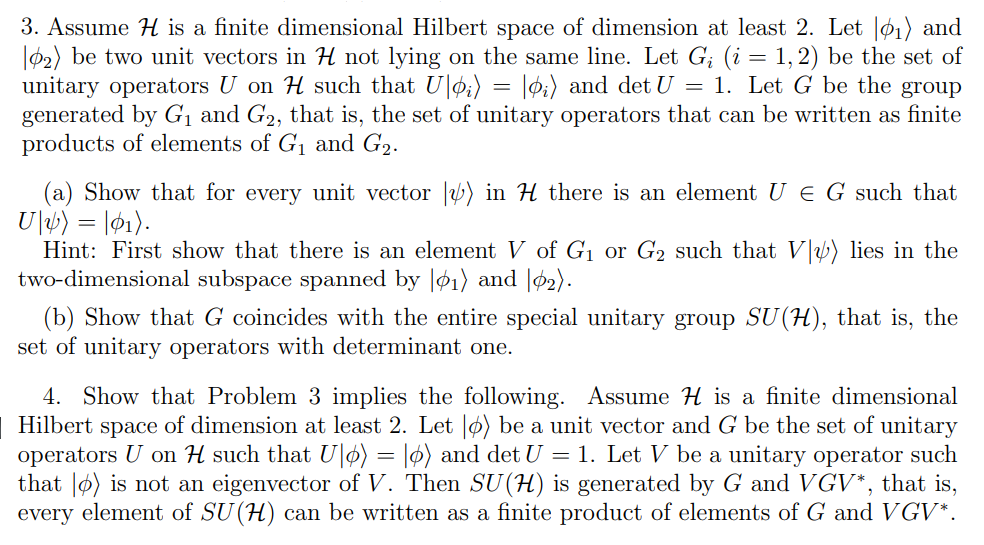
wait fuck, I'll try to fix the discord formating
in b) I'm thinking I could use that the 3D rotation group is isomorphic to SU(2), but I'm not sure how
 sonic osprey
Aren't there usually going to be more than two such G_i?
vocal spade
Well I can just multiply the unitary operators to get new unitary operators, so I should be able to reduce it to two G_i s, I think
 true kraken
Hey i have a question, how would i solve this using geometric description?

 lost ermine
anyone know how to do dis?
 wintry steppe
For question (iv), why would we do what the hint says and take Av dot Aw?
Why not just see if v dot w = 0?
 sonic osprey
how are you going to calculate v dot w?
wintry steppe
Oh my bad..
sonic osprey
The problem is that you don't really know much about v or w
the only thing you know is that they're eigenvectors for some eigenvalues
which is why you have to bring A into the picture, because you don't know much about v,w themselves
wintry steppe
I'm not too sure how to solve it then
Would it still be in the form Av dot Aw = 0? Or do we have to do something strange with a transpose?
 stable kindle
stupid question, can you not find the eigenvectors and eigenvalues explicitly
sonic osprey
It tells you to look at Av dot w
Something you might have covered is that Av dot w is equal to v dot A^Tw
but you know that A = A^T
wintry steppe
sonic osprey
Something you might have covered is that Av dot w is equal to v dot A^Tw
I didn't remember this
stable kindle
no but actually can you not just find the eigenvectors explicitly
sonic osprey
I mean yeah you could
wintry steppe
The book I am using is Linear Algebra and It's Applications
I just tried looking through the paragraphs I had to cover and I couldn't find Av dot w = v dot A^Tw
 wintry steppe
I don't really know how that justifies this
It has nothing to do with matrices does it?
wintry steppe
Jesus
sonic osprey
?
wintry steppe
I just realised that I would not be able to answer this kind of question
A bit worrying
sonic osprey
I mean, you just follow your nose
They tell you to look at the inner product of Av and w
so you write out the definition
that's (Av)^Tw
Then you apply your transpose rules to expand this out
v^T A^Tw
wintry steppe
I didn't even process Av as a vector to be honest, rather as two distinct entities
sonic osprey
Uh
That's what matrices do?
They're a function that takes in vectors and outputs vectors
wintry steppe
Yeah, I understand
Not questioning it
Just, didn't come up in my mind when looking at this equation
 marble lance
Well, you can only apply the dot product on vectors. So if you didn't realize that, that's a lil worrying. But nbd if you just started working with inner products.
sonic osprey
I mean, you can only take the dot product of vectors of the same length, so Av dot w can only make sense if Av is a vector
marble lance
Sniped
stable kindle
sonic osprey
I mean, you can only take the dot product of vectors of the same length, so Av d...
um
 nocturne jewel
<u,u> only makes sense \s
solid flower
are these are equal $$ -2c_1e^{-x}+c_2e^{5x} = c_1e^{5x}-2c_2e^{-x}$$ , i got a different answer using a different arrangement of $\lambda$ and $\vec{x}$ in my D and P
stoic pythonBOT
ahmad_11
 solid flower
would they be equal only if c_1 and c_2 are the same?

 stable kindle
solid flower
would they be equal only if c_1 and c_2 are the same?
stable kindle
solid flower
would they be equal only if c_1 and c_2 are the same?
WLOG they're equal
wintry steppe
mn -xy = 0 therefore parallel
stable kindle
you can just rename c1 as c2 and c2 as c1
solid flower
WLOG?
solid flower
stable kindle
you can just rename c1 as c2 and c2 as c1
ah
solid flower
ah
wintry steppe
Is the range of a matrix A an orthogonal basis, by definition?
I am asking this because I am not sure if we are always allowed to use the "Orthogonal Decomposition Theorem" find the projection of a vectory y onto R(A)

Does it expect me to first find a basis for R(A), check if the basis is an orthogonal basis, and then apply the "Orthogonal Decomposition Theorem"? Or is R(A) by definition an orthogonal basis, allowing me to skip that check?
wintry steppe
Sorry but we skipped over the vector space chapter :(
So I'm not sure what that entails. Could you elaborate?
wintry steppe

We are following Linear Algebra and its Applications by Lay et al.
And Chapter 4 is about vector spaces
3 is about determinants
As you can see on the schedule, we skipped both of those
lavish jewel
what is your definition for a basis?
wintry steppe
I only know how to get determinants under certain conditions, like with 2x2 matrices with the method in eigenvalues
I only know a basis from the subspaces paragraph
Where it is a linearly independent set that spans a certain subspace
Could you please help me with the interpretation of that question?
lavish jewel
i mean... what they told you is exactly it
it is a vector space
in general, a subspace of a vector space
wintry steppe
Do my questions not make sense?
lavish jewel
they do, it's just that
i have no idea how else to put it haha
you kinda missed what linear algebra is all about
what doesn't make sense is your course
wintry steppe
This is the first year this lecturer is giving the course
And it's really confusing to be honest, he even apologised about it
So I am somewhat desperate for assistance elsewhere
lavish jewel
i would recommend you go to the chapter where they explain what a vector space is, or ask the guy to explain it
wintry steppe
His lectures are also very difficult to understand, come across as trains of thoughts rather than presentations to other people
There is no real time anymore for that, sadly
lavish jewel
because every other definition from that point on will include vector spaces and subspaces in some way or another
the range of a matrix is the subspace spanned by its columns
the set of all the linear combinations of its columns
there isn't much more to say
wintry steppe
Right, and the range is also the column space
But I am just wondering
Can I use the "Orthogonal Decomposition Theorem" on a R(A)?
Because the orthogonal decomposition theorem talks about an orthogonal basis
lavish jewel
you would need to find an orthogonal basis for the subspace first
wintry steppe
I'm not sure if the basis for the range of a matrix is always orthogonal
wintry steppe
Okay, I am not sure if any basis of a range of a matrix is always orthogonal
lavish jewel
no
wintry steppe
Or if I need to specifically look for one
lavish jewel
any set with enough linearly independent vectors is a basis of some subspace
you can take the columns and gram-schmidt them
wintry steppe
Right, I would have to apply the gramm-schmidt method to be certain that it is an orthogonal basis
So you think that is a necessary check for a question like this one?
 lavish jewel
it is
wintry steppe
Thank you for helping me by the way, it's such a relief...
Would you be willing to look at the questions I have posted in #help-9 ? Because this is a combination with two other questions
lavish jewel
i don't have the time rn, i gotta go sleep
wintry steppe
Maybe the context will make clear to you what is expected, since I am a bit confused still about the other ones
Oh, okay.
Sleep well, and thank you for the help
wintry steppe
whats wrong here?
 wintry steppe
 hallow cliff
2 looks true to me
hallow cliff
2 looks true to me
could u pls explain why 2 is true?
hallow cliff
i may have foiled wrong but
wintry steppe
no you were right, ty
hallow cliff
you get $I_nI_n + I_nA^{-1} + AI_n + AA^{-1} = I_n + A^{-1} + A + I_n = 2I_n + A + A^{-1}$
stoic pythonBOT
magnusChadson
 wintry steppe
hallow cliff
you get $I_nI_n + I_nA^{-1} + AI_n + AA^{-1} = I_n + A^{-1} + A + I_n = 2I_n + A...
wintry steppe
hallow cliff
you get $I_nI_n + I_nA^{-1} + AI_n + AA^{-1} = I_n + A^{-1} + A + I_n = 2I_n + A...
So anything multiplied by $I_n$ is just itself?
stoic pythonBOT
request new nickname
 hallow cliff
yes
wintry steppe
i see, ty!
hallow cliff
np
 dusky epoch
what's Gamma?
the field over which everything happens?
@lost ermine do you still need help or did you figure it out
wary lily
Let $A$ be an $n \times n$ matrix. Is there any relation between $det(A)$ and $det(A^{-1}$?
stoic pythonBOT
az
 wary lily
like $\det(A) = \frac{1}{\det(A^{-1})}$?
wary lily
O, thanks
stoic pythonBOT
az
 wary lily

 wary lily
then it's transform flips the upper to lower and vice versa?
dusky epoch
transpose
wary lily
transpose
dusky epoch
but you don't know that U is triangular
wary lily
O
wary lily
I think I have the idea
I know, you confirmed
but I have an idea now
let me formulate it
stoic pythonBOT
az
 wary lily
@dusky epoch
dusky epoch
verbose but correct
wary lily
thanks
wintry steppe
Could someone tell me what this is based on?
 lavish jewel
what about it troubles you?
wintry steppe
I'm just not sure which rule allows for this
dusky epoch
$y^TAx = (A^Ty)^Tx$
lavish jewel
if that's a matrix and vectors over R^n and R^m, the argument for why that holds is pretty easy. the transpose of a scalar is the same scalar
stoic pythonBOT
Ann
 wintry steppe
the transpose of a scalar is the same scalar(edited)
Sure, so then we can say
<Ax , y> = <A^T x , y>
wintry steppe
The transpose of a scalar is the same scalar?
lavish jewel
yes, but A is a matrix
wintry steppe
Okay let me give some context
lavish jewel
look at what Ann wrote instead, since my argument seems to be confusing for you
wintry steppe
In the question they state
A = A^T
lavish jewel
ok, but you hand't told us that haha
wintry steppe
But every time I give long contexts I tend to not get responses, so I try to narrow it down
Which is my fault, sorry
lavish jewel
so your A is a symmetric matrix, meaning it is diagonalizable. is A also full rank?
(invertible)
wintry steppe
With full rank you mean that there is a pivot in every column (that the dimension of R(A) = n?)
Then yes
I think so

This is the context
lavish jewel
aha
wintry steppe
(iii) would be -1
Then we need to carry the fact that A = A^T to (iv)
We start out with Av dot w
I saw this explanation. I get all steps except for the middle one
<Ax, y> = <x, A^T y>
 lavish jewel
that was crucial because i was planning on directly using that result, but i see now they have asked you to prove it
wintry steppe
Sorry for not giving full context, hopefully it didn't throw you off
lavish jewel
here is how it goes
we will use exactly what ann wrote up there
gimme one sec to sketch it cuz i'm too lazy to latex right now
wintry steppe
Thank you :>
lavish jewel
oof office decided to start updating, i guess i'll do it in paint
something like that
oh oops, typo
 wintry steppe
I can follow most of this, but I just don't know why
<Av, w> = <v, A^Tw>
Is this a transpose property?
Is this a inner product property?
I can't find it
lavish jewel
that's kinda straightforward
it's what ann wrote
it's a consequence of (A^T)^T = A
wintry steppe
I don't know how what Ann wrote explains it, she starts with a transpose of a vector
lavish jewel

 open pivot
Hey I don't know if this is the right channel but I have been stuck on this for a bit I'm not sure how to get to the right answer


This is my working so far
I think there has to be something wrong with my method because d isnt supposed to be a vector obviously
I think I understand how the method works but I was just using the formulas, deriving A and b from q(x) to get p and then d
hazy sparrow
does anyone have any good resources for self-teaching linear algebra?
 novel hamlet
hazy sparrow
does anyone have any good resources for self-teaching linear algebra?
novel hamlet
hazy sparrow
does anyone have any good resources for self-teaching linear algebra?
If you look for starting id suggest youtube 3brown1blue he explain basics well
 tame mural
IMO you need a book, and 3b1b says so too
His videos are just for intuition
In sum his videos might be maybe 2 hours, maybe even less
No video course will be that successful in cramming a linear algebra course into 2 hours
hazy sparrow
yeah i watched the entire 3blue1brown series 😄
novel hamlet
Yeah, but he explain the intuitition on the topic quite nicely
hazy sparrow
i feel like he gave a good intuition to help dive deeper into it
novel hamlet
Tbh i still dont know what I do in real life with how to calculate null and column space for a matrix
hazy sparrow
but yeah i felt like i shoved a semesters worth of linear algebra in 2 hours
hazy sparrow
tame mural
IMO you need a book, and 3b1b says so too
which book would you recommend?
 zealous junco
im confused of the last 2 lines, i thought the proof was over when they proved R = I which is when they said "last row of R cannot be 0". So i don't see the point of the text after that.

so as A~I then A must be invertible
nocturne jewel
zealous junco
im confused of the last 2 lines, i thought the proof was over when they proved R...
The line above the E= is just them rephrasing/simplifying what they have to prove
not the proof itself
"We wish to show that R=I. That amounts..."
 slate siren
 zealous junco
yea but once u showed R = I, then since R = PA then A~I and we are done right
slate siren
how would you begin to do this problem
I thought something along the lines finding the span of both linear combinations in terms of x,y,z
and these spans are the same equations for x,y,z but im not sure if thats enough and I don't understand why it works which means i cant justify
nocturne jewel
slate siren
if (1,4,-2) is on the first line, then you're done
since the direction vectors are the same upto a scalar
slate siren
ah I see
so they are the same line if 1,4,-2 lies on the first
I understand
yeah I noticed that they had the same direction vector but couldn't figure out how to use that
seems so obvious now
nocturne jewel
they're the same line if they have the same direction vector and start at points on the same line
tame mural
hazy sparrow
which book would you recommend?
I'd try Gilbert Strang's book because he has a lecture series and you can pair it together. I'd also recommend any book which is popular enough to have lots of online discussion you can Google.
hazy sparrow
tame mural
I'd try Gilbert Strang's book because he has a lecture series and you can pair i...
thanks 🙂
novel hamlet
I know the intuititiioin on this one but i dont know how to prove it

A and B are 2x2 block matrices
and multiplication is defined for all A_jk and B_ki
 dire thunder
@novel hamlet you can just do from definition
novel hamlet
i need to prove it,
novel hamlet
i know how matrix multiplication is defined and i tried it but it became quite fast hell of down notifications
 dire thunder
@novel hamlet look
novel hamlet
i ended up starting this way
dire thunder
i will try myself a bit later
need to do tea
but you may start from A, B as usual matrices
and then collapse to 2x2
or vice versa
dire thunder
novel hamlet
show that this can be transformed to AB from usual matrices
hi drake
how are you doing
or even simpler approach
just look at values of c_ij where C=AB
novel hamlet

quick scetch tells me the B needs to be as vide as A is tall
and then same applies to the inner partitions
wich would lead them being square matrices
native rampart
dire thunder
how are you doing
I guess I am not having a bad day
native rampart
Yea,Just find the entry in ith row and jth row in AB
novel hamlet
there is 2 4x4 block matrixes
dire thunder
novel hamlet
A and B are 2x2 block matrices

native rampart
Compare it with the i,j th entry you get from that block matrix product
Should be same
novel hamlet
ah yes, had typo theere
dire thunder
anyway, do you see intuitively why it is true?
novel hamlet
yes i see it, i just dont know how to write it mathematically
it is quite logical its just good old substitution trick
dire thunder
if you want you can just write down all explicitly and do cumbersome computation
but what i would suggest you is just to argue about values of c_ij
novel hamlet
im not sure if it is sufficient to define A_iJ and B_ij have multiplication defined therefore i can substitute matrix A_ij with X and B_ij for Y and do standard matrix multiplication
 dire thunder
determinant ig
little crater
|A| means what again?
dire thunder
novel hamlet
im not sure if it is sufficient to define A_iJ and B_ij have multiplication defi...
wym
dire thunder
little crater
|A| means what again?
determinant
little crater
okay
okay so what is the difference between cross products and determinants exactly
or is it that you just use determinants to solve cross products
novel hamlet

 novel hamlet
lets say i have these matrixes and i want to multiplicate them
dire thunder
novel hamlet
i am suggesting you here
novel hamlet
i decide that A upper left corner can be substituted as X and B upper left corner Y and so on and get then 2 4x4 matrixes with substituted values
tulip glacier
um guys i managed to solve the first part of this question but im curious why when S becomes the solution space here, i need to transpose it?

 plain saffronBOT
From
Rule 3
Stick to one channel and don't post the same question in multiple channels. Please don't ask for help in other channels if no one is responding in the one you have posted your question in.
 wary lily
your honesty and straightforwardness is a public service
 limber sierra
its useful in some proofs
not really computationally
the wikipedia article for cramer's rule provides some example proofs where its handy and simplifying
but it also mentions that its less efficient for computations, confirming what i said:
Cramer's rule implemented in a naïve way is computationally inefficient for systems of more than two or three equations.[7] In the case of n equations in n unknowns, it requires computation of n + 1 determinants, while Gaussian elimination produces the result with the same computational complexity as the computation of a single determinant.[8][9][verification needed] Cramer's rule can also be numerically unstable even for 2×2 systems.[10] However, it has recently been shown that Cramer's rule can be implemented in O(n3) time,[11] which is comparable to more common methods of solving systems of linear equations, such as Gaussian elimination (consistently requiring 2.5 times as many arithmetic operations for all matrix sizes), while exhibiting comparable numeric stability in most cases.
it cites http://web.eecs.utk.edu/~ielhanan/Papers/JDA2011.pdf, which states that cramer's rule is comparable to LU decomposition in terms of numerical stability and asymptotic speed
but still slower in practice
(up to a constant multiple)
As can be seen in Table 4, the algorithm runs approximately 2.5 times slower than the execution time of Matlab, independent of matrix size, which closely corresponds to the theoretical complexity analysis presented above
wary lily
thank you
wintry steppe
cramer's rule is that useful handwaving tool that i use when i want to prove something about invertibility of matrices and smoothness
lost ermine
dusky epoch
what's Gamma?
Sorry for not replying, Gamma is just a field of characteristic 0, you can just think of it as R.
wintry steppe
e.g., GL(n, R) is a lie group, proving inversion is smooth uses cramer
lost ermine
thats the problem if u wanna see it again]
 dusky epoch
mhm
okay
if im reading this right it looks like we must have $P(t) = \alpha_1 t$ with all other coefficients zero
 verbal shard
wary lily
are there any benefits to using Cramer's rule?
verbal shard
wary lily
are there any benefits to using Cramer's rule?
its more fun tbh
stoic pythonBOT
Ann
 lost ermine
thats what i thought but it seems to trivial dont u think?
but yea it looks like thats the only way
verbal shard
i was wondering if there is some way to represent a trilinear form as the product of vectors and a 3D matrix?
or
generally as a matrix vektor product
dusky epoch
lost ermine
thats what i thought but it seems to trivial dont u think?
well it feels like any other coefficient being nonzero would break linearity
so
lost ermine
yea u r right
wintry steppe
What does it mean for Ax=b to have a solution for every b?
Is this another phrasing of 'is there at least one free variable'?
nocturne jewel
wintry steppe
What does it mean for Ax=b to have a solution for every b?
Is this another phras...
It means what it sounds like
any system which can be expressed as Ax=b will have a solution
wintry steppe
But is this related to the idea of "no solution, a unique solution or infinitely many solutions"
Or is it related to mapping/onto?
nocturne jewel
"have a solution"
it refers to the existance of solution(s)
since it says solution
wintry steppe
Sorry, it just threw me off that it says 'for every b'.
Couldn't it be the case that there is a consistency condition which would allow for infinitely many solutions, but not for a specific b?
nocturne jewel
if there's infinitely many solutions, then there's a solution
wintry steppe
So it's just asking if there are free variables?
nocturne jewel
FTIM says that Ax=b has a unique solution for all b, if A is invertible if that's what you're referring to
wintry steppe
I'm not sure what FTIM is, sorry
nocturne jewel
fundamental theorem of invertible matrices
wintry steppe
nocturne jewel
FTIM says that Ax=b has a unique solution for all b, if A is invertible if that'...
Wait, so that would mean that there should be no free variables, right?
If a matrix is invertible, it has n pivot positions
lavish jewel
this also works for nonsquare matrices
no need to look at invertible ones
only invertible from one side
wintry steppe
injective matrix moment
nocturne jewel
you're an injective matrix 
lavish jewel
😛
anyway, you should rather talk about the rank, number of rows, and number of columns
wintry steppe
I was watching videos on this

And it just confuses me because here he says there are infinitely many solutions if there are not n pivot positions
And that n pivot positions would mean that there is only a unique solution
But maybe he means for a specific b?
That if there are n pivot positions, there is a unique solution for every b?
wary lily
imagine a system of n equation in n variables
lavish jewel
the case you mentioned with n pivot positions is a full rank (invertible) matrix
there is exactly one solution for each b
wintry steppe
Okay thank you, and when there is a free variable, does that mean that there are infinitely many solutions for each b?
wintry steppe
nocturne jewel
you're an injective matrix <:sully:651816820122189834>
i agree, there are very few solutions to my problems 
wary lily
wintry steppe
Okay thank you, and when there is a free variable, does that mean that there are...
what may help you to better visualize/digest this is to write your system in three forms:
1- As a matrix equation
2- As a combination of a vector equation
3- As an augmented matrix

you can also write it as a system of equations
which is pretty much the same
wintry steppe
Would you be able to tell me what you would do when faced with a question like
"Does the vector equation Ax=b have a solution for every b?"
It would help out just knowing how someone would go about doing so
Sorry for asking so much
wary lily

there are other equivalent statements
but that's as far as I got
look at this and tell me what you don't understand
stable kindle
i mean matrices are just linear transformations right
i just visualise various violations committed upon the cartesian plane
now considering that there are some matrices which absolutely crush the skeleton down to like a single line, or even the zero matrix which causes an implosion to the origin
wintry steppe
I have no clue what a cartesian plane is
wary lily
wintry steppe
Would you be able to tell me what you would do when faced with a question like
"...
also, the theorem I posted answers the question: "Does the vector equation Ax=b have a unique solution for every b?" Which is a bit different with your original question.
wary lily
maybe you call it smth else in your lang, Bes
wintry steppe
wary lily
also, the theorem I posted answers the question: "Does the vector equation Ax=b ...
Yeah, I'm not sure if it's semantics or if there is an actual difference
That is what I am worried about
wintry steppe
'a solution', do they mean singular, or can there be multiple? stuff like that
wary lily
stable kindle
but not for every b
then when they say every b, they mean unique?
wintry steppe
wary lily
I wrote the entire Lay's Invertible Matrix Theorem a couple of times, it just doesn't stick sadly..
stable kindle
not necessarily
wary lily
wintry steppe
I wrote the entire Lay's Invertible Matrix Theorem a couple of times, it just do...
same book moment
wary lily
that's what I'm saying
stable kindle
no but that's not what they're saying
in the proposition it doesn't have to be one and only one solution, as i understand it, just >= 1
and then it turns out that it's only 1 anyway, i think
wary lily
when they say: "a solution for every b", it can only be true when every b has solution, in which case solutions will be unique.
anyway, the theorem I'm working with is about an n * n matrix
 fervent gulch
Give a scalar equation for a plane at distance 9 from the plane P with equation −2x−2y−z = 4.
wary lily
@wintry steppe is what you dealing with n * n matrices?
wintry steppe
Yeah this is a square matrix
wary lily
OK, then the theorem I posted applies
 fervent gulch
Give a scalar equation for a plane at distance 9 from the plane P with equation ...
fervent gulch
fervent gulch
Give a scalar equation for a plane at distance 9 from the plane P with equation ...
anyone
wintry steppe
wary lily
so, you do know how to solve this, right?
Just check if there are n pivots, no?
wary lily
yes, n pivots, or if the det is not zero, which means it is invertible, or there isn't any zero row/cols in reduced row ech form, or all the vectors/columns are linearly independent.
any of these, means every of these
we clear about this?
wintry steppe
Yes, thank you
wary lily
OK, now when the matrix is not square
the rows represent equations/possible constraints
the columns are the number of variables
you need to row reduce this to echelon form, the augmented matrix
first answer the consistency question:
is there any row of the form [0, 0,... x], where x is none-zero
wintry steppe
In the augmented matrix, right?
wary lily
wary lily
is there any row of the form [0, 0,... x], where x is none-zero
this would equal an equation of the form 0x_1 + 0x_2... = x, where x is not zero
which can never be true
if you find such a row, there is no solution at all
system is inconsistent
right?
wintry steppe
Right
wary lily
now, if it's consistent, we need to answer the uniqueness question
are there more unknowns than equations?
fervent gulch
anyoneee
wary lily
then there are infinite many solutions
if not, the solution is unique
which, coincidentally happens when we dealing with an invertible square matrix
wintry steppe
With unknowns and equations you mean columns and rows, right?
wary lily
yes
but, say rows with pivots for constraints
a full zero row, doesn't count as an equation/constraint
makes sense?
it's always true
wintry steppe
Yeah it does
I'll keep that in mind
Thank you for taking the time to help out az, you're a blessing
wary lily
OK, now a point that may help
you have a non square matrix and are asked if it has a solution for every b
if you end up with a zero row
the system will not have solution where the b has a non zero entry in the corresponding row
bc that will be a [0 0 0 0 x] where x is not zero
that means, it has infinitely many solutions for some bs
but there are specific bs where it has no solution
if you get that too, you have the essence of this subject AFAIK it
fervent gulch
y'all left me on read
wintry steppe
That makes sense, thank you
 reef sleet
What are some engineering applications of linear algebra?
lavish jewel
computer graphics, machine learning, physics simulations
reef sleet
I'm in class right now so I can't take a good look, could you explain or provide some examples please?
wintry steppe
just ignore your class
hazy sparrow
reef sleet
I'm in class right now so I can't take a good look, could you explain or provide...
computer graphics: projection from 3d objects into 2d space (your screen)
machine learning: you can represent your inputs and weights calculations as dot product multiplications
physics simulations: vector fields come up a lot and can be used to determine where a particle can end up
just google applications of linear algebra lel 
reef sleet
oKK got omegasullied my bad 😔
I will Google after ty
Thanks for the examples Charles!
wintry steppe

m x n
rows x columns
The columns need to span the dimensions of rows
So n >= m for it to be onto
Is this correct reasoning?
 slow scroll
 dull pewter


 turbid temple

 desert light


 solid flower
not sure about c) here

is norm only defined for vectors?
so i cant have norm(scalar) ?
wintry steppe
well
the norm of a scalar absolutely makes sense
as in, it's just its absolute value
solid flower
right
wintry steppe
but you should check back to your book's definition of norm
because
who knows
maybe it only defines norm for vectors?
solid flower
yea the back of the book says the expression doesnt make sense
solid flower
"In mathematics, a norm is a function from a real or complex vector space"
$\mathbb{R}=\mathbb{R}^n\big|_{n=1}$
stoic pythonBOT
ahmad_11
 solid flower
righttttt
wintry steppe
then the usual norm is just absolute value!
solid flower
cool!
solid flower
true
 ebon veldt
Let $P_3(\mathbb{C})$ denote the complex vector space of polynomial of degree 2 or less. Let $\alpha,\beta \in \mathbb{C}, \alpha\neq \beta$. Consider the mapping $L: P_3(\mathbb{C}) \rightarrow \mathbb{C}^2$ given by $$L(p)=\begin{pmatrix} p(\alpha) \ p(\beta) \end{pmatrix}, \ \text{for} \ p \in P_3(\mathbb{C})$$ \
Consider the basis $V=(1,X,X^2)$ for $P_3(\mathbb{C})$ and the standardbasis $E=(e_1,e_2)$ for $\mathbb{C}^2$. Consider the matrix presentation $_E[L]_V$ for $L$ with respect to $V$ and $E$
stoic pythonBOT
ScapeProf
 ebon veldt
How do I do this? Im just confused because V is dim 3 and E have dim 2, so how does that work when finding the matrix presentation?
 quartz compass
shouldn't change anything
isolate where each of the basis vectors from P_3(C) get mapped to
so what are your basis vectors of P_3(C) I'll help you out @ebon veldt
ebon veldt
(1,00),(0,1,0),(0,0,1) right?
quartz compass
I was gonna say 1, X and X^2
ebon veldt
oh ye
quartz compass
so where does the polynomial p(x)=1 get mapped to
ebon veldt
to (1,00)?
quartz compass
where's this come from
that's not the mapping, go back up there what do they say L(p) = ?
it should be a 2 dimensional vector
ebon veldt
p(\alpha),p(\beta)?
quartz compass
yeah good
so now specifically our basis vector, p(x)=1
what does this get mapped to
ebon veldt
oh 1(\alpha),1(\beta)?
ebon veldt
yeah
quartz compass
nope
p(x)=1
p(alpha)=1
you're just plugging into a polynomial here nothing spooky 😛
ebon veldt
ah that makes sense
quartz compass
this determines the first column of our matrix
$[L] = \begin{pmatrix} 1 & ? & ? \ 1 & ? & ? \end{pmatrix}$
stoic pythonBOT
Merosity
 quartz compass
see how if you were to multiply by a column vector on the right, let's say [3,0,0]^T
that'd correspond to taking the polynomial p(x)=3
and getting out the column vector [p(alpha), p(beta)]^T = [3,3]^T
so let's do the next basis vector now
p(x)=x
what's L(p)?
ebon veldt
p(\alpha)=X, p(\beta)=X
quartz compass
😬
p(x)=x
plug in x=alpha
let's try something easier
p(x)=x
plug in x=7
what is p(7)
ebon veldt
So thats [7,7]?
ebon veldt
p(\alpha)=7?
quartz compass
p(7)=7
stop
we're just talking about a polynomial here
like you learned in middle school
p(x)=x
means whatever you plug in for x is what you get out
so if I plug in x=3, then p(3)=3
what L(p) does is it takes the polynomial and plugs in alpha and beta to p
@ebon veldt you with me so far?
we're working towards what L(p) is when p(x)=x
ebon veldt
Think so just confused cos doesn't a polynomial have 3 unkowns, \alpha+\beta X+\gamma X^2?
quartz compass
we're just transforming the basis vectors
the columns of a matrix are exactly where the basis vectors are sent to
ebon veldt
Alright
quartz compass
so doing that is all we need yup
so recap, we took p(x)=1 our first basis vector and found L(p)=[1,1]^T
ebon veldt
so L(p) when p(x)=x is [p(x),p(x)]^T?
quartz compass
now we need to take p(x)=x and see what L(p)=? here
not quite
it's [p(alpha), p(beta)]^T
what's p(alpha)=?
ebon veldt
ah so just [x,x]^T
quartz compass
wrong
quartz compass
quartz compass
what's p(alpha)=?
answer this question
ebon veldt
p(alpha)=x
wintry steppe
This is contradictory isn't it?
 quartz compass
this channel is occupied right now @wintry steppe
quartz compass
quartz compass
p(alpha)=x
this is not how you plug into a polynomial!!! @ebon veldt
wintry steppe
Take your time, just curious
ebon veldt
oh okay so [alpha,beta]^T and for x^2 its [alpha^2,beta^2]^T
quartz compass
you sure?
ebon veldt
uh
ebon veldt
quartz compass
what is p(11)=?
well p(11)=11
quartz compass
ebon veldt
p(alpha)=x
ah just so for when I help future students, could you explain why you thought to write this
and what made you realize what p(alpha) should be
ebon veldt
hmm not sure tbh but it makes sense that p(alpha)=alpha I guess
But thanks @quartz compass
quartz compass
lol you're welcome
 glad hamlet
anyone mind explaining how to go from -2/(1-i) to -1-i?
i cant wrap my head around it
quartz compass
multiply by the conjugate divided by itself, (1+i)/(1+i)
glad hamlet
ohhh
 unborn bear
Hey im trying to recreate affine transforms in desmos: https://www.desmos.com/calculator/u8kgcldzqd. But i have problem that draggable points doesnt end on up on circle.

Desmos
quartz compass
how's it supposed to behave?
unborn bear
Theese points should lie in circle as they define my transformation
dusky epoch
wait... so what are the requirements for your circle?
it needs to pass through your two points?
or what
unborn bear
So point [1,0] is transformed to [a, c] by affine transformation so is [0,1]->[b, d]
quartz compass
what's your affine transformation, how does it have anything to do with a circle?
unborn bear
Ok i know the problem, I have wrongly transformed the circle.
Its not affine actually, it's just 2x2 matrix mutltiplication
of 2d points/
mortal juniper
can we take the difference between these 2 eigenvectors which is (1,-1,1) and say it is associated to the eigenvalue 6?
 quartz compass
try to show you can take any linear combination of eigenvectors with the same eigenvalue and get a new eigenvector with the same eigenvalue
dusky epoch
if Av = 6v and Aw = 6w then is it true that A(v-w) = 6(v-w)?
mortal juniper
yes
mortal juniper
yes