
#linear-algebra
2 messages · Page 186 of 1
 stoic pythonBOT
 lavish jewel
don't u wanna do $\sqrt{\int_0^{2 \pi} f(\phi) f^*(\phi) d\phi}$?
stoic pythonBOT
Edd
 lavish jewel
you just integrated the func, that's not the norm and requires complex analysis to justify
btw this is also the reason the inner product is more general than the dot product, this "coordinate" of a vector requires the inner product to define, anyway
lavish jewel
i'm busy :3 use what i wrote
lavish jewel
yea
 lyric swallow
this is even easier because the conjugate and the function simply cancel out
stoic pythonBOT
mirzathecutiepie

 twilit belfry
this?
twilit belfry
o idk i just put that there to show that its normalized since the function is = to 1
lavish jewel
the function's norm
twilit belfry
ty i get it now
i just messed up the complex conjugate
needed to set it to - of the function
 humble oak
another quick question, say i had P(A + P) where A, P are matrices same size. could i make it into PA + PP?
lyric swallow
yes
humble oak
thanks
twilit belfry
i have another quick question
would this be a good answer?
or is there more to it
lavish jewel
i'm not familiar with the terms in physics
lyric swallow
if two operators commute they share a complete set of common eigenstates (eigenfunctions)
lyric swallow
observable can be thought of as some function of $X$ and $P$ like $X^2,P^2,X^2+P^2,....$ are observables
stoic pythonBOT
PROnoob
 lyric swallow
ok so observables are in general some kind of operators but what is actually observed are their eigenvalues and when this happens the wave function becomes the corresponding eigenfunction.
twilit belfry
ohhh
so if the two operators commute then that means the observables are their eigenvalues?
lyric swallow
yes 'observables' in the sense that when you make the measurement thats what is actually observed.
 nocturne jewel
If v and w are in a complex inner product space, how do you expand ||v-iw||^2? I feel like im doing it wrong
I get = <v,v>+i<v,w>-i<w,v>+<w,w>
lavish jewel
the two norm squared in C^N is v^H v
nocturne jewel
what's v^H?
nocturne jewel
no clue what that is
lavish jewel
are these vectors in C^N or are they functions or what?
nocturne jewel
vectors in a complex inner product space V
lavish jewel
generic abstract vectors?
lavish jewel
yep
nocturne jewel
but not sure if i'm doing the expansion right
cause the 2nd term has conjugate stuff
lavish jewel
looks ok
nocturne jewel
<v-iw,v-iw>=<v,v-iw>-i<w,v-iw>
lavish jewel
remember tho that the inner product ina complex space requires complex conjugation
nocturne jewel
yeah that's for the 2nd term expanding
lavish jewel
moshill
twilit belfry
ahh
lavish jewel
you can ask in a channel that deals with differential equations
lavish jewel
multivar calc and diffeq
@nocturne jewel it looks ok, just notice that the 2nd and 3rd terms are complex conjugates of each other
so the overall result is real
nocturne jewel
Gonna be honest im not 100% confident with the conjugate symmetry property, how do they cancel?
i<v,w>-i<w,v> = 2i<v,w> is what i'm seeing
lavish jewel
they don't cancel, you get 2Re{i<v,w>}
nocturne jewel
Not seeing it
nocturne jewel
2Re(z)
nocturne jewel
OH cause conjugate "distributes" so you get conj(i<v,w>) = conj(i)conj(<v,w>) =-i<w,v>
nocturne jewel
lol ty
lavish jewel
still differential equations
probably linear, at that, but you should try the other channel
twilit belfry
is this linear algebra
lavish jewel
or a physics server where they use notation you are familiar with
 plain saffronBOT
From
Rule 4
If your question has not been answered for a minimum of 15 minutes, you may use the Helpers tag once. Please do not try to bump your question using this ping unnecessarily. Do not abuse this ping. Do not individually ping users with the Helpers tag without their express permission.
 limber sierra
also this isnt really linear algebra, but whatever; have you tried substituting the point in?
if you "plug in" x = 2, y = 3, z = 4, is the equality true?
right.
nocturne jewel
lines are orthogonal if the direction vectors are
and how do you tell if 2 vectors are orthogonal?
yes
yes
nocturne jewel
They already got help
stoic pythonBOT


 Requested by | Moonlight ✯ |#9250
 dusky epoch
yeah seems ok
 tame mural
Homogeneous equation just means there's no constant term other than 0
but it can be independent or dependent
 modest kayak
if u have an linear independent family of vector that are all from Q and if the family is independent in Q how does that implicate that it is linear independent in R
can somebody help me
tame mural
You're saying you want to look at the "column" perspective of a linear systems of equations, right?
ah
if you do rref,
and you isolate the pivot columns
those columns will be independent
if you do column row factorization, which is what I think parametization does
where M = CR
then C would be your pivot columns
and R would be your independent rows, kind of acting as weights
so my intuition is yes -_-a
 sonic osprey
@modest kayak where is this question from?
tame mural
u should probably ask someone else too though hehe
 wintry steppe
Yo is this valid for Gauss Jordan : r2 / -r2 -> r2
Or do you have to divide by another row
wintry steppe
I know you can switch rows, add rows, and subtract rows I believe. But i'm not sure about mult and div
 gritty swift
in elimination at least you're only supposed to subtract a multiply of one row from another
 stable kindle
i'm fairly certain you can multiply rows.
tame mural
oh???
wintry steppe
I'm confused cause I tried to follow this Usually with matrices you want to get 1s along the diagonal, so the usual method is to make the upper left most entry 1 by dividing that row by whatever that upper left entry is. So say the first row is 3 7 5 1. you would divide the whole row by 3 and it would become 1 7/3 5/3 1/3.
gritty swift
if you could divide rows then $x + y = c \implies 1 = 1$ NOT $1 + 1 = 1$
stoic pythonBOT
uli
 wintry steppe
What........
gritty swift
I mean in terms of the system of equations
wintry steppe
I just want to know if you can divide the same row by itself and store it in that row
tame mural
I'm not sure you can
It's not one of the elementary row operations
I don't think you can do mult/div
tame mural
Yeah, but he wants more right
gritty swift
its just when he put $r2/r2$ the denominator is a row, which you can't do
wintry steppe
tame mural
It's not one of the elementary row operations
Yeah i'm not sure why that article said you could
stoic pythonBOT
uli
 stable kindle
what article
wintry steppe
Usually with matrices you want to get 1s along the diagonal, so the usual method is to make the upper left most entry 1 by dividing that row by whatever that upper left entry is. So say the first row is 3 7 5 1. you would divide the whole row by 3 and it would become 1 7/3 5/3 1/3.
wintry steppe
....
stable kindle
you can divide the whole row by 3
tame mural
You mult/div with Scalars
stable kindle
but not the whole row by the whole row
tame mural
Yes, and it's better just to think of multiplication and not division
gritty swift
usually you don't apply a row operation to itself if you're doing elimination
since you want to zero everything below the pivots
tame mural
You do it on the first operation at least
wintry steppe
Here wait
[ 1 1 0 | - 1 ]
[ 0 -2 1 | 1 ]
[ 0 2 -1 | 3 ]
So I'm stuck here
trying to get the 2nd row to be 1
in the spot where -2 is
stable kindle
so divide by -2
wintry steppe
wintry steppe
so it would be r2/-2 -> r2
.
wintry steppe
Sweet thank you
other question
do the "pivots" have to be 1
exactly 1
or can it be -1
I call them diagnols but
Uh, i think just standard rref
Yeah thats all I've seen so far, I thought it would be weird to leave it as -1
[ 1 1 0 | - 1 ]
[ 0 1 -.5 | -1.5 ]
[ 0 0 1 | 1 ]

So I proved that there are infinitely many solutions even though they ended up with slightly different numbers right?
I ended up with a1 = -1 a2= -1.5 and a3 = 1 after doing Gauss Jordan
Feel free to roast/correct me

 marble lance
You need to find the general solution to those equations. Maybe try adding/subtracting them as a place to start?
 vital tapir
marble lance
You need to find the general solution to those equations. Maybe try adding/subtr...
vital tapir
marble lance
You need to find the general solution to those equations. Maybe try adding/subtr...
The most I can simplify it to is x2 = -x4, and x1+x3+x5 = 0
marble lance
That looks good. You need to introduce three free variables now
stable kindle
x1 = -x3 - x5, you could note
vital tapir
stable kindle
x1 = -x3 - x5, you could note
oh right
vital tapir
marble lance
That looks good. You need to introduce three free variables now
Not completely sure what you mean here
wintry steppe
I guess I'm just still not understanding the process of Gauss Jordan. Like I wish I could see a tutorial on this exact kind of problem but I don't know what to google
 vital tapir
marble lance
Then you can write the general solution only in terms of x3, x4, x5
vital tapir
marble lance
Then you can write the general solution only in terms of x3, x4, x5
sorry still not understanding fully
trying to think through it
my basis elements will be linear equations equalling zero right
marble lance
Well, your general solution is $\begin{pmatrix} x_1 \ x_2 \ x_3 \ x_4 \ x_5 \end{pmatrix}$
stoic pythonBOT
Lunasong
 marble lance
But now you can replace x1 and x2 in terms of x3-x5
vital tapir
okay so (0 1 0 -1 0) will be one
marble lance
So that it only depends on x3-x5
vital tapir
I only know x2 in terms of x4 though
marble lance
I doooo, oops
vital tapir
okay so $\begin{pmatrix} -x_3-x5 \ -x_4 \ x_3 \ x_4 \ x_5 \end{pmatrix}$
stoic pythonBOT
Mms.
 stable kindle
depression
vital tapir
whoops
marble lance
Yes, now can you split that up into three terms? One with x3, one with x4, and one with x5?
vital tapir

so these are my three basis elements then?
does that look right @marble lance @stable kindle
wintry steppe
wintry steppe
I guess I'm just still not understanding the process of Gauss Jordan. Like I wis...
@wintry steppe Well, I understand that , from what I know you have to perform Gauss-Jordan elimination at that point to prove whether or not the system has any solutions. I just wish I could see the process of proving it has many solutions VS none. They skipped that part on chegg so It's hard to do myself and I could be wrong
 marble lance
Looks good
marble lance
Just add a 0 lol
vital tapir
@marble lance thanks so much for the help!
marble lance
Np
wintry steppe
Yeah one sec
@wintry steppe I feel Like might have done this right so far, but I am lacking a step or two to actually get the values of x,y,z ( or a1 a2 a3 in this problem )

I dunno that ones just such a mess, I'm about to do another and I'll be more carefull but I still don't know what to do after that, Like I think there's an extra step because we didn't do the upper right triangular as all 0's
Thank you!
Imma still do these by hand but, am I dumb and there's just calculators for these? LOL

Omfg , the time..... so much time wasted

LOL
Bruhhhhhhhhhhhhhhhhhhhhhhhhhhhhhhhhhhhhhhhhhhhhhhhhhhhhhhhhhhhhh I was wondering how we were expected to do these problems in 3 min
Oh...
HMMMMMMMM
now i'm more confused
LOL
wait cause
This ones suppose to have no solutions, but it looks like it does?

Or do I have to take those values and then calculate a1 still
this is for another problem but
also I thought the diagnol had to be all 1's
Linear is so confusing lol
OH
so because that last row is 0 = 1 its no solutions
wait...
didn't you do that in yours tho
no no
you had 0 =0
for that last row
ohhhhhh, now it makes sense
So you don't even have to further calucate that for the actual value?
If you just end up seeing an obvious inequality in the rref you can stop there
such as 0 = 1
Bruh, I see why you'd want to do rref now
You have enlightened me , thank you kind fellow
how can i find the orthogonal vector space to another vector space?
This seems like a dumb question but is it wrong to write Span = {} vs span = {} like is it just convention or an actual symbol like COS or SIN
I guess even COS and SIN are just conventions too i think
Like for a spanning set you would write S = {} and for the span it's span = {} but does the way it's written actually matter
tame mural
@wintry steppe https://en.wikipedia.org/wiki/Gram–Schmidt_process
wintry steppe
isnt gram schmidt to find a base?
tame mural
It's a technique to orthogonalize a basis
wintry steppe
@wintry steppe Not sure if you're still around but, what do you do with that last row if the columns and rows are uneven. Is it just 0 = 1
 wintry steppe
tame mural
It's a technique to orthogonalize a basis
wintry steppe
tame mural
It's a technique to orthogonalize a basis
yeah but i think i dont need that. Or maybe yes. Let me explain. I am working on polynomial vector space. I have a dot product and a norm. and i am given a polynomio. I need to find an orthogonal subspace
i got this

my polynomio is p(t)=1+t
and i have to find the orthogonal subspace generated by p(t)
nocturne jewel
wintry steppe
<@456226577798135808> Not sure if you're still around but, what do you do with t...
you need x,y,z such that 0=1, which is impossible
wintry steppe
nocturne jewel
you need x,y,z such that 0=1, which is impossible
Sweet and the rest are 1 =0 which is also an inequality?
wintry steppe
ohhh
then what the heck is the last line
also z?
lol
Is it basically re-defining Z to = 1 = 0
But yeah the fact there's an extra row confuses me
nocturne jewel
the bottom-most row reads 0x+0y+0z=1
wintry steppe
....... thats so weird
so you're basically adding another line to the system that makes no sense
and thats why its impossible
wintry steppe
Isn't the dim(Poly of degree 2 ) = 2 ?? Or am I missing something here
 wintry steppe
oh duh 3 vectors not n = 2
limber sierra
its somewhat weird notation
limber sierra
though i guess the other way would be confusing as well.
wintry steppe
Like R3 is 3 and that makes total sense
wintry steppe
Lol, more so confusing for polys I guess VS other spaces
stable kindle
ew
vital tapir

Not sure about how to do this problem

Tried to do some of it,, but kind of stuck
 nocturne oracle
what do you think the image is
vital tapir
nocturne oracle
what do you think the image is
well the derivative of an arbitrary polynomial
or the set of derivatives of arbitrary polynomials in V
nocturne oracle
yes, which is precisely what
given any poly p in the image, T, can you find some other poly q such that T(q) = p
vital tapir
nocturne oracle
yes, which is precisely what
not sure how to express it
nocturne oracle
you basically just have to apply the power rule/integration power rule? idr what its called
to every part of the poly
vital tapir
idk how to do that
nocturne oracle
what is the integral of ax^b
vital tapir
a/(b+1)x^b+1 + c
nocturne oracle
and so the derivative is of course ax^b
so for any given p(x) in T (the image) , the polynomial given by applying that rule to each of the monomials of p(x), named q(x), is such that T(q(x)) = p(x)
which should give you the answer
vital tapir
So would it be the span of (1, x, x^2, x^3, ..., x^n) ?
aka the set of linear combinations of those
vital tapir
hmm we haven't learned about infinite dimensional spaces
nocturne oracle
well ur answer depends on whether V is finitely generated or not lol, not sure
vital tapir
If V is finitely generated, would that be the answer and just with the qualification that n is finite?
nocturne oracle
would what be the answer
vital tapir
the span of (1, x, x^2, x^3, ..., x^n) ?
nocturne oracle
yep
vital tapir
okay got it thanks. and that would be n-1 dimensional right?
nocturne oracle
would it? you should count them
vital tapir
oh n dimensional
wait
idk how to count it actually
the set of linear combinations of (1, x, x^2, x^3, ..., x^n-1). not sure how I would count that
vital tapir
right
nocturne oracle
so let v1 = 1, v2 = x etc
vital tapir
but isn't it the count of all possible linear combinations
nocturne oracle
no, the dim of V = the number of vectors in a spanning set
nocturne oracle
noo
vital tapir
oh its n
nocturne oracle
yes
vital tapir
LOL I cant think
nocturne oracle
you have n-1 vectors with an x component, and 1 vector that is just "1"
so we have n-1+1
vital tapir
right, the count of v1 starts at x
nocturne oracle
no
nocturne oracle
i mean it doesnt matter where you start
vital tapir
yeah aas long as you add what you left out
nocturne oracle
sure
vital tapir
lol thanks for helping me think through that problem
nocturne oracle

 old dirge
Solving through some Matlab work

It's asking me to compute the left hand side and right hand side of the equation and store them in the variables LHS1 RHS1 and so forth
How would i calculate LHS1?
nocturne jewel
old dirge
How would i calculate LHS1?
there's no LHS to calculate..?
old dirge
Ah here we go
nocturne jewel
You posted 3 matrices and mentioned an equation
nocturne jewel
A(B+C) follows bedmas of numbers, but with matrix rules
so you compute B+C first, then left multiply the result with A

 wide magnet
@edgy kelp There is a formula with A, det(A), and adj(A) in it. If you know the formula, you can plug in the value that you know and find the answer. If you are unsure of what the formula is, I can show it if you want.
 edgy kelp
Yeah @wide magnet what is the formula? I believe the answer is suppose to be a matrix though
Right?
wide magnet
Yeah that is correct

@edgy kelp and if this looks unfamiliar to you, you may recognize this. I wouldn't use this one though since the problem being asked is not dealing with an inverse matrix.
 edgy kelp
I am familiar with this formula @wide magnet
The second one at least
So Its just 7 * Identity Matrix
wide magnet
Yeah
edgy kelp
Oh okay I see now.
 hexed mural
Question regarding the Gram-Schmidt process, particularly in anything greater than R^3. From the derivation from 1D-3D there is a recursive way to compute a new N+1 orthonormal basis vector by finding a orthogonal projection of another vector with a linear combination onto the unit vectors subspace, this extends that idea into N dimensions. But I am curious for anything past 2D can we derive a new orthonormal vector with a cross product between two orthonormal basis without doing any projections onto sub spaces and solving for the new basis vector?
 quartz compass
yeah that will work in 3D
quartz compass
in 4D and higher you have to define what you mean by a cross product of 2 vectors, or think if that's something you actually want
hexed mural
Well I refreshing linear algebra after years of doing it and coming at with a fresh new mindset and start to see patterns
i never saw before when taking it in uni
quartz compass
you can basically make a cross product in n dim that takes n-1 vectors and outputs a vector that's orthogonal to them all by the same determinant type construction as the cross product in 3D space
hexed mural
what you mean by same determinate type construction
quartz compass
you can compute the cross product by a determinant by putting the first row as basis vectors, then the second and third rows as two vectors you're taking the cross product of
it's a pretty common way to compute the cross product, if you haven't seen it before tell me how you compute it normally
hexed mural
so you use the row space (column space transpose)
then
so it's something with the row space you're doing right?
quartz compass
I'm not doing anything
hexed mural
Ya ok I see what you mean
"you can compute the cross product by a determinant "
this is the key
that's interesting
quartz compass
another way to think of it is as like, in n dimensions if you have a determinant with n-1 vectors already filled in it
if you put any other vector that's in the span of those n-1 vectors, the determinant is 0
quartz compass
and so you can think of factoring out this vector and you have effectively a determinant operator
hexed mural
wild
quartz compass
lol 😛
hexed mural
math I swear is crazy like this
vital tapir
hey guys can you help me with a determinant?
quartz compass
you can leave more rows of the determinant "unfilled" in a similar way, but at that point it's probably easier to change notation to work with levi-civita tensors
vital tapir
 quartz compass
like I said, just change of notation effectively
vital tapir
Having trouble finding the determinant for that
quartz compass
imagine you leave 2 rows out of the determinant filled
you could imagine this as being a thing that's now orthogonal to the n-2 vectors left in it
I guess in this case you could explicitly write it as a matrix
and then multiply with a vector on either side
quartz compass
ok 3x3 case, expand out one row with i_1, j_1, k_1 and second row with i_2, j_2, k_2 and last row is a vector
then the entries of the matrix will be the number multiplying the product of the thingies
yeah like you know what it has to give you in the end, the determinant of a 3x3 matrix, so you can check your work no matter how you fumble through to the final answer
maybe that's not very fun though, lol
hexed mural
lol
either way was curious I am not a linear algebra expert or anything just building the knowledge base now after watching the khan videos to get a good knowledge base
to work with things in game dev
quartz compass
makes sense, sounds fun
have you made any games yet or what kinds of game do you want to make?
hexed mural
I've been constantly going to Linear algebra back and forth and said F""" it i am gonna sit down and understand this on a geometric level
because last time I learned it it was compute this compute that
and i never learned anything
Now when I visualize it in my head geometrically it makes way more sense to derives things with it that uses vectors
quartz compass
I just helped someone else out with a handful of vector calculus two days ago too for something they were programming for a game saying similar kinda things lol
hexed mural
I need to use linear algebra to do rotations, movement mechanics and collision physics
some of it can be easy just normal vectors and some vector math
Right now I am trying to figure out how to translate a rotation matrix to a equivalent quaternion operation
I am rotating a frame of reference where a vector lives
quartz compass
hmm it's been a while since I've done that but I distinctly remember quaternions being much better than matrices
quartz compass
because you could more directly rotate how and where you want to
hexed mural
to compute
save compuation
Right now I have what I want working with a rotation matrix
I can take any vector
say its gravity
and reorient the players mouse input
with gravity pointing down
regardless of frame of reference
for example if I walk up and wall and want gravity to point in that direction perpendicular to that wall
I need to rotate my frame of reference so my mouse input stays aligned when I pitch or yaw or roll
while having zero gimbal lock
quartz compass
yeah, from what I remember quaternions avoid gimbal lock altogether
hexed mural
yes
so what I was trying to figure out was
how do I compute the pure quaterions and W to get a new rotation
to rotate my vector
using quaternion multiplication versus a rotation transform
quartz compass
I guess I don't understand what you're really doing well enough from that description to say what to do but I'm pretty sure I could come up with the computation directly in terms of quaternions
which might be easier than trying to translate from rotation matrices
hexed mural
That would be dope. Let me try to see what I can derive from it
I have a bit of knowledge with quats
let you know what I get
quartz compass
I have a specific quaternion video that helped me when I was doing animation in blender a few years ago that might help
hexed mural
I have had some success with quats already doing a plane game
but I never did this specific frame of reference transform with quats before
quartz compass
explains pretty clearly how quaternions have a double cover and why that makes sense to have the whole rotation space be 4 dimensional to cleanly interpolate between different mixtures of pitch, roll, and yaw
hexed mural
the only thing I could think of is computing the projection between two coordinate systems
to get W
for all the basis vectors i transform
then I can take the vector and rotate it by that amount
quartz compass
I feel like fundamentally converting from rotation matrices to quaternions will be flawed
hexed mural
I mean I am cheating a little
quartz compass
you'll end up doing things the same way and so end up having gimbal lock
because how you're working with them is as if you're working with matrices, they just happen to be represented as quaternions
hexed mural
I am cheating because
i am using pure quaternions
so they map 1:1
at least what I think i am doing
X-Y-Z unit vectors
W = 0
right
rotate those when W = 0
then do quat math on that vector in that new basis
quartz compass
I don't think so, at least I don't know if how you're imagining quaternions work is how they actually work
like normalized quaternions let's say, when W=1 that's completely unrotated
then W=sqrt(2)/2 and X=sqrt(2)/2 would be like one of 3 possible ways to rotate around an axis by 90 degrees
they're like living in a space of rotations
hexed mural
yeah
the sum of the squares must equal 1
its like two buckets of water
between real and imaginary
at least how I visualize it
quartz compass
yeah that's pretty good way to think of that I think
hexed mural
you can have complex, pure real and pure imaginary
so the pure imaginary defined a vector
in R3
so like
(w,i,j,k) => (0,1.0i,0.0j,0.0k) so I have a vector
rotating around i
which is
roll i think
how much is defined by some other quat
times that
thats how I was able to do a airplane rotation
with a rotating velocity
quartz compass
well you need all 4 dimensions to talk about rotations unless there's some other convention I'm aware of
quartz compass
if w=0 always it's weird
because you can never rotate back upright even partially
old dirge

What would the matlab code look like to divide the first row to make the pivot a one
Just a general idea
old dirge
why 0.2?
 raw sand
same as dividing by 5
old dirge
I see, so by pivot we are trying to turn the 5 into a 1?
btw that worked, thanks dude!
raw sand
np
 wintry steppe
try a really simple line to project onto
vital tapir
wintry steppe
try a really simple line to project onto
yeah I tried to start with that idea, but couldnt work through it
lavish jewel
what is the dimensionality of a line?
vital tapir
1
lavish jewel
how many lin indep columns does the matrix have, then?
vital tapir
one right?
vital tapir
tbh im not too sure. I know that the basis has only one vector since the dimension of a line is 1. and that vector clearly will span the line
not sure what else I can conclude
lavish jewel
that:s about it, just notice that the column space of the matrix has to be dim 1
vital tapir
that makes sense I think. still not sure how to create an example from that knowledge
lavish jewel
aside from that, you could use this single vector as a change of basis
or if it is clearer, do a vector projection with dot products
wintry steppe
if you write this out as an equation with one side being the expression for a projection, you can choose a really simple line. from there you might see what the matrix would have to be
vital tapir
still not completely understanding. trying to think through what you guys have said
vital tapir
wintry steppe
if you write this out as an equation with one side being the expression for a pr...
can you give me an example of one such line. I know the projection expression would be T(x) = projy(x)
wintry steppe
idk like the line defined by scalar multiples of a standard basis vector
that is as simple as it gets
for example, t*(1,0,0)
lavish jewel
do you know how to do scakar and vector projections? changes of basis?
vital tapir
yeah I know the computations
never really thought through them though conceptually
so I project a vector onto t(1,0,0) and essentially I'm trying to find the matrix of the transformation?

So I'm looking at my textbook. looks like I can easily find a 2x2 matrix that projects onto a line in R2
@lavish jewel @wintry steppe is there a similar formula for a transformation matrix of a projection onto a line in R3?
wintry steppe
you don't need a general formula
what is the projection of a general R^3 vector (v1,v2,v3) onto (1,0,0) (on the line we are talking about)?
 wintry steppe
o I meant for a projection matrix
lavish jewel
just notice that $x \cdot w = w^{\text{T}} x$
stoic pythonBOT
Edd
 vital tapir
it would be v1/1 (v1, v2, v3)
lavish jewel
so you can group stuff in that formula and it directly gives you a matrix
lavish jewel
i trust you peeps will be ok, have fun!
wintry steppe
yuhhhh
vital tapir
yeah so if we choose a line L to be scalar multiples of (1, 0, 0). then every (v1, v2, v3) will project to (v1, 0, 0)
line L in R3*
vital tapir
wintry steppe
yuhhhh
so is the matrix of the transformation a 1 in the first entry, and all else zero?
wintry steppe
that works yup
vital tapir
ah okay that finally makes sense
wintry steppe
POG
vital tapir
thanks so much for the help!
wintry steppe
why the orthogonal vector subspace to the polynomio 1+t is inf-dimensional?
 native rampart
wrt which product?
Well,The dimension of orthogonal vector subspace will always dimension of parent vector space-dimension of the subspace you care aboit
native rampart
SPD?
vital tapir

Need some help thinking through this
Could scalars of the identity matrix for a 2x2 matrix (I2) work?
native rampart
Yea,That would be vector space generated by I
quartz compass
other fun examples might be, diagonal matrices, symmetric matrices, triangular matrices
vital tapir
I just have to show that the subspace contains 0, so the zero matrix, and it is closed under addition and scalar multiplication right?
quartz compass
yup
vital tapir
got it thanks! and to show that it is a subspace of all 2x2 matrices, I can just state that since it is 2x2 it is a subset of the space. or do I have to do something more rigorous to show it is a subset?
vital tapir
perfect, thanks!
wintry steppe
I'm not really sure what they mean , could someone dumb it down for me

first equality is the rank-nullity formula
the inequality is because dim ker L >= 0
dim ker L + dim range L >= 0 + dim range L = dim range L
(you can add things to both sides of inequalities and they still hold)
which shows that dim V >= dim range L
oh one sec
so nullity is dim ( N(B) ) where N(B) is the null space right
yes
which is the same thing as the rank of the null space
if by "rank of null space" you mean "dimension of null space" yes
but be careful with that terminology
ooops
because in linear algebra "rank" usually refers to the dimension of the image
but it can be used to talk about the dimension of any space
I see...
this makes sense
hard to think about abstractly
thanks!
 vital pagoda
i have a matrix where the entries are members of Z_3 and I want to row reduce it

and ive been wondering
how do I deal with row operations producing negative / fractional entries?
is that an invalid row operation?
native rampart
No
R_4->R_3+(-1)R_4 is perfectly valid
Here
Valid operations are:
1)swapping of 2 rows
2)Scaling of a row by a unit
3)R_1->R_1+cR_2 where c is any member of the ring
vital pagoda
well
i may be misunderstanding but
R_4-> R_3 + (-1)R_4
means the fourth row becomes 0 0 0 1
which i can perfectly wrap my head around
but lets say
native rampart
Yes
vital pagoda
one of my intermediate steps
was
R_1 -> R_1 + (-1)R_2
and that produces
0 0 (-2) 1
-2 is not in Z_3
what happens then?
vital pagoda
so they wrap around?
native rampart
Yes
vital pagoda
i guess that is pretty obvious...
native rampart
The addition is as per the ring addition
vital pagoda
then what about ones producing fractions?
vital pagoda
but fractions are not part of any Z_n
native rampart
Frcation is multiplication with a multiplicative inverse
vital pagoda
OHHHHHHHHHHH
native rampart
The multiplication as per the ring rules
wintry steppe
I have grabbed a bagel I am now ready for the study guide

Lol
Do you not like bagels and linear algebra study guides
 slim gyro
is it possible for a symmetric 2x2 matrix to equal the zero matrix when multiplied by itself?
i worked out that it is possible if the 1st entry is equal to minus the 4th entry but i think i did something wrong
nocturne jewel
I mean write out the matrix multiplication of a symmetric matrix, set it equal to 0, and you get 4 equations for the entries
native rampart
0 matrix is symmetric
nocturne jewel
0^2=0 
native rampart
No
slim gyro
it's impossible right?
native rampart
Yes, It's not possible
There's a theorem in LA which says that all symmetric matrices are similar to a diagonal matrix
 reef sleet
Am I wrong or is this incorrect?


I didn't get the same component for khat
I got -2/sqrt5
Let me send my det, lol, they wrote theirs a bit diff

 tame mural
Does anyone know off top of their head how to convert a matrix of floats to rationals?
for Julia
 wintry steppe
not necessarily
Ax = 0 is always consistent
but A may not have full rank
which leads to A not being invertible
 quartz compass
yup
 dusky tinsel
could i get some help with a problem in voice chat?
nocturne jewel
dusky tinsel
could i get some help with a problem in voice chat?
post the question so people know if they can help or not. ..
 vital tapir

Can someone help me with this problem. I'm supposed to only reason through it geometrically
I can't manipulate the equations, find RREF, etc.
stable kindle
so what are they
vital tapir
equations of planes
vital tapir
vectors (x,y,z) that satisfy the equations. so it would be a set of vectors
stable kindle
no but geometrically so like
in terms of the planes, what do the solutions look like
the things that satisfy all the equations
the things on both planes
vital tapir
it would be a line created by the intersection of the planes
vital tapir
okay so since the solution is in the form of a line, it therefore must have multiple solutions
vital tapir
and I know the planes intersect because they each equation equals zero?
stable kindle
uhhh not quite
wait
hmm
no actually yeah that works
bc they will intersect at at least the origin
vital tapir
so how can I prove that the intersection forms a line?
vital tapir
okay makes sense. so for (a) it can't have a unique solution, because the two planes intersect forming a line, which implies there are infinite solutions. for (b) it can't have no solutions, because the planes intersect at at least the origin, which would be a solution
stable kindle
uhhh you could find the normal vectors to the planes, cross product them to get a vector d along the line , take the origin as a point in both and then it's just any vector of the form kv works? or generally with any point p in the intersection, any vector v where v = p + kd would work and that's a line
stable kindle
vital tapir
okay makes sense. so for (a) it can't have a unique solution, because the two pl...
yeah i think that works
well i think to be pedantic for part a you want to say
'if the two planes intersect, the intersect is a line'
vital tapir
do I have to explain why that is the case for this system?
such as why it doesnt intersect in another form?
stable kindle
i think you can take that as granted
vital tapir
okay, perfect got it. thanks so much for the help!
stable kindle
coolio
 plain saffronBOT
From
Rule 4
If your question has not been answered for a minimum of 15 minutes, you may use the Helpers tag once. Please do not try to bump your question using this ping unnecessarily. Do not abuse this ping. Do not individually ping users with the Helpers tag without their express permission.
wintry steppe
just ask your question
 marble lance
Isn't that just the coordinates of T(1) T(x) T(x^2) in terms of B written as columns?
So just find T(1), etc
 crisp cloud
is there anyone here who can help me with some linear algebra homework
 wind pasture
@marble lance so its just [T(1) T(x) T(x^2)]
marble lance
Yep
wind pasture
i thought the entries were respect to the basis B though
{[T(1)]B . . . [T(x^2)]B}
like this
also i don't understand how we can solve it without knowing what p(x) is @marble lance
marble lance
Yeah, that's what I thought you wrote the first time, oops
Uh, p(x) is your input
So it's 1 when you plug in 1, and x when you plug in x, and x^2 when you plug in x^2
wind pasture
huh really?
isn't the function sign redundant?
if p(x) = x
why would it be in this form?
stable kindle
bruh
it can be anything
it's a polynomial in P^2
the point is that p(x) could be 1, or x, or x^2
so like generally p(x) = ax^2 + bx + c, right?
marble lance
If I say, f(x) = 2x + 5. You don't say what is X? Well, now you have T(p(x)), p(x) is the polynomial you plug into the equation
wind pasture
sorry i was getting confused
i thought we were trying to find T(p(1))
but we're actually trying to find T(1)
stable kindle
nnno
wind pasture
wdym? @stable kindle
marble lance
Yes, we are trying to find T(1)
nocturne jewel
ok then
vital tapir
I feel like im close lol
so going to repost if I have trouble

Can someone check if my answer is correct for this question. It asks for us to say if the statement is true or false and then justify
 sick pecan
A linear combination of four vectors in R5 can be expressed as a product as the product Ax where A is a 4x5 matrix. T/F
anyone know the answer
I just started my 8 week course very confused on simple questions
 gray dust
@vital tapir it's all good except how the rhs is written https://i.gyazo.com/ee94bf385fbb07d2014fc4e327856381.png
 vital tapir
gray dust
<@!183052247356276737> it's all good except how the rhs is written https://i.gya...
vital tapir
gray dust
<@!183052247356276737> it's all good except how the rhs is written https://i.gya...
how should I write that instead?
sick pecan
A linear combination of four vectors in R5 can be expressed as a product as the product Ax where A is a 4x5 matrix. T/F
gray dust
@vital tapir matrix multiplication generally doesn't commute so we must be consistent in writing left/right multiplication by a matrix. if we left-multiply the lhs by A^-1 then we must do the same to the rhs
vital tapir
gray dust
<@!183052247356276737> matrix multiplication generally doesn't commute so we mus...
ah right thanks for pointing that out, makes sense. so I just move the A^-1 to before the lambda?
gray dust
yes $A\inv(\lambda v)$
stoic pythonBOT
RokabeJintarou
 vital tapir
gray dust
yes $A\inv(\lambda v)$
vital tapir
gray dust
yes $A\inv(\lambda v)$
got it, thanks!
sick pecan
The dimension of the solution set to the equation 7x1 + 3x2 - x3 + x4 = 0 is three. T/F
what do u guys think
wind pasture
True @sick pecan
wind pasture
I have a question
sick pecan
If A and B are square invertible matrices, the inverse of AB is A-1B-1. This is false right cus it's BinverseAinverse
wind pasture
if we find that b[T]b is not diagonalizable does that mean T is not diagonalizable?
sick pecan
If A is a 5x5 matrix with the property that A3 is equal to the identity matrix, then A is invertible. T/F
im unsure
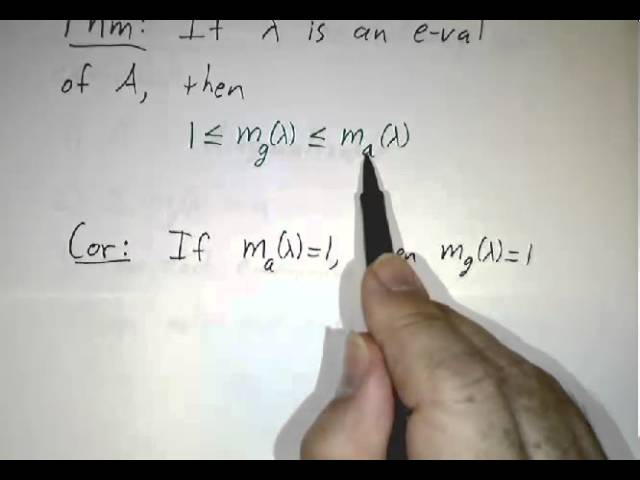
A matrix is diagonalizable if the algebraic multiplicity of each eigenvalue equals the geometric multiplicity. We define these terms, state the relevant theorems, and see how this works in three examples.
according to this no i think
i just learned this monday lol
The solution set of a system of n equations with n unknowns is a subspace of Rn. T/F
what u guiys thing
The solution set of a system of n equations with n unknowns is a subspace of Rn. T/F ? also this is tricky
If a transformation has the property T( v1 + v2 ) = T(v1) + T(v2) for any vectors v1 and v2, then it is a linear transformation. T/F
damn i wish my textbook had solutions to these t/f questions mad hard for me
If A is a 5x5 invertible matrix, the null space of the linear transformation T(x)=Ax consists of one vector. t/f
vital tapir
The above is my answer for that problem, which is to state if it's true or false and justify. I feel like I'm missing something though or did something wrong
I didn't use the fact that v is a unit column vector anywhere in the problem
wintry steppe
looks right
it's actually true that whenever v is non-zero, vv^T has rank 1
hence determinant zero
vital tapir
I see. Curious as to why it has the qualification that v is a unit column vector in the problem then.
wintry steppe
red herring lmao
 mystic sentinel
Welp. I've decided to try to work through the entirety of Axler. 😛 God help me.
And I've run into the first problem that's really stumping me. (The book says it's significantly harder. I COULD look it up but I really don't want to.)
That's as far as I've gotten.

Here's my proof of the previous problem.

But ... I have no idea if I'm on the right track or this is gonna be something completely out of nowhere.
 nocturne jewel
want to find a basis for all functions which obey f'=2xf
 sleek helm
@mystic sentinel I have to study for a final but I think the idea here is to take two vectors each found in only one of the two subspaces
and play some game about failure of closure
or something
mystic sentinel
That's what I did for 1.C.12 and it worked decently well.
mystic sentinel
For 1.C.13 though ... when you've got three vectors, I dunno if that's going to just turn into casework trudgery or what
sleek helm
Yeah sorry I misread
I only read c12
okay for c13
the hint is useful
it tells you that you need to do something that you can't do over F_2
I don't have time rn to think about what that is
but if you only reference addition of vectors or something
mystic sentinel
Fair enough
sleek helm
your proof won't work
mystic sentinel
Huh. Interesting.
sleek helm
So you need to use scalars in some important way or you need to do something that screws up signs
(over F_2 +=-)
mystic sentinel
I didn't realize that the sum of any two gives you the third.
(In F₂², looking at nonzero vectors)
sleek helm
My money is that the reason the proof works for R or C
but not F_2
is a sign issue
maybe not though i really need to get back i cant get drawn in
lol
good luck
sleek helm
tldr if your proof makes sense in F_2 its wrong so you gotta do something that you can't do in F_2
wintry steppe
I think I vaguely recall doing this problem, I agree that sign issue sounds probably right
Well, I guess this basically has to be it, it is so characteristic of F2
 covert trellis
How do I find vector x and show that T(x)=y?
 mystic sentinel
So I at least feel like I'm gonna have to do something similar to what I was doing in my 1.C.12 proof. Take three vectors, maybe call them u v w so that each is contained in exactly one of the three subspaces, and consider u + v + w ... or maybe some other combination
But if you need to include scalars, maybe u + av + bw



 orchid harbor
Isnt there a mistke here?
 wet finch
@mystic sentinel is it true over other fields of char 2?
orchid harbor
2.8a how the hell can u multiply if r and c from other are not equal?
 orchid harbor
question 2.8a
mystic sentinel
It only mentions F₂ specifically.
orchid harbor
F2?
mystic sentinel
Talking to @wet finch
wet finch
yeah I know but just in terms of how to answer it
orchid harbor
oh sorry
wet finch
if it's true over F_4 for example then that's almost weirder
mystic sentinel
And yeah, so far my method from before isn't working very well. I tried examining, say, u + av + bw, where u, v, and w come from the subspaces U,V,W
wet finch
one other thing you can't do over char 2 is divide by 2
things like u = (u+v)/2 + (u-v)/2
mystic sentinel
Interesting
So I'm thinking something like...
Say your vector space is X, and it has three subspaces U, V, W, and none is contained in any of the others. Pick u in U only, v in V only, w in W only.
Show that there's some a,b such that u + av + bw isn't in U u V u W.
If u + av + bw is in U, then u is in U, so that means av + bw is in U, but that doesn't really give me much of a contradiction to work with.
Neither v nor w is in U, but their linear combination could be.
. . . unless this is reducing to the previous case? But if that's the case, then what's so special about F₂?
... okay, in F₂ in just about any space, you can have u = (1,1), v = (1,0), and w = (0,1). And neither v nor w is in the span of u, but v+w certainly is.
sleek helm
Well
you can reduce one possibility to the previous case
which allows you to take 3 vectors all not contained in the other spaces
my guess is from there it doesn't reduce
mystic sentinel
Yeah, I got that much I think
Like if one space is contained in another it reduces to the case I already proved so I'm assuming no one contains any other
wet finch
can you use multiple scalars?
mystic sentinel
Yeah that's what I"m trying to do, lol
 versed topaz
this is tricky
mystic sentinel
But let me see if the whole dividing by 2 thing helps. If I can work a 2 in somehow, then I might be onto something.
 violet sage
Does V + W = L + W imply V = L? (set-theoretic pun unintended)
mystic sentinel
Since if I'm in a field where 2 = 0, then I've got something.
violet sage
mystic sentinel
But let me see if the whole dividing by 2 thing helps. If I can work a 2 in some...
I think it's more about the size (and thus the lattice) than the characteristic.
violet sage
versed topaz
Take V and L to be contained in W
I was assuming V, L, W are pairwise incomparable.
mystic sentinel
Lattice?
Are you talking about like a lattice created from adding repeated copies of u,v,w in various combinations?
versed topaz
violet sage
I was assuming V, L, W are pairwise incomparable.
Still no, consider any three lines in R^2
violet sage
Ohh, right
versed topaz
mystic sentinel
Are you talking about like a lattice created from adding repeated copies of u,v,...
The "lattice structure" here is the fact that any two subspaces have a largest common subspace (the intersection) and a smallest common superspace (the thing spanned by both)
At least, I think that's what they're saying
I was also thinking about this
mystic sentinel
I see. But I'm trying my best not to use things like "span" because they haven't been discussed yet 😛 I imagine it should just be doable from the definition of a vector space somehow (and maybe field properties)
versed topaz
Fair enough
You weren't going to like any of my attempts then lol
I think most so far have started with "assume we're in finite dimensions, choose a basis"
violet sage
U u V u W should equal U + V + W, right?
versed topaz
If it's a subspace then yeah
versed topaz
Nice!
mystic sentinel
Cool. Any suggestions for what direction I might want to try without giving it away?
mystic sentinel
Right now I'm just sort of trying different linear combinations
versed topaz
what's with the nick btw max? You didn't really seem the type to make jokes about 2 genders...
mystic sentinel
Yeah I figured it would be about the 2 thing LOL
versed topaz
lmao
sleek helm
okay so like
versed topaz
Max, does your proof work over F4?
mystic sentinel
Actually
sleek helm
yes
versed topaz
Okay good
mystic sentinel
I wonder if the (u+v)/2 + (u-v)/2 thing could be part of it
versed topaz
I felt like that had to be true lol
wet finch
is this statement true for F4?
sleek helm
Think about you v_1,v_2,v_3 all not contained in the others
wet finch
yeah
sleek helm
so the issue before
was v_1+v_2 can't end up in V_1 or V_2
if it did work for 3 spaces
where would they end up
ponder this
and try to get a contradiction
mystic sentinel
I feel like that's exactly what I was trying to do 😛
wet finch
ohhhh wait max I think I see it
wet finch
wait maybe not
mystic sentinel
That's okay
I'll deal with it
Wait are you telling me to DM you
Or referring to my previous name 😛
mystic sentinel
Nah either's fine lol
mystic sentinel
Actually maybe I can try reducing it down
sleek helm
can u think of anything else equally obvious
mystic sentinel
Like ... if I start with two vectors
v_1 and v_2, from distinct spaces. Think about v_1 + v_2. I can show from previous problem it's not in the first or second space, so it has to be in the third, and maybe get a contradiction there
Actually lemme drop subscripts and just use different letters. Here's what I'm thinking now.
Subspaces U, V, W, containing vectors u, v, w (each one is only in that space).
Start with u and v and look at the last problem.
u + v can't be in U or V. So it has to be in W.
(If it has any chance of being in UuVuW.)
And then from there, you can do the same thing with u - v for the same reason, so u - v is also in W. But that means that (u+v) + (u-v) = 2u is in W which wasn't supposed to be the case.
But that's okay if 2 = 0 because then the zero vector is in any subspace.
sleek helm
it wont work in char 2