#linear-algebra
2 messages · Page 182 of 1
 wintry steppe
no, because lets assume 1 norm is 3
then i have 3a <= 6 <= 3b
i can pick a and b that sattify this
 sonic osprey
.
wintry steppe
and if 1 norm is x, i can do the same
sonic osprey
I'm just going to start quoting messages I've said already
because I'd rather stop repeating things for the fifth time
 sharp idol
Yea. a and b must be constants
wintry steppe
okey, then what a and b will u chose?
u said they are equivalents, so there must be some constant values that sattisfy the inequality for all the polynomials
sharp idol
I recommend you go to #precalculus or one of the question channels. Regardless if this is linear algebra or not, this channel is already pretty involved in something right now.
sonic osprey
.
wintry steppe
tell me the a and b and i will try to find the polynomial
sonic osprey
Oh, are you talking about my example now
wintry steppe
yes
sonic osprey
To show they're equivalent, you want to find numbers a,b such that a||x||_1 <= 2||x||_1 <= b||x||_1 holds for all vectors x
Do you agree with this?
wintry steppe
yes
sonic osprey
So you just take a = 1 and b = 2 for example
sharp idol
Hold on, shouldn't a and b be multiplying the same norm?
sonic osprey
For the sixth time, I complained about this because you are trying to show that two norms are not equivalent
sharp idol
Seems ya fixed it
sonic osprey
I just complained because I didn't understand you were talking about my example
I thought you were talking about your original problem
wintry steppe
sonic osprey
So you just take a = 1 and b = 2 for example
ah okey, i see it
so a=1 and b=2 holds the inequality for any P(t)
right? right
sonic osprey
yes
wintry steppe
okey so, on my problem, they arent cuz i cant find a,b that holds for any P(t) cuz i can always increase the value of n, right?
please tell me yes
sonic osprey
yes
 _||
sonic osprey
_||
sonic osprey
I agree
wintry steppe
okey xd
sonic osprey
But just saying that your vector space is infinite dimensional is not enough
Like i showed
wintry steppe
ye ye, okey, i got it
sonic osprey
So saying that you have infinitely many polynomials is not enough of a justification
wintry steppe
fair
ty
😦
///<
sorry if i missexplained but wasnt my intention to say inf-dimensional = justification. I was trying to say that i could do it cuz it was inf_dimensional
i dont use to talk about maths on english so sometimes is hard for me
 blissful vault
thhanks to closed captions and it's sam i understand now
i have another question

this is the notes i took
i'm not sure what gamma is doing

it looks like the teacher just calculated T(1,0) and T(0,1) and then transposed them
sharp idol
That is normally what you want to do, because T(1,0) and T(0,1) transform the basis and therefore your vector space
Plus, they tend to be easier to evaluate
 wary lily

for b, either two equations must coincide and the third is not parallel to them, or all equations are distinct and intersect at one point.
I'm not sure how to mathematically express this.
Please check:
For case one $\abs{\frac{a}{b}} = \abs{\frac{c}{d}}, k = l, ex + fy = ax +by$, this also works for any other pair to coincide and the third not parallel to them.
 stoic pythonBOT
az
 wary lily
For case two $\abs{\frac{a}{b}} \neq \abs{\frac{c}{d}} \neq \abs{\frac{e}{f}}$ and there exists $(x, y) \in \mathbb{R}^2 | ax + by = cx + dy = ex + fy$
stoic pythonBOT
az
 blissful vault
sharp idol
That is normally what you want to do, because T(1,0) and T(0,1) transform the ba...
blissful vault
sharp idol
That is normally what you want to do, because T(1,0) and T(0,1) transform the ba...
then for this question: do i just evaluate T using beta and ignore alpha?

 spring pasture
blissful vault
then for this question: do i just evaluate T using beta and ignore alpha?
spring pasture
blissful vault
then for this question: do i just evaluate T using beta and ignore alpha?
Alpha is the space in which u r doing transformation
But yeah u don't have to worry about it while doing transformation
blissful vault
alright thanks!
 dusky epoch
wary lily
I'm not sure how to mathematically express this.
dusky epoch
wary lily
I'm not sure how to mathematically express this.
i dont think youre supposed to do this in terms of the variables themselves tho
they ask for a desc of the relative positions of these lines
blissful vault
HAHA my teacher wrote this https://media.discordapp.net/attachments/814219153669619731/817833486936309830/unknown.png

 nocturne jewel
Yeah
 stable kindle
depression
 raven wagon
can someone help me with this problem ? I don't know where to start !!
 sharp idol
I'm sorry, I do not know french well enough to be useful here.
raven wagon
can I try to translate it for you ?
sharp idol
I'd definitely appreciate that.
Can you also tell me what the upside down v means for this? I have never seen it used for vectors
wary lily
my wild guess is that 18 is the triple product so that would be the cross product, but then we would have a problem at trouvez l'angle entre...
raven wagon
So, in this tetraedron, we have the coordinates of W= (2,2,1). We also know that the face (triangle) formed by U and V=6 units.
The product of UV by W= 18
raven wagon
wary lily
my wild guess is that 18 is the triple product so that would be the cross produc...
I thought about it but, nothing specifies that it's regular. I'm absolutely lost here !
wary lily
is that $(\ora{v} \times \ora{u}) \cdot \ora{w} = 18$?
stoic pythonBOT
az
 raven wagon
yes !
wary lily
this would make sense because the triple product is also the volume of the parallelpiped that is formed by the three vectors v, u, and w
if you find a relation between the parallelpiped and the tetrahedron that may help
raven wagon
can we say that all the vectors (u,v and w) have the same length ?
sharp idol
I think that is a bit of a jump
raven wagon
then, I know about W the most right ? ... what could I do with it ?
could I maybe divide 18 by W to find what the product of v and u should be ?
sharp idol
Sadly no. Dividing by vectors is a no no
Also, keep in mind a dot product is not "normal" multiplication
nocturne jewel
you mean the area of a surface?
raven wagon
no sorry I mean the triangle made by U and V = 6 surface units
sharp idol
Wait, that's good!
The triangle made by $\vec{u}, \vec{v}$ is $\frac{1}{2}||\vec{u}\times\vec{v}||$
stoic pythonBOT
dackid
 raven wagon
should I isolate one of the 2 vectors ? or is it too complicated after?
I know what I did is wrong but it might take us somewhere ...
1/2 (uxv) =6
If we isolate u and say that u=3/v
Does it make some sort of sense ?!
sharp idol
Again, we cannot divide vectors
stoic pythonBOT
dackid

 sharp idol
No no. $\vec{u}\times\vec{v}\neq ||\vec{u}\times\vec{v}||$
stoic pythonBOT
dackid
 sharp idol
The left side is a vector and the right side is a scalar
wary lily
is that directed at me?
sharp idol
raven wagon
So, 12 •w=18
It is directed at this claim
wary lily
ah, having the magnitude of h may help here
sharp idol
Oooo, so here is something interesting!
$(\vec{u}\times\vec{v})\cdot \vec{w}=||\vec{u}\times\vec{v}||;||\vec{w}||\cos(\theta)$
This will actually get you really far!
wary lily
noice
stoic pythonBOT
dackid
 raven wagon
Yup ! Got it
sharp idol
Okay. Use that identity and it should take you home free!
raven wagon
Thank you so much for the help ! It almost feels like I won the Olympics or something 😂🥳
sharp idol
It's a good feeling indeed :)
What was the problem anyways? You gave us a lot of givens, but not any goals xp
raven wagon
The final goal was finding the angle formed btw uv and w
I think I have everything I need with the last formula. Thanks again !!
sharp idol
Sweet! Glad we got there in the end
nocturne jewel
If I have 2 3x3 matrices M and N, is showing their determinants arent equal sufficient to showing they arent similar?
stable kindle
similar?
stable kindle
oh, right
nocturne jewel
Yeah wasnt 100% sure on if that was always the case
wintry steppe
stable kindle
similar?
equal up to change of basis
stable kindle
ok
wintry steppe
nocturne jewel
Yeah wasnt 100% sure on if that was always the case
it's also one reason you can give a good definition of the determinant of a linear operator and not just a matrix
something to keep in mind
nocturne jewel

stoic pythonBOT
dackid
 sharp idol
Wait, you are talking about similar. What does it mean for two matrices to be similar?
Is it this?
A and B are similar if there exists a matrix P so that $A=P^{-1}BP$.
stoic pythonBOT
dackid
 wintry steppe
yes
that is the correct definition of "similar" for matrices
that is also the correct definition of "symmetric" for matrices
sharp idol
Okay thanks. I wasn't sure if my memory served correctly, so I just wanted to make sure.
wintry steppe

 sudden nacelle
i need help finding the parametric representation of a hyperboloid
 ruby loom
I'm having difficulty parsing the definition of the dual basis
And also really of getting an intuition for just what this is
wintry steppe
what part of the definition is confusing you
(share the definition you're working with)
 wintry steppe
indicator function?
ruby loom
Oh, I had thought 1 if k = j, 0 otherwise was a type of indicator function
perhaps mistaken
wintry steppe
you're defining a linear map by how it acts on a basis
this is perfectly fine, right?
since a linear map is completely determined by how it acts on a basis
you could write $\varphi_j(a_1v_1 + \cdots + a_nv_n) := a_j$ if you wanted
stoic pythonBOT
(T*Terra, dqⁱ ∧ dpᵢ)
 wintry steppe
it's basically a projection to the jth coordinate, in the basis (v_1, ..., v_n)
wintry steppe
sure
ruby loom
which was the notion of a basis of a vector space over a field, which was a set of linearly independent vectors
wintry steppe
what are you thinking
ruby loom
Well, are the elements of the dual basis also linearly independent? If they are, I'm not sure how to conceptualize what a linearly independent set of elements of linear functionals is
sorry if that is a bit disjointed, not sure I expressed that properly
wintry steppe
it's expressed perfectly and is a good question
they are indeed linearly independent
(it's called dual basis for a reason)
it's the same notion of linear independence, but the elements you're working with are linear functions V -> F
to say that something in V' is zero is to say that it equals 0 on every vector in V
so if you wanted to write out what the phrase "$\varphi_1, \dots, \varphi_n$ are linearly independent" means it'd be: if $a_1, \dots, a_n \in F$ are scalars such that for all $v \in V$, $$(a_1\varphi_1 + \cdots + a_n\varphi_n)(v) = 0,$$ then $a_1 = \cdots = a_n = 0$
stoic pythonBOT
(T*Terra, dqⁱ ∧ dpᵢ)
 wintry steppe
i.e. if the dual basis element $\sum a_i \varphi_i = 0$, then the scalars $a_i = 0$
stoic pythonBOT
(T*Terra, dqⁱ ∧ dpᵢ)
 wintry steppe
that's what that means
you should use this to verify that the dual basis elements are actually linearly independent, it's a good exercise
and then, since V and V' have the same dimension, it follows that the dual basis is actually a basis
ruby loom
Okay, that certainly makes sense, I'll try that exercise, as well
Ah, okay, the definition they provided was just a way of selecting each phi so that we have a linearly independent set of phi's much as we would with a basis for a vector space
ruby loom
This particular one, or the general form?
wintry steppe
the dual basis construction
ruby loom
I'll make sure it makes sense, but I'm curious if that's because the dual basis construction pops up a lot or for some other reason?
wintry steppe
it's important in linear algebra in its own right
if you do anything that involves multilinear algebra you'll need it
e.g. differential geometry uses dual spaces a lot
ruby loom
Okay, yeah I can't say that I immediately see why this dual basis would be significant, but we've just touched on it
wintry steppe
it takes some working with it and seeing it in other places to see why it's important
imo
ruby loom
okay! noted

 fervent gulch
Ahhh. Thanks for letting me know
dusky epoch
so... what's giving you trouble here
fervent gulch
Ik that I have to do this: det([a - l, b]) = 0
[c, d - l] but I had a hard time doing this right
dusky epoch
this is badly formatted
but yes... you need to calculate $\det\bmqty{8-\lambda & -7 \ 6 & -5-\lambda}$ and set it equal to zero
stoic pythonBOT
Ann
 dusky epoch
do you have work to show as far as that goes?
fervent gulch
Not always
dusky epoch
what do you mean, "not always"
this is one particular problem
do you have any work that i could look through, or not?
fervent gulch
Like whenever my prof feels like it but not for this question
dusky epoch
okay then what exactly is giving you trouble with doing it for this question?
fervent gulch
The formatting really, like end result. That's all but you made it simple for me so thank you.
dusky epoch
you don't need to lie to me if what i've been saying has been utterly unhelpful to you all along.
fervent gulch
dusky epoch
you don't need to lie to me if what i've been saying has been utterly unhelpful ...
I really wasn't. Nono I don't mean anything like that.
fervent gulch
Thank you and I'd like your help in 5 mins if you can wait.
dusky epoch
sure, ping me once you need
fervent gulch
dusky epoch
i'll take your word for that
I obtained this: 5l+lλ-8λ-82
dusky epoch
eh?
fervent gulch
and so I tried entering this but it won't accept I
dusky epoch
what's this business with l and lambda being separate things
dusky epoch
i know it's a lowercase L
and i typed one in my message
what i'm asking is
why do you even have $l$ and $\lambda$ in there at once?
stoic pythonBOT
Ann
 dusky epoch
there was no way you could've taken $\det\bmqty{8-\lambda & -7 \ 6 & -5-\lambda}$ and ended up with something that has the letter $l$ in it
stoic pythonBOT
Ann
 fervent gulch
I simplified this: \left(8-l\right)\left(-5-λ\right)-\left(-7\right)\left(-6\right)
$\left(8-l\right)\left(-5-λ\right)-\left(-7\right)\left(-6\right)
dusky epoch
why? why do you have an L in there???
where's it coming from?
why do you write L in one spot and lambda in the next???
fervent gulch
oh my bad, typo. I meant to add lambda
dusky epoch
well this typo somehow slipped by you at all stages of the algebra
also, the lower-left entry of your matrix is 6, not -6.
fervent gulch
\quad λ=\frac{3+\sqrt{337}}{2},:λ=\frac{3-\sqrt{337}}{2}
fervent gulch
dusky epoch
well this typo somehow slipped by you at all stages of the algebra
Eh thanks for that comment.
dusky epoch
redo the problem, but now be extra, extra careful about what youre writing.
you should start with: (8 - λ)(-5 - λ) - (-7) * 6
fervent gulch
yea so i did that and obtained lambda = 3+- sqrt 337/2
dusky epoch
you must have made an algebraic mistake somewhere.
i will need you to write out your work, in full, preferably on a piece of paper, and post it here so i can look over it and tell you exactly where you went wrong.
fervent gulch
Sure one sec.
dusky epoch
be extra careful, and triple-check every single move you make.
dusky epoch
i will need you to write out your work, in full, preferably on a piece of paper, and post it [your work] here
you keep giving me just the answer
i want your work
show your work
 dusky epoch
yikes
okay
so
youre skipping over ALL the steps i was interested in
and you keep writing -6 in the matrix when there was never any -6
the lower-left entry of your matrix is not -6
it's 6
positive 6
not -6
just 6
 dusky epoch
sigh
youre skipping over the step where you work out the determinant
which is what i wanted you to showcase
but yes now your determinant is correct, it's λ^2 - 3λ + 2
fervent gulch
ok I got another question
dusky epoch
yes?
fervent gulch
 dusky epoch
mkay, what's giving you trouble here?
fervent gulch
How do I do this.
dusky epoch
well they give you $P^{-1}AP = D$ for free
stoic pythonBOT
Ann
 dusky epoch
this could also be restated as $A = PDP^{-1}$
stoic pythonBOT
Ann
 dusky epoch
do i need to explain in more detail why those two are equivalent?
fervent gulch
I don't understand the K
fervent gulch
Can you gimme 3 mins, my sibling is calling me
wary lily
I can row reduce augmented matrices, but I'm confusing Gaussian and Gauss-Jordan elimination. Is it important to know them from one another? And if so, can someone give me a rule of thumb that helps me remember them?
dusky epoch
it doesnt really matter
wary lily
OK
 reef sleet
So we just started on determinants in class, and I was just checking my work for a problem using a matrix multiplication calculator when I saw tht you could calculate the determinant by finding the product of each element in the diagonal?
But only in RREF though?
dusky epoch
no, that trick works whenever your matrix is triangular
plus, RREF doesnt preserve det
fervent gulch
I'm alive
reef sleet
Oh yeah that makes more sense lol, thank you
Would you mind explaining why it works after you're done with Barbie?
Oh wait I see why it works
fervent gulch
dusky epoch
do i need to explain in more detail why those two are equivalent?
I understand why it is equivalent.
dusky epoch
okay, great.
now, can you use the equation $A = PDP^{-1}$ to tell me what $A^2$ is, in terms of $P$ and $D$?
stoic pythonBOT
Ann
 dusky epoch
(note: the answer is \textbf{not} $P^2 D^2 P^{-2}$!)
stoic pythonBOT
Ann
 fervent gulch
Well A^2 is A times A. Which is
dusky epoch
which is...?
fervent gulch
25, 24, -16 and -15.
dusky epoch
uh
i couldn't give half a shit about what the actual entries of A^2 are
and you didn't answer my question
which i politely ask you to read in full
can you use the equation $A = PDP^{-1}$ to tell me what $A^2$ is, \textbf{in terms of $P$ and $D$}?
stoic pythonBOT
Ann
 fervent gulch
Hold on


 dire thunder
she asked for A^2 in terms of P and D, not in terms of their values
dusky epoch
that is STILL not what i'm asking you to do.
dire thunder
just find A^2 for arbitrary P and D
fervent gulch
PDP^{-1} -> is the equation that can be used
 faint lintel
Pretend you don't have values for A, P, D, or P^-1
fervent gulch
We add ^k to d.
 shy atlas
hi ann
fervent gulch
dusky epoch
wow, way to jump the gun
I'm trying but you have to stop with the sarcastic comments, everyone has there own pace.
*their
dusky epoch
i'm not being sarcastic
you went from 0 to 100
in a near instant
$A^k = PD^kP^{-1}$ is what i was trying to build up to
stoic pythonBOT
Ann
 dusky epoch
i expected you to say $A^2 = PDP^{-1}PDP^{-1}$, then cancel out the $P^{-1}P$ in the middle to get $A^2 = PD^2P^{-1}$
stoic pythonBOT
Ann
 fervent gulch
Okay so we have to add K in the matrix next to 3 and 1 in matrix D.
dusky epoch
no you don't "add k"!!!
nothings getting added!! the k is an exponent, not an addend!!!
fervent gulch
I know what you mean I am great at visuals then explaining I guess.
dusky epoch
it is important that you learn how to explain yourself properly
fervent gulch
^
 zinc copper
is the channel free or does barbie still need help?
fervent gulch
still
dusky epoch
also, i don't really know how to feel about you saying "i know what you mean" when you spent the last 10 or so minutes not knowing what i meant at all
zinc copper
alright
dusky epoch
anyway, ok, fine, you jumped ahead, and now we know $A^k = PD^k P^{-1}$
stoic pythonBOT
Ann
 dusky epoch
it is now that we remember we know what P and D are, and that we know how to raise D to the k'th power
fervent gulch
mhm so I was doing the math and I obtained the anser
*answer
Gimme a min
Row 1 is( 3^k+2 ) -4 and 2 times (3^k+1) -4
and row 2 is -2 times (3^1+k) - 4 and -4 times (3^k) +4
dusky epoch
$\bmqty{3^{k+2} - 4 & 2 \cdot 3^{k+1} - 4 \ -2 \cdot 3^{k+1} - 4 & -4 \cdot 3^k + 4}$
stoic pythonBOT
Ann
 dusky epoch
is this your answer?
dusky epoch
this is incorrect.
fervent gulch
I'll show my math
dusky epoch
yes, please do.
i mean, idk about you, but the fact that this doesn't give the identity when plugging in k=0 or A itself when plugging in k=1 is a very big red flag that something went horribly wrong somewhere.
 stoic pythonBOT
Ann
 fervent gulch
gotcha so i gotta do
so if we look into my previous answer, for row 1, I remove the ^2 to 1 and -4 to 2, then add in (3^k+1) -3
 lavish jewel
you have to do it all again
dusky epoch
^
fervent gulch
I did
dusky epoch
then show your new work.
fervent gulch
and I am modifying it
dusky epoch
no
do not modify your old work.
go directly back to the start, do not pass go, do not collect $200.
fervent gulch
alr imma show u
wary lily
Quick question, when a homogeneous linear system has the same number of equations as unknowns, is it guaranteed that it has always only the trivial solution?
lavish jewel
depends on the rank
dire thunder
wary lily
Quick question, when a homogeneous linear system has the same number of equation...
no
assuming system is linearly independent - yes
but consider
x+y = 0
2x+2y = 0
wary lily
O, sorry, linear homogeneous system in row reduced form.
dire thunder
x = 0
0y = 0
wary lily
nah, that's not row reduced
lavish jewel
yes, same number of pivot columns as equations -> full rank matrix
i.e. the columns are lin indep
(for a square matrix)
dire thunder
anyway, it is all contained in more simple statement
"rows of matrix/columns of matrix are linearly independent"
wary lily
dire thunder
"rows of matrix/columns of matrix are linearly independent"
I'm still not there formally, but I get it
thanks
zinc copper
that's the same as last time??
dusky epoch
this is all the exact same
fervent gulch
wrong photo
wary lily
can't help but notice the similarity
 fervent gulch
wary lily
can't help but notice the similarity
fervent gulch
wary lily
can't help but notice the similarity
like i said wrong photo
dire thunder
hi az
wary lily
hey
I'm starting some linear alg 
was told multi var calc without lin.alg isn't that useful/productive
fervent gulch
@dusky epoch
 dusky epoch
okay... let me check this now
okay now you inverted P
but u
uh
something weird happened in your multiplication
fervent gulch
zinc copper
still using the old matrix it seems
wdym do u not see the -1
zinc copper
the 1,1 element uses the -3 and 2 elements from P in its dot product
fervent gulch
dusky epoch
something _weird_ happened in your multiplication
wdym
zinc copper
i mean look yuor result is the same
so that should be a clear sign youve gone wrong
and where youve gone wrong is youve inverted P
but still used P as the right multiplicator
fervent gulch
stoic python
**Ann**
this is the last result that when wrong.
zinc copper
and not P^-1
dusky epoch
theres also the issue of $-3^{k+1}$ morphing into $-3^k + 1$ as if those aren't two very different expressions
stoic pythonBOT
Ann
 zinc copper
oh yeah didnt even catch that
you're gonna have to do it again and carefully. Maybe writing more neatly can help, and on paper that hopefully hasnt been attacked by kindergartners

 zinc copper
that's not what you wrote lol
dusky epoch
fervent gulch
this one
i transcribed your earlier answer here. this is not mine. it's yours.
fervent gulch
yea I know
I'm saying that the previous one is not the same as the one I gave in rn. Narwhal said this: #linear-algebra message
dusky epoch
fervent gulch
my now result is not the same as
this is the correct answer. it looks like this is what symbolab gave you.
zinc copper
fervent gulch
this one
both results are like this one is what im saying
dusky epoch
and it is also what i got.
fervent gulch
dusky epoch
this is the correct answer. it looks like this is what symbolab gave you.
it's the only think that let's me format correctly cause I am bad at texit
I'm not sure where to find matrices on google docs
zinc copper
Alt + = for equation
then use equation inserter
or if you know microsoft language for math it's something like \matrix[a&b@c&d] or something
oh nvm google docs
that's word
idk then
fervent gulch
Thank you Narwhal. :p
zinc copper
i dont think you can
i think ima just ask my q in a question channel and come back here when it's free
fervent gulch
thank you
fervent gulch
@zinc copper i think you could use this, free rn
zinc copper
Since ive posted in a question channel ill just make a reference: #help-3
It's a problem im having with a step by step proof of bezout's theorem in "rational points on elliptic curves" by silverman
lavish jewel
shouldn't be 0, the rows are lin indep
use the properties of row operations
what happens if you scale a row, swap rows around, add rows together
 tame mural
Kind of a silly question, but is there a name for joining two columns or rows together into a fatter matrix?
join([1 0 0], [0 0 0]) = [1 0 0; 0 0 0]
fervent gulch
lavish jewel
shouldn't be 0, the rows are lin indep
i can modify, the default is 0
dusky epoch
@tame mural vertical concatenation?
 hollow finch
fervent gulch
i can modify, the default is 0
hollow finch
fervent gulch
i can modify, the default is 0
Identify the row operations used to get to the second matrix and then modify the value of the determinant based on how those row operations affect it
fervent gulch
how do i obtain this?
 spring pasture
fervent gulch
how do i obtain this?
spring pasture
fervent gulch
how do i obtain this?
Get the row echelon form
Do the row operations
fervent gulch
row 1: -125, 25, -5, 1
row 2: 0,72/5,48/25.152/125
row 3: 0,0,-12/5,12/25
row 4: 0,0,-16/15, 208/225
I did that
fervent gulch
row 1: -118
row 2: 0
row 3: 0
row 4: 0
spring pasture
So by row 3 you have -12/5 c +12/25 d =0
Bring the equations back
And try to solve them
But I think you can make it simple than this
fervent gulch
wait i'm confused
spring pasture
spring pasture
So by row 3 you have -12/5 c +12/25 d =0
Just like this
Write all the equations back from the matrix
Like row 1
-125a+25b-5c+d=-118
fervent gulch
0a+72/5b+48/35c+152/125d
spring pasture
=0
fervent gulch
0a+0b-12/5c+12/25d
fervent gulch
0a+0b-16/15c+ 208/225d=0
spring pasture
Yes
But I think that u can bring it in more simple form
The calculations are too big
@fervent gulch I'll tell u some row operations you follow them
fervent gulch
ok
fervent gulch
0, 18,0 2
spring pasture
27 0 3 0 will be row 1
fervent gulch
ok wb the next
fervent gulch
0,0, 0.48 and 12/25 then 0, 7.2 and 0.608. DEf feel way off
fervent gulch
yes
spring pasture
Left side I got
9010
0901
1,16,9,0
8,-8,0,0
And right side
12
6
44
0
Ok
So the equations are
a+c=12
b+d=6
a+16b+9c=44
8a-8b=0
Now by 4th one I get 8a=8b
So a=b
 spring pasture
Oh
So p is like ax³+bx²+cx+d
So yeah first row
27 9 3 1
Yes all rows are right
And after row operations see the equation we got
spring pasture
spring pasture
a+c=12
From here
So I get a=b
And c=12-a
Now substitute this in 3rd equation
We get a+16a+9(12-a)=44
Get a by this
16a+108=44
a=-4
So b=-4
c=12+4=16
fervent gulch
i was gonna type a for ya
spring pasture
d=6+4=10
spring pasture
fervent gulch
i was gonna type a for ya
I think u can do that so np
We got all the values
So write the polynomial
fervent gulch

fervent gulch

spring pasture
Do u get it?
fervent gulch
yes i was just being a bit dramatic
spring pasture
Ok do the next part then
 spring pasture
fervent gulch
i was gonna say something but i doubt myself
spring pasture
fervent gulch
i was gonna say something but i doubt myself
What is it?
wary lily
Is it a bad habit if I row reduce my systems with a CAS? it's boring and I make silly mistakes. I don't see much learning in doing them by hand.
 floral thistle
wary lily
Is it a bad habit if I row reduce my systems with a CAS? it's boring and I make ...
floral thistle
wary lily
Is it a bad habit if I row reduce my systems with a CAS? it's boring and I make ...
If you still make silly mistakes, then I would practice more
Until the task becomes so trivial that needs to be automated
What kind of mistakes you make?
wary lily
like forgetting a minus sign, or miscalculating a product and addition when doing part of it mentally, etc.
not conceptual, I dare say
floral thistle
Oh
Then go ahead and automate it
if it's not required for a test or something
The conceptual part is the important thing
wary lily
yeah, no, I guess it's partly bc I'm not motivated enough anymore to do them
because they started to become boring
thanks
I would first check to see which of the two points lies on the line, A or B
suppose it's A
then by definition, there is a line that goes through B and intersects the line at 90degs
you mean how to check this, or why doing this?
OK, you have two points of a triangle, and looking for the third
you also know that the third lies on a given line
so, by definition, this given line is one of the three sides of the triangle
right?
when you find which point lies on this line, you also find out which point does not lie on it
bc there is C on this line
you find the other one
so the remaining is one point that does not lie on this line
right?
nice
wintry steppe
When the null space of a certain matrix is
x_2 u + x_4 v + x_5 w
Where u, v & w are vectors
Is the basis for such a null space just
Span{u, v, w}?
 limber sierra
not unless u, v, w are all linearly independent
 wintry sphinx
and the span isn't the basis
wintry steppe
I presumed that they were linearly independent, I guess I misinterpreted what the book is trying to say

In fact, the construction of u, v, and w automatically makes them linearly independent, because equation (1) shows that 0 = x_2 u + x_4 v + x_5 w only if the weights x_2, x_4, and x_5 are all zero.
I don't really understand why this is the case
When can I, and when can I not conclude that they are linearly independent?
limber sierra
you can verify linear independence by checking the definition of linear independence
in this case, because you row reduced the matrix, the rows are automatically linearly independent
(as you ended up with no 0 rows)
wintry steppe
limber sierra
you can verify linear independence by checking the definition of linear independ...
I have, it's just difficult for me to follow to be honest
limber sierra
i mean the definition of linear independence is that
this equation

is 0 only when x_2, x_4, x_5 are 0
but that must clearly be the case here
wintry steppe
limber sierra
(as you ended up with no 0 rows)
What do you mean with 0 rows? Since the latter is all zeros. Or do you mean zero on the left side? It would always be fully 0 if the left side is 0, no?
limber sierra
sorry, let me rephrase
you ended up with rows where only one entry is nonzero

in order for the sum of these to be 0
since the circled entries are the only nonzero entries in their row
they must all multiply with their scalars to 0
which means x_2 must be 0, x_4 must be 0, and x_5 must be 0
hence these vectors are linearly independent
wintry steppe
That makes total sense, thank you
wary lily

asterisk can be any real number
I need to decide existence and uniqueness
I thought this is inconclusive
wintry sphinx
what do you mean? existence of solutions to Ax = b?
tame mural
Another definition for independence is that every vector contributes to the span.
wary lily
bc of $a_{14}$
stoic pythonBOT
az
 wary lily
if it's anything other than 1, this becomes inconsistent
wary lily
if it is consistent, there are infinitely many solutions
but we can't say if consistent or not
wintry sphinx
yep
wintry steppe
limber sierra
not unless u, v, w are all linearly independent
If they were not linearly independent, would that mean the basis would be the zero vector?
wintry steppe
Then what would be the basis if that was not linearly independent?
limber sierra
find a set of vectors that is linearly dependent
remove one in such a way that makes the set linearly independent
repeat until all your vectors are linearly independent
that's a basis
wintry steppe
That is what one does for the basis for a null space? I didn't come across an example like that yet
limber sierra
i feel like youre getting wires crossed a bit here
wintry steppe
But row reduction would make this unnecessary, right?
limber sierra
im talking about bases in general
in the context of working with null spaces and row reduction you typically dont run into these issues
wintry steppe
limber sierra
i feel like youre getting wires crossed a bit here
Yeah, I am. Sorry
Thanks for the help
wintry sphinx
okay I'm sure you've heard of a vector space
this is just a set of vectors
a subspace is a vector space that is a subset of another vector space
a basis of a vector space is a set of linearly independent vectors such that the vector space is the span of these vectors
because the null space of a linear transformation is a subspace, it has a basis
wintry steppe
I feel bad for wasting your effort but my lecturer skipped over the chapter covering vector spaces :(
I find it admirable that you two can discuss these kinds of topics with individuals like myself, who are obviously misinterpreting things and reasoning incorrectly. My understanding of mathematics is so shaky that if I was in your shoes, such a conversation would confuse me to the point where I'd doubt what I had learned
wintry sphinx
so you don't know exactly what a vector space is?
wintry steppe
I don't
wintry sphinx
you can look up the definition on Google or Wikipedia, but I'll try to give you some intuition for it
do you know what a set is?
wintry steppe
I do, but I'm worried that being introduced to this would confuse me to the point where I couldn't really return to the material I have to know for the course lol
wintry sphinx
okay
So a vector space is just a set of things that are called "vectors"
that can be added, subtracted, and scaled by scalars, which are just numbers
forgetting about the field for a second
all of the axioms that you find on Wikipedia are basically just guaranteeing that addition / subtraction / multiplication work like how we're used to them seeing
 wintry sphinx
Projection is a linear transformation
so you can find a matrix that represents this transformation
 jaunty sage
do i stack the columns together and do rref?
i know the formula for projection but not sure how to apply it
do i just use the vector a and then use this
 wintry sphinx
first, do you understand the question?
wintry sphinx
what part don't you understand about the question?
wintry sphinx
so do you know what a projection is?
jaunty sage
ye i mean i did go over it once
wintry sphinx
going over it is different from knowing what it is
do you know what an (orthogonal) projection is?
jaunty sage
yes
wintry sphinx
So if we say that we're projecting a vector v onto span(a), we expect to get another vector out, right?
jaunty sage
yes
wintry sphinx
It turns out that this function that does that is a linear transformation
by that I mean if you project x + y, you get the sum of the projections of x and y
I'm sure you've also heard that every linear transformation can be represented by a matrix
They're asking you to find that matrix
jaunty sage
yes
jaunty sage
jaunty sage
is this not the formula tho?
wintry sphinx
It is the formula for it
but you should be able to understand why
and not just blindly plug in a formula
 wintry sphinx
yeah
wary lily
multplied by u
jaunty sage
wintry sphinx
but you should be able to understand why
yeee alright that makes sense
wintry sphinx
$\mathbf z = \frac{\mathbf u \cdot \mathbf v}{||\mathbf v||^2} \mathbf v = \mathbf v \frac{\mathbf v^\top \mathbf u}{\mathbf v^\top \mathbf v}$
stoic pythonBOT
Saccharine
 wintry sphinx
just moving the v to the other side
Now if you say $\mathbf z = A\mathbf u$, it's pretty clear what A is equal to
stoic pythonBOT
Saccharine
 wary lily
nice, I still have to learn some notation to understand this but sounds cool. I understand the vector form of the projection formula because it's just the magnitude of u time the cos of the angle times the unite vector that we are projection onto
this makes intuitive sense
really excited to learn this
wintry sphinx
$\mathbf v^\top \mathbf u = \mathbf v \cdot \mathbf u$
stoic pythonBOT
Saccharine
 wary lily
O
wintry sphinx
$A^\top$ is just the transpose
stoic pythonBOT
Saccharine
 wary lily
transpose is when you convert rows to columns?
wintry sphinx
yes
wary lily
O, we have to transpose for matrice multiplication to make sense
it becomes the dot product
jaunty sage
how do i approach this question

 proper sand
Can anyone give me a hint for starting this?

 digital bough
wary lily
it becomes the dot product
digital bough
wary lily
it becomes the dot product
It is only a transpose matrix multiplikation like that if the vectors are given in an orthonormal basis. Otherwise you cant do that!
After reading some LA questions here i can conclude american LA notation is complete garbage
wary lily
what language do you learn it and what books do you propose?
digital bough
I have nothing to propose
LA notation seems to vary a lot but i mean it is not that bad
It is just bad notation for beginners imo
wary lily
that's true
I'm reading this book and they propose different notation already for matrices on introduction
jaunty sage
i solved part a and it basically is 0 because A^T b was 0

so what would the comment be?
fervent gulch
spring pasture
What is it?
i was looking over and i thought maybe p(x) is x^3 + x^2 + 3x - 3.
okay so 5^3 + 5^2 + 3x5 - 3 is p(5)
fervent gulch
 sharp idol
Do you need help with that problem?
stoic pythonBOT
dackid
 fervent gulch
sharp idol
Do you need help with that problem?
fervent gulch
sharp idol
Do you need help with that problem?
yeah
sharp idol
And solve for $(A-3I)\vec{x}=\vec{0}$
stoic pythonBOT
dackid
 sharp idol
The solution to that should give you your eigenvector.
That should give you a good starting place
fervent gulch
stoic python
**dackid**
could u show me, i have a hard time visualizing this
sharp idol
Have you solved the equation
$A\vec{x}=0$ before?
stoic pythonBOT
dackid
 fervent gulch
I think so but I tend to forget
sharp idol
Okay, use gaussian elimination as best you can, and then let's see what we can get from there.
sharp idol
That is definitely not what will happen
sharp idol
Sorry Barbie. I fell asleep. Do you still need help?
 nocturne oracle
what is this even asking me to do, isnt this like trivially true from the definition of a basis
 sonic osprey
yes
sonic osprey
fucking cringe
 dire thunder
nocturne oracle
i am reporting you to the moderation
dire thunder
nocturne oracle
i am reporting you to the moderation
i am reporting you to the gulag
nocturne oracle
i decline your offer
dire thunder
i decline your decline
 grand imp
jeez zoph lol
 burnt parrot
reddit
1 vote and 2 comments so far on Reddit
for this problem, does it have to be row reduced into that specific form to get the answer?
 burnt parrot
when i reduced it to row 1 [ 1 2 0 -2] row 2 [ 0 0 1 -1] i didn't get the right answer
is there a rule where you always have to row reduce in a way that leaves the free variable as the last vector?
wintry steppe
Why is Spider-Man so good at comebacks?
Because with great power comes great response ability.
dire thunder
burnt parrot
when i reduced it to row 1 [ 1 2 0 -2] row 2 [ 0 0 1 -1] i didn't get the right ...
i mean
wintry steppe
I was wondering why the ball was getting bigger. Then it hit me
stoic pythonBOT
Commander Vimes
$$\begin{pmatrix} 1 & 2 & -3 \\ -3 & -8 & 7 \end{pmatrix} \begin{pmatrix} x \\ y \end{pmatrix} = \begin{pmatrix} 1 \\ 1 \end{pmatrix}$$
 burnt parrot
yeah, agreed
dire thunder
so if i am not wrong in RREF it would be
stoic pythonBOT
Commander Vimes
$$\begin{pmatrix} 1 & 0 & -5 \\ 0 & 1 & 1 \end{pmatrix} \begin{pmatrix} x \\ y \end{pmatrix} = \begin{pmatrix} 5 \\ -2\end{pmatrix}$$
 stoic pythonBOT


 Requested by Commander Vimes#1488
wintry steppe
Requested by Commander Vimes#1488
wintry steppe
A police officer just knocked on my door and told me my dogs are chasing people on bikes. That’s ridiculous. My dogs don’t even own bikes
stoic pythonBOT
Commander Vimes
 burnt parrot
ohhh, so that specifically is the correct row reduced form. I guess I have a fundamental misunderstanding as to why only that form is correct, because i do see how and why it's correct, just not why it's the only correct form
dire thunder
yor moving z which is free variable to the RHS we arrive at
x=5+5z
y=2+z
and now you have vector of coefficients in your linear combination as (x(z), y(z), z)
dire thunder
burnt parrot
ohhh, so that specifically is the correct row reduced form. I guess I have a fun...
well it is becuase of the way how we define RREF
wintry steppe
Two fish are in a tank, one says to the other "how do you drive this thing?"
wintry steppe
😄
dusky epoch
@wintry steppe jokes are fine but don't spam over ongoing convos with them
wintry steppe
just tryna brighten up ur days
wintry steppe
dusky epoch
<@456226577798135808> jokes are fine but don't spam over ongoing convos with the...
alright
dire thunder
dire thunder
well it is becuase of the way how we define RREF
but like permuations of rows of the same system can give diff rrefs
(afaik)
dire thunder
oh nice then
burnt parrot
i do remember learning something about reduced row echelon form being unique; probably should have remembered that. not sure how I convinced myself the other one was a valid rref
thank you for the help!
dire thunder
yw
 wary lily

I looked up a solution
after row reducing, we get the simplified system of:
sin(alpha) = 0
cos(betha) = 0
tan(gamma) = 0
now, there are 3 solutions for eq. one, 2 solutions for eq. 2, and 3 solutions for eq. 3.
I can't make the mental connections as to how this leads to having 18 solutions.
This is maybe connected to the fact that I'm used to linear systems and this isn't linear.
 torpid portal
this amounts to counting all the possible ways you could choose 3 solutions, 1 from equation 1, 1 from equation 2, and 1 from equation 3. By the multiplication principle, that's 3*2*3=18
wary lily
O, true, that's all the permutations of (alpha, betha, gamma) tuple
torpid portal
ye
wary lily
thanks
torpid portal
no worries
wary lily
the difference is that when we dealing with linear systems
there is either a unique solution
or infinitely many
but not something in between
that's maybe what confused me
torpid portal
I mean there could be no solutions
torpid portal
It might help to think of it as being linear in sin(a), cos(b) and tan(c)
but after getting a unique solution for sin(a)=... cos(b)=...
etc
you've only solved for sin(a), cos(b) and tan(c)
not a, b, c
if that makes any sense
torpid portal
You can uniquely determine sin(a), cos(b) and tan(c) since the system is linear in those variables, however determining those values does not uniquely determine a, b, and c.
That probably doesn't illuminate it much further but I'm not sure how to explain it further sorry
Partly I don't quite understand what your gripe with it is
like sin(a)=0.5 doesnt uniquely determine a ofc but you understood that already
wary lily
what does it mean the system is linear in those variable? Are we referring to the output of sin(a), etc?
wary lily
torpid portal
like sin(a)=0.5 doesnt uniquely determine a ofc but you understood that already
helped me further understand
I think I'm starting to see
torpid portal
Oh sure, so in the same sense you might say e^(2x)+e^x+2 is a quadratic
but its not a quadratic in x
its a quadratic in e^x
you can say this system is linear in sin(a), cos(b) and tan(c)
wary lily
it's like we are packaging the non linearity away and look at them from another level
where they look linear
torpid portal
Oh it would have been a much better idea to give sin^2(x)+sinx+2 as the example of a quadratic lol
then that analogy extends all the way through subbing say u=sinx to solve for sinx=some value being the same idea as subbing sin(a)=x, cos(b)=y, tan(c)=z
and yeah I think you got the idea
 sweet vine
can someone tell which book it is

pdf viewer im using lets me invert
thats all i have
and i hv found it
it is a lecture note from
 waxen flume
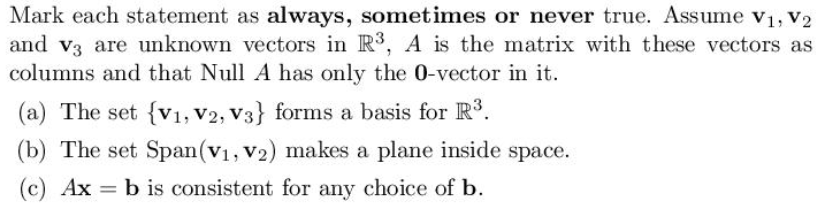
For a, I got always
C, I got never
I'm not sure about B
for B
isn't it never because they're in R3
and a plane is in 2 space?
so
Always, never, never?
waxen flume
why
since null A has only the 0-vector in it
I thought there's 1 solution
so it cant be any choice of b
lavish jewel
there is only one solution to Ax = 0
but that's not what they ask about there
do you know what they mean by "consistent"?
waxen flume
the span of v1 and v2 is just a 3 x 2 matrix
lavish jewel
no
the span of v1 and v2 is all vectors w such that w = av1 + bv2, for any a and b
so taking what you said, the span is all vectors that come out from multiplying that 3x2 matrix with any vector [a;b]
 hoary osprey
might wanna double check ur answer for a too
lavish jewel
how come? if the null space has only the 0 vector in it, the columns are linearly independent
should be rank 3
care to explain?
sweet vine
oo there is an extra condition
ur right then
lavish jewel
it is
a and c are both "always" given the conditions in the problem
b should also be always
waxen flume
ty

for my 3x3
I have [0, 1, -2] for my first column
how do I figure out the other two columns such that the matrix A has only 1 solution
lavish jewel
you can't
waxen flume
because for their to be only one vector [0 1 -2] in the solution set
it means the RREF matrix has only 1 solution
lavish jewel
that's wrong
waxen flume
the other two columns will have free variables
lavish jewel
this will have infinitely many solutions
lavish jewel
it's telling you the column space of A is spanned by a single vector
so it's just a line, instead of all of R3
any b such that Ax = b will be multiples of this vector you were given
waxen flume
its asking for a 3x3 matrix not a multiple of the [0 1 -2] vector?
lavish jewel
it's asking for a 3x3 matrix such that, no matter what x you multiply, the result is a multiple of that vector
waxen flume
how do i come up with the matrix then
lavish jewel
start from the rref form and work backwards, i guess
 lavish jewel
do you know what an eigenvalue decomposition is?
waxen flume
bro what
we havent even learned that stuff lol
im just gonna ask my teacher later today np thanks anyway
lavish jewel
anyway. the easiest way would be to have a matrix A where all columns are identical
waxen flume
like [0, -1, 2; 0,-1,-2; 0,-1,-2]?
lavish jewel
mhm
waxen flume
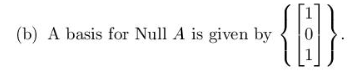
this is the same
instead of Col A
oh wait
nvm
this is Null A
so my 3x3 matrix * [1 0 1] = 0
right?
lavish jewel
mhm
waxen flume
maybe
[-1,1,1; -1,1,1; -1,1,1]
because when i multiply the -1 and 1 by the given vector
they become -1 + 1 = 0
and the middle 1 is irrelevant because its multiplied by 0 anyway
lavish jewel
this is wrong because the basis would have 2 vectors
you also don't get the 0 vector
,w {{-1,1,1},{-1,1,1},{-1,1,1}}*{{1},{0},{1}}
stoic pythonBOT

 lavish jewel
you do get the zero vec, nvm, i was reading those as columns
waxen flume
eyyy
lavish jewel
but anyway this is wrong
 lavish jewel
you need to have 2 linearly independent columns


