#linear-algebra
2 messages · Page 177 of 1
 limber sierra

all rotation matrices in 2 dimensions end up looking like this
where theta is your angle of (counterclockwise) rotation
 fervent gulch
#linear-algebra message. I don;t think rederive is involved
limber sierra
yeah but my point is i dont know whether you've been shown that rotation matrix in class before
 zinc tapir
Okay idk if i'm thinking way too hard about it but given this definition and this thm


im asked to prove that for real or complex matrices,

I just don't know where to begin
 wintry steppe
||AB|| is the smallest constant satisfying (...), right? so what if you could show that ||A||||B|| also satisfies (...)? would that finish the proof?
 lavish jewel
what's a good and easy way to get an overestimate of a matrix's largest singular value?
i'm thinking of applications with gradient descent, so hopefully the overestimate is not too large
 lavish jewel
test the definition of a subspace
 safe blaze
@lavish jewel I'm kinda confused there
lavish jewel
well, what's the definition of a subspace?
safe blaze
As far I know you it's like if it satisfies these 3 conditions
-
non-empty (or equivalently, containing the zero vector)
-
closure under addition
-
closure under scalar multiplication
 tame mural
Yup so now test if it's closed.
Imagine some situations to see if you can or can't break closure
safe blaze
So the first and 3rd condition aren't satisfying
tame mural
yup
I prefer to think of subspace as a subset of a vector space which is still a vector space under the same operations as the parent space
That way I don't have details like "it's not empty"
limber sierra
tame mural
That way I don't have details like "it's not empty"
well, you still have this detail implicitly
in the sense that it's implied by the existence of an additive identity
the empty set still does not form a vector space
 sick zodiac
Can a brother/sister help a homie out with a proof?
 limber sierra
do you know how to check whether something is a subspace?
sick zodiac
We just defined it an hour ago
Non-empty, closure under addition, closure under scalar multiplication.
The big concern for me is quantifying it under the range of T
If U is a subspace of V, it implies all it's vectors are a subset of the vectors of V, right?
I'm having an issue with the notation
I need this in english.
lol
 nocturne jewel
Yes U is a subset of V, specifically a subspace
sick zodiac
I just don't understand what it means by range(T) and how to apply the subspace rules.
because if it was asking if TU was a subspace of W
it would make more sense to me
nocturne jewel
range(T) is all the vectors in W "reached" by T
So if you take a vector in V and throw it through T, you get something in W which is also in range(T)
range(T) is a subset of W, you want to show T[U] is a subspace of range(T)
sick zodiac
which to me sounds like, if you throw anything in U through T, you'd get something that has to be in W because everything in V went to W (after going through T).
nocturne jewel
right
but specifically you'll get stuff which makes up range(T)
which is a subset of W
$T[U] \subseteq range(T) \subseteq W$
 stoic pythonBOT
moshill1

 sharp idol
Oh shoot, can we do latex on here?
nocturne jewel
Yes
sick zodiac
So just pick random vectors for U, like x1, x2, y1,y2 and then roll through the properties.
For a proof sake
nocturne jewel
You just go through subspace / naive test
0 is an element
linear combination of elements is an element
 silver quarry

When I give the order all 4 of these equations are order 1 correct? Just clarifying
sharp idol
I think this is a #multivariable-calculus question
However, to answer your question briefly, no. I see two of these that are differential equations of order 2.

 sonic osprey
It seems like you went from cos(theta_x) + cos(theta_y) in one line to cos(theta_x + theta_y) in teh next
 jaunty cairn
That was cos a cos b + sin a sin b = cos (a-b) if it's the line just after first expression in lambda squared.
sonic osprey
No look at the linear term in your polynomial
jaunty cairn
sonic osprey
No look at the linear term in your polynomial
Thanks. Just noticed it
However the subsequent steps I had corrected it
The expression for lambda has the proper coefficients
jaunty cairn
I am expecting the answer to be in simple terms.
Exactly pi/4 + (theta x+ theta y)/2 and -pi/4 + (theta x + theta y)/2
 slim ice
just a question, do you know one of the two eigen values ?
jaunty cairn
The image as expression for the Eigen values.
slim ice
if so, you can straight up "hack" and use the trace
jaunty cairn
I'm not able to get that expression I have in the box to be in simple terms despite multiple tries.
After inserting the expression for lambda in it.
There's a square root of some expression in sines and cosines and it super complex to take out.
slim ice
what I get for the determinant is $\lambda^2-2\lambda\cos(\theta)+1=0$
stoic pythonBOT
 slim ice
$(cosθ−λ)2+ sin2θ= 0$
jaunty cairn
Column 1 is theta x and column 2 is theta y.
stoic pythonBOT
 slim ice
jaunty cairn
There's theta x and theta y.
slim ice
jaunty cairn
There's theta x and theta y.
oh sorry
 dusky epoch
@slim ice did you miss one of these ^
slim ice
I didnt see
slim ice
dusky epoch
<@659751037925720067> did you miss one of these `^`
french keyboard on discord
I have to type it twice for it to appear
jaunty cairn
Visually speaking the transformation twists x component by theta x and y component by theta y.
Ok I get it. My expected answer is wrong.
Or is it right 😔
If theta x = theta y I will never get a Eigen vector.
Since all points will rotate by that angle.
During transformation.
slim ice
If I note $t=\theta_x,,u=\theta_y$, I find $$\chi_T=\cos(t) \cos(u) -\cos(t)\lambda -\cos(u)\lambda + \lambda^2+ \sin(t)\sin(u)$$ where $\chi_T$ is the characteristic polynomial
jaunty cairn
I think there is one mistake in that calculation
You have two Sint sin u
It should have one sin t sin u and one cos t cos u.
slim ice
the left term is cos
stoic pythonBOT
 slim ice
jaunty cairn
You have two Sint sin u
slim ice
jaunty cairn
You have two Sint sin u
Writing latex too fast
jaunty cairn
Yeah. If you try to solve for lambda you get a fairly complex equation
I have written that in my image
slim ice
you're expression is in fact not complex enough
jaunty cairn
Eigen value can become complex in certain scenarios.
slim ice
jaunty cairn
Eigen value can become complex in certain scenarios.
here is what I find
and it makes more sense than yours because If I put $u=t$ or $\theta_x=\theta_y$ I find the standard rotation matrix eigen values with my formula
Not with yours
stoic pythonBOT
Compile Error! Click the  reaction for more information.
(You may edit your message to recompile.)


 jaunty cairn
If theta x and theta y are equal (and non multiples of n*pi) the Eigen vectors and Eigen value won't be real.
slim ice
jaunty cairn
If theta x and theta y are equal (and non multiples of n*pi) the Eigen vectors a...
exactly
but working out the complex formula leads to the standard complex eigen values
because every rotation matrix is $\mathbb{C}$-diagonalisable with eigenvalues $$\lambda=e^{i\pm \theta}$$
stoic pythonBOT
 slim ice
jaunty cairn
My expected answer is what is wrong.
slim ice
jaunty cairn
My expected answer is what is wrong.
there's one mistake
you have written a $\sin^2$ instead of a $\cos^2$, which lead to an incorrect factoring of $(\cos+\cos)^2$
stoic pythonBOT
 slim ice
jaunty cairn
I donot see any sine squared in my image.
slim ice
jaunty cairn
I donot see any sine squared in my image.
the fact that you have a sum of cos squared
in your lambda expr
or thats just me after 3yrs not doing trig
 tawdry bramble
I have 2 second degree polynomials: ax^2 + bx + c and a(x-h)^2 + k. Given that these are vector spaces, can I show that these two spaces are equal?
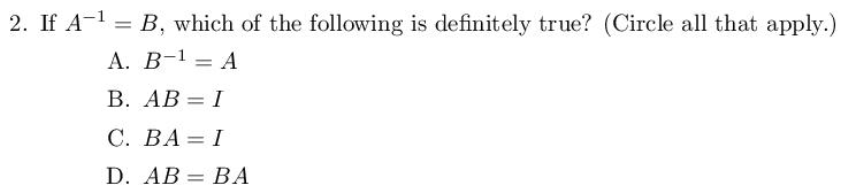
 stable kindle
heh heh heh
tawdry bramble
Isn't (A^-1)^-1)= A
stable kindle
yes
stable kindle
think so
 waxen flume
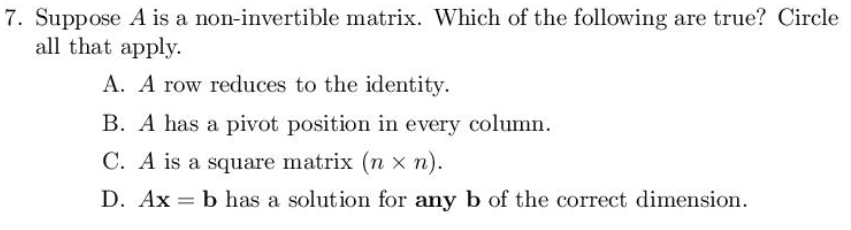
since a non-invertible matrix is one that doesnt have pivot in every row
A, B, are automatically not true
What about C and D?
tawdry bramble
How can I represent the set of 2x2 singular matrices?
limber sierra
tawdry bramble
How can I represent the set of 2x2 singular matrices?
i dont think theres canonical notation
you could do something like $\mathrm{M}{2\times 2}(\bR) \setminus \mathrm{GL}{2}(\bR)$ but
stoic pythonBOT
Namington
 limber sierra
i feel like it'd be more clear just to say "let S_2 be the set of 2x2 singular matrices" or whatever
limber sierra
waxen flume
What about C and D?
can you find an example of a non-invertible, non-square matrix?
hint: ||try literally any non-square matrix||
tawdry bramble
Ok. Because the question prompted to me was "Determin if the set of 2x2 singular matrices is a subspace"
waxen flume
I ended up going with all false
 quartz compass
that's not true, A doesn't need to be invertible for that to be true
A=[1,0]
multiply this by x=[b;0]
yup
yeah that's basically how I think of it too, like projecting down to a smaller space
at least I find this perspective helps for thinking about how to invert rectangular matrices
definitely imo lol
 wary lily
man, I should learn a little linear algebra so that this channel makes sense to me
stable kindle
mood
 north steeple
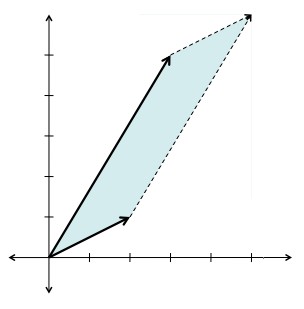
when finding the area of a parallelogram with determinants, can you use any two vertices? or are there specific ones you have to use?
 brisk fractal
the parallelogram has to be spanned by the vectors you choose
north steeple
what do you mean by that
brisk fractal
here let me draw a pic
north steeple
ok thank you
brisk fractal

the parallelogram in blue comes from a different choice of vertices than the parallelogram in red
the red line are supposed to show where the two overlap
actually wait
north steeple
i see
north steeple
ok but how would i know which ones to use for the blue
brisk fractal
it comes from two consecutive sides, specifically the sides formed by vectors from the origin
so the blue one would be that middle long vector and the vector on the bottom right
the fact that they have the same area comes from det(a + b, b) = det(a,b) = det(a, b + a)
sorry, with labels
 brisk fractal

 crude ridge
If you have a m x n coefficient matrix with more rows than columns, are the columns independent as long as there are at least n independent rows?

 faint lintel
ok cool that's what I figured
 ruby loom
Can a vector in a list/set which is linearly dependent be linearly dependent on multiple linearly independent vectors, or can a linearly dependent vector only ever be dependent on a single vector?
ruby loom
Well, I'll take that to mean that we don't really talk about being dependent on a vector, rather we talk about being dependent on sets of vectors?
wintry steppe
define "dependent on a vector"
and clarify the "in a list/set" condition
"in the span of" maybe?
ruby loom
Uhm yes, do we not use the terminology "dependent on" in general? We might say sets of vectors are linearly dependent or independent, but not that they're dependent on eachother?
wintry steppe
the terminology "dependent on" is not very standard, in my experience
ruby loom
okay, noted
wintry steppe
linear dependence/independence is a property of a set of vectors
and not of a single vector (or a single vector relative to a set)
ruby loom
okay, that makes sense. I think I confused myself with the terminology I was using. Lin. dependence means some vector(s) in the set can be represented as linear combo of the others in the set, I'm clear on that
tyty
nocturne jewel
I feel like I'm messing up somewhere on J[t^2] but idk where

nvm doing the bounds wrong
actually no, still messing up, now J[t]
$J[t]=0.5\int_{-1}^1 3t+6st^2-15s^2t^3 \dd{s} = 0.5[3st+3s^2t^2-5s^3t^3]_{-1}^1$
stoic pythonBOT
moshill1
 nocturne jewel
Main issue is I get t^3 in the final answer when J is suppose to be an operator on polynomials up to quadratics 
quartz compass
you're plugging in t when you should be plugging in s
also I recommend plugging in with f(t) = t^n and doing them all at one go
nocturne jewel
quartz compass
also I recommend plugging in with f(t) = t^n and doing them all at one go
Im confused, do i plug in s^n or t^n, cause you said both
quartz compass
ah I didn't though
the formula says f(s)
you're putting f(t)
one is the variable of integration, the other isn't
it would be wrong if I said f(s)=t^n
nocturne jewel
"plugging in with f(t) = t^n"
that means plugging in f(t), which you said is wrong
quartz compass
you don't understand functions if you think that's wrong
nocturne jewel
wow so helpful
quartz compass
f(t)=t^n means when you plug in f(s) you put s^n
nocturne jewel
yeah ik that
quartz compass
well then why are you saying I'm wrong? lol
nocturne jewel
cause you literally said plug in s plug in t back to back
quartz compass
do you see what you did wrong or not
nocturne jewel
Yes, do you see how you worded it poorly or not
nocturne jewel
Not my fault you're insulting when you "help" 🙃
 gray dust
you're plugging in t when you should be plugging in s
how you messed up finding J[t]
also I recommend plugging in with f(t) = t^n and doing them all at one go
for finding the image of each vector in M under J
 cunning pier

Soo I'm confused by this homomorphism
What would the marked function be equal to
Or more specific what would phi(blueBell) be equal to in the set N
I got this as well

why would phi(blueBell) = yellowGift
 west orchid
phi(blueBell)=phi(greenBell * greenBell)=phi(greenBell) * phi(greenBell)=blueGift * blueGift = yellowGift
wintry steppe
Could anyone help?
 cunning pier
west orchid
phi(blueBell)=phi(greenBell * greenBell)=phi(greenBell) * phi(greenBell)=blueGif...
cunning pier
west orchid
phi(blueBell)=phi(greenBell * greenBell)=phi(greenBell) * phi(greenBell)=blueGif...
ahh I see now, thanks
 opal prism
Boys. I have a quick question. I’m very stupid but wanna know if this is okay

Can I do that?
west orchid
no
opal prism
No?!
west orchid
that too
opal prism
Oops. My b
west orchid
anyway, plug in h=1, you get sqrt(16-4)=sqrt(12) and that does not equal 4-2=2
lavish jewel
sure, the x is multiplied by 0
i dont see why you substituted y and z tho, all you did was change their name
 native rampart
an element in that subspace is like (x,18z,z)
 floral tide
 native rampart
wintry steppe
native rampart
wintry steppe
Why is determinant of a matrix defined the way it is? Is it just some random value mathematicians agreed upon as it showed up in tons of places and decided to give it a name or is there some deep universal reason for it's existence?
@wintry steppe : https://www.askamathematician.com/2013/05/q-why-are-determinants-defined-the-weird-way-they-are/
Physicist: This is a question that comes up a lot when you’re first studying linear algebra. The determinant has a lot of tremendously useful properties, but it’s a weird operation. Y…
Oh, I don't understand it but it seems like how the rule for multiplication of multi-digit numbers seem very weird and out of blue for a kid but they start to make sense as they learn more about the fundamentals.
Anyway, thanks for the help <3
wary lily
This is interesting. It states that the determinant of a 3*3 matrix is the answer to the volume of a parallelpiped, created by vectors that are columns of the matrix. The next chapter of my calc 3 studies introduces the concept of the cross product and then the Triple Scalar Product, which is also the volume of a parallelpiped.
$|(\mb{u} \times \mb{v}) \cdot \mb{w}| = |\mb{u} \times \mb{v} ||\mb{w}||\cos\theta|$
stable kindle
yes
stoic pythonBOT
az
 stable kindle
if you just stare at how the 3x3 determinant is calculated you'll see it's the scalar triple product in action i think
wary lily

It must somehow be by definition
because that's the same parallelpiped constructed out of those 3 vectors
It's exciting when different branches of math converge
gray dust
we can check X satisfies the vector space axioms, or if we already know C[0,1] is a vector space then we know X inherits its vector space structure and can just check X is nonempty & closed under linear combos
 red prawn
the constant 0 function is in X
If $f,g:\mathcal{C}[0,1]$ and $f(0)=g(0)=0$, and if $\alpha, \beta\in \mathbb{R}$, then $\alpha f(0) + \beta g(0) = 0$, so $\alpha f + \beta g\in X$
etc.
 marble lance
You don't need to write out the whole proof for them lol
gray dust
it’s also wrong
red prawn
kernel is a linear notion, since linear of zero is still zero
stoic pythonBOT
Apopheniac
 gray dust
still wrong
red prawn
If you add and multiply 0 you get 0. what's wrong with that?
marble lance
@solemn orbit Do you know what you'll have to prove to prove that a subset is a subspace?
@red prawn ||you are concluding that f and g are in X. That is not what you should be concluding. But don't fix it, let them do it themself||
red prawn
why wouldn't you be able to conclude that f and g are in X, from what I have written? I left out that linear is continuous. that is implicit in the "etc." that i said after.
marble lance
Bruh
gray dust
they must already know C[0,1] is a vector space which i doubt
gray dust
which is why i first suggested directly using vector space axioms
red prawn
So, those are things that you have to show for axioms of a vector space. I didn't list all of them, just a couple
marble lance
You have to prove IF f and g are in X, then af + bg is in X.
red prawn
That's what I did.
marble lance
Lol
gray dust
you didn’t conclude af+bg in X
red prawn
If $f,g:\mathcal{C}[0,1]$ and $f(0)=g(0)=0$, and if $\alpha, \beta\in \mathbb{R}$, then $\alpha f(0) + \beta g(0) = 0$, so $\alpha f + \beta g\in X$
stoic pythonBOT
Apopheniac
 red prawn
There.
marble lance
What happened to "don't fix it, let them do it themself"?
gray dust
and even if you do it right, it’s not YOUR hw
nocturne jewel

red prawn
and you're not MY boss
marble lance
 gray dust
this server isn’t where you do others’ hw for them
marble lance
First off, it's important to clarify. Do you already know that C[0,1] is a vector space?
Yes, do you know that continuous functions form a vector space ?
You cannot use X being a subspace of C[0,1] if you do not already know that C[0,1] is a vector space.
red prawn
There are other axioms you have to check to complete the problem. Ergo, I did not solve the problem entirely.
Etc.
I would suggest proving directly from the axioms that this is indeed a vector space.
nocturne jewel
wow almost like that was suggested already
marble lance
I don't think you're understanding what I'm asking. Because you aren't really answering my question. What's your native language? Maybe there's someone who can actually speak it and help you better.
Because it satisfies the vector space axioms.
If you don't know that, then you can't use that.
So you have to prove all the axioms for X.
Try doing that, and tell me if you are stuck.
nocturne jewel
it just means the function has a root at x=0
marble lance
It's all the continuous functions that also satisfy the condition f(0) = 0
So if you want to show something belongs to the set. You have to show it is continuous and it satisfies f(0) = 0
marble lance
No
@solemn orbit
Check for closure
The problem is the extra conditions
Only some of those allow the sets to be closed under + and scalar multiplyint
lavish jewel
take as an example f(x) = x + 1, g(x) = cos(x)
test if the second one up there is satisfied
g(0) = 1, no?
oh you wanna satisfy all 4 at the same time?
then what's the problem
i did say look at the second one up there
what's the definition of a vector space
there's no additive identity
no, i mean, that's the problem with case 2
there under the additive axioms you have 0+x = x+0 = x
case 2 doesn't seem to me to have a "0" element
because all the functions in the set have f(0) = 1
if you add any two of them together, you will get w(x) = f(x) + g(x), w(0) = 2
mhm
mhm
everything you said so far is true
this has nothing to do with the things oyu have said
mhm
look at the definition of your set lol
the 0 function is some h(x) = 0
for which h(0) = 0
it's not in the set
i have no idea what you're confused about, i'll leave this to someone else
sorry but i already explained it, you just don't know what a straight line is
nocturne jewel
You want to find a function in the set, O(x), such that O(x) + f(x) = f(x) for all f
In functions, the only function with that property is the zero function O(x) = 0, but the zero function does not satisfy the requirement of O(0)=1
so the 0 function isnt in the set thus there's no additive identity
we can also argue that if such O existed, (O+f)(0) != 1
since O(0)+f(0) = 1+1 = 2
yeah, ik
cause we only care about the interval [0,1]
lavish jewel
because they literally told you it HAS to be f(0) = 1
nocturne jewel
yeah... the condition is still f(0)=1
idgaf about f(1/2) or f(-63)
as long as f is in C[0,1] and f(0) = 1, it's in X
condition
lavish jewel
as a condition for all the functions in X
lavish jewel
yeah but that has nothing to do with the problem
lavish jewel
lol
a 0 element is a function that you add it to another one, and you get that other one
nocturne jewel
Ok let's assume for a second there is a 0 element for the set, ok
lavish jewel
regardless of what it was
nocturne jewel
let's call the 0 element z(x)
I propose that z(x) + f(x) = f(x), with f and z being in the set
This means that f(0) and z(0)+f(0) should equal the same thing, namely 1
Computing both sides I get 2=1, which is not true, hence my assumption that z is the 0 element is wrong
Therefore no zero element exists
lavish jewel
you don'T know what a vector space is, do you?
lavish jewel
i explained it in 3 different ways, moshill1 recapped the approaches i took and now followed new ones
and you're not understanding us because you don't know what a vector space is to begin with
we can't do anything for you unless you know what the question is even asking you for
look at the axioms you yourself copy pasted here. is there anything about addition with scalars there?
quartz compass
I've noticed students in this channel have been having a habit of blaming the helpers for their own mistakes lately, weird
or the quality of students has gone down
lavish jewel
let's just drop it here lol
nocturne jewel
Linear Algebra has become the worst channel
nocturne jewel
Oh god Ann's here
stable kindle
i just don't understand, it's not a 0 element bc it's not in the set right
dusky epoch
@solemn orbit is g meant to be the function that returns the value 1 at x=0 and zero elsewhere?
stable kindle
jesus what a circus
dusky epoch
maybe don't tell people to kill themselves, aza.
nocturne jewel
Slim maybe dont encourage it?
stable kindle
you can't have g(x) = 0 and also g(0) = 1
lavish jewel
everyone stop spamming and let ann explain, since she's giving it a shot now. chill out
dusky epoch
dusky epoch
<@534837275234795530> is g meant to be the function that returns the value 1 at ...
still waiting for an answer to this
is this what you want g to be?
dusky epoch
this is self-contradictory as-is
okay so then it's what i said
then your function is not continuous
and so it's not in C[0,1]
stable kindle
then at a = 0 f(a) + g(a) = 2 =/= f(a)
dusky epoch
the function g(x) = {1 if x=0; 0 otherwise} is not continuous, therefore not a member of C[0,1], therefore not a member of the set {f in C[0,1] | f(0)=1}, therefore why are we even talking about it?
stable kindle
alright seems like you've got this covered imma go
dusky epoch
and why do we care about g(1) being 0?
this function is not the zero function no matter how much you wish for it to be.
f+g is not the same function as g.
you aren't adding an entire function with just one value from another.
you know, there's an even simpler way of explaining why {f in C[0,1] | f(0)=1} is not a subspace of C[0,1]
yes that's the zero element of C[0,1]. it's known as the zero function.
it's the function which returns 0 everywhere.
you are right about set #3 being a vector space, but you are wrong about the reason
haven't you been given the definition of a vector space?
there are two things to check here: closure under addition and closure under scaling
if you have two functions f and g, such that they're both in C^1[-1,1] and f'(0) = g'(0) = 0, will (f+g)'(0) be 0 too?
and if you have some scalar k, will (k*f)'(0) also be 0?
eh?
wait
... how familiar are you with calculus
i literally explained them to you for this particular example
the "demonstration" is trivial if you know a thing or two about calculus.
which... do you?
if you have two functions f and g, such that they're both in C^1[-1,1] and f'(0) = g'(0) = 0, will (f+g)'(0) be 0 too?
closure under addition means that if you add two elements of your set the sum is still in the set
closure under scaling means that if you multiply an element of your set by a real number the result is still in the set
you think so?
how come your answer isn't "of course, obviously"
can you please not use the R word
nocturne jewel
nothing to try... you just dont type a word
limber sierra
Let's move on.
 dusky epoch
aza, just out of curiosity, how old are you
limber sierra
I muted
and I'd rather you not ask questions about muted users since they dont really have a chance to respond
dusky epoch
oh
limber sierra
okay never mind, they DMed me very rude things
dusky epoch
i didnt see the role
limber sierra
so i banned
limber sierra
truly a great loss to society.
lavish jewel
sorry about the shit show, that got out of hand quickly
wary lily
didn't read all but from what I saw you tried hard, Edd
nocturne jewel
$A^T = -A$ is the definition of A being anti-symmetric right?
stoic pythonBOT
moshill1

 half karma
The x not being there is messing me up
so is it y=18z+0*x
then I let: y=s and z=t
I know i'll have the vertical matrix [s, 18t , t],
but I got

 umbral yew
what exactly confuses you
half karma
umbral yew
what exactly confuses you
How is it [s,18t,t]
I wrote down 0 in place of s. and was confuised also on how we get t in the 3rd component
ooo I get it now
 lavish jewel
aight
limber sierra
this isnt quite linear algebra but its fine, lets study the ones digit of n!
1! = 1
2! = 2
3! = 6
4! = 24
5! = 120
and everything after that also has a ones digit of 0
(since it has a factor of 2 and 5)
so our possible ones digits for a! and for b! are 1, 2, 6, 4, 0
the remaining possible ones digits are determined by all possible differences there
for example, 5 is also possible, since if you subtract something with a ones digit of 6 from something with a ones digit of 1, you get a ones digit of 5
(in fact, this happens ONLY for 3! - 1!)
8 is possible, since 0 - 2 would produce 8
for example, 5! - 2! = 118
can you check the remaining possible digits? (the ones left are 3, 7, 9)
nocturne jewel
Oh i was just helping them in calc
nocturne jewel
I mean took me a minute to realize you can just set b=5 and then run through a values
forgot 2*5=10
 gritty swift
quick linear algebra question, if the columns of $A$ are dependent, can a projection matrix $P$ still exist?
my intuition says if you throw away the redundant cols (to make $(A^TA)$ invertible) then you could use the standard projection formula.
but it woulden't work by default since $N(A) = N(A^TA) \implies n = N(A^TA)$ for $n > 0$ which means $A^TA$ is singular, right?
stoic pythonBOT
uli

 cold ravine
I believe there is a condition of full column rank necessary to make $A^{T}A$ invertible but I don't remember
stoic pythonBOT
HisMajestytheSquid

 dense meadow
Uh, hi there!
nocturne jewel
dense meadow
Uh, hi there!
do you have a question or are you just saying hi in every channel lol
gritty swift
@cold ravine yeah there is, I'm just saying if you threw away the dependent columns coulden't you project after?
dense meadow
Im just introducing myself. After all, im new in this channel.
dense meadow
...so
cold ravine
gritty swift
<@!625155833751142433> yeah there is, I'm just saying if you threw away the depe...
I found a relevant stack exchange post that seems to suggest that's valid
However, I have certainly never dealt with it myself
gritty swift
ok cool
cold ravine
https://math.stackexchange.com/questions/3521372/does-a-projection-matrix-have-to-be-a-square-matrix

Mathematics Stack Exchange
Does a projection matrix have to be a square matrix?
I know that it's computed by a formula
$$P = A(A^TA)^{-1}A^T$$ where $A$ can be virtually of any dimensions. Does this formula guarantee that $P...
If you wanna looksee
gritty swift

 outer lance
technical writing can trip me up sometimes in math, could someone help me with this one? http://prntscr.com/1050t1k
 limber sierra
basically it's asking you to show that, if you multiply everything in a basis by some square invertible matrix
the resulting products form a basis as well
then it's asking you to apply this if you multiply the standard basis vectors by the matrix
it might be better to think about the second question first
to get a concrete example
although not really necessary for the proof
fervent gulch
@limber sierra i think this is easy, can you tell me what i should do
 nocturne jewel
fervent gulch
<@!105878844061286400> i think this is easy, can you tell me what i should do
nocturne jewel
fervent gulch
<@!105878844061286400> i think this is easy, can you tell me what i should do
just see what happens to e1 and e2 by applying T
fervent gulch
nocturne jewel
just see what happens to e1 and e2 by applying T
T as in transpose?
fervent gulch
pi corresponds to 180 and -1,0
nocturne jewel
Ok so rotate e1 by pi, what do you get?
fervent gulch
idk what is e1 tho
nocturne jewel
$\hat{i}$
stoic pythonBOT
moshill1
 nocturne jewel
[1,0]^T
fervent gulch
ohhh okay
nocturne jewel
$e_n$ is the nth canonical basis vector for $\mathbb{R}^n$
stoic pythonBOT
moshill1
 nocturne jewel
ie 1 in the nth position, 0 else
fervent gulch
is it cos(390)
nocturne jewel
how did your vector become a scalar?
fervent gulch
i mean (2,0), (2,4)
fervent gulch
-1,0
nocturne jewel
right, so reflect that in the x axis, what do you get?
nocturne jewel
the sign of what changes?
fervent gulch
nvm. idk
nocturne jewel
if you were asked to reflect a point in the x-axis, do you know what happens?
gritty swift
@fervent gulch

you follow where the basis vectors land
think of a point like (2, 1) as telling you to multiply the first basis vector by 2, the second basis vector by 1 and add
https://youtu.be/kYB8IZa5AuE watch this video
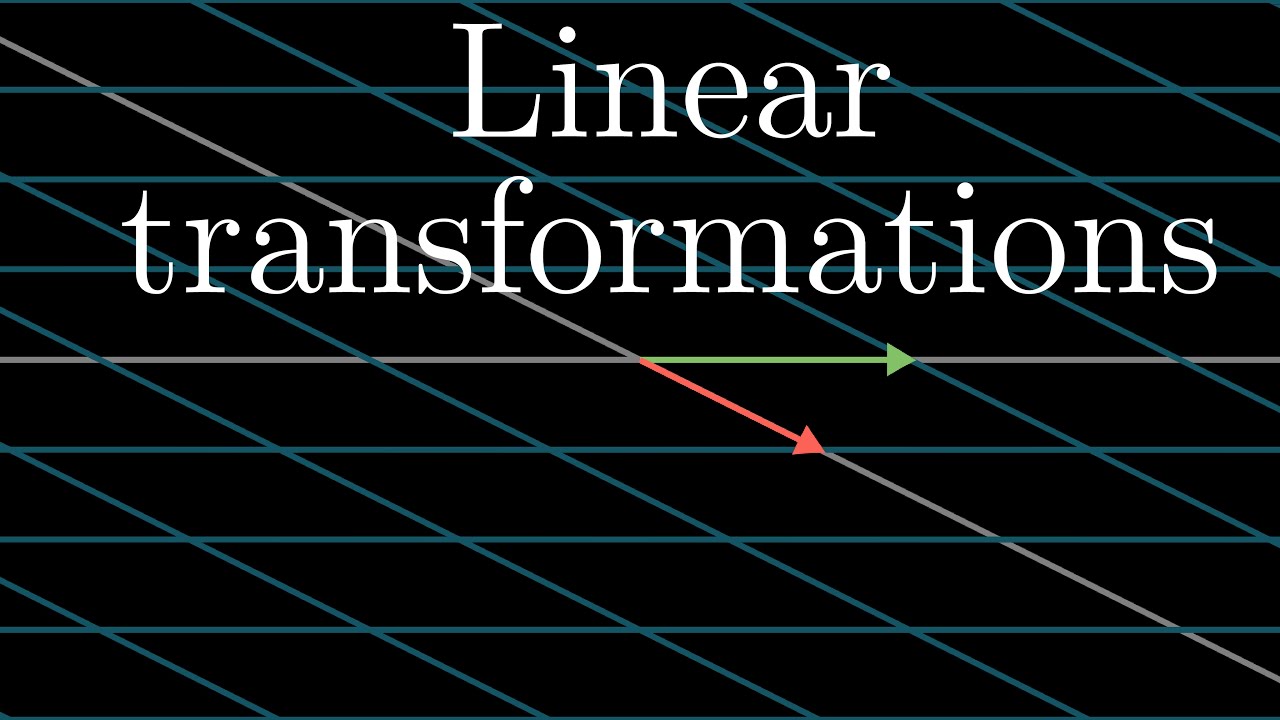
Home page: https://www.3blue1brown.com/
Matrices can be thought of as transforming space, and understanding how this work is crucial for understanding many other ideas that follow in linear algebra.
Full series: http://3b1b.co/eola
Future series like this are funded by the community, through Patreon, where supporters get early access as the se...
fervent gulch
gritty swift
<@!741878669588430888>
that's it?
gritty swift
oh sorry, i forgot the reflection
but if you get the idea its easy to continue it
just do the reflection and follow the basis vectors
fervent gulch
gritty swift
but if you get the idea its easy to continue it
can u show me, visuals help
gritty swift
sure, so we start here

(I'm calling $\hat i$ and $\hat j$ the basis vectors, but they just go in the matrix)
stoic pythonBOT
uli
 gritty swift
then this is after a 180 degree rotation

then we reflect over the x-axis

so if you wanted to describe the vector $v = \begin{bmatrix}1 & 2\end{bmatrix}$ you would multiply $\begin{bmatrix}-1 & 0 \ 0 & 1\end{bmatrix}\begin{bmatrix}1 \ 2\end{bmatrix}$
stoic pythonBOT
uli
 gritty swift
notice how matrix multiplication is defined, we take 1 of the first basis vector $\hat i$ and 2 of $\hat j$ j hat
stoic pythonBOT
uli
 gritty swift
http://matrixmultiplication.xyz/ is how I visualize it
An interactive matrix multiplication calculator for educational purposes
also since A is a diagonal matrix you can just read it off as scaling the first element by -1 and the second element by 1
diagonal matrices scale each component in a vector when they multiply them
fervent gulch
yea that makes sense
 little sage
does x^2+2x+4=x+1 have one solution?
 frosty vapor
thats a cool visualization
 fresh obsidian
little sage
does x^2+2x+4=x+1 have one solution?
fresh obsidian
little sage
does x^2+2x+4=x+1 have one solution?
no real solutions I think
quartz compass
look at the discriminant, see if it's 0 or not
also wrong channel, that's not linear algebra, try #prealg-and-algebra
fresh obsidian
no nonlinear equations allowed here
half karma
I was asked to find a basis for row and column space. I know how to do them but I'm wondering if my ref of this is correct:
 stoic pythonBOT
A Kid Named Galois
 half karma
<@&286206848099549185> help me plz
limber sierra
,w row reduce {{1, 2, 3, 1, 3}, {1, 3, 4, 3, 6}, {2, 2, 4, 3, 5}, {2, 1, 3, 2, 3}}
stoic pythonBOT


 Requested by Namington#1983
limber sierra
Requested by Namington#1983
limber sierra
seems fine besides the extra column
just to make sure
,w row reduce {{1, 2, 3, 1, 3}, {0, 1, 1, 2, 3}, {0, 0, 0, 5, 5}, {0, 0, 0, 0, 0}
stoic pythonBOT
 Requested by Namington#1983
limber sierra
Requested by Namington#1983
limber sierra
yep
its good
(again, except the extra column - not sure whether theres something in your technique im missing)
half karma
I do it for my calculator to accept it

I’m confused as to whether we use ref or rref?
limber sierra
doesnt matter
the real purpose of row reduction is just to identify & eliminate linearly dependent rows
row echelon form "guarantees" that they've all been eliminated
ie the remaining rows are linearly independent
half karma
Perfect. That was throwing me off. Thank you
limber sierra
in theory if you wanted
you could just keep track of the row swaps you did
and use the original rows instead of your reduced ones
ie for every nonzero "ending" row, take the "original" row (keeping track of swaps) as your basis vector
now theres not much reason to do this for rows
(you should do it for columns though)
my point is that it makes no difference "how much" youve reduced a row
half karma
That's what they make us do for columns lol literally my next question
limber sierra
hence REF and RREF are equally valid
yeah
the problem is that row operations MAY change the span of columns
they dont change rows, as i mentioned
but they do change columns
fortunately you can just use the original columns instead
(it might be worth convincing yourself why this makes sense; think about how the way pivot variables work guarantees they're linearly independent)
half karma
My next question gives you different answers for columns depending on if you use ref or rref. Let me post
limber sierra
it might
but both of the answers should work
ie be linearly independent and spanning
 wind pasture
If the linear system Ax=0Ax=0 has at least one solution then Ax=bAx=b must have at least one solution.
is this statement true?
limber sierra
no, counterexample: let A be the matrix of all 0s, and b a nonzero vector.
wind pasture
thought so, thanks
nocturne jewel
The basis for the kernel of an invertible linear operator is just {0} right?
limber sierra
the kernel of an invertible operator is {0}; what is the basis for this space?
its not {0}
limber sierra
more precisely, the basis is empty
limber sierra
right
nocturne jewel
since 0=a*0 for all a
limber sierra
the basis is the null set
this might seem a bit counterintuitive since how do we write the 0 vector as... a sum of 0 elements?
but you can think of it as an "empty sum"
so to speak
nocturne jewel
But then the basis of image would be any basis of the vector space since Im(T)=vector space
limber sierra
huh
nocturne jewel
Im(T) = V since T is a linear operator and V is finite dimensional, so a basis of the image would be any basis of V
tame mural
It'd be more clear to say the dim of basis of the image is equal to the dim of basis for the domain
imo it is also alluded to in the definition of linearity
Which maps coordinates in one space to coordinates in another
nocturne jewel
Yeah but if 2 vector spaces are equal, they can have the same basis
tame mural
Yup, aka endomorphisms
nocturne jewel
Yeah that's what I was trying to phrase lol
 tame mural
A solution is unique when a matrix is full-rank
half karma
tame mural
A solution is unique when a matrix is full-rank
The rank is 3 so it can be expressed as the single solution x=(x_1 x_2 x_3)?
half karma
Oof we didn’t learn about full tank yet but I said something close to it lol
 sonic osprey
What have you tried?
 sonic osprey
Have you seen this type of problem?
 robust lava
Ls Lunch school
no this is new content our professor just showed us
@sonic osprey
like im convinced Im at the right spot
I just dont know where to go from here
td= today lunch and tm is tomorrow lunch
Ls lunch school lh lunch home
sonic osprey
so if I have 100 students eating in the cafeteria today, what will the distribution be tomorrow?
sonic osprey
34 what
robust lava
34 students
sonic osprey
34 students what
robust lava
will be eating tomorrow
sonic osprey
eating what tomorrow
robust lava
eating their lunch from school tomorrow
sonic osprey
and how many are bringing lunch from home
sonic osprey
tomorrow
robust lava
44
robust lava
but the other 56 are eating lunch from home today
robust lava
@sonic osprey sent u a dm
 uneven wadi
ik this is a mainly pure math server but is anyone here familiar with group theory or irreducible representations as applied to infrared spectroscopy? Im asking in here cause it uses linear alg to solve it
sonic osprey
@wind yacht
 dawn apex
zoph wtf
 sonic osprey
playing a deck building game or something idk
 rancid fjord
Could someone help me out with this? im lost

not really sure where to start with this, i know that it's vectors and i need to put them into a 2x2 matrix since it's R^2 but not sure where to go from there. any help is appreciated
limber sierra
well, the idea is that applying T to your vectors should be the same thing as multiplying them by your matrix (on the left)
so let's view this as solving a system:
\begin{align*}\begin{bmatrix}a&b\c&d\end{bmatrix}\begin{bmatrix}2\1\end{bmatrix} &= \begin{bmatrix}4\-5\end{bmatrix}\\begin{bmatrix}a&b\c&d\end{bmatrix}\begin{bmatrix}1\3\end{bmatrix} &= \begin{bmatrix}6\1\end{bmatrix}\end{align*}
stoic pythonBOT
Namington
 rancid fjord
yes that makes sense so far
limber sierra
alright, so now lets expand out those products:
\begin{align*}\begin{bmatrix}2a + b \ 2c + d\end{bmatrix} &= \begin{bmatrix}4\-5\end{bmatrix}\\begin{bmatrix}a + 3b\c + 3d\end{bmatrix} &= \begin{bmatrix}6\1\end{bmatrix}\end{align*}
oops
stoic pythonBOT
Namington
 limber sierra
do you see how i got that?
and now we can simply view this as a system of linear equations:
\begin{align*}2a + b &= 4 \ 2c + d &= -5 \ a + 3b &= 6 \ c + 3d &= 1\end{align*}
stoic pythonBOT
Namington
 limber sierra
now solve that system
rancid fjord
a= 6/5
b= 8/5
c= -16/5
d= 7/5
?
west orchid
yeah that's correct
rancid fjord
so i just put this into the abcd matrix format?
west orchid
yeah the matrix is $\begin{bmatrix}6/5&8/5\-16/5&7/5\end{bmatrix}$
stoic pythonBOT
 limber sierra
you can check to make sure it works as well
to make sure you didnt make any arithmetic mistakes
,w {{6/5, 8/5}, {-16/5, 7/5}}{{2}, {1}}
stoic pythonBOT
 Requested by Namington#1983
limber sierra
Requested by Namington#1983
limber sierra
,w {{6/5, 8/5}, {-16/5, 7/5}}{{1}, {3}}
stoic pythonBOT
 Requested by Namington#1983
rancid fjord
Requested by Namington#1983
rancid fjord
Thank you so much!! @limber sierra you too @west orchid
yall are lifesavers! ive been stuck for so long
limber sierra
note that this isnt the most efficient method
it works, but there are other ways to tackle this
some are outlined here https://math.stackexchange.com/questions/313798/find-the-standard-matrix-for-a-linear-transformation
Mathematics Stack Exchange
If T: $\Bbb R$3→ $\Bbb R$3 is a linear transformation such that:
$$
T \Bigg (\begin{bmatrix}-2 \ 3 \ -4 \ \end{bmatrix} \Bigg) = \begin{bmatrix} 5\ 3 \ 14 \ \end{bmatrix}$$ $$T \Bigg (\begin{
the reason they work, though, is because this works
they're just "streamlined" versions of this process
 hollow ruin
Could anyone help? I guess I need an integral that is 1 for f(t) = 1 and 0 otherwise but can't find a function that this works for?

 hollow ruin
would you need the matrix to find this basis?
 humble oak
Let S and T be two spans of vectors where S and T are subspaces of R^3, what's the general method to find a basis for the intersection of S and T?
hollow ruin

I'm not 100 % sure, I've got this so far but am thrown off by having it as an integral, I can find a dual basis for a functional with each element by inverting the matrix and then substituting in
gray dust
@humble oak let's put it down formally; this applies to any such S and T spanned by finitely many vectors. let S=span{x_1,...,x_n} and T=span{y_1,...,y_m}. a vector x is in S cap T iff x is in S and x is in T iff there exist scalars c_1,...,c_n,d_1,...,d_m where x=c_1x_1+...+c_nx_n=d_1y_1+...+d_my_m. we can rewrite this as c_1x_1+...+c_nx_n-d_1y_1-...-d_my_m=0; we get a linear system and can find a basis of its solution set by usual methods, giving a basis of S cap T
humble oak
ah i see okay, thanks
 keen coyote
For question 5.5

Isn't this missing the assumption that AA^* is invertible?
Because otherwise how can you write the projection onto RanA^*
lavish jewel
not really
use as an example Ax = y
then (A^HA)^-1 A^H y = x_rowspace
the row space is the range of A^H
oh, it says orthogonal projections, lemme check that again
 lavish jewel
it should be what you have at the bottom
lavish jewel
you take x, move it onto the column space, and move it back to the row space
i mean
x row -> col is done by Ax
and x_rowspace = (A^H A)^-1 A^H y
if y is Ax, then x_rowspace = (A^H A)^-1 A^H A x
stable kindle
dumb q, if a* a is invertible, then the determinant is non-zero, so a a* should have same determinant and so be invertible? am i missing something?
keen coyote
lavish jewel
if y is Ax, then x_rowspace = (A^H A)^-1 A^H A x
but so how is this stuff relevant to the invertibility
cause im not really following
lavish jewel
to what invertibility?
keen coyote
The invertibility of (AA^H)
lavish jewel
it isn't
keen coyote
oh
lavish jewel
i got that result without having to do that inverse
Ax is definitely in the column space of A, by definition
you can start like this
x = x_ns + x_rs
null space and row space components
keen coyote
ok
lavish jewel
then Ax = Ax_ns + Ax_rs = 0 + Ax_rs
keen coyote
Oh I see the rest
lavish jewel
Ax_rs is in the column space of A, so Ax = Ax_rs = y
keen coyote
Cause then A is left invertible
lavish jewel
aight
keen coyote
much appreciated
zinc tapir
wintry steppe
\||AB\|| is the *smallest* constant satisfying (...), right? so what if you coul...
Hey i got caught up with other hw but i finally got around back to this problem, so using the definition of the operator norm we know that
|Av|op <= |A|op|v| but like how would i introduce another operator norm B to help me with the inequality
keen coyote
lavish jewel
if y is Ax, then x_rowspace = (A^H A)^-1 A^H A x
but also doesn't this just simplify to the identity matrix
lavish jewel
yeah because (A^H A)^-1 being invertible implies full column rank
that means A of size M x N has rank N, and so the null space contains only the 0 vector
x is projected onto the row space by the identity matrix
the row space is all of R^N
lavish jewel
if A^H A were not invertible, then the projection matrix would not be an identity
and you would just SVD the hell out of this 😛
keen coyote
haven't learned svd yet
lavish jewel
aight
lavish jewel
all of these projection problems will become clearer and easier once you do
 steel acorn
I was going over ref and rref. I don't understand why is matrix B in rref? doesn't it have to satisfy this condition?
"The leading entry in each row is the only non-zero entry in its column."

(please ping me)
Thank you!!!
stable kindle
it seems like a special case, since the second column can't be touched by any of the other rows
steel acorn
stable kindle
it seems like a special case, since the second column can't be touched by any of...
would this make the 2nd varible a free variable ?
limber sierra
"The leading entry in each row is the only non-zero entry in its column."
it does satisfy this
why do you think it doesnt?
these are the leading entries and their columns
 stable kindle
steel acorn
would this make the 2nd varible a free variable ?
stable kindle
steel acorn
would this make the 2nd varible a free variable ?
think so
gonna be honest, my linalg is extremely spotty tho
limber sierra
and yes, the variable corresponding to the second column would be a free variable here.
this isnt a "special case" though
it matches the definition
steel acorn
limber sierra
these are the leading entries and their columns
oh this makes it much clearer, lol i got confused with rows and columns
stable kindle
yeah for some reason i read their thing as 'in its row' i think
idek
words are hard
steel acorn
i interchanged rows and columns
and got conufsed
thank you so much!! @limber sierra and @stable kindle
steel acorn
is this matrix in row echelon form?
 tame mural
This is kind of a noob question, but where might one run into trouble on the differences between cancelling and inverting?
limber sierra
steel acorn
is this matrix in row echelon form?
it is, but it is not in RREF (reduced row echelon form)
limber sierra
tame mural
This is kind of a noob question, but where might one run into trouble on the dif...
what do you mean by this? multiplying by an inverse is the same as "cancelling" as long as youre careful about noncommutativity
tame mural
Well I read that monomorphism is the same as left-cancelling, and that epimorphism is the same as right-cancelling, and that together you don't have isomorphism but bimorphism.
But then there's discussion suggesting that the distinction is really niche
I remember while working through the naturals that there was some effort to make nuance on the difference between inverting and cancelling
limber sierra
in the context of linear algebra at least, theres no difference
a linear map is injective iff it is surjective
and invertible iff it is bijective
steel acorn
limber sierra
it is, but it is not in RREF (reduced row echelon form)
Thank you!
 fickle sable
Quick question: are all inner products on a space isomorphic to $\mathbb{R}^n$ equivalent?
stoic pythonBOT
Probably_Jason
 fickle sable
$n < \infty$
stoic pythonBOT
Probably_Jason
 fickle sable
lol, nevermind
wind pasture
let vectors u,v be a basis of R^2. If a linear transformation T: R^2 to R^3 sends both u and v to u, then T can NOT be onto.
is this true?
brisk fractal
yes, a linear map is defined by its values on the basis of the domain
so if T(u) = u, T(v) = u, then T maps R^2 to a one dimensional subspace of R^3
wind pasture
@brisk fractal sorry i meant R^2 to R^2
brisk fractal
same principle, it maps it to a one-dimensional subspace of R^2
so it's not surjective
wind pasture
thanks
 sleek briar
Can someoen plz help

I really didn't understand the question
There seems to be 2 matrices?
One whose eigenvectors form the second?
nocturne jewel
For part c, am I wrong in just finding a re-arrangement of the canonical basis to find C? Cause I get the identity matrix if I do that and transpose isnt identity
 nocturne jewel
Like am I suppose to link part 2 in somehow?
wintry steppe
you want to diagonalize the matrix
so your basis should be of linearly independent eigenvectors
nocturne jewel
from either eigenvalue?
like a basis of 4 eigenvectors from +1, 4 from -1, 2 from each?
Also it might mean triangular matrix.. given diagonal operators is next week
wintry steppe
you should probably be getting two eigenvectors from each eigenvalue in your basis. the space is 4-dimensional
i can think of two eigenvectors with eigenvalue 1 off the top of my head and im sure you found two for -1
wintry steppe
sounds right
nocturne jewel
So I just pick 2 symmetric and 2 anti-symmetric so long as they're indep.?
then order them correctly
nocturne jewel
Ok
 sour bramble
$L\left(A\right)\ =\ A^{T\ \ }from\ R^{\left(n\cdot n\right)\ }to\ R^{\left(n\cdot n\right)}$
stoic pythonBOT
TheRonaldReagan
 sour bramble
How would you find the determinant of the linear transformation above? If you know, could you ping me?
nocturne jewel
wintry steppe
sounds right
Am I being blind or is there only 1 anti-symmetric 2x2..? everything else is just a multiple of it?
wintry steppe
you're right, sorry
the space of skew symmetric matrices is 1 dimensional and symmetric matrices 3
my bad
nocturne jewel
wintry steppe
anyways yeah pick out three linearly independent symmetric matrices and your favorite nonzero skew symmetric one and you have your diagonalizing basis
 acoustic path

well if theyre noninvertible operators then they arent injective or surjective
but idk how to extend this to a subspace of L(V)
 trim fractal
You have to take two of them and combine them linerly to find an invertible one
trim fractal
Yep
You can take two projectors
Two orthogonal projectors say
Ok i should let you do it ^^
trim fractal
Np :)
lavish jewel
 nocturne jewel
Subspace test is usually just:
0 is an element
linear combination of elements is an element
sour bramble
$L\left(A\right)\ =\ A^{T\ \ }from\ R^{\left(n\cdot n\right)\ }to\ R^{\left(n\cdot n\right)}$
How would you find the determinant of this linear transformation (ping me)?
stoic pythonBOT
TheRonaldReagan
 nocturne jewel
so of cu+dv is an element c=d=0 implies 0 is an element
right
so technically you dont need to prove 0 is an element
yeah
lavish jewel
doesn't it have to be non empty tho?

 broken belfry
I was just kinda confused because it was Ax = mx
so basically just x + 2y = mx1 and 2x + 4y = mx2
would sastisfy a
?
native rampart
broken belfry
so basically just x + 2y = mx1 and 2x + 4y = mx2
Should be mx in rhs of 1 and my in rhs of 2
If you are going by that notation
native rampart
For b,you just rearrange the equations you got in a)
It will be (1-m)x+2y=0 and 2x+(4-m)y=0
broken belfry
how would you approch part c?
native rampart
You know
(2x+4y)-2(x+2y)=my-2mx
Implying m(y-2x)=0
Implying m=0 or y=2x ,now substitute back to get the solutions
broken belfry
oh okay
 thorn robin
There will be a whole host of minor annoyances
- It is no longer true that a vector subspace is a vector space, unless you revise your definition of vector space as well. Assuming you do:
- What is the dimension of the empty set? Is it still true that the dimension of the direct sum of two vector spaces is the sum of the dimensions? The only reasonable way to do this would be to define the dimension of the empty set to be negative infinity
- Vector spaces are supposed to be the solution sets of systems of homogeneous linear equations. But every homogeneous system of linear equations has zero as a solution, so the empty set never occurs this way
- Linear maps are supposed to send 0 to 0. So you will have to revise this theorem to make some exceptions. The kernel of a linear map no longer makes sense in general, so you will have to make exceptions in definitions as well
Basically, it's inconvenient and unnatural lol
Another one is that not every vector space has a basis now
lavish jewel
i guess it depends on whether empty sums and products count, bit it does say the operations are among elements of the set
the empty set doesnt satisty the def because it has no elements
 gray dust
@desert portal please wait 15min before pinging helpers
 desert portal
sorry
lavish jewel
that's what i would say. since it explicitly says sums of elements in the set, it leaves out empty sums
that's kinda funny
because an empty sum is usually defined as 0, by convention
adding nothing at all should not affect the element it was added to
so if your set is empty and the empty sum is defined as 0, then the empty set is not a subspace because the sum isn'T closed
kinda lol. i'm just waving my hands at this point, but eh
maybe someone that actually knows math can comment more on it haha

there is of course no reason why it would have to be this particular definition of empty sum
so yea
that's a new one
proof by convention

thorn robin
for all u, v in V, u + v is in V
The empty set does satisfy this property, it's not a question of convention
The empty sum you are referring to is a sum of zero terms, but the vector space axiom is a sum of two terms
lavish jewel
that's precisely what i meant
the definition is over elements of the set
i just added the empty sum for comic relief
the empty set is always a subset of a set, that'S not quite right
that's what you gave as part of your definition of a subspace
the sum is closed
thorn robin
I was replying to the earlier conversation about "i guess this could all be circumvented if empty sums and products are not counted like edd said
"
Maybe I need elaboration on this quote before I give an appropriate reply lol
lavish jewel
right, so what i meant is that the definition is explicitly taking about two elements u and v chosen from a set V
thorn robin
Were you guys talking about the closure under addition property?
thorn robin
Yeah that is definitely satisfied by the empty set, and this has nothing to do with empty sums
lavish jewel
i mean, that operation is not defined
it is accepted by convention that an empty sum yields the additive identitiy
if you go by that, sums of "nothing" are outside of the empty set
thorn robin
That is true but that convention is not relevant here
lavish jewel
and so the empty set is not closed under sum
thorn robin
Because the vector space axiom refers to sums of two vectors, not sums of zero vectors
lavish jewel
well, that's also what i meant when i said we aren't taking about empty sums because the definition mentions two elements explicitly 😛
thorn robin
The empty set satisfies closure under addition (of two terms) vacuously
Right
Yeah I would assume that they meant to include the third axiom and forgot to write it
Oh I don't know, I guess that depends on how much you like the book, how invested you are in it, and how confident you are about being able to spot other potential issues
It's really up to you, and all books have some errors I guess
thorn robin
Fixing mistakes is just an exercise for the reader 
lavish jewel
we're comparing the binary sum operation with the trivial properties of the empty set
the definition stated a binary sum
it's aight
just keep an eye out for inconsistencies, then
it would require taking a subset of 2 elements out of the empty set first
idk, $\emptyset \times \emptyset \to \emptyset$ does work
stoic pythonBOT
Edd
 lavish jewel
but i guess any u and v are by definition not in the empty set?
i'll just go ahead and say i'm not a mathemagician, so feel free to disregard me and my lack of rigor haha
 coarse rain
if you have a basis u1, ..., un of X and a basis v1, ..., vn of K^n, then you can map uk -> v_sigma(k) for any permutation sigma of (1, ..., n)
and then it's still a isomorphism
(also, idk if this counts, but can't you just scale the isomorphism to make another isomorphism?)
 stoic pythonBOT
Commander Vimes

 dire thunder
then iso is easy
ye, you just complete proof here
ok scalar won't give you nonunique
because if you map (x) to (x) then scalar maps (cx) to (cx) which is the same
but it won't work then for n>1
coarse rain
I meant a scalar multiple of the linear transformation itself
lavish jewel
you can take arbitrary linear combinations of the basis as long as they (the combinations) are linearly independent


 graceful vortex
Fix an iso f:X -> K^n. Then f determines a bijection between GL(n,K)=Aut(K^n) and Iso(X, K^n) given by u |-> u•f
So GL(n,K) measures the degree of non-uniqueness
 rocky wolf
u| is the ispmorphism between GL and Aut