#linear-algebra
2 messages · Page 176 of 1
 native rampart
{$e_1,e_2...e_n$} is orthonormal means
{$\phi_{e_1},\phi_{e_2}...\phi_{e_n}$} would be a basis of that space
 stoic pythonBOT
DrunkenDrake
 native rampart
I don't think it would span (R^n)* at all
If the basis weren't orthonormal,This wouldn't be a "dot product"
A basis for which the inner product is a "dot product" is called orthonormal basis
idk just Intuition
How do you know there is not another x' Which satisfies this $\phi_{x}=\phi_{x'}$?
stoic pythonBOT
DrunkenDrake

 wind pasture
how do i find a vector v thats in span(a1,a2) and span(b1,b2)?

 nocturne jewel
Good cause you didnt give us much to go on with that question
 dusky epoch
and i gave the maliciously compliant answer
wind pasture
was it that vague?
wind pasture
ok mb
i got another question
if A and B are linearly dependent matrices does the product AB have to be linearly dependent as well
 lavish jewel
do you mean the matrices are linearly independent from each other or each one has linearly independent columns (i.e. full rank)?
nocturne jewel
I think they mean cA+dB = 0 for non zero c and/or d
lavish jewel
then no
wind pasture
i mean the columns of each matrix are linearly dependent
lavish jewel
then yes
lavish jewel
yes
you can easily show it yourself by doing operations on the vectors
you can also read wikipedia

oh oops, i meant to circle the property below this one
wind pasture
thanks
im just confused about how rank and linear independence are connected
oh wait
rank = # of pivot columns?
nvm i got it
 spice dock
Hello again! A is a plane in R^3 with normalvector = n = (1, 5, 2). S = R^3 to R^3. Calculate reflectionmatrix S. Any tips on where to start? I've already googled for hours and checked my notes etc without luck..
 wary lily
a reflection matrix changes n to -n?
spice dock
Yepp.
The way I was thinking was, if i find 3 orthogonal vectors to n, and find the reflection of those?
lavish jewel
the plane is spanned by 2 orthogonal vectors v1 v2 on that plane. v1, v2 and n span all of R3
you can do the reflection by expression vectors in R3 in terms of v1, v2, and n, and swapping the sign of the n component
lavish jewel
spice dock
The way I was thinking was, if i find 3 orthogonal vectors to n, and find the re...
you can find 3 vectors, or as many of you want, that are orthogonal to n, but they all lie on a plane and are in a 2D subspace
there's no need to find more than 2
without thinking too hard about it, and probably with mistakes from my side, you're looking for a similarity transformation that looks kinda like this. if M = [v1 v2 n], you'll end up with MTM^-1, where T is probably something like diag{[1 1 -1]}
spice dock
I see, and I have to be honest, that doesn't make much sense now but I'll look at it and maybe in a few minutes I'll understand. I'm really struggling to understand linear algebra, even though I'm having no difficulty with any calculus math.
lavish jewel
surprisingly enough, linear algebra is more straightforward
spice dock
Hehe, so they say..
But thanks, I'll keep on it. I'll probably come back with more questions :). Have a nice day!
 novel hamlet
is there a nice proof of scalar triproduct? v · (w × u) = w · (u × v) = u · (v × w) where v, w, u ∈ R3×1
lavish jewel
you can write out how the result looks and compare them
if you wanna be fancier, you can write the cross products as matrix multiplications
 quartz compass
I just write it as a determinant and see that these are just manifestations of determinant rules
wary lily
novel hamlet
is there a nice proof of scalar triproduct? v · (w × u) = w · (u × v) = u · (v ×...
since it's the volume of a parallelpiped, I guess there is a nice and intuitive geometric proof. Tho I'm very new to this stuff and haven't properly learned it yet.
novel hamlet
proof, is proof
wary lily
lol
novel hamlet
no matter how cheating it is
quartz compass
well if you don't know what the determinant is, you'd have to at least at some point in your life see that you can manipulate the determinant in that way without it changing, that's all I really mean
novel hamlet
thanks
i think i just calculate the corss producst open and get the desired result
on different problem i have troulbe on creating transformation matrix from set of values
i have polynomial space p4 with derivation as operation and i try to create fp->p transformation matrix
i have derived all functions on form a4X^4+a3x^3+a2x^2+a1x+a0 but im not sure how to get the transform matrix
 lavish jewel
ah
novel hamlet
ffs.... the photos never come on correct direction
lavish jewel
well, the easiest way is to see what happens to each of the basis vectors as you transform them
novel hamlet
im stuck on that part
lavish jewel
let's say we start with the vector [1,0,0,0,0], which corresponds to x^4, yeah?
that's one of the canonical basis vectors for 4th order polys
novel hamlet
That should return 0 as there is no x^4?
lavish jewel
no
it should return a vector isomorph to 4x^3
that's the derivative of x^4, and that's what your transformation matrix should do
i'll also teach you a trick of matrix multiplication before we go on
novel hamlet
So 1,0,0,0 should return 0,4x^3,0,0?
lavish jewel
if you have M = [m1 m2 m3], where m1, m2, m3 are column vectors
then the operation Mx yields x1m1 + x2m2 + x3m3
in other words, each element in the vector x is multiplied as a scalar to the corresponding column of M
also no, Tx, with x = [1,0,0,0,0]^T should return [0,4,0,0,0]^T
x = [coef of x^4, coef of x^3, ..., constant]^T
novel hamlet
so basically 1,0,0,0 -> 0, 4x^3, 3x^2, 2x, a, 0?
lavish jewel
1,0,0,0,0 but yeah
well
no
where did x^2 and x come from
what's the derivative of x^4
novel hamlet
4x^3
novel hamlet
if i have polynomial P4 isnt it same as A4X^4+a3x^3+a2x^2+a1x+a0?
lavish jewel
yes but you already said you didn't understand how to work with that, so we are working with one basis vector ata time
novel hamlet
lavish jewel
x = [coef of x^4, coef of x^3, ..., constant]^T
just misunderstood this then
lavish jewel
just look at one basis vector at a time, as i said at the beginning
[1,0,0,0,0]^T corresponds to x^4
novel hamlet
yes, and when you derive it you get 4x^3
novel hamlet
that sounds reasonable
novel hamlet
and by that logic 0,1,0,0,0 -> 0,0,3,0,0?
lavish jewel
if you have M = [m1 m2 m3], where m1, m2, m3 are column vectors
then the operation Mx yields x1m1 + x2m2 + x3m3
in other words, each element in the vector x is multiplied as a scalar to the corresponding column of M
yes
so do all of those, one at a time
0,0,1,0,0 -> 0,0,0,2,0
novel hamlet
and finally 0,0,0,0,1
novel hamlet
yes
lavish jewel
ok
so this is the result of having done Mx for specific choices of x
this M is a transformation from R^5 to R^5, since we are inputting vectors with 5 elements and we are getting vectors with 5 elements out of it, yeah?
novel hamlet
yes
lavish jewel
ok
lavish jewel
well, we left the 0 in front
novel hamlet
since we lose x^4 on derivation
lavish jewel
it's equivalent in the sense that the output is a subspace of R^5 where the first element is always 0
you can either make a 4 x 5 matrix or a 5 x 5 that will have an extra 0
novel hamlet
5x5 is easier
lavish jewel
that's what i thought as well, so let's go with that
now, let M = [m1 m2 m3 m4 m5]
it has those 5 columns
and if we multiply it by some x = [x1,x2,x3,x4,x5], we get x1m1 + x2m2+x3m3+...
the x_i are scalars, the m_i are vectors
so far so good?
novel hamlet
yes
lavish jewel
wait til we're done please
lavish jewel
aight, so we know that if x = [1,0,0,0,0] we get that Mx = [0,4,0,0,0], yes?
it's what we did above
novel hamlet
yes
lavish jewel
but this also means that [0,4,0,0,0] = x1m1 + x2m2 + x3m3 + x4m4 + x5m5
novel hamlet
so when we do this enough we should get
novel hamlet
 lavish jewel
precisely
novel hamlet
something that looks like htis
lavish jewel
you see that the first row is 0s, so this matrix is rank defficient
which is the same as both of us said: i said it spits out a subspace of R5, you said it spits out polys of order 3
same thing
novel hamlet
so this is my transformation matrix M?
lavish jewel
yeah
test it out and convince yourself if you want
feed it random polys and compare with your own derivatives
novel hamlet
oh well that was kinda easy now that you walked me trough how this works
now to do the easy part
lavish jewel
if you can't see it clearly, go for inspection of the basis vectors
novel hamlet
calculating eigenvalues
lavish jewel
as someone else suggested up there
novel hamlet
I'll be bback later with more problems i dont really understand chain theory but I'll finish this first
 dawn mesa
Let m = number of clubs, and let n = number of people in whole clubs.
- Assume in any club there's an odd number of people registered in that club.
2)In any 2 club, the sum of registered people from each club is even.
Prove that m <= n .
novel hamlet
basically you have at least M students (number of clubs), so they can have more so you have to show that m<=m+1
 lavish jewel
the projection should be straightforward
you could do v3 = v1 x v2, find the coordinates of this vector x in that basis, and find the length of the vector v3 * its coefficient
(which still uses projections)
 keen coyote
yeah I couldn't think of any way to calculate it without projections that would "simplify" the calculations so idk
cause projection isn't really that bad
lavish jewel
wow i just noticed it's R4, no cross products, but gram schmidt instead, my bad
 tame mural
yes but gram schmidt is projection too, I think people understood you
I think it's hard to think of a non-projection way
keen coyote
yeah I mean calculus with partials isn't exactly simplifying
i was thinking maybe somehow decomposing v into a vector in the span of v1 and v2
and the complement of the span
keen coyote
but again thats not really simpler
yeah
well maybe something with like the kernel
of a matrix made of v1 and v2
lavish jewel
that is also projection
keen coyote
rip
lavish jewel
project onto the null space
keen coyote
same
lavish jewel
i can't think of anything either
lavish jewel
the book doesn't give any fancy solutions?
keen coyote
nah
no solutions other than this random guy who posted some partial ones for some questions
its Linear Algebra Done Wrong
chapter 5 section 3
pdf is online in case you’re curious
lavish jewel
everything is happening at v1 = 1, maybe you can make a pretty 3D drawing
idk
idk what they mean by "simplify the calculations", it's literally 2 dot products

even drawing it in 3D is a projection onto lower dimensions
keen coyote
i feel like they must just mean partial derivatives
literally the only thing i can think of
tame mural
hmmm
novel hamlet
I got question, i got Γ = (V, E)

i need to find transformation matrix for laplace operator for Γ with ∆: F(V ) → F(V ), with base (χp1, χp2, . . . , χp8)
lavish jewel
i must admit i have no idea what i'm looking at. let's see if someone else helps you out and i learn something by looking

 autumn haven
Can someone help me with the motivation of $\mathrm{dim}({\vec{0}})=0$
stoic pythonBOT
Mr. Stewart
 keen coyote
assume not
well actually I guess a better explanation id
Is
Every vector space has a zero vector by definition
Of a vector space
So let's take R^2 for example
 graceful vortex
the dimension of vector space which has a finite generating family is the cardinal of a basis
The empty set is a basis of the zero vector space
because the empty sum is zero
Hum that's not convincing
The empty set is trivially a linearly independant family
since there's nothing to check
and it's a generating set : since every vector space contains 0
(cont'd), the smallest sub-vector space containing the empty set is the zero vector space
i.e. the span of the empty set is the zero vector space
so the empty set is both linearly independant and generating : it's a basis
and it has cardinality 0
 prime drum
Can i potentially set up an appointment with someone to help me figure out where my lack of knowledge is for my linear algebra class? I have a homework assignment that ive been working on that has me questioning everything
 limber sierra
it might be a little hard to find someone to give one-on-one tutoring here, i'm afraid; does your class have office hours you can attend? can you maybe book a session with your instructor/a TA?
novel hamlet
lavish jewel
i must admit i have no idea what i'm looking at. let's see if someone else helps...
its question about graph theory
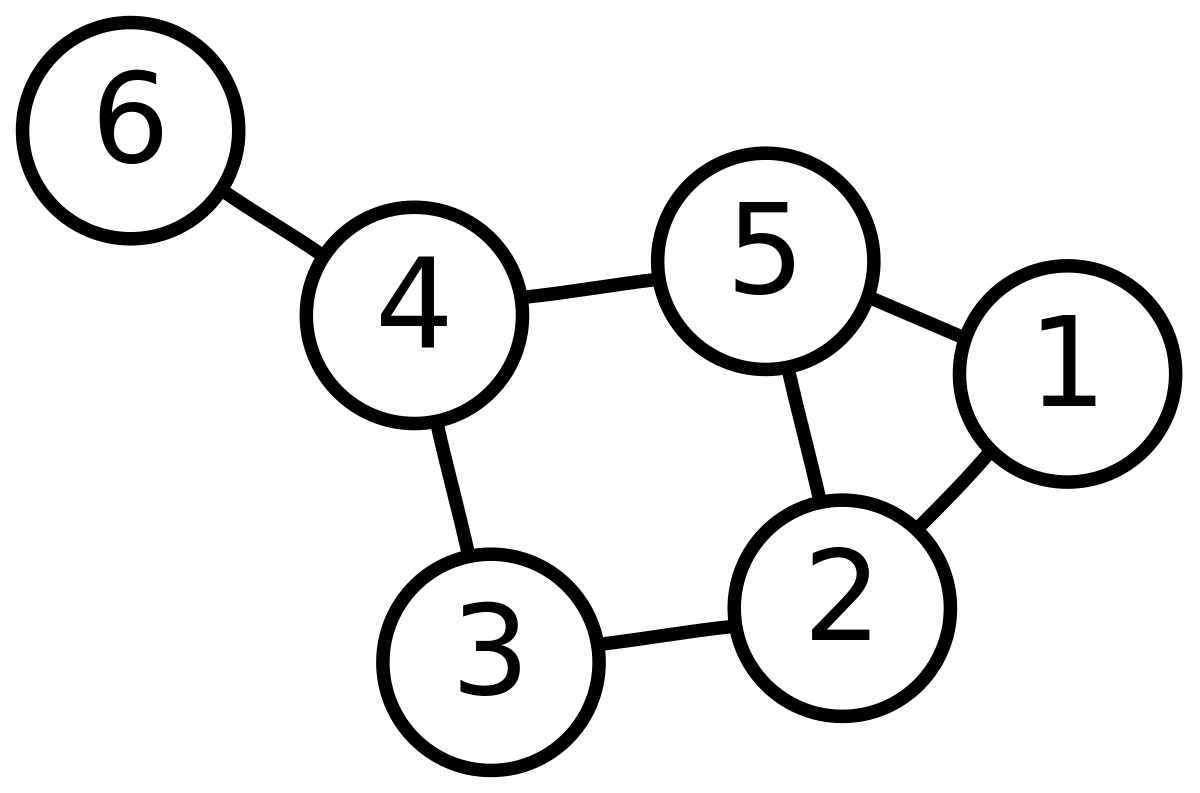
In mathematics, graph theory is the study of graphs, which are mathematical structures used to model pairwise relations between objects. A graph in this context is made up of vertices (also called nodes or points) which are connected by edges (also called links or lines). A distinction is made between undirected graphs, where edges link two vert...
prime drum
I'm going to attempt that aswell namington, i just am very lost and was just wondering if someone here would potentially be willing to help me later is all 🙂
nocturne jewel
Ok I asked this before but I dont fully understand still
If I have 2 linear operators S,T on finite dimensional V, then ST is invertible iff S and T are
Why does that break/not hold if V is infinite dimensional / what's an example?
limber sierra
nocturne jewel
Ok I asked this before but I dont fully understand still
If I have 2 linear ope...
 nocturne jewel
But matrices arent linear operators?
or are those the matrices for the operators?
limber sierra
they represent linear operations in the vector space R^infty
nocturne jewel
which is R^n but inf?
 wintry steppe
can i get help with matrix algebra?
limber sierra
yes; intuitively you can think of it as the set of all real sequences
[im handwaving a bit here]
R^infty certainly has a basis
(1, 0, 0...), (0,1, 0, ...), (0, 0, 1, ...), ...
nocturne jewel
Yeah last time I asked someone (I think Terra) mentioned infinite sequences
limber sierra
uh
then wtf does "infinite dimensional" mean to you
these are not standard definitions
nocturne jewel
But im not seeing the jump from those matrices to operators / sequences
 haughty lagoon
I think they might mean finite linear combinations? is R^infty supposed to have finite support here
limber sierra
you dont need finite support here
you can view those matrices as representative of linear functions
but if this layer isnt quite satisfying

Mathematics Stack Exchange
Suppose $\mathcal{H}$ is a Hilbert space and the product $T_1T_2 \in B(\mathcal{H})$ is invertible. Does this imply that both $T_1, T_2$ are invertible ? I am unable to prove this since, unlike the
(the proving-these-actually-represent-linear-maps is the part im handwaving away)
haughty lagoon
I think this is a hilbert basis here instead of a hamel basis?
limber sierra
oh i see your confusion mirza
you dont actually need that tighter notion of bases here
to map lienar operators to matrices
the map just isnt invertible but we can ignore those issues
nocturne jewel
Is a hilbert space just a vector space?
limber sierra
that said, we still have that hamel bases exist
by the axiom of choice
every vector space has a hamel basis
it just usually wont be constructible
in this case though, it will be constructible i believe?
wait no brain fart
it isnt
you need choice to show it exists
and so it isnt constructible
again though that isnt quite necessary in this case
to map between matrices and linear maps it suffices just to consider hilbert bases
as long as those matrices are infinitely large
(im hiding some details here, dont worry about them)
nocturne jewel
Ok I think I digested the stackexhange post
novel hamlet
are matrix colums interchangeable?
limber sierra
what do you mean by that?
novel hamlet
ie. i have colums lets say i have 3x3 matrix wiht colums W,V,U and i want to calculate det(w,v,u) is it same as det(u,w,v) or det(v,w,u9?
limber sierra
its not the same, no, but swapping columns affects the determinant in the same way swapping rows does
in particular, swapping two columns multiplies the determinant by -1
so det(w, v, u) = -det(v, w, u)
but also det(w, v, u) = -det(v, w, u) = -(-det(u, w, v)) = det(u, w, v)
novel hamlet
i was thinking about this since i had to prove triscalar product
that it is commutative
and since V(UxW)

is essentially this
and from course book i know that

this is what i mean by interchangeable colums
lavish jewel
swapping columns changes the sign of the determinant
novel hamlet
but for triple scalar it is W(UxV)=V(WxU)=U(VxW)
 wintry sphinx
note that these are always two column swaps away from one another
 proper trout
 limber sierra
it is not; try #prealg-and-algebra or any of the ten #questions-_ channels instead
see the pins for a description of what linear algebra is.
 compact relic
I'm familiarizing myself with Invertible matrix and its theorem right now. In one of the problem of a true/false statement, it's asking " Let A be a 3x3 matrix, for some vector v b in R3, Ax =b has more than one solution. would Ax = b consistent for every b in R3?
My answer is that it would be false, since Ax =b in this case is not necessarily an invertible matrix ( because the problem stated some vectors not all?)
 half karma
Is this proof written properly? It doesn’t need to be rigorous. Just wanna see if it’s correct
 half karma
<@&286206848099549185> can someone help me plz ^
 sonic osprey
I'm not really sure what you're doing, I don't think its correct
I'm not sure what your first line even means? What are these two vectors?
half karma
sonic osprey
I'm not sure what your first line even means? What are these two vectors?
I’m trying to generalize for this theorem

 sonic osprey
These are uh, pretty different situations. The second picture is talking about a specific example of a subspace.
half karma
I think my variables might be wrong but it’s how my professor writes the proof for condition 1 and 2
half karma
sonic osprey
These are uh, pretty different situations. The second picture is talking about a...
Oof
sonic osprey
You should focus on the first picture more
half karma
sonic osprey
You should focus on the first picture more
Would it be correct if I replaced x with u and y with v? In the first part I’m showing u+v=0
sonic osprey
why are you showing that?
half karma
Isn’t it the case that if it contains the zero vector then U is a subset of W?
sonic osprey
Just look at
 half karma
Oh W is the non-empty set
sonic osprey
uh
yes?
The notation in your question is different though be careful
In your question U and V are subspaces of W
half karma
Oh so I’m my case the non-empty sets U and V of the vector space W is a sub space of W if it satisfied U+V is also in W
sonic osprey
No
U is a subspace of W
V is a subspace of W
They're both nonempty subsets of W that satisfy the conditions to be a subspace
half karma
Ah so would I need to show that they contain the zero vector?
sonic osprey
 half karma
Ok that U+V is also in W
 fervent gulch
can anyone help me with lin alg? My dms are also open.... I got long questions
sonic osprey
U + V doesn't make sense here. U and V are not vectors, they're subspaces of W
half karma
Oh I was thinking like showing U and V are subspaces of W then their intersection must also be a sub space of W
sonic osprey
No that's what you're trying to show
You're given that U and V are subspaces of W
and you're trying to show that their intersection must also be a subspace of W
fervent gulch
anyone?
half karma
sonic osprey
and you're trying to show that their intersection must also be a subspace of W
How would I show that u+v exists in U⋂V? Intuitively I’m thinking u+v exists since U⋂V is the subset of all the vectors in U and V
sonic osprey
what are u and v there?
half karma
Plz @fervent gulch this room is occupied
half karma
sonic osprey
what are u and v there?
They are vectors in U⋂V?
fervent gulch
half karma
Plz <@741878669588430888> this room is occupied
Alright ping me when u done so Ik when I can go.
sonic osprey
Okay now think about what you know about U and V
use the fact that U and V are subspaces
half karma
sonic osprey
Okay now think about what you know about U and V
If U and V are subspaces of W then U⋂V is also a sub space of W since:
- u+v exists in U and V,
- cu is also in U and vice versa for V.
sonic osprey
yes
half karma
Does that prove it?
sonic osprey
yes
half karma
half karma
Is this proof written properly? It doesn’t need to be rigorous. Just wanna see i...
The last portion is correct right? @sonic osprey
sonic osprey
yes
fervent gulch
yass
half karma
Repost your question
fervent gulch
half karma
Repost your question
I did
half karma
[1 0 0 -3] row 1
[0 1 0 4] row 2
[0 0 1 -3] row 3
Notice the bottom two rows cancel out. But idk if this is correct since the matrix isn’t square
fervent gulch
what happened to the other matrix
limber sierra
half karma
Notice the bottom two rows cancel out. But idk if this is correct since the matr...
they asked for an LU factorization, not a row reduction.
 hollow wharf
lowkey need some guidance here
 fervent gulch
limber sierra
they asked for an LU factorization, not a row reduction.
fervent gulch
limber sierra
they asked for an LU factorization, not a row reduction.
U can say she/her
hollow wharf
well, um am i supposed to like do one by one and see if all of them work or not?
or do i stop after one disproves it?
yeah well i dont know instantly lmao
this is the first problem like this i was given
so im trying to learn it
show all ok, sheesh thatll take a while
yeah i will fs
thanks
fervent gulch
Y'all left me on read...
fervent gulch
Anyone Ping me if ya know?
lavish jewel
@fervent gulch notice w = u - 3v
fervent gulch
lavish jewel
<@741878669588430888> notice w = u - 3v
okay but how does that go with T(w)
like do i do t(w)= t(u)-3t(v) @lavish jewel
lavish jewel
precisely, since T is a linear transformation
fervent gulch
lavish jewel
precisely, since T is a linear transformation
alright i got it right. I can figure out most things but I just need lil guidance
I got a similar question to this
lavish jewel
same as above
fervent gulch
i'll get back to u in 10 mins if i got this right
lavish jewel
i'll be sleeping so dont @ me haha
fervent gulch
Ah I got it done
compact relic
how do you simplifies when you evaluating a determinant inside | |
say |A x B X A^-1 |
can you move the A^-1 in front to simply it out to Identity Matrix, is it not restricted by the order?
nocturne jewel
$|AB|=|A||B|$
stoic pythonBOT
moshill1
 dusky epoch
please do not use the letter x, and especially capital X, for multiplication
hollow wharf
does anyone know how to do #4?
 wintry steppe
write in set notation
show your steps
 hollow wharf
#4?
wintry steppe
$$S = {A \in M(3 \times 2, \bR) : \text{condition goes here}}$$
stoic pythonBOT
(T*(Terra), -dτ)
 hollow wharf
okay
wintry steppe
$$\begin{pmatrix} a & c \ b & d \ -a-b & -c-d \end{pmatrix}$$
stoic pythonBOT
(T*(Terra), -dτ)
 wintry steppe
it's a 3x2 matrix
and the elements in each column all sum to 0
i guess by "show your steps" they meant you're supposed to write out a matrix with entries like a, ..., f, and then show that it has to take on this form?
anyways, for the next part
verify subspace criteria
there is nothing more to it
hollow wharf
hmm
okay well thanks, ill try my best
'

can i write it like that?
and say that a+c+e=0?
and b+d+f=0?
wintry steppe
that's what it means for the entries in each column to sum to zero, yes
 digital bough
hollow wharf
how would i write it in set notation tho?
digital bough
hollow wharf
how would i write it in set notation tho?
Like terra wrote above and then state your condition. One way would be just using indexing :
$$S = {A \in M(3 \times 2, \bR) : A_{ij}=0 , i\leq3 , j \leq 2}$$
stoic pythonBOT
rts
 hollow wharf
hmm
digital bough
Or Well, i and j are not less than 1 and they are integers
wintry steppe
huh
wintry steppe
one way to start would be to write $$S = \left{ \begin{pmatrix} a & b \ c & d \ e & f \end{pmatrix} : a,\dots, f \in \bR : a+c+e=b+d+f=0 \right}$$
stoic pythonBOT
(T*(Terra), -dτ)
 wintry steppe
looks shitty
but you know e = -a-c and f = -b-d, yeah?
so you can "eliminate" e and f
digital bough
Ah, my bad he wanted to sum all Columns
wintry steppe
columbus 
 wintry steppe
sure
hollow wharf
what does that help with tho?
wintry steppe
well the thing i just wrote is perfectly fine "set notation" for S
but presumably you're supposed to simplify
"simplify"
hollow wharf
okay, i mean its prolly better to simplify
wintry steppe
ya
wintry steppe
if you "eliminate" $e$ and $f$ from the previous "set notation" you should get something like $$S = \left{ \begin{pmatrix} a & b \ c & d \ -a-c & -b-d \end{pmatrix} : a,b,c,d\in\bR \right}$$
stoic pythonBOT
(T*(Terra), -dτ)
 hollow wharf
do i need to write that they add up to 0?
wintry steppe
well they already do, dont they?
hollow wharf
or is that already explained in the a+c-a-c
wintry steppe
i'd think so
 stoic pythonBOT
 hollow wharf
thats what i got rn
so thats the first part right?
now i have to fine the subspace of V=M3x2(R)
right?
digital bough
Ye, you can use your set notation to see if it is at least closed under standard addition or scalar, if it isnt then uh... idk.
wintry steppe
meme answer: it's the kernel of a linear transfornmation M(3 x 2, R) -> R^2 so it's a subspace
hollow wharf
hehe 🙂
wintry steppe
namely, the linear transformation whose first, second components are the sums of the first, second column entries of the matrix, respectively
hollow wharf
ight i finished
 silk ether
I wonder, why can't Gauss-Seidel method solve every system of linear equations? (like sometimes values would go to infinity)
dusky epoch
well if you have zeros on the diagonal then you have a problem
silk ether
But umm, the values given in the diagonal don't have any zero
The solutions are still getting larger, approaching infinity
 lavish jewel
is there any special reason you're using that specific method btw?
dusky epoch
might be that they'll get sent to gulag if they don't use it
silk ether
Just try for fun 😂
dusky epoch
anyway, yeah, the coefficient matrix for this system is $$\begin{bmatrix} 1 & 2 & -3 \ 2 & -5 & 4 \ 5 & 4 & -1 \end{bmatrix}$$ which isn't diagonally dominant and doesn't look positive-semidefinite either
stoic pythonBOT
Ann
 lavish jewel
for a quick test of your method, you can multiply both sides of the equation by M^T (the matrix you have there)
that should be solvable with your alg if it's working correctly
novel hamlet
you guys got a easy cheat to do 8x8 matrix determinant?
native rampart
Block matrices or smt?
Gaussian can take up to a max of 28 steps if you are ok with that?
 native rampart
Yea,It depends on the kind of matrix
novel hamlet
this is the matrix i got
native rampart
Yea,This one's easy
novel hamlet
i summed firstt for colums and got 1
not sure what im supposed to do with that result
ah nvm sum is 0
det should be 0
but im not sure how to "calculate" it
native rampart
Sum the diagonal of the original matrix
novel hamlet
that is the original, so i get 16
thanks
just read the final question instructions: "you may use calculation software or calculate eigenvalues and eigenspaces by hand, in either case show your reasoning"
im kinda curious what is the reasoning for i put values on eg. wolfram alpha and trust it count better than me
xD
 mellow solar

what is below the y-1 and 3-z, do i need to divide everything by two or is it 1?
this is line
 dusky heart
if I have a matrix A = [4 -1; 5 2] and it's asking for (the L looking things are capital I's as in igloo) 3I_2 - (3I_2)A
im not sure what is meant by I
above the question it also says: **In the rest of this exercise set and in those to follow, you should
assume that each matrix expression is defined. That is, the sizes of
the matrices (and vectors) involved "match" appropriately. **
 urban egret
maybe the I stands for identity matrix?
so I_2 is (1 0; 0 1)
does the notation O(n) for an orthogonal group mean that the matrix is orthonormal? or just orthogonal?
dusky heart
oh I see what u mean thanks
 quartz compass
imagine the plane like a mirror
whatever point is on one side of the mirror reflects an equal distance to the other side of it
wintry steppe
I'm not entirely sure how to do this, can't really find the explanation in the book
The book references an example solution where a transformation is the multiplication of a vector by a scalar, and the explanation of how this is a linear transformation
But that does not seem very similar to this problem
 fast vector
Do you have a definition of „linear transformation“?
It should be defined by saying that one or two equalities must hold.
Then try to verify these equations for the map T: ℝ³→ℝ³, (x1, x2, x3)↦(x1,x2,-x3).
wintry steppe
Yeah, the two claims would be
T(u + v) = T(u) + T(v)T(cu) = cT(u)
I actually understand the answer to this question (how to prove it is linear), the only issue I have is that I don't understand whatthrough the plane x_3 = 0means
lavish jewel
it is telling you up there what it does
it flips the third component of the vector
if x = (x1,x2,x3), T(x) = (x1,x2,-x3)
wintry steppe
Oh man I feel so dumb lol
Thank you, sorry about that
can someone please help me with the inversions of permutations
i'm losing my mind over it because there are like two "definitions" and i dont know what is going on
first my notes say that (i, j) are an inversion if i < j and p(i) > p(j)
where p is some permutation
but then i saw in so many places that if (a b c d e f) is a permutation
the inversion is when some number is larger than a number thats more right
so what's going on here?
limber sierra
those are the same definition
wintry steppe
how about (1234)
limber sierra
there are no inversions there.
wintry steppe
wait a moment
hmm but thats not the same as if i > j and p(i) < p(j) right?
ok lets look at (2314)
is (2,1) an inversion here?
limber sierra
yes
2 occupies the 1 slot, and 1 occupies the 3 slot, so 1 < 3 but p(1) > p(3)
im assuming this is the second row of a permutation map and not cycle notation
wintry steppe
ohhhhh okay that was my problem
i thought that this second rule is for cycles
i never saw a notation of just the second row
limber sierra
ah no
wintry steppe
so i assumed that must be a cycle but now i think youre right
ok thank you so much i was losing my mind over that
limber sierra
cycle notation is a bit harder to see the inversions directly
wintry steppe
yes because if it was a cycle notation (2,1) wouldnt be an inverse right?
because 2 isnt even smaller than 1?
limber sierra
well it wouldnt fit the strict definition
that would actually still be an inversion if we consider it as a two-row matrix:
(1 2)
(2 1)
but it wouldnt fit the definition laid out above
limber sierra
yeah (2314) and (1423) are the same cycle
wintry steppe
and then it would be an inversion?
limber sierra
but they would have different numbers of inversions
limber sierra
er
other way around
$\begin{pmatrix}1&2\1&2\end{pmatrix}$ has no inversions but $\begin{pmatrix}1&2\2&1\end{pmatrix}$ has one inversion
stoic pythonBOT
Namington
 limber sierra
so youre right that if you tried to apply this definition
to cycle notation
youd run into issues
since (1 2) and (2 1) would then have a different amount of inversions
but they represent the same permutation
wintry steppe
yes you have to work with the strict definition when you have cycles
limber sierra
yeah, you want to convert to the two-row matrix representation first
ideally
(alternatively you could break it down into a product of 2-cycles)
wintry steppe
yes ok thanks i get it now
 worthy plank
what would be the easiest/quickest way of finding the 4th column of C^-1?
 lavish jewel
you can invert L pretty easily
inversion commutes with transpose, so once you have L^-1, you're pretty much set
also, since the matrix in the middle is diagonal, the 4th column will be the 4th column of L^T^-1 scaled by the sum of the elements of the 4th column of L^-1 scaled by 1/elements of the diagonal matrix
 sleek spruce
hello good people
maybe i ask why
a matrix A, that is 5x6, with rank 3
can not span R^3?
the cols of A
sleek spruce
could you elaborate
if it's a 5x6, the dimensions are 5
and if it's rank 3
it has 3 pivots
so shouldn't it span R^3
sleek spruce
5 entries
and 3 entries
but the cols of A
reside in a 3d subspace
so why doesn't it span R^3
my imagination isn't working
my brain clearly shows the cols of A spanning a 3d space in a 5d
wintry steppe
because the columns literally don't lie in R^3. they span a 3 dimensional space, yes, but they don't lie in R^3
that three dimensional space need not be and will not be R^3
sleek spruce
could you differentiate what it means to lie on a R^n?
wintry steppe
is a member of
sleek spruce
oh
OH
ok
bruh
tyvm
so just to get my understanding
it spans a 3d space, but it's not in a 3d space
wintry steppe
yeah that sounds good
sleek spruce
tyvm
wintry steppe
the span will be a 3 dimensional subspace of R^5
Before we defined the determinant we defined multilinear transformations in the following way: F: U^n -> V is n-linear if all maps U -> V, u -> F(u_1, ..., u_n) are linear for all i ∈ {1, ..., n} and all vectors u_i ∈ U
The professor said that in order to do that we have to assume that 1 + 1 isn't 0 in the field that we're working with
my question is why is that condition necessary?
probably just so you don't have to deal with nonsense involving characteristic 2 fields
1 + 1 = 0 is bad
what is characteristic 2
i never heard of it before
it means a field in which 1 + 1 = 0 (a field is of characteristic p if p is the smallest positive integer for which 1 summed p times equals 0)
slightly better answer:
some aspects of the theory of bilinear forms (and by extension multilinear forms) become a little strange when you're working over a field in which 1 = -1, if i recall correctly
https://kconrad.math.uconn.edu/blurbs/linmultialg/bilinearform.pdf
this will probably elucidate that better than i can, see the table of contents first paragraph
e.g. any alternating (B(u, u) = 0 for all u) bilinear form is skew-symmetric (B(u, v) = -B(v, u) for all u, v). the converse is true outside of char 2 (because B(u,u) = -B(u,u), and since 1 is not equal to -1, B(u,u)=0), but false in char 2
oh okay thanks so much
we haven't yet covered bilinear forms so i'll wait until then for more understanding
but i think this thing with antisymmetry is the main thing
ya
because we have used that and apparently it doesnt work with char2

 wispy pewter
does anyone know how to smoothly write the inner product of a bra and ket in LaTeX?
like this

 gray dust
$\ip{x}{y}$
stoic pythonBOT
RokabeJintarou
 gray dust
physics package @wispy pewter
wispy pewter
ah ok that looks good, how about the lineing up a row vector and column vector
gray dust
bmatrix
stoic pythonBOT
EmilD
 wispy pewter
is there no way to line them up?
also dam that LaTeX command for the inner product didn't work in overleaf
gray dust
import physics package
 gloomy arrow
When you want to do multiple rotations all at once, do you add the rotation matrices or do you multiply them?
limber sierra
what do you mean by "at once"?
like rather than rotate by 90 and then again by 90 [by applying a rotation matrix twice], rotate by 180 [by applying a rotation matrix once]?
you would multiply, since linear transformation composition is the same thing as matrix multiplication
 stable kindle
is there any geometrical intuition for why Ax(BxC) = B(A.C) - C(A.B)?
like for the scalar triple product being cyclic it's like any way you do it you get the volume of the parallelepiped which is quite nice
fervent gulch
 wintry steppe
$$\begin{bmatrix}x\y\z\end{bmatrix}=xe_1+ye_2+ze_3.$$ use linearity.
stoic pythonBOT
(T*(Terra), -dτ)
 wintry steppe
(presumably "transformation" here means "linear transformation")
fervent gulch
Hold on
fervent gulch
wintry steppe
(presumably "transformation" here means "linear transformation")
so how do i obtain that and I can resize the matrix
wintry steppe
i don't understand
fervent gulch
I want to get t ( x y z) , I'll do the calculations but I do need guidance
wintry steppe
$$T\left(\begin{bmatrix}x\y\z\end{bmatrix}\right)=T(xe_1+ye_2+ze_3).$$ apply linearity and simplify
stoic pythonBOT
(T*(Terra), -dτ)
 fervent gulch
wintry steppe
that's it
fervent gulch
wintry steppe
that's it
I obtained -22, 17
fervent gulch
fervent gulch
I obtained -22, 17
My bad I realized what when wrong
Ok I got it right, now next question
 wispy pewter
does anyone know the command to have wolfram alpha compute an innerproduct of a row vector and a column vector?
nocturne jewel
fervent gulch
basically solve Au=b, so either gauss jordan or find the inverse of A if A is invertible
fervent gulch
nocturne jewel
basically solve Au=b, so either gauss jordan or find the inverse of A if A is in...
hold on i'll let u know if i got it wrong

I got this for gauss jordan
nocturne jewel
yeah, did you do it w/ the augmented matrix?
fervent gulch
eh i haven't only inserted a for gauss jordan
nocturne jewel
Ok so either solve the augmented matrix or find the inverse
fervent gulch
this is inverse of a
 nocturne jewel
Ok.. so solve Au=b
fervent gulch
wait but I don't have u
nocturne jewel
Yes but you found A^-1
fervent gulch
how do i use the inverse to lead me there
nocturne jewel
left multiply both sides by A^-1
fervent gulch
mulitply b by A^-1?
nocturne jewel
nocturne jewel
left multiply both sides by A^-1

fervent gulch
both sides of what moshill1
nocturne jewel
Au=b...
fervent gulch
Maybe visuals would help, I am getting there
nocturne jewel
$A^{-1}Au=A^{-1}b \to u = A^{-1}b$
stoic pythonBOT
moshill1
 fervent gulch
for A^-1 times b
 nocturne jewel
im guessing you're just getting a program to do the calculation for you from the screenshots, but sure
fervent gulch
y so salty? I am getting the easy things done manually by hand, i would do so if I had time to spare this evening
He/She/They left the groupchat, anyone willing to guide me
<@&286206848099549185>
I am not sure I feel like i prob left out something
The previous person said to multiply by both sides I only did invertible A times b
I am not sure how to do the rest that all
I feel like i did a portion but I want to make sure, u said that" computing A^{-1} b gives you u" so I thought u meant I was done
I did read it but I only understand partially
so like after i did the A^{-1} b gives you u, what do i gotta do next. did i get the complete answer or was there more required.
nvm I got it wrong.
yea no worries
 hollow finch
anyone have an example of a LA proof that uses the contrapositive?
nocturne jewel
hollow finch
anyone have an example of a LA proof that uses the contrapositive?
proof by contradiction?
hollow finch
nocturne jewel
proof by contradiction?
i mean just a theorem or fact in linear algebra that has a proof by contrapositive
nocturne jewel
what's a contrapositive?
lavish jewel
off the top of my head, vandermonde matrices are shown to be full rank by contradiction, if that's what you mean
hollow finch
nocturne jewel
what's a contrapositive?
$(P\implies Q )\iff (\neg Q \implies \neg P)$
stoic pythonBOT
nix
 nocturne jewel
Havent learned formal logic yet lol
or wherever those types of statements show up
hollow finch
nocturne jewel
Havent learned formal logic yet lol
P=the matrix M is invertible
Q=zero is not an eigenvalue of M
If the matrix M is invertible, then zero is not an eigenvalue of M
is equivalent to
If zero is an eigenvalue of M, then the matrix M is not invertible
for example
nocturne jewel

lavish jewel
that looks like a proof by contradiction
hollow finch
lavish jewel
that looks like a proof by contradiction
i was just giving an example of what the contrapositive is
fervent gulch
lavish jewel
that looks like a proof by contradiction
u busy?
lavish jewel
my bad, contrapositive is a more special case
nocturne jewel
Probably getting more into proof/logic, but what's the distinction b/w contradiction and contrapositive then?
Proving contradiction is conditional and contrapositive is biconditional?
lavish jewel
in a contradiction, assuming p leads to q and not q at the same time
nocturne jewel
contradiction is start with the opposite of P and show an obvious false-ness?
hollow finch
lavish jewel
in a contradiction, assuming p leads to q and not q at the same time
sounds like Modus Tollens
lavish jewel
if p then q and you can show that q implies w and not w, then not q and therefore not p
ins't modus tollens contraposition?
hollow finch
lavish jewel
ins't modus tollens contraposition?
$P\implies Q$
$\neg Q$
$\therefore \neg P$
stoic pythonBOT
nix
 hollow finch
personally not quite seeing the contraposition. i thought this was like contradiction because you usually do those by assuming Q is false
lavish jewel
oh, you mean to show that not q then not p, not just not q
in what you wrote one has to show q is false, not assume it
you start with knwledge that if p then q
you show that not q, therefore not p
in contradictions you show that if p then q and not q, which doesn't make sense

modus tollens is the law of contrapositive
but still this is all tangent to what you asked, sorry. i can't think of any examples at 3 am lol
hollow finch
lavish jewel
modus tollens is the law of contrapositive
tfw im an idiot 
lavish jewel
anyway yeah
do you mean to prove p then q by showing that not q then not p?
or to start with knowledge that p then q, and show that not q therefore not p?
the vandermonde matrix example i gave starts with the assumption that the columns (for a certain vandermonde mat m x n) are lin dep, which means they have a nontrivial linear comb that gives a 0 vector
you show that the latter is false, amd therefore so is the former. this uses a contradiction as well tho
someone will give you a better example and correct my mistakes while i sleep
 pseudo thicket

Can I check for this slide, after reducing the matrix A, I got :
A=[
1 0
0 1
0 0 ]
There is a zero row. That means it does not have a solution for every vector b, right?
But the span/column space of A is a 2D plane since we only have 2 Linearly Independent column.
wintry steppe
the columns of A can't span all of R^3 since there are only two of them
so yes, you are right, there will be some b for which Ax = b has no solution
you're also right that the span is a two dimensional plane, since the columns are linearly independent
everything you've said checks out 👍
pseudo thicket
Thank you @wintry steppe !
wintry steppe

native rampart
Matlab or some other program,ig
Assuming you mean solving a system of linear equations in more than 4 variables by "solve"
limber sierra
it's not really any harder
just more tedious/time-consuming
(and more opportunities to make mistakes)
 vocal prairie
\textbf{Problem. }Let $V$ be a vector space having dimension $n$, and let $S$ be a subset of $V$ that generates $V$. Prove that there is a subset of $S$ that is a basis for $V$.\begin{proof}If $V$ is the zero vector space, then $S=\emptyset$ is the only possible spanning set, and $\emptyset$ is a basis for $V$, thus proving the claim. Consider now that $V$ is not the zero vector space. Suppose to the contrary that no subset of $S$ forms a basis for $V$, that is, any linearly independent subset of $S$ has at-most $n-1$ vectors(a linearly independent subset of $V$ can't have more than $n$ vectors by the replacement theorem). Call this linearly independent subset $A$. Now, all the vectors in $S\setminus A$ can be represented as a linear combination of vectors in $A$, which means $\text{span} (A)=\text{span} (S)=V$. Thus, $A$ is a linearly independent spanning set of $V$, and is therefore a basis by definition. But $A$ has at-most $n-1$ vectors, which contradicts the fact that $V$ is $n$-dimensional. Hence, $A$ must have $n$ vectors as well. This proves the claim.\end{proof}
stoic pythonBOT
Ted
 vocal prairie
Does this proof feel shaky?
The bit about A having n vectors...doesn't sound right. I think I'm either missing something, or adding some redundancy.
vocal prairie
But I already ruled out A having more than n vectors by the replacement theorem
native rampart
Then, It's fine
vocal prairie

vocal prairie
Is contradiction redundant in the above proof? 
Can I not just take the largest possible linearly independent subset, claim that it spans the space, but can't have more than/less than n vectors due to replacement theorem and its corollaries?
native rampart
how do you know it spans the space?
vocal prairie
Same reasoning as above
native rampart
a better approach would be to take the minimum subset which spans the space and conclude it is a basis
vocal prairie
Any linear combination in terms of vectors of S can be reduced to a linear combination of vectors of this largest linearly independent subset
vocal prairie
native rampart
a better approach would be to take the minimum subset which spans the space and ...
How do you formalise this idea for a proof?
tame mural
perhaps u just remove 1 vector at a time
vocal prairie
Yeah, but it doesn't mean S has to be finite
You could keep picking out vectors forever
tame mural
ic
native rampart
start with zero add vectors as long as the new gen set is LI
vocal prairie
Hmmm, okay
tame mural
but u could also choose the wrong vectors forever
vocal prairie
¯\_(ツ)_/¯
I'm more insistent on the contradiction approach for this reason
I still don't usually get the "choose one vector, choose another..." approach.
tame mural
it's just that i remembered axler had a proof with removing vectors until it was the minimal span
i shall perhaps look it up
vocal prairie
Thanks!
tame mural
ah
Axler's proof is for finite lists which are still spanning
Ah
Axler's approach is to prove that every finite-dimensional vector space by definition has a spanning list that is also finite
vocal prairie
So that's just saying every finite dimensional vector space has a finite basis
I don't think that helps with this problem, does it?
tame mural
but once you prove the existence of such a list
you can start subtracting in a finite way
You can bluntly define a finite-dimensional vector space as implying the existence of such a set
vocal prairie
I see. For now I'm just going with the idea of picking the biggest possible linearly independent subset of S and then proving that it is indeed a basis; I'll try your approch as well. Thanks!
 sudden egret
can somebody explain how did they get the det A^-1=19?
 pseudo thicket
In a homogenous equation where mxn matrix,m>n
Is it right to say we can state these points:
there could be infinitely many solutions or no solution
But there can never be just 1 solution?
 marble lance
No. It has 1 solution or infinitely many solutions. 0 is always a solution, so it must have at least one.
pseudo thicket
marble lance
No. It has 1 solution or infinitely many solutions. 0 is always a solution, so i...
but there could be no solution since there is a zero row
marble lance
What do you mean by a homogenous equation? Ax = 0?
pseudo thicket
yes
marble lance
A(0) = 0 is always true. It doesn't matter what A is.
So x = 0 is always a solution
pseudo thicket
marble lance
So x = 0 is always a solution
okay so at least 1 solution
But how does infinite solution come about?
marble lance
If A is not invertible
 magic light
Is there a way to get from the base (2,1,1), (-1, 1, 0), (-1, 0, 1) to the base (1,1,1), (-1, 1, 0), (-1, 0, 1) without zeroing (2, 1, 1)?
Basically turn (2,1,1) to (1,1,1)
lavish jewel
what exactly do you wanna do
pseudo thicket
marble lance
If A is not invertible
thanks, so it either has only the trivial solution or infinitely many solutions (in addition to trivial solution)
marble lance
Yes @pseudo thicket
pseudo thicket
marble lance
Yes <@242274190672134144>
thank you
marble lance
Np
pseudo thicket
I'm trying to create a sample question to get the infintiely many solutions, how should I craft them?
marble lance
Create a matrix with zero determinant
Then it won't be invertible
Easiest answer: the zero matrix.
magic light
lavish jewel
what exactly do you wanna do
I made a mistake in the test, I was asked to orthonormalize the eigenvectors of some matrix
after fixing a mistake in one area I didn't fix it in another and got the base with (2, 1, 1) instead of (1, 1, 1) - rest of the vectors were accurate/correct.
I was wondering if I can argue that (1, 1, 1) is a combination of (2, 1, 1) and the rest of the base and thus I still deserve some points despite the last vector being "wrong"
stoic pythonBOT


 magic light
nice, so it is one
lavish jewel
ofc, both of the matrices are full rank transformation matrices
magic light
why the reverse though?
lavish jewel
my guess is you will get no credit, though, because finding a basis is easy. they specifically asked you for an orthogonal basis
magic light
I got an orthonormal basis, but with the wrong 3rd vector
the rest of it was correct
lavish jewel
yours isn't orthogonal, and even less orthonormal
magic light
I know, ok:
I had a matrix A
I was asked to find an orthonormal basis for eigenvectors of A^TA
I found eigenvalues(correct)
I found eigenvectors(2 correct, 1 incorrect) <- my question here
I did gram schmidt on the 3 vectors I found
I normalized all the vectors
in the end I had 2 normalized vectors and 1 incorrect vector
lavish jewel
if you did gram schmidt correctly, the result will be a set of 3 orthonormal vectors
magic light
Yeah, but they are not the eigenvectors of A^TA
I also think I did a mistake in gram schmidt at v3
though I still didn't figure out what it is
lavish jewel
that is more likely
magic light
I still didn't get the results, I just realized I made a mistake halfway with the vectors and was wondering if I can argue that the step is (technically) correct since I still had an eigenvector
in case I lose points
magic light
yeah.
lavish jewel
the matrix is full rank, so your argument won't hold. you can do what i did up there for any vector in R3
you'll get credit for those 3 vectors and for trying G-S, most likely, but that's about it
magic light
well (2, 1, 1) is linearly independent
so it's not just any vector
also at the end, end result
two out of three vectors are correct
Since I used (2, 1, 1) as v_3
only the last vector is not an orthonormalized eigenvector
lavish jewel
they'll probably notice that
 hushed dock
For tensor products, does $$(A \otimes B)(A' \otimes B')=AA' \otimes BB'$$ where A,A',B,B' are matrices?
stoic pythonBOT
init0
 lavish jewel
yes
hushed dock
proof?
lavish jewel
you can expand the product block by block and check
lavish jewel
kronecker products have a block structure
magic light
@lavish jewel
If Av = xv
then isn't it true
3Av = 3xv => A3v = 3xv => 3x is an eigenvalue as well as x?
for any number really?
except 0
lavish jewel
what you wrote is correct, but the conclusion is wrong
magic light
isn't 3v it an eigenvector of 3x?
lavish jewel
if 3x is an eigenvalue, then the corresponding vector is scaled by 3x
magic light
Ok, but by definition can't we say x' = 3x is an eigenvalue because there exists Av' = x'v?
with v' = 3v
lavish jewel
look at your equation
that's not the definition of an eigenvector
it's not the same vector on the other side
magic light
Right, it's two different vectors with two different values
but aren't they both eigenvectors and eigenvalues, albeit differently? or am I misunderstanding something
lavish jewel
you are misunderstanding something indeed
magic light
Av = xv for non-zero vectors, means that x is an eigenvalue and v is an eigenvector
A3v = 3xv where x' = 3x and v' = 3v means that x' is an eigenvalue and 3v is an eigenvector because Av'=x'v
lavish jewel
that's wrong
magic light
hmm
pseudo thicket
marble lance
Yes <@242274190672134144>
hold on, wouldnt there be only inifinitely many solutions?
since there are free variables!
magic light
lavish jewel
so Aw = uz makes u and z an eigenvector z and an eigenvalue u
w is an eigenvector of u eigenvalue
lavish jewel
no
because you got z on the other side, not w
what the fuck
it has to be the SAME vector on both sides
SAME
magic light
okay, don't get angry with me! 😦
I see what you mean now
A3v = 3xv => A3v = x3v
so x is an eigenvalue of 3v?
now we don't have infinitely many eigenvalues, just vectors I guess
lavish jewel
right
that's why one usually normalizes the eigenvector
any vector parallel that direction will get scaled by the corresponding eigenvalue
so only the direction is important
magic light
right, which is why (2, 1, 1) is a bad answer nonetheless S:
even though it is a combination of other eigenvectors
lavish jewel
yep
magic light
sucks
hopefully they won't notice, the answer is 2 pages long and the result is still orthonormalized vectors lol
at least partial points
it's a 20 point question 😦
lavish jewel
you'll get at least partial credit
magic light
hopefully
lavish jewel
a merciful teacher would check separately that you did G-S correctly with the vectors you picked, so you'd get most of the credit
magic light
I checked it with a calculator and didn't find any issues, but the result of G-S in an online calculator seem different
actually I should just try to inner product them and see
pseudo thicket
in a matrix where m<n, where the equation is homogenous, then there will be inifinitely many solutions only, right?
lavish jewel
yep
hushed dock
if a complex matrix is invertible, is it also unitary?
native rampart
No
quartz compass
unitary is like the complex version of an orthogonal matrix
it has determinant |z|=1
stable kindle
okay, asking one more time, is there any geometrical intuition for why Ax(BxC) = B(A.C) - C(A.B)?
like for the scalar triple product being cyclic it's like any way you do it you get the volume of the parallelepiped which is quite nice
native rampart
I don't think cross products work nicely
quartz compass
hmm well the vector BxC is perpendicular to B and C, so when you cross A with BxC you get something that lies in the plane spanned by B and C, so you can look at the projection of A on B and C with those dot products I guess
I'd have to think a bit more about why it has that exact form but at least that seems reasonable enough intuition for why you end up with the dot products A.C and A.B at least
novel hamlet
Edd, I managed to figure out the math of you are intrested
stable kindle
hmmm
lavish jewel
what math
novel hamlet
The one I asked few days ago about the net
And you said you dont know howbto do it
With the funny circle imagine and needed to make matrix out of it
lavish jewel
oh
yeah after you said it was a graph i realized
the graph laplacian is a difference matrix
 novel hamlet
But it took quite long
lavish jewel
it's a big matrix even for only a few nodes, yeah
fervent gulch
 lavish jewel
if you rotate [1,0] by 4/3 pi, what does it become?
 limber sierra
where does a rotation of 4pi/3 land on the unit circle?
it's shown somewhere in that image
fervent gulch
(-1/2, -sqrt3/2)
limber sierra
right (assuming the rotation is counterclockwise)
fervent gulch
Ok so how do i proceed w/ that
limber sierra
well we know $\begin{pmatrix}a&b\c&d\end{pmatrix}\begin{pmatrix}1\0\end{pmatrix} = \begin{pmatrix}-1/2\-\sqrt{3}/2\end{pmatrix}$
stoic pythonBOT
Namington
