#linear-algebra
2 messages · Page 174 of 1
 lavish jewel
if you treat vectors point vectors, they have their tail at the origin
any two vectors then define 3 points: the origin, and the 2 points they are pointing toward
those 3 points lie on a plane, so the same interpretation of an angle on that plane holds
 novel hamlet
okay
well i think it is just enough if i select v=0 and calculate <w,0> and //w//*//0//
and suprisingly 0=0
and the njust same for w=0 and then say w=t0 and v=t0 whjere t is any real number
lavish jewel
the trivial case doesn't help much
a vector in any direction can be made 0 by multiplying by 0
you actually only care about nonzero ones here
lavish jewel
what's the definition of a rectangle
 wintry steppe
the anwser is (6, 18, -4)
wintry steppe
lavish jewel
what's the definition of a rectangle
two pairs of equal sides
lavish jewel
yep
wintry steppe
so what do i do to solve this
lavish jewel
you can make vectors from one of the points to the other two
wintry steppe
so I do vector AB = CD
lavish jewel
in length, sure, but possibly in the opposite direction
wintry steppe
so AC = BD
ive just been stuck on this homeowrk problem for like 40 minutes now
and i dont get the textbook anwser
lavish jewel
i'll try for like 5 mins and see
wintry steppe
no to solve it we have to split up the rectangle into two triangles
and make the vectors side lengths
and the hyptonuse is the diagonal vectors
and solve for the point that way
lavish jewel
aight
you don't really need to do that tho
B + BA + AD = BD can be done fully with vectors
and at that point you should already have c1 and c3 from the side equalities, too
it saves you a square root 😛
novel hamlet
I have (V<g,h>) and (W<a,b>) that are inner product spaces that have dim V <= dim W and U⊂ V (u is subspace for v). I need to show that f:U->W can be expanded to isometry F:v->W (if f:U->W then there exist isometry F:V->W such that F|U = f)
cant make that last one correct for some reason
 cobalt lodge
anyone mind helping me with a problem, ive been stuck on this for a whileeee
 nocturne jewel
cobalt lodge
anyone mind helping me with a problem, ive been stuck on this for a whileeee
nocturne jewel
cobalt lodge
anyone mind helping me with a problem, ive been stuck on this for a whileeee
the answer to the question you posted is 7
cobalt lodge
stuck on 1C
wintry steppe
convince yourself that the columns of A would span all of R^4 if and only of those of R would span all of R^4 (e.g. "row operations do not change column rank")
can the columns of R span all of R^4?
@cobalt lodge
cobalt lodge
yes??? @wintry steppe
wintry steppe
why is that?
(that's not correct)
is (0, 0, 0, 1) in the span of the columns of R?
cobalt lodge
no?
wintry steppe
right, so the columns of R don't span all of R^4
cobalt lodge
therefore the columns of A doont span all of R^4 either
wintry steppe
ya
wintry steppe
i said "convince yourself" for that one since i think there are a few ways to approach it
as long as it makes sense why

cobalt lodge
ive seen some youtube videos and there are a bunch that have different approaches
 pure tangle
can someone please help me fuund where I'm making a mistake with this question
it wants me to find the original matrix based off the solution and a column
to solve for column 2, I used the point (?) part of the solution and did [-1,2,0] + 2 C2 = [-1,2,0]
I got [1,1,2]
for c3 I looked at the null space and used 2c1 + c2 + c3 = 0
and got [5,-1,6]
and finally i used the t parameter equal to 0 and got [7, -2, 8]
but when I row reduce those columns with the given solution d I dont get the same equation
 soft sun
start by stating what rank is your matrix
pure tangle
2
soft sun
by using the theorem for relation of ranks and number of free variables
pure tangle
what do you mean? isnt rank = number of variables - number of free variables
wintry steppe
2/(2i) = -i but the conjugate of 2i is -2i
the expression you expect is $\bar{z}z=|z|^2$, not $|z|$
 stoic pythonBOT
(T*(Terra), -dτ)
 restive moon
ty
 steel moon
hi
pure tangle
<@&286206848099549185>
steel moon
what does it tell you when each row has a pivot column
that the system is consisntet?
wintry steppe
|u| = 4, |v| = 5, |u-v| = 6, what is the magnitude and direction of u+v?
 quartz compass
write them out in terms of dot products
wintry steppe
quartz compass
write them out in terms of dot products
and then what
i was only able to write out one: u*v=(u1v1+u2v2+...+u(n)v(n))
quartz compass
ah, don't write out the components
write like |u|^2 = u dot u and |u-v|^2 = (u-v) dot (u-v)
 west shoal
help
how do i do this problem
not sure what to do
<@&286206848099549185>
i'd really like some helo
if i start with e= (1 0 ) and e2 = (0 1
then when i do the x1 + x2 / -x2
should e1 become 1 0 or 2 0, and will e2 become (-1 0)?
nocturne jewel
west shoal
help
What's T[e_1]?
wintry steppe
nocturne jewel
What's T[e_1]?
bruh we needed your help in ou xD
nocturne jewel
cool
 spice storm
Hello
Let f:R^3->R^2 and g:R^2->R^3 be given by:
f(e1)=e1+e2, f(e2)=2e1-e2, f(e3)=e2;
g(e1)=e1-e2+e3, g(e2)=e1+3e2-2e3.
Compute the matrix of the composition fog. Then use it to calculate (fog)(3e1+2e2).
nocturne jewel
Yes im asking you to do some work and tell me what it is
spice storm
Is my work corret?
west shoal
well if we have e1 = (1 0) and e2 = (0 1)
would that mean that T(e1) = e1 + e2, T(e2) = -e2?
nocturne jewel
No
west shoal
im so confused
nocturne jewel
what's e_1
west shoal
1 0
nocturne jewel
[1,0]^T right
west shoal
mhm
nocturne jewel
so what's x_1 of e_1?
west shoal
1
nocturne jewel
and x_2?
west shoal
0
nocturne jewel
so what's T[e_1]?
west shoal
1 0
nocturne jewel
yes
nocturne jewel
so, not a trick question, how do you express e_1 as a linear combination of e_1 and e_2
(dont over think it lol)
nocturne jewel

 tame mural
There should be an available RREF property which allows you to easily say this
wintry steppe
If i have a matrix in r3 and have only one independent column then my column space would be a line right ?
And if i have vector (0,0,0) would i be wrong to say the column space is a point in r3
 knotty raven
Say I have a nilpotent transformation L:v->v where L^1=L, L o L^n-1 = L^n and L^n=0. I believe that each composition of the function produces a subspace of the last iteration's image. I am wondering how I can prove whether there will never be an iteration such that L^k+1 is not a subspace of L^k.
I think it should follow something like, since L is nilpotent, if an iteration was not a subspace of the previous then it would not equal 0 for some n.
but that feels wrong.
@wintry steppe in R3 if you have one independent vector then its span is a line yes
and 0 is always dependent
since column space is a span of vectors, its a vector subspace, and that means it must go through the origin, so if you think of the 0 space as a point, the point is on the origin.
 naive whale
,w nilpotent
stoic pythonBOT


 Requested by jolimath#8528
 compact relic
I've been working through some Linear Algebra problems and one that Is asking
Columns of AB are linearly dependent, then are columns of B also linearly dependent?
I worked backward that if B is linearly dependent, then Bx=0, thus adding A to both side of ABX= 0A , would get you ABx = 0, that'd mean AB are also linearly dependent right?
However, I'm not sure if you can work it reversely like that
or if there's another way for me to prove since AB are linearly dependent, B also linearly dependent
 dusky epoch
there isn't because it's clearly false
take B = the identity and A = 0
@compact relic
 limber sierra
compact relic
However, I'm not sure if you can work it reversely like that
limber sierra
compact relic
However, I'm not sure if you can work it reversely like that
not directly like this, no
as an example of this, consider "if x^2 > 0, then x > 0"
this is obviously false
for example, (-1)^2 = 1 > 0
but -1 < 0
but if we work "backwards":
x > 0, therefore squaring both sides, x^2 > 0
the point is, you cant just reverse the direction of implication statements
(you can prove a statement by proving the contrapositive, however)
(but in this case that wont help you since, as ann mentioned, your statement is just false)
compact relic
I see, how would I go about proving that since columns of AB are linearly dependent, thus colums of B also linearly dependent?
or ^that is simply false and because?
limber sierra
it's false, so you cant prove it

and the way you prove such a statement false is by providing a counterexample
as Ann did
$\begin{pmatrix}0&0\0&0\end{pmatrix}\begin{pmatrix}1&0\0&1\end{pmatrix} = \begin{pmatrix}0&0\0&0\end{pmatrix}$ which has linearly dependent columns, but $\begin{pmatrix}1&0\0&1\end{pmatrix}$ has linearly \textit{in}dependent columns
stoic pythonBOT
Namington
compact relic
oh okay, that made a lot of senses. Thank you for the helps
tame mural
Does anyone have any book recommendations for a survey or introduction into vector spaces over finite fields?
nocturne jewel
Show the product of 2 linear operators is invertible iff both operators are invertible.
Im pretty sure the reverse direction is just show the product is injective by kernel, but not sure how to do the forward
 gray dust
@nocturne jewel assume A,B:V->V bijective. show AB is injective & surjective by defns
nocturne jewel
Yeah but showing AB is injective is sufficient?
V is finite dim* but idk why V being finite/infinite dimensional matters/affects anything
 foggy field
Hi everyone nice to meet you?
I would know if someone already studied with this book?
Translating the book name: "linear algebra with applications "
Author :Jeffrey holt
gray dust
i see it as a general function thing, not linalg-specific. if f:X->Y and g:Y->Z are bijective then gof is bijective. showing gof is injective & surjective is easy
nocturne jewel
Yeah but AB being injective is equivalent to AB being invertible
So I just need to show AB is injective which is obvious since A and B are injective
But idk how to start with AB being invertible means A,B are
gray dust
so do it
nocturne jewel
I did do it, Im confused on the other direction lol
gray dust
that's not the forward
nocturne jewel
Ik
I said Ik how to do the reverse
Show the product of 2 linear operators is invertible iff both operators are invertible.
Im pretty sure the reverse direction is just show the product is injective by kernel, but not sure how to do the forward
(AB)(v) = 0 iff v = 0 -> AB is invertible (obviously flushed out more) is the reverse
wintry steppe
nocturne jewel
V is finite dim* but idk why V being finite/infinite dimensional matters/affects...
because this is false in infinite dimensions. for example, on a space of sequences, left shift \circ right shift = id is invertible, but are the shifts invertible?
it is true that if A and B are invertible, then so is AB. as rokabe says, this is just a generic function thing.
since that's true even for infinite-dimensional spaces, it should serve as a hint that proving the other direction requires finite-dimensionality
that is, showing that if AB is invertible then A and B are should use finite-dimensionality.
 misty storm
do u guys know of a tool for visualization in r³?
wintry steppe
geogebra 3d
 blissful vault
how do i prove that the dimension of the intersection of two subspaces have to be smaller or equal to the smallest of the 2 subspaces?
intuitively i think about dim(U)+dim(W) = dim(U+W) - dim(U intersection W)
limber sierra
suppose for contradiction theres a basis for U intersect V that's larger than the dimension of (WLOG) U
then this set must be linearly independent in U, since its a basis for U intersect V and constraining our purview just to U won't change its linear independence
so we have a linearly independent set that's larger than U's dimension
problem!

pure tangle
Are there any video series or websites you all recommend for learning why different applications in linear algebra fundamentally work? I feel like between lectures, studying, and homework I'm just memorizing processes and rules without being able to build intuition around what's trully going on
 slow scroll
You could read a book
I read sergei treil’s “linear algebra done wrong” personally, and I thought it did a good job of doing what you’re asking for.
It might take more time than just memorizing the processes and rules though.
@pure tangle
 ruby loom
I just want to confirm if I'm thinking about this correctly, I solved this integral for the potential values of a0, a1, a2, a3, which gave mee
which would seem to indicate that my basis is (a0, 0, 9a2, 0)
 frosty vapor
?
ruby loom
Okay, so revising that earlier statement, I could attempt to construct a basis of all such polynomials as (a0, 0, 0, 0), (0, 0, 0, 0), (0, 0, 9a_2, 0), (0, 0, 0, 0), but these are not linearly independent?
ruby loom
I am a bit confused, so forgive me if my questions don't make sense
ruby loom
hm? Don't my coefficients for the odd degree terms become 0?
Oh, or should it be that they can be anything whatsoever because it's the vector values that become 0?
I'm really just trying to get a handle on what's going on here, and how to relate the results of my computation to the construction of a basis
slow scroll
which would seem to indicate that my basis is (a0, 0, 9a2, 0)
a basis is a set of linearly independent vectors which span a space. You wrote down one vector in R4.
ruby loom
okay, so what is the significance of my scalar coefficients in constructing my basis?
I'm aware, for example, that a basis for R3 would be (1, 0, 0), (0, 1, 0), (0, 0, 1),
slow scroll
okay, so you have the equation a_0 + 9a_2 = 0. These are the constraints you have to deal with. The standard basis for P_3(R) is 1, x, x^2, x^3. You should sort of think about how to modify this so that a_0 = -9a_2 for any polynomial
ruby loom
why, for example, is a basis for P_3(R) not (1, 0, 0, 0, (0, x, 0, 0), (0, 0, x^2, 0), (0, 0, 0, x^3)? Just from following a similar logic to how I would construct one for R4
Is it because (1, 0, 0, 0) and so forth are not elements of P(R)?
slow scroll
You are correct that you can identify 1 -> (1,0,0,0) , x -> (0,1,0,0), .... under an isomorphism P_3(R) to R4, but if we are talking about a basis for P_3(R), and not R4, its probably a little easier (communication wise) to actually work with polynomials.
For example, by (1,0,0,0), its not necessarily clear if you are identifying this vector with 1,x,x^2, or x^3, or some other polynomial.
ruby loom
I see, so...
slow scroll
i mean, this identification is something you do a lot for calculations and stuff, but to say a "basis for P_3(R) is (a0, 0, 9a2, 0)" is a bit worse than just an abuse of notation/language.
anyhow, you want the space of polynomials such that the coefficient of 1 is 9 times the coefficient of x^2
ruby loom
Oh, alright, so it's just 9a_3, x, a_3*x^2, x^3, if I'm understanding correctly?
I was under the impression my scalar coefficients were to be separated from my vectors
Thanks btw, your points have really helped! I'm revisiting how this construction works
slow scroll
@ruby loom i think you might need to check your calculation. I am getting a different equation from a0 + 9a2 = 0. Also, 9a_3, x, a_3*x^2, x^3 is not the correct basis
slow scroll
i get a0 + 3a2 = 0. Now, 3, x, x^2, x^3 still doesn't work
the polynomial 1 + x^2 is in the space spanned by those vectors while 1 + 3 != 0
ruby loom
3a2? Sorry, but that integral is even so it becomes 2*a2 * the integral from 0 to 3 of x^2 which is 9
or am I going crazy?
And then the 2 can be factored out
oh, disregard that!
I see what you did. Sorry about that
slow scroll
np. anyway, as a hint, the basis vector that controls whether a0 + 3a2 = 0 is going to be a sum of monomials.
a polynomial which satisfies a0 + 3a2 = 0 itself
ruby loom
But this will still necessarily be a polynomial in the space of P(3)?
slow scroll
yea it will
ruby loom
so clarifying question, does this mean that my coefficients for the x1 and x3 terms can be anything?
slow scroll
x and x^3 have no constraints, so we can include them in our basis w/o any issue
ruby loom
Oh, well I thought it would be -3a_2, x, (a_2)x^2, x^3, though your monomial comment makes me think perhaps I'm misunderstanding how to find a polynomial that satisfies the coefficients
slow scroll
nope. -3a_2, x, (a_2)x^2, x^3 spans the same space as 1,x,x^2,x^3
we know that x^3 and x belong in the basis. There is one more vector that we need to add. its certainly not x^2 (or scalar times x^2) since the integral of x^2 from -3 to 3 is not 0, and similarly for f(x) = 1.
(this is the sanity check that the basis elements for your space should actually belong to your space)
ruby loom
ah! I see so (0, x, 0, x^3)
slow scroll
hmm? what does that mean? x + x^3 is not a basis element, if that's what that means
and x, x^3 are not the only basis vectors, if that's what you meant
ruby loom
okay, so I'm tempted to just make it (-a0 - 3a2, x, x^3) so as to cancel out the (potential) non zero values of a0 and 3a2
slow scroll
you have the right idea, but the space spanned by -a0 - 3a2, x, x^3 is the same as the space spanned by 1,x,x^3
name a polynomial other than linear combinations of x and x^3 that should belong to this space
ruby loom
how is that so? Because a0 and a2 are arbitrary so they can serve the same purpose as 1?
slow scroll
-a0 - 3a2 is just a number. We can divide (assuming nonzero) by -a0 - 3a2 to get 1, so 1 is in the space, and we can replace -a0 - 3a2 with 1 in that basis.
That's also why I am not writing redundant scalars next to monomial terms in a basis. for example, the space spanned by a, bx, cx^2, dx^3 is the same as the space spanned by 1, x, x^2, x^3 (assuming a,b,c,d are nonzero)
anyway, do this
name a polynomial other than linear combinations of x and x^3 that should belong to this space
ruby loom
alright. x^2 - 3?
slow scroll
yep.
ruby loom
Alright!
slow scroll
x^2 - 3 is not in the span of {x, x^3}. Thus, the set {x, x^3, x^2 - 3} is linearly independent. Does this span U?
slow scroll
ye
ruby loom
thanks for your patience!! I haven't done LA in awhile
slow scroll
npnp
 spice dock
I'm having two vectors: u = (6, 4, 2) and v = (1, -3, 3). I'm supposed to find a third vector w = (x, y, z) so that they generate a cuboid, with volume -180. So far I've gotten to this equation : 18x - 16y - 22z = -180 from calculating determinant. I asked this same question here a few days ago but I can't figure it out. I know they all are 90 degrees, but what to put in for x,y,z..?
slow scroll
im not sure why you have the = -180, but
in 18x - 16y - 22z, x should be (1,0,0), y should be (0,1,0), and z should be (0,0,1).
and when you sum up 18x - 16y - 22z, you will get the "w" you need.
oh i see why -180
you mean || 18x - 16y - 22z|| = 180
wait no 
spice dock
Yeah, both kinda, I'm just saying what the task says.. :). But it's rare to have negative volume.
What I figured was if I took the lenght of u and v, with squareroot and sum of them squared, you know, the u * v * w should be -180 right?
slow scroll
im guessing it wants ||u|| ||v|| ||w|| = 180, but idk where the negative comes from
spice dock
But it just rings ''faulty'' somhow
Ye, I'm just writing what the task says, i would print it, but it is in norwegian so i dont know if it would be any good.
slow scroll
here's what i know: since u and v are perpendicular to each other, ||u x v|| = ||u|| ||v||
u,v,w represent the sides of a cuboid, and u x v gives you the side perpendicular to both u and v. You need to choose the vector of appropriate length in the direction of u x v so that the magnitudes all multiply to 180
can't say where the negative comes from though
spice dock
Ok, what I did a earlier was put in some numbers for x, y and z(just trial and error), so that the equation 18x - 16y - 22z = -180 was correct, i believe it was x = 3, y = 5, and z = 7. But then the product of x * y * z =/(didn't equal) -180. But maybe thats because i didn't do the absolute value as you mention.
Like when I take the lenght of u = 7.48 and v = 4.35.
Then w should be lenght = 5.51 to be 180.
slow scroll
you computed a determinant like $\begin{vmatrix} x&y&z \ 6&4&2 \ 1&-2&3 \end{vmatrix}$, right?
stoic pythonBOT
kxrider
spice dock
-3 instead of -2 but yes, that is correct.
slow scroll
oops yea. anyway, in this, x,y,z are vectors. x = (1,0,0), y = (0,1,0), z = (0,0,1). i.e. 18x - 16y - 22z = (18,-16,-22)
this is the cross product of (6,4,2) and (1,-2,3)
you don't get to choose what x,y,z are here
spice dock
Ok, I see, so how to calculate the vector w then? I'm sorry if I should see it myself. Very new to this.
slow scroll
its np. first, do you understand why u and v are perpendicular (orthogonal)?
spice dock
Yes, because the dot product is 0.
spice dock
Yes, as I have seen in geogebra 3d as well 🙂
slow scroll
u x v has the right "direction," but we need to extract the correct length, so that the volume is 180. that would be our w
slow scroll
||u|| ||v|| ||w|| = 180 so ||w|| = 180/(||u|| ||v|| ).
yea idk about the whole negative thing. i don't think there is a standard interpretation of "negative volume" here
spice dock
Yes, that's true, and I've been doing that, though with the negative, and with the negative I came up with ||w|| being 5.51 in lenght.
slow scroll
okay, that's actually approximately correct
spice dock
From w, but I cant figure out to get the lenght into a vector. it would be something like 5.1 = squareroot x^2 + y^2 +z^2
Maybe writing something wrong here, a lot of numbers in my head, I've been trying to solve this for more than 10 hours over the weekend.
slow scroll
we want something with length 5.51 in the direction of u x v. The standard way to do this is to "make u x v length 1" by computing (u x v)/(||u|| ||v||). This vector has length 1, and points in the direction of u x v. Now, how would we make it 5.51 in length?
lavish jewel
isn't the magnitude of the vector u x v also the area of the parallelogram they describe?
slow scroll
yea, it is
spice dock
yepp
lavish jewel
so you just need $| u \times v |$*L = 180
stoic pythonBOT
Edd
spice dock
Yes, and the L is 5.51.
spice dock
But I need the L = 5.51 to be put into x,y and z :). And there's where we are now I believe 🙂
slow scroll
The standard way to do this is to "make u x v length 1" by computing (u x v)/(||u|| ||v||). This vector has length 1, and points in the direction of u x v. Now, how would we make it 5.51 in length?
referring to this
stoic pythonBOT
Edd
lavish jewel
you make it length 5.51 by multiplying by 5.51 😛
lavish jewel
idk what that is
spice dock
It's the (u x v)/(||u|| ||v||).
I believe
Distance from a plane to a point.
And set distance to 5.51
Or am I way off.
slow scroll
lets say i have a vector v. Do you know what i mean when i say something like 3v points in the same direction as v?
spice dock
Yepp, it's 3 times as long.
lavish jewel
your distance formula is wrong btw
spice dock
Could I just write 5.51*(x,y,z)
lavish jewel
$\frac{u \times v}{\Vert u \Vert \Vert v \Vert}$ has length $\sin \theta$
stoic pythonBOT
Edd
slow scroll
im going to bed, take it away, edd
slow scroll
The cross product of u and v was (18, -16, -22) to save you the scrolling
Ok sleep now
lavish jewel
aight
spice dock
Ok, let's go. I shall translate the task from norwegian to english as best I can.
Find the vector w e R^3 so that the vectors u, v and w generate a cuboid( = straight prism) with oriented volume of - 180. Where: U = (6,4,2) and V = (1,-3,3)
lavish jewel
mhm
well
you already know that $\Vert u \times v \Vert$ is the area of the base, so $\Vert u \times v \Vert \cdot L = 180$ lets you find the length of the third vector
spice dock
Yes
stoic pythonBOT
Edd
lavish jewel
the third vector goes in the direction of $u \times v$. that direction is given by the unit vector $\frac{u \times v}{\Vert u \times v \Vert}$
stoic pythonBOT
Edd
lavish jewel
so $w = \frac{u \times v}{\Vert u \times v \Vert} \cdot L$
stoic pythonBOT
Edd
lavish jewel
i don't remember how to calculate signed volumes from this, so it might be -L instead
that's about it 😛
spice dock
Still taking this in xD
So, say, if I want the value of x in the w vector, how do i do that with that equation? I'm in deep here xD
spice dock
Ahh, ok, so i do the equation 3 times to get the values, got it.
lavish jewel
no
this equation already gives you the whole vector
u x v is a vector
L is a scalar
$\Vert u \times v \Vert$ is a scalar
stoic pythonBOT
Edd
lavish jewel
so w is already a full vector, all 3 of its components are in there
lavish jewel
stoic python
**Edd**
this is all
spice dock
Ok, so I divide the 3 vectors by the scalar and mulitply them by L.
Please say thats the correct way 😄
lavish jewel
i don't understand what you don't understand lol
do you know how it works when you multiply a vector by a scalar?
spice dock
Yes, you just put the scalar in front and mulitply it by all the numbers in the vector.
spice dock
So, what I got is w = (3, -2.56, -3.52)
I believe that is correct. Thanks so much @slow scroll and @lavish jewel, really appreciated!
 uneven cypress
Hello I needed some help in Algebra and was wanting to know if I can just post the question or do I need to ask first.
 steady fiber

uneven cypress
Stephanie receives a salary of $650 per month plus a commission of 5.5% on the first $3,000 of sales, and 7% of all sales over $3,000. Find Stephanie's gross pay for the month if her sales were $11,190
uneven cypress
Thanks
 hearty meteor
can someone help me understand b more?
is it asking to prove that the dimension of T is equal to its image?
wintry steppe
"dimension of T" makes no sense. it's asking you to prove that the rank of T equals (thing described)
the rank is the dimension of the image of T
ugh don't post the same question in multiple channels
hearty meteor
Yeah I'm sorry about that, I didn't intend to spam, I just thought it fit better in lin alg. Thanks though
 magic light
I know if T(v1)... T(vn) are linearly independent then v1...vn are also linearly independent because suppose we have a1v1+...+anvn=0
We know the T(a1v1...+anvn) = T(0)=0 and by linear properties
a1T(v1)...+anT(vn)=0 thus a1..an=0
Is this also true the other way around?
v1...vn are independent then T(v1)... T(vn) are independent?
slow scroll
nope
magic light
I thought so
But why?
I mean I guess the zeroing transformation shows this is wrong right?
Because even though a1...an=0 the solution isn’t trivial since T(v) =0 is possible meaning its scalar could be non-zero while still satisfying the equation
slow scroll
its true that the 0 map is a counter example. More generally, you can always define a linear transformation by where it maps a basis. So you can just define T to be a map which takes a basis to some linearly dependent collection of vectors in the codomain.
magic light
What if KerT={0}?
slow scroll
then it does take linearly independent sets to linearly independent sets
magic light
I thought so - but is it because of the 0?
I mean
v1...vn lin indep thus non-zero, therefore T(vi)!=0 and T(vi) != T(vj) for i !=j
slow scroll
think about reversing this for a proof
I know if T(v1)... T(vn) are linearly independent then v1...vn are also linearly independent because suppose we have a1v1+...+anvn=0
We know the T(a1v1...+anvn) = T(0)=0 and by linear properties
a1T(v1)...+anT(vn)=0 thus a1..an=0
magic light
magic light
v1...vn lin indep thus non-zero, therefore T(vi)!=0 and T(vi) != T(vj) for i !=j
Right so we get a1T(a1v1)... and a1=an=0 is the only solution because of the quote here?
I’m having a hard time justifying it being the only solution
Just because T(v1) != T(v2) doesn’t mean they are independent, is what I’m trying to say
slow scroll
v1...vn lin indep thus non-zero, therefore T(vi)!=0 and T(vi) != T(vj) for i !=j
this is true, but I don't think it helps much
Suppose that $v_1, \dots, v_n$ are linearly independent and $\ker T = 0$. Suppose that $a_1T(v_1) + \cdots + a_nT(v_n) = 0$. Then $$T\left( \sum_{i=1}^n a_iv_i \right) = 0 $$
stoic pythonBOT
kxrider
slow scroll
can u finish the argument?
magic light
Hmm
Ahhhh
The vector inside the T must be 0
Because only T(0)=0
So sum(ai vi) = 0 only has the trivial solution
I think that means aiT(vi) only has one solution as well
slow scroll
yes, good. sum a_i v_i = 0 and linear independence of v_1, ..., v_n shows that a_1 = ... = a_n = 0. Thus, the T(v_i) are linearly independent.
slow scroll
yup, pretty much. In particular, when ker(T) != 0, you can always pick a nonzero vector v from the kernel, and use that to form nontrivial linear combinations of T(v_i) which are 0
slow scroll
np. good questions. i think understanding these things goes a very long way in linear algebra
magic light
Thanks again, have a good day
 zealous junco
if we're talking about A having an eigenvector
Av = lambda v
must this mean A has an associated norm that is induced by a norm on V, where v in V?
slow scroll
V is a normed vector space?
zealous junco
nah
slow scroll
what is the norm you are suggesting then?
zealous junco
Actually maybe
so here's the problem
my question is regarding c)
is there anything implying that R^n here is a NVS?
slow scroll
are you concerned about convergence of the series expansion for e^A or something?
zealous junco
yea
i mean I want to use
submultiplicativity of the norm
but not all matrix norms are submultiplicative
slow scroll
hmm
zealous junco
So i'm just confused what is the norm assumed to be used here yea
slow scroll
the most natural norm here is the operator norm, which is submultiplicative. I've never really thought about this tho tbh 
you should be able to do something like $$|e^A| = \left|\sum_{k=1}^\infty \frac{1}{k!} A^k \right| \leq \sum_{k=1}^\infty \frac{1}{k!} |A^k| \leq \sum_{k=1}^\infty \frac{1}{k!} |A|^k < \infty$$
stoic pythonBOT
kxrider
 slow scroll
np. and the choice of norm technically doesn't affect convergence for matrices
zealous junco
slow scroll
np. and the choice of norm technically doesn't affect convergence for matrices
you mean the choice of norm for the v right
wait nvm
oh cuz all norms are equivalent
slow scroll
ye
zealous junco
slow scroll
ye
Also I wonder why I can say this?
if p_N(A) is the partial sum for the infinite series e^A
like I know this is true fo real numbers but I kind of don't know when this is the case in general
haven't formally learned any things abt limits in metric space/generalization of limit
(If I showed p_N(A) = Pp_N(\Lambda)P^-1 already)
slow scroll
is this for analysis? For a diagonalizable matrix, I don't think you have to go through all of this
 graceful vortex
matrix multiplication and inversion is continuous, since it is given in coordinates by polynomials
zealous junco
it's linear algebra in a numerical analysis class lol
zealous junco
graceful vortex
matrix multiplication and inversion is continuous, since it is given in coordina...
I see, thanks!
yea I just wanted like a brief overview of when this can be done, we don't need to prove to that much detail ( I think)
slow scroll
you were asked to show something like <v1, v2, v3> = <w1, w2, w3>?
 tawdry bramble
Yeah
slow scroll
the idea is to show that <v1, v2, v3> is a subset of <w1, w2, w3> and <w1, w2, w3> is a subset of <v1, v2, v3>.
the <v1, v2, v3> just means span{v1,v2,v3}, the space of all linear combinations of v1,v2,v3 btw, that is correct
tawdry bramble
Oh, so those are just the vectors you use to make all the other vectors in the set, by adding and scalar multiplication?
slow scroll
right, every vector in span{v1,v2,v3} has the form c1v1 + c2v2 + c3v3 for some scalars c1, c2, c3
tawdry bramble
So to show that either subspace is a sunset of the other, I have to show that each element of one set is a linear combination of elements from the other set
And vice versa
slow scroll
yep. In practice, there might be a shortcut with matrix tricks, but that's the idea in theory.
tawdry bramble
Sweet. You say matrix tricks and that made me think of the theorems the professor was talking about directly after subspace talking about linear dependence and independence in regards to a number of vectors being larger or smaller than the number of dimensions your working or something like that where inequalities of amounts were involved, and I wondered if any of that could be uses to show equality of subspaces
slow scroll
sometimes. Lets say for example we are in R3, and I ask you to show that <v1,v2,v3> = <w1,w2,w3>. If v1,v2,v3 are linearly independent, then they are a basis for R3, so <v1,v2,v3> = R3. Then, to show that <v1,v2,v3> = <w1,w2,w3>, all you have to do is show that w1,w2,w3 are linearly independent as well.
I was more referring to tricks like making v1,v2,v3,w1,w2,w3 the columns of certain matrices and computing rref.
tawdry bramble
In either case, it sounds very interesting.
Thanks for the help. You including many others have been a great help. I'm glad a discord server like this exists.
slow scroll
npnp
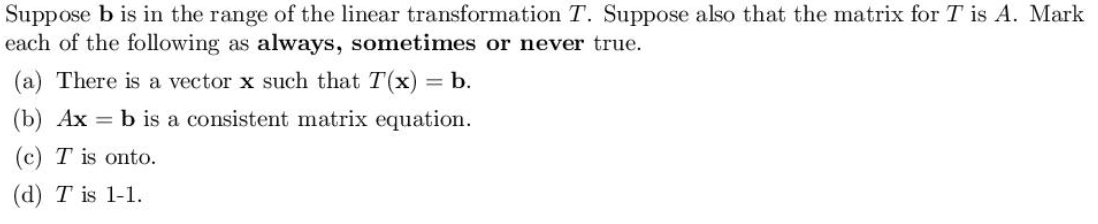 slow scroll
wrong on c and d
 marble lance
Why is c wrong?
slow scroll
for c, take T to be the 0 matrix. 0 is in the range of the 0 matrix, but that doesn't imply in any way that the zero matrix is onto
marble lance
slow scroll
for c, take T to be the 0 matrix. 0 is in the range of the 0 matrix, but that do...
The said sometimes for c
slow scroll
oh, oops
 waxen flume

one to one means there is a pivot in every column
not sure where to go after that lol
slow scroll
My understanding of the question is that A can be basically any matrix. Not every matrix has a pivot in every column of its rref, does it?
slow scroll
i agree with sometimes.
waxen flume
thanks
slow scroll
np
waxen flume

okay so
i think this might be a reflection over x-axis
b/c of the -e_2
im familiar a little with [cos, -sin; sin cos]
but im not sure how that plays a role in this question
slow scroll
a reflection over the x axis would look like T(e1) = e1, T(e2) = -e2
write down what T does to a vector (x,y) in the standard basis.
waxen flume
1 sec
I made a few random points
(1,4) => (-4,1)
(2,3) => (-3,2)
basically the x and y get flipped
but the x becomes negative
how do i describe this geometrically?
slow scroll
what does this transformation do to (1,0) and (0,1)? See if that helps at all
slow scroll
ye, which direction?
waxen flume
counterclockwise
slow scroll
why?
slow scroll
well i disagree 
waxen flume
why?
 fickle citrus
Rate my hint
slow scroll
take (1,0) -> (0, -1). maybe draw it out
fickle citrus
In case it isn't clear, my $g$ isn't the same as your $T$
stoic pythonBOT
ShatteredSunlight
fickle citrus
waxen flume
counterclockwise
To be super clear, my $g$ would be the answer to this
stoic pythonBOT
ShatteredSunlight
fickle citrus
If it's too clear then maybe I shouldn't give this hint 
fickle citrus
If you're saying your T is counterclockwise, then I, like rider, disagree
Maybe my hint was confusing after all
slow scroll
i think it maybe kinda was  . the map shattered posted is a counterclockwise rotation, but its a different map than what you have vici
fickle citrus
That's....how the map was defined?
slow scroll
the transformation was T(e1) = -e2, T(e2) = e1, right?
slow scroll
yeah, exactly. i.e. T(1,0) = (0, -1), T(0,1) = (1,0).
(1,0) gets rotated 90 degrees clockwise around the origin and (0,1) gets rotated 90 degrees clockwise around the origin
slow scroll
e1 = (1,0), e2 = (0,1), the standard basis vectors
for example, when you know what T does to e1, and e2, you can write a matrix for T : $\begin{bmatrix} 0&1\ -1&0 \end{bmatrix} = [T(e_1) \quad T(e_2)]$
stoic pythonBOT
kxrider
slow scroll
and you can write things like $(a,b) = a\mathbf{e_1} + b\mathbf{e_2}$.
stoic pythonBOT
kxrider
slow scroll
but um, anyway, do you see why T(e1) = -e2, T(e2) = e1 is the same as saying T(1,0) = (0, -1), T(0,1) = (1,0)?
marble lance
Your basis vectors from the original space might not be in the subspace.
dusky epoch
$v = a_1v_1,..., a_nv_n$?
stoic pythonBOT
Ann
dusky epoch
suppose for the sake of contradiction that W fails to have a finite spanning list
...wait
i dont know where i was going with this
damn you axler
for every linearly independent list of vectors w_1, w_2, ..., w_n in W, there exists a vector w_{n+1} in W that is not in their span
is axler non-sadist enough to allow us to use induction
to say that this implies we can construct a sequence of lists of ever-growing length, each one linearly independent
and then look at the first one that has more vectors in it than the dimension of V
pure tangle
can someone please help me fuund where I'm making a mistake with this question
it wants me to find the original matrix based off the solution and a column
to solve for column 2, I used the point (?) part of the solution and did [-1,2,0] + 2 C2 = [-1,2,0]
I got [1,1,2]
for c3 I looked at the null space and used 2c1 + c2 + c3 = 0
and got [5,-1,6]
and finally i used the t parameter equal to 0 and got [7, -2, 8]
but when I row reduce those columns with the given solution d I dont get the same equation
pure tangle
<@&286206848099549185>
 desert rapids
It seems that you went wrong for working out c_3
A better way would be to again utilize the solution set. You can simply set the t equal to zero and s equal to 1, and get the particular solution $x = \begin{bmatrix} 3 \ 3 \ 1 \ 0 \end{bmatrix}$.
stoic pythonBOT
LifeSource
desert rapids
Then, (you got $c_2$ right), we have that $3 \begin{bmatrix} -3 \ 0 \ -4 \end{bmatrix} + 3 \begin{bmatrix} 1 \ 1 \ 2 \end{bmatrix} + c_3 = \begin{bmatrix} -1 \ 2 \ 0 \end{bmatrix}$.
stoic pythonBOT
LifeSource
desert rapids
Then it is easy to solve for $c_3$
stoic pythonBOT
LifeSource
 acoustic path
Hey i have a small question. We know that the range of a linear map is surjective if it equals the co-domain, doesnt that mean the range also holds 0 cuz the co-domain must contain the 0 vector to be vector space?
What im trying to say is that the range should map vectors to 0 too. But then its the null space not the range
desert rapids
For it to be a vector space then it has to contain the identity element
Correct
Also note that a linear map by definition preserves the origin
acoustic path
Yeah i thought about it some more i get it now
desert rapids
acoustic path
Yeah i thought about it some more i get it now
Good!
@pure tangle Did you get it?
pure tangle
@desert rapids thanks so much for the response. Sorry let me take a second to look over what you said
@desert rapids thank you so much so your solution makes perfect sense, do you know what was wrong with my solution for c3? I looked at the null for s = 1 and t = 0 and solved for (2,1,1,0) = 0and thats where I differed from you
tawdry bramble
What is the column space of any 3x3 non-singular matrix?
pure tangle
@desert rapids when I use your method for c3 I get the same answer I did with my solution
 strange crystal
im not crazy for realizing that solving a constant coefficient homogenous linear differential equation is just solving for the eigenvalues right?
dont remember that too greatly from when i took linalg but it seems really familiar
 lone tide
whats the best website to learn math
other than Khan Academy
i mean i said website
fatwa kya hai?
mai pakistani houn
ah
magic light
If I have a matrix A
do the matrices
A^TA and AA^T have the same determinant?
it should be that way because B = (A^TA)^T = A^TA so Det(B-xI) = Det(B^T-xI)
 steel plover
In general, det(AB) = det(A)det(B) = det(B)det(A) = det(BA)
magic light
sorry I meant the same eigenvalues
because I have a matrix where it doesn't work and I'm wondering if I am misunderstanding it
steel plover
Can you share your example?
magic light
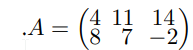
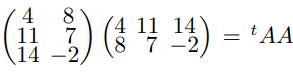
that's A^TA(idk why the professor writes it like that)
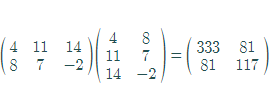
that's AA^T
their eigenvalues aren't equal hmm

that's the answer
to A^TA
steel plover
Ah yes, there's a mistake in your argument:
(A^TA)^T = A^TA
And in this case, it is not the same as A A^T
Since in particular, those two matrices have different sizes
 spiral star
eigenvalues are the same, yea
steel plover
Yeah, I'm just talking nonsense.
Sorry I'm just too tired tonight to actually do maths
 weak glade
Hi! Can I prove that a set îs a direct summand without a direct complement? I have this problem
Firstly, i think i need to prove that A is a subspace of R^2 but then? My text books if A and B are two subspaces of vector space V and if A+B(direct sum) = V and A intersected with B={0} then A and B are called direct summands
Can I assume that if a set is a subspace then it will definitely exist another subspace such that their direct sum Will be the vector space and intersection the null space?
 sick zodiac
Is anyone smart at Linear Algebra online that could help me out understanding some prompts?
steel plover
weak glade
Can I assume that if a set is a subspace then it will definitely exist another s...
It is true in finite dimension. In infinite dimension you need the axiom of choice to prove it.
Here I believe that they just want you to give the direct complement of A
weak glade
I work only in finite dimentions, so i don't need to prove it?
I was a bit confused because it says 'if so'
steel plover
weak glade
I work only in finite dimentions, so i don't need to prove it?
Well, it is a fact, but if it hasn't been proved in class yet, you probably would need to prove it in order to be allowed to use it.
Also, they say "if so" in order not to hint at what is the answer.
weak glade
Ok. Thank you! It hasn't been proved in class and it won't be. How could i prove it? I have no idea
steel plover
Maybe you know of a theorem that says that if $(a_1,...,a_k)$ is a free family of $\mathbb{R}^n$, then there exists vectors $a_{k+1},...,a_{n}$ such that $(a_1,...,a_n)$ is a basis of $\mathbb{R}^n$ ?
stoic pythonBOT
Dagnyr
nocturne jewel
I asked this the other day and still confused on how to go about it:
Let S and T be linear operators on the finite-dimensional vector space V. Show that ST is invertible iff both S and T are
I can do the reverse direction pretty easily, since you just show the ker(ST) = {0} by considering ST(v)=0, but cant see where to start on the forward direction
wintry steppe
as i said
you need to use finite-dimensionality in some way, since the forward direction is false in infinite-dimensional spaces
what are some tools that finite-dimensionality gives you? rank-nullity, choosing a basis, etc.
nocturne jewel
ik the image of ST is V and kernel is {0}
But I dont see how dim(V) = n (for example) would help to show that S and T are
Wait, probably wrong but:
If dim(V) = n, then dim(Im(ST)) = n
but dim(Im(ST)) <= min{dim(Im(S)),dim(Im(T))}
but dim(Im(S)) and dim(Im(T)) cannot be bigger than n
@wintry steppe would that work / at all right? lol
wintry steppe
nice
nocturne jewel
YAY
wintry steppe
so they're both onto. why does that imply they're also one-to-one?
nocturne jewel
what's onto
nocturne jewel
isnt showing surjective or injective sufficient for finite dimensional?
wintry steppe
for operators between spaces of the same finite dimension, yeah
i just wanted to make sure you knew that lol
nocturne jewel
yeah I was digging through my notes cause I always forget which page characterization of invertible operators is written on
and my argument already holds that dim(Im(S))=dim(Im(T)) since if they didnt the min function wouldnt return n
 idle bloom
anyone know how to do this? i have no idea
graceful vortex
Draw two random half-spaces. Is the union convex ? In what position do they have to be for the union to be convex ?
wintry steppe
could i have help with this
im so confused by how would you do this
<@&286206848099549185>
lavish jewel
what's confusing you
wintry steppe
i dont get how I am suppoused to know if its a vector, scalar or meaningless
you dont solve for anything?
@lavish jewel
 digital bough
wintry steppe
digital bough
wintry steppe
Well begin with the first one. Will a cross product always yield a vector?
wintry steppe
yes
digital bough
And will addition of vectors always yield a vector (kernel being a vector aswell)?
lavish jewel
there you go, then
wintry steppe
so this is a vector
lavish jewel
yep
lavish jewel
yyes
wintry steppe
thats a vector
wintry steppe
its also a vector
so its just asking for the cross product of vector a with the cross product of vector BC
so its a vector
overall
right
lavish jewel
yep
wintry steppe
one last question cause this is my last homework question for the day
for this
i got the cross product to be (20, -24, 19)
right
i dont get what perpendicular means
in this case
lavish jewel
if you draw them in 3D space, they form 90° angles to each other
wintry steppe
when you cross 2 vectors you get a perpendicular vector to those 2 vectors you crossed
(20, -24, 19) x (x, y, z) = 0
right
lavish jewel
what's that
wintry steppe
isnt that what i have to do?
lavish jewel
,w cross product of {-5, -1, 4} and {-1,-4,-4}
digital bough
You can use the dot product using a system of equations but they want you to use cross product
stoic pythonBOT


 lavish jewel
you were already done
wintry steppe
this vector is orthogonal to (-5,-1,4) and (-1,-4,-4)
<20, -24, 19>
u already did it
wait what?
how
im confused
it says use cross product and you did the cross product
lavish jewel
that is the definition of the cross product
lavish jewel
a = b x c yields a vector a that is orthogonal to both b and c
wintry steppe
so the cross product means the perpendicular vector of two vectors
lavish jewel
you can test if you want to convince yourself. NOW you can use a dot b = 0 and a dot c = 0
wintry steppe
so if you <20, -24, 19> dot <-5,-1,4> it should = 0
,w <20, -24, 19> dot <-5,-1,4>
stoic pythonBOT

 Requested by Moonlight ⌬ ∰#9250
lavish jewel
Requested by Moonlight ⌬ ∰#9250
lavish jewel
yep
wintry steppe
whenever you cross 2 vectors the vector you get is always perpendicular to the original 2 vectors
oh im big dumb i feel stupid now for asking this question lmao
,w <12,9> dot <13,14>
stoic pythonBOT
 Requested by Moonlight ⌬ ∰#9250
digital bough
Requested by Moonlight ⌬ ∰#9250
digital bough
And the magnitude of that vector that isn’t in the plane represent the area of a parallelogram
wintry steppe
ah okok that makes alot of senese thank you for the help guys @digital bough @lavish jewel
lavish jewel
all good
 meager tinsel
Alright so suppose I have a a_1x_1 + a_2x_2 + .. +a_nx_n = 0, a_i is integer
so this gives a n-1 dimensional int lattice
how do I find its basis?
Like I can find something, i.e.
(-a_2/gcd(a_1,a_2), a_1/gcd(a_1,a_2), 0, ...0)- (same for all other pairs with 1
but I m nit sure if this is actually the lattice and not just sublattice
<@&286206848099549185>
sorry for bothering since its already in the channel(
desert rapids
pure tangle
<@!298621089188413450> when I use your method for c3 I get the same answer I did...
Hm. Your calculations must be wrong because the method is clearly valid.
I didn’t go through the calculations myself
pure tangle
@desert rapids my answer was right. I was misinterpreting the final answer because it's a plane formula that's equivilant, but different, from the original equation
For part c can I just do something like a = alpha1 + alpha2 ....
b = alpha2 - alpaha3 ... or does the question imply a different type of equation?
so my attempt at equation was the red
 dense gorge
can anyone hep me with a question?
meager tinsel
Wow I actually cannot find anything about how to solve integer homogeneous linear equation
Is that like...less trivial than what I thought it is?
limber sierra
nah but it falls more under the purview of number theory than linear algebra
@meager tinsel
youre asking how to solve a degree 1 diophantine equation
such systems are mostly solved by the chinese remainder theorem
meager tinsel
Yes I'm asking exactly that and I know CRT
Lemme check this part
I think I looked through it but maybe I didn't see
@limber sierra okay yes it describes what I want but I have some trouble thinking this late
Can you sort of push me in the direction of
What this turns into when m=1
As in my case
 sonic osprey
what method are you talking about
sonic osprey
Uh
Okay the method in that article is pretty complicated because it relies on smith normal form which is a kind of generalization of euclidean row reduction
meager tinsel
Yes
It's hard to imagine without a paper
Which I don't have atm
But if m=1
Like in my case
I expect it to be feasible?
sonic osprey
since the integers are a PID like described. You can follow the process in the smith normal form article to do that
I mean, if m = 1 in your case, its much easier to just apply bezout's identity
sonic osprey
read the examples in the bezout article and euclidean algorithm articles
pure tangle
sorry i know this is annoying but can someone please help with my previous question after this person? That's the last problem I have to finish before turning something in that's due soon
meager tinsel
@sonic osprey
I can see how to solve it for d /= 0
But I knew that already
I.e. when it's not homogeneous
But I cannot find anything about how to solve the homogeneous part
sonic osprey
Uh what?
If I'm understanding you correctly
you can solve the case when d = 0 in exactly the same way?
You have the trivial solution of all zeroes
meager tinsel
I think it will yield 0 0 0 ... solution
meager tinsel
Yes for 2 variables
But what is the formula for n variables
(Which is the question I was asking the whole time)
Because the formula for n variables is a basis of lattice in question basically
sonic osprey
It's the same
meager tinsel
Wdym the same
sonic osprey
You can just use the fact that gcd(a,b,c) = gcd(a, gcd(b,c)) for example
to do bezout's/euclidean algorithm for n variables
meager tinsel
...
Okay maybe I'm extremely stupid but can you help me out and write that formula for say 3 variables
sonic osprey
what formula?
sonic osprey
So the idea is that you can rewrite ax + by + cz = d as
sonic osprey
ax + g((b/g)y + (c/g)z) = d if we let g = gcd(b,c). So you can introduce a dummy variable say k and let k = (b/g)y + (c/g)z so your equation becomes ax + gk = d
Now it's just two variables and you know how to solve that
meager tinsel
Okay and you are saying that will work with d=0 just fine
sonic osprey
the d = 0 case isn't special
meager tinsel
Well I don't want 000 solution
sonic osprey
Well you can use the picture I sent to find all the solutions by using the (0,0,0) solution
meager tinsel
I don't see how exactly to extract 2 dimensions from this
meager tinsel
sonic osprey
ax + g((b/g)y + (c/g)z) = d if we let g = gcd(b,c). So you can introduce a dummy...
This
Because the solutions space is supposedly 2 dimensional
sonic osprey
uh yeah
like in my picture, the solution space is 1 dimensional since you have a single arbitrary integer k
meager tinsel
Lemme try it
So I will have basically
ax + g((b/g)y + (c/g)z) = 0
And for that I ll have to do
l = gcd (a, g)
So I'll have
x = -g/l*coef
And
(b/g)y + (c/g)z) = a/l*coef
Which I then solve.....?
I guess
I'm unsure
I did an edit
sonic osprey
Yeah thats the right idea
meager tinsel
But how do I solve this
(b/g)y + (c/g)z) = a/l*coef
For every coef
Or whatever
Is there a way explicitly write 2 vectors?
Like I could do with ax+by=0
sonic osprey
No, you can only explicitly write the vectors in that case because you already start with the (0,0) solution. Otherwise, like the picture states, you need to start with some solution for (y,z) to be able to write down the vectors
meager tinsel
Okay that makes sense
sonic osprey
but if you find a solution, then you can write down the vectors
meager tinsel
I guess the idea here is that I need to solve this
(b/g)y + (c/g)z) = a/l
And than multiply solutions by coef
sonic osprey
in this case, gcd(b/g, c/g) = 1 so you can find a single solution to (b/g)y + (c/g)z = 1 and then have a solution for all (b/g)y + (c/g)z = k
meager tinsel
Oh hm
Yea you right they are already coprime
That's good
And so say I will get like
Cy0 + pn,C z0 -qn
Solution
For this
(After multiplying by whatever is needed)
And then I'll have this * some other coefficient
And something for x
It does feel like I'll get some product of parameters somewhere instead of liner sum
But maybe not..?
I ll think about it
zealous junco
I dont understand 2 parts of this proof
first is why the 1st line becomes second line
pure tangle
<@&286206848099549185>
zealous junco
oh yea this makes sense thx
other part is
how did they get the last line from 2nd last line
oh wait i see it
some linearity stuff
stoic pythonBOT
slimvesus
zealous junco
yep, thanks!
 pseudo thicket
can someone explain this part?
wintry steppe
it's just checking that the space of polynomials of degree at most n form a vector space
with the "obvious" operations
pseudo thicket
what does it mean by p(t) = a0 != 0,degree of p?
wintry steppe
if p is a nonzero constant then you say it has degree 0
pseudo thicket
wait so it's just saying purely p(t) is just = a0
not p(t) = a0+a1t+a2t^t... ?
wintry steppe
IF it so happens that a polynomial is a nonzero constant
the thing on the right is defining degree
pseudo thicket
then simply p(t) = 4 the degree is 0
wintry steppe
yes
pseudo thicket
is that what the slide is conveying?
wintry steppe
that's what the definition of degree is, yes
pseudo thicket
thank you so much
wintry steppe

pseudo thicket
Is the difference between Vector space and subspace
for example Vector Space it is 'larger' than the subspace.. well because subspace is a sub of the larger vector space?
wintry steppe
"subspace" implies there's a larger vector space in which it lives
wintry steppe
right
since R^2 isn't even a subset of R^3
any subset of a vector space that's also a vector space with the same operations and zero vector is called a subspace.
pseudo thicket
Okay got it
So vector space has the 3 properties:
0 vector
scalar multiplication
and two vectors u and v added lives in the space
and a subset of a vector space that also has these 3 properties is called a subspace
is that right?
wintry steppe
a vector space also places some restrictions on those operations of scalar multiplication and vector addition, but largely yes
(e.g. associativity, commutativity, distributivity)
pseudo thicket
got it thank you guys
Then R^3 is a subspace and a vector space itself, in this case?
digital bough
wintry steppe
since R^2 isn't even a subset of R^3
Holy shit I only just realised this now. Why in gods name did I think (1,0) is the same as (1,0,0)
pseudo thicket
R3 is a vector space
if we have 2 vectors in R3, the span of these 2 linearly independent vectors is a plane
the plane is a 2D, it is a subspace
is this right so far?
but doesn't R2 vectors create a plane too?
so why is R2 not a subspace of R3?
Is it because we cannot set the "level" of the plane created by R2 in the Z axis?
i am trying to get a geomteric understanding
since technically R3 has a "copy" of R2 with the z being 0
pseudo thicket
pseudo thicket
Is it because we cannot set the "level" of the plane created by R2 in the Z axis...
does this even make sense lol
2d plane is just 2d plane, but we cannot specify which level the plane is at (z axis)
lets say this is a R2
this is r3
the yellow plane isn't "flat" like the blue one.. we can choose the "angle" of the plane
hence why R2 isn't a subspace of r3, but span of 2 LI of R3 is
Thank you
this is so confusing
digital bough
Don’t worry I just learned that now and I’ve been doing LA since 20 january lol. The mistake I guess was that I kept thinking of sub spaces of r3 and r^2 geometrically although I never thought of r2 being a subspace to r3 but for some reason I thought it was a subset. All exercises regarding subspaces all just stated “this is a subset of V, prove it is a subspace” etc, i never actually encountered an ex asking if V is subset of V2.
weak glade
How can I find the Dimension and a base of this supspace? For T i can find, but i don't know how to work with S
lavish jewel
can you recognize the definition that is given there?
i'll rewrite it for you to see if that helps
$S = {v \in \mathbb{R}^3 , \vert , \langle v, n \rangle = 0 }$
stoic pythonBOT
Edd
weak glade
And how can I write the vectors? I havent worked with this form yet
lavish jewel
they're just generic vectors in R3
this one has infinite solutions
first think about the dimension
do you recognize the definition you were given?
$\langle v, n \rangle = 0 = x_1 - x_2 + 2x_3$
stoic pythonBOT
Edd
weak glade
do you recognize the definition you were given?
@lavish jewel i dont understand what is n
lavish jewel
well, ignore that and look only at the definition you were given. what is that the equation for?
weak glade
So the Dimension is 3 and a base can be the canonic base?
weak glade
Hmmm
lavish jewel
do you know the definition of a plane?
lavish jewel
yes
weak glade
And how can I find a base?
I need two liniar independent vectors but i dont know how to find them
lavish jewel
there are infinitely many, but my thinking is that you can pick any one vector that satisfies the equation
literally any
and then take the cross product of the normal vector and this vector you just made up
if v = (x1,x2,x3), the normal vector should be evident in what they gave you, which is why i gave you the definition of the plane as a dot product
weak glade
The normal vector is (1,-1,2)
lavish jewel
mhm
now make up any vector that is orthogonal to that, which would mean that vector is on the plane
-1, 1, 0 could work, for instance
weak glade
Thanks
 urban egret
Hi I have a question trying to conceptually understand transformations. Why does the transformation matrix made from a basis transform onto the standard basis? and not from the standard basis to the basis?
 mossy lodge
Check briefly that $\alpha(v) = \lambda v$ is equivalent to $( \alpha - \lambda \cdot I )(v) = 0$.
stoic pythonBOT
PandaMan-AMB
mossy lodge
There we go, I dont understand this notation, if the mapping is defined by \alpha, then how can you make a mapping for (\alpha - \lambda * I)
This is new to me
dusky epoch
if you have two maps f and g then their sum f+g is the map which sends x to f(x)+g(x)
pointwise addition, as you may call it
mossy lodge
Ah ok, but sadly I dont have two maps, The map is F x V -> V
dusky epoch
mossy lodge
Ah ok, but sadly I dont have two maps, The map is F x V -> V
??
what are you talking about
mossy lodge
I only have one map
mossy lodge
I dont have a map for lambda
dusky epoch
I refers to the identity map
accordingly, λI is the map which scales every input by λ
mossy lodge
Oh ok, I get it now