#linear-algebra
2 messages · Page 150 of 1
 round coral
@errant cedar just take a null space, and extend its basis in two different ways. What's that hard about it?
or you can take an example where the null space is 0. there are so many such linear maps that you can make with the given condition. Meditate on the nature of linear maps
 wintry steppe
round coral
or you can take an example where the null space is 0. there are so many such lin...
wintry steppe
round coral
or you can take an example where the null space is 0. there are so many such lin...
not possible. if T has trivial kernel, then by rank-nullity, rank T = 5, impossible since rank T is at most 2
round coral
that's right. I made a mistake
wintry steppe
happens to us all 
round coral
how is 1/x^2 a polynomial, you got that wrong
wintry steppe
 steady fiber
why did you sully me ttera
steady fiber
why did you sully me ttera

 errant cedar
round coral
<@!321201294440136710> just take a null space, and extend its basis in two diffe...
errant cedar
round coral
<@!321201294440136710> just take a null space, and extend its basis in two diffe...
Its not looks hard but i just started to learn and dont know exactly how to do it
round coral
that I said wrong, don't think upon it.
wintry steppe
if it's wrong then think upon why it's wrong 
round coral
yeah, read the previous message too
wintry steppe
you could try doing something that effectively ignores the last three coordinates of F^5 and gives you something nice on the first two
@errant cedar
then the kernels of your transformations could just be {(0,0,x,y,z) in F^5 : x,y,z in F}
just some food for thought
one example || K(x,y,z,w,t) = (x,y) and L(x,y,z,w,t) = (y,x) ||
this is usually how things go wrong when mapping from a higher dimensional space onto a lower dimensional one

errant cedar
i did not know that i can ignore
wintry steppe
well of course you don't have to
but it's nice to have simpler examples
i could have taken it to be projection onto the last two coordinates, for example
 hollow finch
wintry steppe
one example || K(x,y,z,w,t) = (x,y) and L(x,y,z,w,t) = (y,x) ||
hollow finch
wintry steppe
one example || K(x,y,z,w,t) = (x,y) and L(x,y,z,w,t) = (y,x) ||
making good choices like these is how you can make these kind of exercises easier to digest/understand
errant cedar
wintry steppe
one example || K(x,y,z,w,t) = (x,y) and L(x,y,z,w,t) = (y,x) ||
than here is null(K) = null(L) and null(K) = (0,0)
wintry steppe
hollow finch
making good choices like these is how you can make these kind of exercises easie...
i don't know why i thought clicking on the spoiler text in the message preview would unspoil it
wintry steppe
errant cedar
than here is null(K) = null(L) and null(K) = (0,0)
no, that's not the correct kernel
you should be more explicit
let me make myself more explicit to help (previous message edited)
steady fiber
wintry steppe
i don't know why i thought clicking on the spoiler text in the message preview w...
I did the same

hollow finch
if a vector in F5 (x,y,z,w,t) is mapped by K to the zero vector 0 in F2 (which is (0,0)) then
K(x,y,z,w,t)=(0,0)
(x,y)=(0,0)
so for an element in F5 to be in the kernel then x=0 and y=0
to find a kernel you can always set the entries of the transform of a generic vector to zero
steady fiber
wintry steppe
6 pages of complex analysis <:sadcat:547124024585486359>
lol, is it all residue calculations
wintry steppe
ill post it in #real-complex-analysis
hollow finch
if its a more complex transformation then you may have to set up a system of equations to solve for the kernel
hollow finch
wintry steppe
6 pages of complex analysis <:sadcat:547124024585486359>
i wish i could do 7 pages of complex analysis instead of being 7 labs behind in my physics lab 
wintry steppe
complex analysis is just busywork that i have to get done so i can get to the classes of mine that are actually interesting
at least, that's how it's been the past while
errant cedar
hollow finch
to find a kernel you can always set the entries of the transform of a generic ve...
can you give an example
hollow finch
K(x,y,z,w,t)=(0,0)
(x,y)=(0,0)
so for an element in F5 to be in the kernel then x=0 and y=0
errant cedar
K(x,y,z,w,t) = (x-y+z-w+t,0) L(x,y,z,w,t) = (-x+y-z+w+t,0)
when i say like tihs
is null(K) equal to null(L)
?
wintry steppe
read the pinned message, this is not linear algebra
wintry steppe
My apologies
 copper stratus
What is the process for solving this?
<@&286206848099549185>
A ping would be nice if someone can help 👍
 bitter hornet
I don't know how to find the linear combination for a single number when three equations are involved but basically I have to solve:
0 = a(2-x+x^2) + b(2-2x+x^2) +c(-3+3x-2x^2)
1 = a(2-x+x^2) + b(2-2x+x^2) +c(-3+3x-2x^2)
2x = a(2-x+x^2) + b(2-2x+x^2) +c(-3+3x-2x^2)
3x^2 = a(2-x+x^2) + b(2-2x+x^2) +c(-3+3x-2x^2)
I got the first two by checking and guessing but there has to be a better way to do this right?
wintry steppe
it'd make your life a lot easier to write whatever that is as a matrix equation, for one
bitter hornet
This is what the problem actually looks like
But the process is essentially the same. I'm stuck finding a linear combination that involves three variables
Edit: I understand it now
errant cedar
Give two linear maps L_1, L_2: F ^ 2 → F ^ 2 such that L1 ◦ L2 not equel to L2 ◦ L1
Do you have an idea about it
wintry steppe
think of it in terms of matrix multiplication
after that think of some simple examples, matrices with 1s and 0s
hollow finch
if that vector is a steady state vector then it is an eigenvector with eigenvalue 1
assuming they want the columns to add up to one then there is something else that we know
A^T (1,1)=(1,1) so (1,1) is an eigenvector of A^T with eigenvalue 1 as well
notice the fact that the columns sum to 1 implies (1,-1) is an eigenvector of A
$\begin{bmatrix}a&b\1-a&1-b\end{bmatrix}\begin{bmatrix}1\-1\end{bmatrix}=\begin{bmatrix}a-b\b-a\end{bmatrix}$
 stoic pythonBOT
nix
hollow finch
so we know two eigenvectors of a 2x2 matrix
we can then do a diagonalization
$A=\begin{bmatrix}\frac{15}{29}&1\\frac{14}{29}&-1\end{bmatrix}\begin{bmatrix}1&0\0&\lambda_2\end{bmatrix}\begin{bmatrix}\frac{15}{29}&1\\frac{14}{29}&-1\end{bmatrix}^{-1}$
stoic pythonBOT
nix
hollow finch
then you just have to pick some lambda2 with absolute value less than 1.
@copper stratus thats how id do it anyway
copper stratus
@hollow finch Is this for me?
hollow finch
yes
copper stratus
Ah, I was confused for a min'
hollow finch
sorry i thought jh was trying to help you
hollow finch
you could also do
$A=\begin{bmatrix}15&-1\14&1\end{bmatrix}\begin{bmatrix}1&0\0&\lambda_2\end{bmatrix}\begin{bmatrix}15&-1\14&1\end{bmatrix}^{-1}$
stoic pythonBOT
nix
hollow finch
that may make the calculations slightly easier but it doesnt make a big difference
some other neat things to note as long as |lambda2|<1:
the bigger lambda2 is, the slower the system will converge to the steady state vector
if lambda2 is positive then the sequence will steadily approach the steady state vector
if lambda2 is negative then itll bounce around the steady state vector like an alternating series
just in case you want to test out how the matrix looks for different values/situations
its definitely the kind of thing i like to do
hollow finch
errant cedar
Give two linear maps L_1, L_2: F ^ 2 → F ^ 2 such that L1 ◦ L2 not equel to L2...
its far harder to find two linear maps where L1 ◦ L2=L2 ◦ L1. if you just make them up randomly the chances are high that they will satisfy that.
wintry steppe
far harder
just take L1 = L2
 willow marten
willow marten
willow marten
<@&286206848099549185>
 odd kite
if $y_i=\sum_j A_{ij}x_j$ then $\frac{\partial y_i}{\partial x_j} = A_{ij}$
stoic pythonBOT
Timon
odd kite
all the terms on the rhs for $\bar{h} =\dots$ are equivalent to one matrix multiplying $\bar {x}$
stoic pythonBOT
Timon
willow marten
ok, so i need to move for each value and derive?, but what does having both the uper and under index mean in -W
odd kite
it means the matrix squared that is $W^2_2 = W_2W_2$
stoic pythonBOT
Timon
 acoustic path
dimension=rank+nullity
 bleak ginkgo
Anyone up to help me finding a linear transformation from this:
-R3 to R2
-T(1, −1, 1) = (1, 0)
-T(1, 1, 1) = (0, 1)
willow marten
ah ok, thank you
hollow finch
bleak ginkgo
Anyone up to help me finding a linear transformation from this:
-R3 to R2
-T(1,...
Try turning it into a matrix equation
 shrewd wharf
actually I am supposed to use the fact that (A^2+B^2) = (A+iB)(A-iB) to proceed
as I am unaware of diagonalization (I am in HS)
hollow finch
shrewd wharf
actually I am supposed to use the fact that (A^2+B^2) = (A+iB)(A-iB) to proceed
...
Would you mind posting a picture of the question
shrewd wharf
 half ice
Consider (A + B)², which has a positive determinant
 native rampart
shrewd wharf
actually I am supposed to use the fact that (A^2+B^2) = (A+iB)(A-iB) to proceed
...
native rampart
shrewd wharf
actually I am supposed to use the fact that (A^2+B^2) = (A+iB)(A-iB) to proceed
...
I don't think that's valid considering we are talking about Mn(R) and not Mn(C)
shrewd wharf
why it's not valid
native rampart
det's domain is Mn(R)
half ice
It's possible to get going, but will need more work.
Plus, probably not the easiest way to go about it
native rampart
det is a function from Mn(R) to R.
shrewd wharf
half ice
Huh. I'll have to think on that
shrewd wharf
okay thx
btw I think since n=2, using the fact that det(A+B) + det(A-B) = 2(det(A) + det(B)) might be useful
native rampart
That's not true
shrewd wharf
for second order square matrices?
shrewd wharf
yea generally it's not true, but it is true for second order square matrices
half ice
Oh haha, yeah M2(R) may be making all the difference here
As the first question asks about n×n matricies
 dusky epoch
det(A+iB) and det(A-iB) are conjugates
dusky epoch
round coral
I am very confused on how to prove this if I have two sets X and Y and a field F, then I can't able to make an isomorphism between F^(X ⊔ Y ) and F^X ⊕ F^Y . I am trying to show they are isomorphic
 brisk sparrow
can someone explain how this transformation matrix was made? https://i.imgur.com/3zHQYcX.png
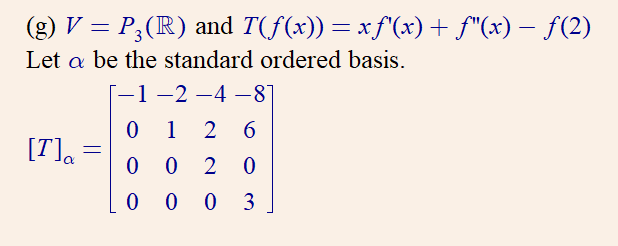 dusky epoch
P_3(R) comes with the basis {1, x, x^2, x^3} presumably
so they just, yknow, constructed the transformation matrix as you normally would
applying the transformation to each basis vector and writing those as the cols
 vocal isle
does anyone know how to find a solution to the following nonlinear matrix equation
$$[A]X^2 + [B]X + f = 0$$
Where $[A]$ and $[B]$ are 2x2 constant matrices and $X = [x_1, x_2]$ and $X^2 = [x_1^2, x_2^2]$. Also, $f$ is a 2x1 vector. I could do this easily using simultaneous equations, but I wanted to know if there was a way to solve this using matrices.
stoic pythonBOT
The Smelly Cherry
 timber magnet
any thoughts?
 simple hornet
ah just a question about notation
if we denote a function f : S to F where F is a field, when we talk about f(x) is that an element of the field?
 marble lance
Yes
simple hornet
And when we just talk about f, that's a more abstract thing
that's a member of the set of functions from S to F, while f(x) is not
marble lance
Yes. f is the function, f(x) is the output of the function which comes from F
simple hornet
thank you
 dense wyvern
- Differentiate with respect to x: 2sin 2x cos 3x
can some help me with this
dense wyvern
then....
wintry steppe

 thorn lichen
is there such thing as a stochastic matrix that does not enable x_k to approach some steady state vector q?
theres a theorem stating every regular stochastic matrix must enable to this to be the case
but the inverse doesnt seem true, as the identity matrix appears to be an irregular stochastic matrix, but still has a steady state vector
in fact every vector is a steady state vector for the identity matrix
ooooo
nvm
i found one
for 2x2 for instance, r1: 0 1 r2: 1 0
would work
😈
 little frigate
Does anyone have some steps in order to find the neutral element for addition, addition being □ depending on the following conditions
Let V = (2,∞). For u and v that belongs in V [...] we can define the internal addition operation such as :
u □ v = uv - 2(u + v) + 6
i don't know how to manage to cancel u on both sides of the equation to just be left with v
little frigate
you're not talking to me hopefully aren't you o_o
native rampart
Yes,I am talking to you
native rampart
Also,This belongs in #proofs-and-logic
little frigate
?
uh... i forgot to mention but those are vector spaces..
ah im big dumb nvm nvm
 marsh veldt
anyone wanna join the VC and help me and my boi out with a basic ass linear algebra question
we struglging haha
 foggy nebula
hollow finch
foggy nebula
hollow finch
$\int_0^t e^{(t-u)A}\vec{v}(u), du=\int_0^t e^{uA}\vec{v}(t-u), du$
stoic pythonBOT
nix
hollow finch
is this a valid change of variables where A is a matrix?
or does the fact that A is a matrix make it wonky
wait is this a convolution? o.o
 fast stag
idk if I'm in the correct section but how do I solve this?
hollow finch
fast stag
idk if I'm in the correct section but how do I solve this?
That is not linear algebra
fast stag
@hollow finch what is this then?
hollow finch
fast stag
ok thank you
 rose coral
hollow finch
is this a valid change of variables where A is a matrix?
rose coral
hollow finch
is this a valid change of variables where A is a matrix?
I believe the change of variables is still valid. I think pretty much all properties of integrals generalize to these settings with vector spaces
 lime dust
Hey cud someone pls explain why only that option is right?
hollow finch
rose coral
I believe the change of variables is still valid. I think pretty much all proper...
Okay thank you :)
rose coral
No problem
rose coral
lime dust
Hey cud someone pls explain why only that option is right?
The explanation for b and d being incorrect is similar. Are you confused by one of those or a?
lime dust
I just don't get why a b and d are not valid :(
hollow finch
Yeah b and d only require a counterexample
Starting with b, can you think of a vector which is orthogonal to every vector in Rn?
lime dust
Not really no...
hollow finch
It's the one everyone forgets about
lime dust
0?
hollow finch
Yeah
lime dust
Ahh I thought 0 vectors are always diacarded
hollow finch
No you still have to invite the zero vector to the vector space party even if it's a buzzkill
lime dust
Oh kk that makes sense, n what about a then🤔
Cos if U is a subspace of Rn shouldn't U'contain everything else in Rn
 gray dust
a is false
in R^2 the orthogonal complement of the x axis is the y axis. their union clearly isn't R^2
lime dust
How though? 🤔
gray dust
you might've conflated union & sum of subspaces
hollow finch
Oh I see. But the span of the union would be Rn right?
lime dust
I haven't exactly learnt to sum subspaces😅
gray dust
sum of subspaces U & W is defined U+W:={u+w: u in U, w in W}
span of the union would be Rn
yes
lime dust
gray dust
in R^2 the orthogonal complement of the x axis is the y axis. their union clearl...
Ah ok, so what would be an example of a vector that lies in Rn but not in this union?
gray dust
(1,1)
lime dust
Ahhh so the in between regions are not covered
gray dust
visualize the union of the x & y axes as the fence between quadrants. there are many pts off the fence
lime dust
Riiight I think it's kinda complicated to think abt it for over 2 dimensions but alright I'll give it a think
Thanks so much both of you!
gray dust
you're welcome. also a nice exercise is to prove c is true
 acoustic zodiac
Can someone explain to me simply what a dual basis is? I don't really get it
wintry steppe
the kth dual basis element just specifies the kth coordinate of a given vector in the basis
that statement is very concisely summed up by what you'll often see written as $e^i(e_j) = \delta^i_j$, where the $\delta$ is the kronecker delta, the $e_j$'s your basis, and the $e^i$'s the dual basis
stoic pythonBOT
TTerra
acoustic zodiac
so for example the 3rd element of (1,1,1) in the canonical basis would be the third element, also a 1, in the dual basis?
wintry steppe
each dual basis element, where the dual basis is dual to the canonical basis (im assuming this is in R^3), will indeed send that to 1
in a few minutes i can type something that expands on the first thing i said
acoustic zodiac
thank you
stoic pythonBOT
TTerra
wintry steppe
i should point out two things
- these are really ordered bases, so if you tend to make the distinction, note that i really do mean ordered bases here (else, how would any of this make sense)
- using upper indices to denote dual space elements is a differential geometry thing, i don't know how common it is in LA books (also at this point i should have used upper indices on the coefficients of v too
 )
)
acoustic zodiac
wow thank you man
wintry steppe
that's a bit long but i hope it can clarify the definition a little
 mild igloo
the process for getting the eigenvalues of a 3x3 matrix is the same as a 2x2 right?
just gets more complicated because taking the determinant is harder?
wintry steppe
I have two (possibly infinite dimentional) linear maps T and S on some space H. I know that T = T* and S = S*, and I want to show that if <T(v), v> = <S(v), v> for all v in H, then T = S.
Since f is infinite dimentional I can't just plug in orthonormal basis vectors and show that the entries must be equal, unfortunately
 shut falcon
Bro I have no idea how to do this problem, I and some of my other classmates think it is not possible can anyone help?
stoic pythonBOT
A brief description and guide on how to use me was sent to your DMs!
Please use ,list to see a list of all my commands, and ,help cmd to get detailed help on a command!
Please give me something to evaluate.
See ,help calc for usage details.
 wintry sphinx
@shut falcon it is possible, but read the pinned message; this is not linear algebra
shut falcon
I know that i couldn't find any other chat.
steady fiber
this is not the chat though
wintry steppe
wintry steppe
I have two (possibly infinite dimentional) linear maps T and S on some space H. ...
maybe one way to get started is by re-writing the given condition as <Tv - Sv, v> = 0; i think that'd be fruitful
well it's not much
but i feel like you can do some funny cauchy-schwarz thing
wintry steppe
||especially since (x,y) \mapsto <(T-S)x, y> is an inner product sometimes (always?)||
steady fiber
complex has infected my brain
wintry steppe
hehe
schwarz has quite a few things in that field
schwarz lemma, schwarz reflection principle
wintry steppe
i'm thinking that ||if the thing i described is an inner product then |<(T-S)x, y>| \leq <(T-S)x, x><(T-S)y, y> = 0 so by whatever argument makes sure this is actually an inner product, i.e. nondegenerate, you get T = S||
just throwing ideas out there
wintry steppe
steady fiber
cauchy/schwarz/christoffel/reimann
i only know christoffel for christoffel symbols and i'm not sure anything can top those 
steady fiber
I love the schwarz-christoffel mappings
they're very cool
there's also the tensor named for him
I forget the other guy
oh lol, it's reimann
reimann-christoffel tensor
steady fiber
last row affects nothing
middle row is v2 = 0
top row gives that v1 = v3
and they set it to t
mild igloo
so were allowed to make v3=t because its all 0
yea I still cant apply that reasoning
dont get it
 nocturne jewel
v_3 is a free variable since the 3rd row is all 0's
so we let v_3 = t
then you have v_1 - v_3 = 0 from top row
so v_1 = t
and the only way 2nd row is true is if v_2 = 0
Thus the v vector is t[1,0,1]
mild igloo
alright
what math am I doing wrong here then?
every calc I give this matrix gives me diff eigen vectors
and my own math hasnt produced the right answer either
mild igloo
pls
 shrewd mortar
@mild igloo so if A(v) = -9v = -9(a, b, c), from the matrix we get
A(a, b, c) = (9c, -5b, 9a)
wintry steppe

Why is (x,x,y,y) + (x,x,x,y) = (x,x,y,z)?
what?
that's an addition of sets there
I know
it's absolutely not the case in general that (x,x,y,y) + (x,x,x,y) = (x,x,y,z), you should try proving that equality by showing each set is a subset of the other
Why did the third coordinate become a y instead of an x, for example?
well you can think of it like this: when you take any element of U, say (a,a,b,b), and any element of W, say (x,x,x,y), then when you add you get (a+x, a+x, b+x, b+y). the first two coordinates are the same, which is represented in set builder notation using the dummy variable x by writing the first two coordinates as the same. the third coordinate, represented in set builder notation using the dummy variable y, could be anything
these are all dummy variables
i strongly suggest writing out a proof as to why that equality of sets holds
so you can see that the x's, y's, z's are just placeholders
Ok. Would it be too much to ask for help writing that proof?
i can't help out with that right now, sorry
i really think you should try it yourself
generally it's a good idea to verify or think about the examples you come across, and get proficient at doing these "mini exercises"
hollow finch
well how do you find the jordan form of a matrix
round coral
@half forge I think the question is quite clear, do you know how to find the Jordan form
hollow finch
 half forge
can someone explain this problem too me
half forge
can someone explain this problem too me
im assuming your teacher gave a lecture on jordan forms if you are given that kind of homework problem
do you have notes?
hollow finch
have you looked at your textbook?
round coral
that's just matrices, you won't be able to understand the algorithm with that
to figure it out, you need to understand the theory behind it as well
that image looks more like a calculator!
hollow finch
the jordan form of a matrix is given in a block pattern based on how defective each eigenvalue is
theyre called jordan blocks
so lets start with the eigenvalues. theres only one of them so it wont take that long
whats the geometric and algebraic multiplicity
 tame mural
Is there such thing as a matrix for which repeated application permutes through the whole space?
wintry steppe
what do you mean by permutes through the whole space?
as in, you can reach any vector by applying the matrix a certain number of times to some vector?
or such that you can reach any matrix of the same size by taking powers?
both of those aren't possible, at least over the reals (uncountable spaces)
tame mural
like a matrix M when applied repeatedly to [1, 2, 3] gets you something like: [123] -> [231] -> [312] -> [321] -> [213] -> [231]
Which are all the permutations of [1, 2, 3]
I'm thinking it's not possible because 123 -> 321 is a different kind of matrix then 123 -> 231
So you always need two different matrices
round coral
I can see what you mean. For that you can define a vector space as a set X={1,2,3} on the field F . Then you can define isomorphism from F(X) to F(X)
there will be total 6 such matrices
wintry steppe
ah yes just take the 3 element field 
round coral
and these 6 matrices will form a group under matrix multiplication
round coral
@wintry steppe Am I saying wrong?
stoic pythonBOT
Kanishk
wintry steppe
i'm not quite sure what you mean by "on the field F" and by F(X)
but i'm liking this idea
@tame mural if you're comfortable with basic abstract algebra maybe you can try looking into connections between finite matrix groups and symmetric groups
i don't know much algebra though so i don't know if you can say anything significant
kanishk may be on to something though
native rampart
tame mural
like a matrix M when applied repeatedly to [1, 2, 3] gets you something like: [1...
For this case,M doesn't exist. As M is a permutation of cycle length 1,2 or 3,M^k(v) can cover a max of 3 vectors
If you can find integers $a_1,a_2...a_k$ such that $a_1+a_2+a_3...a_k=n$ and $lcm(a_1,a_2,...a_k)=n!$ you have your required matrix
stoic pythonBOT
DrunkenDrake
native rampart
S_n is not cyclic for n>2 so no(
(12) and
(13) are 2 different subgroups of order 2 for n>=3.
n=1 and n=2 are trivially cyclic)
tame mural
I see, thanks
So the number of "generators" I need = the number of matrices
and the symmetric group isn't 1-generated
sad
 dreamy iron

What else do I know about the basis vectors???
......
i guess i can conclude that there also live inside V.:
 crystal oracle
Every basis of null(T) can be extended to a basis of V
dreamy iron
Okay. Yeah. I was hoping to get there....
I just don’t know how to do that.
i know the basis of null(T) is linearly INDEPENDENT in V?
That makes intuitive sense....but I don’t know if I can prove it directly....no matter.
How do I know I can start adding vectors to the list of basis vectors?
Like, okay, how?
Is this by like a set theory axiom where im allowed to form set unions?
crystal oracle
@dreamy iron If we are talking only about finite dimensional vector spaces, then look here
dreamy iron
That feels right: I take a new vector in V and that that as a singleton set and Union it to the basis set.
LOL, Im in AXLER TOO
crystal oracle
dreamy iron
Is induction in the under belly of all of these proofs?
(That’s the thing about Axler, he does induction but doesn’t declare that out right.)
crystal oracle
I think the proof of 2.31 uses induction. Namely, I think you can prove it by proving by induciton that for all j, there exists a subset of {v_1, ..., v_j} which is a basis of span({v_1, ..., v_j}).
 cosmic pawn
 brittle orchid
Hi, could someone help me understand a bit of notation?
The Er, Dr, Dc
Please @ me if responding, thank you
wintry steppe
@brittle orchid just from looking at the picture it looks like it's describing the row or column operations going on
for example
in the first line try comparing the row operation going on with the thing under the arrow
the notation is kind of pointless, it just seems confusing and cluttering
brittle orchid
I understand that the notation may not be ideal but I believe that we are required to present our answers in a particular way for university therefore I think I have to understand what this means
wintry steppe
like maybe the letter is the type of elementary operation, the subscript whether it's a row or column operations, and the arguments determining what happens to what row/column
why not just ask your instructor then
brittle orchid
well, I've sent him an email requesting for an appointment
steady fiber
what's with lin alg profs and using wacky notation
I knew a lin alg prof in first year who made up all his notation
wintry steppe
today we're gonna denote change of basis matrices using the clunkiest notation possible
steady fiber
literally 0 notation used in his course was widely accepted notation
it was extremely idiotic
wintry steppe
i cringe a little every time i see the change of basis matrix notation with like, a backwards arrow between capital letters under a [I]
brittle orchid
I mean I wish they would at least topics of Algebra at the same university with relatively consistent notation
wintry steppe
it's so.... clunky
steady fiber
oh lol, I've seen that
brittle orchid
brittle orchid
I mean I wish they would at least topics of Algebra at the same university with ...
but it also doesn't help that last year I was slacking 😄
wintry steppe
consistent notation is a myth, but there's definitely such a thing as bad notation
idk, i feel as if just the arrow with R2 -> (whatever) is perfectly descriptive
it's concise and captures 100% of what's happening
steady fiber
$\bR^{m \times n}$ is how people normally denote the space of m x n matrices, but this prof had to use some garbage like $M_{m,n}$
stoic pythonBOT
PorosInMyAshe
wintry steppe
🤢
steady fiber
and that was some of the best notation he used
wintry steppe
well yeah then you get the students who are like but isn't that technically R^(mn) 
brittle orchid
I think the Er (i, j, k) means multiply k times row j and add it row i or something
steady fiber
E_x (i, j; k) seems to mean [x] i = [x] i + k * [x] j
where x is r or c
[x] is row or column
based on what x is
D just seems to be multipying a row/column by some constant
wintry steppe
use D for multiplication
brittle orchid
ngl E almost reminded me of elementary matrices
wintry steppe
almost like elementary row and column operations correspond to elementary matrices
brittle orchid
pff
Btw does this fall under linear algebra: real canonical form and complex canonical form?
wintry steppe
no? canonical form means something different than this
row/column reduction usually falls under "reduced (...) echelon form" i guess
brittle orchid
this isn't RRE though
if you saw the image
it was 1 or 2 steps from real canonical
wintry steppe
im a little hesitant to say for certain since ive never actually seen row or column operations used simultaneously
brittle orchid
They're fairly similar, they've just got double operations instead of single
steady fiber
same to ttera
brittle orchid
real canonical form is almost identical (visually, at first glance) to RRE with 2 operations happening simultaneously
at least to a noob like me
😄
wintry steppe
in my mind "canonical form" usually refers to something obtained by and related to the characteristic polynomial
but "canonical" is also one of math's many overused words
brittle orchid
idek what it means it's just algorithmic imho
wintry steppe
you can study all of this from a non-algorithmic point of view; the theory behind linear algebra is very nice 😌
steady fiber
if only that were the norm
brittle orchid
tbh I have hated my Maths department for a long time and as a result I wanna get done with my degree asap 😅
 dire thunder

sorry occupied
lmao
ok
so can we prove this
using that every odd degree polynom has root in R
hollow finch
thats how id do it
when it says "has an eigenvalue" does it mean a real eigenvalue?
steady fiber
yes, you can intuitively think about it as an odd dim matrix, which has a characterstic polynomial that is odd, so it must have a real root
hollow finch
IVT ftw
 prime delta
f(6) = 9 , f(-5)=0 can someone explain how to solve this please
hollow finch
prime delta
f(6) = 9 , f(-5)=0 can someone explain how to solve this please
that is not linear algebra
stoic pythonBOT
$\frac{f(b)-f(a)}{b-a}=f'(\xi)$
dire thunder
(i need to formalize it but still)
steady fiber
the "better way" to prove it is via induction
however
you can trivially prove it for dim V = 1
dire thunder
well yes
steady fiber
and you can do induction on every "next" odd dim space
steady fiber
it doesn't say the operator is a matrix
which is why I would steer away from the characteristic polynomial proof
it's still possible to do it that way
but it's not as clean?
dire thunder
we already showed one two one corresponednce between linear maps and matrices tho
steady fiber
ya, I mean I know it's easy to do, it's just not the "cleanest" of proofs, for lack of better words
it's not wrong
dire thunder
and like he does not really use char polynomial
steady fiber
but it's better as a way to think about it rather than to prove it
hollow finch
characteristic polynomial makes it intuitively obvious but yea induction is probably cleaner
dire thunder
i mean he does not derive char poly itself
he just says "we can use polynomials with operators"
wintry steppe
axler avoiding characteristic polynomials
wintry steppe
privyet MVT
dire thunder
wotsup ttera
btw @wintry steppe
today we had quiz on series (and a bit of double integrals)
everyone: doing stuff through pain
me: ok calculus
10 mins later: i am done
 magic light
Looking for some guidance.
Let S,T:V->V be linear transformations s.t Ker(T) = Ker(S) and Im(T) = Im(S)
prove S=T
My incomplete proof: if T(v) = 0 then v in KerT, therefore v in kerS, therefore S(v) = 0 and vice versa
so T=S when the result is 0
but I'm struggling to use Im(T) = Im(S) to get another equality like this, any guidance?
tame mural
If the domain and image are the same, then the function is the same, isn't it -_-a?
magic light
well I need to prove it
lol
ideally using actual linear algebra and not just general sets
half ice
No that's not true in general. Consider R → R, S = |x| and T = x²
Have same domain and image but aren't the same
magic light
Right
half ice
Now, yours is different because the nullspace is also the same
And these are linear operators
magic light
I know S=T, I'm just struggling to prove it
Basically for any v in V if T(v) = 0 then S=T for these v in V
that's easy
but T(v) = w and S(v) = w'
proving w=w' is hard
or alternatively
T(v) = w, S(v')= w => v=v'? not sure if that's correct
hollow finch
no
what if w is the zero vector?
v and v' could be different vectors in the kernel
magic light
w != 0 because I've dealt with 0 in my incomplete proof but yeah
hollow finch
maybe proof by contradiction would work
magic light
I have tried, but just came up with an idea
tame mural
Wait, the proposition isn't wrong, is it?
magic light
what proposition?
native rampart
Are you sure it's correct?
tame mural
For A = [1 0; 0 1] and B = [2 0; 0 2]
Don't they have the same domain and image?
And nullspace?
magic light
I'm not sure it's correct
tame mural
I'm a noob too so don't take my ideas too seriously
magic light
I think so but 🤷♀️
tame mural
but A and B are clealry different functions...
but if you're sure your teacher isn't going to throw you a trick question
then I'm not sure
magic light
tame mural
but A and B are clealry different functions...
the functions can be different in implementation what matters is that f(x) = g(x) no matter what x you throw at it I guess
but let me check your example
half ice
Good counter example, the prop doesn't seem to be true
magic light
Why is that example false?
S[x,y] = [x, y], T[x,y] = [2x, 2y]
KerT = {0} = KerS
ImT = R^2 = ImS no?
half ice
A is the identity
B is the operator that doubles a vector's distance from the origin
Clearly null is trivial
And range is all of R²
For both
magic light
yeah edited
ah
I see
so for [1, 1]
S[1,1] = [1, 1] and T[1, 1] = [2, 2]
man
I've been sitting on this for an hour trying to prove it instead of thinking of a counter example
tame mural
I see now, that's why counterexamples are useful
then you'll save work if you're doing the wrong thing
😄
magic light
sometimes you get stuck with a stupid idea and just can't see you're wasting time
half ice
Oh it was a true/false wasn't it?
magic light
magic light
Looking for some guidance.
Let S,T:V->V be linear transformations s.t Ker(T) = ...
I was sure because I used the KerT incomplete proof there must be a way for ImT
magic light
half ice
Oh it was a true/false wasn't it?
honestly, I didn't notice it was a T/F... I just saw "prove"
wintry steppe
tame mural
Does the cayley graph of a symmetric group always have a hamiltonian path?
Given the 2 generators you need
such as an n-cycle and a transposition
And is it easy to find?
hollow finch
tame mural
Does the cayley graph of a symmetric group always have a hamiltonian path?
you should probably @ the helpers if you still need help with your question
 tall thunder
Is anyone able to explain this to me ? Or link a YouTube video that shows me how to answer it ?
I know what an orthonormal basis is but I don’t really know what this question is asking and how to do it
tame mural
an orthonormal transformation is one that doesn't change the "angles" or the "lengths" of your world
So if you had a unit cube in your world, that cube wouldn't get stretched or tilted
They want you to use a combination of the vectors in B
to reach w
tall thunder
Oh@got you thank you for deciphering that lmao
tame mural
B is called an orthonormal transformation because every vector inside is length 1 long
And because every vector is "orthogonal" to every other
tall thunder
Yeah I got that part, so how do I go about going from B to W ?
tame mural
You can imagine this as a systems of equations
tall thunder
Okay
tame mural
RREF should get you the answer for problems like this
tame mural
RREF(B augmented with w)
tame mural
Yeah you look like you're on the way to getting the answer
tall thunder
And just rref it ?
tall thunder
It’s because i have a classmate and I’m looking at his work and he did something different so I’m just double checking
tame mural
Well one thing I'd check is if your classmate did anythign with orthognoal projection
that was imo the one slight ambiguity in the question
if your classmate did, then I'd be suspicious of misreading the question
tall thunder
Ohh hold on lemme show you his stuff
This is just a study guide so it’s not a test or anything cheating
tame mural
but otherwise you haven't finished your RREF
I'm not near my normal computer
so I can't check it
tall thunder
Yeah but I mean he diddnt do rref at all
tame mural
There are often many algorithms to the same answer
tall thunder
Ok cool
 alpine sequoia
You got it?
alpine sequoia
I felt that lol
tall thunder
Coincidentally the numbers are similar both ways
tame mural
I'd check out why your friend did it different
that could be the way your class wants
tall thunder
Yeah I have no idea but your way was way easier and we both got the same as the teachers answer
wintry steppe
I'm trying to find a linear map T on l^2(R) -> l^2(R) such that T* (the adjoint) doesn't exist. Is there some well known example of this, because I'm really struggling on this
My thoughts were that clearly T would have to be unbounded, so there's probably some thing with picking a countable set out of the basis and defining a linear map using that.
half forge
can someone help me with this one
its a true or false question but im not understanding it
if someone can walk me through it since im not sure how to start it
tame mural
My intuition is the answer is false, but I'm not very good at this
Basically they're saying I have two elements from the same vector space
half forge
yes it false i forgot to mention it
tame mural
And they each generate cylclic subspaces
so they're saying if I know they generate the same subspace
then they are the same
but no, of course not
there are many choices for generators that might not be equal
within the same subspace
half forge
ohh, wait so what would a counterexample be
tame mural
Well my example is gonna be kinda messy...
but my intuition came from doing stuff with error correction codes
half forge
oh can i see your messy example
dreamy iron
wintry steppe
like maybe the letter is the type of elementary operation, the subscript whether...
@brittle orchid and I are just talking and this is exactly what is going on.
 brittle orchid
I'm trying to speedrun videos on RRE as we speak 😂
 deft gull
tame mural
deft gull
tame mural
@half forge Ah I just thought of an easy one. Rotation 90 degrees either forward or backward.
half forge
oh that would be an example
brittle orchid
Tbh it's not actually that bad
If I actually paid attention and studied 2 hours daily I would actually come out with a 1st lol
But of course no one has ever done that
dreamy iron
$${\begin{bmatrix}1 & 0 \ -3 & 1\end{bmatrix} \cdot \begin{bmatrix}3 & 9 \ 9 & 2\end{bmatrix} = \begin{bmatrix}3 & 9 \ 0 & -25 \end{bmatrix}$$
stoic pythonBOT
ninnymonger is a physics main.
Compile Error! Click the  reaction for more information.
(You may edit your message to recompile.)
tame mural
lol
dreamy iron
cannot get that over brace to cooperate
tame mural
What r u trying to figure out or show
brittle orchid
dreamy iron
the left most matrix is E_r (1,2;3)
what does this mean?
tame mural
It might be easier to take a picture of the book
dreamy iron
$$ \overbrace{\begin{bmatrix}1 & 0 \ -3 & 1\end{bmatrix} } ^{E_r(1,2;-3)} \cdot \begin{bmatrix}3 & 9 \ 9 & 2\end{bmatrix} = \begin{bmatrix}3 & 9 \ 0 & -25 \end{bmatrix}$$
brittle orchid
I came across this in some online notes (Google search) but I'm not sure how this relates to the row operation described in the earlier image
stoic pythonBOT
ninnymonger is a physics main.
dreamy iron
the matrix encodes the row operation.
brittle orchid
Do you think it would be a bad idea to just ask my professor for help with notation when he calls me tomorrow most likely?
Stupid questions like "what does E_r(1,2;-3) mean"
dreamy iron
$$ \overbrace{\begin{bmatrix}1 & 0 \ -3 & 1\end{bmatrix} } ^{E_r(1,2;-3)} \cdot \begin{bmatrix}3 & 9 \ 9 & 2\end{bmatrix} \cdot \underbrace{\begin{bmatrix} 1 & 0 \ -3 & 0 \end{bmatrix}}{E_c(1,2;-3)} = \begin{bmatrix}3 & 9 \ 0 & -25 \end{bmatrix} \cdot \underbrace{\begin{bmatrix} 1 & 0 \ -3 & 0 \end{bmatrix}}{E_c(1,2;-3)} = \begin{bmatrix} \sqrt{3} & 0 \ 0 &-25 \end{bmatrix} $$
half forge
@tame mural can you explain more of what you said
stoic pythonBOT
ninnymonger is a physics main.
dreamy iron
@brittle orchid
brittle orchid
So what does the E mean then?
tame mural
E represents all the operations you've been doing so far
If the matrix is reversible, you'll ultimately end up with an inverse matrix
assuming this is rref
brittle orchid
it isn't necessarily ^
dreamy iron
brittle orchid
Stupid questions like "what does E_r(1,2;-3) mean"
okay, so piece by piece:
E_r(1,2;-3)
the E means it's an elementary row operation where there's no row switching
the r means it's a row operation so you have to multiply on the left side
the (1,2) means the value to consider happens in column 1 and row 2
the (1,2;-3) means the value to put in 1,2 is -3
brittle orchid
From my understanding, this is the -3 times row 1 of I_2? added to row 2 of I_2?
brittle orchid
okay
dreamy iron
okay so your professor is applying two "functions" that do the same thing
the top of the row is what you said. R_2 -> R_2 - 3R_1
and bottom of the arrow is saying what i just said, with the matrices.
 brittle orchid
Edited
dreamy iron
the E_r(1,2;3) is just telling you what specific elementary matrix to "hit" the original matrix with.
brittle orchid
and then that's just matrix multiplication from there?
dreamy iron
yes
brittle orchid
Hmm I see
dreamy iron
step two, using his same notation:
https://cdn.discordapp.com/attachments/540211747613704221/783487443335774248/162017091996745728.png
 brittle orchid
So, I have a question about the elementary matrices
dreamy iron
(it is a guy prof right. i just assumed. )
dreamy iron
if you can do elementary row operations using row switches and and row additions, then stick to that.
this E_r and E_C stuff is just the equivalent matrix representation of what it is you're actually doing, but using matrices to do the row switching for you.
brittle orchid
So, do you necessarily need to apply the "elementary" matrices or can you simply apply the row operations?
dreamy iron
okay, so say you want to do row switching in excell.....or google sheets.
and i've wanted to do this....
i can't tell google sheets to "do this row operation". the spreadsheet doesn't understand that language.
what the spreadsheet does understand is elementary matrix operations, so i use that instead.
dreamy iron
brittle orchid
So, do you necessarily need to apply the "elementary" matrices or can you simply...
both, one or the other.
if youre confused, and you seem to be, stick to row operations
but remember that "whenever you do a row operation" that's just a matrix multiplication in disguise.
tame mural
@half forge How about this potentially similar and bad example; let S = {0, 1, 2}, or the integers mod 3. S can be generated through repeated application of n + 1 or n + 2.
dreamy iron
@brittle orchid one last question so youre not feeling defeated:
what is the most basic row operation?
tame mural
IMO a good way to encapsulate what you've been doing with matrices and all that E_r stuff is to simply put your matrix next to an identity one, and perform the same row operations on both
You are slowly creating that matrix
If your matrix is invertible, then you'll turn your original matrix into identity, and your agumented matrix into the inverse one
For many systems of equations problems, that inverse matrix is the "answer" matrix
dreamy iron
brittle orchid
I came across this in some online notes (Google search) but I'm not sure how thi...
what that image is doing, is exactly what we're doing.
but that image is working with a larger elementary row matrices. we only need 2x2 matrices in our case.
if you look at E_1, E_2, and E_3, they're all simple looking matrices.....they are very close to the identity matrix....that's a big clue as to what is going on.
brittle orchid
Hi, apologies for the late response, give me a minute to catch up to this, was just sending an email
brittle orchid
dreamy iron
<@!112934233319673856> one last question so youre not feeling defeated:
what i...
The most basic row operation is simply a row multiplied by a scalar, idk?
brittle orchid
so that would be the same as multiplying by a scalar, wouldn't it?
dreamy iron
no, it would the same as multiplying the entire matrix with the identity.
okay, let's be a bit more atomic with this:
$$\begin{bmatrix}3 & 9 \ 9 & 2\end{bmatrix}$$
stoic pythonBOT
ninnymonger is a physics main.
dreamy iron
what's the first step to row reduce that matrix?
brittle orchid
I mean, assuming these matrices are coefficients of equations surely if you multiply a row by a scalar it "does nothing"
dreamy iron
i mean, i'm not looking at an individual equation here. we need to take entries in the matrix whole-cloth.
not piece-meal
tame mural
you both mostly understand each other
but ninny is more precise
and reasonably more precise
brittle orchid
well, the first step is to get rid of the 9 in the second column
tame mural
in programmer terms, ninny means to feel out the "API" of the matrix and don't get lazy with it
because that's what you'd want to come away with
as opposed to the ability to eyeball the problem
dreamy iron
brittle orchid
well, the first step is to get rid of the 9 in the second column
are you able to do the reduction on a paper and send a picture?
brittle orchid
tbh, I've never done a reduction before because I never had to sit an algebra exam 😂 but yeah, time to try
imagine, doing algebra 3 without knowing 1 and 2
dreamy iron
yeah, this is a finger exercise. we gotta get our hands dirty.
brittle orchid
yeah, I really really appreciate the help, btw
also, it sounds like you got some programming experience just from the way you describe this
brittle orchid
dreamy iron
yeah, this is a finger exercise. we gotta get our hands dirty.
the last person who described a problem as a "finger exercise" was my Computing teacher in school
tame mural
where r u from whiteberry?
brittle orchid
UK
tame mural
ohhh
no wonder I Didn't recognize what u were saying
algebra 3, computation teacher
I was like huh
wintry steppe
these are not really a question i can solve with numbers
anyone know where I should start with these questions?
its homework problems
brittle orchid
tame mural
no wonder I Didn't recognize what u were saying
Oh I study (the module) Algebra 3 at university, I meant Computing teacher while I was at school ("high school"). I study Mathematical Computation at university (UCL, to be specific, and I'm in my 2nd year)
tame mural
They're basically asking you for 6 and 7, what's the definition of a vector space?
Some people memorize it as a list of properties
Use those properties as a test
tame mural
Yes, exactly.
wintry steppe
I tried to use this to figure it out
brittle orchid
Btw ninny here we go. The reason I have no notation is because I don't know how to present it... 😅
dreamy iron
okay, so we need to start from the tippy-top
brittle orchid
and he did it with no notation >.>
tame mural
@wintry steppe how about this, you agree what they're basically saying is can you have vectors with integer "entries"
those aren't closed under scalar multiplication
because you can multiply by 1/2
wintry steppe
i think I am just confused with the wording on number 6
tame mural
Then you end up with fractions
wintry steppe
so you say scalar multiplication is not an due to fractions
dreamy iron
what if the scalars are only integers.
wintry steppe
without numbers how were you able to figure out
i am just confused I understand where you are coming from tho
tame mural
I imagine a scenario where I can do a valid operation on polynomials
but end up "outside" of the set
then I know I broke "closure"
dreamy iron
@brittle orchid https://www.youtube.com/watch?v=9LYVi-n-6Jw

Thanks to all of you who support me on Patreon. You da real mvps! $1 per month helps!! :) https://www.patreon.com/patrickjmt !! Row Reducing a Matrix - Systems of Linear Equations - Part 1. Basic notation and procedure as well as a full example are shown. The last part of the second part got cut off, but is finished in another video!!! For ...
dreamy iron
i hope i'm not talking down to you. and that this is of your required level.
wintry steppe
I have two more questions on my hw
brittle orchid
Not at all, too much explanation really doesn't hurt anyone
brittle orchid
in a worst case scenario I'd be reviewing some concepts
wintry steppe
its true and false
tame mural
you are apparently in a hard class, but you need to get your foundations straight
tame mural
This one is worth understanding.
dreamy iron
column space of A is just the range of the linear transformation communicated by A?
^i think thats right.
 cursive narwhal
Let $V$ be a vector space with dimension $n$ and let $v$ be one of the basis vectors in a specific basis. Then, define a set:
$${v,2v,3v,\ldots,(n+1)v}$$
This is a set of $n+1$ vectors that does not span $V$
gray dust
A is a matrix representation of a linear map T. indeed col(A)=im(T)
wintry steppe
@tame mural you are right tho I don't hace my foundation down all I know is to solve problems.. so when it comes down to true and false or anything without numbers I don't know how to start it
stoic pythonBOT
Abhijeet Vats
gray dust
also try proving e
gray dust
hi
brittle orchid
hii
cursive narwhal
@wintry steppe For g, is what I wrote reasonable or no?
cursive narwhal
Indeed. I'm assuming that V is a real vector space over here, of course
wintry steppe
i'm not sure the how you are able to define a set $${v,2v,3v,\ldots,(n+1)v}$$
stoic pythonBOT
HUMBA CHUMBA
wintry steppe
I don't think I took a high enough class to understand that part
i have not taken math proof
MATH 300 yet
cursive narwhal
Well, to explain why you can construct a set like that, you do need to study a bit more set theory. On the other hand, if you are willing to accept that I can take subsets of a given set, then all I'm doing above is taking a specific vector $v$, looking at $1v, 2v,3v, \ldots, (n+1)v$ and then putting all of these different vectors in a single set.
stoic pythonBOT
Abhijeet Vats
gray dust
assume every linalg student has only seen naive set theory, abhi
cursive narwhal
haha well that's probably a fair assumption to make
@wintry steppe Does that sound reasonable, though?
dreamy iron
i defo don't have any axiomatic set theory under my belt
gray dust
most undergrad classes don't care
cursive narwhal
Well, it's not necessary to have axiomatic set theory to get started
wintry steppe
yes it makes sense
thank you so much it took me a couple minutes to understand
sorry lol i'm not the brightest
brittle orchid
@dreamy iron I watched part 1 & part 2 of Row Reducing a Matrix - Systems of Linear Equations by PatrickJMT as you recommended. So I can really just use simple notation like that? I don't have to use lambda (i, j), delta (i, j), epsilon (i, j, k), idek
cursive narwhal
you're still learning the subject so don't worry about it too much
But you should try to learn a bit of set theory to get yourself acquainted with dealing with different kinds of sets and so on
wintry steppe
@cursive narwhal can i show you my calculator real fast
cursive narwhal
Sure
wintry steppe
i hope its not out of your comfort zone
cursive narwhal
Why would it be?
dreamy iron
brittle orchid
<@!162017091996745728> I watched part 1 & part 2 of Row Reducing a Matrix - Syst...
your instructor uses the same notation
brittle orchid
what is this though
dreamy iron
In mathematics, an elementary matrix is a matrix which differs from the identity matrix by one single elementary row operation. The elementary matrices generate the general linear group GLn(R) when R is a field. Left multiplication (pre-multiplication) by an elementary matrix represents elementary row operations, while right multiplication (post...
wintry steppe
so S is not a basis for r^2 since S is not linearly independent
brittle orchid
So is that the same as for instance R_2 -> 5R_2 to represent row 2 being replaced with 5 times row 2
dreamy iron
yes
brittle orchid
I see
dreamy iron
that's the general case for matrices of any size
the r means it comes from the left, okay.
and your instructor is saying $(1;\sqrt{3})$ just so that the first entry is to be replaced by $\sqrt{3}$
brittle orchid
How do you read that verbally, btw?
stoic pythonBOT
ninnymonger is a physics main.
brittle orchid
This, I mean
dreamy iron
brittle orchid
How do you read that verbally, btw?
i have no idea, lol. i would write it on the board and point and say, do this thing.
maybe "multiply on the left by a diagonal matrix where the first entry is square root of 3"
that's prolly how i would "read that verbally"
brittle orchid
or perhaps multiply each element in row 1 by 1 over root 3
brittle orchid
I understand that it does not capture the purpose of the operation
but it does capture what the end result it
does it not?
dreamy iron
yes, it captures the end result but it's not good math behavior.
there's no mention or appeal to a matrix multiplication.
so if there's not appeal to matrix multiplication then why use diagonal matrices.
brittle orchid
You know, I didn't quite know why my professor used the D symbol till I clocked that the way to scalar multiply each element would be to use a diagonal matrix
dreamy iron
just to clarify, you asked "how do you read that verbally" which is not the same question as "what do you get when you do this"
brittle orchid
since, in our Algebra 1 module, we were taught the notations lambda (i,j), P(i,j), amongst others, when performing row operations
and the diagonal thing was a subtle reference which was never made
perhaps they expected us to figure it out but I wasn't that sharp 😂
dreamy iron
you run into it explicitly eventually, which is now, it would seem. so congratz is in order

brittle orchid
😂 thank you?
dreamy iron

brittle orchid
ahh I wish I paid a little more attention during algebra 1
But thank you so much, I must go to sleep now
@dreamy iron I hope you have an amazing day 🙂
wintry steppe
would s be is a basis for r^2
because even if there is 000 on the bottom there are still 2 rows
1 0 0
0 1 0
0 0 0
there are still R^2
tame mural
Yes, so you could be asked to solve for Mx = [0 0 1]
And that would be outside of the span of your matrix
And that's when your systems of equations is "inconsistent"
wintry steppe
thank you
tame mural
Is there an easy way to find the hamiltonian path for the cayley graph of a finite symmetric group?
Given two generators, a transposition and an n-cycle
wintry steppe
How do I show that if $U ={(x,0,0) \in \mathbb{F}^3 : x \in \mathbb{F} }$ and $W = {(0,y,0) \in \mathbb{F}^3 : y \in \mathbb{F} }$ then $U + W = { (x,y,0) : x, y \in \mathbb{F} }$ by showing that the sets are equal?
stoic pythonBOT
LINEAR_ALGEBRA_GUY
wintry steppe
I need to show that U + W is a subset of the right hand side and the other way around
dire thunder
oh you multiposted haven't you
 rose grotto
how do I add demand function
native rampart
Standard ordered basis is an ordered basis {v1=(1,0,0,..),v2=(0,1,0,0..)...vn=(0,0,0....,1)}
dusky epoch
a standard basis is one that your space "comes with"
like
the default basically
if there is one
 hallow lodge
ty's


 round coral
@dense wyvern this is not a linear algebra question, wrong channel. Also if you want to check your answer just differentiate it online on symbolab or wolfram. Better than asking here
 faint lintel
So I'm taking a proof based linear algebra course this next semester.
This is the textbook: Peter Lax, Linear Algebra and its applications, second edition.
I have literally 0 linear algebra experience. I know how to do determinants and basically vector operation (dot and cross) and that's it. What's a good way to go about self studying some intro linear algebra at a high conceptual level over break?
shrewd mortar
if you're just looking for intuition or something, people seem to like the 3b1b series
i'd recommend you read ahead though
just like get acquainted with proof-based LA
to make the transition to it easier, assuming this is your first time
 quartz compass
I'd recommend learning eigenvectors/eigenvalues and diagonalization as being an important goal
half ice
Honestly Axler is a good book
It has a weird treatment of determinants though
But you already know about that!
round coral
Yeah Axler doesn't give much importance to determinants in most of the book except the last chapter. But overall it is really good for theory. Other good books maybe are Linear Algebra, by Hoffman and Kunze or Linear Algebra, by Friedberg, Insel and Spence
 uncut wave
Hello. I am trying to understand this solution on problem:
A linear isometry on R^n is an orthogonal matrix And the solution I found is as shown in the image. However I am unable to understand on how the first equality came?
<Ax, Ay > = 1/4 {|Ax....} (this term) Can someone please help
 brave pier
If matrix A is invertible, how would you determine if the power of said matrix is invertible?
native rampart
uncut wave
Hello. I am trying to understand this solution on problem:
A linear isometry on ...
Use properties of inner product
|A(x+y)|^2=<A(x+y),A(x+y)>
uncut wave
Ok, I am trying to simplify using properties
tame mural
Does a metric on a set mean there is an identity element inside?
dusky epoch
no
tame mural
I see, thanks
tame mural
Does a distance/metric on a vector space mean you have a normed vector space now?
Because you have the 0 vector now
dusky epoch
no, not necessarily
you can put a very stupid metric on your vector space
theres no guarantee that the metric comes from a norm unless you require it to
uncut wave
Hello, I am trying to prove something, but not sure if my argument is correct or not, can anyone please comment if there is any mistake or lack of clarity.
The problem is:
Suppose V is a finite dimensional vector space, and T : V -> V, Prove that  T is a scalar multiple of identity iff ST = TS for every S : V -> V.
==> If T is a scalar multiple of identity then T = c I for some scalar c.
TS = c I S = c S = S c = S c I = S T
<== If TS = ST
Then T v = c v, for some eigenvector v for an eigenvalue c. (But I can only write this when V is finite dimensional ( WHY ? = Because for a finite dimensional vector space, the smallest Vector space of dimension 1, there will be at least 1 eigen vector of dimension 1 spanning it or a 'dimension' of it, so we can write this), but what happens in infinite dimensional case?
So we have T v = c v, left multiplying by some S
S T v  = S c v
T S v = c S v
which means Sv is an eigenvector of T for eigenvalue c, since S was arbitrary, this holds for any S
So this means T x = c x for all x, so T is a scalar multiple of identity, i.e. T = c I

Here, since S was arbitrary, but 'v' was fixed, why can I say this for all 'x'? Does this means every x belongs to V is of the form Sv for a fixed v, but some linear operator S will ALWAYS exists which will map 'v' to 'x'?
this is kind of hard to read and might get a quicker answer if you typed it in latex
round coral
Not always this may be the case, I think. You can have a T and S operators on finite. dim vector space, and T may not be a scalar multiple of the identity matrix but you may still have TS= ST , you can take S=T or you can take S as the zero operator or S as the identity operator
Correct me if I am wrong somewhere though
native rampart
The person is asking if such a S exists
round coral
Didn't he say TS = ST iff T is a scalar multiple of Identity
native rampart
i.e.,can you always find a map S such that S(v)=x
T satisfying those conditions,for any choice of S
It's an axler question,I believe
Yea,You can always find a linear map S: S(x)=v for any choice of x and v
Just consider a basis,one of whose elements is x
A linear map is defined by how it acts on the basis elements
uncut wave
round coral
Not always this may be the case, I think. You can have a T and S operators on fi...
The iff condition holds here if TS = ST for every such S, but yes, it may not be true if we are talking of a fixed S which commutes with T.
uncut wave
native rampart
A linear map is defined by how it acts on the basis elements
Very well, this makes sense! So I can choose a basis such that the linear operator maps one vector to another. So it will depend on the basis. This made sense. Thank you!
wintry sphinx
my interpretation is that T is a scalar multiple of the identity if T commutes with every linear operator S from V -> V
uncut wave
wintry sphinx
my interpretation is that T is a scalar multiple of the identity if T commutes w...
Yes. with "EVERY" such S
wintry sphinx
that's not what you wrote though
uncut wave
TS = ST iff T is a scalar multiple of Identity for every such S from V -> V
wintry sphinx
yeah that's very confusing wording that can be interpreted multiple ways
for one, you've redefined S
and for two, you could read it as TS = ST if (T is a scalar multiple of identity for every such S from V -> V) which is technically always true
uncut wave
wintry sphinx
and for two, you could read it as TS = ST if (T is a scalar multiple of identity...
The if part is trivial, so it will always be true, the converse is where I had questions
wintry sphinx
I'm not making a statement about the thing you have to prove
I'm just saying that the wording is off
uncut wave
Ok, I will take care from next time. Thanks for pointing it out.
wintry sphinx
well, you should take care of it this time and rewrite your proof in LaTeX so it's easier to read
uncut wave
I have taken care of the wording. I cannot change it to LaTeX as I need to figure out how to do that in here. So that I will learn and do next time.
 calm hamlet
If your matrix T is a rotation in V with real scalars, you cannot find eigenvalues (unless particular cases)
wintry sphinx
complex eigenvalues if you take the complex numbers
calm hamlet
that's why I said real
native rampart
You can easily show T has an eigenvalue by considering S such that Se1=e1 and S maps everything else to 0
uncut wave
calm hamlet
If your matrix T is a rotation in V with real scalars, you cannot find eigenvalu...
But can I comment on the existence?
 rose umbra
is group called vector space if it contains objects that can express every point in the space?
native rampart
Benefits of C being algebraically closed
wintry sphinx
real vector spaces are trash
native rampart
What about real dot product?
round coral
@calm hamlet The rotation matrix can have real eigenvalues too when the angle of rotation is k \pi. This may not be a good answer though. But you are right apart from these, it does not have eigenvalues in real vector space
rose umbra
@calm hamlet what are c and R
rose umbra
@native rampart so group called R- vector space if it contains objects that can express every R point in the space?
native rampart
What's a R point
rose umbra
i mean every point of real numbers
calm hamlet
@round coral that's why I said "unless particular cases" haha
If it works for any S, it necessarily works with well chosen matrices S Zenquiorra
uncut wave
So when I assumed this in the proof
Then T v = c v, for some eigenvector v for an eigenvalue c.
I cannot always write this if V is finite dimensional but NOT algebraically closed. Because such an eigenvalue may not exist?
Please correct me if I am wrong.
@native rampart @calm hamlet Please comment, I am so confused.
native rampart
native rampart
You can easily show T has an eigenvalue by considering S such that Se1=e1 and S ...
This
 errant mist
If a matrix is irreducible is it also primitive and vice versa?
round coral
Primitive matrices are always irreducible but not the other way around always
uncut wave
native rampart
This
Ok.
shrewd mortar
@half ice @round coral yeah i actually quite like axler
yes, determinant treatment is weird
errant mist
@round coral Thanks)
shrewd mortar
but you can just supplement it with another source
but i think axler's exposition and the way the book is structured and the proofs given etc etc are all good
half ice
@copper stratus
So watch out for the helper ping, it is expected to be used 15 mins after not being answered.
copper stratus
cool
acoustic path
cool
wintry steppe
or you can just prove it
copper stratus
Anyone wanna help with that 🤔
wintry steppe
how do you usually show something is linearly independent
calm hamlet
Well I was about to give an answer but yeah it's useless
copper stratus
don't stop......: 🤣
acoustic path
is it if the determinant is nonzero @wintry steppe