#linear-algebra
2 messages · Page 68 of 1
 pastel harbor
 earnest juniper
I have 2 seconds.
pastel harbor
this will take maybe 2 minutes in C++
I see
so then you need to handle all these cases
and get a linear solution
earnest juniper
Do I also consider zero till x1?
pastel harbor
that won't be affected anyway
neither will the elements after y2
but there are more cases
note that you can have y1 < x1 < y2 < x2
you need to put 4 more if else on this too
earnest juniper
This is so complicated, I'll have around 15 cases to cover it all up.
pastel harbor
possibly more that I did not immediately see
earnest juniper
X2 > X1
Y2 > Y1
 earnest juniper
😂 Ikr.
pastel harbor
well you can write the general solution
for varying x1, x2 y1, y2
but that is probably not expected at this level
this is very similar to what you ask
this is the general version
but you don't even need sum
earnest juniper
The submissions are reviewed by people to ensure the code wasn't copied from somewhere else, is this like a public algorithm that you believe is fine to use or what exactly?
pastel harbor
a segment tree is well known
but your course likely expects a stupid solution with case work
earnest juniper
And there's no chance you can help me finish these cases? 
earnest juniper
Ripz.
pastel harbor
I wish you the best of luck 🚬
but I would find this hard too
to write such cancerous case work 
earnest juniper
Thank you for the help.
 south sedge
Finding the matrix for linear transformation of mirroring in a plane x1 + x2 + x3 = 0, n is the normal vector to the plane. and u is an arbitrary vector. I dont understand the step between blue and red. Why is it the matrix subtraction possible when they are arent the same dimension?
 gray glen
that's just a thic column vector
 tall galleon
Anyone got good resources for a geometric understanding of linear algebra other than 3blue1brown, specifically on change of basis and linear transformations
south sedge
khanacademy?
tall galleon
I’ve been finding that helpful although I find their notation a little simple for the course I’m doing
 hot willow
is there an algorithm for getting a non zero matrix that multiplies to a matrix with non zero entries to get a zero matrix?
like if we have a matrix
|6 -18|
|-4 12 |
let's called this c
is there an algorithm to find a matrix such that cd = zero matrix?
 slow scroll
@hot willow sure, cd = 0 iff the columns of d are in the kernel of c.
hot willow
kernel?
slow scroll
null space?
slow scroll
Null space of a matrix A is the set of vectors x such that Ax = 0
By the definition of matrix multiplication, if you have a matrix A and a matrix B = [v1, v2] where v1 and v2 are column vectors, the matrix
AB = [A(v1), A(v2)].
So v1, v2 \in Null(A) implies that AB = 0.
Since there is an algorithm to compute the null space, thats pretty much it
slow scroll
so in your example, you could choose $v_1 = (3, 1)$ and $v_2 = (6, 2)$ and check that $$\begin{pmatrix} 6 & -18 \ -4 & 12\end{pmatrix} \begin{pmatrix} 3 & 6 \ 1 & 2\end{pmatrix} = 0 $$
 stoic pythonBOT
kxrider:
 coral tinsel
@half ice I think I understand now
coral tinsel
the thing about the uninvertability of the matrix
 covert star
Can one learn linear algebra without calc? Or do I need to learn calc first?
 limber sierra
linear algebra is a different subject, and mostly independent
some lecturers might expect you to know basic calculus concepts
like "what a derivative is"
but even then, that's not necessary for the material
just a source of convenient examples
 obsidian jackal
i have this question that confuses me
i have matrix A
and the invertible S matrix
now i know how to get the values of S
but i dont know what D is
am i supposed to know what the values of the diagonal D have?
i meant that i can get S if i know what d is
 nimble egret
This looks like an eigenvector/eigenvalue question is it not?
obsidian jackal
oh
that might be why i dont know it
we haven't gotten through eigenvalues yet
thanks @nimble egret
 shrewd slate
Would it be fair to assume that if T: ℝ⁵ → ℝ⁵ ⇒ dim range T ∈ ℕ?
To be clear, I mean a linear mapping T.
shrewd slate
Yea
 teal lintel
Then yes.
shrewd slate
So, it can’t be fractional
teal lintel
Yes.
shrewd slate
Epic
teal lintel
In linear algebra, we don't deal with fractional dimension at all.
shrewd slate
Cool thanks
 half ice
Looks good. Looks to be a bit on the applied side and does avoid some of the grittier theory.
Pay special attention to chapter 4, as that's where the powerful stuff is
@real plaza
half ice
Did you buy it? I mean you can libgen the 11th edition
I don't know what the 4th edition has haha
Yes, for the love of god don't pay for textbooks
There's a lot there
 idle echo
How are algorithms to solve for determinants designed? Do they recursively solve for the determinants of smaller and smaller matrices until you get to 2x2 ones?
 sonic osprey
That's one way
But that's slow
Faster is to row reduce until you get an upper triangular matrix
idle echo
@half ice yes, I think so
 gloomy arrow
Can anyone check for me?
9 times the length means basically the idenity matrix times 9
But then to rotate it pi/2 rads I would put a negative one on the upper right corner and a 1 on the bottom corner correct?
gloomy arrow
And then the addition of the two matrices would give the new transformation?
half ice
Nup. The multiplication
Basically, if you want a matrix A to happen, then the matrix B to happen, you can instead do that with BA
half ice
,w matrix multiplication {{0,-1},{1,0}}{{9,0},{0,9}}
stoic pythonBOT
 Requested by Kaynex#7520
half ice
Requested by Kaynex#7520
half ice
Yes.
gloomy arrow
Alright cool 👌
And for this one im not too sure
So it reflects over x
and then back pi/2 radians
half ice
Same idea. (Rotate clockwise)(Reflects over x1)
gloomy arrow
So the two matrices im multiplying are:
[0 -1]
[1 0]
and
[1 0]
[0-1]
Im getting something in correct i think
Im getting -1 along the other diagonal
limber sierra
do you know the definition of a linear transformation?
 south wadi
R^n -> R^m
south wadi
isn't it just one vector space to another vector space
limber sierra
no, linear maps have to satisfy a couple other properties
$f(x+y) =f(x) + f(y)$ and $rf(x) = f(rx)$
stoic pythonBOT
Namington:
south wadi
Yeah I've done that but different notation
limber sierra
for all scalars $r$ from the field ($\bR$) and vectors $x, y$ from the domain ($\bR^n$)
stoic pythonBOT
Namington:
limber sierra
that's a theorem, not part of the definition
but sure
that must hold necessarily
south wadi
ok so usually what our prof did
limber sierra
since $f(0x) = 0f(x) = 0$
stoic pythonBOT
Namington:
limber sierra
and ofc 0x = 0
south wadi
where he would let u = (x1 + x2)
and v = (y1 + y2_
)
so it would be
$f(u+v) =f(u) + f(v)$ and $cf(u) = f(cu)$
stoic pythonBOT
PeakThePenny:
limber sierra
sure, same thing
south wadi
if i let u = x 1 + x2
and v = y1 + y2
we have
$T(u+v) = y1 + y2, (x1+x2)^3
yeah i dont think this is gonna add up
$f(u+v) =f(u) + f(v)$ this won't be satisfied
stoic pythonBOT
PeakThePenny:
limber sierra
find a counterexample then
south wadi
to make it a linear transformation?
stoic pythonBOT
PeakThePenny:
limber sierra
yep, that's what i mean by "a counterexample"
and we can verify
clearly u+v = (4, 3) so f(u+v) = (3,64)
while f(u) + f(v) = (2, 27) + (1, 1) = (3, 28)
so this isnt linear
(in general, having exponents should be a big red flag that "it probably isnt linear")
limber sierra
well, i gave the definition above; a linear transformation is a function $f$ such that $f(u+v) = f(u) + f(v)$ and $cf(u) = f(cu)$
stoic pythonBOT
Namington:
limber sierra
but intuitively, you can think of a linear transformation as a function that only "stretches" and "scales"
never changing the shape of a plane
(this is the intuitive explanation 3blue1brown gives, for example)
south wadi
who
limber sierra
alternatively, you can think of it as a "really nicely-behaved function"
in a certain sense
the derivative, for example, is a linear function
and this is incredibly useful
whereas something like exponentiation is not linear
it'd be really handy if we could just say $(a+b)^3 = a^3 + b^3$, but we cant
stoic pythonBOT
Namington:
limber sierra
since raising to the power of 3 isnt linear

 cursive narwhal
Inner product of two vectors v & w
limber sierra
(sometimes used to denote the dot product, which is a type of inner product)
south wadi
yeah thanks for the explanation
 magic light
So, from reading it,
if v = { 1, 2, 3 } and w = { 1, 0, 0}
then <v, w> = 1x1 + 2x0 + 3x0 = 1?
limber sierra
yep.
cursive narwhal
That's the standard inner product in R^3
limber sierra
i'm not a pedagogy expert
naively, i'd say "most people but not everyone"
some people have legitimate learning disabilities
but i dont really know anyhting about this
south wadi
true
limber sierra
so im kinda talking out my ass

 gray dust
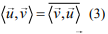
if working in complex vector spaces, complex conjugate of inner product
 gray dust
complex conjugate of inner product
magic light
right
I don't understand exactly, so from my reading an inner product space has this as a quality, that is
for each v, u, <u, v> = <v, u>
with the line
So what does this look like?
if v = {1, 2, 3}, u = {0, 1, 0}
what's the complex conjugate?
what does <v, u>(with the line) look like?
ah
I think I get it
gray dust
first off do you know what, if u,v are in C^n, <u,v> expanded looks like?
magic light
ah, good observation, I don't
I mean
I assume it works the same way?
(a1 + b1i) (a2 + b2i)?
if v = {a1 + b1i, 0, 0...}
and u is the same with 2
and then normal multiplication to get a number like that
but that is a guess
gray dust
let's say $x,y$ are in $\bC^2$, and say $x=(x_1,x_2)$ and $y=(y_1,y_2)$
stoic pythonBOT
RokettoJanpu:
gray dust
use the standard inner product on $\bC^2$ to say $\lbr{x,y}=\cjg x_1y_1+\cjg x_2y_2$
stoic pythonBOT
RokettoJanpu:
gray dust
have you learned what complex conjugate is before
magic light
a + bi is the conjugate of a - bi?
gray dust
for real a,b yeah
magic light
okay
I don't really understand why with x, y in C^2
we take the conjugate?
I mean, is that just by definition?
gray dust
this is the defn of standard inner product for a C^n space
magic light
right, counter intuitive
So
the conjugate of <x, y> is basically conjugating the entire solution to x1y1 + x2y2 where x1, x2 are conjugates?
gray dust
let's say $x,y$ are in $\bC^2$, and say $x=(x_1,x_2)$ and $y=(y_1,y_2)$\\use the standard inner product on $\bC^2$ to say $\lbr{x,y}=\cjg x_1y_1+\cjg x_2y_2$\\$\cjg{\lbr{x,y}}=\cjg{\cjg x_1y_1+\cjg x_2y_2}$
stoic pythonBOT
RokettoJanpu:
gray dust
your u,v look too similar. pick other names
 clear otter
If I take the tensor product of a row vector with itself, do I just get another row vector that’s the square of length of the original?
magic light
gray dust
k yea
magic light
thanks, I got it
gray dust
👍🏾 np
south wadi
let's say $x,y$ are in $\bC^2$, and say $x=(x_1,x_2)$ and $y=(y_1,y_2)$\use the standard inner product on $\bC^2$ to say $\lbr{x,y}=\cjg x_1y_1+\cjg x_2y_2$\$\cjg{\lbr{x,y}}=\cjg{\cjg x_1y_1+\cjg x_2y_2}$
stoic pythonBOT
PeakThePenny:
Compile Error! Click the  reaction for details. (You may edit your message)
south wadi
let's say $x,y$ are in $\bC^2$, and say $x=(x_1,x_2)$ and $y=(y_1,y_2)$
stoic pythonBOT
PeakThePenny:
south wadi
how to get black background?
south wadi
didnt work
gray dust
,tex --color black
stoic pythonBOT
Your colour scheme has been changed to black
gray dust
^ this
 gentle hedge
is it possible to do this?
| 1 - 1 | | 1 | = | 1 | + | -3 |
| 6 -4 | | 3 | | 6 | | -12 |
stoic pythonBOT
Ann:
 dusky epoch
this? @gentle hedge
gentle hedge
thanks yeah this
dusky epoch
yeah, this is correct
dusky epoch
wdym
gentle hedge
I mean can I uses first column for that multiplication?
gentle hedge
nvm, I made a mistake in calculation
ok I am having problems here. How the calculation was done here?
gray dust
refer to the square matrix. the product can be computed by 1(first column)+3(second column)
 brittle orchid
Does this just refer to the group (or set?) of real numbers excluding 0?
$\mathbb{R} - {0}$
stoic pythonBOT
WhiteBerry:
gray dust
set of reals, excluding 0
brittle orchid
Thank you
dusky epoch
what
dusky epoch
Solve the system by using the proper inverse. is that what it says word for word
 thorn prairie
I translated from greek
System it means matrix i guess
So anyone knows what we have to do?
dusky epoch
well i have a hunch that they want you to recognize that this is in fact a linear system in xy, sqrt(y) and yz, and to solve for the values of those things first and then x, y and z themselves
so perhaps you could make a substitution
like u := xy, v := sqrt(y), w := yz
solve the system, which is linear in u, v and w
then go back to x, y and z
thorn prairie
Ok thanks
stoic pythonBOT
WhiteBerry:
sonic osprey
This should be in #groups-rings-fields
brittle orchid
Apologies, I'm studying it in my first year of university
limber sierra
the keyword is "symmetric group"
brittle orchid
Thank you @limber sierra and @half ice
limber sierra
the symmetric group on 3 objects is the group of all permutations of {1, 2, 3}
so it'll have 3! = 6 elements
brittle orchid
yeah
limber sierra
similarly, S_5 will have 5! elements
brittle orchid
So it's a group of sets?
half ice
It's a group of "actions", per say
"Taking the second element and swapping it with the third" is one of the elements
Its inverse is swapping them back
brittle orchid
Right
Okay this goes straight over my head
I'm missing knowledge here
I suppose I need to catch up on mappings?
half ice
This one is a bit abstract, I'll admit. The elements of the group aren't actual real objects, but actions on something else
See cycle notation, which is a great way to bring it back into the concrete
brittle orchid
it's not "bringing it back" I have missed this entirely xD
half ice
I mean that "cycle notation" is good to visualize this
brittle orchid
I see
Do you think it's worth studying Mappings first?
I need to study for my finals eventually anyway as I missed it
Cause like, I'm clueless about surjectivity, injectivity and bijectivity
half ice
Oh lol yeah those are important
brittle orchid
yup x_x
half ice
Despite being a mapping itself, Sn is kinda unrelated and has its own thinking. You can know them independently
brittle orchid
Oh okay
So do I not need to know those concepts for that question? I've got a test on Friday (other subject) so I don't mind delaying this
 vast torrent
You can learn about those three concepts in like an hour and a half on wikipedia
brittle orchid
Okay
vast torrent
Idk what's gonna be on your test
brittle orchid
No no no, my test is unrelated
Like I said, I don't mind delaying the learning of these concepts due to my test (other subject) on Friday
But hey, if I can understand the required concepts in an hour and a half I'm down.
vast torrent
Khan academy has videos on them in his linear algebra module

Khan Academy
Introduction to the inverse of a function
It's not linear algebra but that's the first time in many students' education that it becomes super important to define injective/surjective rigorously
Imo it should be taught with algebra ii
Before lin alg many curricula are sloppy in not distinguishing between codomain and image,a function and its graph, a function and its image
¯\_(ツ)_/¯
 smoky lagoon
can someone help me figure out what this question is asking?
I don't understand what I'm supposed to even be doing for it
vast torrent
Assuming that this is a 2x2 mtx
Taking a vector in the plane and rotating it about the origin theta radians
Is a linear operator
Since it's a linear operator,it has a matrix representation
Find it
vast torrent
Ra is the matrix corresponding to the linear operator "rotate the vector a radians"
Still confused?
👻
smoky lagoon
yeah i'm trying to do another problem presently so i can deal with that one later
vast torrent
Then why did you ask for help
smoky lagoon
because I still don't understand so I went to do something else in the work so i can come back to that later
vast torrent
I began an explanation and you didn't understand it immediately from the first 2 or 3 sentences you give up?
Okay
brittle orchid
🤦♂️
smoky lagoon
not really giving up just thinking about something else
vast torrent
I didn't leave the party, i just decided i wanted to be somewhere not at the party
brittle orchid
imo if someone replies to you out of their own time to help you, the least you can do is give them your attention
smoky lagoon
Yeah I'm trying to look at it and I just don't understand what it is asking at all in any way
was hoping that the problem I pulled from the book would help but it did not
 wintry steppe
Hi, i have a nice question:
when you want to find the eigenvalues / eigenvectors you always do this:
stoic pythonBOT
nxue:
wintry steppe
But what happens when you do:
stoic pythonBOT
nxue:
wintry steppe
and get the values, and then multiply them, you will get the determinant of A
Why does it happen?
 austere cedar
For a 2x2 system:
To write An= lambdan n
An - lambda n = 0 vector
(A - lambda I) n = 0 vector
The I come sure to the lambda isn't a vector
Since you could have n = 0 vector as a solution which isn't very helpful
From cramers rule you can get infinite solutions when determinant of
(A - lambda I) = 0
Meaning both lines of the matrix are the same or a multiple of each other
So you can make any solution you want as long as one is a multiple of the other in n Eigen vector
Hopefully this makes sense, this is how I think of it anyway
vast torrent
I don't see how you answered the question stabulo
I've never seen that equation used anywhere, the
det(A-λI)=λ
@wintry steppe where did you see that expression?
wintry steppe
i made it up
austere cedar
I thought he was just proposing because he didn't know where the original came from
So I think I answered it :) 50:50
wintry steppe
but I dont understand how why when you multiply all the lambdas we get from the second equation i wrote, we get the original det
austere cedar
You don't get the second one?
Not multipled anything either
If you have 2 equations and 2 unknowns you can make one of the coefficients of one of the unknowns ewu as l and subtext the 2 equations , solving the simultaneous equations, cramers rule is as general method to do it
This method has
In the denominator of cramers rule formula for the matrix you're trying to solve here is the 2x2 matrix is the determinant of A- lambda I
wintry steppe
$|A - \lambda I| = \lambda
\text{You get:} \lambda_1 , \lambda_2, \lambda_3 , ... \lambda_n$
stoic pythonBOT
nxue:
wintry steppe
and then multiply them
austere cedar
Why are you setting the determinant equal to lambda
wintry steppe
but I thought to myself, what if we do this: det(A-xI) = x
after you solve this ^
and get x1 x2 ... xn
austere cedar
Well it wouldn't do anything, since it would break the condition of cramers rule
Since it the determinant is non zero
Then cramers rule makes it solvable
austere cedar
With 1 solution
wintry steppe
that does not exist
after you get x1 x2 x3 ...
and multiply them, you will get det(A)
austere cedar
One solution always exists for n = 0
wintry steppe
ok let me do an example i think it's confusing
austere cedar
I guess I don't know your question
austere cedar
Yeah
wintry steppe
it doesnt matter
 fervent spoke
no idea why the hell u wud do that
wintry steppe
i dont try to find eigenvalues
fervent spoke
But use ur example
wintry steppe
its something weird and different
wintry steppe
dont pay attention to eigenvalues, its something different
ill continue:
(3-x)(-1-x) = x
austere cedar
Keep going then
fervent spoke
That make det(a - Ix) = x
You legit solve that with quadratic eq for 2x2 matrix and u get det formula lol
wintry steppe
multiply those together and you get the determinant of A
(-3)
@fervent spoke
can you explain it again? i dont understand
austere cedar
Determinant of A - 3?
austere cedar
You've just made a random quadratic and solved it as far as I can see
fervent spoke
austere cedar
?
fervent spoke
Whole point of orig formula is to find lambdas that make that eq = 0
austere cedar
I don't have as clue what is going on
fervent spoke
If u set it equal to lambda
Thats basically det(A - Ix) - x = 0
Replace x with lambdas lol
U do that and u get cancer equation to solve roots for
Even for 2x2 it kinda cancer
wintry steppe
if you replace x by lambda then what you get?
fervent spoke
But u get det(A) after solving for roots
austere cedar
It has to zero or you will get a single solution but to have the eigenvector formula which you have n on both sides so it will just be n = 0 which is why you must strive for infinite solutions which manages determinant of that matrix being zero, the n = 0 vector is not very interesting which is why you want the infinite solutions
I'd you had it equal to lambda not equal to zero I guess, then you will be able to solve the system of equations and have 1 solutions but you always know the n = 0 one will do this
An = lambda n
Either no solutions which can't be since always have n = 0
1 solution which would be the n = 0 trivial one
Or infinite
The determinant gives you the lambda values such that you get infinite solutions
To the best of my knowledge*
austere cedar
Looks very much like linear algebra
 boreal crescent
yessir
vast torrent
Basis of what?
boreal crescent
R+ with addition and multiplication defined as they did
boreal crescent
it is, its given as a vector space
like a part of the question is to prove its a linear space
which i did with the 8 axioms
i think the zero vector is 1?
but idk how to find a basis for this
vast torrent
Cool
fervent spoke
@wintry steppe
vast torrent
If it's a 1d space then any vector is a basis
fervent spoke
Plug into quadratic formula and simplify
Its aids algebra but u get det(A) after it all
boreal crescent
whats the zero vector though
vast torrent
Tricky
 feral grove
any vector
boreal crescent
what
feral grove
including the 0 vector 🤔
vast torrent
We want the solution to x+0=x
boreal crescent
0 isnt in R+ though
feral grove
he just said 1d space
boreal crescent
oh ok
feral grove
🙂
vast torrent
Solving for the unknown 0 i meant
"0"
With air quotes with your fingers
Let's use e for less confusion
x+e=x, solve for e
What's the equation x+e=x look like with your addition?
vast torrent
"including the 0 vector" oh damn you got me
Any single vector except e spans the space
Indeed, e=1
wintry steppe
@fervent spoke
that does not tell you why the solutions of deltas, when multiplying them, gives the determinant
i have another question regarding this
why when you calculate
|A- xI| = x
you get a polynomial where the value without "x" is the det of A
austere cedar
...
fervent spoke
Wat
austere cedar
Are you setting it equal to x as some kind of experiment exercise?
wintry steppe
i know if you do:
|A- xI| = 0
and get a polynomial it has something with det in it (i dont think its the free value)
@austere cedar
bro im not talking about eigenvalues, leave it alone lol im just messing around with equations
austere cedar
What are your trying to do then?
vast torrent
nxue listen
fervent spoke
its like asking why is 2 + 2 = 4
vast torrent
what are you claiming about the equation det(A-xI)=x
austere cedar
^
vast torrent
what do you think this equation does
wintry steppe
im giving an example it should clear it cus we got confused here
vast torrent
because it's not obvious to us why this equation is of any interest
austere cedar
^
vast torrent
any more than examining the solution to, for example
fervent spoke
Plug that shit in urself
vast torrent
det(A-xI)=5
fervent spoke
See how cancer that is
wintry steppe
bro be more mature im asking nicely
fervent spoke
Quadratic formula is alr cancer bc u have to manipulate it akgebraiically
im just saying
wintry steppe
and you're not explaining it either
austere cedar
I'm mind boggled tbh
wintry steppe
yes, but i dont want it to be a specific value, im just messing around with this equation and want to see what properties it has
vast torrent
do you agree that det(A-xI)=5 is a wholly uninteresting equation?
wintry steppe
/it gives
austere cedar
No property
vast torrent
det(A-xI)=x is just as an uninteresting an equation
wintry steppe
why?
vast torrent
no, the burden of proof is on you to prove something is interesting
austere cedar
True
wintry steppe
im giving an example tho
vast torrent
by default making up a random equation is not interesting
fervent spoke
why 
vast torrent
your equation is just as interesting as det(A-xI)=13
wintry steppe
thats not true, because im asking for what values we get that det(A-xI) equals x itself not just a random constant
thats not correct
your equation is just as interesting as det(A-xI)=13
@vast torrent
vast torrent
and I'm asking you, for what values do we get that det(A-xI) equals 13
wintry steppe
but it doesnt matter, the question matters
austere cedar
I think this guy is too far gone TFG
wintry steppe
TFG?
austere cedar
Too far gone
wintry steppe
can we start over please?
austere cedar
Like Alabama republican etc
vast torrent
yes
wintry steppe
i will give examples
fervent spoke
LMAOOO
austere cedar
Good luck
wintry steppe
can I ? or you're too mad at me for asking questions and not understanding your solutions ...
vast torrent
I'm not mad bro
wintry steppe
:(
vast torrent
you can try again
wintry steppe
thank you bro :)
all im saying is let's take the eigenvalues equation, and change it a little, so we dont =0 but =x (to see for what values the equation det(A-xI) gives the value itself)
when you calculate |A-xI| = x
you will eventually get a polynomial p(x) = x
all im aksing is why the value without x (i forgot whats the name of it, for example: 6x^2 + 4x -5 so -5 is the value without x's) is the determinant of A
that's all lol, im not here to make new rules, im just curious
vast torrent
the constant term it's called
wintry steppe
oops
vast torrent
okay so you're asking about the constant term of a polynomial
if p(x) is your polynomial
then p(x) + x^2 - 300x^11 has the same constant term, agree or disagree
wintry steppe
yes, but its not the standard poly, it's when you det(A-xI)=x and not =0
yes i agree
wintry steppe
yes
vast torrent
so your question can just as well ask
why is p(0) the determinant of A?
because you're asking
why is the constant term of p(x)-x the detemrinant of A?
austere cedar
Still confused
vast torrent
he we wasking why the constant term of the polynomial p(x)-x was the determinant of A
austere cedar
Constant term?
wintry steppe
i know that p(0) = det(A)
when you do |A-xI| =0
but when you p(0)-0
you still get the same constant term
austere cedar
Oh like the y intercept of a quadratic
wintry steppe
yes
austere cedar
Weird question I guess
vast torrent
it's okay to ask weird questions
wintry steppe
nvm 😅
can i ask another question tho but now it will be more 'serious' because it was in my test
or i filled the questions capacity for the day
vast torrent
you can borrow a question from tomorrow
wintry steppe
lol
im going to use that card
i dont study in english, and im totally not sure to translate it, but given a ("multiplication space ????" i hope i translated it well)
f(u,w) = u^t Aw
which of these statements is 100% false:
1)A is symmetric
2) A-I is diagonlizable
3) AA^t is orthogonal
4) trace(A-A^t) =0
Inner product space, thats the term
wintry steppe
i dunno whats a quadratic form
it was 2 minutes to hand in the tests so i marked 3
vast torrent
a function of the form f(u,w) = u^t A w
vast torrent
that's a quadratic form Im saying
wintry steppe
we call it here "American questions" (Multiple choice lol)
vast torrent
because 100% means 100/100 , 1, so I don't know what "1 false" means
I guess we deserve that
wintry steppe
so i made this logic: if there is only 1 solution right (and there is only 1 solution to mark)
if 1 is correct then 4 is correct, so i Xed 1
vast torrent
I dont understand how you can answer that quesiton unless there's a part you didnt translate correctly
we're not told anything about f
so how can we conclude anything at all about A
wintry steppe
its inner product space, takes 2 vectors and outputs this :
stoic pythonBOT
nxue:
wintry steppe
standard inner product space,
<(3 , 6 ,1 ) , (1 , 1,2 )> = 3*1 + 6*1 + 1*2
but this one isnt standard
vast torrent
yes I See what it's asking
wintry steppe
the question is not standard inner ...(i keep forgetting the name)
vast torrent
inner product space
wintry steppe
lol
vast torrent
which of these statements is 100% false:
1)A is symmetric
2) A-I is diagonlizable
3) AA^t is orthogonal
4) trace(A-A^t) =0
it's confusing because
when they say symmetric, and transpose
do they mean symmetric in this product or symmetric in the usual product
wintry steppe
symmetric as A = A^t
vast torrent
it's worded weirdly
wintry steppe
ill tell you half the solution i got from someone
if its an inner product then f(u,w) = f(w,u)
(i forgot its R so no adjugated)
so A has to be symmetric
vast torrent
$u^\intercal A w = w^\intercal A u$
stoic pythonBOT
gfauxpas:
vast torrent
yes
wintry steppe
if A symmetric so A-I is diagonalizable (??? that i dont know)
vast torrent
100% true 😛
wintry steppe
😉
vast torrent
let me think about that for a sec
wintry steppe
ill tell you why i said "100% false" , b/c in the question they worded it like: which of these statements is necessarily false
(i guess because some of the others can be false sometimes, but not necessarily)
vast torrent
I don't see why that statement should be true
wintry steppe
which statement
vast torrent
if A is symmetric then A-I is diagonable
I don't see how A-I is of any relevance to the problem
wintry steppe
its just this annoying american question,
such as
A - 2B + AB = I
and 2 is an eigenvalue of B
which of the following is necessarily correct:
a) detA = 0
b) 1 is an eigenvalue of B
c) 1 is an eigenvalue of A
etc..
sorry, multiple choice question
😅
ok someone told me that if A is symmetric:
then A-I is symmetric
if its symmetric then its normal if its normal its diagonalizable
the problem is that ive never heard the term "normal matrix"
vast torrent
normal is usually called unitary I think? let me double check theyre the same
no, Im very wrong
normal is strictly weaker than unitary
normal means $AA^\dagger = A^\dagger A$
stoic pythonBOT
gfauxpas:
vast torrent
unitary means $AA^\dagger = A^\dagger A = I$
stoic pythonBOT
gfauxpas:
 fast pivot
what is that dagger?
 pallid rampart
Is that transpose?
feral grove
conjugate transpose
half ice
@south wadi
It would have to be the case that
[a b] [1] = [3]
[c d] [3] [4]
and
[a b] [1] = [0]
[c d] [1] [2]
Multiply is out, that's four equations with four unknowns
south wadi
the answer is this
but i dont understand the fking first step
why is T(e_1) = T(e_2)
and like where it says we dudce
why is it pulling 1/2s out of nowhere
gray dust
it never said T(e_1) = T(e_2)
the matrix corresponding to a linear map T can be fully determined if you know where T sends the standard basis vectors
south wadi
yo so rokabe
like i legit am losto n the first step
why is e1 the same as e2
and why are they jizzing out 1/2 and 3/2 like where this shit coming from
nimble egret
They're not the same
Perhaps should note the x and y in the first equation is not the same as the x and y in the second equation
We want to rewrite our standard basis vectors as a linear combination of the two vectors given
Each of the vector equations is just a system of 2 equations in 2 variables
Which you can solve however you want
south wadi
yeah i just dont see the -1/2 constant and 3/2 coming from
no idea
just spawned in
cursive narwhal
jizzing out 1/2 and 3/2 😂
nimble egret
Which gives e_1
So even if you can't get them
You can verify these coefficients work
south wadi
why do we want the coefficient to be 1 on e1 and 0 on e2
nimble egret
??
south wadi
nimble egret
I'm looking at e_1 only
If you look the right hand side of the equation
Simplifying gives [1, 0]
Which is e_1
nimble egret
We're writing (1, 0) as a linear combination of (3, 4) and (0, 2)
south wadi
ok
why (1,0) though
holy fk dude this shit is so confusing
and useless
sorry im back now just had a tantrum right there
honestly im lost in this question
the first 2 were a breeze
So we are writing a linear transformation T
gray dust
the matrix corresponding to a linear map T can be fully determined if you know where T sends the standard basis vectors (which is to say, what T(e1) & T(e2) are). for a linear map T, we can say T(x)=Ax where we're finding the matrix A. what the previous sentence means is, the columns of A are T(e1) & T(e2) or T(1,0) & T(0,1)
nimble egret
And also recall the transformation is linear
south wadi
for T(1,3) = (3,4) and T(1,1) = (0,2)
nimble egret
This is why it's useful to write the standard basis vectors as a linear combination of known vectors
To utilise linear properties
south wadi
so we want e_1 to be (1,0)
and e_2 to be (0,1)
so why are we multiplying -1/2 by the x and 3/2 by the y
gray dust
no. in R^2, e1 is another name for (1,0)
south wadi
ok
gray dust
e1 can be expressed as a linear combo of (1,3) & (1,1), so e1=x(1,3)+y(1,1) for some unknown scalars x,y
south wadi
ok
gray dust
if we find what x,y are then we can compute T(e1) by taking T(x(1,3)+y(1,1))
which, because T is linear, is just xT(1,3)+yT(1,1)
south wadi
ok i think i get it now
 viscid vale
if u call a variable "arbitrary" does that mean its an element of real numbers?
e.g. this textbook problem says: Let W be the set of all vectors of the form (some vector with b and c in it) where b and c are arbitrary
dusky epoch
if u call a variable "arbitrary" does that mean its an element of real numbers?
no
not in general
dusky epoch
well if it only makes sense with b and c as scalars
which it most likely does
then yes
dusky epoch
yeah so
b and c are def real numbers
doesn't make sense to consider 'em as anything else
viscid vale
ok thanks
 undone lake
hello. does someone knows why, here, composition is commutative ?
Let E be a K vector space, f an endomorphism, and f^0 = Id_E, f^k = f o f^(k-1)
i think that’s because of the properties of the linear endomorphism but i’m not sure
dusky epoch
f^k is the composition of k copies of f
the commutation of f with its powers boils down to the associativity of composition itself
 spiral sonnet
So row echelon form is where a row's first non-zero number is atleast one column to the right of the previous row right?
cursive narwhal
Let $T:V \to W$ be a linear transformation. If you want to check if it's surjective, then you just need to show that $T(V) = W$.
stoic pythonBOT
Abhijeet Vats:
spiral sonnet
Is there a rule to row reducing?
south wadi
yea
spiral sonnet
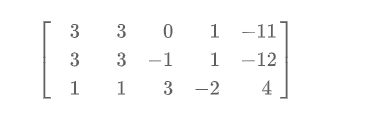
What I'm having trouble with is reducing and finding the pivot columns

In this example, the pivot columns are 1, 3 and 4 when reduced
fervent spoke
if that confuses u jst focus on making matrix look like this
spiral sonnet
Yeah that's what I wanted focus on, but not all matrices will look like that
fervent spoke
Solve it how u want
spiral sonnet
so if it doesn't look like that I'm lost
limber sierra
in any case, do you know what operations are "valid" in row reduction?
spiral sonnet
yes
limber sierra
so try and reduce it best you can
to something similar in "spirit" to that
that is to say
a "pivot variable" is the leftmost variable in a row
you want every "pivot variable" to have all 0s below it
fervent spoke
fervent spoke
ye that dude explaining better lmfao
spiral sonnet
might just have to grind out some problems
fervent spoke
if u have a 1 in a row there cant be 0s om the left of it
spiral sonnet
I get it when my professor goes through it, but I don't know if I can do it myself
limber sierra
the box region denotes the "we dont care" section
because its not below any pivots
also, in this case, you dont have to row reduce to 1 exactly
just to have it in this "shape"
since all you care about is the position of the pivots for this problem
spiral sonnet
doesn't there have to be 0's above and below a pivot variable?
limber sierra
for the purpose of this question? doesnt matter
you only care about where the pivots are
i..e columns 1, 3, 4
yes if you're "fully reducing" you'd have to reduce all the entries directly above the pivots to 0
spiral sonnet
oh okay
Not sure if I'm phrasing this correctly, but would I eventually reach that answer even if I don't do the optimal row operation?
limber sierra
oh yeah, you dont have to do row reduction totally optimally
just try to make progress every step
in fact, doing it optimally is very hard - computer programmers spend a lot of time thinking about how to efficiently implement row reduction
spiral sonnet
So for transformation matrices, specifically the rotation one. How would I convert a clockwise to counter clockwise? Like -pi/4 (clockwise) would be 45 degrees in the 4th quadrant. So would the counter clockwise be pi/4?
pallid rampart
So for this problem
I see how at each step of the gram schmidts, we can multiple the vector by -1
But I can’t prove that any orthonormal list of vector satisfying that span equality is of this form
 wind yacht
Think about how to map each point from the first n to the second
Maybe consider 2 "separate" transformations first - one to deal with italics and one for the size
pallid rampart
@vast torrent finite set
pallid rampart
Well this is what I meant
So for each vector produced by gram schmidts, I can multiply it by -1
And the final finite collection will still be an orthonormal collection of vectors
So for each vector we have 2 choices
Thus the 2^m in the question
But I can’t prove that any finite sequence of vectors satisfying that equation is of this form
 vague cedar


 tacit storm
with my life
vast torrent
I was googl8ng things
If {v1,v2,...,vm} is an orthonormal basis
Then for any isometry A
{Av1,Av2,...,Avm} is an orthonormal basis for the same space
So there are infinitely many bases
sonic osprey
I made this same mistake
note how it says span{v_1, v_2, ... , v_j}
for all j
so the span of the first number of elements must be the same too
i.e. span(v_1) = span(e_1)
and span(v_1,v_2) = span(e_1,e_2)
etc etc
@vast torrent
 remote elm
Hello
I am having trouble understanding vector spaces
first of all, i don't entirely understand what a vector space is
limber sierra
do you have your definition of a vector space?
a vector space is a mathematical structure where we have some sense of "vector addition" and "scalar multiplication"
remote elm
a set of vectors from v1 ... to vk
limber sierra
that is not a vector space
remote elm
oh ok
limber sierra
a vector space is a set of vectors associated with two operators, vector addition and scalar multiplication
addition/multiplication has to follow some "rules" here
in order for them to "resemble" what we want addition and multiplication to look like
do you have a full definition of a vector space? somewhere in your notes/textbook?
limber sierra
yeah, so the definition is given on the second page
the basic gist is, one thing mathematicians like to do is generalize
you mightve seen vector spaces like R^2 and R^3 before
and maybe, say, C^2 or similar
but one natural question to ask is, "is there something special about these spaces? is there a way we can define a general notion that tells us 'what we want' a collection of vectors to look like?"
a vector space is an "algebraic structure", which basically means a set with some additional operations on it
(a set of vectors, in this case)
in theory, those operations can do whatever they want - but we want vector spaces to follow some sensible "rules"
the rules we want vector addition to follow include things like:
a + b = b + a
a+(b+c) = (a+b)+c
there's some element 0 such that a+0 = a
every vector has a "negative" (so we can talk about subtraction) such that a + (-a) = 0
these are fairly sensible things to want from something we'd call "addition", right?
and it's nice because they give us some "rules" that unify vector spaces
they let us easily tell:
a. what is and isn't a vector space
b. what properties we can use when talking about vector spaces in general (rather than just talking about R^2 or C^n or whatever, we can talk about all vector spaces at once - that's powerful! - by just using these rules)
similarly, let s, t be scalars and a, b be vectors; we want scalar multiplication to satisfy:
s(a+b) = sa + sb
(s+t)a = sa + ta
s(ta) = (st)a
there exists some scalar 1 such that 1a = a
again, reasonable things for us to want something we call "scalar multiplication" to satisfy
shrewd slate
Vector space more like diet field amirite
cursive narwhal

limber sierra
one thing to note: we never define vector multiplication here
cursive narwhal
namington, you're way too nice lol
limber sierra
multiplying vectors isnt generally very useful or well-behaved
alright, so, we have two operations: vector addition and scalar multiplication
but it seems kind of... arbitrary
like we have one set with two operations
but those operations seem pretty unrelated
how can we tie those two operations together?
well, you're probably familiar from elementary algebra with the fact that x(y+z) = xy + xz
remote elm
right
limber sierra
so that's where s(a+b) = sa + sb and (s+t)a = sa + ta come from
anyway, thats a bit of a long-winded side-tangent
bringing the focus back to your specific question
in teh screenshot
shrewd slate
In one you add vectors and in another you add scalars, note that
limber sierra
we want to show that R^2 with this funky addition
shrewd slate
@ shahrik
limber sierra
is not a vector space
that means we want to show that it "breaks one of the rules"
to recap, these rules are:
a + b = b + a
a+(b+c) = (a+b)+c
there's some element 0 such that a+0 = a
every vector has a "negative" (so we can talk about subtraction) such that a + (-a) = 0
s(a+b) = sa + sb
(s+t)a = sa + ta
s(ta) = (st)a
there exists some scalar 1 such that 1a = a
also something I didn't mention: whenever you add vectors or multiply vectors by scalars, we expect to get a vector from our vector space back
it wouldnt make sense if, say, $\begin{pmatrix}1\0\end{pmatrix} \oplus \begin{pmatrix}3\6\end{pmatrix} = \text{goldfish}$
stoic pythonBOT
Namington:
limber sierra
(we call this "closure")
anyway, focusing on this specific question
what "rule" do you think this would break?
obviously we're only dealing with addition (the + is written in a circle to distinguish it from regular addition), so we only need to look at those rules
limber sierra
that's how addition is defined; what rule do you think it breaks?
dont think about what it "should be", think about what the problem is
remote elm
the problem is that it wouldnt work for all values of b2
limber sierra
why does this break our "rules for a vector space"?
remote elm
it wouldnt*