#linear-algebra
2 messages · Page 38 of 1
 half ice
half ice
half ice
Just find a counter example
If it's not linear, then it must break one of the rules that a linear transformation must have
T(a + b) = T(a) + T(b)
What vectors a and b break this?
I think it's pretty clear that the | | is going to cause problems, so try playing with negative numbers
half ice
0 is usually amazing for counter examples, but not in this case. Always keep 0 in the back of your mind
half ice
There's a bit of a mix of notation going on here
What they wrote:
T(x1, x2)
Is a linear transformation acting on the vector (x1, x2)
I wrote T(a + b) where a and b are both vectors in R²
In their notation, that's more like
T[(a1, a2) + (b1, b2)]
 gray dust
$\mathbf{x}=\begin{pmatrix}x_1\x_2\end{pmatrix} \\\ T(\mathbf{x})=T\begin{pmatrix}x_1\x_2\end{pmatrix}=\begin{pmatrix}4x_1-2x_2\3|x_2|\end{pmatrix} \\\ \text{show transformation T is not linear}$
 north sierra
Ok
 stoic pythonBOT
RokettoJanpu:
$\mathbf{x}=\begin{pmatrix}x_1\\x_2\end{pmatrix} \\\\\\ T(\mathbf{x})=T\begin{pmatrix}x_1\\x_2\end{pmatrix}=\begin{pmatrix}4x_1-2x_2\\3|x_2|\end{pmatrix} \\\\\\ \text{show transformation T is not linear}$
think of T taking in some vector x and spitting out some new vector as defined above. note x_1 and x_2 are the components of x
recall the definition of a linear transformation and show how T fails at being such a transformation
half ice
Yeah seeing the vectors as vertical is super helpful
north sierra
Idk how I would do this on paper
gray dust
start by reciting the definition of a linear transformation
north sierra
gray dust
where x & y are vectors and c & d are scalars
north sierra
Yeah
gray dust
pick whatever condition you think is easier to use to show T is not linear, and run with it
 charred stirrup
can we say that the vector x is orthogonal to the vector n as well?
half ice
Here's how I'd do it. Let's work with these two vectors
a = (0, 1)
b = (0, -1)
T(a + b) = T(the zero vector) = (0,0)
T(a) = (-2, 3)
T(b) = (2, 3)
So T(a) + T(b) = (0,6)
But for a linear transformation, T(a + b) and T(a) + T(b) should be the same thing. Since they aren't here, this isn't a linear transformation
@north sierra
I suppose you could get the result faster by abusing T(-a) = -T(a)
Actually, I think I see how you did it now. No need to keep x1 and x2 in there, you're better off using specific vectors for the counter example
 slow scroll
Not quite. To write a matrix for T you need to know what it does to a basis for the vector space.
north sierra
O
slow scroll
Lines 1 and 2 are equal by linearity tho.
 undone garnet
The problem yesterday
A=d.I + J
J is a matrix with J_ij = 1
J = P.diag(n, 0, 0, ..., 0).P^-1
@dusky epoch how about this?
charred stirrup
a vector x parallel to the plane is defined as x = p + td
doesn't the the left hand side simplify to n * (td)
?
err sorry Im realizing this is a bad question
I should think of (x - p) as orthogonal to n
a better question I want to know is why the need to subtract point p?
isn't n * (x) = 0 sufficient enough?
charred stirrup
regardless of the point p in X, the factor of + td will make the line parallel and therefore perpendicular to n
OHHH
shit
thank you so much
slow scroll
np
charred stirrup
could I get a clarification on the definition of vector x then ?
(x-p) means it passes through p
then does that mean x = td
or x = p + td
?
slow scroll
what is td?
charred stirrup
t is parameter, d is just the direction vector parallel to the plane
the textbook says x = p + td
but if I want ( x - p ) to pass through point p
then x = td? it cant be x = p + td
slow scroll
oof i said something wrong there
charred stirrup
sorry I should just post the page
It will probably help you know where im confused
slow scroll
alright
charred stirrup
slow scroll
oh okay yea that has literally nothing to do with this.
slow scroll
oh okay well ur right that x - p = td
slow scroll
 well you only know what td is in terms of (x - p). The only thing to take away from that equation is that the solutions (x - p) in n*(x-p) = 0 are all of the lines orthogonal to n.
charred stirrup
i like your thinking
fuck this book
should I then consider ( ** x ** - p) ** x ** is the direction vector, not the vector equation x = p + td
slow scroll
eh (x-p) is more like a direction vector for a line on the plane. "x" is just another point on the plane. when you plot all of the "x" such that (x-p)*n = 0, you get a plane.
charred stirrup
I wont lie I was following and then i got lost lool
but thanks for thinking this out
I will use the first definition you made for me
( x - p ) = td
will probably be enough for midterm tmrw
slow scroll
by "points" I really just mean position vectors. You see, p is a position vector that points to a point on the plane, and x is another position vector that points to another point on the plane. Therefore, (x-p) is the vector that points from x to p (or p to x idk) which means it must lie ON the plane
any line that lies ON the plane must be orthogonal to n, and thus the equation n*(x-p) = 0 follows. Its solutions are all of the position vectors x that make (x-p) lie on the plane.
charred stirrup
your brain is big
picture perfect explanation
i can draw it out rn on W sketch
slow scroll
aight xd
charred stirrup
not kidding
your explanation was so good i drew that out first try
i love you man
thank you
slow scroll
np glad i could help c:
half ice
2
3
@north sierra
Is an example
It's just trying to say that vectors that should be written vertically are not because it's hard to write that
 brittle orchid
Sorry to throw in my question but how does one go about understanding this?
I have no clue what "k" refers to here

 pliant thistle
Hello, what does this mean? Is there a certain theorem I have to use? for what does "upper bound" mean? thank you
 dusky epoch
and you would, in general, be wrong. det(kA) isn't k det(A)
it's k^n det(A), where n is the size of A
this is because $\det(kI_n) = k^n$
stoic pythonBOT
Ann:
 wintry steppe
ah ok
so then in this question
the only operations that would affect A are the times 5, 3 and the row change right?
therefore it would just be 7(3)(5)(-1)?
or would there be no -1?
dusky epoch
uh
that sounds dodgy
i'd rather express $\begin{bmatrix} \mathbf{u} \ 5\mathbf{w} \ \mathbf{v} - 11\mathbf{u} \ 3\mathbf{x} \end{bmatrix}$ as a matrix product, i.e. $MA$ where $M$ is a known matrix
stoic pythonBOT
Ann:
dusky epoch
and then compute the determinant of $MA$ as $\det(M)\det(A)$
stoic pythonBOT
Ann:
dusky epoch
looks like $M = \begin{bmatrix} 1 & 0 & 0 & 0 \ 0 & 0 & 5 & 0 \ -11 & 5 & 0 & 0 \ 0 & 0 & 0 & 3 \end{bmatrix}$
stoic pythonBOT
Ann:
wintry steppe
but theoretically
would my method work?
multiplying by a constant 5 to one row would just increase the determinant by a scalar factor right?
dusky epoch
i mean
yes
i guess that'd work
it just feels a bit unnecessarily complicated to me
wintry steppe
because I get different answers when I calculate them both ways
I get det(M) = 75
so then it'd be 75 * 7
which doesn't seem right to me
wintry steppe
oh yeah my bad
it's -75
but then it would still be -75*7 which doesn't seem right
wintry steppe
but isn't it 5w?
o nvm
yeah i see it now
ty
yeah it's the same as the other way now
charred stirrup
why false? because it can only have 1, infinitely many, or none at all?
dusky epoch
yes, assuming your coefficient field is R
charred stirrup
what is the difference between using this to prove dependence instead of the c1v1 + c2v2 + ... + CnVn = 0 ?
or the better question is, are both methods acceptable when trying to prove dependence in a set a vectors?
dusky epoch
well this is essentially a streamlined way of solving the system of equations c_1v_1 + ... + c_nv_n = 0
or rather
gray dust
 dusky epoch
of determining whether it has any solutions other than zero
charred stirrup
if we sort the vectors by columns, the augmented part will always be 0, but we can tell if there are any other solutions if we have a column without a pivot, so then the set of vectors is dependent
what would you do if it seems tricky to make a 0 row while sorting the vectors as rows? or should I be able to quickly tell if a 0 row is possible
dusky epoch
just do gaussian elimination on it
charred stirrup
holy shit
the row matrix method is basically gaussian elimination
your brain is big
by your statement, isn't the row version of this matrix basically the equations laid one by one?
shouldn't I just try to algebraically see if I can delete an equation instead of row in the matrix? it feels more intuitive
charred stirrup
Would it work for all possible matrices? So in the example, instead of the matrix I would write x+ 2y, x + y - z, and x + 4y + 2z
and just try to delete one of those equations to prove dependence
charred stirrup
 wintry steppe
I think Patrick Star here means that he can get one equation from the two others to prove dependence
charred stirrup
they use the row vectors in the matrix
wintry steppe
but that's literally just a row operation
charred stirrup
you are right
sorry thanks for that wake up slap idk why I'm afraid to work with matrices
 limpid gale
hello again, i need help with complex numbers
i must plot this
but i have no idea how
where z=a+bi
 brittle juniper
Surely you are able to simplify $|e^{a+bi}|$ a little bit
stoic pythonBOT
Tuong:
brittle juniper
what why is this in linear algebra
brittle juniper
when you'll be doing linear algebra, you'll know it
it's really got a particular flavour
limpid gale
we have matrices too
i like it a lot but im not particulary good at it
i will try tweaking with that e^a+bi
 clever cedar
Let A be an r×r matrix and suppose there are r−1 rows (columns) such that all rows
(columns) are linear combinations of these r−1 rows (columns). Show det (A) = 0.
can someone explain the wording of that question to me
i dont understand it
half ice
Indeed some of the wording is redundant
half ice
Let there be a r - 1 vectors. Then add an rth vector that is in the span of the others. Show the matrix they form has a determinant of 0
clever cedar
oh
i see
just show that
[1,2 - [2,4]
has determinant 0
(the dash implies next row)
half ice
I mean, that's one example. You'll want to show this is true for any matrix
clever cedar
Oh ok thank you
half ice
Span(v1, v2, v3) = av1 + bv2 + cv3
Let b = c = 0. That implies that av1 is in the span for any a
dusky epoch
Span(v1, v2, v3) = av1 + bv2 + cv3
ew
dusky epoch

 north sierra
Is a vector space just a set of vectors?
brittle juniper
it's rather the other way around
vectors are elements of vector spaces
and the vector spaces have the more interesting definition
half ice
@north sierra
A vector space is a set that contains:
- Vectors, that you can add and subtract
- Scalars, that you can add, subtract, multiply, divide.
- A scalar multiplication, that takes a vector and a scalar, and returns a vector
As well, for vectors v, u, and scalars a, b, you get:
- Double distributive property:
v(a + b) = av + bv
a(v + u) = av + au - Associative scalar multiplication:
a(bv) = (ab)v
That's the sparknotes version of a vector space definition. A vector space does not need to be made of arrows, and does not need a concept of distance or direction. However, all vector spaces have a basis and dimension.
 tame mural
I thought the concept of magnitude and direction is baked into the scalars
 sonic osprey
That's not true no
Your scalars can be from a finite field, which are related to modular arithmetic
clever cedar
lets say im looking for det(A) and in the processes of using row operations I have to switch rows
does that mean that det(A) = -det(B)
where det(B) is det(A) just with switched rows
half ice
IF B is A with two swapped rows,
THEN det(B) = -det(A)
half ice
Multiplying a row by k also multiplies the determinant by k
clever cedar
im sorry i dont understand that and i can explain why
i had a matrix A, that I wanted to find det(A). So i reduced A into upper triangular form.
In the process I had to multiply a row by 2
the solution i got for multiplying the upper triangular rows was (1 x 2 x -13)
so do I multiply that all by 2
half ice
Since you multiplied by 2, the determinant was multiplied by 2.
In order to get the determinant of your original matrix, you have to undo that change - divide by 2
clever cedar
in that case I am able to find the correct answer (-13) since 1/2 * ( 1 x 2 x - 13) = -13
i need to reread some stuff over
thank you for your time
half ice
Np. Feel free to ask if you need more!
clever cedar
🙂
 toxic pendant
I'm having trouble understanding what the question wants from me
What does A(V1+V2) mean?
wintry steppe
A is the matrix
V1+V2 is simple addition
its actually quite simple if you know what an eigenvalue/eigenvector is
toxic pendant
So it's asking what the matrix from the resulting vector of v1+v2 is?
wintry steppe
no
half ice
This is a matrix multiplying with a vector
half ice
"multiplying with" is a very weird way to say that. I tried
wintry steppe
a matrix transformation
toxic pendant
I'm aware of how you can multiply a matrix by it's eiganvctor to find eiganvalues
toxic pendant
Aren't they just a means to an end for computing large powers
wintry steppe
you can compute powers of matrices with eigenvectors and eigenvalues
but thats not what the definition is
so lets take a simple transformation
2I
2 times the identity matrix
this matrix would simply scale everything by two
in this case all vectors would be eigenvectors
because all vectors would be scaled a certain amount in the same direction
and their eigenvalue would be 2
a matemathical way to show this would be this formula
Av = λv
where λ is a constant eigenvalue
toxic pendant
Yes
wintry steppe
ok
so in the original problem
it says A(v1+v2)
we know that matrix multiplication follows the distributive property
Av1 + Av2
since v1 is an eigenvector of A, what can we do?
toxic pendant
multiply the vectors by their respective scalers since they're equivalent?
toxic pendant
then you just add the vectors together?
wintry steppe
yes
toxic pendant
Great, I was overcomplicating things
I looked at the notation and thought it was some function
slow scroll
are you familiar with the properties of determinants? det(AB) = det(A)det(B), multiplying a row/column by n scales the determinant by n, etc....
wintry steppe
yes these ones
toxic pendant
then just plug in the values
wintry steppe
Is this right
half ice
I can't really read the writing
toxic pendant
c^3, b^2 should also be det(c)^3 and det(b)^2
wintry steppe
where do i go from here
toxic pendant
if you've properly written it out, you just sub the values in and you should get a constant
wintry steppe
can i cancel out detC with detC^3
toxic pendant
wdym
wintry steppe
when you multiply with the det do you get det(x)^y or det(x^y)
toxic pendant
think about it
half ice
det(A^n) = det(A)^n
toxic pendant
so we know that det(a*b)=det(a)*det(b)
wintry steppe
yes
toxic pendant
det(a^2) is just det(aa)
half ice
Since
det(A³) = det(A)det(A)det(A) = det(A)³
wintry steppe
both v helpful 🙏🏽
toxic pendant

Oh I do have a question about diagonalization
So I've been calculating determinants up to this point by always reducing it to upper corner form with gaussian elimination
but it seems like to calculate det(x-A) I have to use the long and ugly formula
Is there a way around it
toxic pendant
So I have to start using fractions?
half ice
I like to do this for a 3×3
That picture is pretty ugly but it's a nice method
Copy over the first two columns and do the lines
toxic pendant
That is a surprisingly effective way to remember it
half ice
It's a special case for 3×3s. It doesn't work for 4×4s or higher
toxic pendant
but with that you can't use the second or third row right?
half ice
That's a shortcut determinant of a 3×3 matrix. Use the second or third row?
toxic pendant
For example if the 2nd row had two zeros
toxic pendant
I just want a cheesy way to solve stuff
I dislike the current formula because it gets messy at 4X4
half ice
That's the easiest way I know to get the determinant of a 3×3 if guassian might be messy with fractions, and there's no easy zero rows
With 4×4 I'm pretty utterly lost sry
toxic pendant
tfw, well thanks for the image
half ice
I doubt they'll test with with a messy 4×4 but if they do god help you
toxic pendant
Imagine doing a 5X5 by hand 
half ice
I can't
toxic pendant
Only one question on final exam, find determinant of 5X5 matrix
toxic pendant
Perfect to mess up a single value 
wintry steppe
Anyone know how I can begin part b this problem?
I was talking to someone about it and they said that we can choose a vector x where its values are +-1 to make dx as large as possible but I dont see how that would help
half ice
Use guassian elimination on it
Which, you're pretty much doing so that's ez
Unless you know the determinant that works too
 urban bough
I need help understanding how to solve this problem
Is it really as straightforward as just plugging in A and A+ SVD’ed into the formula?
north sierra
Could someone explain why this is true? I read a explanation online on this question but I still don’t get it
dusky epoch
the point is that the columns of the n×n identity matrix form a basis for R^n
in fact it's the canonical basis for R^n
do you know what a basis is @north sierra
north sierra
Ya
dusky epoch
bluh
i think it might be easier if you post the explanation you didn't get and point out what part(s) you don't get
 south sedge
If i have a vector PQ = (2i + 2j - 2k), where P = (1, -1, 0) and Q = (3, 1, -2). How do I show which of the points (0, -2, 1), (2, 0, -1), and (5, 3, -4) lie on the vector?
clever cedar
Is linear depdance based on the sum of all vectors or if only at least 2 vectors sum to equal another vector
gray dust
@south sedge gonna assume the q is asking which points lie on the line spanned by vector PQ. recall how to construct the equation of a line given a direction vector and a single point, then test whether that line passes through the three points
gray dust
@clever cedar determining linear dependence can be thought of as answering the q "if i have a set of vectors, can i obtain at least one of the vectors by simply multiplying some of the other vectors by some constants (a linear combo of these vectors) and adding em up?" in some cases a vector can be obtained through the linear combo of just two vectors, however in some cases it very well may take more than a linear combo of two vectors. think back to the equation presented in the definition of linear dependence
clever cedar
Oh i see thank you
The reason i ask is based off of determinants
So only two of the vectors need to have a sum resulting in another vector in order for det(A)=0
gray dust
@south sedge in the last step, you flipped the sign of one of the components of the direction vector
clever cedar
Not all of the vectors
gray dust
@clever cedar you better define what A is. i can only assume since you're talking of linear dependence (LD) that A is the matrix whose columns consist of the set of vectors you are testing for LD (probably a set of n vectors belonging to R^n since det only works for square matrices), anyone else would have no idea what you mean. if det(A) = 0 then its columns are indeed LD
clever cedar
Yeah sorry A is just a square matrix
south sedge
oh, fixed my mistake. I only know how to check if the points lie on the line L 😦
gray dust
you have the equation of a line written in terms of only a single variable t, so it shouldn't be too hard to check if there exists a value t that satisfies the equation at each of the three points
south sedge
For example
this doesn't tell me if the point lies on the line spanned by vector PQ, it only tells me that the point lies on the Line L
gray dust
according to your sketch, L IS the line spanned by PQ @south sedge
south sedge
but L spans farther than the vector PQ. So something lying on L doesn't imply it lies on PQ
gray dust
the span of PQ is the set of all constant multiples of PQ, which generates a line L which runs in the same direction as PQ but stretches infinitely far beyond PQ
south sedge
what if the question would be "Which points lie within the length of PQ?"
gray dust
then you should have specified that earlier
south sedge
I would have referred to the question but it's not in english, so things got lost in translation :/
gray dust
still, it's nice to construct the equation of L as if it were an infinitely long line and solve for t as normal for the three points, but now you add the restriction that t must lie between two particular values
south sedge
So if I want to try it for point (0, -2, 1). Then t is between P(1, -1, 0) and (0, -2, 1)?
gray dust
first find what t is for points P and Q
 marble ravine
Anyone know how to calculate number of basis vectors of an n dimensional VS with entries 1? So for example for a 2 dimensional vector space it would be 3 since we can have {<(1,0), (0,1)>, <(1,1),(0,1)>,<(1,1),(1,0)>}.

 torn hornet
what have you tried
 atomic flint
well ive been just trying to go through my notes, and trying to find a equation like that
torn hornet
thats not rly trying anything, try thinking about what u should do in this problem
atomic flint
I mean like ik that D9f) = 2f' + f''
torn hornet
what?
torn hornet
derivitive of f? whats f?
atomic flint
idk
torn hornet
if u dont know, then whered u get that D(f)=2f'+f''??
like i need to know what u think u need to do and what u have tried
atomic flint
torn hornet
,rotate
stoic pythonBOT
atomic flint
torn hornet
,rotate
stoic pythonBOT
torn hornet
yeah no this is useless
as i said, dont refer to your notes
just look at the problem and tell me what u think
atomic flint
umm idk, im struggling to even get my head around this stuff
torn hornet
wwell what information do you have given in the problem
atomic flint
that $xp''(x) = 2p'(x)$
stoic pythonBOT
B1GW0LF:
atomic flint
and that V is a subspace of the Real-vector space R3[x]
torn hornet
right thats the critical part
atomic flint
V is the set of all real polynomials
torn hornet
so set of all polynomials with degree less than 3 right
can we right a general form for p(x) from that
atomic flint
i mean wasnt it given as xp''(x) = 2p'(x)
torn hornet
like just from the fact that p(x) is a polynomial of deg<3
can we write down a form for p(x)
torn hornet
yeah, also sorry meant deg ≤3
atomic flint
ohh ok
torn hornet
but the idea applies, that is exactly what u need
atomic flint
so p(x) = a + bx + cx^2 + dx^3
torn hornet
ye
atomic flint
so after i have found p' and p'' i then plugged those into the given equation and i go that they did indeed equal one another
torn hornet
yeah, try it an then tell me what u get
torn hornet
yes, and so what must b and c be
atomic flint
not sure
torn hornet
well c and b are zero right
atomic flint
yes
torn hornet
do we have any conditions on a and d, or can they be anything
torn hornet
exactly
now what are the basis of this? and prove its a vector space, i think you could do this on your own easily
torn hornet
yeah
atomic flint
so like the system is an abelian group, multi is associative, right/left distributive and multiplication by 1 is the identity
torn hornet
wait what no those arent the axioms for vectorspace, its not a group and multiplication is not something in the axioms for them
atomic flint
ah damn it
torn hornet
well u could look em up to remember if u forgot
 atomic flint
so are the basis for this (a,3d) ?
torn hornet
hmm no
atomic flint
hmm
atomic flint
i must be having a massive brain fart rn
torn hornet
take some time to think about what a basis means, its fine
atomic flint
I mean ik that "A basis for V is a list S: v1,v2, ... of elements of V such that X= {v1,v2,...}
is a linearly independent spanning set of V
torn hornet
ok so what forms the basis for polynomials
atomic flint
wait is it, like (a, 0, 0, d)?
torn hornet
whats the basis of a vector (a,b,c,d)
atomic flint
 dusky epoch
@torn hornet there is no such thing as "basis of a vector"
torn hornet
ok, basis of the vector space R^4, whose vector look like (a,b,c,d)
dusky epoch
(a) there many possible bases one could write down for any given vector space and (b) "look like" is way too vague
torn hornet
well giving any basis is good enough for this exercise, the point is for him to see how basis work
torn hornet
ok
atomic flint
rip
torn hornet
if u cannot find a basis for R^n, then u need to review
atomic flint
yea ima do that real quick
toxic pendant
I'm having trouble understanding what the question is saying again
For part A, is the rank (I-A) part supposed to be the integer rank of the matrix
In that case isn't rank (I-A) the same as rank(A)
and wouldn't it always equal n
dusky epoch
"integer rank" as opposed to what other kind of rank
toxic pendant
That was redundant wording
dusky epoch
no like what do you mean by "integer rank"
and where tf did lambda go in your messages
and no rank(λI - A) isn't always n
toxic pendant
I wasn't sure how to produce the symbol
Can you give an example of when rank(lambdaXI-A) is not equal to n
dusky epoch
X?
toxic pendant
Times
toxic pendant
The asterisk doesn't work
dusky epoch
please never use x, ESPECIALLY CAPITAL X, for multiplication again
also, apostrophe?
toxic pendant
shh
dusky epoch
anyway w/e
ok simple example
let A be the 5 by 5 diagonal matrix with entries 2, -7, 6, 4 and 11, in that order
and let λ = -7
then rank(λI - A) = 4
pliant thistle
how could I solve this without having to expand it out fully?
gray dust
polar form helps
 quaint sun
I am trying to decipher what the outer norm is. Is it just the summation of the square of all non diagonal entries in a matrix?
 uncut forge
That's how I interpret what's written
Although not the square of the entries, square of absolute values of entries
(Not the same if entries are complex, non-real)
atomic flint

So im kinda confused on this one here
I understand that it should be true but idk how to prove it
sonic osprey
how do you show that a set is a subset of another set?
dusky epoch
if you don't know how to prove it then you don't understand it
atomic flint
Ann i dont mean to come across as rude, but every time you say something to me it the tone always feels like you are trying to put me down, and not actually help me understand what im trying to do
Like I understand the basic notation that in the question it has both a W1 in both brackets on the left hand side
and that has been taken outside of the brackets on the right as if it is a product of both (W1 intersection W2) + (W1 intersection W3)
I understand that if you have (W1 intersection W2) union (W1 intersection W3) that would be equal to "W1 union (W2 intersection W3)
dusky epoch
sum is not the same as union
and making an analogy of this sort really doesn't constitute understanding imo
it's reminiscent of one of the distributive laws of set theory sure
but it's not the same
also, you have still not answered @sonic osprey's question, which was meant to guide you to the answer to yours
@atomic flint
atomic flint
im going back to basics and looking at the previous stuff, but its all confusing me
dusky epoch
how do you show that a set is a subset of another set?
let's go back to the very very basics: do you know what $A \subseteq B$ even \textit{means} (where $A$ and $B$ are sets)?
stoic pythonBOT
Ann:
atomic flint
That means that A is a subset of B
atomic flint
It means that all of the Elements in A are also in B but B has more elements
im pretty sure
dusky epoch
no
first off, "B has more elements" is vague
but even if it's interpreted as "there exists an element of B not in A"
then what you wrote is the definition of A being a proper subset of B
and that's a stronger condition
atomic flint
2tru
dusky epoch
$A \subseteq B$ means that every element of $A$ is also an element of $B$.
stoic pythonBOT
Ann:
dusky epoch
$A = B$ iff $A \subseteq B$ and $B \subseteq A$.
stoic pythonBOT
Ann:
dusky epoch
anyway, to go back to your problem
you need to prove $(W_1 \cap W_2) + (W_1 \cap W_3) \subseteq W_1 \cap (W_2 + W_3)$
stoic pythonBOT
Ann:
dusky epoch
so in other words you need to prove every vector in $(W_1 \cap W_2) + (W_1 \cap W_3)$ is also in $W_1 \cap (W_2 + W_3)$
stoic pythonBOT
Ann:
dusky epoch
what do you mean by "triple variables"
atomic flint
as in W1, W2 and W3
dusky epoch
yes there are three subspaces we are working with, so what
if you think there is a special procedure to be followed whenever there's three unknowns of the same kind no matter what setting this happens in, then you're wrong
atomic flint
ok
how do i go from there
like how do i show that $(W_1 \cap W_2) + (W_1 \cap W_3) \subseteq W_1 \cap (W_2 + W_3)$
stoic pythonBOT
B1GW0LF:
atomic flint
like what do i do first
dusky epoch
to show $(W_1 \cap W_2) + (W_1 \cap W_3) \subseteq W_1 \cap (W_2 + W_3)$, you show that every vector in $(W_1 \cap W_2) + (W_1 \cap W_3)$ is also in $W_1 \cap (W_2 + W_3)$!
stoic pythonBOT
Ann:
dusky epoch
Let $x \in (W_1 \cap W_2) + (W_1 \cap W_3)$ be arbitrary.
... \ ... \ ... \ ...
Therefore $x \in W_1 \cap (W_2 + W_3)$, and hence $$(W_1 \cap W_2) + (W_1 \cap W_3) \subseteq W_1 \cap (W_2 + W_3)$$ as desired.
stoic pythonBOT
Ann:
dusky epoch
there i've laid out the very beginning and the very end of the proof for you, now it's on you to fill in the details
if this much isn't obvious to you then i feel you're really lacking in set theory fundamentals
...
atomic flint
im trying to find the theory now,
ik which theory it is but cant remember the exact thing off the top of my head
dusky epoch
you should have set theory down cold if you want to progress meaningfully in linalg
where linalg is to be understood as distinct from mindless matrix-bashing
atomic flint
ik that i should have everything down, but my course only started on this stuff for the first time 3 weeks ago
ignore that
atomic flint
how come
 bitter root
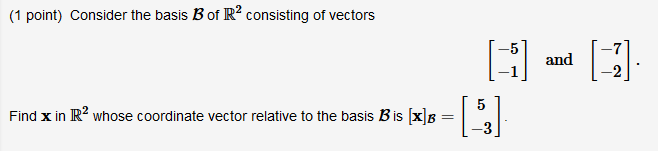
I am having trouble with this question, I thought it was a matter of finding how to combine the basis forming vectors to get the other vector. So I ran through an augmented matrix and solved for the values getting -31/3, 20/3 but it doesn't get me the correct result.
Can someone explain how I am supposed to solve this? I'm not even sure what the [x]B = ... means
https://i.imgur.com/mZbFaQf.png
 dusky epoch
and then uh
you fail to distinguish between capital U and lowercase u in your handwriting at all
and then W3 comes in completely out of left field in the second paragraph
so that's kinda... where the entire thing breaks down
atomic flint
so its wrong?
dusky epoch
it's bordering on the nonsensical but also wrong yes
atomic flint
how do i correct it
dusky epoch
redo it from scratch
atomic flint
ok, but like what do i do different this time
dusky epoch
unfold definitions one by one
what is the definition of the sum of two subspaces of a given space
what does it mean for a vector in a vector space $V$ to be a member of $X+Y$, where $X$ and $Y$ are subspaces of $V$?
stoic pythonBOT
Ann:
dusky epoch
if you can't answer this question then you don't know what the sum of two subspaces is
atomic flint

so i have found this
but since it is minus instead of plus does that change the C variable
atomic flint
is there really that much of a different between the substraction and addition in the (B-C) element
dusky epoch
...
i'd say you really are clueless, but you'd accuse me of putting you down!
subspace addition is a specifically linear-algebraic operation!
atomic flint
Ive been trying to figure this out for the last 4 nearly 5 hrs so at this point i am clueless
dusky epoch
and you CLEARLY don't know what it is nor are you making any productive effort to patch that hole in your knowledge!
do you not have any class notes or a textbook?
also, maybe you should take a fucking break if you've been at this for 4 hours straight!
atomic flint
ive looked through it and it doesnt state anything about it, this professor has a done this sort of stuff befor
i took a break from this yesterday and the day before
but i havent figured it out
atomic flint
lecture notes
dusky epoch
it is impossible that the lecture notes do not define subspace addition anywhere
what topic do they start at
 dusky epoch
ok and are you SURE it doesn't mention "subspace addition" or "subspace sum" anywhere at all
bc i refuse to believe that
pliant thistle
how would I solve a) , using what method or what should be my first step to get started?
atomic flint
@dusky epoch
uncut forge
@atomic flint the page you sent looks like consequences of a definition
The definition is something like this: If U is a vector space and X and Y subspaces to U, then we define V:=X+Y as the set of all vectors v that can be written as a+b where a is in X and b is in Y
The page you sent confirms that V is also a subspace of U
 lone quail
Exercise 2c)
Let f:R4 ->R4 and g:R4->R4 be linear functions so that V=im(f) and W=ker(g)
C) determine explicitly two linear functions f and g so that ker(f o g)=W
uncut forge
@pliant thistle That's not linear algebra, but just use the substitution t=x^2 to solve it
pliant thistle
weird bc it’s in my linear algebra exercises
lone quail
Yeah cos that’s non uni algebra, linear algebra assumes a different connotation after
Anyways anyone know how to solve the above?
uncut forge
I can't read everything
atomic flint
Aoikunie
lone quail
@uncut forge i translated
uncut forge
Does f and g have to be from R4 to R4
lone quail
Yes
 uncut forge
No I don't think so
I'm not sure if I read everything correctly though, very tired right now
lone quail
I need help xd
uncut forge
To show something is a subset of something else. Take an arbitrary element from the first set and show it belongs to the second set too
lone quail
Anyways I’m updating the translation
uncut forge
@lone quail easiest I can think of is to just let f be identity
And let g be the function that maps (x,y,z,t) to (x+2y+z,z-t,0,0)
lone quail
I’m pretty sure you cant do it that way
lone quail
Because you would have to consider the bases of W
And expand those bases
To R4
Instead
lone quail
Could you show me an example? I really have no reference
I never did any similar exercise
I really wouldn’t know what to do
uncut forge
I gave an example above
lone quail
Yeah but I don’t get why that would yield me nay result
uncut forge
Because the only element that gets mapped to (0,0,0,0) is elements from W
And f is just identity so fog=g
lone quail
What do you mean identity
uncut forge
Ah wait I missed your first part
About V=im(f) and W=ker(g)
Identity is the function that does nothing
But gotta go now, sorry
lone quail
Rip
Thanks anyways
Let f:R4 ->R4 and g:R4->R4 be linear functions so that V=im(f) and W=ker(g)
C) determine explicitly two linear functions f and g so that ker(f o g)=W
How to solve c)? (I reposted for ease of viewing)
 lunar sable
Hello all
lone quail
<@&286206848099549185>
 lament atlas
a(1,-1,0)
b(2,0,1)
Given a vector c such that a ^ b • c = 4, calculate the volume of the parallelepiped formed by the vectors:
−b, 2c and a.
Can someone help me?
lament atlas
<@&286206848099549185>
wintry steppe
so the volume of the parralelepiped is the determinant of the 3d matrix
when -b 2c and a are concatenated
 steady fiber
what is a^b
wintry steppe
yeah
steady fiber
how does one take an exponent of a vector
wintry steppe
idk what that means
steady fiber
is that supposed to be a cross product??
assuming it is, then (a x b) * c is just the signed volume of the parallelepiped made by a,b,c
(a x -b) * 2c would just be -2 (a x b) * c = -8
lament atlas
Its the external product
@steady fiber and @wintry steppe
I haven't learned about determinants yet.
lament atlas
steady fiber
it's called the scalar triple product, and it's quite famous as the volume of a parallelepiped
if you have (a x b) * c, and that gives the volume of a parallelepiped
with edges a,b,c
and you know the volume of that is 4
let's say you scale one side by 2
then the volume doubles
wintry steppe
essentially you find the area of the base with the cross product and the height with the dot product
steady fiber
and you scale another side by -1
wintry steppe
and then multiply
lament atlas
Is it possible to find out c?
lament atlas
How?
wintry steppe
yeah you can
steady fiber
I don't think it's possible to find a unique c
wintry steppe
yeah not unique
steady fiber
you can find a c, but not a unique c
but it doesn't matter
what c is
just the formula matters
lament atlas
If i scale another side by - 1 it would be just 8?
lament atlas
Niceee i think i get it
wintry steppe
yes
its just the orientation
think of it like the number line
-1 is negative cuz it is to the left of 0
but it's distance from 0 is 1
wintry steppe
the volume is still -8
steady fiber
the signed volume is -8
the volume is 8
ever so slightly different things
and the negative sign just has information about how the three sides are oriented
lament atlas
Yes i get it
Its because the modules
In my country we use the ^ to represent the external product
@steady fiber
@wintry steppe
lament atlas
Portugal
wintry steppe
ah
lament atlas
Do u study?
steady fiber
yes ^ is the external product symbol everywhere
I just didn't realize ^ was that symbol
also typically cross product is used there
 gilded harbor
wintry steppe
gilded harbor
wintry steppe
The IV quadrant is one such that x is positive and y is negative.
We know tan theta is -12/5
But we know that tan is: sin/cos
gilded harbor
so cos theta is 5/13?
stoic pythonBOT
rudy:
stoic pythonBOT
rudy:
stoic pythonBOT
 Requested by rudy#0446
wintry steppe
Requested by rudy#0446
wintry steppe
And thats cos^2 x
gilded harbor
oh ty
wintry steppe
So clearly
gilded harbor
so u have to square root?
gilded harbor
oh ok ty
wintry steppe
Have you done things like this before?
Did you know sin^2 x = 1 - cos^2 x
hii, i have a little problem, someone can help-me ?
here is
$H\text{ is a subspace of U}\newline
H^\bot\text{ is orthogonal subspace of H}\newline
R_H(v)=
\begin{cases}
v, if\ v\ \in H\newline
-v, if\ v\ \in H^\bot
\end{cases}$
i have to show that is a linear transformation
 pallid swallow
well, you mean "extend it to a linear transformation"
if f(x) is linear transformation, then f(ax+y)=af(x)+f(y) for all a in base field
@wintry steppe
stoic pythonBOT
r41nm4ker:
wintry steppe
hmmmm
i'm confused
i tried show this
through cases, but with v in H and H orthogonal i does't figured how works
 mossy shell
is it just me or is that so small it's unreadable?
mossy shell
okie better ❤
 exotic nova
For the record, the column space of a matrix is the span of the vectors in the columns and the row space is the span of the vectors you’d get by looking at the vectors you’d get from the entries in each row, right?
mossy shell
@gilded harbor can you explain how you got to 146875?
 carmine terrace
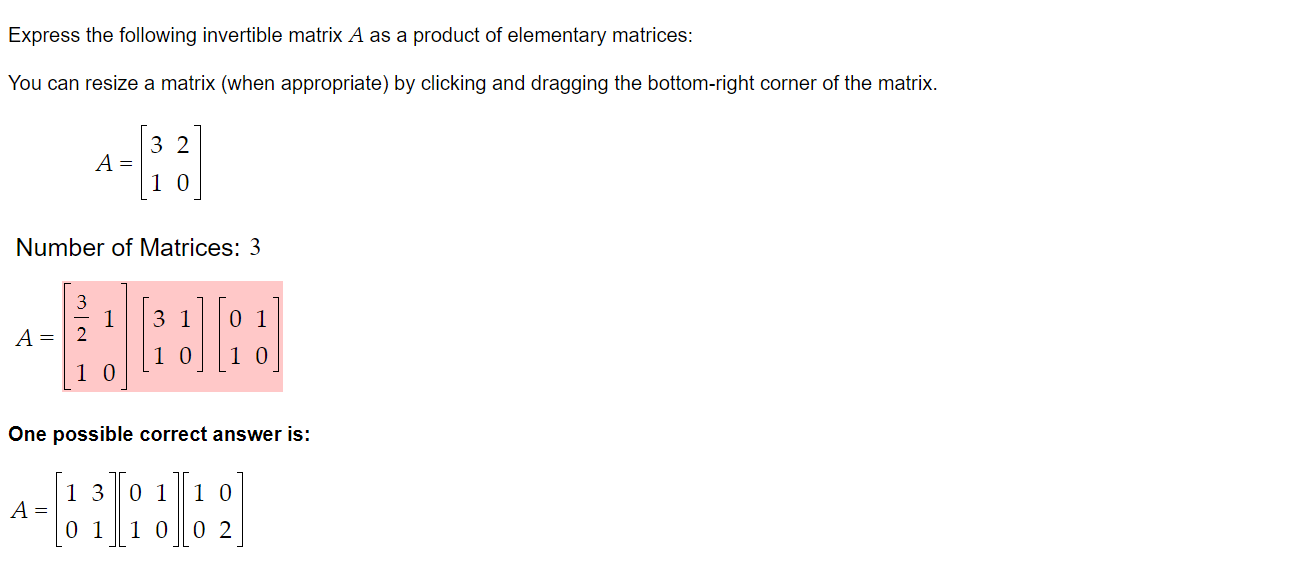
these are driving me crazy
can someone spot what I'm doing wrong?
These are elementary matrices
 gilded harbor
slow scroll
gilded harbor
slow scroll
@gilded harbor this is really the wrong channel for that. #precalculus
gilded harbor
oh that's precalc?
dusky epoch
@atomic flint i was asleep when you sent that
but this isn't at all what you were asked to prove
you weren't asked to prove that either side of the inclusion was a subspace
pallid swallow
@carmine terrace the antidiagonal is 1 for some reason. Other than [0 1][1 0], those are not elementary matrices
carmine terrace
I've been at this for 2 hours and I haven't gotten any of them right
what I was doing wrong at first was for every E^x I was following what I did for the previous one
instead of restarting with the original identity of
1 0
0 1
for every step of the RREF
pallid swallow
you construct an elementary matrix for each step, yes
carmine terrace
but even doing that way I'm still doing it wrong
pallid swallow
but why are you appending it to the matrix?
carmine terrace
just for me to keep better track
that's hte last one i did
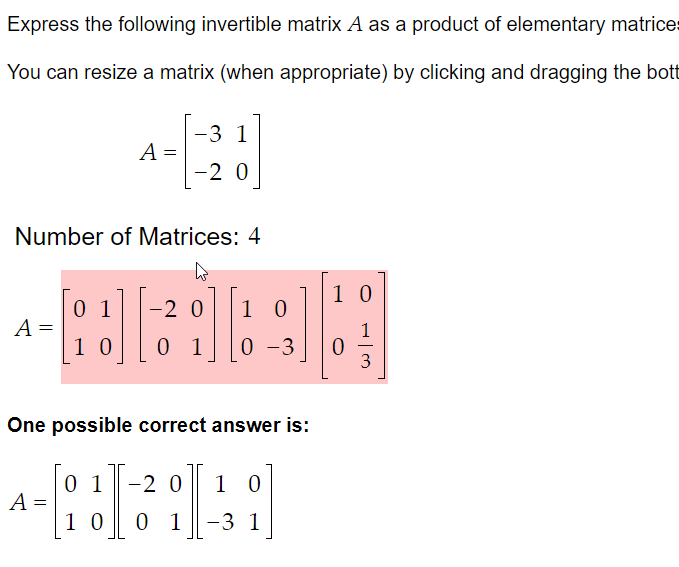
this is driving me insane, not a single one correct so far
carmine terrace
I'm not sure too be honest, considering I'm getting them wrong
I've been watching youtube videos
and they just do them as regular row operations
for both the E^x and the regular one
regular matrix*
Then the Identity is I = E^xA and we use the inverse to isolate A
pallid swallow
Okay, since we are dealing with rows, we need to left multiply these elementary matrices to perform that operation
carmine terrace
what do you mean with left multiply?
pallid swallow
multiply the elementary matrix on the left of whatever you want to do the row operation on
R1+R2 is identity matrix + a 1 somewhere else
carmine terrace
I'm going to be very honest. I feel dumb, I'm having a hard time following. what's the A1 somewhere else
pallid swallow
not A 1
A "add a row to another row" is identity matrix with one extra nonzero entry
@carmine terrace
carmine terrace
so just regular row operations?
pallid swallow
idk what you are asking about
carmine terrace
I'm just super confused. On the work I did where did I go wrong?
I just have no idea.
I'm doing regular row operations on the Matrix that I need to invert
and whatever I do to that matrix, I do to the Matrix 1 0
0 1 which I think is what is the elementary matrix
but I'm not 100% sure
pallid swallow
that is an elementary matrix you constructed, yes
so do you see what happens when you add a row to another row for the identity matrix?
carmine terrace
yes it changes it
the goal is to reduce to the same form as the elementary matrix
I just got my first right answer in the past 2 hour 40 min

but IDk what I did wrong on the previous one.
I did it the same way I've been doing it
and I thought that If I multipled the inverses of Elementary matrixes, that they should multiply to the original A matrix
pallid swallow
Let me try to write this out properly
carmine terrace
awesome thank you. I would greatly appreciate it
pallid swallow
$E_1=\begin{pmatrix}
1 & -5\
0 & 1
\end{pmatrix}\
E_2=\begin{pmatrix}
2 & 0\
0 & 1
\end{pmatrix}\
E_1^{-1}=\begin{pmatrix}
1 & 5\
0 & 1
\end{pmatrix}\
E_2^{-1}=\begin{pmatrix}
\frac{1}{2} & 0\
0 & 1
\end{pmatrix}\$
stoic pythonBOT
Element118:
stoic pythonBOT
Element118:
pallid swallow
because elementary matrices are applied on the left
carmine terrace
yes
pallid swallow
$E_2E_1A=I$, so left multiplying by $E_2^{-1}$ we get\
$E_2^{-1}E_2E_1A=E_2^{-1}$, so\
$E_1A=E_2^{-1}$, so left multiplying by $E_1^{-1}$ we get\
$A=E_1^{-1}E_2^{-1}$
get it?
carmine terrace
yea, I understand the general ide abehind it
stoic pythonBOT
Element118:
pallid swallow
because the way you wrote it, it looks like you aren't even aware matrix multiplication is noncommutative
carmine terrace
ah i see what you mean now
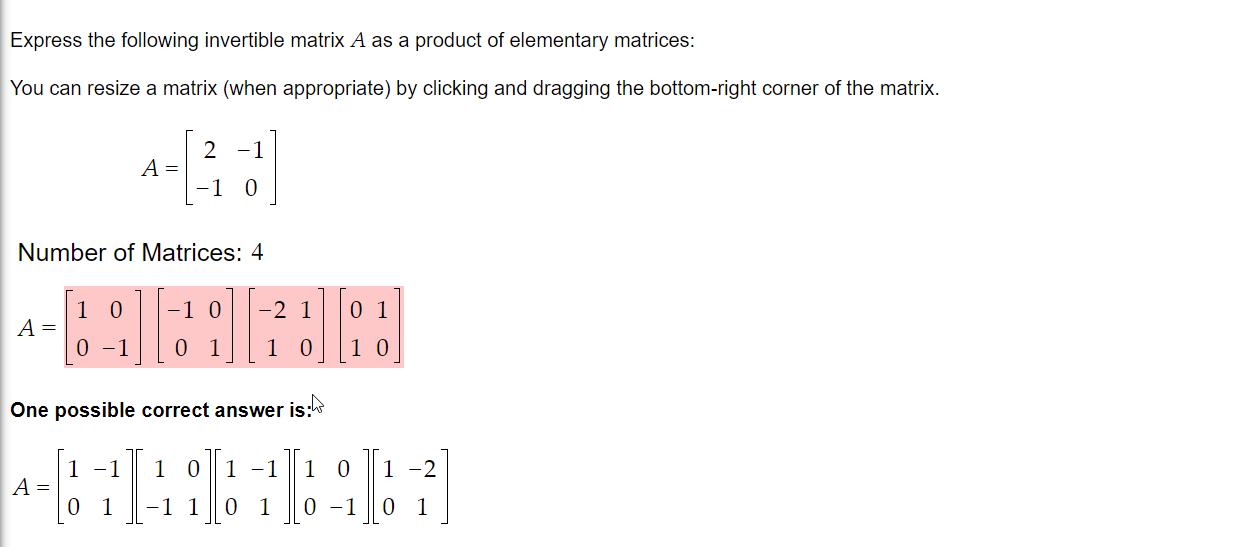 slow scroll
The third matrix doesn’t appear to be an elementary matrix as it’s a product of two elementary matrices (one that adds -2 times row 1 to row 2 by one that switches the first and second rows)
carmine terrace
I tap out, 3 hours and I got only one problem right RIP I don't get it
 spice storm
@carmine terrace it takes practice
pallid swallow
Let's write those labels as subscripts, shall we?
@carmine terrace
How did you get the matrix for adding 2 times of R1 to R2?
@carmine terrace
carmine terrace
@pallid swallow i was away from my computer for a bit
I didn't catch that mistake at the time
it seems I got the wrong E matrix
I'm going to restart another one and see how it goes
pallid swallow
okay
carmine terrace
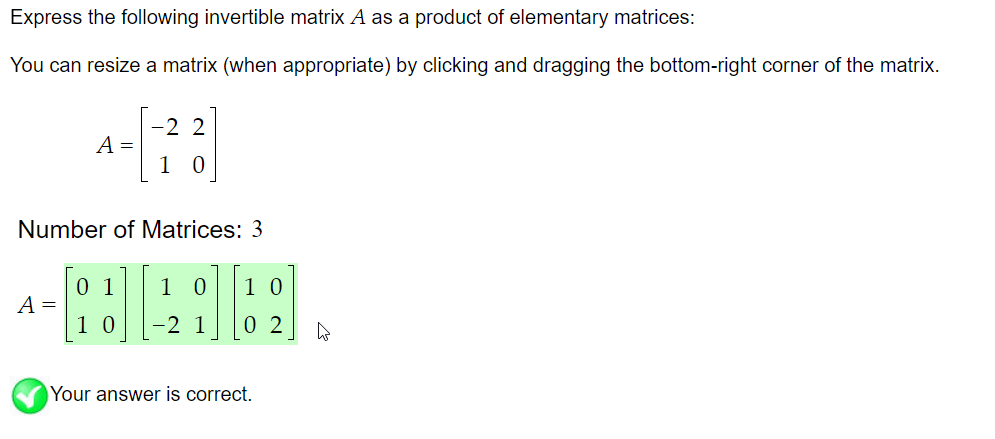
things are looking up
Imma do 2 more and see if I can make it three in a row
pallid swallow
sure
carmine terrace
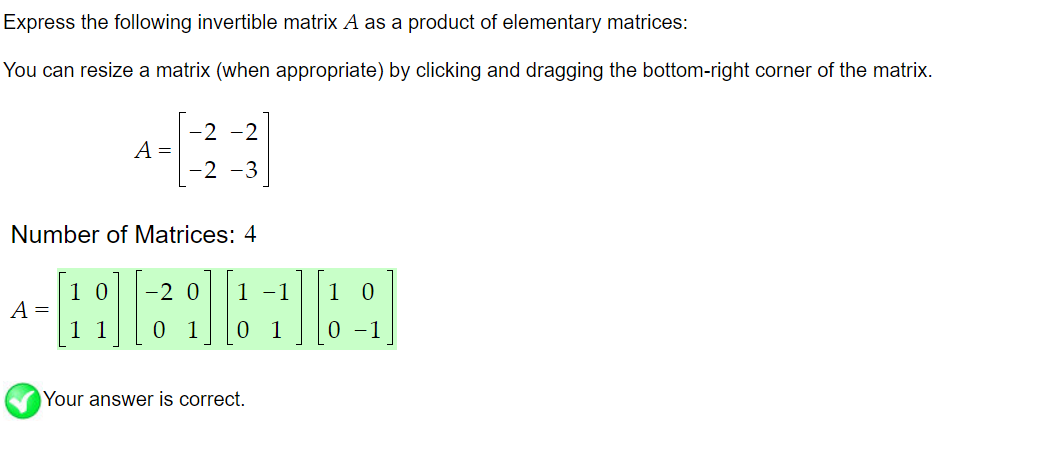




ah bless jesus
when I choose the row operatoin
oh nvm I see what I did wrong
undone garnet
$\begin{vmatrix}a^{k_1}&a^{k_2}&a^{k_3}&\cdots&a^{k_n}\end{vmatrix}$\
$a^{k_1}\begin{vmatrix}1&a^{k_2-k_1}&a^{k_3-k_1}&\cdots&a^{k_n-k_1}\end{vmatrix}$\
$a^{k_1}.a^{k_2-k_1-1}\begin{vmatrix}1&a&a^{k_3-k_2+1}&\cdots&a^{k_n-k_2+1}\end{vmatrix}$\
$a^{k_1}.a^{k_2-k_1-1}.a^{k_3-k_2-1}\begin{vmatrix}1&a&a^2&\cdots&a^{k_n-k_3+2}\end{vmatrix}$\
...\
$a^{k_1}.a^{k_2-k_1-1}.a^{k_3-k_2-1}\cdots.a^{k_n-k_{n-1}-1}\begin{vmatrix}1&a&a^2&\cdots&a^{n-1}\end{vmatrix}$\
$a^{k_n-(n-1)}\begin{vmatrix}1&a&a^2&\cdots&a^{n-1}\end{vmatrix} > 0$\
stoic pythonBOT
Nguyễn Thành Trung: