#discrete-math
1 messages · Page 226 of 1
 tidal tulip
the trick was to use the idempotent law which i was unaware of
basically states (x in A and x in A) = x in A and (x in A or x in A) = x in A
and then you use assoc
comm
group them
get what you desire
tidal tulip
tidal tulip
basically states (x in A and x in A) = x in A and (x in A or x in A) = x in A
is that right for idempotent law?
 wide vine
I guess but really it just says if you have some set A
A U A = A
A n A = A
so in your case when they said
tidal tulip
ok that was the idea i was missing - very helpful
ty for helping i learned something
 light heath
yea I ended up redoing it by using a specific example
this is my updated solution to number 22

could someone give it a look
 weary tiger
anyone can someone please explain me the formula for combination with repititions
i am really confused

 cerulean wind
chinese remainder theorem and eulers theorem
 outer rune
i dont know what that is
oh
i know what that is but i learned this before chinese remainder theorem
is there a more basic way
cerulean wind
it sounds like this is from a class you're taking. maybe try looking at past lecture notes? im not sure of a more simple method
 woven lagoon
how would I begin to prove Z×Z→Z is onto if f(x, y) = x^2 − y^2?
weary tiger
woven lagoon
how would I begin to prove Z×Z→Z is onto if f(x, y) = x^2 − y^2?
well, onto implies surjection, so think about that
cerulean wind
woven lagoon
how would I begin to prove Z×Z→Z is onto if f(x, y) = x^2 − y^2?
break it into cases depending on whether or not z is even or odd. also recall that x^2 - y^2 = (x - y)(x + y)
 cerulean wind
 onyx hull
Anyone have some good youtube links to learn this?
onyx hull
Anyone have some good youtube links to learn this?
this is more suited for #prealg-and-algebra or #precalculus
 obtuse lance
woven lagoon
how would I begin to prove Z×Z→Z is onto if f(x, y) = x^2 − y^2?
obtuse lance
woven lagoon
how would I begin to prove Z×Z→Z is onto if f(x, y) = x^2 − y^2?
2=x^2-y^2 has no solution mod 4
weary tiger

I hope I'm not missing something, but b) and c) are unanswerable correct?
ik this is more algebra but i didnt have access to that channel
cerulean wind
weary tiger
I hope I'm not missing something, but b) and c) are unanswerable correct?
why do you think they are unanswerable?
weary tiger
Because for the composite relation to be defined, you need to have it like a chain, so S o R is defined because R: A --> B and S: B --> C
And I don't even know where the elements in the ordered pairs of T come from
T could be from any set to any set
cerulean wind
T is a subset of {1,3,4} x {1,4,5}. R is a subset of {1,2,3,5} x {2,4,5}.
that said, T is also a subset of {1,3,4} x {1,2,3,4,5} and R is also a subset of {1,2,3,4,5} x {2,4,5}
note {1,2,3,4,5} = {1,4,5} U {1,2,3,5}
i agree that the problem statement lacks precision
but the question itself is certainly answerable
weary tiger
Yes certainly lacks precision because the '1's in T's ordered pairs can be different from the '1's in the other ordered pairs of R or S
I guess he just assumes you will assume that they are constructed from the same sets
weary tiger
cerulean wind
T is a subset of {1,3,4} x {1,4,5}. R is a subset of {1,2,3,5} x {2,4,5}.
that ...
Thank you
cerulean wind
weary tiger
Yes certainly lacks precision because the '1's in T's ordered pairs can be diffe...
im not sure what you mean here
wide vine
cerulean wind
im not sure what you mean here
i think they are saying the 1's might represent something else
cerulean wind
ah, for me that would be a reach
weary tiger
I just assumed since I'm in a mathematical reasoning course, that might not be out of the realm of possibility for him to pull something like that 
cerulean wind
if thats the case then you should be arguing with me over whether or not the 2 in Z is the same as the 2 in R, or the 2 + 0i in C
1 is a 1 is a 1 is a 1 unless otherwise specified. it would be weird one of the 1's here were like, the identity element of some group
weary tiger
I could make a case that they aren't the same, as in, the 2 in Z represents 2 'hatches' on the non-complete number line, the 2 in R represents 2 hatches on the real line, and the 2 + 0i in C represents 2 hatches along the real line, in the complex plane
if we're talking about the elements representing something
but i guess that would be false since R is constructed from Z
wide vine
well they are subsets
cerulean wind
wide vine
well they are subsets
realized as subsets
weary tiger
cerulean wind
ah, for me that would be a reach
but you're right, i'll just go with the assumption he wants us to make to complete the problem
thank you
wide vine
cerulean wind
realized as subsets
wdym by that
you mean it isn't so easy to show it is true?
cerulean wind
Z (technically) isnt a subset of Q, Q isnt (technically) a subset of R
but its so minor that we just ignore it
weary tiger
ohhh since Q is constructed by equivalence classes
cerulean wind
yes
weary tiger
makes sense
cerulean wind
but again, thats really pedantic and technical and nobody really cares
weary tiger
except the logicians 😭
 formal flicker
Does anybody know a good YouTube video that explains this?

 spring surge
I am writing poker related software.. What maths should I look up to into in order to minimize the combinatorical calculations ? I'd like to try find some algebraic pattern which i can exploit reducing load on CPU.
outer rune
What do i need to do to prove the divisibility rule of 2
like how do i prove that a number is divisible by 2
lets say N = 5814, what steps do i take to prove that 2 | 5814
in my professors lecture it has something to do with congruence but i dont understand
 coral parcel
Multiply 3907 by 2 and point to the result?
 stray reef
"prove the divisibility rule of 2" and "prove that a (particular) number is divisible by 2" are two very different tasks
outer rune

My professors notes on the divisibility rule by 2
i dont understand what im supposed to do
what is the rule
theres just a bunch of stuff but what is the actual rule that i use?
stray reef
2 | N <=> 2 | (last digit of N)
that's the rule
said in words, "a number is even iff its last digit is even"
stray reef
that is how your professor chooses to prove why the rule works.
stray reef
a little overkill and a little abuse of notation but it works as a proof
outer rune
yeah it rreally confused me
stray reef
the proof hinges on the fact that 10 is even and that the last digit of a number is, by definition, its remainder mod 10
wide vine
formal flicker
Does anybody know a good YouTube video that explains this?
Are you trying to set up a boolean equation that will be true under specific xyz inputs?
Because the common approach is sum of products
you only worry about the solutions the F(x,y,z) that evaluate to 1 and write out the entire boolean expression that gave you 1
Here is one example from my notes that goes over it

I would recommend look up "Sum of products" and converting truth tables as sum or produts
This video seems okay
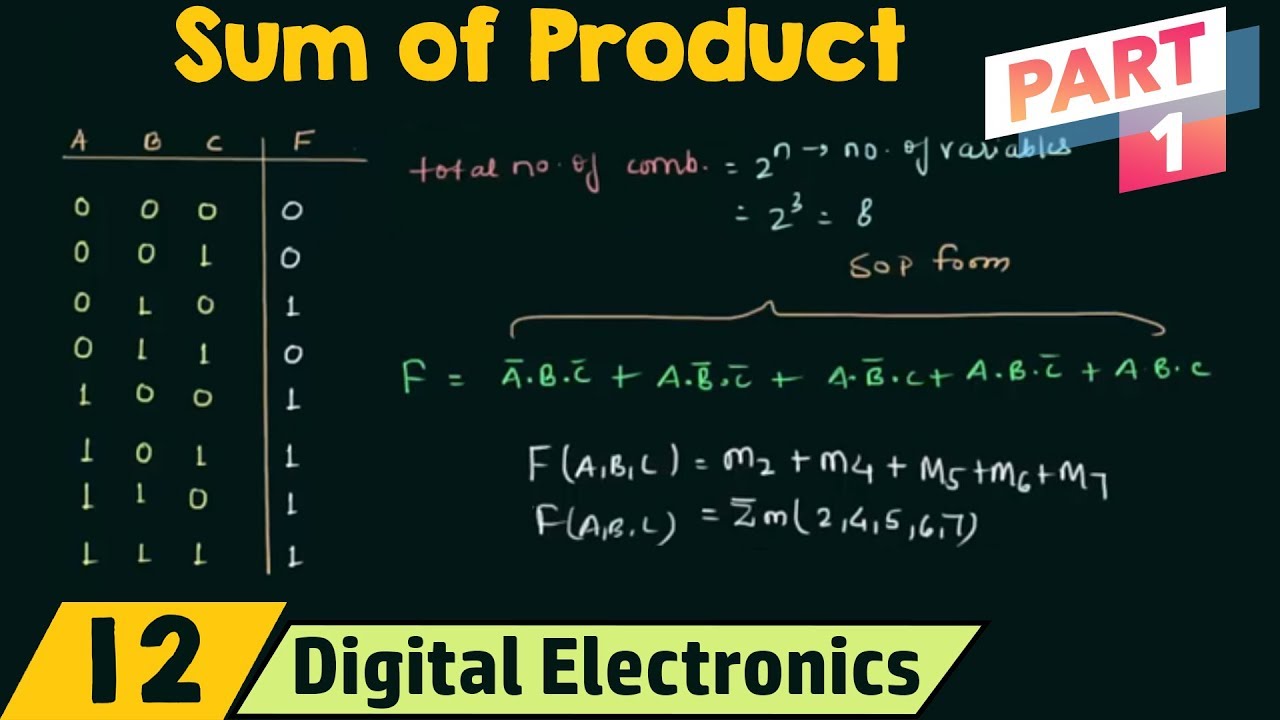
Digital Electronics: Sum of Products (SOP) Form in Digital Electronics
Topics discussed:
- Sum of products form.
- Example of sum of products form.
- Standard or Canonical sum of products form.
- Minterms.
Follow Neso Academy on Instagram: @nesoacademy(https://bit.ly/2XP63OE)
Follow me on Instagram: @sujeetsingh20(https://bit.ly/2JLcQz5)
C...
There is also a product of sums form but doesn't seem your assignment is looking for that
and you might have to simplify those sum of products

 little prism
d|2014 means 2014=dk, the other means 2067=dm. then 2067-2014=dm-dk=d(m-k) and d divides the difference
 sacred dune
Could someone provide a hint to this problem from my discrete math class? I’ve been stuck on it for >4h… It asks us to prove that given n reals a_i with |a_i|>= 1, the number of solutions to -1< e_1a_1 + … + e_na_n < 1 with e_i = +-1 is less than or equal to n choose floor(n/2)
I’ve mainly been focusing on trying to solve it for a_i integers and hopefully gain insight there but I haven’t made any progress: I’ve looked at a bunch of different structures that might give me some insight but except for a few simple realizations I haven’t gotten much
wide vine
sacred dune
Could someone provide a hint to this problem from my discrete math class? I’ve b...
can you give me a few examples of this in action because I am not sure what is going on
or 1
sacred dune
For example take a_1 = 1.5, a_2 = 3, a_3 = 2. Then the possible solutions are a_1-a_2+a_3, -a_1+a_2-a_3, and this is smaller than 3 choose 1
(ie 2<=3)
wide vine
so as long as |a_1| >=1 and by solutions you mean you mentioned that by taking either sums or differences it will fall between -1 and 1?
sacred dune
Yes, a solution is a sequence (e_1,…,e_n) in {-1,1}^n
And they are coefficients of the sum
wide vine
how are the other numbers a_2 and a_3 generated or is it only important that a_1 has a magnitude >=1?
sacred dune
No no a_2 and a_3 aren’t generated
sacred dune
They are all given and of magnitude >=1
sacred dune
Just to bring you up to where I got to, here are the only simple results I got
We can suppose all a_i positive wlog. If the a_i’s are integers they must have even sum (say 2k). We are then looking for subsets of {a_1,…,a_n} whose elements sum to k. This seems the most promising approach to me for the integers case
Reason I’m considering integers is because replacing all the inequalities with 1 by M yields an equivalent problem, and so when solving for rationals we can forget the common denominator
And then I was hoping density might lead the result for the reals
wide vine
this problem sounds hard. Is this like a normal first discrete math course?
sacred dune
Yeah
wide vine
Anyways I think I will play around with it and see if I have anything insightful
Is there a specific topic you are doing right now?
sacred dune
No this is exam revision
 sacred dune
In general we’ve seen things like generating functions, graphs, linear recurrences, mobius inversion, asymptotic estimates for binomial coefficients, probability, and some other stuff
So a typical first course
Since this is supposed to be exam level there’s probably just one smart idea that resolves it in like 15m but I can’t figure it out
wide vine
we never touched those topics 😦 other than graphs and a bit of recurrence and closed form about very specific functiosn
sacred dune
I don’t think it needs an intensive theory though, just a change in perspective
wide vine
we did sets, logic, induction and recursion, basic function stuff (domain, range, codomain, injective, surjective, bijective), relations, directed graphs
sacred dune
It might be cause it’s second semester course
So the function stuff was covered first sem
 viral crown
If the a_i’s are integers they must have even sum (say 2k).
isnt this just
wrong
?
wide vine
do you know the cases that will always maximize the upper bound?
wide vine
i guess I probably will be of little help but let me know if you figure it out (ill look at it after my linear algebra stuff not that I think I will not fair much better)
viral crown
i think maybe since it's asking about n and not specific kinds of a_i focusing on n could be better?
for example if n is even or odd?
sacred dune
I mean for the case n is even there is that intuition of the most balanced set being when all the a’s are equal
viral crown
also wait. say a_1 = 103102381, a_2 = 2, and a_3 = 3
sacred dune
This notion of balance made me think there might be something to do with entropy but I don’t know anything about entropy
sacred dune
viral crown
also wait. say a_1 = 103102381, a_2 = 2, and a_3 = 3
Then no solution
viral crown
if you assume all are positive then there are solutions iif you add some of the a_i you are +-1 if you add up the others and the the number of solutions corresponds to the different ways of adding them up, right?
sacred dune
Could you rephrase that
viral crown
yes
wide vine
sacred dune
Could you rephrase that
I think they are saying the solutions are defined in terms of the coeffiencts
sacred dune
I mean yeah solutions are the coefficients 🤔
It doesn’t really matter what the solutions are though only how many there are (or there are at most)
viral crown
i'm saying that there are solutions iif you can add up some combination of the a_is such that if you add up the others and add or subtract one, then the inequality between the two changes or turns into an equal sign
wide vine
sacred dune
It doesn’t really matter what the solutions are though only how many there are (...
well if all the co-effiecnts are positive as a solution then you would also know that having all negatives is a solution, right?
viral crown
and the number of solutions is the same as the different number of ways to add both of them up
sacred dune
viral crown
i'm saying that there are solutions iif you can add up some combination of the a...
Im still not getting you
sacred dune
wide vine
well if all the co-effiecnts are positive as a solution then you would also know...
Can’t have all coefficients positive
viral crown
wait let me rephrase
If all a_i are positive, then there are solutions iif you can sum some combination of them such that if you sum the rest, the difference between them is at most 1.
sacred dune
Why do you say that
Oh positive sum
Yeah sure I agree (though it would be at most 2)
viral crown
difference
sacred dune
Oop yeah
viral crown
and i think this implies that there can only be an even number of solutions
sacred dune
I still think it would be more helpful to start thinking about integers
sacred dune
viral crown
and i think this implies that there can only be an even number of solutions
This follows from the coefficient symmetry
viral crown
that too
sacred dune
I should be getting a correction of this exercise in a week or so I’ll let you know if I haven’t figured it out by then
 raven grove
can someone help me prove this?
if a^2 is a multiple of 3 ,then a is a multiple of 3
and a is a natural number
coral parcel
Do you have Euclid's lemma?
raven grove
idk what that is
just need to prove that using a proof by contrapositive or proof by contradiction
cerulean wind
raven grove
just need to prove that using a proof by contrapositive or proof by contradictio...
do a proof by cases: a must be of the form 3k, 3k+1, or 3k+2. just rule out the cases where a = 3k+1 or a = 3k+2.
weary tiger
can anyone explain the combinatorial proof of pascals identity?
C(n,r) = C(n-1, r-1) + C(n-1, r)
 haughty garden
Imagine you want to find the number of ways to pick r objects out of n many possibilities and let’s consider one such object. Call this object x.
On the one hand, the number of ways to pick r objects (with or without x) is simply C(n, r). On the other hand, let’s consider separately what happens when we pick or don’t pick x.
If we pick x, then you are ensured that this object is in the subset of r objects that we pick. To pick the remaining objects, we exclude x from our total number of objects AND the number of objects we have remaining to choose. In other words, we have n - 1 objects remaining to choose r - 1. You can do this in C(n - 1, r - 1) ways. See if you can reason about C(n - 1, r) by considering what happens when we exclude x from our subset of r objects
weary tiger
If we exclude x, then we have n-1 total objects (as x isn't included), and we have r objects to choose from those n-1 objects because x wasn't picked
is that good reasoning?
haughty garden
Yep
viral crown
raven grove
just need to prove that using a proof by contrapositive or proof by contradictio...
look up the fundamental theorem of arithmetic
wide vine
@sacred dune any luck on your problem?
 true venture
sacred dune
Could someone provide a hint to this problem from my discrete math class? I’ve b...
true venture
sacred dune
Could someone provide a hint to this problem from my discrete math class? I’ve b...
Because e_i can only be +1 or -1, there are 2^n possible arrangements of e's for a set of n real numbers. And if all the e values in a given arrangement are the same sign there is no possible solution.
There will always be only two arrangements with all e having the same sign.
So the number of possible arrangements of e coefficients for a given set of n real numbers with a solution is (2^n)-2.
(2^n)-2 is always <= n choose floor (n/2)
true venture
wide vine
<@301050945763016704> any luck on your problem?
That is my thoughts, I'm not sure how to make it a proof
true venture
true venture
Because e_i can only be +1 or -1, there are 2^n possible arrangements of e's for...
Hmm, actually there are values where all -1 e's will work but then, two of the other possible combinations would not work. So I still think there are at most (2^n)-2 solutions which is <= the range given
 unreal stump
The thing is $\2^n-2 > \binom{n}{\floor{\frac{n}{2}}}$
 vital dewBOT
Drake
 unreal stump
@true venture
unreal stump
Because $\2^n=\sum_{i=0}^{n}\binom{n}{i}\$
There's a term where i is $\floor{\frac{n}{2}}$
vital dewBOT
Drake
 true venture
Oof I see
sacred dune
true venture
Because e_i can only be +1 or -1, there are 2^n possible arrangements of e's for...
Yeah as drake pointed out the final inequality is wrong
If you want a combinatorial interpretation for n choose n/2 here, the case n= even, a_1=…=a_n achieves this upper bound
formal flicker
Can someone please expand this definition
 obtuse lance
it's not really a definition, more of a theorem
cerulean wind
formal flicker
Can someone please expand this definition
it says that X bijects onto a proper subset of itself, so i can squeeze a "smaller" copy of X inside of X
viral crown
so if you assigned n to 2n
that would be like that?
since set of even numbers is obviously a proper subset of n
obtuse lance
yep
viral crown
oh cool cool
formal flicker
cerulean wind
it says that X bijects onto a proper subset of itself, so i can squeeze a "small...
Thank you
Can you please also explain the proof of part a of the theorem ( the circled part)

 west vessel
Can you take a better picture
 formal flicker
Hey I seriously need help with this
 silent frost
I have bezoutyish equation 27x + 59y = 1, using egcd I got x = -24, y = 11
How do I find all the other solutions?
Oh ok, so x mod 59
so -24 + 59n and 27n + 11 are solutions?
Wait no
-24 + 59n is ok
11 - 27n is what i need
but why...
Yeah so all solutions of 27x + 59y = 1, are:
x = 59n + (-24)
y = -27n + (11)
But why is 'y''s one a minus?
actually nvm
unreal stump
Hint: what can you say about solutions of 27x+59y=0
silent frost
I was going to do:
27(59n + (-24)) + 59(-27n + 11) = 1
so
27*59n + 27(-24) + 59(-27)n + 59(11) = 1
27*59n - 59(27)n + 27(-24) + 59(11) = 1
unreal stump
Well ok you are right
silent frost
So given any ax + by = c
And if I have solutions x, y
I can go ahead and add (abn - abn) to the equation
And generate all the other solutions...
silent frost
Yea?
x = -1, and y = 1
Then 2x + 6y + (2 * 6n - 2*6n) = 1
2x + 2*6n + 6y - 2*6n = 1
2(x + 6n) + 6(y - 2n) = 1
So all solutions are x = 6n - 1, y = 1 - 2n?
unreal stump
Not exactly
silent frost
Where have I dungoofed?
unreal stump
x=3n-1,y=1-n is the general solution
silent frost
Oh I have to remove the common factors?
unreal stump
Yes
silent frost
And then it's general... yeah that makes sense
silent frost
Idk man looks good to me...
unreal stump
Yea it's enough
silent frost
Is there a prettier way of doing it?
Rather than the weird method i used from (abn - abn) then common factor?
So is the general method:
"all solutions" will be:
x = bn + u
y = ab - v (where u, v are certain solutions)
Then removing common factor from b, n
unreal stump
So let (x_0,y_0) be a particular solution to ax+by=c,then suppose (x_1,y_1) is another solution,then
a x_1+b y_1=c
a x_0+b y_0=c
a(x_1-x_0)+b(y_1-y_0)=0
Which implies it's enough to find all solutions to ax+by=0 to find the general solution for ax+by=c
weary tiger
I am a bit confused on the topics of recurrence relations in discrete math. I would like to practice these types of problems but I have a couple of questions
1.) Is iterative method and recursive method the two traditional ways to approach these types of problems? My professor said to know iteration way, so I am wondering what are the other ways to approach solving recurrence relations
just to clarify I'm not really sure what is meant by iterative and recursive? Like I know in programming iterative means typically the usage of for/while loops and recursion is just recursion, but I am not sure what that looks like when solving these problems?
2.) Does anyone have a good guide, it seems that there is not a lot of material on how to solve nonhomogeneous/homogeneous linear recurrence relations
Perhaps a video, or a link to a blog or something
silent frost
Right so I can try find the solution by considering the homogenous version?
So solving the homogenous version is the "nicer"/"more standard" method for finding general solutions?
unreal stump
Yes
Well you can say b divides ax
Which is to say b/gcd(a,b) divides x
So this tells us a solution has to be of the form
x=(bk/gcd(a,b)),y=-ak/gcd(a,b)
For some integer k
silent frost
Ok, that makes sense, but that feels like it'd have less solutions than the weird:
x = u + bn, y = v - an, and then remove common factor from a & b
method
Oh
but it'd be the same
since that's doing it for homogenous
and u, v = 0
Ok, thats cool
Damn, nice. That makes a lot more sense
Thanks heeps Drakesama
coral parcel
weary tiger
I am a bit confused on the topics of recurrence relations in discrete math. I wo...
I don't think there is a generally understood distinction between "iterative methods" and "recursive methods" here. The words have clearly distinct meanings in programming, but in a mathematical treatment they tend to blur more together. If they have crisp meanings in the particular course you're following, you may need to consult the course material.
Methods for what exactly, though? There's a difference between trying to find a closed expression for a function that satisfies a recurrence equation, or finding a practical way to compute terms of the sequence defined by a recurrence without going through a closed expression. Or for that matter, finding a shortcut to just the asymptotic behavior of the solution without getting either a closed formula or concrete values.
For example, consider the Fibonacci numbers, the mother of all recurrences. Binet's formula is closed and exact, and is useful for some purposes. But if you want to use it to the exact value of the 1024th Fibonacci number, you need to calculate with an extremely precise approximation of the golden ratio. Then it's much simpler to use successive squarings of an integer generating matrix. On the other other hand, if you want asymptotic growth, Binet's formula immediately tells you what you need to know, and you can ignore its practical shortcomings.
true venture
sacred dune
Yeah as drake pointed out the final inequality is wrong
Did you figure out a correct solution?
sacred dune
true venture
Did you figure out a correct solution?
dont really have time to think about it since it's my last exam and i have to focus on my other exams for now
but ill get back to it once im done with all the other exams
 keen geode
Is this correct?
 coral parcel
Looks like they think an element is in an intersection if it is in more than one of the input sets.
weary tiger
what x could give you f(x)=0?
stray reef
keen geode
Is this correct?
none of this is correct and there are multiple issues with your notation
keen geode
stray reef
none of this is correct and there are multiple issues with your notation
Thought so, didn't seem correct...
Cheers, I'll look into it
keen geode
I just wanna be sure that I'm correct in my way of thinking here;

For the union, the interval ends up being (0,1) because for all i>1, S_i is a subset of S_1, therefore the union is S_1
For the interssection, since for all i>1 S_i is a subset of S_1, and because as n goes towards infinity the final set S__(infinity) is {0,0}, the infinite intersection is thus an empty set?
Also, I'm confused why the person isn't using {} for the sets in S_i, is that correct?
keen geode
And are unions and intersections always written as intervals?
vital dewBOT
Lochverstärker
 keen geode
 pale epoch
there is no $S_\infty$ however
pale epoch
there is no $S_\infty$ however
oh, so how can we justify the second intersection?
keen geode
ohhhhh ok
pale epoch
then for example it certainly must be in S_1 so its between 0 and 1
and now you can try to find an S_i its not in
so whatever element in S_1 you choose is not in some S_i
then the intersection is empty
the other things about curly braces is hmm
you made this error in the other thing you posted (though thats not the only one)
of adding an extra set of curly braces
i would review the definition of intervals
$(a, b) \coloneqq {x\in\bR \mid a < x < b}$
vital dewBOT
Lochverstärker
 pale epoch
so if you enclose it in another set of curly braces, its a set in a set
and we want a set of numbers
pale epoch
and like ${\bN}$ for example is a set of one element
keen geode
and the union is always an interval
vital dewBOT
Lochverstärker
 pale epoch
sure
keen geode
but {0,1} is a set of cardinality 2?
pale epoch
yes
keen geode
fantastic, thanks a lot
pale epoch
i think a good heuristic is to ask yourself what the elements of the sets you are given are
and what the elements of the set you are writing down is
if you take the union/intersection of a set of numbers then the result should be a set of numbers
and not a set whose elements are sets for example
pale epoch
👍
keen geode
I'm ready to face the fact that i'm probably wrong once again, but if I'm not yipee I guess

 fading gust
man wtf is all that crap
keen geode
wdym?
coral parcel
keen geode
I'm ready to face the fact that i'm probably wrong once again, but if I'm not yi...
The first two lines are good, but the third is a bit iffy. There are ways to give a meaning to "lim S_n", and they'd even agree with what you say, but I doubt you have those definitions available.
keen geode
ah
coral parcel
The argument for the middle line you should be making is something like: Because the limit of the fractions is 1, every number that is less than 1 is also less than one of the fractions. Therefore it is in one of the Sn, and therefore it is in the union.
keen geode
coral parcel
The argument for the middle line you _should_ be making is something like: Becau...
Ok, I see the logical thinking
thanks a lot!
stray reef
Because the limit of the fraction is 1, every number that is less than 1 is also less than one of the fractions.
and this argument does not even hold wate
water*
if anything you need to say that the supremum of n/(n+1) for n ranging over the natural numbers is 1.
otherwise the same argument would have you conclude $\bigcup_{n=1}^{\infty} \paren{0, \frac{n+1}{n}} = (0, 1)$ and not $(0, 2)$ as it actually is.
vital dewBOT
Ann
 keen geode
ouf, and I was just about to post another one with the same argument
coral parcel
Okay, strictly speaking I only argued that (0,1) is a subset of the union, not that it is the entire union.
The fact that 1 and numbers larger than 1 are not in the union needs separate reasoning.
 tribal pond
Is it possible that ax=ay and x not equal to y and a not equal to 0??
keen geode
How about this?
 coral parcel
keen geode
How about this?
coral parcel
keen geode
How about this?
Here the limit is in fact irrelevant.
coral parcel
Hmm, it seems to be arguing the wrong way. It is also true that an element that is in all of the sets must be in S_42, but that doesn't mean S_42 is the intersection.
The critical fact is an element of S_1 is also an element of all the other sets. Or in other words, that S_1 is a subset of each of the S_n's.

 sick dirge
keen geode
sick dirge
keen geode
To me it seems this is more an explanation than a proof. To prove those two are equal, you need to prove two subset relations. Any element in the intersection must be in S_1, so it must be in (0, ½) and you'll prove that the intersection is a subset of (0, ½). You also need to show that every element in (0, ½) is in the intersection of the S_n. This will let you conclude that (0, ½) is a subset of the intersection.
Also I think you're confused about the concept of a set. You refer to a set S_x that is in all sets S_n, which doesn't make sense.
coral parcel
It's not uncommon to say "in" (or "contains") about both membership and subset, and leave it to the reader to figure out which of them makes sense.
Unfortunately this tends to create problems for students who have not yet firmly grasped the difference.
sick dirge
Still though I don't think this is sufficient as a proof. It seems like an intuition-based argument and does not use the notion of sets being equal $A = B$ iff $A \subseteq B$ and $B \subseteq A$.
vital dewBOT
PhenomPlasma
 coral parcel
Intuition is important too, though. We're not sure exactly what is expected of Dealersgrip here. (It might be a "lean to write proper proofs" exercise, in which case your criticism is definitely justified, or a "develop a feeling for how sequences of sets behave" exercise).
keen geode
coral parcel
Intuition is important too, though. We're not sure exactly what is expected of D...
more of a developing a feeling exercise
I started getting into set theory very recently, so i'm just trying to get the hand of it
sick dirge
Hm, in that case I'm not very sure if what you wrote would be sufficient. Still though I'd recommend writing it out in a more formal manner. It'll also make your thought process clearer.
I think you have the main idea that because S_1 is the smallest of the S_n that the intersection should be S_1, but the language is a bit vague.
keen geode
In the goal of being sure that I've understood the idea of infinite unions and intersections, I just want to see whether this is correct or not. The next time I post here I'll offer a whole reasoning behind my statements:
 coral parcel
The last line of that seems to claim that, for example, pi is in one of the Sn's. Which of them would that be?
(Or even just 3).
keen geode
coral parcel
The last line of that seems to claim that, for example, pi is in one of the Sn's...
I don't understand 😅
the union of all the Sn is the interval from (1/2) to infinity
or maybe I'm totally wrong
pi is in onne of sns I thinkk
ohhhhh it's not

hmm, how can I re-write this?
coral parcel
I can't offhand think of a nicer way to write the resulting set than the infinite union itself ...
keen geode
that sucks 
 nimble sequoia
what about something like $$\left{ n \in \mathbb{R} | \floor{n} = \floor{n-\frac{1}{2}} \right}$$
vital dewBOT
Nathan_
 nimble sequoia
its not quite right but i think its close
wide vine
so are you asking is that equivalent to R or T?
well okay then
anyways your answer is yes
 weary tiger
tribal pond
Is it possible that ax=ay and x not equal to y and a not equal to 0??
weary tiger
tribal pond
Is it possible that ax=ay and x not equal to y and a not equal to 0??
even if a = 0, this is still ''technically'' incorrect, which is one of the reasons why division by 0 is undefined. but to answer your question, no, it is not possible
tribal pond
weary tiger
even if a = 0, this is still ''technically'' incorrect, which is one of the reas...
Ok thanks
 buoyant zephyr
If I prove that a language would have a pumping length greater than any finite number, have I proven that the language is not a regular language? Idk if you can prove that it would have a pumping length larger than any finite number, but I can prove a language has some string that needs n+1 states for a machine to accept it no matter what n equals. I'm trying to prove that the set of strings that repeat once (w°w) isn't a regular language, and my idea right now rests on showing that for any string in the language, you can make a string not accepted by the machine by simply adding another character to both strings, because you can pump a string of ww by designating y to be the entire string. I figure this is really the only way to prove it's not a regular language? But please do tell me if there's another, simpler way.
This implies that the machine would have to have an infinite number of states to accept this language, I think.
Which contradicts the definition of an FSM
 pastel hollow
my book says that
$$\sum_{k > N}\frac{1}{2^{k-1}} = \frac{1}{2^{N-1}}$$
vital dewBOT
EdgarAlnGrow
 pastel hollow
how are they getting that?
weary tiger
anyone know how i can practice combinatorial proofs
i've got a test tomorrow with some combinatorial proofs/arguments on it
sick dirge
pastel hollow
how are they getting that?
Well you essentially have that $\sum_{k > N} \frac{1}{2^{k - 1}} = \sum_{k = 1}^\infty \frac{1}{2^{k - 1}} - \sum_{k = 1}^n \frac{1}{2^{k - 1}}$ and I think that should drop out from using the geometric series formula. First one would be $\frac{a}{1 - r} = 2$ and the second one would be $\frac{a(1 - r^n)}{1 - r} = 2 - \frac{1}{2^{N - 1}}$.
vital dewBOT
PhenomPlasma

 vivid tulip
I just proved that if x and y are real numbers, then x relates to y if x-y is rational is reflexive, symmetric, and transitive. So x and y belong to an equivalence class if their difference is rational, and belong to an equivalence class if their difference is irrational. So basically I can partition the real numbers using this relation. But I'm not sure what it looks like.
 vast hearth
It basically partitions the reals into disjoint subsets; one of them is the subset of reals that are also rational; the others are the subsets of the reals containing an irrational number and those numbers whose differences with it are rational.
What might be confusing you is that there are several *representatives” of each equivalence class
vivid tulip
Oh, I think I see
Is this a way to prove that rational minus irrational is irrational?
vast hearth
You’d still have to prove their difference is not rational; then you’d know they’re not R-related, which would mean they’re in separate equivalence classes
Are you given that the two terms you’re subtracting are one rational snd one irrational?
In that case you can work backwards and say their difference can’t be rational since they’re each in distinct equivalence classes
But if you’re just given two arbitrary real numbers, there’s no way of knowing if their difference is rational or not
cerulean wind
vivid tulip
I just proved that if x and y are real numbers, then x relates to y if x-y is ra...
there are uncountably many partitions (or equivalence classes). the collection of all the equivalence classes is the set of all r + Q, where r + Q = {r + q : q in Q}. This set is typically called R/Q, or, R mod Q.
cerulean wind
vivid tulip
Is this a way to prove that rational minus irrational is irrational?
you dont really need this set up to do that. if r is irrational and p is rational, if p - r = q is rational, we have r = p - q being rational, which is false
sick dirge
Hey, can I just quickly check if my work is correct? Define $I^+ = {n > 0 : | : n \in I}$. By the well-ordering principle, $I^+$ has a least element, which we claim fulfills the criteria of $n_0$. (Note that $I^+$ is nonempty since $\exists m \neq 0 \in I$ and either $m$ or $-m$ is in $I^+$ by (a)). To see this, note that evidently ${kn_0 : | : k \in \mathbb{Z}} \subseteq I$ by (c). Now consider an arbitrary $n = n_0q + r \in I$. Then by (c), $-n_0q \in I$ and by (b), so does $r = n + (-n_0q)$. If $r > 0, r < n \in I^+$, a contradiction. Hence $r = 0$ and the reverse inclusion is proved. Thus we are done.
 vital dewBOT
PhenomPlasma
 little prism
sick dirge
Hey, can I just quickly check if my work is correct? Define $I^+ = \{n > 0 \: | ...
little prism
sick dirge
Hey, can I just quickly check if my work is correct? Define $I^+ = \{n > 0 \: | ...
Yes
sick dirge
Aye good stuff. Thanks.
 little prism
the union is not the set containing N, it's just N itself
keen geode
little prism
the union is not the set containing N, it's just N itself
what's the difference?
little prism
one is a set containing a set, the other is a set containing numbers
keen geode
Ok I see, because N is a set in it's own right and can be written as {1,2,3,4,5,6...}
little prism
yes
 keen geode
alright, cheers!
obtuse lance
it might help to see them written differently as well
{N} = {{1,2,3,4,5,6...}}
{empty set} = {{}}
you're like "double bagging" everything
keen geode
yeah i get it
I think there's also different notations in my country
Because whenever we said an equation has no solutions S, we'd write S={∅}
which I guess is incorrect?
I've also noticed that here we use () to say that the boundaries of an interval are not included
In France we use ][
little prism
keen geode
In France we use ][
that is fine
little prism
keen geode
Because whenever we said an equation has no solutions S, we'd write S={∅}
this isn't
weary tiger
I have to show if relation R is an equivalence Relation. Is my attempt correct?

 little prism
for reflexive it isn't. you start with aRb and conclude that aRa and bRb. but what if there is no b such that aRb? (here there is but in general there might not) show directly that aRa by showing that a +2a is even for all a in 2Z^+
rest is correct
weary tiger
👍
 weary remnant
how do I show for all sets A,B (A∪B)\B=A I showed (A∪B)\A ⊆ A but I don't know how to show the other direction
weary tiger
little prism
for reflexive it isn't. you start with aRb and conclude that aRa and bRb. but wh...
But, since a+2b + a+2b is even
(b + 2a) + (3b) is also even
So, b+2a and 3b must be even
If 3b is even, then b is also even by definition, because b belongs to 2Z^+
In other words, 3b can only be even if b is even, which is true
And 3b = b + 2b
Hence bRb.
Same can be done for aRa, starting with bRa
This can work right?
little prism
But you don't know if aRb exists. That's the point
You can conclude everything from a false premise. That isn't helpful
weary tiger
any hints for how to count $\varphi(p^k)$ where p is prime
vital dewBOT
紫の
 weary tiger
totient
i kinda had a conjecture
(p-1)pk
not the case
tried with one
pk -1 tho 🤔
(k-1)(p-1) 🤔


 final cliff
weary tiger
any ***hints*** for how to count $\varphi(p^k)$ where p is prime
final cliff
weary tiger
any ***hints*** for how to count $\varphi(p^k)$ where p is prime
Here's one way to see it. Notice phi(p)=p-1 because in {1,...,p} there are p-1 numbers relatively prime to p (so no multiples of p). For phi(p^2) we have {1,...,p} containing p-1 numbers relatively prime to p^2 and one number (p itself) not relatively prime to p, we have {p+1,p+2,...,2p} containing p-1 number relatively prime to p and one number (2p) not relatively prime to p. So, you should see if we continue this pattern in {1,...,p^2} that only the multiples of p, {p,2p,...,(p-1)p,p^2} are not relatively prime to p.
weary tiger
final cliff
Here's one way to see it. Notice phi(p)=p-1 because in {1,...,p} there are p-1 n...
o
so (p-1)^k
final cliff
No
final cliff
Sorry I hadn't quite finished typing the hint lol
final cliff
In {1,...,p^2} how many sets can you chop this set up into sets of the form {kp+1,kp+2,...,kp+p}?
This is the last part of the hint lol
This trick generalizes to p^k
Notice how that kp set has p-1 elts relatively prime to p^2 and one element that is not.
Maybe there is an easier way, I've just done it this way before. Hopefully I'm not butchering it, I haven't thought about this in a while lol.
weary tiger
(k-1)k/2 ..
final cliff
No
weary tiger
naah this looks too ugly
final cliff
It's really not lol
weary tiger
gimme a sec
final cliff
Uhh
final cliff
final cliff
This trick generalizes to p^k
Ignore the fact that I used k here and also
final cliff
final cliff
In {1,...,p^2} how many sets can you chop this set up into sets of the form {kp+...
here
I don't mean to make it seem like I'm talking about the same k mb
weary tiger
final cliff
In {1,...,p^2} how many sets can you chop this set up into sets of the form {kp+...
p or p-1
final cliff
Yeah, so really we can kind of look at it as hoe many choices of k are there that make {kp+1,...,kp+p} a subset of {1,...,p^2} I guess? Also notice kp+p=(k+1)p.
weary tiger
card of this {kp+1,kp+2,...,kp+p} is p right
final cliff
Yeah
weary tiger
final cliff
So what is the largest?
p
final cliff
Mmm no
final cliff
No
weary tiger
hmm
final cliff
Don't just guess the largest choice of k lol
final cliff
weary tiger
card of this {kp+1,kp+2,...,kp+p} is p right
We're trying to count how many sets of this form we can chop up {1,...,p^2} into.
So, the largest choice of k has to end in (k+1)p=p^2 yeah?
So, then solve for k and you get k+1=p hence k=p-1 like you said.
weary tiger
yes
final cliff
So, k can be any number from 0 to p-1, there are p such choices of k then.
final cliff
weary tiger
card of this {kp+1,kp+2,...,kp+p} is p right
So, we have p sets of this form.
Each one has p-1 elements relatively prime to p^2
Notice the union of them all is just {1,...,p^2} and each is disjoint too.
final cliff
You see it now? Lol
weary tiger
im so dumb, ive been counting all those between p+1 and p² including p+1
but it turns out
theres 2p 3p... and so on till p²
aaand 1P 2P 3P .. P² that p in total
so p-1 for the set {1;...;p} and (p-1)p for {p+1;..;p²}
ig
i rushed this wait
final cliff
Yeah you mixed up the {p+1,...,p^2} part
 final cliff
Notice that this set still has only p-1 numbers not relatively prime to p and a single number that is a multiple of p.
 final cliff
I'm doing this: {1,...,p^2}={0p+1,...,0p+p}U{1p+1,...,1p+p}U{2p+1,...,2p+p}U...U{(p-1)p+1,...,(p-1)p+p} basically then I'm noticing that each set in this union is disjoint and contains p-1 elements relatively prime to p^2 the rest (the multiples of p) are not relatively prime to p^2.
Then you just add up all those relatively prime elements in each set to get phi(p^2).
weary tiger
so
weary tiger
weary tiger
theres p-1 elements between each here
in this set only
there are (p-1)(p-1)
plus those <p
which gives
(p-1)²+(p-1)
which is p(p-1)
final cliff
Yeah
weary tiger
damn
final cliff
That's a nice way to put it.
final cliff
And this same trick generalizes to p^k.
weary tiger
yeah i can see a bit into the fog now
final cliff
Though you'll have to count it out until you see the full pattern ofc lol
weary tiger
final cliff
Though you'll have to count it out until you see the full pattern ofc lol
i like taking wild guesses lol
$\frac{(p-1)^k-1}{p}$
bruh
lol
final cliff
It's not hard to see what the formula is for p^k as you were putting it earlier, you'll consider {p,2p,...,(p-1)p^(k-1),p^k}.
vital dewBOT
紫の
 weary tiger
@final cliff sorry for the ping
final cliff
final cliff
It's not hard to see what the formula is for p^k as you were putting it earlier,...
Try and count it using the same trick you used last time.
You were kinda counting the commas to notice that between each mp and (m+1)p there are p-1 numbers relatively prime to p^k.
Then you remarked that all you had left was to account for the remaining coprimes less than p.
This seemed like a good way to look at it to me. 
weary tiger
mb but i cant not think that there are (p-1) between tp² and (t+1)p²
no
what i did was between p and p²
so i cant just down it on p² and 2p²
brain gone
final cliff
For p^k you'll have to count between 1 and p, between p and p^2, between p^3 and p^4 up to counting between p^(k-1) and p^k.
I guess that's kind of a bad way to put it.
We have a lot more multiples of p now is all I'm trying to say. "Counting the commas" like you did before requires you to pay more attention to the multiples of p and powers of p in the set {p,2p,...,(p-1)p^(k-1),p^k} from before.
weary tiger
oooooooooooooooo
final cliff
If it helps we can write that set as {p,2p,3p,...,p^2,2p^2,3p^2,...,p^(k-1),2p^(k-1),3p^(k-1),...,(p-1)p^(k-1),p^k}?
vital dewBOT
紫の
 weary tiger
no
final cliff
I don't think that is correct.
weary tiger
god wtf is my counting
i lowkey went like
there are p²-1 elements between p² and 2p²
excluding those two
i am braindead
final cliff
final cliff
If it helps we can write that set as {p,2p,3p,...,p^2,2p^2,3p^2,...,p^(k-1),2p^(...
Thinking about how many times we can chop this set up into subsets of the form {p^m,2p^m,...,(p-1)p^m} might help?
weary tiger
weary tiger
there are p²-1 elements between p² and 2p²
following this. there are (p²-1)(p-1) between p² and p^3 and again (p^3-1)(p-1) between p^3 and p^4
and so on
weary tiger
vital dew
**紫の**
added them all up together, a few cancellations and got this
weary tiger
final cliff
Thinking about how many times we can chop this set up into subsets of the form {...
this is what i was trying to do
well not directly
i assumed theres k-1 of em
weary tiger
weary tiger
following this. there are (p²-1)(p-1) between p² and p^3 and again (p^3-1)(p-1) ...
following this again (p-1)(1+p+p²+...p^(k-1) - 1-1...-1 )
-1 (k-1) times
final cliff
final cliff
It's not hard to see what the formula is for p^k as you were putting it earlier,...
This might be easier the multiples of p^k in {1,...,p^k} are of the form mp^n so if we count all choices of m and n we can find the cardinality of the set of multiples.
Then subtract 1 to count all the commas and do your same trick as last time.
Well, maybe I'm confusing myself lol
weary tiger
final cliff
This might be easier the multiples of p^k in {1,...,p^k} are of the form mp^n so...
card of this {1,...,p^k} is p^k right?
okay so
final cliff
Talking about how to count the set of multiples you have.
weary tiger
counting the numbers n st gcd(n,p)=1 from $p^{t-1}$ up to $p^t-1$ goes by first counting all whats in there, which is $p^t-p^{t-1}$ and subtracting the number of multiples of p in that interval which is p-1 , so total is (in this case) $p^t-p^{t-1}-(p-1)$ and since we have $(k-1)$ intervals like that , then the total number is $\sum_{i=1}^{i=k-1}p^i-p^{i-1}-(p-1)$
vital dewBOT
紫の
 weary tiger
@final cliff what do you think
final cliff
final cliff
It's not hard to see what the formula is for p^k as you were putting it earlier,...
That seems complicated. If you take the set of multiples here, notice between any two consecutive elements of this set there are p-1 relative primes and there are also p-1 relative primes less than p, so the value we want at the end is (p-1)(cardinality of set of multiples) I think.
The multiples are just {p,2p,...,(p-1)p^(k-1),p^k}={mp: m in ???}, so for ???, what values can m take on?
weary tiger
{1;...;p}
final cliff
No
If that were true the set would just be p to p^2.
The biggest value of mp we want is p^k itself and the smallest is just p
weary tiger
simply p^k -p^{k-1}?
final cliff
Hence the set of multiples of p (less than or equal to p^k) has p^(k-1) elements.
weary tiger
wtf
weary tiger
final cliff
Hence the set of multiples of p (less than or equal to p^k) has p^(k-1) elements...
which we will remove from the big set(main) that has p^k elements
final cliff
Yeah one way to do it.
But your comma counting trick made it easier.
With no weird factoring stuff at the end.
final cliff
final cliff
That seems complicated. If you take the set of multiples here, notice between an...
I was trying to rewrite it here.
final cliff
You were saying between p and 2p there are p-1 relative primes and so on
weary tiger
who are you
weary tiger
final cliff
You were saying between p and 2p there are p-1 relative primes and so on
oh yes
final cliff
Between p and 2p there is a comma lol
weary tiger
ah
final cliff
You were effectively counting the commas in our set.
Then adding in the relative primes less than p at the end.
We just counted p^(k-1)-1 commas
weary tiger
ooooooh
final cliff
final cliff
That seems complicated. If you take the set of multiples here, notice between an...
Same basic idea I just finesse away the -1 here by counting the relative primes less than p early to get the formula we're going for.
Basically I counted the commas and added 1 for the { bracket lol.
weary tiger
final cliff
Basically I counted the commas and added 1 for the { bracket lol.
please carry on what you were writing
typing*
final cliff
Mmm I was just gonna mention this stuff with commas and brackets is kinda wishy washy. We're really just noticing for any mp in {p,2p,...,p^k} there are p-1 relative primes to p^k between mp and (m+1)p then counting the missing relative primes between 1 and p.
weary tiger
m in {1;..;p^(k-1)} always yeah?
final cliff
Yes of course
weary tiger
final cliff
Mmm I was just gonna mention this stuff with commas and brackets is kinda wishy ...
yes you're right
my vision is quite narrow and im a bit stubborn, so like i cant back off and see things from above
and it seems to me that i confused u a bit as well
final cliff
Yeah I recall this being a kind of confusing thing to prove off the top of my head when I first did it lol.
There might be an easier way but so long as you recall the issue being multiples of p in {1,...,p^k} you can fiddle around until you find the proof of it.
weary tiger
wait in what u can I prove this?
induction seems quite easy
but now that we went through it, it seems to me that there is actually nothing to prove
final cliff
final cliff
Mmm I was just gonna mention this stuff with commas and brackets is kinda wishy ...
I guess it depends on what you know. But I'd be fine accepting a proof like this in most cases.
weary tiger
if there's anything to prove, i think it'd be to prove that the way of counting is correct, and directly from that we can say our result ( what we counted) is indeed true
final cliff
weary tiger
m in {1;..;p^(k-1)} always yeah?
Oh wait your bounds on m here are messed up I think.
you accidentally picked m too big is all
I guess it's kinda ambiguous on my end.
weary tiger
on our end
final cliff
Anyway. For any mp in {p,2p,...,p^k} where m is in {1,...,p^(k-1)-1} notice there are p-1 numbers between mp and (m+1)p relatively prime to p^k and between 1 and p there are p-1 numbers relatively prime to p. Hence by product rule of counting there are (p-1)[p^(k-1)-1+1]=(p-1)p^(k-1) numbers in {1,2,...,p^k} that are relatively prime to p^k.
final cliff
weary tiger
on ***our*** end
Yes lmao 
weary tiger
final cliff
Anyway. For any mp in {p,2p,...,p^k} where m is in {1,...,p^(k-1)-1} notice ther...
this is much
much
much
much
$\sum_{n=1}^{\infty}much_n$ better
vital dewBOT
紫の
 final cliff
Yeah, induction seems like it would be overkill here.
weary tiger
st much_1<much _2<...
weary tiger
final cliff
Yeah, induction seems like it would be overkill here.
wdym
final cliff
Well, we could try and make some ugly induction argument or just let basic counting principles that are commonly accepted do the majority of the work.
I guess there could be an induction argument hiding in your proof of the product rule for counting somewhere but that's way out in the weeds lol.
weary tiger
just let basic counting principles that are commonly accepted do the majority of the work.
weary tiger
weary tiger
**just let basic counting principles that are commonly accepted do the majority ...
yes please 🤝
weary tiger
final cliff
I guess there could be an induction argument hiding in your proof of the product...
😭
final cliff
Usually you get to take those rules as a given.

In combinatorics, the rule of product or multiplication principle is a basic counting principle (a.k.a. the fundamental principle of counting). Stated simply, it is the intuitive idea that if there are a ways of doing something and b ways of doing another thing, then there are a · b ways of performing both actions.
weary tiger
final cliff
Usually you get to take those rules as a given.
GASP
this is my biggest weakness
imma go through it in the summer
it's keeping me from doing most maths
final cliff
Combinatorics is hard lol
weary tiger
final cliff
Combinatorics is hard lol
one bad thing about this is that you can count something in two different ways, and it feels like they're both logical
final cliff
This can be useful though
Because if you count something in two ways correctly you wind up with two formulas for the same quantity.
Rather than just one.
weary tiger
mb i meant like
when u dont know whats right and whats not
@final cliff ngl, I don't know how to thank you
such patience and kindness
you are a wonderful person
thanks a lot
final cliff
No problem
 rough radish
.
keen geode
keen geode
.
formal flicker
Guys does anybody know why there is this a11a12...instead of a1a2...?

Someone please help 😭
final cliff
formal flicker
Someone please help 😭
Because f(1), f(2), f(3), ... are all different numbers.
They're using a_ij to be the jth digit of the ith number in the list f(1), f(2), f(3), ...
weary tiger
can someone give a hint oto show that eulrer's totient is multiplicative
pale epoch
hm, the proof is either very easy (if you have enough theory) or kind of tricky (if you dont)
in the former case the hint is chinese remainder theorem in the latter case i am not sure a hint will do
weary tiger
o
i'll try that
i was trying to find some kinda sequence to how things go by studying various examples but im too blind lol
pale epoch
there is a trick way i know that goes like this:
you want to see what phi(mn) is
so you write the numbers 1, ..., mn like this:

now either every element in the r-th column or none are coprime to m
and phi(n) elements are coprime to n
weary tiger
o
pale epoch
both of these statements need some kind of proof
weary tiger
🤝
pale epoch
the former is not too hard, the latter a bit
weary tiger
gotcha
pale epoch
and then you need some additional argument, but it will work out
if you know what rings are and know the chinese remainder theorem and how units in quotient rings of Z look, its just a simple corollary of CRT
weary tiger
pale epoch
if you know what rings are and know the chinese remainder theorem and how units ...
yup i did a study of (Z/nZ,+,.)
guess my vision is just too narrow
pale epoch
well, then look at CRT and count how many elements $(\bZ/n\bZ)^\times$ has
vital dewBOT
Lochverstärker
 formal flicker
Is my proof correct?


 weary tiger
pale epoch
so you write the numbers 1, ..., mn like this:
weary tiger
pale epoch
so you write the numbers 1, ..., mn like this:
oooooooo i understand this now!
thanks a lot!
id say i mostly used
gcd(a,b)=1 =>gcd(a,a+b)=1
i mean to filter things out ofc, ur trick is still the main idea to my answer
weary tiger
well things didnt go as planned
and I think im satisfied with the answer
seen a few vids to get a bit deep in the topic of the tot function
gained a good understanding!
thanks nyways
sick dirge
Hey. I'm having a bit of trouble with (c). I don't see why the proof method of considering $n = 8p_1...p_n - 1$ would fail. Am I missing something blatantly obvious here?
 vital dewBOT
PhenomPlasma
 sick dirge
- A number is perfect if the sum of its factors is twice itself. For any prime $p$, you know that $1, p, p^2, p^3, ..., p^n$ are the only factors of $p^n$. So all that's left is to show that the sum of these factors is not $2p^n$.
vital dewBOT
PhenomPlasma
 sick dirge
As for 2, I'm not entirely sure how to approach it. But we know that the form of the factors of $a = 27q$. Since $q$ is not divisible by $3$, $q$ and $27$ do not share any common factors. Hence, the factors of $a$ must be of the form $k, 3k, 9k$ or $27k$ where $k$ is a divisor of $q$.
vital dewBOT
PhenomPlasma
 obtuse lance
vital dew
**PhenomPlasma**
obtuse lance
vital dew
**PhenomPlasma**
the problem is with mod 4 the only options for primes is 1 and 3, similarly with mod 6 the only options for primes are 1 and 5. When looking mod 8, you have 1,3,5,7 now, so you're not trapped into only one option, they could be finitely many since you can make 7=3*5 mod 8
 cursive wind
 undone ibex
im confused about this question: For every prime p, p + 2 is a prime. I know the answer is false and that 7 is the counter example. But why? 7+2 = 9 is a prime number.
undone ibex
little prism
9 is not prime
thanks, i had a brain fog
little prism
happens
 untold lion
Could anyone help explain vii? I get the rest but this one is kind of confusing me

For the image (iii) i got {0<= x < 1}
but for the preimage = y where y can be +-, im confused cause to me it just seems like the answer would be {-1 < x < 1}
 quaint notch
Hey all, I need to decide which ordinals are greater (2 different sections)
a. w^2 + w^3 or w^3 + w^2
b. (w+2)(w+1) or (w+1)(w+2)
How do you start such question? got no clue sadly
sick dirge
obtuse lance
the problem is with mod 4 the only options for primes is 1 and 3, similarly with...
Terribly sorry. I get that we can have 1, 3, 5 and 7, but I don't understand your last line. What do you mean that "they could be finitely many since you can make 7 = 3 × 5 mod 8"?
sick dirge
untold lion
For the image (iii) i got {0<= x < 1}
Should be right.
sick dirge
untold lion
Could anyone help explain vii? I get the rest but this one is kind of confusing ...
I think (vii) is just being tricky. The -1 < x < 0 part has no effect on your answer since |x| is never negative.
sick dirge
untold lion
but for the preimage = y where y can be +-, im confused cause to me it just seem...
And yeah that seems right.
untold lion
sick dirge
I think (vii) is just being tricky. The -1 < x < 0 part has no effect on your an...
Yeah, that’s why I got confused cause we have -1 < x < 1 but in the true image we never get -R, but since it’s the pre image, y = |x|, the pre image can be negative since x would end up being positive no matter what so that’s why I think the answer is -1 < x < 1 but my prof isn’t replying to my email 😭
undone ibex
How do i prove that For all integers n, n3 −n is divisible by 3.
 hard oriole
undone ibex
How do i prove that For all integers n, n3 −n is divisible by 3.
hard oriole
undone ibex
How do i prove that For all integers n, n3 −n is divisible by 3.
Try proving by induction.
 floral field
So, I'm trying to prove that the maximum number of attacking non-attacking kings on an nxn board is floor{n^{2}/4}. Any hints on how I might be able to prove this? I've tried to justify it by a direct counting argument, but I can't quite get it.
Would setting up a bijection work?
stray reef
maximum number of attacking kings?
floral field
non attacking
stray reef
ah.
floral field
Oops
stray reef
i believe this only works for even n
on a 5 by 5 board you can place 9, more than the 6 predicted by your formula
floral field
Shoot
final cliff
undone ibex
How do i prove that For all integers n, n3 −n is divisible by 3.
There are only 3 choices of remainder under division by 3 for n. So, really there's only 3 cases you need to consider here.
If you want to avoid induction you can maybe try that instead.
floral field
Any hints as to how I might re-approach the non-attacking kings problem?
stray reef
in any 2x2 subgrid there is at most one king
you can show that this implies the number of kings is at most k^2 for n = 2k and at most (k+1)^2 for n = 2k+1
quaint notch
quaint notch
Hey all, I need to decide which ordinals are greater (2 different sections)
a. ...
Any help guys?
 final cliff
quaint notch
Any help guys?
final cliff
quaint notch
Any help guys?
For (a) you can factor w^2 on the left and notice 1+w=w I think.
stray reef
is ordinal multiplication actually left-distributive tho
final cliff
I coukd be mixing it up lol it distributes one way but not the other
Lemme double chk
stray reef
(ω+2)*(ω+1) = ω^2 + 2 i believe
ok yeah i just checked on wikipedia it's distributive on the left only
final cliff
Yah yah
quaint notch
final cliff
I coukd be mixing it up lol it distributes one way but not the other
Yeah I'm just confused about it
final cliff
Yeah ann said it right
In the ordinals you have a(b+c)=ab+ac
But not always (b+c)a=ba+ca
There's this one theorem you can prove that might help for (b)
quaint notch
so w^2(w+1) or w^2(1+w), meaning w = 1+w right?
final cliff
It took me a min to find it
final cliff
quaint notch
so w^2(w+1) or w^2(1+w), meaning w = 1+w right?
I'm not sure what you are asking?
final cliff
quaint notch
so w^2(w+1) or w^2(1+w), meaning w = 1+w right?
So, there would be more to do from here I suppose.
The thm I was gonna mention for (b) is that for n a finite ordinal, a a limit ordinal and b an ordinal (a+n)b=ab+n when b is a successor ordinal and (a+n)b=ab when b is 0 or a limit ordinal.
This is an exercise from a book called "problems and theorems in classical set theory" by Komjath and Totik.
Idk if it will help. If you wanna use it you should prove it first though.
quaint notch
Yeah of course, I'll try 🙂
final cliff
Or prove the parts that you need by letting a=w or whatever you find useful.
obtuse lance
sick dirge
Terribly sorry. I get that we can have 1, 3, 5 and 7, but I don't understand you...
it'd be easier if you wrote out a proof and I can point out specifically where it goes wrong
main thing is you can really only say there are infinitely many primes that are of the form 3, 5, or 7 but it could be that there's only finitely many that are 7 mod 8 with this kind of argument.
sick dirge
obtuse lance
main thing is you can really only say there are infinitely many primes that are ...
Oh wait, in trying to explicitly explain this proof I seem to have found my own mistake.
obtuse lance
nice lol
sick dirge
Assume finitely many primes $p_1, ..., p_n$. Let $n = 8p_1...p_n - 1$. Since $8p_1...p_n - 1 > p_n$, $n$ cannot be prime. So there must be a prime dividing $n$. However, in the $4k + 3$ and $6k + 5$ cases we can show that there must be a prime of that form. But in this case the prime need not have the form $8k + 7$, as you said, since we could have primes of the form $8k + 3$ and $8k + 5$ that go into $n$ instead.
vital dewBOT
PhenomPlasma
 obtuse lance
cool 👍
sick dirge
Cheers mate!
 vagrant glen
In a typical non-cooperative, non-zero-sum game, is the aim for each player to maximise their points or to maximise their point advantage over the other player?
(if there's a better channel for game theory, let me know; i just joined this server)
floral field
stray reef
in any 2x2 subgrid there is at most one king
So, it seems like this can be cerged to [ceiling{n/2}]^2. If I went with this, would this be harder to argue via some direct counting argument?
stray reef
stray reef
you can show that this implies the number of kings is at most k^2 for n = 2k and...
well if you refuse to split into cases based on the parity of n like i said here then i think itll be a little tricky to find such an argument
floral field
No, I agree that it's easier to prove the formula with cases. I was just curious if the proof for the one using the ceiling had a proof of similar flavor
Out of curiosity, would proving [ceiling{n/2}]^2 involve some kind of analysis?
coral parcel
vagrant glen
In a typical non-cooperative, non-zero-sum game, is the aim for each player to m...
I'd assume each player wants to maximize their own score. If they just cared about the difference, we could reformulate the game as zero-sum by tracking that difference instead, and get access to nicer theory.
quaint notch
Hey all, I need to prove the follow statement.
Was thinking about the following way, would love to hear your feedback.
Say $\alpha = \beta$, so we could just choose $\gamma = 0$
Otherwise,
$\alpha < \beta$, meaning $\alpha \in \beta$, so we could just take $\beta \ \alpha$ and finish
Am I missing something?
 vital dewBOT
meitar5674
 stray reef
did you mean $\beta \setminus \alpha$?
vital dewBOT
Ann
 quaint notch
oh yeah, my bad
coral parcel
quaint notch
Hey all, I need to prove the follow statement.
Was thinking about the following ...
That looks like a good strategy. But there would be some details to argue for in more depth. First, that beta\alpha is well-ordered. Second, if you don't already have it established, that ordinal addition actually corresponds to putting the ordinals end-to-end.
(E.g., it is common to define ordinal addition by transfinite recursion, and then it takes some work to show that it corresponds to placing the two orders after each other).
You ought to get that gamma=0 case automatically when alpha=beta since then alpha\beta = Ø.
quaint notch
coral parcel
That looks like a good strategy. But there would be some details to argue for in...
Ain't all sets are well ordered?
so there exist such ordinal?
Also sorry but the transition from my language math to English math is sometimes difficult for me
thanks for helping 🙂
coral parcel
All sets are well-orderable, but when you want to identify beta\alpha with an ordinal gamma, you need to consider the particular ordering it inherits from being a subset of beta. (It is not hard to show that this is indeed a well-ordering of beta\alpha; I'm just saying you ought to note that explicitly).
quaint notch
Oh I understand, thanks 🙂
vagrant glen
coral parcel
I'd assume each player wants to maximize their own score. If they just cared ab...
thank you, yes that does make the most sense
true venture
Hello I want to express the sum of the integer sequences $1,121,1232121,1234321232121...$
Is this sum written correctly?
$a(n)= [\sum_{a_0=0}^{n-a_i>=2}(n-a_i)^2]-a_n$
vital dewBOT
jo_fish
 true venture
Main question being why does
$a(n)= [\sum_{a_0=1}^{n-a_i>=2}(n-a_i)^2]-a_n$ and $a(n)=(2n^3+9n^2+7n+6)/6$ work for this sequence???
This is also OEIS A047732
vital dewBOT
jo_fish
 stray reef
your notation definitely makes no sense
and oeis A047732 seems to have nothing to do with the sequence (1, 121, 1232121, 1234321232121, ...) that you posted about
it is not clear how it continues past the ninth term and it is not clear whether you want a formula for the sequence itself or for the sum of its first n terms...
true venture
stray reef
and oeis A047732 seems to have nothing to do with the sequence (1, 121, 1232121,...
Thanks, I also made an error in the sequence. But what I am trying to say is this sequence of integer strings 1, 121, 1212321, 1212321234321. When you sum the digits of each string, the sequence of sums is A047732.
The sum I am trying to write represents this process.
undone ibex
How do you algebraically manipulate this? Can someone explain the steps?
 true venture
stray reef
it is not clear how it continues past the ninth term and it is not clear whether...
true venture
stray reef
it is not clear how it continues past the ninth term and it is not clear whether...
The formula I want is for the sum of the digits of each string
vital dewBOT
jo_fish
 true venture
What I am trying to write in the sum notation is for
$a(3) = 3^2+2^2+1^2 -(n-1)$
$a(4) = 4^2+3^2+2^2+1^2 -(n-1)$
vital dewBOT
jo_fish

 tame trench
Macro Economics:
Is this thread the right place?

In case not, I'll delete it but if you can explain what is going on here and the "how" and "why".. I would really appreciate the help.
true venture
tame trench
In case not, I'll delete it but if you can explain what is going on here and the...
Um I'm not totally sure, what "price elasticity" is there a separate equation for that?
Ok revised sum, does this one make sense
$a(n)= [\sum_{i=0}^{n-1}(n-i)^2]-(n-1)$
tame trench
Ep is the elasticity formula for percentage i believe..
Triangle means "difference of"
Q= Quantity
D= Demand
S= Supply
P= Price
Ignore the numbers... Lets see them as empty unknown variables
 vital dewBOT
jo_fish
 tame trench
vital dew
**jo\_fish**
tame trench
vital dew
**jo\_fish**
No it doesn't to me.
true venture
stray reef
and oeis A047732 seems to have nothing to do with the sequence (1, 121, 1232121,...
Does this notation make sense?
$a(n)= [\sum_{i=0}^{n-1}(n-i)^2]-(n-1)$
vital dewBOT
jo_fish
 tame trench
Its the same as above.
No I don't recognise it at all.
I mean.. it reminds me of statistics but my problem isn't statistics.
true venture
tame trench
Its the same as above.
No I don't recognise it at all.
This was for something else, not elasticity
tame trench
oh.
true venture
tame trench
oh.
Is 4.71 elastic the given answer?
tame trench
No. It what is "supposedly" the answer but mustn't be.
I want to know how my collegue came to this answer, how to do it myself but I am heavily confused.
true venture
tame trench
No. It what is "supposedly" the answer but mustn't be.
I'm not sure either, do you have notes on the "midpoint method"?
tame trench
Yes and no
Np though.
thanks anyway
Like.. I know the formula for mid point method but I dont know hoe to implement any of it.
true venture
tame trench
Like.. I know the formula for mid point method but I dont know hoe to implement ...
What is the formula?
tame trench
This

Difference of Qdemand/ difference of price
but anyhow.. Ill youtube it.
Thanks though
true venture
tame trench
Thanks though
Googling the equation for elasticity demand, gives a different equation that gives 4.71 as the answer
true venture
tame trench
Difference of Qdemand/ difference of price
 true venture
tame trench
Difference of Qdemand/ difference of price
true venture
tame trench
Difference of Qdemand/ difference of price
Using this formula, I get 4.71.
tame trench
true venture
Using this formula, I get 4.71.
huh..
interesting
What did you do exactly (insert into that formula) ?
true venture
tame trench
interesting
Since the problem asks for a price increase of 1 from the market eq. You know which values to use for Q and P. Does this make sense?
tame trench
well.. if I equate 20-3p=-5+2p of the market quilibrium, i get P= 6
so.. how do i find out Qd and Qs?
true venture
You only need to look at Qd and P. You have the Qd and P values at the equilibrium and then Qd and P values after P is increased by 1 as the problem says
tame trench
oh no.. P = 5
I did it wrong
my bad
Okay
P= 5
But still. How do I find out Qd and Qs?
true venture
Think of it as you have P = 5 and P = 6. Then find Qd at both those price points. Then use the equation
tame trench
okay.. This may take a bit. I'm still here and giving you my full attention though
okay. Now I caught up.
Qd with P=6 is Qd= 2
true venture
tame trench
okay.. This may take a bit. I'm still here and giving you my full attention thou...
Those two values of P are your P_2 and P_1 . Then solve for Qd at each P. Those are your Q_2 and Q_1 values. Then plug everything into the formula
tame trench
Aha... So as I wrote above.. and my difference given is that of case1 P= 5 and Case2 P= 6 ?
true venture
tame trench
Aha... So as I wrote above.. and my difference given is that of case1 P= 5 and ...
Yes
tame trench
fml
hah!
Wait, lets see if I get the same result
hmm... Difference of price would be 1 right? (6-5)
true venture
tame trench
hmm... Difference of price would be 1 right? (6-5)
Yes
tame trench
difference of Qd is 5-2 = 3
but... elasticity is 4,71 and what I get is a clear 3..
Im doing something wrong
I did 3/1 (Qd1 difference to Qd2/ P1 difference to P2)
true venture
You have to plug Q1=5 Q2=2 P1=5 and P2=6 into the equation
tame trench
... I still get 3.. I am doing something stupid.
Would you please type exactly what you insert?
true venture
tame trench
... I still get 3.. I am doing something stupid.
Would you please type exactly w...

Q1=5 Q2=2 P1=5 P2=6
tame trench
Finally!!
Thanks so much!
E= - 4,709 ~ - 4,71
wait...
I get - 4,71
.. fml xD
Okay. I just found out.
For elasticity, the minus is to be ignored.
So -4.71 = 4.71
Therefore it is above 1 = Elastic
It is not equals 1 or 0, not over 1 but below 0. Therefore an inferior good
true venture
Ok maybe this makes sense now,
When checking values of a(n) I get the same answer.
$a(n)= [\sum_{i=0}^{n}((n+1)-i)^2]-n$
And
$a(n)=(2n^3+9n^2+7n+6)/6$
Is there a way to derive on from the other?
vital dewBOT
jo_fish

 vale cairn
Well you can expand out the first sum in terms of sums of 1,i,i^2 and use the standard formulae for those to get the second expression.
Deriving the first from the second seems impossible without already knowing what it should be and if all you're interested in is truth of equivalence of the two expressions, rather than worrying about how one might stumble across the first, say, you can just use induction on n.
true venture
vale cairn
Well you can expand out the first sum in terms of sums of 1,i,i^2 and use the st...
What are the standard formulae for those? Would i use 1,i,i^2 for n?I came up with the sum form and was surprised someone else expressed it as the second form.
sick dirge
Hey can I just do a quick check about this? To show well-definedness, what I should check is that $[a_1] = [a_2] \implies F([a_1]) = F([a_2])$, right? And in this case $a_1 \sim a_2 \implies f(a_1) \sim f(a_2)$, so $[f(a_1)] = [f(a_2)]$ and $F([a_1]) = F([a_2])$ right?
 vital dewBOT
PhenomPlasma
 sick dirge
Ye thanks. Just wanted to check if that was what I was meant to do.
 cerulean cosmos
Anyone knows how to do this?
stray reef
think about parity
cerulean cosmos
Apparently it uses invariant principle I dont know how to do with it
stray reef
try playing around with this setup and seeing what numbers of white squares you can achieve.
then try to make a conclusion about said numbers.
cerulean cosmos
0 2 4
So even parity?
And does that come to a conclusion where the preserved invariant is even number of white squares?
stray reef
well, why don't you attempt to prove that the number of white squares is always even?
cerulean cosmos
Hmm alright
I could but Im not sure how do I start with?
Not really sure how do I go about it
stray reef
by what amounts can the number of white squares change after one move?
cerulean cosmos
Depends. If a side with black and white color is chosen the number of white squares will be the same. But if a side of both black squares is chosen that number of white squares is +2. If a side with 2 white squares is chosen then -2 number of white squares.
stray reef
yes, so the only amounts by which the number of white squares can change are -2, 0 and +2.
and you have exhausted all possibilities
 burnt lynx
~(p->q v r)
is their something equivalent to that or can I simply write the statement as it is
" if it is not the case that n is prime, then n is odd or n is 2 "
stray reef
where did n come from and what do p, q and r have to do with it?
sick dirge
Not an exam. This is a practice test from 2015/2016. Was just looking through it and was wondering if my ideas here are correct since there's no answer scheme. For (a), I noted that for all $n \in \mathbb{N}$, we can write $n = (2k - 1)2^{(2j - 1)2^{i - 1} - 1}$ and thus we can define a bijection $f : \mathbb{N} \to \mathbb{N}^3$ by $f(n) = (i, j, k)$. For (b), I note that such a mapping $\mathbb{N} \to $ Maps($\mathbb{N}, {0, 1})$ is not surjective. To this end, suppose such a mapping exists and let $n \mapsto M_n$, with $M_n$ being a map $\mathbb{N} \to {0, 1}$. Then, $M_n(n) = 0$ or $1$. Now, define a new mapping $M$ so that $M(k) = 1$ if $M_k(k) = 0$ and $M(k) = 0$ otherwise. Then, $M$ differs from $M_k$ in its choice of mapping $k$. This disproves surjectivity.
 vital dewBOT
PhenomPlasma
 little prism
looks good. I don't wanna go through all the details of a) but seems like a correct idea. and b) also sounds good
sick dirge
Aye nice.
That took too long. Don't think I'll have that much time during a real exam. 💀
little prism
do you know the theorem that if you have injective maps from A to B and B to A then there exists a bijective map between them?
sick dirge
Hm, nope I didn't. Interesting.
little prism
with that you can solve a) by showing that the maps n->(n,n,n) and (n,m,k)->2^n3^m5^k are both injective
sick dirge
Ah that makes far more sense. 😂
little prism
but I also really like your idea. just needs a bit more checking for all the details with the +-1 etc
sick dirge
Yeah I need to check the exact details to make sure it actually maps all of N to something.
Just wanted to see if that was the right idea.
I hope there's a simpler idea but since I don't have the answer scheme I guess I'll never know.
little prism
you could first write your map as N->(odd)x(odd)xN or something
and then bijection from (odd)x(odd)xN to NxNxN is somewhat obvious
sick dirge
My idea kinda came from me experimenting first with N -> N² and that's fairly easy, just n = 2^i(2j - 1) and f(n) = (i, j). Then I tried to extend using 2^i3^j but that didn't work since the leftover term doesn't have a nice form. So I just went with the tower of exponents. 💀
sick dirge
little prism
and then bijection from (odd)x(odd)xN to NxNxN is somewhat obvious
Ah that does make sense. I'm sure there's probably a relatively more straightforward method by combining multiple maps.
little prism
well you can always go from NxNxN=NxN^2 to NxN=N^2 and then to N
sick dirge
I just thought of something but using the same idea of 2^i(2j - 1) we could map N -> N². And then take the second element in N² and map it again using 2^i(2j - 1) and that should give N² -> N³.
little prism
in each step use your map N->N^2
sick dirge
Yeah. I think I over-thought. 😂 Thanks for the ideas!
little prism
essentially this is what you did with your tower
sick dirge
Yeah but there's a chance I messed up with some cases.
Like previously the mapping I found didn't map 1 to anything. Oops. Had to change it a bit.
little prism
there is an obvious map between N and N\{1}
sick dirge
True.
little prism
handwave all the details away by doing stuff like this
cerulean cosmos
Can anyone tell me what is the closed form for

I thought it was (x^(n+1)-1)/x-1
Sorry I do not know how to use latex
sick dirge
For $|x| < 1$, it's $\frac{1}{1 - x}$.
vital dewBOT
PhenomPlasma
 sick dirge
cerulean cosmos
I thought it was (x^(n+1)-1)/x-1
sick dirge
cerulean cosmos
I thought it was (x^(n+1)-1)/x-1
What you wrote is the sum up to some n, not up to infinity. If you let n go to infinity, the x^(n + 1) goes to 0 and you get the same thing as above.
sick dirge
Yep.
cerulean cosmos
cerulean cosmos
I thought it was (x^(n+1)-1)/x-1
Whats the difference between what I wrote here and this
$\frac{1-xⁿ}{1-x}$
vital dewBOT
Tony Chiba
 cerulean cosmos
Ok makes sense but since my numerator has x^n+1 and in the other equation the numerator xⁿ
Im still seeing some difference here
sick dirge
Oh wait.
sick dirge
cerulean cosmos
Ok makes sense but since my numerator has x^n+1 and in the other equation the nu...
Sorry didn't see that. Yours is the sum up to n. This is the sum up to (n - 1).
cerulean cosmos
Ahh. Gotcha. Thank you.
 spice basin
Hey guys, can you explain to me how can I reach the final answer, in this case is d. I'm having a very difficult time to understand this concept
 stray reef
spice basin
Hey guys, can you explain to me how can I reach the final answer, in this case i...
stray reef
spice basin
Hey guys, can you explain to me how can I reach the final answer, in this case i...
do you still need help with this?
spice basin
can you give me the name of this type of worksheet only ?
It's will be great if you help me but more importantly, I need to know the name of this type of problem for more further practice
 idle hazel
so the subset {1,2} is the same as {2,1} right? i forgot this basic concept 
stray reef
idle hazel
so the subset {1,2} is the same as {2,1} right? i forgot this basic concept <:sa...
you mean set, not subset
but yes
stray reef
spice basin
It's will be great if you help me but more importantly, I need to know the name ...
this problem does not belong to a type with a name
but if i had to give it a name it would be "finding gcd and lcm through prime factorization"