
#discrete-math
1 messages · Page 217 of 1
 vital dewBOT
 muted gate
if I go like this $a_{n + 3} = a_{n + 2} + a_{n + 1} + a_{n}$ is that correct?
vital dewBOT
texaspb
 muted gate
bro this is so hard for me
muted gate
hm
ok so let me get this straight
when I do operations I'm not actually operating on the sum of a's itself but on the indexes instead
the sum is just denoting a sequence
 olive wren
Well if you’re manipulating the sum by changing indexes ye
olive wren
muted gate
the sum is just denoting a sequence
It’s the sum of a series sure
olive wren
Sure
$a_{n+1} = \sum_{i=0}^n a_i = \underbrace{\left(\sum_{i=0}^{n-1} a_i\right)}_{=a_n} + a_n = 2a_n$
So you get $a_{n+1} = 2a_n$, so it’s a geometric series
vital dewBOT
 muted gate

ok
I literally spent 5 minutes looking at this
but I got the reasoning behind it
ok now one last thing
does this make sense? $a_{n} = a_{n - 1} + a_{n - 2} + a_{n - 3}$
therefore
$a_{n + 3} = a_{n - 2} + a_{n - 1} + a_{n}$
vital dewBOT
texaspb
 muted gate
because if this makes sense I think i got it
olive wren

muted gate
I can't explain, but helps in my head
olive wren
Ah okie
muted gate
ty again!!! really appreaciate it
olive wren
muted gate
ty again!!! really appreaciate it
Ofc!
 wide vine
If you have a some recursive relationship, are you always able to express it in a closed form?
Basically if I have some a_n recursive definition, how do I know if it is possible to always convert that into some a(n) function which will give me the answer without the use of recursion
this are notably, but I was curious if anything exist in general or if there is easy cases of knowing when it isn't feasible

 normal hatch
How is { NOT (x) AND NOT (Z) } OR { X AND NOT (y) AND NOT (z) } == { NOT (x) AND NOT (z) } OR { NOT (y) AND NOT (z) }
 stray reef
$(\neg x \land \neg z) \lor (x \land \neg y \land \neg z) \overset{?}{=} (\neg x \land \neg z) \lor (\neg y \land \neg z)$
vital dewBOT
Ann
 stray reef
is this what you're asking? @normal hatch
normal hatch
stray reef
is this what you're asking? <@847338031178448906>
yeah..i dont understand how the x disappeared
stray reef
3+ hour delay...
i think you can just apply the distributive law here though
$x'z' + xy'z' = (x+x')(x'+y')(x'+z')(z'+x)(z'+y')(z'+z') \ = 1(x'+y')(x'+z')(z'+x)(z'+y')z'$
vital dewBOT
Ann

 proven relic

 vernal cypress
sos

 hard moth
vernal cypress
sos
hard moth
vernal cypress
sos
use inclusion-exclusion principle
 dark oyster
vernal cypress
sos
dark oyster
vernal cypress
sos
Is it 9?
dark oyster
vernal cypress
sos


 weary tiger
how does 2ˆ(k+1) + 2ˆ(k+1) = 2 * 2ˆ(k+1) ?
because there's two of them
let a = 2^(k+1)
then a+a=2*a
2*a=2 *2^(k+1)
dark oyster
Can u solve a and b pls thanks
 muted gate
dark oyster
Can u solve a and b pls thanks
muted gate
dark oyster
Can u solve a and b pls thanks
what do you mean solve a and b? lol
please read #❓how-to-get-help, nobody will do your homework for you
 dire obsidian
Can someone help me understand this?
It's about Finite State Machine Language sets
 dire obsidian
what would be the expansions of B and C?

 serene walrus
dark oyster
Can u solve a and b pls thanks
serene walrus
dark oyster
Can u solve a and b pls thanks
Clearly it's some form of school or college assignment
So, No.
 fickle turret
how do you put math into a truth table?
like
1+2=3 is a proposition because this is correct but idk how to show it in truth table
 coral parcel
That's not something you can use a truth table for.
Truth tables are for propositional logic, which is about how different propositions relate to each other -- and here you have only one of them.
coral parcel
dire obsidian
what would be the expansions of B and C?
Do you know what the set builder notation used to define B and C means?
fickle turret
coral parcel
That's not something you can use a truth table for.
ye thats what im thinking but for some reason part of our instruction is to create a truth table for it and i cant see how to do that
dire obsidian
coral parcel
Do you know what the set builder notation used to define B and C means?
kind of
I'm now more confused about what something like this means
${00}^*$
vital dewBOT
Salt
 fickle turret
only thing i can think of is to treat 1+2=3 as AorB= AorB
coral parcel
vital dew
**Salt**
You have a definition of L^* in your first image -- though it is stated a little strangely, because Sigma is usually used for denoting the alphabet your strings are built from, but here it needs to mean a set of strings (that is, a language).
{00} is a set of strings which has the string 00 as its only element.
 severe swan
How many subsets of {-6,-5,-4,...7,8,9} contain exactly three negative numbers and four positive numbers?
total numbers wanted: 7
numbers:
6 neg 9 pos
My answer:
P(6,3) x P(9,4)
Is this correct? I believe it is because the order of the numbers does not matter. Otherwise it would be combination and not permutation.
 crude mango
you forgot 0
dire obsidian
coral parcel
{00} is a set of strings which has the string `00` as its only element.
wait by definiton lambda should also be included in ${00}^*$
crude mango
severe swan
How many subsets of {-6,-5,-4,...7,8,9} contain exactly three negative numbers a...
double whatever answer you got to account for including or excluding 0
vital dewBOT
Salt
 crude mango
also shouldnt that be choose function and not p function? or is that just notation im not familiar with?
$2 * {6\choose{3}} * {9\choose{4}}$
latex hates me
coral parcel
dire obsidian
wait by definiton lambda should also be included in $\{00\}^*$
The empty string is an element of {00}*, but is not an element of {00}.
dire obsidian
coral parcel
The empty string is an element of {00}*, but is not an element of {00}.
is that the only difference between the two sets?
coral parcel
No.
vital dewBOT
hiiistrex
 crude mango
there we go
coral parcel
dire obsidian
is that the only difference between the two sets?
The definition of the Kleene star operator was at the bottom of your "red handwriting" image. Unfold it here and see what you get.
severe swan
The question on the homework said that 0 is neither positive nor negative so i didn't count it in my calculations
crude mango
it's neither positive nor negative, which means you still need to account for it, but differently from positive and negative
the question says nothing about the inclusion of 0
so we need to account for all possibilities it allows for
i.e. every allowable subset without 0 and every allowable subset with 0
which in this case means straight up doubling the answer
coral parcel
It's a matter of whether "exactly three negative numbers and four positive numbers" means
- "exactly three negative numbers and exactly four positive numbers and nothing else", or
- "there are exactly three negative numbers and there are exactly four positive numbers and I don't care what else there is"
coral parcel
Both are reasonable interpretations.
severe swan
it is not more specific sadly
 paper zinc
use properties of the summation
fickle turret
if its something like hits
~x ^(~y v x) ^ y
can I use associative to
y^(~y v x) ^ ~x
then abrosption law to
~y^~x
 frank silo
severe swan
frank silo
severe swan
How can I solve this?
How many 5-element subsets of S = {1,2,3,4,5,6,7} have more odd numbers than even numbers?
1,3,5,7 so 4 odd
2,4,6 so 3 even
i know there are 21 subsets with 5 elements
normal hatch
stray reef
$x'z' + xy'z' = (x+x')(x'+y')(x'+z')(z'+x)(z'+y')(z'+z') \\ = 1(x'+y')(x'+z')(z'...
'+' and ' * ' ?
 unreal stump
Pick 3 odd 2 even or 4 odd 1 even
stray reef
normal hatch
'+' and ' * ' ?
- stands for or, * stands for and, ' stands for negation
can sometimes help de-clutter long boolean-algebraic expressions
normal hatch
oh thanks
unreal stump
unreal stump
Pick 3 odd 2 even or 4 odd 1 even
So ${4\choose 3}
{3\choose 2} + {4\choose 1}
{3 \choose 0}$
vital dewBOT
BYE BYE!
 dire obsidian
coral parcel
The definition of the Kleene star operator was at the bottom of your "red handwr...
dire obsidian
coral parcel
The definition of the Kleene star operator was at the bottom of your "red handwr...
that's the part i'm stuck at
 cosmic path
hey, can someone help me with this, i need to know what is the BIG O Notation of this python code.

 cerulean wind
cosmic path
hey, can someone help me with this, i need to know what is the BIG O Notation of...
cerulean wind
cosmic path
hey, can someone help me with this, i need to know what is the BIG O Notation of...
in the worst case how many elements can be appended to L in the inner loop?
vital dewBOT
spatialerror
 weary tiger
that C is meant to be combinations, I don't know the command
<@&286206848099549185>
that m is also bugging me out, because if m is zero the first case is equal to 1, if m is another natural then 0
With $0\leq m< n$ prove by induction that $\sum_{k=0}^{n} (-1)^k C^{n}_{k} k^{m} =0$ with $n,m \in \mathbb{N}$
vital dewBOT
spatialerror
 cerulean wind
weary tiger
that C is meant to be combinations, I don't know the command
cerulean wind
weary tiger
that C is meant to be combinations, I don't know the command
\binom{m}{k}
 spare forge
Can someone walk me through this section?:
 cerulean wind
weary tiger
that m is also bugging me out, because if m is zero the first case is equal to 1...
cerulean wind
weary tiger
that m is also bugging me out, because if m is zero the first case is equal to 1...
you are right that for m = 0, the sum is 1
cerulean wind
vital dew
**spatialerror**
do you have to do it by induction?
weary tiger
cerulean wind
do you have to do it by induction?
yes induction
cerulean wind
weary tiger
yes induction
what do you have so far?
weary tiger
cerulean wind
what do you have so far?
actually I'm the process of proving the base case for m=0
spare forge
spare forge
Can someone walk me through this section?:
A little bump? 😬
weary tiger
cerulean wind
0C0 = 1, 0Ck for any k > 0 is 0
N must be greater or equal than 1, so the base case is when n = 1 and m =0, which therefore sets the sum from zero to one
f*cking tricky exercise if you ask me lol
unreal stump
Why induction tho
cerulean wind
(-1)^0 (0C0) 0^0 + (-1)^1 (0C1)1^0 = 1 - 0 = 1
its not true when m = 0
just treat it as a typo and make m > 0
then induct on n
dire obsidian
Can someone explain to me how finite state automata works? (I understand the regular kind I have trouble understanding the ones that have "memory/output")
unreal stump
You familiar with a stack @dire obsidian?
dire obsidian
unreal stump
You familiar with a stack <@349718773441232896>?
what?
unreal stump
Stack in the programming sense
dire obsidian
yeah
unreal stump
Pushdown automatas are based on that
dire obsidian
I meant stuff like this when I said finite state automatas that have output
unreal stump
Like Mealy machines?

 dire obsidian
unreal stump
What's your doubt exactly
dire obsidian
unreal stump
What's your doubt exactly
oh sorry I had to leave for something
But yeah mb I don't really know what Mealy machines are
unreal stump
So mealy machines take in an input bit,output a corresponding bit and then move to the corresponding state
input bit here is letters from which the string is made
Output bit is a special set of alphabets reserved for output which could be same as input alphabet
dire obsidian
unreal stump
So mealy machines take in an input bit,output a corresponding bit and then move ...
Ok so can you explain to me what the state table is saying?
unreal stump
dire obsidian
Say you are in state s_0 and you get an input of 0
Then move to state s_0 and output 0
If you are in state s_0 and you get input of 1
Then move to state s_1 and output 0
If you get input 0,check what state you are in currently,then scan the first column of v and get entry corresponding to current state to get the new state
Repeat with w for output
dire obsidian
unreal stump
Say you are in state s_0 and you get an input of 0
Ah right so for input you can get either 0 or 1
dire obsidian
unreal stump
Say you are in state s_0 and you get an input of 0
How do you track 'last output'?
or is the output is instantaneous regardless of where you are in in the finite state machine?
 agile magnet
I don't see a graph theory channel so imma ask here
I want to run a reading group at my university for graph theory
mainly as a way to get me to actually self study it
what are some recommended texts
We were going to use West's but that's what the textbook here is for the graph theory class.
and I don't want to just run a class for the reading group so a different text would be cool
 burnt oxide
is the gcd of (9k+1,9) where k equals any non negative integer always = 1? and how do you prove this?
 obtuse lance
agile magnet
what are some recommended texts
obtuse lance
agile magnet
what are some recommended texts
Graph Theory by Reinhard Diestel is a popular book, I've read parts of it and it seems good, it's definitely more math based like definition -> theorem rather than application based, which might be worth considering depending on who is in your reading group
obtuse lance
burnt oxide
is the gcd of (9k+1,9) where k equals any non negative integer always = 1? and h...
You could prove it by induction, I'd recommend just generally proving the euclidean algorithm. For your problem all you really need to show is gcd(a,b) = gcd(a-b, b)
burnt oxide
obtuse lance
You could prove it by induction, I'd recommend just generally proving the euclid...
ill give this a try, thank you very much!
obtuse lance
good luck 👍
 obtuse lance
one way is differentiate it 46 times and then plug in x=0, then divide by 46!
or you can expand the 3 separate geometric series like (1+x^3+x^6+...)(1+x^4+x^8+...)(1+x^20+x^40+...) then look at what terms in the product will contribute to x^47
but if you're going to do it that way you might as well just work out the partitions of 47=3a+4b+20c by hand since that's all encoded in the exponents
that's basically what lets you do the dumb way of taking the derivative I described first, which is arguably one of the reasons you make a generating function in the first place
weary tiger
thx
 tidal tulip
Prove by induction that the number of functions from $A$ to $B$ is $|B|^{|A|}$
Can I get a proof check?
Let $A, B$ be finite nonempty sets. Prove that the number of functions from $A$ to $B$ is $|B|^{|A|}$ (hint: use induction on $|A|$).
\Proof by Induction:
\Base Case:
\Suppose $|A|=1$, then by the definition of a function every element in the domain of A has to map to a single element in the codomain of $B$. The number of ways to map a single element of A to elements in B is $|B|^|A|} = |B|^ {|1|} = |B|$. Thus we see that for the base case if $|A|=1$, the number of mappings from $A$ to $B$ is $|B|^ {|A|}$.
\
\Induction Hypothesis:
\
Assume for an arbitrary $k \in \mathbb{N}$, if $|A|=k$, then $|B|^ {|A|}$ = $|B|^ {|k|}$.
\Induction Step:
\Assuming $|A|=k$, you have $|B|^{|k|}$ functions from $A$ to $B$ (induction hypothesis). If you add one element to $A$ then each of the $|B|^ {|k|}$ functions has an additional $|B|$ choices of how to map that element. Thus you have $|B|^ {|k|}$ * $|B|$ possible functions from $A$ to $B$ when $|A|=k+1$.
Thus we see that if $|A|=k+1$ then the number of functions from $A$ to $B$ is $|B|^{|k|}$ * $|B|$ = $|B|^{|k+1|}$
vital dewBOT
strings
Compile Error! Click the  reaction for more information.
(You may edit your message to recompile.)
 tidal tulip
can i get a proof check
weary tiger
how do i get good at generating functions
obtuse lance
practice, read generatingfunctionology would hel
tidal tulip
can someone check my induction proof
obtuse lance
I won't because I don't believe that should be proved with induction, but maybe someone else will
obtuse lance
i empathize
tidal tulip
thanks haha
 obtuse lance
not quite, look at the derivative of the geometric series
 obtuse lance
you know what an infinite series is though, which means you must have studied limits, which means you probably learned derivatives at one point though, right?
weary tiger
i only have precal knowledge
obtuse lance
the alternative is messier, you could try squaring the infinite series for the geometric series
weary tiger
can i learn simple derivaties quickly?
obtuse lance
for this, yeah probably
idk it will already get harder like part d
I don't see you doing that without knowing about the taylor series of e^x
which is more calculus
weary tiger
 obtuse lance
are you self teaching or what's the context of this
weary tiger
im getting ready for a test
obtuse lance
have they taught about the cauchy product?
weary tiger
no
obtuse lance
to do part c you'll need to learn how to multiply two series or how to take derivatives, not sure what you'd be expected to know for your test if any
weary tiger
multiplying two series doesnt sound too hard
alright imma watch a few vids on generating functions
and jump back on trying to solve some questions
 ornate kettle
can someone tell me if my answers are right or wrong??


 severe swan
Can someone explain how to solve this?
How many (base 10) integers (leading O's are NOT allowed) between 1 and 9999 are palindromes?
All of the following are examples of such integers: 5, 22, 373, and 8448. The following would not count because they have leading O's: 0,00.000, 0000, 010, 0440.
Answer: 198
 mild temple
weary tiger
idk how to do derivatives
mild temple
weary tiger
idk how to do derivatives
sum of g.s.:


 weary tiger
Noice
fickle turret
is it possible to use idempotent law on
(~a V b)^(~a V b)
will it just turn into
(~a V b)
unreal stump
^ is xor?
fickle turret
unreal stump
^ is xor?
its and
unreal stump
Yea works
tidal tulip
Prove by induction that the number of functions from $A$ to $B$ is $|B|^{|A|}$
Can I get a proof check?
Let $A, B$ be finite nonempty sets. Prove that the number of functions from $A$ to $B$ is $|B|^{|A|}$ (hint: use induction on $|A|$).
\Proof by Induction:
\Base Case:
\Suppose $|A|=1$, then by the definition of a function every element in the domain of A has to map to a single element in the codomain of $B$. The number of ways to map a single element of A to elements in B is $|B|^|A|} = |B|^ {|1|} = |B|$. Thus we see that for the base case if $|A|=1$, the number of mappings from $A$ to $B$ is $|B|^ {|A|}$.
\
\Induction Hypothesis:
\
Assume for an arbitrary $k \in \mathbb{N}$, if $|A|=k$, then $|B|^ {|A|}$ = $|B|^ {|k|}$.
\Induction Step:
\Assuming $|A|=k$, you have $|B|^{|k|}$ functions from $A$ to $B$ (induction hypothesis). If you add one element to $A$ then each of the $|B|^ {|k|}$ functions has an additional $|B|$ choices of how to map that element. Thus you have $|B|^ {|k|}$ * $|B|$ possible functions from $A$ to $B$ when $|A|=k+1$.
Thus we see that if $|A|=k+1$ then the number of functions from $A$ to $B$ is $|B|^{|k|}$ * $|B|$ = $|B|^{|k+1|}$
vital dewBOT
strings
Compile Error! Click the reaction for more information.
(You may edit your message to recompile.)
 tidal tulip
can someone check my proof
stray reef

also in the inductive step it is somewhat unclear whether A is supposed to refer to the set with k elements before the addition of a new one or the set with k+1 elements after, and perhaps your teacher might want you to explain why it is always possible to obtain a set of k+1 elements by adding a new element to a set of k elements
but other than that there is nothing to complain about in this proof
tidal tulip
excellent feed back, thank you
wide vine
is there any real application from the idea of transitive closure
is it just a way to express if 2 nodes/vertex could ever be reached?
such that if you have calculated the transitive closure of a graph then you have all possibly pairings/connections between 2 nodes
actually now that I think about it, it sounds pretty useful to have a matrix/graph that shows all possibly paths between nodes without needing to worry about the exact "walk length"
although I would imagine computationally it could be extensive?
considering you have to multiple the matrix n times for n vertexes?
wide vine
what exactly does a partial order or total order mean when it says something is comparable
like if something is "transitive, reflexive, and anti symmetric" it could be a partial order
but even if you can order it, it doesn't exactly mean you can extract anything meaningful from it?
they have an example graph

and while it is a partial order I guess it doesn't really mean much exactly?
I guess it is important when you give context to the stuff in the graph or sets?
weary tiger

Why is it

why not 2a_n-2
because it could end with 11?
and 10
do you understand what im getting at
Q : (Kenneth H. Rosen)
Find a recurrence relation for the number of bit strings of length n that contain three consecutive 0s.
Visit GO Classes Website :
Website Link : https://www.goclasses.in/
Join GO Classes Telegram channel for Resources :
Telegram Link : https://t.me/Goclasses_for_GATECSE
Discrete Mathematics Course Link : https://www.g...
never mind
weary tiger
wide vine
what exactly does a partial order or total order mean when it says something is ...
maybe a nonexample would help. If you look at the collection of subsets of the real numbers (or any other set) you can partially order them by set inclusion. But (0,1) is not a subset of (5,6), nor is (0,1) a subset of (5,6). So we'd say (0,1) and (5,6) are not comparable
wide vine
weary tiger
maybe a nonexample would help. If you look at the collection of subsets of the r...
yeah I got it but it is just I guess sometimes hard to give meaning to something arbitary
like sure the exam shows how they are comparable and I guess this is how you would define something is maybe "less" then something else
weary tiger
wide vine
yeah I got it but it is just I guess sometimes hard to give meaning to something...
what do you mean? 😕
wide vine
weary tiger
what do you mean? 😕
Like common examples would be numbers and the alphabet, right?
that we say are comparable
weary tiger
sure
wide vine
but I could have this

and this case it is a total order
but still
in this example square < triangle
like I get it but I think maybe im thinking too deep into any usefulness of when it is said to be "comparable"
but I guess it just gives order to something 
maybe im thinking too much about it
but then again it is somewhat by definition that the alphabet and numbers have an order
and I guess I am just so use to comparing them
severe swan
How many terms are there in the expansion of (x + y)^98 after like terms are collected? This would be 2 correct? It would be 98x + 98y expanded so 2 terms total.
 viral crown
 sand smelt
hello can someone explain me how to solve number 3? it says that the answer is 10 but I get 8 😦


this is how I solved it
can someone point out where I went wrong?
 crude garnet
how to start with>

 dense glade
Let A:{x,y,z} and F be commutative. How did they get this graph? I'm so confused, shouldn't f(a,b) =f(b,a)? why are there some blank spaces and some have a value? the question is how many binary operations where f is comutative
 crude garnet
F be commutative. isn't mean g。f=f。g?
dense glade
how did they graph the binary oprtation
crude garnet
oh sorry
 gritty crescent
dense glade
Let A:{x,y,z} and F be commutative. How did they get this graph? I'm so confused...
gritty crescent
dense glade
Let A:{x,y,z} and F be commutative. How did they get this graph? I'm so confused...
I'm guessing they want you to count the number of commutative binary operations that meet the constraints of this table (you are free to use any values in the blank spaces so long as f remains commutative). You are correct that you need f(a,b)=f(b,a): does this tell you something about how you can fill up the table?
fickle turret
guys can i read
~b ^ (a >b) ^a
as
(~b ^a) > (b ^a)
muted gate
never seen this sort of notation before
 rancid fiber
Can I assumption $\frac{2x}{2^{x}} \leq 1$ automatically for $x > 0$?
vital dewBOT
Rezende
 rancid fiber
Like, that its true for all x > 0
 austere cedar
no
rancid fiber
Oh man, my induction proof in another variable end in this 😂
austere cedar
are you talking about every real x or every natural x?
rancid fiber
every natural x
austere cedar
ah ok, because its false for every real x
rancid fiber
I would need another proof?
austere cedar
I would write a short proof (by induction on x) just to be safe.
rancid fiber
Okay
austere cedar
If you think that its pretty trivial, you can also risk it and don't prove it to find out, whether the corrector think the same, such that you know it the next time
dense glade
Why is F: Z+ -> Z+ f(x)=x+1 has no inverse?
 vale cairn
Is it injective? Is it surjective?
 atomic swan
Just to be clear, this chat has nothing to do with discrete calculus, right?
I'm just realizing that I already asked that question, I did not get a straight answer but I'll assume nope
 pale epoch
read the channel topic for what this channel is about
dire obsidian

Can someone explain to me what it means by 'recognize all strings in language'?
Is it just related to going to accepting state?
dire obsidian
So recognize == I don't care about output
I only care about going to that accepting state
dire obsidian
So something like this works?

I don't really care about what I set as output?
S_2 is accepting state
unreal stump
Are they forcing you to use Finite state automata with output for this?
dire obsidian
I think so
unreal stump
Ok,Then the definition might be different. For fsa without output,the goal is to get to accepting state
For fsa with output there are no accepting states afaik
dire obsidian
That's weird
unreal stump
You just output 0 if the new state is supposed to be "non accepting" and 1 if it's "accepting "
dire obsidian
Well the official solution manual i think dictated that there is output and it looks like the state diagram I sent above
unreal stump
Show the official solution
dire obsidian

From grimaldi textbook
6.3 #3
Since there is no double circle for states I'm pretty sure you assume that S_2 is accepting state
unreal stump
Ok,It works ig
dire obsidian
So can I change the output to anything I want?
unreal stump
No
dire obsidian
I know I need to have at least one 0 and 1
unreal stump
The output order is important
dire obsidian
In what way?
unreal stump
If you do the 0 transition on S1 and 1 transition on S2 only in those cases you find the string is in the language
dire obsidian
Yeah but what about the loops?
dire obsidian
Self loops
unreal stump
So if you ignore those self loops you get a string like 0101010010
Or 0101011101
Where you have only 1 0 or 1 1 at the end
unreal stump
There is no concept of accepting states in fsa with output
That's for fsa without output
dire obsidian
Well then what does 'recognize the language' mean in this context?
dire obsidian
What is the exact goal of 'recognize'?
unreal stump
To get an output of 1
unreal stump
Well, That's how fsa with memory are designed. The output bit tells you if the string is accepted or not
If it's 1 the string you have inputed is part of language
If it's 0, it's not in language
dire obsidian
So previous outputs literally don't matter?
unreal stump
Yea
dire obsidian
So self loop with output 1 basically is the same thing as accepting state
unreal stump
Well it means accepting on a particular input on that state
dire obsidian
Right
unreal stump
s_1 doesn't accept on 1
dire obsidian
This is kinda scuffed in a sense
unreal stump
I know this feels kinda bullshit because for problems on say finding 2's-complement you don't discard the output bits
But here you do
dire obsidian
What is 2s complement again?
unreal stump
Invert bits add 1
unreal stump
unreal stump
I know this feels kinda bullshit because for problems on say finding 2's-complem...
Actually thinking about it you don't
You print the output bit as soon as it comes and then discard it
dire obsidian
Do you have access to grimaldi textbook?
dire obsidian
What does reflexive and anti-reflexive relations mean?
dire obsidian
unreal stump
What's the book called?
discrete and combinatorial mathematics 5th edition pdf
unreal stump
reflexive is for all a in A aRa is true
dire obsidian
unreal stump
reflexive is for all a in A aRa is true
What
dire obsidian
Ok
unreal stump
2=2 is true
dire obsidian
Yes
unreal stump
1=1
dire obsidian
Yes
unreal stump
So for any element a in N , aRa is true where R is =
dire obsidian
So reflexive is only =?
dire obsidian
Isnt that also equal sign
unreal stump
Not exactly it's equality modulo 3
dire obsidian
This is kind of weird
dire obsidian
a<=b
dire obsidian
Take aRb iff a<= b
unreal stump
Yea?
So if you put b=a you get the condition is still satisfied and you get aRa is true
dire obsidian
Yeah it's weird
dire obsidian
.
dire obsidian
@unreal stump What do
Transistent State
Sink State
Submachines
Strongly Connected Submachines
Mean?
unreal stump
Ok,I have no experience with those things sorry
dire obsidian
unreal stump
Ok,I have no experience with those things sorry
ok thanks anyways
 spring surge
Number of ways to write n as a sum of k positive integers. What is the short and elegant way?
Just found out there is a whole branch of math talking about this.
stray reef
do you consider partitions that differ only by order of terms, such as 2+3 vs. 3+2, to be different or the same?
spring surge
same
stray reef
then it's going to be painful
muted gate
how to prove a set is countable or uncountable? I already know that you can define a one-to-one correspondence between such set and the natural numbers, but is there another way to go about this proof?
also if you could help me with defining a one-to-one correspondence, is there a rule of thumb for that (I'm not that creative lol)?
pale epoch
no, there is no other way
countable is defined as bijective with N, so you have to show this some way
how to write down such a map depends a lot on context
might be easy, might be impossible
burnt oxide
if xRy iff xy>0 is that relation transitive?
ive trapped myself in a rabbit hole where im conflicted
pale epoch
hint: when is xy > 0 based on the sign of x and y?
 loud matrix
burnt oxide
pale epoch
hint: when is xy > 0 based on the sign of x and y?
loud matrix
burnt oxide
pale epoch
hint: when is xy > 0 based on the sign of x and y?
could you elaborate a tiny bit more i'm still a bit lost
pale epoch
are you convinced that whether xy > 0 is true only depends on the whether x and y are positive?
burnt oxide
also wwhere x and y are negative
pale epoch
ye
but the 'magnitude' doesnt matter
(ignoring 0)
anyways
there are 4 possibilities then
x, y both positive
x, y both negative
x positive, y negative
x negative, y positive
when is xy > 0?
burnt oxide
only 1st and 2nd case?
pale epoch
ye
so they must have same sign
if you now have x, y and z such that xy > 0 and yz > 0, then by the above x and y must have the same sign and y and z must have the same sign
and the question becomes: do x and z also have the same sign?
burnt oxide
pale epoch
and the question becomes: do x and z also have the same sign?
unless im not accounting for something i beleive yes?
pale epoch
i believe so too
pale epoch
you still have to convince yourself that one of the numbers being 0 doesnt break it
but yes
burnt oxide
pale epoch
but yes
alright thank you very much
also is there another way to think of fundamental laws of set algebra asides from remembering the laws?
got a test upcoming but its tough remembering all the laws
pale epoch
what are fundamental laws of set algebra?
pale epoch
they follow from the corresponding laws for "and", "or" and "not" in logic
if you think about what the symbols are supposed to mean, most of them are 'obvious'
distributive and de morgan's law need some getting used to
burnt oxide
actually yeah you're right its much better looking at it from logic as opposed to just memorising the laws
alright thank you very much for the help
 stray reef
Hint: mathematical induction
 wicked basin
ok
but induction usually has a left hand side and a right hand side
this only gives me half
 true venture
Just make a left hand side
stray reef
wicked basin
but induction usually has a left hand side and a right hand side
no, that's only when you're proving an identity by induction.
wicked basin
ok
i dont see how to apply induction
when n = 0, region = 1
n = 1, region = 2
n = 2, region = 4
n = 3, region = 7
n = 4, region = 11
i dont see a pattern
stray reef
when n = 0, region = 1
that's your base case
should be obvious enough
now take an existing arrangement of k lines which divide the plane into k(k+1)/2 + 1 regions and add a new line to them that doesn't pass through any existing intersection points and isn't parallel to any of the existing lines
the new line will intersect each of the k old lines exactly once
continue from there
 cosmic wadi
What's the contrapositive of p → q ∨ r?
The "V r" is throwing me off. 🤔
I keep wanting to add " ∧ ¬r "
 balmy jay
cosmic wadi
What's the contrapositive of p → q ∨ r?
The "V r" is throwing me off. 🤔
balmy jay
cosmic wadi
What's the contrapositive of p → q ∨ r?
The "V r" is throwing me off. 🤔
You wanna find the contrapositive of p --> (q v r) right
cosmic wadi
q v r is in quotations because by default that always comes first, yea?
balmy jay
Not sure actually but that's the only way for the contrapositive to make sense in this case
If that's the case, do you know how to do it?
cosmic wadi
I'm leaning towards not q or not r then not p
balmy jay
Should be not q and not r since the or switches to and when you're negating
 south yarrow
I have a question, if numbers in set theory can be expressed as sets can I move from this to prove say addition properties of numbers using just sets ?
I just thought about it and I think its dumb but I just want to ask if it makes sense
pale epoch
ye, this is the framework most mathematicians work in
south yarrow
well so is there is sth I can read regarding this
I will try to proceed on this on my own too
pale epoch
im not 100% sure what you want
you can start with the von neumann construction of the naturals
you define 0 as the the empty set and then $x + 1 \coloneqq x \cup {x}$
vital dewBOT
Lochverstärker
 pale epoch
ye, this is more like it
then addition is defined in terms of this
on the naturals as least
and you can build Z, Q (easy) and R (a bit harder) from this
at the end of the day addition is just a function S^2 -> S for your set S and functions are sets
south yarrow
aight cool thanks ^^
pale epoch
well your way doesnt work
you are just adding the empty set
but what you want is x having cardinality x
(in fact you will define cardinality in that way)
and you want $x \leq y \iff x \subseteq y$
vital dewBOT
Lochverstärker
 severe swan
Can someone explain how I can I solve this problem?
If x = log16 y then which of the following is equal to log2 y ?
A) 4x = ln(y) / ln(2)
B) 3x = 3ln(y) / 4ln(2)
C) 1/3x = ln(y) / 12ln(2)
D) 1/4x = ln(y) / 16ln(2)

 vale cairn
Could put it this way.
Define g by g(n) =f(3^n). Since we only care about the calues f(3^n), this reduces to solving g(n) = 2g(n-1) + 4 with g(0)=1
then you just have a more normal recurrence relation
vale cairn
I hope that helps?
weary tiger
yeah that simplfies it alot
vale cairn
Epic
weary tiger
❤️

what does a = 2 , b= 3 , c =4 mean
log b^a makes sense
not sure what c =4 means

oh
c^d d = 0
ok makes sense now
😈

is there a easy way to find big-o estimate
for this problem
@vale cairn
vale cairn
Well I'd just just use their hint
weary tiger

vale cairn
Yeah so let g(n)= f(10^n), then g(n) = f(10^n) = 2f(10^(n/2)) +1 = 2g(n/2) + 1
That was my point ig
Then you can get an estimate on g and then f
weary tiger
how is 10^m/2
vale cairn
Sqrt(10^m) = 10^(m/2)
vale cairn
Let $g(n) = f(10^n)$. Then if f satisfies the recurrence relation, $g(n) = f(10^n) = 2f(\sqrt{10^n}) + 1 = 2f(10^{n/2}) + 1 = 2g(n/n) + 1$
vital dewBOT
potato
 weary tiger
srry i still just dont generally understand


 silver panther
Change it to $f(3k) = 2f(k)+4$
vital dewBOT
Max..
 silver panther
You might then see this is just $a_{n+1}=2a_n +4$ which we can then solve
vital dewBOT
Max..

 sly lava
hmm if xy>=0 would this relation be transitive? ive seen a question similar to this and want to see how the equality affects said relation.
 hard citrus
sly lava
hmm if xy>=0 would this relation be transitive? ive seen a question similar to t...
hard citrus
sly lava
hmm if xy>=0 would this relation be transitive? ive seen a question similar to t...
What are your thoughts about it?
dire obsidian
Can transitive relations be something like (x,x)
cerulean wind
dire obsidian
Can transitive relations be something like (x,x)
that relation is R = {(x,y) : x = y}
so yes this is transitive
dire obsidian
cerulean wind
that relation is R = {(x,y) : x = y}
so yes this is transitive
I'm confused because transitive relation definition is
for all real numbers x ,y, and z, if x=y and y=z , then x=z .
idk if I needed that "traversal" part
between different relations
usually transitive relation is something like
{(1,2},(2,3),(1,3)}
idk if
{(1,1)} works as transitive relation
cerulean wind
dire obsidian
I'm confused because transitive relation definition is
for all real numbers x ,...
R as above satisfies this condition
cerulean wind
dire obsidian
usually transitive relation is something like
{(1,2},(2,3),(1,3)}
idk if
{(1,1)}...
{(1,1)} is also transitive
x,y,z are not required to be distinct
dire obsidian
Ok then
is this relation transitive, symmetric, but not reflexive?
Set A = {1,2,3,4};
R on $f:A \to A$
$R \in {(1,1)}$
cerulean wind
yes
only 1 is related to itself. none of the other elements are related to anything
dire obsidian
cerulean wind
only 1 is related to itself. none of the other elements are related to anything
right so this works
cerulean wind
typeset like this: A = \{1,2,3,4\}R = \{(1,1)\}
vital dewBOT
Salt
 dire obsidian
@cerulean wind originally had something like this for transitive, symmetric, not reflexive

so was just wondering
dire obsidian
cerulean wind
i don’t know why you have f : A —> A
Relation of A to A
dire obsidian
yeah it jsut makes it more clear for myself
cerulean wind
ah
cerulean wind
dire obsidian
<@293135813418418177> originally had something like this for transitive, symmetr...
2 is related to 3 and 3 is related to 2 but 2 is not related to 2 so it’s not transitive
dire obsidian
cerulean wind
2 is related to 3 and 3 is related to 2 but 2 is not related to 2 so it’s not tr...
oh shoot I need (2,2) for transitive??
cerulean wind
yea
dire obsidian
I thought it's already on 2?
cerulean wind
dire obsidian
I thought it's already on 2?
idk what this means
cerulean wind
cerulean wind
2 is related to 3 and 3 is related to 2 but 2 is not related to 2 so it’s not tr...
i just used ur definition of transitive on the relation you gave me and found a counter example
so it’s not a transitive relation
dire obsidian
${(1,3), (3,2)} \implies (2,2)$
vital dewBOT
Salt
 cerulean wind
(1,3),(3,2) in the relation implies (1,2) is in the relation if the relation is to be transitive
cerulean wind
vital dew
**Salt**
fyi, this notation is extremely vague and non-standard
dire obsidian
dire obsidian
<@293135813418418177> originally had something like this for transitive, symmetr...
@cerulean wind also this is the official solution given for this question
cerulean wind
dire obsidian
<@293135813418418177> originally had something like this for transitive, symmetr...
this relation is only symmetric
dire obsidian
cerulean wind
this relation is only symmetric
Ok wait I think the online solution thing might be wrong
cerulean wind
it is
dire obsidian
Actual official textbook solution is
{(1,1),(2,2),(1,2),(2,1)}
cerulean wind
or it’s a solution for a different problem
dire obsidian
But just {(1,1)} works as well right?
cerulean wind
dire obsidian
Actual official textbook solution is
{(1,1),(2,2),(1,2),(2,1)}
this works if the set has another element other that 1 and 2
cerulean wind
dire obsidian
But just {(1,1)} works as well right?
if the set has an element other than 1, yes
dire obsidian
cerulean wind
this works if the set has another element other that 1 and 2
yeah the set is the same as I defined earlier
dire obsidian
Also are you familiar with finite state automata?
cerulean wind
sort of
dire obsidian
I'm kind of confused about a few definitions
like
Sink State
Transistent State
Submachines
Strongly Connected Submachines
cerulean wind
never heard of these definitions, sry
dire obsidian
Dead state?
sly lava
hard citrus
What are your thoughts about it?
im not certain but the relation is not transitive? because factoring in the case where is x>=0 y>=0 and Z>=0 then you would get a case where it just wouldnt relate
Can't exactly picture the case though
hard citrus
If you look at it with all 3 of them >=0 you won't find a counterexample. Take one of those to be <0
cerulean wind
sly lava
im not certain but the relation is not transitive? because factoring in the case...
try combinations on the x-axis and the y-axis.
sly lava
not exactly sure how to do that
cerulean wind
look at things of the form (x,0) and (0,y)
sly lava
sorry a bit lost for that method
sly lava
hard citrus
If you look at it with all 3 of them >=0 you won't find a counterexample. Take o...
Could i do x=1 y=0 z=-1 where xy and yz =0 but xz !=0 so not trans?
sly lava
ahh alright thank you!
sly lava
cerulean wind
look at things of the form (x,0) and (0,y)
Im still interest how you would prove it like this though?
Interested*
cerulean wind
sly lava
Im still interest how you would prove it like this though?
u just did it
sly lava
oh
cerulean wind
i’m not sure why u had a more positive response to .nai vs me haha. we were saying the same thing lol
sly lava
cerulean wind
i’m not sure why u had a more positive response to .nai vs me haha. we were sayi...
sorry haha i havent gotten up to combinations so i was just focused on that and was lost
cerulean wind
i meant combinations in the non-technical sense
just like
try some configurations out
hard citrus
trial and error
sly lava
OHH i thought you were referring to the other combos mb sorry!
cerulean wind
choose a four element subset. how many permutations leave none of the remaining 5 elements fixed?
yes, it’s c
stray reef
have you heard of the inclusion-exclusion principle
why time pressure
are you in a test right now 
getting help on graded, timed assessments is against the rules here.
spring surge
Consider a simple lottery with N tickets and P prizes (of course, P ≤ N). A person buys T tickets (T ≤ N).
How many chances does he have to win exactly K prizes (K ≤ P)?
unreal stump
Did you find this from Skiena
spring surge
 spring surge
Yeah I just sit and draw little squares and have faith i'll find something
stray reef
unreal stump
There is no formula for this
are you sure theres no formula
cause this looks like hypergeometric distribution to me
you pick K winners out of P prizes and T-K winners out of N-P prizes
so $\frac{\binom{K}{P} \binom{T-K}{N-P}}{\binom{N}{T}}$ is the probability
vital dewBOT
Ann
 stray reef
and it looks like theyre looking for just the numerator
spring surge
thanks. hypergeometric distribution - that sounds clever.
stray reef
dont pay it much mind
spring surge
googling it already ha
burnt oxide
how do you prove something is reflexive?
unreal stump
stray reef
are you sure theres no formula
Sorry I thought this was a different problem
coral parcel
burnt oxide
how do you prove something is reflexive?
In the vast majority of cases by applying the definition of "reflexive" directly to the definition of "something" and getting a result that is obviously true.
burnt oxide
coral parcel
In the vast majority of cases by applying the definition of "reflexive" directly...
alright that clarifies things tyty
 mint salmon
T = {E, B, S, δ, s0, F}
E = {a, b}
B = {a, b, *}
S = {s0, s1}
δ = {
  δ: (s0, a) -> (s0, b, R)
  δ: (s0, b) -> (s0, a, R)
  δ: (s0, *) -> (s1, *, N)
}
s0 = s0
F = {s1}
this is intended to be a turing machine and before I start fiddling around with trying to emulate it, I was wondering if I'm even on the right track
it's supposed to move from left to right on the tape and swap a for b and vice versa; the machine stops when it reaches an empty cell, here denoted with *
it seems like it's too straightforward to mess up, but I'm not entirely sure that I haven't misunderstood something
dense glade
Hi guys I have been stuck on this question for a bit because I'm getting all the wrong numbers except for a) I get it's 5^24
but for example b) if were to remove the x horizontal and vertical comlumn we would be left with 5^12 but the answer is wrong
c) the answer says a nor bad can have an identity which I'm not sure why
spring surge
How many ways are there to divide 2·N different objects into N pairs?
spring surge
(2N!)/(2^N)
 narrow trench
Are the pairs ordered or unordered?
spring surge
unordered
weary tiger

weary tiger

This is also what I did on the side but I am not sure if it’s right or wrong

<@&286206848099549185>
weary tiger
Nvm I got it.
dense glade
prove that if 6 integers are selected from {3,4,5,...,12} there must be 2 integers whose sum is 15, why is that?
 quiet parcel
well... you can see it's true if you take the smallest 6, (3,4,5,6,7,8)
or the largest 6, (7,8,9,10,11,12)
because 7+8 = 15
then... something something...
there are only (10 6) = 210 possibilities to enumerate and verify :)
 meager prairie
dense glade
prove that if 6 integers are selected from {3,4,5,...,12} there must be 2 intege...
meager prairie
dense glade
prove that if 6 integers are selected from {3,4,5,...,12} there must be 2 intege...
write them as pairs which exclude each other
then use pigeonhole
quiet parcel
oh that's nice

 violet flower
maybe i used the wrong word
stray reef
can you post the question exactly as stated?
as-is all you're given here is a function
 stray reef
right.
so what you're asked for is to determine f^2, f^3, f^4, etc.
ie what happens when you compose f with itself
violet flower
Yes
stray reef
and i take it you've made no progress on that front?
violet flower
correct
stray reef
you know what max and min refer to, yes?
violet flower
yes
stray reef
okay
so the output of f depends primarily on whether or not x ≥ y
specifically, $f(x,y) = \begin{cases} (x,y) & x \geq y \ (y,x) & \text{otherwise} \end{cases}$
vital dewBOT
Ann
 violet flower
it spits back out the x y if x is bigger otherwise it switches the x y numbers
stray reef
yes
...you really should not omit the parentheses and comma though
but yes. if the first number is bigger, it returns the same pair as output. otherwise it swaps the numbers.
what happens when you apply this map twice?
violet flower
If you would apply this twice you would have 2 sets of points.
Like f^2 would be the equation twice so would we need to narrow that down more or am I heading in the wrong direction
stray reef
you are heading in the wrong direction
violet flower
freak
stray reef
you have this procedure "if the first number is bigger, do nothing; otherwise swap the numbers"
what happens when you do this and then do the same thing again
violet flower
you are back at the same numbers
You either remain the same or the numbers switch and then would remain the same
stray reef
phrasing...
violet flower
so the power of f(x,y) is just f(x,y)
because no matter how many times repeat the steps it will be the same 2 points
 timber python

I am not sure how to show that the properties are preserved invariants
I assume the first part of a has to do with
 vernal cypress
This is wrong right? my teacher wrote it but I thought the answer would be it's raining so Iam happy

converse
hard citrus
Your proposition is:
If p, then q
The converse is:
If q, then p
Exactly which one are you saying is wrong?
The way the proposition is rewritten using If..., then... or the converse of the proposition
vernal cypress
hard citrus
Exactly which one are you saying is wrong?
the one in the image of course
is wrong, right?
and the one I sent as a message her is right
no ?
vernal cypress
hard citrus
The converse is: If I'm happy, then it's raining.
how? isn't p the first thing ?
which is I'm happy?
hard citrus
vernal cypress
how? isn't p the first thing ?
The first "thing" after "If" or "whenever"
Not the start of the proposition
So:
p: it's raining
 coral parcel
Try to see if there's an easy proof. If there isn't, try to see if it is easy to construct a counterexample. If you fail at constructing a counterexample, see if the way you fail can inspire a proof. Otherwise repeat the whole program with more effort spent at each step until one of the directions yields.
 floral field
I'm trying to prove that in a simple graph, if there is a walk from vertex u to vertex v, then there is a path from vertex u to vertex v. Intuitively, it makes sense, since there are no repeated edges in a simple graph, but I'm not quite sure how to rigorously state the reasoning in my proof
coral parcel
If the walk has no repeated vertices, then you're done. Otherwise, cut away the part of the walk between two repeats of some vertex and proceed by (strong) induction on the length of the walk.
I'm not sure how the graph being simple is relevant for this, though.
floral field
coral parcel
If the walk has no repeated vertices, then you're done. Otherwise, cut away the ...
Is it possible to argue this without induction?
floral field
coral parcel
I'm not sure how the graph being _simple_ is relevant for this, though.
I'm assuming that having loops and repeated edges pose problems?
coral parcel
Since walks and paths are lists of things, almost anything interesting we can say about them will ultimately (but perhaps indirectly) be a matter of induction.
I don't really see any problem from either loops or parallel edges. Unless you're working with a formalism where "path" and/or "walk" are only defined for simple graphs in the first place.
floral field
We’re just defining “path” as a walk with no repeated vertices
floral field
stray reef
you could define an algorithm for walk-ifying a path
I think the nature of the proofs I’ve seen in lecture were of this form
floral field
floral field
I'm trying to prove that in a simple graph, if there is a walk from vertex u to ...
But I’m just not sure how to rigorize it for this
stray reef
something that, in very loose pseudocode, would look like this:
def pathify(walk w):
    let visited_vertices = []
    let i = 0
    let n = len(w) # n = index of last vertex, so w actually has n+1 vertices but whatever
    visited_vertices.append(w[0]) # 0th vertex of w, a.k.a. beginning; w is considered as an array of vertices
    while w[i] ∉ visited_vertices:
        visited_vertices.append(w[i])
        i += 1
    if i == n+1:
        return w # while-loop found no repetitions => p must not have any to begin with, so is already a walk
    # otherwise vertex w[i] is among the list of visited vertices already. let's find where it is
    let j = find(w[i], visited_vertices) # assume find() does a lazy search, i.e. halts as soon as it finds a match as opposed to finding and returning all matches
    let w1 = w[0:j, i+1:n]
    return pathify(w1)
something along these lines
er
hold on
exit condition
basically the idea is to recursively find the first time a vertex is repeated in your path and cut out the loop between the old and the new occurrence thereof
thereby eliminating one repetition
in doing so the length of the path always goes down by at least 1
coral parcel
Surely you mean pathifying a walk.
stray reef
do i
surely i am confused as to which of these two incredibly similar terms to the point of near-synonymity in quotidian usage is used for something that allows repetition of vertices and which one does not
...yes
yes i do mean pathifying a walk oops
coral parcel
It's a "walk" that can have repeated vertices. (I need to look it up every time).
floral field
coral parcel
It's a "walk" that can have repeated vertices. (I need to look it up every time)...
Wait, a path can’t have repeated vertices right?
coral parcel
Correct, that's what distinguishes it from a walk.
stray reef
you know there exists a walk and want to show there exists a path, that's what my algorithm does
coral parcel
BTW, the induction proof I alluded to is basically this, with just differences of style.
floral field
Thank you!
 remote light

I want to solve for the x_j's.
The question is motivated by looking at the number (y_m) of closed walks in a graph of length m. And relating that to the eigenvalues (x_j) of the adjacency matrix
unreal stump
@remote light d has to be atmost n
coral parcel
On the other hand d has to be at least n too; otherwise you have more unknowns than equations.
unreal stump
With n equations,you can reduce this to finding roots of a polynomial
remote light
yes exactly it has to be at least n
remote light
coral parcel
On the other hand d has to be at _least_ n too; otherwise you have more unknowns...
I don't think this holds as the equations could be in some way degenerate
coral parcel
Well, but only if one of the y_n's is zero.
remote light
they are very often zero
coral parcel
Ah.
unreal stump
Suppose you have
x+y = c
x^2+y^2=z
You can reduce this to a quadratic equation such that x and y are roots
With (x+y)^2-(x^2+y^2)=2xy
coral parcel
If any y_{2m} is zero, then all of your x_i need to be zero too.
unreal stump
Similarly for 3 equations you get a cubic
remote light
y_{2n} is never zero
y_m = number of closed walks of length m
in a given graph
(for intuition)
remote light
unreal stump
Similarly for 3 equations you get a cubic
mh not sure if this helps me
unreal stump
If you have a cubic,you can find the roots
coral parcel
Hmmm, the thing is symmetric, so you can only get the x_i's up to permutations.
unreal stump
And if all roots are real you have a solution
remote light
coral parcel
Hmmm, the thing is symmetric, so you can only get the x_i's up to permutations.
yep
my next thought was that we can bound d by 2n as then we can get a system of equations for x_j^2
and the nice thing for x_j^2 is that they must be positive
so solving that seems way easier
dire obsidian
Is there a specific trick to solving pigeonhole problems?
coral parcel
Umm, "pigeonhole problem" pretty well means "a problem where the trick is to use the pigeonhole principle".

 dire obsidian
coral parcel
Umm, "pigeonhole problem" pretty well _means_ "a problem where the trick is to u...
dire obsidian
coral parcel
Umm, "pigeonhole problem" pretty well _means_ "a problem where the trick is to u...
yeah but most of the difficulty of these problems come in terms of recognizing that you need to use pigeonhole and how you apply it
I think I meant like tricks in terms of this ^
coral parcel
vernal cypress
I tried but i don't think it's correct
That assumes that the gold winner can also go on to win silver and/or bronze, which doesn't sound like it's the intention.
vernal cypress
coral parcel
That assumes that the gold winner can also go on to win silver and/or bronze, wh...
so what would be the correct answer?
coral parcel
Well, there's 21 people who can win the gold medal all right. Once you know the gold winner, how many ways are there to distribute the silver and three bronze among the remaining 20 contestants?
dire obsidian
vernal cypress
I tried but i don't think it's correct
wait why is this sum rule
dire obsidian
coral parcel
Well, there's 21 people who can win the gold medal all right. Once you know the ...
Wait you can assume that the order of distribution is gold->silver->bronze right?
If so, why is this permutation and not choose?
coral parcel
You can assume any order, and the results had better be the same.
dire obsidian
wait so you use choose? It doesn't matter what order for example the bronze medal is awarded in
coral parcel
Yeah, the end result is something called a "multinomial coefficient" $\binom{21}{1,1,3,16}$, but if you haven't already learned about that, it's probably not helpful to shoehorn the concept in.
vital dewBOT
Troposphere
 dire obsidian
coral parcel
Yeah, the end result is something called a "multinomial coefficient" $\binom{21}...
dire obsidian
coral parcel
Yeah, the end result is something called a "multinomial coefficient" $\binom{21}...
why not
21C1 * 20C1 * 19C3 ?
coral parcel
That's what it is!
dire obsidian
dam I need to brush up on multinomial
dire obsidian
coral parcel
That's what it is!
Will this still work if we do not know the order the medals are distributed in?
I'm worried about something like 18C1
(if bronze gets chosen first)
coral parcel
Yes. You can either write $\binom{21}{1}\binom{20}{1}\binom{19}{3}$ or $\binom{21}{3}\binom{18}{1}\binom{17}{1}$. If you then expand each of the binomial coefficients with $\binom{n}{k} = \frac{n!}{k!(n-k)!}$, you'll find that several of the factorials cancel out when you multiply them together and what is left is just $\frac{21!}{1!\cdot 1!\cdot 3!\cdot 16!}$ in both cases.
vital dewBOT
Troposphere
 coral parcel
(and that is neither more not less than what a "multinomial coefficient" is).
dire obsidian
coral parcel
Yes. You can either write $\binom{21}{1}\binom{20}{1}\binom{19}{3}$ or $\binom{2...
I see. Is the multinomial theorem also technically derived in this way?
coral parcel
Yes.
vernal cypress
So what's the best way to solve it ?
coral parcel
Either of them will work.
dire obsidian
vernal cypress
So what's the best way to solve it ?
you first need to recognize whether to use sum rule or product rule tho
you're currently using sum rule (which is incorrect)
coral parcel
(Sorry, I hadn't noticed I wasn't talking to the person with the problem 😅)
dire obsidian
coral parcel
(Sorry, I hadn't noticed I wasn't talking to the person with the problem 😅)
XD thanks for clearing things up anyways
coral parcel
Oh right, I hadn't even noticed that Youz was adding instead of multiplying.
dire obsidian
vernal cypress
So what's the best way to solve it ?
When you think about whether to use sum or product rule,
Think:
If I give someone the gold medal, does that mean I will no longer give anyone bronze and silver?
(If so, sum rule)
If I give someone the gold medal, will I give someone the silver or bronze medal right after?
(If so, product rule)
vernal cypress
THANK YOU
vernal cypress
dire obsidian
When you think about whether to use sum or product rule,
Think:
If I give some...
should it be like this?
 dire obsidian
vernal cypress
should it be like this?
dire obsidian
vernal cypress
should it be like this?
many issues
- Why permutation
- Why 21 does not change after every session?
- Why (a+b)*c?
Does it really matter what order you give the bronze medal in? (Note this is NOT medal TYPE distribution order)
After you give someone a gold medal, can they receive another medal? (Obviously the answer is no)
ex order: gold->silver->bronze
What is supposed to happen is:
After you give someone gold medal, you give someone silver medal, after you give someone silver medal, you give someone bronze medal.
your answer right now says "(I give gold [exclusive or] silver medal), then I give bronze medal"
severe swan
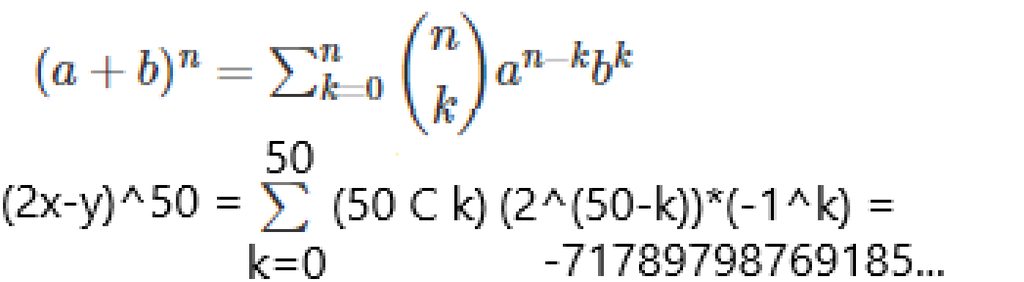
I am trying to expand (2x-y)^50 with binomial expanison. I want to find the coefficient of the term x^20y^30. This is what I did. Am I using the correct formula? Is there a different formula I should use to solve this?
 coral parcel
The binomial formula is right, but something is off in the second line in your image. It has x and y appearing on the left-hand side, but not to the right. That can't be correct.
dire obsidian
coral parcel
The binomial formula is right, but something is off in the second line in your i...
what is your way of understanding binomial theorem?
I can't seem to wrap my head around it in a discrete math context
coral parcel
Hmm, I'm not sure I understand that question.
coral parcel
The binomial theorem tells us in general what happens when we expand (a+b)^n completely using distributivity until only a sum of products of a and b is left, and then collect like terms.
That's really just a packaging-up of a formal computation using the axioms for a commutative ring; it doesn't inherently depend on whether the ring we then apply it to is continuous or discrete.
severe swan
thanks
dire obsidian
coral parcel
That's really just a packaging-up of a formal computation using the axioms for a...
is there a visual representation of this?
Is there any youtube videos you recommend watching to get a better grasp of binomial theorem/expansion?

 coral parcel
dire obsidian
is there a visual representation of this?
Is there any youtube videos you recom...
coral parcel
dire obsidian
is there a visual representation of this?
Is there any youtube videos you recom...
Hmm, I don't know about any visual representation that I'd feel helpful. And I don't really know about math videos in general.
coral parcel
dense glade
In one sense (b) is true because that is the definition of f^{-1}. I think what the exercise really wants is for you to show that the expression for f^{-1} you will have found in part (a) actually works.
dense glade
coral parcel
In one sense (b) is true because that is the definition of f^{-1}. I think what ...
is there a way to figure out if a function
has an identity or not
like a trick or something
coral parcel
Do you mean "has an inverse"?
A function has an inverse if and only if it is bijective.
It may or may not be possible to write down the inverse function as an algebraic formula, though.
I don't think there is a foolproof systematic way to determine the latter.
dense glade
coral parcel
Do you mean "has an inverse"?
no no like identity as in f(a,b)=f(b,a)=a
coral parcel
Ah, I see.
I can't think of any particularly general way to determine that, either.
dense glade
umm I see
coral parcel
In other words, what I'd do would depend a lot on which kind of definition and already known properties I had for f.
dire obsidian
coral parcel
Hmm, I don't know about any visual representation that I'd feel helpful. And I d...
Do I just expand binomial theorem and multinomial theorem to understand them? Or is there something else involved?
coral parcel
Yeah, that would be my suggestion: try the expansion of (a+b)^n on paper (without the binomial theorem, just the distributive law etc) for some small n and observe how what is left after the dust settles is exactly what the binomial theorem promised it would be.
n=3 should be doable; n=4 will start to get tedious.
(whereas n=2 is just the well known (a+b)² = a² + 2ab + b²)
It can help understanding to try to do it while you pretend multiplication is not commutative until you have multiplied out completely and you start collecting like terms.
On the other hand, if you then try to do it another time but attempt to be smarter about expanding out so you compute (a+b)^n by first expanding and simplifying (a+b)^{n-1} and then multiplying the result by (a+b), you will see the recursive formula for the binomial coefficients arise in your computations!
dense glade
How is y=x^3 surjective on R -> R
dire obsidian
coral parcel
Yeah, that would be my suggestion: try the expansion of (a+b)^n on paper (withou...
Ill try that
dense glade
if the codomain is all real numbers
then for example what is 2 mapped to
there is no value that can be plugged into x^3 to get y=2 right?
dense glade
I see
so when I try to prove a function is surjective
i need to solve for x and see if x is defined
for all values?
I guess thats the idea?
coral parcel
You don't necessarily need to actually solve for x -- often you can get away with doing just enough work to be sure there's a solution somewhere, without actually finding it.
For x^3, a typical argument would be:
- Prove the function is continuous.
- Prove that for every y, the function has a value somewhere that is larger than y.
- Prove that for every y, the function has a value somewhere that is smaller than y.
- Apply the intermediate value theorem to conclude that there exists some x with x^3=y.
dire obsidian
coral parcel
Yeah, that would be my suggestion: try the expansion of (a+b)^n on paper (withou...
Kind of confused why n=1 works for binomial

wouldn't b^0 = 1?
obtuse lance
dire obsidian
wouldn't b^0 = 1?
yeah, so what
dire obsidian
obtuse lance
yeah, so what
I thought (a+b)^1 = a+b ?
obtuse lance
write out the whole formula for n=1
write out the whole formula for n=1
plug in for each of the terms
show what you get
coral parcel
Remember that the sum in the binomial theorem for n=1 has two terms: One with i=0 and another one with i=1.
dire obsidian
dam that's wack
 obtuse lance
nice job
floral field
How would I argue that a simple graph, where every vertex has degree k, has a cycle of length at least k+1?
I have no clue where to start.
dire obsidian
obtuse lance
nice job
what's the reasoning behind the "choose" part of binomial theorem?
obtuse lance
I see it as coming from when you multiply, if you don't change the order of the terms, for instance
(a+b)(a+b)=aa+ab+ba+bb
before you put exponents on them and join terms by commutativity, you're litterally counting numbers of strings of length 2
dire obsidian
obtuse lance
before you put exponents on them and join terms by commutativity, you're littera...
can you elaborate?
obtuse lance
similarly (a+b)(a+b)(a+b) = aaa+aab+aba+baa+abb+bab+bba+bbb
aab, aba, and baa all are equal to a^2 b, there are 3 choose 1 ways of arranging them
dire obsidian
obtuse lance
aab, aba, and baa all are equal to a^2 b, there are 3 choose 1 ways of arranging...
that's kind of interesting
and a bit weird at the same time
coral parcel
floral field
I have no clue where to start.
Start somewhere in the graph, keep following edges at random, except avoid edges that lead to a vertex you haven't already been to.
(Hmm, this might not actually work. But somehing like that probably will).
dire obsidian
obtuse lance
similarly (a+b)(a+b)(a+b) = aaa+aab+aba+baa+abb+bab+bba+bbb
can I also expand this idea into multinomial theorem?
multinomial is far more confusing for me to understand
obtuse lance
yeah it is the same idea just more letters in your strings
(a+b+c+d)^13 the coefficient on a^i b^j c^k d^l will be 13!/(i! j! k! l!) (with i+j+k+l=13 of course)
dire obsidian
obtuse lance
yeah it is the same idea just more letters in your strings
yeah I'm completely confused about multinomial
obtuse lance
you can think of it like each term (a+b+c+d) as giving you one letter to pick from to make the word, and doing this 13 times
dire obsidian
This is kind of hard for me to visualize
obtuse lance
floral field
How would I argue that a simple graph, where every vertex has degree k, has a cy...
ah I learned a proof of a similar thing the other day, the main trick for it (in my opinion) is if you start with the longest path, then you know that the end vertex of the path has all its neighbors in the path itself
so to look at any term of say, (a+b+c)^2 I can write it as (a+b+c)(a+b+c) and now I think from the first trinomial (a+b+c) I distribute one of the letters to the right, which will then end up on another choice of letter from (a+b+c)
and all terms are created this way, I'm really trying to think backwards here in terms of
if I wanted to know what the coefficient on ba was I could think of where it came from
(. + b + .)(a + . + .) and (a + . + .)(. + b + .) would be the two terms
dire obsidian
obtuse lance
so to look at any term of say, (a+b+c)^2 I can write it as (a+b+c)(a+b+c) and no...
can I bother you to draw a diagram/equation?
obtuse lance
trying to hide the other terms to highlight what contribute to it
dire obsidian
discord text is kind of
obtuse lance
maybe later I just woke up and feeling lazy sorry haha
dire obsidian
obtuse lance
maybe later I just woke up and feeling lazy sorry haha
alright I'll wait 👍
obtuse lance
floral field
How would I argue that a simple graph, where every vertex has degree k, has a cy...
the proof actually doesn't require the graph to be regular, you can loosen it to having minimum degree k
just figured I'd say that since I'm guessing your thumbs up and heart meant you proved it haha
coral parcel
The graph does need to be finite though -- not everyone considers that implicit in calling it "simple".
obtuse lance
true, I only assumed it was finite because if it were infinite the theorem would be false since an infinite tree of degree k contains no cycles
floral field
Yeah, so basically take a maximal path of length l. And basically, the fact that it's regular implies the neighbors of each vertex in the path are all in the path?
coral parcel
Not necessarily.
But all you need is that for the end of the maximal path in particular, all of its k neighbors are already in the path.
Connect it to the one that is farthest away from the end, and discard the beginning of your maximal path up to that point.
 dry raven
Suppose a satellite transmission protocol was designed to run at 4 Mbps using 2000 Byte packets size. With the same window size, if we want to transmit at a rate of 40 Mbps and achieve the same utilization (efficiency), what packet size should be used? (Note: be careful with the units.) anyone able to help with this?
coral parcel
That doesn't really look like a mathematics problem.
dry raven
idk its a problem in my networking algorithm class which is directly after discrete so thought Id ask here
coral parcel
It's a question of knowing what "window size", "utilization", "packet size", etc mean in the communication context, and how they interact. The actual computation is likely to be trivial once you use domain knowledge to figure out which computation you need to do.
vernal cypress
Hi, can someone suggest me a video explaining the topic surrounding this equation?

I keep not understanding it
dire obsidian
obtuse lance
maybe later I just woke up and feeling lazy sorry haha
Hi do you have time now?