#discrete-math
1 messages · Page 211 of 1
 coral parcel
 maiden drift
We have a segment between a,b which is is disjoint from K. We then take an open ball around C disjoint from K?
 obtuse lance
yeah sorry, I mean to say there are two points on the boundary we can find, and so we pick a point that's equadistant between them
maiden drift
ok, so we take c to be the midpoint from the line seg a,b and take an open ball around c disjoint from K right?
obtuse lance
I've left out details in that a,b are not necessarily going to be these points either
in case it seems I'm saying that too - I'm not haha
coral parcel
But there might be a third point in K that is closest-in-K to the midpoint.
obtuse lance
coral parcel
But there might be a _third_ point in K that is closest-in-K to the midpoint.
yeah this is what I was just trying to preempt with my statment
maiden drift
The easy example i can think of is some U shape thing
obtuse lance
like pick a, b on the boundary of K, there's a c not in K between them (because we assume it's not convex), now we know there's an open ball around c that's not in K because it's closed, then we can now walk along this open interval contained in [a,b] until we get to some edge points [r,s] in [a,b]
we pick the point in the center of [r,s]
r,s lie on the boundary of K
coral parcel
Um is what you're arguing here just that we can find r,s in K such the open interval (r,s) is disjoint from K, or is there more to it?
obtuse lance
the reason the open set matters is because we're trying to avoid a singleton which doesn't violate the uniqueness
maiden drift
What if for example X is an annulus
obtuse lance
works as it should, we know it's not convex so pick two points on the boundary of the inner circle
draw a line between them
pick the midpoint
ah it's not minimal
I guess this doesn't work

coral parcel
Okay, concrete example. Let's say that K = { (x,y) | y <= (x-1)(x+1)/10 } and pick r=(-1,0) and s=(1,0). Then what?
maiden drift
Im starting to doubt the idea of trying to go for a contradiction. Maybe there is something more direct. The siutation is this.
- K closed in R^2.
- I have the following unique projection, p_K onto K. For any point x in R^2, p_K(x) is the unique pt in K such that |x-p_K(x)|< |x-k| for all other pts in K.
WTS: K convex.
coral parcel
The points that fail the has-a-unique-closest-point condition start a bit up on the y-axis (and are only found on the y-axis), but it's not obvious how to see that they must exist, starting with this r and s.
maiden drift
What happens if I restict K even more and make it compact, is there any results in compact sets that seem fruitful?
obtuse lance
what if we slice it with a line, imagine the points not in K to project along that line onto its boundaries, do we only end up with intervals?
I'd think if yes, that means its convex
coral parcel
Can we force the projections to be along the line? I don't think so.
obtuse lance
yeah, probably not, I'm thinking maybe if the line pierced the centroid when it's convex maybe
coral parcel
The basic trouble as I see it is that if we have a figure that is very slightly concave along one side, the only points that fail to have a unique projection can all be very far from the shape, and certainly not on any of the line segments that violate convexity.
maiden drift
So if we take the line segment with boundary end points that violates convexity, and take the midpoint, and a orthgonal line through the midpt, every point on that orthagonal line is equidistant to a,b.
if we go far out enough along this orthogonal line, is there an idea there?
coral parcel
That's the case for the most obvious toy examples, yes. But if we wiggle the line segment just a little bit so its slope changes minutely, I think its midpoint-normal can completely miss the narrow curve of counterexample points.
Hmm, or perhaps not. I have trouble constructing any concrete example that misses.
maiden drift
examples of non convex sets just get too messy. I wish I could rephrase the question into something more analytic
 severe swan
How do I calculate the number of elements in a set? If I have the set { {5, 9}, {1, 2, 3}, {3, 4, 5, 6, ...}, 1, null (zero with slash through it) } for example? Would there be 5 elements because there are 3 pairs of curly braces and 2 numbers without any curly braces, or would it be 6 because they are all included in the first large curly brace? Or would I count how many numbers there are in total?
 heavy tinsel
5
severe swan
That is what I thought, thanks @heavy tinsel
heavy tinsel
count the elements to the left and right of the commas of the big curly brackets
 distant bobcat
@coral parcel Yes, its assumed the graph is embedded in the plane
 hard yew
Let us be given a relation $R$ on the set $\mathbb{R}$ s.t. $$R={(a, b): a\neq b}$$If I want to find the composition $$R \circ R$$ can I go by the definition of a composition of a relation, which gives me: $$\(a, b) \in R \land (b, c) \in R \Leftrightarrow a\neq b \land b\neq c$$, which basically allows a formation of a relation between any two real numbers, so $$(1, 1) \in R \circ R$$ and $$(1, 2) \in R \circ R$$ and $$(2, 1) \in R \circ R$$ or $\R\circ R ={(a,b): (a=b) \lor (a<b) \lor (b>a)}= \ ={(a, b): \forall a, b \in \mathbb{R}}=\mathbb{R}^2\$ Which means that $$R\circ R = \mathbb{R}^2$$ Is this valid or did I completely misinterpret the way to find the composition?
 vital dewBOT
Alter

 wide vine
Do you think this has the same intended meaning as it was written in english. (Domain is the set of all real numbers)
The reciprocal of every number between 0 and 1 is greater than 1
$\forall{x}[(0<x<1) \longrightarrow (\frac{1}{x} > 1)]$
vital dewBOT
Brandon7716

 hard citrus
wide vine
Do you think this has the same intended meaning as it was written in english. (D...
hard citrus
wide vine
Do you think this has the same intended meaning as it was written in english. (D...
Yes
wide vine
okay thx 
heavy tinsel
Shouldnt the number of solutions just be the number of elements in that congruent class?

Seems like there is no solution for the first one, and I think x = 6 and 14 are solutions to the second one by trial and error
But im not seeing a connection
 outer portal
You're correct that there's no solutions to the first one, which you can prove since gcd(6, 16) does not divide 3. However, there are infinite solutions to the second one
Try converting the second one into an algebraic equation by introducing another variable k
heavy tinsel
16|6x-4 => 6x-4=16k
outer portal
Good, so now try factoring out a 2 from both sides, removing it, and converting back into a congruence equation
heavy tinsel
3x-2=8k =>3x congruent 2 (mod8)
outer portal
Good, and do you know solve this?
heavy tinsel
So, since gcd(3,8) = 1, there is a multiplicative inverse for 3 mod 8. I can do it this way?
outer portal
Yep I think that works
You could also keep adding 8 on the right side of the congruence until you get a number divisible by 3:
3x congruent 2 (mod 8)
3x congruent 10 (mod 8)
3x congruent 18 (mod 8)
and then since gcd(3, 8) = 1 you can divide by 3 to get
x congruent 6 (mod 8)
heavy tinsel
could you actually expand a bit on why the first one doesnt have solutions?
ok I think this is a better way
obtuse lance
I'd just brute force multiply, there are only 3 numbers to check
 obtuse lance
inverse can only be 3, 5, or 7
heavy tinsel
obtuse lance
inverse can only be 3, 5, or 7
Im not entirely sure why,
obtuse lance
try to explain part of why and I'll fill in the gaps
obtuse lance
well can't be even because it has to be relatively prime to 8
that just leaves us with 1,3,5,7
but 1 is the identity, so doesn't make sense to check
fun fact, it turns out every invertible element is its own inverse mod 8
heavy tinsel
obtuse lance
well can't be even because it has to be relatively prime to 8
this is from the gcd condition right
obtuse lance
yeah
obtuse lance
so what do you get for your final answer for the second question you originally asked, there's a sorta "gotcha" aspect about it
heavy tinsel
thats what im trying to figure out lol
obtuse lance
oh ok cool, I thought you went back to part 1 cause you were done with it, didn't mean to rush you lol
heavy tinsel
Im stairing at this, still not sure lol
obtuse lance
well what do you have so far
heavy tinsel
that the first one doesnt have solution, the second one has solutions x =6, 14
obtuse lance
yeah that's it
 vital dewBOT
Jonathan Phan

 next sail
Hello everyone! ☺️👋🏼 My name is Helen. It’s a pleasure to meet you all. I’m cohosting a hyrbid hackathon this spring & would like to invite you all to register for this special event. Such event will take place the last weekend of March (3/26 - 3/27).
For more information, please visit our website at http://www.beelikecoders.com (not mobile friendly) 🐝. If you’re interested in signing up please fill out this google registration form https://forms.gle/9Jy4D9oNxBzvz7KRA. 🙏🏼 And if you have any questions, regarding the event, feel free to message me privately! (:
This hackathon is also beginner friendly! 🙌🏼
 pallid lintel
What's a good resource for learning about combinatorial order types?
im interested in line arrangements in R^2
 sleek loom
try to draw ven diagramms
adding the sizes of 2 sets does not give the size of their union, unless they do not intersect
you have to substract from your result the size of $A \cap B$ because you counted it twice when adding their sizes
vital dewBOT
Orian

 zenith valley
vital dew
**Jonathan Phan**
zenith valley
vital dew
**Jonathan Phan**
Anyone?
 meager prairie
zenith valley
Anyone?
meager prairie
zenith valley
Anyone?
identity weirdness?
does a have to be e?
id ask in abstract channel
theyre smarter
 weary tiger
zenith valley
weary tiger
zenith valley
what textbook is this from?
 tall oxide
¬p^(p->q)
can I conclude that ¬q ?
hard yew
No. p is false so p->q is true regardless of what q is.
tall oxide
thanks
 spare forge
Hi, I have to explain a proof to another person but I not sure how to do that. Would someone give any tips (perhaps I can even link the proof and we can walk through a way of explaining it)?
The actual theorem (Hall's Theorem, a matching problem) is unchallenging but I am having trouble not plagiarizing the proof without just invoking the proof by example.
coral parcel
Do you have an actual person you're attempting to help, or are you trying to respond to a homework exercise saying "explain this proof to a (hypothetical) other person"?
In the first case, you shouldn't need to worry about "plagiarizing".
spare forge
coral parcel
Do you have an actual person you're attempting to help, or are you trying to res...
It's for a directed reading group
The person I'm trying to explain to will be my superior too 💀
coral parcel
Presumably said superior already knows the proof, right?
spare forge
Yes
coral parcel
So either your real audience is the other group members, or your real task is to convince the superior that you know the proof.
spare forge
There were three proofs to Hall's Theorem. Each of us will explain one proof to our superior. So it might be both 😬
coral parcel
It still doesn't sound like plagiarism is a real risk. If your presentation is live, you should in any case be comfortable enough with the proof to respond to clarifying questions from the audience, so simply reading verbatim from your source material is not an option anyway.
Also, "explain the proof" would probably also need to identify the key ideas in the proof and point them out during the presentation, perhaps more explicitly than the source material does.
spare forge
I see, maybe I will try once and share an attempt at explaining it here?
coral parcel
Referring to a concrete example along the way is not a bad idea, by the way, as long as you keep connecting it to general reasoning.
spare forge
coral parcel
Referring to a concrete example along the way is not a bad idea, by the way, as ...
I have a really basic question. In this picture,

does the augmenting path show those paths that are not selected in the first paths selected in the alternating paths?
And since this is bipartite, should I be looking at paths starting from the part with smaller order? Yes.
Is it correct to say that if the M-augmenting path pictured above was instead labelled the M-alternating path, then the M-alternating path pictured above will be its augmenting path? Yes.
coral parcel
I'm not familiar enough with proofs of the marriage theorem to answer that.
spare forge
Oh, this is not related to the proof but just with the language in it.
I'm trying to discern the difference between alternating and augmenting path.

 old mantle
Is the term "strategy vector" common in game theory?
It seems to be an older term
I am writing something that involves a bit of game theory and I am not sure if I should introduce it or avoid it
heavy tinsel
How do I compute $6^{6777} \mod 667$ got it
vital dewBOT
Kurama

Kurama
Compile Error! Click the  reaction for more information.
(You may edit your message to recompile.)


 uneven swift
Hey, I pretty new here. I am trying to understand an algo and I came across this if condition and not able make sense out of it. Can someone please help me?
if ([c− : c+] ∩ [c1, c2]) != 0
if the color at point P in Grid is c, we allow that the actual color is in the range [c− : c+], where c ∈ [c− : c+]
For example,
c- = c - 0.5
c+ = c + 0.5
c1 and c2 are color at point p1 and p2 on grid
outer portal
weary tiger
Show the base case where n=2 using DeMorgan's law and try to get the inductive step from there
outer portal
uneven swift
Hey, I pretty new here. I am trying to understand an algo and I came across this...
It's saying that if c is some number representing a color, then the condition is true if the interval [c-, c+] overlaps at all with the interval [c1, c2], where [c-, c+] appears to just be some interval that contains c
At least that's what I think, but it's worded very weirdly
weary tiger
outer portal
Show the base case where n=2 using DeMorgan's law and try to get the inductive s...
ok thank you!
uneven swift
outer portal
It's saying that if c is some number representing a color, then the condition is...
Thanks. So it is just saying that if c1 and c2 lies in c-:c+ range?
outer portal
I think if either of c1 or c2 lies in the c-:c+ range it would be true
Because that would make the intersection nonempty
Sorry, I had assumed [c1, c2] was an interval but I think you're right that they're kind of using it as {c1, c2}
uneven swift
Thanks, @outer portal
 spring surge
Is inverse function of cartesian product possible?
 stray reef
what do you mean
spring surge
{1,2} x { a b } = { (1 a), (1,b), (2,a), (2,b) }
suppose i want to get the set {1,2} from the set in the right
cartesian product is like a multiplication, I wonder how does division looks like then
stray reef
there is no such thing as division of sets
the closest thing you can get is like... quotient by an equivalence relation
 copper ore
I need help making a graph with only 1 odd cycle but that it could also have even cycles

I was thinking something like this
 spring surge
How to check if your combinatorics solution is correct? Lecturer told that only way is to solve the problem the other way and check if the answers match. Is it the only way to be sure if I solved it well?
 pale epoch
you have to be critical of your solution
and try to find holes
if you find two different ways to solve a problem and they match, thats good
personally i often had the problem that even wrong solutions can sound plausible, but you can find such mistakes with more experience
you can also do sanity checks on smaller examples or with the help of computers
 pale epoch
is this a cycle graph?
if yes, the proof is easy enough by doing the obvious thing
if you color a single vertex, it determines the colors of all of its neighbours
so in the even case you can alternate and in the odd case you run into a problem where at a point you need a third color
 tidal tulip
is it fair to say that a relation R on sets S and T is an set of tuples (s,t) in R subset S x T
 gritty crescent
A relation from S to T is indeed a subset of S×T by definition
tidal tulip
is it correct to say R is a set of tuples the way i described above
book states or a bit differently and i want to make sure the way i’m thinking about the definition is correct
weary tiger
No, because not necessarily any (s,t) is in R
tidal tulip
that’s why i said “set of tuples (s,t) in R subset S x T”
so you’re saying that’s not correct?
is it fair to say that a relation R on sets S and T is an set of tuples (s,t) in R subset S x T
weary tiger
it is a subset of S x T
tidal tulip
why did you say it wasn’t correct?
weary tiger
I even explained why lol
tidal tulip
tidal tulip
> is it fair to say that a relation R on sets S and T is an set of tuples (s,t) ...
im confused - are you saying this isn’t correct
i’m interpreting your statement that this is false
weary tiger
I understood differentyl what you said
tidal tulip
ah i see no problem
so that is correct understanding yeah? because the book words it differently
and i interpreted it as what i wrote there
 elder berry
Yeah, what you wrote is correct. To be even more precise, you could say that it is a set of tuples, possibly empty (just to include the empty set as well)
elder berry
On the subject of relations, given alpha and beta, how did they show that this property is correct?

It is safe to assume the relations are symmetric and reflexive, but I am kind of skeptical of the above write-up
tidal tulip
testing for transitivity
let’s say you have a relation
(x,y) in W subset X x X
where
X:={A,C, P, T}
W:={(A,A), (A,C), (A,P), (C,C), (C,P), (P,C), (P,P), (T,C), (T,P)}
then is it valid to reuse the same tuple in W to check for trans or are you allowed to use the tuple only once?
eg
are these valid checks
(1)
(C,C) in W,
(C,C) in W,
therefore (C,C) in W
(2)
(C,C) in W
(C,P) in W
therefore (C,P) in W
?
 final cliff
Do you consider it obvious that the implications "CWC and CWC implies CWC" and "CWC and CWP implies CWP" are true?
There's not just one correct test for transitivity. It might be inneficient to check those implications but it's not really wrong.
tidal tulip
ok so basically it’s correct to check for that but we can ignore it since it’s trivially true
final cliff
Yeah pretty much, doesn't hurt to check it if you feel you need to though.
tidal tulip
looks like W is transitive but not symmetric nor reflexive
elder berry
elder berry
On the subject of relations, given alpha and beta, how did they show that this p...
Anyone understands this write-up?
 livid minnow
How would I go about proving that given 6 circles arranged on a plane such that no circle contains a common center point as another then they have no common intersection point
stray reef
elder berry
It is safe to assume the relations are symmetric and reflexive, but I am kind of...
what relations?
i'm seeing something being done with a binary operation that is assumed associative and commutative with both of these properties seeing extensive use
elder berry
stray reef
what relations?
Alpha and beta are relations on some set (not specified) and are equivalence relations (alpha and beta are transitive, symmetric and reflexive)
I guess it is safe to assume they are relations on AxA, for some set A
stray reef
and what is juxtaposing these relations supposed to mean?
elder berry
Just to make sure, you mean what does ab mean?
stray reef
yes
elder berry
it is a composition of relations, for example
if alpha = {(a, b)} and beta = {(b, c)}, we define the composition in a way so that
alpha ○ beta = {(a, c)} (connecting the end point of one relation, to the beginning of another
in reverse sorry, beta ○ alpha would be {(a, c)}
weird notation issues :(
Better definition
 stray reef
okay, so it's a composition
composition of relations is associative
and what remains to be seen is that for equivalence relations it is commutative
elder berry
I can show that, both that ab is commutative and associative
ah wait
alright, got it then, I got confused since the solution never mentioned those properties
Thanks a bunch Ann!
 indigo tinsel

Okay, so i know this is "there exist an x in D S.T for all y in d, if x != y, then x < y"
However, what can I imagine x and y to be?
Just elements inside of D?
stray reef
yes just as it says
indigo tinsel
Right. I'm a little confused as to why this says there is an element in D less than every other element. Like would I just assume that x = 0 in the set D = {0,1,2,3}, and y incremented to be 1, 2, 3? Sorry, I know that's probably a dumb question lol
stray reef
i mean...
what is D
yes, this statement says "there is an element in D that is smaller than everything else in D"
 echo raptor
very quick question about sets: suppose you have a disjoint union $A_1 \cup A_2 \cup A_3 = A$ and another disjoint union $B_1 \cup A_2 \cup A_3 = A$; does it follow that $A_1 = B_1$, and how would you prove that?
vital dewBOT
scorpio1147
 echo raptor
like, would you go about showing $A_1 \subseteq B_1$ and the other way? i feel like it's almost by definition but i can't really figure out how to go about it
vital dewBOT
scorpio1147
 heavy tinsel
vital dew
**scorpio1147**
heavy tinsel
vital dew
**scorpio1147**
doesn't actually seem like a correct statement..
vital dewBOT
scorpio1147
 heavy tinsel
like A = {1,2,3,4,5,6}. You let A1 = {1,2} A2 = {3,4} A3 = {5,6}. They form partition of A. Now let B1 = {1,3} B2 = {2,4} B3 = {5,6}. It is a partition. But it certianlly doenst follow that A1=B1, etc
echo raptor
no, there is no B_2 and B_3
heavy tinsel
oh, my bad
echo raptor
it's A_1, A_2, A_3 and B_1, A_2, A_3
seems almost obvious but i can't figure out how to formally prove it
heavy tinsel
yeah, it does make sense. If they are not equal, then there is some x in A1 that is not in B1. But that is impossible since the union of A1 A2 A3 and B1 A2 A3 both form a partition of A.
So some sort of a contradiction ?

I think using the definition here, you can prove it
tidal tulip
i don’t understand what C_x means jn definition 5.11 or what statement 5.47 means, can someone explain it and sketch how to prove that statement


seems like C_x is a set of all the y’s in T related to x in S?
so if we had relation W:={(A,A), (A,C), (A,P), (C,C), (C,P), (P,C), (P,P), (T,C), (T,P)}
relation class of A is C_A = { A, C, P} ?
and is this saying if W were an equivalence relation (which it isn’t) then C_C, C_P both would equal C_A?
weary tiger
echo raptor
like, would you go about showing $A_1 \subseteq B_1$ and the other way? i feel l...
you can let x be an element of A_1, then it is an element of A
and use cases
use the fact they are disjoint unions to guide you
that's actually a nice question
 vivid bison
Hi, I need to determine whether this statement is true or false:
There is a 3-regular graph G = (V, E) with exactly 2 sets Y ⊊ V , Y ̸= ∅ such that the cut induced by Y has exactly 1 edge in it; and with exactly 4 sets X ⊊ V , X ̸= ∅ such that the cut induced by X has exactly 2 edges in it.
However, I cant find a 3 regular graph that when we cut it, it has 1 edge. When we remove 1 vertex, it will have 3 edges, when we remove 2 vertex, it will have 4 or 6 edges...
vivid bison
nvm i figured it out
 feral osprey
How do I calculate the numbers of ways to arrrange 20 students to 4 arrange groups of 5 students?
stray reef
as in, the number of ways to split 20 students into 4 groups of 5, with order within a group not mattering and the groups themselves being interchangeable?
feral osprey
pretty much
stray reef
20!/(5!5!5!5!4!)
feral osprey
how so? @stray reef
stray reef
20! ways to arrange the students in a row, with subsequent assignment of students 1-5 to group A, 6-10 to group B, etc.
divide out to account for rearrangements that don't affect the final grouping
stray reef
if you insist... but also divide by 4! afterward
feral osprey
due to the groups being interchangeable?
stray reef
yes
weary tiger
i have to answer this question
"let E be a finite set of cardinal n ∈ N.
let A be subset of E of cardinal d. how many subsets B of E are there such that A ∪ B = E"
i find 2^d (all elements of E-A have to belong to B, but any (or none) of the elements of A can belong to B, so the number of subets of B isthe number of subsets of A which is 2^d ) but my friend find 2^n-d, who is right?
weary tiger
can someone teach me set
 keen drum
set
pale epoch
consider reading #❓how-to-get-help to see what kind of help this server generally provides and how to get it
feral osprey
stray reef
yes
Thanks
 hard laurel
Can anyone tell Me prerequisite for Studying Relations..?
weary tiger
intro logic/sets
 trim blaze
is the difference between two countable sets still countable?
gritty crescent
Yes, you can prove why it must be so.
 inner beacon
What does it mean if something is a divisor of another number?
i.e "both 1 and -1 are divisors of 1"
 outer portal
Have you noticed that if $(A \cup B) \subseteq A$ then $B \subseteq A$?
vital dewBOT
mandelbruh
 outer portal
inner beacon
What does it mean if something is a divisor of another number?
outer portal
inner beacon
What does it mean if something is a divisor of another number?
If a and b are integers, a is a divisor of b if there exists an integer k such that ak=b
 ebon quest
Yeah I did
I had this for the first part

Is that correct for p -> q?
But then idk how to prove q -> p
outer portal
You have the right idea but I would be more explicit that B being a subset of A follows from your assumption
For the second part notice that if $B \subseteq (A \cap B)$ then $B \subseteq A$ also
vital dewBOT
mandelbruh
 outer portal
Since every element of B is in the intersection of A and B then every element in B must also be in A
 iron hearth
i have a quick question
so i already proved a abd b are false

but for c i dont how to solve it using set identities
i know its true but don't know how to prove it
ebon quest
outer portal
Since every element of B is in the intersection of A and B then every element in...
How would I write that out in math terms
This is what I have now but I’m not done the second part
 outer portal
Any set is a subset of itself, therefore $B \subseteq B$. Since $B \subseteq A$ we know that $A \cap B = B$. Therefore $B \subseteq (A \cap B)$
vital dewBOT
mandelbruh
 ebon quest
But aren’t we trying to prove (A u B) c A from B c (A intersection B)?
For q -> p
@outer portal sorry idk if I should @ you or not
ebon quest
My tablet is gonna die soon so I wanna see if I can this last part
outer portal
Since $B \subseteq A$ then $A = A \cup B$. Any set is subset of itself therefore $A \subseteq A$ meaning $(A \cup B) \subseteq A$
vital dewBOT
mandelbruh
 ebon quest
So both of these look correct right?

Also, idk if you but can you see if these 2 questions are right too?

 outer portal
Yeah maybe say something at the end of each like “since assuming p led to q then p—>q”
ebon quest
Ok, makes sense
outer portal
a. can’t be transitive because you have (a, b) and (b, c) but not (a, c)
ebon quest
Oh right, how about part b and c?
outer portal
b. looks right but I’m pretty sure c. is transitive
ebon quest
Just making sure, like this right?
 outer portal
Pretty sure
ebon quest
Ok, and the other question looks good too?
outer portal
I’m a bit confused by the x operator
Is that Cartesian product?
Your second claim looks good and part ii. is good as well
ebon quest
I’m pretty sure it means Cartesian product
outer portal
Ok in that case first claim is good
ebon quest
Ok, how about the third one?
outer portal
If the Cartesian product is the empty set then A AND B are empty
So I think or would also be always true
outer portal
Seems good
severe swan
I am wondering if someone can explain this to me.
I got this question wrong on my test and I don't know how to come to the correct answer.
What is the symmetric difference of sets {1, 3, 5} and {2, 3}?
I put that it is {1, 2, 5}
It says that the correct answer is {2, 5}
Can someone explain why the answer is {2, 5}
iron hearth
iron hearth
so i already proved a abd b are false
Can someone address this question plz
 olive wren
iron hearth
so i already proved a abd b are false
olive wren
iron hearth
so i already proved a abd b are false
A = (A U C) \ C U (A n C) = (B U C) \ C U (B n C) = B
outer portal
severe swan
I am wondering if someone can explain this to me.
I got this question wrong on ...
I think you're right since ${1, 3, 5} \Delta {2, 3 } \
= ({1, 3, 5} \setminus {2, 3 }) \cup ({2, 3} \setminus {1,3,5 }) \
= {1, 5} \cup {2} \
= {1, 2, 5}$
wide vine
I am looking at this and they use the word "increasing" but Idk why I think it should be "strictly increasing"
 vital dewBOT
mandelbruh
 severe swan
Thanks
wide vine
Is this really what they use as far as this terms. "Increasing, Decreasing, non-increasing, non-decreasing"?

Not sure how the use here would be different than using the phrase "strictly increasing" as opposed to "increasing" and "strictly decreasing" as opposed to "decreasing"
iron hearth
olive wren
A = (A U C) \ C U (A n C) = (B U C) \ C U (B n C) = B
is this using set identities?
keen drum
wide vine
Is this really what they use as far as this terms. "Increasing, Decreasing, non-...
no it's used differently in different texts. So far, I've had increasing as <=, strictly increasing as <, nondecreasing as <=, but I think non-decreasing is better than just increasing
wide vine
keen drum
no it's used differently in different texts. So far, I've had increasing as <=, ...
how do you describe a sequence like this {-1,1,-1,1}
wide vine
well I thought non monotonic or something
keen drum
yea it works
wide vine
neither non-decreasing nor non-increasing?
wide vine
but I hate that so much 
keen drum
 ok stop killing my head with english
im sorry im sorry im sorry
i will stick to math symbol sorry sorry sorry
wide vine
the weird thing is they use "strictly increasing" to describe functions
which has the same meaning as what they used for sequences with "increasing"



 wide vine
keen drum
ask your instructor <:KEK:586240877358350341>
wide vine
keen drum
ask your instructor <:KEK:586240877358350341>
I am my instructor
 wide vine
Just me and the book and hopefully a response for the prof if I do email her.
 ashen cloak
I need help understanding why is this problem is true.
For all of x, there is y, x + y =0.
outer portal
ashen cloak
I need help understanding why is this problem is true.
For all of x, there is y,...
Is there a particular set you are working with? For example, if x and y are integers, this is true, but it would not be if they were natural numbers
ashen cloak
outer portal
Is there a particular set you are working with? For example, if x and y are inte...
My next question what are natural numbers?
ashen cloak
outer portal
The inclusion of 0 is debated though
The book didnt really say but im assuming integers since my professor said true. He does a poor job explanning things
So how with integers is true?
outer portal
Look up additive inverses for the integers
olive wren
iron hearth
is this using set identities?
Idk what you mean by that
You can try proving every step of the equation, it shouldn’t be too hard
tidal tulip
i’ll give a concrete example and want to see how the definition i have a question on applies to this example
say
A={1,2,3,4,5}
R={(1,1), (1,3), (1,5), (2,2), (2,4), (3,1),(3,3),(3,5), (4,2), (4,4), (5,1), (5,3), (5,5)} = { (a,b) | a+b is even}
C1 = C3 = C5 = {1,3,5}
C2 = C4 = {2,4}
I = {1,2}
partition F = {C1, C2}
my question is would ~_F and U/~ be applied to this example as defined below in Note 5.62?

i don’t understand what the hook is saying ~_F nor U/~ is
tidal tulip
can anyone help me understand then notation
weary tiger

how is my proof?
oops, I made a mistake that should say g(y) <=> f(x)
oh wel I think I was on the right track
stray reef
no, you weren't
you talked about g^-1 without knowing that g^-1 even exists. which it may very well not.
and you concluded that f is a bijection, which it may very well not be.
would you like me to give an example of a pair (f,g) as given in the problem with f not a bijection,
or would you like me to give you pointers toward properly proving what is asked of you?
weary tiger
stray reef
or would you like me to give you pointers toward properly proving what is asked ...
pointers please, I legitimately though I was on the right track
tidal tulip
is it saying U/~ is the relation each of the Cn’ are generated by so U/~ = F = the set of partitions of U defined by ~
?
i’m pretty confused by what it’s saying if someone could help me understand
i gave an explicit example and would like to see the notation applied to it to understand it concretely
stray reef
weary tiger
pointers please, I legitimately though I was on the right track
use the definition of an onto function. show that for every a in A there exists b in B such that f(b) = a
tidal tulip
can anyone help i don’t see “associated partition” as a term on google
to better understand this
i think it’s saying U/~ = F = { C1, C2 } and that F is generated by ~_F
where ~_F is an equivalence relation of a+b is even
how does that sound
tidal tulip
nvm i see it’s correct
wide vine
can someone tell me where this would be important

In working with summations, it is often useful to pull out or add in a final term to a summation:
iron hearth
can someone help me with this question
Let D be the set of BU dorms. Each dorm is a set of rooms. Each room is a set of students. For two students a, b, let F(a, b) be “a is friend of b.” Express the following
using quantifiers.
 wide vine
iron hearth
Let D be the set of BU dorms. Each dorm is a set of rooms. Each room is a set of...
wide vine
iron hearth
Let D be the set of BU dorms. Each dorm is a set of rooms. Each room is a set of...
so what sets do you have to work with? You set D = {dorm, dorm1, ....}, dorm = {room, room2...} , Room = {student1, student2, ... }?
 sturdy walrus
I'm currently going through some practice problems, and I'm not really sure what " r' " and " rr' " means here. Could someone please help me out here?
 weary tiger
This set contains every rational number such that there exists some other rational number where when we multiply it by our original number gives 1
basically think every rational number with a multiplicative inverse
weary tiger
sturdy walrus
I'm currently going through some practice problems, and I'm not really sure what...
^
sturdy walrus
weary tiger
^
Got it. Thanks!
 haughty garden
wide vine
can someone tell me where this would be important
haughty garden
wide vine
can someone tell me where this would be important
If you’re trying to force a telescoping series, it might be useful to take out a few terms so that terms in the middle cancel out (or at least it’s easy to see that these terms cancel out)
tall oxide
if a conditional has "provided that" in the middle, is it p->q or q->p?
outer portal
q provided that p would mean p->q
 granite frigate
j=1(j+2)?
severe swan
My calculator doesn't have the element of option
 sick meadow
can anybody help me simplify this expression to n and q?
 severe swan
How do I find the answer to this problem? Which of the following is equal to 1 + 2 + 3 + ... + 100?
Answers:
50(100)
100(101)
( 50(101) )/2
( 99(100) )/2
( 100(101) )/2
If I put all of these into my calculator I don't get the same answer as I do when I did 100! since that is the same as 1 + 2 + 3 + ... + 100.
coral parcel
No, 100! means 1 × 2 × 3 × ... × 100 -- factorial is a product, not a sum.
Your calculator most probably doesn't have a button for doing 1 + 2 + ... + 100 in a single step, since there are simple formulas for getting the result of that by basic arithmetic.
severe swan
Ok thank you very much
coral parcel
The sum of 1 + 2 + ... + 100 is the subject of a famous (apocryphal) anecdote about Gauss, so if you google for, say, sum of the first 100 numbers, you'll find lots of explanations of what the sum should be and why.
severe swan
Understood, I will do that
 manic zinc
is this the right channel to ask about Master's theorem ?
 silent hinge
Hello g
Guys*
Can anyone please explain to me how this numbers are being worked out

How the heck 92 turned into 2
77 and 62 into 2*2, 85 to 1 and 11 to 2
I know I could’ve asked in class but this professor gets so annoyed by anyone asking questions
pale epoch
when working modulo n you can replace numbers in sums and products by their remainder when dividing by n
92 divided by 3 is 30 remainder 2
the other stuff is similar
severe swan
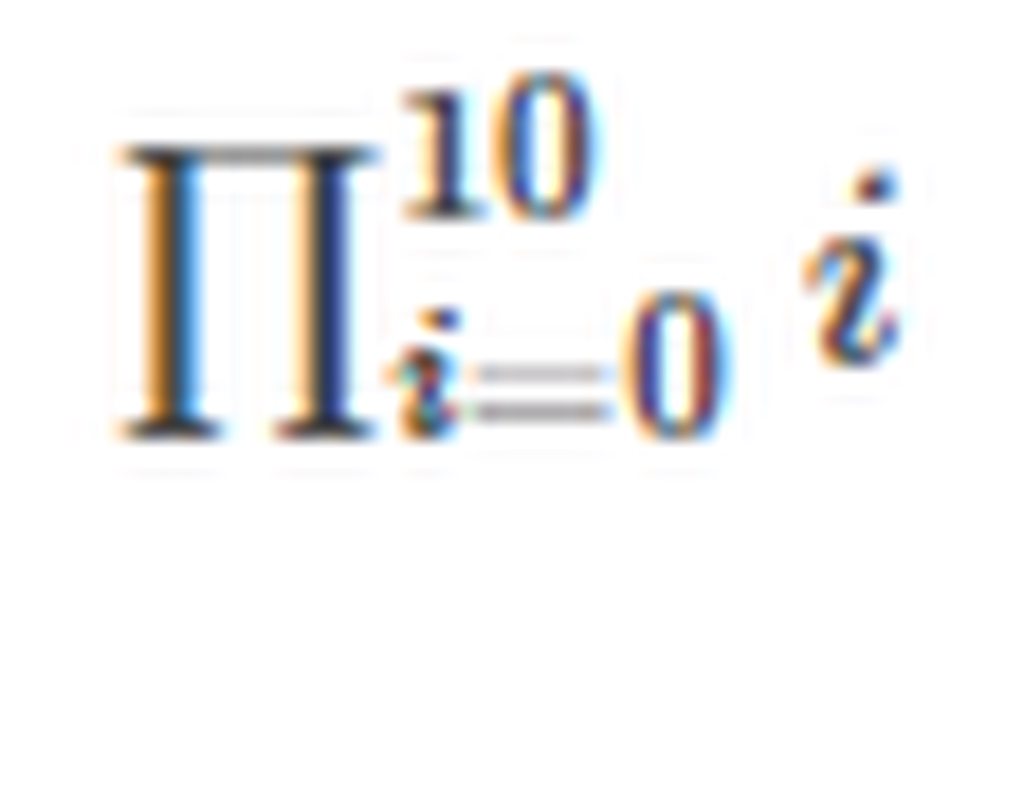
How do I solve this? https://imgur.com/a/sZcxCCh
 coral parcel
The first factor kills everything else.
 coral parcel
Sounds right.
silent hinge
pale epoch
the other stuff is similar
oh i see, how about something like 7 * 3 + 4 mod 9
is equal 7
how so
coral parcel
No tricks there. Just calculate 7×3+4 first.
 icy parcel
hey
can someone check a dfa for me?
I have a question:
I had in my discrete exam a question that requires us to draw a dfa for [0,1]* that its binary representation is not a multiple of 3
lets say i want to check 110
do i start inputing in my dfa from 0 or from 1?
i did it from right to left (0) is it wrong?
(the exam was a week ago but i wanna check if i did it right)
all the inputs im trying are working even when i read the string from right to left
coral parcel
It actually works from either end.
A binary number is divisible by 3 iff the difference between the number of ones in odd positions and the number of ones in even positions is a multiple of 3.
Reversing the bits in a number either doesn't change which positions are odd or even, or swaps the odd positions for the evens
In either case the difference in the divisibility test is either the same or minus what it was before, which doesn't change whether it was a multiple of 3.
icy parcel
did that in my exam, is it correct?

tried many case it works
(just tried 333 somehow it says its acceptable but shhh i dont wanna overthink it) ugh
coral parcel
That doesn't look right. Inputs 11 (= 3) and 101 (=5) both end up in the same state.
inner beacon
are proofs by contrapositive and contraposition the same?
coral parcel
Yes.
To the extent both mean "proving the contrapositive of whatever your goal is".
severe swan
If I have a summation problem and there is no numbers or variables at the top of the sigma in the problem is there a default number I should put?
coral parcel
Can you show what you're looking at?
weary tiger
severe swan
If I have a summation problem and there is no numbers or variables at the top of...
Normally I'd go to infinity or the end of the set if I have that
severe swan
Ok Thanks
 cerulean wind
composition of an integer n is just a way of writing n as the sum of strictly positive integers, correct?
right
this recurrence is incorrect then
the number of compositions of n into k parts is ||(n-1)C(k-1)||
when you sum from k = 1 to n, you get ||2^{n-1}|| total compositions
vital dewBOT
graded homework
Compile Error! Click the reaction for more information.
(You may edit your message to recompile.)
 cerulean wind
So, you're saying $$ a_n = \sum_{k=0}^n \binom{n-1 }{k-1}$$
vital dewBOT
c squared
 cerulean wind
yes, but in particular, that sum is equal to 2^{n-1}
by the binomial theorem
if you just want to partition n into k parts
strictly larger?
okay, then you just need to subtract 1 from 2^{n-1}
but anyway, imagine that we have n circles all lined up
so, o o ... o (n o's)
if we want to break this up into k parts, we need to choose k - 1 places to split the sum at (not at the end points), so there are (n-1) C (k-1) ways to do this
for n = 4, it should be 7
for n = 5, it should be 31
is that what you got?
no, the size of the parts need to be larger than one
not the number in the composition
wait am i dumb
im dumb
my bad
coral parcel
The a[n-2] term are for those solutions where the first part has size exactly 2. If the first part has size > 2, on the other hand, remove one from the first part and you have a valid solution with sum n-1, for which there are a[n-1] possibilities.
cerulean wind
if you want repeated underscore's, you can use \_ on each of them (just in case)
coral parcel
For example: two of the solutions with n=10 are 2+5+3 and 4+4+2.
Of these 2+5+3 starts with 2; it corresponds to the n=8 solution 5+3.
On the other hand 4+4+2 starts with something larger than 2; subtracting one from the first term gives us 3+4+2, which is a solution for n=9.
Every solution for n=10 arises in exactly one way from one of these principles, therefore a10=a8+a9.
weary tiger
hey
would someone be able to help me with my homework
I haven't been to class in 2 weeks because of health issues and it's due tonight
I have a good grade in this class and I want to understand but also I have no clue wtf is going on

I'm thinking I have to use the method of direct proof but I'm not really even sure how that idea works because I haven't been over it myself
and I don't know how involved that gets with multiple different variables
or like a youtube video or ANYTHING
I'm just completely lost and my teacher's notes are not legible
wide vine

How do you know it is A and (B or C)
and not
(A and B) or C
based on the sentence
For lunch you had a ham and cheese sandwich and an apple or an orange.
 coral parcel
That is not a matter of symbolic logic, but a matter of figuring out what the speaking of the English sentence must have meant by that sentence.
Only after you understand the meaning of the sentence can you start writing down a corresponding symbolic formula.
The order of operations is a convention for how to write down symbolic formulas. It cannot dictate the meaning of utterances in natural languages.
So in this case we can reasonably guess that the speaker is more likely to have meant "sandwich and (apple or orange)" than to have meant "(sandwich and apple) or orange" based on our real-world knowledge about the food items in question. It seems to be more likely that the speaker intended to describe one of two meals that we'd consider roughly equally filling. It would be an unusual in practice to need to describe a choice between sandwich+fruit and just fruit but which fruit it is depends on whether you also take a sandwich. So if the speaker had really meant the latter, one would expect them to use more words to make sure the unusual meaning got through to the listener.
coral parcel
Also, when you think about it, it's somewhat duplicitous of the book to pretend that any of the "and"s in that sentence really have a meaning that corresponds to logical conjunction. A native speaker of English would most likely understand the sentence to be making a claim about the listener's entire lunch (or at least the non-beverage items in it), not just "your lunch included a sandwich, and it also included an apple". The native speaker would probably find that the sentence was not a true utterance if the lunch actually consisted of a sandwich plus an apple plus a croissant. But the purported logical translation would be true in that case.
 spare orchid
From Levin Discrete Mathematics 3rd edition page 28, just to check if I understand the question (pls give no answer yet, :)) we want to give the number of subsets that you can make from the set {1,2,...,10} with cardinality 2 right

so for example the set B2 contains the set containing the empty set and set A because this set has cardinality 2 and contains two subsets of A namely the empty set and set A
gritty crescent
spare orchid
so for example the set B2 contains the set containing the empty set and set A be...
No
gritty crescent
spare orchid
From Levin Discrete Mathematics 3rd edition page 28, just to check if I understa...
You were right here
B_2 is the collection of those subsets of A that have cardinality 2
Emptyset has cardinality 0 so it is not in A
spare orchid
nono I mean " the set B2 contains the set containing the empty set and set A because this set has cardinality 2 and contains two subsets of A namely the empty set and set A (edited)" among other sets
ah
gritty crescent
The elements of B_2 are subsets of A, not collections of subsets of A
For example {1,2} is an element of B_2
spare orchid
so 45
gritty crescent
How did you arrive at it?
gritty crescent

spare orchid
but my mistake was also make combinations of empty set with the elments of A, and the set A itself with elements of A, and the set containing A and empty set + 45 combinations, to arrive at a wrong total of 66 but its clear now
because {empty set , 1} has cardinality 2, but it is no subset of A, i get it
thx
vital dewBOT
Manan.
 gritty crescent
spare orchid
thx
gritty crescent
spare orchid
thx
No worries
spare orchid
vital dew
**Manan.**
yes my thought was a combination of subset, elements and pwoer sets, i should have rephrased it out loud
 noble wasp
any book recommendations for discret math?
spare forge
What does the assumption for a graph $G = ({V}, {E})$ that $V \cap E = \emptyset$ mean?
vital dewBOT
Qlinltiqor
 spare forge
That no vertices or edge share something?
Oh, its likely vertices are just a set of singletons but edges being sets of 2-subsets (sets containing information of a connection between two vertices) will just have the intersection yield the empty set on outer comparisons.
stray reef
misplaced {}
also $V \cap E = \varnothing$ just means there's no such thing as an object that is an edge and a node simultaneously
vital dewBOT
Ann
 spare forge
Okay, that makes sense 👍
 sacred dune
this is not so much a math question, but would anyone have a pointer as to why i only got half points for this exercise? It was a really easy one, super simple to intuit and I know the numerical answers are fine but i didnt want points getting taken off per lack of rigor so i tried to justify things a little more, and im guessing that's where i lost points in the second question, i just need someone to confirm
the questions were distributing postcards of 3 types to 12 friends, where in the first scenario we have as many cards as we want and in the second we have 4 of each type
omg nvm
i think i got a point taken due to a typo in the first one 😭 Edit: turns out I used the wrong equivalence relation in the second part of course: should’ve been mod 3
bruh i really ought to read over my work
 naive sonnet
Any resources on natural deduction proofs, gentzen style specifically? They're incredibly hard to find, most of what I could find was fitch style. I honestly do not get it at all.
 gritty crescent
 fossil stump
Can Someone Please Explain this?
fossil stump
Can Someone Please Explain this?
Do you understand what it means for the dice to be indistinguishable?
fossil stump
Well Not exactly.
gritty crescent
This means that for our consideration, when we roll the dice we can't "tell them apart". So there's no notion of "4 on dice 1, 3 on dice 2", but instead "one of the dice has 4, the other has 3".
gritty crescent
Even if they get different digits
Okay let's go back to the usual case where dice are distinguishable
fossil stump
Okay.
gritty crescent
You know there are 36 possibilities for rolling a pair of distinguishable dice, right?
gritty crescent
Now when the dice are indistinguishable, our ability to tell apart, say, (4,2) and (2,4) goes away.
fossil stump
Yes.
gritty crescent
Both the combinations correspond to "one dice has a 4, the other has a 2"
fossil stump
Yes.
gritty crescent
So we count in this spirit: first we count the number of ways of getting two distinct numbers on the dice from the six possibilities. Since the order doesn't concern us anymore, the number of possibilities is 6C2=15.
Does this make sense?
vital dewBOT
Manan.
 fossil stump
Yes Yes.
gritty crescent
6C2 tells us the number of ways we can choose two distinct values out of 6.
fossil stump
Yeah.
gritty crescent
But we also need to account for the cases where both dice turn up with the same digit
fossil stump
6!/2!(4!)
fossil stump
gritty crescent
But we also need to account for the cases where both dice turn up with the same ...
Yes.
gritty crescent
Thus the total number of ways you can roll a pair of indistinguishable dice is 15+6=21
fossil stump
We Could have also done 36-15 right?
fossil stump
Total Number of possibilities- uhhh wait let me name this.
Total number of possibilities- distinct Total possibilities.
gritty crescent

fossil stump
gritty crescent
But we also need to account for the cases where both dice turn up with the same ...
What Does this exactly mean?
gritty crescent
6C2 accounts for the cases where both dice have different digits
You could also have, say, 1 on both dice
So you need to account for them as well
You can only roll two dice with the same digits on both of them in 6 ways, one for each digit 1-6
fossil stump
gritty crescent
6C2 accounts for the cases where both dice have different digits
Yes Okay.
fossil stump
gritty crescent
You could also have, say, 1 on both dice
So?
fossil stump
gritty crescent
So you need to account for them as well
WhAt?
gritty crescent
You need to account for them if you want to count all possibilities
fossil stump
What Are you saying?
Mhmm This gets weird with all the combinations vs permutations and order or not and repetitions or not stuff.
gritty crescent
I think I don't understand your point of confusion here. You wish to count the total number of ways you can roll a pair of indistinguishable dice. There are two mutually exclusive and exhaustive possibilities: both dice show distinct digits, or both show the same digits. There are 15 ways in which the former can happen, and 6 ways in which the latter can happen. The total is thus their sum.
fossil stump
gritty crescent
You could also have, say, 1 on both dice
Oohh so same digits.
gritty crescent
Yes
fossil stump
gritty crescent
I think I don't understand your point of confusion here. You wish to count the *...
Okay so See.
What we include-
- Same digits in Both dice.
- Different digits in both dice.
We we exclude -
- Similar kinds of pairs coming from different outputs, like (4,1) and (1,4) are considered as the same output and hence not considered alone.
Right or Wrong?
@gritty crescent.
gritty crescent
Correct.
gritty crescent
This is precisely what being indistinguishable means.
gritty crescent
If you assume your dice to be distinguishable, the table of possibilities can be enumerated like this. When the dice are indistinguishable, everything above the wiggly line is redundant since a pair below the wiggly line already accounts for it (say, (4,2) already has (2,4)).
 gritty crescent
Yes
fossil stump
Damn Damn so fast.
gritty crescent
As you can see in the picture, the number of redundant entries is 15, out of a 36 total.
gritty crescent
fossil stump
We Could have also done 36-15 right?
Answering this
gritty crescent
Elementary combinatorics is within the scope of this channel.
spare forge
Hey guys, what is ${a}$ in
 vital dewBOT
Qlinltiqor
 spare forge
Is it all the vertices in the $A$ of a bipartite graph?
vital dewBOT
Qlinltiqor
 spare forge
Then is $A' \cup {a} = A?$
vital dewBOT
Qlinltiqor
 spare forge
Or is it just a single vertex $a \in A?$
vital dewBOT
Qlinltiqor
 coral parcel
{a} is the set whose only element is a.
A' cup {a} is the set whose elements are all the elements of A' and also a.
Presumably the letter "a" has been defined in the context to represent a particular vertex of the graph.
spare forge
Thanks for the clarification
I'm now confused in the part where it says $b \notin P$ when the preceding line stated a path $P$ being generated between vertices $v$ and $b.$
 vital dewBOT
Qlinltiqor
 spare forge
I guess in the matching, $b$ isn't selected yet but lies ready to be augmented in the matching $M$ from the alternating path identified in a previous part.
So $Pvb$ denotes a future path that can become a matching.

 stray reef
vital dew
**Qlinltiqor**
stray reef
vital dew
**Qlinltiqor**
no, P is a path between a and v. Pvb means the path that extends P by the edge vb
spare forge
Oh, damn.
That makes more sense now
I was getting confused with this in an earlier part of the book:
 coral parcel
Dang, that's confusing notation.
spare forge
So $vb$ is meant to be a discovery in the bipartite graph
vital dewBOT
Qlinltiqor
 spare forge
I guess the mental hurdle can be removed by assuming an alternating path not be perfect walks through each partite such that there can be large skips between two vertices in $A$ or $B$ just that the path starts in $A$ and ends in $B$. But then, there's options of $B$ unselected that vertices starting in $A$ matched or unmatched can match in $B$ with.
vital dewBOT
Qlinltiqor
 spare forge
My notation is really imprecise but I think I am understanding the proof to the Marriage Problem a bit more now. Thanks for the help and until next time.
I guess just a little question now with this theorem:

Does $S$ just mean some subset of $A$ called $S$?
vital dewBOT
Qlinltiqor
 spare forge
And then the neighborhood is all possible matchings of degree one from a vertex $v \in S$ to some vertex in $b?$
And then $|N(S)|$ means the sum of the number of all those possible matchings for each vertex in that subset?


 hearty furnace
What is the negation of "1 < a < 5"?
spare orchid
This is another way of saying odd natural numbers in the interval [0,100]? so the cardinality of this set is 50?
 spare orchid
hearty furnace
What is the negation of "1 < a < 5"?
spare orchid
hearty furnace
What is the negation of "1 < a < 5"?
I could be wrong, but I think a can be smaller than or equal than 1 or bigger than/ equal than 5,
 hearty furnace
A is less than or equal to and or 5 is less than or equal to A?
I believe I said that right
spare orchid

Khan Academy
A compound inequality is an inequality that combines two simple inequalities. This article provides a review of how to graph and solve compound inequalities.
spare orchid
hearty furnace
A is less than or equal to and or 5 is less than or equal to A?
no I think a can be smaller than 1 or equal to 1 OR a can be bigger than 5 or equal than 5
hearty furnace
I'm just trying to prove the proper negation
Because the question is
The negation of "1 < a < 5" is "1 >= a >= 5."
spare orchid
 spare orchid
hearty furnace
The negation of "1 < a < 5" is "1 >= a >= 5."
spare orchid
hearty furnace
The negation of "1 < a < 5" is "1 >= a >= 5."
i think thats wrong I think "1 < a < 5 can be written as (1 < a) AND (a < 5)
and if you negate that
you get
hearty furnace
thank you sir
spare orchid
well I'm no expert, it needs confirmation from another discord guy
im just learning discrete math at my own pace :p
hearty furnace
oh
cause yea I've tried rewatching these lectures
many times
even looked through our book
I have no examples with numerical values
just words 😔
spare orchid
but if you see the khan link i send you, you can see how to write double inequalities as an AND clause of two inequalities
and then you can use the https://en.wikipedia.org/wiki/De_Morgan's_laws

so I think im right
spare orchid
np
severe swan
Can someone explain how to solve these problems? I got them wrong on my quiz and I have no idea how to do it. How do you calculate it if there is no number on the top of the sigma? How do you calculate the answer with the E at the bottom instead of an equals sign?

 stray reef
$\sum_{x \in A}$ means you sum over the members of $A$
vital dewBOT
Ann
 stray reef
which are denoted by x
so the first problem would be "for each element of A, add 1"
and the second would be "add up all the elements of A"
 floral field
I’m working with set partitions. For n=8, if I want to count set partitions with at least one of the blocks being size 2, would 8C2 count all of these or would it undercount?

The _ are slots for the integers, and the | are the “walls” between blocks.
severe swan
Thank you @stray reef
ashen cloak
so my professor went from x^2+3y less than/equal to 9
to -3 less than/equal x less than/equal 3
Can someone please how?
floral field
ashen cloak
so my professor went from x^2+3y less than/equal to 9
to -3 less than/equal x le...
Solving for y might give intuition as to why
In the first inequality
 dire obsidian
Is there anything wrong with my answer?
 coral parcel
"n=k" and "n=k+1" are really confusing ways to state the induction hypothesis and conclusion.
And the p(n) you prove by induction should really be: n=1 or n=3 or there exits a,b such that n=2a+5b.
dire obsidian
coral parcel
And the p(n) you prove by induction should really be: **n=1 or n=3 or there exit...
Can you elaborate a bit more? This is really confusing to me
coral parcel
There are two additions.
dire obsidian
does proving p(k+2) not work?
coral parcel
You're stating p(n) as n=2a+5b, but that should really be there exist a,b such that n=2a+5b. The variables a and b are not constants that are defined externally to what you prove.
dire obsidian
Can you show me an example of how that would even look like? I don't think I've been taught about inductively proving anything other than p(k+C)
coral parcel
In addition to that, mathematical induction is for proving something that is true for all natual numbers n. The statement you've written down is not true for n=1 nor for n=3, so it shouldn't be provable by induction; you need to modify the statement into something that is always true.
Can you show me an example of how that would even look like?
I don't understand the question. I've just typed what it should look like twice.
dire obsidian
Here's the "official" solution to this question:

does this clear things up more
induction is so wack
coral parcel
The looks pretty sloppily written to me, too.
I surmise that "Alternative Form of Mathematical Induction" refers to long induction.
dire obsidian
coral parcel
I surmise that "Alternative Form of Mathematical Induction" refers to long induc...
This is also really confusing to me
 coral parcel
Hmm, okay, so this does match the way the model solution is phrased.
It's valid too, but is not the way things are usually presented.
dire obsidian
It's confusing af to me
Quizlet gives more "clear" answer to this question but with less explanation

This is just extremely confusing to me in general
coral parcel
Okay, so to back up: I still maintain that you must have the words "there exist a and b such that" (or symbols to that effect) in your statement of what you're proving.
That is, if you use the letters a and b in the context n=3a+5b, of course.
dire obsidian
coral parcel
Okay, so to back up: I still maintain that you _must_ have the words "there exis...
does this part of the solution satisfy this?
 coral parcel
All the solutions we've seen here miss what I think is a crucial reasoning step, namely to state explicitly that if k+1 is at least 6, then k-1 is not 1 or 3.
dire obsidian
coral parcel
All the solutions we've seen here miss what I think is a crucial reasoning step,...
I think the quizlet solution makes more sense to me
That said I don't know why they are allowed to do this assumption

base case S(4) and S(5) are proven but that only allows you to use assumption of
S(k-1) and S(k)
coral parcel
That's basically the induction hypothesis in long induction: You assume that p(n) is true for all n smaller than the one that's your goal right now.
But again, it would be much clearer if we had defined S(n) to mean "n=1 or n=3 or n is the sum or twos and fives".
Then we could honestly assume that S(1), S(2), S(3), ..., S(k) are all known to be true.
dire obsidian
so when I assume S(k) I am automatically allowed to use S(k-1)
coral parcel
No, that's not what I say.
I'm saying you are assuming S(1) and S(2) and S(3) _ and_ .... and S(k-2) and S(k-1) and S(k).
The fact that you can use S(k-1) is because that is one of the things you assume, not because you're also assuming S(k).
dire obsidian
So I still need the S(4) and S(5) proven first before I can assume S(k) and S(k+1) ?
coral parcel
Depends on what k is, if course.
If k is 5 or more, then both S(4) and S(5) are part of what you assume.
In the step where you're provign S(4), however, you of course cannot assume that S(4) and S(5) has already been proved,
dire obsidian
coral parcel
If k is 5 or more, then both S(4) and S(5) are part of what you assume.
so it follows the "ladder rung" mentality?
coral parcel
Hmm, yes I think so.
dire obsidian
"You assume that p(n) is true for all n smaller than the one that's your goal right now."
This is only applied when n is an exact number like 4 and 5?
coral parcel
Um, that is how the general proof step in long induction goes.
You're being told "I have an k, and I promise you that S(n) is true for every n<=k. Your task is now to prove S(k+1)".
You can choose to let your proof depend on whether k is larger than 5 or not, but that choice is part of your proof, not part of long induction.
dire obsidian
coral parcel
Um, that is how the general proof step in long induction goes.
so in this case if I assume S(k-1), S(k)
I am not allowed to also assume S(k-2)
 coral parcel
As I've said already, the only way I can see to get this to make principled sense is to change S(n) such that it means n=1 or n=3 or n is a sum of twos or fives.
Then you can assume S(1) and S(2) and S(3) and so forth all the way up to S(k), whatever k is.
coral parcel
You have only assumed S(k-2) when k is at least 3, of course.
dire obsidian
coral parcel
You're being told "I have an k, and I promise you that S(n) is true for every n<...
"I have an k, and I promise you that S(n) is true for every n<=k. Your task is now to prove S(k+1)"
Doesn't this automatically allow me to also assume S(k-2)?
dire obsidian
coral parcel
Only if you know that k-2 >= 1.
wait why is this needed?
oh assume n >= 1?
coral parcel
Because S(-1) might not be true!
dire obsidian
so I also have to set k >= 6 for this proof to work
and by extension I'm allowed to assume as much as needed from the following expressions:
S(k-5), S(k-4),...S(k)
coral parcel
So the induction step would be something like:
Now k is an arbitrary number in N0 and we're assuming S(1), S(2), ..., S(k). We have to prove S(k+1).
If k=0 then S(k+1) is S(1) which is true because S(1) means "1=1 or 1=3 or 1 is the sum of twos and fives".
If k=1 then S(k+1) is S(2) which is true because 2=1·2+0·5.
If k=2 then S(k+1) is S(3) which is true because S(3) means "3=1 or 3=3 or 3 is the sum of twos and fives".
If k=3 then S(k+1) is S(4) which is true because 4=2·2+0·5.
If k=4 then S(k+1) is S(5) which is true because 5=0·2+1·5.
Otherwise k>=5. We then know that k-1 >= 4, which means that k-1 is positive (so we actually have S(k-1) among our assumptions), but k-1 is neither 1 nor 3. Therefore S(k-1) tells us that k-1 is the sum of twos and fives. If we now add in another two to that, we'll have expressed k+1 as a sum of twos and fives, and therefore S(k+1) is true.
This completes the induction step, since we have handled every possible value for k.
dire obsidian
coral parcel
So the induction step would be something like:
> Now k is an arbitrary number in...
I thought n!=1, n!=3 ?
coral parcel
As I've said several times now, we need to make the claim we're proving something that is true for all n.
Therefore I'm correcting the solutions into something I actually think makes sense.
Saying "if n!=1 and n!=3 then such and such" is the same as saying "n=1 or n=3 or such-and-such".
dire obsidian
coral parcel
Saying "if n!=1 and n!=3 then such and such" is the same as saying "n=1 or n=3 o...
ok
dire obsidian
coral parcel
As I've said several times now, we need to make the claim we're proving somethin...
so you always have to provide a bound whenever you assume k?
coral parcel
Hmm? Not if the original goal you're proving is actually true for all the naturals.
dire obsidian
coral parcel
Hmm? Not if the original goal you're proving is _actually_ true for all the natu...
wait nvm
coral parcel
What exactly are you referring to with "bound" here?
dire obsidian
$n\in Z^{+}$
coral parcel
\in
vital dewBOT
Salt
 coral parcel
Yes, that's always part of induction.
dire obsidian
coral parcel
What exactly are you referring to with "bound" here?
k range basically
coral parcel
(It differs from book to book whether 0 is included or not.)
dire obsidian
coral parcel
So the induction step would be something like:
> Now k is an arbitrary number in...
one more question, how do you know when to assume anything other than S(k)?
like in this instance assuming S(k-1)
coral parcel
You can always assume S(n) for all smaller n. Whether it helps you to do so depends on what it is you're proving, and must be figured out from case to case.
severe swan
Can someone explain why there are 2001 elements in the set? I don't understand how the math works.
-1000 + 1000 = 0 + 1000 = 1000 not 2000
 limpid fossil
can we ask about algorithms here
wide vine
would g_0 be part of the sequence or only g_1?

for 2(b)
because they want the first 6 terms but say the sequences start with index 1 
severe swan
You would use g0 to solve for the other numbers in the sequence
wide vine
severe swan
Can someone explain why there are 2001 elements in the set? I don't understand h...
what set?
wide vine
severe swan
You would use g0 to solve for the other numbers in the sequence
yeah I just didn't know if my first term was g_1 or g_0
severe swan
 wide vine
but I guess I should start with g_1, g_2, g_3, ....
severe swan
The first term would be g1
wide vine
severe swan
The first term would be g1
{-10, -9,-8,-7,-6,-5,-4,-3,-2,-1 , 0, 1, 2, 3, 4, 5, 6, 7, 8 ,9 10} Expand this idea but I think you are forgetting that you have the 0 term. You have [-1000,1000] so you have 1000 postive elemnts , 1000 negative elements, and one 0 element
like -1<=x <=1 would have 3 terms (assuming ints)
[-1,0,1]
wide vine
for (b) are they referring to the cumulative amount of just how much the cost would be for the last month

like are they just asking for the last month cost
or how much the person has spent in total over the 2 years
 static pond
it would be cumulative i think
otherwise there would be no need to specify closed form
 wooden mason
𝑝(6𝑛+0,3)=3𝑛2
𝑝(6𝑛+1,3)=3𝑛2+𝑛
𝑝(6𝑛+2,3)=3𝑛2+2𝑛
𝑝(6𝑛+3,3)=3𝑛2+3𝑛+1
𝑝(6𝑛+4,3)=3𝑛2+4𝑛+1
𝑝(6𝑛+5,3)=3𝑛2+5𝑛+2
I get that the constant terms are basically Pascal's, but why does it start at p(6n+3,3)
 whole hamlet
Can someone please help me with this problem I’m really bad at factorials and word problems in general

 unreal stump
So first you choose 4 spots to put 2,8 or 9 @whole hamlet
You have 6 spots left for everything else
So that would be 7^6*3^4 * C(10,4)
whole hamlet
unreal stump
So that would be 7^6*3^4 * C(10,4)
Where did u get 7 and 4 from?
Oh nvm I got it thank you 🙏
sick meadow
∀x∃y¬M(x, y)
hey guys is this statement read like: For every value of x there is a y?
 ember obsidian
sick meadow
∀x∃y¬M(x, y)
hey guys is this statement read like: For every value of x there i...
ember obsidian
sick meadow
∀x∃y¬M(x, y)
hey guys is this statement read like: For every value of x there i...
yes, for all x there exists y where M(x,y) is false
sick meadow
M| 1 | 2 | 3|
1 T T T
2 T F T
3. T T F
Okay so with these values the statement would be considered false right ? since there is a negation all the Ts will become Fs and all Fs will become Ts
M| 1 | 2 | 3|
1 F F F
2 F T F
3. F F T
so with the new table the first value of "1" which is "x" does not have a value for y so that makes the statement false because not every x has a value for y right ? @ember obsidian
The domain of discourse for this problem is a group of three people who are working on a project. To make notation easier, the people are numbered 1,2,3.The predicate M(x, y) indicates whether x has sent an email to y, so M(2,3) is read “Person 2 has sent an email to person 3.” The table below shows the value of the predicate M(x, y) for each (x, y) pair. The truth value in row x and column y gives the truth value for M(x, y)
Heres the question if it helps
ember obsidian
sick meadow
M| 1 | 2 | 3|
1 T T T
2 T F T
3. T T F
Okay so with these values t...
yes, M(1,y) is true for all y, so the given statement is false
sick meadow
okay thank you ! just needed to make sure I was understanding this correctly
 simple nimbus
Hey guys I’m new to this discord and have just started learning discrete maths. Would I be able to post screenshots of worksheets on here because I’m a little bit unsure of some of the answers
hard citrus
yes
simple nimbus

Can someone please help me answer these? I got the first one from b.) as a tautology and question 3 a.) I got (ii) as correct and (i) as incorrect. I’m unsure of the other ones
simple nimbus
Can someone explain how I would answer (b) and (c) without using truth tables please?
 pale epoch
have you tried using what is mentioned?
vital dewBOT
hiiistrex
Compile Error! Click the reaction for more information.
(You may edit your message to recompile.)
 pale epoch
$\neg$ for negation $\lor$ for logical or, $\land$ for logical and
vital dewBOT
Lochverstärker

 crude mango
Makes sense
simple nimbus
pale epoch
have you tried using what is mentioned?
I’m trying it now, im trying to convert all the -> to what’s mentioned on the sheet
pale epoch
yes, do that
crude mango
$\neg p\lor (\neg q\lor r)$
vital dewBOT
hiiistrex
 pale epoch
report back with results
simple nimbus
crude mango
$\neg p\lor (\neg q\lor r)$
Is this what it looks like when -> is converted to what’s mentioned?
Oh okay yeah I got that
I’m just wondering how to prove its logically equivalent to the right hand side
simple nimbus
pale epoch
report back with results
This is what I got
 pale epoch
looks good
can you pull the negation into the parentheses on the right hand side?
(to see that both sides are the same)
simple nimbus
This is what I got, but I’m only a bit confused because there’s an AND on the right hand side and none on the left
 simple nimbus
pale epoch
(to see that both sides are the same)
simple nimbus
pale epoch
(to see that both sides are the same)
^
pale epoch
oh, this isnt correct
pulling the negation into parentheses will 'flip' the connective
does "de morgan's law" ring a bell?
simple nimbus
pale epoch
does "de morgan's law" ring a bell?
Ohhh yeah I get it now!
simple nimbus
pale epoch
does "de morgan's law" ring a bell?
Can I get rid of the parentheses to make both sides the same?
pale epoch
good question
you also should have covered this
is $(a \lor b) \lor c$ the same as $a \lor (b \lor c)$?
vital dewBOT
Lochverstärker
 simple nimbus
pale epoch
is $(a \lor b) \lor c$ the same as $a \lor (b \lor c)$?
simple nimbus
pale epoch
is $(a \lor b) \lor c$ the same as $a \lor (b \lor c)$?
According to my logic yes but I’m not 100% sure
pale epoch
you are correct
this is called associativity
tbf you have to verify this (and also de morgan's law) using truth tables
so the exercise is a bit misleading
i just assume you have verified both those things earlier in class
simple nimbus
pale epoch
i just assume you have verified both those things earlier in class
I remember verifying de Morgan’s law but not associativity, however my memory is not the greatest and we most likely have covered this in class lol
pale epoch
you should have, but whenever you are unsure, you can verify it yourself
you will have to use truthtables though
its easier to just verify such small rules often though
and then use them repeatedly
instead of making giant truth tables
(which i think this exercise is trying to show you)
simple nimbus
pale epoch
its easier to just verify such small rules often though
Okay makes sense. Thank you so much for your help! I’ll be back on here tomorrow if I’m stuck with anything else. Have a good day/night!
 weary cobalt
Can someone explain if there is any connection or similarity between a minor of a graph and a subgraph of a graph
for some reason I think that they should be closely related but I dont understand why they require separate definitions
I believe that any subgraph is a minor
but not every minor is a subgraph
 shadow geyser
how would go about proving if there a second order logic statement that is true in Q + Q but not in Q?
also if anyone doesn't mind I would appreciate if they could explain what second order logic really means
ebon quest
Hi, I was just wondering if i did this proof correctly, if someone could check it over that would be awesome

 soft bobcat
Hey! I wanted to ask a quick question, how would I prove that P(IN) is uncountable?
crude mango
ebon quest
Hi, I was just wondering if i did this proof correctly, if someone could check i...
Shouldn't you be using the definitions of subset etc
There's a bunch here that seems off
ebon quest
crude mango
There's a bunch here that seems off
Really? Can you tell me how to fix it?
crude mango
$B\subset A \to A \intersect B = B$ needs to be proven
vital dewBOT
hiiistrex
Compile Error! Click the reaction for more information.
(You may edit your message to recompile.)
 crude mango
Pretend that's an intersection
Idk the latex for it
But that's not "immediately obvious"
ebon quest
I’m not sure I understand
ebon quest
“B is a subset of A implies A intersection B = B”?
That’s the line you’re talking about right?
 austere cedar
crude mango
Pretend that's an intersection
austere cedar
crude mango
Pretend that's an intersection
its $A \cap B$
vital dewBOT
Alexander42
 crude mango
ebon quest
That’s the line you’re talking about right?
crude mango
ebon quest
That’s the line you’re talking about right?
Yes
austere cedar
crude mango
What's union
$\cup$
vital dewBOT
Alexander42
 crude mango
$\cup$
vital dewBOT
hiiistrex
 crude mango
Good to know
ebon quest
crude mango
Yes
Wdym by justify? Like I have to show that A intersection B equals B?
crude mango
Pretty much yeah
ebon quest
How would I do that?
crude mango
Idk exactly what level of rigor your class expects tho
crude mango
ebon quest
How would I do that?
Basically use the definition of subset to derive the statement
 crude mango
But that lemma (fancy word for proof within proof in case you didn't know) is invalid
$(A\cup B)\subset A$
$\newline \forall x, x\in (A\cup B)\to x\in A$
$\newline\forall x, (x\in A\lor x\in B)\to x\in A$
vital dewBOT
hiiistrex
 crude mango
That's the fully expanded version of the left
Technically I skipped a step but it comes out the same
ebon quest
Sorry I still don’t really get what’s you’re saying
 rigid oriole
crude mango
But that lemma (fancy word for proof within proof in case you didn't know) is in...
rigid oriole
crude mango
But that lemma (fancy word for proof within proof in case you didn't know) is in...
What is invalid?
nvm nvm I see it
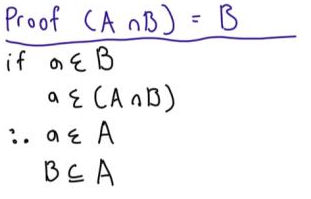 crude mango
Yeah
rigid oriole
a in B does not imply a in A n B
This is the main error
crude mango
This looks like law of explosion except it's not law of explosion
crude mango
rigid oriole
a in B **does not imply** a in A n B
This is the main error
^^^ if it was union that would be different
Not that union is particularly helpful
rigid oriole
rigid oriole
a in B **does not imply** a in A n B
This is the main error
This may be true under certain circumstances however.
You would need to justify why though.
crude mango
^
rigid oriole
Also, I would advise against using $\varepsilon$ for 'is an element of'. Write $\in$ instead.
vital dewBOT
 ebon quest
Umm can you guide me through how to properly prove my 2 cases? I’m not really following what you’re saying
rigid oriole
We are not following this argument.

How does this follow?
This is the issue. Can you explain this please
ebon quest
Yeah ok I see, that doesn’t make sense, kinda comes out of nowhere
crude mango
So you wanna try again to fix that?
crude mango
Might be
ebon quest
crude mango
Might be
Am I allowed to ping?
crude mango
Sure, can't guarantee a ping will get my attention immediately tho
Sometimes it does, not always
ebon quest
So I’m good now @crude mango but I’m not really sure how to prove this
crude mango
How much do you know about predicate logic
It's easier imo to do it like that but we can work around it if needed
ebon quest
Uhh I’m not sure what that is lol
crude mango
$\forall x,x\in A\lor x\in B$
vital dewBOT
hiiistrex
 crude mango
Does every part of that look familiar
ebon quest
Yeah, for all x, x is in A or x is in B
crude mango
Alright cool
ebon quest


 crude mango
vital dew
**hiiistrex**
crude mango
vital dew
**hiiistrex**
Does me expanding the statement like this all make sense?
ebon quest
When I asked for help a while ago, they told me this
ebon quest
crude mango
Does me expanding the statement like this all make sense?
Sorry, which statement were you trying to explain?
crude mango
I started with P and reexpressed it
ebon quest
Oh ok I see
vital dewBOT
hiiistrex
 crude mango
Is that familiar
ebon quest
Yeah
crude mango
vital dew
**hiiistrex**
Alright now try applying that to the expanded P then simplifying
ebon quest
So, for all X, x is not in A and x is not in B?
weary tiger
When constructing an adiabatic hyperbolic holomorphism, does the isometry of the Gaussian distribution concatenate itself within a principal obduration?
simple nimbus
If I bring the negation into the bracket on the left will it become (p AND not q)?

 spark aurora
i think so? because de morgans law
simple nimbus
spark aurora
i think so? because de morgans law
Okay that makes sense
Can someone please help me with c? I’ve done a and b but I’m not sure how to prove c as a contradiction or prove it’s false without truth tables

 dry raven

 weary tiger
rigid oriole
This is the issue. Can you explain this please
weary tiger
rigid oriole
This is the issue. Can you explain this please
They are simply proving one direction of the equals sign
wait hold up
their second line is only true if B is a subset of A, so they used the fact that B is a subset of A to reach that B is a subset of A, thats literally circular
oh my bad
i am