#discrete-math
1 messages · Page 200 of 1
 weary tiger
28 + 28 = 46
but they cant play more than 45
you see what i am trying to say? it doesnt make sense for me
weary tiger
no it says at least once a day
 coral raven
ah crap
weary tiger
"at least one game a day"
coral raven
ok well in that case it's impossible to play 14 games on both day 1 and day 2
it's never going to happen
coral raven
what do you mean 'play twice'
weary tiger
"Show that there must be a period of some number of consecutive days during
which the team must play exactly 14 games."
consecutive means twice or more right?
coral raven
not necessarily
weary tiger
😩
weary tiger
alright I'm doing something silly feel free to point it out:
$\sum_{k=0}^{m} {n \choose 2k+1} = \sum_{k=0}^{2m+1} {n \choose k} - \sum_{k=0}^{m} {n \choose 2k} = 2^{2m+1} - \sum_{k=0}^{m} {n \choose 2k} = 2^{2m+1} - \sum_{k=0}^{m} {n+1 \choose 2k+1}+ \sum_{k=0}^{m} {n \choose 2k+1}$
wait lmao texit moment
 vital dewBOT
zd
 weary tiger
cancel right term on extreme right with original expression to get
$2^{2m+1} = \sum_{k=0}^{m} {n+1 \choose 2k+1}$
vital dewBOT
zd
 weary tiger
and, this is false
what happened?
for example, sum from k=0 to 2 of (7 choose 2k+1) is (7 choose 1) + (7 choose 3) + (7 choose 5) = 7 + 35 + 21 = 63
weary tiger
figured it out in vc
vital dewBOT
zd
 weary tiger
when n > 2m+1
otherwise the original formula actually does worth, the example I chose had 7>2(2)+1
 north dust
I hope my combinatorial explanation of why the Stirling Cycle Number s(n,n) is equal to 1, is correct.
 jagged junco
Help? An is a recurrence relation.
n is the length of series that consists of {0, 1, 2} where all the occurrences of 0 must be before the occurrences of 2.
Find An
 stray reef
your teacher wants a minimal spanning tree so you give him a minimal spanning tree. minimizing individual paths is not a concern you have.
 rich siren
If in a graph the number of vertices is one more than the number of edges, then the graph is a tree?
I can't seem to come up with a counter-example, but it could be because I'm peanut brain
 cerulean wind
@rich siren take a cycle graph
and then just keep adding vertices until you get more vertices than edges
north dust
Ahh, Bell Numbers...
 frosty bay
broad question, not sure where to ask it
is a function a specific case of a relation?
 last flicker
yes.
north dust
I have to deal with exponential generating functions, AHHH
 elder steppe
i'm struggling to understand if this is transitive or not

i don't think it is but i'm not sure what the counterexample would be
 elder salmon
It is transitive right? Cus transitive means if aRb, bRc exist, then aRc should also exist. Here, (a, c) is there so it should be transitive. Er.. right? 🤣
 quaint raft
whats the fastest way i can find a c-admissable s-t flow of a diagraph?
is running ford-fulkerson the best option or is there a shortcut ?
weary tiger
Hi guys
Let S be the subset of the set of ordered pairs of integers defined recursively by
Basis step: (0, 0)∈S.
Recursive step: If (a, b)∈S, then (a, b+1)∈S, (a+1, b+1)∈S, and (a+2, b+1)∈S.
a) List the elements of S produced by the first four applications of the recursive definition.
b) Use strong induction on the number of applications of the recursive step of the definition to show
that a≤2b whenever (a, b)∈S.
c) Use structural induction to show that a≤2b whenever (a, b)∈S
I am stuck at b part
I did it like this so far but dont know where to take it from here
 stray reef
that is not how they expect you to word it, i think.
weary tiger
yeah i mean i just quickly did it paint
i am writing it in my paper
too lazy to take a pic of it
but what do you mean how should i word it?
stray reef
you should begin your proof like this:
Let n ∈ N and assume that a ≤ 2b is true for all (a,b) ∈ S such that (a,b) can be achieved from (0,0) by strictly less than n applications of the recursive step.

Let (a,b) ∈ S be a point which can be achieved in exactly n applications of the recursive step. We aim to show that this point satisfies a ≤ 2b.
right, okay
stray reef
since (a,b) ∈ S, there must exist (a', b') ∈ S such that (a',b') can be achieved in n-1 applications of the recursive step, and one of the following holds: (a,b) = (a', b'+1), or (a,b) = (a'+1, b'+1), or (a,b) = (a'+2, b'+1).
weary tiger
okay i got it to so far
stray reef
by the induction hypothesis, a' ≤ 2b'.
weary tiger
but how do we actually show it, thats what i am most confused on
stray reef
go through every case one by one and show that a' ≤ 2b' implies a ≤ 2b
stray reef
and one of the following holds: (a,b) = (a', b'+1), or (a,b) = (a'+1, b'+1), or (a,b) = (a'+2, b'+1).
weary tiger
can i write it as a + b + 1?
stray reef
no, (a, b+1) is not the same thing as a + b + 1.
weary tiger
i have no clue
can i write (a', b' + 1) as
a <= 2b <= 2(b+1)
so a <= 2b <= 2b + 2
which means its true?
stray reef
you're not sticking to my notation here, which will make it hard or even impossible to properly communicate
weary tiger
I am sorry, what didn't you understand?
Anyone that can help me explain this question for me?:
Assume that h(x) is a w-bit value, and h has properties similar to a fully random one function. How large can the length n of the sequence be if the assumption that there are no collisions to hold? An answer in big-O notation is sufficient.
stray reef
@weary tiger your use of "write ___ as ___" is a bit hard to decipher sometimes.
that is all i will say. please do not question me any further on this.
weary tiger
okay
weary tiger
a binary operation as defined in my textbook is an operation that maps each pair of elements that can be made in a set onto another element of that same set
then the division operator on the set of real numbers isn't a binary operation right? since division by 0 (which is part of the real numbers) is not possible ?
 dim marten
hey i was given a bunch of practice problems for class.
if anyone can show me how to do this one that would be nice.

 pale epoch
weary tiger
a binary operation as defined in my textbook is an operation that maps each pair...
pale epoch
weary tiger
a binary operation as defined in my textbook is an operation that maps each pair...
correct
pale epoch
dim marten
hey i was given a bunch of practice problems for class.
if anyone can show me ho...
show you how to do it? did you not do an example problem in class?
dim marten
pale epoch
show you how to do it? did you not do an example problem in class?
probably did but its a bit hard to pay attention the whole class time
pale epoch
i don't think it's possible to explain the whole concept of induction via discord, you should work through your material and/or search for other explanations (youtube, ...) of the concept first and actually attempt the question
dim marten
ok

 wheat leaf
Can someone help with this

 meager prairie
How would you go about generating the binary code given an encoding matrix?
I am tasked to list out the (6,3) binary code for this matrix:
$\begin{bmatrix} 1 & 0 & 0 & 0 & 1 & 1 \ 0 & 1 & 0 & 1 & 0 & 1 \ 0 & 0 & 1 & 1 & 1 & 0 \end{bmatrix}$
vital dewBOT
jan Niku
 meager prairie
so im anticipating 8 words? since its binary and its a 3 dimensional subspace
do you just pick one at random and see if its order divides 8?
meager prairie
F_2^6?
damn this stuff is confusing
oh, yea
F_2^6
how would you know the span though
pale epoch
well, there are only 8 possibilties
meager prairie
we know there are 8 just by it being binary and messages of 3 length right
or are you getting 8 in another way
pale epoch
the span of 3 elements over any F_2 vector space can have at most 8 elements
all the elements in the span are linear combinations of the 3 elements with coefficients in F_2
the span is $\lambda_1b_1 + \lambda_2b_2 + \lambda_3b_3$ where $b_i$ is the $i$th row vector and $\lambda_i \in \mathbb{F}_2$
meager prairie
I guess im confused, 3 is our message size, right?
the words will still be 6 digits long
vital dewBOT
Lochverstärker
 pale epoch
been a while since i used that lingo lmao
but words should be elements of F_2^6 and thus be 6 digits long
meager prairie
sorry im sorta confused we had our first lecture on this, and our teacher switched two variables halfway through (n,k) code to (k,n) code
yea, thats what i thought 
so why are you looking at the span of something 3 long?
pale epoch
the 3 rows of your matrix generate the code i think?
meager prairie
they do?
pale epoch
what is the definition of encoding matrix
meager prairie
an n by k matrix which encodes a word
pale epoch
and what does encode mean
meager prairie
im not sure we didnt define that word further
pale epoch
i know what a generating matrix is
and that is just collect a basis of the code in a matrix
so then you can write every word of that space as the matrix multiplied by some vector
meager prairie
oh these are the bases?
pale epoch
which i would read as encoding
meager prairie
that makes way more sense than whatever my teacher was talking about
pale epoch
so i would assume that the rows of your encoding matrix are a basis of your binary code
meager prairie
so you'd just take uhh
take each pair in turn i guess and operate them
then all 3
then each row
thatd give you the 8
is that really it
pale epoch
vital dew
**Lochverstärker**
you look at this
there are 8 possibilities for (\lambda_1, \lambda_2, \lambda_3)
meager prairie
okay
stray reef
you could multiply [000; 001; 010; 011; 100; 101; 110; 111] by your encoding matrix
meager prairie
thats a much nicer way to write what i was thinking of doing lol
stray reef
stray reef
you could multiply [000; 001; 010; 011; 100; 101; 110; 111] by your encoding mat...
by this i mean an 8 by 3 F2-matrix
pale epoch
i mean this is all simple linear algebra, you just have to translate the lingo
meager prairie
stray reef
by this i mean an 8 by 3 F2-matrix
this also would have been a good idea
meager prairie
pale epoch
i mean this is all simple linear algebra, you just have to translate the lingo
idk really linear algebra
pale epoch
that is unfortunate then
 meager prairie
stray reef
by this i mean an 8 by 3 F2-matrix
meager prairie
stray reef
by this i mean an 8 by 3 F2-matrix
or i guess im still confused, how do you know taking things of length 3 will work out
since arent our words in the end gonna be 6 long
stray reef
the codewords are 6 bits long
meager prairie
are you just figuring since the actual message is gonna be 3
stray reef
but the messages are 3 bits
weary tiger
I have to prove whether or not there exists a number n element of the natural numbers for which every natural number is a dividor.
the only expression that can be divided by every natural number is the product of (p_i)^r, with i from 1 to infty and r tending to infty. p_i here is the i-th prime number.
however, this product tends to infty, and so it is not an element of the real numbers I would think, thus the first statement is false
Is there any fault in this reasoning?
pale epoch
the only expression that can be divided by every natural number is the product of (p_i)^r, with i from 1 to infty and r tending to infty. p_i here is the i-th prime number.
why?
weary tiger
pale epoch
> the only expression that can be divided by every natural number is the product...
well, each natural number can be represented by a product (p_i)^(r_i) with r_i the specific exponent for the prime number p_i (r_i can be 0 too) and i from 1 to infty (basically the fundamental theorem of arithmetic)
so, every number for which an i exists with a finite r_i will not have the natural number p_i^{r_i+1} as a divisor.
thus, a number can only be divisable by all natural numbers if it is equal to the product of p_i{r} with r tending to infty and i from 1 to infty
pale epoch
thats not quite correct
whats the definition of "divides" @weary tiger?
(there is no reason to use such heavy machinery here)
also the original argument is kinda weird, since it seems to conclude that the only "number" dividing every number is "infinity" and that infinity is not a number, so it can't exist
so, every number for which an i exists with a finite r_i will not have the natural number p_i^{r_i+1} as a divisor.
this is a better formulation as to why most numbers have a non-divisor, but you also get this by just considering any greater numbers and dont need a prime factorization
notice that i say most numbers, considering the actual definition of divides you should easily see the exception
weary tiger
pale epoch
whats the definition of "divides" <@456226577798135808>?
If b divides a, then a modulo b = 0
pale epoch
what does modulo mean
pale epoch
eh, thats a bad definition, but you should still be able to see which a works always
weary tiger
pale epoch
also the original argument is kinda weird, since it seems to conclude that the o...
No im saying that the only number which can be divided by all natural numbers is infty
pale epoch
infinity is not a number
weary tiger
Yeah that was my point
pale epoch
yes, hence that argument is bad
weary tiger
I need to prove that there isn't a natural number n which can be divided by all natural numbers
pale epoch
saying "the only number which can be divided by all natural numbers is infinity and that is not a number" is not an argument
weary tiger
Since every natural number can be written as a product of primes (or power of primes), there can't exist one, because for every natural number, say it has in its product 2^(r_i), then 2^(1+r_i) won't be a divisor of that number
pale epoch
that works in most cases
weary tiger
The only case in which that doesn't work is if r_i is infty, but then we don't have a number anymore?
pale epoch
r_i cant be infinity
you just construct a number that doesnt divide any given number, so you are done
well, except this argument only works for strictly positive numbers
weary tiger
pale epoch
r_i cant be infinity
Thats what im saying, since it can't be, there will always be a 2^a that doesn't divide a given natural number
pale epoch
only positive numbers, but yes
"except when r_i = infinity" makes it wrong though, as this does not make any sense
weary tiger
Yeah that was the doubt I had in the beginning and why I asked here, if that infinite product of primes can be considered a natural number
I thought it wouldn't but I wanted to be sure
weary tiger
pale epoch
only positive numbers, but yes
0 isn't necessarily considered a natural number
pale epoch
bad definition, but ok
weary tiger
We include 0 as a natural number in our textbook discrete math, but not in all textbooks
However I know I should have specified
pale epoch
well, the point is that 0 is indeed divisible by any number
and that's kind of important
weary tiger
But I thought it was clear because if we included 0 the problem would be too easy xD
weary tiger
pale epoch
well, the point is that 0 is indeed divisible by any number
Yes of course
Thank you for your time
 restive surge
How would I find where this polynomial is rational? I know it’s not really a polynomial, but that’s why I can’t find rational solutions. The polynomial is sqrt(4a^4b^2-8a^3b^3+4a^2b^4+b^2d^4-4abd^4+4a^2d^4) and I want there to be two separate values of d that work with the same a and b and no values to be equal or 0.
Also maybe important to note that I only need one nontrivial solution, but I’d definitely prefer infinite.
a cannot be twice b.
I tried asking in the help channels but nobody responded
cerulean wind
why tho
 quaint raft
<@&286206848099549185>
 narrow sorrel
Anyone knows how to prove (a*b)+a=a in Boolean Algebra?
 grim citrus
Can someone help me with this
How many people must be present to guarantee that :
at least three of their birthdays are in one of the months January, February, March, April or at least four of their birthdays are in one of the remaining months?
<@&286206848099549185>
I am very confused
I figured that we need atleast 4 people for the first case and then 5 people for the second case??
 round tulip
Just starting my first lessons on discrete math here and learning logical equivalences...can someone clear something up for me? I get how to go from 1. to 2. using the rule I've added, but is going from 2. to 3. using also the same rule? I think I might be thinking about the rules too literally. Thank you!
 north dust
These exponential generating functions are (figuratively) killing me.
 bitter spire


 limpid fern
so, like if you were to describe a function $y = f(x)$ in the form $f:X \to Y$ would there be a special word for the representation $f: X \to Y$
like I have the function $y = x^2$ if x is an integer, then we can describe this function as $f: \mathbb{Z} \to \mathbb{Z}^+$
vital dewBOT
ChubbyMuffins
 limpid fern
is there a special word for the representation $f: \mathbb{Z} \to \mathbb{Z}^+$

 limpid fern
I would appreciate a response 😅
cerulean wind
a function
limpid fern
just that?
a function?
not like a word that represents "a description of a function"
anyways
thanks
I'll look more into it
stray reef
i have seen the notation f: X->Y specifically called a signature
 floral field
So, I'm trying to understand the proof that if we have
$$ A(x) = \sum_{n \geq 0} a_nx^n, $$
$$ B(x) = \sum_{n \geq 0} b_nx^n $$
then the coefficient of the nth term of $A(x)B(x)$ is
$$ \sum_{i=0}^n a_ib_{n-i} $$
vital dewBOT
beeswax
 floral field
I tried to expand both series and looked at each term when multiplying out, and only thing I noticed was that the sum of the subscripts of a,b equal exactly the power. Could someone guide/talk me through what is going on?
pale epoch
thats exactly that
you have to ask "when is x^i*x^j = x^n for some fixed n?"
turns out this is the case precisely when i+j=n
so now you want to group together all the terms a_i, b_j such that i+j = n
those are a_0 and b_n, a_1 and b_{n-1}, ..., a_n and b_0
so the expanded sum will have a_0b_nx^n + a_1b_{n-1}x^n + ... + a_nb_0x^n as summands and those are precisely all terms where x^n appears
@floral field
floral field
Ah
So basically the number of terms in the coefficient of $x^n$ corresponds to the number of ways we can sum $i$ and $j$ to $n$ and each $a_ib_j$ will have $i+j=n$. Looking at the first three terms of $A(x)B(x)$ as an example, we have
$$ (a_0b_0)x^0 + (a_0b_1+a_1b_0)x^1 + (a_0b_2 + a_1b_1 + a_2b_0 )x^2. $$
vital dewBOT
beeswax
 pale epoch
indeed
 restive finch
Hello, I was wondering how to find a closed form expression for an algorithm

I understand how to do it for an equation or summation, but this is confusing me
pale epoch
this is basically a summation
restive finch
what numbers are being used in it?
pale epoch
you think of the for loops as two sums
the outer one goes from i=0 to n and the inner one from j=0 to i
and you sum up the "work" done inside, i.e. the work done by bar()
restive finch
So my teacher set up the answer at the bottom for us. How is he getting 243?
The bottom table just doesn't make sense to me

I don't think thats right but that's the closest I can get
pale epoch
why the j after the 2?
bar should be doing constant work
i have no idea how anyone would be getting 243, considering the result has to depend on n
restive finch
is bar not doing constant work in the drawing?
pale epoch
is 2j a constant?
restive finch
I was setting it up like this. 2j isnt a constant
 pale epoch
"like this" doesnt tell me anything
what you sum up (in this case) should just be the work done by bar(), and it does a work of 2, not 2j
also the loops start at 0, not at 1
eh nvm, thats actually fine
except it isnt
is this code purposely written badly ...
well, check how often exactly the loops run and adjust your bounds accordingly
restive finch
would the closed form expression then be 2n^2?
pale epoch
,w sum(sum(2, j, 1, i), i, 0, n)
vital dewBOT


 Requested by Lochverstärker#5585
pale epoch
Requested by Lochverstärker#5585
pale epoch
apparently not
 candid gorge
what rule of inference law is used to get A->B given A and B
or do i need more information
like
I've proven A and B
the conclusion i need to meet is A -> B
can i conclude A -> B knowing A and B
pale epoch
would be weird if A -> B depended on anything other than A and B
candid gorge

thsi is the problem
i did
- assume A
- get AvB from step 1 with v elimination
- get C^D from step 2 using MP
- Get C from step 3 with simplification
- Get BvC from step 4 with v elimination
- Get A^B from step 5 with MP
- Get A and B from step 6 with simplification
pale epoch
i mean then its just v introduction or something
from B to not A or B
and you still have to consider the case not A
but that's just 1 step then
 ripe sierra
 crystal scarab
can someone help me with this? I dont understand how all three events can be independent of each other until they are all combined

 haughty garden
The classic example can be found in Probability Essentials by Jacod and Protter. Consider the set of 4 points: S' = {1, 2, 3, 4}. We define the sample space to be the set of all subsets of S'. That is, S = 2^(S').
Let A = {1, 2}, B = {2, 3} and C = {1, 3}. Finally we define P({i}) = 1/4 for each i = 1, 2, 3, 4. It's easy to see that P(A) = P(B) = P(C) = 1/2. And we can see that P(A and B) = P({2}) = 1/4 = 1/2 * 1/2 = P(A) * P(B). Hence, A, B, and C are pairwise independent (i.e. they satisfy the first three properties). We also see that P(A and B and C) = P(empty set) = 0 =/= P(A) * P(B) * P(C)
crystal scarab
got it ty
floral field
Why is the sum of infinitely many power series defined if and only if for each $n$, the coefficient of $x^n$ is zero in all but finitely many terms?
vital dewBOT
beeswax
 floral field
Actually, let me just send the statement

I am not quite understanding the paragraph below that equality and I was wondering if someone could help me in understanding that
stray reef
@floral field still here?
floral field
Yes
stray reef
alright so here's how i personally view it
floral field
The book also mentioned something about G(x)^n being divisible by x^n?
Sorry, go ahead
stray reef
when you add up infinitely many formal power series, normally to get the x^n coefficient of the result you add up all the x^n terms from each summand
but if there's a certain power of x such that every summand contains a nonzero term of that power, bullshit might start happening
bullshit such as the sum of the coefficients accidentally diverging when you didn't mean for it to do so
like if you tried to add 1 + (1+x)/2 + (1+x+x^2)/3 + (1+x+x^2+x^3)/4 + ... and so on, and tried to look at the constant term
you would find that the constant term ends up as the sum of the harmonic series, which diverges. which is bad.
so you DON'T want that happening.
and hence you require that for any power of x, there have to be only finitely many summands that contribute a term with that power.
stray reef
for a series like the one in your picture in particular, by requiring G(x) to have a zero constant term, you will get that G(x)^n does not contribute any terms below x^n
and hence that the x^n term in the sum is affected by at most the first n summands
floral field
Wait, in the specific case you gave, what's the composition there?
I'm just trying to see it in terms of the composition of power series
stray reef
...F(G(x))?
floral field
yes
stray reef
sorry, i'm not sure what you're asking here.
floral field
Wait actually nvm

 reef tapir
Help :/
stray reef
why me specifically???
 sudden knot

stray reef
reef tapir
Smart person
heard that excuse a million times
just because im smart and help other people (of my own volition!!!) does not entitle you to ask for my help unprompted like this
so honestly no, you can get lost. im not helping you
 surreal sand
is the empty set a subset of the set of the empty set?
 quaint star
The empty set is a subset of every set, so yes
I assume by the set of the empty set you meant ${ \varnothing }$
vital dewBOT
Lunasong the Supergay
 stray reef
"is the empty set a subset of-" yes
 weak lodge
Hey everyone. This is my first time using this server.
I've got two questions that the support center at my university couldn't answer for me today. Can anyone help me?
quaint star
Ask your questions and you will find out
weak lodge
ah ok cool.
So i get how derangements work. But i don't understand derangements with duplications?

in part (i) each grade is different so that's D4. But when two are the same what happens?
pale epoch
so you know how to count those assuming that you could distinguish the 80s somehow?
pale epoch
i will take that as a yes
so like, if you could distinguish the 80's in a way, say you have 80_1 and 80_2, then there would be two permutations for what is really just one
i.e. (70, 80_1, 90, 80_2) and (70, 80_2, 90, 80_1) would be indistinguishable (both correspond to (70, 80, 90, 80)) and you are overcounting by a factor of 2
i don't actually know if this is a good explanation
(also you should post the complete question as well...)
weak lodge
no that makes sense alright

that's the entire question
I'm not sure but are we just dividing the answer from part (i) by factor of 2 when there's 2 elements the same?
pale epoch
reading the full question that doesnt work i think, sorry
weak lodge
no worries. i get a derangement of 9 for the first part
pale epoch
how so?
 pale epoch
yeah, so division by 2 makes no sense
weak lodge
I have notes on how to do permutations of a set with non distinguishable elements. But we covered nothing on derangements of duplicates and i can't seem to link the ideas together
pale epoch
think about how many ways there are to give the students with 80 the wrong score and how many ways there are to give the other students the wrong score
weak lodge
something like
(4C2)2! ?
pale epoch
seems like a lot
well, say person 1 and person 2 both scored 80
for them to get the wrong scores what are the possibilities? just for them
weak lodge
2 possibilities. either grade 70 or 90?
pale epoch
yeah
but then 70 and 90 are "used", so only 80 is left for the other two guys
so that seems to be it?
weak lodge
so the answer is 2?
pale epoch
seems like it
weak lodge
that seems so straightforward!
pale epoch
or do you disagree?
weak lodge
not at all.
weak lodge
i was in a math center today and they couldnt figure it out. thanks for your help
i've got one other question that we couldnt figure out. if you want to cast an eye over it?
pale epoch
just post it, maybe i do, maybe someone else will
weak lodge
ok thanks

If anyone can help me this part (b), it's last the question in 3 past exam papers that i haven't solved.
pale epoch
probably just do induction
weak lodge
i dont know what to say for it

i think that works for the (a) part? I'm lost how to word part (b)
pale epoch
i think that works, yes
but dont think i can come up with a combinatorial argument for b
weak lodge
that's ok. thanks for your help with the first one.
stray reef
i know how to do a combinatorial argument for b
$\binom{n}{3}$ is the number of ways to pick three numbers from $1:n$.
the middle number can be anywhere between $2$ and $n-1$ inclusive. call it $k$. there is one number in our choice to the left of $k$ (there are $k-1$ ways to pick it) and one number in our choice to the right of $k$ (there are $n-k$ ways to pick it)
vital dewBOT
Kanga Gang Annihilator Ann
 stray reef
@pale epoch @weak lodge
pale epoch
oh, nice
weak lodge
thanks to both of ye for helping me 🙂
 tepid bay
Not sure if this is the place for this, but it is part of my final year discrete module:
how do I do the LIFO method to calculate the modelset of a boolean function? my lecturers notes are wild
for example this:

this is the process but the notes explaining the method are quite bad

does anybody know of this?
 simple nova
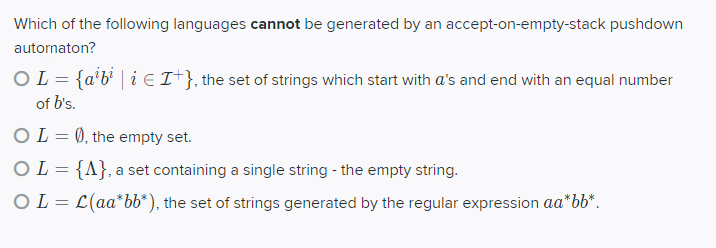
Does anybody know what can be generated by a PDA?
I'm thinking its between B and C
 bronze basin
Prove that if there is a function from N onto a set A, then A is countable.
N being the natural numbers
 gusty star

 keen python
bronze basin
keen python
bronze basin
is a set in bijective correspondence with its preimage?
 ember obsidian
prove if u think its true, if not give a counterexample
 ashen tapir
Does anyone know the answer

 lean loom
Hey all, I've been studying discrete math lately, but I have a question about Complete Partial Orders (cpo) and Continuous functions. I understand why the function not: B -> B is a continuous function, but according to a friend of mine, the following function f: B -> B is not continuous and I don't understand understand why. I thought this function f is monotonous because xRy and f(x)Rf(y) holds.
 stray reef
do you know the definition of a hasse diagram
@placid cairn
....
no that's just bad
the hasse diagram of a partial order $\leq$ has an edge $x \to y$ iff $x \leq y$ and there does not exist any $z$ such that $x\leq z \leq y$
vital dewBOT
Kanga Gang Annihilator Ann
 stray reef
IN PARTICULAR the existence of an edge $x \to y$ in the hasse diagram implies that $x \leq y$
vital dewBOT
Kanga Gang Annihilator Ann
 stray reef
so IF you had a cycle $x_1 \to x_2 \to \dots \to x_{n-1} \to x_n \to x_1$ THEN you would also have $$x_1 \le x_2 \le \dots \le x_{n-1} \le x_n \le x_1$$
vital dewBOT
Kanga Gang Annihilator Ann

 turbid swallow

In this Mating Ritual, if n different men went to n different women the first day, will the ritual be over?
- If a particular woman(X) has only one man(Y) serenading her, but at least one of the women has more than one man serenading her, does this mean X will still be serenaded by Y the next day?
Therefore, when the day arrives, that every man is serenading a separate woman, this means the ritual ends, right?
 vernal thorn
I'm not too sure what the for each d part means. Do I have to list all vertices 1 for each d or just overall?

 iron marsh
So I know the answer is no, but I am not sure how to explain it.
The issue is the edge v4v5 in G2 has nothing it can map to in G1

It is a bit wordy, but I think this is sufficient.
 stray reef
vernal thorn
I'm not too sure what the for each d part means. Do I have to list all vertices ...
stray reef
vernal thorn
I'm not too sure what the for each d part means. Do I have to list all vertices ...
it means there exists one vertex of degree 3, one vertex of degree 9, one vertex of degree 10, one vertex of degree 11, and one vertex of degree 12.
dim marten
can anyone explain how

they turned 4^(2m+1) into that (15a...)
this was the original question
 pale epoch
they used the induction hypothesis
by that $4^{2m+1} + 5^{2m+1} + 6^{2m+1} = 15a$ for some $a$ and thus $4^{2m+1} = 15a - 5^{2m+1} - 6^{2m+1}$
vital dewBOT
Lochverstärker

 stray reef
you are right this graph is not connected at all
it has two connected components: {a,c,e} and {b,d,f}
there does not exist a path from a to b for example
 coarse cave
awesome thank you


 hard cape
I’m interested in learning discrete mathematics. Does anyone know any good learning material or sources where I can learn?
Also what are the requirements before learning this subject?
vernal thorn
stray reef
it means there exists one vertex of degree 3, one vertex of degree 9, one vertex...
Are all of these part of 1 tree as it says the tree only contains 1 vertex of degree d?
vernal thorn
Oh so its just saying that it has those 5 distinct values of d as degrees of vertices
Thanks
 fresh venture
What does even number of odd integer mean?

 gritty pumice
hard cape
I’m interested in learning discrete mathematics. Does anyone know any good learn...
gritty pumice
hard cape
I’m interested in learning discrete mathematics. Does anyone know any good learn...
rosen discrete math
no prerequisites

 gritty pumice
maybe its "let"
vernal thorn
would the top vertex have a degree of 2 or 3?
 pale epoch
$re\vdash$
vital dewBOT
Lochverstärker
 pale epoch
(i also think its let)
pale epoch
vernal thorn
would the top vertex have a degree of 2 or 3?
what do you think and why
vernal thorn
i think 3 cos it the degree counts itself and then its children
pale epoch
itself?
vernal thorn
the point itself and then the ones below it
vernal thorn
If i extend it like this would the top vertex now have a degree of 3 or would it still be 2?
 vernal thorn
ok thank you
fresh venture
pale epoch
the product has an even amount of factors
Ok thanks
How can I solve this?
I only know how to do for smaller numbers

45 will make too many calculations
Is there any easier way to solve?
fresh venture
It mean if you expand it what will be the power of 45
dim marten
am i allowed to send my completed hw assignment in here
fresh venture
Answer is 4
dim marten
to see if anyone is willing to check it over
gritty pumice
just write out the definition of choose
fresh venture
45^4 will divide it without giving decimals
gritty pumice
you dont need to compute it
fresh venture
gritty pumice
you dont need to compute it
How?
Can I do like how many 45 powers for 53
Then how many for 27 and 26 and then subtract them
Will that give me the answer?
fresh venture
No
gritty pumice
we can see 45^2 on the top and 45^2 on thebottom
gritty pumice
you want so see what power 45 has yeah?
gritty pumice
53 choose 26 / 45^4 is not a whole number ?
 gritty pumice
ur calculator is cutting it to a whole number
fresh venture
Is that so?
gritty pumice
i believe so
if we write it as a fraction
we can see 45,5,9 on the top
and on the bottom 5,9,5,9
so should be 0 no?
fresh venture
gritty pumice
we can see 45,5,9 on the top
Ohh wait I don't get where did you got that from
gritty pumice
$53C26 = \frac{53 \times ... \times 45 \times ...\times 9\times ...\times 5 \times ..\times 1}{26 \times ... \times 9 \time .. \times 5 \times .. \times 1 \times 27 \times ... \times 9 \times .. \times 5 \times .. \times 1}$
vital dewBOT
Lsfhv
Compile Error! Click the  reaction for more information.
(You may edit your message to recompile.)
 fresh venture
Won't we also count 15x3?
fresh venture
Ig it's 45 power -1
gritty pumice
yeah 😅
gritty pumice
about?
fresh venture
I mean if we say remove all 27! From 53!
Then we only need to worry about 26!
There it will generate 45 idk how many times
gritty pumice
fresh venture
I mean if we say remove all 27! From 53!
wym
fresh venture
Like 9x5
15x3
Then break 18 into 3x6 and 25 into 5x5
It will give more
gritty pumice
oh yh ur right
fresh venture
gritty pumice
wym
I mean removing.... Like dividing so only 53x 52.... 28 are left
gritty pumice
so youll need to be factor into primes
fresh venture
Yeah
fresh venture
gritty pumice
and count them
That will take a lot of time in exam
I don't think that's how we are supposed to do
fresh venture
Yeah
gritty pumice
then you count from there
there is probably no better way other than seeing which numbers will factor to a 5 and 3
fresh venture
Yeah
I got an example

So I was thinking if I just calculate how many 45s for 53! And subtract those for 26! And 27!
Will that work?
fresh venture
That seems easier
fresh venture
fresh venture
I got an example
But idk what this dude is doing in there
gritty pumice
but then u also have the case if 26 has a 3 left and 27 has 15 left, you add combine the left overs if u do it like that
fresh venture
Can't understand
fresh venture
gritty pumice
but then u also have the case if 26 has a 3 left and 27 has 15 left, you add com...
Won't those be counted as well?
gritty pumice
depends if u count 26 and 27 seperatly or 26! x 27!
at once
imo i think its easier to simply first
fresh venture
Ok
gritty pumice
sounds right
 night gust
This is wrong... Right?
S is a relation between two sets, defined by: X >= Y
With X and Y into the set of real numbers.
Question is: X S Y if X = -1 and Y = -2 ?

 urban mantle
Question about discrete random variable.
If I have a X - set of events and probabilities, and I need to compute mathematical expectation of X => M(X), then I just need to find mean event of set X.
M(X) = x1p1+x2p2...xn*pn.
But what about something like this?
M(2+2X)
How do I compute this one? What operation defines sum of number with set X and multiplication of set X to number? I just don't understand.
 vapid torrent
urban mantle
Question about discrete random variable.
If I have a X - set of events and prob...
vapid torrent
urban mantle
Question about discrete random variable.
If I have a X - set of events and prob...
you could use linearity of expectation
That would be equal to 2+2M(x)
using the same notation you are
but note, X is not a set of events and probabilities, it's a random variable
it assigns probabilities to events
urban mantle
What about M(X^2) ?
urban mantle
Oh, you mean that xi and pi are different things. It is not like pi depends on xi, so multiplication inside of M(X*N) just gonna result in changing xi variables, but if forwarding the same thought we must conclude that M(X+2) is gonna change every input of M to be bigger on two
M(X)=x1p1+x2p2...+xn*pn
M(X+2)=(x1+2)*p1+(x2+3)*p2...(xn+3)*pn
But you said that I could just take away const values from M function
@vapid torrent
Sometimes I really regrets that I just understand things entirely different from most people so I had to ask a lot of questions to figure out how something works
Otherwise I most likely do something wrong
My brain just built differently
Wait. It just works. It is really true that M(X+2) will change terms inside of equation, but it still works that I can just take away const variables
wot
Anyway thanks
 sand cipher
how do i prove this, i thought i had something to do with compliments that could make the problem easier to solve, but my professor said that there is no use of compliments in this problem
 pale epoch
you take an element of the LHS, show its in in the RHS and vice versa
(you can also just make a truth table)
sand cipher
pale epoch
you take an element of the LHS, show its in in the RHS and vice versa
ye that's what i wanna proof, but idk how
also my professor did say that I will need to use DeMorgan law
pale epoch
ye, this is demorgan's law
what does it mean for an element to be in the LHS?
you will have to "translate" what that means into logic
sand cipher
LHS is the Premise and RHS is the conclusion?
pale epoch
LHS is $X - (Y \cup Z)$
vital dewBOT
Lochverstärker
 pale epoch
(left/right hand side)
sand cipher
pale epoch
what does it mean for an element to be in the LHS?
that it will be in X but not in Y or Z?
pale epoch
yes, but you will have to write it down more formally
because you then get a statement of the form $a \in X \land \dots$ which you can apply demorgans law to
vital dewBOT
Lochverstärker
 sand cipher
how would i do that like what variable i use,
a exist in x but does not exist in y and z
yep that but what can i say about a, like is it ration an integer or is it just x
pale epoch
i mean just look at how set difference and set union is defined
in my example a is just an element of a set
sand cipher
so i can say $a \in U where\ a \in X \land \dots$
vital dewBOT
Centrous
 pale epoch
U is some universe?
sand cipher
U is some Universal set
sand cipher
so i can skip the part about $a \in U$?
vital dewBOT
Centrous
 pale epoch
yes
X, Y and Z are sets so $X - (Y\cup Z)$ is a set and we can talk about elements of it
vital dewBOT
Lochverstärker
 sand cipher
ok so after defining what X Y and Z how do we turn that into X-y n X-Z,
do we like multiply the x- in there or something like that?
pale epoch
pale epoch
because you then get a statement of the form $a \in X \land \dots$ which you can...
i told you how here
read up the definitions of set difference, union and intersection
sand cipher
so set difference = in X but not in Y or Z like what we just talk about
union is set ... ^(and) ....
Intersection is the one in common
 pale epoch
,?
sand cipher
a is in x & a is not in y or z?
pale epoch
check the definition of $\cup$
vital dewBOT
Lochverstärker
 pale epoch
, means nothing to me
sand cipher
 pale epoch
eh, that doesnt work
you applied set difference wrong
or distributed it wrong
the statement is $a \in X \land a \notin (Y \cup Z)$
vital dewBOT
Lochverstärker
 sand cipher
so this is U rite
 pale epoch
vital dew
**Lochverstärker**
pale epoch
vital dew
**Lochverstärker**
do you see how this is applying the definition of set difference?
sand cipher
so set difference is A is in X and A is a subset for Y, is what i got(for X-Y)
pale epoch
i can't parse this
sand cipher

 versed frost
"A relation R on a set X is said to be reflexive if for all a, b
∈ X, it is true that aRb and bRa." Rough translation from Spanish, but - it'd be false considering aRb and bRa is transitive.
sand cipher
pale epoch
the subset symbol really has no place there
what bout this?
 pale epoch
vital dew
**Lochverstärker**
pale epoch
vital dew
**Lochverstärker**
yes, thats what i used here
now notice that $a \notin Y \cup Z$ is equivalent to $\neg(a \in Y \cup Z)$
vital dewBOT
Lochverstärker
 sand cipher
yep
pale epoch
then you can apply the definition of $\cup$ and finally demorgans.
vital dewBOT
Lochverstärker
 pale epoch
versed frost
"A relation R on a set X is said to be reflexive if for all a, b
∈ X, it is true...
pale epoch
versed frost
"A relation R on a set X is said to be reflexive if for all a, b
∈ X, it is true...
that is not what reflexive means
also i fail to see a question?
versed frost
What's in quotation marks, it's a true or false question - which I'm pretty sure is false. Since what's denoting is basically transitive.
It's a bit hard translating the nuances in Spanish to English.
I'm legit having a hard time since the professor gave us an assessment to study with no answers to correlate with, so I am basically trying to figure out if I am right - or not. Asymmetrical classes are a pain.
pale epoch
oh, then if you translated correctly, the statement in quotation marks is indeed false
but it has nothing to do with transitivity
versed frost
Is that so? Huh. The only thing that's asking me out of the assessment is if it's true, or false - but I want to know more beyond that, and even my tutor struggled to make of what my professor wrote in the modules.
So I'm just stumped figuring it out for myself, and my 12 other classmates are just silent on our group.
pale epoch
well, if aRb for every a and every b, then every element is related to every other element
this relation is reflexive and transitive, but that's not how either of those things are defined
versed frost
Well, that's a pain. 
I also have these three other questions that weren't even brought up in the module at all - and I know it's got to do with algebra, and set builder notations, but I don't know how to apply it here.
- If the relations R and S are symmetric, then R ∩ S is symmetric
- If the relations R and S are symmetric, then R ∪ S is symmetric.
- If the relations R and S are symmetric, then R ◦ S is symmetric
Intersection, union, and composition - I think?
weary tiger
Hi! Im having a bit of trouble on my homework about graph theory and I read the rules about asking questions and it says that these types of questions should go in the discussions. It's about Kruskal's Algorithm, may I post it?
pale epoch
versed frost
Intersection, union, and composition - I think?
yes
coral raven
what does the composition of relations mean
pale epoch
you need to have the first on like X \times Y, the second on Y \times Z and then you get the obvious one on X \times Z
you probably didnt ask me...
coral raven
oh
no i'd just literally never run into that before
seems pretty awful
and niche
pale epoch
no idea if it appears in nature
pale epoch
weary tiger
Hi! Im having a bit of trouble on my homework about graph theory and I read the ...
also yes, but i don't want to answer two questions in parallel 
also i have to go to bed
versed frost
Goodnight.
sand cipher
BTW thx @pale epoch
weary tiger
pale epoch
also yes, but i don't want to answer two questions in parallel <:bruh:7203351234...
Hey no worries! I just figured it out too!
Definitely get some sleep 😂
 rotund delta
suppose that s is a subsequence of length 7 of distinct characters. how many different length 4 subsequences does s have?

 stray reef
none of these are proper parenthesizations.
the order of the letters should be w, x, y, z in all of these, and the parentheses must indicate the order of operations unambiguously
remember we are talking about associativity and NOT about commutativity
this is what you should have had:
((w*x)*y)*z
(w*(x*y))*z
(w*x)*(y*z)
w*((x*y)*z)
w*(x*(y*z))
@coarse cave
do you understand why what you have written is complete nonsense?
weary tiger
Hi! Im a little confused on this problem on my nearest neighbor graph theory hw, I feel like I followed the algorithm correctly and I've been at this for 20 minutes now and im not really sure what im doing wrong. I put the answer as the path I followed, as what this requires is following the smallest number and ending at the starting vertex, but im just a little confused as to why because I feel confident in my answer (Nevermind! I figured it out, im blind XD)

 latent reef
Is this question does not have answer
 stray reef
it does
latent reef
bruh wrong channel
 signal basin
What does usually this notation means: $i=1, \ldots, I$. Does it mean for all $i \in {1\dots,I}$ ?
vital dewBOT
baan
 stray reef
yes
coarse cave
stray reef
do you understand why what you have written is complete nonsense?
yes i do!
ya that makes a lot more sense
I was just confused bc the examples they gave us were with 3 variables
could you by chance know how to utilize the trees to get a postfix?
stray reef
[answered in help channels]
 austere musk
For when is $P(A-B) = P(A) - P(B)$? \\
I have: \
If $A=B$, then $P(A - B) = \varnothing$ and $P(A) - P(B) = \varnothing$ \
If $A \neq B$, then $\varnothing \in P(A - B)$ and $\varnothing \notin P(A) - P(B)$
Is this reasoning correct
Is this correct?
Or have I dungoofed
pale epoch
P is powerset?
austere musk
Yes
pale epoch
powerset of empty set is empty?
pale epoch
yes
austere musk
Ok the second part is also wrong
pale epoch
why?
austere musk
Well surely it's equal at some point
pale epoch
i think your second argument works
 prime parcel
Yeah the second seem to work
austere musk
When P(A-B) = P(A) - P(B)
If A = B, then P(A-B) = { {} }, and P(A) - P(B) = { }
If A != B, then {} in P(A-B) and {} not in P(A) - P(B)
So it's never equal?
austere musk
pale epoch
no reason to consider cases
Wdym, is there a nicer proof for this?
pale epoch
your second argument works for A=B as well
austere musk
Ah right
 open glacier

I have to show if its injctive, surjective or bijective.
What exactly am I looking for? Set of integers (s,t) so that 2s+1=s+t or that 2s+1= integer and s+t=integer?
It is mapping set of integers to integers, so I'd assume I'm looking for integers
pale epoch
"looking for"?
look up what injective, surjective and bijective means and then check if its true or false
open glacier
Sure, thats cool, but I'm just asking to know what answer I'd be looking for. Do I select random integers and test or should I first do something with the equations or ...
pale epoch
testing is always a good approach
just plug in about 10 different tuples, see what happens
open glacier
Okay heres a question: with injectivity definition, would f(x1) be a set (s,t) or just s?
pale epoch
notice anything not mapped to? try to find a preimage
notice a "collision"? its not injective! try to force collisions
there is no f here
the function g takes in tuples of integers and spits out tuples of integers
g((0, 0)) = (1, 0) for example
open glacier
Okay so you're saying that its not injective because it is possible to find set of imaged integers that are mapped by multiple different sets of g(s,t)
pale epoch
no
set is the wrong word
and im saying that if that is the case, then its not injective
if you find say $(s_1, t_1)$ and $(s_2, t_2)$ with $(s_1, t_1) \neq (s_2, t_2)$ but $g((s_1, t_1)) = g((s_2, t_2))$ its not injective
vital dewBOT
Lochverstärker
 open glacier
Got it, thank you. I did kind of understand the definition, just wondering if I should find tuples to find a collision
open glacier
Cant say its injective just because I dont find any either
pale epoch
true, but looking for it you might notice a reason why it must be injective
so if you dont just see a reason why its (not) injective, you have to do something
open glacier
Question is, what is that something ^^
I do see that 2s+1 is always odd number
That most likely has something to do with it
pale epoch
yes, you can use that to show its not surjective
injectivity will be a bit more tricky i think
open glacier
Yeah surjectivity is quite easy, I suppose I'll try finding a collision. Otherwise i'd have to start doing some matrix equation stuff
Saw it done on google..
pale epoch
matrix equation stuff 
take like g((0, 0)) = (1, 0), can you find another element mapped to (1, 0)? why / why not?
open glacier
Quite an obvious example to bring as its quite apparent it would be easiest way to show its not injective.
It is not possible to find another pair of integers so that we'd get (1,0)
pale epoch
yes, but why not
open glacier
Because s has to be 0 to have (0,) and t has to be 0 in order to get (,0)
Best I could come up with.
There is no other pair of integers (s,t) besides (0,0) to get (1,0)
Pardon if I'm being stupid but I honestly don't see any other way of proving it without just stating the obvious
pale epoch
t doesnt have to be 0 to get 0 in the second coordinate of the image
g(1, -1) = (3, 0)
is there any other way you can get 1 in the first coordinate though?
open glacier
There is not.
I suppose that there is the answer that you've been directing me towards so patiently.
pale epoch
yes, now you just need to figure out if 1 is special in this regard, or if it works for any first coordinate and formulate the argument
open glacier
Just to be clear - we've concluded that indeed it is. Is the conclusion what you meant by "figuring out"?
All I see is left now, as you mentioned, is building the argument based on data.
pale epoch
the conclusion is injective
in particular you cant "fabricate collisions" in the first coordinate
for the argument you can just consider an arbitrary point like (1, 0)
the same argument will apply to any point in the image
with maybe minimal alterations
north dust
Exponential generating functions and Lucas numbers, ahh
north dust
I can't believe I had to figure out how to do partial fractions in order to find the closed form for a formula for Lucas numbers, ahhh
rich siren
Determine the smallest maximum number of comparisons needed to merge sorted lists with 5, 6, 7, 8, 20, and 29 elements?
How would I start with this problem?
north dust
I can't seem to get the exact formula for Lucas numbers via exponential generating functions
cerulean wind
coolest way to do this is linear algebra imo
versed frost
"The relation R at {1, 2, 3, 4} defined by (x, y) ∈ R if x^2 ≥ y" - question is, how would I be able to write this as a table?
pale epoch
row and column entries for the set elements and then some marker to show if the pairs are in R or not
versed frost
Sorry, what I meant to say was - if I have x^2 that means I would have to set all values in the domain to the power of 2? And in which case, what would the y values be? Would they be the same? In which case, it'd be (1,1) (2,1) (2,2) (2,3) (2,4), etc. (?)
stray reef
you're overthinking it.
stray reef
if you want to write this as a table, then you just... yknow
write a table
and check every pair (x,y) against the inequality x^2 ≥ y
that's it
 twin narwhal
def seperator(lst):
    """
    lst is a list of integers
    returns a list of odd and even numbers from lst
    """
    odd = []
    even = []
    for i in range(len(lst)):
        if lst[i] % 2 == 0:
            even.append(lst[i])
        else:
            odd.append(lst[i])
    return even, odd
anyone got any tips to find the loop invariant(s) and the variant(s)? im trying to prove this algorithm is correct
for the variant i was thinking len(lst[i::]) because it gets smaller with each iteration until its 0
twin narwhal
yeah
pale epoch
how does len(lst[i::]) satisfy any of this
oh wait you said variant
nvm me lmao
i dont know what a variant is but reading the definition rn this probably works
twin narwhal
hold on lemme make the function a bit easier invariant wise
a variant is basically a termination condition that is always decreasing and the loop guard and invariant imply that v >= 0
pale epoch
it should work after a sufficient amount of reformulations
yeah with your edit its better
twin narwhal
coz loop guard is i < len(lst)
so i was thinking that the invariant should be 0<=i <= len(lst)
that way i can get that my variant V = len(lst) - i(i changed it just now lol) is >=0
twin narwhal
like len(odd) + len(even) <= len(lst)?
pale epoch
thats not true though?
but i meant you need to state things about what the algorithm actually does
twin narwhal
whoops looks like i forgot
pale epoch
so that when i is whatever value it is at termination (len(lst) i guess) you get correctness of what your algorithm actually does
twin narwhal
so this algorithm just seperates the integers into two lists one of odd numbers and one of even numbers
pale epoch
yes, so your invariant probably needs to talk about odd and even
and well, the original list
twin narwhal
twin narwhal
like len(odd) + len(even) <= len(lst)?
so then this doesnt work right for an invariant?
pale epoch
its not even true, right?
the length of odd and even change with each iteration
but the length of list is static
oh
<=
i should probably go to bed or sth
i mean you can add that
twin narwhal
what time is it where you are rn?
pale epoch
unimportant
twin narwhal
true
twin narwhal
the <=?
twin narwhal
so rn it would be i<= len(lst) and len(odd) + len(even) <= len(lst)
pale epoch
you still need to talk about what the algorithm actually does
twin narwhal
yeah in the proof
pale epoch
otherwise you wont get correctnes
the invariant has to give you correctness for i = len(lst) + 1
twin narwhal
wait why len(lst) + 1?
pale epoch
thats when the algorithm terminates?
twin narwhal
doesnt it terminate when i = len(lst)?
pale epoch
it depends where you start counting, if 0 or 1
twin narwhal
0
pale epoch
then you probably need i < len(lst) in the invariant i think
twin narwhal
alright thanks
pale epoch
then it terminates at i = len(lst)
but you still need a statement about what the algorithm is supposed to do
do you have some example of a loop invariant?
twin narwhal
for like a different piece of code?
pale epoch
ye
twin narwhal
without lists yes, with lists no
pale epoch
look at wikipedia: https://en.wikipedia.org/wiki/Loop_invariant
In computer science, a loop invariant is a property of a program loop that is true before (and after) each iteration. It is a logical assertion, sometimes checked within the code by an assertion call. Knowing its invariant(s) is essential in understanding the effect of a loop.
In formal program verification, particularly the Floyd-Hoare approach...
the example invariant for finding a maximum in a list is something like
"m stores the maximum of list[0..i]"
you need something like this
so that when the algorithm terminates (and your invariant is always true), you get correctness
 patent fulcrum
Hi. Can you give me an example of non-computable subset of naturals?
patent fulcrum
Is the set of all turing machines isomorphic to naturals?
stray reef
it's isomorphic to a subset of N
exactly which subset depends on exactly how you encode turing machines, of course
patent fulcrum
Turing machine is N -> N, so there are N^N turing machines which is bigger than N
I'm not getting this
N^N ~ R ~/~ N
patent fulcrum
stray reef
there are N^N turing machines
patent fulcrum
Considering the fact that there are non-computable subsets
No
But then I'm not getting this
Also how do you prove that fact
Ahhh because to get if an algorithm halts is impossible
Makes sense
But how do you prove that there are N turing machines?
stray reef
the description of any turing machine is finite
patent fulcrum
Heh
Interesting pov XD
We can even say that a turing machine is no more than a word in some language with finite alpahbet
Whcih obviously making it ~ N
Thanks
 autumn horizon
 gritty pumice
you just want a path between every node i believe
in ur picture, they are all connected except the top right
restive surge
If a multivariable diophantine polynomial has at least one nontrivial zero, Will there be more nontrivial zeroes that aren’t just multiples of the first?
The one i’m looking at specifically is a 4d quartic with no combatants and the last term is just -n^2. I’ll post the full thing and the solutions I found when I have time.
It is 4x^4y^2-8x^3y^3+4x^2y^4+y^2z^4-xyz^4+4x^2z^4-n^2=0 and the solution is x=18 y=25 z=35 n=14875
and subsequent multiples by just multiplying all of them by some constant.
 split drum
The line in front of the first interval is a negative. It's meant to be $(-\infty, 0]$. I'm struggling to come up with a proper bijection between these sets to prove their numerical equivalence. Does anyone have any tips on how to do this beyond just playing around with random functions until one works? I know I could also form a bijection between each set and $\mathbb R$ individually, which would also show that they are equal (numerically). I'm not sure which approach to take.
 vital dewBOT
Umiguess4000
 split drum
<@&286206848099549185>
 proven silo
probably easier to just construct two injective functions if allowed
otherwise probably easier taking a detour around [0,1) or smth than a bijection between those 2 sets, so create bijections from the 2 sets to [0,1)
restive surge
I’ll ask in a help channel
 austere musk
Guess em
What numbers are congruent 6 mod 13 @graceful nimbus
So if this was set of numbers congruent 3 mod 7
I would think:
3 mod 7 = 3
Whats the next number:
p mod 7 = 3?
And after trying a few I'd get 10
10 mod 7 = 3
And so on, and so on until I have the list:
3, 10, 17, 24...
And if you notice they're all numbers: 3 + ? + ? ...
So I'd write my set S recursively as:
Let 3 ϵ S, (start with 3 is in S)
Then n ϵ S ⇒ n + ? ϵ S, (if a 'number' is in S, add ? will also be in S)
split drum
proven silo
otherwise probably easier taking a detour around [0,1) or smth than a bijection ...
Ooh, I didn't even think of that!!
Thank you 😭
 graceful nimbus
austere musk
So if this was set of numbers congruent 3 mod 7
graceful nimbus
austere musk
So if this was set of numbers congruent 3 mod 7
damn that helped a lot
tysm
hey @austere musk sry for the ping but if ur familiar with congurences can you help me out with 1 more exercise 😓
austere musk
i might not be able to but if you post it here someone else may be able to
graceful nimbus
 graceful nimbus
 sour arrow
Solve 497x + 121y = 23 using Euclidean algorithm GO
sour arrow
Solve 497x + 121y = 23 using Euclidean algorithm GO
x = -115 and y = 28
graceful nimbus
oh alright
sour arrow
As once you take mod 121 of the equation I gave, you get the equation you're trying to solve
split drum
Can someone confirm this function definition for me? For $f: (-\infty, 0] \rightarrow (0, 4]$, we can define $f(x) = \frac{4}{1-x}$.
vital dewBOT
Umiguess4000


 sharp ledge
Anyone could help ?
 signal basin
What does this mean "the nodes are ordered so that i < j for all arcs (i, j) ∈ A"?
Does it mean that (i,j) is a forward arc?
stray reef
wym by forward arc
if you mean "an arc whose end has a higher number that its start" then yeah
@signal basin
signal basin
Is you stand at node s you look at node t, and what you seee is "s ---> t" — this is what i call a forward arc
i'm not sure what that means, still
it could be that the nodes in the graph are denoted by a,...,e.
what sense does i < j then make?
stray reef
can you show the whole paragraph or section where you saw this phrase
signal basin
 stray reef
the nodes are ordered, and it's implied they are ordered by numbering them from 1 to n
 marsh cliff
Asking here too 🙂 Anybody aware of a longer list than 212 terms of https://oeis.org/A132581 (https://oeis.org/A132581/b132581.txt)
 neon fulcrum
Hello
Given: If you do not do your laundry, your parent will not be happy with you.
Lets say that the above is p -> q
then what is this? You do your laundry because your parent will be happy with you.
~p -> ~q ?
 proven breach
Do I go into a help channel if I need help ?
neon fulcrum
yes
or to one of the subject channels like this one
Many schools are doing finals this week and next so it might be hard to get help though just FYI
proven breach
Very true. That's what I'm doing right now. ✅ I'll post my question and just come back to it. Thanks for the reply.
weary tiger
Could there be a simple graph with 12 vertices of 3 degrees each?
quaint raft
any hints, I can only show <12
 narrow sorrel
Can anyone explain what does Id+ stand for in boolean algebra? tia
 last flicker
assumedly the identity under +
narrow sorrel
Thanks!
 ornate cliff
What does a path of length 0 look like? Is it just one node/vertice? Or no nodes/vertices?
 last timber
ornate cliff
What does a path of length 0 look like? Is it just one node/vertice? Or no nodes...
last timber
ornate cliff
What does a path of length 0 look like? Is it just one node/vertice? Or no nodes...
what is your definition of path and length?
but presumably empty path or just somethink like {v1}
ornate cliff
Path: sequence of nodes where no edge is traversed more than once
Length: edge between 2 nodes
ornate cliff
last timber
but presumably empty path or just somethink like {v1}
Okay thank you!
last timber
ornate cliff
Path: sequence of nodes where no edge is traversed more than once
Length: edge b...
ok yes then {v1} or {}
sharp ledge
A country uses as currency coins with values of 1 peso,
2 pesos, 5 pesos, and 10 pesos and bills with values of
5 pesos, 10 pesos, 20 pesos, 50 pesos, and 100 pesos. Find
a recurrence relation for the number of ways to pay a bill
of n pesos if the order in which the coins and bills are
paid matters.
 outer hinge
 I have an exam in about two hours and I barely know anything about our proofs
It’s my final
 kindred raptor
there are 3 red ball / 4 blue ball / 5 green ball
a) how many combination for picking 3 redball together 4 blue ball together and 5 green ball together
b)how many combination for picking 3 redball together 4 blue ball together
i think
answer for a is 12C3 + 9C4 +5C5...... i guess
but idk how to do b
7C5+(12C3 + 9C4)???????
 grave totem
