#discrete-math
1 messages · Page 181 of 1
 quaint star
Oh, yes, typo
quaint star
Now we look at the equations from the bottom to the top. The last equation gives us 1 as a linear combination 8 and 25.
$$1 = 25 - 8(3)$$
But the equation before that gives us 8 as a linear combination of 108 and 25, so we can substitute that in to get 1 in terms of 25 and 8. But then we can use the previous equation to replace 25 with 241 and 108, and then the one before that to replace 108 with 241 and 590. So we end up with 1 as a linear combination of 241 and 590, which is what we want. Okay, let me write it out.
 vital dewBOT
Lunasong the Supergay
 quaint star
$$\begin{align*}
1 & = 25 + 8(-3) \
& = 25 + (108 + 25(-4))(-3) = 108(-3) + 25(13) \
& = 108(-3) + (241+108(-2))(13) = 241(13) + 108(-29) \
& = 241(13) + (590+241(-2))(-29) = 590(-29) + 241(71)
\end{align*}$$
vital dewBOT
Lunasong the Supergay
Compile Error! Click the  reaction for more information.
(You may edit your message to recompile.)
 quaint star
So when I move to a lower row, I am using the previous equation to substitute in, then I simplify next to it.
See if you can follow what I did
 west rain
yeayeayea I see what you're doing
quaint star
So we use each of the equations in the Euclidean algorithm to work our way back to 590 and 241, and we end up with
1 = 590(-29) + 241(71)
Now if we wanted to know the inverse of 241 mod 590
Then this equation reduces to 1 = 241(71) (mod 590)
So 71 is the inverse of 241 mod 590
And -29 is the inverse of 590 mod 241
Does that make sense?
So from 1 = mx + ny, we get that m and x are inverses mod n, and n and y are inverses mod m
Assuming m and n are positive
quaint star
Okay, so if you want to implement this as code, you need to organize your data neatly. Because you need to store all of the equations in the euclidean algorithm, so that you can reverse them to get to 1 as a linear combination of 241 and 590
west rain
right
quaint star
Ima sleep now. But go through the process slowly, maybe try to to do an example on your own, and then try the code.
If you get stuck, ask again and I'm sure someone can help
west rain
thank you so much
quaint star
Np, good luck
west rain
at this point I think I have a good enough foundation. I'm gonna keep looking over what you did and try some for myself
gn
quaint star
👍
 hybrid crown
(That was a helpful explanation on the euclidean algo for me as well)
hybrid crown
quaint star
👍
(so thanks!!)
quaint star
😂 yw
hybrid crown
(the words "linear combination" in particular helped crystalize it for me XDD)
 pale magnet
I need help!!

 strange grotto
pale magnet
I need help!!
strange grotto
pale magnet
I need help!!
suppose g has a vertex which is not connected. then maximum possible connected vertex would be n-1. so maximum possible edges would (n-1) choose 2. but edges are (n-1)C2+1. contradiction.
pale magnet
strange grotto
suppose g has a vertex which is not connected. then maximum possible connected v...
Thanks, i was trying by induction
strange grotto
pale magnet
Thanks, i was trying by induction
ok base case is clear. consider graph with n vertices with (n-1)(n-2)/2 +1 edges and assume it is connected. add a vertex. now suppose this is not connected. but this (n+1) graph has n(n-1)/2+1 edges. that is, we have to add n-1 edges in the new graph such that it is not connected. note that we can only add a maximum of n-2 edges (nC2- (n-1)C2-1) in the graph with n vertices. contradiction. thus (n+1) graph is connected if n is.
Thus all graphs are connected.
pale magnet
strange grotto
ok base case is clear. consider graph with n vertices with (n-1)(n-2)/2 +1 edges...
So thanks!
😄
 mortal kiln
I’m taking discrete math and have no math background, I’m stuck on this question, would appreciate your response. We have 7 balls, each of a different color, that we are placing in 3 different boxes, each of a different size. How many ways are there to do this so that none of the boxes are empty?
 stray reef
without the "none of the boxes are empty" constraint the number of ways would be 3^7
...i take it that you aren't familiar with the inclusion-exclusion principle?
@mortal kiln
mortal kiln
I’m not
stray reef
damn
would've made things a lot easier
do you at least understand why the number of arrangements is 3^7 if you don't care about the boxes being empty?
mortal kiln
I always get confused about these type of problems because I don’t know if I have to use combination or not
stray reef
if by 'combination' you mean the n-choose-k thing, it's no more than a shortcut for some multiplicative counting.
you don't "use" it; it arises naturally.
mortal kiln
So we don’t use it in this problem?
stray reef
are you familiar with the more basic concept of multiplicative counting? perhaps it goes by some other name (or no name at all) in your class
mortal kiln
Yes
stray reef
well then
look at your problem like this: for each ball, there are 3 options for where it could go (the small box, the medium box or the large box)
and there are seven balls
so the number of arrangements (again, ignoring the 'no boxes empty' thing for now) is 3 * 3 * 3 * 3 * 3 * 3 * 3, or 3^7 for short
does that make sense to you?
mortal kiln
Yeah thanks
stray reef
now obviously this count will include some arrangements that we don't want
i.e. arrangements that leave some boxes empty
so if we were to count those, we could subtract them from our count of 3^7 and get the answer
does this make sense to you?
mortal kiln
So if the question was for example asking at least 2 balls in each box, would it be different?
mortal kiln
Yeah that part made sense
stray reef
but yes you'd have to do it somewhat differently if the requirements were different
should i continue or are you going to attempt this on your own?
stray reef
👻
mortal kiln
If you can continue it would be really helpful tnx
 unreal stump

This is from an old test
(and our professor doesn't share the answer key with us)
Should the answer be C(u,t)-1?
Because pick x from some group and there are C(u,t)-1 groups that x is not in
And each such group gives one value to x
 last timber
@unreal stump is it given that K_a != K_b for distinct groups?
last timber
also how you treat case when t > u and we have zero groups
someone should get -1 numbers than
last timber
and this question is vague on whether groups are disjoint
unreal stump
Assume u>t,K_a's are all distinct and the groups don't intersect each other
last timber

then it seems that yes C(u,t)-1
oh wait
still
@unreal stump u = 5 and t = 3
we are able to form only one group
and there will be 3 ppl with no number
and 2 ppl with one number
 vital dewBOT
Buncho Dragons
 last timber
@unreal stump but then groups are not disjoint
last timber
oh lol
unreal stump
This question is just too vague
last timber
 young vector
should I ask some very simple entry-level questions about topology here or should I apply for access of the topology channel?
stray reef
you can type ,iam adv to get advanced access lol
young vector
yeah I was just thinking whether it's okay to clog advanced channels with simple layman questions 😄
stray reef
i mean you can post your questions here if you want
theyre probably to do with proof techniques or something of the sort
 ocean island
Ty
 vital dewBOT
Merosity

 obtuse lance
multiplying by r shifts all the terms basically
$rS_n=ar+ar^2+ar^3+...+ar^{n-1} +ar^n+ar^{n+1}$
vital dewBOT
Merosity
 obtuse lance
does that much make sense @ocean island
obtuse lance
the right side is nearly the same
ocean island
Yeah
obtuse lance
$rS_n=-a + (a+ar+ar^2+ar^3+...+ar^{n-1} +ar^n)+ar^{n+1} = -a + (S_n)+ar^{n+1}$
vital dewBOT
Merosity
 obtuse lance
-a is the j=0 term we put in and ar^{n+1} was an extra one we got out, otherwise all the terms inside are the exact same
obtuse lance
well the k=0 term of S_n is a
so I'm adding 0 = -a + a
so I'm not actually changing anything, just completing the formula for S_n there by adding 0 in a fancy way
ocean island
oh
I see what you mean
So what you wanna do manipulate rSn in a way that matches Sn
obtuse lance
yeah, it's just the first and last terms that sort of get messed up
ocean island
And to do that, you need to add the "a + -a"
obtuse lance
so we fix those two end terms up, yeah
that fixes up the first term
the last term we just pull out cause ar^{n+1} is not in S_n
obtuse lance
yeah you're welcome
definitely a cool trick haha
cause it's like looking at a pattern in the equation, usually you're not looking at patterns in the formulas and stuff themselves which is kinda neat
obtuse lance
when I learn math from books I usually get multiple books on the same topic and then if I get an explanation I don't like I just go to a different book to find an explanation I do like haha
 warped pecan
Any ideas?

 weary tiger
Hint: ||Can anything be simplified with Fermat's Little Theorem? ||
 pale epoch
that's the same, just multiply by k
warped pecan
But can I like add up remainders?
pale epoch
what do you mean?
warped pecan
Am I at least one the right track
 pale epoch
ye, but you can reduce more
warped pecan
How?
pale epoch
$2^{202} = (2^{10})^{20}\cdot 2^2 \equiv 1^{20}\cdot 2^2 \pmod{11}$
vital dewBOT
Lochverstärker
 pale epoch
2^10 = 1 mod 11 by fermat
pale epoch
and general rules for congruences
pale epoch
warped pecan
Okay but if I do that for everything, do I like add each one up?
yes
if a = b mod n and c = d mod n, then a + c = b + d mod n
that's the general theorem
like, you want to replace 2^2222 by the smallest possible representative mod 11
which is a number between 0 and 10
and there is some theorem that tells you that you can do this
in this case that smallest representative is 2^2 = 4
 warped pecan
Hahaha okay but now how do I go about simplifying that
pale epoch
you calculate it
warped pecan
Oh I see
Since the one for 2 also came out to be 4 mod 11?
Is there something with that?
pale epoch
huh?
obtuse lance
it might help to think since x^10 = 1 mod 11 that you can imagine it being x^10 = x^0 mod 11 and so you're really thinking mod 10 in the exponent
and since the exponents are written in base 10 you can immediately just leave the last digit and write,
$2^2+4^4+6^6+8^8 \mod 11$
vital dewBOT
Merosity

 abstract iron
uhhh
I got a question
involving truth tables

so I know this is tautology
but like not sure how to explain it
 rotund frigate
It says Using a truth table. You can determine whether a formula is a tautology by seeing if it is true for all possible inputs.
 mint shore
can someone explain to me how this is broken down?

it's from a solved exercise and simplifications are skipped
solving a recurrence relation w generating function
that part kinda confuses me
the $3^n$ part can just be turned into $\frac{1}{1-3x}$
vital dewBOT
Subdivisions X-1
 mint shore
but how do you handle the other part?

just given this in terms of getting the sum out of the way
but here instead of u there is n+2
and it's screwing w my head a little
obtuse lance
$$\binom{n+2}{n} = \frac{(n+2)!}{n!(n+2-n)!} = \frac{(n+2)(n+1)n!}{n!2!} = \frac{(n+2)(n+1)}{2}$$ now you're effectively just looking at $\sum_{n\ge 0} (n+2)(n+1)x^n$, you know how to simplify from here? @mint shore
vital dewBOT
Merosity
 abstract iron
rotund frigate
It says *Using a truth table*. You can determine whether a formula is a tautolog...
abstract iron
rotund frigate
It says *Using a truth table*. You can determine whether a formula is a tautolog...
yeah but the 0's and 1's
I'm not the best at discrete maths mind you lol
mint shore
obtuse lance
$$\binom{n+2}{n} = \frac{(n+2)!}{n!(n+2-n)!} = \frac{(n+2)(n+1)n!}{n!2!} = \frac...
yea i do, thanks tons
 livid elk
Show that for any positive integer $n$, there is exactly one positive integer $k$ for which $\frac{k}{2}(k-1)<n\leq\frac{k}{2}(k+1)$. Give a formula for finding this $k$ using floor functions.
vital dewBOT
-vertex
 unreal stump
Hint sum of natural numbers
livid elk
Looking for some insight as to where to start here. Cant seem to find it
unreal stump
You can find a k such that
n<=1+2+3+4...k
Now this k will be unique assuming you also use that 1+2+3...(k-1)<n
livid elk
I have shown that for any positive integer $n$, there is exactly one positive integer $k$ for which $\frac{k}{2}(k-1)<n\leq\frac{k}{2}(k+1)$. However I can't seem to come up with a formula using floor functions to find $k$. Any hints?
vital dewBOT
-vertex
 last timber
@livid elk you prolly may solve two inequalities
vital dewBOT
Commander Vimes
 livid elk
@last timber i played around with that, but couldn't seem to find anything.
 civic horizon
you have to be a bit more specific
2 and 8 are fibonacci numbers but they arent coprime
warped pecan
Oh sorry two consecutive
civic horizon
spamming the euclidean algorithm probably works
warped pecan
What do you mean?
stray reef
any common divisor of a and b also divides b-a
and any common divisor of a and b-a also divides b
warped pecan
Linear combination
But the how is the fact that it divides equivalent to it being the greatest common divisor
stray reef
let S = {k in N: k divides a and b} and T = {k in N: k divides a and b-a}
do you agree that max(S) = gcd(a,b) and max(T) = gcd(a,b-a)?
warped pecan
Yes
stray reef
okay and so you agree that S = T by the argument i just presented?
warped pecan
Are the ks the same?
stray reef
that question is nonsensical
 jade birch
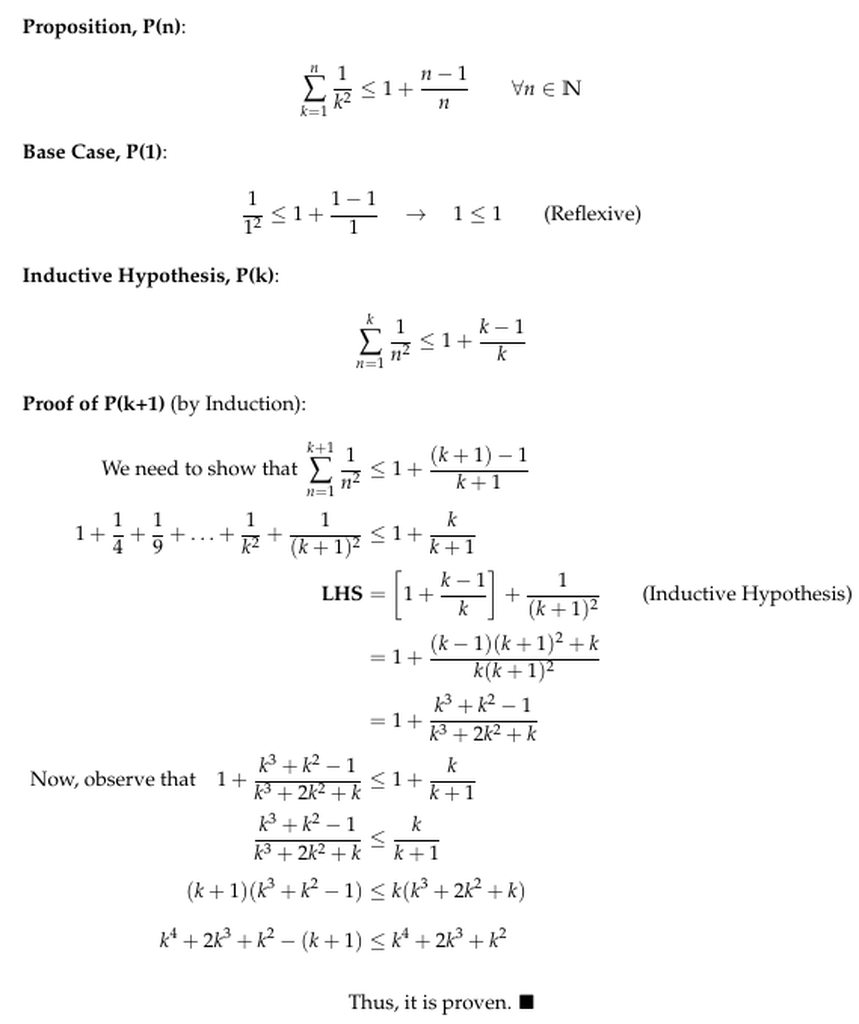
Would anyone care to critique my proof? https://imgur.com/a/rPTUr0I
 odd trout
HELP ME
 manic dome

I proved it is an equivalence relation, but how do I write out the equivalence classes for this
jade birch
@manic dome prove it
jade birch
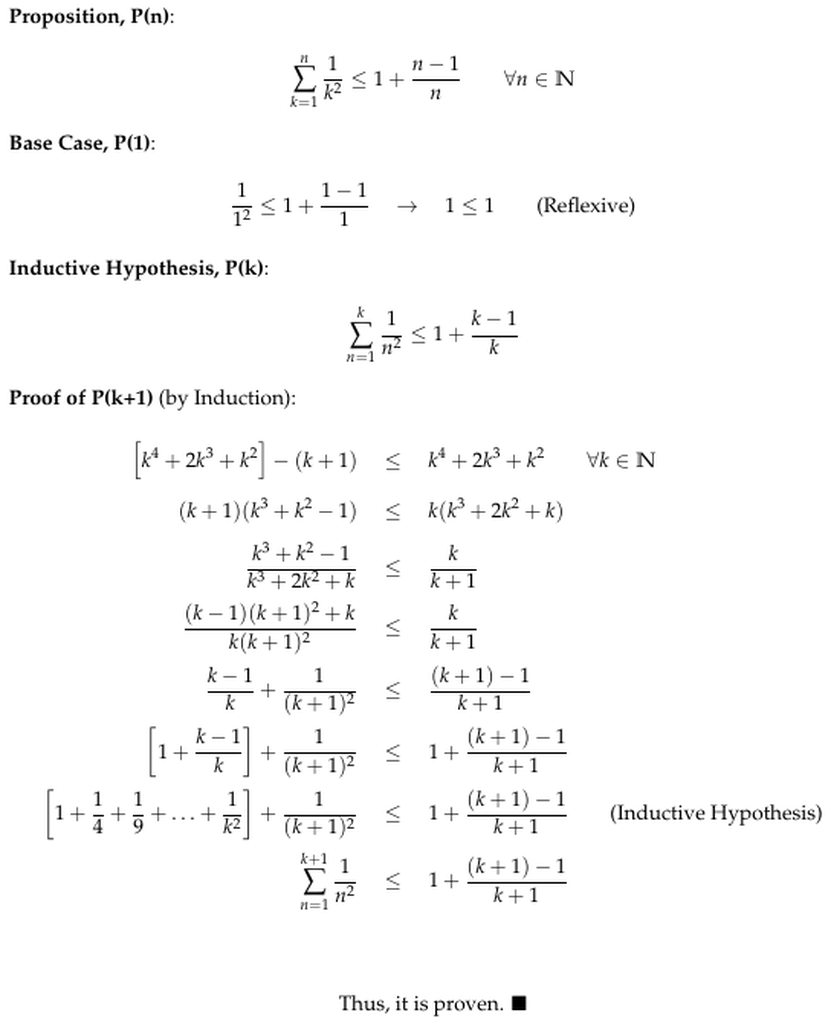
check my proof bros https://imgur.com/a/mEn9Iud
 modern dew
hello
jade birch
hi
warped pecan
Anyone know how to prove it forward?

 obtuse minnow
Hmm … hint?
If 11 divides A, 11 divides 2A or 3A or 4A or 5A or 6A or 7A or 8A or 9A or 10A
 red nest
warped pecan
Anyone know how to prove it forward?
red nest
warped pecan
Anyone know how to prove it forward?
Try multiplying both sides by 9
 deft dock
what is this even asking me to do???
 rotund frigate
They want you to eventually prove t.
jade birch
@deft dock whaty isn't clear about that?
 timber sage
hey anyone here know what all the symbols means like pyramids and stuff in mathmatics
stray reef
'pyramids and stuff'?
the meaning of a symbol is very likely to highly depend on context
@timber sage can you show the symbols whose meaning you're interested in?
stray reef
those "pyramids" are just the capital letter Delta
timber sage
it would really help to know the name of the theory involved like a wikipedia page or something
stray reef
and in this context, they're being used to denote traded amounts of... coins?
stray reef
this sounds like some kind of cryptocurrency economics thing
timber sage
well it could just as well apply to resistor flow but yeah
thing is most flow theorys do not seem to account for the dynamic nature of the constant function on the edges
from what i could tell and i am super noob at this
i dont see why they use square root there also
 glass condor
How can I find the solutions $n$ of $$N n = 0 \mod k$$ for some $N$ and $k$? What I've got is that it means $N*n$ is a multiple of some multiple of $k$, meaning that we can calculate the prime decomposition of $k$, remove from it the parts that are in $N$, and the remaining parts will be the lowest $n$. Is that the only way, or am I missing some more obvious one?
vital dewBOT
ConfusedReptile
 glass condor
oh wait that's just k/gcd(N,k), is it...
obtuse lance
yeah, or you could write it as lcm(N,k)/N, that at least is how I thought of it, since it has to be a multiple of k and N, so we pick the least one, then since we already have N, we can divide it out of what we need to complete n.
of course they're related by gcd(N,k)lcm(N,k)=Nk so it's all the same thing
deft dock
rotund frigate
They want you to eventually prove t.
and we use each premise only once right?
livid elk
Why must $\frac{n!}{r!(n-r)!}$ be a positive integer whenever $n$ and $r$ are non-negative integers with $r\leq n$
vital dewBOT
-vertex
 livid elk
Since $n,r \in \mathbb{Z^+} \land r\leq n,$\hspace{2mm}$ \frac{n!}{r!(n-r)!}$ is the quotient of two positive integers, which must be positive.\
There are $\frac{n!}{(n-r)!}$ permutations of $r$ distinct elements that can be made from an $n$-element set, and there are $r!$ ways to order each $r$-element subset. Therefore, the number of $r$-element subsets is:\
$\frac{1}{r!}\frac{n!}{(n-r)!}=\frac{n!}{r!(n-r)!}$\
Since the number of $r$-element subsets must be a positive integer, $\frac{n!}{r!(n-r)!}$ must be a positive integer.
vital dewBOT
-vertex
 livid elk
does this proof suffice?
 cerulean wind
yes this is a good combinatorial argument
livid elk
@cerulean wind great, thanks
modern dew
i should prove that

 narrow trench
is φ the totient function ?
weary tiger
you should
weary tiger
narrow trench
is φ the totient function ?
yes
modern dew
it is
 dull slate
modern dew
i should prove that
dull slate
modern dew
i should prove that
really interesting 💗
$\phi(n) = n\prod_{\begin{array}[c] p \in \mathbb{P} \ p | n \end{array}}(1-\frac{1}{p})$
cerulean wind
why are you using an array
dull slate
cerulean wind
use \substack
how does that work?
civic horizon
\nmid is not divides
cerulean wind
like this $\sum_{\substack{n=1\\text{p is prime}}\ \text{another line}}\text{your mom}$
cerulean wind
civic horizon
\nmid is not divides
right. it’s \mid for a | b
just keep using substack
dull slate
and for multi eqtions?
cerulean wind
cerulean wind
just keep using substack
maybe not? lmao
dull slate
cerulean wind
right. it’s \mid for a | b
why just not let it | ?
$\phi(n) = n\prod_{\substack{ p \in \mathbb{P} \ p | n }}(1-\frac{1}p)$
vital dewBOT
4z1z
 dull slate

cerulean wind
dull slate
why just not let it | ?
cus cool kids use \mid and \nmid lol
vital dewBOT
-vertex
Show that $\forall n \in \mathbb{Z}^+, n^2\mid [(2+n)^n-2^n]$ at first glance this seems to rely on induction, however it does not seem to work, as

$n=k$ $\rightarrow$ $(2+k)^k
$n=k+1$ $\rightarrow$ $(k+3)^{k+1}

Is there something im missing?
```Compilation error:```! Missing $ inserted.
<inserted text>
                $
l.58 $n=k+1$ $\rightarrow
                         $ $(k+3)^{k+1}
I've inserted a begin-math/end-math symbol since I think
you left one out. Proceed, with fingers crossed.```
-vertex
 livid elk
Show that $\forall n \in \mathbb{Z}^+, n^2\mid [(2+n)^n-2^n]$. At first glance, this seems to rely on induction, however it seems to not work, as
$n=k$ $\rightarrow$ $(k+\textbf{2})^k-2^k=k^2P$
$n=k+1$ $\rightarrow$ $(k+\textbf{3})^{k+1}-2^{k+1}=(k+1)^2Q $
is there someh
vital dewBOT
-vertex
 livid elk
no, it is not necessary to use induction, it was just my only intuition here.
obtuse minnow
Yeah, how much do you know about Combinations as they relate to the binomial theorem?
Sorry, like, is that something you can use to solve this?
livid elk
I dont think i could formulate a proof using that method, however I could probably follow yours.
possibly* lol
obtuse minnow
so okay what are the terms for (a + b)^n ?
cerulean wind
oh nice
obtuse minnow
Then think about a = 2 and b = n. Then think about what happens to the leading term.
livid elk
$(a+b)^n=(C{n,0})a^nb^0+C{n,1})a^nb^1+...+(C_{n,n}a^0b^n$
vital dewBOT
-vertex
 obtuse minnow
yep okay plug in 2 for a and n for b.
livid elk
well i fucked it in discord but you get it lol
obtuse minnow
I'll assume you can clean it up later.
(i.e. we're good?) 🙂
Tell me when you're done with (2 + n)^n and what the first term is.
livid elk
sorry, one minute, on the phone
obtuse minnow
kk
livid elk
sorry, work, the first term is $2^n$
vital dewBOT
-vertex
 obtuse minnow
yep. So it cancels with the - 2^n right?
livid elk
right
obtuse minnow
So what about the next few terms?
(First term, check! It's zeroed out by the -2^n. Zero is good in this case.)
livid elk
$\frac{2^{n-1}}nn!{(n-1)!}$
vital dewBOT
-vertex
 vital dewBOT
-vertex
 obtuse minnow
is that divisible by n^2?
obtuse minnow
Let's just say: 3! = 3 x 2 x 1. 6! = 6 x 5 x 4 x 3 x 2 x1
obtuse minnow
For Systems ... There's a nice generalization about (n!)/((n-1)!). It's equal to just "n." (3 x 2 x 1)/(2 x 1) = 3. (8 x 7 x 6 x 5 x 4 x 3 x 2 x 1)/(7 x 6 x 5 x 4 x 3 x 2 x 1) = 8.
narrow trench
yup
obtuse minnow
So vertex, what are the rest of the terms? Are they EACH divisble by n^2? 🙂
narrow trench
because n! = n*(n-1)* ... * 2* 1 = n * (n-1)!
obtuse minnow
Yep.
@livid elk Can you argue the third, fourth, up to the last terms are all divisible by n^2?
livid elk
all remaining terms take the form $\frac{2^{n-k}n*n!}{(n-k)!k!}$ so are divisible by $n^2$
vital dewBOT
-vertex
 obtuse minnow
hmm not quite.
I gotta go in 10-15 🙂
I should go. Here's what we've discussed so far and that last bit that might need induction.
||
Facts:
- All C(a,b) ... all combinations ... are whole numbers.
- The k'th term of a binomial expansion (a + b)^n is C(n, k - 1) a^(n-k+1)b^(k-1).
- n divides C(n, 1).
Consider (2 + n)^n. The first term is 2^n which nicely cancels with the 2^n we need to subtract!!
The 2nd and 3rd and other terms are C(n, 1)(2^(n-1))(n) + C(n, 2)(2^(n-3))(n^2) ...
Notice the second term has the product of C(n, 1) and n and as such is divisible by n^2.
Notice also each term after that has n^(k+1) where k+1 > 1. n^2 divides the n^(k+1) part of every term from the third to the last!!
And that's it!!
The first term gets subtracted to become zero (zero is auto-divisible by n^2). The second term has a factor of n^2 because of C(n,1) and n^1. The rest of the terms have a factor of n^(k+1) and because of this, each of these remaining terms have a factor of n^2.
When you add up multiples of n^2 you get a multiple of n^2. So the whole thing is divisible by n^2.
||
livid elk
thanks, really appreciate it
 shell flicker
how do I exactly prove this, this makes senses to me because otherwise it wont be true, but I have no idea how to prove this formally
 cerulean wind
A and B are subsets of some other set correct?
anyway, it doesn’t really matter. $$2^{|A|}=2^{|A\setminus B|+1}$$ so $|A|-1=|A\setminus B|$ hence there is only one element of A that is also a member of B, and the conclusion follows
vital dewBOT
coycoy
 shell flicker
cerulean wind
anyway, it doesn’t really matter. $$2^{|A|}=2^{|A\setminus B|+1}$$ so $|A|-1=|A\...
shell flicker
cerulean wind
anyway, it doesn’t really matter. $$2^{|A|}=2^{|A\setminus B|+1}$$ so $|A|-1=|A\...
thank you!
deft dock
where does the d come from???

should it say "for all integers a, b, c, and d" instead?
narrow trench
yeah
deft dock

deft dock
Prove the statement: For all integers a,b and c, if a|c and b|d then ab| cd .
Proof:
Suppose a, b, c, and d are any integers such that a|c and b|d.
By definition of divisibility, c = k * a, for some integer k and d = y * b, for some integer y.
Thus, c * d = (k * a) * (y * b) = k * y * a * b by algebra and the distributive law.
Let x = k * y
By substitution, c * d = x * (ab), where ab, x, and c * d are integers because products of integers are integers.
Thus, cd is divisible by ab for some integer x
is this correct?
cerulean wind
yea
deft dock
im actually getting the hang of this 
for a first time proof class id say im not doing too bad
deft dock
i think this is correct as well?
 deft dock

 deft dock
also for this why dont we mention infinity and just go separate ways

 snow sleet
deft dock
did i write this correctly?
snow sleet
deft dock
did i write this correctly?
For this problem the formal predicate logic notation would be $\forall x\in\mathbb Z: 5|x\implies 5|-x$.

 snow sleet
deft dock
also for this why dont we mention infinity and just go separate ways <:KEK:58624...
snow sleet
deft dock
also for this why dont we mention infinity and just go separate ways <:KEK:58624...
we don't just mention infinity because doing so would be an instance where we're assuming what we're trying to prove. We're trying to prove there is no greatest even integer, so we can't/shouldn't assume there is no greatest integer to begin with.
deft dock
my night in shining armor 
deft dock
snow sleet
we don't just mention infinity because doing so would be an instance where we're...
ah this makes sense
snow sleet
@deft dock So the proof you provided that shows there is no greatest even integer works because if you give me any even integer, I can find another even integer greater than it. In predicate logic: For any even integer N, there exists an even integer M such that M>N. So there must not be a greatest even integer because if there were, we've shown we can find one greater than it, a contradiction.
 snow sleet
before I check that one, do you mind if I slightly reword your proof that there is no greatest even integer?
deft dock
here:
Suppose that there is a greatest even integer called N.
Hence, N > n, where n is all even integers.
Let M = N + 2. M is an even integer because it is the sum of two even integers.
Thus, M > N because M is two more than N (M = N + 2)
So, this means that M is greater than the greatest integer, N. This contradicts our original assumption.
Hence, the given statement is true.
so you can edit without having to type everything
snow sleet
kk thanks; imma code it using the LateX bot here
vital dewBOT
logician_pdx
 deft dock
at least in terms of proofs?
deft dock
vital dew
**logician\_pdx**
woah
wait what
everything after M = N + 2 > N becomes a blur
snow sleet
yes, -5|x is actually equivalent to saying 5|-x since there's an underlying equation there and you can just apply/delete negative signs from both sides to obtain the other., but 5|-x makes more sense given the english statement you were trying to transform into predicate logic
okay so if we assume N is the greatest even integer. Then this must mean that any integer greater than N isn't even
snow sleet
it's essentially a "maximal criminal proof"
snow sleet
the maximal criminal was N
deft dock
this is a summer de class anyways
snow sleet
we assumed there was a counterexample, then there must be a greatest counterexample
which we called N
it's typically not a method of proof anyone really teaches
deft dock
i thought m was the counterexample
snow sleet
M is what we used to give us a contradiction
snow sleet
so we assumed for the sake of contradiction, that the statement we're trying to prove was false. This means we assumed there was a counterexample
a counterexample is something that renders a mathematical statement false.
deft dock
snow sleet
so we assumed for the sake of contradiction, that the statement we're trying to ...
ohhhhhhhhhhhh
snow sleet
a contradiction isn't a counterexample
deft dock
counterexample is a contradiction
snow sleet
a contradiction is something like x<x
deft dock
a counterexample would be specific values that make that true?
deft dock

snow sleet
if x is prime, then x is composite
a counterexample would be x=2.
this is because 2 is prime, but 2 isn't composite
see how there's no contradiction here
deft dock
mhm
snow sleet
so in our proof, the fact that we had M>N and 2|M, those two things together contradict the maximality of N
snow sleet
so 2|M means M is even, right?
this is because M=N+2, and the sum of 2 even integers is also even
deft dock
wait wait
so instead of 2k = M
youre saying 2|M?
for how even?
but same thing?
wait
OHHHHHHHHH
yes yes
same thing
because |
snow sleet
if 2k=M for some integer k, this by definition of divisibility means 2|M
deft dock
and QRT
snow sleet
right
deft dock
yeah the whole n = 2d + q or wtv
snow sleet
gotcha; yeah that's also known as the division algorithm
deft dock
i wanna go back to caclulator man 
snow sleet
lmao
deft dock
precalc to discrete was a large jump
snow sleet
proofs are fun once you get the hang of it and appreciate the beauty of the logic behind proofs.
damn that is quite a jump
I've already taken discrete, but sounds like you're handling the jump quite well!
keep up the good work!
 snow sleet
what's de?
deft dock
wait could you check that 3 cases abomination proof?
deft dock
snow sleet
what's de?
dual enrollment
deft dock
im still in high school im going into my junior year this year
snow sleet
wow, that's impressive actually.
deft dock
 snow sleet
I didn't get to discrete till bout sophomore year in college
deft dock
comedically i took this class for fun because i saw it didnt have any pre reqs 
deft dock
yeah strange
snow sleet
4q+3, should be there
deft dock
also
in my webassign
those werent even there
instead they were
hold on
n = 2q and n= 2q +1
instead of the 4q stuff
same proof as well

almost
wait so why is the divisor two in one place and 4 in another?
with the other one having 4q, +1, +2, and +3 (not included)?
snow sleet
oh nice proof
well so if n is even, then n=2k for some integer k. For that same integer k, n^2=(2k)^2=4k^2.
deft dock

deft dock
snow sleet
well so if n is even, then n=2k for some integer k. For that same integer k, n^2...
mhm
snow sleet
If n is odd, then n=2l+1 for some integer l. For that same integer l, n^2=(2l+1)^2=4l^2+4l+1=4(l^2+l)+1.
given an integer n, n is even or n is odd...hence only two cases to consider
snow sleet
by disparities, you mean what?
deft dock
or wait.
actually
the whole thing with 2q + 1 and 2q
and the other stuff with 4q and other constants
snow sleet
that's just breaking up the integers into even and odd integers
 barren rose
anyone know how to see what a recurrence relation converges to
snow sleet
the QRT is just saying "you give me an integer n, and for that n, n leaves remainder 0,1,2,or 3 after division by 4"
snow sleet
barren rose
anyone know how to see what a recurrence relation converges to
not me unfortunately sorry
deft dock
i dont think im explaining what im confused about
okay so
i have two of the same statements that they want me to proove


they want me to proove the same things
but
why is it that in one of them
we assume the divisor is 2
and in the other one we assume the divisor is 4
?
snow sleet
again, this has to do with how we can break up the set of integers.
splitting up the integers into evens and odds is a much quicker way of doing this than covering all four cases (4q+0,4q+1,4q+2,4q+3).
so you could totally use the (4q+0,4q+1,4q+2,4q+3), route...it'd just be longer than necessary
want me to write a proof for this?
snow sleet
no!!!!!
deft dock

snow sleet
recall what the QRT guarantees given the integers n and 2
and then given the integers n and 4
so do you agree that an integer is either even or odd?
deft dock
yeah
snow sleet
okay, so 2q, 2q+1 makes sense, right?
either the integer is divisible by 2, hence 2q...or the integer isn't divisible by 2, hence 2q+1
deft dock
snow sleet
okay, so 2q, 2q+1 makes sense, right?
yup even/odd
deft dock
snow sleet
either the integer is divisible by 2, hence 2q...or the integer isn't divisible ...
mhm
snow sleet
okay so do you also agree an integer is divisible by 4 or not divisible by 4?
deft dock
yes
snow sleet
if an integer is divisible by 4, we can write it as 4t right?
deft dock
yes
snow sleet
for some integer t*
awesome.
and if that same integer isn't divisible by 4, how can we write it?
we could write it as 4t+1, 4t+2, or 4t+3
right?
In other words, if n isn't divisible by 4, then n leaves a nonzero remainder after division by 4
snow sleet
awesome!!
snow sleet
right, because 4t+4=4(t+1)
deft dock
keep going
snow sleet
perfect
so we can break up the integers into even or odd
or we can break it up into 4 cases (divisible by 4 (one case) or not divisible by 4 (three cases))
deft dock
so either or works?
okay so
i get even and odd
but why specifically 4?
why not 6?
oh wait.
lemme guess
more cases?
snow sleet
you could break up the integers into those divisible by a million and those not divisible by a million, but you wouldn't wanna have to cover a million cases explicitly in a proof
snow sleet
present in your three cases proof? or the other proof you showed?
snow sleet
oh, well maybe your teacher just wanted to show you another way of doing it, tho I'd argue he/she shouldn't have left off the 4q+3 case
deft dock
yeah im gonna email but i alr turned in the assignment so it should be ight
but other than that thanks a lot
snow sleet
you're welcome!
@deft dock I'll write up a proof for that problem and then post it here both for you and others
vital dewBOT
logician_pdx

 obtuse lance
what methods did you cover in the notes?
 olive wraith
to check does 1/4 is greater than 1/2 should we convert it onto decimal form
snow sleet
no
olive wraith
like .25 and 0.5
snow sleet
just check that 2<4, so 1/2>1/4
vital dewBOT
logician_pdx
 olive wraith
right
vital dewBOT
logician_pdx
 weary tiger
barren rose
weary tiger
barren rose
$a_n = a_1(f(2) \cdot f(3) \cdot f(4) \cdots f(n))$ I think
vital dewBOT
omeganebula
 weary tiger
but dunno about the method covered in your notes
weary tiger
weary tiger
$a_n = a_1(f(2) \cdot f(3) \cdot f(4) \cdots f(n))$ I think
$f(n) = \frac{n+1}{n-1}$ btw
vital dewBOT
omeganebula
 olive wraith
just reading discrete math book in universal quantifires come this staement Ax(x^2 >=x)
domain is real numbers
snow sleet
um so what's A there?
olive wraith
(1/2)^2 >=1/2 is false
unreal stump
You mean $\forall x$ ($x^2>x$)
vital dewBOT
Buncho Dragons
 olive wraith
yes excatly
unreal stump
That's false yes
olive wraith
how you guys right this formate ?
vital dewBOT
logician_pdx
 unreal stump
mb
snow sleet
I use LaTeX
unreal stump
Also is $\forall x \in R$ a valid first order quantifier?
vital dewBOT
Buncho Dragons
 unreal stump
I don't usually see people using \in in a FOL Statement
olive wraith
he
unreal stump
Like people write
$\forall x (x^2>0)$ but not
$\forall x\in R (x^2>0)$
vital dewBOT
Buncho Dragons
 unreal stump
Is that because the convention is understood(i.e.,we know x is a member of R)
snow sleet
depends on the context
vital dewBOT
logician_pdx
 snow sleet
unreal stump
Is that because the convention is understood(i.e.,we know x is a member of R)
snow sleet
unreal stump
Is that because the convention is understood(i.e.,we know x is a member of R)
yeah, once the universe of discourse has been established/agreed upon you can go straight into the notation you're using
unreal stump
ic
snow sleet
it really depends on how picky your professor/teacher is
and whether or not you should state where x `lives'
olive wraith
I just start learning discrete mathematics
snow sleet
noice
olive wraith
but I have not very good math foundation but I learn a lots of math from khan academy so some time I face difficulty in understanding but the book I follow is nice it tells things in detail discrete mathematics and it's applications by kenneth
snow sleet
ah gotcha; well whenever you have questions or difficulty in understanding some math concept in discrete, feel free to ask here.
olive wraith
thanks
snow sleet
you're welcome!
 livid drum
@unreal stump it is first order. In other contexts, membership could be viewed as part of the second order framework— but quantifying over elements in a set, or elements which satisfy a property, is still first order quantification.
(Quantifying over properties would be second order quantification.)
 south jacinth
I'm trying to teach myself discrete math but the book doesn't have the answer for this question

I think the answer is 2 but I'm not sure
narrow trench
write them all out
jade birch
Well, T_1 would be {1, 1} no?
 surreal surge
hey
i invetned a new base today
invented*
it doesn't even use numbers but it can permute all of the integers
anyone interested?
i call it base-x-unknown-base
jade birch
u wont
surreal surge
0 1 2 3 4 10 11 12 13 20 21 22 30 31 40 5 1,0 1,1, 1,2 1,3, 1,4, 1,10, 1,11 1,12 1,13 1,20 1,21 1,22 1,30 1,31, 1,40 1,5 2,0 2,1 2,2 2,3 2,4 2,10 2,11, 2,12, 2,13 2,20 2,21 2,22 2,30 2,31 2,40 2,5 3,1, 3,2 3,3 3,4 3,10 3,11 ,312 3,13 3,20 3,21 3,22 3,30 3,31 3,40 3,5 4,0 4,1 4,2 4,3 4,4 4,10 4,11 4,12 4,13 4,20 4,21 4,22 4,30 4,31 4,40 4,5 10,0 10,1 10,2, 10,3, 10,4 10,10 10,11 10,12 10,13 10,14 10,20 10,21 10,22 10,30 10,31 10,40, 10,5 11,0 11,1 11,2 11,3 11,4 11,10, 11,11 11,12 11,13 11,20 11,21 11,22, 11,30 11,31 ...
 errant bear
wat

 vestal cradle
Do i = 6 and i = -3 for 2i-3 and see what you notice about the results
for i=6, 2(6)-3 = 9, for i=-3, 2(-3)-3 = -9, so they sum to zero. If you then were to exclude those two from the sum, you'd end up with the same result.
surreal surge
0
1
2
3
4
0 1 2 3 4
1,0 1,1 1,2 1,3
2,0 2,1 2,2
3,0 3,1
4,0
1,0 1,1 1,2 1,3 2,0 2,1 2,2 3,0 3,1 4,0
what comes next?
vestal cradle
69
surreal surge
does this look right:
0
1
2
3
4
0 1 2 3 4
1,0 1,1 1,2 1,3
2,0 2,1 2,2
3,0 3,1
4,0
1,0 1,1 1,2 1,3 2,0 2,1 2,2 3,0 3,1 4,0
1,0,0 1,0,1 1,0,2 1,0,3 1,0,4 1,1,0 1,1,1 1,1,2 1,1,3 1,2,0 1,2,1 1,2,2 1,3,0 1,3,1 1,4,0
2,0,0 2,0,1 2,0,2 2,0,3 2,0,4 2,1,0 2,1,1 2,1,2 2,1,3 2,2,0 2,2,1 2,2,2 2,3,0 2,3,1 2,4,0
3,0,0 3,3,1 3,0,2 3,0,3 3,0,4 3,1,0 3,1,1 3,1,2 3,1,3 3,2,0 3,2,1 3,2,2 3,3,0 3,3,1 3,4,1
4,0,0 4,0,1 4,0,2 4,0,3 4,0,4 4,1,0 4,1,1 4,1,2 4,1,3 4,2,0 4,2,1 4,2,2 4,3,0 4,3,1 4,4,0
1,0,0 1,0,1 1,0,2 1,0,3 1,0,4 1,1,0 1,1,1 1,1,2 1,1,3 1,2,0 1,2,1 1,2,2 1,3,0 1,3,1 1,4,0 2,0,0 2,0,1 2,0,2 2,0,3 2,0,4 2,1,0 2,1,1 2,1,2 2,1,3 2,2,0 2,2,1 2,2,2 2,3,0 2,3,1 2,4,0 3,0,0 3,3,1 3,0,2 3,0,3 3,0,4 3,1,0 3,1,1 3,1,2 3,1,3 3,2,0 3,2,1 3,2,2 3,3,0 3,3,1 3,4,1 4,0,0 4,0,1 4,0,2 4,0,3 4,0,4 4,1,0 4,1,1 4,1,2 4,1,3 4,2,0 4,2,1 4,2,2 4,3,0 4,3,1 4,4,0
Pastebin
Pastebin.com is the number one paste tool since 2002. Pastebin is a website where you can store text online for a set period of time.
jade birch


 distant pollen
vestal cradle
for i=6, 2(6)-3 = 9, for i=-3, 2(-3)-3 = -9, so they sum to zero. If you then we...
distant pollen
vestal cradle
for i=6, 2(6)-3 = 9, for i=-3, 2(-3)-3 = -9, so they sum to zero. If you then we...
i see, so if the sums of each equal up to 0, its equivalent to the other?
vestal cradle
That's not quite what I was saying
summing from -2 to 5 is the same as summing from -3 to 6 in this case since the sum of i=-3 and i=6 is 0.
livid drum
 last granite
The tree constructed from k other trees, need not be given a name.
Once built, it can be one of trees used as part of the formation of a new one.
Any tree can be formed via those rules of formation. (Try to find a counter example.)
you may have an incorrect perception of the tree simply based upon its name?
For example, a tree called T3 need not have three primary branches.
Idk but a name is a name. It doesn’t assert any status or Hierarchal superiority.
||unless it’s got a yellow tag...which is why this discord is silly...||
warped pecan
Can someone pls help me with this because I don’t understand how to even start

I kind of know how RSA encryption works but have no idea how to approach this
 pale sorrel
hmm, well, do you know how to encrypt the letter 'S'?
look back at the RSA encryption, and try working out how to encrypt the number 19, for example, when the public key is (n,e) = (1963, 49). do you have problems with this?
warped pecan
@pale sorrel yes but I don’t know how to deal with the modulus of such a big number
pale sorrel
oh, i see... are you allowed to use a calculator?
you can break it up: for m^49 mod 1963, first compute m^7 mod 1963. then can you see how i can get m^49 from m^7 (mod 1963)?
warped pecan
I did this?

But then I tried encrypting N and got the same value and I’m pretty sure I shouldn’t have?
pale sorrel
for S, that looks good, i computed it myself and got the same value.
you should consider the approach i mentioned previously though, it is a lot less work, and you are less likely to make computational mistakes
here it is in action: first compute 19^7, reduce it modulo 1963. thats 59.
then take 59^7, reduce it modulo 1963 to get 461, the same as your computation of 19^49 above
with this approach, you can try to compute N again, and see if you get the same result as your first attempt
warped pecan
Ohhh I see what you did
I’m going to try to decrypt using that
Would that still work?
Or no?
pale sorrel
yeah, you can use the same trick depending on what the secret key 'd' is. i dont know what it is here though
 surreal surge
Pastebin
Pastebin.com is the number one paste tool since 2002. Pastebin is a website where you can store text online for a set period of time.
Pastebin
Pastebin.com is the number one paste tool since 2002. Pastebin is a website where you can store text online for a set period of time.
pale sorrel
oh he leaked it! yes, it is quite a large exponent, have you heard of the square and multiply method?
that pastebin over there is probably suggesting the use of that method
warped pecan
Yeah I thinks but did not really understand it
pale sorrel
ah, i see, well ill type out a small example for you, and i hope it helps you. if not, there is the rest of the internet
say you want to compute the modest but somewhat difficult example of 2^70, modulo n = 101.
first, reduce 2^2 mod 101. make a note of it, somewhere.
now we want to compute 2^4. to do this, we may take our earlier computation of 2^2 mod 101, and square that. again, keep the value around.
for 2^8. we take our result of 2^4 mod 101, and square that.
we do this until we have 2^2, 2^4, all the way up to 2^64
by multiplying some (and definitely not all) of those values together, we can get 2^70 modulo 101
warped pecan
Also, sorry to interrupt but how is it that before you could do 59^7?
warped pecan
pale sorrel
say you want to compute the modest but somewhat difficult example of 2^70, modul...
Okay this makes sense!
Thank you so much!
pale sorrel
warped pecan
Also, sorry to interrupt but how is it that before you could do 59^7?
most practically, i just use a calculator. if i was on an exam, i would do something like 59^3 or something.
take 59^3 mod 1963, square that, reduce it mod 1963, and multiply the result by 59.
you effectively compute (59^3)(59^3)(59) to get 59^7
warped pecan
Oh but like I know that you are squaring the mod of 19^7
Ahhhh I see
But why do you want 59^7
pale sorrel
because in the beginning, we wanted to compute 19^49
as an intermediate step, we computed 19^7, and then reduced it modulo 1963. once we had that, we took the result to the power of 7, and reduced it modulo 1963 once more
effectively, we end up computing (19^7)^7, which is 19^49
please let me know if i am not clear on any point
i do not explain things too often, so that is my fear
warped pecan
Why are we allowed to replace 19^7 with its modulo?
errant bear
merositt is a big fan of unknown bases
pale sorrel
hey, sorry, i missed your comment, but im quite done with math for the night. in any case, you may have seen a result that went something like this: if a = b modulo n, then a^k = b^k modulo n, for any positive integer k. it is for this reason that we can replace 19^7 with its reduction modulo 1963. to be explicit, take 'a' in the previous theorem to by 19^7, and then 'b' to be its modulo reduction.
in general, when you are evaluating an expression modulo n, you can replace any parts of that expression with its modulo reduction to make computations easier
 tranquil flint
If we have a connected planar graph such that each face is bounded by a different # of edges, and there are 35 vertices
how do I prove it has at most 11 = f
I have some progress
like i said say theres a face thats contained by 3 cycle, then another contained by 4 cycle and so on
if i can show the largest cycle to exist is size 8 i think im good
but idg how i would show that
Cuz if 8cycle is largest cycle (?) (idk if this is true)
then 2m <= X <= 8f where X is sum of # of edges on the boundary of all faces
and then i can use n - m + f = 2
snow sleet
Graph theory isn't my forte @tranquil flint , but I'd suggest a proof by contradiction
tranquil flint
the hint says
to take the inequality
2m >= 3f and "improve it" based on restrictions
and i guess itd be "at most" instead of "at least"
snow sleet
"improve it"... so vague lol. what a hint
tranquil flint
Well ik what it needs to be
i just need to explain
how to get that
its 2m<=8f
then im done
just not sure how to understand/prove/explain the 8f part
tranquil flint
its alright if no one can, ill ponder it overnight but help is much appreciated
any insight
snow sleet
so let me get this straight...you wanna show the the number of faces is no more than 11
vital dewBOT
logician_pdx
 tranquil flint
Ohh
that works 😮
Did you use fact that
If we have a connected planar graph such that each face is bounded by a different # of edges
(the graph in this question)
snow sleet
no I didn't use that fact...I just thought might be a valid approach since the number of vertices n is fixed, 2 is fixed, and we have (m+2)-n=f. So m is really the thing we need to bound.
snow sleet
same here!
tranquil flint
thank you though, any other insights greatly appreciated
snow sleet
you're welcome!
snow sleet
lmao same!! I took it (and passed) and it was one of those classes that couldn't end soon enough!
snow sleet
I'll let you know if I have any other potentially helpful insights. lmk if you come up with something clever. I'm interested in seeing a dope proof for this
tranquil flint
i hate it so much
snow sleet
Yeah I like it's cousin though, combinatorics
snow sleet
For instance, to count the number of edges on the complete graph K_n, I gave a combinatorial proof that that is the same as counting the number of hanshakes that occur in a room filled with exactly n people if each person in the room shakes hands with everyone else.
cerulean wind
just spam induction
 remote cosmos
lmao
cerulean wind
i should probably get more comfortable with it. for some reason analytic/algebraic proofs feel so much more natural
tranquil flint
ive gotten good at combinatorial proofs
i always use
teams and captains
as analogy
and it just works
somehow
i just write what each term is in the real world
in terms of teams, captains
maybe theres 3 teams
2 captains per team
etc
weird caveats
snow sleet
dope
snow sleet
vital dew
**logician\_pdx**
correction, the order of the difference here needs to swap @tranquil flint
 subtle ermine
I'm stuck on how I would be able to make a compound proposition that is only true if at least one of p1, p2,p3,.......pn is true

The previous problem had this which is only true if at most only one proposition is true
I'm not entirely sure where to start but I've been experimenting with this
snow sleet
@subtle ermine I have an idea
vital dewBOT
logician_pdx
 subtle ermine
Hmm. If all are false then the first statement would be true. But the second statement would be wrong.
If you have some true in the first statement it would be ALL false, and then the latter half can be anything
and it would be true
is that right?
snow sleet
if at least one of the atomic propositions is true, this statement (as a whole) is vacuously true. If all are false, then the whole statement is false.
snow sleet
subtle ermine
I'm stuck on how I would be able to make a compound proposition that is only tru...
this is what you wanted
a conditional proposition is a compound proposition
subtle ermine
Just wondering what's the best way to appraoch problems like this. I just started discrete math so it feels very different from what i was doing b4, aka calculus
snow sleet
well so I like to think of what makes the statement true and what makes it false.
rather than trying to think of the truth table with 2^n rows ot T's and F's
do you see how my statement I've brought here is exactly what you want?
subtle ermine
Yes I do
Hm wait if I think about it, conditional is defined to where q can only be true if p is satisfied
So you found a way to where p was true if all were false and then we just have to make it so that q is false
then any other case is just considered true because in any other case p would be false instantly leading
I see!
snow sleet
subtle ermine
Hm wait if I think about it, conditional is defined to where q can only be true ...
p->q is true precisely when p is false or q is true or both
this is why "p->q" is logically equivalent to "(not p) or q" that's an inclusive or there
subtle ermine
Ah I understand
I'll try doing more practice, but now I see that I should be more flexible, I was trying to do it with just And/Or, but conditional is very useful too. Same with the other compounds connectives probably
snow sleet
yes, it's less about being more flexible and more about being more aware of all the tools you have at your disposal (conditional statements are just one of the many tools)
for your future reference, this is actually a proofs/logic question, so it'd be more appropriate to ask it in the "proofs-and-logic" channel, but luckily I saw this here and was able to answer
subtle ermine
snow sleet
yes, it's less about being more flexible and more about being more aware of all ...
Ah alr, thanks!
snow sleet
you're welcome!
subtle ermine
snow sleet
for your future reference, this is actually a proofs/logic question, so it'd be ...
Oh yeah mb
This is in my discrete math textbook so I just posted here but I'll be careful next time
snow sleet
yeah I mean it's not incorrect to post it here...I covered propositional and predicate logic in my discrete class...it just fits the proofs-logic channel a bit better tho simply due to the nature of your question
@subtle ermine and just another slight correction/clarification, 'p implies q', in English, (especially in proofs) is taken to mean "if p is true, then q is true." (if p is false, then that's besides the point and we have nothing to prove...hence vacuously true)
I think you'll find that you'll get better at this logic stuff as you progress with proofs
surreal surge
Pastebin
Pastebin.com is the number one paste tool since 2002. Pastebin is a website where you can store text online for a set period of time.
cerulean wind
dude what r these
obtuse lance
<@&268886789983436800> keeps spamming this across multiple channels
 young patio
👍
 gray axle
hey guys, got a slideshow that im struggling to understand -- im reading this slideshow in order to understand a concept -- the concept of the abelian group U(1) specifically in astrophysics but any level of understanding in any field would be much appreciated. this is the slideshow :) https://hepwww.pp.rl.ac.uk/users/haywood/Group_Theory_Lectures/Lecture_2.pdf
livid drum
@gray axle
This is the definition of a group.
A group is a set of elements G together with some operation between them •.
For any two elements x,y of G, you can form the product x • y.
This is why • is considered a binary operation on G.
You can also expect x • y to itself be an element of G.
This is why • is considered closed.
We demand that • is associative.
There is a special element in G, call it e, where for every element x in G,
x • e = x.
This is why e is considered the identity. In this particular form it is considered the right sided identity.
(Once we finish these definitions of a group, you can show that a right sided identity is also a left sided identity.)
Finally for any x in G, there exists an element y such that,
x • y = e.
This is why y is called the inverse of x.
In this particular form y is considered the right inverse of x, and x is considered the left inverse of y.
(You can show that a right sided inverse is also a left sided inverse.)
livid drum
@gray axle
So this is the usual mathematical outlook.
But I would really like to share something else with you.
I would like to answer the question "Why these axioms for defining a group?"
Perhaps all of mathematics is born, in one way or another, as a contemplation of space or of numbers.
This concept of a group is born from fantasies of "space".
@gray axle
Imagine we live in some weird space.
We make a set X consisting of all the points we can occupy.
Now consider a particular subset G of functions f : X --> X.
These correspond to "movements" (or affine translations) we can make in this space.
For example, say "up" were an element of G. That would mean at any point in the space,
we can perform the "up" motion to end up at another location in space.
Now what are the basic postulates we might have for "motions" in this space?
Here are our basic demands.
-
The identity function is an element of G.
Intuitively we should have the capacity to remain absolutely still, to choose not to move, to be stationary. -
If f is an element of G and g an element of G, then their composition is an element of G.
If we have the capacity to translate by "up" say, and also move by "right", then surely we have the capacity to first go "up" and then go "right" and that entire movement can be regarded as one "movement" we can make in space. -
For every movement f in G, their must be a movement g in G such that f composed with g is the identity.
If we can move "up" then surely we have the ability to undo that movement, of progressing backwards. Surely we should be able to move "down".
So if f is in G, it must be invertible and its inverse must also be in G. -
For every two points x, y in our space X, their exists a movement f in G such that f(x)=y.
Intuitively this represents "completion". That no point in space is inaccessible.
Our space is "pure" and "empty", free of all obstacles and all barricades which otherwise impede movement.
If we start at x, we can move by a particular movement to arrive at y.
@gray axle
5. For every x in X there is only a single movement f in G such that f(x)=x.
This is "homogeneity of space". Whatever keeps us still at x, when "imitated" at other points in space, say y,
should also keep us still. In that way there can only be one movement which keeps us stationary-- the identity.
livid drum
@gray axle
That's it with our demands.
In fact not only is G a group ( over the natural operation of composition),
but there is a very deep natural function between X and maps X-->G.
Consider the map psi : X --> (X--> G), defined as:
psi (x1) (x2) = "the necessarily unique map in G which connects x1 to x2".
In fact for any x1 in X, psi(x1) is a natural bijection from X --> G.
This means there are as many points in space X as movements in G.
For every song there is a singer, dance there is a dancer.
For every action there is an actor to mediate its effect.
Any group structure on G, can be inhereited by X via this isomorphism from X--> G .
The iso is not canonical-- there are several bijections to choose from, one for each point in space,
This degree of "free choice" corresponds to selecting the "identity" element of X.
In fact we can also go the other way around. Given a group X, we can form a group G which satisfies our above demands, and which is isomorphic to X.
This can be called the dual group of X.
This is the end of the story, and how i view groups. sorry and thank you.
 west silo

The given condition is satisfied for any function iff for any n+1 points at least it is 1. So we choose n+1 points and map them to 1 and we have to choices for remaining points. So the total number is (2n choose n+1 ) x 2^(n-1)
am i right?
 vast narwhal
I don't think these two steps are independent of each other.
obtuse lance
I counted them differently, by symmetry the ones > will be the same as < so I just count the number of ways to make functions and subtract by the number of ways to split into two equal groups then divide by 2
$\frac{2^{2n}-\binom{2n}{n}}{2}$
vital dewBOT
Merosity
 vast narwhal
what about balanced functions though...
obtuse lance
that's what the subtraction removes
vast narwhal
oh, right, that's what you said
 loud copper

vast narwhal
at first I thought you meant subtracting the <0 sums
obtuse lance
yeah I could have said that more clearly, but I was trying to say it in one line lol
loud copper
and goddamn, was it beautiful 😌
vast narwhal
it's pretty clear. the symmetry route prevails again
obtuse lance
can we generalize the problem?
I'm thinking $h: {1,2,\dots,pn} \to {\zeta, \zeta^2, \dots, \zeta^p}$ with here $\zeta^p=1$ is a primitive pth root of unity might work
vital dewBOT
Merosity
 obtuse lance
if it's not prime, counting will be harder cause there are nontrivial ways to make 0 by adding
I think this will still keep the symmetry argument through it
$\frac{p^{pn}-\frac{(pn)!}{n!^p}}{p}$ I think
vital dewBOT
Merosity
 obtuse lance
maybe it can make sense as being restricted to between pizza slice sectors of angle 2pi/p in the complex plane or something
maybe 2pi/p + pi/p multiples to be precise, like visually is how I'm thinking it, writing it in symbols looks less obvious
vast narwhal
maybe put them on the equator of a qubit
obtuse lance
haha
well ok in p=2 case we have basically a line separating them
like if I imagine rotating from 1 to -1, halfway through I have a line I draw in the complex plane
vast narwhal
the imaginary line
obtuse lance
if I now separate into 3 parts I have to cut the complex plane into 3rds
but rotated by a sixth
I don't think it actually matters tbh I might be getting overly technical about it, algebraically the functions we get are gonna be related by multiplication by zeta^k for some k
so where we decide to say these are is not really important except for how we define the problem ourselves, since this partitions no matter what
I just wanted it to coincide with the p=2 case of the original problem

between the dotted line divisors are where the sums are landing is what I'm saying haha
left is p=2 case, right is p=3 case
vast narwhal
So sums evaluated could be in 6 different places in the p=3 case, indicated by the arrows and the dotted lines
is that right?
obtuse lance
no just 3 places
the p=2 case we only have the positive and negative cases
even though it looks like it's cut into 4 regions
vast narwhal
oh, the dotted lines are the boundaries?
obtuse lance
yeah
it's so that 1+1+1 is positive and -1+-1+-1 is negative
and these are in the middle of the regions, so it's unambiguous
much like 1+1+1 is in the first region, zeta+zeta+zeta is in the middle of the second region, etc
vast narwhal
There's a lattice then
obtuse lance
these are just rays that go off to infinity
there's no lattice as far as our problem is concerned
for every h we have zeta^k*h for k in {0,...,p-1} is really all that matters
and this partitions them
vast narwhal
yes it partitions the powers of zeta
obtuse lance
p=2 case that was us just saying h and -h were the 2 cases, aside from the ones that are perfectly balanced
well, here's a desmos of it basically just made lol https://www.desmos.com/calculator/nvd4jjhuxo

Desmos
vast narwhal
Maybe get it to plot all of the possible sums in question?
obtuse lance
well not super interested in that unless you are unsure about something
I'd rather think about if this is possible to generalize to non prime
like for 4 regions, we can make 0 in unbalanced ways so kind of curious how to get that to work out
vast narwhal
what do you mean?
obtuse lance
to make 0 with 2 or 3 you need exactly the same number of each kind of root
1+(-1) or 1+zeta+zeta^2 etc
for 4 you could have 1+(-1)+i+i+(-i)+(-i)
so the solution will be something like
$$\frac{4^{4n}-\sum_{i+j=n}\binom{2i}{i}\binom{2j}{j}}{4}$$
vital dewBOT
Merosity
 vast narwhal
oh, so it could be "balanced wrt to real but not imaginary"
obtuse lance
yeah, every composite case will have this sort of issue I think
so now it's like, some kind of inclusion/exclusion on the divisors so probably we will need the mobius function to count these correctly lol
Maybe I should make it concrete and change the regions slightly so it's simpler to work with algebraically, we can define $h: {1,2,...,kn} \to {1, \zeta, ..., \zeta^{k-1}}$ and the sum $S(h) = \sum_{j=1}^{kn} h(j)$ which is generically complex and so we can then ask to count the number of functions $h$ such that $$S_h \ne 0$$ and $$0 \le\arg(S_h)< \frac{2\pi}{k}$$
vital dewBOT
Merosity
 obtuse lance
this coincides with the original problem when k=2 (if it doesn't tell me cause I messed up lol)
vast narwhal
yes this looks like what you've been saying so far
so strategy is to count where S_h = 0, then divide the remaining regions by symmetry?
obtuse lance
yup
I'm not even sure how to do it when k=6 or k=12 haha
ok k=6 I think makes sense, just individual ways you would do it with 2 and 3 cases added up
maybe relatively prime numbers can always be split up and worked independently
vast narwhal
so prime powers would be the harder case?
obtuse lance
I think so, I'm trying to work out a few cases since I need to see more details
looks like when you have k=pq for two different primes, then the number of ways will be $$\frac{(pq)^{pqn}-\sum_{pi+qj=pqn} \frac{(pi)!}{i!^p} \frac{(qj)!}{j!^q}}{pq}$$
vital dewBOT
Merosity
 obtuse lance
I should probably write a program to test it to make sure, I'm not thinking too hard and could easily be wrong lol
maybe being relatively prime doesn't matter considering this is basically the same way I split it apart for when p=q=2
livid drum
@west silo
As Apopheniac says that formula double counts.
Eg. let n=3.
In one count, we have:
The choice where {1, 3, 4, 5} ↦ +1 and separately 2 ↦ +1, 6 ↦ -1.
But in another count, we have the same function:
The choice where {1, 2, 3, 5} ↦ +1 and separately 4 ↦ +1, 6 ↦ -1.
Instead choose j inputs to map to 1, (and send the rest to -1).
Sum this count from j=n+1 to 2n.
This is the total number of functions
west silo
ohhh hmm I get it now
west silo
obtuse lance
I counted them differently, by symmetry the ones > will be the same as < so I ju...
this is a great way
obtuse lance
thanks
 split haven
I proved for a sequence an+1=f(an), a0=2 that
- if a0=2 then an>φ,
- an is monotonically decreasing and
- if the limit to infinity exists then its equal to φ
is do the first 2 statements guarantee the existence of the limit?
vital dewBOT
Commander Vimes
 split haven
yep
last timber
then yes, the limit is guaranteed to exist
split haven
thank you
last timber
(but not guaranteed to be ф)
split haven
I will use proper notation next time
It's guaranteed by the third statement right?
I proved that if it exists then its φ
vital dewBOT
Commander Vimes
 split haven
I'm kinda proud I came up with that by myself without knowing if its provable or not and without having studied sequence
sorry for patting myself in the back
last timber
you basically used monotone sequence theorem in 1 and 2
it is good that you came to it by urself
||though intuitively ig this theorem is clear||
split haven
Yeah but many "theorems" which seem intuitively right are not actually theorems because there are weird cases for which they are not true
this came out from a circuits exercise , compute the equivalent resistance of this:

and I kinda over engineered the answer
warped pecan
Can someone please explain to me how to find the number of lattice paths that don’t cross y=x?
From 0,0 to n,n
I have absolutely no idea how to do this
weary tiger
anyone able to help me with this? I wrote the negation out and got suppose x is irrational... but idk what manipulation is needed for this
