#discrete-math
1 messages · Page 167 of 1
 pale epoch
you mean {b}?
 valid wave
yes elemnt b
since parts in partition must be pariwise disjoint?
but element b is in both partitions
so its confusing me
how the intersection isnt B
pale epoch
valid wave
since parts in partition must be pariwise disjoint?
this already gives you just two possibilities
either the parts are disjoint or they are equal
and i think you noticed that they cannot be disjoint, so ...
 coral raven
different names for the same thing
pale epoch
valid wave
but how can they be equal?
what makes you think that this is a problem?
valid wave
because partitions have to be uniuqe
valid wave
ah
so
meaning
that theres nothing that interects
because
b
cannot be
in the partition of a?
valid wave
nothing
pale epoch
think again
pale epoch
what do you mean with everything?
valid wave
all the elements in the set?
pale epoch
the set itself, yes
valid wave
but im so lost

1a. how b wouldnt be the answer
since b would be in both sets
could someone explain this
im sorry my brain is tiny
pale epoch
i mean that is true, but what makes you think that only b is in both sets
valid wave
since we are told that b E P_a
im assuming everything else would like "alternate"
because parts of partition have to be unique
pale epoch
let's start again from the beginning
so $P_a$ and $P_b$ are not necessarily unique parts of the partition
 vital dewBOT
Lochverstärker
 pale epoch
since different parts in a partition are disjoint, there are two cases:
coral raven
pale epoch
so $P_a$ and $P_b$ are not necessarily unique parts of the partition
they're not necessarily distinct
they are unique in that they are the only parts which contain a, or b
</pedanticism>
vital dewBOT
Lochverstärker
 pale epoch
do you agree with this @valid wave ?
valid wave
ohhh
so either its the same set
so the intersection would be itself
or
they are compleletly different
so the empty set
gotcah
pale epoch
ye, and you figured out that $b \in P_a \cap P_b$
vital dewBOT
Lochverstärker
 valid wave
so that means they are the same?
but only b is in both sets>
not everything in partition b
coral raven
no, Pa = Pb
coral raven
it never said b was the only thing in Pb
valid wave
because we are told that b is in the set of P_b
oh
what loses me ig is because partitions are usaully unique
so like in only 1 part of the parition
we are then told that b is in both parts of the parttion
coral raven
yeah so they have to be the same part
the parts have to be unique, the names don't have to be
there's only one part which contains b but you can call it fifteen different things
in this case it turns out that Pa and Pb are two names for the same thing
valid wave
how can we just make a be in both as well?
coral raven
a is in Pa and Pa and Pb are the same thing so a is in Pa and Pb
valid wave
how are they the same thing when Pa = ab and Pb = b
coral raven
look
valid wave
😦
coral raven
Pa isn't just a and b
and Pb isn't just b
think of sets, generally, as boxes
so it's like
if you're told that there's an apple in the box
that doesn't mean there's not a banana in the box
if you're told there's only an apple in the box, then that would be true
so
we saw that both a and b are in Pa, right?
valid wave
yes
coral raven
but we also saw that this meant that Pa and Pb were the same thing
two names for the same box
capiche?
so if a and b are both in Pa, and Pa and Pb are the same thing, then a and b are both in Pb
coral raven
ok so
valid wave
the jump that they are the same
coral raven
when you have two parts
then the intersection of them is either everything or nothing
so if they share anything, then you know they share everything
and if they share everything, they're the same thing
it's like saying 2 = 2
valid wave
ahhh gotcah
so
the question saying that
B E P_a
is kind saying that
A E P_b
ahhh so the question saying B E P_a
we know that the intersection is gonna be everything
coral raven
yes
coral raven
uhhh
yes
they'd just be two completely different parts
nothing interesting to say
valid wave
ok ok
i get it now
lassttt question
if we have a partition
isnt it supposed to be uniuqe
like how can we say b is in both
that idea seems weird
coral raven
they're the same part
valid wave
but ill worry about that later
coral raven
two names for the same part
coral raven
you're allowed to have multiple names for the same part
 sand cipher
need help with this

this is a test review but idk how to do it
i need help to understand this ch for tomorrow test
honestly whichever we review doesn't matter
since it's just a review, but i need any help to understand
 amber prism
I mean, 4 is pretty obvious
amber prism
sand cipher
for 4 i can just write smthing like sqrt2 and sqrt 2 = 2
I mean even "better" is sqrt(3) and sqrt(12) since we're not obviously squaring a square root
 kind geode
second one is quite easy too
u have n^2+n+1, that becomes n(n+1) + 1
and you know that n(n+1) or the multiplication of two consecutive integers will always be even, and then u add 1 to an even number making it odd
third one i believe u solve using contraposition (ie prove that if r is rational, that r^3 will also be rational)
sand cipher
n^2 mod n = 0
&
4 mod 2 = 0
rite??
 obtuse lance
yep
sand cipher
can someone explain number 8 pls
obtuse lance
it's basically the same thing as 1
 last timber
but if you turn it 90 degrees you get infinity!
 naive saffron
sand cipher
can someone explain number 8 pls
naive saffron
sand cipher
can someone explain number 8 pls
it's the magic number where if you see it it means you're reading an applied math book
obtuse lance
lol for the record my response is actually legitimate
naive saffron
 obtuse lance
sand cipher
need help with this
obtuse lance
sand cipher
need help with this
problem 8 is like problem 1, just do induction using the result from problem 1
naive saffron
jk yeah just apply 1. and you'll get the answer
 orchid pine
- is the ternary expansion in the tertiary cantor set supposed to be infinite?
orchid pine
- can i represent intervals [2,1]
 stray reef
[2,1], taken literally, will refer to the empty set
orchid pine
intervals are just a set showing a range though
stray reef
i mean
why do you need to represent intervals with the left endpoint bigger than the right
orchid pine
if i represent outputs of a function as an interval then it would make it more clear
if the outputs are decreasing
 viral sandal
 frigid abyss
im confused about how to go about solving this recurrence relation given that a0 = 1

i solved the characteristic equation and got that r=2n
vital dewBOT
Ann
 stray reef
as can be seen by simplifying 2 * 4 * 6 * ... * 2n
frigid abyss
wait dont you solve recurrences by finding the roots of the characteristic equation
im confused
stray reef
this only works for linear recurrences with constant coefficients
which are a very specific class of recurrence
frigid abyss
oh you can only use the characteristic equation technique for linear homogeneous recurrence relation with constant coefficients
so for that one i have to use iteration?
stray reef
idk if you "have to" use anything
frigid abyss


i dont get how they got the part i put the brackets around
where did the ... x2 x 1 x a n-n come from
stray reef
they applied the recurrence n times
frigid abyss
right i get it now thx
stray reef
how can you build a valid codeword of length n from valid codewords of length less than n?
thats the question you should think about
 chilly granite
what is the best prime factorization algorithm?
 unreal stump
There is no good prime factorisation algorithm
 weary tiger
Let $a_{n-1}$ be a valid codeword of length n-1, so it has an even number of 0's in it. $a_{n}$ is obtained from $a_{n-1}$ by adding an extra decimal digit, in a way that preserves the given condition, so that extra digit can be anything except 0, otherwise, this would imply an odd number of 0's in $a_{n}$
vital dewBOT
Laïka
 stray reef
clashing notation
unreal stump
The best we have is checking if a prime p divides a number(n) and find the number of times it divides the number(let that be k,i.e.,k is the largest number such that p^k divides n) and writing n=p^k*(n/p^k) and repeating with n/p^k
afaik
stray reef
who pung me
stray reef
n indicates the length of the codeword
also i think i got it
you can either
- take an invalid codeword of length n-1 and attach a 0 to it
- take a valid codeword of length n-2 and attach 00 to it
- take a valid codeword of length n-2 and attach two non-zero digits to it
so... $a_n = (10^{n-1} - a_{n-1}) + 82a_{n-2}$ i guess?
vital dewBOT
Ann
 stray reef
the possible pairs of digits to attach to a codeword of length n-2 yeah
 short wyvern
Привет @stray reef , не подскажешь случаем, тут ведь получается, что функция определена везде, ведь мы не достигаем случая, где у=4? По логике материала лекций проблем нет, но зачем тогда давать такое задание...
PS прим. рек функции вроде относятся к дискре
PPS прости за прямое обращение, я помню ещё в прошлом году что-то спрашивал по дискре и ты мне тогда помогла, надеюсь выглядело не крипово
 stray reef
стрелка вверх значит "не определено"?
мне как-то неочевидно, что здесь никогда не достигается случай y=4
short wyvern
Да, неопределённость
stray reef
так, а как работает оператор \mu y?
short wyvern
Хм, просто же подставляя любые натуральные х, нам почти всегда должно хватить у=0 или у=1, чтобы функция была больше 1
short wyvern
stray reef
так, а как работает оператор \mu y?
Наименьшее число у, такое что
stray reef
ага
$1 \dot - |g(y)-x| = 0$ вроде бы равносильно $|g(y)-x| \geq 1$
так
а забыла команду для этого минуса с точкой
short wyvern
\dot-
vital dewBOT
Ann
 stray reef
херово выглядит, но ладно
short wyvern
Да
short wyvern
Определить где она определена и какие значения принимает в точках где определена
stray reef
ну и
short wyvern
То есть там везде получается что 0, кроме f(1)
Просто странно, я ожидал какую-то возню, вот и подумал, что может я что-то не так интерпретирую
 prisma cypress
okay i could use some assistance as for how i get the other value in this... its not making much sense
 stray reef
just distribute
$38 - 9 \cdot (42 - 1 \cdot 38) = 38 - 9 \cdot 42 + 9 \cdot 38 \ = -9 \cdot 42 + 10 \cdot 38$
vital dewBOT
Ann
 prisma cypress
um... im still confused
stray reef
don't overthink it
prisma cypress
... but im not seeing how distributing is supposed to give that 10...
stray reef
you couldve said that outright instead of leaving me guessing, just sayin'
38 + 9*38 = 10*38.
prisma cypress
now... to be fair... my initial post did ask for help on how to get the other value. but then this is just... uh... i think i see that now..?
 hybrid crown
I need help getting over this hill


this is what they mean by one line notation

--
In the question there are three parts (a) (b) and (c)
I've done a and b a while ago but then got stuck with c and then dropped the book I was reading for a little bit
The first two screenshots are of the question
The third is from earlier in the text to clarify if needed
I will also explain the idea for the solutions I had in mind for a and b
In spoilers in case someone wants to give it a go
For a || every permutation can be matched up with a corresponding one that comes from reversing the elements.. A c b d to d b c a for example and then considering the increasing segments||
For b || when we have n-1 elements permuted there are n spaces where the next and largest element can be inserted. If the largest is placed at the end of a segment it will not generate a new segment. Thus we are worried about f(n-1,k) case in this situation and there K such spots so the k*f(n-1,k) term. Similarly for the other case there are n-(k-1) for the other case since we need to consider perms with k-1 segments and not K since we would be increasing them in this process. And hence the (n+1-k)*f(n-1,k-1) term. These are all the possibilities when adding the nth element into a n-1 perm. Either you increase the number of segments or you don't. And then you measure with the help of that wrt what f(n, k) you want. ||
B looks long only because there are two terms which I had to explain
hybrid crown
(pls ping BTW thanks a ton for looking)
 fleet hare
Yo programming 2 , calc 3 and discrete math . I am taking those next semester
is this going to be hell? or is it doable
weary tiger
fleet hare
Yo programming 2 , calc 3 and discrete math . I am taking those next semester
discrete maths will be pretty tough lmao
fleet hare
fuck
 autumn star
Is anyone able to help with this ?

 lime jolt
Can anyone explain to me why
bool someFunc(int a, int b) {
  for(something) {
    if(something) {
}
}
}
Would be T(n) = n - 1?
kind geode
lime jolt
Can anyone explain to me why
```
bool someFunc(int a, int b) {
for(something)...
lol what is this a function takes two ints loops "something" then if ("something") do nothing?
lime jolt
I mean, it is no specific function lol
If there was code in there it would only be one for loop and one if statement inside it
kind geode
wait so whts the connection from the fucntion and T(n) = n -1
lime jolt
I am just trying to figure out a recurrence relation formula for the function
And justify it
Let's just say I had that T(n)=n - 1
Forget the code lol
If I were to justify it, would it just be, input a size for the function?
So T(1) = 0 because and array of size one doesn't do anything?
hybrid crown
autumn star
Is anyone able to help with this ?
Write the equation it'll be smth like a/b + p/q = k
Take LCM and move one of the terms to the right and see what observation you can make while keeping in mind b does not divide a and q does not divide p
 urban saddle
is there any mechanical/easy way to find all subsets of a given set?
last timber
for finite one - enumerate it and use char function
pale epoch
subsets of finite (or more generally countable) sets corresponds to binary strings
hybrid crown
^^ If you are doing it in a program you could maybe say the nth subset is the one you get from taking the binary form of n and then using the corresponding elements
so in a way you already have all the subsets enumerated and available.
 balmy hornet
We are doing this in my discrete math class, but if it doesnt fit here please tell me! to confirm this answer, −18 mod 5 = 2?
stray reef
yes
balmy hornet
stray reef
yes
Thank you!
So I dont understand my prof’s notes and its disordered so I don’t know where step 1 is to approach this problem. Multiply 1111(subscript 2) by 4 = ________(subscript 2)
balmy hornet
stray reef
so like, `1111` in binary?
Yes sorry ill edit that so it makes more sense. I didnt even realize i had written subset
balmy hornet
stray reef
do you know what 4 looks like when you write it in binary?
Sorry for the late message. but 0100?
stray reef
100, yes
so multiplying by 4 looks like shifting to the left by two positions in binary
balmy hornet
stray reef
so multiplying by 4 looks like shifting to the left by two positions in binary
mhm ok so i would then do that to 1111?
stray reef
....yes
balmy hornet
stray reef
....yes
so then it would just be 11110000?
stray reef
why are you multiplying by 16 and not by 4 
balmy hornet
stray reef
why are you multiplying by 16 and not by 4 <:thonk:406575732563902485>
Excuse that sorry. 111100
balmy hornet
sorry sorry habit on other servers lol
 robust mango
what's troubling you?
Do you know what a geometric sequence is?
it's a sequence of numbers that differ by a common ratio
You are given that the first term in the geometric sequence is 2
and then also given that the ratio is 2
The ratio is used on the first term to find the second term
and it's done by multiplying
We multiply the first term(2) by the ratio(2) to get the second term
Which is 4
then the second term multiplied by the ratio to get the third term
and so on
yes
similarly, for an arithmetic sequence
instead of multiplying by the ratio, we add the common difference to the previous term to find the next term
Difference means difference between the next and previous term
The formula for difference in an arithmetic sequence is d = Next - Previous
Similarly for ratio, it's r = next/previous
we would subtract if the difference was negative
yes
yes
yeah just put that down
hm
Okay so the rule is that if (a,b) is in S, then we must have (a+1,b+2) and (a+1,b+1) in S
Since (0,0) is in S, we must have (0+1,0+2) and (0+1,0+1) in S, that is (1,2) and (1,1) in S
now since you have (1,2) in S, use the rule again
since you have (1,1) in S, use the rule again
The rule says, if you have (a,b)
Then you must have (a+1,b+2) and (a+1,b+1) in S
SInce we had (0,0), we used the rule and concluded that we have (1,1) and (1,2)
Now since we have (1,1)
We must use the rule again
And since we have (1,2), we must use the rule again
robust mango
lmao
weary tiger
?
robust mango
@tepid fulcrum why'd u delete all the messages
weary tiger
oh lol
weary tiger
lmao
 tepid fulcrum
see it lagging the server
weary tiger
it was a test for sure
valid wave
hi just making sure im understanding

'

when making groups from this set of numbers
we divide by the amount of groups we have
when we make our permutations
to account for switching the groups into different orders right?
weary tiger
looks good @valid wave
valid wave
thanks
valid wave
also

wouldnt that second line with two astriks mean that x has two outputs?

but it says it has exactly 1
and why does only the first set have to map to something for it to be a function
oh wait, i think the first set is the domain?
but still im lost
even the idea of saying f(x) = f(y)
doesnt that mean a function is mapping to the same image?
kind geode
hey for questions like these do i just substitute the given a_n into the recurrence relation, if it is a solution i should get back the a_n i sub in correct? if so I also wanna know what the solution really means?


Slader
Tomorrow's answer's today! Find correct step-by-step solutions for ALL your homework for FREE!
this is the solution but i dont undertstnad it
 static rapids

how would you use inductive definition with binary functions and predicates
im tryin to do the first question rn
if i understand 1 I wanna try 2 on my own
static rapids
<@&286206848099549185>
kind geode
also a set of real numbers is never countable rgt, even if u have a finite number of 1's or 0's in its decimal
 faint narwhal
Uh what?
 faint narwhal
I'm not sure what you mean by "having limited 1's and 0's"
kind geode
OHH
sorry that was a different quesiton
this one is consiting of all 1's in decimal reppresentation
4c)
faint narwhal
so why do you think its uncountable?
kind geode
well just with real numbers in general thers always goanne be a number in between "a" and "b" rgt
so my assumption is any real number set is uncountable?
kind geode
like R all real numbers
faint narwhal
I mean
R is uncountable yes
But it's not because "thers always goanne be a number in between "a" and "b""
kind geode
ohoh sorry this was the question yea i ss'd the wrong one thats why i was lowkey foncfusedd too

this 3c) not containing 0 in decimal representation
is this uncountable?
faint narwhal
what do u think
kind geode
i think uncountabel? lool
faint narwhal
and why?

 faint narwhal
For example, the rational numbers also has this property that between any two real numbers, there's a rational, but the rationals are countable
I mean, the answer is fine, the reasoning is not
kind geode
faint narwhal
I mean, the answer is fine, the reasoning is not
mhm tryna spill the beans on the reasoning 😉
faint narwhal
You should go figure out why R is uncountable
kind geode
well thats just cause u cant list the numbers between like 0 and 1 rgt
and so for all realnumbers its not possuible to have a 1-1 correspondence with natruak numbers
kind geode
mhm now u making me think everything is countable lmao
faint narwhal
The thing to look up is Cantor's diagonal argument
but I feel like you should've learned this in your class
kind geode
oh this is the chart rgt
danm yea i did but a while ago
ohhhh ok i see basically if u construct a real number from the diagaol of previous real numbers u will have a new number
meaning u can always create a different number hence u cannot list EVERY number
ya?
faint narwhal
Yeah that's the idea
so you want to try to find a way to adapt that proof to the problems you have
kind geode
OHHH
so basically uncountable cause u can construct a new real number from diagonals even if 0’s aren’t present
so even if u tak out all 1,3,9 for instance still uncountable
faint narwhal
yea
kind geode
noice ty
 fleet latch
how do i approach this question
 valid wave
hi
quick question
for proving a function is one to one

why would we prove that f(x1) is the same as f(x2)
wouldnt that mean we get the same output?
faint narwhal
You're not proving that f(x1) is the same as f(x2)
you're assuming that f(x1) is the same as f(x2) and proving this must mean that x1 = x2
valid wave
oh
meaing that they are the same number
so every unique number
gives us a different image?
🤯
valid wave
ohhh shitttt
ok that makes sesne
the explanation was confusing me
thank sm
so pretty much proving this means that we are showing that two random nums in the set give the same value
which means they are the same number
so any different number will also have a unique iamge
time to practice thanks
thanks again
short wyvern
I’m trying to figure out yet another exercise. Here is my reasoning and I wonder if that’s the correct way to approach the problem.
PR as primitive recursive

 worthy patrol
Hey guys this question I can’t get, I’ve gotten 14, 16, 17, 52 and they have all been wrong, would anyone be able to help me?

 uncut kelp
Hey if I define my hash function as
h(x) = ( ( x / 10^0) % 10 ) + ( ( x / 10^1) % 10 ) + ( ( x / 10^2) % 10 ) + ............ ( until x became 0 )
Can I inverse this hash function I don't know how can I make subject x from this modulo operation
If I am asking in wrong channel please let me know.
pale epoch
this is not bijective, so how would you "reverse" this?
uncut kelp
oh sorry we can't do this we have to try all possibilities in any way to crack hash password
 zinc moss
need help

 last flicker
well assume the negation(n/(n+2)>=n/(n+1)) and prove that it leads to nonsense
it may help to remember that n being in Z+ implies that n, n+1 and n+2 are all >0
for instance, if you were able to assume the negation and prove 1>=2, that would be a contradiction
 broken kiln
"Find the number of permutations (as a function of the derangement numbers) of 1,2,...,n in which exactly k of the n numbers are in their correct position"
Little confused on how to approach this question. I know derangement numbers are valid if none of the original numbers are in their original position. So would I find how many positions that is, then take the factorial of that?
Also there would be a formula as the solution opposed to an actual value right? Because n and k are not defined, so it has to be generalized, right?
I'm also not exactly sure what 'their correct position' is referring to
 lyric pumice
Essentially, you are to calculate the number of derangements for each sub-list that contains n-k numbers.
@broken kiln
You can express the number of derangements of a list of x numbers as D(x).
broken kiln
@lyric pumice So would it be something like D(x) = (n/x) + D(n-x)? So we are finding the number of permutations with (n/x) using the formula n! / (r! (n - r)!) and then the D(n-x) to iterate through the different sets?
lyric pumice
@broken kiln No.
Derangements of a list of n-k numbers are counted by D(n-k).
Then there are different ways to choose a sub-list of n-k numbers from a list of n numbers.
How many ways are there?
broken kiln
I definitely think I'm missing some fundamentals here, because I am so confused. Should I completely forget about using the permutation formula?
d(n-1) / n! ways?
@lyric pumice We should be decreasing each time right?
lyric pumice
There are n choose k ways. @broken kiln
zinc moss
how would go with this one?
 stray reef
you could go through the same algebra as you would to solve this equation, but with more rigor/formality
 slow vale
I've been learning combination type questions and have been having quite the conundrum. I've encountered quite a few questions similar to something like "x1+x2+x3+x4=30, find how many integer solutions there are" and keep finding conflicting information from my textbook and teacher. The textbook and homework gives the answer of the combination of (30+4-1,30)=(33,30), but my teacher and other websites say it should be something like (33,4). Which one is truly right?
 last timber
ok so then
vital dewBOT
Commander Vimes
 last timber
basically this formula
 slow vale
so it would be (33,30) combination correct
last timber
yes (33, 30) is correct
slow vale
Ok so to expand on that, I was given a practice question like this, and it made me think I had been doing this all wrong
last timber
 slow vale
I was doing some practice quesitons and came across this, and it was just like another question I had done, but I had gotten this one wrong and was confused.
 last timber
what ? means
last timber
welll
slow vale
Because thats what the other similar questions ive done were
last timber
look
slow vale
Ik how to do it
or so i thought
but the answer is (33,5)
when I thought it would be (33,29)
last timber
usually there are >= tho
last timber
well then look
vital dewBOT
Commander Vimes
 slow vale
I understand that I think
My steps were x1+x2+x3+x4+x5=50
50-21 (the given inequalites) = 29
29+5-1=33
vital dewBOT
Result:
21
 slow vale
i just dont understand
why they use 5, instead of 29
for the 2nd element of the combination
 slow vale
the answer they give nonsimplified is 33!/(5!28!), which is (33,5) right
last timber
yes
slow vale
so where am I wrong
see, theres also a similar problem

You could solve it the same way, x1+x2+x3+x4+x5=14
but again, the answer is similar in that its (18,5), not what I would think (18,14)
 slow vale
But in the homework, we have questions and answers like this https://www.slader.com/textbook/9780534203771-bundle-discrete-mathematics-with-applications-3rd-student-solutions-manual-3rd-edition/355/exercise-set/13/
Slader
Tomorrow's answer's today! Find correct step-by-step solutions for ALL your homework for FREE!
Where what I would think to be true is true
So Im just scared on the test, which method should I use?
last timber
well the one i posted is proved to be correct..
slow vale
I also found this on a website which is so odd to me, because it contradicts that I think https://www.andrew.cmu.edu/course/15-251/Recitations/recitation03/rec03_sol.pdf
which confused me even more
wait, nvm they are equivlent arent they?
(44,4)=(44,40), because of binomial theory right
you know, what, I think my teacher simply forgot the -1 on the second element, so instead of (33, 4) they did (33,5)
they forgot how to do it with every similar problem
the dodgeball question should end with (18,4), but they wrote (18,5)
last timber
could happen
 slow jewel
Anyone know how to do 5.60a
 obtuse lance
,rotate
vital dewBOT
 weary tiger
Think of finding the number of ways not to answer the first two questions
then subtract this from the total number of answering 10 question out of 13
@slow jewel
slow jewel
no idea mate
dont know how to find the number of ways not to choose the first two questions
weary tiger
Actually there is a much more simpler way to solve this
slow jewel
i just guessed c(11,8)
weary tiger
Yes that's correct. Just pick the 8 questions to answer from the remaining 13-2=11
slow jewel
what about part b?
weary tiger
For the first question to answer, you have 2 possible choices: either question 1 or question 2. For the remaining 9 question to answer, you have 11C9 = 55 options
By the multiplication rule
,calc 2*55
vital dewBOT
Result:
110
i should have became a physicist
weary tiger
Discrete maths is a pain for me too
slow jewel
its just counting problems
 weary tiger
no its just me facing such questions routinely
and i think i have your book
its called "combinatorics and graph theory"
no?
 weary tiger
same ^^ but I hard time with graph theory tbh
 earnest dirge
can someone help me with that ?

 naive gulch

How did they reach the $140/5n conclusion?
They say "at least $140" when the amount is a multiple of 5 but isn't $50 a multiple of 5?
 tight lotus
yes but $50 is less than $140
their conclusion only pertains to numbers >= 140
and divisible by 5
naive gulch
tight lotus
their conclusion only pertains to numbers >= 140
and divisible by 5
But where did that 140 come from? Like in my eyes I'm not understanding because it sounds arbitrary
I'm sure it isn't I just don't quite understand
tight lotus
it's just the first number for which the pattern starts
I can't think of the equation atm :/
more importantly, they didn't use an equation;
they systematically wrote down reachable numbers from least to greatest and then *conjectured* just by looking at them that there is this pattern that starts at 140, in which the next number will be 5 greater
naive gulch

Here they pick n = 28 to n = 32 for their basis step

But then here they use k >=32
I'm sorta confused again, why didn't they just use 1-2 like n = 28 and n= 29 for basis, why all the way to 5?
nvm, I think thats literally part of strong induction
naive gulch
Ah I finally see now
naive gulch


Jesus, I know more practice will get me better intuition but I just don't have the thought process to get through induction steps sometimes
If I'm understanding this right, the first step is to break off a column so its one less column and the same rows represented by (m-1) * q, and then a 1 * q rectangle being a single column of the new break?

This is the part specifically I'm confused about then
naive gulch
Where does the +1 come from in the (m-1)q -1 + (q-1) +1 come from? k+1?
 errant bear
yes
naive gulch
errant bear
yes
ah okay thanks!

Similarly then I get where this +1 comes from (although it confuses me since we already modified k+1 to k-2), but where does this +3 pop up from?
Wait
I get the +1, its from the 2^1
 sturdy zodiac
it's putting eveyrthing under a common denominator
sturdy zodiac
like $\frac{k-2}{3} + 1 = \frac{k-2+3}{3}$
vital dewBOT
young_smasher
 sturdy zodiac
yeah basically
naive gulch
Ah ok thanks that makes sense
 lethal prawn
How many flags can we make with 7 stripes, if we have 2 white, 2 red, and 3 green
stripes? Justify.
naive gulch
Induction is killing me I've done 5/16 of my problem set in a whopping 6 hours of working averaging over an hour per question
lethal prawn
I feel like this is asking me to basically make a case where I subtract 1 from the stripe count each time I add a stripe to the flag.
Am I wrong?
naive gulch

What is the intuition here for doing an-2 instead of an-1?
Like I get the problem and how it works later
errant bear
because they are equal
weary tiger
Hello, I'm new to coding theory and would appreciate some help. Let C and C' be two codes with check matrices H and H' respectively where H' is obtained from H by rearranging the columns of H in a certain why. Explain the relation between codewords in C and C'
In the previous question I was asked to find an example of H where C and C' are not the same
 graceful vapor
What methods am I going to use to prove this?

 near prawn
the hint is pretty useful
weary tiger
Sure because if is even then n/2 is a number so that’s ez
graceful vapor
maybe im thinking too much but do you do some kind of contrapositive proof for this? I feel like I'm missing something
graceful vapor
n doesn't divide evenly and the two numbers added are a difference of 1
weary tiger
id rather say: there exists an integer k such that n=2k+1
graceful vapor
oh yeah thats the proper way of saying it
so the floor of n/2 is equivalent to k?
graceful vapor
okay i managed to figure it out
kind geode
is it a fact that if u mod a number (n) by (m) that the possible outcome values will always be 0-(m-1)
 errant bear
yes
obtuse lance
I don't think it's always implemented this way in programming languages for the record
 fast umbra
https://cdn.mathpix.com/snip/images/hgFhk1BfOmjZRK2G-W52T349MZnE5U0U7MOjR5-zZY4.original.fullsize.png did I prove it?
 kind geode
errant bear
yes
kind geode
errant bear
yes
ty
kind geode
obtuse lance
I don't think it's always implemented this way in programming languages for the ...
and yea very differenyt just in like discrete math ty tho
fast umbra
fast umbra
https://cdn.mathpix.com/snip/images/hgFhk1BfOmjZRK2G-W52T349MZnE5U0U7MOjR5-zZY4....
i feel like i lack something before i conclude
weary tiger
@fast umbra your proof doesn't really make sense
 normal sentinel
what makes a set countable is onto functions? or both one-to-one AND onto?
weary tiger
hommies is there a linear time algo for mst
naive gulch

For B) I'm pretty rusty on combinations, I know since order matters its a lot
I was thinking like 6 + 5! but that sounds like too many, is it like division 6!/2! or smth? That doesn't sound right either argh
Wait is it even! Or is it counting? like for a) I wrote 6 + 5!, but is it just 6 + 5 + 4 + 3 + 2 + 1?
last timber
is that rosen?
 red wigeon
how do you get from
1 (congruent=) 8(-4) mod 11
to
1 (congruent=) 8(7) mod 11 ?
im trying to find the multiplicitive inverse of 8 mod 11, so i used the extended euclidean algorithm on gcd(8,11)
i got -4, but it says the answer should be 7
im assuming theyre eq
oh
they just added 11 to it, didnt they
crazy how that works, sometimes the question only needs to leave your lips for you to understand what you did wrong
thanks
errant bear
are u thanking urself
red wigeon
uhhhhhh
yessss
also, i do have a question actually
when im doing this extended euclidean algorithm, trying to find the multiplicitive inverse, when i do it on 8 mod 11, it ends up being gcd(8, 11), and my first equation is 11 = 8*1 + 3.
at the end I get an equation
1 = 3 * 11 - 4 * 8
so the inverse i find is -4. does the 3 have a special meaning in this case? for example, is 3 the inverse of 11 or something?
errant bear
11=0 so 3 cant be the inverse, as 11 doesnt have an inverse mod 11
red wigeon
ahh shoot, i think i see
errant bear
3 is just the number that happens to solve 11x + 8y = 1
 patent reef
Hey am interrupting?
red wigeon
so for the euclidean algorithm gcd(8,11), we always take the bigger number on the left, like 11 = 8*1 + 3?
and thanks
errant bear
i mean yeah, if you want to do it the other way it doesnt really matter
its just a lot more helpful to do it that way
red wigeon
tyty
errant bear
please dont ping me @faint narwhal i am trying to sleep @faint narwhal .thanks
errant bear
i will let the moderation know if you keep doing this @faint narwhal . i do not tolerate this behaviour.
faint narwhal
@errant bear i offer my deepest apologies
@errant bear I was only trying to express my appreciation
 quaint star

errant bear
@quaint star can you please direct the moderation of this establishment to me. @faint narwhal is jesting and i am trying to sleep
quaint star
I am moderation. If @faint narwhal didn't ping you @errant bear , how could @faint narwhal be sure that you @errant bear got their apology? Stop being a baby and put your phone on silence.
errant bear
wow. i am offended at the lack of of respect and empathy in this serving by the moderation. if not even the moderation is willing to help me out with handling the joker @faint narwhal i do not know what is going to happen
quaint star
Your offense has been noted, and the note will be thrown away.
errant bear
wow. i now understand what kind of serving this is... i am a pauled.
last timber
@errant bear good night
last timber
good morning @errant bear good to hear
errant bear
i am always happy to share @faint narwhal
oh sorry @faint narwhal
i meant to ping @last timber
errant bear
okay i will keep that in mind szarekh, the silent king @last timber
 stray reef
@edgy totem you can write $x_2 = 5 + y_2$ and $x_3 = 10 + y_3$ and count the solutions of the equation $x_1 + y_2 + y_3 + x_4 + x_5 + x_6 = 25$ with $x_1, y_2, y_3 \leq 9$ and all variables nonnegative
vital dewBOT
Ann

 edgy totem
how do you count the number of solutions to x_1+x_2...+x_6 where the restriction x<9 is only on 3 of the variables
stray reef
edgy totem
how do you count the number of solutions to x_1+x_2...+x_6 where the restriction...
inclusion-exclusion principle
edgy totem
ahh okay
thank you
is it also equivalent to solving
nvm
wait
if x1,x2,x3 was less than 9
then 9 + 9+9+x4+x5+x6 > 25
and x4+x5+x6>-3.....
 uncut matrix
nevermind, I got it!
it was dumb by me
I need to double check more often
thank you!
fast umbra
weary tiger
<@!220222962123538432> your proof doesn't really make sense
Thought so 😦 how would you prove it?
fast umbra
weary tiger
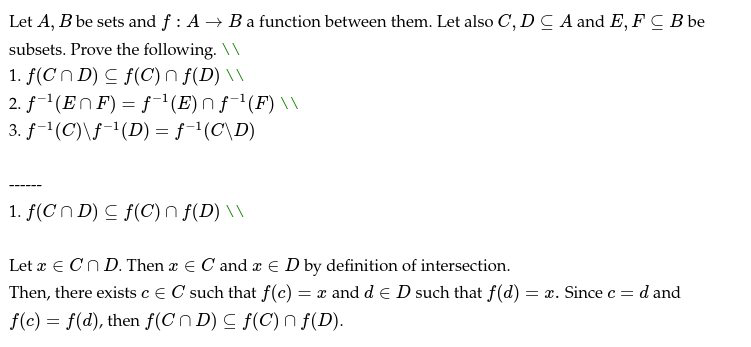
Let x in f(CnD). Exists y in CnD s.t f(y)=x. By the definition of intersection y is in C and y is in D. So f(y)=x in f(C) and f(y)=x in f(D) so x in f(D) n f(C) so LHS subset of RHS
fast umbra
LHS, RHS?
weary tiger
left handside
fast umbra
Ah, thank you!
fast umbra
I rewrote it a bit

 prisma cypress
uh... i could use some guidance on how to determine if K3 is a subgraph of this... (bleh i wish subscript or whatever was possible on discord)
 weary tiger
K_3 is the complete graph on 3 vertices right?
prisma cypress
i believe so
prisma cypress
that doesn't help me really comprehend how which is what im needing guidance on since just started this material.. today
the k graphs confuse me
weary tiger
Well, to show that K3 is a subgraph, you need to show that its vertex set is a subset of the vertex set of the "bigger" graph (the same applies for the edge set)
K3 given by ({1,3,5}, {13,15,35}) is a subgraph
 prisma cypress
i see...k4 might be one then..? but it described that as done either as a square or as a triangle with the dot in the middle.. unsure about how it is in the example graph
weary tiger
last timber
```{13,15,35}```
it's a simplification for writing the edge set
prisma cypress
... anyway moving on... now uh im not sure if this is possible but im being asked to either come up with a 3 regular graph with 5 vertices if it is.. same with a 3 regular graph with 6.. hm.
last timber
 prisma cypress
...?
weary tiger
Have you heard of the "handshake lemma"?
It basically says that the sum of the degrees over all vertices in a given graph is equal to twice the number of edges
prisma cypress
uh... there was a mention of some induction proof or theorem that stated degrees = 2 * number of edges but never heard of this "handshake lemma"
weary tiger
You can use this lemma
3*5 = 15 which is not even
So a 3 regular graph on 5 vertices doesn't exist
prisma cypress
so... a 3 regular one with 6 vertices could potentially exist but im not sure how i'd draw that if it did
weary tiger
each vertex should have 3 neighbors
a 3-regular graph with 6 vertices is bipartite
put 3 vertices on one side and then 3 vertices on the other
then put an edge between each pair
last timber
 weary tiger
That’s the simplest way to draw such a graph.
If it’s unlabelled, then two structures exist (up to isomorphism)
 prisma cypress
this is gonna be a weird chapter, i can tell already lol
prisma cypress
okay... now this is one i definitely don't know how to do and im not seeing anything that spells it out in the section.. largest n such that kn = cn
prisma cypress
k is complete graph, c is cycle of vertices, according to book
a would be k and b would be c
 last timber
then n is pretty easy to find
prisma cypress
okay... then how would i go about determining/finding that
last timber
prisma cypress
k is complete graph, c is cycle of vertices, according to book
a would be k and ...
well look
this already suggests that n < 5
so you have only 4 possible nominees
weary tiger
n = 3
last timber
you could do this by brute force tbh
weary tiger
its the same graph (pictorially)
prisma cypress
last timber
well look
i believe you misunderstood. those aren't related to the problem, it was just as an example of k and c. i have no graphs to go with for the one in question
last timber
for different problems there may be different methods
weary tiger
if they are the same, they have the same edge set and vertex set (up to isomorphism)
prisma cypress
let me put it another way then. this is all i have to go off of
 prisma cypress
... does it matter which vertices from graph g i set c and e equal to? can't figure out which should correspond to 1 and which should correspond to 4
 naive gulch

For this Q I gotta use power set cardinality right?
Its subsets total - subsets < 1 to find subsets > 1, no?
 minor dagger
there would only be one subset with less than one element
it should be total subsets - subsets with cardinality < 2
 thorn brook
 plucky thunder
hi, i was wondering if this would be an example of an bipartite graph?
 faint narwhal
what do you think?
 proven shard
You need to partition the verticies
plucky thunder
i did, but it comes back to the same part of the veritcies
so when i did V1 as {A, B, C} and V2 as {D, E, F}
an example would be A and C would match to each other, which im confused it its allowed
faint narwhal
do you know what being bipartite means?
faint narwhal
you should go figure out exactly what bipartite means
plucky thunder
it says that every edge should connect to a vertex according to my notes and textbook
plucky thunder
yea im really confused on how it works anyways beside for the partion part of the graph
faint narwhal
you should go figure out what bipartite actually means
errant bear
@faint narwhal wow thanks for the help! i now know that i should go figure out what bipartite means. thanks 🙂
you're an excellent helper 🙂 @faint narwhal
prisma cypress
... i can't tell if zopherus is ever being serious
 gritty crescent

pale epoch
||this is unironically the best way anyone could have helped with this question||
sand cipher
need help with this practice question
 sand cipher
well all of them
he does not give a problem this hard in class but the practice problem is this hard
so i'm lost
sand cipher
well ik that all of that $n!=1\cdot2\cdot3\cdots n$
vital dewBOT
Centrous


 kind geode
the union of the natural numbers and positive rational is countable r ight?
weary tiger
every countable union of countable sets is countable
kind geode
okok thank you
 wooden acorn
Is there something similar to generating functions, but not generating functions? Like is there another way to encode information besides exponents?
I’ll probably spend some sitting time thinking about this tomorrow
unreal stump
That would still be a generating function
Also see Dirichlet generating functions
In mathematics, a Dirichlet series is any series of the form
      ∑

        n
        =
        1


        ∞


          a

            n


          n
...
You encode a series ($a_n$) as
\newline
$F(s)=\sum_{i=1}^{\infty} \frac{a_i}{i^s}$
vital dewBOT
Drunknarwhal
 faint narwhal
Exponential generating functions too maybe?
wooden acorn
Oh cool thanks
weary tiger
Prove that there exists no graph with 2, 3, 4 or 5 vertices such that its only automorphism is the identity.
i'm not quite sure how to go about... induction seems rather daunting
and so does manually checking
proven shard
- Prove that you only need to consider connected graphs
- Draw all the connected graphs on 2,3,4,5 verticies and observe their nontrivial automorphisms
weary tiger
 clear apex
360 + (360 x 15%)
weary tiger
if I have say the numbers 1 , 2 ,3 ,4 ... till 25
and I ask you to find all the primes between them
so the theorem says you first cross 2 cause 2 is prime right?
and then you cross every multiple of 2 ( crossing meaning you eliminate them, cz they are not prime )
but the theorem says every number from 2 till 2^2 that weren't crossed are primes
and I am asking why
I didn't understand why
weary tiger
 coral raven
if the only prime you know is 2, then everything that doesn't divide by 2 up to ^2 is a new prime
so just 3 really
if the only primes you know are 2 and 3, then everything that doesn't divide by 2 or 3 up to 3^2 is a new prime
weary tiger
I am gonna add to this that everything that doesn't divide 2 between 2 and 2^2
coral raven
ok so it's because it's like
weary tiger
coral raven
if the only primes you know are 2 and 3, then everything that doesn't divide by ...
why up to 3^2
coral raven
if you have a number n
and it divides by a prime p
where n > p > sqrt(n)
then you know it divides by at least one more prime q < sqrt(n)
weary tiger
yes this I understand it
coral raven
yeah so that's it isn't it
weary tiger
p<sqrt(n)
coral raven
so up to 49, if it doesn't divide by 2, 3 or 5 then it's prime
up to 121, if it doesn't divide by 2, 3, 5 or 7 then it's prime
coral raven
no
weary tiger
what?
coral raven
if n isn't prime, then the smallest prime factor of n is at most sqrt(n)
there might be another one
so take 10
5 is a prime factor of 10
but sqrt(10) < 5
so 10 < 5^2
weary tiger
ah
coral raven
so 5 can't be the smallest prime factor of 10, because the smallest number with only 5 as its factors is 25, apart from 5
weary tiger
then where does the theorem that says a prime factor of a number must always be less than sqrt of n?
weary tiger
ah the smallest prime factor
coral raven
of a non-prime
weary tiger
ah
coral raven
ok so it's like
right, starting over, i'm messing up this explanation
so say n is not prime and it has a prime factor p > sqrt(n)
weary tiger
coral raven
so 5 can't be the smallest prime factor of 10, because the smallest number with ...
this I dont understand
coral raven
say n is not prime and it has a factor p > sqrt(n), eg. n is 10 and p is 5 > sqrt(10)
weary tiger
coral raven
so say n is not prime and it has a prime factor p > sqrt(n)
alright so p is the smallest prime factor here or considered like that
weary tiger
alright I will shutup sorry
coral raven
ok so i was typing out a really long thing but i thought of a shorter explanation
if n = kp and p > sqrt(n), then k < sqrt(n)
k must either be a prime or have even smaller prime factors
either way there is a prime factor < sqrt(n)
and essentially if you know all the primes < sqrt(n), then you don't need to consider any primes p between sqrt(n) and n, because if you have any p > sqrt(n), then you know that there's a smaller prime goes into n
coral raven
no, that's it
weary tiger
lets clarify more
coral raven
ok
coral raven
no
weary tiger
so it depends right?
coral raven
any non-prime, or composite, number has a prime factor =< sqrt(n)
but for example 8 has no prime factors > sqrt(8)
weary tiger
yeah alright true
ok now going back to the theorem
if you have say 3 which is prime and you crossed all multiples of 2 and 3
now I still don't see why the numbers that weren't crossed between 3 and 3*3 are prime
(I understood everything you said earlier)
coral raven
if you know all the primes =< sqrt(n)
then if n is composite and has a prime factor > sqrt(n)
it also has to have a prime factor =< sqrt(n)
so if it doesn't have any prime factors =< sqrt(n)
it has no prime factors > sqrt(n) either
except itself
weary tiger
just to clarify n is the composite number or the non prime number
or the potential prime number
coral raven
potential
weary tiger
coral raven
then if n is composite and has a prime factor > sqrt(n)
you said not all numbers have prime factor > sqrt(n)
coral raven
yes
but if it does
then it also has something =< sqrt(n)
so if you've checked everything =< sqrt(n)
there's no point checking > sqrt(n)
weary tiger
but here you are talking in reverse
coral raven
yes
coral raven
ok so just logic: so suppose whenever you have A, you have B
then if you don't have B
you definitely don't have A
right?
weary tiger
I understood what you said you said if we don't have a prime factor for a number between 1 and sqrt(number) then the number is prime
but my question is in reverse
coral raven
no wait
go back to the logic
if you always have B whenever you have A: then if you see you don't have B, you know you don't have A, right?
weary tiger
uh sorry what do you mean by a and b
coral raven
logic
weary tiger
A implies B?
weary tiger
A is finding a prime less than sqrt n?
weary tiger
what is A then?
coral raven
whenever you have A, you have B
then if you don't have B
you definitely don't have A
whenever n is not prime and you have a prime factor > sqrt(n), you have a prime factor =< sqrt(n)
so if you think n is not prime but you don't have a prime factor =< sqrt(n), you don't have a prime factor > sqrt(n)
so n has to be prime
weary tiger
ah
@coral raven but I swear how does that relate to n being between his primefactor and hisprimefactor^2
coral raven
so if you know all the prime factors =< sqrt(n), then all the composite numbers up to n have one of those prime factors
so if you know all the prime factors =< m, then all the composite numbers up to m^2 have one of those prime factors