#discrete-math
1 messages · Page 161 of 1
 errant bear
 weary tiger
sorry not to sure what those symbols mean, b can't be 1?
 ebon valve
can anyone help me with constructing spanning tree with depth first search and breath first search
 west zenith
@humble bridge For your question about the laplacian you can just do the matrix product in the definition explicitely and find what is the term L_i,j
 stray reef
ebon valve
can anyone help me with constructing spanning tree with depth first search and b...
stray reef
ebon valve
can anyone help me with constructing spanning tree with depth first search and b...
do you still need help with this
weary tiger
hey sorry i forgot some of my basic math rationale
why wouldn't -(x)^2 be positive again?
sorry i meant
-(-x)^2
okay nvm excuse my dumb question
ebon valve
stray reef
do you still need help with this
yep
the question is
Using alphabetical ordering, construct a spanning tree for this graph by using a depth-first search and breath-first search
what does it mean by alphabetical ordering
stray reef
the vertex names
they're named with letters of the English alphabet
they want you to order them as such
so that every time you have several options you pick the one that comes earliest alphabetically
stray reef
.heic??
ebon valve
ya
stray reef
one would have thought A would be the vertex to start at, given the whole
alphabetical ordering thing
also G would've been attached to F i think
ebon valve
i need to start with A ?
oh i think i need to start with A and end with K
Using alphabetical ordering, construct a spanning tree for this graph by using a depth-first search and breath-first search
anyone help ?
errant bear
...ann literally...
 last timber
do you know what is depth-fist search and breadth-fist search?
stray reef
ebon valve
i need to start with A ?
yeah start with A but otherwise do the same thing you did
last timber
in depth-fist search you are adding vertices to the last one added as far as possible
and in breadth-fist search you expand each one

Animation of 157 vertex graph being traversed with the Graph Depth First Search (DFS) Algorithm set to the music of "fight of the Bumble Bee". This is done in PyGame in python on 4K display in Ubuntu Linux. I hope this is a useful teaching tool.
Suggestions for new content box: https://teklern.blogspot.com/p/loading.html
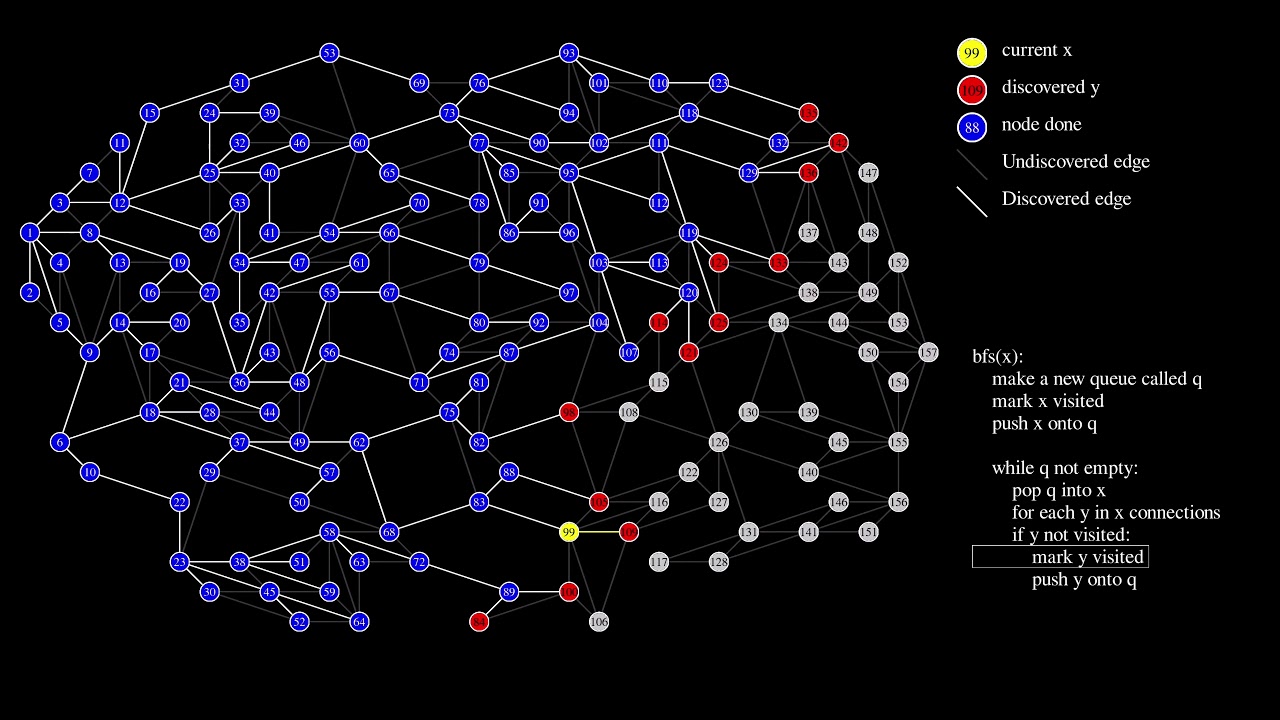
Animated Visualization BFS Algorithm (Teaching Aid) set to Music.
This animation shows the progress of the Breadth first search algorithm as it traverses nodes in a 157 vertex graph.
It has been set to the music of "fight of the Bumble Bee".
This is done with the pygame module in python on 4K display in Ubuntu Linux.
I hope this is a usefu...
stray reef
ebon valve
wat is the difference between depth first search and breath first search
in dfs you construct (or traverse) your tree down one branch as far as possible before hitting a dead end, then backtrack once you do so.
while in bfs you traverse all nodes at a given level before moving to the next level
 dire sphinx
i did (a) of this exercise, but i am realizing that i don't quite understand what a corresponding relation means, e.g. in (b) and (e). can someone point me in the right direction?
is U = P(N) the universe of all sets of natural numbers? how do we interpret x+1 in (b)?
 naive gulch
Can I just get general pointers of what they want me to do for this? I have a whole 5 premises and they want to have me pull up a set of conclusions from these 5? thats going to be a long inference
stray reef
maybe write them down symbolically?
like
H(x) = x is healthy, G(x) = x tastes good, E(x) = you eat x
- ∀x: H(x) -> !G(x)
- H(tofu)
- ∀x: E(x) -> G(x)
- !E(tofu)
- !H(cheeseburgers)
4 is derivable from 1, 2 and 3 it looks like
stray reef
"gap" acts as a 7th color
 neat fog
Is A(B+C) a product of sum form?
 obtuse lance
what's the sum of entries along a row?
 autumn pebble
Am I going wrong somewhere, specifically I wanna make sure my induction hypothesis is correct so far
 humble bridge
The sum of entries along a row?
Oh
The sum of a row in any Laplacian matrix is always 0
I know this now, but how do I prove that?
errant bear
you forgot a term on the rhs of the inductive step @autumn pebble
humble bridge
I don't know how to use that to show that 0 is an eigenvalue
wait
it's [1 1 1... 1]^T
obtuse lance
😎
obtuse lance
you're welcome
autumn pebble
@errant bear what term?
errant bear
you have the sum to n = the sum to n+1
errant bear
yea
autumn pebble
My induction hpothesis is correct right
errant bear
autumn pebble
Okay so sum of n+1 =sum of n (2k-5) + n(n-4)
plus (n+1)((n+1)-4)
autumn pebble
Oh okay that makes sense
humble bridge
im kind of confused as to how i should go about doing this
the second picture is some context for the first
 blissful zenith
can someone please help me prove the 1st and 3rd one? ive proben the secon and disproven the fourth
blissful zenith
not greater than
weary tiger
thank you 
blissful zenith
<@&286206848099549185>
weary tiger

I think the answer is false and for the negation I got this - Can someone tell me if I'm doing it right?
autumn pebble
@errant bear Just to circle back I rewrote things in terms of L, I’m having some trouble with getting to my conclusion
blissful zenith
can i pls get some help w my questin
weary tiger
sry I would if I knew 
blissful zenith
😦
 split shell
I need help with this ANYONE
 frigid abyss
why do they change the arrow symbol to the intersection sign when solving the negation. would it be wrong if it kept the arrow?
cant i just put (x>1 -> x/x^2+1 >= 1/3 )
last timber
because negation of a->b is a AND not b
stray reef
^
 worthy thistle
Can I use master method to solve T(n) = T(n/2) + cN?
blissful zenith
can someone pls help me prove the 1st and 3rd one? i've figured out how to prove the 2nd and disprove the fourth
gcd is greatest common denominator
blissful zenith
<@&286206848099549185>
 vital dewBOT
Commander Vimes
blissful zenith
@last timber not gonna lie idek how that helps
 exotic shadow
Hi! can someone pls help with these bijections??
blissful zenith
@last timber for the first one?
can i please get some heklp <@&286206848099549185>
just with the first one
for all naturals x,y,z gcd(xy,xz) = xgcd(y,z)
by contradiction io assume
idk how th to set this up
@last timber u there man
im struggling
 noble wasp
 analog sonnet
exotic shadow
Hi! can someone pls help with these bijections??
analog sonnet
exotic shadow
Hi! can someone pls help with these bijections??
wrong channel
I can't really make much sense out of what's written there either
frigid abyss
for this problem could i use proof by contradiction to proove the claim x+y is rational is false by giving an example like pi+1/2. this would show the contradiction is false so the original statement is true
my book does it using proof by contrapositive. does either way work?
 deft cipher
contradiction seems easier (without numerical values)
 sour arrow
@frigid abyss
To be more specific, the contradiction is actually:
There exists an x, y ∈ R such that for rational x, irrational y, x + y is rational.
Note the "there exists". To prove your statement is false, it's not enough to provide a single example where it fails - you have to show that there's no example where it's true.
 dark bough
last timber
dark bough
last timber
without loss of generality you can assume that you do not have empty set in collection
 hazy pine
no
 solid garden
what is a minset?
 halcyon oak
 violet nebula
value of x
violet nebula
value of x
this is clearly too advanced for discrete math
 short steeple
graph theory question:
must a k-regular graph with odd vertices contain at least one odd cycle?
i'm kinda like completely stumped on this one lol
weary tiger
@short steeple
No odd cycles => bipartite, bipartite+k-regular => perfect matching => even number of vertices (contradiction)
short steeple
ok that’s awesome, i had already thought of something along those lines last night, but now i’m stuck on this: why does “no odd cycles” automatically mean “bipartite”
i saw the proof that bipartite iff no odd cycles but does that also mean no odd cycles iff bipartite?
sorry if that’s a stupid question, my defense is a) i just woke up and b) i don’t have any other defense lol
weary tiger
@short steeple iff literally means it is implied in both directions
so bipartite => no odd cycles but also no odd cycles => bipartite
 loud matrix
Is this stating that A_1 has n_1 elements, A_2 has n_2 elements, etc.?
 near prawn
yes
autumn pebble
Can someone help me out with these problems?
autumn pebble
Okay but for f I can get a evaluation but g will have to be closed form correct
weary tiger
both will be closed form
 fleet plinth
Is this correct? and if it is can some explain it please?
loud matrix
Could somebody entail the difference between unique and discrete?
Say we got a 4 slot thing that includes two letters and two digits
How we would distinguish what is distinct and what is unique?
oh yeah
so if i have a 4 slot thing that must contain 2 digits and 2 letters, could you show me the difference between two distinct and two unique?
 shut fjord
Can someone help verify my answer for algorithm B?
I highlighted the info I thought was relevant to algorithm B problem
N/3 is treated as O(n) time for worse case your shifting goes to n bits
That’s a given for me
So I got that algorithm b is 5(Tn/3) + O(n) which I think was a bit too easy..
*5 recursive multiplications
*splitting the binary expression into 3 parts (thus the n/3)
*doing n/3 shifting results in O(n) work
Can anyone come up with a counter argument to this?
 tawdry wyvern
loud matrix
tawdry wyvern
loud matrix
I don't have the problem since I don't got the worksheet but it was something about this place having like a license where you have 26 characters and 10 digits and you needed to have unique 4 slot licenses that contained 2 characters and 2 digits and each license had a border - standard or premium. Changing either the id or border of the license plate results in a unique plate. It then asks how many unique plates could you have
 lethal prawn
Can I get some help on a Problem?
1.4: Prove that A U B = A n B implies A = B.
n is supposed to be the intersection symbol.
near prawn
what have u tried
lethal prawn
I'm just confused on where to start.
I don't want to be cheap and look it up online, but it says that I should prove that A is a subset of B.
In order to prove that A = B.
near prawn
well that's one part yea
you also need to prove that B is a subset of A
so for the first part take a random element of A and try show it's also in B using the assumption
lethal prawn
I'll call that random element x for now.
 naive mural
Not solving your assignment for you
weary tiger
I have a question, in propositional logic if you say P = Q does that mean if they have the same truth value it's true?
errant bear
naive mural
Not solving your assignment for you

loud matrix
if u had to compare the difficulty between proofs and combinatorics which one would you say is harder?
 dull slate
can anyone give me nugde on justifying the decreasing or the convergence of the $\sum_{k=1}^{n}{1/(n^2+k^2)}$ please:)
vital dewBOT
4z1z
naive gulch
This is a really simple question, just wondering how n^2 is more than or equal to 0 follows in case(iii)
naive gulch
aah
that makes sense ty!
is integer n = 10a+b a known formula? Otherwise I have no idea what intuition would lead me to say that I'd express n through 10a+b
 balmy hornet
Which of the following sentences is a proposition? (One or more could be correct)
A. Please fetch me that book.
B. How do you like your coffee?
C. Chicago is the biggest city in California.
I know that a proposition is a statement that is, by itself, either true or false.
For statement A. can there be define true or false? Like you dont know which book technically. right?
for B. Any answer can be true or false person, so that can be consider a proposition
For C. this would be completely false since Chicago is not located in California in the first place
naive gulch
B is subjective
So it can't be T/F
A is a request so I don't think thats T/F either
I'm still not sure how that relates though? the final digit is b I understand but I don't see how they connected 10 and a together so that a is the final digit/divided by 10
dull slate
dull slate
can anyone give me nugde on justifying the decreasing or the convergence of the ...
any help?
weary tiger
dull slate
can anyone give me nugde on justifying the decreasing or the convergence of the ...
compare to sum(1/k^2)
balmy hornet
Given two propositional variables, p and q. Assuming that p is True and q is False. Which of the following propositions are true? (One or more could be correct) ( Bold is my selected answer although correct me if my definitions are wrong)
A. p < - > q
- p implies q and q implies p
B. p ∧ q - p and q
C. p ∨ q - p or q
D. p→q - p implies q
When i am thinking that p is true then q cannot be true if it is stated as false. i was questioning of if that definition fits the statement so i do not know if my thinking is entirely correct
Yeah so how the question states that, "Assuming that p is True and q is False". My thought process is that us p is True then q cannot be true since it is stated as false. P cannot imply that q is true if q is false
i dont know if that makes sense to you though sorry if it doesnt
im trying to wrap this concept into my brain
yes, which was my 4th answer that p inplies q (p->q)
In this case, A is right?
ooooh okok (sorry i am also looking at truth ables in the presentation give to me) so this makes sense when written out. thank you!
frigid abyss
can someone help me out with this proof
ik i have to prove that y is a subset of z and z is a subset of y but idk how
 livid drum
@frigid abyss
Here is a (heavily translated) proof of just the forwards containment.
Here is what it says.
Take any element x ∈ Y.
Then x ∈ X∪Y.
So x ∈ X∪Z.
Case 1. (x ∈ Z). Trivially x ∈ Z.
Case 2. (x ∈ X). Then x ∈ X∩Y. So x ∈ X∩Z. Thus x ∈ Z.
In either case, x ∈ Z.
fin.
balmy hornet
What is the negation of ∀x. (x>1→x/(x2 +1)<1/3)
- Definition: The negation of a proposition X is a proposition that is true whenever X is false and is false whenever X is true. This would mean the complete opposite (i.e. It is snowing outside. Negation: It is not snowing outside)
A. ∃x. (x>1→x/(x2 +1)<1/3)
- Same statement but only replaces ∀ to ∃
B. ∃x. (x/(x2 +1)<1/3→x>1) - this is the backwards version of the give statement but only replaces ∀ to ∃
C. ∃x. (x≤1→x/(x2 +1)≤1/3) - true because when x is an integer of 2 then 2/(2^2 +1) is 2/5. it is greater than 1/3
D. ∃x. (x>1 ∧ x/(x2 +1)≥1/3) - true for .5 is less than 1 and true for .5/1.25 is less than or equal to 1/3
Im confused on which is right. Is C or D right or and i misinterpreting A and B
frigid abyss
Thanks Pi, that was a clear proof. i understand it now.
naive gulch
ooh its like floor division so 31585454 turns into 31585450/10 = 31585454 effectively cutting off that last digit completely
ty
 tranquil jewel
One to one is injective
Bijection is injective and surjective so it does include it
weary tiger
ye i was wrong just havent really heard it used much
but yeh your logic makes sense
essentially idea is just |A|=|f(A)|<=|B|
tranquil jewel
Ya I’m just not sure if I should prove it’s surjective thus a bijection, cause I am making assumptions
 foggy hatch
weary tiger
(one to one means bijection right)
foggy hatch
weary tiger
(one to one means bijection right)
Unfortunately, "a one-to-one correspondence" means "a bijection" even though in like every other phrase "one-to-one" just means injective.
shut fjord
Does anyone know or can throw me a hint as to how to do O(k) multiplications
Where x is just any real number you give the function, and y is an integer but it is y = 2^k
To return x = x^(y) or x = ^(2^k)
 wild harness
 haughty garden
Injective: If f(a) = f(b), then a = b.
Surjective: Let f : A -> B; there is an element a in A such that f(a) = b for every b in B (in other words, the range is the codomain of the function).
Bijective: Injective and surjective together
 bronze rain
shut fjord
Does anyone know or can throw me a hint as to how to do O(k) multiplications
bronze rain
shut fjord
Does anyone know or can throw me a hint as to how to do O(k) multiplications
The key idea is repeated squaring instead of just iteratively multiplying by x.
 patent galleon
Hey I have a pretty simple conceptual question
is this saying that we plug in a number for x and then test with the resulting y
e.g. plug in 0 and get y = 0
which would then make this True
or is it saying plug in an x and a y and then evaluate it's truth
bronze rain
No , this says that there is some x such that no matter which y you plug in x=y^8
patent galleon
ok, so then it's clearly false, gotchya
bronze rain
Now try switching for all and exists and see if that is true
 valid wave
hi question
so because that is true both ways
would A if and only if B
be true
in that case
valid wave
yes !
last timber
and is if B then A true?
bronze rain
What ring are you working over?
last timber
it seems that concept of ring here is overkill
valid wave
yes thats true too
last timber
then by definition you have A iff B
last timber
yw
valid wave
so just for clarification
A iff B is true when if A then B and if B then A are true
gotcha
thought it might be something weird with the logic
naive gulch
Just for clarification on this example, why does the third line suddenly have x = sqrt(2) ^ sqrt(2) instead of sqrt(2)
I don't quite the conlusion either. How does that prove anything?
shut fjord
bronze rain
The key idea is repeated squaring instead of just iteratively multiplying by x.
Thanks! I’ll see what I can do with this info (:
 rich bramble
[hint] ||Because of the Distributive property (A ∪ (B ∩ C) = (A ∪ B) ∩ (A ∪ C)) and the Associative Property (A ∩ (B ∩ C) = (A ∩ B) ∩ C = A ∩ B ∩ C),
we can write
(B ∪ C) ∩ (B ∪ Cᶜ) ∪ (Bᶜ ∪ C) ∩ (Bᶜ ∪ Cᶜ)
as||
[step] ||(B ∪ (C ∩ Cᶜ)) ∩ (Bᶜ ∪ (C ∩ Cᶜ)).||
[hint] ||Because for A ∩ Aᶜ = ∅, this equals||
[step] ||(B ∪ (∅)) ∩ (Bᶜ ∪ (∅)).||
[hint] ||Because A ∪ ∅ = A, this equals||
[step] ||B ∩ Bᶜ.||
[hint] ||Because A ∩ Aᶜ = ∅, thus the answer is||
[answer] ||∅ ( empty set. )||
Please tell me if there is something wrong. I am not perfect.
Edit: This question has points so I spoilered each step.
weary tiger
foggy hatch
Unfortunately, "a one-to-one correspondence" means "a bijection" even though in ...
Yeh makes sense
valid wave
Hi
im struggling to understand
when the floor of an integer
or a rational number rather
why the floor wouldnt like always be the rational number
like the floor of 5/3 would just be 5/3
 unreal stump
Floor of 5/3 is 1
valid wave
whaaaa
oh the floor is the integer
i thought it would be like all reals or something
ok thanks
wait that actually gives me another question
unreal stump
Yes
valid wave
could you guide in me a direction of how i may prove something like this
i dont even see what like definition I would base this on
unreal stump
y=integer part (y)+ fractional part(y)
Floor(a+b)=a ,where a is an integer and b is a real number in [0,1)
valid wave
ohhh
wait so basically because x is an integer
the floor will always be that integer
so its only really the y thats changing things
🤯
is that the right way to think about it?
sorry for question spam

unreal stump
Kind of
frigid abyss
can someone verify if 52 is false and 64 is true
 merry steeple
can anyone confirm that the highlighted part is an error?
should be just (H and M), and not (nonH and M) right?
dull slate
weary tiger
compare to sum(1/k^2)
how is that helping? comparing so only inform us that the sum is majored by pi^2/6
weary tiger
@dull slate yeh which in turn justifies convergence
dull slate
i think we should also justify the increasing of it..
weary tiger
what are you actually trying to show converges lol
$a_n=\sum_{k=1}^n \frac{1}{k^2 +n^2}$
vital dewBOT
same
weary tiger
are you trying to show that a_n is convergent?
(because it's bounded above by sum(1/k^2) and it's monotone increasing so has to be by monotone sequence theorem)
obtuse lance
I think we can do better with
$\sum_{k=1}^n \frac{1}{k^2 +n^2} < \sum_{k=1}^n \frac{1}{n^2} = \frac{n}{n^2} = \frac{1}{n}$
vital dewBOT
Merosity
weary tiger
ye defo a nicer bound
dull slate
yeah right, thanks guys..
naive gulch
a rational number to the power of a rational # can never be irrational right
errant bear
2^(1/2) 
errant bear
is 2 rational

 naive gulch
:D
(1/2) ^2 
0 ≤ 𝜖 < 1.```Am I tripping
Can't I just say n is an integer 1 and e = 0 and n = x?
errant bear
naive gulch
Can't I just say n is an integer 1 and e = 0 and n = x?
im referencing this
you let n=1, then n=x
naive gulch
Like x = n + e and we say e is 0, then x = n?
errant bear
anyways, ots asking you to prove that every real number can be expressed as a whole number + some bit (decimal/fraction)
haughty garden
x is not necessarily an integer
naive gulch
I thought it was saying unique
errant bear
well, it is unique
naive gulch
Nevermind I was thinking we only had to show an example of one case
So it applies to all real numbers x I see that now based on the wording
So I can do proof by cases where real number x is an integer and not an integer?
errant bear
sure
oh yea, i shouldve specified that "some bit" could be 0, which then of course means x is an integer like you said
naive gulch
yeah thats what I originally was thinking about, I understand the frame of the problem now
if its an integer than e is 0 since there's no bits needed but if its not then e represents the right of the decimal
I think that would be sufficient proof for proof by cases
errant bear
oh um
if this is an assignment ur most likely not gonna get full (or possible even any credit)
errant bear
well, you dont mention n in your second case, besides the example which, although is good for you to get an idea of whats going on, is worth nothing in terms of the actual proof
"the numbers after the decimals" isn't really a rigorous argument, not trying to nitpick
naive gulch
Wait I said where 1 is integer n for my second case, wdym mention?
oh yeah I know that was kind of a muddy way of saying it
I wasn't sure how to phrase that
errant bear
the second case consists of everything excluding the example, so everything in the parentheses doesnt count basically
you only mention x and e
what is n?
naive gulch
then n = 3 and e be irrational number 0.14 and so on
naive gulch
For a uniqueness proof I need to prove existence and then uniqueness right?
errant bear
yeah
errant bear
well, technically 4, if you have your 2 cases
errant bear
yes, although
you need to explicitly say what n is in the second case
eg. floor(x)
errant bear
no, what is n specifically
in relation to x
floor function basically rounds down the number to the nearest integer
you can think of this as chopping off the decimal
or, if for example x is rational, then x=p/q, in which floor(x) = a, where aq +r = p
i mean this is getting a bit out of intention from what the problem wants
naive gulch
Ooh floor division yeah okay I get what you mean
errant bear
this will allow you to "choose" a unique n, given x
naive gulch
Ah okay phew
This problem was more to it than I thought time to prove the uniqueness
weary tiger
does anyone know what that sign between the 3 and n^2 means
cant find it anywhere online
 faint narwhal
Does not divide
weary tiger
oh i thought divide was something else. thx
errant bear
wtf
 novel beacon
How are the renders of graphs on Wikipedia made?
 minor dagger
What kind of graphs are you referring to?

CSAcademy is a next generation educational platform. Discover computer science
with interactive lessons and a seamless online code editor.
I like this for making graphs
novel beacon
Using that program to make a graph with 120 vertices and 1200 edges would be rather tedious.
faint narwhal
2^n/n! is just 2/1 * 2/2 * ... * 2/(n-1) * 2/n
So if we multiply this by n^2 then one cancels with the last n
faint narwhal
Uh what
 nimble glade
Hey guys! I have this problem for proving that I have no idea how to solve, help would be appreciated! the question: For all a, b E Z, if there exists cE Z so that ab= 4c+ 1, then there existsx y E Z so that a= 4x+ 1 and b= 4y+ 1. (E is element of...
 bleak jolt
can i get some help with this question? pretty sure my answer is in the wrong format
bronze rain
I don't understand why the predicate is unary. Otherwise it looks ok.
weary tiger
novel beacon
Using that program to make a graph with 120 vertices and 1200 edges would be rat...
can do that on matlab easily
im not sure which renders you're referring too though
 hardy quartz
So i am stuck with this question cause I am struggling to figure out a formula to get the right answer on matlab
any help is appreciated
stray reef
you might start by writing the sum in sigma notation @hardy quartz
alternatively, you can add the terms two at a time, like this:
nterms = input("Enter term count to be used for approximation");

A = 0;
for i = 1:2:nterms
    A = A + 4/i - 4/(i+2);
end
disp(A)
disp(abs(A-pi))
eh i have never seen that for i = 1:2:nterms
i usually do for i = 1:nterms
@stray reef
never got thought that method with for loops
stray reef
you can put any vector in a for loop and it'll iterate over the entries in the vector
it's super convenient
hardy quartz
the thing is I wonder if ill be allowed to use such a method
for me i was trying to do something like this
for i=1:n

    piValue = piValue + 4/(2*i-1);
    piValue = piValue - 4/(2*i-1);
end
And trying to figure out the "condition i should give it"
when to - and when to +
stray reef
I wonder if ill be allowed to use such a method
why not? it's valid matlab code and it has a for loop.
when to - and when to +
add when i is odd, subtract when i is even.
 vagrant elm
Hello! Recently started brushing up on set notation and got this as part of an assignment.
I am unsure what is mean by "encoding a function" and "encoding a relation".
Can someone explain?
@weary tiger Yeah, each element in one set maps onto each element in another set
And so I assumed that the answer to b) is no since 484 is not part of R
Please correct me if I'm wrong
For the same reason, I think c) is yes, however I'm not sure since 17 now appears twice in R
 vagrant elm
The professor has a weird way with words, I'm pretty sure he just means if it is a relation
Why is b) yes?
and more importantly, why is c) no?
I haven't been given any, sorry
Not formally anyway
I found this online though:
A relation between two sets is a collection of ordered pairs containing one object from each set. If the object x is from the first set and the object y is from the second set, then the objects are said to be related if the ordered pair (x,y) is in the relation.
I understand the definition I gave is too vague
I was just pointed to a book but I could only find the definition of a binary relation
and last time I had anything about relations was 1.5 years ago
I see, my bad then
So if a relation is a collection of ordered pairs containing one object from each set, then why is b) yes if R does not contain a pair with 484?
Is it not a requirement that all elements be present?
So it is a relation because some objects from C map onto elements in D
However c) is no because then R would contain an element that is not a pair
Yeah that makes sense. Functions have one specific output for each element however relations may have multiple elements pointing to the same output in the range, correct?
Ohhh right, I see, so looking at the sets I sent, R is not a function because 17 outputs both y and z
Thank you, that was a good explanation, I get it now
Just unsure about d) now but a, b and c make total sense
One moment
OK I'd say yes to d) since (17, z) is now gone from R
and so there is only one output for each input
Also I have not heard of partial and total functions, but my intuition tells me that a total function maps all elements in the domain whereas partial is only some
Finally a term that makes total sense from its name lol
In this case it would be a partial function
Thank you for your help
weary tiger
2^|E|
each element can either be in a subset of not be in a subset
any ideas for this?
stray reef
what's G[A]?
stray reef
ah ok
weary tiger
so just the subgraph induced by those vertices basically
stray reef
so essentially you need to prove that it's possible to paint the nodes of your graph red and blue such that each node is connected to evenly many nodes of its own color
weary tiger
like every problem seems to be induction pretty much but seems kind of useless here
yeh
stray reef
hmm
weary tiger
so i guess if its bipartite then thats easy enough
weary tiger
so i probs just need to work out how to do it for odd cycles?
 stray reef
of course we do
weary tiger
because if it splits into components i can use induction
and if theres an element of order 0 or 1 i can also use induction
stray reef
you can paint each component separately
yeah
anyway a single odd cycle is easy cause you can just paint it one color
weary tiger
oh yeh ofc
vagrant elm
Using this formula to compute the cardinality of a power set equals 16 for a power set of a power set.
However, when I compute P(P(B)) I get a set with 32 elements instead of 16.
What's going on here?
I feel like I either misunderstood something or did something wrong, or maybe the point of the exercise is to prove that the formula does not work for power sets of power sets?
vagrant elm
hmm then i'm not sure how to find P(P(B))
faint narwhal
Have you seen the proof of the fact that in a planar graph, you have to have that e <= 3v - 6?
 languid cradle
yep
d(f) >= 3 for any face
ohhhh
so maybe I just work that backwards
but with an equality
2 = V - E /3
faint narwhal
Okay another way to see it is to use the fact that v - e + f = 2 here
languid cradle
yeah
shut fjord
Still stuck on this problem
shut fjord
faint narwhal
@shut fjord what have you tried?
shut fjord
I tried using powers of 2
But when I go to something like
(3,2^3) or (3,8)
It doesn’t really help
Because I need to do at most 3 multiplications
faint narwhal
your power of 2 idea is on the right track
shut fjord
Can we express 27 as a power of 2?
It would be something annoying like.
2^4 + 11
2^4 + 2^3 + 2^1+2^0
faint narwhal
uh why do you need to do that?
shut fjord
Trying to avoid unnecessary multiplication
I think there’s a sub problem where if I can get to 27
I can get to 6561
Cause 6561 = 27 * 27 * 9
Or I can try getting to 9 first
faint narwhal
I'm not sure why you're looking at those numbers
the power you're raising things to are always powers of 2
languid cradle
oh, wait, I just assume the degree of each face is the same?
I have 3 |F| = the sum of d(f)
but 3 |F| = |F| df only follows if df is the same for all f right
faint narwhal
yes that is true
faint narwhal
no I'm not really sure what you've done or are trying to do
languid cradle
here I’ll show u
ok so the last line doesn’t follow
but up until then it’s all good I think
faint narwhal
but what's the minimum possible degree of a face?
languid cradle
3
ohhhh
lol
so any one can’t be more than 3
cus then another would have to be less than 3
to maintain the average
faint narwhal
yep
shut fjord
I think I found the approach here
I have 2^3 3’s so I can split that in half every iteration
So my first iteration would involve 3^(2)
The second would involve 3^4 which is 3 * 3 * 3 * 3 or 9 * 9 which gives me 81
faint narwhal
Right
shut fjord
Something like this
faint narwhal
so all you need to do at each step is just to square the previous thing
shut fjord
Yeah
I understand it intuitively but
like the relation seems mysterious to me
Thank you
(:
naive gulch
Its fun
until its not
{x ∈ R | x is an integer greater than 1}
For checking for subsets what would the difference be between 2 and {2} for this
2 is included the set because 2 is an integer greater than 1, but the set containing 2 would not be?
 last flicker
naive gulch
For checking for subsets what would the difference be between 2 and {2} for this
last flicker
naive gulch
For checking for subsets what would the difference be between 2 and {2} for this
the set containing 2 clearly can't be in a subset because its not in the original. The original contains only numbers, no sets.
naive gulch
ok yeah thats what I thought thanks!
For this that I wrote up, A ∈ B but A is not a subset of B right
last flicker
Other way around actually.
naive gulch
IF I changed it to 0 < x <_ 2, then A is a subset of B but A ∈ B?
oh
oh A would be {2} right
last flicker
{1}
naive gulch
sorry wait yeah thats what I meant
How could I make it both A ∈ B and a subset then?
last flicker
A clearly can't be in B because B doesn't contain any sets and A is a set. However it is a subset of B as every thing in A(i.e. just 1) is also in B
naive gulch
Yeah so A = {1} and B = {1, 3, 5, 7, 9} right?
last flicker
Correct
naive gulch
Ah okay
So because A is in a set, then A cannot in B. But wouldn't it only be a subset if B = {{1}, {3}, etc}}
last flicker
Well because A is a set it can't be in B. As for subset, i think you misunderstand what a subset is
A set Y is a subset of a set X is everything in Y is also in X
naive gulch
Ah okay
So {1} has just element 1, {1, 3, 5} has 1 inside it
therefore {1} is a subset of {1,3,5}
last flicker
True
naive gulch
But {1} is not a subset of {{1}, {2}}
last flicker
True
naive gulch
Because {1} contains element 1 and {{1},{2}} contains the elements set containing 1 and the element set containing 2
last flicker
More precisely, the second set doesnt contain 1
naive gulch
yeah sorry thats what I was trying to get across
the second set contains sets but not the element 1
So in that case, is there any way I could say both set A is an element of set B and a subset of B?
I can't think of a way to make it so that its an element and a subset
naive gulch
its a subset because element 1 inside set A is also inside set B, and an element because {{1}} inside B is an element right?
last flicker
Well {{1}} is not in B, but A={1} certainly is
Just to be clear, something being in a set is just another way of saying its an element of that set
naive gulch
sorry what I meant is I was representing it as a set not an element
Ok got it I think I understand then
○ Set A contains the element 5, so does set B therefore A is a subset of B
○ Set B contains the element which is the set {5}, and since set A is {5} therefore A is an element of B
last flicker
Uh so you're saying A={5} and B={{5}} or what
I'm not quite sure I understand the question
naive gulch
Sorry for confusing you!
20. Find two sets A and B such that A ∈ B and A ⊆ B
This is the question I'm trying to answer
where A is {5} and B is {5, {5}}
last flicker
naive gulch
○ Set A contains the element 5, so does set B therefore A is a subset of B
○ Se...
Sure, so the first dot point should prob specify that A contains only 5, and the second is fine save the fact that you could probably remove "the element which is" and get away with it a lot more concisely
naive gulch
Ah okay tysm!
 sand cipher
need help with this, abit confuse with this section of the chapter
 sharp quarry
sand cipher
need help with this, abit confuse with this section of the chapter
sharp quarry
sand cipher
need help with this, abit confuse with this section of the chapter
i think the switched "Belong to" do not make sense
It might be a typo
 night mauve
I was thinking that aswell
But 2 can be read as for any x that is an element of the real numbers if x^2 < 0 then 2x > 1
sharp quarry
Correct
last timber
second is vacuously true btw
night mauve
Ya
sharp quarry
It can be read as There exists an Integer n such that for each integer m, mn<1
last timber
and this is also true (but proof is left as an exercise to the grater)
 iron pine
i did not understand how the degree of u can be zero
iron pine
<@&286206848099549185>
stray reef
@iron pine a vertex of degree zero is a vertex that is not connected to anything
iron pine
yeah so , in this grap is there always a vertex that is not connected
stray reef
the problem imposes no requirements on your graph besides having at least two vertices and no loops
so the answer is of course not
stray reef
what do you think
iron pine
i am not sure unfortunately
stray reef
reread or conversation
you: yeah so , in this grap is there always a vertex that is not connected
me: [...] so the answer is of course not
iron pine
sorry for asking but i am not good at understanding
precise answer would be appreciated
what i understand is statement is false and i should disprove it
right?
stray reef
yes, the statement is false
iron pine
so how can i disprove it
stray reef
give a counterexample
a graph with
- at least two vertices
- no loops
- no isolated vertices
iron pine
yeah there is counterexamples but does it prove anything
i should give solid answer
how can i prove scientifically
stray reef
"scientifically"? i beg your pardon?
if for whatever reason you are not satisfied with 1 counterexample as disprpof (even though in math a single counterexample is perfectly good for disproof on its own),
then i could present to you 2 counterexamples, or 10, or even infinitely many
iron pine
sorry if i offended, but how can we know maybe there is an example that conforms the definition of this graph. also, counterexample is not accepted in this question i should explain the reason
stray reef
wym by "counterexample is not accepted"
explaining why what you're presenting is a counterexample in the first place will be reason enough
"Let X be an object with such and such properties, then this and that statement is true"
this states that all objects with those properties make the statement true
if you find even one counterexample the statement is rendered false
statement: all geese are white
disproof: here is a goose that isn't white.
you didn't "offend" me either
seriously though, why do you say counterexamples are not accepted?
did your teacher say "if you present a counterexample as disproof your entire family will be sent to gulag"?
iron pine
stray reef
did your teacher say "if you present a counterexample as disproof your entire fa...
so what should i write. there is bunch of counterexamples after drawing a graph that is counterexample i say this disproves the statement. this can not get point
iron pine
stray reef
statement: all geese are white
disproof: here is a goose that isn't white.
also the question does not say "all" it says there is at least one example
stray reef
"Let [...]. Then [...]" means all
draw a graph that's 5 vertices connected in a row, point at it and say "this doesn't have any isolated vertices nor vertices connected to everything"
how do you know this won't get a point
iron pine
does not Ǝ this symbol (reverse E) mean there is at least one example
stray reef
it refers to vertices not to the graph itself
seriously you are saying your teacher won't let you disprove "all geese are white" by presenting a black goose
iron pine
stray reef
how do you know this won't get a point
i just wanted to be sure. if you say draw a graph that is counterexample it works me and also sound logical for me. but i wanted to be sure that i give the correct solution
is it counterexample
can you send any counterexample
stray reef
of course???
your graph is directed though
you should have an undirected graph
just remove those arrows on the edges
iron pine
so just drawing this graph(without arch) an saying that "here is counter example. so this statement is false" is correct disprovement?
stray reef
of course??? disproof by counterexample is extremely common
iron pine
ok thanks a lot. i am really grateful for your time and explanations
vital dewBOT
You already have the selfroles studying!, do you want to remove them? (y(es)/n(o))
(Tip: use ,iamnot to remove roles without this prompt.)
Session timed out waiting for user response.
iron pine
stray reef
of course??? disproof by counterexample is extremely common
i have one more question, is there any graph as described in the question
is it possible
Let G = (V, E) be a simple undirected graph without loops, where |V | ≥ 2.
∃u∈V ∃v∈V such that δ(u)=0andδ(v)=|V|−1,where δ(v) is the degree of vertex v.
stray reef
no, there does not exist such a graph.
but the proof of that is actually more interesting than the counterexample thing we talked about 6 hours ago
i can tell it to you in two ways: the formal boring way or the fun memorable way
which one do you want
@iron pine
iron pine
the formal boring way
 jolly olive
iron pine
stray reef
i can tell it to you in two ways: the formal boring way or the fun memorable way
jolly olive
iron pine
stray reef
i can tell it to you in two ways: the formal boring way or the fun memorable way
the both would be perfect, but if i have 1 choice i would choose the formal boring way
stray reef
k fine
suppose there exist vertices u and v of degrees 0 and |V|-1 respectively
notice that this means u is adjacent to nothing while v is adjacent to all the other vertices in the graph
in this scenario, u and v must be adjacent (by definition of v) and not adjacent (by definition of u) at the same time.
contradiction.
 trail steppe
nitpick: either specify u!=v, or 0!=|V|-1
stray reef
|V| ≥ 2 guarantees it
trail steppe
or that
stray reef
the fun memorable spin on this is as follows:
imagine the vertices represent people in a town, and the edges represent friendships.
call someone a hermit if they're friends with nobody, and a leader if they're friends with everybody.
the question becomes: can a town have both hermits and leaders?
of course not! consider what'd happen in a town that had both.
would the hermit and the leader be friends?
they must be friends or the leader wouldn't be a leader, but they can't be friends or the hermit wouldn't be a hermit
so a town with both a leader and a hermit cannot exist
 atomic forge
Is it correct to say that since n logn < n^2 for all n > 0, that Θ(n logn) = O(n^2)
stray reef
if a function is Theta(n log(n)) it'll also be O(n^2) but not the other way around
iron pine
@stray reef thanks a lot. the both solutions are catchy and fully logical. i am grateful
atomic forge
stray reef
if a function is Theta(n log(n)) it'll also be O(n^2) but not the other way arou...
how do you notate that
stray reef
you can write $\Theta(n \log(n)) \subseteq O(n^2)$ i guess
vital dewBOT
Ann
stray reef
if you interpret each notation as referring to a class of functions
atomic forge
Can you find a better bound than O(n^3) for an algorithm that finds whether any two elements in an array sum to any other element, so find whether there exist i, j, k where A[i] + A[j] = A[k]
stray reef
as in, design an algorithm that runs faster than O(n^3)?
what do we know about the elements of the array?
 glass condor
atomic forge
Can you find a better bound than O(n^3) for an algorithm that finds whether any ...
glass condor
atomic forge
Can you find a better bound than O(n^3) for an algorithm that finds whether any ...
You can find (if they exist) two elements that sum to a given value in O(n), so you can do at least as good as O(n^2).
 slow jewel
Isnt this 5!
unreal stump
No
slow jewel
why is it 2^5
unreal stump
The subset can have either 0,1,2,3,4 or 5 elements
weary tiger
for every single element you can decide whether it is in a subset or not. So it is 22222
So for example you decide whether 1 is in the subset or not- thats two options
and when you do that decision for every single element in the set
you have 2^5 options
weary tiger
what is your way of thinking
slow jewel
p(5,5)
weary tiger
why would you use permutations?
slow jewel
order matters
weary tiger
there cant be repetition
because {1,1} is not a subset
i mean
it is
because {1,1}={1}
vital dewBOT
Laffen
weary tiger
but those cases are all the same so you don't count them separately
 graceful vapor

What does it mean about number of strings of n zeros?
If it's easier to explain in voice chat let me know I am able to talk.
 coral raven
shut fjord
coral raven
shut fjord
I was thinking...if we had a rod of length n
We could cut it by x pieces
Then we would have n - x length left over
And then we can make a recursive call over this n - x piece
Until we hit n = 1 or n = 0
It’s a dynamic programming problem so I’m a bit unsure how I would go about writing the recurrence relation for tihs
graceful vapor
ok so I understand what it means by strings of n zeros and ones that contain an even number of ones
but when I try to turn that statement into something for p(n), logically I can get to 2^(n-1). but that's already given.
so I don't what to do in the induction step
 pale epoch
you assume that it is true for a fixed n, so that there are 2^(n-1) such strings of length n and then you consider strings of length n+1
you can i.e. think about turning a string of length n into a string of length n+1 by appending a symbol
graceful vapor
How do you seperate (8^n - 3^n) from 8^(n+1) - 3^(n+1)?
I'm working on the next question and im stuck on this
 minor dagger
separate the exponents
obtuse lance
you can factor it as $5*\sum_{k=0}^{n-1} 8^{n-1-k} 3^k$
vital dewBOT
Merosity
obtuse lance
@graceful vapor
 mystic moss
graceful vapor
How do you seperate (8^n - 3^n) from 8^(n+1) - 3^(n+1)?
mystic moss
graceful vapor
How do you seperate (8^n - 3^n) from 8^(n+1) - 3^(n+1)?
or if you're doing it with induction, try adding them together
mystic moss
shut fjord
It’s a dynamic programming problem so I’m a bit unsure how I would go about writ...
yeah your idea sounds good. you might try writing it as "max_{x \in [1 ... n]}" and then whatever you're maximizing over all x. notice that you don't really need a separate case for n = 1.
 clear sierra
Can anyone help me get started on this? I'm having a hard time understanding the notation equal to A_i and B_i
stray reef
@clear sierra have you seen interval notation before?
clear sierra
I've seen interval notation before yes, it's the other bit to the right of the intervals
"x is a subset of all real numbers for -i < x < i"
like I don't know how to view that as a { } set
stray reef
$\in$ does not mean ``subset''
vital dewBOT
Ann
stray reef
{x in R : -i < x < i} reads as "the set of all real numbers x such that -i<x<i"
vital dewBOT
Levi
clear sierra
Would This be right? @stray reef
clear sierra
okay thank you so much!!
vital dewBOT
Levi
stray reef
"for all"
 void kraken
can anyone please explain these two
I mean i initially thought it'd be like
C(X) = Contradiction
Therefore,
C(x) --> ~C(X)
but that isn't right ryt?
glass condor
a contradiction is
$$
A \land \lnot A
$$
vital dewBOT
ConfusedReptile
glass condor
and the negation of that is $\lnot(A \land \lnot A) = \lnot A \lor A$, which is indeed a tautology
vital dewBOT
ConfusedReptile
autumn pebble
?turor
?tutor
I am having some trouble understanding this problem, I cannot find something similar to it in my textbook
pale epoch
this is not a problem, its just a definition
bronze rain
Have you seen such recursive definitions before, orcacaca?
autumn pebble
I think I have, I know my answer should be a number
bronze rain
What do you mean by answer? A closed form for this?
autumn pebble
They don’t want an expression of T it should be a number, I just don’t understand how I can make a sequence of T(n)=1 with both of the other expression even and odd T
Oh
I’m supposed to evaluate T(7)
bronze rain
Hint: for every two steps you take starting from an odd number, the number decreases.
Well that will give you an idea of what it might look like generally also. In vague terms, since the recursion just goes to another number, you don't really get anything 'new'.
autumn pebble
So start with T(n) = 1 and apply the definitions in a sequence ?
bronze rain
No, start with what you want to compute. Since 7 is odd you would first use the rule for odd numbers.
Once you do it for 7, you may want to try some other numbers and see how that goes.
 inner lava
Is there any precedent in graph theory for the idea of graphs where you have... what I can only call hyper edges?
you have nodes
edges that connect nodes
hyper edges that connect edges
glass condor
I have an idea where you encountered that idea 🙂
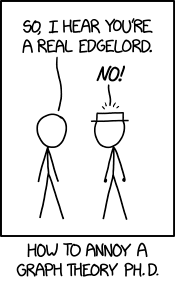
If you study graphs in which edges can link more than two nodes, you're more properly called a hyperedgelord.
glass condor
is the sequence just "latest term + 9"?
autumn pebble
Yes
glass condor
if so, it's easy to figure out a formula for the series, and prove it via induction
glass condor
You can easily guess that it's linear, and find the coefficients by fitting through the first two points.
like, $a_n = k n + b$ for some $k$ and $b$.
vital dewBOT
ConfusedReptile
glass condor
what
autumn pebble
I’m trying to solve for the k
autumn pebble
What do you mean by fitting
glass condor
Require that $a_0$ is 4, as it is. So you know that $k * 0 + b = 4$
vital dewBOT
ConfusedReptile
glass condor
require that $a_1 = 13$, as it is. So $k + b = 13$
vital dewBOT
ConfusedReptile
glass condor
solve for $k, b$.
vital dewBOT
ConfusedReptile
autumn pebble
So b wouldn’t be 9
Or will it always be 9
a451 = 4 + 9(450)
Through explicitly forumula of an = a1 +d(n-1)
@glass condor this correct?
 uncut matrix
if I'm struggling with this MIT textbook I'm using to study discrete math, should I just use something else?
just can't figure out how to prove things using the well ordering principle
yes I understand it involves finding a contradiction, either that the set is empty or there exists a number less than the least number
but actually being to apply it to solve a proof is just extremely confusing for me
faint narwhal
Not sure if this is really a problem with the textbook you're using. Seems like you just need more practice using it
uncut matrix
I've tried reading the explanation again and again
tried doing the questions and I can't solve anything using it
the stuff with applying it to the sum of consecutive numbers to prove 1 + 2 + ... + n = n(n+1)/2 still doesn't make sense to me
faint narwhal
Uh, that seems more like an induction question, and not well ordering principle
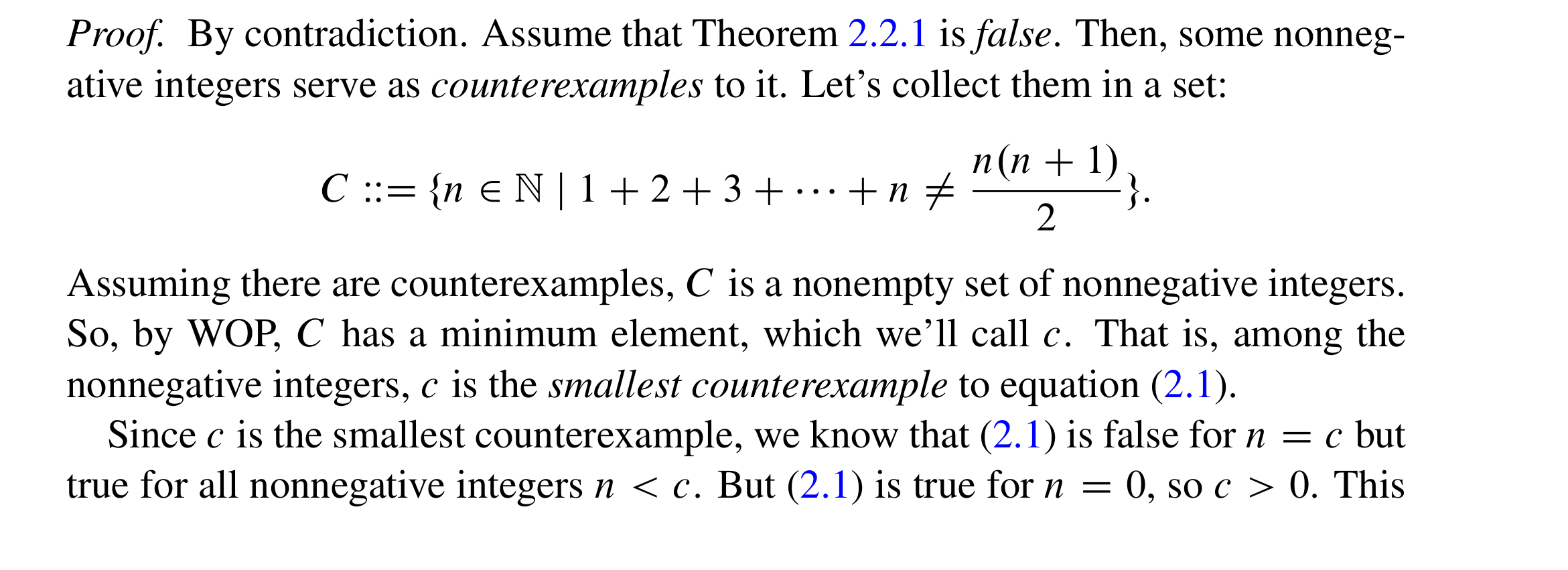
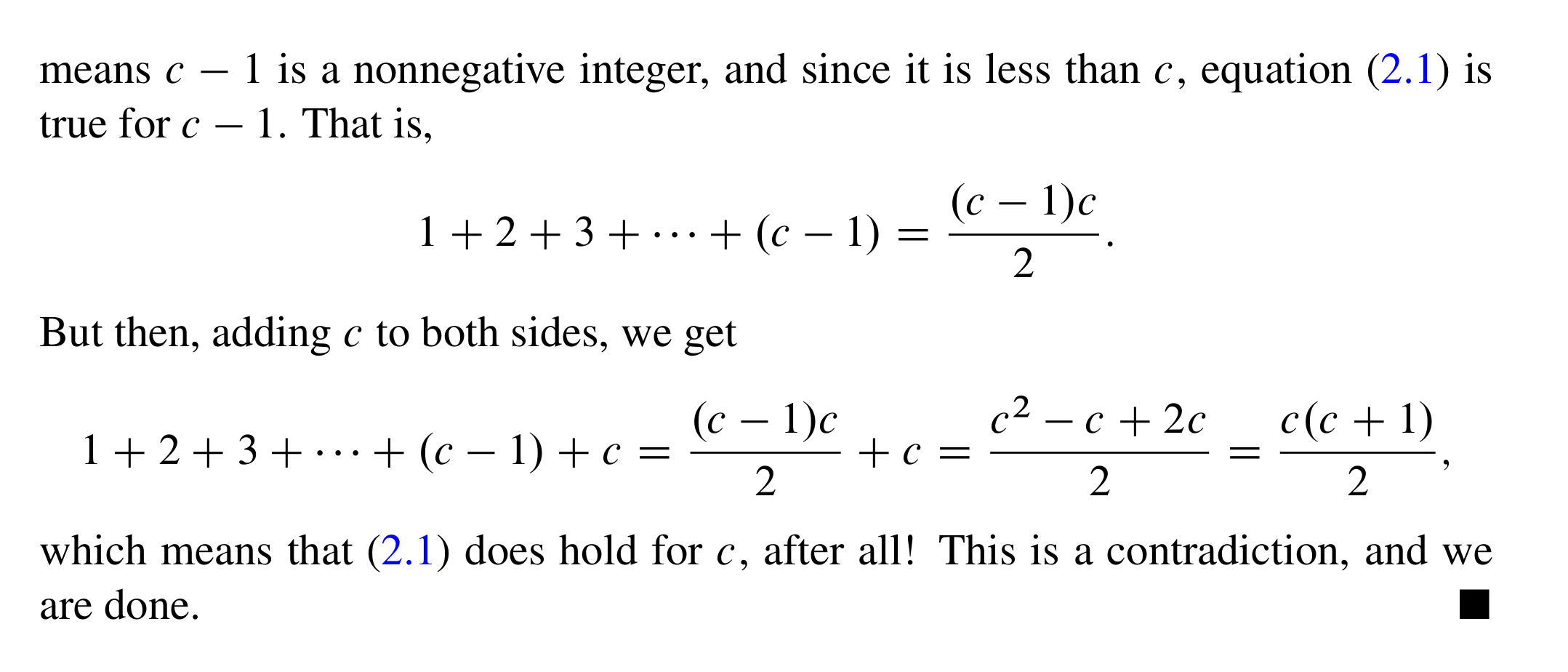 faint narwhal
Okay yeah this isn't super standard
Usually people call this method induction (although it is implied by well ordering)
uncut matrix
oh hm
faint narwhal
What here aren't you understanding?
uncut matrix
Since c is the smallest counterexample, we know (2.1 which refers to 1 + 2 + ... + n = n(n+1)/2) is false for n = c, but true for all nonnegative integers n < c. But the theorem is true for n = 0, so c > 0. This means c - 1 is a nonnegative integer, and since it is less than c, the equation is true for c - 1
for starters, why are they trying to test n = c?
n refers to the # of terms in this equation, yes but
faint narwhal
You're trying to prove that it holds true for all natural numbers n. So we take an arbitrary natural number c and show that it holds true for c
uncut matrix
why would it be false for n = c but true for n = 0 though?
if n = 0, then there are no terms in the set(?)
0(0+1)/2 is just 0
faint narwhal
Sure, I guess this is a bit of a technicality. You're right that we're not summing things on the left hand side, but usually we assign the value 0 to this "empty sum"
and this is a pretty common thing to do
If this bothers you, everything goes through if you just change all the 0's to 1s and like nonnegatives to positives and start your natural numbers at 1
uncut matrix
hm ...
so since there exists a 0 in the set regardless it's not empty
and assuming all positive integers, there exists an element (denoted c here) which is a least element
isn't n = c true for n = 1 by the way?
because then the equation would just equal one and there'd exist c = 1 which is the least element in the set
ofc if n = c = 2 then it wouldn't be correct because the set would contain 1 + 2 and 1 is obviously smaller than c, which is then equal to 2
faint narwhal
I think you're confused about the set C. The set C is defined as all elements that don't satisfy the inequality
Since we're trying to prove the statement, we're trying to show that the set C is empty
The set isn't the numbers 1 + 2 + 3 + ... + n
The set C contains the values of n such that 1 + 2 + 3 + ... + n is not equal to n(n+1)/2
uncut matrix
okay, so just taking base cases then ...
wait no I'm just confused
how would you go about proving this then?
I don't really see how somebody to come up with c-1 to draw a contradiction with
faint narwhal
So c is the smallest element in C
that means that c -1 is not in C, because it is smaller than c
 plucky patio
Hello! Is it okay if I ask a quick question about set notation here?
haughty garden
yes
uncut matrix
so always try to take a number smaller than the least number?
and try to use to find a contradiction since it belongs in the set?
plucky patio
If A is a set, then what does {A_i}_i^k mean?
faint narwhal
Well, you always take one less than the smallest number
since that is the only way you can guarantee that its still nonnegative
if you take c - 2 for example, that could end up being negative
uncut matrix
ah
faint narwhal
yes you use that to try to create a contradiction
Since you know the statement is true for c-1, you try to use that to show that the statement is true for c
uncut matrix
hm, so if I try to apply this to a different problem
say
prove: every amount of postage that can be assembled using only 10 cent and
15 cent stamps is divisible by 5.
the set would equal every amount of postage that can be assembled using 10 cents and 15 cent stamps is NOT DIVISIBLE by 5
assume the set is not empty and contains non-negative integers, hence there exists an element c that is the least number
for c - 1, the set is true
faint narwhal
Well okay, this ends up being a bit different
because you're not trying to prove something holds true for all integers n


 faint narwhal
you can apply a similar idea though
basically instead of looking at c-1, look at either c - 15 or c - 10
uncut matrix
hmmm
faint narwhal
since c was assembled using some combination of 10 and 15 cent stamps, you can remove one of these stamps to get a value of c - 10 or c - 15 and then apply similar ideas
uncut matrix
so then I have to prove c - 10 or c - 15 is divisible by 5
and that creates a contradiction because c should be the smallest integer that's divisible by 5
weary tiger
what does Un mean?
minor dagger
In what context?
weary tiger
minor dagger
In what context?
General terms and sequences
minor dagger
it's just the nth term
I think usually a subscript like n refers to the nth value of some index
 turbid kestrel
@weary tiger
weary tiger
hiii
turbid kestrel
Discrete
weary tiger
ik
weary tiger
oh lmao
weary tiger
oh, congo 
shut fjord
This is a dynamic programming problem, we are tasked with just creating a recurrence relation for now
Here’s my work so far, but I can’t really grasp a pattern:
Thought that something was going on with combinations but I abandoned this idea
Then I thought of how they were smaller problems.. but again I’m stuck
mystic moss
@shut fjord it's like the one you did earlier, except with less cases