#discrete-math
1 messages · Page 144 of 1
 dapper needle
need help, not getting anywhere with my attempts
 gusty crag
I think it would be helpful to rewrite the left side with $\sum$
 vital dewBOT
mathew_soto78:
 unreal stump
Let Sn be the sum on the left. How can you rewrite S(n+1) in terms of Sn and n?
||S(n+1)=S(n)+2^(n+1)||
dapper needle
what's the -1 though?
gusty crag
1+2 = 2^2 - 1
dapper needle
ah right..
gusty crag
the sum of the first n powers of 2 (including 2^0) is always one minus the next power of 2
that's what the problem is asking you to show, but I recommended to write out the left side with a summation symbol because I usually find it easier to do these sort of problems when I've written it out more formally, or "mathematically"
dapper needle
can't believe I had to refresh on how to correctly write sigma notation but.. I got it
gusty crag
yep that's the left side
so show that $\sum_{k=0}^n 2^k = 2^{n+1}-1$ for all $n\in \mathbb{N}$ using induction, you need a base case and an inductive step
vital dewBOT
mathew_soto78:
gusty crag
I don't know if the way your teacher defined $\mathbb{N}$ includes 0 or not, but it works for 0 as well as 1 so it doesn't matter which one of those you take as your base case
dapper needle
right
 nocturne carbon
Hey, i just started learning discrete math and have become familiar with the conjugation operator, can anyone confirm if my answer to this question is correct?
does that emoji mean yes or no...
 lyric pumice
@delicate ridge Yes, there is.
nocturne carbon
Okay thanks
 errant bear
though a might work, its been a while though so probably want some more confirmation
nocturne carbon
from the examples i read, i dont think its a, but then again im the noob here
considering this question, which is supposedly really easy, i have no clue at all how im supposed to solve it
im not familiar with how to solve this type of problem in my practice sheet, does anyone know how to solve it?
 stray reef
here's a hint: consider O_1 + O_2
 frail girder
i got this example saying sqrt2 to the power of sqrt 2 is rational and I don't see how? It was a non-constructive proof
unreal stump
I think it proves (irrational)^irrational can be rational, not √2^√2
frail girder
yea this textbook trolled me then
stray reef
kobayashi are you sure you aren't misinterpreting it
frail girder
u want a screen shot
stray reef
yes
i'm like 99% sure it says
"either sqrt(2)^sqrt(2) is rational or it is not. if it is, we're done. if it isn't, raise it to the power of sqrt(2) and end up with 2"
stray reef
if x is rational, then x is rational
 pliant horizon
Is this a statement that even makes sense?
https://puu.sh/GsUeX/21c3b9e646.png
 pliant horizon
I don't understand what the intersection of a set X and a cartesian product of two other sets would even be
Empty?
 pale epoch
the cartesian product of two sets is a set
and you can intersect any two sets
for X=R^2, Y=Z=R, its not empty
its R^2
pale epoch
the intersection of R^2 and R
pale epoch
then its empty?
pliant horizon

pale epoch
what's the problem?
pliant horizon
so it does make as little sense as i originally thought
pale epoch
it's a valid statement
pliant horizon
Wait what
We just found a counterexample
Last I checked R^2 is not equal to the cartesian product of the empty set with the empty set
pale epoch
yes, that does not make it less of a statement
it just happens to be wrong in this case
 weary tiger
nocturne carbon
weary tiger
nocturne carbon
Can someone please explain What Left Identity of => is,
and what ex false quodlibet?
i know ex false quodlibet mean, from falsehood, anything
weary tiger
$a_1=\left{a_i:::2\le :i\le n\right}$
vital dewBOT
The-Elite:
weary tiger
is this how you would say "a_1 can take any value of a_i where i is greater than or equal to 2 and less than or equal to n?
 elfin flume
Can anyone help with this? I'm not sure how to even start this.
weary tiger
use the product rule and binomial coefficient
stray reef
is this how you would say "a_1 can take any value of a_i where i is greater than or equal to 2 and less than or equal to n?"
no
you're equating a_1 to the entire set {a_2, a_3, ..., a_n}
 leaden pebble
no, should have been $\in$ @weary tiger
vital dewBOT
Fractal:
leaden pebble
but also, the set builder notation is wrong as well
well, not the notation. the set is wrong
a_1 should be in that set
stray reef
not with how she specified it
 brave lava
well
what does A subset B mean
that set A has the same elements as set B?
doesnt that make them both equal sets
brave lava
right and we didnt use the proper set symbol
so we know set B doesnt have another elements that are not in set B
thus, set A and B have the same elements
and are both subsets of each other
?
stray reef
bruh what
i never said B was a subset of A
it is possible to have A ⊆ B without B ⊆ A yknow
for example, A = {1,2,3} and B = {1,2,3,4,5}
stray reef
symmetric*
and no obviously it isn't
would you expect the less-than-or-equal-to relation ≤ to be symmetric?
would you expect a ≤ b to be the same as b ≤ a?
 zenith thorn
Yep so basically if it’s improper ⊆, similar to what Ann said, then all elements in A are in B. If B just so happens to have the same elements in A, then that’s why there’s the bar under the subset symbol. The relation doesn’t commute because if it did, then all sets would be equal to each other. This notion is explored when you get into subset inclusion proofs where you prove two sets to be equal by proving two cases where each is a subset of each other.
stray reef
what do you mean
weary tiger
like how do i write it in math notation
weary tiger
so I have a set P that contains elements from 2 all they way upto n
stray reef
is that all
weary tiger
ya
stray reef
P = {2, 3, ..., n}
stray reef
{k ∈ N | 2 ≤ k ≤ n} if you want to be stuck-up and formal
weary tiger
so P = {k ∈ N | 2 ≤ k ≤ n}
is it fine to put the P there
P = {k ∈ N | 2 ≤ k ≤ n}
also what is N?
pale epoch
the set of natural numbers
weary tiger
oh
so if we want to describe the elements of a set P it is fine to say P = {k ∈ N | 2 ≤ k ≤ n}?
pale epoch
that's set builder notation, so yes
 mint bane
can anyone explain a state machine please
i have a textbook explanation but im curious if anyone has a different wording or something like that
 gritty crescent
I've just started with discrete math 
 turbid meadow
with set theory, let's say i have a set A = {1,{3,5},3,6,7} is {3,5} an element or a subset?
pale epoch
of A? an element
turbid meadow
oh i c so {{3,5}} would be a subset?
pale epoch
yes
mint bane
@gritty crescent use the MIT opencourseware on it, i started about a month ago
it goes pretty fast but im going really slow to counter it and ive liked it v much
gritty crescent
Yeah, I was bothered by their pace. I liked their assignments though, I might use them. Currently, I've enrolled in a different MOOC, which is also free. It's going at a manageable pace, but they're not offering a lot of courseware, so I might complement it with OCWs material.
mint bane
yeah what im doing is just following the OCW lectures but since they go so fast if they talk about something i missed i go back and read up do practice etc
hence, im only on lecture 4 after a month lmao
gritty crescent
But that's good, they do cover everything in a lot of depth.
And this also highlights MIT's own academic rigour. I guess the students over there have to grind real hard to get through their college lives.
mint bane
yeah probably true
im supposed to be a sophmore but taking a gap year and i go to a decent private uni in PA, super different
then again i mostly bullshitted my freshman year unfortunately but MIT seems crazy
gritty crescent
Freshman means first year at uni, right? Not familiar with American education terminology, sorry.
mint bane
yeah lol first year, supposed to be second year rn
gritty crescent
I see. So you're majoring in maths?
mint bane
we should probably talk in PM tho, dont wanna get too off topic here
gritty crescent
👍
gritty crescent
I was given an explanation in #help-8 , which seems to be the standard analogy. However, I personally struggled with understanding it, and need some intuition to understand this.
gusty crag
If kid 1 ordering chocolate and kid 2 ordering strawberry were different from kid 1 ordering strawberry and kid 2 ordering chocolate, then I think it would be n^r (each kid can order from any of r flavors)
but it seems like what this question is really looking for is the number of different possible orders of n ice cream cones if there are r different flavors, so the order in which the cones are ordered doesn't matter
I just checked questions-theta, I was about to give you the same explanation you're struggling with lol
@gritty crescent what about that explanation gives you trouble?
turbid meadow
Need to confirm my answers are right here is the context and answers:
Context:
U={1,2,3,4,5,6,7}
A={1,7}
B={1,2,4,6}
C={1,3,5,7}```
Answers:
- C-A = {3,5}
- A∩ B′= {7}
3)(A∩B)∪C′= {2,4,6}
4)(A∪B)′= {3,5} - (C-A)'∩B={1,2,4,6}
Thanks in advance :)) shell jewel
Any time :)
weary tiger
how do i go about this problem
pale epoch
read the definitions
weary tiger
I have such that if x is in A and B then x is in a and x is in b but I do not know how to prove something is a subset of something else
I need direction on how to start
pale epoch
you take an element from the left hand side and show that it is also an element of the right hand side
weary tiger
so x is an element of a and b. Hence, x is an element of a and x is an element of b. Therefore x is an element of b and AandB is a subset of B?
This was what I answered previously before consulting this channel
pale epoch
ye
weary tiger
Ok thank you!
pale epoch
your argument works for every x, this then shows A and B subset B
 robust light
yo can someone explain how to draw hasse diagrams
im very confused
i'm looking at this question and my brain is drawing a blank
robust light
i think i have an idea of how to solve it
but i dont know if i'm right
is anyone here?
robust light
yea, i just have questions regarding formatting and whatnot
I have to draw a hasse diagram of natural numbers less than or equal to 10
And the divides are “|” whatever that means
I just feel like this isnt right because i dont think 8 would be the maximal?
 haughty garden
weary tiger
haughty garden
weary tiger
if i have a function that maps i to a_i and they're all the same values, how do i write that in set notation?
i was thinking $a_i=\left{i\in N:::1\le i\le 4\right}$
but idk if that's right
vital dewBOT
The-Elite:
weary tiger
<@&286206848099549185>
 fallow raft
$A_{i} = {X | X \in \mathbb{N}, 1 \leq X \leq 4}$ might work
vital dewBOT
Swagger:
fallow raft
$\frac{a}{b}
 ember sky
Well if u can relate something to something else is that is certainly true, then the subrelation must be true as well, dont you think?
fallow raft
I guess in this case sure?
ember sky
Well there is little context here for me, so theres not to much to go off of.
But that would be my main argument ^^^
 fallen osprey
Hey, is there anyone that could help me with a concept?
I've been stuck on this concept for quite some time now
 last sigil

 fading abyss
 orchid jasper
Depends
But yes if you have a limited number of bits there will be overflow at some point
gritty crescent
@gritty crescent what about that explanation gives you trouble?
@gusty crag I've figured it now, initially I had trouble processing it.
gusty crag
what made it click?
 dapper mason
hello all
in this NFA, the prof said it accepts an epsilon input
but I thought in a NFA you have to take the epsilon path if it is an input
gritty crescent
what made it click?
@gusty crag I took a look at the visual of separating by sticks again, and then all of a sudden the idea started making sense. I still have a minor doubt though.
ember sky
Bro i love ur pfp @dapper mason
dapper mason
lol thanks
dapper mason
issue has been resolved, NFAs aren't forced to traverse epsilon transitions
 devout stone
Hi, can someone explain to me about Quantifier?
stray reef
what about them
devout stone
I do not understand when to use for all and there exist formula in the word statements
stray reef
can you show an example of what you're struggling with
devout stone
stray reef
okay yeah some of these are not obvious
devout stone
How to know which one to use in this statements?
gritty crescent
(d) seems to be a case for "there exists" quantifier.
The other three all seem to be "for all" statements since any passenger/man/woman/student qualifies if they meet the given criterion. I could be wrong though. 🤷♂️
What have you tried so far?
devout stone
The first three I put it as forall then the last one as there exist
 solid nacelle
Could someone check my work? I'm going through the Book of Proof Section 1.4 and I'm having a difficulty solving question 12. Now, if I'm reading this correctly, X is an element of that powerset but 2 must be an element of X. 2 isn't the same as {2} right? Which would mean that the answer is an empty set since there's none. I'm not sure if I'm right though so if there's someone that could help me understand, that would be fantastic.
stray reef
\in, by the way
also, no
your set is the set of all subsets of X which have 2 as an element
{ {2}, {1,2}, {2,3}, {1,2,3} }
solid nacelle
these questions confuse me a lot but I think I got it now, I wish it was part of the solutions so that I didn't have to ask. Thank you for clarifying my concerns @stray reef
that makes so much sense now
@stray reef Also another question if you don't mind, if the rule was something like |X| ≤ 1, does that mean the set would be any element that only has a size/cardinality of less than or equal to 1? For instance, the question would be {XeP({1,2,3}):|X| ≤ 1} and the answer would be { {}, {1}, {2}, {3} }, am I doing this right?
gritty crescent
Sounds good to me.
solid nacelle
@gritty crescent Thank you!
stray reef
that wording will get a grumble grumble from me but otherwise fine
gritty crescent
In how many ways can one move from (0,0) to (5,5) on the Cartesian plane, making only unit movements to the right or upwards?
For instance, one such path would be (0,0)->(0,1)->(0,2)->(1,2)->(2,2)->(3,2)->(3,3)->(4,3)->(5,3)->(5,4)->(5,5)
I'm not aware of any systematic method of solving this problem, and I guess there are too many possibilities for brute force.
unreal stump
10c5?
10 steps will always be required to do that
You have to choose which 5 will be upward
unreal stump
I think so
gritty crescent
Wolfram says this is equal to 252, which does sound like a compelling number.
I'll try solving it for a simpler case, then try to generalise and see if I catch up with your result.
gritty crescent
@cunning thistle Help me on this one.
 cunning thistle
Can i see the question?
gritty crescent
In how many ways can one move from (0,0) to (5,5) on the Cartesian plane, making only unit movements to the right or upwards?
 cunning thistle
I don't know a formal way of doing these type of questions but i guess counting manually won't be such a bad idea.
gritty crescent
Fr? Drake suggested the answer's 252- how am I supposed to count that?
gritty crescent
I understood Drake's solution. Nvm.
The idea is that you're going to make 10 moves in all, so you choose(without loss of generality) which 5 of these will be upwards.
This gives you 10C5, hence 252.
cunning thistle
Are you certain that 252 is the correct answer?
unreal stump
Should be
cunning thistle
Idk. It just seems like alot.
gritty crescent
Yes, that's the correct answer.
Now a bit trickier part: We still need to move from (0,0) to (5,5) using rights and ups, without crossing the diagonal joining (0,0) and (5,5)[touching the diagonal is permissible, but crossing it isn't]. In how many ways can this be done?
I've been suggested the answer's $\binom{10}{5}-\binom{10}{6}=42$, but I don't exactly understand where the latter term comes from.
vital dewBOT
TedNowKaczynski:
last sigil
@gritty crescent learn about the catalan numbers
can't directly help rn cause in class
gritty crescent
Np, and yes this answer is supposed to be linked to Catalan numbers but the instructor didn't explain the how-and-the-why, so I'm looking up in different books now.
stray reef
admittedly the only way i know of to derive the catalan number formula is through generating functions
gritty crescent
Above and below the diagonal, yes. Touching the diagonal is permissible but crossing it isn't.
admittedly the only way i know of to derive the catalan number formula is through generating functions
I see. I guess generating functions will appear only very later in my current course sequence, so I might have to wait till then to get a satisfactory answer.
The instructor did some weird explanation by saying one possible way of crossing the diagonal is RUU|RURRURU. The diagonal is crossed after the UU. He then said he'll take "the complement" after the seperator to get RUU|URUURUR. Then he claimed there are 6 Us and 4 Rs, which give C(10, 6) combinations of crossing the diagonal, which can now be subtracted from C(10, 5) to get 42.
I didn't understand the explanation at all.
cunning thistle
Idk how this would help but i suggest you dig up on Andre's principle of reflection. It has a close relation to problems of Random Walk as well as that cashier problem.
@gritty crescent
gritty crescent
Yeah, one of the books talks about this reflection too but I'll pass on this problem for now. There's far too much I don't know atm, so I'll wait for a while to get to the gist of this solution.
There is?
Nor do I. 🤷♂️ The reasoning seems too contrived.
What could be a possible way to count crossings?
Every crossing path will either go this way (n-1, a)->(n,a)->(n+1,a) or (b, n-1)->(b,n)->(b,n+1), right?
0<a<5 and 0<b<5
One of the books used the exact same words you did lmao, I couldn't follow that line of reasoning.
Thanks! Ping me if you have any ideas.
cunning thistle

Mathematics Stack Exchange
I think this question uses catalan numbers.. but I don't know exactly how to answer it... its not homework or anything but I need to understand how to do it.. I tried drawing up likes for each 5r d...
@gritty crescent
gritty crescent
I'll look into it.
 valid wave
Hello peeps
discrete math is really whooping me
anyone have a good resource for learning it?
cant seem to find khan academy videos
gritty crescent
MIT OCW's Discrete Math course is worth looking into.
last sigil
don't think there is a central resource since most of the concepts in discrete math that are taught vary
I'd focus more on specific techniques/concepts you struggle with and google from there
lyric pumice
don't think there is a central resource since most of the concepts in discrete math that are taught vary
I'd focus more on specific techniques/concepts you struggle with and google from there
Agreed.
 burnt herald
b.) is saying that for atleast 1 value of x in R, every single value of y in R will make P(x,y) true
@cursive elk they both sounds similar to me..
burnt herald
@burnt herald quite different
@cursive elk In other words,
for a, we define a range of x, then only we choose a y that satisfied the P?
and for b, we choose an x first, then only a range of y
Is it right to think that way?
 leaden moon
What's the difference between Contraposition and Contrapositive?
Is it the same thing?
dapper needle
is this possible to do using the Euclidian Algorithm?
unreal stump
If a and b are not coprime, integers r and s won't exist
You can use Euclidean algorithm to find integers r and s ,such that this condition is satistifed when (a,b)=1
leaden moon
@weary tiger o thanks for clarifying
dapper needle
@unreal stump is coprime another word for relatively prime?
dapper needle
okay, do you have any idea how to begin if I wanted to use the Euclidean algorithm?
I know I could probably just assume d = common divisor and go from there
to eventually prove that it's not possible
but I was wondering if it's possible to do using the algorithm
unreal stump
I don't think you can
burnt herald
Prove using math induction: n < 2^n
Base case 1 is true for above
n = k
Induction Hypothesis: k < 2^k
Show: k+1 < 2^k+1
2(k) < 2^k * 2
2(k) < 2^k+1
k+k < 2^k+1
k+1*k < 2^k+1
Is this correct?
The last statement LHS k+1*k is "much better" / greater than k+1, which is still less than the RHS
unreal stump
Yes
 void maple
can anyone help with some pretty simple propositional logic questions
burnt herald
I'm also learning it @void maple ...what kind of questions?
void maple
basically i need to translate the math form into plain english
burnt herald
maybe post them here?
void maple
not allowed to post directly unfortunately
hold on
So one part of it is (x=/=y) and i'm not really sure how to read that
@burnt herald
 quaint star
Yes
 stuck iris
∃ y ∀ x (x>0 → x>y) would you say this is true? x and y are real numbers
@quaint star
quaint star
Yes
stuck iris
really ? o.O
 plucky stirrup
For proof by contradiction
If P is our statement
We have to say the negation of P is true, and then prove that is wrong, correct?
weary tiger
$\frac{n^2}{2n:}-1<\frac{n}{2}+1$ having trouble proving n>=2 using induction, i proved the base case made the hypothesis but am confused on how to do when n=k+1 $\frac{\left(k+1\right)^2}{2\left(k+1\right):}-1<\frac{k+1}{2}+1$
vital dewBOT
The-Elite:
plucky stirrup
So if my P is
In a graph G with at least two vertices, there are always at least two vertices that share the same degree
Then my negated statement is
In a graph G with at least two vertices, there exists less than two vertices sharing the same degree
weary tiger
i can't get them to equal my assumption of $\frac{\left(k\right)^2}{2\left(k\right):}-1<\frac{k}{2}+1$
vital dewBOT
The-Elite:
quaint star
@plucky stirrup yes, but it would just be that such a graph exists, not that all graphs have less than two...
plucky stirrup
So negated statement is
Such a graph G, exists where there are less than two vertices sharing the same degree? @quaint star
so my first negated statement was incorrect then
quaint star
Yes, it doesn't read as clearly as this does
It sounds like you're saying it's true of all graphs
plucky stirrup
okay got it
stuck iris
∀ x (P(x) → Q(x))
is true.
void maple
can someone help
stuck iris
∃ x (P(x) ∧ ~Q(x)) cant be determined right?
void maple
i need to write everyone has something except 1 person
x & y = all people
A(x) = x has a car
i need to write everyone has a car except John
in the like math form
@plucky stirrup could u help
vital dewBOT
The Arsonist:
 balmy turret
(subtract n/2 from both sides and it's -1 < 1 which is true)
dapper needle
I know that I need to invoke the Fundamental Theorem of Arithmetic, and I know that primes and perfect squares are mutually exclusive, but I'm having trouble finding a way to prove that?
weary tiger
you could try proving (or cite, if you've already learned this in class or whatever) that a number is a perfect square if and only if the unique primes in it's factorization are raised to even exponents
then a contrapositive argument could easily be used
if the prime factorizations of x or y contain some number of odd exponents, and x and y are relatively prime, then the factorization of xy also has odd exponents, so it isn't a perfect square
plucky stirrup
@void maple you still need help didnt see your message till now
everyone has a car except john; can be rephrased as all people that are not john has a car
does that help?
to render except would be something like this though
∀x(P(x)∧¬J(x)→C(x)) ∧ ∀x(P(x)∧J(x)→¬C(x))
where P(x) are people, J(x) is John and C(x) is owning car
 errant bloom
You have a set $S$ of integers up to $3n$. Now we define a new variable $N_k$ which counts how many subsets of $S$ we can form. We actually create multiple variables, one for each $k$. We call those subsets $X$, and they should fulfill two conditions: 1) their cardinality should be 2n+1. This means that X should contain exactly $2n+1$ elements from $S$. 2) the smallest element in X has to be equal to k.
The question now is, for which values of k can we create such subsets (i.e. $N_k \neq 0$) @weary tiger
vital dewBOT
lyinch:
 violet geode
If I have to show two sets are equal to each other using the laws of logic:
- Do I have to make arbitrary sets and make the relations by using logical operators, and then use logical equalities to show that the two sets are equal to each other? And if so, do we have to use the definition of subsets to prove that both ways works?
- Or, can i show this using set equalities?
 open narwhal
Really dumb question cause I'm blanking, how do I prove a function countable compared to natural numbers?
weary tiger
show the question @violet geode
weary tiger
you just use absorption law
ya
it is
your question is literally the definition of the absorption law
violet geode
well the question i have is actually much harder
weary tiger
show it
violet geode
i cant
pliant horizon
is finding an inverse function sufficient to prove a function is injective and surjective?
weary tiger
show that f is invertible
pliant horizon
not sure what you mean.
for example $f(x)=6x-9$. I can find an inverse function, $f^{-1}(x)=\frac{x+9}{6}$. Is that sufficient
vital dewBOT
nix:
lyric pumice
You find all the lists that are three entries long where each entry is 1 of the n possible elements.
And then consider the restrictions.
weary tiger
Can any show how to prove this statement is true or false:
a^(x) =(congruent) b^(x) mod m
x is a natural number
I’ve tried a few values for a counter example but those hold, not sure how to go about proving/disproving this
lyric pumice
Give a counterexample.
weary tiger
sorry I completely forgot to put the first "if"
a =(congruent) b mod m => a^(x) =(congruent) b^(x) mod m
conditions for my attempted counter examples always seem to match but maybe im just not seeing a proper counter example
elfin flume
So all I've been able to figure out for this problem so far is that we have 7 days in the week so we choose any one day and then go for five consecutive days and we get 7 * 6 *5 * 4 * 3 =2520 possible ways to go through the 5 days. Is that correct?
lyric pumice
@weary tiger You can prove it by induction.
weary tiger
Didn’t think of that, thanks !
 sour arrow
@pliant horizon
It's enough to show that the function is injective and surjective on some domain and range.
Consider x², x ≥ 0. It has an inverse, √x. Of course, this is assuming the range is x ≥ 0, otherwise this isn't surjective.
pliant horizon
@sour arrow so going off my example from before, if i can find an inverse and show it has the same domain as the original function then its proved?
sour arrow
It's enough to show that the function is injective and surjective on its domain and range, but that range may not be R
If you've shown that range is R, then you got it, but that's a lot of work at this point haha
zenith thorn
Yeh surjective and objective functions really depend on what the function is defined by. Just remember for surjective functions all output values have at least one input value. Considering kaynex’s example, you have a simple parabola. Suppose your output is -1. Can you find an x such that when plugged into the function will map to that value? No, because the range doesn’t contain negative values for parabola; and geometrically, x² doesn’t push further down into negatives. Hence, it’s not surjective.
Surjective and injective functions^
 sleek island
Can someone help?
How can it be written like that?
 versed summit
Can someone explain to me why p <-> q when p is FALSE and Q is TRUE equates to FALSE? Because I know in p -> q it's still true, so what changes in if and only if?
ember sky
think of it as if one side does not rationalize the other side, both sides are brought down
this is essentially how the and keyword works in many programming languages
well sort of
versed summit
Damn see now this has also made me get confused on how normal p then q works
So how come in the bottom half of p -> q it's true?
Like why is if false then false, true?
versed summit
Ah okay when you put it like that in programming terms I understand it
ember sky
good source
versed summit
It's just the wording in discrete math is confusing
My biggest issue with being a cs major is im very good at coding, not good at math
ember sky
I believe you can sum up -> and <-> as this:
-> as in (x == y)
<-> as in ((x == y) == (y == x))
versed summit
Well in -> saying F == T doesn't make sense because in the end that would be true, right?
ember sky
no cause its false
versed summit
okay so in <-> it's only true if both values are the same
so either both true or both false?
ember sky
yeah
versed summit
Alright so I sorta get why "if true then false" is false, because it's basically saying when p is true, q is false, and therefore the overall thing is false
idk if that makes sense
Like I get why "if false then false" is true because logically it makes sense when spoken, same for "if false then true"
It was just "if true then false" that was throwing me off
ember sky
For example
x = 2 ⇒ x^2 = 4 is generally true
but x^2 = 4 ⇒ x = 2 is not necessarily true
so isnt x^2 = 4 <⇒ x=2
because x can be -2
its like saying a square is a rectangle
but a rectangle is not a square
in one simple step
@versed summit its hard to visualize with bools
so i get your confusion
ember sky
hope you understand what i mean
 finite wren
i'm wondering if this is equivalent - (i typed this)
 hardy viper
right side doesn't include the negative c's
finite wren
@hardy viper if we assume c is non-negative, then it is true?
hardy viper
yea
 naive saffron
This isn’t right
$\sum_{c\equiv0\pmod{5}}x^a=x^a\sum_{c\equiv0\pmod{5}}$ converges only when $x=0$ and $a$ nonzero
vital dewBOT
Whoever:
naive saffron
Ok my point is that the left hand side doesn’t depend on c and that’s a problem
Neither is the right side to be honest
So technically this is true but not the way you wanted it
$\sum_{c\equiv0\pmod{0}}x^c=\sum_{c=-\infty}^\infty x^{5c}$
vital dewBOT
Whoever:
naive saffron
@finite wren
If you assumed c is nonnegative then it’s
$\sum_{c\equiv0\pmod{0}}x^c=\sum_{c=0}^\infty x^{5c}$
vital dewBOT
Whoever:
finite wren
@naive saffron I’m just generating a series it doesn’t have to converge
With that, would they be equivalent?
Sorry pretend a=c
I typed it wrong
naive saffron
Yeah that was my point
pliant horizon
can some explain what the last two lines mean? https://puu.sh/GutAS/00637534b0.png

the R^n and tau of R
hardy viper
if R has (x,y) and (y,z), then R^2 will just have (x,z)
so like if R was x has y as a parent
R^2 would be about grandparents
and t(R) would be parents grandparents great-grandparents etc
pliant horizon
but $R^n$ would still be of the form $(x,y)$ if $x,R^n, y$ for elements $x,y\in X$?
vital dewBOT
nix:
pliant horizon
or i guess maybe i should say it a different way
if R has say (x1,x2),(x2,x3),...,(x_{n-1}, x_n}, then (x1,xn) is in R^n?
hardy viper
that's right
 cerulean ore
I am trying to find the time complexity of T(n) = 3T(n/4) + cn^2
The way I have learned is that you sum the work you are doing at each level.
Level 0: cn^2
Level 1: 3c(n/4)^2  = 3*c*n^2/(4^2)
Level 2: 3^2 *c*(n/4^2)^2 = 3^2 * c * n^2/(4^4)
Level i : 3^i * c * n^2/(4^(2i))
Summing up: cn^2 (1 + 3/4^2 + 3^2/4^4 + ... + 3^i/4^(2i))```How do I sum this series?
hardy viper
are you summing infinite terms or just up to i?
cerulean ore
@hardy viper Just up to i.
hardy viper
ok that's a geometric series, because each term is multiplied by 3/16
a1 is the first term, let's say 1, and r is 3/16
finite wren
is this step mathematically right?
i just havent worked with summations like this before
weary tiger
the idea is correct but you misused the exponent rules
finite wren
@weary tiger so is the wrong part that I made x^45?
should i keep x^30 , 10 , 5 in each summation?
weary tiger
$x^{30a}\neq x^{30}\cdot x^{a}$
vital dewBOT
HoboSas:
weary tiger
how do you solve this? anyone can give a hint?
 tepid jacinth
Can anyone help me understand polynomially larger because im having a hard time understanding a question on one of my homeworks.
stray reef
context?
last sigil
Post the whole question and we may be able to help better
stray reef
nah poco don't you know, we're all supposed to be telepaths who magically know the entirety of every question ever /j
tepid jacinth
Sorry I was eating lunch. The question was about comparing if n/log(n) is pollynomially less than nlog(n)
n/log(n) <(p) nlog(n)
I dont really know how I should show this, he showed an example where he stated that this is equivalent to
n*n^E/log(n) = O(nlog(n)) , where E > 0 but I dont know if I just show that if i can cancel the n's on both sides just show that n^E/log(n) = O(log(n))
balmy turret
Not too sure, but maybe you could do smething lazily like: n/log(n) < nlog(n) n < n(logn)^2 (* logn) 1 < (logn)^2 (/ n)
 gray ingot
i need help proving set identities. question is (R\S)\T=R\(S\T)
i know the answer is true but i just don't understand how i'm supposed to say it's true
 pallid lintel
should be deduced from some list of axioms in your notes your given. (screenshot them and post them here maybe?)
 velvet junco
hmm is boolean algebra fair game here?
if so:
I need to factor this ~w*x*z + ~v*w*x*~y*~z + ~v*~x*y*~z for a fan-in of 2
Not really seeing a clear way
 elfin egret
Hey can anyone help me prove that the cardinality of ZxZxZ is the same as that of Z
I tried to find a bijection but it's getting a bit difficult to find such a function
stray reef
do you want an explicit one?
cause if not i'd first show that Z is equipotent with N, then use that to show Z^3 is equipotent with N^3, and then make a bijection from N to N^3
elfin egret
Yes I tried that but it seems that it was a bit long and may be extra work... Maybe we can find an injection from Z to Z3 and then Z3 to Z
Maybe we don't need to go for N
stray reef
injection from Z^3 to Z will take some work
actually you can just make a bijection from Z^3 to N
elfin egret
How so?
stray reef
split Z^3 into a countable collection of finite sets
one way to do this would be as follows: $$\bZ^3 = \bigcup_{k=0}^{\infty} C_k$$ where $C_k = { (n_1, n_2, n_3) \in \bZ^3 : \max(|n_1|, |n_2|, |n_3|) = k }$
vital dewBOT
Ann:
stray reef
you can imagine the C_k as being cubes made of lattice points
like C_0 is just the origin, C_1 is the 3x3x3 cube surrounding the origin (without the origin itself), C_2 is the 5x5x5 cube surrounding C_1, and so on
basically like an infinite matryoshka of cubes
do you get what im talking about
elfin egret
I got the definition of Ck, and a bit of geometrical intuition but how can it give a bijection from Z3 to N
stray reef
i'm gonna make it N -> Z^3
basically as an enumeration of the points of Z^3 in a sequence
you start with the origin
then the points of C_1
then the points of C_2
then C_3,
and C_4, and C_5, and so on
each of them is finite (in fact, |C_k| = 24k^2 + 2 for every k ≥ 1) so you'll always exhaust each C_k before moving onto the next
elfin egret
Can you express it in functional notation... Like f(n) =?.. Sorry I'm a beginner in this subject
stray reef
i was trying to avoid doing that
i mean honestly what im giving here isnt even a concrete description
but if you wanna make it concrete, you could list the elements of each C_k in lexicographic order
elfin egret
I think it isn't a function in the first place... Many triplets have same k... So starting with a natural number n, many triplets can be found
stray reef
Many triplets have same k...
??
ok like let me be clearer
i'm not mapping the number 1 to the entirety of C_1
C_1 is mapped to the numbers 2 through 27
(if we start N at 1)
C_2 is mapped to 28:125
C_3 is mapped to 126:343
and so on
the ranges grow with the sizes of C_k
elfin egret
Okay I got you now...
Though I need some time to write it formally but it gives a well defined bijection... Thanks👍
 carmine widget
is this true or false?
unreal stump
True
 wild flame
Can anyone make sense of this proof?
https://i.imgur.com/TiYr1a7.png

The highlighted portion is what's confusing me.
They're checking surjecting by picking one variable n (that is a positive integer) and another variable m ( that is another positive integer)
and somehow these two equal each other?
wild flame
Ah. I thought 'onto' meant surjective. My bad.
unreal stump
One-one is injective
wild flame
OH
unreal stump
And in your marked passage,he says one-one
naive saffron
Don't use the same index for different sums in the same formula
no it is not. The current expression doesn't even quite make sense
finite wren
@naive saffron mb pretend the index things are unique
finite wren
it was originally summ 0 to infinity x^(a+2b+30c)
@finite wren
Yes
@naive saffron I'm just not sure if what i have is multiplication or "repeated summation things"
like basically is
is the shape () () () = () () () (equal obviously)
or (1(2(3))) = (1(3(2))) (equal??)
Are these repeated summations, or are you trying to multiply the three summations?
@worthy palm is there a difference - i think thats what im trying to ask
 spring mica
@pale epoch how does this set builder notation specify mapping
it just says that all of the tuples in the set has to come from A B and C
it dosen't specify all combinations
spring mica
@lyric pumice are there any exmaples of A being a subset of powerset(A)
other than the powerset(emptyset)
gray ingot
how would i go about these?
i know the best way to start would be to assign different sets to each value and then work from there but tbh i don't really understand the logic
lyric pumice
@spring mica No. Prove that there are none.
spring mica
gotcha
versed summit

i have no idea what im doing
my answer for A looks like minecraft enchanting table so I'm not sure if it's correct
this is a cry for help
gritty crescent
You could see this unfold step by step.
vital dewBOT
TedNowKaczynski:
 zinc robin
Hi, I was wondering if anyone could help me with this proof
I'm not exactly sure what it's trying to have me prove, or where to start with writing the proof
stray reef
prove that if m has no prime divisors up to its square root then m is prime
or equivalently that any non-prime will have a divisor less than or equal to its square root
zinc robin
ohh ok lmao
it's probably just too late
for some reason I couldn't think of how to do the contradiction
or wait that's contrapositive
 short lantern
I'm not sure how we get from the step before to the one with an arrow, could anyone explain?
short lantern
Ooh thanks alot lol
 alpine owl
Need help with this question -
Count the number of ways in which n identical items can be distributed into n identical boxes such that no group has more than 2 items each
To be clear, this is a homework question, so I don't want the final answer, just want help with how to approach it
There's 1 way in which every group has 1 item, 1 way in which there will be one group with 2 items and another with 0 while the rest all have 1, and so on
So do I just need to enumerate that?
You need to have an even number of pairs of 2-0 groups so it will be a different value of odd and even n
Or am I missing something
 silver raptor
correct but are you supposed to simplify?
~(pvq) v (p^r)
hmmmm ... actually it does not simplify further ...
I am a "bit" surprised at that 😁
silver raptor
@backgrounddeep
here is another way to view the problem:
n=1: one way, all 1s
n=2: three ways: 2 with one zero in it, 1 with no zeroes: specifically { (0,2), (2,0), (1,1) }
n=3: 7: six ways with one zero in it, one way with no zeroes
n=4: two zeroes has 4 choose 2 arrangements, one zero has 4x3 arrangements, no zeroes is still 1, so 19 ways total
n=5: two zeroes has 5x4 ways to place zeroes and 3 ways to place the 1 so 60, one zero has 5 places for the zero and 4 for the 2 so 20, and then there is all 1s, so 81 total
so what is the inductive pattern, how can this sum of sums be converted into a formula in terms of n? Do odd values of n need to be treated differently from even n, requiring two inductive rules, two formulae?
versed summit
@silver raptor you're right, my bad
Secondary question
What does consitent mean?
Would
r t ~r ~r v t
T T F T
T F F F
F T T T
F F T T
be inconsistent because there's no line where it's all T
versed summit
or does ~r not count?
fallow raft
How many ways are there to put m distinguishable elements into n different locations, given the locations and elements are different? Also, there can be more than 1 element in a location
I thought it would be $m^{n}$, but wasnt sure if its that or the normal permutation equation
vital dewBOT
AH:
sour arrow
@versed summit
The statement ~r v t is consistent because there is a way to make it true.
Take your first element. There's n different places it could go. That's n choices.
Take your second element. There's n different places it could go. That's n choices.
Take your third...
You get n×n×n×... (m times) choices. That's n^m@fallow raft
versed summit
@sour arrow so if a statement is a tautology is it also consistent
wild flame
These proofs are kicking my ass.
https://i.imgur.com/N7vcrVf.png
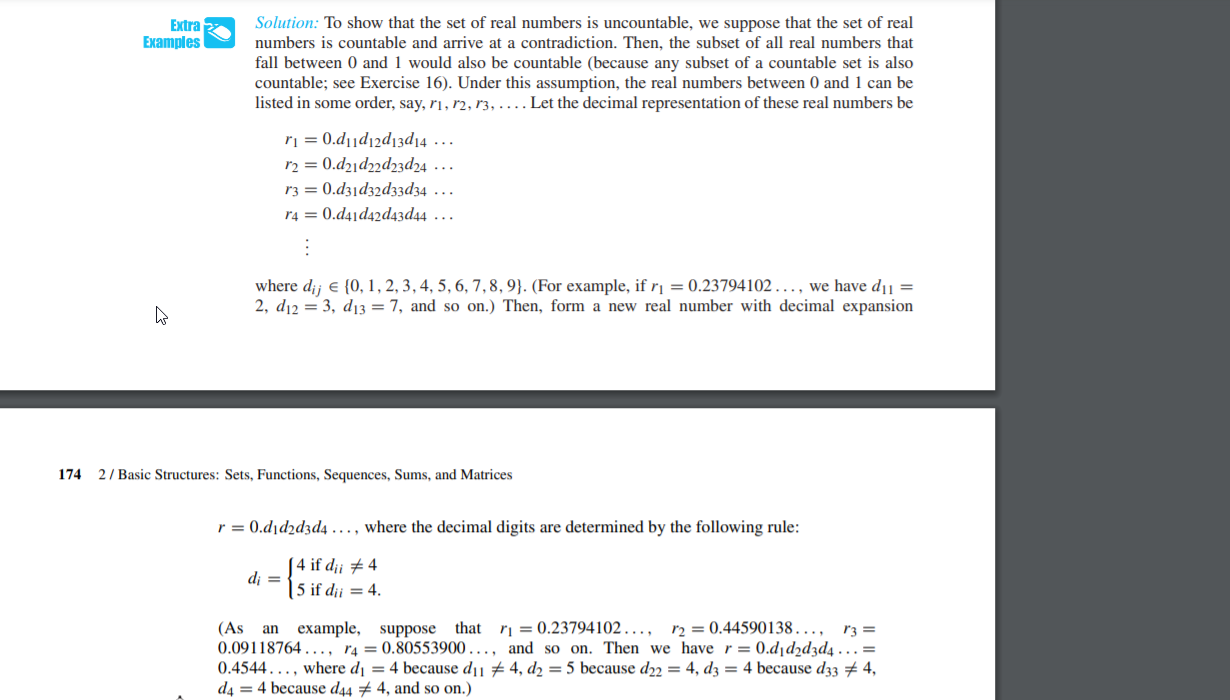
How in the world are they mapping d1 to d11?

OH
I just got it
 dire void

 inner lava
Is there a python package that lets you easily generate a random eularian graph with N nodes?
 winged bramble
quick question: what does a uniqueness proof look like? im not entirely sure what one looks like
hardy viper
@winged bramble depends on context, but one common way is assuming u and u' satisfy the conditions, and concluding u=u'
winged bramble
so is it bascially saying "only this particular thing makes this particular thing true?"
 sonic path
hello does it matter which premise i start with for this problem?
dire void
quick question: what does a uniqueness proof look like? im not entirely sure what one looks like
@winged bramble https://docs.google.com/document/d/1Bc1rAp1EN9_UIpnCaVKKlPpNtwq8h62WHYVrknwpig4/edit

Google Docs
Axler 1.A. 7. Every complex number has a unique additive inverse: Proof: Be mindful that we do not have defined notions of subtraction for complex numbers, only for real numbers. So we must leverage that to complete our proof. We show existence first and let We posit th...
another uniqueness proof: https://docs.google.com/document/d/1UDMAeoEkKbqGNXPTQlwIXLRKId_qq4yX_N0Gbb6vHqU/edit

Google Docs
Axler 1.B. Definition of Vector Space v.1.25. A vector space has a unique additive identity. Proof: Let both be additive identity for some vector space Consider the following computation: By commutativity: And since we stipulated in the beginning that is, itself, a...
winged bramble
oh, so its showing something exists and then has that unique property?
dire void
well. i combined the proofs of existence and uniqueness.
but there are two sections in the proofs: one section proves existence. the other section proves uniqueness.
versed summit
Can someone explain to me Idempotent law and Absorption law? I don't get them at all.
dire void
Can someone explain to me Idempotent law and Absorption law? I don't get them at all.
@versed summit

Google Docs
public
Field Axioms
+
- : 𝔽 x 𝔽 → 𝔽,*
- : 𝔽 x 𝔽 → 𝔽
1.,closure,6.,closure
2.,associative,7.,associative
abelian group axioms,Group Axioms
3.,identity,8.,identity
4.,inverse,9.,inverse
a ≠ 0
5.,commutative,10.,commutative
11.,distributive
Vector Space Axioms
( a vector sp...
Refer to 3, 8, and 12\
versed summit
So why is it that A or (A and B) = A?
dire void
do a truth table?
dire void
do a truth table for A
do one for B
use excell, google sheets
dire void
i guess. i dont even think about it anymore, i just follow along and use it
versed summit
yeah this stuff is really hard to me
and my professor doesn't really teach us
just tells us to learn it before the next quiz
sonic path
can someone explain to me how they went from 2 to 3 here, says law of implication on 2 but i don't get it
hardy viper
@sonic path that's the definition of the -> sign
seems like they applied it wrong though O_o
sonic path
how so?
hardy viper
p->q is -p or q
 robust mango
@iron crescent What's the whole question? I mean, is it state that it's true/false?
robust mango
typo i think, they meant doesnt belong prolly
gritty crescent
...it was a proof by contradiction
robust mango
Yeah now that I see it
x is in the intersection of all the intervals
that's our assumption
and that can only happen if 0 < x < 1/n for every n (for every interval that is), but then by the Archimedean property, we find that there is a N such that 1 / N < x, or there is an interval which doesn't contain x.\
np!
gritty crescent
Is the collection of all circles in a given non-Euclidean plane a set?
I'm tempted to think it's not, since circles may not be well defined in non-Euclidean geometries, but I don't know if that's true.
stray reef
circles are well-defined so long as you have a metric
gritty crescent
I see. So this is a set?
stray reef
why wouldn't it be
gritty crescent
Aight, thanks!
 wide agate
stray reef
wide agate
stray reef
these are graphs, not sets
K_j does contain K_n as a subgraph if that's what you actually meant
zenith thorn
Well, for the expected value, usually it’s ∑x(f(x))
stray reef
"usually"
you mean in the discrete case @zenith thorn
zenith thorn
Oh yah, my bad for clarity
 fathom pond
hi may i please get help for this question? Is it right to assume that
p: n is an integer and 𝑛^2 + 1 ≤ 2^n
q: 5 ≤ 𝑛 ≤ 7
quaint star
You are trying to prove that: 5<=n<=7 implies n^2 + 1 <= 2^n
fathom pond
@quaint star so can i use proof by contraposition (indirect proof) in this case? which means i assume that n^2 + 1 not less than or equals to 2^n (n^2 + 1 > 2^n) and show that n < 5 and n > 7
i'm sorry if i'm not making sense lol
stray reef
you're kinda overcomplicating it
there are only three integers between 5 and 7 inclusive
5, 6, 7
fathom pond
meaning to say i just have to show that n is not 5, 6 or 7?
fathom pond
so trivial proof
gritty crescent
Suppose that the following propositions are true:\if $x\in A$ and $y\in B$, then $y\in A$;\if $x\not\in A$ or $y\in A$, then $y\not\in B$\What simple conclusion can be drawn from this?
vital dewBOT
TedNowKaczynski:
gritty crescent
I guess it's $A\cap B=\emptyset$, but not completely sure.
vital dewBOT
TedNowKaczynski:
gritty crescent
Even this doesn't make much sense I guess :3
pale epoch
why not?
gritty crescent
This was my first hunch but I couldn't put this thought down on paper
pale epoch
seems true, but there is more you can say i guess
weary tiger
Hi, I have some questions about discrete mathematics
gritty crescent
My head's spinning, I really don't know what else I can conclude.
Feel free to ask here, I'll bang my head against my question laters lol.
weary tiger
Kk, sorry if I'm disturbing yah 😅

For this compound proposition, I've already written out a truth table and I've discovered that this is a tautology
But how do I prove this using logical equivalence? Could someone walk this through with me because I'm looking at the list of laws and I'm just not sure how to apply it to this case. I am very new to discrete mathematics and I'm not used to applying these laws yet
pale epoch
use the fact that $(p \rightarrow q) \equiv (\neg p \lor q)$
vital dewBOT
Lochverstärker:
weary tiger
hmmmmm...
🤔
The thing is there is 3 implications on this so I'm just a bit confused. "P" is a compound proposition too
pale epoch
just start with any of them
weary tiger
Do I use rules of inference in here too?
pale epoch
like $(p\land \neg r) \rightarrow q \equiv \neg(p\land \neg r) \lor q$
vital dewBOT
Lochverstärker:
weary tiger
Ah
pale epoch
what's that
weary tiger
Okay that's starting to make sense
I'll try that and then I'll post what I got
I'm writing this out and
I can either continue with the
distributive laws or the de morgans law

however both laws doesn't have any negations in them

This one has
pale epoch
and that is a problem because?
weary tiger
how do I convert them if there is a negation inside?
or rather how do I convert them with the negation?
pale epoch
convert to what
weary tiger
I've seen my lecturer done it but he has never clearly explained how he is able to do that with the negation
I want to apply the distributive law or the de morgans law
pale epoch
you can just do that
well
you can't distribute in this case
but de morgan tells you how to "move" the negation into the parenthesis
this will also remove the need to distribute anything in this case
weary tiger
can you show me an example?
pale epoch
there is an example listed in that picture
 tame hound
I would really appriciate it if anyone could help me with this as soon as possible
pale epoch
$\neg(p \land q) \equiv \neg p \lor \neg q$
vital dewBOT
Lochverstärker:
pale epoch
also notice that $\neg\neg p \equiv p$
vital dewBOT
Lochverstärker:
weary tiger
so would it just be...
$\neg p \lor \neq\neg q$
is that the right answer 🤔
oooh that wasn't what i intended
vital dewBOT
Wumbo:
pale epoch
the answer to what
tame hound
Anyone?
weary tiger
nvm i'm just gonna try to solve it myself
pale epoch
yes that was the goal, i just told you how
weary tiger
I don't know how to apply it correctly
pale epoch
then either ask precise questions or go back to easier questions and study first
(and its not like you will find a better way to solve it)
btw the statement is not a tautology from what i can tell
e.g. if p, q and r are all false, it's false as well
tame hound
If not maybe the truth table for it?
versed summit
I'm still a bit lost on this.
r    t    ~r    ~r v t
T    T    F    T
T    F    F    F
F    T    T    T
F F T T```Inconsistent?
Because there's no line where it's all T?
versed summit
So then the statement ~r v t is inconsistent, right?
pale epoch
what does that mean
tame hound
On thing what is <=> expression wise. Is it NAND or NOR?
tame hound
Wait Nand And NOR
 abstract ravine
Hey, so im confused over one thing
lets say i have this sequece -3, 6, -9, 12... given that f(k) = (-1)^k(3k)
and i need to prove this by using induction
so the first step is the basis step, i need to prove f(k)
and then its the induction step, where i need to prove f(k+1)
once i have proven those 2 steps i have proven the sequence formula correct?
abstract ravine
am i not supposed to prove that the given formula does indeed give us the correct kth term in a sequence?
by using induction
so by proving that f(k) = -3
we have proven the first step
pale epoch
how is the sequence defined?
abstract ravine
lets say i have this sequece -3, 6, -9, 12... given that f(k) = (-1)^k(3k)
pale epoch
so by f(k) = (-1)^k(3k)?
abstract ravine
yes
pale epoch
and what do you want to prove?
abstract ravine
idk tbh
what is induction then
i dont understand induction i guess
i thought i knew what induction is
pale epoch
is this some exercise or did you make this up yourself?
abstract ravine
no i took it from a youtube clip
pale epoch
induction is a way to prove that some statement is true for every natural numbers
but if you have a sequence defined by f(k) = (-1)^k(3k) and want to show that f(k) = (-1)^k(3k), then there is nothing to do
abstract ravine
really?
pale epoch
if you assume something, then how are you supposed to prove it?
abstract ravine
what am i assuming?
pale epoch
i thought you said that you have a sequence defined by f(k) = (-1)^k(3k)
abstract ravine
how is that an assumption
pale epoch
how is it not??
pale epoch
well, ok, this does define a sequence and that is a fact
but then, what do you want to prove from that?
abstract ravine
ye thats the thing, i think i dont understand induction
yet
i thought i did
kinda lost
lol
i watched this video

Learning Objectives: Prove a family of claims, indexed by the positive integers, using the idea of induction.
Step 1: Write out the Basis Case
Step 2: Assume true at the kth level. This is the induction assumption.
Step 3: Use the induction assumption to show it is true at ...
he tried to prove the above sequence
oh wait he is proving that n >= 1 ?
by using induction?
pale epoch
no
abstract ravine
wtf
pale epoch
he is proving that the sum of the first n natural numbers is equal to $\frac{n(n+1)}{2}$
vital dewBOT
Lochverstärker:
abstract ravine
how is that any different from the one i wrote
pale epoch
i.e. $1+2+3+\dots + n = \frac{n(n+1)}{2}$ for all $n \in \bN$
vital dewBOT
Lochverstärker:
abstract ravine
what
pale epoch
any different from what you wrote?
abstract ravine
yes
pale epoch
your example was just a sequence
pale epoch
the claim here is that $1 + 2 + 3+ \dots + n$ and $\frac{n(n+1)}{2}$ are actually the same thing
vital dewBOT
Lochverstärker:
pale epoch
what is your claim?
abstract ravine
lets say i have this sequece -3, 6, -9, 12... given that f(k) = (-1)^k(3k)
oh wait
pale epoch
what is f(k)?
pale epoch
ok
abstract ravine
wait what do you call the one above
pale epoch
and then what is the claim
abstract ravine
the claim i assume is that the given formula can gie me any kth term from the sequence
this is from my understanding
pale epoch
and how is the sequence defined then?
abstract ravine
huh
pale epoch
"-3, 6, -9, 12" what is the next term?
abstract ravine
-15
pale epoch
why not 42?
abstract ravine
ok we dont know thats the point isnt it
ahh shit
ok but
what if it was -3 + 6 + (-9) + 12...+n
different story?
pale epoch
that's still not a clear definition
like, can you explain in words how your sequence is supposed to look
and not just put random dots somewhere
abstract ravine
idk i dont have a question/sqeuence
pale epoch
like, when you want to prove that 2 sides of an equation are equal
you first have to know what both sides are
pale epoch
what does a=1 have to do with that
abstract ravine
idk this is literally a question
i have
from Uni
thats literally all the information i have
pale epoch
well, you can prove n^2-2n >= 0 for all n >= 3 with induction
wild flame
So I'm again having trouble making sense of Cantor diagonalization argument.
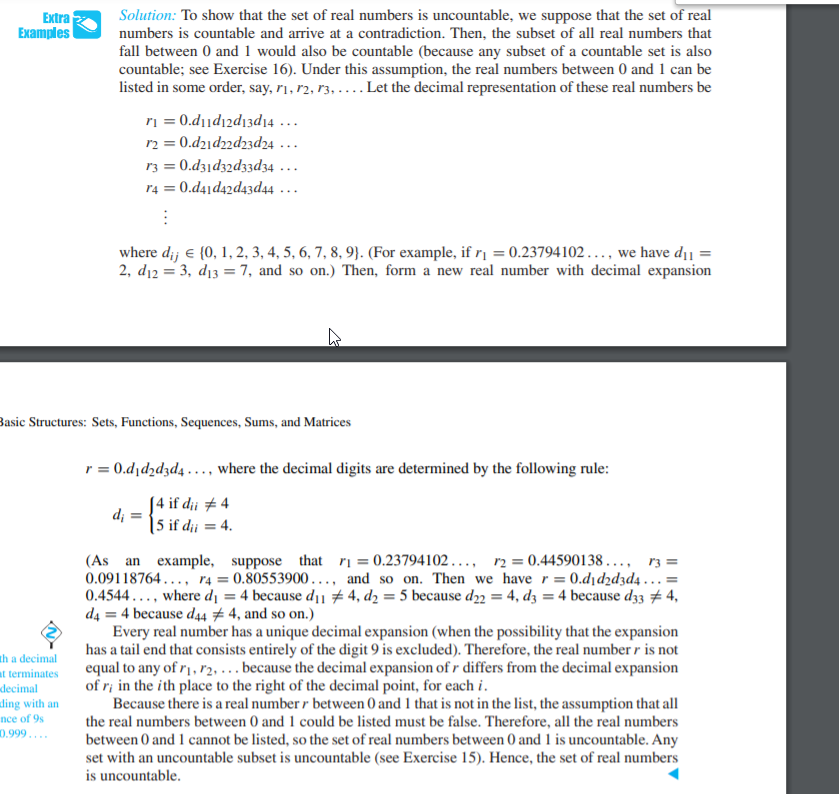
Having rouble making sense of the last part in particular: https://i.imgur.com/UDBuzc0.png
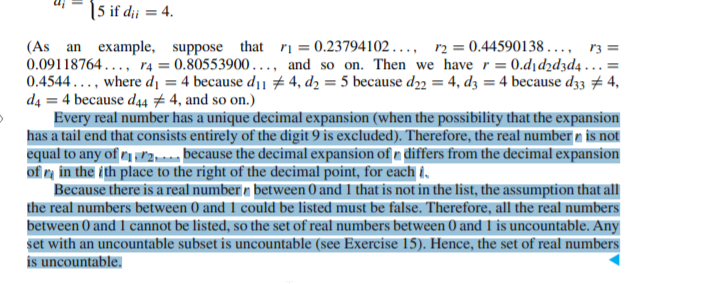


How does choosing a random decimal expansion made of 4s and 5s
and having it the placement of the 4's and 5's contingent on the real numbers in the notation.
Supposed to prove that this new real number isn't part of the list?
pale epoch
it's different in at least 1 place from every number on the list
wild flame
I don't get it. Do theese other numbers have some sort of overlap that I'm missing?
pale epoch
no, why?
to show that 2 decimal expansions are different it suffices to find 1 place where they differ
and the constructed number differs from the ith number on the list in the ith place
wild flame
Yeah. But:
0.23794102
0.44590138
0.09118764
0.80553900
The majority of these are all different in one or more spaces too. No?
pale epoch
yes?
wild flame
I'm confused as to why it matters then. If they're all sufficiently different anyway.
pale epoch
all numbers on the list are different
by assumption
you want to show that there is another number that is different from all those, yet not on the list
i.e. your list must be incomplete
wild flame
Ah. Okay. I think its making a bit more sense. So just to make sure it makes sense.
Countable numbers must be able to be shown in a sequence, such as 1,2,3,4. . . n
What Cantor's Diagonalization argument does is prove that this isnt the case with real numbers. Due to the fact that no matter what sequence you create, you can always make another sequence that does not follow the rule, right?
pale epoch
what's a countable number?
wild flame
Countable sets*
pale epoch
countable sets are in some sense "listable"
you can write a potentially infinitely long list
so this list does not have to terminate at n
and the idea of cantors argument is
assume that we have an infinitely long list listing all real numbers
then we can construct another real number that is not on that list
so our assumption must have been wrong
wild flame
Ah.
wild flame
That makes so much sense.
so this list does not have to terminate at n
And fair. So I guess it would be more accurate to say that a countable set must at the very least be able to d oa sequence like so: '1, 2, 3,4 . . .' As opposed to with an n, which implies termination at some point.
Right?
pale epoch
yeah
wild flame
👌
pale epoch
in technical terms a countable set is in bijection with the natural numbers
(or with a subset of the natural numbers)
wild flame
So to go over one last iteration just to make sure I have a good grasp.
Basically, a countable set is an orderd listing with the same cardinality (number of elements) that is either the same or a subset of Natural Numbers. These sets have to be able to be listable. IE: (1, 2, 3,4 . . ) and can go on infinitely as you'll know which comes next.
What the argument is stating that a countable set is not possible for the set of real numbers. It proves it by showing that no matter what the listing you have in your proof, you can always make up some number that would not possibly be listable.
If so, eureka. This has been kicking my ass all day.
pale epoch
that's the gist of it
 cloud cargo
eureka
abstract ravine

I introduce the steps to doing an Induction Proof. I then work through three examples that I hope will help you understand the concept and complete your homework:)
More Induction Proofs:
Induction Proof for Divisibility: https://youtu.be/CjD2KppNRxg
Induction Proof of Inequal...
ok so im kinda confused, why did he do the 5th step where he added k+1 to both sides
look at the 3rd step and 5th step
from 11:00
pale epoch
$S_{k+1} = S_k +6(k+1)$
vital dewBOT
Lochverstärker:
pale epoch
his 3rd step looks horrible though