#discrete-math
1 messages · Page 129 of 1
 last timber
 patent moat
got another one im stuck
6 married couples sit in a 12 seats round table.
-boys sit together so does girls
i think this is 6! * 6!
and also one couple decides to break up and we want them to sit differently. rest 5 couples needs to sit together
this last one im confused.
patent moat
yes it's cyclic permuitations
i sold most of the parts except the last one.
solved*
 lusty eagle
ill try this q
order each of the couples in 2 ways, gvies 2^5 = 32
there are 5 couples and two individuals to seat around the table with the restriction that one couple does not sit next to each other
so
lusty eagle
ye
patent moat
ok yea sorry.
lusty eagle
2^5 x 1 x 3 x 5!
patent moat
2^5 for the 5 couples
patent moat
why 3?
lusty eagle
draw it
 runic cedar
@last timber okay, I'll look into it. Thanks
lusty eagle
group the couples
patent moat
5 couples 2 individuals
lusty eagle
yes, but the couples have to sit next to each othrr
so you just count them as one
for simplification
patent moat
ok so
5 couples
that occupy 10 seats
2 seats left for 2 individuals
C C E C C E
E C C E C C
C E C C E C
there are more than 3 options
for them to sit
patent moat
im burned.
lusty eagle
couples are meant to be together
patent moat
Yes the 5 couples
lusty eagle
you can group a couple
lusty eagle
so your groups are 5, 1, 1
patent moat
yep
lusty eagle
arrange them
patent moat
lots of them xD
lusty eagle
remember its a round table
patent moat
is it just 5?
lusty eagle
ye
patent moat
2^5 x 1 x 3 x 5!
the x1 and x3
how cme
2^5 for the 5 couples
5! for the empty seats
shouldnt be x2 cause those 5! seats they can sit the other way around as well
lusty eagle
i accounted for it in the 2^5
patent moat
what's up with the x1?
lusty eagle
the sacrificed one
there is essentially only one way to seat thr first person, because until then, all seats are equivalent
patent moat
aight thanks
also
if they want the boys grouped + the girls grouped , is it
6! * 6! ?
patent moat
😄
i have one last left
which is 10 character long password
using only small letters + no repitition + lexigographical order
e.g bdgjkmpqr
So for the first we can pick out of 26 (small letters)
but the second depends on first.
lusty eagle
lexigoraphical order
patent moat
yes
lusty eagle
what that
last timber
a > b > c > d
patent moat
then the second needs to be after O
patent moat
alphabetical order.
lusty eagle
ok
patent moat
bdgjkmpqr see this
last timber
i bet it is permutations
lusty eagle
yes
patent moat
do u have any idea?
lusty eagle
u got any clues?
patent moat
I can only imagine a more algorithmic way for this
because the second depends on first
patent moat
if first is X out of the 26 letters of the alphabet)
the second one will be picked from 25- X
third will be 24-second
23-third etc
i think
lusty eagle
but thats dependable on the first
patent moat
but i can't get it into math because the next always depends on previews.
it can be
A then D so the third one
needs to be after D
it could W
then next shuld be aftyer W
someone said we have 16 letters since it's 10 char long
so
cause u cant have qrstuvwxyz
i mean u can have that
but u cant start from R
caus then there are only 8 chars left. for a 10 pass
lusty eagle
so 16 letters at the start then
 hollow olive
 halcyon ledge
Well you start with turning the sentences into math notation
$u \implies (r \lor c)$
 vital dewBOT
deekaan:
halcyon ledge
normally you would use truth tables
or transform the statements
$u \implies (r \lor c) \equiv u \lor \neg(r \lor c) \equiv u \lor (\neg r \land \neg c) \equiv (u \lor \neg r) \land (u \lor \neg c)$
vital dewBOT
deekaan:
 sleek swallow
@hollow olive lmao your second premise is literally:
$\lnot{c} \implies \lnot{r}$
vital dewBOT
Abhijeet Vats:
sleek swallow
By the law of contrapositives, it follows that $r \implies c$
vital dewBOT
Abhijeet Vats:
 proven girder
When asked to define a graph that models all possibilities, would that mean to actually graph it?
Something like this:
 pallid lintel
possibilities of what?
 dapper mason
do you mean a complete graph?
in that case each vtx is adjacent to every other vtx so maybe that's what the question is implying?
yes, pairs of natural numbers
probably, they're asking for the equivalence classes after all
maybe there's some pattern in the relation that can make identifying solutions faster
lol gl
 hexed granite
@craggy sentinel what do you mean by deal with it?
It just means that your solution is periodic
Aka the eigenvalues are complex
Some cool stuff is that for a non-homogeneous equation if the real part of the eigenvalues is negative, then the long term behavior will solely depend on the particular solution
 crimson canopy
is this the place for graph theory(introductory course)
 stray reef
sure
crimson canopy
thank you. will ask here to at questions. have an exam like tomorrow, so hopefully i can clear all misconceptions by then
 obtuse lance
maybe try to do a similar problem you can work out by hand with only 4 letters or so that way you can see
yeah
crimson canopy
how about finding A becomes M and B becomes W
then take A becomes M only minus the above?
idk
 stable valve
 dense creek
 weary tiger
what's -1+5?
one way of thinking about it is integers that are congruent to -1 mod 5 are the integers which can be written as -1+5n for some integer n
or better yet, 4+5n for some integer n
or more properly you could verify it using the definition

since (4- (-1))/5 is an integer, the congruence is true
weary tiger
so a graph that has only one cycle subgraph
is basically a graph that is a square?
or one in which each of its vertices only have 2 degrees?
 ionic wind
anyone here familiar with how to solve markov chain questions?
 patent rover
Is an "element of a set" a special case of a "subset of a set"?
my thought was || no because say A = {1,2,3} and 1 is an element but not a set (because there is no set defined to be 1) and we then defined B = {1},
the set B would be a subset of A but the element 1 would still be contained in B
and we couldnt ever say 1 is a subset of A
because we would have to say B is a subset of A or that {1} was a subset of A which is not an element but {1} and B is not the same as the element
which means it is not a special case ||
 young ferry
I would agree with that assessment @patent rover
pallid lintel
you put verticies instead of edges? the counterexample indeed shows there's no cycle from z that uses y. but e1Re2 and e2Re3 shows e1Re3. Your example doesnt show a common edge e2.
crimson canopy
to prove 2 graphs are isomorphic, do i simply compare if they have the exact same graphical sequence?
true
oh...adjacency matrix...but wouldn't the rows and columns of the numbers be different
lemme check out its definition again
my understanding of adjacency matrix is that it can be transformed
PA1P^-1 = A2 for some matrix P given 2 adjacency matrices A1 and A2 of graphs 1 and 2 respectively
can't find it in my notes
so the question is how do i find P
 cunning slate
quick question
for this definition
c can equal a right?
c = a is possible?
so if aRb and bRa it means aRa or else it ain't transitive?
stray reef
if you have aRb and bRa but not aRa then your relation is not transitive, yes
stray reef
uh
no
not by any means
math is huge and it's impossible for one person to be an expert in everything
cunning slate
Well you seem to be knowledgable in a lot of fields that is for sure.
More than the vast majority of people here
stray reef
i am knowledgeable in a number of things, i guess
 dapper rose
she is also knowledgeable in numbers
stray reef
you're fine
last timber
well, just simple counting gives that
there are 120 outcomes with all dices not equal
out of 216 possible
does not look similar to 0.9 probabilty
well, yes you can just count
but i think what you should do is to use inclusion-exclusion principle and probably conditional probability
i mean look, you do not firstly care about the first roll, and count the probability that at least one of the remaining two will be the same as first
then you count the probability of that they are not equal to the first but equal between them and sum it together
obtuse lance
wrong channel this is #calculus or #advanced-analysis
 weary atlas
oh gotcha. is this also #calculus ? @obtuse lance
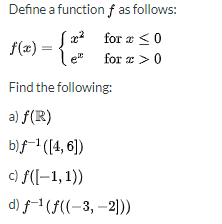
https://i.imgur.com/Cz9KISW.png
 little ermine
GRAPH THEORY: Prove that a graph with minimal degree 2 has at least 1 edge which isn't a bridge.
How do I prove that?
last timber
GRAPH THEORY: Prove that a graph with minimal degree 2 has at least 1 edge which isn't a bridge.
@little ermine just show that if you'll remove this edge graph still remains connected
i mean, construct firstly graph so that its minimal degree is 1 and in which each edge is bridge
and then show that adding (and then therefore removal) of an edge does not change anything
weary tiger
Can I get help on this? I even @ the helpers...
Here is my attempt don’t know if it’s right need confirmation
last timber
p or r?
weary tiger
Yes
last timber
yep
weary tiger
Negation?
 dire orbit
questions about basic enumerative combinatorics go here?
hi, i was reading a chapter about the use of generating functions in combinatorics, mostly for the purpose of finding a closed form equation for recursive formula of a series, and although i understand the mechanics and able to solve the basic exercises, i find the whole thing kind of magical. i mean, why suddenly using polynomials and basic calculus come into play, in a way other than just magically helping with the computation? why does going from and to geometrics series helps us solve these king of questions. sorry for being vague im a beginner...
obtuse lance
that's a good question I'd like a better answer to myself but I can at least give some partial answer
a lot of things we're taught is not really stressed what kind of combinatorial interpretation they have, for instance the binomial theorem
expanding out (x+y)^3 = xxx+xxy+xyx+yxx+yyx+yxy+xyy+yyy literally encodes the combinations of strings if we are careful when we expand
I think over all there are more things like this lurking around if you think deep enough about it, which might make things seem more natural
if you find an answer let me know
dire orbit
interesting, in fact some of the proofs in the chapter were exactly like this: showing that algebric/polynomial form is just another way of representing the combinatorical problem in question @obtuse lance
obtuse lance
since it's bipartite, all of the vertices in V_1 are not connected to each other
I mean, directly by an edge
they are only attached to vertices in V_2
because there are no edges connecting within the partitions, only across
we can count the degrees of the vertices of V_1 to get |E|
likewise for V_2
you can do it by induction I guess sure
but seems like a waste of time to do that
because it's bipartite, every edge has one foot in V_1 and one foot in V_2
the degree of each vertex just tells you how many edges it's connected to, so looking at all the vertices by adding them up tells you this
obtuse lance
assume there's a cycle of odd length
cycles have to end where they start right?
think about counting your steps and saying if your step is even or odd
and keep an eye on which of the two partitions you're in
yeah, try to think about what happens in general
yeah
pallid lintel
@last timber quite a few ways to prove this theorem. If you assume by contradiction that G has all bridges (its a forest), thats a nice way.
can also think about the longest path in G
weary tiger
Hello, can someone tell me why C is wrong
pallid lintel
In logic and related fields such as mathematics and philosophy, if and only if (shortened as iff) is a biconditional logical connective between statements, where either both statements are true or both are false.
The connective is biconditional (a statement of material equival...
weary tiger
So do I just flip what's inside the ()??
pallid lintel
if and only if is the conjunction of two statements (if p then Q, and if Q then P)
weary tiger
Okay, got it. Makes sense now thanks
 dire void
Hi #discrete-math !!!
I’m trying to understand what an intersection of an arbitrary collection of sets actually is, mainly what it means for an element to be in that intersection.
These are personal notes that I’ve written. I hope it is correct.
Mainly are 3 and 4 correct examples of the definition?
Maybe this belongs in #proofs-and-logic ?
sleek swallow
@dire void That's something called a generalized intersection/union. Essentially, it's a very neat generalization of the definition of union/intersection given for that of a finite number of sets.
In particular, the index set doesn't have to be finite. It can be countable or uncountable. The definition of a generalized intersection/union is practically the same as that of the regular union/intersection. Obviously, there are a few more details to be wary of.
Let $X$ be our set in question and denote $I$ as the index set. Then, an indexed family of subsets of $X$, denoted by ${S_i}_{i \in I}$ is a family of subsets of $X$, So, it contains elements from $P(X)$. Then, we define the generalized intersection and union of this family as follows:
$\cap_{i \in I} {S_i} = {x \in X: (\forall i \in I: x \in S_i) }$
$\cup_{i \in I} {S_i} = {x \in X: (\exists i \in I: x \in S_i) }$
vital dewBOT
Abhijeet Vats:
sleek swallow
Notice that, if the index set is finite, then this definition I've put up just reduces to the regular definition for finite unions and intersections. That is what you'd expect, actually.
In your picture sent above, the point of examples 3 and 4 is to illustrate the difference between using a countable set as your index set and an uncountable set as your index set. In the case of using the natural numbers as the index set, it's very easy to characterize the union/intersection in terms of what has been stated. However, when using an uncountable set as the index set, this becomes relatively more difficult to do.
Ping me if you do have questions and I'll try my best to respond.
dire void
@sleek swallow maybe I’m getting confused by notation here:
Is it correct to write 1) $$\bigcap_{i \in I}S_i$$
or is it correct to write 2)
$$\bigcap_{i \in I}\left{ S_i \right} $$
sleek swallow
:?
vital dewBOT
ninnymonger:
sleek swallow
I've seen both notations being used, though the former is far more common.
If you state that {S_i} is a family of subsets, then people are probably not going to confuse it with the set containing the element S_i
 solid forge
does inferential statistics belong here?
sleek swallow
solid forge
thank you!
pallid lintel
yo, i want to prove that for 3 sets, which are pairwise intersections non empty, then i cannot have n/2 elements in each set without making them all interesect
for n elements that i wish to distribute
 wanton steppe
can anyone help?
 umbral sky
Hello everyone. Hopefully someone can help me with a short question on the transitive property on a relation. Let R = { (1, 2), (2, 1)} to I need to fulfill the transitive property just (1, 1) or also (2, 2)?
 pale epoch
what do you think
halcyon ledge
Is R also symmetric?
umbral sky
R should be symmetric. I think, we have two connections in R. (1, 2) (2, 1) and (2, 1) (1, 2) so I think we need both (1, 1) AND (2, 2) to let R be transitive.
pale epoch
you are right
umbral sky
Great, thanks a lot.
last timber
You always can apply Warshall's algo to produce transitive closure
 weary atlas
Thank you!
 versed flare
you can try the first cases until you notice a pattern
obtuse lance
look at them mod 100
notice 99=-1 and 93=-7 mod 100
there's a bit of symmetry that cancels out
@neon thorn
because you only care about the last two digits
and mod 100 cuts off all higher digits you don't care about
when you carry after adding and multiplying, the digits go to the left, so they are just thrown away as irrelevant
 north jewel
How can I solve the recurrence relation $a_n = 6a_{n - 1} - 8a_{n - 2}$ where $a_0 = 1, a_1 = 0$ for an explicit formula?
vital dewBOT
Frank:
north jewel
I tried something of the form $a_n = \alpha r^n + \beta s^n$, but it isn't able to satisfy the initial conditions for any combination of $\alpha, \beta, r$ and $s$ (I think)
vital dewBOT
Frank:
obtuse lance
no not quite
(-7^13) + (7^13)=0
but the other two (-1)^12 + 1^12 = 1+1=2
12 is even, 13 is odd
makes all the difference for the negative sign
@neon thorn
 daring harness
does anyone remember what its called when there are two vertices on a graph with no path connecting them? its on the tip of my tongue and i cant remember
is there even a word for it, or are they just on separate subgraphs?
last timber
Well. they are just called disconnected vertices
and also it means that graph contains at least two (strongly) connected components
daring harness
@last timber thanks "connected components" is what i was looking for
 novel quartz
I disagree with discrete math
last timber
And?
weary tiger
Hello people i am new
I have a question that i would really appreciate any help with in matrices
vital dewBOT
Commander Vimes:
Compile Error! Click the  reaction for details. (You may edit your message)
last timber
loop always increases ii-th entry by two
undirected graph's adjacency matrix is always symmetric
but for directed $a_i_j$ not equal to zero means that there is an edge from ith vertex to jth
vital dewBOT
Commander Vimes:
Compile Error! Click the reaction for details. (You may edit your message)
weary tiger
Thanks ur a good person but i dont understand i need easy terms
I dont get discrete at all so the ith vertex i dont know where that is and same with jth infact i dont know whats going on at all
last timber
just as an example
adj matrix would be
0 1 0 1
1 0 1 0
0 1 0 1
1 0 1 0
so first row and second column is 1
it means that between vertex labelled 1 and vertex labelled 2 there is an edge
the same is true for other entries
for example 1 row 3 column is zero and there is no edge between vertices labelled 1 and 3
weary tiger
Bro thanks a lot even though i can recall some of this ima have to go back to basics its been a while since i touched the content
last timber
yes
 prisma arch
need help with B. I know the answer because its in the back of the book but i dont know why it is 14.
It has to do with the pigeonhole principle
sleek swallow
Well, the goal is to get two socks of the same color, correct? Since he is picking the socks at random, it stands to reason that the firsts 12 socks he could pick could all be brown. So, picking 12 socks is clearly not enough to guarantee that you have at least two socks of the same color.
If you pick 13, then you are guaranteed to have at least one black sock. But you need 2, so you need to pick 14 socks.
prisma arch
So these are worst case scenario situations right?
sleek swallow
Yeap
prisma arch
Ah ok that makes a little more sense.
sleek swallow
You COULD pick out two black socks without picking out 14 socks
No one is denying that that's possible
However, you want to guarantee that you do have 2 black socks and picking 14 guarantees that outcome.
prisma arch
Right definitely makes more sense. This I will start my homework now that I get that much lol
sleek swallow
Yeap
prisma arch
legit was going to quit the class because its on zoom and hard to understand the prof and I couldnt understand the concept lol
sleek swallow
Same tbh
pallid lintel
r
im just wondering how this problem would be solved...if anyone out there is into ramsey theory. (im just getting into it today)
you would colour edges for 2 colours though right, one colour for a number that increases and one for a number that decreases?
for K6 we have either a blue triangle (increasing), or a red triangle (decreasing)
halp
oh, we sequence Kn vertices, and each next vertice in sequence either has to be increase, decrease or the same
 lime jolt
Is there anyone that can help me with this problem?
Using algebra, show that C(n+1,r+1) - C(n, r+1) = C(n,r)
 robust mango
@lime jolt By C(n+1,r+1), you mean $\binom{n+1}{r+1}$ right?
vital dewBOT
Sup?:
lime jolt
yea
robust mango
shouldn't be too hard, did u try anything
lime jolt
I mean, i kind of looked up a solution, but I don't fully understand it
I missed the class my professor taught because I forgot to even look at the clock before i went on my walk in which class was in 5 minutes -.-
robust mango
Well you should know the binomial coefficient is defined as $\binom{n}{r} = \frac{n!}{r!(n-r)!}$
vital dewBOT
Sup?:
lime jolt
Yea, i know that part
robust mango
Nice, so we're given $\frac{(n+1)!}{(r+1)!(n-r)!} - \frac{n!}{(r+1)![n-(r+1)!]}$
vital dewBOT
Sup?:
lime jolt
Okay
robust mango
Now what we wanna do is make both the denominators same
So we can add these fractions
Are you familiar with the fact that n! = n(n-1)!
lime jolt
Yea, i kind of like factorials 😄
First time I saw it i was like O.O then i realized how awesome it is
robust mango
The denominator of the fraction on the left can be written as (r+1)! (n-r) (n-r-1)!
using the property stated above
Why do we do this? Because it resembles the denominator of the second fraction
So wo we have $\frac{(n+1)!}{(r+1)!(n-r)(n-r-1)!} - \frac{n!}{(r+1)!(n-r-1)!}$
vital dewBOT
Sup?:
robust mango
we just distributed the negative sign there in the denominator of the second fraction
Now our denominators are almost the same
To make the second fraction's denominator the same as the denominator of the first fraction, what we do now is just multiply/divide the second term by (n-r)
$\frac{(n+1)!}{(r+1)!(n-r)(n-r-1)!} - \frac{n!(n-r)}{(r+1)!(n-r)(n-r-1)!}$
vital dewBOT
Sup?:
robust mango
You can surely do the rest
robust mango
😄
lime jolt
Which is pretty useful
robust mango
yes
 idle violet
 lyric pumice
Hello,
weary tiger
Is every reflexive and symmetric relation is transitive?
pale epoch
no
weary tiger
in predicate logic how to write that two numbers are such that their sum is equal to their product
real numbers
stray reef
x+y=xy?
weary tiger
yess thanks
anyone good with counting principles?
How many subsets of A of cardinality 3 are there?
A is {1,2,3,4,5}
 near prawn
what have u tried
halcyon ledge
well the simplest way would be to count them
near prawn
have you covered combinations?
halcyon ledge
I mean it's basically just a question of possible permutations
weary tiger
how to do it by permutations?
 whole shard
What is the difference between subset and proper subset. Aren't they the same thing?
Or a set of A is a subset of set B, if both set have equal elements?
 split python
A being a subset of B just means all the elements of A are also contained in B. If the sets are equal then this is certainly the case, so A would still be considered a subset of B. Set A being a proper subset of B means all the elements of A are in B but there is at least one element of B not also in A.
 gleaming zephyr
first set is the set of all x such that x+3 is in N
the second set is all x in IN such that x+3 is in N
':' means such that
whole shard
The second statement is all x is natural numbers?
but first one includes x such as x=-3?
pallid lintel
what does a ramsey number of a clique of a line graph tell us about the helly property of a induced partial subhypergraph if anything?
whole shard
thanks mo2men and moonside, everything makes sense about sets now
weary tiger
you only need the first point right
actually no they're not
all of them contribute something
 quasi ferry
Alright, first of all X_i \cap Y_j are disjoint with X_i \cap Y_k, sinc Y_j and Y_k are disjoint.
So basically, X_1 contains each element from Y_1, Y_2, Y_3 and Y_4, all distinct.
So basically, you can think of X_1 as coming from the first elements of Y_i, X_2 as coming from the second elements of Y_i, X_3 as coming from the third elements of Y_i, and X_4 as coming from the fourth element of Y_i.
i.e. X_i doesn't really add anything.
so you only have to count Y_i
sorry that's a bit of mess.
yeah, which is easy
If I didn't make sense, try it with X_1, X_2, Y_1, Y_2 with two elements each.
yeah, because Y_i are pairwise disjoint
blame it on Corona lol
maybe do an example, should make things clear.
whole shard
How are there 8 functions here
stray reef
{1 ↦ a, 2 ↦ a, 3 ↦ a}
{1 ↦ a, 2 ↦ a, 3 ↦ b}
{1 ↦ a, 2 ↦ b, 3 ↦ a}
{1 ↦ a, 2 ↦ b, 3 ↦ b}
{1 ↦ b, 2 ↦ a, 3 ↦ a}
{1 ↦ b, 2 ↦ a, 3 ↦ b}
{1 ↦ b, 2 ↦ b, 3 ↦ a}
{1 ↦ b, 2 ↦ b, 3 ↦ b}
whole shard
is there a shorcut i need to learn?
 last sigil
Think about possible outputs for each input
stray reef
for every input in {1,2,3} there are two options for what output it maps to
and you make this choice independently for every input
therefore
2 * 2 * 2
or 8
whole shard
wait it looks like a truth table?
Ann how about counting the injective/subjective. Do I have to write it down?
stray reef
surjective*
whole shard
Nevermind, wriiting it down like u did helped.
stray reef
and uh yeah ig you'll have to write it down
counting surjective functions is kinda hard
stray reef
well you could write y-7.50x+300=0 i guess
 tight shard
In the form of ax + by + c?
 tame gale
Can anyone help me asap pls?
whole shard
I can try 😛
whole shard
oh dis is logic
tame gale
christ
tame gale
i have like an hour or so trying to do this mdfkr
weary tiger
@whole shard it can be proven relatively easily that there are $n^m$ functions that can be made from a set to with $m$ elements to a set with $n$ elements
vital dewBOT
Botnuke:
weary tiger
for your shortcut you wanted
weary tiger
what?
whole shard
i dont know where you got n and m? is this about the function i asked earlier?
weary tiger
the $n$ and $m$ are arbitrary
vital dewBOT
Botnuke:
whole shard
@tame gale (~p^(pV~q))
tame gale
aha
weary tiger
stated differently - let $X$ be a set with $m$ elements and $Y$ be a set with $n$ elements. Then there are $n^m$ functions from $X$ to $Y$.
vital dewBOT
Botnuke:
weary tiger
you were considering number of functions from ${1,2,3}$ to ${a,b}$
vital dewBOT
Botnuke:
weary tiger
so I claim that since these are 3 and 2 elements sets
whole shard
Oh okay I understand clearly now. so 3^2?
tight shard
weary tiger
send that in #prealg-and-algebra or any of the questions channels
whole shard
@tame gale then you can do this (~p^(p->~q))
(-p^-q)
how was it
im not sure how you write one line down in chat
botnuke so you're saying # codomain ^# domain
 viral hinge
how was it
@whole shard you are a G.O.D ❤️
tame gale
Why the conditional there @whole shard ? im lost
tame gale
@tame gale (~p^(pV~q))
@whole shard
But here the one with the ~ is the q
so is it still possible?
whole shard
oh so like (-p ^ (-p -> - (-q)))
tame gale
What the actually fuck
tame gale
well....
whole shard
oh man it would have been easy if it was just q
whole shard
im not sure if its right cuz i'm still learning discrete math
im about to begin chapter 4
tame gale
its ok thank u
whole shard
ok
whole shard
Hello, so for inverse functions, you just swap the set from both side?
Like X -> Y becomes Y -> X
weary tiger
what?
you need to swap the components in the pairs that define the function
what you are suggesting is more like..
a prerequisite for functions to be inverses of each other
or something
whole shard
what i understand is if set X:{1,2,3} and Y:{a,b}. the inverse would be X:{a,b} and Y:{1,2,3}
whole shard
oh yes.
im reading it by the book, thats what i'm trying to understand. The book is makes it really weird
weary tiger
ok, you should really understand the statement of the definition of a function before pushing forward into other things
do you know what a relation is?
weary tiger
how does you book define functions without touching relations at all?
weary tiger
I am talking about functions, not inverses
whole shard
oh uh, functions is rule i know that
weary tiger
a function is not simply "a rule"
a function is a set of ordered pairs
the high school definition of functions as "rules" totally ruins functions for everyone
whole shard
I guess I have to read the whole chapter again, because the invese thing made me lose it all
weary tiger
yea I mean, you aren't going to understand function inverses at a rigorous level if you don't understand functions at a rigorous level
which is what you seem to be trying to do
weary tiger
hmmm
I can recommend -

Relations are a structure on a set that pairs any two objects that satisfy certain properties. Examples of familiar relations in this context are 7 is greater than 5, Alice is married to Bob, and 3 ...
start here and understand everything on this page
https://www.tutorialspoint.com/discrete_mathematics/discrete_mathematics_relations.htm this is good as well
Discrete Mathematics - Relations - Whenever sets are being discussed, the relationship between the elements of the sets is the next thing that comes up. Relations may exist between objects of the
I am personally of the opinion that relations should be learned before functions, but that's just me
functions build from relations rather easily, once you understand them
whole shard
i never heard of this
weary tiger
functions can be defined as relations that satisfy one extra condition that a relation doesn't need to have
so you should learn what a relation really actually is at a rigorous level, if you want to really understand what a function from set X to set Y is
because saying a function is "a rule" is really useless if you want to understand or prove things related to functions at an abstract level
whole shard
alright, let me just start over this chapter. I might be able to change my understanding
cuz now ur saying functions are "sets"
weary tiger
yes, a function from set X to set Y is a subset of the cartesian product of X and Y (which is a set of ordered pairs) satisfying the condition that each x in X associates with exactly one y in Y
you should understand that statement fully before trying to understand function inverses and other things at a rigorous level
functions are, literally, sets of ordered pairs
not rules
function "rules" describe the ordered pairs
but they don't exactly define the function
they tell you how to find the ordered pairs, or what they look like
or however you want to think of it
whole shard
okay so I'm looking at this
A function assigns to each element of a first set exactly one element of a second set, where the two sets are not necessarily distinct
Is this what you're trying to say?
weary tiger
"where the two sets are not necessarily distinct" what's necessary about this remark?
whole shard
I couldnt understand what it says
weary tiger
they surely don't need to be distinct
whole shard
two set are not the same
weary tiger
yea but you don't need to mention that
whole shard
OOH okay so function here is assigned from first set to second set?
now I see what ur saying. I need to read more
weary tiger
basically what I'm saying is, you should replace your "rule" intuition with "sets of ordered pairs"
whole shard
reading different websites about discrete math is really a bad idea. I should stick closely with the book
 weary tiger
it's easier to understand because it matches the intuitive notion of functions that high school gives
weary tiger
I mean, it's almost there
but I'd have to say there are plenty of better things out there
whole shard
Lol I'm taking that off my bookmark list
one more thing, ordered and unordered, is like organized and not organized?
my vocabulary is bad
whole shard
something like {1,2,3} is ordered and {3,2,2,2,3,1} unordered
weary tiger
(a,b) is the same unordered pair as (b,a) even if a and b are not the same
where as with ordered pairs, (a,b) and (b,a) are only the same if a=b
whole shard
uhm like (fruits,vegetables) is unordered. then (fruits,fruits) is ordered?
weary tiger
no
if we were working with ordered pairs, then we would consider (fruits,vegetables) and (vegetables,fruits) to be 2 separate pairs
but if we were working with unordered pairs, then (fruits,vegetables) and (vegetables,fruits) would be the same object
whole shard
AHhhh
weary tiger
basically, the order in which we write them matters, in ordered pairs
while it doesn't for unordered
whole shard
Ah so what that mean is the ordered pairs are strictly (a,b)..
where unordered is (a,b) but can be (b,a)?
weary tiger
I don't know exactly what you mean
if (a,b) is an ordered pair, then (b,a) is a different pair, unless a=b
whole shard
I'm beginning to understand thank you
 clever patrol
Hi, not sure where to put this but i think this channel is alright? Anyway, can anyone explain why the answer for part IV is simply {a,b,c,d}^2?
I'm normally used to adding new pairs to make the relation an equivalence relation (adding new elements by reflexitivity/symmetry etc). Thanks
weary tiger
https://i.imgur.com/to57Qiw.png hey @whole shard here is a good example
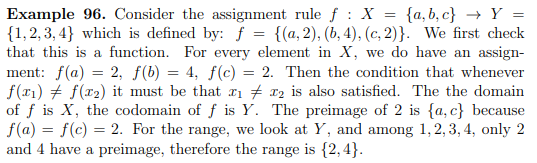


see how the function is defined by a set of ordered pairs?
a associates with 2, b associates with 4, and c associates with 2
that's the function
a set of 3 ordered pairs
whole shard
oh this is something different, i know function is like f(x)=2x
maybe thats why im confusd
weary tiger
well, yea, but that's not a very precise way to define a function
weary tiger
what that function actually is
is a set of ordered pairs
for example, (5,10) is one ordered pair that defines the function
so is (1,2), and (20,40), etc
that's what defines the function
whole shard
oh ok, but for discrete math, we have finite variables right
most of the times
finite domain i mean
weary tiger
yea but I'm just trying to change your perception on functions lol
even the high school functions from real numbers to real numbers are still sets of ordered pairs
they just never get presented that way
which is a shame imo
makes functions very hard to understand rigorously later
whole shard
yes I can see that
im trying to adjust
now I'm beginning to understand what the book is saying about students enrolled in school and students enrolled in discrete math
the function is students enrolled in school who's taking discrete math
 tiny axle
what's the logical connectives for but? like
A but not B
stray reef
$A \land \neg B$
vital dewBOT
Ann:
 sterile yacht
if i flip a coin and you win $1 if its Tails and you get $0 if its Heads, but if its heads 3 times you will 100% win on the 4th flip. What is your win chance? and how do i calculate that?
 sacred furnace
the floor of x < x for all real numbers, that would be false right?
like if x=2
the floor of 2 < 2, would be false?
obtuse lance
are you sure?
sacred furnace
i think so, for the expression, the floor of x < x, it would have to be lessthan or equal too
for it to be true
obtuse lance
yeah
stray reef
those statements are both true.
cunning slate
I see,
I know modular arithmetic is not supposed to be this hard but I am confused.
is there a distinction between congruence and the equal sign for modular arithmetic?
Sorry to bother but 22 = 12 (mod 10) also true?
sacred furnace
Is this one to one?
sacred furnace
Myself
split python
To show one to one you want to show same output implies same input
sacred furnace
What would I plug in?
split python
But can you conclude from that the inputs have to be equal?
Can you think of any two pairs of inputs that give the same output?
sacred furnace
If r1 and s1 = 1 and r2 and s2 = 2
cunning slate
Can someone please explain modular arithmetic to me?
I understand why 37 = 1 (mod 12)
But I dont understand how 2 = 22 (mod 10)
split python
What's the remainder of 22 divided by 10?
cunning slate
*2
cunning slate
well you cant apply that logic to 37 = 1 (mod 12)
split python
Yes you can
cunning slate
what's the remainder of 1 divided by 12?
split python
1
split python
12 goes into 1 0 times with a remainder of 1
cunning slate
but that doesnt explain how 37 = 1 (mod 12) (Which I understand through a different method)
split python
12 goes into 37 3 times with a remainder of 1
cunning slate
Oh ok I see
split python
So they both have remainder 1 mod 12
cunning slate
so its like a clock
sacred furnace
So do J(r1,r2) and J(s1,s2) both have to be the same ordered pair i.e (2,3) and (2,3) ?
split python
Exactly like a clock
cunning slate
this has been bugging me for ages
split python
Np
split python
No prob
 lunar flint
moonside
sacred furnace
Sorry if I came off rude at all moonside
lunar flint
not sure where my question falls under but can someone help me?
cunning slate
Sorry another question, So I know that 2 = 72 (mod 10)
But is 12 = 72 (mod 10) , and 102 etc?
sacred furnace
Post it
lunar flint
last sigil
@lunar flint #geometry-and-trigonometry
cunning slate
not b
split python
What's up
sacred furnace
So do J(r1,r2) and J(s1,s2) both have to be the same ordered pair i.e (2,3) and (2,3) ?
split python
Huh that doesn't even make sense chondro
sacred furnace
I'm just confused on what to sub for those to show 0=0
split python
You want to check if J(s,r) = J(x,y) then you HAVE to have s=x and r=y
If you can find two different values of s,r
That give the SAME output J
Then J is not 1-1
Pick an output value and try to find two different inputs that give that value
Yes tom
2 = (any number with remainder 2 after division by 10) mod 10
cunning slate
thx again moonside
and so is 22 = (any number with remainder 2 after division by 10) mod 10
split python
Yes
It's exactly like a clock you're just changing how many hours in the day you have (well, ignoring am/pm)
sacred furnace
Does my spanning tree for dijkstrstras look correct?
pale epoch
the shortest path from a to z is correct
sacred furnace
i guess im unsure of D to C
i want to say after the fourth edge has been added (A to D to F to C)
the next shortest distance would be A to D to C with a value of 8 (5th edge)
and then the final edge would be A to D to F to Z with a value of 9 (6th edge)
actually swap the 4th and 5th edge
So it might be F to C im unsure of
also maybe B to C is include where its value of 10 is less than the value of A to Z at 11
pale epoch
wait what
sacred furnace
well the way i was taught was to add the cheapest edge then relabel distances
so it would start from A to B value=1
Then A to D value 3
Then D to F value 6
Then D to C value 8
Then F to C value 9
Then B to C value 10
Then F to Z value 11
all values are from A
pale epoch
ok, let me think
you always choose shortest distance to an unvisited node
why would you visit C twice
once via D and once via F
you actually visit it a third time
via B
sacred furnace
Ahh unvisited node being the key word
sacred furnace
Yes , so E has 2 paths that are both 11
A,d,e And a,b,c,e
Which one would I take?
Bm
Nwvermind
The shortest would be a,d,c,e
pale epoch
yes
sacred furnace
Cool thanks a bunch
weary tiger
hey guys, in regards to set algebra, how do you deal with A ∩ bar A
ik what to do if it's union but not intersection
sacred furnace
Intersection is what both sets share
weary tiger
right
but in terms of simplifying I learned it by rules
which idk the one for this case
sacred furnace
Do you have more information? What is the question asking?
weary tiger
Sorry for the late reply, this is the question
@sacred furnace
I was simplifying that expression and ended up with that case
sacred furnace
Ya kinda weird simplification, not sure what the circuit would look like
Maybe a node with a loop to itself
weary tiger
sacred furnace
Or two nodes that point at each other
weary tiger
So far this is what I have in terms of simplifying one side
sacred furnace
Making me read sideways and shit lol XD
weary tiger
Lol sorry I'm on mobile
sacred furnace
It's all good
That's still like every element of every set I think
I could be wrong
weary tiger
I was wondering if anyone here knows truth tables, cuz I'm unsure if my work is correct
thought it is completely solved
halcyon ledge
show tables
halcyon ledge
looks fine
weary tiger
it's neither a tautology or contradiction right?
not sure how that works with biconditional statements but it's not all true and not all false
halcyon ledge
well tautology means always true and contradiction always false
so you take a good look at your result and you have your answer
 distant bay
hey all
I was wondering which is the best book / online course for a someone self studying discrete maths
for context I've been covered algebra / trig pretty throughly
and plan on going through precalculus too
 spare jolt
Knuth had a book called concrete maths which I think is pre good.
Is it correct that expanding:
(3-x)^-7 would be the same as expanding (3-x)^7, except I would just ^-1, each coefficient?
E.g
(3-x)^-7 = 1/(3-x)^7
= 1/(-x^7 + 21x^6 - 189x^5 + 945x^4 - 2835x^3 + 5103x^2 - 5103x + 2187)
= -x^-7 + 21x^-6 - 189x^-5 + 945x^-4 - 2835x^-3 + 5103x^-2 - 5103x^-1 + 1/2187
halcyon ledge
$\frac{1}{a + b} \neq \frac{1}{a} + \frac{1}{b}$
vital dewBOT
deekaan:
spare jolt
rip
How would I expand it then?
Since binomial theorem uses combinations which I don't think support negative numbers.
halcyon ledge
$x^{-3} = (x^{3})^{-1} = \frac{1}{x^{3}}$
vital dewBOT
deekaan:
halcyon ledge
you just don't do that weird last step you did
halcyon ledge
what do you want to do exactly?
spare jolt
I want to get it in an expanded form, without brackets. Apparently the coefficients change?
halcyon ledge
$\frac{1}{(x + 1)^{3}} = \frac{1}{(x^3 + 3x^2 + 3x + 1)}$
vital dewBOT
deekaan:
halcyon ledge
that?
spare jolt
Well I was hoping to get rid of the 1/
So like in a more: x^3 + 3x^2 + 3x + 1 like form
halcyon ledge
it's in that form, just the inverse
spare jolt
Can I get rid of the inverse?
vital dewBOT
deekaan:
spare jolt
Hmm, apparently there are different powers when I expanded it like that.
As in
I had a question and it was asking me what the coefficient of x^12 is, for (1-x)^-7
halcyon ledge
0
spare jolt
$$(1-x)^7 = -x^7+7x^6-21x^5+35x^4-35x^3+21x^2-7x+1$$
vital dewBOT
Soap:
halcyon ledge
well you can add $0 \cdot x^{12}$
vital dewBOT
deekaan:
spare jolt
Yeah I guess. But that feels like trivial answer.
0 seems most likely answer tho
Thanks
spare jolt
Ok apparently not a trick question.
$$(1+x)^{-n} = \sum_{k=0}^{\infty} (-1)^k \binom{n+k-1}{k} x^k$$
vital dewBOT
Soap:
spare jolt
I don't get how this is allowed or even makes mathematical sense?
(1+x)^-n = 1/(1+x)
For the case: (1+x)^-4, x^69 exists?
Apparently in some bizzaro world: 59640x^69 is part of the expansion (1+x)^-4?
$$\binom{-n}{k} = (-1)^k \binom{n+k-1}{k}$$
vital dewBOT
Soap:
spare jolt
Because of this identity, this whole wacky thing exists apparently.
 spark oyster
Hmm, I imagine this binomial coefficient for negative n was defined in exactly such a way that it makes this identity true
since a priori, with the usual definition, the binomial coefficient only accepts nonnegative integers as arguments
And then, of course, you need to specify for what x you want the above expansion to hold. I imagine you want |x| < 1 or so
And for small x, this doesn't look super implausible at least
spare jolt
Now I need to figure out how it works for (1 - x)^-n
Cuz apparently it exists
Feels very wrong to me though
Algebraically doesn't make sense imo
spark oyster
What about it, though? It's unusual in the sense that it's a "binomial" expansion by an infinite series, which you don't have for positive n, but if you're comfy with infinite series then it should be okay
spare jolt
I guess so, since most things can be expanded into some infinite series.
spark oyster
https://www.wolframalpha.com/input/?i=sum+k%3D0+to+infinity+of+(-1)^k+(binom(2+%2B+k+-1%2C+k))+(1%2F2)^k for an explicit example, this checks out

Wolfram|Alpha brings expert-level knowledge and capabilities to the broadest possible range of people—spanning all professions and education levels.
spare jolt
Yea, this makes sense, https://mathworld.wolfram.com/NegativeBinomialSeries.html
Still weird tho
spark oyster
I imagine you can get this series fairly easily by just using the geometric series $(1 + x)^{-1} = \sum_{k=0}^\infty (-1)^k x^k$ and just using a Cauchy product formula or so
vital dewBOT
Lartomato:
spark oyster
If that's anything you're familiar with
If it's not, you will 100% encounter it on your mathematical journeys
spare jolt
Probably, havent seen any Cauchy stuff, but will probably have to deal with it later on
Btw would it be the same expansion for (1 - x)?
But just negative of the coefficient?
spark oyster
Yeah, I imagine so. By the formula for negative binomial coefficients that you showed earlier, the expansion would look exactly the same for positive exponentials
spare jolt
Like since this one is true:
$$(1+x)^{-n} = \sum_{k=0}^{\infty} (-1)^k \binom{n+k-1}{k} x^k$$
Then I maybe I can assume:
$$(1-x)^{-n} = \sum_{k=0}^{\infty} (-1)^k \binom{n+k-1}{k} (-x)^k$$
vital dewBOT
Soap:
spark oyster
Oh, yeah, sure. If you know that your previous formula holds for all |x| < 1, then the second one also holds for all |x| < 1
spare jolt
Aight cool, thanks!
weary tiger
hey guys
may someone pls explain what they did here in induction
like ok, they replaced k with k + 1 but how did the 10 get there
weary tiger
online classes be too stressful
sleek swallow
At least you have online classes lol
I'm gonna be waiting for 3 months before i go to uni
Well, a bit less than that
distant bay
ok so I had a look into books and it seems like
This one is a good intro to discrete maths
but I can't find any information about a prerequisite
has anyone read this and knows (Discrete Mathematics: An Open Introduction, 3rd Edition)
spare jolt
Nope
But apparently its for math undergrads
This text aims to give an introduction to select topics in discrete mathematics at a level appropriate for first or second year undergraduate math majors, especially those who intend to teach middle and high school mathematics.
distant bay
Yeah isn't particularly clear for someone like me whose self studying
I have zero context what first / second year maths majors study
spare jolt
I assume its calc 1, calc 2, linalg
What are you self-studying for?
If its for compsci, I hear concrete maths is good
distant bay
yeah it's for computer science
spare jolt
concrete maths is written by knuth
who u mightve herd of
i think hes gonna die soon
hasnt finished his seminal work yet
spare jolt
well i dont think most books have a page called prerequisites
distant bay
they should at least have a paragraph saying you'll need this much maths to understand this book
hell both of the graphics programming books I looked at have that
spare jolt
so apparently basic calculus, (everyone likes spivak fr some reason), geometry, trigonjometry, algebra,
"graphics programming"
generally if your good with your fundamentals which are geometry, trigonometry, algebra and calculus
you should be good with most of discrete mathematics
if your good with calc 1 and calc 2 and linear algebra (which are the uni-level fundamentals i guess)
you should be good with most other subjects
i assume thats why most people dont outline "prerequisites"
distant bay
it's still a bad practice