#discrete-math
1 messages · Page 87 of 1
 wild flame
@sharp raptor
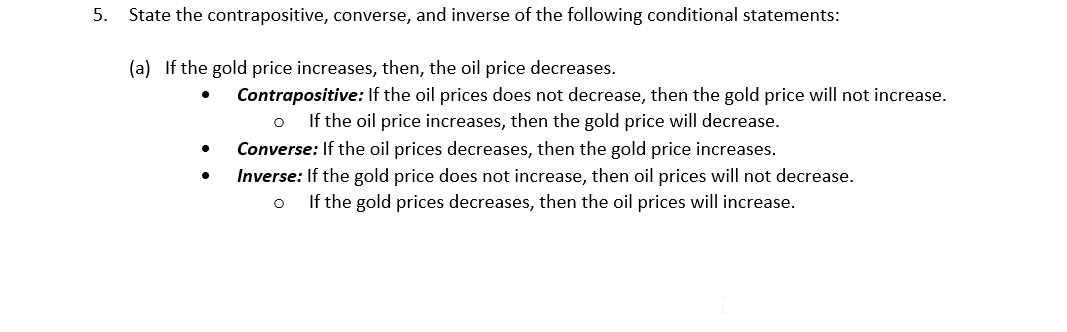
Lastly. Ifor the contrapositive and inverse.
Would it be okay if I used 'does not increase'? Or would the negation adequately be decrease.
 sharp raptor
I think does not increase
Technically speaking it could remain the same so idk if decrease would be equivalent
Though idk how nitpicky about it your teachers would be
wild flame
Fair.
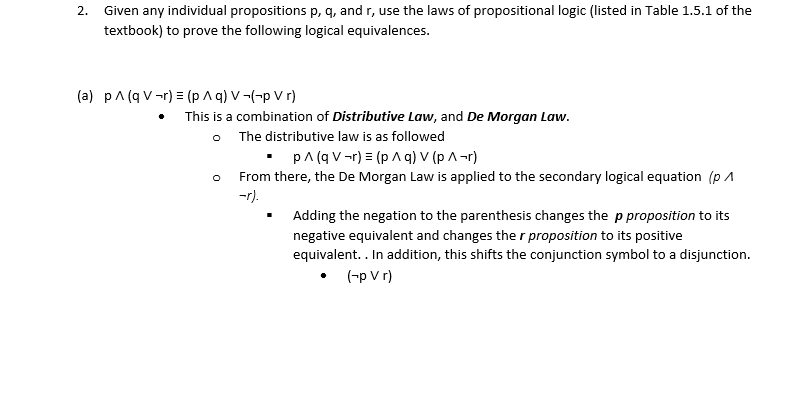
The last thing is this question that confused me in wording.
I guess they wanted me to identify the rules used to change the formulas around?
 slow socket
can someone explain how they got "~B". i dont understand it
sharp raptor
Does P equal something?
slow socket
no?
wat u mean?
hypothesis 1: A -> P
hypothesis 2: A and notB
conclusion: P and notB
im good so far up to "P"
but idk how they got notB
slow socket
would this be correct?
P: Pat did it
Q: Quincy did it
R: Quincy was reading
https://cdn.discordapp.com/attachments/238956921581862913/542191273424060426/a229b5bdf478df31c9e226532f0b9ab2.png

to start
slow socket
if i have (notp and q) using commutative laws can i do (q and notp)
sharp raptor
yes
 topaz parcel
how to solve for three missing parts in a venn diagram?
sharp raptor
I'm sorry, I didn't understand the question. Not sure if it's lacking information or I'm just stupid
 analog sonnet
Can you give an example @topaz parcel
topaz parcel
i managed to get it but idk how to solve it
i cant come up with algrebraic stuff to make it pop out
i sorta made assumptions and found a way out of it
analog sonnet
Usually with Venn diagrams, your intuition is correct
topaz parcel
so no need for solutions?
analog sonnet
Well you do need to write it down in a proper way
topaz parcel
i think so
analog sonnet
The most formal way is to use set theory notation
analog sonnet
Then try to express it in words as clearly as possible
Might get a bit verbose, but it does the trick
topaz parcel
thanks man
sharp raptor
If you want an easy way to do it math-ly without set theory:
36-11-9-8 gives you 8 which is the amount which like only blueberries
then a+b+c = 54-36=18
if a = amount that like just apples, b amount that like just cranberries and c both
a+b+c = 18
a+c = 28-11-8
a+b = 31-9-11
And you end up with a simple 3 equation system
topaz parcel
thank youuuu
 violet heath
 verbal furnace
👀.
sharp raptor
😍
 lean leaf
Discrete Mathematics and Its Applications by Kenneth Rosen is pretty awesome too.
topaz parcel
guys i still dont know how to solve it so bad :(
could u guys help me out how to solve for intersections?
 weary tiger
@topaz parcel split everything into disjoint sets
then it's just a matter of adding things together
slow socket
hey i got this question. part a i put "if x is an element of both A and B" and i got it right
but for part b i put "if x is in either A or B, not both" and i got it wrong. can someone help
weary tiger
$\mathbf 1_A + \mathbf 1_B - \mathbf 1_{A \cap B} = \mathbf 1_{A \cup B}$
 vital dewBOT
TendentiousTorturousTopics:
 whole marsh
I need some quick help. I don't have a problem, persay, I just need someone to explain a concept to me.
Could someone explain this to me?
Just ping me if someone thinks they can help
whole marsh
Can anyone help me?
 thin kite
and then set m=n and you get an expression with only a_0 and n
 uncut haven
heyo, for graph theory, how would you calculate centrality for a node in a graph?
specifically eigenvalue centrality
o i misinterpreted something
got it, thank you!
 paper thicket
Hello, I need help with the following
For a) does ∀x ∈ Z (1/x) ∈ Q work?
Not sure if the notation is correct
paper thicket
Where would I add the : ?
 azure lichen
$\forall x \in \mathbb{Z}: \frac{1}{x} \in \mathbb{Q}$
vital dewBOT
Sascha Baer:
paper thicket
Oh I see
Would negation work on this?
Or would I have to make predicates that define what a reciprocal is
 sudden prawn
Yes, I would recommend using negation for this. It should work better opposed to defining the reciprocal.
Do you know where to start if you were to negate it?
slow socket
Holy
 sour arrow
Write down your definitons.
Even number: Can be written as 2k for some natural number k
That is, x = 2n
And y = 2m
For some n, m
sour arrow
So what have you done?
sour arrow
Nice! Now, k + p is a natural number.
So, that's 2k for some natural k. That is, that's an even number.
@copper ore
 wooden swift
halp
sour arrow
Yes indeed! You had to recognize that 2(k + p) is an even number. Do you understand why?
sour arrow
2m, where m is a natural number, is even. This is by definition. With me on that one?
 copper ore
yes
sour arrow
Now, I didn't have to call it m. m is just a label. As long as the number can be written as 2(natural number), the number is even
copper ore
yeah
sour arrow
You wrote x + y as 2(k + p)
But k + p is a natural number
Again, 2(natural number) is an even number
copper ore
ok
but do i have to put a therefore statement at the end
or any kind of statement before i start the proof
wooden swift
halp
copper ore
yea so post what you need help with
wooden swift
it is in math help questions k
copper ore
and someone will help if they know what they're doing
wooden swift
i hope so
weary tiger
hllo
slow socket
hi
 acoustic valve
hey guys
can i get some help with this problem
im rly bad at induction
i proved the base case already
but idk where to go from there
 quaint river
$\sum_{i = 0}^{n} x^i= \frac{x^{n+1}-1}{x-1} $
vital dewBOT
Victoria:
quaint river
so we assume that this is true
for some i
then, to prove next case, we have to add the next term
and we get
$\sum_{i = 0}^{n} x^i + x^{n+1}= \frac{x^{n+1}-1}{x-1} + x^{n+1}$
vital dewBOT
Victoria:
quaint river
now we just have to simplify the right side so that it is equal to $\frac{x^{n+2}-1}{x-1} $
vital dewBOT
Victoria:
quaint river
@acoustic valve
acoustic valve
thanks, victoria
i ended up watching a youtube video and it made some sense there but with this you made me understand even more
:D
my brain is literally ginormous now 🤠
 crimson reef
ok so question
if A n B do not intersect does that mean A n B = empty set
or A n B = 0
quaint river
empty set
 glad oriole
0 is not a set
crimson reef
ty
ik 0 is not an empty set im just wondering if A n B does not intersect what does it mean
in the sense that its 0 or empty set
so thank you
 finite cipher
Hi guys, I have a question that goes like this:
On the menu of a chinese restaurant there are 6 chicken dishes, 5 beef dishes, 9 seafood dishes and 10 vegetable dishes.
a)In how many ways can a family order if they choose exactly one dish of each kind?
b) In how many ways can they order if at most one dish of each kind is chosen?```
Can someone tell me whats the difference between a) and b)? they look the same to me tawny pawn
Problem 35: Let Σ = {a, b} and Λ be the null string. Define A ⊆ Σ
∗ by the following rules.
- Λ ∈ A.
- If ω ∈ A, then aωb ∈ A.
- If µ, ν ∈ A, then µν ∈ A.
- Every ω ∈ A must come from a finite number of applications of rules
1, 2, or 3.
Prove by mathematical induction that, for every ω ∈ A, ω has equally
many a’s and b’s
azure lichen
uh, when you say {a,b}, I take it you don’t mean the set that only contains the elements a and b, cause that would not make sense
did you mean {a,b}*?
tawny pawn
yea oops
azure lichen
yea so, I don’t really see the issue here, this seems pretty straightforward
you can induct over the number of rule applications
crimson reef
anyone mind helping with this
like mind explaining what its saying when its definted under the power set
isnt the power set of N = { {empty set}, {1}, {2}, {1,2} , etc }
so 1 is not in any power set?
weary tiger
show ∃x(P(x)→Q(x)) and ∀xP(x)→∃xQ(x) is valid:
1) ∃x(P(x)→Q(x))
2) P(c)→Q(c)         Existential Instantiation

am i allowed to use Q(c) as a premise because they both imply →Q(x))?

also am i allowed to use conditional statement equivalences?
what do i do next?
 vocal sable
@Thorng ok so the difference is a and b is that in a you have to order one of the dishes of the specific type but in b you can or cannot order one from that set , the maximum size limit is one and the minimum is zero.
@finite cipher^
 opal crescent
@crimson reef that relation is indeed defined on P(N), ie X and Y are themselves elements of the power set of N
so they're just subsets of N
azure lichen
X and Y are subsets of N. you say that they are equivalent if 1 is both in X and in Y
 lethal solstice
Does anyone know a method to draw a graph from a given degree sequence?
verbal furnace
Share more.
lethal solstice
you have been given a degree sequence like : G(3,3,5,5,5,5) and you need to draw a graph, here the number of vertices are 6,in which 2 vertices have degree 3 and 4 vertices have degree 5
By trial and error method it tedious,.. I looked on Google but was bombarded with theorems,
@verbal furnace
verbal furnace
Is the graph connected ?
lethal solstice
I have to draw it
verbal furnace
5, 5, 3, 3, 5, 5.
lethal solstice
🎊🎊
verbal furnace
You can use 1 and 4 to connect with 2 and 3.
lethal solstice
but the definition of bipartite graph is that each vertex must join a vertex in set A and a vertex in set B, considering the two sets A and B
 late gust
1 and 3, 2 and 4
lethal solstice
but figure 6 has 3 edges while, 1 and 3, 2 and 4 has only 2 edges
late gust
uhhh, I don't think I explained myself clearly
what I was trying to say is that
you number the vertices of graph 6 as 1, 2, 3, 4 from the top down
1 and 3 are a set, 2 and 4 are a set
because 1 and 3 are not connected to each other but are each connected to something from the other set
and similarly for 2 and 4
since they form the sets that way, 6 is bipartite
lethal solstice
So 1 connects with 2 and 3 connects with 4,right?
late gust
thats true
but the question you needed to answer was to show that graph 6 is bipartite correct?
because 3 is also connected to 2
lethal solstice
no, I had to find if it was bipartite or regular,
late gust
ah ok
its bipartite, because we can separate the groups in such a way that we have 2 sets of vertices
within each set of vertices, they arent connected
but each vertex is connected to a (at least one) vertex from the other set
lethal solstice
is it possible to draw a cubic graph with 11 vertices
azure lichen
a cubic graph is one which can be interpreted as the vertices and edges of a hypercube, right? in that case, no
cause a hypercube has 2^n vertices, where n is the dimension
weary tiger
can somebody verify if im reading this correctly?
If the inbox is full, than all emails are lost

where F(x) is inbox is full, where x is all emails
and L(x) is emails are lost, where x is all emails

F(x)  → ∀xL(x)   like this??

or is it

∀x(F(x) →L(x))
<@&286206848099549185>
azure lichen
I don’t really see how those definitions for F(x) and L(x) make any sense
what is x
weary tiger
x is for all emails
azure lichen
how can a function take in an email and determine if the mailbox is full?
L(x) is fine
but F(x) makes no sense to take in mails as an argument
however, if you redefine F to take in a sensible argument then F( ) ⇒ ∀x∈Mails: L(x) does make perfect sense
weary tiger
this is the full thing
Let M(x) be "email is sent"
Let S(x) be "saved in inbox"
Let F(x) be "inbox is full"

∃x(M(x) Λ ¬S(x))   (there exists* an email is sent, but not saved in the inbox)
∀x(S(x) v F(x))  (All emails* are (saved in the inbox, or the inbox is full))
F(x)  → ∀xL(x)   (If the inbox is full, than the emails are lost)

therefore: ∃xL(x)
There is an email that is sent but it is not saved in the inbox.
All emails are saved in the inbox or the inbox is full.
If the inbox is full, then all emails are lost.
Therefore, some email is lost.
oh okay
azure lichen
however, as this reads right now all emails are lost
including whatever had been received
if you don’t mean that, you have to specify further for which x L(x) really is true
weary tiger
okay let me think about it and get back to you
azure lichen
oh I see how F(x) is meant
it’s intended to be like “when trying to save x, the inbox was full”
azure lichen
in which case, F(x) ⇒ L(x) is all you want
you don’t want all mails to be lost
just the ones that didn’t have space
so whenever the mailbox is full upon arrival, it is lost
weary tiger
i have to use the rules of inference to show that the premises have a conclusion that some mails are lost ya
azure lichen
also M(x) Λ ¬S(x) without any qualifiers would to me imply an implicit ∀x
but I think oyu meant ∃x based on the text
weary tiger
ya
i forgot to update my post
i fixied it before with Ex and Ax before the first two premises
im just kind of lost on the last one if i wrote that right before i begin trying to solve it
azure lichen
well, for every x, if the inbox is full (F(x)), then it is lost (L(x))
the way you wrote it, is “if the inbox is ever full, all mails are lost”
weary tiger
the question had the premise wrote like this which confuses me
"If the inbox is full, then all emails are lost."
that's why i wrote it like that i think is that still wrong
azure lichen
that’s not what you wrote in parens at least
azure lichen
well idk
your predicate logic and your english in parentheses afterwards don’t say the same thing
also, then*
weary tiger
oh
how do i write it like the question asks?
the question asked it as like the parenthesis
which is how you reworded it? for every x, if the inbox is full F(x) then it is lost L(x)
azure lichen
yes
weary tiger
could you teach me how to read and re-word it?
azure lichen
no
weary tiger
i think that's a problem i have is trying to rewrite it
azure lichen
as in I actually don’t know how to teach that
weary tiger
okay
i know i did it wrong and it should be wrote like that, since i dont think i can solve it without having the ∀x encapsulating the F(x) and S(x) which is why i asked
thanks im gonna try solving this, then i'll just ask the pforessor for help after class on my homework
on how to re-word lol
are there any points that i can give you on this server? i just joined yesterday
azure lichen
convince a moderator that I am Honorable and should get a fancy yellow name
please do not actually do that
(no, there is no such thing)
weary tiger
lol i think i know how to think about it now
i just have to think about x is the mails
then the functions are what happens to it
and go from there maybe
azure lichen
yes
weary tiger
i see why it didn't make sense now for you
because if i set
let x be all emails
M(x) would be, x email is sent
S(x) would be, x emails are saved
and F(x) would be, x emails are full, which wouldn't make sense lol
i think
azure lichen
well, I now interpret F(x) as “when the mail arrived, the box was full”
weary tiger
okay
what do you study to know so much math
also im starting to understand the beauty of math and why everything in society is built on it's foundation or something lol
azure lichen
math?
I study math
it turns out, if you wanna know math, study it :P
I probably learned more in my first year of undergrad than in at least all of highschool combined, at least when it came to math
 pale berry
hs is a bit of a meme
azure lichen
(I probably learned somewhat more history in hs though)
well mine was actually rather good
and, importantly, nonamerican
azure lichen
math was piss easy if you cared and impossible if you didn’t
pale berry
best hs in the region, even got their shitty little inspection rewards
azure lichen
is more or less how I experienced it
pale berry
One thing I found really enjoyable about studying logic
was solving predicates and problems pretty much algebraicly
I'd love to have more of that
azure lichen
I love math but in math class I sat last row (which had advantages such as: the teacher not seing what I am doing because it was like a mini-auditorium so he was below us; being in reach of our own wi-fi; more legroom)
and rarely if ever participated
it was just booring
pale berry
I just skipped class so I could actually learn
azure lichen
we had a number of classes we could skip per semester
without like, having to jump over a lot of hurdles to not get into trouble
this included missing because of sickness just as much as missing cause you felt like it
(sickness could get excused with a doctor’s note, but even then only if it was a regular occurence or lasted more than three days)
despite being one of the better students, I usually used at least 60% or so of the possible hours that I could miss
(I left some buffer in case of sudden sickness)
pale berry
probably makes you a better student even
I hate it when you get punished for inattendance
when the reason I want to stay home is to actually learn xd
azure lichen
I mean I more or less ignored most classes anyway
I got through on my +5 to fast learning perk mostly
I tend to pick up stuff rather quickly, it’s like the one thing I got going for me
pale berry
+5?
azure lichen
at least
pale berry
as in a passing grade at the very least you mean right
azure lichen
no, as in a DnD-like stat
pale berry
oh wait, you mean like an rpg skill
yeah xd
same, used to be extremely driven too, but energy has left my body recently
and details sometimes slip through my fingers
azure lichen
nah I was never driven back in high school
I was definitely one of those “naturally smart” kids or sth who never learned and got good grades. had to change that up in university
I had luckily heard enough stories about people like me failing hard in university
and decided to not let chance determine my fate :P
I wouldn’t call me diligent but I’m not lazy anymore either
just… scared of failure?
pale berry
wasn't talking about high school
High school sucked the life out of me, because I knew I could be doing so much more in the time I was forced to spend there xd
azure lichen
I… idk, I kinda enjoyed high school. I didn’t care much for it but in my last two years I had great classmates and was in a fun club
(robotics. actual robotics, not just that lego bullshit)
complete with deciphering data sheets. fun times
weary tiger
sascha if i had my 4 variables
x is the domain of all mails

M(x) - x mails were sent
S(x) - x mails were saved in the inbox
F(x) - when x mail arrives, the inbox was full
L(x) - x mails are lost

If i deduced a single variable like M(x)

does the "addition" rule for rules of inference mean i can  add
M(x)  with any existing variable I have right now? Like  state

M(x) v F(x)

A mail x was sent, "or", when x mail arrived the inbox was full?
addition rule is
p
there fore p v q
azure lichen
what does “doing M(x)” mean to you
weary tiger
my mail was sent
azure lichen
M(x) is a value, either true or false
every mail has that value
it cannot be anything other than true or false, and it can never change
pale berry
M(x) is not a correct predicate
weary tiger
oh
pale berry
mhm
azure lichen
but in general you always have to specify what “x” is, which tends to mean either any x (in which case you use for all) or some specific existing one (in which case you use exists)
pale berry
it's not how i've seen predicates typically been used, but you could do it this way
azure lichen
the way you should think about this problem is, we’ve taken a snapshot in time
every mail has a determined state, which is either “not sent” or “sent”, and either “lost” or “not lost” and either “saved” or “not saved”
and either “inbox was full when it arrived” or the opposite
there is no “doing” anything
weary tiger
oh i made a type
typo
how exactly does the addition rule work from rules of inference
basically it says i have my predicate, then i can magically add another predicate using or connector
azure lichen
I can’t really give you good advice cause to me Logic is a thing of, well, logically makign conclusions, not blindly applying rules
weary tiger
so does that mean i can just take my predicate M(x) mail was sent (or not sent) and connect it with any other one?
azure lichen
but this does not seem to fit into the sort of questions that are posed here about logic
there are all these fancy words like “syllogism” and “rules of inference” but it’s all just common sense written down
of course if P is true, then P∨Q is true, look at a damn truth table for ∨
weary tiger
oh okay
azure lichen
or like… p⇒q and q⇒r
yes, of course p⇒r, what do you think “implies” means? why does this need its own name and deserves a rule worth memorizing?
(sorry, just ranting)
about the only nontrivial thing in all these logic rules is contraposition
that is (Q ⇒ P) ⇔ (¬P ⇒ ¬Q)
and even that is readily verified from a truth table
weary tiger
do you know if im allowed to use equivalences while solving with rules of inference?
azure lichen
no of course I don’t know that
I’m literally ranting about how senseless I find the concept of having a fixed set of rules like that in a field called logic
weary tiger
ya
me too
it makes me more confused
but it did teach me some new things but overall i think its confusing me more lol
omg
@azure lichen i did it
i did the question!
i liked the way you wrote the last premise
azure lichen
yay
weary tiger
for every x, if the mail box is full, then x mail is lost
thats what you did and i like it because
the textbook question is stupid i think
it just literally says "If the inbox is full, then all emails are lost." but you wrote it so much more beautifully with logic behind it
by telling me that if i wrote it the way i did, it means i lose every sing mail from before too lol
sascha want to read some of my statements and see if you can guess what i'm trying to say?
azure lichen
I’m kinda doing stuff, sry
weary tiger
oh its okay
azure lichen
that looks right
 thin hinge
or should I include stuff like (5,1)
thin hinge
hm okay
azure lichen
ordered pairs
thin hinge
ah okay
azure lichen
it’s an equivalence relation so it’s symmetric, but not all relations are
thin hinge
okay that makes sense
azure lichen
e.g. if R was ≤ then you wouldn’t have (5,1) in it but you would have (1,5)
thin hinge
wait
azure lichen
but that’s stil lnot all
thin hinge
I mean (4,2) lol
azure lichen
you’re missing five more elements
thin hinge
like (1,1), (2,2) etc?
azure lichen
yep
thin hinge
okay
lethal solstice
Guys what is the difference between Eulerian and semi-Eulerian graph?
The definition in the book is thick
analog sonnet
If my memory serves, a graph is semi-eulerian by definition if there is an Euler trail, and eulerian by definition if there is an Euler tour (i.e. closed Euler trail)
So every eulerian graph is also semi-eulerian but not the other way around
 heady sedge
can i get some help with this
azure lichen
what have you been able to show, where are you stuck?
is there anything confusing in the definitions or quesitons?
I don’t know what A_n is in the last part though, that must rely on some definition from elsewhere
but the first two seem pretty straightforward proofs by contradiction
analog sonnet
Tanaka from Tanaka is Always Listless
 mint harbor
i came across this on mathstackexchange, how do you even derive $$Y_n \leq Y_{n-1} + 1$$ to begin with? and i have no idea how you get from that to $$Y_n \leq n-1$$
vital dewBOT
manzu:
mint harbor
to give some context: this problem is about recurrence relations for the tower of hanoi game with 4 towers/pegs instead of 3
<@&286206848099549185>
 radiant bough
I'm not sure of the problem, but I know you can derive the second statement from induction and using the first statement
you know Y1 = 0 \leq 1
so Y2 \leq 0 + 1 = 1
so Y3 \leq 1 + 1 = 2
mint harbor
hmm...
mint harbor
thats neat...
okay i think i get that
still confused about how they'd derive $Y_n \leq Y_{n-1} + 1$ though
vital dewBOT
manzu:
radiant bough
I mean, I think you just do it
and what I mean by that is: you have an expression for Yn
mint harbor
i mean intuitively yeah its true that the inequality holds
radiant bough
and you have a relationship between some Ws
mint harbor
but i wouldnt have thought of using Y_n-1 and add 1 to it
radiant bough
no you don't do it that way
mint harbor
hmm?
radiant bough
you don't start by thinking "oh yeah you know what's cool? Y_n-1 + 1 is pretty cool, so let's put that on the other side"
you start with Yn = the thing with the W
then you just use the inequality given for the Ws
and then you should literally find that once you simplify that, Y_n-1 + 1 pops out
radiant bough
haha I'm not sure what else you expected to happen!
In a problem like that, there's really only one thing you can do
so you just have to do it
and hope it works out
mint harbor
i dunno, i thought the RHS of the inequality felt like a completely arbitrary choice
so i had no idea how it came about
radiant bough
I mean you're not really choosing it
it's just what comes out of the computation
like, you know you want some inequality with the Ys. And you are given some inequality with the Ws
so all you can really do is try to use the W one to get the Y one
mint harbor
hmm well, i also wouldnt have thought of substituting an expression Y = something with W
radiant bough
how else could you ever prove anything about Y?
mint harbor
initially i proceeded with brute force through mathematical induction
radiant bough
You know nothing about Y except how it's defined in terms of W
mint harbor
well
the Y was introduced as a way to solve the problem
originally this is how the problem looks like
radiant bough
I see, I thought you were starting from the Ys
mint harbor
so my first approach was doing mathematical induction aka brute force lol
i would never have thought of introducing a Y
radiant bough
yeah I will give you that introducing a Y is not obvious at all
but in any case the first step would be to prove the inequality between the Ws
radiant bough
np
 harsh warren
can anyone explain to me why when dealing with combinations containing a certain suit in a deck of cards (a hand containing 5 spades for example), we use C(13,5) instead of C(52,5)? we’re still drawing cards from a deck of 52 cards isn’t it

 craggy gale
$f(\bbZ) = {f(x)\ |\ x\in\bbZ}$
vital dewBOT
Tuong:
craggy gale
it's asking to describe these sets
(the thing I wrote was just in case you weren't familiar with the notation f(Z))
vital dewBOT
Tuong:
 modest zealot
like describe the resulting domain when the numbers r plugged into f(x) = 2x?
i mean range
weary tiger
@craggy gale choose any non-real number x, for every NON-integer n, true or false, X^n > 0
craggy gale
What
If you go non-real, how do you still dare talking about the usual strict order relation?
weary tiger
i dont know my question asked me
to negate that sentance and i got that
and i have no idea if that's true or false lol
how do i type notation?
hold on i'll just draw it
@craggy gale https://i.imgur.com/wm2VzJ4.png

the negation of this, and see if it is true or false
craggy gale
$\forall x\in\bbR,\exists n\in\bbZ, x^n\leq 0$
vital dewBOT
Tuong:
weary tiger
ya but the negation of that
craggy gale
$\exists x\in\bbR, \forall n\in\bbN, x^n>0$
vital dewBOT
Tuong:
weary tiger
ya
i need to learn how to type that lol
that's what i tried telling you in words xD
craggy gale
Ah xD
weary tiger
except you have to negate the E
so (not) in R and (not) in N
or, not in Z*
$\exists x\not in\bbR, \forall n\not in\bbZ, x^n>0$
vital dewBOT
nini:
weary tiger
how come mine is black?
craggy gale
Uhh there was a command to change that
weary tiger
how do i type "not in" or is that the same as negation of episolone
craggy gale
$\notin$
vital dewBOT
Tuong:
vital dewBOT
nini:
weary tiger
so basically i got this, from the negation
is that true or false.. i havn't learned complex numbers yet
craggy gale
you don't even have the usual order relation in C
meaning for x in C\R, this "xⁿ>0" does not make any sense
I think you got the negation wrong
weary tiger
oh
well that was the question given to me
let me copy and paste
negate this: ( ∀𝑥 ∈ 𝑆,∃𝑛 ∈ 𝑎, 𝑥 𝑛 ≤ 0 )
the S is a R
wait let me just screen cap it lol
craggy gale
half the characters don't render on my phone lmao
weary tiger
 weary tiger
oh... am i not suppoed to negate the epsilone?
vital dewBOT
Tuong:
weary tiger
so the "in" doesn't get negated?
craggy gale
it doesn't
craggy gale
it depends on the context
weary tiger
oh
the context is this, Write down the negations of the following expressions, so that the ¬ symbol
does not arise to the left of any quantifier. Indicate whether the negated statement is true.
craggy gale
"not (for all x, P(x))" is the same as "there exists x such that (not P(x))"
weary tiger
ya you are right
lol
so for all in R negated would be there exists some in R...
not there exists some NOT in R LOL
okay back to re-doing the question before that
i have another one i did wrong then let me brb
wait but @craggy gale
for this question then...

does that mean i just ignore the negation of the term in the middle?
craggy gale
It's different here
weary tiger
$exists/in/bbN/, x^2/in/bbN/or/1/2x/notin/bbN$
vital dewBOT
nini:
craggy gale
antislash
weary tiger
its because there wasnt any quantifier
before the middle term?
so i just negate the epsilone
$exists x\in\bbN,\x^2\in\bbN\or\1/2x\in\bbN$
vital dewBOT
nini:
Compile Error! Click the  reaction for details. (You may edit your message)
weary tiger
lol i suck at this
craggy gale
$\lnot(\forall x\in\bbN, x^2\in\bbN\land\frac 1{2x}\notin\bbN)\
=\exists x\in\bbN, \lnot(x^2\in\bbN\land\frac 1{2x}\notin\bbN)\
=\exists x\in\bbN, \lnot(x^2\in\bbN)\lor\lnot(\frac 1{2x}\notin\bbN)\
=\exists x\in\bbN, x^2\notin\bbN\lor\frac 1{2x}\in\bbN$
vital dewBOT
Tuong:
craggy gale
there
weary tiger
ya that's what i got
craggy gale
with steps
weary tiger
for the first one at least
excpet i negated the episole for the 1st term.. oops xD
okay.. so i get the rule now
if there's no quantifier i negate the episolone
if there's a quantifier i just move onto the next term
craggy gale
$\lnot(\forall x, P(x)) = \exists x, \lnot P(x) $
vital dewBOT
Tuong:
weary tiger
ya i know the demorgan's law
i just thought that E N was a predicate lol.
$\in\bbN$
vital dewBOT
nini:
weary tiger
i thought this was a P(x) LOL
craggy gale
x')
weary tiger
oaky let me try solving this myslef then ill ask you for help if im unsure
one day im going to be a one strong tuong apprentice!
craggy gale
haha <3
weary tiger
@craggy gale is this correct for how i solved this one?
https://i.imgur.com/VICtAVO.png
Let S(x) be x solution for x^2-x-1=0
Let N(x) be x in all the natural numbers
∀x(N(x)→¬S(x))
 craggy gale
I'm not sure I understand what your S(x) and N(x) are supposed to be
weary tiger
oh
Let x be numbers
Let N(x) be x in the domain of natural numbers
Let S(x) be x numbers in the equation x^2-x-1=0
maybe i should just say numbers
craggy gale
Is this just a quantifier translation question?
weary tiger
ya
well it just says try writing the following sentence in predicate logic
does my updated one make more sense?
i'm still learning how to write more beautifully like you xD
i think my math grammar is so bad i write like a hobo
craggy gale
I still can't make any sense of it xd
weary tiger
aw okay
craggy gale
$\forall x\in\bbR, x^2-x-1=0\implies x\notin \bbN$
vital dewBOT
Tuong:
weary tiger
ya i want to write it like that but i have to use predicates
so i just wrote it like ∀x(N(x)→¬S(x))
lol...
but i dont know how to define my predicates any well
$\forall x\in\bbN\implies\negation x^2-x-1$
craggy gale
maybe with S = {x in R | x²-x-1=0}
∀x in S, x not in N
vital dewBOT
nini:
Compile Error! Click the reaction for details. (You may edit your message)
weary tiger
okay
craggy gale
$\lnot$
vital dewBOT
Tuong:
vital dewBOT
Tuong:
craggy gale
I'll go to sleep now, good luck with your exercises!
 uncut isle

the domain would be p and q, and the range would be f(p,q)? I'm not exactly sure what the codomain would be
sour arrow
The domain is sometimes written B², for two boolean variables
Codomain is B
Range? I'm not sure give me a sec @uncut isle
Well, B since it can be 0 or 1
uncut isle
oh wait so it isn't p or q?
I know that like A --> B, A maps to B
Then domain is A, codomain is B, and range is f(A), but the mapping arrow isn't the same as the implication one, i dont think
not sure if it's supposed to be like outputting truth values or whatever
sour arrow
f(x) = x²
The domain and codomain isn't x
f(x, y) = p → q
Takes in two boolean values, and gives one back
f: B² → B
f: [0, 1]² → [0, 1]
uncut isle
ohh okay, domain would be B^2, codomain would be B and range is f(x,y)?
since my book i think defines it as "all the possible points that can be inputted"
also i just got done with an exam, this was one of the questions
a lot of my classmates just did sum(a) + sum(b), which i didn't think to do cause i havent used series in a long time
i did this instead
and someone told me i couldn't do that? if I can't, why can't i?
vital dewBOT
DEAD.:
uncut isle
oh rip my bad
but im allowed to do like the first line right?
so many stupid mistakes lmfao
i just wanna know if im allowed to do 4k^2((k(k+1))/(k(k+1)))
$ \dfrac{1}{k(k+1)}+\dfrac{4k^2(k(k+1))}{k(k+1)}$
vital dewBOT
Majesticat:
vital dewBOT
Majesticat:
vocal sable
Hmm.
uncut isle
im noob so im not sure but dont you have to use propositional logic?
like for all x such that x = n^2+n+5, then theres a y such that x=2y+1
2y+1 being the odd integer.
$\forall{x:x=n^2+n+5}, \exists{y:x=2y+1}$
vital dewBOT
Majesticat:
 sharp ravine
I have Epp's hardcover book to self studying Discrete math. I wonder if you guys read a Discrete Math book (Epp or Rosen) from cover-to-cover or no?
I also have Book of Proof by Hammack
uncut isle
i have one im trying to go through but i haven't gotten far sadly
its the velleman one
sharp ravine
I see. I am still in Chapter 1 (Rules of inference)
sharp ravine
Yes
I also read that one and I am surprised that they have different rules of inference.
pale berry
so for recurrence relations
Are there recurrence relations we can't solve through diagonalizing matrices?
sour arrow
Non-linear ones
craggy gale
when the relation isn't "linear", you can't even have matrices
pale berry
makes sense
sour arrow
Why are we diagonalizing matricies? What's the method?
pale berry
does that render them unsolvable then?
I know you can derive an explicit formula for fibonacci through diagonalizing for example
Can we do non-homogenous ones too in this way?
also, how about the instances where we don't have enough eigenvectors to diagonalize?
craggy gale
You diagonalize to find, in the end, the powers of a matrix right?
pale berry
yes
taking the 1000th power of the diagonalized fibonacci matrix nets you the 1002th term if you transform (1 1) in this way
the vector (1 1)
sour arrow
Oh cool, I see what you're up to
craggy gale
Well if you can't diagonalize, there are other means to calculate these powers
pale berry
I know, but the linear algebra way seems the most intuitive to me
craggy gale
by other means, I mean still lin alg related :p
pale berry
Actually derived it this way myself, as it was way more straight forward than the linear combination proofs i've seen for these
owo
complex eigenvalues 🤔
craggy gale
Dunford decomposition maybe
pale berry
t!wiki dunford decomposition
 uncut groveBOT
sour arrow
uncut groveBOT
sour arrow
You can educated guess a function for fibbonacci
sour arrow
But that lin alg method is lit
pale berry
it is uwu
I wonder if this would work for non-homogenous recurrence relations too 🤔
i've noticed that linear homogenous differential equations of the second order had a similar looking explicit form to that of recurrence relations
What was the explicit form 2nd ordered sequences that only had 1 solution to the characteristic equation again?
(A+Bn)g^n = a(n) or something?🤔
Suppose we had 1 line spanned by eigenvectors i.e. 1 eigenvalue
if we restrict ourselves to 2 dimensions
lean leaf
Determine whether f is a function from the set of all bit strings to the set of integers if f(S) is the position of a zero bit in S.
Could someone help me with this? I know what a bit string is and I understand that f maps a bit string to an integer but I don't know how to form a proper answer.
pale berry
functions have 2 properties
for all x in the domain f(x) = y where y is in the co domain
and
for all x,y,z if f(x)=y ^ f(x)=z then y=z
lean leaf
Mhm...
pale berry
that's all you have to prove
of "a" zero bit in S
it's not a function
because S can contain multiple 0 bits
lean leaf
Oh, so it would map to several results?
pale berry
Well, your codomain is integers, not sets of integers
we don't call the circle equation x^2 + y^2 = 1 a function as an output for an input x can have multiple solutions for the same reason
the definition for proper functions becomes more intriguing when dealing with recursive formulae
as recursive steps can get you situations where f(5) =/= f(5)
lean leaf
oh lol
pale berry
owo
pale berry
Pay close attention to the definition of equivalence relations
reflexivity is one that cucked me out of a 10
lean leaf
@pale berry Okay. Thanks!
harsh warren
some help with a question please!
How many permutations of the letters ABCDEF contain the substring DEF?
 viral stump
4!
harsh warren
could you explain how you got it?
viral stump
DEF has to stay as a block
harsh warren
what does substring mean?
viral stump
so we have 4 blocks
A B C DEF
we can permute these in any way
for example A B C DEF or A B DEF C
etc
harsh warren
ah i see
shouldn’t there be more than 4 then?
ABCDEF
ABDEFC
ADEFBC
DEFABC
DEFBAC
etc..
or is there no difference between the last 2
viral stump
4! isnt 4
harsh warren
can i ask what were your steps to arrive at 4! ?
i used 6P3 and still arrived at the same answer but i’m just wondering how you did it
oh wait never mind, i understand now
thanks!
viral stump
nice
 earnest oxide
@violet heath ?
vital dewBOT
rockpaperscissors:
copper ore
Using only the rules of inference and the logical equivalences listed on the last page of this quiz, show that the following argument is a contradiction by reducing it to a value of "False". You may assume that all the premises given are true. Make sure that you include both the rule and the line number(s) to which that rule is applied.
𝑎→𝑏
¬𝑏∧𝑐
¬𝑎→𝑑
𝑑→¬𝑒
𝑒∧𝑓
how do i do this?
azure lichen
without listing that list of rules you are allowed to use, no one will be able to help you
also, what have you tried yourself?
lean leaf
Let f(x) = 2x. What is f(R)?
I know the answer is R, but I don't understand why.
 proven shard
f(R) = 2R
proven shard
If R denoted the set of reals then show f is a bijection from R to itself
lean leaf
Ok, so to be a bijection it needs to be injective and onto, right?
lean leaf
Hm, I understand why it is injective
but I don't understand why it's onto
like
2R doesn't map to every element in R, does it?
proven shard
It's onto because you can divide by 2 in R.
It's not on to in Z or N because you can't divide by 2 in Z or N
lean leaf
why not?
f(Z) = {..., -2, 0, 2, 4, ...} (example)
I can divide all this elements by 2, can't I?
copper ore
it's just the list of inference and logic @azure lichen it says it in the Q
quaint river
But the integers are not closed under division
So t does not work there
@lean leaf
azure lichen
there is no "the list of inference and logic" @copper ore
any statement you could prove (including this exercise) could be on such a list
quaint river
Rules of inference are rules like modus ponens, disjunctive syllogism, etc
@copper ore use e AND f implies e is true by simplification
Then d -> NOT e is equal to NOT d or NOT e
By disjunctive syllogism NOT d has to be true so d is false
Repeat with the other statements and you get that b is true
Thus, NOT b and C is never true
paper thicket
How can I go about proving that ¬(P v Q) = ¬P & ¬Q ?
Im starting with ¬P & ¬Q as a premise and deducing ¬P and ¬Q
And then im trying to join things with ¬P by adding or but idk where to go with that
paper thicket
Nvm I got it
I started with ¬P & ¬Q
Did a double negation
Then carried one negate using demorgans law which flips the v to &
 patent prairie
which part
@fast night
like, which part are you confused by?
@fast night are you available
 fast night
All the text in general, I mean I understand the idea of a boolean function, what it is but i don't understand , for example, where that
2^{2^n}
comes from
patent prairie
darn it, I was just going to say I had to go soon
but let's see if I can crank out an explanation rn
the n represents how many inputs there are
2 ^ n is how many inputs can be inputed
i.e. for 2 inputs
there are 4 possible inputs total
00, 01, 10, 11
then 2 ^ that
is just how many binary outputs can be
I hope that helps
patent prairie
okay, I'm back
had to deal with something
so, imagine you can input 0, 1, 2, 3 into a function
and it can output either 0 or 1
actually, let's say you can only input 0
then there are only two possible functions
f(x) = 0 and f(x) = 1
if you can input 0 or 1 there are twice as many functions
0 -> 0; 1 -> 0
0 -> 1; 1 -> 0
0 -> 0; 1 -> 1
0 -> 1; 1 -> 1
this is because the choice of what f(1) is is independent of f(0)
each has 2 choices
2 * 2 = 4
what do you think of that explanation, I can be more specific if you are still confused
fast night
sorry, in some parts I think I start getting it and then I get confused. What do you mean by "actually, let's say you can only input 0
then there are only two possible functions
f(x) = 0 and f(x) = 1"?
patent prairie
what I meant was that
if you have f(x) which has domain {0}
and range {0, 1}
how many unique functions are like this?
@fast night sorry for not getting back to you sooner, again, doing stuff
actually this is the best part of the above explanation
each has 2 choices
2 * 2 = 4```that's for domain {0, 1} and range {0, 1}
the chart in the first picture also exempifies this
where the domain is {00, 01, 10, 11}
they have a row for each possible function
fast night
I think I get it now, thanks for your dedication, and don't worry for not answering sooner, we all have stuff to do
patent prairie
np glad I could help
 fallow zealot
viral stump
fallow zealot
viral stump
 sudden knot
hi
 sand vault
Are there any videos or anything that helps explain modular arithmetic that you know of?


 azure lichen
trivial
 tranquil roost
97% of surveyed high school students in my country could not answer this correctly
azure lichen
were these high school students familiar with set builder notation and what an intersection of sets is
cause obviously if you can’t parse the notation it would be very hard
(also the notation is bad)
tranquil roost
They know set builder notations and know what the operators are
how is the notation bad, if you don't mind explaining?
azure lichen
would imo be more elegant to write it as $${ x \in \mathbb{R} \mid -3 \leq x < 9 }$$
vital dewBOT
Sascha Baer:
azure lichen
two issues:
why is the x bold
and why does the lefthand side not indicate what set the x is taken from
usually set builder notation goes {x ∈ larger set | attributes that x fulfills}
but honestly the bold annoys me almost more, cause imo bold x and regular x are just different entities
tranquil roost
Ah, thanks for the feedback, I'll let the lecturer know about that actually 😄
azure lichen
also, I assume most people who got it wrong went with 1 or 3?
(either misreading the < as ≤, or misinterpreting the intersect as a union?)
(though imo 0 is not in Z⁺ anyway)
(but these notations are always awfully ambiguous)
would be interested to see the stats
tranquil roost
a mixture of interpreting the operators incorrect - most were just flabbergasted because the notation was different to the standard notation they wer eused to
I'll see if I can upload them here
azure lichen
what would the standard be?
I find it weird that so many got it wrong. like that means most people were misled somehow, and weren’t guessing by chance
like if it was 75% who got it wrong then people just didn’t get it and guessed wrong
mint harbor
i can prove this algebraically, but im just curious as to how you can prove it using a counting argument
the left hand side counts the number of r-permutations of an n-element set, and we can count this by first obtaining an (r-1)-permutation of the same set. there are P(n, r-1) such permutations, and for the r-th element of such permutation, we have (n-r+1) remaining possible elements to add to the permutation
how can i proceed from here to show that the number of r-permutations is indeed (n-r+1) times P(n, r-1) ?
<@&286206848099549185>
late gust
Rigorous counting argument or intuition?
Because intuition wise, just think like this
If we have all of the r-1 permutations, we can construct all the r permutations by considering all the different possible endpoints
mint harbor
hmm, mind giving both the intuition and a rigorous counting argument? 😃
late gust
I'm not that good at rigour so you might need someone else
But here goes my attempt at intuition
mint harbor
hmm alright
late gust
So has what I've said made sense so far?
mint harbor
i dont really understand why its enough to consider 'all different possible endpoints'
so, there are n-r+1 possible remaining elements we have not added to the permutation
late gust
Yeah
mint harbor
we choose one out of these n-r+1 elements, but it doesnt mean that we simply append it to the end of the permutation
late gust
It's enough to think about just the endpoints, because if you envision putting another remaining element somewhere else, that permutation minus the endpoint already exists
Because you're still using elements of n
mint harbor
so its not exactly the 'endpoint' 🤔
late gust
It's enough to consider one position, the endpoint is just easiest to envision because it leads nicely from just thinking about counting permutations as a factorial
Let's use an example to make sure the thinking makes sense
If we've got numbers up to 10, let's start with permuting just 2 of them
One of these permutations will be 12
We can just consider adding something to the end of 12, and to the end of all the other permutations
If you think about adding something to another position in that permutation, say making it 132, 13 already existed as a permutation of length 2, so that's already covered
mint harbor
ehhh but you choose 1 and 2, the n-r+1 remaining elements include 3 (i.e 3 is not included as one of the r-1 initial choices)
so how could 13 have already existed?
late gust
The n-r+1 remaining elements won't always be the same n-r+1 remaining elements
mint harbor
😮
late gust
Because our already existing permutations use different elements
If we're considering 12, we have 3-10 to consider
If we're considering 13, we have 2, and then 4-10 to consider
So the number of elements will remain the same, but the exact elements we're considering won't
Which is why permutations initially work
late gust
If we're doing a 3 letter permutation of the alphabet, we have 262524
oh crap
asterisks don't work on discord
uh
26 x 25 x 24
It doesn't matter which of the 26 we choose in that first one, only that there are 26 possible choices, and after that, there are 25 possible choices
If the first one is A, or B, or C, there are still 25 possible choices
mint harbor
okay i see the problem with fixing n-r+1 elements to be the same every time
late gust
Yeah combinatorics can be super counterintuitive, despite the fact that it's foundation is just clever ways of counting things
mint harbor
so by considering all the different possible endpoints
there are n-r+1 possible endpoints for each permutation
and P(n,r-1) permutations
so we get (n-r+1) times P(n,r-1)
late gust
Yup
For me, when combinatorics gets confusing, examples help as a sanity check
So think again about our 10 numbers
If we're doing up to 4 of them, we start with 10 x 9 x 8 x 7
Now if we extend to 5, which is our r, let's multiply by (10 - 5 + 1)
Which is 6
And it makes sense, if we're permuting 6 of them, we have 10 x 9 x 8 x 7 x 6
mint harbor
man i wish i thought of that example
i was thinking in terms of a set with n elements and forming r-permutations from this set
late gust
Keeping your examples more practical and less abstract tends to help, I find
Don't think elements, think numbers, or letters, or cards
mint harbor
but lets say we want to prove pascal's identity via a counting argument i.e. C(n,r) = C(n-1,r-1) + C(n-1,r)
mint harbor
i would have immediately thought of using elements lol
 blissful basalt
Any good resources on on Proofs? (direct argument, contrapositive argument and proof by contradiction), need to learn this stuff for compsci
 dense thicket
How do I check given a relation on two sets whether they are isomporhic?
dense thicket
Like if one is dense the other one has to also be dense, any others? if ones well ordered, linear second one also has to be for them to be isomporphic?
 ripe cave
These are more like ways to disprove two ordered sets being isomorphic
If one ordering is linear and the other one not then the sets are definitely not isomorphic
Same for well-order and dense order
But to show that two sets are isomorphic I think usually you can just find an isomorphism
dense thicket
@ripe cave k thanks : ) ! 
ripe cave

copper ore
The ceiling of a real number x, denoted by ⌈𝑥⌉, is the unique integer that satisfies the
inequality
⌈𝑥⌉ − 1 < 𝑥 ≤ ⌈𝑥⌉.

Prove or disprove that, for any real number 𝑥…
if ⌈𝑥⌉ − 𝑥 ≥ 1/2 then ⌈2𝑥⌉ = 2⌈𝑥⌉ − 1.
this is what i have so far and i’m stuck
weary tiger
can't you try induction on reals @copper ore
choose some value of x and try for any k, x + k
is that even discrete math
maybe try putting it in #geometry-and-trigonometry ?
copper ore
it is discrete math @weary tiger
weary tiger
@copper ore what @polar pulsar put was not