#discrete-math
1 messages · Page 83 of 1
 past rivet
 fossil mural
you... kind of just translate each part of it and it works? i don't really see why there would be a problem
"for every statement P in the language of first-order arithmetic, if there is a proof of [a translation of P into the language of first-order set theory] from the axioms of ZFC, then (N, +, *) |= P"
past rivet
Hm, then my issue is probably a lack of knowledge on how these translations are done. Where could i read about that?
 coral parcel
It is important here that "is true" is interpreted as "true in (N, +, *)" which is a set ZFC can speak about.
Also beware that just because you can form that statement in the language of ZFC doesn't mean ZFC can prove it.
fossil mural
past rivet
Hm, then my issue is probably a lack of knowledge on how these translations are ...
well anything that proves the incompleteness theorems should involve defining the notion of "proof", because that's one of the key parts of it (the statement that the theory is consistent is just expressed as "the theory does not prove [obviously false statement]")
past rivet
Oh interesting, i thought it’d be a lot more complicated than that
The statement of consistency that is
fossil mural
for the definition of ``$(\mathbb{N}, +, \cdot) \models P$'', you kind of just do recursion on $P$, for instance $(\mathbb{N}, +, \cdot) \models \varphi \land \psi$ iff $(\mathbb{N}, +, \cdot) \models \varphi$ and $(\mathbb{N}, +, \cdot) \models \psi$
 vital dewBOT
bee [it/its]
 past rivet
fossil mural
for the definition of ``$(\mathbb{N}, +, \cdot) \models P$'', you kind of just d...
past rivet
fossil mural
for the definition of ``$(\mathbb{N}, +, \cdot) \models P$'', you kind of just d...
In this case the $\land$ is internal and the “and” is external?
vital dewBOT
Pseudo (Cat theory #1 Fan)
 coral parcel
past rivet
The statement of consistency that is
coral parcel
past rivet
The statement of consistency that is
It's implicitly assumed here that the proof system is a remotely conventional one where proving a contradiction would mean you can immediately prove everything. That gives a wide range of equivalent ways to state "is consistent", of which you can pick the one that suits your purpose best.
coral parcel
past rivet
In this case the $\land$ is internal and the “and” is external?
Yes.
 random sparrow
$\textbf{Exercise 3}$ Can it happen in any base that the sum of two fixed-precision numbers has a carry greater than 1? Provide an example or prove the opposite.
vital dewBOT
Renato
 random sparrow
hopefully the translation is accurate but
in a sum of two numbers of same base, the maximum digit that you can have is like (b-1) where b is the base
say for example the rightmost digit where we have 0 carry for now
you sum (b-1) + (b-1) you get 2b - 2 + 0
so this leads to next digit with 1 of carry
we do (b-1) + (b-1) + 1 now and we get 2b -2 + 1
which leads to carry 1 again
the thing is, intuitively it seems like carrying 2 out of two same numbers of same base is impossible because (b-1) + (b-1) is the max + the carry, we would need a carry of >= 2 for it to be possible
 spark field
random sparrow
hopefully the translation is accurate but
in a sum of two numbers of same base, ...
spark field
random sparrow
hopefully the translation is accurate but
in a sum of two numbers of same base, ...
In the ones place that's true but what if you also have a carry from a previous place(?
Oh you covered it
Nvm my question then
 sick grail
-# i think that's the last bit, even if it is a little poorly phrased
random sparrow
not necessarily in binary (base 2), in any base, the max digit for each digit in the number is b - 1
random sparrow
spark field
In the ones place that's true but what if you also have a carry from a previous ...
in the rightmost digit of the number we start with carry 0
spark field
Yes, I agree with your logic now
random sparrow
spark field
Yes, I agree with your logic now
say for example
00001
00001 +
we sum this, we get 1 + 1 = 0 with 1 of carry
we sum this we get 0 + 0 + carry = 0 + 1 = 1
if the base is 2, b = 2, the maximum digit we can have in every digit is 1 , aka b - 1
now say for example hexadecimal
0xC0FFEE + 0xCOFF00
C0FFEE
C0FF00 +
C -> 12
F -> 15
E -> 14
we do 14 + 0 = 14 , zero carry since 14 < 16
we do 15 + 15 = 30, since its floor(30 / 16) = 1 we get carry of 1
we do 0 + 0 + carry = carry = 1
C + C = 12 + 12 = 24 >= 16 , but since 24 < 32 we get carry of 1
basically we get
1-8-1-15-14-14-14
which is
0x181FEEE
spark field
You already wrote a proof, and I agree with it, no need for a demonstration 😆
But yes
I agree with the demonstration as well
spark field
I think that the implicit induction you use is fine, someone with more experience with this specific subject may disagree though
Ah, I guess technically it isn't implicit
Sure then
Not that it would change much from what you wrote
random sparrow
spark field
Ah, I guess technically it isn't implicit
care to elaborate?
spark field
I thought it was implicit but when I wrote out my cases I realized that it depended on the assumption of an induction hypothesis
So it would have to be written explicitly
as you said
random sparrow
can you help me with the proof
spark field
What part do you need help with

 lofty cloudBOT
 weary tiger
I would like to see if anyone can check my proof of a problem in a book
weary tiger
I would like to see if anyone can check my proof of a problem in a book
Asking the actual question right away is more likely to get responses.
Asking "Can I ask...?" or "Does anyone know about...?" doesn't give people enough information to decide whether they can help, and answering can feel like a promise to help with the actual question, which they might find themselves unable to.
weary tiger
Its problem 3.1 letter d

This is my proof

And the definition of o(n) I am using
 spare slate
weary tiger
spare slate
weary tiger
Forgive me if I'm being thick, but does not not implicit assume that all of the coefficients are non-negative?
You're only given that a_d is positive
not anything about the other coefficients
spare slate
weary tiger
The definition of little-o notation also mentions a lower bound, which you hve not addressed (granted this is trivial, but you should still mention it).
 spare slate
weary tiger
spare slate
weary tiger
You also start with the inequality that you're trying to prove, which can be interpreted as you assuming what you're trying to prove (big no no). Usually, you'd start with your assumptions/definitions. So something like "Let c>0 be an arbitrary constant..."
 weary tiger
That was more of a test case to figure out how to solve for n0
My thought process was if this inequality were true then the expression in the radical would be less than n
I can then choose n0 to be greater than the radical expression without the powers of n in the denominator
 frail sage
Can someone please help me with how to get started on this problem?

 grand crown
frail sage
Can someone please help me with how to get started on this problem?
grand crown
frail sage
Can someone please help me with how to get started on this problem?
try a similar strategy pigeonhole principle. consider every sequence of k adjacent numbers around the circle. what is the overall product of products?
frail sage
grand crown
try a similar strategy pigeonhole principle. consider every sequence of k adjace...
I know I have to somehow apply the pigeonhole principle but tbh I really don’t see how it applies..
grand crown
grand crown
try a similar strategy pigeonhole principle. consider every sequence of k adjace...
did you do this
frail sage
I’m not sure I entirely understand what you suggested I do, but I think it will be the product of P(n,k) for every k that there is? P(n,k) being n * (n-1) * … * (n-k+1)
grand crown
not exactly
i guess let's go through the motivation of pigeonhole principle
the idea is that if i have n boxes and more than nk balls, at least one box has more than k balls, right
frail sage
Yes
grand crown
one way to think of this is that if every box had <= k balls, then the overall sum of the balls would be <= nk
in some sense looking at an accumulation of buckets gives us information about how big individual buckets have to be
here, each bucket is one of the sequences of k adjacent numbers
how many buckets do we have?
here's an example, let n = 7 and k = 3
let's say the numbers are ordered as
1 3 2 4 5 7 6
then one sequence is 1 3 2. another is 7 6 1. how many sequences can we form in all?
the idea is that for each sequence, you can compute its product. then you can compute the product of the products. this is where pigeonhole comes into play:
if all of the sequence products are "small", then the overall product of products would also be "small". so, if the product of products is "big", then at least one sequence product is "big"
it's just that instead of adding and dividing like in regular pigeonhole, we use different operations
frail sage
grand crown
how many buckets do we have?
n right? Because it’s around a circle so it wraps around?
grand crown
yup
frail sage
grand crown
the idea is that for each sequence, you can compute its product. then you can co...
Right so we’re finding an upper bound which means we focus on how big the smallest sequence at least has to be when it’s of length k?
Is that correct?
grand crown
its a lower bound on the maximum bucket size
but yes
the rest of what you said is correct
frail sage
grand crown
its a lower bound on the maximum bucket size
Right right, bucket size
Okay thanks a lot, that gives me a place to start!!
grand crown
grand crown
the idea is that for each sequence, you can compute its product. then you can co...
this strategy will work, you just need to figure out what operations to use and how to compute the product of products
 rugged sky
Hello everyone!
I am studying combinatorics, and everything was going fine until I had to solve problems involving sums with binomial coefficients. I don’t have many problems with the combinatorial part itself, but rather with manipulating the sums to get the desired result.
Could anyone suggest any resources that I can use to improve my skills in working with summations?
Thanks in advance!
 vernal wave
rugged sky
Hello everyone!
I am studying combinatorics, and everything was going fine unti...
vernal wave
rugged sky
Hello everyone!
I am studying combinatorics, and everything was going fine unti...
There's a very tough book by Knuth et. al. with lots of hard exercises -- if I recall correctly, "Concrete Mathematics" is the title. There's also a great book, not as hard, also great content, written recently by Douglas West.
I don't know of any resources other than textbooks for this, and I suspect (but could be proved wrong) that textbooks are going to be the best resources that you're going to find for it.
past rivet
is this proof fine?
 rugged sky
vernal wave
There's a very tough book by Knuth et. al. with lots of hard exercises -- if I r...
rugged sky
vernal wave
There's a very tough book by Knuth et. al. with lots of hard exercises -- if I r...
Thanks
 wooden python
past rivet
is this proof fine?
wooden python
past rivet
is this proof fine?
no it's too purple
 misty hatch
Guys, I’m stuck 😭

 dense mountain
Hi everyone! I’m looking for help with the Principle of Vacuity. I understand the predicate notation (∀x∈∅,P(x)), but I’m struggling to internalize ∅⊆A or the cases A⊆B with false P->Q purely through the lens of set inclusion. I’d like to understand it as a relationship between sets rather than just a 'default' logical implication. Does anyone have any resources or an intuitive explanation for this?
Ive been doing a TON of research on this but I still can't quite go on sorry for long msg
 winged delta
A vacous truth is where there is nothing for it to be true about, so it is true
"All the elephants in my office are pink"
Is true vacously because there are no elephants in my office (to my knowledge)
In terms of sets, you just need that fact about ∅⊆A really
The set of elephants in my office = ∅
The set of pink elephants = A
The idea of a false premise proving anything could then be seen as following from translating "if P, then Q" into set language: "the set of x such that P(x) is a subset of the set of x such that Q(x)"
 slim geode
misty hatch
Guys, I’m stuck 😭
slim geode
misty hatch
Guys, I’m stuck 😭
You've got 7 equations of 7 variables there... Why don't you use Gaussian elimination to solve it?
 cosmic topaz
misty hatch
Guys, I’m stuck 😭
cosmic topaz
misty hatch
Guys, I’m stuck 😭
this questions has some value wrong ...i checked it.....
your method is fine but use this instead after rechecking the wrong values given in question..
use this formula from set theory :
n( T or P or B) = n(T) + n(P) + n(B) - n(T and P) - n(P and B) - n(B and T) + n(P and B and T)
Also T,P and B in above are different than what u have described in your answer. T is tacos ( 50 acc to your question) and so on......
your required answer gonna be n(T) - n(T and P) -n( B and T) + n(B and T and P)
 valid willow
isn’t this paper too much to except from first year undergrads?(except first and second q)

 vernal wave
valid willow
isn’t this paper too much to except from first year undergrads?(except first and...
vernal wave
valid willow
isn’t this paper too much to except from first year undergrads?(except first and...
It's not easy but it's not unfair. You're not, like, solving stuff that couldn't be learned after a week or two of study.
misty hatch
cosmic topaz
this questions has some value wrong ...i checked it.....
your method is fine bu...
Man, I feel so stupid reading this
misty hatch
slim geode
You've got 7 equations of 7 variables there... Why don't you use Gaussian elimin...
Wasnt taught that
Took the exam just now and that question wasn't even on it. So upset
slim geode
misty hatch
Wasnt taught that
It's a well arranged way to solve systems of linear equations
 blazing fern
vernal wave
There's a very tough book by Knuth et. al. with lots of hard exercises -- if I r...
blazing fern
vernal wave
There's a very tough book by Knuth et. al. with lots of hard exercises -- if I r...
Love this book!!
 blazing fern
if that’s the penultimate one what’s the ultimate one
 odd heart
blazing fern
if that’s the penultimate one what’s the ultimate one
odd heart
blazing fern
if that’s the penultimate one what’s the ultimate one
It's the same one but without the pen
spark field
<@&268886789983436800>
 lethal hearth
Is the equivalent or form and the logical negation of a problem always the same formula?
 grand totem
could you clarify, in particular what's 'the equivalent or form'?
 thick owl
Hello everyone.
Does anyone know of a resource, whether videos, notes, or a book, that explains difference equations well, especially the complementary function and particular integral?
 dull briar
 willow owl
Penultimate Venn Diagram
willow owl
Penultimate Venn Diagram
Have you seen markiplier thumbnail
For Elden Ring

 lost ridge
Hello everyone
Im currently doing DM1 for my CS degree and trying tho make sense of some exercises about the principles of addition and multiplication (i think these are basic but i tend to struggle with math alot).
One of them goes as follows:
A, B , C and D are nodes of a computer network. There are 2 paths between A and C, 2 between B and D, 3 between A and B and 4 between C and D. Throug hiw many paths can a message form A to D be sent?
 little prism
draw the situation
then draw all paths between A and C
if you feel adventurous, draw all between A and D
uh wait I skipped the text they arent in a line
well step 1 is to draw the situation anyway
honestly you can draw all between A and D
sometime during the process it should get clear what is happening
 analog hound
$x\geq y$ and $x\not>y$ do not imply $x=y$ in an arbitrary poset, right?
vital dewBOT
person2709505
 little prism
x >= y means x>y or x=y unless you are very weird
analog hound
Well the axioms for poset I've seen just describes certain rules >= must satisfy
lost ridge
little prism
well step 1 is to draw the situation anyway
But how would i go about drawing it out though?
little prism
draw 4 dots, call them A,B,C,D and connect them with lines
two lines between A and C, 2 between B and D and so on
little prism
just try things
lost ridge
aight
lost ridge
I got something like this but i think its incorrect since there are more than 3 paths from A to B
 lost ridge
little prism
just try things
lost ridge
little prism
just try things
.
lost ridge
lost ridge
Hello everyone
Im currently doing DM1 for my CS degree and trying tho make sense...
<@&286206848099549185>
 prisma vapor
little prism
uh wait I skipped the text they arent in a line
prisma vapor
little prism
uh wait I skipped the text they arent in a line
Helpful LMAOO
coral parcel
lost ridge
I got something like this but i think its incorrect since there are more than 3 ...
The problem statement doesn't mention any paths directly from A to D, or between B and C, so I think we ought to assume there are none. Thus those edges should not be part of the drawing.
With the way it is described it sounds like you can get from A to D by going through B (with several choices for each of the two stages) or going through C, but not by going through both or neither.
spark field
little prism
x >= y means x>y or x=y unless you are very weird
For a poset? they could be uncomparable no?
coral parcel
spark field
For a poset? they could be uncomparable no?
Yes, but then would write neither x >= y nor x > y nor x=y.
spark field
lost ridge
I got something like this but i think its incorrect since there are more than 3 ...
Hmmm
Here let me draw something that might help
lost ridge
spark field
Oh right
If i remove both of those connections, i end up only having 2 paths between A and B (and if im correct there would only be a max of 2 paths connecting any 2 given points)
spark field
If I say, as an example, "there are two paths between A and B and three paths between B and C", here is what I imagine:

Where I can get from A to B using the top path or the bottom path (2 choices)
And then from B to C using the top path, the middle path, or the bottom path (3 choices, independent of the previous 2)
By the multiplication rule, there are 2*3 = 6 ways to get from A to C:
top top
top middle
top bottom
bottom top
bottom middle
bottom bottom
I believe you should be approaching your problem this way, does this example make sense
lost ridge
spark field
I believe you should be approaching your problem this way, does this example mak...
It does thank you
So by that logic (if i understood it correctly), then there would be 4 paths from C to D (independent from the other 5) and by applying the multiplication pricinciple id have:
234 = 24
Therefore 24 ways of getting from A to D (?)
lost ridge
Oh wait you used an example my bad
spark field
Ah yeah 😅 not your exact problem
lost ridge
😭
spark field
For your problem, you'll need to split into cases (to apply the sum rule)
I'll provide an example of that now so you can see

Not the best drawing I've ever made but xd
Here I have cases
If I want to travel from A to D
Leaving A, I can either go to B or to C
There is 1 way for me to go from A to B
Then 3 ways for me to go B to D
By multiplication rule, there are 3 ways for me to go A -> B -> D
There are 2 ways for me to go from A to C
And 3 ways for me to go from C to D
So 6 ways to go A -> C -> D
These are the only ways for me to get from A to D
The total number is 11
(excluding the possibility of going backwards)
So now I've applied the sum rule
lost ridge
spark field
Leaving A, I can either go to B or to C
There is 1 way for me to go from A to B...
11?
spark field
No problem, it's still not your problem (you'll have to draw that and do it yourself  ) but hopefully it's clearer now
The traversals (vertex paths) get added
Within each one you can make decisions of which connection to walk down (so those get multiplied), but they ultimately lead you to the same place (the next vertex in the traversal)
In general, multiply when you can do different things to get to the same next step
Add when you have to take different next steps (of course, everything works towards the same final ending)
spare slate
spark field
No problem, it's still not your problem (you'll have to draw that and do it your...
orz u
spark field
spare slate
orz u <:happy:908558103992225822>
I was gonna wait till you got here and give the problem to you but you didn't come so I tried myself
spare slate
spark field
I was gonna wait till you got here and give the problem to you but you didn't co...
scrolling up hard  I see pictures
spark field
lost ridge
Hello everyone
Im currently doing DM1 for my CS degree and trying tho make sense...
original
lost ridge
I got 14
spark field
That's what I get as well 💃
lost ridge
Thanks man i appreciate it
I gtg sleep now tho, cya
spark field
👋 glad to help, sleep well
lost ridge
Ive woken up and ive got another one:
"Referring to the set of whole numbers between 100 and 999 (inclusive), how many of them are divisible by 4?"
When it was 2 and 5 it was easier to figure out due to the divisibility criteria being directly tied to the last number but im having trouble now that the criteria for being divisible by 4 is very specific.
 cosmic lake
how to be a math guy to master it for AI track
 vestal bronze
lost ridge
Ive woken up and ive got another one:
"Referring to the set of whole numbers be...
vestal bronze
lost ridge
Ive woken up and ive got another one:
"Referring to the set of whole numbers be...
The criteria is you skip 3 numbers, you're not supposed to use the divisibilty tricks
there are 900 numbers if you separate them in fours, there will be one number in each group, so it's 225 total
lost ridge
vestal bronze
The criteria is you skip 3 numbers, you're not supposed to use the divisibilty t...
But wait wdym i skip 3 numbers? I didnt really understand that part
Could you explain it differently?
little prism
lets start listing all the numbers
we have 100, 104, 108, 112, ...
which are 25*4, 26*4, 27*4, 28*4, ...
we continue and arrive at 980, 984, 988, 992, 996
which are 245*4, 246*4, 247*4, 248*4 and 249*4
can you now think about a way to count them?
 vital cloak
Can anyone help me with breaking down IEEE half-precision? I don't really sure about this
For example for 5555 base 16 how would I transfer to decimal
coral parcel
Is that significantly different from single or double precision, other than the fields having different lengths?
vital cloak
Can you explain it simpler? English is not my first language so
In my course we only deals with rationals and double-precisions
"Half-precision floating points" they say
Mainly about hexadecimals in IEEE
For instance, they calculated things like this
 coral parcel
If you know double precision, a value there is represented as 64 bits, of which there's 1 sign bit, 11 bits of (biased) exponent, and 52 bits of mantissa (with an implicit leading 1).
Half precision works pretty much the same way, except there are only 16 bits in total, divided into 1 sign bit, 5 exponent bits, and 10 mantissa bits.
coral parcel
15 is the exponent bias, just like double precision represents the exponent with a bias of 1023.
So the value represented there is +1 × 2^(21-15) × (1.0101010101)_2.
vital cloak
so they remove the first bit for sign indicators, then the next 5 bits are for exponent
the rest is mantissa a.k.a. fraction part
coral parcel
Yes.
vital cloak
Alright, thank you for your explanation!
Just doing quick revision for exams after term break ;-;
 glass summit
Hi, is anyone willing to check over my work? The question is bit detailed but I've attempted it and would really appreciate if someone can have a look at it. It's related to Turing machine
 daring gyro
!da2a
lofty cloudBOT
Asking the actual question right away is more likely to get responses.
Asking "Can I ask...?" or "Does anyone know about...?" doesn't give people enough information to decide whether they can help, and answering can feel like a promise to help with the actual question, which they might find themselves unable to.
 bleak spoke
my prof is asking us to describe symmetric differences of sets
ex.
Some sets, A, B, C
The symmetric difference of A and c is equal to the symmetric diffrence of B and C which implies that A and B are equal.
im not super sure what hes on about because symmetric differences are not in the text book at all. if anyone could explain to me what this means it would be greatly appreciated
I seem to think it means that its the set of elements that are exclusive to either set in the difference but i want to make sure
little prism
yes the symmetric difference of A and B are those elements which are exclusively in A or exclusively in B
in symbols you can also write it as $(A\setminus B)\cup (B\setminus A)$ or $(A\cup B)\setminus(A\cap B)$
vital dewBOT
Denascite
 bleak spoke
okay thanks.
another thing is hes asking about cardinality for example what is the cardinality of the empty set which also doesnt make sense because isnt cardinality comparitive?
fossil mural
if the only definition you've seen of cardinality is things along the lines of "X has cardinality at most Y iff there is an injection from X to Y" then you're right that it wouldn't make much sense
but for finite sets you can say that the cardinality of the set is the natural number n for which the set has a bijection with the set of natural numbers less than n (assuming a convention where 0 is a natural number)
so for instance the cardinality of the set {A, B, C}, where A, B, C are any three distinct things, is 3, because you have the bijective function that maps A to 0, B to 1, C to 2, and {0, 1, 2} is the set of natural numbers less than 3
(which agrees with what you'd intuitively expect - it's just the number of elements in the set)
 cunning slate
Hi everybody, why is AoC considered an axiom? It honestly seems derivable to me. Don't get me wrong idk how to derive it, but it feels like it should be right?
Actually I just realized that I am wrong.
I was arguing based on personal feelings rather than actual logic.
coral parcel
And that's why it's considered an axiom.
It feels intuitively safe enough that it surely has to be true, and at the same time the other axioms of set theory are not enough to prove it by themselves.
 frosty mulch
coral parcel
frosty mulch
coral parcel
No, that is "discreet", not "discrete".
 robust monolith
Discretion
 drowsy marlin
Prepping for a final exam and combinatorics and graph theory will be large components of it. The course covered counting sets using perms, combinations, etc, proofs using set theory and integers, and counting the size of binary relation spaces by their properties using Sterling numbers. Mostly follows Grimaldi's combinatorics textbook.
Any recommended methods for reviewing these topics? I find the course is very heavy on definitions and I didn't feel that I got enough guided practice because of it.
I didn't fall behind on definitions, so mostly wondering if there's efficient ways to spend this time besides rereading the textbook and doing each of the hundreds of practice problems in this course's scope
Because going back over every practice problem leaves me a little unchallenged and takes a lot of time.
frail sage
drowsy marlin
I didn't fall behind on definitions, so mostly wondering if there's efficient wa...
Honestly doing the problems is always the most efficient way of using your time
Going over problems you’ve done before and know how to do can give you a false sense of confidence
drowsy marlin
Yeah, for sure. A lot of the problems in the textbook don't match the difficulty/complexity of the exam problems to-date.
But I can certainly cherry pick the ones that are close.
frail sage
Also sorry for posting my question right after but I’m wondering whether this proof is more “mathematically rigorous” than just saying “all possible degrees are 0 to n-1 but since we can’t have both 0 will either be replaced with smth from 1 to n-1 or n-1 will have to be replaced with smth from 0 to n-2” and finishing the argument there.
This is the question: Prove that for any graph $G$ of order at least 2, the degree sequence has at least one pair of repeated entries.
This is the proof I wrote:
We can split into two cases, since G cannot have a vertex of degree 0 and another vertex of degree n-1 at the same time. (If vertex $u$ has degree $n-1$ that means it must be adjacent to every other vertex in $G$, i.e., it must share an edge with every other vertex of $G$. But if another vertex $v$ has degree $0$ that means it is not adjacent to any vertex, i.e., it shares an edge with no one. An edge cannot simultaneously exist and not exist between $u$ and $v$)
Case 1: Assume G is connected. Then, its minimum degree is at least 1 and its maximum degree is at most n-1. Therefore, the set of possible degrees in G is {1, 2, ..., n-1}, which is of size n-1 < n. By the Pigeonhole Principle (where pigeons = slots in degree sequence; pigeonholes = possible degrees), since we have n-1 possible degrees and n slots in the degree sequence to fill, at least one entry will repeat.
Case 2: Assume G is disconnected, so the minimum degree is at least 0 and the maximum degree is at most n-2. This gives us the following set of possible degrees: {0, 1, ..., n-2}. Since this set is again of size n-1 < n, the Pigeonhole Principle still applies as above, resulting in at least one entry being repeated in the degree sequence of G.
vital dewBOT
chanti
 frail sage
drowsy marlin
Yeah, for sure. A lot of the problems in the textbook don't match the difficulty...
frail sage
drowsy marlin
Yeah, for sure. A lot of the problems in the textbook don't match the difficulty...
Are they more difficult or less difficult?
Also, is there any way you can gain access to past exams? If yes, I’d say practicing those with a time limit is always good for practice
Or even “compiling” your own exam by cherry picking questions that are nice representatives of the difficulty
I feel like endurance is smth important to train, cause doing a set of problems from one topic, then a set of problems from another topic (with breaks and stuff) is one thing, but really sitting through 3 hours or so of working through questions that test a semester’s worth of material is another thing
frail sage
frail sage
Also sorry for posting my question right after but I’m wondering whether this pr...
FYI this is also the proof the TA presented, but then when I explained it to my friend they just said this is way too much and you could just write the very first paragraph and conclude the proof from there… so idk
drowsy marlin
frail sage
Are they more difficult or less difficult?
Most Grimaldi problems are less complex than the exam problems. The exams usually expect full proofs using the primitives and theory of the textbook, sometimes for theorems from outside the textbook. Not multiple choice. And then a handful of computation questions using the combinatorics equations on problem spaces that are nontrivial
frail sage
drowsy marlin
Most Grimaldi problems are less complex than the exam problems. The exams usuall...
I’m using a book called “combinatorics and graph theory” which is very good and has hard problems
drowsy marlin
frail sage
Also, is there any way you can gain access to past exams? If yes, I’d say practi...
Only past midterms/quizzes, so the graph theory questions are an unknown
frail sage
Maybe you can look there?
frail sage
frail sage
I’m using a book called “combinatorics and graph theory” which is very good and ...
Very proof heavy
frail sage
frail sage
Also sorry for posting my question right after but I’m wondering whether this pr...
This question is actually from there haha
Here’s the link
drowsy marlin
Better intros than Grimaldi's, which is a very dense pile of definitions and theorems

 cobalt cosmos
Is my demonstration corerect?
 cobalt cosmos

 fallow stratus
cobalt cosmos
Is my demonstration corerect?
fallow stratus
cobalt cosmos
Is my demonstration corerect?
The forward direction you can prove by contradiction. Thus assume that $\Gamma \models \beta$ holds, and suppose for the sake of contradiction that $\Gamma \cup {\neg \beta}$ is satisfiable. Then this means there exists a valuation $v$ such that $v \models \Gamma \cup {\neg \beta}$. This means $v \models \Gamma$ and $v \models \neg \beta$. Since $v \models \Gamma$, then by our assumption this means that $v \models \beta$, but then $v$ satisfies both $\beta$ and $\neg \beta$, which is a contradiction. For the other direction, do it again by contradiction. In a sense, suppose that $v \models \Gamma$ but $v$ does not model $\beta$, and see what contradiction you get.
vital dewBOT
Mootje
 frail sage
Hi everyone, I want to prove that for any graph $G$ of order at least 2, the degree sequence has at least one pair of repeated entries.
I already know how to prove it but I'm wondering what the best/most rigorous/most elegant way is
vital dewBOT
chanti

 lucid trout
Btw ive a combinatorics question: how tf do you specify a set of n-tuples with k elements to choose from and none of them overlap, for example the set of every configuration of a card deck
In set builder notation
spark field
Are you referring to the set of permutations(? or is this more than tuples without duplicate elements
lucid trout
spark field
Are you referring to the set of permutations(? or is this more than tuples witho...
Ah yes
lucid trout
spark field
Are you referring to the set of permutations(? or is this more than tuples witho...
Just tuples with no duplicates
vital dewBOT
Coolempire93
 spark field
How would I write it in set huilder
If you write the components explicitly its not too hard but it's also far from elegant
But that might also be the only way to attack the condition
Ah I guess if you treat the tuple functionally, as you would a permutation
That abstracts from the components themselves
But you'd have to define the notation beforehand
${\sigma : i \neq j \implies \sigma(i) \neq \sigma(j)} \subseteq [n]^k$
vital dewBOT
Coolempire93
 lucid trout
I just write it as uhhh {(i;j) | i,j \in Universe | i ≠ j}
But hold up
I only really need to consider 2-tuples
So the above notation would suffice
spark field
Ah then you definitely could also just address explicitly
${(a,b) \in [n]^k : a \neq b}$
vital dewBOT
Coolempire93
 spark field
[n]²*
The set of transpositions
Regardless in that case your notation is fine
I would write (tuple) in Universe² though to not have double "such that" inside the set builder
lucid trout
spark field
I would write (tuple) in Universe² though to not have double "such that" inside ...
Ok thanks (hold up how tf do i write a range of ints again, [m;n]^2| m,n \in N looks cursed)
Or is it implicit  since my book tells me that a < i,j < b works
spark field
You could do either
$i,j \in [a,b]$ is typical, but $a \leq i,j \leq b$ is also used
vital dewBOT
Coolempire93
 lucid trout
Ok thx
spark field
Although personally I still state the convention at the top of the page/paper
Since sometimes its N, sometimes N_0, etc.
weary tiger
Anyone want to study together? I havea quiz on thursday and wouldn't mind people hanging around while I study in a call or something
 delicate dagger
put me on guys wher do I get a free bona walk through combinatorics pdf
 inland raft
You can't ask such things here
robust monolith
delicate dagger
put me on guys wher do I get a free bona walk through combinatorics pdf
What?
 boreal crescent
Can anyone explain why co domains have 0,1 and more than 1 pre images?
past rivet
boreal crescent
Can anyone explain why co domains have 0,1 and more than 1 pre images?
That’s an exhaustive list of options
boreal crescent
past rivet
That’s an exhaustive list of options
Could you elaborate in simpler terms?
little prism
well there are no other options than 0, 1 or more than 1
thats what pseudo means
but I'm guessing you want to ask something else. tho I have no clue what
boreal crescent
little prism
but I'm guessing you want to ask something else. tho I have no clue what
you see when talking about functions we have pre-images and images right? my question is that when elements are mapped on a co-domain then how many pre images will it have that were previously mapped on it from the domain? does that depend upon the elements mapped? because I just searched and it said that it could have either 1, 0 or infinite possibilities (more than 1 in this case)
boreal crescent
boreal crescent
you see when talking about functions we have pre-images and images right? my que...
ps I'm not really familiar with words such as pseudo or exhaustive as much yet I'm actually taking this course for the time for the very first time. I'll appreciate if you could explain the terminologies you use in this context!
boreal crescent
alright
little prism
what other number of preimages are you expecting.
1/2 preimages?
0.1905061396... preimages?
boreal crescent
no like why 0,1 and n numbers are included? Reason?
little prism
I have no idea how to answer your question. what else should it be
boreal crescent
Okay can you explain pre-images and images in terms of domain and co-domain?
little prism
a function has a domain and a codomain and a "rule" which says that if you put in some element from the domain you get some element from the codomain
so f:R->R, f(x)=x^2 has domain R and codomain R and the rule is that you square the number you put in
so f(1)=1, f(17)=289, etc
the image of the function is the set of all numbers that you can actually get
so all numbers >= 0 in this case
the preimage of a number is what you can put into the function to get that number
so the preimage of 4 is {-2,2}
because f(-2)=4 and f(2)=4
so here 4 has two preimages
the preimage of 0 is {0} because only f(0)=0
the preimage of -1 is the empty set
because there is no number with f(x)=-1
is that helpful?
boreal crescent
woah what you explained is not even 1/2 of what my teacher explained he just explained that pre-images from Set A maps to Set B making them images and somehow co domains have 0,1 and more than 1 pre images. Thanks it cleared things up
 sturdy frigate
frail sage
Can someone please help me with how to get started on this problem?
sturdy frigate
frail sage
Can someone please help me with how to get started on this problem?
Instead of proving the inequality for products try to convert it into a sum by taking logs and the problem would structurally start making much more sense
 south quarry
does anyone know where I could turn to to get tutored in on discrete math. I just need to go over practice exams
blazing fern
basic question about functions
If we have a function f: X -> Y where y=f(x), how would the definition of a function permit situations where f(x) is undefined at certain points? Does the corresponding x still map to something?
Would it still be a function?
im just thinking about very basic removable discontinuity examples
 quick folio
blazing fern
basic question about functions
If we have a function f: X -> Y where y=f(x), ho...
quick folio
blazing fern
basic question about functions
If we have a function f: X -> Y where y=f(x), ho...
well, no, when a function is said to be undefined at a point then that means that that point is not in the domain of f
blazing fern
i see
so if we have a function f defined over R x R and then “poke a hole” in the corresponding curve then the domain wouldn’t be R anymore, if that makes sense?
quick folio
yeah sure, I think I get what you mean
blazing fern
thank you
past rivet
blazing fern
basic question about functions
If we have a function f: X -> Y where y=f(x), ho...
You may be interested in “partial functions”
 grizzled wasp
i had leaerened maybe i am wrong that llm understand us by 3 math branches
Discrete math is the grammar. Linear algebra is the meaning. Probability is the voice
blazing fern
past rivet
You may be interested in “partial functions”
thank u
lucid trout
grizzled wasp
i had leaerened maybe i am wrong that llm understand us by 3 math branches
Disc...
what is this bullshit
this doesnt even make sense
blazing fern
if u squint really hard it makes a little sense
drowsy marlin
grizzled wasp
i had leaerened maybe i am wrong that llm understand us by 3 math branches
Disc...
LLMs specifically don't understand. They are text prediction, like autocorrection on your phone or Markov chains.
cobalt cosmos
In the second example , I didn't understand why they're not terms?
 spare slate
cobalt cosmos
In the second example , I didn't understand why they're not terms?
spare slate
cobalt cosmos
In the second example , I didn't understand why they're not terms?
P(a) is an atomic formula, not an object
and so f(P(a)) is not a term by r3

 jolly plinth
i find pnc bit difficult to understand so what should i do , i can't drop it either
 velvet knoll
jolly plinth
i find pnc bit difficult to understand so what should i do , i can't drop it eit...
velvet knoll
jolly plinth
i find pnc bit difficult to understand so what should i do , i can't drop it eit...
As in permutations like P(5,3) = "ordered sets of 3 objects out of 5" and combinations like C(5,3) = "ways to pick 3 out of 5 things" ?
Though you may use different notation
Assuming that's right, if you've got a test on this topic coming up really soon I'd focus on trying to remember the formulas, and that P(n,m) is "with order" and C(n,m) is "without order"
So the number of possible 5 card hands from a 52 card deck where the order doesn't matter is C(52,5)
But if you played a game where the order you drew 5 cards in did matter, there would be P(52, 5) possibilities
@ me if you wanna discuss this more
 keen flower
can someone explain me Unions, Intersections, Differences, and Complements please?
union means set of both of them
intersection means which elements are in both
but what are the differences and complements?
spare slate
keen flower
but what are the differences and complements?
You can google this yourself
 keen flower
spare slate
You can google this yourself
keen flower
spare slate
You can google this yourself
i tried, i tried youtube too
spare slate
 keen flower
its hard to comprehend i need it said in easier words lol
velvet knoll
So for there to be a compliment you need a larger set U
Let U = {1,2,3,4,5} and A = {1,2,3}, then the compliment of A in U is A^c = {4,5}
A \ B means everything that is in A that is NOT in B
 velvet knoll
keen flower
its hard to comprehend i need it said in easier words lol
velvet knoll
keen flower
its hard to comprehend i need it said in easier words lol
Does this help at all?
velvet knoll
No problem!
keen flower
Did u draw that diagram?
velvet knoll
Ye
Though I'm sure you could find similar, cleaner ones if you look around
I know I've seen it presented this way before
Oh one thing, you might see A - B sometimes, that just means the same thing as A \ B
Different notations for the same operation
keen flower
velvet knoll
Ye
i appreciate your effort a ton!
blazing fern
past rivet
You may be interested in “partial functions”
This turned out to be very helpful and inspiring thank you
 wind pelican
I think this is the right place to ask but I am stuck on this problem:
"Let [n] = {1,2,...,n}, consider S = {all subsets of [n] of size k} ,
Suppose you want to partition S in such a way that for every pair of sets in each part, they are not disjoint. Show that n-2k+2 is an upper bound on the size of S."
I think this is equivalent to saying "Show that n-2k+2 is an upper bound on χ(Kn(n,k))"
if we have a colour set C, then f^-1(c∈C) is an independent set.
I know n is enough because at each stage you can construct S and remove all sets containing 1, then all sets containing 2 and so on
I can improve this to n-k+1, because suppose i play a game with a friend where i ask him to pick k distinct numbers in [n] and if I say any of them he loses. Then there are n-k numbers he didn't pick, so to eliminate his choice, i need to say at least n-k+1, but for Kn(5,2), only 3 colours are sufficient, but n-k+1 = 4 ...
wind pelican
Nvm came up with a proof
Proof: Let S0 = [n], fix N ∈ n and generate all sets that contain N of size k. Remove N from S0 to create S1 and repeat...
Note, if |Si| < 2k then any set of size k will not be disjoint from any other sets (Consider the edge set of Kn(2k-1,k)), as such the last set in the sequence is Sn-(2k-1), so we have sets S0, S1,...,Sn-(2k-1), this corresponds to n-2k+2 independent sets/partitions containing non disjoint sets ❑
spark field
wind pelican
I think this is the right place to ask but I am stuck on this problem:
"Let [n] ...
ah nice it's the chromatic number of kneser graphs
wind pelican
spark field
ah nice it's the chromatic number of kneser graphs
wait is it proven that it is exactly n-2k+2
spark field
When they are connected (so n >= 2k) yes
wind pelican
I hope i never have to prove that in an exam
spark field
Your class just seems like it has a bunch of extra stuff in it 😆 our discrete class definitely didn't cover specific classes of graphs
wind pelican
spark field
Your class just seems like it has a bunch of extra stuff in it 😆 our discrete c...
my entire course always finds a way to talk about graphs, while its not always "what tyep of class is this", its always "show this graph has this property", "does this graph have this property? Justify your answer", or "Prove this holds for all graph of this type"
i quite like graph theory but man I am just not good at Combinatorics
spark field
wind pelican
my entire course always finds a way to talk about graphs, while its not always "...
Maybe I'm your professor  everything must come back to graphs
joking joking haha
spark field
wind pelican
i quite like graph theory but man I am just not good at Combinatorics
this is real
me when my professor asks me to succinctly write a proof for a conjecture that was open for 22 years
wind pelican
spark field
Maybe I'm your professor <:opencry:586078614865444865> everything must come back...

 wind pelican
spark field
me when my professor asks me to succinctly write a proof for a conjecture that w...
wind pelican
spark field
me when my professor asks me to succinctly write a proof for a conjecture that w...
THIS IS SO TRUE
I HATE IT

 robust thunder
Any guidance on how to approach and solve these types of questions?

 cerulean wind
robust thunder
Any guidance on how to approach and solve these types of questions?
cerulean wind
robust thunder
Any guidance on how to approach and solve these types of questions?
a binary operation on a set X is just a function X x X —> X
robust thunder
cerulean wind
a binary operation on a set X is just a function X x X —> X
I get (a). testing if $x \cdot y \in S$ but how do you go about this?
vital dewBOT
4E656F
 cerulean wind
show that if x = a + b sqrt(2) and y = c + d sqrt(2), then x * y is of the form e + f sqrt(2) for some rational numbers e and f
robust thunder
cerulean wind
show that if x = a + b sqrt(2) and y = c + d sqrt(2), then x \* y is of the form...
Thanks mate, that makes sense
 sick copper
Is anyone able to make out what the question is saying 😅
 spark field
Determine whether $f : \ZZ \to \ZZ$, $f(x) = x^3 - 1$ is a total function, partial function, one-to-one, onto, inverible. If the function is invertible, then find $f^{-1}$ (15 points)
I believe
vital dewBOT
Coolempire93
 spark field
Not sure exactly if it's a x^3 or x^2 but I think x^3
sick copper
yeah it is
this is pretty impressive ngl I wasnt able to make out a single word lol
thank you so much
spark field
No problem
 storm violet
sick copper
Is anyone able to make out what the question is saying 😅
storm violet
sick copper
Is anyone able to make out what the question is saying 😅
Determine whether $f : \bZ \to \bZ$, $f(x) = x^3 - 1$ is a total function, partial function, one-to-one, onto, inverible. If the function is invertible, then find $f^{-1}$ (15 points)
vital dewBOT
 sick copper
thats the same thing as what the person above sent right?
sick copper
can someone walk me thru solving the last one?
Will the cartesian product be a tuple of everything or what exactly
 spark field
sick copper
can someone walk me thru solving the last one?
Will the cartesian product be a t...
spark field
sick copper
can someone walk me thru solving the last one?
Will the cartesian product be a t...
Doing multiple cartesian products like that gives you a product of everything yeah
It would be the same as if you did $(A \times B) \times C$ (or $A \times (B \times C)$) and then removed the inside parentheses
vital dewBOT
Coolempire93
 spark field
Which is probably the easier way computationally to do it, i.e. if you were actually asked to write out all the values from some simpler sets
For this you can just pretend you extended the definition to more than two sets
$A \times B \times C = {(a,b,c) \colon a \in A, b \in B, c \in C}$
vital dewBOT
Coolempire93
 spark field
Keeping in mind as well that the members of your set A are tuples themselves, so you will have nested parentheses
 cunning plank
if you had P = {a,b} and Q = {c,d} PxQxQ would look different from (PxQ)xQ right?
spark field
Yes
cunning plank
spark field
Technically different objects 👌
how it feels after doing 20 questions of whether {1} is an element of {1,2}
cunning plank
fr
 spare tulip
Is this how power sums are usually calculated? I'm working on a project for school where I'm moving towards a least regressions formula. The first image is the example for p=2 while the second is general.


Also I think this is the right spot to ask this but I'm not actually sure
spare slate
spare tulip
Is this how power sums are usually calculated? I'm working on a project for scho...
This isn't usually how they're calculated, but it seems valid
normally you'd use induction to verify and faulhaber's to actually come up with the formula
spare slate
spare tulip
Also I think this is the right spot to ask this but I'm not actually sure
I suppose it fits into here
discrete calculus

doesn't matter too much tbh
spare tulip
spare slate
normally you'd use induction to verify and faulhaber's to actually come up with ...
Faulhaber's is a bit out of my league for school, I was looking at it but I think this will let me show the relationship by integration
and faulhaber's is lowkey just disguising the recursion since bernouli numbers are recursive anyways -_-
spare tulip
spare tulip
Faulhaber's is a bit out of my league for school, I was looking at it but I thin...
like integrating the previous terms to find the next ones
spare tulip
spare slate
This isn't usually how they're calculated, but it seems valid
Good to know though thank you very much
spare slate
spare tulip
Good to know though thank you very much

 idle geode
so ive been thinking a bit about number bases, seems theres something called compressed fibbinary (basically a bijective function to the binaries using 0s and 1s but not ordered the same way)
there's a problem im interested in:
minimising the number of bits to represent multiple numbers, without any separators like commas and with no upper limit of number size.
i know you could do it in O(log n) extra bits per number but is there something that does it in O(1)? like for example a completely new number base which leaves a few bits of freedom in its representation to encode if the number should end
doesnt have to be constant but any improvement to its complexity is fine
example:
90, 3, 10 = 1011010, 11, 1010 could be encoded as 11111101011010101111101010
i know you could do something like repeat this process one more time for the size of the size but to me that is not an interesting solution
i guess anything below O(log log n) is good
another way to do it would be to mangle the numbers into a single result which might be the only option to reduce it tbh
like you could do something like π(n_1)*π(n_2)*π(n_3) but then you'd not know the order
probably doesnt give a lower complexity anyway
idle geode
my intution says it cannot be done since the prime decomposition is basically bijective to its set (possibly with repeated members) of prime number indexs
and my list of numbers is strictly more information than its set
 cerulean radish
You could also use the enumeration of ({0,1}^*)^3, but then you would probably be concerned with the encoder and decoder complexities
idle geode
i guess that would work for the case where elements are rather close in size
it would effectivley be constant of +3 bits
if they all same size
idle geode
i guess theres also one more similar method:
enumerate based on total number of bits used, so yeah it's possible to get O(1).
for fixed list lengths |N| its O(log |N|!)
i guess thats actually just written as O(|N|log |N|)
vital cloak
If I have $(X \land Y \land \neg Z) \lor (\neg X \land Y \land Z) \lor (\neg X \land Y \land \neg Z)$ equivalent to $(X \land Y \land \neg Z) \lor (\neg X \land Y)$ for 3 variables X, Y, Z, which one is DNF (Disjunctive Normal Form)?
vital dewBOT
Minλ
 spark field
I believe both but if the second is equivalent you would call that minimal DNF
whereas the first is
canonical?
vital cloak
well i was doing question like this

I am not sure whether to use for the circuit, since my prof ask for both component form and circuit
vital cloak
spark field
I believe both but if the second is equivalent you would call that minimal DNF
so they are both DNF right?
spark field
Yeah they're both disjunctions of conjunctions which is the only requirement
vital cloak
Right, thanks
Sometimes help channels are just not helpful enough as these advanced channels
spark field
haha yeah I've stopped reading the help channels as I realize my enjoyment of seeing less and less actual numbers in my math
vital cloak
Wow
spark field
Not to say that I don't enjoy this
I think k-maps and normal forms were the most interesting part of my digital fundamentals class
vital cloak
Yeah help channels are getting boring
I think logistic maths is quite interesting too
sick copper
Am i on the right track here? Or have i done something that is considered to be wrong before writing since j and k are integers therefore (a+c) - (b+d) = mx and that therefore they are congruent

 daring mantle
sick copper
Am i on the right track here? Or have i done something that is considered to be ...
daring mantle
sick copper
Am i on the right track here? Or have i done something that is considered to be ...
the algebra is basically what would be involved in a proof but you want to try to write out a paragraph in words and using logical qualifiers
but yes on the right track
sick copper
how can I add logical quantifiers to it I get the paragraph part and im working on it but now the logical quanitifiers
daring mantle
i’ll just give some pointers for the beginning and let you try to see how to do it for the rest of the proof. do you see where you have 1) m | a-b = km = a-b? that doesn’t make sense grammatically, “m divides a -b” is a statement (a sentence with a truth value) and then you set that sentence equal to km, except i don’t know what k is without reading your mind and you shouldn’t set a statement equal to something, you need a new sentence there
so instead you can say something like, “since a = b mod m then by definition there exists some integer k such that km = a-b. likewise since c = d mod m there exists an integer j such that jm = c-d.
hence (b+d) - (a+b) = ….” and go from there. remember the goal is to show that expression is of the form (integer) *m which will establish the first congruence you want.
sick copper
Alright thank you ill try rewriting my proof like that
daring mantle
if you have any programming experience then using an existential quantifier like “there exists k such that” is kinda like instantiating a variable before you begin writing code with it
basically only the a,b,c,d, and m are fair game to reference without specifying what they are since they’re used in the problem statement
sick copper
daring mantle
hence (b+d) - (a+b) = ….” and go from there. remember the goal is to show that e...
Is this fine?
 spare slate
sick copper
Is this fine?
spare slate
sick copper
Is this fine?
c-d, not a-b
 spare slate
sick copper
Is this fine?
spare slate
sick copper
Is this fine?
the way you wrote this makes it seem circular, and honestly it's kinda of a mess from this point on

You're better off doing
,texsp ||Since $a \equiv b \pmod{m}$, $a-b=mk$ for some integer $k$. Similarly, because $c \equiv d \pmod{m}$, there is some integer $j$ such that $c-d=mj$. It follows that
$$(a+c)-(b+d)=(a-b)+(c-d)=mk+mj=m(k+j).$$
Because the integers are closed under addition, $k+j$ is an integer. So,
$$m \mid (a+c)-(b+d) \implies a+c \equiv b+d \pmod{m}.$$||
vital dewBOT
Civil Service Pigeon
 daring mantle
yeah i think you want to think of your proof as showing the existence of some integer you're calling x. your sentence that begins with "by definition of divisibility there exists x..." feels a little premature because it takes a little work to show that (a+c) - (b+d) is actually divisible by x
how CVP wrote it is perfect so that's a good model to look at but make sure you understand the difference we're pointing out
but compared to the first attempt it was already a big improvement
 chrome iron
 ❓
❓
 spare tulip
what law states that the integral and sum are interchangeable?
 pallid heart
Is the correct term indexed set or indexed family?
 ember obsidian
pallid heart
Is the correct term indexed set or indexed family?
ember obsidian
pallid heart
Is the correct term indexed set or indexed family?
we say indexed family or collection. also note that its distinct from the set of indices which we call the index set
spark field
pallid heart
Is the correct term indexed set or indexed family?
In my book we called it an indexed set
With the same set of indices being called the index set
but I agree "indexed family of sets" is clearer
 merry kayak
chrome iron
<:blankstare:1438715334390583406> ❓
merry kayak
chrome iron
<:blankstare:1438715334390583406> ❓
what have you tried?
 vast mason
chrome iron
<:blankstare:1438715334390583406> ❓
vast mason
chrome iron
<:blankstare:1438715334390583406> ❓
a.) 3! x 6C1 x 5C2 = 360
b.) 6C1 x 5C2 = 60
c.) 6!/1!2!3! = 60
if you want me to elaborate just ask
chrome iron
merry kayak
what have you tried?
i couldnt differentiate how to solve the a v/s b part
chrome iron
vast mason
a.) 3! x 6C1 x 5C2 = 360
b.) 6C1 x 5C2 = 60
c.) 6!/1!2!3! = 60
if you want me t...
can u kindly elaborate the diff b/w like box 1 and one box
vast mason
chrome iron
can u kindly elaborate the diff b/w like box 1 and one box
from what i understand, box 1,2,3 are labelled, whilst there being 3 boxes are distinct and not labelled, so the reason we x by 3! for the first one is cuz 3! ways to assign the labels 1,2,3 to the 3 boxes
chrome iron
yea right like there are still going to be 3! ways to label the boxes as box 1 ,box 2 and box 3.
but in the b part theyre already labeled so theres just one way to label them correctly
 slate dove
pretty sure b) is 360 but Idk im not sure about the first tbh
actually no
the balls aren't distinct I Imagine
shouldn't the answer be 1 then for b
and c even
if balls ain't distinct the first one would be a permutation of 3 so that's 6
second and third I think should be 1
chrome iron
the balls are distinct
see if they are to be indentical the question will specifically make that a case
solve by taking B1,B2......B6.
if anyone is confident about pnc kindly ping me i need help understaning some sub topics and i got some minor doubts will be sending some qs tmrw
pnc=permutaions and combinations
slate dove
vast mason
a.) 3! x 6C1 x 5C2 = 360
b.) 6C1 x 5C2 = 60
c.) 6!/1!2!3! = 60
if you want me t...
If they're distinct then what he did is correct
start with b since it's simpler to understand because the boxes are ordered
box1 box2 box3, start with the first, you have 6 balls and you wanna place one of them, so that's 6C1, all possible 1 combinations of 6 balls.. which is obviously 6, now after we put that one we have 5 left, find the different 2 ball combinations you can have, because we don't care about order of insertion we use combinations not collections so that's 5C2, finally we have 3 balls left, cuz they're the final balls you don't really have to do anything, but for deeper understanding you can do 3C3, all combinations of 3 balls from.. 3 balls, which is only one.
so that's 6C1 * 5C2 * 3C3 = 60
you can obviously start the other way around, like 6C3 * 3C2 * 1C1 if ya want to, because each one is already reserved for the respective box
now going back to a, it's the same, but at the end you multiply by 3! because the number of balls isn't relative to the number of the box, it just says that one of them must have one, one must have two, one must have three, not important which is which, so that creates a permutation of possible outcomes, they're 3 so that's 3!, = 360
for c, the boxes are not distinct, but since each box has a different number of balls attached to it this doesn't create much of a difference, opposed to it saying two of the boxes had two balls for example, yea that'd need extra work, but because each box contains a different amount of balls you can go through the same process you used in b
slate dove
chrome iron
but in the b part theyre already labeled so theres just one way to label them co...
actually you seem to understand nvm
I yapped for nothing
Ig I revised the topic tho thanks for the refresher
chrome iron
slate dove
for c, the boxes are not distinct, but since each box has a different number of ...
tysm for this
 cobalt sable
where can I find videos explaining these properties of images

can anyone help me collect them?
what do I need to search to get these results?
chrome iron
i think u can look up khan academy lectures if u speak eng i mean and look ralations and functions and set theory in detail on there it will help u understand these prepoerties ig
or maybe the oc tutor if he has taught this stuff
or just look up any arbitrary lecture there are alot of good teachers with less reach
 long willow
hey
 west hedge
cobalt sable
where can I find videos explaining these properties of images
west hedge
cobalt sable
where can I find videos explaining these properties of images
https://math.stackexchange.com/questions/359693/overview-of-basic-results-about-images-and-preimages
see the top answer. this is the gold standard reference
 agile magnet
cobalt sable
where can I find videos explaining these properties of images
agile magnet
cobalt sable
where can I find videos explaining these properties of images
I mean the thing to do would be trying to prove them
and getting stuck and asking for specific help would be good
 simple solstice
Just to clarify my understanding, two geodesics belonging to some connected graph G that have lengths equal to the diameter of G must have at least one common vertex, or else it contradicts the fact that the lengths of the geodesics equal diameter? (Sorry if my wording is bad)
OR is this a false fact because we can have geodesics that do not have any common vertices, but retain a length equivalent to the diameter of the graph?
grand crown
simple solstice
Just to clarify my understanding, two geodesics belonging to some connected grap...
take the two geodesics, suppose for contradiction they don't overlap. since the graph is connected, there is a path from some vertex in the left geodesic to some vertex in the right geodesic, and WLOG we can assume the path doesn't use edges in either geodesic. then we can take the augmented path that uses the "longer" segment of each geodesic, and the bridging path, and the overall length will be longer than either geodesic
simple solstice
Thanks!!
 indigo stump
Guys, is this the correct way of making a number adding machine?

I wanna try and make one out of wood, but I'm not very good at math so idk whether this system will work properly
coral parcel
indigo stump
Guys, is this the correct way of making a number adding machine?
Is that supposed to be a binary adder? I don't completely understand your notation, but it looks like if it works it would be more complex than the common ripple-carry design.
indigo stump
coral parcel
Is that supposed to be a binary adder? I don't completely understand your notati...
It is supposed to. Maybe this image will help

Black lines are which gates are supposed to be active
coral parcel
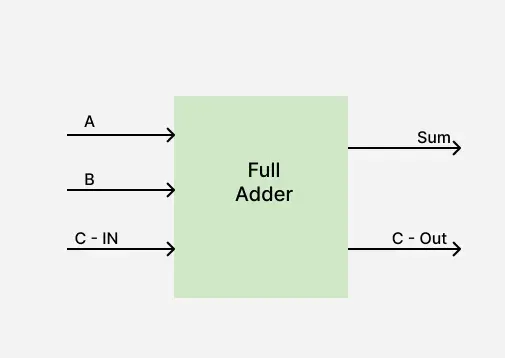
The trick is to build it from copies of a pattern that can add three single-bit inputs and give a two-bit result. Then the three inputs to that can be one bit from each of your original number together with the carry out from the previous bit position.
That way you won't need a whole wedge-shaped structure whose size will grow as the square of the number of bits.
I think each of your XOR/AND crosses is a correct 1+1->2 bit adder. You can build a 1+1+1->2 bit adder by cascading two of the XOR/AND crosses. The carry ("and") outputs of those cannot both be 1 at the same time, so you can OR them together before you feed the carry to the next bit position, and end up with much smaller overall solution.
slim geode
indigo stump
Guys, is this the correct way of making a number adding machine?
What you want is a sequence of full adders https://www.geeksforgeeks.org/digital-logic/full-adder-in-digital-logic/
GeeksforGeeks
Your All-in-One Learning Portal: GeeksforGeeks is a comprehensive educational platform that empowers learners across domains-spanning computer science and programming, school education, upskilling, commerce, software tools, competitive exams, and more.
coral parcel
It would be neat to find a link that explains without that extremely annoying cookie splash. (It's not enough to scroll though the long list and uncheck all the "legitimate interest" lies, you also need to click "vendor preferences" at the bottom to get an even longer list with about a hundred further "legitimate interest" lies to deny).
indigo stump
coral parcel
The trick is to build it from copies of a pattern that can add _three_ single-bi...
Like this?
 indigo stump
slim geode
What you want is a sequence of full adders https://www.geeksforgeeks.org/digital...
indigo stump
slim geode
What you want is a sequence of full adders https://www.geeksforgeeks.org/digital...
Oh, thanks
coral parcel
indigo stump
Like this?
More like (going left to right):
 input1 --and----------or -----> carry out
        \/            /
        /\           /
 input2 --xor --and--
              \/
              /\
 input3 --------xor ----> result bit out
ye but I've only figured out how to make XOR and AND out of wood
😄
and other available materials
which is why I tried to replace OR with XOR on XOR + AND
coral parcel
I see.
indigo stump
Well, okay, thanks for your help I'll start trying to make it then 🙂
coral parcel
In the above diagram, you can also replace the or with an xor -- since the inputs to it cannot both be 1, anyway.
wind pelican
coral parcel
More like (going left to right):
```
input1 --and----------or -----> carry out
...
 drowsy marlin
indigo stump
Like this?
drowsy marlin
indigo stump
Like this?
Might help to use standard notation here so colourblind people can read it.

Normally the gate names are ommitted in circuit diagrams
So you just have the labels for in/out
You can expand the full adder to any number of bits by feeding the carry out to cin of the next bit
And the last carry out can detect overflow conditions (when the result is invalid because the computer can't store MAX + 1)
 plain tangle
Does anyone here have a good bibliography to start studying discrete mathematics?
spark field
#book-recommendations probably does
Otherwise good books include
Discrete Math and its Applications (Rosen), which is more CS/usage focused
Discrete Mathematics (Johnsonbaugh), which I think is really good for self-study
A Transition to Advanced Mathematics (Smith et al), which is more math focused
I will think of others in due time probably
plain tangle
thank you
 flint valley
spark field
Otherwise good books include
Discrete Math and its Applications (Rosen), which i...
flint valley
spark field
Otherwise good books include
Discrete Math and its Applications (Rosen), which i...
I'm in a cs focused discrete math and we're using rosen. It is fine. I don't love it simply because it isn't written like most math textbooks I've used before.
But it explains things in an approachable way for non-math people.
 grand crown
try writing the LHS for n = k + 1 in terms of the summation for n = k, and then adding an extra term
then you can replace the n = k summation using the inductive hypothesis
keen flower
im on 6.2 now
spark field
keen flower
im on 6.2 now
Need help with 6.2 or are you working
 spiral nest
Is that a valid way of formalising "It is not true that every natural number is either not dividable by two or by 5" while I should only use the existential quantifier, negation, conjunction and disjunction?
 spare slate
spiral nest
Is that a valid way of formalising "It is not true that every natural number is...
spare slate
spiral nest
Is that a valid way of formalising "It is not true that every natural number is...
yes
spiral nest
spare slate
yes
I am a little scared because I did not use a disjunction
grand crown
you dont need to use everything
 sand talon
plain tangle
Does anyone here have a good bibliography to start studying discrete mathematics...
sand talon
plain tangle
Does anyone here have a good bibliography to start studying discrete mathematics...
intro to discrete math V.K. Balakrishnan is pretty fire
 lapis gate
spiral nest
Is that a valid way of formalising "It is not true that every natural number is...
lapis gate
spiral nest
Is that a valid way of formalising "It is not true that every natural number is...
what no
does (x:2) mean "x is divisible by 2" ?
spiral nest
lapis gate
does (x:2) mean "x is divisible by 2" ?
Yes
I am still used to write it that way from school but yeah
lapis gate
what then I do not understand wtf does it have t do with every natural number is either not dividable by two or by 5
you are starting by saying "there exist an x"
while the sentence sayss "for all x"
spiral nest
There exists a number that is dividable by two and not by 2
lapis gate
(in N)
spiral nest
lapis gate
while the sentence sayss "for all x"
The task was to only use the existential quantifier
lapis gate
spiral nest
There exists a number that is dividable by two and not by 2
by 2 and not 5 you mean
spiral nest
lapis gate
by 2 and not 5 you mean
Yeah, I am tired mb
lapis gate
but that's just not the sentence you wrote after
for example 4 is divisible by 2 and not 5
how does that inform us on like 13 for ex ?
coral parcel
The prose statement is fairly weirdly phrased. Either of these would be unambiguous:
... every natural number is either not divisible by 2 or divisible by 5
or
... every natural number is not divisible by 2 or by 5
(and they don't mean the same), but the wording given seems to be somewhere in the middle.
lapis gate
or 25
spiral nest
coral parcel
The prose statement is fairly weirdly phrased. Either of these would be unambigu...
Yeah that irritated me as well
It was originally written in German but with the same issue
lapis gate
coral parcel
The prose statement is fairly weirdly phrased. Either of these would be unambigu...
no I think its every n number is either not div by 2 or not div by 5
spiral nest
lapis gate
for example 4 is divisible by 2 and not 5
I am disproving the statement using a counter example
spiral nest
lapis gate
no I think its every n number is either not div by 2 or not div by 5
Then it would have been phrased that way
coral parcel
spiral nest
I am a little scared because I did not use a disjunction
The disjunction correctly became a conjuction when you pushed the "not true" down past it with De Morgan's laws.
spiral nest
lapis gate
oh ok
I would say that is equal to saying "it is wrong that the statement is true"
spiral nest
coral parcel
The disjunction correctly became a conjuction when you pushed the "not true" dow...
Thanks
coral parcel
lapis gate
no I think its every n number is either not div by 2 or not div by 5
That just makes it triply ambiguous, then.
 rough crescent
Hello
Can anyone help me
I want to self study math but idont know where to start.
I alr know calc with like epsilon delta proofs,
And a little bit of linear algebra
Where do I go next
 mystic linden
rough crescent
Can anyone help me
I want to self study math but idont know where to start.
I al...
mystic linden
rough crescent
Can anyone help me
I want to self study math but idont know where to start.
I al...

This video has a list of books, videos, and exercises that goes through the undergrad pure mathematics curriculum from start to finish.
REAL ANALYSIS
Book: “Understanding Analysis” by Stephen Abbott.
Videos: Lectures by Francis Su (https://www.youtube.com/playlist?list=PL0E754696F72137EC)
LINEAR ALGEBRA
Book: “Linear Algebra Done ...
What you could also do if pick a university of your choice and take a look at the modules that they offer and study the relevant textbooks
Hope this helps
 spark field
<@&268886789983436800>
grand totem
<@&268886789983436800>
storm violet
spark field
<@&268886789983436800>

 scenic mesa
does there exist a graph whose group of isomorphisms is generated by a 3-cycle of nodes?
cerulean radish
scenic mesa
does there exist a graph whose group of isomorphisms is generated by a 3-cycle o...
You mean the group of automorphisms?

This graph has automorphism group isomorphic to Z3
You may also be interested in Frucht's theorem, which states any finite group can be presented as the automorphism group of a connected graph
scenic mesa
yeah the group of automorphisms
i think it can be isomorphic to Z3 but i'm wondering if it can be actually equal to a group generated by a 3-cycle
i suspect not
cerulean radish
Ah, I get what you mean now, yeah that's not possible
Actually, let me think about it
cerulean radish
scenic mesa
i suspect not
Yeah, say the 3-cycle moves v1, v2, v3, then {u, vi} in E iff {u, vj} in E for any i, j and u not in {v1, v2, v3}, meaning swapping v1 and v2 will also be a permutation
scenic mesa
thanks
 visual solstice
let's call right rotation L( , ), right rotation R( , ), the pivot node "p" and the root note "r"

and T the tree
R(T,p) = L(T,r) ?
am i crazy or are R() and L() not inverses of each other?
they're only inverses if, like in this diagram, we also swap who is the pivot and who is the root
 keen flower

Can someone help me out with this
Im going over my tests preparing for finals
gpt is saying im right
fossil mural
keen flower
,rcw
vital dewBOT
 keen flower
Idk what i did wrong
fossil mural
the second line should be $(p \land \neg p) \lor \neg q$
vital dewBOT
bee [it/its]
 fossil mural
(you have the $\lor$ and $\land$ the wrong way around)
vital dewBOT
bee [it/its]
 fossil mural
$(p \lor \neg p) \land \neg q$ would be equivalent to $(p \land \neg q) \lor (\neg p \land \neg q)$
vital dewBOT
bee [it/its]
 fossil mural
although your final answer of ~q still happened to be correct, it's just the steps that were wrong
keen flower
Wtfff
Why did he take off 5 points for that
I got the answer right
Can u show me the entire steps please
If u have time
 spare slate
keen flower
Can someone help me with 1
spare slate
keen flower
Can someone help me with 1
In the future, please use the ,rotate command.
,rotate
vital dewBOT
 spare slate
keen flower
spare slate
keen flower
The point is that zero is a rational number. What happens if you divide by zero?
keen flower
u get undefined
spare slate
mhm
you don't even get a number as the result, let alone a rational one
go back to the theorem you reference - I'm sure there's a condition on something being nonzero that's not in this question.
keen flower
apparently thats not even a theorem
spare slate
probably because you're missing the condition of something being nonzero
keen flower
how would you answer that question
spare slate
 keen flower
im confused :/
spare slate
As I said earlier, zero is a rational number
and as you said, when you try to divide by zero, you get an undefined result
which is not a number at all
So this is a case where dividing two rational numbers doesn't even give a number, let alone a rational one
and hence your answer is no
As I've been referring to, you need to impose the condition that the number you're dividing by is not zero
which relates to this condition that you incorrectly assumed/introduced/imposed
 keen flower
ohh okay got it
i think
maybe maybe not
How is it not a Yes, except when you're diving by 0
which is what i was trying to say there
spare slate
keen flower
How is it not a Yes, except when you're diving by 0
You never said "except when you're dividing by zero"
and the question never imposes that condition at all
this is similar to the idea of finding a counterexample
if you find one example where something fails, then it's not always true
 spare slate
keen flower
thank you civil service pigeon
spare slate
keen flower
thank you civil service pigeon
lofty cloudBOT
Asking the actual question right away is more likely to get responses.
Asking "Can I ask...?" or "Does anyone know about...?" doesn't give people enough information to decide whether they can help, and answering can feel like a promise to help with the actual question, which they might find themselves unable to.
keen flower
you literally smash knowledge into my mind so i appreciate your method of teaching
ohh
oopsie
.rotate
 keen flower
.rotate
keen flower
keen flower
.rotate
!rotate
vital dewBOT
 spare slate
you wrote 2k+1 on its own with no other context

and as they say, you should specify what k is
k is an integer
furthermore, you're reusing k between two different integers (m, n), which is bad practice
You're better off saying something like
Let $n=2k_1+1$ and $m=2k_2+1$ for integers $k_1$, $k_2$. Then, both $m$ and $n$ are odd by definition.
vital dewBOT
Civil Service Pigeon
 spare slate
furthermore, you're reusing k between two different integers (m, n), which is ba...
spare slate
spare slate
furthermore, you're reusing k between two different integers (m, n), which is ba...
note this is why there's the comment of n=m?
becuase in a literal sense, you wrote n and m as both being equal to the same thing (2k+1)
(insert comment about transitivity if you want to be super thorough/pedantic/whatever)
also at the end it seems like you're floundering about
an integer is even if and only if it's a multiple of 2
aka 2 times some integer
perhaps you meant to write that, but it's not clear at all
keen flower
yeah i meant to write that
idk how to write proofs at alllll man
holy cow
what does a good proof for this question look like?
spare slate
Let $n=2k_1+1$ and $m=2k_2+1$ for integers $k_1$, $k_2$. $m$ and $n$ are both odd by definition. By a direct computation,
$$m+n=(2k_1+1)+(2k_2+1)=2k_1+2k_2+2=2(k_1+k_2+1).$$
Since $k_1$, $k_2$, and $1$ are all integers, it follows that $k_1+k_2+1$ is also an integer since the integers are closed under addition. So, since $m+n$ is the product of $2$ and an integer, it is also an even integer. This shows that the sum of any two odd integers is even.
Here's a rough first draft
The key points are to invoke things in an at least somewhat chronological order (obviously this isn't a hard and fast rule, especially with things like lemmas, but try to write things in an order that makes at least some sense)
ex. you invoked closure of the integers under addition before even writing down the equation where it's relevant
and at the end, you could be a lot more direct with how you invoke the definition of being even
all you need is multiple of 2 -> even
I think writing too much at the end may have shot you in the foot here
oh and also don't recycle notation
that's important as well
vital dewBOT
Civil Service Pigeon
 keen flower
spare slate
I think writing too much at the end may have shot you in the foot here
keen flower
spare slate
I think writing too much at the end may have shot you in the foot here
Damm
keen flower
spare slate
oh and also don't recycle notation
Wdym by this
 spare slate
keen flower
And thank you for your help!
spare slate
keen flower
And thank you for your help!
 elder crane
does anyone know who has the best course for University Math 2 (discrete math/structures)?
keen flower
elder crane
does anyone know who has the best course for University Math 2 (discrete math/st...
wdym
keen flower
Can someone help me with #5

 austere swan
It's been 10 minutes lmao
keen flower
ahahah
keen flower
austere swan
It's been 10 minutes lmao
i love your pfp!
austere swan
Thanks
Oh wow the person who was marking this sucks
They read you writing (2k)*(2k) as you wanting yo write (2k)^2. (2k)^2
What do you need help with exactly?
keen flower
austere swan
Oh wow the person who was marking this sucks
😭😭😭 everyone been saying that
They even stated im missing reasoning for contropositive
Like what did I miss
austere swan
keen flower
They even stated im missing reasoning for contropositive
Idk about reasoning, the only things I think you "missed" are:
In your contrapositive statement you need to say "for all integers n" before saying "if n is even...".
When you start the proof, you need to declare n (let n be an integer, suppose n is even/let n be an even integer)
Oh also, you added "for some even integer k" but you can have n=2k with k odd. I think maybe that's why they asked "why"? Otherwise there's nothing really to explain here, even means n=2k for some integer k by definition
keen flower
okay i think i got it
he took off 4 points for that holy molly

this one i just winged it i did not know how to answer at all
austere swan
keen flower
he took off 4 points for that holy molly
Yea that's crazy work. Shit feedback too
keen flower
it would help if he gave constructive comprehensible feedback
class avg is like 40% i heard
austere swan
Here first you failed to write a/b=(7-4sqrt(2)), so it just says "by the definition of rational, a/b such that b\neq 0.
Also, like the grader wrote, a,b rational implies ab rational does not say anything about irrational numbers, so you can't use that to conclude 4sqrt(2) is irrational
The play here is to rewrite it to be sqrt(2)= (bunch of rational stuff) and obtain a contradiction by irrationality of sqrt(2)
keen flower
how would i get to that point
keen flower
austere swan
The play here is to rewrite it to be sqrt(2)= (bunch of rational stuff) and obta...
.
i appreciate you helping!
a lot!
spark field
<@&268886789983436800>
 feral harbor
Are math proofs part of discrete mathematics?
coral parcel
Discrete math courses typically has some amount of introduction to proofwriting as part of their goals.
Formal proof theory is something different, however. Some discrete math courses do contain a bit of it, but that's not an universal feature.
 frosty sphinx
 spark field
I think this might be better for #linear-algebra
or advanced analysis or smth
Idk enough math to say but I just don't know that it's right for here
 dire bough
frosty sphinx
dire bough
frosty sphinx
so as stated part 1 is just wrong
T certainly cannot be compact
but yeah this is more suited for #advanced-analysis
spark field
<@&268886789983436800>
keen flower
spark field
<@&268886789983436800>
what happened broski
spark field
scpammers
 grand crown
what does exercise 4.17 say?
robust thunder
Can someone help me draw this Hasse diagram? I just can't get it to work?!
 grand crown
robust thunder
Can someone help me draw this Hasse diagram? I just can't get it to work?!
grand crown
robust thunder
Can someone help me draw this Hasse diagram? I just can't get it to work?!
i dont think this is a valid partial order
8 divides 3 * 24 and 24 divides 3 * 8
robust thunder
Ah so it's not anti-symmetric. I didn't check if it's a poset @#$!
 uncut wagon
grand crown
what does exercise 4.17 say?
uncut wagon
grand crown
what does exercise 4.17 say?
Exercise 4.17 states that with the conditions in the problem statement, G has a face that is bounded by at most four edges
grand crown
mm an idea i have is to keep identifying a face and compressing it down to a vertex
that way you decrease the number of faces and vertices while ensuring every vertex still has degree >= 3
so inductively you can color the new graph
then maybe figure out a way to expand back to the original and color the vertices that you condensed
actually that doesnt work u dont get simple graphs
 vivid osprey
Basic question. Reading a proof in Rudin's book. He says something along the lines that every permutation of {0, ..., k} is a composition of two special cases considered already in the proof; swapping 0 with any 1 <= j <= k, and swapping i with j, for 0 < i < j <=k.
My question; it was some time ago I studied permutations, but I'm familiar with the fact that every permutation in {0, ..., k} can be written as a composition of disjoint cycles. Is that the theorem Rudin refers to?
vivid osprey
Solved it.
spark field
vivid osprey
Basic question. Reading a proof in Rudin's book. He says something along the lin...
oh yeah I remember this from my abstract algebra book
you can write an n-cycle (1,2,3,...,n) as (1,n)(1,n-1)...(1,3)(1,2)
and then I guess if you have multiple such cycles the second special case comes into play
so everything comes as a result of the theorem you're referring too
That's nice
spark field
<@&268886789983436800>
 old briar
📈
 craggy trench
Hai kittens
 elder tide
how to solve this ;-;

 waxen mist
elder tide
how to solve this ;-;
waxen mist
elder tide
how to solve this ;-;
What is this 😭🙂
 glossy solstice
elder tide
how to solve this ;-;
glossy solstice
elder tide
how to solve this ;-;
I suppose its asking for solutions modulo 4, 15 and 28.
Do you know how to solve ax + by = c in integers?
glossy solstice
elder tide
forgot
Do you know the euclidean algorithm for finding the GCD/HCF?
elder tide
glossy solstice
Do you know the euclidean algorithm for finding the GCD/HCF?
forgot too ;-;
glossy solstice
elder tide
forgot too ;-;
There are other ways to solve these, but they are either harder (continued fractions) or trickery, I think you should take a look at your classnotes.
elder tide
glossy solstice
There are other ways to solve these, but they are either harder (continued fract...
m- my classnotes? I didn't take any 😭 </3
glossy solstice
RIP
elder tide

 proud laurel
elder tide
how to solve this ;-;
proud laurel
elder tide
how to solve this ;-;
Chinese remainder theorem
coral parcel
Well, the theorem itself just states that a solution exists, right?
coral parcel
glossy solstice
I suppose its asking for solutions modulo 4, 15 and 28.
It's really just modulo 4, 3, and 7, since the middle and last equation can be divided through by 5 and 4, respectively,
spark field
coral parcel
Well, the theorem itself just states that a solution _exists_, right?
The proof of the theorem outlines the algorithm
At least that is how our book did it
So after the proof the book said now let's attempt to apply it
(Rosen)
But I agree CRT is likely the intended way
Although this system is simple enough to just work by hand
glossy solstice
coral parcel
It's really just modulo 4, 3, and 7, since the middle and last equation can be d...
Well, as soon as they'd convert it into a linear equation they'd see it.

 worn wyvern
Yeah its 11 sry
 thorny hollow
Is it
My thought process for eleven is that,
there's 6 people with both blonde hair and blue eyes, x - 6 people with blue eyes, and twice as many as that with blue eyes which is 2x (cus x -6 + 6 is x), and 3 people whos neither
So
x - 6 + 2x + 3 = 30
3x - 3 = 30
x = 33/3
x = 11
Dunno
Hm
thorny hollow

thorny hollow
Do I ping staff
 hidden totem
thorny hollow
My thought process for eleven is that,
there's 6 people with both blonde hair a...
hidden totem
thorny hollow
My thought process for eleven is that,
there's 6 people with both blonde hair a...
x-6 people with blue eyes but not blonde hair but otherwise this work looks good
honestly its easier if you just visualize a venn diagram, one circle for blonde hair, another for blue eyes
notice that one circle is x, the other 2x, overlap is 6, 3 outside both circles
so now its easy to add the two circles, subtract overlap
cleaner to think about that way
thorny hollow
hidden totem
honestly its easier if you just visualize a venn diagram, one circle for blonde ...
Im just following the books guide, that says it's important to know how to transform it into an equation
Tried to do this inside my head only. Is the answer for a) 66?
 thorny hollow
Thx
spare slate
thorny hollow
Thx
hidden totem
thorny hollow
Im just following the books guide, that says it's important to know how to trans...
oh yeah it's definitely important, im not saying to skip the step of creating the equation, im saying this is a cleaner way to think about how to write out the equation
its slightly less prone to mistakes
thorny hollow
spare slate
<:catthumbsup:614540188747563008>
57?
That or 84
When you try the same question thrice and you get three dif answers

coral parcel
That's when you conclude that the only way to trust an answer is if it produces a full breakdown of number of dogs in each of the 2³ possible states, and then verify that it satisfies each of the givens.
What's up with the hints though? 131 is definitely no the answer to question (b), but then what it is?
thorny hollow
coral parcel
That's when you conclude that the only way to trust an answer is if it produces ...
It says to use a venn diagram and start from inside out
coral parcel
"It says"?
thorny hollow
Cus i have 9 in the middle, I'd subtract 9 from the ones that knows 2 skills only, so I'd have
8 dogs who can sit and stay, 3 dogs that can stay and roll rover and 9 dogs that can sit and roll over. So, if this reasoning is right, the answer for question b is 20?
thorny hollow
spare slate
thorny hollow
Cus i have 9 in the middle, I'd subtract 9 from the ones that knows 2 skills on...
the answer for question b is 20?
yes.
thorny hollow
So
The answer for a is 84
Or 85
Wait I just guessed sorry
Leemme thunk
57?
coral parcel
coral parcel
That's when you conclude that the only way to trust an answer is if it produces ...
Instead of asking here, I will once again recommend this way to check your work.
thorny hollow
Wdym by a full breakdown? 2³ possible states?
spark field
thorny hollow
Wdym by a full breakdown? 2³ possible states?
This goes back to the venn diagram idea
You have 3 conditions, A B and C
Each one has 2 possibilities
yes A or no A, yes B or no B, yes C or no C
So you have 2^3 possible states
no A, no B, no C
yes A, no B, no C
no A, yes B, no C
no A, no B, yes C
yes A, yes B, no C
yes A, no B, yes C
no A, yes B, yes C
yes A, yes B, yes C
you need to make sure that your answer accounts for all possibilities, and also plug back in your answers to make sure it satisfies each of the equations you constructed ("the givens")
Only then can you be certain that your answer is valid
The only way to get better than just producing multiple answers, who knows of which is the correct answer, is to know how to check your answer
spark field
Or at least that is what I assume tropo meant
thorny hollow
Im trying to understand how to apply it here
Do I attempt to solve my question and substitute A, B , C with my answers?
spark field
A, B and C here are "can sit", "can stay" and "can roll over", respectively
spark field
Here is a 'full workup' if you will
There are shortcuts and better ways to approach this (with a little simplification of the PIE) but if you were to go complete brute force
In this case I would look at the givens here and go
Starting from 9 dogs can do all three (that is case yes A yes B yes C)
17 dogs can sit and stay -> 17 - 9 = 8 dogs can only sit and stay (case: yes sit, yes stay, no roll over)
12 dogs can stay and roll over -> 12 - 9 = 3 dogs can only stay and roll over
18 dogs can sit and roll over -> 18 - 9 = 9 dogs can only sit and roll over
By turning them into individual cases, I get sets of dogs that do not overlap (basically, I am partitioning the full set of dogs into the 8 cases)
Then
50 dogs can sit. Of those 50,
8 can also stay but not roll over
9 can also roll over but not stay
9 can do all three
So exactly 50 - 8 - 9 - 9 = 24 of them can only sit
29 dogs can stay
3 can also roll over but not sit
8 can also sit but not roll over
9 can do all three
29 - 3 - 8 - 9 = 9 dogs can only stay
34 dogs can roll over
3 can also stay but not roll over
9 can also sit but not stay
9 can do all three
34 - 3 - 9 - 9 = 13 can only roll over
Now I have all the cases
9 dogs do everything
8 dogs both sit and stay (but no roll over)
3 dogs both stay and roll over (but not stay)
9 dogs both sit and roll over (but not stay)
24 only sit
9 only stay
13 only roll over
9 do nothing
I'll leave adding up the total number of dogs to you
You're essentially doing the work of a venn diagram, by enumerating the number of dogs in each possible state (that is every intersection of circles in the venn diagram)
Again not necessary, but hopefully at least this is instructive
thorny hollow
You did the cooking and left me with the incredible task of eating ur food
Not just
Lemme read it
Thx
Yes 84 was right wasn it
Interesting manner of sorting it
Ill see if I find other problems to apply that
U all are very sweet instructors, thank u and sorry to bother u with my neuronless brain
spare slate
<@&268886789983436800>
 lunar pawn
Does a version of the Akra-Bazzi method also provide another way to prove the master theorem in its full generality? I see this paper refer to the continuous and discrete Akra-Bazzi theorems, though I can't parse the paper myself as the proofs are written as formalizations in some proof assistant.
 haughty garden
Yes, the Akra-Bazzi method can be used to prove the continuous master theorem and it is, in some sense, then most general formulation of the master theorem
thorny hollow
1.4.2 is 56? (8*7)
 spark field
thorny hollow
1.4.2 is 56? (8*7)
spark field
thorny hollow
1.4.2 is 56? (8*7)
Yes
8 choices of shirts, then 7 choices of ties
Or $8^2$ tuples in $[8]²$, take away 8 for matches $(1,1)$, $(2,2)$, etc which are invalid, gives $64 - 8 = 56$
thorny hollow
How
vital dewBOT
Coolempire93
 spark field
thorny hollow
How<:sully:651816820122189834>
spark field
thorny hollow
How<:sully:651816820122189834>
Each number 1 through 8 represents a color
The first entry of the tuple represents shirt color
Second tie color
thorny hollow
No I mean the in terms of a function part
spark field
thorny hollow
No I mean the in terms of a function part
Oh that was me writing the wrong thing by accident
I meant individual mappings of elements
spark field
In terms of functions
I guess there are 8² mappings from [2] to [8]
But that's just coordinates
I.e. just writing writing tuple entries as function
spark field
I know that representation is nice for something but I can't remember
Vectors as functions are really interesting though
thorny hollow
True
 halcyon nest
thorny hollow
No I mean the in terms of a function part
halcyon nest
thorny hollow
No I mean the in terms of a function part
If you want to count all 3-permutations of a set with 10 elements (so think same problem but shirt, tie and pants and 10 colors), that's the same as counting how many injective functions exist from the finite set {1,2,3} to the finite set {1,...,10}, which is 10(10-1)(10-2), called a falling factorial
thorny hollow
1.4.7 would be 8*7*6 possibilities?
 spark field
thorny hollow
1.4.7 would be 8*7\*6 possibilities?
spark field
thorny hollow
1.4.7 would be 8*7\*6 possibilities?
cf what IOM said
thorny hollow
spark field
Oh I guess yet another approach goes something like
Choose 3 from the 8 to win medals
Then permute those 3
3!*(8 choose 3) = 3!*8!/(5!*3!) = 8!/5! = P(8,3) that is the 3-permutations of a set of 8 elements
Me when combinatorial proof of formula for permutations and combinations in terms of the other
Idk i can't think of anything cool and insightful
hidden totem
counting is weird, you'd be surprised what is easy and what is hard
hidden totem
thorny hollow
I can already see me crying when I take some proof based counting theory
if you want an accessible explanation to how counting proofs work and how to check your work: https://m.youtube.com/watch?v=uxjAHkn4VFI

To see an example of how bijections can transform a hard problem into an easier one, check out the previous video of the series: https://www.youtube.com/watch?v=3B-D3w292TI
If you want to see some more examples of where these ideas can be applied, try these problems: https://www.youtube.com/watch?v=LUVKuyfpe2I
My Patreon: https://www.patreon.c...