#discrete-math
1 messages · Page 74 of 1
 dire walrus
N_n? Rest I can understand
dire walrus
i have never heard of that term ever
 hollow token
I think it's just annotated as N_1
oh sorry its null graph, mb
In the mathematical field of graph theory, the term "null graph" may refer either to the order-zero graph, or alternatively, to any edgeless graph (the latter is sometimes called an "empty graph").
dire walrus
\bar{K_n} makes sense to me
but honestly, I think considering the empty graph as a graph is... umm... a choice
hollow token
N_n = null graph
K_n = complete graph
P_n = path graph
C_n = cyclic graph
W_n = wheel graph
K_n,m = bipartite graph
and there's one more i think that i forgot about
dire walrus
You have to remember the notations?
hollow token
nvm that's all
hollow token
dire walrus
You have to remember the notations?
yes, and their characteristics
dire walrus
also, K_{n,m} is not bipartite, it is the complete bipartite on n+m vertices
dire walrus
hollow token
yes, and their characteristics
that sounds appalling
hollow token
yeah i apologise it's still all jumbled in my head
dire walrus
For us, we gladly tell the students what a notation means
or our profs tell us
and for characteristics, what are the things you have to remember? Eigenvalues? Eigenvectors??
Because I don't remember anything that cannot be argued in a single line
hollow token
hollow token
yes, and their characteristics
More specifically:
- Number of vertices (V)
- Number of edges (E)
- Order
- Size
- Diameter
- Radius
- Complement
- Denote which ones can be autocomplimentary (isomorphic to its own complement)
hollow token
dire walrus
and for characteristics, what are the things you have to remember? Eigenvalues? ...
^
hollow token
one sec
dire walrus
But mmmmm... why remember when you can derive 
hollow token
My uni is very cooked
dire walrus
the autocomplimentary thing is cool. A quick check is the number of edges. If it is not n(n-1)/4, for sure it is not autocomplimentary
so a quick check is whether n=0 or 1 mod 4. If not, no chance it is autocomplimentary
hollow token
So to check if it's autocomplimentary is to check if n=0 or if n equiv 1 mod 4?
hollow token
hollow token
More specifically:
- Number of vertices (V)
- Number of edges (E)
- Order
- Siz...
also apparently |V| = Order and |E| = Size
This is basically what the task says:
Describe the graphs N_n, K_n, C_n, P_n, K_m,n and W_n -- determine their V and E, denote their Order, Size, Diameter and Radius; describe their complement and denote the ones which can be autocomplimentary. Write at least one example of each. Write down definitions of all terminology used and elaborate upon them.
I am probably failing this one :p
But I can at least do BFS and congruences
Thank you for all your help!
dire walrus
hollow token
So to check if it's autocomplimentary is to check if n=0 or if n equiv 1 mod 4?
This is necessary, but not sufficient.
hollow token
dire walrus
This is necessary, but not sufficient.
Yeah I need to learn about that
dire walrus
hollow token
Yeah I need to learn about that
The proof is simple
What is the union of a graph and its complement?
Say the graph is on n vertices
hollow token
The union? It's the original graph with all its neighbours mapped identically, I believe?
I know that a graph is isomorphic if f : V -> V' keeps the adjacency list in tact, in other words: forall u,v in V u ~ v <=> f(u) ~ f(v)
dire walrus
Right, we will come to that
hollow token
dire walrus
What is the union of a graph and its complement?
So you are asking about V union V'?
dire walrus
hollow token
So you are asking about V union V'?
Yup
dire walrus
hollow token
I know that a graph is isomorphic if f : V -> V' keeps the adjacency list in tac...
Also there is more needed in this definition. V and V' must be of the same size
hollow token
I see
hollow token
hollow token
So you are asking about V union V'?
Also I don't know the answer to this question
dire walrus
hollow token
Also I don't know the answer to this question
Think in terms of pictures
If you had a graph, what does its complement look like?
hollow token
Like a cross turning into 2 parallel lines?
dire walrus
Not exactly that description
Like, if there was an edge in G, can the complement of G have that edge?
hollow token
No
dire walrus
And if the complement of G has an edge, can G have that edge?
hollow token
No
dire walrus
So do you agree that the complement is exactly the graph you get if you deleted all the edges and added all the edges that was not previously there?
hollow token
Yes
dire walrus
hollow token
So you are asking about V union V'?
Now how about this then?
hollow token
It's all the possible edges for a given graph G
hollow token
bipartite?
dire walrus
No?
dire walrus
You have a bunch of vertices, and all possible edges as you said
Yup! Bingo
How many edges does this have?
hollow token
It should have n(n-1)/2 edges
dire walrus
beauty
hollow token
I am so amazed I remember the binomial something something
dire walrus
so |E(G)|+|E(G')|=n(n-1)/2, agreed? Where E(G) is the edge set of our graph and E(G') is the edge set of the complement of G.
hollow token
dire walrus
so |E(G)|+|E(G')|=n(n-1)/2, agreed? Where E(G) is the edge set of our graph and ...
It should be E(...)
dire walrus
edges my bad yes
hollow token
but yes
dire walrus
But, isomorphic graphs have the same number edges, right?
hollow token
Yeah, they should
dire walrus
not just autocomplimentary, in general
If G and H are isomorphic, they have the same number of vertices, same number of edges, same everything
hollow token
yeah my bad, i figured that what i said was wrong
hollow token
dire walrus
If G and H are isomorphic, they have the same number of vertices, same number of...
yes
dire walrus
We are working with autocomplimentary graphs, so G andf G' are isomorphic (G' is the complement of G)
hollow token
Oh, then yes
dire walrus
right!
hollow token
Since |E(G)|+|E(G')| = 2|E(G)| iff |E(G)| = |E(G')|
dire walrus
Now just some number theory
4 must divide n(n-1) [number of edges cannot be a fraction]. Since n and n-1 cannot both be even, 4 must divide exactly one of them. If 4 divides n, then n=0 mod 4. If n divides n-1, then n=1 mod 4.
Following?
hollow token
Yes
dire walrus
Well then you have your result
hollow token
So that's how we get condition n = 0 mod 4 or n = 1 mod 4
dire walrus
If G is autocomplimentary, then the number of vertices in G must be 0 or 1 mod 4
hollow token
you are implying 0 mod 4, right?
dire walrus
wdym?
hollow token
dire walrus
If G is autocomplimentary, then the number of vertices in G must be 0 or 1 mod 4
here i mean
n = 0 mod 4 or n = 1 mod 4
dire walrus
it can be 1 mod 4 too
hollow token
yeah okay just making sure i got that right
dire walrus
but this is only necessary. This modulo condition is not sufficient
hollow token
then we have to check for bijection on f, yeah?
dire walrus
(In fact, given a graph, it is very hard to check if it is actually autocomplementary. In fact it is almost as hard as checking if two graphs are isomorphic, and finding an efficient algorithm for which is like a holy grail for complexity theory researchers)
hollow token
yeah we only really have one example of an autocomplimentary graph
and its C_5
everything else that we glance over is just not autocomplimentary
hollow token
i think we haven't mentioned Paley graphs
hollow token
to be fair this is 1st year CS math
dire walrus
bachelors I suppose?
dire walrus
Here is a cool paley graph
 hollow token
Ohh, that looks really cool
dire walrus
hollow token
am hoping to go for a MSc
well, good luck to you!
hollow token
so far the best math I had was involving proofs, relations and operators on number sets
hollow token
dire walrus
well, good luck to you!
thank you! I'll definitely need it
dire walrus
hollow token
so far the best math I had was involving proofs, relations and operators on numb...
Well, I don't know where you are studying, but maybe you will get to see some cool math
the pg programs in cs ()we don't have an ug for cs) at our place is... well... lackluster in math
it is good for cs folks wanting jobs, but eh...
hollow token
PG, UG?
hollow token
dire walrus
the pg programs in cs ()we don't have an ug for cs) at our place is... well... l...
the math here is fairly rudimentary compared to everything else
dire walrus
hollow token
PG, UG?
post-graduate, undergraduate
hollow token
ah
dire walrus
,ti .kernel
 vital dewBOT
This user hasn't set their timezone! Ask them to set it using ,ti --set.
dire walrus
blehh
hollow token
i live in bosnia
dire walrus
ah
hollow token
GMT+2/CET
vital dewBOT
The current time for nekomatism is 12:44 AM (IST) on Mon, 23/06/2025.
hollow token
here for 1st semester we had 7 step solutions for graphs (range, 1st derivatives, 2nd, etc.), uhh the tasks where you find if the rhs is divisible by the lhs, integrals, and differential equations
i passed that with a 10 (highest mark here), and for math 2 (2nd semester) i passed my midterm with a 7
hollow token
yeah but to be fair they matter for me because of my scholarship
dire walrus
ohhh...
hollow token
I need to be passing to qualify, and need to keep a GPA of 8.0+ for bonuses
dire walrus
yeah I was talking about the long run, but if you have a scholarship, you gotta be careful
hollow token
its not that strict, i mostly want to aim for those bonuses lol
as long as you pass every year they'll fund you
But yeah in the long run i understand marks dont really make a difference
Ive been a software dev for 10 years, mainly in uni just to get a BSc so i can find work more easily
dire walrus
hollow token
Ive been a software dev for 10 years, mainly in uni just to get a BSc so i can f...
Oh that's nice! Hopefully you will enjoy it!
Completely unrelated, but that furina banner is fire :D
hollow token
Thank you! I found it on Pinterest
 limpid leaf
I need to show that this graph is non-planar using Kuratowski’s Theorem, stated as
A graph is planar iff it does not contain a subdivision of K_5 or K_3,3 as a subgraph
The definition of "subdivision" I have been given doesn't seem very rigorous, but I get the impression that a vertex added in a subdivision should have degree 2, so we can only use g in one "divided" edge of the subgraph (please correct me if I am wrong about this).
Any pointers or solutions appreciated :)

these are my attempts so far

 odd heart
limpid leaf
I need to show that this graph is non-planar using Kuratowski’s Theorem, stated ...
odd heart
limpid leaf
I need to show that this graph is non-planar using Kuratowski’s Theorem, stated ...
Both of your attempts ignore g and any of its edges altogether, so they won't work (if you remove g and all adjacent edges from the original graph, it becomes planar). Note that subdivision involves vertices of degree 2, but that means the vertex should have degree 2 in the subgraph, so intuitively you could ignore 4 edges adjacent to g and then consider it as subdivision (for example, if you remove the edges gb, gc, gf and ge, then the resulting graph is a subdivision of one where there's no g, but there's an edge directly joining a and d)
limpid leaf
odd heart
Both of your attempts ignore g and any of its edges altogether, so they won't wo...
The dashed lines in my attempts are meant to indicate edges that could be divided by g, but the problem is that in both cases there are more than one of these necessary
Sorry, that wasn't clear
odd heart
Just one should suffice.
As a hint, try to keep the edge "ad" and find K3,3 as a subgraph in that.
odd heart
@limpid leaf This one is much easier if you have the other theorem (Wagner's theorem) which involves contractions (just contract AB and DE, and you get K5, unless my intuition fails me): https://en.wikipedia.org/wiki/Wagner's_theorem
My favourite example for this is the Petersen graph, where you're very tempted to look for K5:

But to invoke Kuratowski's theorem you actually need to find a subgraph that's a subdivision of K3,3
With Wagner's theorem you just contract the edges connecting the outer five to the inner five and there's your K5
limpid leaf
Unfortunately I am studying for an exam and probably won't get away with quoting other theorems, but this looks interesting to know in general, thank you :)
 rocky torrent
Now i officially hate math
Like complex numbers makes no sense, teacher making theorems with name and i dont even know what he is yapping about like what in the fuck is "Omnibus theorem"
I don't find it ANYWHERE
I mean nothing makes sense
odd heart
rocky torrent
Now i officially hate math
Your feelings are valid, but this is not the channel in which to air them (I'd recommend #discussion or #chill )
rocky torrent
odd heart
Your feelings are valid, but this is not the channel in which to air them (I'd r...
But i came here to understand complex numbers
odd heart
Still not the best channel, probably #precalculus or #prealg-and-algebra
 hidden totem
curious why you're learning about majorization
what is the context for this? why are you screenshotting an LLM output?
rocky torrent
hidden totem
what is the context for this? why are you screenshotting an LLM output?
because the presentation is not in english
and so i translated it
hidden totem
can you at least explain the context then? what math level, what topic?
rocky torrent
hidden totem
curious why you're learning about majorization
because the dog teacher asked for it in exam
rocky torrent
hidden totem
can you at least explain the context then? what math level, what topic?
university
discrete math
infinite set
rocky torrent
odd heart
Still not the best channel, probably <#363224154469826562> or <#326138737606262...
thats bad
cuz everything i learnt is from "discrete math"
so i am not sure anymore 😭
hidden totem
very weird that a discrete math course would go over both complex numbers and majorization from a set context
rocky torrent
hidden totem
very weird that a discrete math course would go over both complex numbers and ma...
nono
first of all
- natural number
- sets
- inf sets
- algebra+complex number
- number theory
rocky torrent
rocky torrent
5. number theory
something like modulo and things like that
and that ugly three line equal sign
 neon harbor
rocky torrent
because the dog teacher asked for it in exam
neon harbor
rocky torrent
because the dog teacher asked for it in exam
If your course is literally taught by a dog then I would understand your frustration, but if not I think your attitude is the main issue
rocky torrent
neon harbor
If your course is literally taught by a dog then I would understand your frustra...
i just cant learn it man
 elder light
rocky torrent
and that ugly three line equal sign
elder light
rocky torrent
and that ugly three line equal sign
Ugly??
 dreamy coral
neon harbor
If your course is literally taught by a dog then I would understand your frustra...
dreamy coral
neon harbor
If your course is literally taught by a dog then I would understand your frustra...
Honestly i would really like a class being taught by a dog i love dogs
neon harbor
Me too, maybe dogoligical algebra for example, dogs are very good at chasing diagrams
rocky torrent
elder light
Ugly??
Mayb
rocky torrent
neon harbor
If your course is literally taught by a dog then I would understand your frustra...
I failed 3 times in exam
dreamy coral
rocky torrent
I failed 3 times in exam
that proves more about yourself than it does your prof
dreamy coral
rocky torrent
But i studied !!!!
you might be studying ahead of where youre currently at
i would recommend going back to earlier content and building understanding from there
that would help with later concepts of course
rocky torrent
Can you help me with one specific thing?
dreamy coral
probably not, i dont know much set theory myself
rocky torrent
Nono its not set theory
dreamy coral
ah
rocky torrent
Its modulo stuff
rocky torrent

I dont understand ahhh
Tmr= full remaining system
Rmr =reduced remaining system
Im not sure how you call it
 quick folio
rocky torrent
quick folio
rocky torrent
it's talking about how residue systems remain reside systems under certain operations
in particular adding any integer to every number inside a residue system gives you another residue system, and multipling every number in the system by a fixed number that is coprime to m gives you another reside system
quick folio
it's an important lemma for proving some important results in basic number theory
dreamy coral
quick folio
in particular adding any integer to every number inside a residue system gives y...
Wait a minute thats an application of cosets from group theory isn't it
dreamy coral
quick folio
this is how naive NT is taught w/o group theory lol
Aka my terrible elementary NT class
Doing algebra before NT would make that class 2 weeks long
quick folio
yeah basically
rocky torrent
quick folio
it's an important lemma for proving some important results in basic number theor...
And why is that my teacher named it with something i cant find in the internet
quick folio
well you haven't shared enough for me to tell you why
quick folio
preliminary results I'm getting says that omnibus is a method, not a name
but you'll have to ask your teacher
odd heart
It also might be something specific to Hungarian
rocky torrent
odd heart
It also might be something specific to Hungarian
Its a damn bus type
😭 🙏
odd heart
Omnibus in general means something general/encompassing.
It's almost certainly used here more as a descriptor than as a proper theorem name
odd heart
rocky torrent
Its a damn bus type
It's also a bus type in English, although I'm not sure whether it's a damn bus type.
rocky torrent
Alright
 cloud rampart
they mean exactly the same thing, bus is just short for omnibus (which is dated)
nowadays it usually means an anthology or collection
 cunning widget
Hi, i am just wondering what the difference between an element and an object is in this context: "A tuple with n elements, an n-tuple, is a collection with n objects in which both the mutual order and the number occurrences of each object count."
dire walrus
cunning widget
Hi, i am just wondering what the difference between an element and an object is ...
(potato, tomato, potato, potato, mango) is a 5 tuple, and it is different from (potato, mango, tomato, potato, potato) and both of them are different from (potato, potato, potato, tomato, mango)
The 'potato', 'tomato' and 'mango' are your objects. They are also called elements here
There is no difference in this context
cloud rampart
an object is a thing that exists in general whereas an element is a member of a particular collection
dire walrus
cloud rampart
an object is a thing that exists in general whereas an element is a member of a ...
in this context, they mean the same thing, right? We do say tuple with n things or tuple with n elements interchangeably (or at least I do, maybe that is wrong?)
cloud rampart
well the elements of a tuple are also objects so for the purposes of the above sentence they could be interchanged
dire walrus
yeah alright phew
cunning widget
cloud rampart
well the elements of a tuple are also objects so for the purposes of the above s...
understood, so they are just used as synonyms in this context?
cloud rampart
yeah in this instance it doesn't matter
but in general let's say you're working with integers, and the tuple (1,3,4). then the numbers 1, 2, 3, 4, and 5 are all objects. 1, 3, and 4 are elements of the tuple and 2 and 5 are not elements of the tuple
cunning widget
cloud rampart
but in general let's say you're working with integers, and the tuple (1,3,4). th...
aah, now it all makes sense, thank youu
cunning widget
dire walrus
(potato, tomato, potato, potato, mango) is a 5 tuple, and it is different from (...
Yes, they are indeed different from each other because the elements in each 5-tuple are arranged differently. In other words, each tuple has its elements in a different order compared to the rest, right?
cunning widget
Alsoo, how can the empty set be a subset of the set A = {a, b}? I dont really understand, because the empty set has no elements, while A has the elements a and b, and by definition "A subset is a set B whose elements are all elements of another set A." Lets say B is the empty set, how is it a subset of A then?
cloud rampart
all zero elements of the empty set are members of A
it's what we call vacuously true
cloud rampart
cloud rampart
all zero elements of the empty set are members of A
basically if it were untrue you should be able to find at least one element for which it is not true (a counterexample). if no counterexample exists then by default the claim is considered true
cunning widget
cloud rampart
basically if it were untrue you should be able to find at least one element for ...
aah, got it
dire walrus
cunning widget
Alsoo, how can the empty set be a subset of the set A = {a, b}? I dont really un...
Mathematically you write this as "B is a subset of A" if "for all x (x in B implies x in A)" is true.
Let's test it with B as the empty set. For all x (x in the empty set implies x in A). But look! x in the empty set is false by default, so the implication is true automatically. Thus the empty set vacuously satisfies the definition of an empty set as cloud said.
cunning widget
dire walrus
Mathematically you write this as "B is a subset of A" if "for all x (x in B imp...
i seee, thanks a lot
dire walrus
cloud rampart
basically if it were untrue you should be able to find at least one element for ...
I know this might not be appropriate for the intended audience, but I would be a little careful while making this statement because iirc, this is only valid in classical logic, right?
A proof/procedure showing no counterexample exists does not immediately give me a proof/procedure for the universally quantified statement is what I remember.
 past rivet
Hmmm
As far as I remember, one of de Morgan’s laws still holds constructively
$\neg (A \vee B)$ should be equivalent to $\neg A \wedge \neg B$?
vital dewBOT
Pseudonium

 fossil mural
yes, that's true
past rivet
Or more generally $\neg (\exists x . P(x))$ should be equivalent to $\forall x . \neg P(x)$
vital dewBOT
Pseudonium
 past rivet
It’s the other one that doesn’t work
Constructively you should have $(\exists x . \neg P(x) )\implies (\neg(\forall x . P(x)))$
vital dewBOT
Pseudonium
 past rivet
But I think the reverse implication does not hold constructively
fossil mural
yeah
if you have $\exists x. \neg P(x)$ and $\forall x. P(x)$ then you can get a contradiction by taking a witness $x$ for the $\exists$, putting it into the $\forall$, and observing that it satisfies $P(x) \land \neg P(x)$ which is obviously nonsense
vital dewBOT
bee [it/its]
 past rivet
mhm
fossil mural
but you wouldn't expect the other direction to be provable because, intuitively, $\neg (\forall x. P(x))$ provides no information, it's an entirely negative statement
vital dewBOT
bee [it/its]
 past rivet
mhm
dire walrus
So not exists x not P(x) implies forall x P(x) constructively? [sorry on my phone, and latex typing just is clumsy here]
fossil mural
fossil mural
but you wouldn't expect the other direction to be provable because, intuitively,...
and in fact we can get WLEM out of it
$\neg (\forall x \in 2. (P \leftrightarrow x))$ is provable, because it expands out to basically $\neg (P \lor \neg P)$, but if you could then conclude $\exists x \in 2. \neg (P \leftrightarrow x)$, then that's $\neg P \lor \neg \neg P$
vital dewBOT
bee [it/its]
 fossil mural
dire walrus
So not exists x not P(x) implies forall x P(x) constructively? [sorry on my phon...
fossil mural
dire walrus
So not exists x not P(x) implies forall x P(x) constructively? [sorry on my phon...
no
past rivet
Is this “weak law of excluded middle”?
fossil mural
yes
dire walrus
fossil mural
no
Beauty...
past rivet
Interesting, this is the first time I’ve come across it
dire walrus
At least my 2 am tipsy brain did not remember wrong.
fossil mural
fossil mural
no
$\neg \exists x. P(x)$ is equivalent to $\forall x. \neg P(x)$, but that means that if you have $\neg \exists x. \neg P(x)$, all you can get from that is $\forall x. \neg \neg P(x)$
vital dewBOT
bee [it/its]
 dire walrus
fossil mural
$\neg \exists x. P(x)$ is equivalent to $\forall x. \neg P(x)$, but that means t...
dire walrus
fossil mural
$\neg \exists x. P(x)$ is equivalent to $\forall x. \neg P(x)$, but that means t...
Right, that was what I argued in my head semantically, but I was not sure if I was remembering correctly
Thanks so much, and good night. I can now sleep in peace.
past rivet
past rivet
Or more generally $\neg (\exists x . P(x))$ should be equivalent to $\forall x ....
I’m pretty sure this is just a special case of $(\exists x . P(x)) \implies Q$ being equivalent to $\forall x . (P(x) \implies Q)$
vital dewBOT
Pseudonium
 past rivet
Just by taking $Q = \bot$
vital dewBOT
Pseudonium
 fossil mural
yes it is
past rivet
universal properties~
dire walrus
Couple of cool questions I found today. Sharing one of them now, might share the other later.
Suppose we have $n$ letters and $n$ envelopes, with each letter having exactly one correct envelope. Let $D(n,k)$ count the number of ways to put the letters in envelopes such that exactly $k$ of them are correctly matched. What is $$\sum_{j=0}^n jD(n,j)\ ?$$
vital dewBOT
Nekory

 coral parcel
Well, if you divide by n!, you get ||the expected number of correctly matched letters if you just choose envelopes at random -- which by additivity of expectation must be ...||
dire walrus
This is one solution! Beautiful, love to see probability rear its head in places like this.
 true venture
The total number of fixed points in all permutations of [n]. I'd think there is a nice egf A(x,y) = Sum_{n,k} x^n y^k for the number of permutations of [n] with k fixed points. Then taking A(x,y) d/dy and setting y=1 gives the egf series of sum jD(n,j) for each n. I think
true venture
Could also do some binomial coefficient sum
 flat summit
can sombody help me on this problem it says how many sequences length n that consist of elements 0,1,2,3 and that 0 and 1 are not together
i tried recursion but the problem is if i have a sequenc lets say length 3 and if the second to last number is 2 or 3 i have 4 sequences but if the second to last number is 1 or 0 i cant really put a 0 or a 1 so i only have 3 sequences
so i need like a system of recursions but idk how to set it up
true venture
Another way to try is to subtract the sequences with 0 and 1 together from the 4^n sequences of {0,1,2,3}.
 cerulean wind
flat summit
so i need like a system of recursions but idk how to set it up
cerulean wind
flat summit
so i need like a system of recursions but idk how to set it up
count the number of sequences of length n with no consecutive 0’s and 1’s that end in 0, 1, 2, or 3, then add them together. that is, if a_n is the number of sequences of length n which end in 0 and have no consecutive 0’s and 1’s, b_n is the number of sequences of length n which end in 1 and have no consecutive 0’s and 1’s, similarly for c_n and d_n, then
s_n = a_n + b_n + c_n + d_n
where s_n is the number of sequences of length n that don’t contain any consecutive 0’s and 1’s.
now we have
a_{n+1} = a_n + c_n + d_n = s_n - b_n
b_{n+1} = s_n - a_n
c_{n+1} = s_n
d_{n+1} = s_n
so s_{n+1} = 4s_n - (a_n + b_n)
but you can write a_n + b_n in terms of s_n and s_{n-1} to get
s_{n+1} = 3s_n + 2s_{n-1} with
s_0 = 1 (the empty list) and s_1 = 4
now you have a homogenous linear recurrence of whose characteristic polynomial has two distinct roots, say x and y, so
s_n = c_0 x^n + c_1 y^n
where c_0 and c_1 are some coefficients determined by the initial conditions
rocky torrent
hai
i wanna know something

what does it means?
i know N is natural numbers but what the plus means?
cloud rampart
can you show the context in which it appears?
it's probably the positive natural numbers (i.e. the naturals excluding 0)
rocky torrent
cloud rampart
it's probably the positive natural numbers (i.e. the naturals excluding 0)
oh?

it appeared on this
number theory
 brave rock
This is not enough context
rocky torrent
well i guess its positive number
 dark bolt
Excuse me. Does anyone know how to solve exercise, and most importantly, explain, because there are 0 ideas in general, the teacher doesn't like the argumentation with AI?
 flint sentinel
A is a subset of Nn+m\Nm and B is a subset of Nn+m\Nn

C is a subset of Nn+m

I am so lost
flint sentinel
k is a natural number and k>=2 I looked at the answer of the proof and still dont get it so hopefully someone can help me out

Answer:
 cerulean wind
you have to give more context to your questions
for people to be able to help you
at least give the full problem statement and what you have tried
flint sentinel
flint sentinel
C is a subset of Nn+m
 flint sentinel
k is a natural number and k>=2 I looked at the answer of the proof and still don...
flint sentinel
flint sentinel
k is a natural number and k>=2 I looked at the answer of the proof and still don...

 barren panther
rocky torrent
well i guess its positive number
barren panther
rocky torrent
well i guess its positive number
Isn't N... positive numbers? 😭
 cerulean radish
barren panther
Isn't N... positive numbers? 😭
cerulean radish
barren panther
Isn't N... positive numbers? 😭
Depends on the writer, for some it's the set of nonnegative integers
barren panther
cerulean radish
Depends on the writer, for some it's the set of nonnegative integers
Oh ok
 gritty bronze
any idea to what the other methods might be?
 quick folio
gritty bronze
any idea to what the other methods might be?
quick folio
gritty bronze
any idea to what the other methods might be?
there are truth functional / propositional arguments one could use, but those are somewhat unnecessary here
gritty bronze
quick folio
there are truth functional / propositional arguments one could use, but those ar...
thanks! I was interested in what the other methods might be
odd heart
gritty bronze
thanks! I was interested in what the other methods might be
You could axiomatize propositional logic using something like Hilbert's system, and conduct a syntactic proof using your axioms and some rule of inference (Modus Ponens will usually suffice as the base rule): https://en.wikipedia.org/wiki/Hilbert_system
In logic, more specifically proof theory, a Hilbert system, sometimes called Hilbert calculus, Hilbert-style system, Hilbert-style proof system, Hilbert-style deductive system or Hilbert–Ackermann system, is a type of formal proof system attributed to Gottlob Frege and David Hilbert. These deductive systems are most often studied for first-ord...
A syntactic proof basically works by taking your axioms as the starting "valid" statements; and repeatedly using rules of inference to create new valid statements from the existing ones.
gritty bronze
 thanks outsider!
 compact cape
hey is anyone active
 outer peak
compact cape
hey is anyone active
outer peak
compact cape
hey is anyone active
yh me
compact cape
ok wanna chat
 waxen robin
Denote $p_n=|\mathcal{P}n|$, and define a set $\mathcal{L}{n+1}={L(z_1,z_2): z_1\ne z_2\in\mathcal{P}_n}$ where $L(z_1,z_2)$ is the line that goes through $z_1,z_2\in\bC$(does not matter for my question).
The book gives an upper bound $|\mathcal{L}_{n+1}|\le \frac12 p_n (p_n+1)$.
Why is this the bound, and not $|\mathcal{L}{n+1}|\le\frac12 p_n (p_n-1)$, as an element in $\mathcal{L}{n+1}$ is by choosing two distinct points in $\mathcal{P}_n$, so it should be $\binom{p_n}2=\frac12 p_n (p_n-1)$.
(I'm asking this question in this section because although the definitions are related to Field Theory stuff, my question focuses on the combinatorics of it).
vital dewBOT
𝒢𝒾𝓃𝑔𝑒𝓇 𝑀𝒶𝑔𝓂𝒶

 stone laurel
 cinder hornet
OH HELL Yiiiiisssss
 robust monolith
I'm not sure if this is the right channel, but I'll ask anyway. Is morphism a synonym of homomorphism?
coral parcel
In some contexts, yes.
"Morphism" is a somewhat more general term that is used in category theory.
But pretty much everything that is called a "homomorphism" will also be a "morphism" in the appropriate category. (And then every morphism in that category will be a homomorphism).
On the other hand, there are categories whose morphisms are not called "homomorphisms".
 tropic moth
coral parcel
Well, if you divide by n!, you get ||the expected number of correctly matched le...
tropic moth
coral parcel
Well, if you divide by n!, you get ||the expected number of correctly matched le...
the suspense is killing me! must be... what? IT MUST BE WHAT? WHATS IN THE BOX?
coral parcel
tropic moth
the suspense is killing me! must be... what? IT MUST BE WHAT? WHATS IN THE BOX?
1
dire walrus
dire walrus
Suppose we have $n$ letters and $n$ envelopes, with each letter having exactly o...
Double count the set ||{(s,j) \in S_n x [n] | s(j)=j}||
coral parcel
dire walrus
2
No, 1
coral parcel
dire walrus
Double count the set ||{(s,j) \in S_n x [n] | s(j)=j}||
That works too. 👍
(And convincing a skeptical listener of the handwavy probabilities in my approach would probably lead to something like that anyway).
 primal glade
How to do 3 and 4

 tired summit
primal glade
How to do 3 and 4
tired summit
primal glade
How to do 3 and 4
Good question! What have you tried?
primal glade
tired summit
Good question! What have you tried?
Yeah
But i got wrong
So i give up, instead of miserably trying random stuffs, i prefer to ask other people to help.
tired summit
Recall the definition of induced subgraph
primal glade
tired summit
Recall the definition of induced subgraph
Ik but i still don’t know how to get those answers
 stray reef
what are P_n and C_n
dire walrus
Path graph on n vertices and cycle graph on n vertices respectively (at least that is what standard notation says)
dire walrus
primal glade
How to do 3 and 4
Mmmm... For 3, ||the maximum value of n is 2 because if you take 3 vertices, you immediately get a cycle.||
For 4, ||the maximum n should be 3 because if you take at least 3 vertices, the induced subgraph is a clique and cliques are not cycle graphs unless n=3.||
coral parcel
dire walrus
Path graph on n vertices and cycle graph on n vertices respectively (at least th...
If 6 is a correct answer for the first question, P_n would need to be a path graph with n edges.
coral parcel
primal glade
Ik but i still don’t know how to get those answers
The nice thing about complete graphs is that they're the same no matter how you reorder the vertices.
So, for example, if you pick 5 vertices and take the induced subgraph, it will look the same no matter which 5 vertices you pick.
Thus there are really only 8 different induced subgraphs of K_7 (from the empty graph up to K_7 itself), so you can just consider each of those in turn to see if any of them happen to be a P_n or C_n.
(Start from the low end; fairly quickly you should discover a pattern that convinces you it's futile to continue towards larger induced subgraphs).
dire walrus
coral parcel
If 6 is a correct answer for the first question, P_n would need to be a path gra...
ah okay I kind of did not see the first two questions
slightly changes my answers then
coral parcel
Let the OP find them, though.
dire walrus
yup
cunning widget
Onee question, is there any limit to how small or large a set can be? Is it correct to say that a set can be infinitely large, but it cant be smaller than the empty set?
 hardy zinc
cunning widget
Onee question, is there any limit to how small or large a set can be? Is it corr...
hardy zinc
cunning widget
Onee question, is there any limit to how small or large a set can be? Is it corr...
Set of real numbers R
Infinite
past rivet
cunning widget
Onee question, is there any limit to how small or large a set can be? Is it corr...
This is correct
 tall crescent
Sets can have arbitrarily large cardinality: the set of Natural Numbers {1, 2, 3, ...} has infinitely many elements for example. It is true that the empty set is a subset of every set and there is no proper subset of the empty set, so in that way the empty set is the smallest possible set
hardy zinc
past rivet
This is correct
Algtop grind? 
past rivet
hardy zinc
Algtop grind? <:sadcat:547124024585486359>
I will get back to it dw
dire walrus
cunning widget
Onee question, is there any limit to how small or large a set can be? Is it corr...
You can in fact prove that there is always a set with cardinality more than any set you can come up with because power set of a set X is always bigger than the set X.
hardy zinc
dire walrus
You can in fact prove that there is always a set with cardinality more than any ...
Is that because the power set always contains the null set?
past rivet
hardy zinc
Is that because the power set always contains the null set?
You prove this with Cantor’s diagonal argument
odd heart
hardy zinc
Is that because the power set always contains the null set?
Not really; adding just one element to an infinite set isn't usually going to give you a set of larger cardinality. The power set turns out to be "quite large" compared to the original set, in a way which is guaranteed to make bijection between them impossible (as formalized by Cantor's diagonal argument).
 prisma lily
yep, just as an example, (0, 1) and R have the same cardinality, but of course (0, 1) is a subset of R
cunning widget
tall crescent
Sets can have arbitrarily large cardinality: the set of Natural Numbers {1, 2, 3...
uuh, this made it so much clearer why the empty set is considered the smallest set, thanks
cunning widget
hardy zinc
Set of real numbers R
yess
cunning widget
dire walrus
You can in fact prove that there is always a set with cardinality more than any ...
what do you mean by power set?
fossil mural
the power set of X is the set of all subsets of X
cunning widget
fossil mural
the power set of X is the set of all subsets of X
aaah, i see
fossil mural
so for instance the set of all subsets of N is strictly larger than N (and in fact it turns out to be the same size as R)
cunning widget
fossil mural
so for instance the set of all subsets of N is strictly larger than N (and in fa...
N as for the set of all natural numbers, and R as for the set of all real numbers?
cloud rampart
cunning widget
N as for the set of all natural numbers, and R as for the set of all real number...
yes
cunning widget
oh wow, thats cool
primal glade
coral parcel
The nice thing about complete graphs is that they're the same no matter how you ...
yeah i got it, for 3 the answer is 1, cuz it only needs 2 vertices which has an edge of 1.
 hexed rune
Suppose $x_0=e, x_{n+1}=x_n+log(x_n)$. How fast does $x_n$ grow?
vital dewBOT
EmmaGhost
 hexed rune
I'd like it to be o(n)
fossil mural
it's not even O(n) because the amount that it increases by each time is unbounded
(proof: the sequence is unbounded because x_n > n by induction; log is unbounded and strictly increasing; so log(x_n) is unbounded)
i'm not sure there's going to be any "nice" formula for the exact growth rate
hexed rune
Sorry I meant something else when I said o(n) 😔
I meant I needed it to grow strictly faster than n
x_n/n\to infty
Ultra posted something in discussion which showed it was lower bounded by nlog(n)
https://stackoverflow.com/questions/22618778/calculating-the-recurrence-relation-tn-tn-1logn
But it would be nice to know larger lower bounds at least
Like maybe it's superpolynomial
fossil mural
i think it probably isn't but i'm not quite sure how to prove it
hexed rune
You think n^2 is enough?
fossil mural
ok well it's O(2^n), because log(x_n) < x_n and x_{n+1} = x_n + x_n would be the recurrence for 2^n
but that means log(x_n) <= log(2^n) = n log(2) ~ n, so it's O(n^2) because we add at most n each time
but that means log(x_n) <= log(n^2) = 2 log(n) ~ log(n), so it's O(n log n) because we add at most log n each time
(up to various constant factors)
...and we also have a lower bound of n log n, so it's actually Theta(n log n)? i guess?
i wasn't expecting it to be something so nice but i guess it's just n log n
dire walrus
<@&268886789983436800> more here
 chrome fossil
can any one help me
I need a source to understand the discrete structure I am in uni and they have completed 7 chapters mids are done and i got a terriblr score like 7/35 now I need help but could'nt find a usefull yt channel
prisma lily
@chrome fossil do you wanna send a summary of your course content?
primal glade
How to do b?
 cerulean wind
primal glade
How to do b?
cerulean wind
primal glade
How to do b?
what are the multiples of 1 in V?
what are the multiples of 2 in V?
what are the multiples of 3 in V?
.
.
.
for example, every number in V is a multiple of 1, so the vertex labeled 1 will have edges from it to every other vertex, including itself
now, the only question i have is if you are using directed graphs or not
because non-directed graphs won’t be able to capture asymmetry
if you are not using directed graphs, then (b) cannot be represented by a graph
primal glade
cerulean wind
what are the multiples of 1 in V?
what are the multiples of 2 in V?
what are the...
Everything, 2,4,6,8 and 3,6,9
primal glade
cerulean wind
now, the only question i have is if you are using directed graphs or not
What is a directed graph
cerulean wind
don't worry about it for now
primal glade
cerulean wind
don't worry about it for now
Okay
cerulean wind
it seems that you are not using them
primal glade
Yeah
cerulean wind
so, what i said about (b) not being possible holds
primal glade
cerulean wind
so, what i said about (b) not being possible holds
Why
If x is 4 and y is 2 does it works?
cerulean wind
well, the rules were to draw an edge between vertices x and y if and only if x ~ y
primal glade
cerulean wind
well, the rules were to draw an edge between vertices x and y if and only if x ~...
Okay
cerulean wind
but if you draw an edge 2 - 4, there is also an edge 4 - 2
but 4 is not a multiple of 2
primal glade
cerulean wind
but if you draw an edge 2 - 4, there is also an edge 4 - 2
Ohhhhh
I seee
cerulean wind
and that's what i meant about graphs not being able to capture asymmetry
they will only ever be able to capture symmetric relations because of this
however, if you generalize to directed graphs, then you can capture asymmetric relations
because each edge has a direction, a start and an end
primal glade
cerulean wind
however, if you generalize to directed graphs, then you can capture asymmetric r...
Let me google it
cerulean wind
primal glade
So 4,2 can be also written as 2,4?
idk what you mean by this
primal glade
cerulean wind
idk what you mean by this
I mean the edge
primal glade
cerulean wind
but if you draw an edge 2 - 4, there is also an edge 4 - 2
This
cerulean wind
yea, an edges in graphs don't care about the start and end vertices
primal glade
cerulean wind
yea, an edges in graphs don't care about the start and end vertices
Could you teach me how to prove it using directed graph?
cerulean wind
well, a directed graph is just like a graph, but we care about direction of the edges.
so, you may have seen a definition of a graph as like, a set of vertices V along with a set of edges E, each of which is a non-empty set of at most two vertices in V
for example, if V = {1,2,3,4} and E = {{1},{1,2},{2,3},{3,4},{4,1}}
then we get a square with a loop around the vertex labeled 1
a directed graph is similar
it starts of with a set of vertices
but instead of the edges being a subset of the powerset of V, the edges are a subset of the cartesian product of V with itself, V x V
so if V = {1,2,3,4}
and E = {(1,1),(1,2),(2,3),(4,3),(1,4),(2,1)}
then we get a square graph again, in shape only
for example, for the edge (1,2), we draw an arrow from 1 to 2, not just an edge
so 1 -> 2
to indicate that the edge starts at 1 and ends at 2
since (2,1) is in E, then we also draw an arrow 2 -> 1
primal glade
Okay
cerulean wind
these arrows are usually called directed edges
we say that the directed edge (2,1) is directed from 2 to 1
does this make sense so far?
primal glade
Yep
cerulean wind
cool
so if you want to modify your question,
you can say, draw a directed edge from x to y if and only if x ~ y
and you can now represent the relation in (b) with a directed graph in this way
primal glade

Like this?
Where 6 and 9 , 4 and 6 don’t have any arrows so it’s impossible
And for the third one is a tree not a graph so it’s impossible for y to be a multiple of x?
cerulean wind
that is a bit hard to read for me
but i have drawn it here for you
y is a multiple of x is the same as x divides y, written x | y
the colors don't mean anything, just for clarity
cerulean wind
primal glade
you don't want to repeat vertices
there is only one of every vertex

this is correct
those dang self-edges
cerulean wind
its impossible to represent the relation in (b) without directed edges, yes
 primal glade
Am I doing those correctly?
 dire walrus
,rotate 90
vital dewBOT
 dire walrus
primal glade
Am I doing those correctly?
dire walrus
primal glade
Am I doing those correctly?
for graph theory, drawings should be your mantra (If you were trying to show the graphs are isomorphic, then yes, your solution is correct)
cerulean wind
surprising that you did this without drawing it lol
dire walrus
cerulean wind
surprising that you did this without drawing it lol
it is not hard
there is only vertex of degree 4. Just match that and the rest is almost automatic
cerulean wind
yea, but its like playing with a higher difficulty for no reason haha
dire walrus
new game +
dire walrus
cerulean wind
make the graph iso without drawing the graph
in polynomial time

Reminds me of a cool question : Suppose you have access to a graph-isomorphism oracle (that is, an oracle whom you can give two graphs and it would answer yes if they are isomorphic and no if they are not). Then show that you can count the number of isomorphisms of a given graph in polynomial time (polynomial in the size of the graph).
[This is in fact a hunch why graph isomorphism testing is probably not in polytime]
primal glade
dire walrus
for graph theory, drawings should be your mantra (If you were trying to show the...
alr thx
primal glade
cerulean wind
surprising that you did this without drawing it lol
Cuz I cooked.
cerulean wind
indeed
cerulean wind
dire walrus
Reminds me of a cool question : Suppose you have access to a graph-isomorphism o...
this is cool
haven't seen it before
cerulean wind
trying to see how like, having the iso oracle will help with self iso's
primal glade
dire walrus
in polynomial time
You also play genshin?
dire walrus
primal glade
You also play genshin?
used to, till like 5.4
primal glade
dire walrus
used to, till like 5.4
Oh.
dire walrus
I still keep up with the story, but no time to play. 10 to 10 is uni time now
primal glade
dire walrus
I still keep up with the story, but no time to play. 10 to 10 is uni time now
I see
cerulean wind
dire walrus
Reminds me of a cool question : Suppose you have access to a graph-isomorphism o...
a naive approach would just go through all of the |V|! permutations of the vertices
but thats not polynomial in the size of the graph
dire walrus
cerulean wind
a naive approach would just go through all of the |V|! permutations of the verti...
you are not using the oracle
since this is essentially the brute force solution to the graph isomorphism problem itself
test everything
cerulean wind
true
cerulean wind
dire walrus
the hint is cool itself lmfao
lets hear that hint
don't think imma get this one on my own
dire walrus
cerulean wind
lets hear that hint
Orbit-Stabilizer theorem
dire walrus
i am serious
cerulean wind
alr lets try it lol. Iso(G) is a group after all
cerulean wind
potato potato
dire walrus
Iso(G) sounds to me like the set of isogenies of the algebraic group G
cerulean wind
the heck is an isogeny
dire walrus
cerulean wind
the heck is an isogeny
surjective morphism with finite kernel
I am just memeing
dire walrus
cerulean wind
why is having finite kernel important tho lol
it works well in that case and makes sense when we look at varieties. Elliptic curves give good inutition of what we mean by isogenies.
cerulean wind
i am not familiar with ag unfortunately
dire walrus
yeah dw, as I said, I am memeing around
I have a paper submission due in like a week and I am stressed af
any luck with the graph iso problem?
cerulean wind
i think?
dire walrus
go on
cerulean wind
the stabilizers of the action of Aut(G) on itself by left multiplication are trivial
so if we can find a non-trivial iso, i think we can just iterate it
to get all of them? (by orbit-stabilzer)
i must be tripping here
that doesn't feel right tho
like, i must be doing something wrong, since this won't get me all graph isos of a graph with two components
cerulean wind
cerulean wind
the stabilizers of the action of Aut(G) on itself by left multiplication are tri...
oh oh
its not just iterates
nvm then
i haven't gotten anywhere
dire walrus
Okay second hint : ||Fix a vertex v_1 and suppose you know to which vertices v_1 can go to using the automorphisms (orbit of v_1). Can you somehow use this?||
dire walrus
cerulean wind
the stabilizers of the action of Aut(G) on itself by left multiplication are tri...
not a bad idea... how about letting Aut(G) act on the graph?
a little more details is in the second hint
cerulean wind
im gonna keep thinking about this one tmrw
dire walrus
sure sure tyt
 half rock
I haven't studied much graph theory, but I'm curious about the idea of this thing. if I have a map and the associated graph, I can think of this as "embeddable on a plane" in some way, but if I allow two vertices which are opposite on the map to be adjacent, suddenly something changes. what are the terms I'm looking for here to formalize this?
not looking to do any serious math with this, I'm actually looking into board game design and just started thinking about some questions, but I'm not sure how to refer to these graphs or what precisely changes when we allow something like this
dire walrus
what do you mean by "two vertices which are opposite on the map"?
half rock
ok lets just talk about a map with states. lets say there's a state A on the left side of the map, some stuff in between then a state B on the right side, and they don't share a visual border on our physical map
if we decide that they are adjacent despite that, maybe there's a teleporter, then the graph is different because we've added an edge between those states
but something is different about this graph, can we represent in 2d like we did the first one (with basic moving of the borders)? I'm tempted to say that we can't always do that (imagine if A is completely surrounded by non-B states?)
dire walrus
okay, so kind of saying that you are gluing the left edge and the right edge?
half rock
yeah in a way, but they don't necessarily have to be at the edges of the map
even on a sphere, maybe we could glue two points on the sphere together through the middle
dire walrus
okay, a sphere makes more sense
so let us say you take your map and add an extra point at infinity to make it a sphere (an inverse stereographic projection). Then do you want to call diametrically opposite points on the sphere as opposite?
half rock
sure
dire walrus
okay then, the structure you get by gluing oppsoite points (on a sphere) is the projective plane
this is why your embedding changes
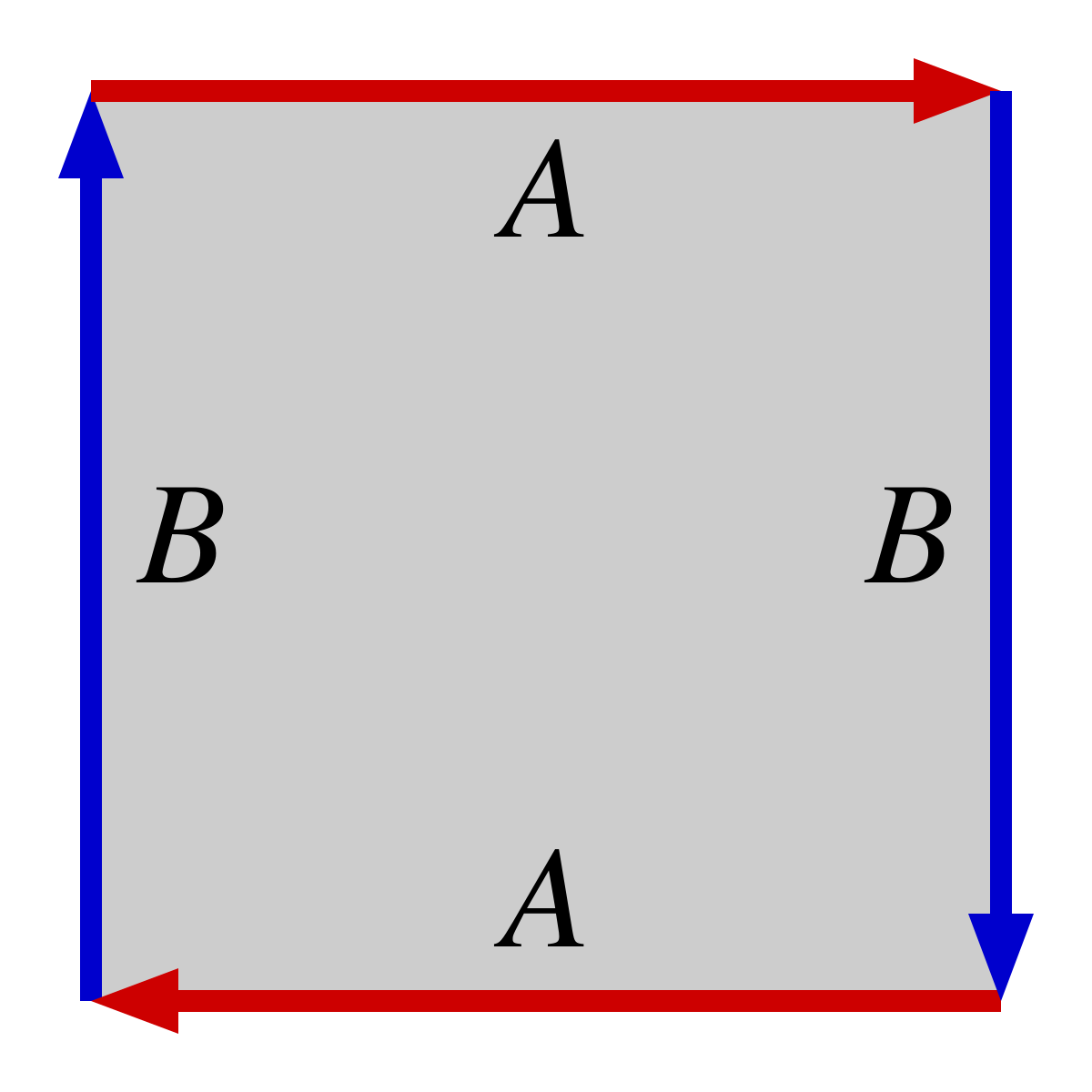
In mathematics, the real projective plane, denoted
        R
        P


        2


{\displaystyle \mathbf {RP} ^{2}}
or
…
half rock
I will look into this, thanks!
dire walrus
np!
primal glade
Help
 primal glade
dire walrus
odd number of leaves
primal glade
dire walrus
odd number of leaves
Yeah
dire walrus
if k number of leaves, then total number of vertices is k+4
the total degree is?
then the number of edges is?
can you do now?
primal glade
dire walrus
if k number of leaves, then total number of vertices is k+4
Let me try
primal glade
dire walrus
if k number of leaves, then total number of vertices is k+4
The total degree is 2k+6 and the edges is k+3?
dire walrus
primal glade
The total degree is 2k+6 and the edges is k+3?
2k+6?
dire walrus
what formula?
coral parcel
How does 10+7+4+2+(1+1+1+....+1) with k ones become 2k+6?
dire walrus
but you are given the degrees
coral parcel
I think the idea is to set that equal to the sum of degrees as computed by actually adding up the degrees.
dire walrus
yup, i was trying to push them towards that
 summer sable
Find $\sup_{A \in O_n(\mathbb{R})} \sum_{1 \leq i \leq j \leq n} a_{ij}$ and determine its asymptotic behaviour as $n \to +\infty$.
vital dewBOT
Slomenist
 summer sable
A = (a_i,j)
(no the sup is not ~ n√n we are only summing over the upper triangular part of the matrix not all the coefficients)
 lethal girder
I just started my discrete math class this week and was wondering if anyone had any tips on my methodology in showing work.. thanks
 quick folio
lethal girder
I just started my discrete math class this week and was wondering if anyone had ...
quick folio
lethal girder
I just started my discrete math class this week and was wondering if anyone had ...
it looks fine
a little long winded but that's never hurt anyone
lethal girder
I think I got carried away with the feeling of chalking lol
 little prism
a truth table wouldnt hurt. much more efficient way of writing down whats going on, easier to read
coral parcel
Hmm, are you talking about Jett's post? Where would you put a truth table there?
odd heart
Yeah, truth tables for statements with quantifiers seem tricky
little prism
well, more just a table with columns x, P(x), Q(x), P(x) or Q(x)
I figured truth table was close enough as a term
coral parcel
Hmm, right.
flint sentinel
Hi, I had a quick question. I have an exam coming up, and we’re doing combinatorics proofs using a method that’s not very well known, so there’s very little material to practice with or to check your answers. I was wondering if anyone is familiar with the following method: (I have to use this specific method from my professor, so no other approach is accepted). If you are familiar with it, could you please help me with some questions? This part counts for 33% of my grade :/
Example of such a proof:

 quick folio
flint sentinel
quick folio
flint sentinel
looks good!
it's an interesting proof method, I like it a lot
I would write g instead of f^-1, because otherwise that's confusing notation
flint sentinel
ye true.
May I dm you by any chance with some questions?
or should I just post it here?
quick folio
sure
dire walrus
flint sentinel
I just want to comment that step 3 can be avoided by just modifying step 2, let me call it step 2'. In step 2' you can count X in a different way, namely by picking k+1 elements, then picking one of them to be x, the rest to be your set A. This is exactly the right hand side count.
But I guess this goes against the philosophy of what you are trying to do? Or are you allowed to do this?
flint sentinel
dire walrus
I just want to comment that step 3 can be avoided by just modifying step 2, let ...
True! My prof just said that over the last few years she noticed some students did not fully understand the proof and sometimes created some functions that would not make sense at all so in this step we need to check if it is actually correct and well defined.
The part of the f o f^-1 must be in the proof tho but the well defined step is normally not needed
dire walrus
flint sentinel
The part of the f o f^-1 must be in the proof tho but the well defined step is n...
Right. I was just hoping you can avoid the whole f business by double counting the same same set
flint sentinel
dire walrus
Right. I was just hoping you can avoid the whole f business by double counting t...
no sadly not would have been nice tbh
primal glade
Help

 winged delta
What can you say about each component?
primal glade
winged delta
What can you say about each component?
Maximal subgraph
winged delta
Sure, sure
I think you may be overthinking it
What does Euler say about each component?
stray reef
primal glade
Help
have you done what the question, and now also Denascite, have said?
do you still need help with this, actually?
 gusty dome
Is it true? $\bigcup_{a\in I}\bigcup_{b\in J_a}C_b=\bigcup_{b\in \bigcup_{a\in I}J_a}C_b$?\
In my opinion Yes. Because
\begin{align*}
x\in \bigcup_{b\in \bigcup_{a\in I}J_a}C_b&\iff \exists b_0\in \bigcup_{a\in I}J_a (x\in C_{b_0})\
&\iff\textcolor{red}{ \exists a_0\in I (\exists b_0\in J_{a_0})(x\in C_{b_0})}\
&\iff \exists a_0\in I \exists b_0\in J_{a_0}(x\in C_{b_0})\
&\iff x\in \bigcup_{b\in \bigcup_{a\in I}J_a}C_b.
\end{align*}
vital dewBOT
Topological Afzal
 gusty dome
i have a bit doubt on red colored line
 random sparrow
how to write the symmetrical difference of two sets using a set builder
coral parcel
random sparrow
how to write the symmetrical difference of two sets using a set builder
I've proposed an answer in #recreational-math. Please don't crosspost the same question between several channels -- it leads to wasted work if people start answering in one channel without having seen what was already said in the other.
random sparrow
coral parcel
I've proposed an answer in <#1238006543153369108>. Please don't crosspost the sa...
,, A \triangle B = { x \mid (x \in A \lor x \in B) \land (x \notin A \lor x \notin B)}
vital dewBOT
Renato
 random sparrow
but idk how to simplify
random sparrow
coral parcel
I've proposed an answer in <#1238006543153369108>. Please don't crosspost the sa...
im sorry, I just thought this channel was more appropriate
coral parcel
gusty dome
Is it true? $\bigcup_{a\in I}\bigcup_{b\in J_a}C_b=\bigcup_{b\in \bigcup_{a\in I...
The general drift looks alright to me -- but I don't understand that happens between the red line and the one below it. As far as I can see you're just removing a set of parentheses which don't really have any semantic effect anyway.
And the step between the last two lines seems to skip over some details that might be half the real meat of the argument.
I think the logical structure of the argument would be clearer if instead of bounded quantifiers exists x in A.p(x) you write the bounds explicitly as exists x(x in A and p(x). That gives more freedom to to replace x in A by equivalents without worrying about violence being done to the quantifier syntax.
coral parcel
random sparrow
im sorry, I just thought this channel was more appropriate
Yes, I think it is. But now, due to the crossposing, I've posted my answer in the other channel because that was where I saw the question first!
gusty dome
coral parcel
The general drift looks alright to me -- but I don't understand that happens bet...
this makes sense, thank you Troposphere

yeah i left some detail in last two lines cuz it was easier imo
true venture
How can you count words of length n over some finite alphabet, counted up to permutations of the letter labels and reversal of the word? Ex. the following words of length 3 with 3 possible letters, 122, 211, 322, 311, 221, 331 are all equivalent under these rules.
Can Burnside's lemma be used here?
primal glade
little prism
the question is clearly asking you to draw examples
Yep but I can’t find a pattern
primal glade
stray reef
have you done what the question, and now also Denascite, have said?
Yeah, but using equations not the example drawing method.
quick folio
primal glade
Yep but I can’t find a pattern
here's a hint - euler's formula is true when there's one connected component, so clearly it's to do with the fact that there are more than 1 connected components
try playing around with that
stray reef
primal glade
Yep but I can’t find a pattern
show the examples you've drawn
primal glade
quick folio
here's a hint - euler's formula is true when there's one connected component, so...
Here is what I found, v-e+(f1+f2)= 4, and an unconnected graph has 2 components( one is the isolate vertex and the other is the other part of the graph), thus one component must have 0 face. Then I found v-e+f always 1 more than the number of components
primal glade
stray reef
show the examples you've drawn
 stray reef
... what are f1 and f2?
unconnected graph has 2 components (one is the isolate vertex)
incorrect, this need not be the case
 weary tiger
Greetings. I would like to verify whether this claim is correct:
A finite subset of N is always semilinear because it's a finite union of singletons that are linear sets.
I think this is true for a finite subset of N^k as well in general 
little prism
primal glade
examples. plural. you are only supposed to draw things and count
 marsh raven
is possible to get back to state here?
unsigned int get_random_U32_number(){
    // get current state
    unsigned int number = state;
    // XOR shift algorithm (in 32 bits)
    number ^= number << 13;
    number ^= number >> 17;
    number ^= number << 5;

    state = number; // updaet random number state
    return number;
}
i can't possibly think that
 broken pivot
in West's text Combinatorial Mathematics, he makes the claim that $\sum_{i=1}^{n-1} i$ counts the number of pairs of elements in $[n] = {1,\dots ,n}$, saying that the sum "groups the pairs by the larger element, applying the sum principle ($i$ pairs have larger element $i+1$)." I'm having trouble parsing his explanation, does anyone have any insight as to what he means, or perhaps a more intuitive explanation as to why this is the case?
vital dewBOT
clover
 cloud rampart
let's apply it to n = 4. there are 10 elements, sorted by the value of their largest element:
i = 1: {1,1} (1 pair)
i = 2: {1,2}, {2,2} (2 pairs)
i = 3: {1,3}, {2,3}, {3,3} (3 pairs)
i = 4: {1,4}, {2,4}, {3,4}, {4,4} (4 pairs)
so adding 1 + 2 + 3 + 4 will total up the amount of pairs in [4]
you can also see that it we bumped it up to n = 5, we would have to add a fifth row with 5 elements (one for each other possible element), and the previous rows would be unaffected, so the number of pairs of elements of [5] would be the previous sum + 5
applying a more general argument should show you that the pattern continues indefinitely
broken pivot
cloud rampart
let's apply it to n = 4. there are 10 elements, sorted by the value of their lar...
this is extremely helpful
thank you!
 scenic heart
How many words can be formed using 7 letters from the word "PERMUTAION" (yep, not "PERMUTATION") all the vowels stays together?
My approach : We have 5 vowels and 5 consonants.
Treat the vowels as one block. So within the block the vowels can be rearranged 5!
Now we have 3 blocks. One vowel block and two consonant blocks.
The vowel block can be placed at the first, middle and the last. If it's at first it has 2 blocks that can be rearrange with 5 consonants. Meaning 5! × 5p2
But it can be in the middle and last position so net rearrangement is 5!×5p2×3
Am i correct?
Please explain.
coral parcel
After you've arranged the vowels, just rearrange {P, R, M, T, N, vowel-block} for another 6! possibilities.
Wait, no, you want 7-letter words.
Yeah, then I think you're right.
scenic heart
Chatgpt, Gemini and other AI's giving me difficult answers. They are giving me different solutions at different time.
Can you recheck it again kindly?
coral parcel
!nogpt
 lofty cloudBOT
Please do not trust ChatGPT or similar AI tools for mathematical tasks, as they often generate output which "sounds correct" but has numerous factual or logical errors. Use of these AI tools to answer other people's help questions is strictly against server rules (see #rules).
primal glade
stray reef
... what are f1 and f2?
Face of component 1 and 2
broken pivot
cloud rampart
let's apply it to n = 4. there are 10 elements, sorted by the value of their lar...
sorry to ping you, but I have a followup question. You iterated from i=1 up to n=4, but the sum says we should iterate from i=1 up to n-1=3, so is the summation bound that West gives incorrect?
maybe this summation is discounting reflexive pairings?
I think that must be it because, in the case of [4], using the sum from 1 to 3 returns 6, which is the number of ways to choose 2 items from a set of 4
cloud rampart
yeah it seems that in order to recover your formula you would discount pairing a number with itself
in which case you remove the last element of each row but the argument is otherwise the same
broken pivot
this makes sense
thank you for your insight
I was going fucking insane trying to think what he was trying to say with his explanation in the text
 void forge
Guys is there a way to compute the number of subsets easier
 vocal island
void forge
Guys is there a way to compute the number of subsets easier
vocal island
void forge
Guys is there a way to compute the number of subsets easier
wdym? Of a finite set?
dreamy coral
void forge
Guys is there a way to compute the number of subsets easier
yes but lets motivate it
void forge
I dont like counting
dreamy coral
void forge
I dont like counting
we can make the counting process a bit less painful
void forge
K
dreamy coral
remember from our talk a moment ago that {1} has 2 subsets, {1,2} has 4
vocal island
For each element you can either have it in your subset or not. So the possible subsets are 2^n, where n is the number of elements in your set
dreamy coral
{1,2,3} has empty, {1}, {2}, {3}, {1,2}, {1,3}, {2,3}, {1,2,3}
void forge
Ok
dreamy coral
vocal island
For each element you can either have it in your subset or not. So the possible s...
man i wanted them to realize this
vocal island
oh, i am so sorry
dreamy coral
vocal island
oh, i am so sorry
thats alright
void forge
I thought it was 2n but its 2^n
dreamy coral
we can actually still use this opportunity to practice induction
dreamy coral
void forge
I thought it was 2n but its 2^n
true, but how do we prove it?
im not sure if ur familiar with induction or not
dreamy coral
i can remind you real quick
dreamy coral
if we think of the natural numbers as steps to some sort of machine working, then they sort of become like dominoes
void forge
ITS THAT if P(x) is true then P(x+1) is also true
dreamy coral
void forge
ITS THAT if P(x) is true then P(x+1) is also true
yep
void forge
I used it on proving that 1+2+...+n=n(n+1)/2
dreamy coral
see how its like dominoes?
if i have a chain of dominoes and i want to make sure all of them fall over
theres really only two things i need to be sure about
if i have one domino itll always knock down the next
and the first domino is knocked down
dreamy coral
void forge
I used it on proving that 1+2+...+n=n(n+1)/2
lets try doing induction to show that a set with n elements has 2^n subsets
(which is to also say that the size of its power set is 2^n)
ok so for the first case, the empty set, we have 1 subset
so it works at n=0
then were gonna assume that a set with k elements has 2^k subsets
if we add a new (k+1)th element to the set, we can add it to any of the previous subsets we had from the last set, and itll be a subset of the new one, right @void forge ?
void forge
Ye
dreamy coral
formally we can say that if $T$ was a subset of ${1,2,...,k}$ then $T \cup {k+1}$ is a subset of ${1,2,...,k,k+1}$
vital dewBOT
hiidostuff
 dreamy coral
but we also have that each previous T is still a subset of our new set
so we have that at least 2^k subsets are still subsets
but now if we add k+1 to each subset we get a subset
so there 2 * 2^k = 2^k+1 subsets
@void forge thats our proof
pretty cool huh?
void forge
Ye
I have another way
So we wanna prove that a set S containing n elements has 2^n subsets
If n=0 then S is the empty set and has only 1 subset which proves P(0) is true (P(n)=S having 2^n substes)
Suppose that P(n) is true and then let S have n+1 elements and let js one of them be a
Now let S-{a}={x in S | x not equal to c} then S-{a} has n elements and thats 2^n subsets
Now every subset OF S either contains or doesnt contain a and those that dont are subsets of S-{a} so there r 2^n of them
But those that do have a consist of those that dont have a but with a adjoined
There are 2^n of that aswell so now it becomes 2^n2^n=2^n2=2^(n+1)
Thus P(n+1) is true and P(n) is also true
Well for non negative n but thats my proof
void forge
void forge
There are 2^n of that aswell so now it becomes 2^n*2^n=2^n*2=2^(n+1)
The fancy n is meant to be a multiplication
void forge
dreamy coral
<@1382744471178842294> thats our proof
I think bro disappeared
dreamy coral
void forge
I think bro disappeared
yeah sorry i was busy for a moment lol
void forge
Its ok
dreamy coral
seems the proof is essentially equivalent to what i did with induction so good work
void forge
Us too
 swift lagoon
may i join in your conversation?
void forge
Does everyone else denote equivalence relations as R
Like the fancy capital R
Or js my book
void forge

swift lagoon
where are you from
void forge
UK
 glass venture
void forge
Or js my book
glass venture
void forge
Or js my book
Which book is it
dreamy coral
void forge
Does everyone else denote equivalence relations as *R*
Yeah
Usually its like xRy or smth
glass venture
void forge
Its called " a first course in abstract algebra" fourth edition
oh nice lol I'm self studying the same one (assuming it's fraleigh)
swift lagoon
void forge
UK
oh my sister is studying in University of Oxford
glass venture
glass venture
oh nice lol I'm self studying the same one (assuming it's fraleigh)
ah yeah nice
void forge
glass venture
oh nice lol I'm self studying the same one (assuming it's fraleigh)
Exactly
dreamy coral
We say a relation R on a set X is a set of ordered pairs (x,y) of members of X
And that the relation between two elements a and b holds if (a,b) is an element of that set
void forge
K
dreamy coral
@void forge from here it'd be a good thought exercise to think about how we can define a function
Based on the definition of a relation
void forge
If theyre not then the relation isnt equivalent
dreamy coral
void forge
If theyre not then the relation isnt equivalent
Then the relation doesn't hold
void forge
dreamy coral
<@1382744471178842294> from here it'd be a good thought exercise to think about ...
Yk i never thought about that
swift lagoon
why not get some exercise to do
void forge
The notation {x|P(x)} is js so ez to forget what it does
dreamy coral
void forge
Yk i never thought about that
Fortunately a function is super close to a relation
There's just one more piece of info you need to add
dreamy coral
void forge
A function is on an x and not a set?
Functions are on sets
Something to note is that a function is a relation, just with a further detail
void forge
Like a specific property?
dreamy coral
void forge
Like a specific property?
Yes
There's something that the ordered pairs cant have in common
dreamy coral
void forge
Idk bro
The first entries cant be the same in any of them
(That's essentially the same as the vertical line test)
An input cant map to more than one output
dreamy coral
void forge
Is that what mapping means i didnt get to that yet
Function and map basically are the same
Usually people talk about mappings on elements from my experience tho
Smth like "The function f on the set X maps each x to x^2"
dreamy coral
So 2 is mapped to 4
vital dewBOT
The sigma
 void forge
My first language isnt even english
 radiant oyster
vital dew
**The sigma**
radiant oyster
vital dew
**The sigma**
hahahaha this is funny out of context
tired summit
No it's not
 worthy saffron
This bothers me; my discrete math course is defining a cycle so that it can repeat vertices
I don't understand why they wouldn't just use the standard terminology
cerulean wind
worthy saffron
I don't understand why they wouldn't just use the standard terminology
a cycle is just a path with the same start and end vertex.
a simple cycle is one which visits each vertex exactly once, the start and end vertex exactly twice.
in other words, it is a cycle in which only the start and end vertices are equal.
besides, every simple cycle is a cycle and every cycle is a concatenation of simple cycles
why is this bothersome for you?
worthy saffron
I never heard the terminology cycle/simple cycle before and when I looked it up the circuit/cycle terminology seemed to be the dominant one
I was being a bit complain-y, sure there are multiple ways of defining it and they're all valid, but I think it's more sensible to name cycles so that all cycles are cycle graphs.
cerulean wind
yea, i suppose
 maiden talon
@errant sequoia uff
 paper swift
Guys, I'm very noob at Number Theory, I'm trying to integrate Mathematics (especially NT and Combi) and Computational Task together, I wanna research on those topics, especially I'm fascinated to solve problems from https://www.projecteuler.net
But I don’t know how can I approach, I wanna start from project euler. I need complete roadmap since I'm absolute beginner. Besides, I want solid foundation of NT as well as Combi and Its implementation on CS as well as solving problems.
A website dedicated to the fascinating world of mathematics and programming
 agile magnet
paper swift
Guys, I'm very noob at Number Theory, I'm trying to integrate Mathematics (espec...
agile magnet
paper swift
Guys, I'm very noob at Number Theory, I'm trying to integrate Mathematics (espec...
There's a Project Euler discord server (DM me if you want a link). You'll probably get better help there for the CS stuff + specific problems.
If you start a problem and there's a math thing you need help on, then this server would be good for asking about the math thing.
odd heart
<@&268886789983436800>
Pah
Beaten
I was too careful not to ping @modern_day_gatsby, next time I'm going to consider them collateral damage.
worthy saffron
Just wanted to vent but it's not really a big deal... got a point off on my discrete math exam because I wrote something like (this isn't the exact same question for obvious reasons, but it's the same structure)
1 + 2 + ... + n + n+1 = n(n+1)/2 + n+1
And I "missed" the associative property step where I had to write...
1 + 2 + ... + n + n+1 = (1 + 2 + ... + n) + n+1
...first. Like, we're allowed to skip steps when distributing and factoring so that felt a bit arbitrary.
 granite knot
Damn they were harsh on you
worthy saffron
It was a single point on a 50-point exam, I got all other 49 points, and I recall now the professor saying the associative property step in an in-class example (though I don't think he said specifically that this step was required), so it's like, okay sure whatever, but I'm glad I got the validation I was looking for 😛
little prism
if you wrote it in sigma notation it would be a much more noticable step. and in terms of general proof writing style, it highlights what you are going to do next which is a good thing
still a bit harsh
 gaunt moss
ngl i took discrete and forgot everything afterward
dreamy coral
gaunt moss
ngl i took discrete and forgot everything afterward
I probably would try to remember it considering that discrete is like basic proofs
paper swift
agile magnet
There's a Project Euler discord server (DM me if you want a link). You'll probab...
Sure brother, I would like that
@agile magnet
fossil mural
worthy saffron
Just wanted to vent but it's not really a big deal... got a point off on my disc...
yeah that's... i mean i kind of get it, because if you let students "skip steps" like that you'll get all sorts of cases where they skip over something that is in fact not that hard but that they don't know how to fill in, ...but also like. what. why that in particular
 quaint zinc
@agile magnet regarding the pumping lemma, what I don't quite get is this: we have a really long string right, and we need to choose vxy smaller or equal in length to p to pump, so then, how do we know how long that can be if we don't have an actual value for p? Do I take a segment with a only a single letter? 2? 10? 100?
Or do we assume that since s is so long, the segment vxy is length p? But then that also doesn't help it doesn't tell us how many characters that is.
I think what I don't get is what p represents in the first place. Is it the minimum length of s such that when constructing it using production rules, a non terminal gets repeated? Idek
agile magnet
I'll paste this here for convenience

I mean study the proof given here. You have to argue that no matter the decomposition of s into uvxyz, if the decomposition satisfies some of the conditions then it must violate other conditions
agile magnet
quaint zinc
<@191656769267695617> regarding the pumping lemma, what I don't quite get is thi...
and we need to choose vxy smaller or equal in length to p to pump
so in the proof in the video, he argues that for s_2, no matter how you split it up into s_2 = uvxyz if uvxyz satisfy condition 2 and 3 then condition 1 must fail
in another proof you may argue that no matter how you split up s into uvxyz if it satisfies condition 1 then condition 3 must fail
that difference is dependant on the problem and the proof, I can't give you a general rule
quaint zinc
bruh its simply beyond the capabalities of my nugget I think. Its not like im ever gonna come across it again though so ill just leave it be ig
thanks anyway
coral parcel
quaint zinc
<@191656769267695617> regarding the pumping lemma, what I don't quite get is thi...
In general your strategy would be to define a whole family of ever longer strings in your language, and argue that none of them can be pumped anywhere.
Then, if you assume the language is context-free, then no matter which number the pumping lemma gives you as p, it will contradict one of your examples.
hardy zinc
Just to check, if $R$ is a relation between $A$ and $B$, and if $(a,b)\in A\times B$ with $(a,b)\in R$ then it follows that $(b,a)\in R^{-1}$ right
vital dewBOT
Real Lost Fruit
 hardy zinc
By definition
coral parcel
Yes, by definition of R^-1.
 spice token
guys does the binary operation need be closed on the finite set for it to be an algebraic structure? are all agebraic strucutres closed? then why do terms like "groupoids" exist, isnt that for closure ? needexpertopiniononthis
spice token
spice token
guys does the binary operation need be closed on the finite set for it to be an ...
@coral parcel can u give a quick ans pls
coral parcel
Do not ping random people for help.
 granite kettle
What is principle of inclusion exclusion
agile magnet
granite kettle
What is principle of inclusion exclusion
If $A$ and $B$ are two finite sets, how do you compute $\abs{A \cup B}$?
vital dewBOT
Spamakin🎷
 agile magnet
(ping me when you reply)
 velvet sandal
can anyone help me solve this?
 quick folio
velvet sandal
can anyone help me solve this?
quick folio
velvet sandal
can anyone help me solve this?
first apply the normal euclidean algorithm to 27 and 146 to solve 27a + 146b = 1
velvet sandal
ok
I am past that, just somewhat confused, was out of class for a week and online notes are not that helpful. ChatGPT is telling me to use a EEA Table to solve this, but it doesn't make much sense, what would be the steps proceeding that?
quick folio
I don't know what an EEA table is
velvet sandal
Extended Euclidean Algorithm table
quick folio
it's just the normal euclidean algorithm with extra steps
essentially what I explained written out
 craggy flint
velvet sandal
I am past that, just somewhat confused, was out of class for a week and online n...
craggy flint
velvet sandal
I am past that, just somewhat confused, was out of class for a week and online n...
use euclidean algorithm to get bezout's coefficients and one of them is the inverse of the number ur looking for
which would be the coefficient being multiplied by a
stray reef
velvet sandal
I am past that, just somewhat confused, was out of class for a week and online n...
!nogpt
lofty cloudBOT
velvet sandal
I am past that, just somewhat confused, was out of class for a week and online n...
Please do not trust ChatGPT or similar AI tools for mathematical tasks, as they often generate output which "sounds correct" but has numerous factual or logical errors. Use of these AI tools to answer other people's help questions is strictly against server rules (see #rules).
stray reef
actually wait do you still need help w this
 fervent nacelle
ZXDVDSSVSSFSDFSFSF
 rapid kernel
So what does it mean here by there exists a walk that visit each edges exactly once? In definition of Eulerian graph

So it doesn't need to complete graph
 runic lava
rapid kernel
So what does it mean here by there exists a walk that visit each edges exactly o...
runic lava
rapid kernel
So what does it mean here by there exists a walk that visit each edges exactly o...
in my understanding, it means of you trace the graph with a pen to reach every node, you only trace it once and you don't trace it more than once i.e. you don't trace it again while trying to reach every node
rapid kernel
runic lava
in my understanding, it means of you trace the graph with a pen to reach every n...
Yes, thank you
What does it mean degree of u is number of indices i such that u = v_i? Does it mean that deg(v_i) = 2i?
I don't think so because what if there is graph v_0 -> v1 -> v2 -> v3.
 runic lava
according to your screenshots, it just means the degree of u is the number of edges containing the node
yea i can't quite extract what the proof is saying exactly
according to the first screenshot, each of v1 and v2 must have degree 2
but the second says
degree equal twice the number of indices i
if degree is 2, 2=2×i. Therefore the number of indices is 1. Now idk what is that indices and why is that 1
i guess it's just a proof for the eulerian graph to prove how it visits an edge exactly once only
because in a non-eulerian graph, a node can be contained by more than to edges and therefore have degree ≥ 2. So the proof for eulerian graph just emphasizes how a node of the degree corresponds to the node itself since it's only being visited once
rapid kernel
runic lava
i guess it's just a proof for the eulerian graph to prove how it visits an edge ...
I don't get it because in my example how this proofs work
runic lava
i haven't really studied graphs so idk
I'm sure watching on YouTube or searching online can fill up the gaps u don't understand
fossil mural
rapid kernel
What does it mean degree of u is number of indices i such that u = v_i? Does it ...
no, it says the number of indices i
as in you count how many there are
for instance if you have the walk A, B, C, D, E, A, C, E, B, D, A, and that visits every edge exactly once, then the vertex D, which is not the first or last node in this walk, occurs twice, meaning it must have degree 4
which makes sense because we can just read off from this walk what exactly its edges are - C, D, E means it has edges to C and E, and B, D, A means it has edges to B and A
to spell it out further, we have the sequence v_0 = A, v_1 = B, v_2 = C, v_3 = D, v_4 = E, v_5 = A, v_6 = C, v_7 = E, v_8 = B, v_9 = D, v_10 = A
and the indices i with v_i = D are i = 3 and i = 9, in particular there are two of them, so the number of indices i with D = v_i is 2
because the number of elements of {3, 9} is 2
rapid kernel
fossil mural
for instance if you have the walk A, B, C, D, E, A, C, E, B, D, A, and that visi...
Yes it is correct
Thank you I got it
primal glade
How to find the chromatic number of this graph?
 winged delta
Shouldn't be hard to show it's not 2
It's small enough that I would try brute forcing a 3 or 4 coloring after that
hidden totem
you mean brute forcing a 3 coloring
brute forcing a 4 coloring effectively does nothing because it won't get you anywhere close to figuring out that 3 isnt possible and since its planar the four color map theorem guarantees 4
winged delta
Well I wasn’t sure what the answer would be until I tried it, but yeah, 4’s always possible
If 3 weren’t, the hope is you’d find some reason why during the brute forcing
hidden totem
oh ||since this is a famous graph, i found the chromatic polynomial haha||
tired summit
hidden totem
oh ||since this is a famous graph, i found the chromatic polynomial haha||
Yeah, the graph is the ||dodecahedral graph||
odd heart
hidden totem
oh ||since this is a famous graph, i found the chromatic polynomial haha||
I mean, there's an algorithm for determining the chromatic polynomial, so the comedy option is to use that, and then find the first integer for which the chromatic polynomial is not zero
hidden totem
yeah i just meant since it's a well known graph i didn't need to use that algorithm, it was a simple lookup
odd heart
Yeah, and also by "comedy option" I meant that this algorithm would be quite tedious on a graph this size
And just feeling it out and trying to find a 3-coloring (or an argument why it fails) would probably be faster
weary tiger
Hey fellow math peoples, so I have a question, when you perform a discrete-time fourier transform on a signal; what does the complex output actually represent? Because I assume I cannot just change frequency by just modifying the discrete-time fourier transform?
quick folio
weary tiger
Hey fellow math peoples, so I have a question, when you perform a discrete-time ...
well it's the frequency domain in discrete space
the discrete fourier transform really is the same as the CT fourier transform but discrete
Because I assume I cannot just change frequency by just modifying the discrete-time fourier transform?
I don't understand what you mean here
weary tiger
What I mean is; say I had a discrete version of a 1Hz sine wave sampled at a frequency of 100Hz, performed a discrete fourier transform on it, and, say added 5+0i to every value in the frequency domain, and then used the inverse discrete fourier transform, would the resulting signal be of a higher frequency?
quick folio
weary tiger
What I mean is; say I had a discrete version of a 1Hz sine wave sampled at a fre...
saying that the resultant signal having higher frequency is a confusing statement, since you've increased the amplitude of every frequency of the signal
the resultant signal is not even going guaranteed have a fundamental frequency anymore, it's going to be a bunch of jumbed noise
quick folio
if you have a periodic signal and you want to increase its frequency, then you just uniformly shift its fourier transform to the right (assuming no aliasing happens)
weary tiger
quick folio
saying that the resultant signal having higher frequency is a confusing statemen...
So, instead of doing that, could I instead zero-pad the input signal and then shift the fourier transform into the higher frequencies?
quick folio
yeah
weary tiger
So say I wanted to shift every frequency down by a factor of 1.35, do I have to zeropad before the signal starts in the time-domain?
(In order to shift down)
quick folio
weary tiger
So say I wanted to shift every frequency down by a factor of 1.35, do I have to ...
like the issue with just moving down without zeropadding, is that if the bandwidth of your signal is too wide then the lowest frequencies might wrap back around to the right when you shift the frequencies
so in practise yes do it
weary tiger
I got it! Thank you!
 rigid night
For a non-negative integer $n$, what is the number $N_n$ of tuples $(i_1, ..., i_{n-1})$ of non-negative integers such that $\sum_{j = 1}^{n-1} (n-j) i_j = (n-1) i_1 + ... + i_{n-1} < n$? In particular, an informal ``geometric'' estimate suggests [ N_n \sim \frac{1}{(n-1)!} \times \prod_{j=1}^{n-1} \frac{n}{n-j} = \frac{n^{n-1}}{(n-1)!^2} \mathrlap{\qquad\text{as $n \to \infty$;}} ] is this true?
vital dewBOT
Raghuram

 sinful peak
What are some of the harder/more misunderstood topics people see in a discrete math class?
spice token
Are these two equal
 little prism
what can you say about cycles of certain lengths
stray reef
spice token
Are these two equal
do you think they are or do you think they aren't
spice token
stray reef
do you think they are or do you think they aren't
They don't have the same properties
stray reef
ok, which property distinguishes them?
spice token
stray reef
ok, which property distinguishes them?
Hamiltonian cycle
stray reef
so you're saying that one of them has a hamiltonian cycle and the other does not?
spice token
Shouldn't this only be 1 why is the answer 24 bruh
 spice token
stray reef
so you're saying that one of them has a hamiltonian cycle and the other does not...
spice token
stray reef
so you're saying that one of them has a hamiltonian cycle and the other does not...
Yes
stray reef
spice token
Yes
ok, which one does and which one does not?