#discrete-math
1 messages · Page 71 of 1
 hidden totem
you can prove the case for P(0)
which is fine but not necessary
the problem only asks to prove from P(1) onwards
you CAN start with P(0)
 muted basin
im just utterly confused
if we need 2 bases for strong induction
why wouldnt we want the decremented base from our first base test
hidden totem
you can use a single base for strong induction
strong induction is about the inductive step
so look
your inductive step is
if P(n-1) and P(n), then P(n+1)
the strong inductive step is
if P(n) for all n from something to n, then P(n+1)
this is way more powerful than you need
but you can still use it with a single base case
how many base cases is not what makes it strong induction
again
you CAN use P(0) and P(1) as a base
ive said that like a hundred times already
its a valid proof
but you dont HAVE to do that
because the problem does not ask you to prove P(0)
it only asks you of P(1) onwards
thats why it chooses P(1) and P(2) as the base cases
if i asked you to prove P(n) for all integers from -3 onwards
why would you start with a P(-4) base case
muted basin
i just dont understand why you need P(2) here or a second base case at all
when induction implies it already
hidden totem
right here
induction does NOT imply it
you must assume P(2) in order for this to hold true
but you have not yet established P(2)
you ONLY have a P(1) base case
without P(2), you cannot do this substitution, so your proof fails to prove P(3)
and if you dont have P(3), then you dont have P(4)
muted basin
im confused on why youre proving F(5) in the first place
it never occurs in the problem or is needed
hidden totem
no, not correct
hidden totem
muted basin
for all n >= 1
this is wrong
also your induction sentence is not complete
a simple inductive step to prove would be like
IF P(n) THEN P(n+1)
muted basin
the way my prof described induction conclusion is its what we want to go for
by manipulating the hypotht
hypothesis
muted basin
i dont know what that means. he has us do it procedurally with base case, inductive hypothesis which is usually P(n) or whatever statement it is, induction conclusion which is P(n+1), and then inductive step is the proof
hidden totem
ok so thats the problem
you dont know how induction works yet
stop saying prof said this or prof said that
the problem is your logic isnt clear
so lets look at simple induction first
muted basin
im just telling you what i know based on what ive been taught
hidden totem
ok well stop
muted basin
he expects us to solve it in only that format
hidden totem
do you want to assert what you remembered from class for which you dont know the reasoning for
or do you want to actually learn how it works and actually follow my explanation
because im volunteering my free time here
muted basin
i want to learn how it works but i just simply dont understand
hidden totem
then for a minute
forget whatever your prof said
and focus on the logic of my explanation
ok?
or im out
muted basin
can do
hidden totem
ok
so lets understand simple induction first
suppose we want to show that P(n) is true for all n at least 0
we cannot brute force this
because there are an infinite number of cases to test, yes?
muted basin
yes
hidden totem
ok so we start by proving P(0)
now we prove the following statement:
IF P(n), THEN P(n+1)
once we show this statement is true
can you see that this means:
IF P(0), THEN P(1)
and now we have P(1)
is this clear?
muted basin
yes
hidden totem
ok
but can you see that this only works if we have P(0)
without P(0), we cannot show P(1)
muted basin
right
muted basin
my intuition says prove P(1)
hidden totem
(which we have now)
muted basin
but also if we proved P(0) then we can show P(1)
hidden totem
yes
muted basin
so instantly P(2) works
hidden totem
bingo
can you see that the starting seed of P(0) gives us everything
up to infinity
muted basin
yes
hidden totem
ok good
so now lets summarize
we are trying to prove:
P(n) for all n at least 0
we do this by breaking this into two things to prove:
P(0)
IF P(n), THEN P(n+1)
can you now see why the "if then" is critical
the inductive step in full is "IF P(n), THEN P(n+1)"
at least for this simple induction case
following?
muted basin
right
hidden totem
ok
now lets see what happens if i do the following
suppose i want to prove the same thing
that P(n) from 0 on
i once again have P(0)
but this time, i have proved the statement:
IF P(n-1) AND P(n), THEN P(n+1)
question, how would we prove P(3)?
muted basin
i would need to prove P(n+1) and P(n+2)
muted basin
sorry i guess rather P(1) and P(2)
hidden totem
good
actually i made a mistake
meant to write P(2) but you got the idea
we are definitely missing P(1)
if we have that, then we have P(2)
and then we have P(3)
and so on, this keeps going again
but notice we need two base cases now
so far so good?
muted basin
yes
hidden totem
ok now for the problem you are trying to solve
can you now write your inductive step IN FULL in terms of either the F statement or just using the P placeholder?
muted basin
i think im starting to get the picture a little bit better
here one sec
We want to prove F(n+3) = 2F(n+1) + F(n) for n >= 1.
Base: P(n) = P(1) = F(4) = 2*F(2) + F(1) which holds
Because we want to prove a recurrence relation we need the gaps as well, and P(n+1) works here as a base case to fit that P(n-1) and P(n) then P(n+1). F(5) is valid so now we have, in regards to the example you gave, the equivalent of P(1) and P(2) so we can find P(3) now.
this is where my last gap of confusion is
in this problems context P(2) is the F(5) if n is 1
but were still safe to make the conclusion goal F(n+4) right
hidden totem
muted basin
We want to prove F(n+3) = 2F(n+1) + F(n) for n >= 1.
Base: P(n) = P(1) = F(4) =...
I think you got the idea here about whats wrong with your solution
muted basin
we want it to be equal to 2F(n+2) + F(n+1)
hidden totem
muted basin
but were still safe to make the conclusion goal F(n+4) right
im not sure what this means
because
the F(n+3) = blah
and the F(n+4) = blah
is the same thing? it just depends on what n is
if n=2 in the first one, thats the same as n=1 in the second one
so like
if you can show F(n+3) = blah for n at least 3
that is the exact same thing as F(n+4) = blah for n at least 2
does that make sense?
muted basin
yeah
muted basin
yeah i think
let me rephrase to clarify
the P(n) we want to prove has 2 previous terms
so we meed two succeeding base cases to prove thst relation works
hidden totem
perfect
remember that the inductive step is always an "if then" statement
its not something you just take for granted
muted basin
gotcha, thank you for the help i appreciate it a lot
 grand totem
a bit late but this particular problem won't give too much insight into induction since it admits a very quick direct proof
||F(n + 3) = F(n + 2) + F(n + 1) = F(n + 1) + F(n) + F(n + 1) = 2F(n + 1) + F(n)||
 lethal linden
hax
 brazen mortar

 stray reef
brazen mortar
stray reef
brazen mortar
 stoic sky
can someone help me with this True or False question
If a 10-vertex graph G has 2 edge-disjoint spanning trees, then G contains at least 38 different cycles
stray reef
stoic sky
If a 10-vertex graph G has 2 edge-disjoint spanning trees, then G contains at le...
do you think it's true or do you think it's false
stoic sky
hmmm i do know that the edges must be at least 18
im trying to draw some small example atm
but im leaning toward true
also i know that adding an edge to a tree increase it cycle count by 1
so hmm
 tardy tangle
Does every finite sequence of digits occur infinitely many times in the decimal representation of π?
 odd heart
We don't know
We don't even know if every finite sequence of digits occurs at least once.
tardy tangle
Interesting
I remember Harold Finch in the TV show Person of Interest said that every finite sequence does occur. But of course that was a fictional show
This line of thinking seems to give rise to a whole new system for categorizing irrational numbers
odd heart
odd heart
We don't even know if every finite sequence of digits occurs at least once.
Actually if every finite sequence appears, then every finite sequence appears infinitely many times, so it's going to be equivalent
odd heart
tardy tangle
This line of thinking seems to give rise to a whole new system for categorizing ...
A related, stronger notion is normality (https://en.wikipedia.org/wiki/Normal_number)
Every normal number is disjunctive, and every disjunctive number is irrational, but the converse implications don't hold (and we do know that pi is irrational, but we don't know whether it's disjunctive, let alone normal)
hidden totem
normal feels significantly stronger than disjunctive
i wonder if there is anything in between other than n number of bases where it is disjunctive
like some kind of more natural property
 iron marsh
I could use some help with this. It has to do with the general binomial functions, but that dang and seeing it as a product of 2 sums, but that 2n-k in the 2nd binomial coefficient is really messing with me!

In particular, these coefficients correspond to the product:
$\sum_{k} \binom{2k-1}{k} \frac{(-1)^{k-1}}{2k-1} \cdot \sum_{k} \binom{2k+2n-1}{n+k} \frac{1}{2k+2n-1}$
 vital dewBOT
dackid
 iron marsh
It's that dang n+k that is messing things up
Note the first sum is $B_2(-1)^{-1}$, where $B$ refers to the general binomial function
vital dewBOT
dackid
 iron marsh
Better question: why is this true? In particular, the end is almost Vandermonde convolution, but where'd that extra fraction go?

 median flame
What are the possible rational outputs for $\cos\left(\frac{2}{3}\arccos\left(x\sqrt{3}\right)\right)$ if x is rational?
According to Niven's theorem, the only rational outputs of cos(n) are -1, -1/2, 0, 1/2, or 1 if n is a rational multiple of pi (or just rational, for degrees), but I'm not sure if those cases where n don't meet that stipulation are just cases like cos(arccos(m)), etc.
vital dewBOT
Tiger Ros

 drifting sand
Sanity check, if a planar embedding with n vertices has 3n-6 edges, every face is bounded by 3 edges right
n >=3

 primal valley
any idea on how to do this

i got 12,3,5 using a spiral strategy but am very unsure of my answer
 tired summit
drifting sand
Sanity check, if a planar embedding with n vertices has 3n-6 edges, every face i...
tired summit
drifting sand
Sanity check, if a planar embedding with n vertices has 3n-6 edges, every face i...
Yeah
 fossil torrent
primal valley
any idea on how to do this
fossil torrent
primal valley
any idea on how to do this
The 3, and 5, seems right. But 12? I got 13.
 granite wharf
any hint on this? , I tried to apply induction, but I got stuck in proving P(n) --> P(n+1), I dont really understand what happens to the graph when adding one node, and I am not sure if it will work for the induction step
 stray reef
i don't think ordinary induction is gonna do you much good
strong induction somehow maybe?
primal valley
fossil torrent
The 3, and 5, seems right. But 12? I got 13.
yea realized i did it wrong, got 13 also
lethal linden
granite wharf
any hint on this? , I tried to apply induction, but I got stuck in proving P(n) ...
What are you inducting on?
lethal linden
granite wharf
any hint on this? , I tried to apply induction, but I got stuck in proving P(n) ...
Hint: For every vertex v, either deg(v) <= |V|/2 or deg(v) > |V|/2
granite wharf
lethal linden
**Hint**: For every vertex `v`, either `deg(v) <= |V|/2` or `deg(v) > |V|/2`
thanks , I will check this approach
 bright zenith
Given $d, k, n$, how many $k-$element subsets $S$ of ${1, 2, \ldots, n }$ are such that any two distinct elements of $S$ differ by at least $d$?
vital dewBOT
phoenixperson

 tulip cliff
Revisited an old topic, hopefully it's better this time! https://www.youtube.com/watch?v=rvTkN2wDdm0
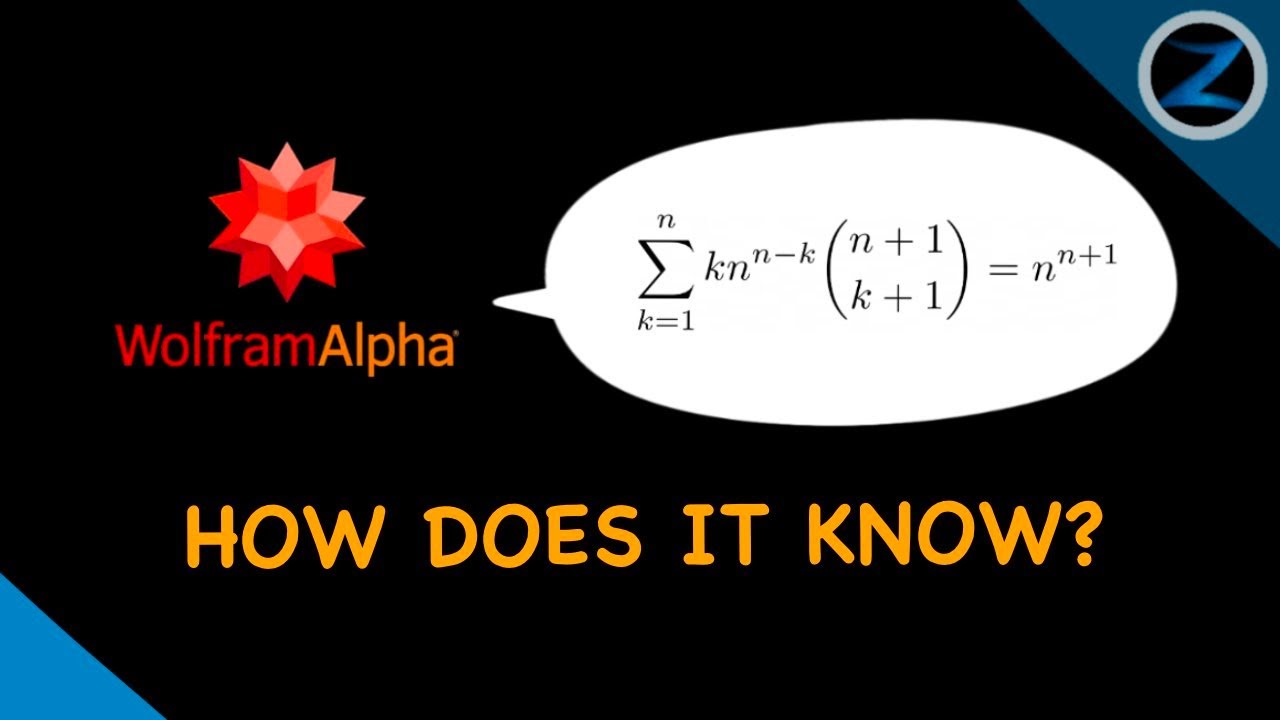
Please check out the source of this video: https://www2.math.upenn.edu/~wilf/AeqB.html
Original video: https://youtu.be/0LFg5dvPOoc
An informal overview of how to use a computer to solve the problem of finding closed forms of hypergeometric identities, covering 2 of the 4 major algorithms: Sister Celine's method and Gosper's algorithm.
The vid...
median flame
can $c$ in $c=\sqrt{a^{3}b-ab^{3}}$ ever be in integer if $a$ and $b$ are integers?
vital dewBOT
Tiger Ros
 median flame
(and ab=/=0)
 rustic star
fork
rustic star
median flame
can $c$ in $c=\sqrt{a^{3}b-ab^{3}}$ ever be in integer if $a$ and $b$ are intege...
a = 1, b = 1 gives c = 0
ab = 1
a = b all gives 0
because the thingy under the root is ab(a-b)(a+b)
median flame
oh right, i should've said a=/=b lol
 hearty spoke
What if you have an alternating series that alternates a non-integer amount of times
For example
(-1)^(n/zeta(2))/n
How would you calculate the convergence of such a series and what it even converges to
?
stray reef
hearty spoke
For example
(-1)^(n/zeta(2))/n
raising -1 to a non integer power is highly sus
bright zenith
bright zenith
Given $d, k, n$, how many $k-$element subsets $S$ of $\{1, 2, \ldots, n \}$ are ...
Source for solution:
Let $A$ be the set of sequences we want to count, and $B$ be the set of strictly increasing functions from $[k] = {1, \ldots k }$ to $[n - (d - 1)k + (d - 1)]$. They correspond bijectively by $H:A \to B$ given by $H(f)(i) = f(i) - 2i + 2$ for given $f$ in $A$, with inverse being $H^{-1}(g)(i) = g(i) + 2i - 2$. So the answer is $\binom{n - (d - 1)k + d - 1)}{k}$. If anybody cared, I leave to them to check that the functions go to the appropriate ranges.

Mathematics Stack Exchange
How many ways are there to select $k$ elements from the set $[n]$ such that the numbers selected differ by at least three?
I thought of considering two cases: $n-k$ is even or $n-k$ is odd. If $n-...
vital dewBOT
phoenixperson

 echo niche
OK SO UR TELLING ME THE SUM OF ALL NATURAL NUMBERS IS -1/12 AND THE HARMONIC SERIES DIVERGES???
echo niche
I mean ramanujan proved its -1/12
 fossil mural
no he didn't
echo niche
Yes he did 👍
fossil mural
none of the partial sums of 1 + 2 + 3 + 4 + ... are negative, so none of them are ever within 1/12 of -1/12, so it doesn't converge to -1/12
echo niche
U can google more proofs of it
hearty spoke
echo niche
OK SO UR TELLING ME THE SUM OF ALL NATURAL NUMBERS IS -1/12 AND THE HARMONIC SER...
Isnt it analytical continuation?
fossil mural
he guessed (i'm not convinced that what he did constituted a proof) that there is a complicated relationship between 1 + 2 + 3 + 4 + ... and the number -1/12
echo niche
Ye
fossil mural
fossil mural
he guessed (i'm not convinced that what he did constituted a *proof*) that there...
this relationship is not equality, because 1 + 2 + 3 + 4 + ... diverges
in particular it approaches infinity, because for every N, after ceil(N) terms the partial sums are all above N
hearty spoke
hearty spoke
Isnt it analytical continuation?
If its not continuing the domain of the zeta function then it diverges but if it does continue the domain of the zeta function it converges
iirc
fossil mural
you can say a lot of interesting stuff about like, zeta(-1) or whatever, but none of those are "actually the sequence 1 + 2 + 3 + 4 + ... converges", because it doesn't
hearty spoke
fossil mural
you can say a lot of interesting stuff about like, zeta(-1) or whatever, but non...
I agree
echo niche
Use the dirichlet regularization
hearty spoke
echo niche
Use the dirichlet regularization
It doesnt converge on its own man
If you apply stuff then ok
But if you dont
fossil mural
or more precisely, you can say things about "1 + 2 + 3 + 4 + ..." if you use a different notion of what an infinite sum is
hearty spoke
Let it go
fossil mural
if you use the usual notion of an infinite sum, then "1 + 2 + 3 + 4 + ..." is the limit of its partial sums 1, 3, 6, 10, 15, 21, etc., and the partial sums are monotonically increasing and unbounded so they approach infinity
hearty spoke
Also guys i made something a little interesting
I turned the oplus function into an infinite version
The oplus function btw is the one 3b1b referenced in his video about the triangle of power where its (a^-1 - b^-1)^-1 and so i extended the function to be infinite wheres its basically
1 oplus 2 oplus 3 oplus 4…
I haven’t fully refined it or even know all of its nature but I want to share it to see if anyone can add anything to it
echo niche
,w zeta(-1)
vital dewBOT


 Requested by sigmaboy0222
fossil mural
Requested by sigmaboy0222
fossil mural
yep, zeta(-1) is equal to -1/12 and isn't equal to 1 + 2 + 3 + 4 + ... which diverges
the fact that if you take the formula that defines zeta for inputs with real part > 1 and just naively plug in -1 and rearrange you get 1 + 2 + 3 + 4 + ... isn't really relevant because the real part of -1 is not > 1, so the actual definition of the zeta function there isn't that it's an infinite sum, it's an analytic continuation
echo niche
Ok zetax=∑1/k^x
fossil mural
that's true if Re(x) > 1
the right-hand side isn't defined if, for instance, x = -1
so if you're taking this as your definition of zeta, then zeta(-1) isn't defined
fossil mural
well it's also monotonically increasing and unbounded, so it also goes to infinity
hearty spoke
echo niche
But why does the harmonic series also diverge?
1 not > and including 1 plus what bee said
fossil mural
fossil mural
well it's also monotonically increasing and unbounded, so it also goes to infini...
the counterintuitive part here is that it's unbounded, but if you just
1/2 + 1/3 + 1/4 + 1/5 + 1/6 + 1/7 + 1/8 + ...
decrease each term to the nearest power of two
1/2 + 1/4 + 1/4 + 1/8 + 1/8 + 1/8 + 1/8 + ...
now if you group them together, 1/2, then 1/4 + 1/4 = 1/2, then 1/8 + 1/8 + 1/8 + 1/8 = 1/2
you get 2^(k-1) copies of 1/2^k, which always sums to 1/2
so it ends up as just 1/2 + 1/2 + 1/2 + 1/2 + 1/2 + ... which clearly diverges to +inf
echo niche
I read that every little sum is bigger than 1/2 so thats why
fossil mural
fossil mural
so it ends up as just 1/2 + 1/2 + 1/2 + 1/2 + 1/2 + ... which clearly diverges t...
and the partial sums of the harmonic series are strictly bigger than this, so, they also diverge to +inf
hearty spoke
fossil mural
and the partial sums of the harmonic series are strictly *bigger* than this, so,...
Does the alternating series of zeta(-1) converge or oscillate?
fossil mural
...well zeta(-1) isn't a series, do you mean 1 - 2 + 3 - 4 + 5 - 6 + ...?
that diverges, its partial sums are 1, -1, 2, -2, 3, -3, etc
so it doesn't converge to anything (not even positive or negative infinity), it just keeps flipping between big positive numbers and big negative numbers
echo niche
Using other things its 1/4
fossil mural
1 - 2 + 3 - 4 + 5 - 6 + ... is not 1/4
some other notion of summation applied to the sequence 1, -2, 3, -4, 5, -6, ..., is 1/4
fossil mural
...no it doesn't
 glossy roost
Hi, I have a question about solving for the variance of a random variable. Since Var[X] = E[X^2] - (E[X])^2 and we can easily solve for E[X] using linearity of expectation, is there a similar method that we can use to solve for E[X^2] or do we always need to compute it manually using the formula?
 twilit sundial
for some discrete distributions you can use indicator variables (specifically computing the moments of the number of events that occur), see 7.3 in ross first course in probability for some examples
<@&268886789983436800>
hearty spoke
Testing out TeXit
$x$ - $y$ = $5$,
$x$ = $zeta($y$)$
vital dewBOT
Cheetle

 true venture
If I have a collection of n distinct subsets of N, all being of cardinality k, how many different collections can I have if collections with a similar intersection pattern are considered the same?
For example: n=2, k=2 there are two collections I can have (1,2),(1,3) and (1,2),(3,4).
The collections (1,2), (1,3) and (1,2),(1,4) are considered the same as they both have 2 sets with 1 element in both.
I'd think there is some binomial expression T(n,k) for this, or maybe it is better rephrased with graphs or something?
true venture
Think these collections can be thought of as hypergraphs
true venture
as I have written above the hypergraphs would be unlabeled, but maybe it is easier to consider labeled
My motivation for this is looking at all collections of subsets of [n] of the same size. For example for [3] and subsets of size 2, there are the collections ((1,2)), ((1,3)), ((2,3)), ((1,2),(1,3)), ((1,2),(2,3)), ((1,3),(2,3)), ((1,2),(1,3),(2,3)). So there are 3 collections with a single element, 3 with two elements and 1 with 3 elements.
stray reef
hearty spoke
Testing out TeXit
$x$ - $y$ = $5$,
$x$ = $zeta($y$)$
#bots but also this is not how to use TeX. dollars should enclose entire formulas and not individual symbols.
 quick folio
hearty spoke
Testing out TeXit
$x$ - $y$ = $5$,
$x$ = $zeta($y$)$
quick folio
hearty spoke
Testing out TeXit
$x$ - $y$ = $5$,
$x$ = $zeta($y$)$
To do that, consider instead $x-y = 5, x = \zeta(y)$
vital dewBOT
HChan

 strong cloud
vital dewBOT
strong cloud
vital dewBOT
theaveragejoe6029

 limpid coyote
I only just realised that there was an error in formatting. I'll resend it now lol. sorry.
So I’m trying to solve $x^{134843} = 19$ mod $203299$ I’ve found that 203299 is semi prime and factors into 773 and 263 by using difference of squares. So I can solve it in two equations and combine it later using crt. So basically, I’ve got the two equations and I reduce them using fermats little theorem and I end up getting as one of them $x^{175} = 19 $ mod $ 263$ but I have no idea where to go from there.
vital dewBOT
theaveragejoe6029
 twilit sundial
you can probably reduce further by looking at $x^{131}?$
vital dewBOT
elrichardo1337
 twilit sundial
for mod 263
limpid coyote
twilit sundial
you can probably reduce further by looking at $x^{131}?$
how come? Sorry, I don't see how.
 light mango
this might be a stupid question but can some one help me understand how the last step of the kv map is determined? i don't really get how the biconditional i.e if and only if is evaluated. why is the bottom row shaded for this?
 light mango
this might be a stupid question but can some one help me understand how the last...
light mango
light mango
this might be a stupid question but can some one help me understand how the last...
got it never mind
 drowsy frost
can i ask questions here?
lethal linden
drowsy frost
can i ask questions here?
!da2a
 lofty cloudBOT
drowsy frost
can i ask questions here?
lofty cloudBOT
drowsy frost
can i ask questions here?
No need to ask “Can I ask…?” or “Does anyone know about…?”—it’s faster for everyone if you just ask your question! See https://dontasktoask.com/
 torn sierra
torn sierra
torn sierra
I am stuck on this. Can anyone help ?
 mild aspen
can anyone give me a small crash course on group theory and graph theory for exam ?
torn sierra
I want to study Group theory and Graph theory. Does anyone want to be my study partner ?
 copper inlet
drowsy frost
can i ask questions here?
copper inlet
drowsy frost
can i ask questions here?
Yes
hidden totem
torn sierra
I am stuck on this. Can anyone help ?
so i dont have a solution to this problem unfortunately
but i do have an answer
basically you do this:
||write out the sequence n! in a row, prepending a 1 to the front
then continue taking finite differences at each row
the diagonal along the left edge is your sequence that solves your problem generally, find the 7th term for your answer (remember it indexes from 0, not 1)||

however i am now mega interested in this problem and will be looking for a solution
 old hatch
Hello ✌️
I'm studying discrete mathematics, currently I'm in the applications part of the principle of mathematical induction, and I ended up coming across the following problem:
Prove that for every n greater than 3 there exists a convex n-gon with exactly 3 acute angles.
What I've tried so far:
I started with an equilateral triangle ABC, and I kept adding vertices on the BC side, it turns out that angle A is still acute, and B,C too because they are angles between a chord and a radius, but I don't know how to put this into an induction... (this exercise is in a book I'm using as a study guide, but it's in Portuguese, so I'm trying my best to translate my problem)
Does anyone have any suggestions on how to start demonstrating for k+1?
hidden totem
so lets say the statement you want to prove is P(n) for all relevant n
in this case, P(n) = "there exists a convex n-gon with exactly 3 acute angles"
and you want to prove this for all n>3
there are two key steps to simple induction: the base step (prove P(4) in this case) and the inductive step, which is
if P(k), then P(k+1)
so to do the inductive step, you first assume that P(k) works
in this case it means taking the polygon that satisfied the conditions of P(k)
and then showing that you can apply your steps to add a vertex so that you get a polygon that prove P(k+1)
 sick grail
(I also have a suspicion that there has been a mistranslation and it is quite likely that in Engish it would be n greater than or equal to 3, since taking P(3) and not P(4) as the base case makes a lot more sense)
 trim thicket
i have this question and i dont get what its asking
theres no other context given
it also doesnt say like $k_{0}=0,k_{1}=1$ or something like that
it also doesnt say what T(n) could also possibly equal to
 vital dewBOT
2ndchar
 lethal linden
trim thicket
i have this question and i dont get what its asking
theres no other context giv...
lethal linden
trim thicket
i have this question and i dont get what its asking
theres no other context giv...
Really? There's no other context? It's not contained on a larger page? The expressions k_n,r_n, T(n), etc. don't occur anywhere previous in the text?
trim thicket
nope
i asked my classmates
they're clueless too
i just emailed the teacher
tbh i mostly wanted a sanity check because
i thought this was too little information
but like i wasnt sure if i was just being really dumb or something
if the context is in the textbook or something
theres not even like a line that says "go look to page ??? for this question"
i dont understand 😭
hidden totem
100% not enough information
trim thicket
great, now how the heck am i gonna explain that to my teacher 😭
because i emailed them about it and they said
"Prove the second expression by using the first"
which is not helpful in the least????????
im not confident in my math terms but
so we dont know:
k_n's definition
k_n initial conditions
what T(n) equals
hidden totem
hidden totem
basically you do this:
||write out the sequence n! in a row, prepending a 1 to t...
@torn sierra ooooh from the spoiler tags i gave, i found a lead:
||let A(n) be the number of ways to seat n people according to the conditions of the problem
A(n) + A(n+1) = D(n), where D(n) is the number of derangements of n objects||
 sour magnet
Can somebody help me with finding the discrete Fourier transform of signum function in discrete time domain?
 worldly fulcrum
trim thicket
so we dont know:
k_n's definition
k_n initial conditions
what T(n) equals
worldly fulcrum
trim thicket
so we dont know:
k_n's definition
k_n initial conditions
what T(n) equals
this is wild. would love to get an update on this
lethal linden
trim thicket
great, now how the heck am i gonna explain that to my teacher 😭
because i email...
I'm guessing based on the form and names that a candidate for $T(n)$ is the n-th triangular number, i.e., $$T(n) = 1 + 2 + \cdots + n = \frac{n(n+1)}{2}$$
And that $r_n$ is somehow related to remainders. Maybe you're in a class that's talking about algorithms or circuits for adding binary numbers, like adders and half-adders?
vital dewBOT
Cufflink

 outer bridge

what should be the answer of this question?
: not home work exercise it is a workbook question that i am stuck at
hidden totem
ignoring the answer choices, how would you solve this?
bright zenith
What's an explicit bijection between the compositions of size n with k parts (1 <= k <= n), and the compositions of the same size of (n + 1 - k) parts? I have nothing to show for the time I've spent thinking about it so I guess I'll spend some time reviewing and stuff  . Fingers crossed I'm not being overly dumb......
Wait you could just translate a composition (a_1, ... , a_k) to the word 0^(a_1 - 1)1...10^(a_k - 1). Then switch that to 1^(a_1 - 1)0........01^(a_k - 1) to get a composition in (n + k - 1) parts. Then this mapping is its own bijective inverse  . Any kinks in this?
twilit sundial
I’m trying to count the number of (nonisomorphic) 8 participant tournament brackets with “depth” 4 (ie the largest number of matches someone can play is 4); I’m getting 7 but some online sources are saying.6, where am I overcounting?
 hidden totem
bright zenith
What's an explicit bijection between the compositions of size n with k parts (1 ...
hidden totem
bright zenith
What's an explicit bijection between the compositions of size n with k parts (1 ...
wait im confused, are these compositions or weak compositions?
suppose n=4, k=2
you could do like (2,2)
but now you want a composition with n-1+k parts, which is 5
you cant do this unless you allow zero
also based on your word method, if im understanding correctly, (2,2) would give 01, which you flip to 10, but i dont see how this word converts back to a composition in a different number of parts
also i dont think it works, no matter whether its a composition or weak composition
twilit sundial
seems like you could just use binomial coefficients?
bright zenith
hidden totem
wait im confused, are these compositions or weak compositions?
If it starts or ends iwth a 1, it's assumed to have a "0" before (if it starts with a 1) or after (if it ends with a 1) , with an exponent being with a (a_1 - 1) or (a_(x) - 1), where a_i = 1. So then the difference is effectively 0, which is why it doesn't appear. Forgot to mention that part.
So for example, 010 turns to 101. The middle 0 gives (a_2 - 1) = 1, so a_2 = 2. Then the "first" and "last" 0s gives 2 more +1s, completing the composition. But those wouldn't get switched with the mapping
Edit: No wait I'm dumb it works. First has 4 components, 2 parts. Seconds has 4 + 1 - 2 = 3 parts.
twilit sundial
or ||swap the balls for dividers and vice versa||
hidden totem
twilit sundial
I’m trying to count the number of (nonisomorphic) 8 participant tournament brack...
i reconstructed the same cases myself recursively, i think 7 is correct
twilit sundial
nice so the online sources might be wrong
hidden totem
bright zenith
If it starts or ends iwth a 1, it's assumed to have a "0" before (if it starts w...
oh you meant n+1-k
you typed n-1+k earlier so i got hella confused
 twilit sundial
nice so the online sources might be wrong
twilit sundial
twilit sundial
nice so the online sources might be wrong
https://oeis.org/A002083 which is strange bc taking all the depth cases together gets an answer off by one from what this sequence would suggest
am I tripping
 hidden totem
we will see
i checked your 7 person 4 depth case but i didn't look into this larger one yet
but if youre taking crazy pills then so am i
ill check in detail soon
twilit sundial
hidden totem
i checked your 7 person 4 depth case but i didn't look into this larger one yet
7?
twilit sundial
lmao
hidden totem
ok so here's what i figured out
let $f(n,k)$ be the number of ways to tournament n people at k depth
vital dewBOT
Cozmogrgdfschkipkhrshtensi
 hidden totem
we have to start f(1,0) = 1, f(2,1) = 1, all other f(1,k) and f(2,k) = 0
we have a recursive relationship:
$$f(n,k) = \left[-\frac{f(n/2, k-1)^2-n/2)}{2}\right] + \sum_{i=0}^{n-1} \sum_{j=0}^k f(i,k) f(n-i,j)$$
I obtained this by saying:
ok let's suppose we want to find the number of ways to tournament 8 people at depth 4
the very last finals at the top contributes one "depth" and has two nodes, left and right
wlog assume the left node goes the full depth, maybe the right node matches
vital dewBOT
Cozmogrgdfschkipkhrshtensi
 hidden totem
we check by doing like
the left node is a depth 3, and the right node has depth up to 3, add all the cases where the total number of people in the two nodes add up to 8
but the ugly thing in brackets is subtracting out the overcounted cases in the specific case where n is even only
because let's say you're counting 14 people at depth 5, you could split the two nodes into something with 7 people at depth 4
there are 5 of these cases, let's call them A-E
you could count AB and then count BA, so you gotta remove these
building this table out using this formula, I get:
  | 0 1 2 3 4 5 6 7
-------------------
1 | 1 0 0 0 0 0 0 0
2 | 0 1 0 0 0 0 0 0
3 | 0 0 1 0 0 0 0 0
4 | 0 0 1 1 0 0 0 0
5 | 0 0 0 2 1 0 0 0
6 | 0 0 0 2 3 1 0 0
7 | 0 0 0 1 5 4 1 0
8 | 0 0 0 1 7 9 5 1
where n goes down, k goes across
and this matches what you have
i would still need to write this out in a program to fully test it
might do that later
lemme know if my methodology looks correct
twilit sundial
yea this looks right
twilit sundial
 twilit sundial
the discrepancy is at T(8,4)

 oblique pelican
 scarlet oxide
is this a typo?
scarlet oxide
is this a typo?
Yeah that's a typo
hidden totem
twilit sundial
# cache values
vals = {}

# actually compute f(n,k)
def f(n,k):
    # some base cases
    if n==1:
        if k==0: return 1
        return 0
    if k==0: return 0
    if n==2:
        if k==1: return 1
        return 0
    if k==1: return 0

    # check if already cached
    if (n,k) in vals:
        #print('cached f(' + str(n) + ',' + str(k) + ') = ' + str(vals[(n,k)]))
        return vals[(n,k)]

    # eval sum
    #print('evaluating f(' + str(n) + ',' + str(k) + ')')
    sum = 0
    # we don't want to repeat like f(6,4)*f(7,4) and f(7,4)*f(6,4)
    if n%2 == 0:
        start = n//2
    else:
        start = n//2+1
    # sum all the cases
    for i in range(start,n):
        for j in range(k):
            #print('adding f('+str(i)+','+str(k-1)+')*f('+str(n-i)+','+str(j)+')')
            a = f(i,k-1) # left node
            b = f(n-i,j) # right node
            #if a != 0 and b != 0: print(str(a) + '*' + str(b))
            sum += a*b
    # still some overcounting cases within like f(6,4)*f(6,4)
    # f(6,4) = 3, so let's say those trees are A, B, C
    # you will overcount A-B and B-A, so we remove these
    if n%2 == 0:
        over = f(start,k-1)
        adj = (over*(over - 1))//2
        #print("adjust " + str(adj))
        sum -= adj

    # cache the value
    vals[(n,k)] = sum

    #print('calc f(' + str(n) + ',' + str(k) + ') = ' + str(sum))
    return sum

# print table
for n in range(11):
    row_ele = []
    for k in range(11):
        v = str(f(n,k))
        v = ' '*(4-len(v))+v
        row_ele.append(v)
    print(' '.join(row_ele))
it seems the discrepency at T(8,4) is also causing a cascade of wrong values later on
but maybe my code/logic is just gigabad
it's a lot messier than i expected and so i suspect I might have made a mistake somewhere
the sum I wrote earlier was actually slightly wrong in a couple of places, found the problems when I wrote the code
let me know if you end up checking this
i kept my debugging prints if you need them lol
i suppose the next step could be to write a program that actually prints all the trees visually to be explicit
true venture
vital dew
**Cozmogrgdfschkipkhrshtensi**
nice recurence, why do you all think the row sums of this triangle should be A002083?
Say I have a length n word over some k-ary alphabet {1,2,...k} for example a length 4 word over 3-ary aphabet is 1132. Then I define an equivalence class to be the words that can be reached by some permutation on the letters, ex. 1132 is similar to 2213, 3312, ect. How many equivalence classes are there for length n words over a k-ary alphabet?
In that case the relative order of the letters does not matter, but adding that reqirement seems interesting too.
true venture
twilit sundial
hopefully I’m not just taking crazy pills
Is what your counting the same as the comment on that page about ordered trees?
twilit sundial
nope, see my earlier diagrams
true venture
twilit sundial
nope, see my earlier diagrams
Oh I see
true venture
twilit sundial
nope, see my earlier diagrams
If the number of these tournaments is not A002083, you should add it as a new sequence
 gaunt nest
true venture
Say I have a length n word over some k-ary alphabet {1,2,...k} for example a le...
gaunt nest
true venture
Say I have a length n word over some k-ary alphabet {1,2,...k} for example a le...
These are called necklaces: https://en.m.wikipedia.org/wiki/Necklace_(combinatorics)
You can count them with orbit stabilizer

In combinatorics, a k-ary necklace of length n is an equivalence class of n-character strings over an alphabet of size k, taking all rotations as equivalent. It represents a structure with n circularly connected beads which have k available colors.
A k-ary bracelet, also referred to as a turnover (or free) necklace, is a necklace such that stri...
true venture
gaunt nest
These are called necklaces: https://en.m.wikipedia.org/wiki/Necklace_(combinator...
Oh, they are the same?
gaunt nest
Sorry, are what the same as what?
true venture
Words that are equivalent by permutung the groups of letters.
I wasn't thinking of rotating the letters so not seeing how they are necklaces. I probably don't see it yet
true venture
I think yes
gaunt nest
That should be easy to count, it's just this, right? https://mathworld.wolfram.com/Multichoose.html

The number of multisets of length k on n symbols is sometimes termed "n multichoose k," denoted ((n; k)) by analogy with the binomial coefficient (n; k). n multichoose k is given by the simple formula ((n; k))=(n+k-1; k)=(n-1,k)!, where (n-1,k)! is a multinomial coefficient. For example, 3 multichoose 2 is given by 6, since the possible multi...
true venture
Hmm I need a better definition, like the blocks of equal letters stay constant, but some arbitarty permutation swaps the letters
If it's just binomial coeff I will facepalm
gaunt nest
Oh you're permuting the labels not the string itself
true venture
Yes
gaunt nest
Gotcha. I should read more carefully lmao
true venture
Np
gaunt nest
I suspect the forbidden tools would know the answer 🙂
true venture
Is that a user?
true venture
Oh lol, I will first write some code to brute force small n and check the oeis, but I'm lazy rn
I feel like this will be hard to explain to gpt
But let me try
gaunt nest
https://en.m.wikipedia.org/wiki/Stirling_numbers_of_the_second_kind I think your thing is the sum of the first k of these?

In mathematics, particularly in combinatorics, a Stirling number of the second kind (or Stirling partition number) is the number of ways to partition a set of n objects into k non-empty subsets and is denoted by
    S
    (
    n
    ,
    k
    )


{\displaystyle S(n,k)}
or
...
Well, sum of s(n,i) times (n choose i) times i!
true venture
gaunt nest
https://en.m.wikipedia.org/wiki/Stirling_numbers_of_the_second_kind I think your...
Ah, I see it. As each pattern of letters just partitions the set of n letters
Thanks!
gaunt nest
Right
true venture
But the second case where say 113 and 112 are equivalent but not 221...
gaunt nest
Stirling counts nonempty partitions which is where the tricky bit comes in
true venture
Yes here for a n letter word I want all n letters
Or some letter pattern can't have 0 letters
gaunt nest
This case looks kind of annoying but I imagine you could still do it with Stirling
true venture
Yea that's what I mainly wanted to know, is what known combo object I was getting at
gaunt nest
221 is also equivalent to 331 right
true venture
Yes
Also gpt got to integer partitions, so maybe after some more correcting it would have gotten to Stirling2 😵💫
gaunt nest
So maybe you can start by saying, for a fixed number of letters being used, how many are there. So for 221 and 331 there are exactly 2 groups, and all the possibilities are
AAB, ABB, ABA
(have I missed any)?
That's just Stirling 2
Then from there you can say, how many ways can I choose 1 <= A < B <= k
And factor that out, if that makes sense
Then sum over number of groups?
true venture
221 and 331 are one group they are similar
gaunt nest
IOW,
- take an equivalence class like {331, 332, 221}
- for each element, there are let's say i <= k distinct letters, i does not change within a single class
- reorder with each of the i! to get a new equivalence class, in this case i=2
{113, 223, 112}
These all used to be equivalent but aren't now.
Like there used to be a class of size 6 and now there are 2 of size 3
I think you just need to add or remove a factor of I! From the sum above
true venture
Nice
gaunt nest
true venture
Also gpt got to integer partitions, so maybe after some more correcting it would...
Claude got it on the first try FWIW, I just pasted in your original problem statement (and then verified myself before posting here of course)
true venture
Dang I never try that one
gaunt nest
I like Claude better and pay for it, but I haven't done a rigorous comparison
It's still sometimes hilariously wrong, definitely need to double check!
true venture
Do you know any more interesting equivalence classes on words?
gaunt nest
I asked it a linguistics question and it told me people with my accent pronounce "Alan" and "Allen" differently (I had not told it my accent) (we definitely do not)
Hmm, well you can do Burnside for any group I guess, to extend necklaces
true venture
Cool, I will look into necklaces more.
gaunt nest
Do you know the Myhill nerode theorem?
true venture
No
true venture
Oh I see it's about words cool
gaunt nest
Given a language (which is just what the cst people call sets of strings, usually infinite), two strings are equivalent if for any suffix s, xs and ys are either both in the language or both not in the language
That's an equivalence relation on the set of all strings (not just of finite length)
Then the language can be recognized with a dfa iff the number of classes is finite
true venture
Oh wow, I Def like to think of finite strings/languages
gaunt nest
There's also free groups I guess
true venture
Thanks these are good similat things to look into. Im still new to group stuff.
Another class I was thinking of was like the pattern of equal letters in the whole word
gaunt nest
You can count how many strings have no (nontrivial) rotations that make them equivalent to themselves
So 1234 is like that but 1212 is not
Counting that is hard I believe
true venture
interesting
gaunt nest
The other thing that comes to mind is using the stars and bars trick to turn counting multisets into regular old binomials, that's a combinatorics classic
true venture
my other idea was to define a tuple E each corresponding to some k-ary word W = (w_1, ..., w_n), where E is a tuple (e_1, ..., e_{n-1}) with e_i being the number of pairs of equal letters (w_j,w_k) in W such that j + i = k. then two words are equivalent if they have the same E
gaunt nest
Interesting
Burnside's lemma is sometimes useful for counting these kinds of things
But I took abstract algebra like 15 years ago so...
I am a little rusty on it
true venture
yea, I sort of understand it, but I need more practise with burnside and the cycles counting
gaunt nest
true venture
my other idea was to define a tuple E each corresponding to some k-ary word W = ...
Where does this come from?
true venture
my recreations on words
gaunt nest
It looks gnarly. But very oeis-able.
true venture
yes I added a triangle there
yea brute force doesnt get very far
I guess it was inspired by the descent set of a permutation which has been studied more
true venture
no problem, thank for the good info as well!
 bright zenith
What's the identity for $\sum_{k = 0}^n k\cdot\binom{n}{k}\cdot a^{n - k}\cdot b^k$? I know there must be one because $\sum_{k = 0}^n k\cdot \binom{6}{k} \cdot 9^{6 - k}$ adds up to exactly 600,000 (it's a more convoluted way of counting the number of appearances 7 makes between numbers 1, 1,000,000)
 cerulean wind
do you mean k instead of i?
bright zenith
yeah
vital dewBOT
phoenixperson
 bright zenith
or at the very least ignore the b^k
cerulean wind
differentiate (a + b)^n w.r.t. b using the binomial theorem and rearrange
bright zenith
alright I'll try that, thanks!
cerulean wind
the sum in question should be something like nb(a + b)^{n - 1}
but i’m not sure at the moment. tired and i’m doing this in my head lol
bright zenith
cerulean wind
the sum in question should be something like nb(a + b)^{n - 1}
oh now that i think about i think i'd seen something like this a while ago in the derivation of bernstein polynomials for a version of the weierstrass approximation theorem (both of which I'd completely forgotten about until this moment  )
)
cerulean wind
lol hopefully it helps
bright zenith
it does  wouldn't have thought to recall that in a million years
 kind needle
does johnson algorithm to enumerate cycles work on a multidigraph?
or does his algo require it to be a directed graph only?
true venture
 shut ivy
anyone?
shut ivy
anyone?
Think of the smallest strings with an odd number of 1s, how can you build all the other strings from those?
true venture
gaunt nest
https://en.m.wikipedia.org/wiki/Stirling_numbers_of_the_second_kind I think your...
Still thinking of this, what about ABCAC and ACBAC? Both correspond to the S2(5,5) =1 set partition, and there is no permutation of letters between them.
But I think I'm starting to see it now for each set partition of the n letters into m letters, each class can be represented by another word with first letter A and no adjacent equal letters.
This still isn't completely right as words that don't use all the letters of the given alphabet will be overcounted. Ex the set partition {1}{2} then by the process above we have AB and AC, giving two classes, but the words formed by AB and AC mapped onto {1}{2} given AB and AC which are considered equivalent. So there is some nuance to when there are unused letters
gaunt nest
I'm not totally following but I think that's why you need to do this sum of Sterling numbers
true venture
Ok, I'll look into it more
lethal linden
shut ivy
anyone?
Say you have an n-symbol string containing an odd number of 1s. Look at the prefix made from the first (n-1) symbols, which may or may not have an odd number of 1s.
What can you say about the relationship between the number of 1s in that (n-1)-length prefix and the number of ways you can append a new symbol so that the n-length string has an odd number of 1s?
true venture
gaunt nest
I'm not totally following but I think that's why you need to do this sum of Ster...
Yea, I agree about summing over the stirling numbers but each S2(n,i) has some multiplier I don't know
gaunt nest
gaunt nest
Well, sum of s(n,i) times (n choose i) times i!
Something like this?
true venture
For 2 letter words over {1,2,3}, there is only 1 class for s2(2,2) not s2(2,2) * 2! * C(2,2)
true venture
gaunt nest
Something like this?
Yea, something like that.
bright zenith
Any book recommendations that could help me learn how to solve binary guessing games like this? I don't want direct help solving it just yet. Problem came from a combinatorics book, but I'm only on the first chapter and it hasn't taught me anything like this . It's one of the last problems in the chapter fwiw.
" Consider a game in which player 1 picks a permutation
w of n letters, and player 2 must determine w by asking player 1 a sequence of yes/no
questions. (Player 2 can choose later questions in the sequence based on the answers to
earlier questions.) Let K(n) be the minimum number such that, no matter what w player
1 chooses, player 2 can correctly identify w after at most K(n) questions.
(a)Prove that (n/2)log_2(n/2) <= ceil(log_2(n!) <= K(n)
(b)K(n)= ceil(log_2(n!) for n <= 5 (guess you could just write a program to analyze all 120 cases for n = 5, but I think there should be a mathematical way of doing it)"
(c) Prove
that (b) still holds if we restrict player 2 to ask only questions of the form “is w_i < w_j?"
lethal linden
bright zenith
Any book recommendations that could help me learn how to solve binary guessing g...
You should say more. Where are you stuck with (a)?
bright zenith
lethal linden
You should say more. Where are you stuck with (a)?
nvm I got (a). Just order all theword permutations into 1,...,n ! and ask questions as if you're doing a binary search?
Then I guess we can skip (b) since (c) answers it, but OTOH maybe answering (b) helps answer (c)
lethal linden
bright zenith
nvm I got (a). Just order all theword permutations into 1,...,n ! and ask questi...
If you flesh that you, you'll be able to conclude ceil(log_2(n!) <= K(n), but that won't immediately help with (n/2) log_2(n/2) <= ceil(log_2(n!).
bright zenith
lethal linden
If you flesh that you, you'll be able to conclude `ceil(log_2(n!) <= K(n)`, but ...
yeah fair enough
lethal linden
I'm not totally sure why they want you to prove (n/2) log_2(n/2) <= ceil(log_2(n!). I don't immediately see how it's connected to the rest of the exercise. 🤷♂️
bright zenith
same 🤷♂️
lethal linden
bright zenith
Then I guess we can skip (b) since (c) answers it, but OTOH maybe answering (b) ...
Yes, I think (b) is probably there as scaffolding. A very common problem-solving technique is to look at some small examples and get a feel for what happens.
You can often get a sense for what's impeding a more general proof.
Like, maybe for n <= 5, every question you ask winds up being a comparison question no matter what, just because the permutations are so small. Then at n=6 there's suddenly another sort of question you can ask.
(I'm not saying that's the case, just giving one possible reason they might be telling you to look at n = {0,1,2,3,4,5} specifically.)
bright zenith
alright, thanks
hidden totem
hidden totem
<@1019680845881168024> ooooh from the spoiler tags i gave, i found a lead:
||le...
does anyone know how to prove this? struggling to see any way to make the cases line up, not seeing any bijections
 bright zenith
lethal linden
If you flesh that you, you'll be able to conclude `ceil(log_2(n!) <= K(n)`, but ...
bright zenith
lethal linden
If you flesh that you, you'll be able to conclude `ceil(log_2(n!) <= K(n)`, but ...
ok so I took a nap, but after a lil research I realized n/2log_2(n/2) is of a type of loglinear complexity. So I guess the solution may involve showing that some algorithm to do something involving n/2 objects that has loglinear complexity always takes less steps than or equal to some binary search algorithm involving n! objects.
I know virtually nothing about algorithms so idk where to go from here. But I don't feel like giving up on the problem. I'm willing to spend days if not take an entire detour into TCS if I have to
muted basin
Hey, I'm trying to answer: How many 5 card hands contain at least one card of each suit?
I'm a little lost by the answer, which is: (52/5) - (4/1)(39/5) + (4/2)(26/5) - (4/3)(13/5)
Ignore the /, it's just there for clarity but it's the "out of _ choose _" notation thing
and I'm guessing using inclusion exclusion rule
How do I approach this properly? I understand there are 52 cards so you can only choose 5 for a hand obviously
but I'm a little lost at the application of IE
 vestal bronze
each set is missing one suit

you find the total, and subtract from 52c5
39c5 times 4 adds up the circles, then you correct the overlaps
it's really hard to see the logic btw
with 3 sets it makes sense, but it keep working for any number, and that's super not obvious
"the motivation" is not hard, you use it when you want to find "the total of a diagram"
stray reef
muted basin
Ignore the /, it's just there for clarity but it's the "out of _ choose _" notat...
better to write C(n,k) tbh
hidden totem
hidden totem
does anyone know how to prove this? struggling to see any way to make the cases ...
ok made some progress on this
let B[n] = the permutations of [n] that do not ever have consecutive increasing integers and does not start with 1 (indexing starting from 1)
let D[n] = derangements of [n]
|B[n]| = |D[n]|
for example, in B[5], we have permutations like:
42513
32514
because they end in 5, however we cannot count permutations like:
42351
51243
because there are consecutively increasing integers
can anyone find a constructive bijection between these two classes B[n] and D[n]? it doesn't seem obvious why they should be equal
hidden totem
oops small error, fixed
bright zenith
Ok I think I figured out this problem.
The first part of the inequality in (a) is just simple algebra . compare the latter half of (log(n) + log(n - 1) +.... to adding up n/2 (or ceil(n/2) instances of log(n/2)
(b) is sort of a trick question I think? I found this post to compute the n-th location of a permutation in lexicographical ordering and vice versa (https://math.stackexchange.com/questions/2717475/finding-position-of-specific-permutation-in-alphabetically-ordered-list-of-permu). Then this (https://stackoverflow.com/questions/39822756/worst-case-for-a-binary-search-if-youre-not-dealing-with-a-power-of-2) post claims worst case time complexity for a binary search is exactly floor(log(k) + 1), which is basically ceil(log(k)) for non-powers of 2. So I think it applies for all n, not just up to n = 5.
(c) The comparisons are basically equivalent to doing a merge sort. You can check by hand the worst possible sorts for 3 and 5, and you could look up an exact formula for 1,2,4 pretty easily if you want since they're powers of 2. Or you could also just use easy reasoning for 1,2, and again check the worst possible sort by hand with 4.
Mathematics Stack Exchange
I have to create two algorithms (but I think it is more of a combinatorics question).
Let there be list of permutations on elements ${1,2,...,k}, k \in N$ and this list is alphabetically ordered (

Stack Overflow
I understand that in the worst case the number of guesses needed for a binary search is lg(n)+1 where n is the number of elements you're searching. I understand this completely, but this obviously...
bright zenith
bright zenith
Any book recommendations that could help me learn how to solve binary guessing g...
this problem
 waxen dune
I have a question: real number with decimal representations consisting of all 1s. it means whatever numbers have to be having 1s otherwise false. So is this one finite?
odd heart
What does "finite" mean here?
0.1111.... is the decimal representation of the real number which we can also denote as 1/9
If you mean ...111111.11111... then this is not a valid decimal representation of any real number.
waxen dune
yes I mean to
ah i see
thank you for the clearly explaining
The finite is a limited numbers
waxen dune
if uncountable set B then B is R\Z, is the B count consider as uncountable?
 agile magnet
Can you form your question better?
Is B = R \ Z?
or are you asking if every uncountable set B is equal to R \ Z?
waxen dune
yes if B = R\Z then would B be uncountable set?
agile magnet
waxen dune
yes if B = R\Z then would B be uncountable set?
Do you know that R is uncountable and Z is countable? If so what do you think the answer is?
and why
waxen dune
yes R is uncountable because R is rational number which are can including pi or e, etc while Z are integers including negative and positive. I assumed B is uncountable because R-Z which keep numbers exclude integers therefore B is uncountable set
does my answer make sense?
@agile magnet
agile magnet
R is not rational numbers, R is the set of real numbers
waxen dune
my bad
agile magnet
you haven't really given a proof
Here's my hint for a proof
assume towards contradiction that R \ Z is countable
go from there
waxen dune
since R \ Z is countable then R is the set of real numbers which is rational and/or irrational numbers and Z is the set of integers.
Since R is the real numbers then it is uncountable number
Since Z is the integers then it is countable numbers
I forgot to add R that R is proved via Cantor’s diagonal argument.
By definition of \ is keep elements except exclude some elements if A and B have same elements
Then set of R \ Z contains all real numbers except a set of integers
Since there are infinitely many real numbers between any two consecutive integers which is remaining is still uncountable
Thus R \ Z is uncountable.
That is all my answer
@agile magnet
agile magnet
no you haven't proven anything.
waxen dune
really?
agile magnet
The only thing you've done is state some definitions
Also read what you wrote, you never derived a contradiction
agile magnet
waxen dune
Since there are infinitely many real numbers between any two consecutive integer...
this is not a proof
there are infinitely many rational numbers between two integers but the rational numbers are countable
waxen dune
That is why I don't like to write a proof haha
anyway
First step: Proof: [by contradiction]
Two step: suppose R \ Z is countable
waxen dune
yeah you have to proof that R \ Z is uncountable
 silent hazel
so long as you don’t remove an uncountable set of irrational numbers, as that would make the set Q (and a countable number of irrational numbers) and therefore countably infinite
waxen dune
I have to figure out that how I proof that it is uncountable
silent hazel
since N is not an uncountable set of irrational numbers, removing elements of N from R makes it still uncountable
⬜️
waxen dune
is that all proof?
waxen dune
ah i see, my gut tells me that is incomplete proof but you are good to start
yes in logical, it does make sense
I can't imagine I write all these sentences that make a proof
Proof: [by contradiction]
Suppose R \ Z is countable then a list all elements of R \ Z as a sequence r_1. r_2. r_3, ....
We know that the set of all real numbers R is uncountable (by Cantor's diagonal; argument) and the set of integers Z is countable.
If we remove a countable set Z from the uncountable set R, the remaining set should still be uncountable.
However, assumed that R \ Z is countable.
assumption that R \ Z is countable must be false.
Therefore, R \ Z is uncountable.
@agile magnet
agile magnet
that's not really a full diagonalization proof
ok ok I'll just write out the proof
since I think that'll be more valuable at this point for you to see an example of a proof by contradiction
waxen dune
yeah it would be nice to see a full of proof that R \ Z
why does my proof is not completely diagonalization proof?
agile magnet
waxen dune
why does my proof is not completely diagonalization proof?
because you haven't actually given any diagonal construction of a new element not in your supposed listing of all elements of R \ Z
waxen dune
May i ask you @agile magnet what is your career or major? seems you are expert in discrete math
agile magnet
Suppose towards contradiction that R \ Z is countable. Then R = (R \ Z) ∪ Z. But since Z is countable, this means that R is the union of two countable sets, and thus R itself is countable. However, we know that R is uncountable. This is a contradiction, and thus R \ Z must be uncountable.
I'm doing my PhD in math right now (in my first year)
waxen dune
nice no wonder you are expert in that stuff
I am just freshman undergraduate student
😦
agile magnet
we all start somewhere, don't worry
waxen dune
thank you so much for giving me a full proof
agile magnet
I struggled with proofs a ton when I was learning
agile magnet
agile magnet
Suppose towards contradiction that R \ Z is countable. Then R = (R \ Z) ∪ Z. But...
does this make sense?
waxen dune
yes it is clear now
waxen dune
agile magnet
I struggled with proofs a ton when I was learning
I get you
 steel agate

 terse wyvern
this isn't very discrete
odd heart
Indiscreet mathematics
Anyway, "basic properties and operations on sets" does seem to be in the purview of this channel:
 agile magnet
alot of schools call their intro to proofs courses (especially ones designed for CS and engineering majors) "discrete math"
 dreamy coral
Mine does that
agile magnet
I was a TA for such a course for CS majors in my UG and it was called discrete math
 weary tiger
agile magnet
I was a TA for such a course for CS majors in my UG and it was called discrete m...
weary tiger
agile magnet
I was a TA for such a course for CS majors in my UG and it was called discrete m...
We call it discrete structures here in my course
weary tiger
Lmaoo
 muted pumice
how to find the maximum value of theta and the corresponding value of t in a summation of the continuous periodic model?
Like theta(t) = a + summation 3 k=1, [ck* cos(k* omega * t) +sk* sin(k* omega* t] +c4 * cos(4* omega* t),
where a is 34.0926, c1 is 6.1189, s1 is -25.2, c2 is -9.2409, s2 is 5.2747, c3 is 9.0272, s3 is -16.9892, c4 is -19.9977, omega is 20pi/9
terse wyvern
<@&268886789983436800>
weary tiger
terse wyvern
<@&268886789983436800>
Did u call moderators on ztorm or was there someone else
agile magnet
probably something else
 thick copper
i have this question and i dont know how to solve

 left stratus
thick copper
i have this question and i dont know how to solve
left stratus
thick copper
i have this question and i dont know how to solve
n^3 - n can be factored as n(n-1)(n+1)
then you know that its 3 consecutive integers and since theyre consecutive so one of them must be divisible by 3 and
n is odd, both n-1 and n+1 are even, and among any two consecutive numbers, one is divisible by 4
then the product is divisible by 3*4 =12
thick copper
left stratus
then the product is divisible by 3*4 =12
yeah i got it thanks
can you help me with this also if possible
 odd heart
all numbers are imaginary
 graceful shell
it just me hating on imaginary numbers
hidden totem
i think most mathematicians, once they really understand complex numbers more deeply, appreciate complex numbers more than real numbers
hidden totem
obviously, and so do the integers, nice in their own way
odd heart
The complex field is algebraically closed, but the real field is totally (and completely) ordered
hidden totem
but none of those systems are beautiful the way complex numbers are imo
odd heart
Depending on situation you'll prefer either of those
Well, beauty is a hugely subjective judgment.
I confess I don't feel particularly strongly about any number field
graceful shell
same
 chrome sand
Hi given the below Relation, can i argue for transitivity, that there are no 2 different values only pairs of the same value. There trtransitivity is given?
R1 ⊂ {a, b, c} × {a, b, c} a R1 a, b R1 b, c R1 c
dreamy coral
hidden totem
but none of those systems are beautiful the way complex numbers are imo
It's hard to not like algebraic closure
 rigid oriole
chrome sand
Hi given the below Relation, can i argue for transitivity, that there are no 2 d...
rigid oriole
chrome sand
Hi given the below Relation, can i argue for transitivity, that there are no 2 d...
its not hard to give a formal argument though
Suppose xRy and yRz
Given the above relations, we must have x = y and y = z
 hollow gyro
It kinda sucks that imaginary numbers are called that
 halcyon slate
Hi
Can someone motivate how the strong form of Induction is a refinement of the weak form?
Can it be used to attack problems that the weak form can't?
quick folio
halcyon slate
Can it be used to attack problems that the weak form can't?
Yes, absolutely
halcyon slate
um can you talk a bit about why we need all these additional base cases and how does that help us solve these type of problems?
maybe some explicit example would help
quick folio
halcyon slate
maybe some explicit example would help
See example 5 here:
https://courses.grainger.illinois.edu/cs173/sp2009/lectures/lect_18.pdf
Goal. Prove that prime factorisation is unique for all positive integers
Here strong induction is absolutely necessary
agile magnet
typically any time when you're inducting over recursive structures where there aren't clear "this is the exact previous case"
for example sub-trees / subgraphs (what would be correct notion of a single "previous" graph even be?)
strong induction is the way to go
 rigid night
A lot of propositions about finite-dimensional vector spaces also require strong induction on the dimension.
hidden totem
i always thought about it like this:
there are two steps to simple induction
P(0) is true (or whatever your base case is)
if P(n) then P(n+1)
hidden totem
hidden totem
if P(n) then P(n+1)
this induction step has to be proven
but maybe P(n) is not sufficient to prove P(n+1), maybe you also need P(n-1), or you dont know which of your previous P(k)'s youll need, so may as well grab all of them just in case
hidden totem
agile magnet
typically any time when you're inducting over recursive structures where there a...
and then that lines up with this
bright zenith
is $\sum_{0 \leq j < k \leq n}\binom{n}{j} \binom{n}{k} = \frac{2^{2n} - \binom{2n}{n}}{2}?$
My reasoning is that you take $(2^n)^2 = \left(\sum_{k = 0}^n \binom{n}{k}\right)^2$. Then substract $\sum_{k = 0}^n \binom{n}{k}^2 = \binom{2n}{n}$ because $j \neq k$. Then divide by $2$ because the original summation range only represents the strictly upper triangular half of the whole thing.
vital dewBOT
phoenixperson
 hidden totem
looks right to me, probably sanity check by plugging in a few base cases
bright zenith
Thanks,I'll try that
Edit: compiled TeX says 1 is lowerbound in the summand,but it should be 0. It's better for it to be 0 anyways, since that's what this problem statement says and also where my reasoning would actually work
Yeah checks out up to n = 3, I'm satisfied 
 tall comet
can someone help me with this question
 hidden totem
hint: figure out how the prime factorizations of a and b get you the prime factorization of d
then consider how to generalize the logic by separating it into independent "pieces"
tall comet
hidden totem
hint: figure out how the prime factorizations of a and b get you the prime facto...
d is the minimum of the powers of each prime in the factorization right
hidden totem
yeah
and each prime power is independent
so if you prove the claim for any p^n you prove it for all numbers
tall comet
sorry i dont understand what does it mean that each prime power is independent
hidden totem
so like first pretend that the claim is true for all cases in which all values a, b, c, d are all powers of 2
now pretend that this claim is also true for all powers of 3
so now you know that for any set of a, b, c, d for which all of these values are of the form 2^x 3^y
this claim only holds true if you can separate the powers of 2 and powers of 3, and show that they each work
if the powers of 3 work but powers of 2 dont, this fails
it also works the other way
if both powers of 2 and powers of 3 work
combine the a, b, c, d values on each side and now it works for all 2^x 3^y
this logic can then be extended to all prime powers, aka all natural numbers
tall comet
hidden totem
this claim only holds true if you can separate the powers of 2 and powers of 3, ...
wdym by showing that they each work?
hidden totem
ok lets do this
suppose
all the variables are powers of 2
so for convenience, instead of a i will write 2^A
b is 2^B
tall comet
okay
hidden totem
the claim is now to show that:
if 2^D = GCD(2^A, 2^B), 2^A | 2^B, and 2^C | 2^D, then 2^(A+C) | 2^(B+D)
this should be pretty easy
but now if you extend the logic so that every variable is represented as their full prime factorization
say a = 2^x 3^x 5^x ... (where each x is potentially different)
what would the reasoning look like?
notice that the logic we need to convert the powers of 2 to the general case is almost identical, you just need to do it separately for each prime power
for instance, 2^A | 2^B is the same as saying A<=B
but for an arbitrary prime factorization, it would mean that
for every p
let the exponent of p in a be a_p etc
a | b is the same as p_a <= p_b for all p
its like you split each prime power by column and check all the corresponding columns together
but 2 was an arbitrary choice of prime, it works for any p, and so this is proven
 random sparrow
can someone explain what $\supseteq$ is
vital dewBOT
938c2cc0dcc05f2b68c4287040cfcf71
 tall comet
it means it contains the set
random sparrow
can you elaborate?
odd heart
$B\supseteq A$ is equivalent to $A\subseteq B$
vital dewBOT
Outsider
 random sparrow
vital dew
**Outsider**
random sparrow
vital dew
**Outsider**
lmao, is this true or a joke?
odd heart
It's true
A is a subset of B, B is a superset of A
It means that every element of A is also an element of B
random sparrow
why would someone use superseteq instead of exchanging the places in a subseteq
odd heart
Why would someone use > instead of exchanging the places in an inequality with <
tall comet
hidden totem
but 2 was an arbitrary choice of prime, it works for any p, and so this is prove...
so here we will get that d = gcd(a,b) is just a? then we want to show ac | ab, but also c | b and so this is true ?
hidden totem
uhh small typo and skipped a few steps but it seems like you get the idea?
the rest is just how would you write it out formally so it is accepted as a proof
tall comet
yes yes
tall comet
hidden totem
uhh small typo and skipped a few steps but it seems like you get the idea?
but whats the typo sorry
hidden totem
ac | bd, not ab
tall comet
yeah but d = a right?
hidden totem
in the case of a single prime power yes
tall comet
hidden totem
in the case of a single prime power yes
like the prime factorization being only one prime?
hidden totem
yes
tall comet
But isn't this generalizable because as you said if a | b then $p_1^{A_1} \cdot p_2^{A_2} \cdot \ldots \cdot p_k^{A_k} | p_1^{B_1} \cdot p_2^{B_2} \cdot \ldots \cdot p_k^{B_k}$ then $A_i \leq B_i$ and so $d =p_1^{A_1} \cdot p_2^{A_2} \cdot \ldots \cdot p_k^{A_k} = a$
vital dewBOT
XDStar
 tall comet
or is there something wrong here
tall comet
hidden totem
in the case of a single prime power yes
does it work for any number of prime powers like i did here?
tall comet
yes thats what i got
hidden totem
then yeah i think thats right then
tall comet
then the question boils down to proving ac | ab which is true iff c | b which is given
hidden totem
ok i missed that simplification hahaha
that makes it so much easier than what i had in mind
sorry
tall comet
no its okay i got it from what you said thank you so much!
rigid oriole
random sparrow
why would someone use superseteq instead of exchanging the places in a subseteq
$A\supset X\subseteq C$
vital dewBOT

 random sparrow
rigid oriole
$A\supset X\subseteq C$
random sparrow
rigid oriole
$A\supset X\subseteq C$
wdym?
random sparrow
yep
silent hazel
similar to $a > x \leq c$ for variables instead of sets
vital dewBOT
Gyro
 random sparrow
I guess?
silent hazel
just a similar example
random sparrow
yep but the symbols have completely different meanings , but I think I see what you mean ( sorry for the pedantry )
you guys still talking about the analogy someone said above, when explaining why dont just change the order of the operands
random sparrow
rigid oriole
More realistically "Let A supset B" for an existent B
supset is an actual word? to abbreviate super set?
silent hazel
random sparrow
yep but the symbols have completely different meanings , but I think I see what ...
 rain ivy
Hello everyone, I have just started the automata theory course and we have a lot of tasks to prove that a language is regular. Is it enough to show that the language can be read by a finite state machine?
 cerulean radish
rain ivy
Hello everyone, I have just started the automata theory course and we have a lot...
cerulean radish
rain ivy
Hello everyone, I have just started the automata theory course and we have a lot...
Languages read by a finite state machine are regular, so doing that would be sufficient as long as the former has been shown
 radiant gale
accepted precisely*, but yes
waxen dune
Let A be a 3 x 4 matrix and B be a 4 x 5 matrix then BA is not defined because $5 \neq 3$
vital dewBOT
E_2xi
 waxen dune
am I right?
 neon harbor
yes
waxen dune
neon harbor
yes
thank you
iron marsh
I am going through a geometric argument of Raney's Lemma (or a baby version of it). Namely, if (x_1,...,x_m) is any finite sequence of integers that add up to 1, then there is exactly one cyclic shift of (x_1,...,x_m) where all partial sums are strictly positive.

I could use some help understanding this idea of "average slope" though. I am very confused on how the relation s_m+n=s_n+1 gives an "average slope" of 1/m...
Ah, I see what it means. I got it from here.
waxen dune
my answer for question B is $[
A_{2\times2} =
\left[ {\begin{array}{cc}
n+n & n_{2} \
n_{2} & n_{1} \
\end{array} } \right]
]$ am i right?
 vital dewBOT
E_2xi
Compile Error! Click the  reaction for more information.
(You may edit your message to recompile.)

 opal crescent
vital dew
**E\_2xi**
Compile Error! Click the <:errors:504266556054962196> reaction for mo...
opal crescent
vital dew
**E\_2xi**
Compile Error! Click the <:errors:504266556054962196> reaction for mo...
can you explain your answer ? not sure what you mean by n1 and n2
@waxen dune
waxen dune
I don't sure how to explain about it but i know that when increasing power then n2 will became n1 then n+n into n_2.
you can tell it has the repeat of process
@opal crescent
opal crescent
ok
what do you get if you list say the top left element of A, A^2, A^3, A^4, A^5, A^6 ?
@waxen dune
waxen dune
yes, A^2 = $[
A{2\times2} =
\left[ {\begin{array}{cc}
2 & 1
1 & 1
\end{array} } \right]
]$
vital dewBOT
E_2xi
Compile Error! Click the reaction for more information.
(You may edit your message to recompile.)
 opal crescent
I'm only talking about the top left elements, don't go listing the whole matrices
waxen dune
increasing by Z^+
opal crescent
what does that even mean
waxen dune
1+2 = 3 then 2+ 3= 5 then 5+3 = 8 then so on
waxen dune
yes
waxen dune
Yes it look familiar to me, like n!?
waxen dune
yeah right
opal crescent

In mathematics, the Fibonacci sequence is a sequence in which each element is the sum of the two elements that precede it. Numbers that are part of the Fibonacci sequence are known as Fibonacci numbers, commonly denoted Fn . Many writers begin the sequence with 0 and 1, although some authors start it from 1 and 1 and some (as did Fibonacci) fr...
rings a bell ?
opal crescent
aight and as you noticed already the top-right/bottom-left/bottom-right are just shifted versions of the top left
like top-left is 1 step ahead of top-right/bot-left, and 2 steps ahead of bot-right
waxen dune
then x_n = x_(n-1) + x_(n-2)
opal crescent
yea right
waxen dune
is that answer?
opal crescent
well the answer will involve the fibonacci sequence yes
like if you take $F_1 = 0, F_2 = 1,$ and $F_{n+2} = F_{n+1} + F_n$ for $n>=1$,then your matrices are
vital dewBOT
aPlatypus
 opal crescent
alright
 opal crescent
yea if you started with F_0=0, F_1=1
waxen dune
i guess it is not really exactly the answer?
opal crescent
well it all depends how you define the fibonacci sequence exactly
it's just minute off-by-one details
waxen dune
makes sense

it should be proof that is the definition of fibonacci sequence
?
@opal crescent
opal crescent
well this ain't a proof, you're just saying it is
waxen dune
then top-left corner will jump into the next sequence while Fn would be normal and F_(n-1) is the previous of the sequence
opal crescent
I haven't proved anything yet either I just whispered it in your ear
waxen dune
opal crescent
well this ain't a proof, you're just saying it is
I just explain at the simple
lol
opal crescent
waxen dune
then top-left corner will jump into the next sequence while Fn would be normal a...
that's an idea of proof sure
waxen dune
at least I get it
waxen dune
I don't want proving because i just need a conjecture lol
are you sure that the proof of that one is a pretty easy one?
Now I am learning about the induction
opal crescent
it's pretty straightforward for an induction proof yes
it's "I can hold the entire proof in my head" levels
now if you're not super familiar with induction it can be hard
opal crescent
waxen dune
Now I am learning about the induction
it's the first time you've been reading on it right now or you've had a class on it or something ?
waxen dune
yes I was in a class that I learned about it
opal crescent
waxen dune
are you sure that the proof of that one is a pretty easy one?
well we can go through it if you want
waxen dune
my answer for the proof is Proof: (induction), (basic) f_0 = 0, f_1 = 1. (recursive step [like the loop function]) f_n = f_n-1 + f_n-2 for n>1. [final] thus, (f_n) from n= 0 to infinity equal to (0, 1, 1, 2, 3, 5, 8, 13, and so on) #
That is pretty basic of proof by induction?
@opal crescent
opal crescent
well you're not involving the matrix at all, that's an issue
waxen dune
right i forgot
i have to get it before diving into the matrix
it is a basic concept of proof of fibonacci sequence
right?
opal crescent
waxen dune
my answer for the proof is Proof: (induction), (basic) f_0 = 0, f_1 = 1. (recurs...
but that's the info from the fibonacci sequence that you will use in each case yes
opal crescent
waxen dune
it is a basic concept of proof of fibonacci sequence
you don't prove an object
you prove a statement about an object
waxen dune
what do i need to prove that it is an object?
opal crescent
is that what you want to prove tho
you've written a conjecture about A^n earlier
isn't that what you're looking to prove ?
waxen dune
i don;t know what i should say but as the answer, I just want a conjecture
but I want to learn about induction more because i have a hard time to understand what my professor said about induction
opal crescent
waxen dune
but I want to learn about induction more because i have a hard time to understan...
what are you confused about ?
waxen dune
how to use induction
true venture
I have a sum involving repeated applications of inclusion exclusion,
Writing C(k) as just k the sum Expands to:
1
- 12 - 1 - 2
- 123 - 12 -13 -23 + 1 + 2 +3
...
So each previous row is canceled out by the next, can this property be used to simplify the sum? Are there any identities for something like this?
 timber trellis
Hello
I need someone to help me with my test tomorrow
Permutations, combinations and probability
true venture
Any specific questions your stuck on?
 night urchin
yea fr bro low effort you aren't studying if your questions don't hold specific content relative to the test
night urchin
waxen dune
how to use induction
bro what the heck
have you read literally anything about it? you use it whenever you need to find something which depends on the structure of the problem in a way that you can isolate out a pattern into a recursive step
imo low effort zone let's pump it up
actually I forgive you, it's not that low effort. Anyways, the way you use it by identifying and specifying the structure of the problem into recursive and base cases.
hidden totem
i agree that their questions could be more specific but can we tone down the hostile attitude a bit
otherwise whats the point
waxen dune
night urchin
bro what the heck
ok i got you, I have six classes, most of them are hard core. I have a hard time to do all
thank you for explaining
that is what I need
waxen dune
hidden totem
i agree that their questions could be more specific but can we tone down the hos...
yeah that is my point because some cases would be complex while others are not
hard to track all induction problems
you know what i mean
stray reef
<@&268886789983436800> disturbing&offtopic video
 shrewd obsidian
stray reef
<@&268886789983436800> disturbing&offtopic video
shrewd obsidian
stray reef
<@&268886789983436800> disturbing&offtopic video
and disturbing username too
stray reef
...true
 terse bison
can i get help with Strong Induction
 azure wind
How do I approach these types of problems

 dire notch
azure wind
How do I approach these types of problems
dire notch
azure wind
How do I approach these types of problems
I need to refresh myself on some of this but the first one is simple enough
No Bs or Cs means you’re just picking from the letters ADEFGHI
So it’s 5 letter strings that start with A
Or, it’s ‘A’ then ‘4 letter combination of DEFGHI’
azure wind
Okay that’s what I was thinking, I ended up with 360 as the answer
dire notch
yep
 slim garden
You have a bag with n > 1 M&Ms, m > 0 are green and n − m > 0 are red. One at a time, you randomly pull candies out of the bag and eat them until you pick one of the other color. (That is, you stop eating candies if you started with a green one and then picked a red one, or started with the red one and then pick a green one.) When you get to a candy of the other color, you put it back in the bag, and start picking candies again using the same rule. You keep going until you have eaten all n M&Ms. What is the probability that the last candy you eat is a red M&M?
im having some difficulty with this problem
it feels to me like the answer is intuitively like red/total, but im drawing trees and getting 1/2
which i believe since like youre more likely to select the higher colored one, so the process always favors high colored one until you're even
weary tiger
dire notch
Or, it’s ‘A’ then ‘4 letter combination of DEFGHI’
Cant you also reuse A after the second place? I thought words like ADADA are also candidates?
Or does repitition mean using every letter once?
dire notch
weary tiger
Or does repitition mean using every letter once?
without repetition, yes
weary tiger
Okay
weary tiger
azure wind
How do I approach these types of problems
Still need help?
 frozen tangle
Help :Advanced Probability Problem (Graph Theory):
Consider a complete graph with ( n ) vertices (every pair of vertices is connected by an edge). You start coloring each edge independently with:
- Red with probability ( p )
- Blue with probability ( 1-p )
Question:
Given that there exists a monochromatic ( k )-vertex subgraph (all edges red or blue, where ( 3 \leq k \leq n )), what is the conditional probability that this subgraph is entirely red?
Hint: The answer has a surprising symmetry! The solution reveals a beautiful independence from ( k ).
vital dewBOT
Erfan59
Help :**Advanced Probability Problem (Graph Theory):**
Consider a complete graph with \( n \) vertices (every pair of vertices is connected by an edge). You start coloring each edge **independently** with:
- **Red** with probability \( p \)
- **Blue** with probability \( 1-p \)

**Question:**
Given that there exists a monochromatic \( k \)-vertex subgraph (all edges red *or* blue, where \( 3 \leq k \leq n \)), what is the conditional probability that this subgraph is **entirely red**?

*Hint: The answer has a surprising symmetry!*  The solution reveals a beautiful independence from \( k \).
 frozen tangle
twilit sundial
did you ask chatgpt for this question
frozen tangle
twilit sundial
did you ask chatgpt for this question
This was a question posed by the math teacher, and I am unaware of the source they used.
 hollow token
Hi all, I have a specific question about a task I did, this is how the question is formed.
I first interpret both of these operators as XNOR, and OR, respectively.
I prove that (S, ⟺) is an Abelian group, then I prove associativity, LHS/RHS distributivity for (S, ⟺ ∨). My question is: For (S, ⟺), the identity element turns out to be T, however, for the ∨ operator, it turns out to be F. Why is it F? I'm wondering this because T ∨ T = T, meanwhile T ∨ F = T as well. I could just be thinking too much on it, but this has me a bit confused, since the identity is defined as ∀x ∈ S, ∃e ∈ S : x ∨ e = x

Well, I know that T cannot be identity element of the ∨ operator since F ∨ T = T, which doesn't hold. But I'm wondering if T ∨ T = T can just be ignored
opal crescent
hollow token
Well, I know that `T` cannot be identity element of the `∨` operator since `F ∨ ...
Why does it matter that T or T is T if you're checking whether F is the identity for or ?
If you wanna check that F is the identity, you need to look at
F or F
F or T
T or T is irrelevant here
Nvm I misunderstood your question
The fact that T or F is T is already enough grounds to eliminate T as an identity element here
hollow token
opal crescent
Nvm I misunderstood your question
The fact that T or F is T is already enough gr...
I see, thank you!
 visual hawk
hi, i found this on a book from the 50s .
 waxen dune
hi guys, I have a question about propositional function. this question said, "Suppose that P(n) is a propositional function. Determine for which nonnegative integers n the statement P(n) must be true for each of the conditions below. [Instructor comment(s): Write your answer as a set and be sure to use proper notation for the set.] so D) P(0) is true; for all nonnegative integers n, if P(n) is true, then P(n + 2) and P(n + 3) are true.
my answer is {0} ∪ { n ∈ ℕ : n ≥ 2 }.
is it right answer?
or { n ∈ ℕ : n = 0 or n ≥ 2 }.
stray reef
my answer is {0} ∪ { n ∈ ℕ : n ≥ 2 }.
is it right answer?
or { n ∈ ℕ : n = 0 or n ≥ 2 }.
@waxen dune are you asking "Is either of these correct?" or "Which is the proper way to write it?"
waxen dune
which one is correct or both
@stray reef
if my write is not proper way then please tell me that which is the proper way to write it
stray reef
waxen dune
if my write is not proper way then please tell me that which is the proper way t...
both are correct and both are OK imo
i would probably do it as just N \ {1} to be more compact
but your notations are also good
waxen dune
Let P(n) be the statement that a postage of n cents can be formed using just 3-cent stamps and 5-cent stamps. [Instructor comment(s): The parts of this exercise outline a strong induction proof that P(n) is true for all integers n ≥ 8.] part c, To complete the inductive step, you would need to establish that P(k+1) is true. Show that P(k+1) is true using the inductive hypothesis
so my answer is:
Proof: [by the strong inductive].( Basic) For n ≥ 8, P(8) is true
(inductive steps) suppose P(8), P(9), so on, P(k+1) are all true.
then the left i do not sure to write
my guess..
if k+1 is combination of 3 cent and 5-cent stamps since k ≥ 8 then k = 9 is true
wait a minute, I am wrong
for n = 8, n is written as 8 = 3 + 5 which is true.