#discrete-math
1 messages · Page 66 of 1
 solemn mortar
 opal crescent
c'est un peu court là quand même
ok t'as la bonne réponse
mais ton argument il a cette tête "alors 2Z c'est 2Z, 6Z c'est 6Z, donc coup de baguette magique la réponse c'est ..."
je suis pas des masses convaincu
@solemn mortar
solemn mortar
c'est pouer cela je veux avoir les idee des autre pour que je peut mieux comprendre la chose et comment l'expliquer
ms maintenant j'ai les chose vagues
si tu prend des question specifique la baguette va disapretre
disparetre
@opal crescent
opal crescent
oui c'est bien pour ça que je t'ai sorti ces relations-là
c'est plus spécifique, plus simple
prends chacun de ces deux trucs indépendamment, qu'est-ce que ça te dit sur X ?
solemn mortar
que les deux solution sont un multiple de 6?
opal crescent
solutions de quoi
solemn mortar
X?
car2Z/X inclus danc 6z et le meme pour X\2Z
donc les deux sont des multiple de 6?
j'ai un petit cerveaux desoler si s'est faux T~T
opal crescent
ok donc les éléments de 2Z \ X et X \ 2Z sont des multiples de 6 d'accord
solemn mortar
oui
opal crescent
oui déjà on est moins sur de la baguette magique
le 2ème cas est assez intéressant à regarder
imagines tu prends un ensemble X et t'enlèves tous les multiples de 2 dedans, est-ce qu'il peut te rester des multiples de 6 ?
opal crescent
ok en effet
donc ça te dit que X \ 2Z inclus dans X \ 6Z (les pas multiples de 2 sont aussi pas multiples de 6)
mais en même temps on veut X \ 2Z inclus dans 6Z
X \ 6Z et 6Z ils ont aucun élément en commun donc c'est pas possible
sauf si X \ 2Z est vide
grosse info là
on sait que X \ 2Z est vide, dit autrement X contient que des multiples de 2
2Z\X U X\2Z = 6Z
donc ton équation de départ en réalité le X \ 2Z est vide
donc tu te retrouves avec 2Z \ X = 6Z
opal crescent
solemn mortar
Donc il est vrai si le 2k|k ≠0 mod 2?
mod 3
solemn mortar
opal crescent
ok donc les éléments de 2Z \ X et X \ 2Z sont des multiples de 6 d'accord
Okey donc on a trouver cela
Et que X/2Z est vide
Qui nous done 2Z/X = 6Z
et puisque 6 est un multiple de deux si il y on a 3
On dit que X = { 2k|k ≠ 0 mod 3}
opal crescent
solemn mortar
On dit que X = { 2k|k ≠ 0 mod 3}
ouais
solemn mortar
opal crescent
ouais
Moins de baguette magic mais un vrai pain baguette
opal crescent
là tout ce qu'on a fait c'est la solution pas clean
solemn mortar
opal crescent
là tout ce qu'on a fait c'est la solution pas clean
Tous cela n’est pas clean?!
opal crescent
ce que je voulais suggérer au début ça tient en 2 lignes
là on en a chié avec des tonnes de raisonnement ensembliste
 inland raft
 pine bear
Yo
Who can kindly teach me basics of discrete math?
pine bear
Yo
Who can kindly teach me basics of discrete math?
noone can, not through discord text, your best bet is to get a book, read it and try to do the exercises, if you can't solve then people here can help you work your way through it
solemn mortar
opal crescent
ce que je voulais suggérer au début ça tient en 2 lignes
Vraimant?
opal crescent
oui
pine bear
inland raft
noone can, not through discord text, your best bet is to get a book, read it and...
Alright
solemn mortar
Pouvez vous me le dire svp
opal crescent
l'idée c'est de vraiment travailler comme si c'était une équation
tu pars de $2 \mathbb Z \Delta X = 6 \mathbb Z$
 vital dewBOT
aPlatypus
 opal crescent
et t'appliques 2Z Delta des deux côtés en gros
solemn mortar
Avec cet truc? $A(\DeltaB\DeltaC) = (A/DeltaB)\DeltaC$
opal crescent
$2 \mathbb Z \Delta (2 \mathbb Z \Delta X) = 2 \mathbb Z \Delta 6 \mathbb Z$
vital dewBOT
aPlatypus

Luci
Compile Error! Click the  reaction for more information.
(You may edit your message to recompile.)
 opal crescent
solemn mortar
Avec cet truc? $A(\DeltaB\DeltaC) = (A/DeltaB)\DeltaC$
opal crescent
solemn mortar
Avec cet truc? $A(\DeltaB\DeltaC) = (A/DeltaB)\DeltaC$
oui et ensuite t'utilises ça pour simplifier à gauche là
$(2 \mathbb Z \Delta 2 \mathbb Z) \Delta X = 2 \mathbb Z \Delta 6 \mathbb Z$
vital dewBOT
aPlatypus
 opal crescent
ça fait quoi 2Z Delta 2Z ?
solemn mortar
Z?
opal crescent
non
solemn mortar
2Z?
opal crescent
non plus
solemn mortar
Mon cerveau ve me tuer la 😭
opal crescent
eh reprends la définition si tu sais pas
solemn mortar
Okey je vais la chercher tt de suite
solemn mortar
Il faut que je revise encore plus mes lesson
opal crescent
opal crescent
ça fait quoi 2Z Delta 2Z ?
donc 2Z Delta 2Z = ensemble vide
et (vide) Delta X c'est X
la magie opère
donc au final X = 2Z Delta 6Z
finito
ce qui est exactement les multiples de 2 pas multiples de 6
solemn mortar
Merci beaucoup je vais essayer de la refers en plus regardant les definitions et les etape
Ms mntnt je vais avoir du cafe ma tete a fondu
opal crescent
pas une bonne idée le café le soir
mais bon je sais pas dans quelle timezone t'es
bon café I guess
solemn mortar
opal crescent
mais bon je sais pas dans quelle timezone t'es
S’est 22 pour moi
10PM
Ms je dois travailler academic comeback
opal crescent
yep allez courage ^^
solemn mortar
15 janvier c est mes examen est j’ai Analyse algebre prog c algo et les langue que je n’ai rien fais dedant
On peut enlever prog c car je le connait un peut
En tout cas merci beaucoup <33
 versed oasis
can i have functions in the alphabet of strings?
like f and g and some functions and i want to consider the set of all compositions of them, so i make the alphabet {f, g} and map each string in {f, g}* to a function like fgff --> f(g(f(f(x)))), but i'm not too sure if characters in a string can be functions
i considered using lists instead but it seems too computer-science-y
 sharp rose
Aren't strings normally represented as lists/ordered sequences anyway
 weary tiger
Can someone quickly help me understand how to solve math problems in discrete math??
sharp rose
versed oasis
so i can?
I don't rlly get your question
You can have ordered sequences of functions
versed oasis
sharp rose
I don't rlly get your question
i mean, strings are sequences of characters, but can i make these characters whatever mathematical objects i want or can they just represent symbols?
if f and g are functions, i can have a tuple containing these functions: (f, g, f, f), but can i have a string containing these functions such as "fgff"?
or would i need to make placeholder characters to represent the functions, like "FGFF"
where F is character that represents the function f, and G is a character that represents the function g
sharp rose
sharp rose
You can have ordered sequences of functions
How isn't this just this
I don't see the point in trying to collapse the semantics of functions and the letters of an alphabet into one
You can represent whatever you like in math, letters/formal languages are just a formalization of how you can display it in text form
 agile magnet
versed oasis
can i have functions in the alphabet of strings?
like f and g and some function...
agile magnet
versed oasis
can i have functions in the alphabet of strings?
like f and g and some function...
what you've written is fine and defined but like
I guess what's the point?
what are you trying to model / do
versed oasis
agile magnet
what are you trying to model / do
i just need some notation to denote possible compositions, like f(f(x)), f(g(f(x))), etc., and prove things about them.
I could do this mapping like $fgf \to f(g(f(x))$ by defining $(\epsilon)^{\circ}$ as the identity function, and for all strings $S$ in ${f, g}^*$ i define $(fS)^{\circ} = f \circ S^{\circ}$ and $(gS)^{\circ} = g \circ S^{\circ}$ or something like that so I can do induction
vital dewBOT
kaue
 agile magnet
I think you can just define this recursively
Like fix $x$. Then you can define a function from ${f, g}^* \to Y$ recursively by $\varepsilon(x) = x$ and then for $w \neq \varepsilon$ so that $w = v \cdot c$ for some $c \in {f, g}$ and $v \in {f, g}^*$ define $w(x) = v(c(x))$
vital dewBOT
Spamakin🎷

 novel ore
If $\gamma \in \beta$ is it the case that $\gamma \cup {\gamma} \in \beta \cup {\beta}$
vital dewBOT
okeyokay

 solemn badge
weary tiger
Can someone quickly help me understand how to solve math problems in discrete ma...
solemn badge
weary tiger
Can someone quickly help me understand how to solve math problems in discrete ma...
they're gonna ask you to come with more specific questions or even practice problems on topics you{re struggling with that you wanna work through
 oblique pelican
novel ore
If $\gamma \in \beta$ is it the case that $\gamma \cup \{\gamma\} \in \beta \cup...
oblique pelican
novel ore
If $\gamma \in \beta$ is it the case that $\gamma \cup \{\gamma\} \in \beta \cup...
Let $\gamma={1}$ and $\beta={{1},2}$. Then $\gamma\in\beta$, but $\gamma\cup{\gamma}={1,{1}}\notin{{1},2,{{1},2}}=\beta\cup{\beta}$
vital dewBOT
Dilly

 versed cairn
does anyone has an idea on how approach this ?

 vestal bronze
versed cairn
does anyone has an idea on how approach this ?
vestal bronze
versed cairn
does anyone has an idea on how approach this ?
apparently you don't get to write i_n until there's no space
until it has to be 0
so it's some unknown amount of 0
 polar geode
hey can someone help me with the induction step? i need to show that Fn < Fn+1 < 2Fn holds for all n ≥2.
it's the fibonacci sequence. my prof defines it a little different:
F0 = F1 = 1 and Fn+2 = Fn+1 + Fn
i did the base case and it holds for n = 2 . how do i proceed with the induction statement Fn+1 < Fn+2 < 2Fn+1 ?
i thought about splitting it into Fn+1 < Fn+2 and Fn+2 < 2Fn+1
but i don't know how to proceed from there
 haughty garden
For n >= 2, you have that F(n + 1) = F(n) + F(n - 1) >= F(n) + F(1) > F(n). For the other inequality, you just apply the previous result. For n >= 2, you have that F(n) = F(n - 1) + F(n - 2) > F(n - 1). So you have that F(n + 1) = F(n) + F(n - 1) < F(n) + F(n) = 2F(n)
Induction seems a bit overkill here
polar geode
haughty garden
For n >= 2, you have that F(n + 1) = F(n) + F(n - 1) >= F(n) + F(1) > F(n). For ...
thank u !!
 last turtle
please i need a step by step help or solution. If it can be solved on paper then snapped and posted it would be nice

 cursive nymph
this is correct, right?

 neon harbor
cursive nymph
this is correct, right?
neon harbor
cursive nymph
this is correct, right?
Yep, looks correct  if this is an assignment I would expand on why the final line is a contradiction though
cursive nymph
neon harbor
Yep, looks correct <:catthumbsup:614540188747563008> if this is an assignment I...
nah, that ain't an assignment
just proved it much shorter than the lecturer so wanted to make sure it's also correct
neon harbor
I see 👍 just to be sure, b < x is not enough for a contradiction, you need b < x AND not phi(b), since x is a minimal element of S
I guess you know that, but the way you wrote it is somewhat unclear
cursive nymph
neon harbor
I see 👍 just to be sure, b < x is not enough for a contradiction, you need b <...
wait, why do we need not phi(b) tho?
by construction, x is minimal
yet we found an element that is comparable with it and which is smaller
neon harbor
x is a minimal element of S, but not necessarily a minimal element of A
 dry lotus
Is this where I would talk about sets?
 ashen bane

 solar marsh
there is any probabilistic proof of the König/Hall theorem on bipartite graphs?
 dusky marsh
solar marsh
there is any probabilistic proof of the König/Hall theorem on bipartite graphs?
dusky marsh
solar marsh
there is any probabilistic proof of the König/Hall theorem on bipartite graphs?
Hola Kevin, ¿cuánto tiempo? Jaja.
The proof I know only uses graph theory related concepts, what do you mean by a probabilistic proof though?
 halcyon dock
 frosty tide
what is a matroid ?
frosty tide
what is a matroid ?
A matroid is a mathematical structure that generalizes the concept of independence found in linear algebra, graph theory, and other areas. It is defined as a set system that captures the essence of "independence" in a way that applies to a variety of problems, from geometry to optimization.
solar marsh
dusky marsh
Hola Kevin, ¿cuánto tiempo? Jaja.
The proof I know only uses graph theory relate...
Hola Trivial!! Que bueno verte de nuevo por discord : )
Estoy buscando relacionar el teorema de Gallai-Milgram y Gallai-Roy con algún teorema de matching, y me parecio interesante probar una ruta probabilística
muchas de las demostraciones de estos teoremas, son esencialmente encontrar alguna estructura con ciertas propiedades. Esta estructura quizás se pueda encontrar usando probabilidad. La idea seria considerar un espacio de probabilidad de estructuras y demostrar que con probabilidad positiva existe alguna con las propiedades que me permiten demostrar el teorema.
 cursive dew
Quick terminology question.
The word extension, when refering to a set, that just means the elements inside that set? Reading Halmos's set theory book atm.
 prime steeple
On the ordinal {0,1,...,n-2,n-1} of size n, the map acting as small shift
p_n(x) := (x+d) % n with d=1
not only has no fixed point, but indeed no cycle of length smaller than n. And ord(p_n)=n is its order.
What are the other d's for which this shift map has no small cycles and order n?
Is it the |d| < n that aren't factors of n? (And d=+1 like above and also d=-1)
(edit: counter-example to that conjecture is n=3*4=12 and d=3*3=9, where then the p_n has order 3. See below.)
 fossil mural
it's the d that are coprime to n, meaning gcd(d, n) = 1
agile magnet
cursive dew
Quick terminology question.
The word extension, when refering to a set, that jus...
Can you send a screenshot with more context?
 digital parcel
can somebody help i'm not sure why this is wrong
 digital parcel
ohh like two nonconnected graphs that have even vertices
vestal bronze
maybe they meant like that
digital parcel
yay it worke
 deft lynx
Let $L_1, L_2$ be languages on $\Sigma$ Let's define: \
$L = { u \in \Sigma^* | \exists \sigma \in \Sigma : \sigma u \in L_1 \wedge u \sigma \in L_2}$ \
Prove by building an automat that if $L_1 and L_2$ are regular languages then L is regular
vital dewBOT
prograce
 deft lynx
I would appreciate any help ^^
 candid scarab
Can I define relation R as R = {(a, b) in A * B | p(a, b)}, like, generally?
 coral island

Could someone explain what this is trying to prove
I feel like this is just pointing out the obvious
Rearranging the formula of x in terms of y and subbing it back into y in terms of x
 lethal linden
coral island
lethal linden
coral island
It's proving that the function defined in the example is surjective. Do you know the definition of surjective?
 final cliff
If this way is obvious can you prove it in another way?
coral island
lethal linden
It's proving that the function defined in the example is surjective. Do you know...
Every element in codomain is mapped to by an element in domain?
final cliff
Fwiw they aren't just solving. The part where they claim x in Q is important.
lethal linden
coral island
Every element in codomain is mapped to by an element in domain?
Yep.
y is an arbitrary element of the codomain. If x = (y-1)/3 then:
xis rational becauseyis rational, andf(x) = y
therefore f is surjective
final cliff
If you had say f(x)=x^2 for example, 2 is in Q, but sqrt(2) is not. So even though you can solve in R and back sub the same argument fails.
lethal linden
coral island
Every element in codomain is mapped to by an element in domain?
If you took f: ℚ → ℝ defined by the same formula, would it still be surjective?
For any y ∈ ℝ, does there exist an x ∈ ℚ such that f(x) = y?
coral island
Nope
lethal linden
Well, then there's something to prove!
True
For any y ∈ ℚ, there exist an x ∈ ℚ such that f(x) = y
False
For any y ∈ ℝ, there exist an x ∈ ℚ such that f(x) = y
The example is proving the former
coral island
So for surjective questions, I need to prove that there is no situation where an element in codomain is left dangling if true
lethal linden
coral island
So for surjective questions, I need to prove that there is no situation where an...
Uhh..
Say you have a function f: A → B
The negation of
For any
y ∈ B, there exist anx ∈ Asuch thatf(x) = y
is
There exists
y ∈ Bsuch that, for allx ∈ A,f(x) != y
Surjective says: if you give me a y, I can find an x such that f(x) = y
If a function isn't surjective then there's some y you can give me where I can't find any x with f(x) = y.
coral island
Oh I see. Thanks for clearing that up!
lethal linden
coral island
Oh I see. Thanks for clearing that up!
Cheers.
It's important here that the codomain is the rational numbers. The example would've been more effective if it made that explicit.
If the codomain were the reals then I could pick a number like y = 3*sqrt(2) + 1
There's no rational number x such that 3x + 1 = 3*sqrt(2) + 1, because sqrt(2) itself isn't rational.
Proving that isn't hard, but it's harder than proving f: ℚ → ℚ is surjective and the textbook author might not think it's appropriate for that textbook or chapter or whatever.
lethal linden
candid scarab
Can I define relation R as R = {(a, b) in A * B | p(a, b)}, like, generally?
Sure, but how is this different than just saying R is a subset of A×B?
 buoyant yoke
how the hell do you solve this
 lethal linden
buoyant yoke
how the hell do you solve this
lethal linden
buoyant yoke
how the hell do you solve this
By understanding the difference between subgraph and induced subgraph.
buoyant yoke
lethal linden
By understanding the difference between subgraph and induced subgraph.
what is the difference?
lethal linden
buoyant yoke
what is the difference?
What does your book say?
buoyant yoke
i dont know it doesn't say
lethal linden
buoyant yoke
i dont know it doesn't say
What book are you using?
buoyant yoke
nvm i got it
lethal linden
Guessing: the key to success
deft lynx
What subject is automata stuff ?
inland raft
some kind of intro cs, theory of computation
 agile magnet
Ask your question then
 arctic hill
yoo
i have my final exam tommorow
and i need help
can i dm someone?
basically i need help with these questions

for 2,5 (f), my answer is (C ^ D ^ R) -> H
where C : It is raining cat
D : It is raining Dog
R : I am going swimming
H : i will eat my hat
and please guide me on how to solve 2.6
 shrewd violet
deft lynx
vital dew
**prograce**
shrewd violet
deft lynx
vital dew
**prograce**
This is my question btw
 distant estuary
Hi everyone! I have a predicate logic question: Is the following statement true or false?
∀𝑥∀𝑦∃𝑧(𝑃(𝑥,𝑧)→𝑃(𝑦,𝑦))
lethal linden
distant estuary
Hi everyone! I have a predicate logic question: Is the following statement true ...
Whether it's true or false depends on the model. Are you asking whether it's logically valid, i.e., true in every model?
distant estuary
True in every model or not?
lethal linden
distant estuary
True in every model or not?
You shouldn't expect it to be true in every model because the two parts of the implication don't share any variables. That gives you lots of control.
Two ways to find a countermodel, short of trying something systematic:
- Think of an everyday two-place relations with a familiar domain and see if it holds there
- Look at small domains like
{0},{0,1},{0,1,2}, etc. and reason about what relations must be or must not be present
distant estuary
Thank you, I find model where it is false)
arctic hill
arctic hill
basically i need help with these questions
Can someone help me with this please?
@lethal linden
 twilit sundial
how many hamiltonian paths are there from the southwestern corner to the northeastern corner of a 3xn grid (with 3(n-1) horizontal edges and 2n vertical edges) such that no edge is visited more than once?
is there a nice way to do this recursively?
there seem to be too many subcases to keep track of
vestal bronze
its the cat problem

each path corresponds to a subset of columns

you go right, and if the column is marked you switch to the middle go left, switch to the other side and go right
(and go through)
so it's 2^(n−1) / 2 when n is even
hm
because you want even number of marks for some reason
same for odd n apparently https://math.stackexchange.com/questions/4677579/combinatorics-how-many-paths
vestal bronze
right so when you do e.g. 7 choose k, you get equal amount of 0− and 7−subsets, 1 and 6 etc.
so half is even
and if you do 8 choose k, there's twice as many
i get it now
and here it looks like the last column outside is also marked (always marked)
that's why you want even and not odd
cool
 twilit sundial
ah so it's like choosing where to break the "S" patterns
vestal bronze
it's where you switch to the opposite side, because you can't move horizontally on the middle row
i mean move to the right i guess
twilit sundial
ok i think i see it
 halcyon slate
For any two sets $S$ and $T$, $S \triangle T$ is defined as the set of all elements that belong to either $S$ or $T$ but not both, that is, $S \triangle T = (S \cup T) \setminus (S \cap T)$. Let $A, B$ and $C$ be sets such that $A \cap B \cap C = \phi$, and the number of elements in each of $A \triangle B$, $B \triangle C$ and $C \triangle A$ equals 100. Then the number of elements in $A \cup B \cup C$ equals -
vital dewBOT
James
 halcyon slate
If I take explicit examples of this, then the intersection of any two of the three sets comes out to be half of the symmetric difference
The question is, how do I justify this claim?
 vestal bronze
just say you add the three symmetric deifferences

then these get counted twice
idk
lethal linden
arctic hill
<@134064110596915200>
If you want to ping me either ask a specific question or make an earnest attempt yourself.
distant estuary
Hi friends, is it true for all model ∃X ∀Y ∃Z (P(Z, X) → P(Y, Y)) , I think, answer
is "YES" )
 fringe turret
Why it didnt consider the same flag color? A signal is composed of two flags. lets say we use same color RED RED and GREEN GREEN, they are two different signals. Also since it didnt mention "repetition is not allowed", how can I decide and choose correct option in exams?

Also this example looks wrong to me
Here we should use 3 cases
Case 1: (2, 1, 1)
Case 2: (1, 1, 1)
Case 3: (1, 1, 2)
And then because its at least one keyword, we should add these cases. Am I right?

 fresh marten
fringe turret
Why it didnt consider the same flag color? A signal is composed of two flags. le...
fresh marten
fringe turret
Why it didnt consider the same flag color? A signal is composed of two flags. le...
does it not say that the flags are all different colours?
lethal linden
fringe turret
Also this example looks wrong to me
Here we should use 3 cases
## Case 1: (2, 1...
No. Imagine you have space for 4 books somewhere. The first spot you pick a novel, second spot you pick a biography, third spot you pick a textbook, and fourth spot you pick one more from everything that remains.
fossil mural
fringe turret
Why it didnt consider the same flag color? A signal is composed of two flags. le...
my guess of the intended reading is that the flags are all physical objects, and so to display RED RED you would need two copies of the red flag, which you don't have
...but also yeah i don't like that phrasing
fossil mural
fringe turret
Also this example looks wrong to me
Here we should use 3 cases
## Case 1: (2, 1...
your strategy and their strategy are both reasonable approaches
as it happens their answer overcounts, because for instance if you choose two novels A and B, it will count that once with A as the novel and B as the extra book, and then again with B as the novel and A as the extra book
but that can be fixed by just dividing by 2, because it does end up counting every possibility exactly twice
fringe turret
fresh marten
does it not say that the flags are all different colours?
It says different signal, not different flags on each signal
fringe turret
fossil mural
my guess of the intended reading is that the flags are all physical objects, and...
I see if thats the assumption then yes its without repetition.
fringe turret
lethal linden
No. Imagine you have space for 4 books somewhere. The first spot you pick a nove...
So when I take 1 book from each category, I filled 3 places $5 \times 3 \times 4$. At least 1 book from each type is selected. But we need to fill 4th place also, and since there is no contraint. Any book can be used therefore, the leftover is $4 + 2 + 3 = 9$. Therefore we can say total arrangement count is $5 \times 3 \times 4 \times 9 = 540$.
Did I get it right now?
vital dewBOT
ĐARK々MÁTTER

 light sinew
https://www.youtube.com/watch?v=yWEZVVKwIME is this guy wrong, or is there actual credibility to what he's saying? I don't know enough to make a judgement, but it seems like bs to me.
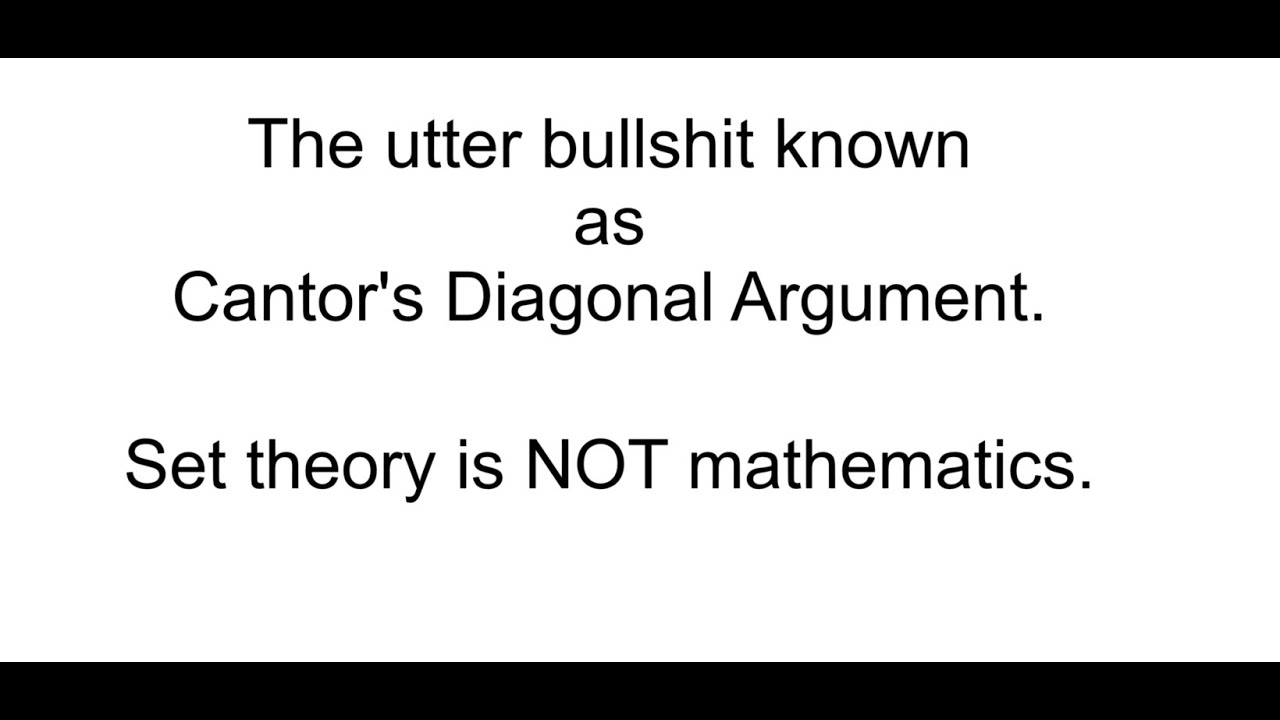
Cantor was a NON-MATHEMATICIAN and SET THEORY is NOT mathematics. It's drivel, especially the part concerning infinite sets because there is no such thing as an infinite set - it's a 100% bullshit concept - like the drivel you find in the brains of mainstream math academics.
If you DO NOT understand, then your brain is functioning as it should!...
Seems like all of his videos are some crazy claim
 sweet lava
light sinew
https://www.youtube.com/watch?v=yWEZVVKwIME is this guy wrong, or is there actua...
sweet lava
light sinew
https://www.youtube.com/watch?v=yWEZVVKwIME is this guy wrong, or is there actua...
Well he's the self proclaimed greatest mathematician of all time, what do you expect?
He also said about Richard Courant "I wouldn't even call him the backside of a mathematician."
lethal linden
light sinew
https://www.youtube.com/watch?v=yWEZVVKwIME is this guy wrong, or is there actua...
If you can't tell it's BS then get your BS detectors in for an emergency repair
 brave rock
light sinew
https://www.youtube.com/watch?v=yWEZVVKwIME is this guy wrong, or is there actua...
brave rock
light sinew
https://www.youtube.com/watch?v=yWEZVVKwIME is this guy wrong, or is there actua...
This guy is a very prolific and well-known crank, which is to say yes: he is full of shit.
 odd heart
lethal linden
If you can't tell it's BS then get your BS detectors in for an emergency repair
odd heart
lethal linden
If you can't tell it's BS then get your BS detectors in for an emergency repair
The utter bullshit known as The utter bullshit known as Cantor's Diagonal Argument
 woeful musk
lethal linden
odd heart
The utter bullshit known as *The utter bullshit known as Cantor's Diagonal Argum...
woeful musk
lethal linden
odd heart
The utter bullshit known as *The utter bullshit known as Cantor's Diagonal Argum...
Fixed point of utter bullshit endofunctor
brave rock
Yes you will literally die
No, just study as you would in any other class. It's just a class.
 tight hound
 graceful shell
should i worry about discrete math?
graceful shell
should i worry about discrete math?
No
brave rock
Depends on you and your prof
graceful shell
brave rock
Depends on you and your prof
prof is bad
light sinew
lethal linden
If you can't tell it's BS then get your BS detectors in for an emergency repair
I've been wrong so many times in the past, I've kind of given up trying to make judgement on stuff I have no clue about.I find it best to ask people who know more than me, at least for now. You are right though, there's like a billion red flags
tight hound
light sinew
I've been wrong so many times in the past, I've kind of given up trying to make ...
The guy in the video was using pretty abrasive language. This is not characteristic of someone who wants to engage in good faith scientific discourse.
light sinew
Yeah this guy is batshit crazy, he claims set theory is a jewish conspiracy to get them prizes and places in academia. Yikes
lethal linden
graceful shell
is it worse or better than linear algebra?
I have news for you: https://people.cs.uchicago.edu/~laci/babai-frankl-book2022.pdf
lethal linden
light sinew
I've been wrong so many times in the past, I've kind of given up trying to make ...
I mean, yeah, let's look at how the video opens. Who knows, maybe there is a Jewish conspiracy to suppress the fact that Cantor's diagonal argument is bullshit. 
Who am I to say? I'm no expert in Jewish conspiracies. /s
No. Anyone who opens with that is obviously about to follow up with a river of nonsense, regardless of one's own expertise in the purported subject.
 graceful shell
lethal linden
I have news for you: https://people.cs.uchicago.edu/~laci/babai-frankl-book2022....
graceful shell
lethal linden
I have news for you: https://people.cs.uchicago.edu/~laci/babai-frankl-book2022....
i dont need english math
lethal linden
graceful shell
i dont need english math
I only meant to illustrate that linear algebra plays a non-trivial role in discrete math. You may or may not discuss the connections in your first discrete math course.
cursive nymph
I'm studying set theory on the undergrad level, and I don't quite understand where ZF axioms operate
So, for example, consider the pairing axiom. It says that given any two sets the "thing" that contains only those two sets is also a set
But it looks more like a 'deductive rule', that 'the starting positions of a formal game ≈ axioms'
Then why are they called 'axioms'?
I'm much more comfortable with calling the infinity axiom an axiom — something is assumed to be true, and we can use deductive rules of FOL to construct further propositions / theorems
fossil mural
...the axiom of pairing is also something that we assume to be true
i don't see how it's different at all to infinity
$\forall x \forall y \exists z (x \in z \land y \in z)$
vital dewBOT
bee [it/its]
 fossil mural
that's a statement, and we assume that the statement is true
or i guess to exactly match what you said it should be $$\forall x \forall y \exists z \forall w (w \in z \leftrightarrow (x = w \lor y = w))$$
vital dewBOT
bee [it/its]
 fossil mural
(the two are equivalent given separation, without that the second version is stronger)
cursive nymph
hmmm, I see
ig it's just a difference in perspective
I thought of that 'exists z' as a 'rule' on how to 'construct' it, given x and y
but if we just think of it without a specific 'construction'.... ig I can buy it
thanks
 grizzled storm
Regarding graph theory, what is the eccentricity of a vertex if it has no path to one of the other vertices? Infinite?
tight hound
grizzled storm
Regarding graph theory, what is the eccentricity of a vertex if it has no path t...
Yes, if a graph isn't connected then all of its vertices are said to have infinite eccentricity
grizzled storm
tight hound
Yes, if a graph isn't connected then all of its vertices are said to have infini...
So the diameter is infinite as well?
tight hound
grizzled storm
So the diameter is infinite as well?
Yes
grizzled storm
Thanks!
cursive dew
Hello, trying to understand Logical Implication in propositional logic but not quite understanding it.
We're given just a "If P Then Q"
And i understand that if P is true and Q is true, the statement is true, and if Q is instead false, its false.
But im lost to the outcome of whenever P is false. Its always true, why?
Am i not understanding the scope / meaning of what implication is trying to convey?
Like we know for "and" its looking if both(all given) sides are true.
But im not sure what to make of Implication.
I heard some think of it as a promise.
sharp rose
cursive dew
Hello, trying to understand Logical Implication in propositional logic but not q...
"if it's raining, the ground is wet." aka Rain => Wet
In order to show the statement to be false, it would need to be raining but without the ground being wet, ie True => False
If it isn't raining, you cannot emphatically say that the statement is false, ie the statement is "not false" which is the same as "true" in classical logic
It isn't raining, and the ground isn't wet? Statement is not false.
It isn't raining, and the ground is wet anyway? Statement is not false
You can also think of <= , reads "if" (while => reads "only if")
"The ground is wet if it is raining." Would be Wet <= Rain which is equivalent
This statement can only be false when False <= True ie the ground is not wet but it is raining
vestal bronze
cursive dew
Hello, trying to understand Logical Implication in propositional logic but not q...
you should think of every statement as a promise
it's the same with "A and B"
cursive dew
I feel as though me and propositional logic have different intutitions on what true and false actually mean on a conceptual level, like im missing what its seeing
Or maybe im just looking at implication wrong. Maybe i shouldnt focus on Q of P -> Q?
Perhaps it's logic doesnt relate Q in any way
with it only "promising" that if P is true, then and only then, would it require Q to also be true
otherwise P being false, Q can be whatever it wants and still keep that promise that if otherwise P were true, then Q would require to be true as well
vestal bronze
i think of it as ≤
you can think of it as arithmetic, A or B means "A+B > 0"
A and B means "A × B = 1"
then implication is A ≤ B
it's not supposed to be complicated, and it is a lot like "if" in English, but many people struggle with this thing
cursive dew
Sorry not really understanding that xD
i understand conjunction, disjunction, and negation well enough, this implication thing tho is where the table turns
"wounderstand" might be my favorite word now
sharp rose
cursive dew
i understand conjunction, disjunction, and negation well enough, this implicatio...
it is helpful if you think of the negation of implication
like ( \lnot (A \implies B) )
vital dewBOT
qiuzlm
 vestal bronze
i don't think it's helpful to try to make sense of it even though it makes sense
sharp rose
it helped me at least
vestal bronze
it's more like you're lookng for a mnemonic device
"i don't want to just remember this rule, I want to know what it means"
but it's not actually important!
sharp rose
i mean it makes sense intuitively but it takes a bit of thought
vestal bronze
i agree
agile magnet
There's some intuition but also $\implies$ has a \textit{definition} which is its truth table, just like $\land, \lor, \oplus$ etc. There is no higher reason why that \textit{symbol} has that definition other than convention. Now everything above is about why we care abou that particular symbol, why its useful and models things we do in math. But that's separate from the \textit{definition}.
vestal bronze
but it all feels tangential somehow, while the point is that it's like ≤
vital dewBOT
Spamakin🎷
 vestal bronze
thank you
cursive dew
so, for me the first two rows of the truth table where P is true makes sense.
But the other 2 when its false is just convention? Just we chose to call them true?
vital dewBOT
Spamakin🎷
 agile magnet
it would not be useful for us to do mathmatics and say that statement is false
so yes that is convention but it's convention motivated by how we think about mathematics
if that makes sense
vestal bronze
"it rains → ground is wet" is like tautological, it doesn't have to be, a different example is "if it's wednesday, bob is at home"
then it's true when it's true when you should have trusted that advice
when the promise was kept
agile magnet
vestal bronze
"it rains → ground is wet" is like tautological, it doesn't have to be, a differ...
that last example IMO is only confusing. Trying to reason that is true or false is a thought exercise, it doesn't actually convey any intuition for why we define implication to have that specific truth table.
vestal bronze
i disagree
it's a real life statement that works as an implication. i'm probably failing to express the idea
you ask someone where's bob
cursive dew
so it seems like our less rigid speech/thought can just make the math inspired conventions to seem wonky in a out of math context right? Like saying `if 2 not a number then cats are also dragons"
vestal bronze
they don't know, and they don;t know what day it is but they can tell you something at least
they use the implication, everyone knows how to do it
that's why we associate the word "if" with implications
cursive dew
When A Then B does sound nice
wait i remember seeing a circuit like this before
!(P & !Q)
ig thats why they called it the Imply gate 😮
vestal bronze
@cursive dewwhe you say you understand the truth table for and, you misunderstand
you mean that the word "and" works as a mnemonic for you, you get the connection
but like that wasn't the point
the truth table is not there to explain the english word
to "mathematically prove and"
it's just there's 16 truth tables you could make, and that's one of them
the implication doesn't work mnemonically, and you don't get the connection, but you don't need to, it just exists, and there's a short way to refer to it
the → symbol
cursive dew
what do you mean by "connection"?
Im really lost in how we are meant to think about all this
in terms of logic i mean
vestal bronze
i thought i can explain but i'm discouraged because spamakin said that's bad
i'll explain i don't care
so this is "and" it just exists it's a table with letters
 cursive dew
I think i like the current idea i have so far.
"Implication is a promise/claim that if P is true, than it implys the whole statement P->Q is true if Q is also true"
"With that, said, other than if P is true, and Q is false, than they're all true cause the above's claim still holds."
Thats worded better in my head xD
vestal bronze
not even close to what i wanted to say
cursive dew
So given that table. Is and just that table only? Like idk where i go wrong, to me it feels intuitive.
vestal bronze
if you say "P & Q" that's short for "P & Q is true" meaning the values of P and Q are in the first row
it's slang
fossil mural
yeah we decided to use "and" as an abbreviation for that table
(obviously there is a reason we did that, we didn't pick a string of letters at random, but that's more about linguistics/human intuition/etc. than about the mathematics itself)
vestal bronze
so here you're saying the values are in the 1st or 3rd or 4th row

it's very "low information"
cursive dew
so we shouldnt try to get a understanding of the tables?
Ig that would explain the "if the sun is a moon, then anything else i say after is ofc true" wackyness
sharp rose
we love classical logic
cursive dew
what is classical logic? xD
Just going by the table without adding human quoted intutiton that may break in some place?
sharp rose
cursive dew
what is classical logic? xD
Well it has law of excluded middle
fossil mural
...i mean i think it's a good idea to try to understand why we defined the tables like this, like in practice a good understanding of what the operations mean is useful for doing anything with them
cursive dew
law of excluded middle? Not sure what that means
sharp rose
cursive dew
law of excluded middle? Not sure what that means
[ \lnot \lnot A \equiv A ]
vital dewBOT
qiuzlm
 cursive dew
fossil mural
...i mean i think it's a good idea to try to understand why we defined the table...
cursive dew
fossil mural
...i mean i think it's a good idea to try to understand why we defined the table...
tbh i kinda had to do that just now for my brain to stop digging into what Implications meant. I saw the table but my brain kept trying to understand the idea behind.
fossil mural
fossil mural
...i mean i think it's a good idea to try to understand why we defined the table...
just also yeah they're not... justified in terms of human intuition? they just exist
vestal bronze
in this framing the implication makes total sense
cursive dew
sry my palm hit the numpad enter before i could disable ping
sharp rose
rlly we can have any logic we want
vestal bronze
it is super justified
sharp rose
classical is just the most based 😎
vestal bronze
don;t interrupt k
cursive dew
sharp rose
rlly we can have any logic we want
thats the idea around abstract algebra right? Where we can make a random rule and see what that does to math?
fossil mural
fossil mural
just also yeah they're not... *justified* in terms of human intuition? they just...
there are some reasons why we're interested in these particular tables but at a certain point the answer to "why is it like this?" ends up being "well it just is", as if you were talking to someone who just really doesn't understand what the number 11 means and why it exists
cursive dew
So in math ig the rules we wanted was the axioms of math we use?
sharp rose
cursive dew
thats the idea around abstract algebra right? Where we can make a random rule an...
you could simulate logic in abstract algebra
vestal bronze
you ask me "where is Bob"
i don't know
i just woke up, i don't know what day it is
i know that he's at home on wednesdays
i say "If it's wednesday, bob is at home"
sharp rose
But logic is its own area of math
vestal bronze
i'm literally saying

that the values of "it's wednesday" and "bob is at home" are in one of those three rows, all but the second
that's all i can tell you
but it's useful
and it could be false
cursive dew
ig the trick here is to dont dig to deep in the thinking about the idea
sharp rose
sharp rose
you could simulate logic in abstract algebra
viz Boolean algebra
cursive dew
I keep going down the "but why is it true when he's home while it isnt wednesday?" rabbit hole
vestal bronze
cursive dew
ig the trick here is to dont dig to deep in the thinking about the idea
no no
fossil mural
well there is a direction that you can go with it that's productive, i think at this point i have a pretty good intuitive concept of what exactly -> is that's separate from my concept of the english word "if"
...but yeah if you try to reason about it as if it exactly corresponds to how normal humans use "if" then that's not going to help
vestal bronze
wtf
cursive dew
I have noticed a few times where the word if really doesnt seem like a proper fit
sharp rose
I think the English "if" is just <= but we don't think about the concept precisely, normally
vestal bronze
i completely disagree
sharp rose
in math we say "if" so
And I can't think of an example in English when it isn't the same logical connective as in math
Only misunderstandings
fossil mural
well the english "if" is a human concept
vestal bronze
no
fossil mural
i'm not really sure how meaningful it is to claim that you can separate out "what it means" from the fact that statements like "at a bar, there is some person such that, if that person is drinking, everyone is drinking" just sound so weird (if you're not used to material implication and explicitly interpreting "if" as that)
sharp rose
All "if" 's are human concepts
sharp rose
fossil mural
i'm not really sure how meaningful it is to claim that you can separate out "wha...
What would the equivalent in "normal" English be
I don't think anyone is expressing this exact idea but if they did, it would either be this or a more verbose version of this
 obtuse terrace
🤓
fossil mural
"at a bar, either there is somebody who isn't drinking, or everyone is drinking" is the closest normal-sounding logically equivalent statement
(which also makes it sound like an obvious tautology)
vestal bronze
@sharp rosewhy did you say it's <=
sharp rose
vestal bronze
<@841105344763920386>why did you say it's <=
"if" is <=
"only if" is =>
vestal bronze
no
fossil mural
fossil mural
well the english "if" is a human concept
there are things that you just wouldn't say in a natural language because they're weird things to say
sharp rose
"if it is raining, then the ground is wet"
"it is raining only if the ground is wet"
Equivalent semantics
fossil mural
fossil mural
there are things that you just wouldn't say in a natural language because they'r...
specifically a lot of the weird cases are situations where there's some more concise way to express logically the same concept
sharp rose
obtuse terrace
<@841105344763920386> we have a mutual lol
That's crazy
obtuse terrace
are you from HK
sharp rose
No
cursive dew
Im getting quite lost, but i should just stick to the idea we chose our rules(the truth tables) for the logic we use, while making some thought/idea of what they represent to us is not nescessary, just helpful to understand, right?
sharp rose
I assumed nagisa was either Singapore or hk
sharp rose
no
fossil mural
fossil mural
specifically a lot of the weird cases are situations where there's some more con...
"if this object is red, then it is blue", where "if" is read as material implication, is equivalent to "this object is blue", and we already have a way to say that, so nobody would use this longer representation for the same reason they wouldn't say "either this object is blue or it is blue"
sharp rose
I play(ed) chess
obtuse terrace
i see
vestal bronze
@sharp roseit's true if you mean the arithmetic less than or equal
sharp rose
vestal bronze
<@841105344763920386>it's true if you mean the arithmetic less than or equal
What
vestal bronze
the arrows are thwe other way
sharp rose
"if" is ( \impliedby )
"only if" is ( \implies )
vital dewBOT
qiuzlm
 vestal bronze
yeah, you have them backwards idk why
sharp rose
vestal bronze
yeah, you have them backwards idk why
What's backwards
fossil mural
cursive dew
Im getting quite lost, but i should just stick to the idea we chose our rules(th...
yeah pretty much
as long as you're consistent about what truth table you're using, it's logically valid
the whole thing with naming them after words and mapping them to intuitive concepts etc. is just for intuition, i.e. to help us understand/deal with the concepts
fossil mural
sharp rose
"if" is \( \impliedby \)
"only if" is \( \implies \)
if by if'' you mean if $P$ then $Q$'', which is far more common, then that's $\to$ \
``$P$ if $Q$'' does mean $Q \to P$ but is also honestly kind of a confusing way to write it
vital dewBOT
bee [it/its]
 cursive dew
vestal bronze
yeah, you have them backwards idk why
cursive dew
vestal bronze
yeah, you have them backwards idk why
Does direction matter? Or is it based on the order of the statements?
"If its raining {P}, then i have an umbrella {Q}"
We tend to say P->Q
But couldnt we also just do Q<-P?
vital dewBOT
qiuzlm
 fossil mural
like i don't think i really see $P$ if $Q$'' anywhere outside of if and only if'' which effectively acts like one word by this point, it even has a single symbol $\leftrightarrow$
vital dewBOT
bee [it/its]
 cursive dew
woah! Such a slight symbol change! 😮
eh, ig its not negation versus subtraction
sharp rose
it is one word
iff 🗿
cursive dew
Lets make a new one, "However if" ~>
sharp rose
what would that mean
vestal bronze
sharp rose
yeah "if" meaning A if B
i see you mean there's no "then" when you say "if"
sharp rose
sharp rose
it is one word
iff 🗿
(petition to add iff to English dictionary)
vestal bronze
got it
cursive dew
would "however if" feel more like a xor?
sharp rose
I don't know what the term means semantically
sharp rose
so what's andif
vestal bronze
it corresponds to nothing
cursive dew
well im off to bed to dream of proposition(im scared) ty for the help guys 😄
sharp rose
yeah the binary connectives have been exhausted ig the best we can do is come up with new names for the same connectives
fringe turret
Isn't this a combination problem? I am doing 8C2, but the answer is 8P2

Why I think so? Because of choose keyword and we say n chooses r for nCr
I see, these two positions are distinct. For example lets say we have two person A and B, then two arrangements AB and BA are distince because roles are different. Therefore its a classic example of permutation.
How choose keyword got me wrong there 😄
 hard stone
fringe turret
I see, these two positions are distinct. For example lets say we have two person...
hard stone
fringe turret
I see, these two positions are distinct. For example lets say we have two person...
Yup exactly, it's a permutation bc the two positions are distinguishable
If it were just "choose two co-chairmen (where the order of the co-chairmen doesn't matter)" then it would be a combination problem
lethal linden
fringe turret
I see, these two positions are distinct. For example lets say we have two person...
C(8,2) picks out two people, so you can imagine simultaneously summoning forth 2 people from the crowd of 8.
"Would Dark Matter and Cufflink please step forward."
And then you have two ways of assigning roles to those two people.
fringe turret
lethal linden
C(8,2) picks out two people, so you can imagine simultaneously summoning forth 2...
Oh yeah 2 . 8C2, this is nice logic
weary tiger
How do I get from {A} only A with ZFC set theory?
context: Im learning how to define ordered pairs without adding any other axioms
cursive nymph
weary tiger
How do I get from {A} only A with ZFC set theory?
context: Im learning how to de...
u want to construct A given {A}?
or vice versa?
weary tiger
cursive nymph
u want to construct A given {A}?
or vice versa?
I have {A} and I want to construct A out of it
Ive seen that some people used U{A} but I dont understand which set your unioning A with
weary tiger
nvm my questions
ive found the answers
hard stone
weary tiger
How do I get from {A} only A with ZFC set theory?
context: Im learning how to de...
If you already know that you have a set which has exactly one element in it, you don't need any axioms to name what the one element is.
However you are correct that U {A} is just A, and the existence of U {A} is guaranteed by the axiom of union.
solar marsh
Hi everyone! I’m researching Mader’s Theorem on S-Paths (Mader 1978) "Über die maximalzahl kreuzungsfreier", and I was wondering if anyone knows of any interesting applications or practical cases where this result has been used. Any references or ideas are greatly appreciated. Thanks in advance! 🤝
agile magnet
solar marsh
Hi everyone! I’m researching Mader’s Theorem on S-Paths (Mader 1978) "Über die ...
I have no idea about things about S-paths but just as a future reference, one place to start could be to look up the paper on Google Scholar. There, you'll get a list of papers which have cited that paper, which would be a good start of finding people who have used this theorem in some capacity in their work.
https://scholar.google.com/scholar?hl=en&as_sdt=0%2C14&q=Uber+die+Maximalzahl+kreuzungsfreier+H-Wege
dry lotus
I have a question about discrete mathematics. Would you say this is a course that's more of a preperation to the advanced maths we will see later on, kind of diving into multiple topics to prepare us?
weary tiger
Isn't ω^ω the same as ω because ω is infinite? (Context: ZFC ordinals)
weary tiger
dry lotus
I have a question about discrete mathematics. Would you say this is a course tha...
Most of modern math is built upon axiomatic set theory which is afaik part of discrete math.
odd heart
weary tiger
Isn't ω^ω the same as ω because ω is infinite? (Context: ZFC ordinals)
Nope, it's greater: https://en.wikipedia.org/wiki/Ordinal_arithmetic#Properties_3
(in particular, since exponentiation is strictly increasing in the exponent, ω^ω > ω^1)
dry lotus
weary tiger
Most of modern math is built upon axiomatic set theory which is **afaik** part o...
so discrete math kinda prepares for all those other topics
hard stone
dry lotus
I have a question about discrete mathematics. Would you say this is a course tha...
I would say a lot of discrete math classes just package up all the math a CS student needs to know lol
That being said, some of the skills you learn in discrete math, like proofwriting, will be essential to everything math related you do later on
Some of the topics, like graph theory, are entire rich fields of study that you only touch on the surface of
So there's lots of ways you can take it afterwards!
fossil mural
dry lotus
so discrete math kinda prepares for all those other topics
...well, maths isn't "built on" axiomatic set theory in the sense of that being the order you should learn them in, it's more just that most of mathematics can be encoded in ZFC
so axiomatic set theory is a reasonable place to start if you're writing a computer program that checks proofs, but for humans, you don't really need to know how to encode objects as sets for most things, it mostly comes up in independence results
some basic concepts about sets like injections, surjections, intersection, union, cardinal arithmetic, etc., are very useful, but that's not really related to foundations stuff, it's just that sets come up a lot and it's useful to know how to work with them
dry lotus
I will apply what I learn to computer programming but I mostly just want to learn for the fun of it. In the end all of this is just for fun. So if there is some new math idk, I’m gonna learn it lol
 arctic berry
Are cartesian products and outer products the same thing or is the cartesian a type of outer product?
 pale epoch
whats an (the?) outer product?
arctic berry
The outer product of two vectors is $\vec{v} \otimes \vec{u} = \vec{v} \vec{u}^T$
vital dewBOT
KySquared
 arctic berry
Whereas the cartesian product is $A \times B = {(a,b) | a\in A \quad \text{and} \quad b\in B}$
@pale epoch
vital dewBOT
KySquared
 arctic berry
But sets can belong to vector spaces
 quick folio
pale epoch
well, one of them is for vectors, the other is for sets
quick folio
pale epoch
well, one of them is for vectors, the other is for sets
I can elaborate a little more on this
pale epoch
arctic berry
But sets can belong to vector spaces
wdym
quick folio
set can belong to vector spaces, sure, but there are plenty of sets that aren't in vector spaces
it doesn't mean anything just to say that something is a set
arctic berry
I agree
But in what instance would the cartesian product not be equal to the outer product
quick folio
but the more important reason why the cartesian product is not in any way related to the outer product, is that the cartesian product does not respect the structure of a vector space, while the outer product does
arctic berry
Since from my understanding the outer seems like a generalization of cartesian
quick folio
quick folio
but the more important reason why the cartesian product is not in any way relate...
what do I mean by this? well, v \otimes w is a matrix (for vectors at least). So we naturally get the very nice result that, for instance, v \otimes (w + u) = v \otimes w + v \otimes u
arctic berry
Mhmm
quick folio
but what even is v x w? it's not even a vector anymore, it's just some set. it doesn't meant anything to say v x w + v x u anymore, because v x w and v x u aren't in the original vector space anymore
but, and I think this is what you're confused on, this doesn't mean you can't make it make sense
arctic berry
v x w is a vector
Thats the cross product
quick folio
in here I'm writing the cartesian product with x, don't think about the cross product lol
in math there's a lot of notation clashing
arctic berry
I getcha
quick folio
quick folio
but, and I think this is what you're confused on, this doesn't mean you can't *m...
but this:
arctic berry
Ok continue
quick folio
just because the sentence "v x w + v x u" doesn't make sense doesn't mean I can't introduce some sense to it
specifically, there's nothing stopping me from defining v x w + v x u = v x (w + u)
but you see, the difference between this and the outer product, is that here I have to go out of my way to define this nicely, while the outer product already comes with it built in
moreover, once I define the rule "v x w + v x u = v x (w + u)", the result I get is no longer just the cartesian product anymore. it's the cartesian product along with the added rule that it must satisfy "v x w + v x u = v x (w + u)"
but.
you aren't entirely incorrect in saying that they're related.
there is a certain sense in which the cartesian product and the outer product are special cases of the same thing
if you ever want to read deeper into this someday, they are in fact the categorical product in the category of sets and vector spaces
the idea of what's going on, is that the outer product is the "product" that "plays nice" with vectors, while the cartesian product is the "product" that "plays nice" with sets
that's the best I can describe it to you without getting deeper in the weeds
quick folio
quick folio
but.
if you just want the clean answer you can ignore everything after this message lol, it's just bonus info
arctic berry
quick folio
if you ever want to read deeper into this someday, they are in fact the categori...
So many layers of generalizations 
The outer is a generalization of the cross, the categorical product is a generalization of the outer AND the cartesian
quick folio
the categorical product is a GIGANTIC generalization
it covers a lot, a lot, a lot of things
and you don't need to worry about it unless you really want to dive deep into pure math :D
arctic berry
I’m somewhat understanding what you’re saying
Since v otimes w isn’t within v or w, it belongs to some new space
arctic berry
quick folio
specifically, there's nothing stopping me from defining v x w + v x u = v x (w +...
Why do we choose to define it like this then?
We could have defined the cartesian product an million different ways
quick folio
a good metaphor might be that one is (outer) a crosshead screwdriver and the other is (cartesian) a flathead screwdriver
you can still use the flathead on crosshead screws, but you'll strip the head of that screw until it can't be used by a screwdriver anymore. and you certainly can't use a screwdriver on a flathead.
so if you ask a mechanic, they'll obviously tell you that they're completely unrelated
but it is still true, that they're kind of the same thing, just that one is for cross head screws and the other for flathead screws
image for reference, lol


 quick folio
and then in this analogy the categorical product would be the entire toolbox
probably more
arctic berry
Lol
quick folio
arctic berry
Why do we choose to define it like this then?
We could have defined the cartesia...
what do you mean?
quick folio
vital dew
**KySquared**
this is how the cartesian product is defined
arctic berry
You say here that we define v otimes (w+u) = v otimes w + v otimes u. However, as you mentioned, there is nothing within the structure of set theory which tells us this is the specific definition
quick folio
not my "v x (w + u)" thing
no no no that's not what I'm saying
because v otimes u is just a matrix, in fact vu^T,
we get the fact that v otimes (w+u) = v otimes w + v otimes u for free
and that's the core difference
with the cartesian product, you can still get something similar, but you have to force it to be like that, and you don't get it for free
arctic berry
One second, let me try and phrase this in my own words then
quick folio
moreover once you force it to be like that it's no longer just the cartesian product
 little prism
hmm if you write subsets as their characteristic vectors over F_2 and then do the outer product of these vectors, the resulting matrix does essentially correspond to the cartesian product of the subsets. but that does feel more like a coincidence
(these vectors form a vector space and the addition corresponds to the symmetric difference of the subsets)
I've never thought about whether Ax(B Delta C)=AxB Delta AxC is true, maybe
arctic berry
Given vectors v, u and w
In LA: Since vu = some matrix A, we can immediately deduce and define v(u+w) = vu +vw. No other definition for this could exist within the lens of LA
In ST: because we already stated v and u to be vectors, we can pull from our definition of vu in LA to define v otimes u = vu, thus v otimes(w+u) = v otimes w + v otimes u.
Is this on the right track?
quick folio
yes
you can pull from the definition in LA to define v otimes u = vu, but because they're just sets you can pull from whereever else to define v otimes u to be whatever you want it to be
but that isn't the case for the outer product
arctic berry
Yeah, I forgot that last bit
So technically, the cartesian product could have been defined in some other manner however we settle on this one
Im basing that question off of my understanding of inner/outer products from LA
And how an infinite number of those products exist
But we have common ones like the dot in the case of inner and the cross for the outer
quick folio
I think you've got it, but here's one final way to look at it:
-vectors only care about two things: vector addition and scalar multiplication.
because the outer product is just vector multiplication, the outer product looks at that and goes "cool! I care about vector addition and scalar multiplication as well! we have so much in common let's be friends :)"
-sets only care about one thing: functions, of any kind.
because the outer product is just also a set, the outer product looks at that and goes "cool! I care about functions as well! we have so much in common let's be friends :)"
now, the cartesian product kind of cares about vectors as well, because vector addition and scalar multiplication are also functions, but they're only a tiny tiny corner of all possible functions so the cartesian product doesn't really like to play with the vectors.
however, the friendship between vectors + outer product, and sets + cartesian product, is the same friendship
arctic berry
OHHHHHHH okay I understand it now
Sets don’t care about what kind of function you give it, thus a cartesian product will exist for any two functions
Vectors DO care about the kind of function you give them (as only ones that are linear can exist w/i a vector space)
If the function(s) in question just so happen to exist within some vector space, then they also exist within a set
Thus the cartesian & the outer product are equivalent
quick folio
but they're still the same idea of multiplying things together in a way that plays nice with whatever you're originally using to multiply
arctic berry
Mhmm
quick folio
don't say they're equivalent. unless you're a category theorist that will make people angry
because they're really not unless you squint your eyes really hard
arctic berry
As another analogy, A square is a rectangle but a rectangle is not a square
An outer product is a cartesian product but a cartesian product is not an outer product
quick folio
an outer product isn't a cartesian product
they're neither each other
just vaguely related
arctic berry
I understand the vague relation part, but from my understanding this sounds correct
A cartesian product will always exist regardless of the two inputs. However an outer product only exists if the two inputs are elements within a vector space
quick folio
correct!
arctic berry
So, if the two inputs both belong to a vector space then the cartesian and outer product should be equivalent
As thats how we originally defined the caretesian prod
We just extrapolated its definition to cover more then just stuff w/i vector spaces
quick folio
they're still not equivalent. if both inputs are vectors, then you can force the cartesian product to be equivalent to the outer product. but it itself is not the same at all
and without that forcing, the cartesian product doesn't "want" to be like the outer product
arctic berry
What do you mean by “forcing” exactly?
Like I kinda get it, the cartesian is pretty much a set of sets, so by “forcing” are you saying we just represent it as a matrix?
quick folio
pretty much
I can define a bijective function from v x w to v otimes w
that just sends (v_i, w_j) to a_ij
and so if we force every v x w to have this bijective function, then the cartesian product would be the same
arctic berry

Okay I fully understand now
Ig my last question would be, in what instances would we prefer to keep everything as a set/in set notation versus using matrices/vectors?
quick folio
well.. if you're working with sets, lol
arctic berry
What about the inputs/outputs can we analyze using ST that we are unable to in LA?
quick folio
anything that isn't linear
arctic berry
Assuming they are lol
This kinda falls apart if they aren’t lol
quick folio
although ST is kinda boring and vanilla in and of itself. we usually can find some other branch of mathematics that the thing we're trying to understand is inside
and look at that branch instead
arctic berry
@quick folio
quick folio
?
quick folio
yeah
arctic berry
quick folio
yeah
Assuming the inputs are linear, what can we analyze about them using ST which we can’t using LA?
And vise versa
arctic berry
Idk
I brought that up just to cover all my bases
Im just now getting into ST so i was unsure if we could analyze anything in one framework but not the other (again assuming linear inputs)
arctic berry
I see
Alright then ill keep studying
quick folio
good luck!
arctic berry
Thanks so much for your time
Happy new years
quick folio
you too
 winter topaz
Merry Christmas everyone!!

Im not asking for any answers, just a fun problem with funny numbers xD
sharp rose
bobs
weary tiger

does anyone know an easy way to raise a matrix to k-th power if it looks like this
I only need the last rows of the k-th powers
 vagrant chasm
If you are doing this on a computer you can use binary lifting (calculate M^(2^i) by repeatedly squaring it), otherwise I'm not sure if there's a pattern. Maybe try some powers
At least it will be lower triangular
little prism
if you transpose it then the last column of M^k is just M^k*e_n. matrix vector multiplication is faster than matrix matrix multiplication so you could gain some speed from that (although you do need to calculate every step I think)
will depend on how big k is
 coral raven
weary tiger
coral raven
weary tiger
you can just treat it in blocks
each row is like 1 I 0
each column is like 0 I 1
actually i might be dumb
vagrant chasm
What are the possible sizes of k and your matrix? Where does this come from?
 vapid depot
Representation of a Hadamard matrix. Half of the entries in each row and column are 1 (represented by white squares) and half by -1 (black squares). All columns are mutually orthogonal, and all rows are as well.

 upper wraith
What are some tips for discrete and what are some good videos to watch for the course so I can learn during break?
lethal linden
upper wraith
What are some tips for discrete and what are some good videos to watch for the c...
Do as many exercises as you can from a good textbook, get feedback on your answers/attempts, and compare your answers/attempts to other people's.
coral island
Could some explain how this counting method proves it is 1-1 and onto
I’m confused as to why one set isn’t being mapped to the other
 quick folio
coral island
Could some explain how this counting method proves it is 1-1 and onto
I’m confus...
quick folio
coral island
Could some explain how this counting method proves it is 1-1 and onto
I’m confus...
you seem to have said two opposite sentences...?
this counting method is 1-1 and onto, and so it's mapping Z to N
coral island
Forgive me I understand nothing about this chapter
Why does the counting method show that it is 1-1 and onto
Isn’t it just counting within one set
quick folio
coral island
Isn’t it just counting within one set
it's a function from Z to N
not from Z to Z
the picture is just showing it as a series of arrows inside Z
coral island
Oh ok nvm I think I got it now
arctic berry
How does one handle unions when dealing w/ cardinality?
<@&268886789983436800> (noticed a spam account so i pinged mods, pls ignore this)
arctic berry
arctic berry
How does one handle unions when dealing w/ cardinality?
I have sets $A,B,C$ and I want $|A\cup B \cup C|$\
I managed to rewrite it as $|A-B\cup C| + |B-C| + |C|$ but idk how to deal w/ the union without expanding
vital dewBOT
KySquared
 odd heart
arctic berry
I have sets $A,B,C$ and I want $|A\cup B \cup C|$\\
I managed to rewrite it as $...
odd heart
arctic berry
I have sets $A,B,C$ and I want $|A\cup B \cup C|$\\
I managed to rewrite it as $...
For finite sets that's basically what you need to do (something along the lines of the inclusion-exclusion principle); for infinite sets it sort of trivializes, because the cardinality of the union of finitely many infinite sets is just the largest of their cardinalities
odd heart
(unless you reject the Axiom of Choice)
arctic berry
I assume my prof wants me to rewrite it only in terms of base cardinalities & intersections(since thats what im given) but im moreso asking for general knowledge
odd heart
If we're talking finite sets, then in general there's nothing simpler than inclusion-exclusion principle (of course for specific finite sets it might simplify)
arctic berry


This is what i did @odd heart
But uhh, i dont feel like writing that out eacb & every time 💀
arctic berry
vital dew
**KySquared**
So i managed to simplify it to this^
odd heart
This is fairly clearly a problem that wants you to use the inclusion-exclusion principle and there isn't much in the way of shortcuts.
arctic berry

odd heart
My heart goes out to you at this difficult time
arctic berry
Thanks
How would the question need to be phrased in order to properly use the simplification?
Since the union immediately makes me want to add B & C
odd heart
What would "the simplification" be?
arctic berry
arctic berry
So i managed to simplify it to this^
^ (assuming i even simplified correctly)
 odd heart
That's correct, it just doesn't help you much if you don't know the cardinalities of the three sets you've reached
The first one is "tools used only by A", and the second one is "tools used by B but not by C"
arctic berry
odd heart
The first one is "tools used only by A", and the second one is "tools used by B ...
As in: of the 8 used by A, |A-B U C| are the ones which B or C didn’t use
And: of the 10 used by B, |B-C| are the ones which C did not use
odd heart
Yes. Also note that $|B\setminus C| = |B|-|B\cap C|$
vital dewBOT
Outsider
 polar geode
i can't wrap my head around what < is supposed to mean, is it a set of A but ordered? or how can i imagine it?
 hard stone
polar geode
i can't wrap my head around what < is supposed to mean, is it a set of A but ord...
hard stone
polar geode
i can't wrap my head around what < is supposed to mean, is it a set of A but ord...
≤ is a relation on A satisfying the poset axioms
so set theoretically, it's a subset of A × A
every element of ≤ is an ordered pair (a, b) where a and b are elements of A
if (a,b) is an element of ≤, then you can write that as a ≤ b
polar geode
hard stone
if (a,b) is an element of ≤, then you can write that as a ≤ b
i seee thank you so much
hard stone
you're welcome
 plain shoal
is this a good proof for the transitive part?

 agile magnet
plain shoal
is this a good proof for the transitive part?
agile magnet
plain shoal
is this a good proof for the transitive part?
Technically this seems correct but stylistic this needs a lot of work. You've seen proofs in the text you're reading yes? Write actual sentences, not just floating bits of math
Make it nicer to actually read and parse
You've got scratch work, now make it a written proof
plain shoal
agile magnet
You've got scratch work, now make it a written proof
okies, thank you
agile magnet
As an extra challenge, this relation is basically the relation for saying two fractions are equal right? So you can extend this claim to all integers
Now you have to worry about division by zero, so see if you can rewrite the proof without divisions
plain shoal
agile magnet
Now you have to worry about division by zero, so see if you can rewrite the proo...
can't we do a 2 parts proof if we have zero and division, we do the first part by assuming that one of them or more equals 0 and solve it and then we can prove by proving that all the multiplications equal 0, and then we do the second part were we assume that all of them are different than zero and do this proof.
agile magnet
plain shoal
can't we do a 2 parts proof if we have zero and division, we do the first part ...
Yea sure you can
plain shoal
agile magnet
Yea sure you can
tysm 8)

 vestal bronze
@carmine bramblethere's a 3 cycle
just use the right part
i don't know what it should be instead
oh you mean the leftmost vertex maybe
yeah that makes sense
so like, it's wrong because you didn't write v anywhere
lol
 carmine bramble
vestal bronze
so like, it's wrong because you didn't write v anywhere
carmine bramble
vestal bronze
so like, it's wrong because you didn't write v anywhere
gpt says it was wrong, but I don't why i listen to gpt
it said b) wasn't possible
agile magnet
carmine bramble
it said b) wasn't possible
Like you said, who cares what GPT / any other LLM has to say
Do you think your answer is correct, yes or no and why? In particular if you think your digraph is a sufficient example, then which vertex is the v in question?
cursive dew
guys somehow im failing to understand the inverse truth table and making it wrong

the internet seems to keep claiming the 3rd row is the false one
But i really just dont see how
If p is false, then Not q
But then claim its wrong when p is true? Thats now how implications work 😮
brave rock
The second line is incorrect. Ex falso quodlibet, False -> X for any proposition X is true
Maybe write out the truth table for X -> Y again and compare with what you have written
(In fact there is another incorrect line which you will need to correct)
cursive dew
what is x and y
brave rock
Some propositions, it doesn't matter what.
You have written P and Q, so I wanted to use different letters
cursive dew
I want to think the guides i seen they might not even use the columns for !P and !Q, and just negate P and Q mentally.
That way it makes sense
Was i not meant to actually use those columns?
brave rock
You can use whatever method you find easiest
cursive dew
Doing it the way I was doing, P column for P and !P column for !P is that why my table seems odd?

Cause i notice the condition and the contrapositive were ment to be the same, same for converse and inverse
Going to work, but the logic holds for me, im not sure how its appearing wrong
fossil mural
cursive dew
Doing it the way I was doing, P column for P and !P column for !P is that why my...
it doesn't matter whether you have columns for !P and !Q or not
if you get different results with the columns compared to without the columns, then that implies that you're doing something else wrong
fossil mural
cursive dew
Doing it the way I was doing, P column for P and !P column for !P is that why my...
although, uh, the exact text you wrote in for !P and !Q in this table is a bit odd and might be part of what's confusing you
 neat oasis
Does someone have any counterexample to this algorithm to find the bridge edges of a graph?
Imagine we have an undirected graph G = (V,E), then you run a dfs search through the graph, and while doing so, you transform the undirected edges into directed edges. When finished you should have a graph G' = (V,E') (where E' is just E but with directed edges). Then we grab the inverted graph of graph G', G'^T and we run a dfs in the order that the last dfs was done (this means, if we started in node 0 in the creation of graph G', we will start here too by that, and then check the next unseen by the dfs node that follows the original order) and we remove any adjacent edges to a vertex that aren't accessible (through themselves or another path that starts on the same vertex). Finally the complementary graph to this graph where we removed edges from G'^T, while transforming it again into an undirected graph is the graph of every bridge edge in graph G.
neat oasis
Is there any better channel than this to ask this?
 cerulean wind
neat oasis
Does someone have any counterexample to this algorithm to find the bridge edges ...
cerulean wind
neat oasis
Does someone have any counterexample to this algorithm to find the bridge edges ...
can you do it with
3
/ |
0 — 1 — 2 |
\ |
4
and send sketches after each step?
i am a bit confused with your description
you should get 0 — 1 — 2 as a output
 terse wyvern
one method you could use is to find cycles
cursive dew
I rewrote the two for conditional and contrapositive with a better statement.
Now I'm feeling the contrapositive is NOT the equivalence of the conditional, its just not making sense.
 quick folio
cursive dew
I rewrote the two for conditional and contrapositive with a better statement.
N...
quick folio
cursive dew
I rewrote the two for conditional and contrapositive with a better statement.
N...
oh, what are you confused about the contrapositive
quick folio
it is
cursive dew
But if you look at that truth table, its not
what was false for P->Q is magically true for !Q->!P
denoted with the "?!" in the photo
quick folio
$\begin{tabular}{c|c|c}
P & Q & P \rightarrow Q \
\hline T & T & T \
T & F & F \
F & T & T \
F & F & T \
\end{tabular}$
vital dewBOT
HChan
Compile Error! Click the reaction for more information.
(You may edit your message to recompile.)
 cursive dew
Woah you remembered that format first try 😮
quick folio
$\begin{tabular}{c|c|c}
\neg Q & \neg P & \neg Q \rightarrow \neg P \
\hline
F & F & T \
T & F & F \
F & T & T \
T & T & T \
\end{tabular}$
so here's the truth table for the contrapositive
vital dewBOT
HChan
Compile Error! Click the reaction for more information.
(You may edit your message to recompile.)
 cursive dew
I dont think so? When its like that i do understand it, but its when i use my truth table with those worded statements it seems to break somehow
fossil mural
yeah i think that's because the statements you put in the truth table are kind of just wrong
!P is the statement that it's not raining
so if !P is false, that doesn't mean it's not raining, it means that "it's not raining" is false, so it is raining
cursive dew
but the first row of !P is the negation of P right? raining -> not raining?
fossil mural
it's the negation of the truth value, so T becomes F
"raining" and "not raining" aren't the values of P
if P has the value T, then that does mean that it's raining
but then when we look at !P
we're still in the same row, so it's the same situation, it's still raining
and !P has the value !T = F
so !P being F means it's raining
fossil mural
cursive dew
I rewrote the two for conditional and contrapositive with a better statement.
N...
so looking at what exactly the "wrong" result you got here is
cursive dew
sry trying to follow along
fossil mural
you've written at the bottom "if not wet, then no rain"
but what that really means in terms of the table the way you wrote it is "if Q is not wet, then P is not rain"
but then you took the boxes and wrote in the values that are in the !P and !Q columns
fossil mural
cursive dew
but the first row of !P is the negation of P right? raining -> not raining?
this is how "negation" works in the sense that like
P is true in the rows where it's raining
!P is true in the rows where it's not raining
but once you've picked what world you're in (i.e. which row of the table), P is either just "true" or just "false"
cursive dew
I think i see what you mean? Not sure tbh, the world of logic is somehow quite confusing.
I rewrote my table, and i noticed, I wrote just now !P, given it a basic FFTT table, but im looking at it as "Not raining"
Meaning the first value which should be the negation of P, is instead F for not raining which works out to be raining doesnt it, and not F
quick folio
cursive dew
I think i see what you mean? Not sure tbh, the world of logic is somehow quite c...
so !Q -> !P is no longer a statement about whether if it's raining or if it is wet
they are now statements about the statements P and Q
 cursive dew
Somehow my chart doesn't make sense but this online one does
 fossil mural
like if we focus on the first row of the table
then what you're claiming is
- P is true, i.e. it's raining
- Q is true, i.e. the ground is wet
- !P is true, i.e. it's not raining
- !Q is true, i.e. the ground is not wet
cursive dew
fossil mural
if P is T then !P should be F
But then !P doesnt mean "is not raining'?
fossil mural
which doesn't make sense, is it raining or not lol
fossil mural
cursive dew
But then !P doesnt mean "is not raining'?
!P does mean "it's not raining"
if "it's raining" is true, then "it's not raining" is false
sharp rose
cursive dew
But then !P doesnt mean "is not raining'?
Rather than "is not raining," it may be more precise to move the 'not' outside the quotes and say not "is raining"
cursive dew
fossil mural
3. !P is true, i.e. it's not raining
Cant help but see that as being what negation is, is it wrong?
sharp rose
sharp rose
Rather than "is not raining," it may be more precise to move the 'not' outside t...
May help understand
fossil mural
cursive dew
Cant help but see that as being what negation is, is it wrong?
well negation is "if !P is true, then it's not raining"
that's kind of my entire point
that, if it is raining, then !P must be false
because if !P is true, then that would mean it's not raining
like you've basically been claiming that if "it's raining" is true, then "it's not raining" is also true
 fossil mural
yep that's the correct table
cursive dew
bee, after all this, im worried for what philosophers way back in the days of time must of gone through for this.
is this why i see a lot of them drawn as wizards? Or just people who gone insane
fossil mural
"the days of time" is an interesting way to phrase it
sharp rose
Honestly I find the !P and !Q columns confusing in terms of contributing to the semantics
cursive dew
I say that cause i dont know the timescale of this xD
I heard there was a historical "issue" with sets of all sets or something
sharp rose
sharp rose
Honestly I find the !P and !Q columns confusing in terms of contributing to the ...
I would cut them out
fossil mural
cursive dew
I say that cause i dont know the timescale of this xD
I heard there was a histor...
well more specifically the problem is the set of all sets that don't contain themselves
the problem being, does this set contain itself?
it contains itself iff it doesn't contain itself
cursive dew
A sort of mathethical "flucation in logic" right?
Doesnt contain itself, add it in, now contains it self, take it out, repeat"
quick folio
cursive dew
A sort of mathethical "flucation in logic" right?
Doesnt contain itself, add it ...
but that's the problem. in logic there can't be any fluctuations
fossil mural
well mathematics doesn't really change over time, so it's more just an issue of
yeah
quick folio
therefore, the set of all sets **[that don't contain themselves] can't be a set
cursive dew
these are my two options xD I doubt i was THAT far off to be uncorrectable
 fossil mural
"if it contains itself, then it doesn't contain itself, that's a contradiction. so it doesn't contain itself, but then it does contain itself, that's also a contradiction. oh no"
fossil mural
quick folio
therefore, the set of all sets **[that don't contain themselves] can't be a set
no
the conclusion from this is that the set of all sets that don't contain themselves isn't a set
the more general conclusion is that you can't just run around saying "the set of all [whatever]" and expect nothing bad to happen
cursive dew
Wait so we cant say "the set of all numbers"? Or is that only sets of things
quick folio
what do you mean by numbers
quick folio
every time before you want to say something like "the set of all X", you need to double check that it is indeed a set
fossil mural
it turns out that you can have a set of all integers without any problems
quick folio
and the point was that you needed to do this double checking
fossil mural
but yeah you do have to prove that
cursive dew
for now before i delve too far into set theory im gonna continue my logic series xD
My end goal in all of this is to have a understanding of why (-A)*(-B) = +C
quick folio
cursive dew
My end goal in all of this is to have a understanding of why (-A)*(-B) = +C
you mean AB?
cursive dew
ig it would be the same as AB? I just used C to represent the result in a different name
I made "simple" proofs a while back for me to sleep with but people kept saying they wernt proofs, just intutitions
quick folio
well if you want a simple proof of that, (-A)(-B) = (-1)^2*AB = AB
cursive dew
more of a concept of negation turning positive once multiplied.
But i realize now thats steming more from subtraction of negatives
neat oasis
cerulean wind
can you do it with
3
/ |
0 — 1 — 2 |...
Well basically, you start at 0 and in this case creates the directed graph G' (0,1),(1,2),(2,3)(3,4),(4,2), then you grab the inverse graph G'^T with (1,0),(2,1),(3,2),(4,3),(2,4) and run dfs starting by 0, which makes you remove edge (1,0) as it is innaccessible and adjacent, then you go for 1, which makes you remove edge (2,1), because it is inaccessible and adjacent, you start on 2, which goes to (2,4), (4,3), (3,2) and so all these edges are accessible therefore none are removed.
Then the complementary undirected graph is the graph (0,1),(1,2) which is indeed the bridge edges of the original graph G
neat oasis
terse wyvern
one method you could use is to find cycles
That's indeed the main idea of the algorithm, as there should always be a reversed path if there's a cycle when you run the dfs in the inversed graph in the order asked
cerulean wind
neat oasis
Well basically, you start at 0 and in this case creates the directed graph G' (0...
ah. this clears things up. my notion of inverse and complement was different
dfs creates a spanning tree, so you never get the edge (4, 2) in the digraph G’
if you can tweak that, then any edge that remains must be part of a cycle (can you argue why?) and so the complementary edges are bridge edges
i think it’s solid
neat oasis
cerulean wind
dfs creates a spanning tree, so you never get the edge (4, 2) in the digraph G’
Wdym by that?
neat oasis
cerulean wind
if you can tweak that, then any edge that remains must be part of a cycle (can y...
Well mainly the edges that remain are from cycles because there exists at least two paths to reach the same starting point
Which is reflected by being able to reach every edge in the inverse graph
cursive nymph
i don't understand, how are:
1. Assume p is true, [...]. Contradiction. Hence p is false
2. Assume p is false, [...]. Contradiction. Hence p is true
different?
neon harbor
Sometimes the former is just called proof by negation, since it isn't followed by double negation elimination. For the latter, you're actually proving (not (not p)), which is equivalent to p in classical logic
 tired gazelle
cursive nymph
i don't understand, how are:
```
1. Assume p is true, [...]. Contradiction. Hen...
tired gazelle
cursive nymph
i don't understand, how are:
```
1. Assume p is true, [...]. Contradiction. Hen...
main difference lies in the assumption and the ultimate conclusion tbh. Both are proof by contradiction, but they work with opposite assumptions to reach a conclusion about p
lethal linden
cursive nymph
i don't understand, how are:
```
1. Assume p is true, [...]. Contradiction. Hen...
In what context were you told they were different? They are certainly formally different.
- In the first case, you are allowed to conclude
¬Pif you assumePand derive a contradiction. - In the second case, you are allowed to conclude
Pif you assume¬Pand derive a contradiction.
If you permit the first case then assuming ¬P and deriving a contradiction gets you a proof of ¬¬P.
Can we start with¬¬P and deduce P? This is called double-negation elimination. Some logical systems have it and others don't.
So you still need "something more" for (1) and (2) to be substantively equivalent.
cursive nymph
lethal linden
In what context were you told they were different? They are certainly *formally*...
so, in classical logic they are equivalent, right?
and in IPL they aren't, right?
tired gazelle
tired gazelle
main difference lies in the assumption and the ultimate conclusion tbh. Both are...
^ the process of reaching the conclusion about p is equivalent (proof by contradiction)
lethal linden
cursive nymph
so, in classical logic they are equivalent, right?
Classical logic has double-negation elimination, yes.
tired gazelle
the statements themselves aren't 100% equivalent unless stated
cursive nymph
tired gazelle
^ the process of reaching the conclusion about p is equivalent (proof by contrad...
but proof by contradiction doesn't work in all logics tho
when u don't accept LEM for example
lethal linden
tired gazelle
yes, but here it clearly says contradiction
I think you're over-interpreting what's going on.
cursive nymph
tired gazelle
yes, but here it clearly says contradiction
I think I heard there is a way to make a 'contradiction' in constructive mathematics. I didn't get what the lecturer meant by that tho xD
tired gazelle
yeah i don't quite understand what they mean, i'm just trying to explain to them the main difference between the two
lethal linden
Replace "contradiction" with "absurdity" if you take the mere use of the word "contradiction" to imply proof by contradiction is permitted.
In IPL, ⊥ is usually given as a primitive and ¬P is an abbreviation for P → ⊥.
cerulean wind
neat oasis
Wdym by that?
if dfs gets caught in a cycle, it will loop forever. so it can’t ever close a cycle. the graph traced out by a dfs is a tree
neat oasis
cerulean wind
if dfs gets caught in a cycle, it will loop forever. so it can’t ever close a cy...
I just have to do a "seen" vector
Which indicates if a vertex was already seen by the algorithm and if it was, ignore it
cerulean wind
yes, of course, but you won’t ever get the edge (4,2) traversed
neat oasis
I get you now
cerulean wind
it’s a small issue
but if you can maintain some other information about the state of the dfs, you should be able to fix it
neat oasis
Err then I guess I can use something like kruskal's with every edge being of cost 1 or some shit
But the algorithm does seem solid right?
cerulean wind
neat oasis
But the algorithm does seem solid right?
yes!
neat oasis
Or instead of "unvisited vertexes" I could keep a vector of unvisited edges
neat oasis
cerulean wind
yes!
Does it seem efficient enough? I think it's O(V+E) (where V is the number of vertices and E the number of edges)
As I'm just running two dfs
neat oasis
neat oasis
Does it seem efficient enough? I think it's O(V+E) (where V is the number of ver...
Which would be the same complexity as tarjan's algorithm if I'm not wrong
cerulean wind
neat oasis
Does it seem efficient enough? I think it's O(V+E) (where V is the number of ver...
yea
neat oasis
neat oasis
Or instead of "unvisited vertexes" I could keep a vector of unvisited edges
P sure this should work
cerulean wind
not familiar with tarjans, but it does run in O(V + E) time
cerulean wind
neat oasis
P sure this should work
you need to visit every edge anyways, so that makes sense
neat oasis
cerulean wind
not familiar with tarjans, but it does run in O(V + E) time
Ok cool, I was practicing some algorithms past exams, and a question to find bridge edges appeared and the solution mentioned tarjan's algorithm but I didn't know about it so I just kind of thought of my way to do it
cerulean wind
but now your dfs complexity may change
i haven’t given it any thought tho
just a consideration
neat oasis
cerulean wind
but now your dfs complexity may change
It doesn't seem like it would increase in a significant manner in terms of visiting vertexes in the worst case
cerulean wind
also, you need to take into account disconnected graphs as input
neat oasis
cerulean wind
also, you need to take into account disconnected graphs as input
Yeah yeah, obviously
When I run the initial dfs I start from somewhere but if there are any unseen vertices I start a dfs from them too
From a "seen" (now yes) vertices vector
cerulean wind
yea
neat oasis
Which any normal dfs already does
Ok cool
Anyway, thanks
I may end up programming it if I have time
It doesn't seem really hard to do tbh
cerulean wind
it seems like a cool one to do
i’m also brushing up on algorithms for interview prep. might do this one and tarjans now for fun
neat oasis
Haha, cool, have fun testing it out, if you end up programming it, may I see it?
cerulean wind
yea. would love to see yours if you end up programming it too
neat oasis
What do you program in?
neat oasis
Great, I usually do C++, but I know a little bit of python from a course
cerulean wind
great opportunity to learn some more python
neat oasis
Maybe when I get to numerical calculus
Next semester
(Mainly because numerical linear algebra was an all-python course)
neat oasis
 shadow cobalt
python is easy rigth
shadow cobalt
python is easy rigth
It is intuitive
I preferred starting with C++ tho as you really have to do everything on your own and not rely on 300 libraries, but yeah to grasp coding it is good to start with python
cerulean wind
neat oasis
I preferred starting with C++ tho as you really have to do everything on your ow...
you only begin to appreciate the stl once you try to do anything in C
shadow cobalt
anybody do comepetitive coding
agile magnet
This is not the server to ask about programming and competitive programming
neat oasis
agile magnet
This is not the server to ask about programming and competitive programming
Yeah it was previously related to some algorithms about graphs, sorry
 night magnet
is "Discrete Math and its applications" a good book to learn?
arctic berry
night magnet
is "Discrete Math and its applications" a good book to learn?
Yeah, lots of people recommend it
 shell yew
what is the sequence S: N/{0} -> N/{0} such that
x<y->S(x)<S(y)
|{x:S(x)=y}| = S(y)
proportional to? (the first few terms are 1,2,2,3,3,4,4,4,5,5,5,6,6,6,6....)
I thought of the fact that S(sum from n = 1 to y of S(y)) = y
and compared it to the integral of x = 0 to y of f(x) = f^-1(y) and got f(x) = (phi^(1/phi^2))*(x^(1/phi)), but when I tested their ratios on python it was clearly getting smaller and smaller (S(x)/f(x)), and even if that's not a formal proof it does make me doubt that it's proportional to f(x) in any way
shell yew
It seems the sequence I mentioned here is basically a not-only 1 and 2 version of this sequence
 polar geode
what does a ̸≡0 mod 4 mean?
shell yew
Without that slash it would mean that 4 divides a. I'm not sure what that slash is doing here but perhaps it means that 4 doesn't divide a?
polar geode
shell yew
Without that slash it would mean that 4 divides a. I'm not sure what that slash ...
and what does the zero mean?
shell yew
shell yew
what is the sequence S: N/{0} -> N/{0} such that
x<y->S(x)<S(y)
|{x:S(x)=y}| = S...
so this sequence is called Golomb's sequence huh
shell yew
polar geode
and what does the zero mean?
a ≡ b mod c means: (these are all the same)
the remainder you get when dividing by c is the same for a and b
c divides b-a
these are the same because if c divides b-a that means that it also divides the difference between the remainders, but the only way that's possible if that difference is 0 so the remainders are the same
a ≡ 0 mod c means that c divides a-0, so basically a
to visualise it you can image a 12-hour clock as being mod 12
if you add the seventh hour and the 6th hour, for example, you get the 1st hour
shell yew
shell yew
so this sequence is called Golomb's sequence huh
apparently it is proportional to x^(phi-1) so now I'm confused
did I do something wrong in python
 vivid osprey
Basic question. If $I$ is a countable set, is it true that we can find an increasing sequence $(I_n)$ of finite subsets of $I$ such that there union is $I$? I struggle with how to construct such a sequence for an arbitrary countable set $I$? (With the naturals it is immediate.)
vital dewBOT
psie
 lethal linden
vivid osprey
Basic question. If $I$ is a countable set, is it true that we can find an increa...
lethal linden
vivid osprey
Basic question. If $I$ is a countable set, is it true that we can find an increa...
If it's countable then it's in bijection with the natural numbers, so use that bijection along with the "immediate" construction in the naturals.
vivid osprey
lethal linden
If it's countable then it's in bijection with the natural numbers, so use that b...
Ok. So suppose we have our finite, increasing subsets of the naturals A1, A2, ... The image or the preimage of a function preserves inclusion, so they'll be increasing in the countable set I too. However, and I feel silly for asking, what property is it that preserves that the sets will be finite in I too?
lethal linden
vivid osprey
Ok. So suppose we have our finite, increasing subsets of the naturals A1, A2, .....
The bijective preimage of a finite set had better be finite.
vivid osprey
yes, ok 😅
hard stone
Yeah, finite by definition means there's a bijection with some set of the form {0,1,...,n-1}
So if you pick A1 = {0}, A2 = {0,1}, ..., etc., then this guarantees that the corresponding subsets of I will be finite, by definition
cursive dew
Learning contradictions for propoisitional logic.
So far i heard 2 sides of the coin.
It is considered a contradictory IF all truth values of both propositions are not logically equivlant. No F - F and no T - T.
The other side i heard elsewhere is that we dont care for F - F, that if F-F we can still consider it a contradiction?
Im hoping we can lean more towards the first one.
cursive dew
This claims c and p are contradictions. Yet other info online says they're not cause the bottom row

 true parcel
cursive dew
This claims **c** and **p** are contradictions. Yet other info online says they'...
true parcel
cursive dew
This claims **c** and **p** are contradictions. Yet other info online says they'...
It is a contradiction if all possible truth values are false
Meaning, every column of c ^ p must be F
cursive dew
is there a single thing explaining this? Im still seeing different things be said. Been only finding bits and pieces around the internet
"Heres a contradiction" shows one example type of stuff
true parcel
It's simple