#discrete-math
1 messages · Page 44 of 1
 little prism
well 0+1+2+...+9 but same idea
so if you wanna do N pushes, you need 0+1+2+..+(N-1)
do you know a closed form for that?
 grave sail
is it just a sum?
little prism
well it is a sum, sure
but there is a formula for the sum of the first few natural numbers
little prism
youre welcome
 brave rock
Not defined.
Some people use that notation to mean the number of derangements of n elements.
 stray reef
 heavy shore
If n! is n(n-1)(n-2)….(3)(2)(1)…
Then what is !n
heavy shore
If n! is n(n-1)(n-2)….(3)(2)(1)…
Then what is !n
where did you see the notation !n?
heavy shore
stray reef
where did you see the notation `!n`?
I heard it’s a thing for some reason
 frail yew
stray reef
from whom?
frail yew
stray reef
from whom?
.
stray reef
ok but i want to hear him say where he got it from.
and give a link to the video or article or blog post or whatever else
frail yew
stray reef
ok but i want to hear _him_ say where he got it from.
I'm curious, how did you become a mathematician?
stray reef
long story.
stray reef
i mean first off what do you imagine when you see me put "mathematician" in my bio
bc i might not exactly correspond to that
i am not terry tao or a fields medalist or any kind of public figure like that
frail yew
I believe I could figure that out.
frail yew
stray reef
i mean first off what do you imagine when you see me put "mathematician" in my b...
well,
I expect this to be an unacceptable perception of what mathematicians are, however I think that you are given various opportunities to model various situations, occurrences, processes, etc using mathematics
@stray reef
stray reef
i mean this is less about acceptability and more "i dont really get you there"
i have a bachelor's degree in math and am currently doing a master's
frail yew
ping me
frail yew
stray reef
<@700073243733655572>
sorry
your responses didn't appear on my screen
so I thought you had left or something and I asked that you'd ping me so I can return to the conversation
well how did you obtain the job of mathematician if you are still in university?
stray reef
what "title"
i do not know of any formal governing body that regulates and distributes the word "mathematician" as a title
frail yew
job
stray reef
i work as a math teacher.
but i suppose this wouldn't be good enough for your highness.
frail yew
I'm sorry
stray reef
what a pedestrian, lowly, PEONIC job for somebody to have that claims to be a Mathematician™️, amirite.
stray reef
frail yew
I'm sorry
for what?
 agile magnet
the "which you aren't" clarification is insane
brave rock
Yes
 prime steeple

 warm stirrup
prime steeple
warm stirrup
prime steeple
Thank you
warm stirrup
Also how to prove something is reflexive, like the mathematical proof. Thank you
 queen mulch
if anyone can help with the question above!
warm stirrup
<@&286206848099549185> pls if anyone can help me solve it
 rapid mural
start with the definition of reflexive.
 silver jetty
Is this correct? If not lmk what step I messed up on, TY

 distant bobcat
For three non disjoint sets $A,B,C$ am I right to assume that $ |A \cap B | + |A \cap C | + |A \cap B \cap C| \leq |A| $ does not hold in general? I am thinking here we are adding $|A \cap B \cap C| $ several times such that its cardinality may exceed that of $A$.
 vital dewBOT
FredrikPiano
 brave rock
Even just |A n B| + |A n C| <= |A| doesn't hold in general
distant bobcat
How about $ |A \cap B | \backslash {|A \cap B \cap C| } + |A \cap C |\backslash {|A \cap B \cap C| } + |A \cap B \cap C| \leq |A|$?
vital dewBOT
Boytjie
 distant bobcat
no, I want with sets
brave rock
|A n B| + |A n C| - |A n B n C| <= A
brave rock
And indeed since in general |X u Y| = |X| + |Y| - |X n Y| you can clearly see this works.
This is called the inclusion-exclusion principle.
The only slight leap is seeing that (A n B) u (A n C) is a subset of A.
distant bobcat
yes, but if we assume x is an element of (A n B) u (A n C) then it is also an element of A
distant bobcat
yes, I understood
another one that I had to use recently was |A n B n C| <= |A n B| and |A n B| <= B
wondering if I can see this as well using the inclusion-exlusion principle. Otherwise the proof is simple using a typical set theory proof
brave rock
That is just the fact that a subset cannot exceed a superset in size.
If A is a subset of B then |A| <= |B|.
distant bobcat
A superset is a set which contains all the elements of the other set right? Like pacman swallowed the set I guess haha
 weary tiger
How do you even say these two expressions are equivalent? Can someone pls give me a hint?
 brave rock
$\sum_{i=1}^n{(2i+1)} = 2\left(\sum_{i=1}^n i\right) + \sum_{i=1}^n(1)$
vital dewBOT
Boytjie
 brave rock
@weary tiger this is what's happening on the top of the fraction, that's all it is.
I've bracketed aggressively, hopefully there's no confusion
weary tiger
I see, thank you
 timber barn
Is f(x) = x^2 -2 surjection and injection?
brave rock
What do you think? Recall the definitions of surjectivity and injectivity. Maybe draw a picture of f
Remember, you also need to specify the domain and codomain of f.
timber barn
@brave rock I had an exam and I have proven that is injective and surjective but its incorrect so thats why I need help
Even chat gpt says its surjective and injective
brave rock
Well it's wrong :) hope that helps
timber barn
brave rock
Well it's wrong :) hope that helps
Oh so its not surjective and injective right?
brave rock
brave rock
What do you think? Recall the definitions of surjectivity and injectivity. Maybe...
If you're not going to engage with my suggestions up here, then we're out of luck, because I'm not interested in just telling you the answer.
timber barn
brave rock
If you're not going to engage with my suggestions up here, then we're out of luc...
Then just dont reply
I dont get the point of writing a paragraph and not telling the answer because you are not interested
 shadow lion
timber barn
Is f(x) = x^2 -2 surjection and injection?
shadow lion
timber barn
Is f(x) = x^2 -2 surjection and injection?
what co/domain are we considering?
R?
the domain you consider is gonna affect whether f is injective or not, while the codomain affects whether f is surjective or not
 errant bear
gives incomplete question
complains when not given the answer
stray reef
timber barn
I dont get the point of writing a paragraph and not telling the answer because y...
!noans
 lofty cloudBOT
timber barn
I dont get the point of writing a paragraph and not telling the answer because y...
lofty cloudBOT
timber barn
I dont get the point of writing a paragraph and not telling the answer because y...
The purpose of this server is to help you learn, not to hand out answers. Do not ask someone to give you the answer directly.
 unborn raft
find the mass of ρ(x,y,z) = xz is a mass density function for T: a solid bound by x^2 + y^2 +z^2 = 4 and z = sqroot(x^2 + y^2). any one can help? I am getting 0
 naive parrot
does anybody have any resourse for a question bank on mathematical foundations for machine learning
stray reef
unborn raft
find the mass of ρ(x,y,z) = xz is a mass density function for T: a solid bound ...
what is this doing in #discrete-math
when it is clearly #multivariable-calculus

 elder berry
 odd prism
How can I start to think about this
odd prism
How can I start to think about this
# of orange stars + # of black stars = # of stars
elder berry
right, so in total that is n(n+1) stars right?
since each cell has a star, and since there are n(n+1) cells
elder berry
elder berry
since each cell has a star, and since there are `n(n+1)` cells
do you agree with this?
 strong furnace
Is there a word for when a function from a set, S to another set Y, has the property that every element of S is mapped by the function
agile magnet
strong furnace
Is there a word for when a function from a set, S to another set Y, has the prop...
Every function must satisfy this
part of the definition of a function f is that for every element x in the domain (the domain here is S), f(x) must be defined
strong furnace
ok that makes sense
I wasn't sure if something like sqrt(x): R to R is not allowed
So I guess you would have to say like sqrt(x) positive real to R
vital dewBOT
Jacks0n

 half knot
Ignore above please
 muted moth
is it better to regard graphs as a triple: the vertex set, the edge set, and a relation/function relating vertices to edges?
brave rock
Better than what?
It's a set-theoretic way to construct it, certainly. I'm not sure what the alternative would be.
You certainly can't throw away the geometric interpretation though, that's really crucial to the study of graphs. You can write down what that means in terms of the set-theoretic definition, but this is complex.
uh complex as in complicated, not real vs complex lol
stray reef
muted moth
is it better to regard graphs as a triple: the vertex set, the edge set, and a r...
better than what & better in what way
muted moth
yeah sorry! I forgot to mention the conventional definition of graphs provided in textbooks
the definition of "a graph being an object containing two sets, the vertex set and the edge set."
are we better off referring to graph as containing two elements, or should we also include the idea of a relation mapping individual vertices to edges or something like that?
stray reef
again, better in what way?
muted moth
i am just being pedantic
stray reef
bruh
muted moth
is it more accurate
stray reef

muted moth
yeah, is it more accurate to think of graphs as a triple?
brave rock
More accurate than what
 cerulean radish
I don't see how that's better in any way
The relation that you are talking about can be derived using the set of vertices and edges anyway, so that's just extra information
brave rock
cerulean radish
The relation that you are talking about can be derived using the set of vertices...
This isn't true, for example multigraphs cannot be described only using a relation between vertices.
stray reef
muted moth
yeah, is it more accurate to think of graphs as a triple?
if and only if you want to fuel your own pedantry.
 rocky jewel
is this proof clear enough and sufficient: tex b) uncountably infinite. let s be a string of 0's and 1's, representing a total function f from $\mathbb{N}$ to ${0,1}$ where the ith element of S $s[i]=f(i)$, and let $S$ be the set of all such functions (assuming S is countably infinite). if we put all s in a matrix, we can form a new function $s_n$ by going down the diagonal and setting to the opposite of the element on the diagonal. Since $s_n$ differs from every function in $S$ it is not in S, and so S cannot be countably infinite. the question is to prove:
 vital dewBOT
Fb_Wdw
 brave rock
That is sufficient. The explanation is brief but clear enough.
Really it's not a set you want but a bijection, I don't care enough to correct that.
little prism
a matrix is usually finite. better to say that you are writing it into a list
 fossil mural
muted moth
yeah, is it more accurate to think of graphs as a triple?
fossil mural
muted moth
yeah, is it more accurate to think of graphs as a triple?
i'd say the most accurate way to think of it is that it doesn't really matter what representation you use because there are obvious ways to convert between them
the same way that nobody cares if the "real numbers" are dedekind cuts or cauchy sequences or whatever, the word "real number" just refers to the result (it's a complete ordered field), not any particular encoding
if you're like, writing in a proof assistant, or doing model theory or something, then the exact encoding does matter somewhat, but you can just pick one and it probably won't really make a difference which encoding you're using - it's the same kind of choice as "what language are you going to write in", it's a good idea to be consistent but it doesn't really matter to the actual mathematics
if it turns out that it does meaningfully change something, then... just decide on one encoding based on whatever's convenient i guess? or give both encodings names and think of them as related but distinct objects? the important thing is just that, for anything where it does matter which encoding you use, you're consistent about it
for a lot of things you can just, implicitly insert conversions, if you have a theorem that's proven about one encoding and want the same theorem about the other encoding, which is why it doesn't matter
 soft iron
Hi
Can someone help me
There are some pairs of students assigned with distinct prime numbers that have exactly one student assigned with a composite number between them.

<@&286206848099549185>
stray reef
can we see the problem exactly as it appears in the textbook?
cause your logical notation looks strange???
@soft iron
soft iron
Ok
Basically can't do prime (x,y) because it's not multivariate as it implies I know x has y
Negation must be processed through
-(P--> Q)
= -(-PVQ) ...... Implication law
Then flips and multiply through
Demorgans , DN
lofty cloudBOT
Please show the original problem, exactly as it was stated to you, with the entire original context. A picture or screenshot is best. If the original problem is not in English, then post it anyway! The additional context might still be helpful. Do your best to provide a translation.
 stray reef
hmm
are we allowed <
wait hold on
we don't even have a way to refer to the number assigned to a student
so how can we possibly translate "composite number between [the prime students' numbers]"
i think this problem is screwed up
soft iron
It means the same as a number is between two different prime numbers
So, idk about the greater or less than symbols
I'm thinking now on the best alternate
stray reef
well then we simply have NO WAY AT ALL of talking about any order relations on students' numbers
like that's a blocking limitation
soft iron
Wdym
That's why I put the V 'or' to say the order is unknown
Just Z is between
Wait
I'm still on a
stray reef
soft iron
Just Z is between
YOU CAN'T TALK ABOUT BETWEENNESS AT ALL
our variables can only refer to students
we have no way of saying "student x is assigned the number 37"
stray reef
do you not understand what i am saying here
soft iron
We don't know what the numbers are ONLY that IT the composite is somewhere between
The PRIME
OPTIMUS PRIME
stray reef
ok you clearly do not understand me.
 proven ibex
is the chromatic number of K_n graphs just n?
cerulean radish
Should be
 calm chasm
Say you have a mean of 5.
You're given the n for this. You're told that one of the values x was changed from 10 to 5. How would you compute the new mean exactly?
stray reef
well
mean = total/count
when you reduced one of the data points by 5, how much did the total change
 thorny hollow
Hi
calm chasm
stray reef
when you reduced one of the data points by 5, how much did the total change
True
thorny hollow
I am a little confused here for question 2. Does repetition is allowed or not?
"2- Airports are identified with 3-letter codes. For example, the Richmond, Virginia airport has the code RIC, and Portland, Oregon has PDX. How many dif f erent 3-letter codes are possible?"
 calm chasm
You just reduced it by 5
stray reef
yes exactly. the new total is the old - 5, and that's it
calm chasm
Wow that was so easy
I was helping someone with this an thought I was forgetting something about summation. But that's all it was.
stray reef
thorny hollow
I am a little confused here for question 2. Does repetition is allowed or not?
...
yes, repetition is allowed
thorny hollow
If repetition is allowed, then thr answer is 26³?
stray reef
yes
there are IRL airport codes with repeated letters
Cochabamba, Bolivia is CBB for example
 quiet eagle
Is there a formula for the number of circuits in the complete graph K_n?
weary tiger

I attempted to construct such a partition by sth like X-g(Y') and rest of X like constructs where Y' is a subset
Didn't work out
I suspect that we can somehow overkill this using some maximality argument in form of zorn's or sth
Or there might actually be a construction
In any case I am currently stuck and would greatly appreciate some help
quiet eagle
quiet eagle
Is there a formula for the number of circuits in the complete graph K_n?
I believe it is $\sum_{k=3}^n\binom{n}{k-2}$
vital dewBOT
Sciencenjoyer

 grand totem
weary tiger
https://media.discordapp.net/attachments/576511723574525962/1209485456652107796/...
grand totem
weary tiger
https://media.discordapp.net/attachments/576511723574525962/1209485456652107796/...
Hint: Consider the map $\varphi:PX\to PX$ that sends an $X'$ to $X\setminus g(Y\setminus f(X'))$. Show that this map is monotone (with respect to the inclusion ordering on $PX$) and hence has a fixed point (since $PX$ is a complete lattice). Use that fixed point as your $X_1$ and go from there
vital dewBOT
neverbloom6760

 compact owl
How do we go from the first part of the highlight to the next?

 neon harbor
compact owl
How do we go from the first part of the highlight to the next?
neon harbor
compact owl
How do we go from the first part of the highlight to the next?
x - 3 = -3 * (-x/3 + 1) and move the -3 outside the fraction
compact owl
neon harbor
x - 3 = -3 * (-x/3 + 1) and move the -3 outside the fraction
Ah, gotcha. Thank you!
 vernal torrent
this is a bit of a dumb question but how do you know when to use $n \choose k$ versus $n \times ... \times (n-k - 1) \times (n-k)$
vital dewBOT
ImtiSauce
 vernal torrent
for example, apparently b) is $12 \choose 6$ and c) is $12 \times ... \times 6)
 vital dewBOT
ImtiSauce
Compile Error! Click the  reaction for more information.
(You may edit your message to recompile.)
 vernal torrent
apparently it has something to do with order?
neon harbor
vernal torrent
for example, apparently b) is $12 \choose 6$ and c) is $12 \times ... \times 6)
(n choose k) is just n * (n-1) * ... * (n - k + 1) / k!, ie. the number of ways to pick k things among n things divided by the number of ways to order k things
so if the order doesn't matter then use (n choose k), for example if picking blueberry donut then chocolate donut is the same as picking chocolate donut then blueberry
vernal torrent
That helps a lot, thank you!
neon harbor
by the way, I think you got the answers to b) and c) mixed up
 last dome
Im a little stuck on the process, from what I understand is you build out a few of the iterations to find a pattern by simplifying but I think im having trouble turning that into an explicit formula


 rugged dock
calm chasm
When creating cases with absolute values, How do we do that
rugged dock
calm chasm
When creating cases with absolute values, How do we do that
Hi. Recall definition of absolute value func.: $y=x if x\ge 0 or y=-x if x<0$. Now, since we only have two absolute values, we need to prove the following cases:
vital dewBOT
javier
 rugged dock
case 1: $x-1, x+1$, case 2: $-x+1, -x-1$, case 3: $x-1, -x-1$, case 4: $-x+1, x+1$
vital dewBOT
javier
 rugged dock
If you find that one of the proofs for some case is exactly the same for the previous case, just say "similarly, conclusion goes here"
weary tiger
vital dewBOT
Eso

 paper jolt
rip i meant to say B \cap Y = Y - A
grand totem
paper jolt
rip i meant to say B \cap Y = Y - A
That's not true either? If B is empty and Y is inhabited then their intersection is empty, while Y - A isn't
Just realized you corrected the assumption not the conclusion
(So this is indeed true)
paper jolt
yeah. how does one show it
grand totem
Like one usually shows set equality, show that the left side is a subset of the right side and vice versa
paper jolt
hoped there was a more direct way
compact owl
The screenshot on the left is the series I got for the generating function on the right. Is my solution accurate?


 wintry cedar
compact owl
The screenshot on the left is the series I got for the generating function on th...
wintry cedar
compact owl
The screenshot on the left is the series I got for the generating function on th...
I dont think you meant to have a + here but other than that it looks good


 twilit sundial
casework
particularly on which of the "top" and "diagonal" edges (or both) that you include
 lapis mulch
how about the minimum weight? it's simply 5 right
 agile magnet
No that's not what it means
You chose 3 spots for the vowels to be in correct? That's what the 8 choose 3 is
But you haven't chosen which vowel goes in each spot
How many vowels are there? 5
How many times do we have to pick a vowel? Once per spot so 3 total
Hence 5^3
Makes sense?
 gilded sun
agile magnet
Makes sense?
gilded sun
agile magnet
Makes sense?
5 vowels in english language, and each of the three positions for the vowels can be filled with any of the 5 vowels, ok.
agile magnet
gilded sun
5 vowels in english language, and each of the three positions for the vowels can...
bingo
So now can you walk through a very similar argument to see how they got 21^5?
There are 21 consonants
gilded sun
agile magnet
There are 21 consonants
Okay right, with a google search I can get that, but shouldn't that be included in the question?
agile magnet
I guess it assumes that you are familiar with the English alphabet
gilded sun
agile magnet
I guess it assumes that you are familiar with the English alphabet
Could we go over some more problems?
agile magnet
You can ask them here, if I see them I'll help otherwise someone else will
I'm boarding a flight soon so idk how much longer I'll be able to help
gilded sun

So same process. There's 21 consonants in the english language. So for strings with exactly 3 vowels, we choose 3 positions out o 8 for the vowels (8 3) * 5^(3)*(21)^(5)
For strings with 4 vowels, we have ( 8 4) because we choose 4 positions out of 8 fo the vowels, and then we multiply that by 5^(4), and then we multiply that by 21^(4)... So the total number of strings is (8 4) x 5^(4) x 21^(4).
 compact star
Theorem: Let n be an integer. If n^2 is odd, then n is odd.
Proof: Let n be an integer. Assume n^2 is odd and n is even. Then there is some integer k such that n=2k. Then n^2=(2k)^2 = 4k^2, which is even. Therefore, n must be odd.
Is the proof valid, and which type of proof is used?
gilded sun
For 5 vowels, we have ( 8 5) because we choose 5 positions out of 8 for the vowels, and then we multiply that by 5^(5), and then w multiply that by 21^(3) (because there's 3 remaining positions).
Then we add the number of strings from each case together.
agile magnet
gilded sun
Then we add the number of strings from each case together.
That's exactly correct
The 3 cases are disjoint so you can simply sum the answer
And you computed each case correctly it seems
agile magnet
compact star
Theorem: Let n be an integer. If n^2 is odd, then n is odd.
Proof: Let n be an i...
What do you think?
Does it seem valid? Why or why not?
compact star
yeah, 3^2 is 9 and is odd. seems valid.
the proof by contradiction is, 'n must be odd' ?
agile magnet
compact star
yeah, 3^2 is 9 and is odd. seems valid.
Well this shows that it works when n = 3, do you believe it's valid for all n?
You are correct that this is a proof by contradiction
gilded sun
I only now have questions with this. I might be a little lost in my steps since it's late here...
 compact star
@agile magnet yes, because 3 is odd and all odd numbers exhibit the same behavior
agile magnet
3 does not exhibit the same behavior as all odd numbers
For example, 3 is divisible by 3 but 5 is not
So can you be specific about what you mean by same behavior?
compact star
@agile magnet yes, because 3 is odd and all odd numbers exhibit the same behavior in relationship to even numbers
agile magnet
Only reason I'm being pedantic is because this is important when first learning proofs. I'm sure you know the answer but learning how to phrase that in writing is important
gilded sun
What I'm thinking is this: For the 1st student, there's 9 possibilities. 9 -1 = 8. For the 2nd student, there's 8 possibilities, 8-1 = 7. For the 3rd student, there's 7 possibilities, 7-1 = 6. For the 4th student, there's 6 possibiilities, 6-1 = 5. For the 5th student, there's 5 posibilities, 5-1 = 4. For the 6th student, there's 4 possibilities, 4-1 = 3. For the 7th student, there's 3 possibilities, 3-1 = 2. For the 8th student, there's 2 possibilities, 2-1 = 1. And lastly for the 9th student, there's 1 possibility..1-1 = 0.
agile magnet
compact star
Theorem: Let n be an integer. If n^2 is odd, then n is odd.
Proof: Let n be an i...
Well really what you need to verify is that each logical deduction in the written proof is correct as written.
agile magnet
gilded sun
What I'm thinking is this: For the 1st student, there's 9 possibilities. 9 -1 =...
But by the time you've gotten to student 5, all students have been paired
compact star
@agile magnet indeed, I just started discrete math
agile magnet
Also after you pair 2 students, then there are only 8 students left
Can you answer the question for if there are 2 students total? Then 4 students total?
agile magnet
compact star
<@191656769267695617> indeed, I just started discrete math
So the question is asking about the written proof there.
So far you have identified the claim is true and that it's a proof by contradiction
But you're still yet to tell me if you think the proof is correct
So do you think the proof is valid?
compact star
Assume n^2 is odd and n is even. 2^2 != odd. Therefore I'm thinking that doesn't look valid.
Should I expect to halt when I identify something that doesn't look valid, or continue with the proof.
If I'm driving down a street, and see a sinkhole. I don't try to drive my Subaru into it.
Exhibit A
gilded sun
agile magnet
But by the time you've gotten to student 5, all students have been paired
Could we do this using binomial coefficient computation?
So we can do ((10 2) x (8 2) x (6 2) x (4 2) x (2 2))/(5!)
Simplify that, and find our answer?
agile magnet
gilded sun
So we can do ((10 2) x (8 2) x (6 2) x (4 2) x (2 2))/(5!)
Yea that's exactly right.
agile magnet
compact star
Assume n^2 is odd and n is even. 2^2 != odd. Therefore I'm thinking that doesn't...
You've shown here an example of why the assumption is bad and thus we have a contradiction
This proof says "assume n^2 is odd and n is even" and then shows n^2 is even
Since a number can't be both odd and even, we arrive at a contradiction
So in fact the proof is valid
compact star
@agile magnet good point! What I thought I was reading was, assume the result of n^2 is odd and the input of n is even.
Maybe my English comprehension sucks
agile magnet
That is exactly what it is assuming
But then it shows that the assumption yields that n^2 is simultaneously odd and even
So the assumption is nonsense
Thus, n must be odd
compact star
I went back to the text, but didn't see the area which shows simultaneously odd and even. Can you provide the text
agile magnet
compact star
I went back to the text, but didn't see the area which shows simultaneously odd ...
Do you see in the assumption where it says "assume n^2 is odd" and then later they show n^2 is even...
It's like 4 sentences man
gilded sun
Could I ask questions relating to k-Subsets (or Combinations) of Multisets?
 gritty breach
for (i), I believe no such graph exists but I can't find a way to explain why concisely. I know that since |V(G)| = 5, a degree of 4 means the vertex must connect to all other vertices. Since there are three of them, then all vertices must have degree >= 3. Is this correct? and what would be better way to phrase this?
 agile magnet
gilded sun
Could I ask questions relating to k-Subsets (or Combinations) of Multisets?
agile magnet
gilded sun
Could I ask questions relating to k-Subsets (or Combinations) of Multisets?
Yea
agile magnet
gritty breach
for (i), I believe no such graph exists but I can't find a way to explain why co...
Nah what you said is perfect
To make it more concrete, you could start with saying "suppose such a graph exists." and end with "Thus, the two degree 2 nodes must have degree ≥ 3, a contradiction"
gilded sun
agile magnet
Yea
 gilded sun
agile magnet
Yea
gilded sun
agile magnet
Yea
Would we find how many different 5 subsets we can make doing ( 6 1)?
agile magnet
gilded sun
Would we find how many different 5 subsets we can make doing ( 6 1)?
How did you get that? Can you explain your work to me?
gilded sun
agile magnet
How did you get that? Can you explain your work to me?
There’s 6 unique letters. Since we want exactly 5 letters, a letter is excluded from each subset. So we have 2-1 = 1, (2 being the choices to include or not include in the subset)
agile magnet
gilded sun
There’s 6 unique letters. Since we want exactly 5 letters, a letter is excluded ...
I don't get the relevance of the 2 - 1 = 1
Choice to include what in the subset?
And where does the 6 choose 1 come from you never explained that to me
gilded sun
agile magnet
I don't get the relevance of the 2 - 1 = 1
I’m confused, does the entire expression not make sense, or just 1?
agile magnet
You say "we have 2 - 1 = 1" and then say 2 is the choice to include or not include in the subset
Include or not includewhat? You're talking about some object but I can tell what you're talking about
agile magnet
gilded sun
Would we find how many different 5 subsets we can make doing ( 6 1)?
And then here you said the answer is 6 choose 1 and you never brought up that expression in your final answer
I'm not saying you're wrong but you need to be able to justify your work. I'm not going to sit here and just say yes or no your answer is right. This is also how you check your own work for yourself, which is the end goal
gilded sun
agile magnet
I'm not saying you're wrong but you need to be able to justify your work. I'm no...
I don’t think you think my answer was much of a justification then.
agile magnet
You haven't told me what the 2 - 1 = 1 means
You said it's including or not including something
Idk what that something is
gritty breach
How can I improve on this answer? It feels too wordy or informal or something... I attached the question for reference.
Consider a 9 vertex graph G with 4 vertices of degree 6 and 5 vertices of degree 5. Then the total edges of G |E(G)| can be computed as 1/2 E deg(Vi) = ... = 49/2. However, it is impossible to have half an edge, so we must either deduct or add a degree to a vertex. Since all vertices must be of degree 5 or 6, we have only two options: deduct a degree from one of the 6 degree vertices, resulting in six 5 degree vertices and three 6 degree vertices; or add a degree to one of the 5 degree vertices, resulting in four 5 degree vertices and five 6 degree vertices. In either case, there are at least 5 vertices of degree 6 or at least 6
vertices of degree 5.

 coral raven
gritty breach
How can I improve on this answer? It feels too wordy or informal or something......
coral raven
gritty breach
How can I improve on this answer? It feels too wordy or informal or something......
i'd just say: the only way the conditions cannot be satisfied is if there are exactly 4 vertices of degree 6 and 5 vertices of degree 5
but then the total degree is odd, but total degree is always even, contradiction, so we are done
gritty breach
coral raven
i'd just say: the only way the conditions cannot be satisfied is if there are ex...
wow very concise, nice! I've always been dog shit at worded answers
 spark gazelle
does anyone know of a good cheat sheet website/website that would help me in making a cheat sheet on induction and homogeneous and non-homogeneous recurrence relations?
 forest breach
Having trouble starting with the following proof, I already tried contrapositive.
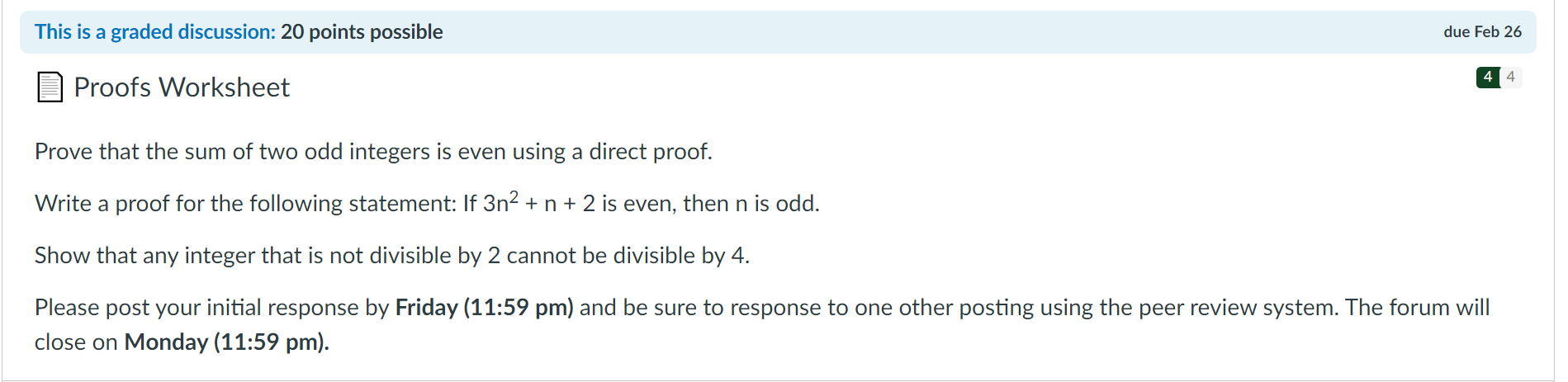
If 3n^2+n+2 is even, then n is odd
well can you write down the contrapositive of this stmt? @forest breach
forest breach
stray reef
well can you write down the contrapositive of this stmt? <@921183141564141588>
If n is even, then 3n^2+n+2 is odd
Then I did
Let n be an even integer
n = 2k
v = 3(2k)^2+(2k)+2, where v is some integer
v = 12k^2+2k+2, v = 2(6k^2+k+2)

The issue is this proves that 3n^2+n+2 is even, not odd
It was "Write a proof for the following statement: If 3n2 + n + 2 is even, then n is odd."
brave rock
It is often hard to prove false statements
forest breach
 stray reef

brave rock
You should email whoever set this worksheet with a counterexample highlighting the mistake.
agile magnet

stray reef
yeah is emailing possible
if not you are just fucked
but HOPEFULLY it's incompetence and not outright malice
agile magnet
Did they mean the converse?
fossil mural
i mean if you can't email them you could just submit a counterexample instead of a proof
fossil mural
in fact 3n^2 + n + 2 is even for all n
agile magnet
What's written is not true lol
forest breach
agile magnet
What's written is not true lol

agile magnet
It isn't tho
brave rock
brave rock
You should email whoever set this worksheet with a counterexample highlighting t...
Just do this
forest breach
I know, that's why I was so confused, because there is no way to write a proof for
"If 3n^2 + n + 2 is even, then n is odd."
brave rock
No point getting worked up about the fact whoever set this task made a mistake, just try to resolve it
forest breach
Thanks for the help all
compact owl
e^x is the exponential generating function that produces the sequence on the right. How can I rightward shift the sequence by 2 0's?

Having a hard time understanding the integration aspect of rightward shifting...
brave rock
Well, the sequence corresponding to an e.g.f named f(x) is f(0), f'(0), f''(0), .. etc.
So let's say F is the integral of f with F(0) = a for some constant a. Remember when we integrate a function we can add a constant to let F(0) be whatever we like.
So what's the sequence corresponding to F(x)? The first value is a, and the rest is exactly the same as f(0) just shifted by one, since differentiation undoes integration.
So OK, with that in mind, how do we get the EGF of the sequence 0, 1, 1, 1, ...?
Well we have f(x) = e^x, and we want to find the integral F(x) with F(0) = 0.
Now the integral of e^x is e^x + c, so we choose c = -1.
So the sequence corresponding to the EGF e^x - 1 is 0, 1, 1, 1, ...
Now it's your turn! Use this to find the EGF of 0, 0, 1, 1, 1, ...
compact owl
I would assume that the EGF would be e^x - 2 in that case
brave rock
I do not like guesses.
If you don't have good reasoning, I don't consider it an answer. Use the explanation I gave you to work it out.
compact owl
First off, thank you for the thorough explanation! Highly appreciated. Based off the logic you have provided, I would say that to rightward shift by another 0, we could use the integral of F(0) with C being 0 as well. So the integral of e^x - 1 is e^x - 1 + 0
brave rock
This is not correct, try again.
I don't think you believe that the integral of e^x - 1 is e^x - 1.
compact owl
Am I on the right track though? As in attempting to find the integral of (e^x -1) + C
brave rock
I put out steps above
Maybe you should think about why I chose c = -1 in that specific example.
compact owl
Is it because you are comparing the difference between f(0) = 1 and F(0) = 0
So c becomes -1
brave rock
brave rock
Well, the sequence corresponding to an e.g.f named f(x) is f(0), f'(0), f''(0), ...
You should reread this from the top, I think
I don't like guesses!
compact owl
Ok so, as you've mentioned the integral of f(x) = e^x is e^x + c. This becomes F(x)
So we are trying to find F(0) = 0 + F(1) = 0
 regal pelican
Using mathematical induction, show that (6^n) -1 is always divisible by 5, given n is a natural number.
fossil mural
well that's false so it's going to be rather difficult to prove
regal pelican
oh wait mb
regal pelican
fossil mural
well that's false so it's going to be rather difficult to prove
not anymore
fossil mural
ok yeah that's true
 white bear
How would I go about evaluating this?

I dont see a way to do partial fraction decomp...
 quasi jewel
I have a question on Gale Shapley-- i know that it always returns the matching where the proposing side gets their best possible option in their preference list
In the sense that best(m) gives the best option s.t. a stable matching exists where m is paired with that option
But I dont understand intuitively why best is an injective function
And I would like a hint on how to prove this using that intuition because I have none rn
quasi jewel
Nvm figured it out 💀💀💀
stray reef
white bear
How would I go about evaluating this?
$\sum_{k=n+1}^{2n} \frac{1}{k^2-1}$ and THEN pfd?
vital dewBOT
Ann
 stray reef
reindex, basically.
 mighty ingot
anyone knows how to do this
 stray reef
a nonzero number of people probably do!
mighty ingot
im stuck at proving w^6+x^6+y^6 +z^6 mod 8 is even
stray reef
are you trying to prove it's even for all possible combinations of w, x, y and z?
mighty ingot
yeah
stray reef
(w,x,y,z) = (0,0,0,1) should blow that claim to smithereens then, shouldn't it...
so the question is, why are you trying to prove a false statement?
well, that or you didn't answer my question truthfully.
stray reef
that was a "why" question, not a yes-no question.
why are you trying to prove a false statement?
 shrewd obsidian
mighty ingot
im stuck at proving w^6+x^6+y^6 +z^6 mod 8 is even
shrewd obsidian
mighty ingot
im stuck at proving w^6+x^6+y^6 +z^6 mod 8 is even
it's not
 quaint summit
how are you getting from the original question you posted to
im stuck at proving w^6+x^6+y^6 +z^6 mod 8 is even
regal pelican
regal pelican
Using mathematical induction, show that (6^n) -1 is always divisible by 5, given...
can someone help with this please
thorny hollow
Hi
coral raven
regal pelican
can someone help with this please
what have you tried
thorny hollow
Would the answer for 4 be 4(13!/8!)?

 vestal bronze
it would
thorny hollow
vestal bronze
it would
Is the answer for 5 2(26!/21!)?
vestal bronze
yeah
thorny hollow
vestal bronze
yeah
Is the answer for 6 (52!/47!) - (48!/43!)?
vestal bronze
no that's a different thing
thorny hollow
How
Which is the answer for the question 6?
My reasoning was to subtract the number of possibilites that may contain queens with the number of possibilities that doesn't contain queens, so I arrived at the solution: (52!/47!)-(48!/43!)
vestal bronze
so you counted hands that have queens, which is a different problem
it says exactly, not "at least'
thorny hollow
Oh
stray reef
yeah you need to read the problem in its entirety and not miss those words
also for the love of god please don't let the problem number and your potential answer run together
for 6, is the answer 52!/47! - 48!/43! ?
is the answer for 6 equal to 52!/47! - 48!/43! ?
will the answer for 6 be 52!/47! - 48!/43! ?
three possible rephrasings
thorny hollow
Thx
regal pelican
coral raven
what have you tried
I've proven the base case but for the k+1th step I'm not sure what I should put on the right hand side
 uneven violet
regal pelican
I've proven the base case but for the k+1th step I'm not sure what I should put ...
uneven violet
regal pelican
I've proven the base case but for the k+1th step I'm not sure what I should put ...
To get started, try this:
$$6^{k+1} - 1 = 6\cdot 6^k - 1 = (5 + 1)\cdot 6^k - 1$$
vital dewBOT
OneTrackPony
 quiet eagle
Do you know if the order of the indices in the three for-loops of the Floyd-Warshall algorithm affects the relaxation process?
uneven violet
quiet eagle
Do you know if the order of the indices in the three for-loops of the Floyd-Wars...
It doesn't affect the relaxation process, but for practical implementations it can affect performance.
(since multi-dimensional arrays are usually stored in memory in row-major order, and memory caches like good spatial locality, so iterating through consecutive elements in memory is preferred rather than jumping around)
calm chasm

I'm going to use a trivial proof technique here. I just need to show that q is true. Now, is x being a real number enough to say that x can be rewritten as a fraction
little prism
no, not all real numbers are rationals
rugged dock
calm chasm
I'm going to use a trivial proof technique here. I just need to show that q is t...
What does the hint say
calm chasm
rugged dock
What does the hint say
Basically hinted at the proof technique being trivial
rugged dock
Proof. Clearly this isn’t true. QED
little prism
when is p=>q true
calm chasm
little prism
when is p=>q true
Easier to say when it's false. It's false when p is true and q is false.
For every other case it's true.
rugged dock
Are you reading velleman
little prism
ok and what is the case here?
calm chasm
little prism
ok and what is the case here?
I'm thinking it's p = t and q = f
calm chasm
rugged dock
Are you reading velleman
Na it's a book my professor wrote.
little prism
"2 is irrational" is true?
little prism
you can also write it as 4/2. or 2000/1000
little prism
do you need to say?
little prism
you cant say. you dont know enough about x
calm chasm
Hmm
calm chasm
little prism
you cant say. you dont know enough about x
Well what about x being a real number. Not ever real number could be rational right
So it's not default true
calm chasm
Noted
calm chasm
How about I negate p and show that not p is true
Can i just start like that?
Sometimes when I write these proofs I'm not sure how to start it.
Could I just start by saying p is false. Not p is true and show that 2 can be written as a fraction
little prism
yes
calm chasm
Bet
 hallow flicker
Explain this part please? I don't understand how this relation is reflexive.
 stray reef
hallow flicker
Explain this part please? I don't understand how this relation is reflexive.
stray reef
hallow flicker
Explain this part please? I don't understand how this relation is reflexive.
!nogpt, generally.
lofty cloudBOT
hallow flicker
Explain this part please? I don't understand how this relation is reflexive.
Please do not trust ChatGPT or similar AI tools for mathematical tasks, as they often generate output which "sounds correct" but has numerous factual or logical errors. Use of these AI tools to answer other people's help questions is strictly against server rules (see #rules).
stray reef
but in this specific case, it happens not to have messed up. [because you were lucky.]
can you tell me which part of chatgpt's output confuses you?
here maybe i'll break it down into bite sized pieces for you:
[1] For any integer a, we have a - a = 0.
[2] 0 is divisible by 3.
[3] Therefore, a - a is divisible by 3 for all a.
[4] Therefore, (a,a) belongs to R for all a.
[5] Therefore, R is reflexive.
@hallow flicker can you read through this and tell me the earliest point here that you don't understand?
quiet eagle
uneven violet
(since multi-dimensional arrays are usually stored in memory in row-major order,...
ah, interesting. Thankss
 static briar
can someone explain how thsi was found, he said it was becuase 15 = 1 mod(7) but I dont know how that fact makes 15x thing go down to the x part with 4mod(7)
 brave rock
if a = b (mod m) and x = y (mod m) then ax = by (mod m), I hope you are aware?
So if 15 = 1 mod 7, then what does this tell us about 15x.
static briar
x = 25mod(7) which means x leaves remaidner of 25 when divided by 7 meaning x = 4mod(7)
calm chasm

Question. The hint says I don't need all these inequalities. But I'm not sure how to take that hint. Can I just break up the inequalities and use them?
calm chasm
rapid mural
can you think of something similar with ceil(x)?
I wrote the def for both!
calm chasm
rapid mural
can you see how to proceed
Not exactly. I want to combine these somehow. But the hint stumped me
rapid mural
calm chasm
Not exactly. I want to combine these somehow. But the hint stumped me
well both inequalities are true
so what can you deduce
calm chasm
rapid mural
so what can you deduce
I don't know...
Are you trying to say they are logically equivalent
calm chasm
rapid mural
if a leq b and b leq c
What is leq?
rapid mural
<=
calm chasm
Oh
calm chasm
rapid mural
can you see how to proceed
Wait so I can split up the inequality from the definition.
Hold on. I'm going to think about this again.
calm chasm
rapid mural
well you have
1. floor(x) leq x
2. x leq ceil(x)
In the book I'm using, I can use the fact that x is a real number, we can combine 1 and 2 and get
Floor(x) <= x < ceiling(x).
rapid mural
does this solve your problem
calm chasm
rapid mural
does this solve your problem
Did I make the wrong move here
I can try and do it on my own from here. I think I just needed to start it
calm chasm
rapid mural
does this solve your problem
Okay I think that was actually enough to solve my problem.
Unless the floor(x) fails to be <= the ceiling(x)
stray reef

 woeful copper
For this question I induct over n by proving

$\left(\left(\bigcup_{i=1}^{n}A_i\right) \cup A_{n+1}\right)^c = \left(\bigcap_{i=1}^{n}(A_i)^c\right) \cap (A_{n+1})^c$
right?
vital dewBOT
ℝage-E | Lv35+x-Exp:5770+11000
 woeful copper
I am 99% sure that is the case, I just have trouble setting up the proof. How would I set it up so that it's coherent?
woeful copper
Yup that was exercise 1.2.3, did that.
woeful copper
Yup
woeful copper
Oh right, I could have just used A_n and A_n+1 instead of the mess above
 prime grotto
yeah that works too
woeful copper
So I know I have to prove this and I have proved it, I just have trouble in setting up the induction proof (idk how)
I know how it works
prime grotto
so first you prove base case (de morgan's law) which you already did
woeful copper
Alright
prime grotto
now let's say you have a sequence of sets A_n
now use induction hypothesis
it works for up to first n sets
now you want to prove it works for first n+1 sets
then you use the union = set and de morgan's law to prove it also works
that's a sketch though
woeful copper
prime grotto
then you use the union = set and de morgan's law to prove it also works
Ah, so basically
Base Case (n=1,2)
-prove de morgan's laws
Induction Hypothesis
-assume it works for n sets
-then prove for n+1
By induction over n, proved for all neN

prime grotto
woeful copper
Ah, so basically
**Base Case (n=1,2)**
-prove de morgan's laws
**Induction Hypo...
yep!
woeful copper
prime grotto
that's a sketch though
De morgan?
prime grotto
woeful copper
De morgan?
i mean the proof is a sketch, you can extend it a little if you want
woeful copper
Oh my bad, my brain for some reason inserted guy in the middle
I read it as sketch "guy" though
prime grotto
brain moment
woeful copper
lul, thanks a lot hsf!
prime grotto
no problem!!!!
 dire stag
How do I fnd the sequence for 3,7,17,...?

The terms increase by 4, 10, 16, 22. And each of those increases by 6
But how is this related to the above questions?
uneven violet
If the sequence 4, 10, 16, 22, … is called c_n, then b_n = b_(n-1) + c_(n-1) for n > 0, and b_0 = 3. Thus
b_n = c_(n-1) + … + c_0 + 3.
So the n’th term of b is related to the previous sum.
The c sequence is arithmetic, and so you can find its sun.
 ocean socket
what exactly is "a set of order 6"
 icy swift
ocean socket
what exactly is "a set of order 6"
icy swift
ocean socket
what exactly is "a set of order 6"
i might be wrong but it could mean that the set has 6 elements


i dont understand the logic of the solution,
the part where it says "view all the numbers in the set as different elements"
then you'd be overcounting a set like {1,1,1,1,2,2} 24 times
actually nvm
i think i get it
ocean socket
icy swift
i might be wrong but it could mean that the set has 6 elements
i must say i doubt it. its mentioned in relation to a set which can never be a vector space
icy swift
hmm
ocean socket
although i see that would be the standard
ocean socket
Q: "what is a set that can never be a vector space" ans: "a set of order 6" if it is what you say it is, just saying not order 1 or order infinity would be eneough but idk.
ty
uneven violet
ocean socket
Q: "what is a set that can never be a vector space" ans: "a set of order 6" if i...
The order of any finite field F is the power of a prime, say q=p^k. If a vector space V over F has finite dimension n, then the size of V is q^n.
Since 6 is a product of two different primes, it's not possible as the dimension of a vector space.
ocean socket
uneven violet
The order of any finite field F is the power of a prime, say q=p^k. If a vector ...
yeah i just got it explained in linalg channel ty
uneven violet
Ok, np.
ocean socket
saving the answer tho
brave rock
Cross-posting and its consequences have been a disaster for the human race 
ocean socket
well i didnt know it would escalate 😅
uneven violet
Just put "Cross-posted in LinAlg" or something, if you for some good reason decide to cross-post.
compact owl
My solution (in red) is the sequence for the ordinary generating function at the top. I used to partial fraction decomposition to solve it. Can one of you please verify if my solution is accurate?

 copper tulip
is this diff eq or discrete structures or neither
fossil mural
out of those probably "discrete structures"? (but in the sense where like, it's about things that are discrete, it's not necessarily related to anything in particular that someone decided to call "discrete structures" because sometimes people give things names that don't make much sense)
woeful copper
You are correct, discrete structures include combi, grapj theory and proofs and logic
Basically the purpose of this channel :p
Unless it's another topic I'm unaware of
weary tiger
I love
I will have an exam like this in two weeks
Anyone have any recommendation for other exams I could take to practice?
oh wait tahts homework
 weary tiger
𝐴 ⊆ 𝐵 = ∀𝑥 ∈ 𝐴(𝑥 ∈ 𝐴 ⟶ 𝑥 ∈ 𝐵)
Is this equivalence correct?
Is there another definition for subset eq
 dense basin
this is the one afaik
weary tiger
Am i missing a step?
 fossil mural
weary tiger
𝐴 ⊆ 𝐵 = ∀𝑥 ∈ 𝐴(𝑥 ∈ 𝐴 ⟶ 𝑥 ∈ 𝐵)
Is this equivalence correct?
fossil mural
weary tiger
𝐴 ⊆ 𝐵 = ∀𝑥 ∈ 𝐴(𝑥 ∈ 𝐴 ⟶ 𝑥 ∈ 𝐵)
Is this equivalence correct?
well that's true but it's a somewhat weird way to phrase it
you're essentially saying "any element of A that is an element of A is an element of B"
when you could just say "any element of A is an element of B"
i.e. $\forall x (x \in A \to x \in B)$, or equivalently $\forall x \in A (x \in B)$
vital dewBOT
bee [it/its]

 crimson zenith
I can't find a formal definition of a constant function anywhere. Is it a simple as, "For any values x1 and x2 in the domain, f(x1)=f(x2)? Or is it more complicated?
For example, given the definition I just gave, that would mean a domain with a cardinality of one would make any function f constant regardless of what f(x) is. Is this intended?
 sick grail
crimson zenith
For example, given the definition I just gave, that would mean a domain with a c...
sick grail
crimson zenith
For example, given the definition I just gave, that would mean a domain with a c...
yes
the definition you give is fine
crimson zenith
interesting
stray reef
Is it a simple as, "For any values x1 and x2 in the domain, f(x1)=f(x2)?
what other complications do you think should be there
weary tiger
So I'm working on a (high school) math assesment which I chose to do on decompression models (you know, the ones used in scuba diving), and the aim of my IA is to use an existing discrete model to develop a continuous one. Though, the model is recursive, and I'm at a point where I'm just stuck staring at my screen trying to figure out how to continue. I might've chosen a topic that's too advanced for me, but I want to go through it, I just need a nudge in the right direction.
if anyone is interested in helping me (for some reason) or giving me ideas, please dm me 🥲
 zenith marsh
u guys have any tips or roadmap for discrete math? i have been in this course for like 2 days / 6 periods
😁
 lone verge
how do i find a set of positive integers X and Y and such that there exists integers A and B so that AX + BY = 2, and the GCD of X and Y is not equal to 2?
uneven violet
lone verge
how do i find a set of positive integers X and Y and such that there exists inte...
I'm answering what I think you are asking: You want to find integers X and Y with GCD(X,Y) different from 2, such that there exists integers A and B with AX + BY = 2.
You can take X = 1, Y = 2. Then GCD(X,Y) = 1. Now take A = 2 and B = 0. Then AX + BY = 2.
uneven violet
np
 astral hatch
Does a universal quantifier make a predicate a proposition?
ie, is a predicate like (E(x) -> W(x)) changed into a proposition when we have ∀x(E(x) -> W(x))
brave rock
Yes
astral hatch
Is that true for a existential quantifier too
brave rock
Yes
astral hatch
How does that work
Doesnt the truth value of the inside predicate still depend on the values of E and W
brave rock
Uh, yes?
 neat oasis
I asked this in help channels but realised it may be a bit too advanced for there, could someone help me here?
 stray reef
$S \geq f(x)$ is cursed notation.
vital dewBOT
Ann
 stray reef
actually a lot of this is kind of cursed. did you get this from your textbook?
 stray reef
!original
lofty cloudBOT
Please show the original problem, exactly as it was stated to you, with the entire original context. A picture or screenshot is best. If the original problem is not in English, then post it anyway! The additional context might still be helpful. Do your best to provide a translation.
neat oasis
this is better right?
stray reef
If the original problem is not in English, then post it anyway! The additional context might still be helpful. Do your best to provide a translation.
neat oasis

Here there's also the inferior sum, but that part of the exercise I didn't need any help for
stray reef
ok, right.
neat oasis
although it could have some relation ig, so the result is 2^|A intersection x|
stray reef
so you missed a subscript.
and also $A \in P = 2^{[n]}$ is not at all the same thing as $A \in 2^{[n]} = p$. the way you wrote it, it was confusing as shit.
vital dewBOT
Ann
 stray reef
just had to point that out.
neat oasis
I didn't wrote it out like that sorry, I asked in help channels and they translated to latex as best as they could
stray reef
neat oasis
this image is already clearly latexed
ok so f(x) is the function that returns 1 if x ⊆ A and 0 otherwise. ok.
and we want to find the sum of $f(y)$ for $y \geq x$, where $x$ is fixed, and that'll give us $S_{\geq}f (x)$.
vital dewBOT
Ann
 neat oasis
yes
stray reef
this i believe boils down to the number of sets y such that x ⊆ y ⊆ A.
which would be 2^|A \ x| actually, not 2^|A ∩ x|.
neat oasis
Yeah I saw that too, but I was not able to give a value
neat oasis
stray reef
which would be 2^|A \ x| actually, not 2^|A ∩ x|.
no, no, that's for the inferior sum
inferior sum being for <=
but 2^|A\X|? that can't be, there's a bunch of ways you can get it to give 0
like
in [3], S>={1,2}({2,3})=0
stray reef
oh, hold on.
it's 2^|A \ x| if x is a subset of A
otherwise it is 0
that should check out
stray reef
stray reef
this i believe boils down to the number of sets y such that x ⊆ y ⊆ A.
the existence of at least one such y implies x ⊆ A
neat oasis
a lot of sense,
like I saw 2^|A\X| before but discarded it because of the 0 cases
ok ok
thanks
astral hatch
brave rock
Uh, yes?
but doesnt that imply that its then a predicate?
brave rock
No
The truth value of a sentence always depends on its content. I feel like you're not saying what you really mean, or perhaps I am simply not understanding.
 golden nacelle
One of my first proofs I wrote in my disc math class, can someone verify it?
 golden nacelle
stray reef
logic holds up, but style is not great.
golden nacelle
stray reef
logic holds up, but style is not great.
What can I improve?
stray reef
less symbol soup, i'd say.
and less assignment of letters to represent statements.
i could rewrite this proof to make it better on style, but it's midnight here.
if you're ok waiting like 7-8 hours for me to wake up tomorrow, i can do it in the morning.
golden nacelle
Fair enough, I was just tryna represent them all as propositions and proceed
golden nacelle
stray reef
if you're ok waiting like 7-8 hours for me to wake up tomorrow, i can do it in t...
yep that works
calm chasm
if you have 3^(n+1) > 2^(n )* 3 why can we change 3 to 2 ?
My understanding is that it's just because the inequality is still true but being able to just change the numbe feels like magic.
Like if I have 10^(n+1) > n^(2) * 10 and I'm doing proof by induction and need 10^(n+1) > (n+1)^2 can I just do that?
I see now
as long as the inequality still holds when doing proof by induction, I can do this
Example:

 zenith quail
stray reef
and we want to find the sum of $f(y)$ for $y \geq x$, where $x$ is fixed, and th...
zenith quail
stray reef
and we want to find the sum of $f(y)$ for $y \geq x$, where $x$ is fixed, and th...
relatable tbh
calm chasm
Does anyone know of a video that explains universal quantifier proofs? I realized I don't understand how to prove them.
 dawn gulch
Anyone?

 final cliff
lone verge
what does (x,y) having domain A x A mean?
final cliff
lone verge
what does (x,y) having domain A x A mean?
Pretty sure they just mean the set of values that pairs (x,y) are chosen from
lone verge
So that means (x,y) can be (1,2), (2,3) (4,3) etc.?
final cliff
Yep
lone verge
can it be (1,1), (2,2)?
final cliff
Yes, it can be any element from the cartesian product of A={1,2,3,4} with itself.
final cliff
Yeah, (1,1) is not an element of A={1,2,3,4}.
Sometimes people will talk about a "universe" or a "domain" or a "domain of discourse" in the sense of "the set of elements we take values for our variables from"
So, it would be good to double check your definition for domain here to be safe.
lone verge
Noted
 rugged dock
calm chasm
rugged dock
calm chasm
Did you complete the square
stray reef
zenith quail
relatable tbh
??
weary tiger
calm chasm
Could I get a hint?
My first thought is to find for what values 4x is greater than x^2 then show that adding 5 to x^2-4x makes the value greater than or equal to zero
I suck at discrete math tho
Also $f'(x) = 2x -4$ might be helpful


 lone verge
i tried making their denominators the same but it just results in so much stuff that im lost
stray reef
say, where'd this come from?

 stray reef
i have a feeling that there is a better way to do this
lone verge
what do u propose?
stray reef
why not decompose 30/((2r+1)(2r+5)) into partial fractions
lone verge
what do u mean by that
stray reef
In algebra, the partial fraction decomposition or partial fraction expansion of a rational fraction (that is, a fraction such that the numerator and the denominator are both polynomials) is an operation that consists of expressing the fraction as a sum of a polynomial (possibly zero) and one or several fractions with a simpler denominator.The im...
lone verge
sorry idk how to do this 😭
stray reef
hm
$\frac{30}{(2r+5)(2r+1)} = \frac{\tfrac{15}{2} \cdot 4}{(2r+5)(2r+1)} = \frac{\tfrac{15}{2} [(2r+5) - (2r+1)]}{(2r+5)(2r+1)}$
vital dewBOT
Ann
 stray reef
so you can do this hack, i guess
you'll get $\frac{15}{2} (-1)^{r+1} \paren{\frac{1}{2r+1} - \frac{1}{2r+5}}$ as your summand
vital dewBOT
Ann
 dawn gulch
Hello
stray reef
dawn gulch
Hello
hello, do you have a math question to ask?
stray reef
!da2a
lofty cloudBOT
No need to ask “Can I ask…?” or “Does anyone know about…?”—it’s faster for everyone if you just ask your question! See https://dontasktoask.com/
stray reef
you should send the question upfront
stray reef
http://nohello.net/ etc.

please don't say just hello in chat
stray reef
dawn gulch
Give me moment
ok sure. ping me when you've sent the question.
dawn gulch
I am trying to simplify truth tables because logical equations are hard to understand as symbols not as words and sentences.
I understand the 3 symbols but what I want to do is to solve a truth table by using analogies or sentences to prove or disprove something based on the table itself.
@stray reef
dawn gulch
Not
stray reef
ok then come back when you do?
right now it's almost impossible to understand what you want
dawn gulch
Then do you want me to clarify
stray reef
i want a concrete problem that you tried to solve and ran into issues.
you have already confirmed that you are unable to supply such a problem.
lone verge

I understand that as n gets bigger, the mod of the nth term gets smaller, and that every 2nd term in the sequence is negative, but I cant connect it to the in between 0 and 1, and the in between 1 and 2
dawn gulch
I am saying that I have a hard time breaking down logical equations to complete truth tables
calm chasm
rugged dock
Did you complete the square
I didn't but I'll try. Right now it's not obvious to me why that would work.
If my goal is this form,
(x+a)^2+b
I'd still have an issue.
agile magnet
dawn gulch
I am saying that I have a hard time breaking down logical equations to complete ...
Can you give an example problem?
It'll be easier for us to help you if you give an example problem, your attempted solution, and where you got stuck
 short ridge
dawn gulch
I am saying that I have a hard time breaking down logical equations to complete ...
short ridge
dawn gulch
I am saying that I have a hard time breaking down logical equations to complete ...
the number of rows you will need is 2^k where k is the number of variables. and then setup all combinations of true false and keep plugging into the equation and evaluating the truth
rugged dock
calm chasm
I didn't but I'll try. Right now it's not obvious to me why that would work.
I said that because it’d put it in an easier form to digest .and work with
Probably would lead to some clear path
calm chasm
Okie. I'll give it a try
 somber fox
I don’t understand the setup here. Any square be an be divided into n squares? Where n >= 5? So it’s asking to show that any square can be divided into at least 5 squares? What’s the connection of this with k + 3?
 brave rock
Well firstly, the problem says n > 5, not n >= 5.
The problem says this: choose some n with n > 5. Then a square can be subdivided into exactly n squares.
So it's not at least 5, it's exactly n where n > 5 is of anyone's choosing.
I won't discuss the k+3 bit, that's the hint.
somber fox
brave rock
The problem says this: choose some n with n > 5. Then a square can be subdivided...
Thanks for clarifying. I think this helps.
somber fox
brave rock
Well firstly, the problem says n > 5, not n >= 5.
I wonder the requirement for 5. Is it necessary? Or it’s just how they constructed the problem? Because of n = 4. You can subdivide a square into 4 squares.
 amber wolf
The symbol in part b. has put me in quite the pickle.
What is it? I can’t find a mention of it anywhere in our coursenotes. I originally took it as a symbol for a subset of but apparently that is not the case

Please ping in reply! Thanks.
 unborn vapor
amber wolf
The symbol in part b. has put me in quite the pickle.
What is it? I can’t find ...
unborn vapor
amber wolf
The symbol in part b. has put me in quite the pickle.
What is it? I can’t find ...
the symbol likely does mean subset, but the set you listed is an element of A, not a subset of A
amber wolf
unborn vapor
the symbol likely does mean subset, but the set you listed is an element of A, n...
Would a subset of A be {2,7}?
Maybe I'm not clear on the definition of a subset
Because in our course notes, the subset symbol is that symbol with a line underneath
unborn vapor
amber wolf
Would a subset of A be {2,7}?
Yes! If B is a subset of A, that means that all of B’s elements are also elements of A. You could also think about it as A with potentially some elements removed. Your answer is not a subset because 4 is not an element of A
amber wolf
unborn vapor
Yes! If B is a subset of A, that means that all of B’s elements are also element...
Ah, the elements of B in this case would have to separately be elements of A then?
unborn vapor
Yes
Another subset of A is {2, 3 {2, 3, 4}}, or even {{2, 3, 4}} though that last example is harder to parse and might require a bit more thought
amber wolf
Very nice, you explained it well  thank you!
unborn vapor
No problem!
 elfin furnace
How to find G+? And is G^2 correct
 agile magnet
elfin furnace
How to find G+? And is G^2 correct
agile magnet
elfin furnace
How to find G+? And is G^2 correct
your adjacency matrix looks fine, I'm not checking your matrix multiplication you can do that yourself
what is the definition of G^+?
elfin furnace
Transitive closure
agile magnet
ok, so can you draw that graph out for me?
elfin furnace
Idk how
I just wanna know how I can find the transitive Claire
Closure
The textbook barely explains it
It just says it’s the union of G^2, G^3, and G^n
How do you compute that value or matrix
calm chasm
What I've learned from math text books is its probably in the text book. You probably just missed something or didn't fully appreciate what you read.
Happens to me often
agile magnet
elfin furnace
It just says it’s the union of G^2, G^3, and G^n
Ah ok so I think there's a better way to view it
like that definition is not wrong
but it doesn't really explain the "transitive" part
So another "combinatorial" way to view G^2 is that it is a modification of the definition of the adjacency matrix G
rather than G_ij = 1 if i -> j by one edge
we have G^2_ij = 1 if i can reach j in two edges
G^3_ij = 1 if i can reach j in three edges etc etc
so that's where the textbook definition comes from
but what I think is a nicer combinatorial definition that is that G_ij = 1 if i can reach j in a finite number of edges
so j is reachable from i
this is where the transitive part of the name transitive closure comes from
because reachability is transitive
if i can reach j and j can reach k
then i can reach k
does that help you come up with the matrix for G^+?
calm chasm
I don't have the time to help much. But I'm pretty sure this is just a permutation with restriction. Have you tried drawing it out? Or how about just making the numbers smaller so you can start with an easier problem.
 rose creek
calm chasm
I don't have the time to help much. But I'm pretty sure this is just a permutati...
rose creek
calm chasm
I don't have the time to help much. But I'm pretty sure this is just a permutati...
im not sure if im supposed to permute the men and women, multply that by the # places a women can be seated
 haughty garden
this looks like tedious inclusion/exclusion
 glad panther
do you guys have good resources to practice mathematical, strong, and structural induction?
I don't think induction is intuitive at all, at least for me. I don't really understand it
 silver panther
Mathematical Induction: https://www.youtube.com/playlist?list=PLWItv3oXcB2XWzvJIAMujaMoHwUQx32Sw
YouTube
This video series of lectures on Mathematical Induction. This is a topic widely seen at Year 13 / Class 11 / Grade 12 In this series we will go through all t...


@glad panther these videos are good, make sure to try lots of problems after, there are also lecture notes with problems for these videos...
The creator also uses induction to prove irrationality of pi
 viral crown
glad panther
do you guys have good resources to practice mathematical, strong, and structural...
viral crown
glad panther
do you guys have good resources to practice mathematical, strong, and structural...
andreescu's mathematical induction: a powerful and elegant method of proof (or something)
it's primarily intended for competition math audiences but i find it serves perfectly well as a resource for a lot of induction problems
neon harbor
You can pair each woman with a man, so you end up with 9 pairs plus 5 single men, and the solution should be straightforward from there
 edgy lintel
im having trouble displaying a collection of pairs on a given interval in set builder notation
stray reef
!xy
lofty cloudBOT
Please show the original problem, exactly as it was stated to you, with the entire original context. A picture or screenshot is best. If the original problem is not in English, then post it anyway! The additional context might still be helpful. Do your best to provide a translation.
stray reef
@edgy lintel
edgy lintel
 stray reef
hold on
stray reef
edgy lintel
can you explain in more detail what pairs your set consists of?
or show a graph with them all marked?
edgy lintel
Multiples of 1/2
stray reef
...


 stray reef
oh my god why didn't you post the problem in the first place.
wait so ok. you want to approximate this integral via the midpt rule with 6 subintervals, yes?
edgy lintel
yes
stray reef
ok now tell me
what's the length of the full interval of integration?
don't answer any more or any less than i ask you!
edgy lintel
12
stray reef
good. your interval does have length 12.
you split it into 6 equal length subintervals. what is the width of each subinterval?
edgy lintel
2
stray reef
uh huh
and can you write out in a list the intervals themselves and their midpoints?
i think you will find that it will differ from what you sent earlier.
edgy lintel
ill be back ,my boss is making me put on a fur suit
stray reef
what kind of boss is that? are they a furry themselves?
edgy lintel
no no i work for a party business
well
i think my boss might be a furry 🤔
woaw 1 /2 does not equal 2 🤦♂️
my bad
stray reef
indeed, they are quite different.
stray reef
@gritty garnet it's true that ∅ is a SUBSET of any set, but it is NOT true that ∅ is an ELEMENT of any set.
 wet flame
is (b+c)* equivalent to (c+b)* (regex)
haughty garden
yes
wet flame
hm ok
https://bakkot.github.io/dfa-lib/regeq.html this website said otherwise which is weird
 haughty garden
oh they define it to be concat
haughty garden
yeah if it’s used as concatenation, then they are not equivalent
wet flame
how would i describe "all words where num of a’s + num of b’s is odd" in regex over the alphabet {a,b,c},
i guess it would start with something like c*(a+b) but idk after that
agile magnet
wet flame
how would i describe "all words where num of a’s + num of b’s is odd" in regex ...
split it into cases
based on the parity of the number of a's and the parity of the number of b's
create a regex for each case, combine appropriately
wet flame
so like 3 a's, 3 b's, 2 a's 1 b, 2b's 1 a ?
agile magnet
yea
also I'd ignore c for now
figure out the regex ignoring c's
and then add then later as necessary
wet flame
how would you suggest combining the different regex for each case
agile magnet
what do you think?
I mean what ways are there to combine regular expressions to form a new one?
wet flame
my initial thought would be to just union them together
agile magnet
lets start there
agile magnet
wet flame
my initial thought would be to just union them together
why?
wet flame
so you can pick any of the cases
agile magnet
sounds good to me
wet flame
im a little stuck, if we just consider we only have a's and b's, we just need even a's odd b's, or vice versa right? Im not sure on how to express even or odd in regex
weary tiger
Can someone give me a simplification of what they are saying here? First they refer to congruence class. Then they say m pairwise disjoint equivalence classes modulo m. Whats the difference between "equivalence classes" and "congruence class?"
 agile magnet
weary tiger
Can someone give me a simplification of what they are saying here? First they re...
agile magnet
weary tiger
Can someone give me a simplification of what they are saying here? First they re...
No difference
They should have kept consistent wording
Equivalence class is a more general term I guess
When talking about modular arithmetic, we say "x is congruent to y modulo m"
Hence congruence class
But modular congruence is an equivalence relation (easy exercise)
So we may also say equivalence class
weary tiger
Thank you
@agile magnet when you say modular congruence is an equivalence relation, is it because of the proof being this theorem ...

Behind*
agile magnet
Well you want to use that "Consequently" sentence to prove it's an equivalence relation
dire stag
How do I find a0?
 stray reef
dire stag
How do I find a0?
stray reef
dire stag
How do I find a0?
you find the n'th term as instructed then plug in n=0...?
but the problem also doesn't say to find a_0.
dire stag
stray reef
but the problem also doesn't *say* to find a_0.
I think that I need a0 in order to do the polynomial fitting
In the previous examples that I did on my own, I think that I always started at a0, not a1.
This is also the last problem on the homework, the previous problems also didn't mention anything about the first term being a1 and not a0
stray reef
dire stag
I think that I need a0 in order to do the polynomial fitting
why? what method are you using?
 near stream
how would i use membership tables for this?
 compact owl
What sequence does the generating function f(x) = (3-2x) * 5 generate?
I'm slightly confused as there's no division here.
brave rock
Remember that the ordinary generating function of the sequence $f_0,\ f_1,\ \dots$ is the infinite sum $f_0 + f_1x + f_2x^2 + f_3x^3 + \cdots$
vital dewBOT
Boytjie
