#discrete-math
1 messages · Page 43 of 1
 haughty garden
no
should be 10
pick one element in each of the 8 pairs, pick 8. Then picking one extra element guarantees that at least one of the 8 pairs has both of its elements chosen
if one of the 8 pairs has both of its elements chosen, then the two elements in the pair add to 16, which correspond to elements in the original set that sum to exactly 2010
 dire stag
ok
What does cardinality mean in this context?

Is it the column of pascals triangle?
 gilded dragon
does a proposition have to verifiable? in the sense like "There is life in the andromeda galaxy"
 rain moth
gilded dragon
does a proposition have to verifiable? in the sense like "There is life in the a...
rain moth
gilded dragon
does a proposition have to verifiable? in the sense like "There is life in the a...
dont think so
not sure but assuming as a given whether its true/false is the closest you can get to "verifying" it
dire stag
:/ Pls help

 agile magnet
Let $X$ be the set of 11-bit strings that have weight 5 and start with 011. Let $Y$ be the set of 11-bit strings that have weight 5 and end with 01. The question is asking you to compute $\abs{X \cup Y}$.
@dire stag
 vital dewBOT
Spamakin🎷
 agile magnet
so compute that using inclusion-exclusion
so rewrite |X U Y| as something perhaps easier to compute
and go from there
 stray reef
@dire stag do you still need help w/ this
 ionic ice
Assume that we have five operations, union, intersection, difference, symmetric difference and cartesian product and three sets $A, B, C$. How many different sets can we create using these 5 operations? I think the answer is $5 \cdot 4 = 20$. My reasoning is the following: We can create 4 sets using union as the primary operation (meaning it comes first, reading from left to right) and the other operation(s) come afterwards. We can use only union as the operation but that can be discarded with because of associativity. Therefore there are 4 different sets from these 5 operations. However, because this can be written in 2 different orders, one beginning with the operation union and the other ending with it, there are 8 different ways this can be achieved. But the latter 4 sets, those that end with union, are respectively these sets where the other four operations come first. Therefore there are 4 different sets that start with a different operation than union. We can continue to do this and eventually get 4 sets for each operation. Therefore there are 20 different sets. Is this reasoning correct or incorrect?
vital dewBOT
Forsaken

 twilit sundial
the solution given here seems somewhat poorly explained: what about the classes that come after class i? do we just repeatedly apply that transformation at all points where the schedules deviate?
 haughty garden
twilit sundial
the solution given here seems somewhat poorly explained: what about the classes ...
haughty garden
twilit sundial
the solution given here seems somewhat poorly explained: what about the classes ...
yeah, it's the standard exchange argument. You actually do not need an explicit contradiction. The idea is that any time a solution deviates from your greedy algorithm, you can swap it with the element that your greedy algorithm chose and argue that by exchanging this element, the new solution is either strictly better or not any worse
Repeat this argument for each index where your greedy algorithm and some optimal solution disagree
Here's the way that I normally prove the result. We prove the following claim.
Claim. There exist an optimal scheduling that includes the class with the earliest ending time.
Proof. Let x be the class with the earliest ending time, and suppose that S is an optimal solution that does not contain x -- we let y be the class in S with the earliest ending time. Firstly, since x ends earlier than y, then e_x < e_y (where e_i denotes the ending time of class i; similarly, we will also let s_i denote the starting time of class i). Since S is a valid solution, it follows that e_y <= s_i for each class i in S (otherwise, some class will clash with class y). Therefore, e_x < e_y <= s_i, which implies that S' := (S \ {y}) U {x} is also a valid solution with |S'| = |S|. In other words, swapping y for x does not yield a worse solution.
Convince yourself that this actually implies the correctness of the algorithm
haughty garden
yes
you just repeat the same argument to slowly transform any optimal solution into your greedy algorithm using the exchange
 somber spindle
hi, im a bit confused on well order relations since my lecturer only glossed over it a bit, can someone please walk me through how to solve this question/explain how to go about this question?

 pale epoch
somber spindle
hi, im a bit confused on well order relations since my lecturer only glossed ove...
pale epoch
somber spindle
hi, im a bit confused on well order relations since my lecturer only glossed ove...
whats your definition of well-order
also this question is formulated quite open, so it might be useful to play around a bit with examples
somber spindle
pale epoch
whats your definition of well-order
see thats what im not sure of, all my lecturer said is if every subset has a least/smallest element
in that case are we instead looking at the sets (in this case set A and B) rather than the relation to determine if its well order?
pale epoch
somber spindle
see thats what im not sure of, all my lecturer said is if every subset has a lea...
this is a definition
a well-order is defined on a set, you need both pieces of information
do you have examples of well-ordered sets?
pale epoch
pale epoch
this is a definition
at least if you know what an order relation is
somber spindle
pale epoch
do you have examples of well-ordered sets?
my lecture slides don't have any
it only gives the definition
somber spindle
pale epoch
at least if you know what an order relation is
so as long as we know that it's a total order relation, that means to determine if its well order we just have to look at the set?
 fossil mural
well as an example: the natural numbers, with their usual order
every set of natural numbers has a minimum element (in fact this is equivalent to induction), so this is a well-order
if you take the normal order on the real numbers, that's not a well-order, because the set of all positive real numbers has no minimum element
somber spindle
ahh i see
somber spindle
somber spindle
hi, im a bit confused on well order relations since my lecturer only glossed ove...
so in a question like this, will a set of ordered pairs have a minimum element?
not entirely sure how ordered pairs work and if you can determine a minimum element from a set of them
fossil mural
well that depends on the order
they're asking you to define an ordering on A \times B
that is also a well-order
somber spindle
wait so that means you can have a well-order relation on a set of ordered pairs?
fossil mural
yes
for instance a well-order on {(a, a), (a, b), (b, a), (b, b)} is (a, a) < (a, b) < (b, a) < (b, b)
(any total ordering on a finite set is a well-order)
somber spindle
fossil mural
(any total ordering on a finite set is a well-order)
ill have to keep this in mind, thank you 👍
dire stag
agile magnet
so rewrite |X U Y| as something perhaps easier to compute
idk what to do
How do I find the results?
if I already have numbers like 011 or 01, then how does that affect the weight?
How do I find the overlap if I'm doing this in binomial coefficient notation?
stray reef
do you know what the weight of a bitstring is?
dire stag
number of 1s
stray reef
right
so when you're finding |X ∩ Y|, i.e. the overlap as you say
you are calculating the number of strings that begin with 011 AND end with 01
and have length eleven
so you are counting strings of the format 011xxxxxx01
do you understand y/n
dire stag
y
dire stag
3
stray reef
and so how many 1's need to appear in the middle?
dire stag
2
stray reef
well there you have it
dire stag

 agile magnet
Instead of giving a number with an emote can you explain how you arrived to 15?
dire stag
yes
stray reef
well do it lmao
dire stag

Monkey brain did something
2^8 I believe is C(8,3), because 011 already reserves 2 of the 5 weight. 5 - 2 = 3.
Same for 2^9
2^6 is the overlap
agile magnet
agile magnet
Let $X$ be the set of 11-bit strings that have weight 5 and start with 011. Let ...
Can monkey brain compute |X| as a start
dire stag

idk, I'm not sure if I'm supposed to
subtract
5 - 2 = 3 from |X|, because 011 already reserves 2 1's
and
5-1 = 4 in |Y| because, 01 already reserves 1 1.
or
if I just ignore it and apply the weight 5 to the X's without looking at 011 or 01.
It's interesting just how similar the answers are to one another.
 weary tiger
how do I find y?


 agile star
Hello guys, weird question, how do I get better at combinatorics?
I've found it verg hard even at beginner level and I think I lack many of the basics
And time is very tight lately, my final exams are 120 days away and it's pretty life changing especially due to my shittys country's economy
So any recommendations??
 pale monolith
Do problems
 brave rock
How do you get good at literally any skill? You practice.
agile star
How about learning the basics?
And getting a better understanding on how it works and all
agile magnet
agile star
How about learning the basics?
Do you have a textbook you're looking through?
Like for whatever course you're taking
agile star
Yes but it barely has any practice problems and it has very shitty outlaying
agile magnet
Ok so maybe a better text would be worth getting
agile star
Like I've read it all twice
agile magnet
There's a good text, A Walk Through Combinatorics
agile star
agile magnet
Ok so maybe a better text would be worth getting
It's actually not possible
We are forced to study our gov curriculum
From official books from the ministry
agile magnet
Ok but you can still learn the material through different stuff
Do problems from different stuff
agile star
So I'm kinda stuck with it
agile star
agile magnet
Ok but you can still learn the material through different stuff
Yeah that's what I'm trying to do
agile star
But honestly I'm ignorant to all different sources
agile magnet
And do problems from that
agile star
agile magnet
There's a good text, A Walk Through Combinatorics
That one?
agile magnet
Ya
agile star
Cool
Imma check it out
Thanks man
Oh crap internet is out
Now you understand my resentment towards my country
It's the upgraded version of Detroit
Anyways thanks man
.close
 haughty garden
C(20, 18) means that the ordering of the books doesn't matter
I think the phrase "Notice that here we will allow the books to end up in any order" can be a bit misleading
P(20, 18) doesn't work for part (b) because you allow permutations where the books aren't necessarily in alphabetical order
e.g. if you had books A and B, then P(20, 18) will consider arrangements where A comes before B different to arrangements where B comes before A (which we do not allow)
(in fact, you have it the wrong way around but I'll let you think about why)
haughty garden
yes but it might help to think about why
dire stag
Permutations are all the possible rearrangements of objects / elements.
haughty garden
another way to think about permutations is to that it is an ordered collection of objects
in other words, once you choose your collection of objects, you want to find the number of ways to permute these objects
hence, you also have that P(n, k) = k! * C(n, k)
for part (b), in any group of 18 books, how many ways can you arrange these books if you require these books to be in alphabetical order?
for example, let's say I have the letters {B, C, A, D}, how many ways can you arrange them so that these letters are in alphabetical order?
dire stag
haughty garden
for example, let's say I have the letters `{B, C, A, D}`, how many ways can you ...
1
haughty garden
yup
haughty garden
haughty garden
for part (b), in any group of 18 books, how many ways can you arrange these book...
now what about this?
dire stag
😑
dire stag
haughty garden
for part (b), in any group of 18 books, how many ways can you arrange these book...
1?
haughty garden
exactly
in other words, if I choose any 18 out of the 20 books, there's exactly 1 way to arrange these books
but how many ways can I choose 18 books from a total of 20?
dire stag
P(20,18)?
haughty garden
P(20, 18) assigns an order
we don't care about the order
because remember that there's only 1 ordering
haughty garden
yep
so we can first select 18 out of the 20 books and then realise that once we choose these books, there's only 1 way to arrange them
which gives you C(20, 18) for part b
haughty garden

 onyx axle
Can someone tell me what multi-sets are?
Specifically why is the formula this, why do we subtract 1 and add k?

 vestal bronze
onyx axle
Can someone tell me what multi-sets are?
Specifically why is the formula this, w...
vestal bronze
onyx axle
Can someone tell me what multi-sets are?
Specifically why is the formula this, w...
multisets have a certain amount of each element
like, {a,a,a,b} or {3a, 1b}
the formula is like this because we can count ways to e.g. add up to 10 with 4 integers
by taking 3 dividers and 10 stars**********|||
and permuting it
****||******| 4+0+6+0
**|***|**|*** 2+3+2+3
meaning there's 286 multisets with 10 elements if there's 4 types of an element
so we choose 3 spots out of 13 to be dividers
or 10 spots, it's the same thing
the formula is at the same time (n−1+k)C(n−1)
 wheat hound
 agile magnet
,rotate
wheat hound
guys please lock in
vital dewBOT
 agile magnet
yay now its readable
ok how many rows are there in a truth table with 2 statements?
wheat hound
4
agile magnet
how did you get that?
You're right, but explaining why will hopefully help you figure out how to get the 4 statement version
wheat hound
well like its p q not p not q
wheat hound
idk twin thatx ehy im asking
agile magnet
can you write out the truth table for P and Q?
this has 2 statements: P, Q
and it will have 4 rows
wheat hound
twin im sorry i knos how to do it but i have tobgo go to bed in 5 mins
its
ttff
tftf
agile magnet
idk what that means
wheat hound
like for the possibilities beloe it
agile magnet
possibilities of what below what?
wheat hound
for a scensrio
please tell me how to solve this
i needbthe 4 extra credit points
spamakin
is it 16
agile magnet
wheat hound
is it 16
how did you get that?
 haughty garden
my first thought is inclusion/exclusion
the complement is "either the m's are together or the t's are together or the e's are together" and apply inclusion/exclusion on that
 odd prism
haughty garden
and those cases are easy to compute
odd prism
haughty garden
and those cases are easy to compute
I’m completely brain farting can you give an example for case E
haughty garden
Treat the E's as 'one letter' and arrange the rest
There are 8 letters once we group the e's together; so you have 8!/(2! * 2!) total permutations
odd prism
haughty garden
Treat the E's as 'one letter' and arrange the rest
So for case et we would have (9-1-1)!/((2-1)!(2-1)!2!)
haughty garden
try it out by hand
 sonic shadow

How should one approach this problem?
I have been aching this one for quite some time, and I actually have no clue as to how to set up the pigeons and the pigeonholes
I know that it's a pigeonhole problem, I can just simply taste the yummy pigeons
But I actually have no idea
Here is my take to this problem, so that I am not just spoonfed the answer, because I want to know how to squeeze a pigeonhole from a rock
We let X be the set of numbers from 1 to 49, and we define a function a_i =1,2,..5 for all i in X.
In other words, a_i is the number of hours the student plays video games at the ith day
We see that using our formulation, we have \sum_i ^{i+7} a_i \le 11 for all i,i+7 in X
That is, for every "interval" in X that is 7 days long, the corresponding sum is always less than or equal to 11
I found out that the suitable intervals for which the student plays 20 days is atleast 218
So, that's a lot of pigeonholes
How do we catch our pigeons?
Thank you in advance
The total number of intervals possible was 1225
Thanks in advance
:)
 last flume

 gilded sun
Am I understanding this properly? I used the property that (n/k) = (n!)/k!(n-k)!
 agile magnet
how did you get that answer
vital dewBOT
Spamakin🎷
 gilded sun
agile magnet
how did you get that answer
gilded sun
agile magnet
how did you get that answer
So basically what I did was the following: if we follow the property i put above we get (17/5) = (17!)/(5!17-5), which gets us (17/5) = 17x16x15x14x13x12x11x10x9x8x7x6/5x4x3x2x1x12x11x10x9x8x7x6
12x11x10x9x8x7x6 can be canceled from numerator and denominator
so I get (17x16x15x14x13)/(5x4x3x2x1)
then i simplify
vital dewBOT
Spamakin🎷
 agile magnet
so that first step is wrong
but then you correctly simplified (17!)/(5! 12!) to (17x16x15x14x13)/(5x4x3x2x1)
agile magnet
gilded sun
So basically what I did was the following: if we follow the property i put above...
so you realize you made a mistake typing this out here right?
vital dewBOT
Spamakin🎷
 agile magnet
you follow everything I said so far?
gilded sun
agile magnet
you follow everything I said so far?
yes
agile magnet
gilded sun
so I get (17x16x15x14x13)/(5x4x3x2x1)
ok so you see how what you wrote here is different to your selected answer?
so what is the correct answer?
agile magnet
why?
gilded sun
agile magnet
why?
wait no, my original answer is the correct one..
 olive wraith
I have a question 1/10 = 0.1
so how 1%10 == 1 I did not understand this can any one eleborate this
stray reef
remainder.
that's right, a % b is the remainder of the integer division of a by b.
when you integer-divide 1 by 10, your quotient is 0 and your remainder is 1:
1 = 10*0 + 1
do you understand this? Y/N
olive wraith
Y
olive wraith
Y
somber spindle
ive encountered a problem while solving this question, i got that the answer is
b = -19,
c = 90
d = 112,
but when my friend tried doing it using almost the same exact method but differing ever so slightly, he couldnt get the answer, even though logically we did the same thing
(image is missing curly brackets for the set {3,4,...,10}, sorry)

in my work, i decided to multiply the 2's from the nC2 terms into the 56 and reached the correct answer

but here my friend decided to fully evaluate the nC2 instead of multiplying the 2's from them it into the 56, and found that the value for b changed every time he tried to use different numbers of i for his elimination

is there any reason why this happens?
 ashen sandal
Let M(n,m) denote the complexity of the best algorithm for assimilation of series a1<...<an and b1<...<bm. Prove that M(3,6) <= 7
You have 15 white,32 black and 17 red balls. There is exactly 1,
radioactive ball among each group. There is a device, which says
if there is at least one radioactive ball among some group of balls
(quantity and color doesn't matter). You have to give an algorithm
that sorts out the 3 radioactive balls with minimum measurements.
[10:24 PM]
Please Help me to solve this
 errant bear
are you familiar with binary search?
 wraith pelican
Just started working with floor and ceiling functions, and I'm confused with what should probably be a very simple proof. This is what I'ge got so far. Not sure about the logic after this, though.

This is what my book has for the solution. Can I really just assume that floor(-x)=-n-1 and do the substitution? It feels like there are steps missing. But, again, I am seeing floor functions for the first time
 errant bear
its not an assumption
 summer falcon
Yeah you can prove it from the inequality
wraith pelican
Like so?
 summer falcon
I mean yeah you can just say its by definition (I mean its fairly trivial) but you could also assume that there is an integer a between x and -n-1 and then show that a has to be -n-1 by contradiction for example
 static briar
Can someone explain the answer
 haughty garden
inclusion/exclusion principle
static briar
Total arrangements - those with two consecutive letters for the Es and then again for the Ts
But I don’t understand how the 6! Comes from
haughty garden
T's are consecutive and E's are consecutive
you treat the two T's as 'one letter' and the two E's as 'one letter'
so you now have 6 'letters'
static briar
Is that where the two 7!/2! Comes from
haughty garden
the 7!/2! comes from treating the T's as 'one letter'
and then arranging the rest
there are 7 'letters' after grouping the T's together, so now you can think of it as arranging BAGUE(TT)E
which is 7!/2!
and similarly for the E's
static briar
Ok but why do we have to add 6! Then
haughty garden
because you have to consider the case where the T's are together and the E's are together
e.g. EEBAGUTT is counted once when you consider the T's together and once when you consider the E's together
static briar
Ahh so we over counted got it
haughty garden
i.e. one way to count it is (EE)BAGUTT and another way is EEBAGU(TT)
 warm egret
Can someone recommend an ebook on number theory am a beginner

 meager prawn
The point of this server isn't to ask people to DM you
It's to ask your question and then someone should help you
 rose acorn
Hey. Let G be a graph and phi be an automorphism of that graph. Then, it does not necessarily hold that phi(G) = G?
An example of why I think this does not hold: Consider G = ({1,2,3}, {{1,3}, {1,2}} and the mapping phi that maps:
1 -> 2
2 -> 3
3 -> 1
Then phi(G) = ({1,2,3}, {{2,1}, {2,3}}) which is not equal to G (but isomorphic to it).
So this example here:

I am misunderstanding automorphisms, aren't I?
 cerulean radish
Pretty sure what you provided isn't an automorphism in the first place, it doesn't preserve the degree of the vertices 1 and 2
 stuck blaze
rose acorn
So this example here:
stuck blaze
rose acorn
So this example here:
If I'm understanding you correctly, this is true
not all graph automorphisms are the identity function
cerulean radish
They are asking about the image though
As far as I am aware, yes, phi(G) must be equal to G
That's almost the entire point of an automorphism
rose acorn
Thanks for the replies. I am interested in the general statement: every graph automorphis is an identity function. The image is supposed to be a counterexample to that
cerulean radish
Then yeah not every graph automorphism is the identity function
Here the mapping 1 -> 1, 2 -> 3 and 3 -> 2 provides an automorphism different from the identity
rose acorn
Okay that is good! Thanks. Just realized that the image is not exactly what I wrote down. Are the drawn things still automorphisms?
cerulean radish
No, the degrees of 1 and 2 are not preserved in the mapping
Graph isomorphisms in general must be degree-preserving
cerulean radish
cerulean radish
Here the mapping 1 -> 1, 2 -> 3 and 3 -> 2 provides an automorphism different fr...
This in fact should be the only nontrivial automorphism
rose acorn
What exactly do you mean by degree-preserving?
cerulean radish
A vertex v has degree n in the original graph <-> The vertex f(v) has degree n in the codomain
A function f satisfying this is called degree-preserving
In your example, the vertex 1 is the only vertex with degree 2, so it must be fixed by any automorphism of G
rose acorn
Oh yes, I see why that should be the case
So G and G' are isomorphic but not automorphic?
cerulean radish
You can say that, yeah
rose acorn
But in this example:
Here the mapping 1 -> 1, 2 -> 3 and 3 -> 2 provides an automorphism different from the identity
We get an identical edge set?
cerulean radish
Yeah
rose acorn
So the graphs are actually identical and the automorphism is an identity?
cerulean radish
No, that's like saying a bijection of a set is always an identity mapping because the image is the same set as the domain
rose acorn
okay thanks, gotta think about this for a bit
rose acorn
Okay, I am still confused 😄
Would you say that the following definition of graph automorphism is correct (marked in blue)?
 cerulean radish
Yeah
rose acorn
So if i have some edge {i,j} in my edge set E(G), then I will also have that edge {i,j} in the edge set E(sigma(G)) where sigma is an automorphism?
cerulean radish
Yes
In general adjacent vertices should stay adjacent after a graph isomorphism
And viceversa
rose acorn
Yea, but do the indices of the vertices change?
Because I fail to reconcile this (image, from wikipedia) with the fact that an automorphism is supposed to give me the same graph back (so not even an isomorphism)
 cerulean radish
I don't see where the confusion is coming from
In case you are asking if the names of the vertices change, yes, they may change under an automorphism
So {i, j} being an edge in G and also in sigma(G) does not mean that i and j get mapped to themselves
brave rock
rose acorn
Because I fail to reconcile this (image, from wikipedia) with the fact that an a...
You will get the same graph in the same way that a symmetry of a square – for instance flipping it horizontally – will get you the same square at the end. The vertices of the square have been permuted by this reflection despite it being the same object.
In fact here is a similar 'flipping' example. I define a graph automorphism of this graph here by exchanging the vertices as indicated by the red arrow. If you like, the labels of the vertices have been changed (and the edges connected to them have been exchanged to follow them) and the graph looks no different.

Automorphisms encode symmetries of graphs in this way.
rose acorn
Yea, I think I somewhat do get that but I cannot relate that to the proof I want to understand. I guess my problem is somewhat connected with the idea of indices (or names of vertices). I'll just post the proof, here v and w being similar means that there is an automorphism between them. My problem is that I do not understand the last line where they just get rid of the \sigma

 icy swift

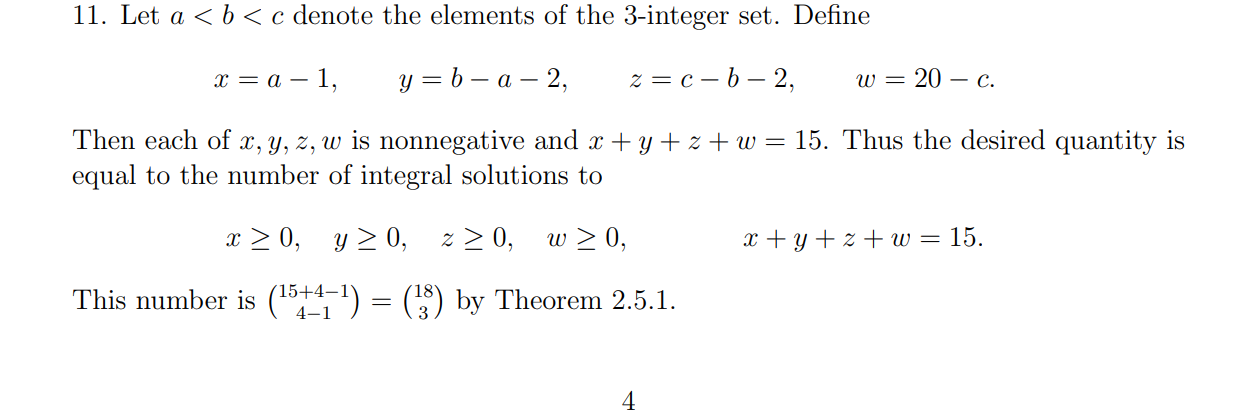
I'm confused by the solution
As to how the choices for x,y,z, and w were chosen
actually i think i understand how they were chosen but
what is the logical reason that solving for the integral solutions of x+y+z+w = 15 gives us the same number of 3 integer sets that satisfy the problem
 narrow robin
Anyone knows why this is true?

 haughty garden
Say that modules on processor 1 belong to the set $S$. Convince yourself that the total cost is given by [\sum_{i \in S} \alpha_i + \sum_{i \not\in S} \beta_i + \sum_{i \in S} \sum_{j \not\in S} c_{ij}.]
Construct the flow network as follows: let $V = {1, \dots, n} \cup {s, t}$ and define the edges in three parts.
\begin{itemize}
\item For each module $i$, construct an edge $s \to i$ with capacity $\beta_i$.
\item For each module $i$, construct an edge $i \to t$ with capacity $\alpha_i$.
\item For each pair of modules $i, j$, construct an edge in both directions with capacity $c_{ij}$.
\end{itemize}
Now, consider any cut $(S, T)$ in this flow network. The only edges that contribute to the value of the cut are exactly those edges of the form $S \to T$. Convince yourself that this corresponds to the value of the total cost and therefore, the value of the minimum cut corresponds exactly to the minimum value of the total cost.
@narrow robin
vital dewBOT
 narrow robin
haughty garden
<@255025230408318978>
narrow robin
haughty garden
<@255025230408318978>
I'm still confused, what exactly is the meaning of the flow in this case?
haughty garden
As in you’re not sure what the flow network is doing?
If you compute any flow, you can find its corresponding cut
The value of the cut will correspond to the value of the total cost
So to minimise the total cost, you want to find the value of the minimum cut
but this corresponds to the value of the maximum flow (by the maximum flow-minimum cut theorem)
 cursive hamlet
I've been working on a personal (programming) project for a long while related to mazes, but I haven't made much progress more most of that time because I don't have a good mathematical understanding of mazes because I've learned very little discrete math. Would studying just graph theory eventually give me a good understanding of mazes, or is there another category of math I should also study? I'm also open to any textbook/online course recommendations.
static briar
how do I come up with combinatorial arguments quickly
brave rock
You practise
narrow robin
haughty garden
So to minimise the total cost, you want to find the value of the minimum cut
oh i see thanks
i get it now
brave rock
static briar
there has to be a trick tho right
There is not a trick to finding proofs; a proof can be as hard as anything
summer falcon
static briar
how do I come up with combinatorial arguments quickly
You could learn different techniques to have an repertoire to use on a given problem but otherwise as Boytjie says
 tidal kindle
Need help with this question

 static briar
Can anyone explain how they got this
 haughty garden
Inclusion/exclusion with stars and bars
static briar
lemme eplain my thought process
we have 50 that we want to distribute into r,s and t so that 50+3 -1 choose 3 which is 52 choose 3 for the solutions including overcounting
how did they get 52 choose 50
haughty garden
Using stars and bars should give you C(50 + 3 - 1, 3 - 1) = C(52, 2)
 haughty garden
This formula swaps the n and the k in my formula
You want to distribute k objects into n bins
static briar
ye so 50 objects into 3 bins in our case
haughty garden
Yep
haughty garden
static briar
following this formula should give you k = 50 and n = 3
haughty garden
when you counted C(52, 50), you counted the possibility that either r or s were > 25. So you need to remove the number of solutions where r or s > 25. We can do it one at a time. Suppose that r > 25 or r >= 26 (since r is an integer). Then this is equivalent to saying r - 26 >= 0 and so we can set r* := r - 26. The equation r + s + t = 50 then becomes (r* + 26) + s + t = 50, where r*, s, t >= 0, or equivalently, r* + s + t = 24. Then apply stars and bars on this equation to get C(24 + 3 - 1, 3 - 1) = C(26, 2) = C(26, 24)
then do the same but with s >= 26 (you should get exactly the same as when r >= 26 because of symmetry)
then count the number of non-negative solutions when both r, s >= 26 (you'll realise this has no solutions!)
static briar
goat
also i just found out the question was changed to have both r and s <=25 but u seemed to have caught on to it
acc a legend
wraith pelican
Having trouble on a proof involving floor functions. I've made it work when n is even, but I honestly have no idea what to do with it when n is odd. The hint in my book says to split the odd case into 3 separate cases, which I have tried, but I can't see how that yields anything useful. I'm sorry I can't be more specific with my question. I'm just very confused on this. Here's my work so far.
 dire stag

How am I supposed to do this?
Pricniple inclusion/exclusion, binomials? What do I do?
agile magnet
dire stag
How am I supposed to do this?
at least 6 means it could be exactly 6, 7, or 8 heads
these cases are all disjoint right?
so compute each of these cases and combine
 agile magnet
dire stag
Like this?
agile magnet
dire stag
Like this?
what do those products represent?
Like ok 1/2 = probability of a head or tail
why multiply? What does that count?
twilit sundial
those computations completely fail to account for the fact that the heads/tails could occur in different orders
 azure hamlet
Does anyone know a good Soviet Math book that explains the Expansion series? (Dévelopment Limits)
 carmine pond
Can any1 explain how natural deduction works

I have this but don't know wut to do
 unique girder
Is the minimum order of a graph containing exactly one vertex of degrees 0, 1, 2, 3, and 4 n=11?
stray reef
by "order" do you mean vertex count?
unique girder
Yes
The best I have produced is connected the K_5 graph to the vertex of degree 4, and leaving the vertices of degree 0, 1, 2, and 3 alone. But I'm not sure if there is a way to decrease the order even further by connected the vertices that will have degree 1, 2, and 3 to vertices other than the one of degree 4, if that makes sense.
stray reef
yeah it looks like you're right
i don't have an ironclad proof but i did manage to convince myself at least 11 vertices will be needed
unique girder
Very well, thank you!
 fervent wyvern
When is the boolean lattice graph ($BL_n$) non planar?
I'm looking for a specific n for which this happens
vital dewBOT
piss_master49
 stray reef
fervent wyvern
When is the boolean lattice graph ($BL_n$) non planar?
I'm looking for a specif...
stray reef
fervent wyvern
When is the boolean lattice graph ($BL_n$) non planar?
I'm looking for a specif...
do you mean graphs like these?

(the one depicted would be BL_3 i guess)
unique girder
Is the following a fair slightly informal proof?
Proposition: If $G_1$ and $G_2$ are isomorphic graphs, then the degrees of the vertices in $G_1$ are exactly the degrees of the vertices in $G_2$.
\vspace{12pt}
My informal proof: Let $G_1 \cong G_2$. Then there exists some bijection $f: V(G_1) \rightarrow V(G_2)$, with ${f(e_1), f(e_2)} \in E(G_2)$ for all ${e_1, e_2} \in E(G_1)$.
\vspace{12pt}
Now, let $e_1, e_2 \in V(G_1)$ such that ${e_1, e_2} \in E(G_1)$. That is, suppose $e_1, e_2$ are adjacent in $G_1$. Then ${f(e_1), f(e_2)} \in E(G_2) \Rightarrow f(e_1), f(e_2) \in V(G_2)$. Since it is the case that for any edge $e={u, v} \in E(G_1), f(e)={f(u), f(v)} \in E(G_2)$, all adjacent vertices and therefore edges must remain invariant under isomorphism. That is, $\text{deg}{G_1}(v)=\text{deg}{G_2}(f(v))$ for all $v \in G_1$.
I'm mostly just ensuring that my logic, especially towards the end, is consistent here
vital dewBOT
j.ross.

 near stream
Hello, could anyone help me with this question? I have no clue if I am on the right track at all ;-;
 summer falcon
near stream
Hello, could anyone help me with this question? I have no clue if I am on the ri...
summer falcon
near stream
Hello, could anyone help me with this question? I have no clue if I am on the ri...
your solution for a) looks good
near stream
summer falcon
your solution for a) looks good
yay, thanks a bunch!
near stream
could someone pls guide me through this? i dont know where to start..
 twilit sundial
while it's not a formal solution
at least one of p,q,r is true, so at least one of 2,3,4 is true
then by modus ponens $a\vee s$ holds, at which point you finish with disjunctive syllogism
vital dewBOT
elrichardo1337

 lofty geode
Does anyone know whats the minimum order of a graph? or the maximum order of a graph. Graphs in terms of graphs in graph theory.
stray reef
"order" probably means vertex count
and without conditions placed on the graph, the answers to those would be... 0 and +∞, i guess?
brave rock
Do you mean given a graph, what is its minimum order?
Because that's just the smallest order, and that could mean various things 
lofty geode
Yes, thats why i am confused. G_BD is independant from the definiton i believe, but they never defined what minimum/maximum order meant. They mention distance alot however

now that i think about i feel like its just setting a bound for the min/max number of vertices for the given graph
lofty geode
its just a special subgraph so thats what makes me believe is the definition, thank you it helped to ask
 hard pasture
Don't know where to put this, but can anyone prove if this formula eventually reaches a power of 2 if recursively put into itself?
$\frac{5}{2}x^{2}-\left(5x+2\right)\operatorname{floor}\left(\frac{x}{2}\right)+\frac{3}{2}x$
vital dewBOT
Vanouper

 coral raven
this is some collatz type shit
 stray reef
 frozen blaze
for this is it just Z or
frozen blaze
for this is it just Z or
what makes you think it is Z?
hard pasture
coral raven
okay cool
lol
weary tiger
Whats the answer to
x²y +3yz - 2x² + y - 6z - z
stray reef
weary tiger
Whats the answer to
x²y +3yz - 2x² + y - 6z - z
there is no answer because there is nothing to solve
!original
 lofty cloudBOT
Please show the original problem, exactly as it was stated to you, with the entire original context. A picture or screenshot is best. If the original problem is not in English, then post it anyway! The additional context might still be helpful. Do your best to provide a translation.
lofty cloudBOT
The purpose of this server is to help you learn, not to hand out answers. Do not ask someone to give you the answer directly.
weary tiger
👍
stray reef
weary tiger
👍
ok but like are you gonna show the problem
or did you decide to abandon it
 weary tiger
weary tiger
weary tiger
Check No.18
I think thats how it work
stray reef
weary tiger
Separate factors of degree polynomials
this sounds like a bad translation
stray reef
and if you're asked to factorize
i think that's going to be difficult
x²y +3yz - 2x² + y - 6z - z
i don't really see how to proceed here
 stray reef
this one looks more doable, but do you have any progress for it?
weary tiger
stray reef
this one looks more doable, but do _you_ have any progress for it?
no.
Lemme try
weary tiger
stray reef
oh, ok, you're going to try.

But I'm stuck at no.19
I think its not right
 wet flame
do we even need the alphabet? surely it doesn't help with the question?

so we just get {ε,a,b,ab, ba,bc,aa,bb,abc,bbc,bca,bcb, aaa,bbb,baa,bab,aab,bba,aba} ?
agile magnet
wet flame
do we even need the alphabet? surely it doesn't help with the question?
in this case no you don't need the alphabet I guess but technically, languages are defined over an alphabet so it's I guess for completeness
agile magnet
wet flame
so we just get {ε,a,b,ab, ba,bc,aa,bb,abc,bbc,bca,bcb, aaa,bbb,baa,bab,aab,bba,a...
at a glance this seems fine
wet flame
i feel like im doing this wrong, say i have two elements in some set e.g x= {a,b,ba}*
is this correct?: u ∈ x ∧ v ∈ x ⇒ uv ∈ x
agile magnet
do you think it's correct?
if so, why?
or if you think its incorrect, tell me why
wet flame
I thought it would be incorrect given this definition, e.g for x again, we get {e} U {a,b,ba} U {aa, ab, bb,aba} ,... for the first three terms right? if we go by the implication definition, i feel like that also gives additional elements not given by this union definition, e.g ba
 agile magnet
ba is in L^2
 tidal bridge
can someone do this
 agile magnet
oh thank god it's a recurrence lol
agile magnet
tidal bridge
can someone do this
ok so what is the key to a recurrence?
step 0 should be identifying a decision you make
and your recursive cases depend on that choice
your decision here is what tile you place
So if your first tile is green, how does that influence your next choice?
etc etc
 crimson canopy
I am learning graph theory. Trying some questions...not very satisfied with my presentation kf answers so far. But i will work on thay
But..i am stunned by a question.
A simple connected graph has 2024 vertices such that there are exactly 2 vertices with the same degree.
What is the degree and why?
I have no idea where to begin or what to think
The maximum number of edges is v(v-1)/2 right?
But it doesn't need to be maximum edges
twilit sundial
the degrees being involved makes me think you might need to use handshake lemma
it’s been a bit since I did graph theory in combo class, my memory is a bit rusty
crimson canopy
Hmmm... i will read up on that.
Thank you.
Hmmm...anything i should like keep in mind while reading up?
twilit sundial
ah wait
I did a problem very similar to this one
ok so since the graph is connected
what are the possible degrees of each vertex
||1,2,…,2023||
and how many vertices do we have
I have a feeling that there being 2024 vertices is not that important, and the answer is probably similar for smaller numbers of vertices too
try it for some smaller cases: 3 vertices, 4 vertices, 5, etc.
crimson canopy
Sorry, i am pretty lost.
I don't have the number of edges.
Isn't that a crucial info.
Hs lemma state that sum of vertex degrees = twice of number of edges, but i don't have either of these numbers.
Only number of edges.
It can be 2000 vertices connect 2023, and the remaining 23...connect skme number
twilit sundial
we have 2024 vertices, and 2023 possible degrees, since the graph is connected (1,2,…,2023)
by pigeonhole two vertices must have the same degree: what that degree is im still trying to figure out
I think the best strategy for now is to try some small cases and see what you get
crimson canopy
I don't understand what do you mean by 2023 possible degrees.
I think that is the possible number per vertex?
So the total number of possible configurarions, while remaining a simple graph is 2023^2024?
stray reef
I don't understand what do you mean by 2023 possible degrees.
if you list out all the vertices' degrees, without duplicates, the list will contain 2023 numbers.
So the total number of possible configurarions, while remaining a simple graph is 2023^2024?
probably not, but it's also probably not very helpful to think about that number of configurations anyway
fossil mural
there are at most that many configurations but a lot of them don't work
like anything where the sum of degrees is odd, or twenty vertices with degree 2023 and then all the rest have degree 1
twilit sundial
I reread the problem statement and I think the “exactly two vertices with the same degree” part might be important
crimson canopy
stray reef
> I don't understand what do you mean by 2023 possible degrees.
if you list out ...
Ah. So its the sequence number thingy.
Sorry if my terminology suck. I am still weak at that
crimson canopy
fossil mural
like anything where the sum of degrees is odd, or twenty vertices with degree 20...
Oh ya. True. Thank you
If i "assume" which my profs say i should never.
Suppose 2024 vertices lie along a line.
The 1st and last points are...idk how to say...like, they are bounded? So they are only connected 1 way
So...that means 2 points with degree 1?
But if correct, i have no idea how to proof if this unique or not.
I just guess and hit ssr
twilit sundial
twilit sundial
I reread the problem statement and I think the “*exactly* two vertices with the ...
so give the first 2023 vertices a unique degree each, then see what the degree of the 2024th vertex must be
might help to try this on a smaller number of vertices
3, 4, 5
stray reef
can the duplicate degree be 0?
twilit sundial
no, since the graph is simple and connected
crimson canopy
twilit sundial
so give the first 2023 vertices a unique degree each, then see what the degree o...
Wouldn't this raise the question of why can't some of the vertices have same number of degrees?
As long as its not a pair
pale monolith
There are exactly two vertices that have the same degree
I.e. all other vertices have different degrees
 vital dewBOT
Girimuszek
 dire stag
$18-4 = 14 (14/18) --> (7/9)$
vital dewBOT
Girimuszek
 dire stag
I'm confused by what I did wrong
crimson canopy
pale monolith
There are exactly two vertices that have the same degree
Oooh.
I am starting to understand.
Suppose there is a pair of vertices with the same degree n.
Suppose there is a triplet or more vertices with same degree k, for k=/= n.
That means there are exactly 2 vertices with a specific degree n, not same degree?
Rip my english
Hmmm..i see.. i have to give the 1st 2023 vertices each a unique degree.
 formal falcon
dire stag
?
formal falcon
dire stag
?
est-ce clair?


 crimson canopy
@twilit sundial
I think....i got it, but its not math, i didn't guess and check, but its inspiration rather than hard work which i am ashamed to admit.
So exactly 2 vertices have same degree.
As you said, suppose the other 2023 vertices have unique number of edges.
I had this thought. We know some propertiss of degree sequences of simple connected graphs.
So suppose i write the degree sequence append n, where n is some integer [1. 2023] is the degree of the last vertex that has the same degree number as one of the other 2023.
By the havell hakimi algorithm?
We remove 1st term, and subtract 1 from k number of terms, where k is the value of subtracted term.
Largest term is 2023, so whether n is 2023 or not, 2023 will be the 1st removed term, and 1 will be subtracted from all other term.
Issue: if n = 2023, that means it connects to every term, then since there is already another node that connects to all other nodes, then there cannot be only node with degree 1, since 2 2023 meaning min degree is 2 then.
Idk if and (andd if correct) induction should be applied here to extend through the numbers.
Then we can find the value of n
Thanks so far for being patient with me
And.....ngl...this argument is more english than mathy?
twilit sundial
imma read through this more closely later
but yea graph theory proofs tend to be like that
which is why it’s potentially a good way to introduce proof writing (much better than Euclidean geometry or analysis for that matter)
formal falcon
dire stag
What do I do here?
use the concept of probability of getting a sum of 11 with a pair of fair dice in general
and then use the binomial distribution
and take the summation over something, this part is rather obvious
icy swift
this is from a chapter on Pigeonhole principle and I'm confused on ithttps://gyazo.com/39bfadc9fc49d7016e4f7c4d92cb3cea
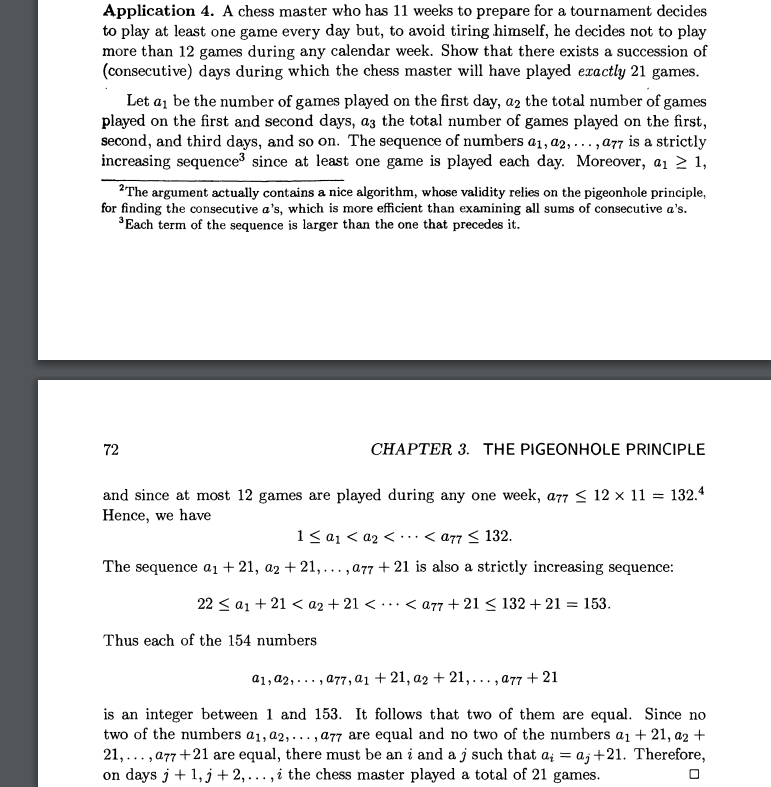
What if he were to play 1 game everyday, then a_22 = a_1 + 21 and a_23 = a_2 + 21 and so on, then you can say that a_1, ..., a_77, a_1 + 21,...., a_77 + 21 is an integer between 1 and 89?
I don't think you'd be able to apply the pigeonhole principle then?
Does having multiple numbers from the sequence a_1 to a_77 equaling a_1 + 21 to a_77 + 21 affect whether or not you can apply the pigeonhole principle?
 gusty swallow
where do you see php being applied?
And, no. Your first sentence is the same as the conclusion of the application. "If he were to play 1 game everyday, then a_22 = a_1+21"
So you have that he played 21 games on consecutive days from day 2 to day 22
icy swift
gusty swallow
where do you see php being applied?
somewhere in the last part of the proof where he says there are 154 integers between 1 and 153 so there must be atleast 2 integers that are equal like a_i = a_j + 21
gusty swallow
ah, i see now.
Then you can still use pidgeon hole, you still have 154 numbers listed, that have values between 1 and 89 (88?), so some of them have to be the same.
gusty swallow
correct
icy swift
i have one more confusion which is the php "strong form" https://gyazo.com/d35fd462077ae8e9ea1ab5e0654397b8

I don't really understand the "- n + 1" part
is there an intuitive explanation for this theorem like there is with the "simple" form of php where if there are n+1 objects and n boxes there must be atleast 1 box with 2 objects
gusty swallow
That sum is just the number of objects being distributed.
But I think it comes from -(n-1), so theyre removing a ball for almost every box. If they just subtracted n, then I suspect this wouldn’t be true.
dire stag


Followed my notes for this exact same type of problem, and I honestly have no clue where I went wrong
C(7,7) = 1
dire stag
Thanks!
agile magnet
dire stag
Followed my notes for this exact same type of problem, and I honestly have no cl...
why did you say you have no idea where you went wrong?
dire stag
I forgot how to read scientific notation
agile magnet
Look it up then
dire stag
my bad, but thanks!
 plain totem
This is a little puzzle which one of my classmates came up with
Consider the parallelepiped spanned by vectors (1,0,0), (0,1,0), and (a,b,c) where a,b,c are integers (c>0)
Try to prove that it can be partitioned into a total of 6c tetrahedra, all of them having vertices with integer coordinates
 quiet eagle
I found this article, while studying Edmonds' branching algorithm. I believe there is a mistake, it should say |C-B| = 1. Is that right?

 old peak
quiet eagle
I found this article, while studying Edmonds' branching algorithm. I believe the...
old peak
quiet eagle
I found this article, while studying Edmonds' branching algorithm. I believe the...
yes i believe so
quiet eagle
ok ty
 distant otter
Any tips on how to approach this problem?
Initial thoughts: Find at most 3 linear orderings whose intersection results in the original poset P. When constructing each linear ordering, keep track of the antichains (incomparable pairs within linear ordering) and make sure that the other linear orderings contain the same pair in reverse order so that their intersection contains neither pair.
 coral raven
distant otter
Any tips on how to approach this problem?
Initial thoughts: Find at most 3 line...
coral raven
distant otter
Any tips on how to approach this problem?
Initial thoughts: Find at most 3 line...
giving =< 3 orders explicitly would suffice
distant otter
Can any linear ordering be a part of the realizer or do I need to be careful about how I construct them so that I can derive the original poset from 3 of them?
 mighty ingot
anyone knows how to do this
 quiet eagle
mighty ingot
anyone knows how to do this
quiet eagle
mighty ingot
anyone knows how to do this
Can you think of any not-surjective function?
 elfin furnace
does this graph have any self-loops?
 elfin furnace
How do I use the adjacency matrix here
 agile magnet
elfin furnace
does this graph have any self-loops?
agile magnet
elfin furnace
does this graph have any self-loops?
what is the definition of a self-loop?
agile magnet
elfin furnace
How do I use the adjacency matrix here
Do you know what the definition of the adjacency matrix is?
elfin furnace
agile magnet
what is the definition of a self-loop?
a vertex with the same edge
elfin furnace
agile magnet
Do you know what the definition of the adjacency matrix is?
not really
agile magnet
elfin furnace
a vertex with the same edge
wdym same edge
elfin furnace
i mean a vertex with the same edge that goes in and out of the vertex
agile magnet
You mean an edge with the same endpoints
agile magnet
elfin furnace
does this graph have any self-loops?
Ok, so does this graph have any such edges?
elfin furnace
yeah if the head and the tail are the same
elfin furnace
agile magnet
Ok, so does this graph have any such edges?
no
was getting skeptical about my own knowledge of self loop cos i thought the graph was incomplete
agile magnet
wdym incomplete?
elfin furnace
elfin furnace
does this graph have any self-loops?
if you look closely on vertex e it looks like the far right of vertex e is not fully printed
agile magnet
Oh
Nah it seems fine lol
I mean from what you can see in the pic there are no self loops
agile magnet
agile magnet
Do you know what the definition of the adjacency matrix is?
Look in your notes / textbook
If you're still confused come back and ping me why you're confused
But I want you to try first
elfin furnace
yeah i'm done studying linear algebra for now, when i get back to it after my next class i'll let you know
thanks
brave rock
Well it'll please you to know that despite there being a matrix here, nothing here asks you to understand them more than simply being a list of numbers. No linear algebra is being done.
elfin furnace
i mean the course
i'm taking linear algebra
wait
no nvm
this is discrete math
my bad
i'm taking both, and they both have matrices so i get them mixed up
elfin furnace
elfin furnace
yeah i'm done studying linear algebra for now, when i get back to it after my ne...
discrete math*
agile magnet
elfin furnace
i'm taking both, and they both have matrices so i get them mixed up
Both notions of matrices are the same
Just the adjacency matrix is defined in terms of the edges of a graph
static briar
Can someone explain why 5 is also right

Ion see how the function is surjective if a = 5
brave rock
Well, here's a hint: what happens when you do f twice when a = 5? Or more directly, what's 5 x 5 mod 6 (and why is that relevant)?
static briar
Who said ur allowed to use the function twice
static briar
Nah I’m asking like shouldn’t a function be bijective in only one go
Using it twice is foreign to me
To prove its bijextive
brave rock
Well think about it and see.
static briar
In that case u r right
I didn’t know in general u could show bijectivity by applying a function twice ngl
Seems like cheating
twilit sundial
in this case, you want something relatively prime to the modulus
since that's the condition for a modular multiplicative inverse to exist
brave rock
static briar
Seems like cheating
It's not.
static briar
I took an intro to proofs course and it was never mentioned once
brave rock
You can do anything you like to prove something as long as you don't make a logical error.
It is impossible to cover all the ways to prove things.
You seem to still think of math as an exercise in following a fixed recipe to solve a problem, when in fact you can be creative – and will eventually have to be – to solve problems.
agile magnet
ehhh I see what you're saying @static briar
Do you see know what 5 x 5 (mod 6) is?
Do you see how this correlates to computing f(f(x)) for a = 5?
And thus do you see why a = 5 means that f is a bijection?
static briar
agile magnet
Do you see know what 5 x 5 (mod 6) is?
0?
agile magnet
how did you get 0?
static briar
mb im dumb
agile magnet
not 5
agile magnet
yes
static briar
1
agile magnet
agile magnet
Do you see how this correlates to computing f(f(x)) for a = 5?
but there's a reason I wrote it as 5 x 5 and it connects to my second question here
static briar
kinda cause its the same as 1mod6 and 1 is for sure right
agile magnet
why is 1 right?
static briar
the fucntions just f(x) =x
agile magnet
which is clearly a bijection right?
static briar
ye
agile magnet
because it has an inverse, namely itself
static briar
ye
agile magnet
ok so 25 (mod 6) = 1
static briar
yes
static briar
ye
agile magnet
for arbitrary x in Z_6
static briar
f(x) would be 5x
agile magnet
f(x) = 5x yes
static briar
then f(f(x)) would be 25x
agile magnet
but 25 = ? (mod 6)
static briar
1
agile magnet
so f(f(x)) = x right?
static briar
ok ye
agile magnet
so now explain to me why f is a bijection
agile magnet
agile magnet
so f(f(x)) = x right?
what is the inverse of f?
agile magnet
1/5 isn't an integer...
static briar
bro idk i just didnt knwo you could use the function twice ngl
agile magnet
but we've shown that the inverse of f is itself
so f has an inverse!
so f is a bijection!
static briar
ahh yee
agile magnet
brave rock
Well, here's a hint: what happens when you do f twice when a = 5? Or more direct...
that's what they were getting at here
static briar
goat
agile magnet
makes sense?
static briar
yeah

 compact owl
How exactly does it go from the first highlighted part to the next?
 stray reef
expand (1 + (-x))^-3 with the binomial thm.
twilit sundial
odd prism
does the form of that expression remind you of a certain trigonometric expression you might know?
odd prism
Uh yes… I was shown it
odd prism
twilit sundial
does the form of that expression remind you of a certain trigonometric expressio...
$\tan(a - b) = \frac{\tan(a) - \tan(b)}{1 + \tan(a)\tan(b)}$
vital dewBOT
Alex
 odd prism
Did not see it at first though
Would not have even thought about trig
Until my classmate showed me
twilit sundial
yea it can be kinda hard to see unless you already know the trick that it uses
odd prism
Some bs, I was spending hours thinking about remainders and multipels
Getting no where
twilit sundial
||in this case i think your "boxes" can just be the four quadrants||
odd prism
twilit sundial
||in this case i think your "boxes" can just be the four quadrants||
I believe it is the range of inverse tan
Cut at pi/4 and -pi/4
odd prism
So first and fourth quad cut into 4 pieces
twilit sundial
yea sounds right
odd prism
Some bs
odd prism
twilit sundial
yea sounds right
How did you immediately notice it
Have you done the problem
Or are you just good with trig identities
twilit sundial
i've done a very similar problem
there's no way i would've seen it otherwise LOL
😭
odd prism
I’m lowkey pissed
It was such a hard problem goddamn
I wasn’t even thinking in the right realm
crimson canopy
I am having trouble understanding radius of a graph
Distance of graph is the shortest distance between 2 vertices.
Eccentricity is the greatest distance a vertex has.
Diameter is the largest eccentricity in the graph.
Then comes radius which is the minimum eccentricity.
Wait...hmmm...
I think i got it
Maybe
 jade tangle
Man discrete math is ass
fossil mural
crimson canopy
Then comes radius which is the minimum eccentricity.
if you imagine you were dealing with a circle
the distance from the centre point to any other point is at most the radius of the circle, so the eccentricity of the centre point is the radius of the circle
for any other point, the point at the "opposite" side of the circle (draw a line through the point and the centre point until it hits the edge) will be more than the radius, so it will have an eccentricity of more than the radius
intuitively eccentricity is sort of the extent to which a point is out at the edges of the graph instead of being closer to the middle, so the points of minimum eccentricity are basically the centre, and then radius is "maximum distance from the centre point"
wet flame
any hints on what language this DFA describes in plain english? kinda just seems like a random assortment of a's and b's, not sure if its something more specific
 wet flame
s0 is the initial state and {s1,s2} are end states (red doesnt mean anything)
 wind kraken
difference between a's and b's is odd
wet flame
i think its also that it accepts odd length strings?
wet flame
wdym by that
wind kraken
like you might as well glue s2 to s1, and s3 to s0
then a and b do the same thing at each state
wet flame
ahh
wind kraken
given a finite set X, and an alphabet Σ = {0, 1}, define the norm |-|: Σ* -> N_0 as taking the number of symbols a string is constructed with. a transition function (monoid homomorphism) δ: Σ* -> End(X) is transitive if for any pair x, y in X, there is some σ in Σ* such that δ(σ)(x) = y.
what transitive transition function m: Σ* -> End(X) minimizes
vital dewBOT
quasi_semi_group
 wind kraken
i probably used the wrong jargon for this. in other words, i have some finite amount of states, and i want a transitive transition function such that the average amount of time needed to get from a state to another is minimized
what i know so far: up to constant factor we can get |X|^2 log |X|, which is also optimal
agile magnet
wind kraken
difference between a's and b's is odd
don't just give away answers
agile magnet
wet flame
any hints on what language this DFA describes in plain english? kinda just seems...
in the future a good strategy would be first to compute some example strings that are and aren't in the language
wind kraken
agile magnet
in the future a good strategy would be first to compute some example strings tha...
i'm not convinced this is a good strategy though
agile magnet
it's a good starting point
yes of course examining structural properties is better
but 1: that comes with time seeing more and more DFAs and NFAs and 2: doesn't mean other strategies aren't valid
wet flame
agile magnet
in the future a good strategy would be first to compute some example strings tha...
i did do this, didnt realise they were all odd lengths 😭
wet flame
agile magnet
yes of course examining structural properties is better
also what sort of structural properties?
crimson canopy
Thank you.
Yeah, my mistake was i forgot eccentricity of a point is the (shortest)distance between 1 point and another point furthest from it.
I was thinking distance between any 2 arbitrary points. Which is pretty much just 1.
That was my mistake.
I should like you said, think of it like a circle. Thank you.
Radius would be
Find distance between center and an "end" point.
 mild root
can someone help in channel 28
agile magnet
wet flame
also what sort of structural properties?
I mean you see things like the arrows labeled a going back and forth, same with the b's, maybe look for cycles, etc
shortest paths from start to accept states
etc etc
It's sort of like integration: the more integral you see the more patterns you see
quiet eagle
Why is it not possible to find and delete negative weighted circuits in a graph in polynomial time?
errant bear
C is correct
your answer should be in the form
"f(A), f(B), f(C), f(D), f(E), f(F)"
so since you have already identified that f(F) = Y, f(C) = V, you have to fill in the rest:
"_, _, V, _, _, Y"
where f is your isomorphic function
does this answer your q, or were you asking for the process of identifying the mapping itself?
for this problemc that is a good way to go about it. i would personally just note that A doesn't have an isolated point, and B doesn't have an point with only 1 edge, therefore it must be C. but i would do a handwavy squint my eyes and rotate/move drag points around as a sanity check to verify that C can me shifted into lambda
if however, the graphs are complicated messes with no easy visual cues, you have to have an algorithmic approach
which I'm sure there are millions
I would use a traversal method
in this case, if we pretend there is no isolated point, in any of the graphs (lambda included), i would start with point C
why C? because it only has 1 edge
now we just travel along the graph and count edges at successive nodes
ehh, this isn't text friendly
okay. I would first try to "untangle" the original graph, if possible
then, for the candidate graphs, you can "trace" it out over the initial graph
you will probably have a few starting nodes to go check depending on the initial graph structure
yes this is what i was trying to describe (and failed)
yes, you can "drag" it out so it doesn't cross over the other edges
yes
nope
you can probably just google graph editor
err
that will give you plotting things
maybe graph edge node editor
also btw, you are/were, at least in the image
errant bear
looks good
stray reef
of course
errant bear
just adding as an aside, you should try not to become too reliant on a visualization software like this that you won't necessarily have for tests
you should get comfortable doing/vizualizing these untangling transformations in your head, or on paper
 calm chasm

I am not following this. Why is having at least one y working for multiple x is stronger than having multiple x works for at least one y?
brave rock
If every kid in class has a pet, this does not mean that there is a single pet that every kid in class shares.
Forall kid, Exists pet, has(kid, pet) is the former statement.
Exists pet, Forall kid, has(kid, pet) is the latter statement.
calm chasm
brave rock
Forall kid, Exists pet, has(kid, pet) is the former statement.
Exists pet, Foral...
I'm not getting why one is harder to defend? Or stronger
 sick grail
calm chasm
I'm not getting why one is harder to defend? Or stronger
sick grail
calm chasm
I'm not getting why one is harder to defend? Or stronger
in the former, each kid has a pet. in the latter, there is a single pet, which is the pet of every kid.
calm chasm
sick grail
in the former, each kid has a pet. in the latter, there is a single pet, which i...
I did not see that at first.
Okay following
sick grail
so the latter is stronger, because going one way that single animal works to show each kid has a pet (not necessarily the same one)
but the other way doesn't work
this is what is meant by the "there is universal y ... might all be the universal y)" bit
calm chasm
sick grail
so the latter is stronger, because going one way that single animal works to sho...
I just can't see why that makes sense.
Why that would imply one is stronger
sick grail
because each kid having a pet doesn't mean they all have the same pet
calm chasm
I'm missing an important piece here
Like I know that already
Idk why that means it's stronger
Maybe I'm not asking the right question
sick grail
it's stronger because it implies the other, but not vice versa (I think it's being defined for you in this section)
so if it's true so is the 'weaker' statement
(which is true more often so says less, I think is the logic behind the naming)
calm chasm
sick grail
so if it's true so is the 'weaker' statement
OHHHH
I think I finally get that
Is it kinda like a set and the other is a subset?
sick grail
I don't see why that analogy would break down
so yeah
except the subset is the stronger statement
calm chasm
oh god
sick grail
you're being more precise
sick grail
I do think it takes a while to get the language here
calm chasm
I thought the stronger proposition would be the set
sick grail
when you have a stronger statement, you know more than you would with the weaker statement
because the stronger statement implies the weaker statement, so you know at least as much
but the weaker statement does not (by definition) imply the stronger statement, so you know more
so e.g. being strictly increasing is a stronger statement than being increasing (for functions)
(or inceasing compared to nondecreasing, idk what terms you're used to)
there's 'more'* increasing functions than there are strictly increasing functions, because each strictly increasing function is also increasing but not vice versa
(*maybe technically not really but that's more with issues in defining quantity when you start getting infinite collections than what I feel the motivation for the language is)
because you know more, you also tend to get more / nicer results when you have stronger conditions e.g. continuing this example strictly increasing functions are injective/one-to-one, whereas increasing functions don't have to be
as a non mathematical example, "I will go to IKEA tomorrow" is a stronger statement than "I will go to a store this week"
calm chasm
sick grail
as a non mathematical example, "I will go to IKEA tomorrow" is a stronger statem...
This made it super clear
weary tiger
Can someone explain this to me
 stray reef
do you know big sigma notation for summations
weary tiger
Yessss
stray reef
yeah, these are similar in spirit
only instead of adding you take unions or intersections, accordingly
weary tiger
Understood
weary tiger
stray reef
only instead of adding you take unions or intersections, accordingly
Can I dm ya something?
stray reef
weary tiger
Can I dm ya something?
why do you want to dm it to me instead of asking on the server
weary tiger
Yeah that works too
 storm prism
is there a way to concisely write 2 variables as a member of the same set?
ie {(x,y) | x, y E R } (ignore me using E and R I mean to say x and y are members of the set of all real numbers)
or do I have to state separately x E R and y E R or is there another concise way to do it?
rly wishing I could use latex right about now
stray reef
$x, y \in \bR$ is fine.
vital dewBOT
Ann
 storm prism
ah okay thanks
crimson canopy
Are there any patterns to degree sequences of simple graphs beyond sum of everything = 2| E |, where | E | is the number of edges?
Because i can have a bogus degree sequence and add them up, multiply by 2, but if we don't know the exact form of the graph, we can't tell
Only way is the havel hakimi method?
But that's assuming we know the entire degree sequence
I mean, i do know most of them, i just don't know the value of 1 term, except that it must be even
So e.g, i have 1, 2, 3, 4,...2023, n where n is some even number between 1 and 2023
Burrowing a different example:
Degree sequence: 6, 5, 4, 3, 3, 2, 1 is that of a simple connected graph.
Or at least that's what i submitted in my homework kekw.
From some...idk what you call them, theorem? Lemma? , the number of odd degrees must be even.
Make sense because sum of all degrees must be twice number of edges.
So sum od odd number of odd numbers = odd number = contradiction.
So there must be even number of odd vertices degrees
However, looking at the sequence, we have 1, 3, 5 and let's say 7.
7 does not work of course, because that would imply a loop, thus not simple graph.
If we were to replace 1 of the 3 with 1 or 5...the resultant sequence would not be simple too.
So, we know that there is some kind of sweet spot.
But i can't find any theorem about what that sweet spot is
Edit: let me test if i replace a few odd degree instead of 1 odd degree.
crimson canopy
Okay, messing around for a bit,
Suppose, we keep even numbers the same, counting multiplicity,
6, 5, 4, 3, 3, 2, 1 work
6, 4, 3, 3, 3, 2, 1 work
6, 5, 5, 4, 3, 3, 2 work
6, 5, 5, 4, 3, 2, 1 don't work
6, 5, 4, 3, 2, 1, 1 don't work
6, 4, 3, 2, 1, 1, 1 don't work
6, 4, 2, 1, 1, 1, 1 don't work
6, 5, 5, 4, 2, 1, 1 don't work
6, 5, 5, 5, 4, 2, 1 don't work.
6, 5, 5, 5, 5, 4, 2 work
So....it seems like the more 1s i have the more...likely its not going to work
6, 5, 5, 5, 4, 3, 2 work
So...it seems like the number of 1s has some impact on necessary number of 3s
6, 4, 3, 3, 3, 3, 2 work
6, 5, 4, 3, 3, 3, 2 work
Its just the 1s being shit
Maybe this is trying to tell me something. I don't understand what does the min refer to though
 agile magnet
crimson canopy
Maybe this is trying to tell me something. I don't understand what does the min ...
agile magnet
crimson canopy
Maybe this is trying to tell me something. I don't understand what does the min ...
the minimum of d_i and k
crimson canopy
what is k?
why is it different from n?
i suppose it is saying
suppose we arrange the degrees in descending order
taking the sum of the 1st k terms, if the sum is less than k(k-1) + sum min(d_i, k) n-k times, the the sequence is graphical
sonic shadow
Is it true that $\sum_{i=0}^n{n \choose i} = 2^n$?
vital dewBOT
dulg_n
 sonic shadow
I mean, intuitively, it makes sense
brave rock
Yes this follows from the binomial theorem
fossil mural
or double counting: the number of subsets of n things is the same as the sum of (the number of subsets of size i) over all possible i
agile magnet
crimson canopy
taking the sum of the 1st k terms, if the sum is less than k(k-1) + sum min(d_i,...
yes exactly
and the converse also holds
if the sequence is graphical
that inequality always holds
crimson canopy
thank you. but i don't understand what min(d_i, k) mean
so suppose i have 25 terms, and i take the sum of 1st 6 terms
so min(d_i, k) where k is 6, would be comparing which is smaller? 6 vs value of d_i?
seems...off, when i try to apply to my question above
agile magnet
crimson canopy
thank you. but i don't understand what min(d_i, k) mean
so suppose i have 25 te...
min(d_i, k) would equal k if k < d_i and otherwise it would equal d_i

 twilit sundial
no
then you would've long since drawn all the cards
consider the worst case scenario where
you draw all the clubs
all the diamonds
all the spades
39 cards drawn
then to guarantee three hearts
you would need to draw three more
42
dire stag

I got (6 x 5 x 4 ) x 4 - 4
But apparantly, the answer is 6!-4 x 3!
I dont know how, but I now know that I'm screwed, and that I won't pass discrete math with an A
I'm just too unintelligent
agile magnet
dire stag
wouldnt it be 39 x 2 + 1?
well the immediate issue here is that 39 x 2 + 1 > 52
agile magnet
dire stag
I got (6 x 5 x 4 ) x 4 - 4
how did you get this answer?
dire stag
agile magnet
how did you get this answer?
3 spots are reserved
so 6 x 5 x 4
4 possible positions for bad
for every possible position ob bad, a new variation of 6 x 5 x 4 has to be calculated
dire stag
 agile magnet
ah so there's one issue
if you used the letters b, a, d
you don't have 6 choices for the remaining 3 slots
dire stag
Hmm
agile magnet
right?
dire stag
I guess so
agile magnet
because you already used those letters
so you have how many letters left for the first slot?
dire stag
3
agile magnet
second issue is this
right now it seems you are counting the number of words that include bad
you need to count the number of works that don't include bad
so take the total number of words and subtract the number of words that include bad
so now try the problem again with those 2 hints
dire stag
3 x 2 x 1 - 4
agile magnet
how did you get that?
I presume the 3 x 2 x 1 is from what we talked about before
where did the -4 come from?
dire stag
number of words that include bad
-4
subtract them out, and you get the number of words that dont contain the word bad
Sicne there's only 4 possible positions where bad can be placed
 grave sail
hi, would this channel be approriate to talk about some time complexity for a data structure? im assuming most people here are in CS or at least familiar with big O.
grave sail
I've implemented a stack using a singly-headed singly linked list. The top of the stack must be located at the END of the list. To achieve this my push() method is essentially LL_append() and my pop is LL_removeback(). Both functions traverse the list to get to the last node as there is no tail ptr. When analyzing the total time complexity to push N elements, and then pop those N elements I was intially thinking O(N), however some people in my class are suggesting O(N^2), due to the fact of summation of traversal for each time we push, which I think makes sense --- but i'm not entirely sure. TLDR: O(N) or O(N^2) total time for N pushes then pops
 little prism
is the list empty before?
grave sail
yes
little prism
lets say N=10. how much would you have to do
grave sail
10 pushes, 10 pops?
little prism
how much traversing
grave sail
each time i push it has to traverse the length of the list to get to the last node
same with pop as its popping from back, and no tail ptr
little prism
yes so how much is that for N=10