#discrete-math
1 messages · Page 27 of 1

 vital dewBOT
Kiameimon | Welt Rene (glomed)

 odd garden
so f is true
 jolly ledge
yes
odd garden
but g is false because it's missing the equal sign
 true pelican
He probably means $\subseteq$
vital dewBOT
_daili
 odd garden
yes
jolly ledge
honestly $\subseteq$ and $\subset$ notations are fucked up because some books mix them up 
vital dewBOT
Kiameimon | Welt Rene (glomed)
 vital dewBOT
Kiameimon | Welt Rene (glomed)

 native dragon
Think of {empty set} as an empty box within a big box
The smaller box contains nothing but the large box contains a small box which is still considered something

 haughty garden
think about how A and B are related so that each of these statements are true (or at least what sort of properties must occur for these statements to be true)
e.g. for (a), you already know that A is a subset of A U B, but if A U B = A, then what else must be true?
 ember obsidian
it may help to draw a picture of each statement
odd garden
ember obsidian
it may help to draw a picture of each statement
can you please tell me how
ember obsidian
odd garden
can you please tell me how
try to draw two circles representing sets A,B such that AUB=A
odd garden
exercise 20 (a) is this correct?


 iron marsh
For starters, the piecewise is the same for both cases, so it's a waste to do piecewise.
'onto' is focused on the codomain. So specify a codomain and make sure f doesn't map to all of it
 brave rock
iron marsh
For starters, the piecewise is the same for both cases, so it's a waste to do pi...
brave rock
iron marsh
For starters, the piecewise is the same for both cases, so it's a waste to do pi...
Just to clarify what dackid is saying here: this function could equally have been written just as F(m) = m+1.
iron marsh
In your words @odd garden , what do you think 'onto,' commonly known as surjective, means?
 little prism
well to be called an image you need to have a pre-image. so no, not quite
iron marsh
Yea, for every output, you can find an input that maps to it
It's really easy to make a map that is not onto, as you just make the whole space larger than the image (what f can map to)
odd garden
yes but the questions get harder
iron marsh
Start with this one
odd garden
so piecewise functions are easier i think
iron marsh
No, none of these require piecewise
And your function wasn't really a piecewise function, as it did the same thing in both cases.
iron marsh
So why did you?
odd garden
Come up with your own function f : N → N that is not one to
one but is onto (Justify)
let's say this exercise
this is done using piecewise function
odd garden
iron marsh
So why did you?
makes it safer to cover all possibilites
iron marsh
Well you're answer was one to one in that last one
I didn't see the N to N bit, and I can see how you can do this with a piecewise function
Got to be a bit more clever though. F(m)=m+1 ain't gonna cut it
odd garden
odd garden
Come up with your own function f : N → N that is not one to
one but is onto (Jus...
in this one yes?
iron marsh
Yea
odd garden
solution was using even/odd but you can make a piecewise function
iron marsh
You're piecewise did not work though
odd garden
i'm not using my piecwise function ofc lol
iron marsh
Then why'd you ask if that was correct?
iron marsh
odd garden
exercise 20 (a) is this correct?
Here
odd garden
odd garden
exercise 20 (a) is this correct?
for this it's correct
how is it not correct ?
iron marsh
It is, me missing the N to N bit was causing problems.
But
1: it's not piecewise, so don't write it that way, and
2: Justify why it works.
odd garden
Okay thanks
 earnest portal
I don't like math anymore
 analog token
earnest portal
I don't like math anymore
analog token
earnest portal
I don't like math anymore
do i care?
 coral parcel
Yeah.
coral parcel
Yes.
coral parcel
Yes -- if P=NP, then every language in P (other than the empty language and the language of all strings) is NP-complete.
Umm, yes, why wouldn't they?
If P=NP, then it simply isn't true.
Yes, for the third time.
That has nothing to do with the fact that if P=NP then there are plenty of finite NP-complete languages.
coral parcel
No, if P=NP, then every problem in P (except for the always-true and always-false ones) is NP-complete.
You definitely should say that you're adding an assumption that P!=NP, because unless that is true, the thing you're being asked to prove is false!
odd garden

in the first line I can't understand where we got the 3
3(3an-2)
<@&286206848099549185>
 jolly nova
its using the condition an=3an-1
jolly nova
odd garden
an-1= 3an-2
bruh put an-1=3 an-2 in an=3 an-1

 mental pecan
odd garden
mental pecan
odd garden
What are you confused about
 weary tiger
Is this a good approach to seq probkems?
say you're given numbers a,b,c,d,e,___
and you're supposed to fill in the blank
- Consider the strict differences in the numbers
- Consider the strict factors from n to n+1
If neither the differences or factors follow any distinguishable subpattern
- Consider the some simple function f(x), such that f(n) = n+1
where f(x) is some first or second degree polynomial
(Ex: 2,4,6,10, ___ , f(x) = 2x-2
 obtuse lance
weary tiger
3. Consider the some simple function f(x), such that f(n) = n+1
where f(x) is so...
obtuse lance
weary tiger
3. Consider the some simple function f(x), such that f(n) = n+1
where f(x) is so...
well step 1 will lead to any polynomial solution, so step 3 is redundant if you're trying polynomials again
weary tiger
obtuse lance
well step 1 will lead to any polynomial solution, so step 3 is redundant if you'...
hmm
rue
i just took a quant oa and i idiotically didnt have a paper out so it proved way too difficult to work it out in my head lol
obtuse lance
the strict differences can make any sequence if you have the original sequence too btw, for instance powers of 2
cause these can arbitrarily make any sequence
weary tiger
obtuse lance
the strict differences can make any sequence if you have the original sequence t...
so do you always start with strict differences?
obtuse lance
well, the problem is these sequence questions are basically ambiguous
you can make a polynomial that goes through any n points you like to continue the sequence
 ivory badge
Well that’s just saying it does halt on accepted inputs, and whether it halts on the others doesn’t matter
We have no idea if all A halt on some inputs (not all will)
But the ones in L definitely do and return 1 too
Well, it being RE is because there is an algorithm which will halt on acceptable ones
It’s still RE even if it halts with a negative outcome for all unacceptable ones
You just only need it for the acceptable ones
ivory badge
The 1 part is the important part
Since 2 is just saying it doesn’t matter what it does outside L
What might your algorithm be
Well, does this have an issue if A does not halt on an input?
Right, I do wonder if that might be an issue
ivory badge
That sounds hard to me idk
brave rock
Considering turing machines aren't multithreaded, and definitely can't do infinitely many things at once, you need to be more specific about this.
Hint: the proof I have in mind is similar to the usual one that N^2 is countable.
iron marsh
I don't think the 2nd works (it needs to be a bijection)
 sly heart
Hello guys, does the Hackenbush game have a winning strategy?
brave rock
Hint: let's consider a simpler problem. Fix an algorithm A. Can you show that the language of all inputs for which A outputs 1 is recursively enumerable?
ivory badge
Well, consider boytjie's smaller problem
Consider a single fixed A, how can you show that the inputs which return 1 through A are RE?
Can you find an algorithm which shows this set is RE?
 merry crest
Somebody wanna take a crack at this, I'm stuck

I have tried taking ratios, multiplying terms, taking sums and differences
haughty garden
Try convincing yourself that $\frac{1}{x} + \frac{1}{y} = \frac{1}{a}$
vital dewBOT
 haughty garden
You can express 1/b and 1/c similarly as well
Convince yourself that 1/x - 1/z = 1/a - 1/c
merry crest
Oh, i can see that 1/x + 1/y = (y + x) / xy
merry crest
Ok, I've worked it out
i came up with x = (2abc) / (cb + ca - ab)
This means x is Rational, because it is a ratio of integers
Of course a, b, and c can''t be zero
Man, I knew it was something simple I was missing
shame on me
Without fail doing these problems always makes me feel so dumb
@haughty garden I thank you for the nudge in the right direction

 ivory badge
well, can you think of a single TM which would halt and return a success on the inputs which A returns 1 on?
Also you didn't fix A, you did something like (A, x)
Well, I think we want to narrow it down to only the ones where A returns 1
yeah, true
well if you take 1 as the success, then congrats the set of inputs to A which returns 1 is RE
no?
you just need an algorithm which returns true for things which are in the set
 hollow reef
anyone does turoting in this chat? I am having a HARD time wrapping my mind around basically everything except cipher. pseudocode is also a challenge.
hollow reef
*tutoring or a in person math group
 hard stone
hollow reef
anyone does turoting in this chat? I am having a HARD time wrapping my mind arou...
hard stone
hollow reef
anyone does turoting in this chat? I am having a HARD time wrapping my mind arou...
We generally don't do tutoring in this server, but if you have a question, please ask
(Allowing paid tutor service advertisements tends to lead to scams)
 keen topaz
hey guys. can you check my answer in a problem:
There are 100 points marked on the straight line. How many ways can 10
points be selected from them so that no two selected points are adjacent?
I ve got С(10,91)
hard stone
keen topaz
hey guys. can you check my answer in a problem:
There are 100 points marked on ...
can you explain how you got your answer?
weary tiger
keen topaz
hey guys. can you check my answer in a problem:
There are 100 points marked on ...
other than the endpoints the other 98 points will have only 2 points adjacent to it
I mean at this point you wouldn't even need binomial coefficients to solve it
Oh nevermind I misread the question
Well for those 98 points, you would delete two points adjacent to it every time you select them, so your option for the next point reduces by 2
keen topaz
I tried to interpret this problem and decided to position some 'sticks' on 101 places. when I played with this construction I unnderstood that if I had positioned 10 sticks on 91 places I would have got the same result
weary tiger
the boundary case is annoying
keen topaz
weary tiger
the boundary case is annoying
yeah pretty well
weary tiger
keen topaz
I tried to interpret this problem and decided to position some 'sticks' on 101 p...
so you wanna place 1 unit long sticks such that no two sticks share an endpoint?
weary tiger
keen topaz
I tried to interpret this problem and decided to position some 'sticks' on 101 p...
don't you mean 5 sticks? Since each stick selects 2 points?
I might be misinterpreting you since that does select adjacent points
keen topaz
weary tiger
don't you mean 5 sticks? Since each stick selects 2 points?
not exactly. i would rather say to place 20 stickson 101 place
to separate these 10 points
and this can be eventually simplified to placing 10 sticks on 91 place
if i am not mistaken
e.g. in this case i ve chosen 4 points from 10 and put 8 sticks on 11 places
 weary tiger
how does this avoid picking adjacent points?
keen topaz
we can also simplify this picture and get 1010110 there 1 is two sticks construction and 0 - empty space
and when two '1' are adjacent that means that they separate two points separated by a single dot
weary tiger
this might work
keen topaz
and if we count these '1' we may get the right answer i hope
weary tiger
I would try drawing some counterexamples
keen topaz
ok thanks
ivory badge
You don’t have to do that, you just need to verify that it checks where at least one input spits out 1
Well, the set of inputs which A returns 1 on is RE
Yes, for any A, we have that {x input|A(x)=1} or wtv is RE
Well you can’t just blindly check every possible input
It’s gotta halt and return true for every A with such an input
ivory badge
The TM for each A = 1 input set is basically just, run A with x, then check if it is 1
Well this is just the TM for the {x | A(x)=1} set
We don’t know a TM for L
Are there any helpful properties of RE sets you might know
Well, do you know any nice properties of RE sets
Maybe checking your notes back for a handy property or two might help here?
You’ve had no prior exercises or lectures on RE?
 ivory badge
This is clearly a question on homework (or worse)
 true shore
it was graded alredy
ivory badge
Can literally see 0/5 top right
true shore
yes i got it wrong y im asking captain obvious
ivory badge
Well if you get a true/false wrong, that should be a pretty good hint as to the right answer 
true shore
and a great explanation from captain obvious again
ivory badge
Well, what exactly are you asking for then?
true shore
how about you read what i wrote this time and not just say something to say it
ivory badge
I’m saying if you already have a good idea what the answer should be, since it’s already graded
What exactly is the point of asking if it’s true or false
true shore
captain obvious obviously needs to go back to kindergarten to learn how to read
true shore
i was just asking why, ok, so if you cant explain it or do not want to then whats your problem?
ivory badge
true shore
i was just asking why, ok, so if you cant explain it or do not want to then wha...
So why do you think it is or is not ambiguous?
 vapid drift
how to knoe if they are connected
ivory badge
well if a R b then a and b are in the same component
iron marsh
Hey @ivory badge , I don't know if you remember, but about a week ago I wanted to show that sin(n) is dense in (-1,1).
I wasn't in the right headspace at the time to understand it, but I am now. If you remember how you did it, do you think we could go over it again?
ivory badge
Oh yeah sure
Step one: We can turn sin from a function R->[-1, 1]=I into S^1 -> I
Because periodic
iron marsh
What is I here?
ivory badge
[-1, 1] = I
iron marsh
Ah, you're just naming it that.
ivory badge
Yeah because lazy
iron marsh
Lol, sure. I'm with you. And S^1 is of course the unit circle
ivory badge
Ye, specifically mapping based on the [0, 2pi)
I will note further, this is a homomorphism under addition
iron marsh
Hold on. what's the action happening in S^1?
iron marsh
Ah, so we're sending x to (cos(x),sin(x)). Got it.
iron marsh
Well, wouldn't a homomorphism under addition mean cos(x+y)=cos(x)+cos(y)?
ivory badge
Nope, because the homomorphism in on R->S1
Next, I showed we can get an integer k such that |k - 2npi| < epsilon for any epsilon, for some n
iron marsh
I know if you look at the unit disk in the complex plane instead, x in the reals map to e^{ix}, and that is indeed a homomorphism (under complex multiplication)
iron marsh
ivory badge
Next, I showed we can get an integer k such that |k - 2npi| < epsilon for any ep...
I'm having a hard time convincing myself of this
You used that dirichlet's approximation thing right?
ivory badge
Well ofc it’s true but yeah
There’s infinitely many integers p, q such that |q pi - p| < 1/q right?
| 2 q pi - 2 p| < 2/q
iron marsh
I'm not sure why this is
ivory badge
ivory badge
There’s infinitely many integers p, q such that |q pi - p| < 1/q right?
This is basically the theorem
iron marsh
Let me read the wikipedia article for the approximation thing real quick
ivory badge
ivory badge
| 2 q pi - 2 p| < 2/q
Multiply by 2
ivory badge
iron marsh
Let me read the wikipedia article for the approximation thing real quick
You can get p/q with q<=N such that |x - p/q| < 1/N
Make N big
Something like that
iron marsh
Okay, now that I believe since the rationals are dense
ivory badge
You get the original N statement by pigeonhole I think
ivory badge
ivory badge
| 2 q pi - 2 p| < 2/q
We get this
p is an integer
And we can make it arbitrarily small, so now we get sequence(s) of naturals where [n] -> [0] in the circle
Because we don’t need the sequence to approximate the sequence 2n pi, we just need each term to get successively closer to a multiple
Next, we approximated rationals by naturals
iron marsh
Why do we need to do that?
ivory badge
Well idk if it’s strictly necessary, but since we can get n ~ 0, and if we approximate rationals
And R->S^1 is continuous, we should be able to sort of chain these approximations to get n approximating arbitrary reals
To approximate rationals, we need to get |p/q + 2npi - k| < e for some n, for all e
We can get some natural approximations for 2npi less than f, so call that m_f
|p/q + 2npi - k| = |p/q + 2npi - m_f + m_f - k| <= |p/q + m_f - k| + |2npi - m_f|
*+2npi being an equivalence class-y kind of “for some n” thing
We can get k=a/b rational, |bp/q + 2nbpi - a| < 1/b right?
iron marsh
what is f here? I don't think it was established yet
ivory badge
|bp + 2nbq pi - qa| < q/b
ivory badge
iron marsh
what is f here? I don't think it was established yet
Ah right, another epsilon whoops
ivory badge
ivory badge
|bp + 2nbq pi - qa| < q/b
Mix this with our m_f, so we get |bp + m_f - qa| < q/b + bqf
And we can make f low for any b
iron marsh
ivory badge
To approximate rationals, we need to get |p/q + 2npi - k| < e for some n, for al...
so why does this approximate rationals?
ivory badge
I think? Been a while since I remember the convoluted argument I used
ivory badge
iron marsh
so why does this approximate rationals?
Because we want a sequence of naturals which get [n] -> [p/q] in the circle
And we know rationals are dense
iron marsh
I mean how does this achieve that?
ivory badge
Well, we can get arbitrarily close to [0]
And that lets us take very large equivalence classes of p/q
So we can take arbitrarily large rationals a/b approximating it
And then multiply by b which is still fine because it was < 1/b^2
We’d get some q factor but that’s fixed, and f (from our approximation of [0]) can be made arbitrarily small too?
Pretty sure this is close to the kinda silly argument I used
I think I’ve mixed up the order of the approximations
iron marsh
ivory badge
We can get some natural approximations for 2npi less than f, so call that m_f
Not gonna lie, you kinda lost me here. But I understand what you are trying to do. We can always find n such that [n] is sufficiently close to any [p/q], and that is what gives us that e^in is dense over the unit circle
ivory badge
But point is, [x+y] = [x] + [y]
And if our distance between x, y is small enough, then the distance in the circle is pretty similar. It’s not getting any larger I think
iron marsh
I understand what's being accomplished here. I'm going to take some time tomorrow and see if I can iron out the details myself. This has been helpful. Thanks sharp 🙂
ivory badge
So our approximations are essentially like d( [p/q] , [k] ) < d( [bp], [qa]) + small or smth
Then afterwards Valley came in something about how h(x) = x - floor(x), then h(nx) is dense in [0, 1] or something
So it’s an R/N thing, and you pigeonhole it saying two multiples are gonna be the same in the 1/n size sub intervals like (k/n, (k+1)/n)
And since you can do that for any n, you get nx - floor(nx) < 1/k so that’s your approximation when x = 2pi
And similar from there, which also has some caveats like how the density of h(nx) is uniform across the interval, whereas sin isn’t so much
Which is much cleaner @iron marsh
iron marsh
Hmmm, I'll have to take some time to unpack that one.
ivory badge
Right but I mean it’s pretty similar it just uses a different coloring
Still approximating things and I think you still need a diagonal sort of approximation? I forget
The natural approximation of things is still a lil tricky to make hit everything?
h(x+2npi) is gonna be dense too in a similar fashion so gg
homomorphism momento
iron marsh
I understand the idea for the first one, and I'll need to spend a little time tomorrow digesting the 2nd.
Either way, I understand the general idea of what we did.
ivory badge
yee, either way it still relies on getting n ~ 2pi
iron marsh
When I say we, I mean you. I contributed nothing here xp
ivory badge
Valley pulled out the h(x) one (and a short lil paper on it and its density properties)
Which is way more slick than pulling out the wacky double sequence and getting a cofinal thing in it 
iron marsh
Definitely. Seems like a pretty clever approach
iron marsh
I think if you take the time to organize your ideas, I think your approach would work fine.
You're definitely more 'think and type' then 'think, then type.' Hence why there's so many "or somethings" in your argument :p
 sinful rock
What exactly is the Power Set? I'm getting mixed results when looking it up
ivory badge
iron marsh
You're definitely more 'think and type' then 'think, then type.' Hence why there...
Right, but it was also like, right when you’re like
sinful rock
One video said that given 2 sets A = {1, 2, 5} and B = {3, 4} that the Power Set would be the set of all Natural Numbers
ivory badge
“Hey how do I do this” “oh obviously it’s just rational approximation just uhhhhhhh…”
ivory badge
sinful rock
One video said that given 2 sets A = {1, 2, 5} and B = {3, 4} that the Power Set...
It did not, or it was wrong
Very likely, you misheard or misinterpreted what exactly was said
sinful rock
 ivory badge
But the power set of a set X is the set of all subsets of X
If x in A implies x in X, then A is in P(X)
sinful rock
A website said that given {a, b, c}, P = {{a}, {b}, {c}, {a, b}, {a, c}, {b, c}, {a, b, c}, {∅}}
ivory badge
yeah, that is very different from {0}
iron marsh
ivory badge
“Hey how do I do this” “oh obviously it’s just rational approximation just uhhhh...
Lol, yeah.
Definitely not a complaint btw. Like I said, you've been very helpful and I appreciate you taking the time to delve into this with me again.
ivory badge
0 = {} is common though
sinful rock
So is the website right
iron marsh
NOT a complaint. Shit... 😅
ivory badge
iron marsh
Lol, yeah.
Definitely not a complaint btw. Like I said, you've been very helpfu...
I mean a lot of it is just finding the right sequence(s) to show rational approximation is exactly what’s happening
“Yeah bro it’s one of these keys” and it’s an overpacked key ring
sinful rock
The Power Set being all unique combinations of the elements in all relevant sets
ivory badge
But the general idea is obvious
iron marsh
Haha I feel you there 😅
ivory badge
sinful rock
The Power Set being all unique combinations of the elements in all relevant sets
The power set is the set of all subsets
When it’s an infinite set, like N, then it’s a lil tricker than calling it combinations imo, since that feels like suggestive language
ivory badge
Those are the same
sinful rock
Exactly
 sinful rock
That's what I was getting at
sinful rock
Idk if Combinations has a different definition in Set Theory, I just started learning about it
ivory badge
It is not just containing all the elements, combinations of 2 elements, of 3 elements, of 4…
Because that contains only finite subsets
And the union of them all is countable, which is a big problem with being a powerset
sinful rock
Would't the power set of a continuous set be infinite
ivory badge
Btw dackid, consider P(X) countable and if there’s any issues @iron marsh
ivory badge
sinful rock
Would't the power set of a continuous set be infinite
The powerset of any infinite set is infinite
sinful rock
I think I get it, thanks for the help
iron marsh
Wait, what I'd do to get involved in this? 😛
ivory badge
iron marsh
Wait, what I'd do to get involved in this? 😛
because it’s a silly lil question
Especially consider when with choice
 timber creek
is injectivity enough for a function to have an inverse?
haughty garden
You require surjectivity as well
timber creek
i see, i'm guessing we specifically want to say that, if f^-1 is an inverse, the codomain becomes the domain?
haughty garden
basically yeah
timber creek
noted, thanks a lot!
ivory badge
timber creek
is injectivity enough for a function to have an inverse?
It is enough however to get a function g such that g(f(x)) = x, but not the identity on the other direction
timber creek
ivory badge
It is enough however to get a function g such that g(f(x)) = x, but not the iden...
oh ok, ty!
ivory badge
I mean, should be fairly apparent how it could be done since injective guarantees uniqueness in the image
Surjective having a g such that f(g(x)) = x uses choice tho
You should immediately see why it implies surjective at least
 grand totem
And injective => left-invertible requires excluded middle! (And is in fact equivalent to LEM if the set theory has full comprehension)
ivory badge
Good ol im f u (B-im f)
That it implies LEM (with comprehension) is incredibly funny to me
grand totem
Yeah, though all those proofs involving "(some set theory stuff) implies LEM" are always odd to me since I'm not used to thinking about sets that look like {x | P} (with x not occuring in P), since they're not particularly interesting classically
ivory badge
The “we don’t really care about it classically” sets
I’m almost certain there’s a way to make this joke precise and correct
ivory badge
grand totem
Yeah, though all those proofs involving "(some set theory stuff) implies LEM" ar...
There’s probably some relevance to like wacky type-y stuff and related structures
grand totem
Maybe that stuff looks less odd in a topos theoretic setting (I believe Diaconescu's original proof of AC => LEM was a topos theoretic one, instead of the purely set theoretic one that's on Wikipedia for example)
ivory badge
Right probably
In the same vein as the surjection related one being the category flavored choice
Topos would be like, intuistionistic logic at least, so checks out
Set theory without LEM sounds weird tho
grand totem
It sure does
ivory badge
Type stuff seems less odd without it imo since there’s not like
Basing the whole thing around \in
grand totem
ivory badge
That it implies LEM (with comprehension) is incredibly funny to me
Going back to the injective => left-invertible stuff, I believe this works:
Writing {0 | P} for {x | x = 0 ∧ P}, we set X = {0 | P} ∪ {1} ⊆ {0, 1} and the inclusion i : X → {0, 1} is an injection.
Now suppose there was a g : {0, 1} → X such that g ∘ i = id_X.
If g(0) is in {0 | P} then P holds. If it's in {1} then g(0) = 1 and we claim ¬P holds, since if we assume P then 0 ∈ X and so g(i(0)) = 0, hence g(0) = 0, contradicting g(0) = 1
ivory badge
The whole P … contradiction therefore -P one
I’m not about to pull up something on constructive set theory to make sure this follows all the adequate conventions, looks close enough to me


 ivory badge
vapid drift
why did they divide 3/7 and 9/5 and 3/7 and 9/7
ivory badge
vapid drift
why did they divide 3/7 and 9/5 and 3/7 and 9/7
They say that 3 does not divide it, and that 9 does not
well, is 5/3 an integer?
Or rather, is there an integer n where 5 = 3n
ivory badge
That’s what the bar means, and they cross it to say that they don’t divide
ivory badge
vapid drift
5/3 is an integeer
It is not
vapid drift
yes it a decimal
vapid drift
ivory badge
It is not
how did they know ut doesnt divide
vapid drift
ivory badge
There’s no n in N such that 5 = 3n
how do i know that without guessing
ivory badge
because it is obvious to those who are more familiar with it
Also, if you can’t tell
a | b iff b/a is in N right?
If b=na, then b/a = n
vapid drift
i see but for this one how is it not the samw


what is s crocidle with aline under it mean
 ivory badge
That is subset
If you do not know what that means, perhaps you should go back and review earlier sections?
 stray reef
vapid drift
stray reef
vapid drift
ok but what the fuck is this problem
vapid drift
ivory badge
If you do not know what that means, perhaps you should go back and review earlie...
oh subset is related
stray reef
$S \subseteq T$ is literally defined by $(x\in S)\to (x\in T)$ so why the fuck would they make you dance around this with ``indirect proof'' like what is this exercise in pointlessness
vital dewBOT
Ann
 stray reef
oh wait no
ivory badge
stray reef
$S \subseteq T$ is literally defined by $(x\in S)\to (x\in T)$ so why the fuck w...
Contradiction
ivory badge
vapid drift
oh subset is related
Yes?
ivory badge
It is 9
Not g
It is in T iff 9 does not divide it
So if it is not in T, then 9 does divide it
Might wanna go back to earlier sections and review a
 fossil mural
sinful rock
Would't the power set of a continuous set be infinite
fossil mural
sinful rock
Would't the power set of a continuous set be infinite
...what's a "continuous set"?
 worthy pivot
something that does not belong in #discrete-math
hollow reef
Write the pseudocode for an algorithm that takes as input a list of n distinct integers and finds the location of the largest even integer or returns 0 if there are no even integers. procedure locate-largest-even ( a1, a2, …, an: integers ). Help me understand this please.
iron marsh
Please don't rely on chatGPT to solve math problems...
To check for even, this should be helpful:
Note that $n$ is even if an only if $\floor{\frac{n}{2}}-\frac{n}{2}=0$. You can use this as a condition to check to see if an integer is even.
vital dewBOT
dackid
 iron marsh
In other words, dividing by two gives an integer
little prism
any useful language should have n % 2
iron marsh
Oh yeah, also mod arithmetic works 🤦♂️
 quiet tendon
are there any tips for these question, if the question is wether it's ture or not

how do I check quickly if it's true
because otherwise I am using half my time proving it while it was false
I know btw first is true second is false but how do isee it fast
ivory badge
quiet tendon
I know btw first is true second is false but how do isee it fast
What is P(A | A)
quiet tendon
ivory badge
What is P(A | A)
u mean P(A | AUB)
ivory badge
But familiarity is helpful
ivory badge
quiet tendon
u mean P(A | AUB)
No I mean P(A | A)
quiet tendon
ivory badge
What is P(A | A)
oh a question to me?
ivory badge
Yes
quiet tendon
ivory badge
No I mean P(A | A)
1>
ivory badge
Right, it’s 1
quiet tendon
but that is an easy one
quiet tendon
uhm
quiet tendon
ivory badge
What’s P(A | A u B)
well I can apply the definiitonb
but that won't help me I think
ivory badge
Try it holmes
quiet tendon
holmes?
quiet tendon
it's 1?
ivory badge
Well, try and work it out here
quiet tendon
ivory badge
Well, try and work it out here
u mean it's correct?
ivory badge
P(A n (A u B)) / P(A u B) here, right?
ivory badge
Can you simplify this
quiet tendon
ye ofc
ivory badge
Simplify A n (A u B)
ivory badge
P(A) / P(A u B)
quiet tendon
P((A u A) n (A u B))
ivory badge
A n B is a subset of A
ivory badge
So A u (A n B) = A
ivory badge
Yep, that’s P(A | A u B)
ivory badge
ye, or equal
quiet tendon
and also for second one
quiet tendon
ivory badge
ye, or equal
I know second one is false
but if I am gonna prove it
it wastes time
ivory badge
quiet tendon
but how do u see it fast
Because it’s clear if you think about how the P(|) is defined
 ivory badge
A makes up a bigger portion of A u B than the whole set, heuristically
1 - P(A^c)
what is this
quiet tendon
ivory badge
A makes up a bigger portion of A u B than the whole set, heuristically
wait isn't A u B bigger
quiet tendon
ivory badge
1 - P(A^c)
P(A)
ivory badge
Right
quiet tendon
so how do I see it?
ivory badge
What’s P(A n B | A)
quiet tendon
ivory badge
Since it’s already a subset of A
yes
but u divide by p(A)
so then it's not that easy to see
P(A n B) >= P(A)^2 is also still hard to see right
ivory badge
But it’s not immediately clear it’d be bigger, so you can try and show it false
quiet tendon
ivory badge
But it’s not immediately clear it’d be bigger, so you can try and show it false
oh so if u can't see a good way to prove it
u should check if it's false?
ivory badge
Well, if you don’t think it should be true
Then showing it false makes sense
How would you show this one false
quiet tendon
well that is easy
quiet tendon
ivory badge
How would you show this one false
but what is the usual way to choose
because I can just try some numbers
and adjust the number the way it will help my proof
is that good way?
ivory badge
If you think it shouldn’t be true then try showing it false
quiet tendon
ivory badge
If you think it shouldn’t be true then try showing it false
but that is hard to see as u just saw with second example idk if it's false/true
ivory badge
Well, do you think it should be true?
quiet tendon
well I alr know the answer
quiet tendon
ye I guess that makes sense
ivory badge
There’s no easy way to tell in general
Whether something is true or not
Just gotta think if it should be or not and proceed to try that direction
vapid drift
why is x or z colum like that

i dont get why its like that. i thought its x or z first x and z is both true. so why is it true

 final cliff
vapid drift
i dont get why its like that. i thought its x or z first x and z is both true. s...
final cliff
vapid drift
i dont get why its like that. i thought its x or z first x and z is both true. s...
Is there a specific row you are confused by? When I go thru the columns for x and z and compare them to the column for x v z everything looks fine.
To be clear, x v z is true if either or both of x and z are true. So, rows in the columns of x and z that have a T under x, or a T under z or a T under both x and z will have T in the x v z column.
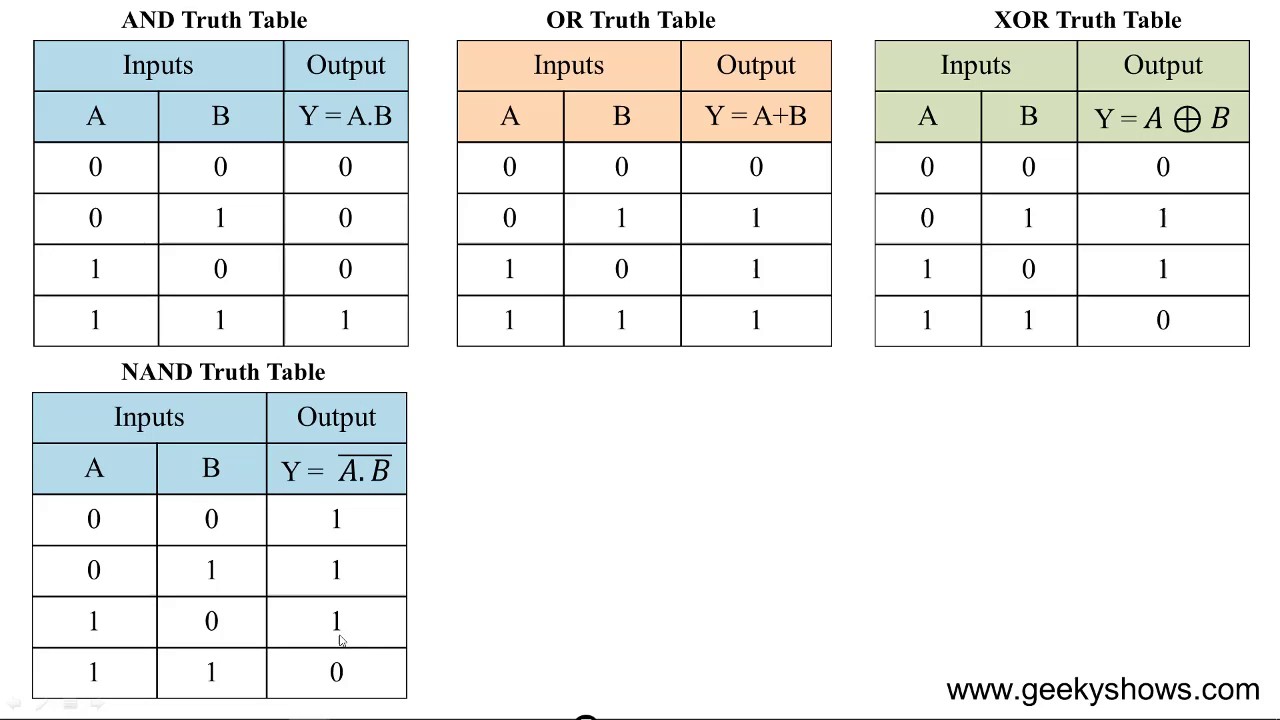
final cliff
xor stands for exclusive or. A xor B means A is true or B is true but not both.
final cliff
vapid drift
why is x or z colum like that

Here's some truth tables. The or table has 1 when A=B=1. The xor table has 0 when A=B=1.
 vital dewBOT

 final cliff
vapid drift
did i draw the picture right?
final cliff
vapid drift
did i draw the picture right?
Pretty sure you did it right, unless I'm miscounting somewhere.
You can just read through your adjacency matrix, for an undirected graph entry i,j of A has a 1 in it if there is an edge between whatever node corresponds to i and whatever node corresponds to j.
vapid drift
how did they know that it was the naswer

 ivory badge
You can make an adjacency matrix in this case
But those sets in P are the sets where a, b are in X iff (a, b) is in R
final cliff
You can also compute these out by hand. 1 only relates to itself so one of your classes is just 1. 2 relates to 3 and no other things relate to 2 or 3 besides themselves so another class is the set with 2,3 and so on.
For a bigger relation you might have lots of tuples to check though which can become unwieldy.
Because you might have some goofy thing like 1 relates to 2 relates to ... 1000000.
vapid drift
wait so i can make matrix out of this and see which ones connect?
final cliff
You can also draw out the graph of the relation I think. Each equivalence class will contain all the nodes of a connected component of your graph.
 vapid drift
 final cliff
See what I mean?
vapid drift
final cliff
how to i read this so the answer is b
final cliff
You mean option d?
vapid drift
yeah
final cliff
Look at the bits that are all connected together
vapid drift
is the answer just a simplified version of it
final cliff
List off the set of nodes in each one. Each of those sets is one equivalence class.
So for example one of the graphs has just the node 1, so one of your equivalence classes is the set {1}
Another one of the graphs contains the nodes 2 and 3, so one of your equivalence classes is {2,3}
The last graph contains the nodes 4 and 5, so your last equivalence class is the set {4,5}.
final cliff
You see how I constructed these graphs from the given relation right?
vapid drift
final cliff
You see how I constructed these graphs from the given relation right?
yes that makes sense
final cliff
Kk
final cliff
vapid drift
]may i ask one more quetsion?
Yeah, I may not be able to answer it though lol.
vapid drift
the answer only is theroy and i dont understand how he got them
 final cliff
What is your question about this?
 final cliff
Maybe I'm dumb but I don't see how A is correct lol
ivory badge
It isn’t
ivory badge
However ||g is surjective||
final cliff
My hint for understanding this problem is try to work out A,B,D and E first. The rest is just definitions.
f can't be surjective by the reason just mentioned.
(Can you find a concrete example of this?)
vapid drift
i only know these definitoons with truth tables
final cliff
f can't be injective because the floor isn't injective
vapid drift
surjective when the last column is all true right?
ivory badge
What?
vapid drift
but how to put in truth table
final cliff
No, a function is surjective when every element of the codomain gets mapped to.
ivory badge
No???
As it says on the image, when the range = codomain
The image is wrong though
f is not surjective
final cliff
final cliff
f can't be injective because the floor isn't injective
For example consider floor(1) vs floor(1.5)
ivory badge
And to show it is not surjective, what value of x satisfies f(x)=1
So, is g injective?
Why or why not
vapid drift
i dont undersatnd
final cliff
Do you know what injective means?
vapid drift
injective when truth table is all false
final cliff
No
A function is injective when no two distinct elements of the domain map to the same thing.
Probably you need to review definitions first before you can make progress on this problem.
vapid drift
 final cliff
Is this the definition they gave you or just some diagrams to show you examples?
vapid drift
definition from notes
final cliff
This doesn't seem very good for a definition 
Okay, well usually people define a function $f:A\to B$ as injective if and only for all $x,y\in A$, $f(x)=f(y)\implies x=y$. This is equivalent to saying for all $x,y \in A$, $x\neq y\implies f(x)\neq f(y)$.
vital dewBOT
dootdooter
 final cliff
The latter implication says informally that if x and y are different elements of the domain of f, then they map to different things when you plug them into f.
Mmm, do you know the bold arrow notation I am using?
It means implies.
A function $f:A\to B$ is defined to be surjective if for any $y\in B$, there exists an $x\in A$ such that $f(x)=y$.
vital dewBOT
dootdooter
 final cliff
All this means informally is that if I give you any y in the codomain (which is B) of the function f, then you can find me an x, where plugging x into f makes f spit out y (i.e. it makes f(x)=y true).
final cliff
This one $\implies$ means implies.
vital dewBOT
dootdooter
 vapid drift
and implies means : if this then that?
final cliff
This notation $f:A\to B$ means f is a function with domain $A$ and codomain $B$
vital dewBOT
dootdooter
 final cliff
In other words f maps the set A to the set B.
So, $\to$ and $\implies$ are different arrows with different meanings.
vital dewBOT
dootdooter
 final cliff
vapid drift
and implies means : if this then that?
final cliff
vapid drift
and implies means : if this then that?
Yes that is correct
vapid drift
:0
ivory badge
vapid drift
injective when truth table is all false
Ok English doesn’t seem like a first language here, but I’m curious what truth table you’re referring to tbh
vapid drift
i usually make a truth table but im not sure how to in this question
final cliff
Yeah, for this kind of problem you won't always be able to build a truth table to solve things. Because you may have infinitely many elements in your domain, and you care about whether or not the propositions in the definitions for things like injectivity and surjectivity hold for all of them.
final cliff
vital dew
**dootdooter**
For example $f:\mathbb{R}\to\mathbb{R}$ defined by $f(x)=3x$ is injective, but to show it is injective you need to show this holds.
vital dewBOT
dootdooter
 final cliff
The problem with truth tables here is that you can't make a truth table with one row for every choice of x, there are too many real numbers for that.
vapid drift
i see so to see if its injective would i plus in the same number for both equations?
 ivory badge
No
final cliff
These aren't good examples for showing something is injective because neither f nor g is injective here.
ivory badge
You would say f(a) = f(b) and try to derive that a = b (which is false here, try a=1, b=1.1)
vapid drift
what is a and what is b
final cliff
Are you familiar with proving "for all" statements?
vapid drift
not by the name
final cliff
vital dew
**dootdooter**
Mmm, okay well if I want to prove this
final cliff
vital dew
**dootdooter**
I need to prove this holds for my f(x)=3x
I can try particular cases like f(x)=f(y) implies x=y where x=1 and y=2 and junk, but that doesn't tell me enough information
Because the actual definitions for injectivity starts with "for all x,y" not for x=1 and y=2.
So you have to deal with x and y as general elements of R to show my f(x)=3x function is injective.
ivory badge
vapid drift
what is a and what is b
They’re arbitrary variables. If it works for any choice of a, b then it works for all of them at once
final cliff
You assume x,y are real numbers, then you assume f(x)=f(y).
By definition of f this tells you 3x=3y, by algebra this tells you x=y.
So, then f(x)=f(y) must imply x=y.
vapid drift
ok so i do plus in a random number and if ther equal they are injective ?
final cliff
Since this implication holds for any choice of x,y we know my f(x)=3x function is injective.
final cliff
vapid drift
ok so i do plus in a random number and if ther equal they are injective ?
No that won't work.
The trick is to do with not actually specifying a particular value of x and y
Like, imagine I want to prove to you that all your friends like to read comics. And I do it by picking some friend of yours named jim who likes reading comics, but I ignore all your other friends.
Have I shown every single one of your friends likes reading comics?
vapid drift
no
final cliff
Yep, what if you have a friend named sally who hates comics?
So, we have to pick elements of the domain of f in general here.
Then you use known properties of f and of the elements of the domain of f to prove f(x)=f(y).
vapid drift
are you trying to sleep?
final cliff
I probably will get off here in a sec.
vapid drift
I understand iwill review what you posted and review the notes/fundemntals
thank you for the help
final cliff
Try these: prove f from the reals to the reals defined by f(x)=3x+1 is injective. Prove f from the reals to the reals defined by f(x)=x^2 is not.
ivory badge
Can you show whether or not g in your exercise is injective, too!
final cliff
The first one will be similar to my f(x)=3x proof. The second one you will need to find a counterexample to the definition of injectivity.
final cliff
ivory badge
Can you show whether or not g in your exercise is injective, too!
This is also a good example to try.
fossil mural
what about if L' isn't in P or in NP-complete?
also was this proof generated by chatgpt
we assumed that at least one intermediate language is finite (namely L), which is not the same as all of them being finite
if we assumed that all intermediate languages are finite and derived a contradiction, the result of that would just be that at least one intermediate language is infinite, not necessarily that all of them are
chatgpt doesn't know what maths is so when it generates text that looks like a proof it's generally nonsense that just resembles a proof, instead of an actual proof
yes
if you assume that an intermediate finite language exists, and get a contradiction, then that means no intermediate finite language can exist
yes
...the problem is that the reasoning it used to get a contradiction isn't actually correct
i also just noticed another problem, which is that for an arbitrary language L in NP, L' might not be in NP
it's definitely in co-NP, ...but it's actually unknown whether that's equal to NP

 fossil mural
ok well yes, if L is finite then L' is definitely in NP
but that's because all finite languages are in P, and the complement of a language in P is in P
vapid drift
vapid drift
what does the 6 represent
fossil mural
{2, 3, 4, 5, 6, 7} has 6 elements
vapid drift
what does the 9 represnt
fossil mural
and chatgpt's reasoning in case 2 is definitely wrong
Case 2: L' is in NP-complete
This would also imply that L is in NP-complete because we can simply negate the output of the verifier for L'. This contradicts our initial assumption that L is not in NP-complete.
"we can simply negate the output of the verifier for L'" nope, if you could do that that would mean NP = co-NP
fossil mural
vapid drift
what does the 9 represnt
there are 9 places that you could put something in a string of length 9
L is finite so it is poly searchable
this is the correct proof of that statement btw
vapid drift
how did he know to do 7!
fossil mural
L is finite, therefore it's in P, therefore it can't be intermediate
fossil mural
vapid drift
how did he know to do 7!
because after placing 2 characters of a 9-character string there are 7 others, and we want to know how many ways those 7 characters can be arranged
vapid drift
fossil mural
because after placing 2 characters of a 9-character string there are 7 others, a...
are those two characters a and e?
fossil mural
...yeah that's the thing
it knows enough about what proofs "look like" to generate things that look like proofs, but not enough to generate actually correct proofs
fossil mural
vapid drift
are those two characters a and e?
yes
vapid drift
fossil mural
yes
how do we know a is the first letter it can accept and e the last letter
fossil mural
"the first occurrence of letters (i.e. the leftmost letter) must be A, and the last occurrence of letters (i.e. the rightmost letter) must be E"
vapid drift
how did they get those ones


the 25 and 36 you already explained the rest i know
15
fossil mural
$\binom{6}{4}$ is the number of ways to choose $4$ things from the set ${2,3,4,5,6,7}$ which has $6$ things
vital dewBOT
bee [it/its]
 fossil mural
to get that that's equal to 15 you would use the formula for n choose k, or just a calculator
,w 6 choose 4
vital dewBOT


 Requested by bee2660#0
 inner schooner
@vapid drift شوف الخاص
vapid drift
fossil mural
to get that that's equal to 15 you would use the formula for n choose k, or just...
where did the 2 come from
 vital dewBOT
bee [it/its]
 vapid drift
ah and 6-4 is 2
fossil mural
yep
vapid drift
thank you i will do the question by myself now i thanking you
 quiet eagle
Any set B and its power set B' have no element in common right?
fossil mural
quiet eagle
Any set B and its power set B' have no element in common right?
consider B = {empty set}
quiet eagle
fossil mural
consider B = {empty set}
okay but for every nonempty set B that is true, correct?
fossil mural
B is not empty
it contains a set that's empty, but it's not empty
by "{empty set}" i mean the set containing the empty set
quiet eagle
haha
fossil mural
if B is the empty set then that's not actually a counterexample because the empty set doesn't have elements in common with anything (because it doesn't have elements)
fossil mural
are you saying that sets that contain sets aren't "normal"...?
quiet eagle
don't cancel me for that pls
So, there is a set B, which has no element in common with its powerset
fossil mural
...yes, there is at least one set with that property
quiet eagle
I went back by a lot
fossil mural
quiet eagle
for normal sets like {1,2,4,e}
...by the way are you actually sure that 1, 2, 4 and e definitely aren't sets?
quiet eagle
fossil mural
...by the way are you actually sure that 1, 2, 4 and e definitely aren't sets?
Why would you ask that? Is {1} equal to {{1}}??
fossil mural
no, because then 1 would be a set that contains itself and that can't happen (assuming that this is ZFC)
but 1 might be equal to {2}
or, probably more likely, it might be a set containing some other object that isn't a real number, like maybe 1 is the set containing the empty set
quiet eagle
fossil mural
no, because then 1 would be a set that contains itself and that can't happen (as...
ah phew
fossil mural
although if this is ZFC then real numbers are definitely sets because everything is a set
quiet eagle
fossil mural
although if this is ZFC then real numbers are *definitely* sets because everythi...
Is that so!?
 meager prawn
quiet eagle
Is that so!?
meager prawn
quiet eagle
Is that so!?
If you take an intro to set theory, you'll see it's the standard way of defining them
You have the empty set and everything is built from it
quiet eagle
meager prawn
You have the empty set and everything is built from it
that sounds elegant. I'm hyped for set theory.
I've got the real numbers defined by using sequences and Cauchy-Stuff I think
fossil mural
alright so if 1 is some sequence... is a sequence a set? how did you define sequences? :)
quiet eagle
I forgor, it's been some time :(
fossil mural
the reason that the real numbers don't "feel" like sets is that generally we don't care what the elements of 1 are
but they could still exist
quiet eagle
"they could exist"? What could exist?
fossil mural
elements of 1
although in general if you have to worry about whether real numbers are actually sets you're generally doing something wrong (unless you're constructing the real numbers but in that case you know what the elements of a real number are)
"are B and the power set of B disjoint" is just a weird question to ask if B is a set of real numbers, the answer would not be meaningful or useful
quiet eagle
I see
I am in fact a bit puzzled by an exercise
Let $A$, $B$ be sets and $f : A \rightarrow B$ be a mapping. The power sets of $A$ and $B$ are $\mathcal{A}$ and $\mathcal{B}$, respectively. We consider the mapping $g : \mathcal{B} \rightarrow \mathcal{A}$, $B' \mapsto f^{-1}(B')$. Show: \
(a) $f$ is injective if and only if $g$ is surjective.
vital dewBOT
Sciencenjoyer
 fossil mural
...alright
what specifically are you confused about?
quiet eagle
So I suppose B' is element of power set B?
fossil mural
i think f^-1 here is supposed to be preimage, not inverse
quiet eagle
Heh I've already been through that. Was told not to assume an inverse exists in this server
fossil mural
$f^{-1}(B')$ is the set of all $a \in A$ such that $f(a) \in B'$
vital dewBOT
bee [it/its]
 quiet eagle
And we have clarified there exists at least one set B, which is disjoint with its power set
fossil mural
that's true but not relevant
quiet eagle
No way
fossil mural
it doesn't matter whether B' is in B or not because f^-1(B') would still mean preimage and not inverse, that's just what that notation means in this case
quiet eagle
ye
It may be the case that B and B' have no element in common. So if b is element of B and b' element of B' and f(a) = b, then f(a) !=b' for every a
fossil mural
B and B' definitely do have elements in common unless B' is empty
B' is a subset of B
quiet eagle
But every element of B' is a set
fossil mural
...oh wait hang on the notation here is confusing
fossil mural
vital dew
**Sciencenjoyer**
here we're using B' to represent an element of the power set of B
and the power set of B is $\mathcal{B}$
vital dewBOT
bee [it/its]
 fossil mural
ok so yeah it might be true that elements of the power set of B are also not elements of B, ...but also it wouldn't be relevant
quiet eagle
In that case g would map nothing though
quiet eagle
because no f(a) would be equal to B'
fossil mural
that doesn't matter
because f^-1(B') doesn't mean inverse, it means preimage
we're asking whether f(a) is an element of B'
quiet eagle
B' is an element already
fossil mural
...i don't even know what that means
everything is an element of something, why would that matter
quiet eagle
lol I ment B' is an element of the fancy B (power set of B)
fossil mural
why would the power set of B be relevant here
we have f, which is a function from A to B, and B', which is a subset of B
quiet eagle
quiet eagle
So I suppose B' is element of power set B?
here
fossil mural
and we write f^-1(B') to mean the set of a in A such that f(a) is in B'
why would it matter whether f(a) is equal to B'?
quiet eagle
brr I am steaming
So I was looking at the definition of g
In order for its codomain to be nonempty there should be at least one f(a) = B', correct?
fossil mural
no
quiet eagle
I dont mean the codomain but the value set
fossil mural
i'm assuming you mean "the set of values that can be outputs of g", and if you do then yes that's the range
quiet eagle
yeees, thanks. Good to know
quiet eagle
fossil mural
still no
How could there be a preimage f-1(B') if no f(a) =B' exists?
fossil mural
because a preimage isn't an inverse
f^-1(B') means the set of a such that f(a) is AN ELEMENT OF B'
being an element of B' and being equal to B' are not the same at all
 winter tangle
quiet eagle
winter tangle
quiet eagle
lol
quiet eagle
fossil mural
being an element of B' and being equal to B' are not the same at all
As I already mentioned I am steaming a bit. Let me think a little ._.
quiet eagle
fossil mural
f^-1(B') means the set of a such that f(a) is *AN ELEMENT OF* B'
Oh yeah that would be the case if B' was a set. Which it is
okay fine
Would the scalar number 2 be a subset of {{1};{2};{1,2}}? @fossil mural
fossil mural
well it would be if 2 = {{1}}, otherwise no
..."is 2 a subset of [...]" is a pretty weird question though
quiet eagle
haha I realized it
I have an appointment now. I'll come back with a fresh mind sometime later
Thanks for now
 warm fog
Hello,
I am a newbie to the field of inferring preconditions and am trying to wrap my head around it. Currently, I am trying to do the questions given over here - https://www.cs.williams.edu/~freund/cs326/ReasoningPart1.html
In the following question -
    x = x - 2;
    z = x + 1;
    { z != 0 }
Why is this happening -
    { x != -1 } =====> Shouldn't this be x!=1
    x = x - 2;
    { x != -1 }
    z = x + 1;
    { z != 0 }
 unreal stump
What is initial x
warm fog
unreal stump
What is initial x
It can be anything ... imo
warm fog
Can someone please help me come up with pre conditions for these equations -
x = 7*k+5
b = 2*a-6
y = 3*b+2
{(x + y) > mu}
z = x + y
{z > mu}
 vague scaffold
alright guys. i've asked a number of mathematicians what I thought was a basic proposition, but it turns out there's significant difficulty in my question. Is this the proper place to ask questions about projective geometry/algebra?
vapid drift
how did he know to add 21 and 4
 fossil mural
vague scaffold
alright guys. i've asked a number of mathematicians what I *thought* was a basic...
fossil mural
vague scaffold
alright guys. i've asked a number of mathematicians what I *thought* was a basic...
tbh just ask the question
if this turns out to not be the right channel then we can tell you where to put it once we know what the question is actually about because we've seen it
vapid drift
I mean alot of numbers add of to 21
ivory badge
vapid drift
how did he know to add 21 and 4
He wants 21 because the goal is multiples of 21, the 4 is what’s left
vapid drift
i see thabk you
how is this true

i understadn that when i plus in 1 for the firsdt one but the second one?
ivory badge
It is the inductive hypothesis isn’t it
vapid drift
yes
ivory badge
What don’t you get
ivory badge
vapid drift
does this mean if both x and y are true or one of them is true the answer is true
 ivory badge
If either of X or Y is true, then X v Y is true
When both are true, that satisfied it
vapid drift
then whats the differece is it to this
 ivory badge
That is an entirely different thing
That’s always true when Y is false
It’s only false when Y is true and Z is false
vapid drift
would the correct wording would be
vapid drift
ivory badge
If either of X or Y is true, then X v Y is true
like this
how would you say it like that
ivory badge
If Y implies Z?

 ivory badge
Does it prove the final statement?
vapid drift
ivory badge
Does it prove the final statement?
how would i know
vague scaffold
Here is my question.
The projective harmonic conjugate uses this rule. I wrote a script to produce all of the whole/natural number possibilities on a number line. That is to say, if you make A=0, and solve for all whole number possibilities (I used python), the next picture is the coordinate locations on a number line that are valid for the remaining points. There are two valid solutions for every final value, because it works forward and backward.
I have found that every valid harmonic conjugate produces a length exactly half that of a pythagorean triple's perimeter. The first values, 0-2-3 produce 6 for the final value, which is 1/2(3+4+5) the first pythagorean primitive.
This process creates a value that is exactly half the perimeter of all of the pythagorean triples, and only creates these values.
--- Why??---


here's the python script if you care to follow up
This seems like a hint at a serious truth about numbers to me
anybody willing to say i'm at least not insane to wonder this?
ivory badge
vapid drift
how would i know
Well do you have any notion of what it means to be a valid argument
ivory badge
Then go back and review
vapid drift
 ivory badge
Do you understand why
If not, go back and review so you can see why the rows where they’re all 3 true are the important ones
vapid drift
oh that photo was from the notes
vapid drift
i still cant fin dthe patterm

 vapid drift
 urban berry
<@831591156919173141>
urban berry
<@831591156919173141>
can i see the original question
ivory badge
vapid drift
i still cant fin dthe patterm
The pattern is all three are true, and those are the only rows where it happens
And it compares it to the truth of r, which is what they’re trying to derive
 vapid drift
i have truth table now what does it prove
vapid drift
vapid drift
i have truth table now what does it prove
for this table?


 urban berry
never delt with matrix before
urban berry
vapid drift
best bet might be posting it in #1021175428326633542
vapid drift
butt this is discrete math]
ivory badge
vapid drift
What does the degree sequence mean
vapid drift
ivory badge
What does the degree sequence mean
i dont know
ivory badge
vapid drift
for this table?
What do you think the critical rows are for it
ivory badge
Well try and think what they should be, checking your examples

 ivory badge
What’s significant about the columns highlighted for the critical rows
vapid drift
they all are true
ivory badge
No
The columns
That’s is correct that the critical rows have all these three columns true
But that’s not what I’m asking, why is it those 3 in particular
ivory badge
That’s not why they’re important volume
They’re important because those are your P1, P2, P3 and r is you C for an argument
And you show that having all of them true means that C is true
 vapid drift
wait how is their r my c
vapid drift
becuase they are comparing to r
ivory badge
What’s the connection there
The order of things on the table doesn’t matter
You want P1, P2, P3 all true to imply C true right?
Do review old notes some, though
 vital dewBOT
 vapid drift
sorry i know im dumb
ivory badge
Why did you just copy down the table
vapid drift
i circled the ones that are true
ivory badge
There are only two rows where P1, P2, P3 are all true though
vapid drift
yeah i circled them
ivory badge
So is C true on those rows
vapid drift
only one of them
vapid drift
vapid drift
for this one do i find the sum of all degrees and divide by 2
and if its odd it doesnt exist?
ivory badge
Well the sum of all degrees divided by 2 isn’t odd here, it’s 11/2?
vapid drift
is it supossed to be odd or integer the rule
ivory badge
Idk, check your notes
 ivory badge
vapid drift
is it supossed to be odd or integer the rule
ivory badge
vapid drift
is it supossed to be odd or integer the rule
I meant check your notes on this part in particular
vapid drift
i figrued it out
ivory badge
But good
vapid drift
ivory badge
I meant check your notes on this part in particular
i couldnt find anything im just hoping it wont appear in 10 hours
ivory badge
Should’ve kept better notes fr
 vapid drift
vapid drift
vapid drift
 vapid drift
what makes something isomorphic?
 charred gale
I believe K and L have a different number of connected components, and that G_{1} has no vertex of degree 4
ivory badge
vapid drift
what makes something isomorphic?
If I can map each point on the left to a unique point on the right, and send edges to unique edges between them
Essentially, if you can move the points around into the same shape, including the edges
ivory badge
charred gale
I believe K and L have a different number of connected components, and that G_{1...
Trying not to just give him answers and all, so as to help figure out why they’re the answers
vapid drift
why cant the answer be 8 and 7 why is it 5 and 7
 ivory badge
vapid drift
why cant the answer be 8 and 7 why is it 5 and 7
ivory badge
vapid drift
why cant the answer be 8 and 7 why is it 5 and 7
There can be multiple pairs of elements
 vital dewBOT
 vapid drift
i dont know why i just asked that