#discrete-math
1 messages · Page 26 of 1
 neat pasture
 brave rock
Think about what such numbers look like in binary. Try describing what they look like in language, then afterwards try and think about what a DFA that accepts them looks like.
You can work on trimming down the number of states after you've got something that works.
neat pasture
So if i have 5 states, q0 - q4
Would it make sense to do q0 to q1 if 1, q1 to q2 if 0, q2 to q3 if 0, q3 to q4 if 0 and q4 is the final?
 ivory badge
1000 would be accepted then, yes?
That should be 8, which I believe is divisible by 4
ivory badge
you have to think critically, not just sequentially place the 5 states
What numbers are accepted
Maybe you’ll see a pattern

 coral parcel
The strings you're considering here don't even consist of a and b!
ivory badge
Why do you think this will work, instead?
neat pasture
obviously thats just a pic from my text book
i feel like a, b can be substituted in for 0,1
coral parcel
The first step here is to get a more text-oriented understanding which strings should be accepted in the first place. Until you have that, it's too early to start drawing states.
neat pasture
just bc i dont feel like writing it out in latex
well its just strings divisible by 2 and not 4
ivory badge
Is 101000110 accepted, yes or no
coral parcel
THat is not a text-oriented (i.e. syntactical) understanding.
coral parcel
How do you see on 101000110 that it should be accepted?
ivory badge
If you can’t tell just by looking at the binary, that’s an issue
If you can tell, why can you tell
What exactly tips you off
neat pasture
#1s != #0s
brave rock
So is 1010 accepted?
neat pasture
nope
brave rock
Wrong, it is
neat pasture
that is 10
brave rock
1010 in base 2 is 10, which is divisible by 2 but not 4.
neat pasture
10 is divisible by 2..
ivory badge
Yes
brave rock
Maybe you should reread the question
brave rock
Ok, so is 10000 accepted?
ivory badge
neat pasture
Ok so then it is based on the last digit being 0
Is 0110 accepted
Ya know what I can’t type clearly so I’m just leaving it
But what’s 4 in binary
neat pasture
So its always the last 2 digits
coral parcel
(I don't think it is completely clear from the problem description whether 0110 should be accepted).
ivory badge
I think it’s pretty clearly divisible by 2 but not 4?
brave rock
neat pasture
So its always the last 2 digits
What about the last two digits? Explain in words what needs to be true.
neat pasture
If the last digit is 0 and the last two are not both 00, it is divisble by 2
but not 4
coral parcel
The issue with 0110 is not the divisibility, but whether we consider 0110 to belong to "binary representations of natural numbers" in the first place.
I.e. are leading zeroes allowed.
ivory badge
He listed 0 and 00
brave rock
neat pasture
If the last digit is 0 and the last two are not both 00, it is divisble by 2
The last digit of 0 is 0, and the last two digits are not both 00. So this seems to say that 0 is accepted.
coral parcel
ivory badge
He listed 0 and 00
As things that should be rejected.
neat pasture
If the last two digits are 00, it is divisible by 4, so it must fail.
If the last two are not 00 but the last is 0, then it passes
ivory badge
neat pasture
If the last two digits are 00, it is divisible by 4, so it must fail.
0 is listed as rejected in your example
coral parcel
You're getting there.
neat pasture
that is what i said
brave rock
coral parcel
(I don't think it is completely clear from the problem description whether 0110 ...
Let's give it a moment – it's easy to adjust an automaton to accept only this 'proper' version, so let's get the main requirement done
coral parcel
Yeah, it was a bit premature of Sharp to bring 0110 up.
neat pasture
If it's only 0, then the finite state machine will loop
on q0
until it goes to a 1
coral parcel
You shouldn't be thinking about states yet.
neat pasture
DFA**
ivory badge
coral parcel
Yeah, it was a bit premature of Sharp to bring 0110 up.
Id honestly just say it should be accepted all the same tbh
coral parcel
You're still on "understanding which strings to accept" -- you're almost there, but it can be tighter.
If the last digit is 0 and the last two digits are not 00, then what are the last two digits actually?
ivory badge
neat pasture
If the last two are not 00 but the last is 0, then it passes
I’ll ask a very suggestive question: this is saying what it isn’t. What does it have to be
Dang it sniped
neat pasture
the preceding digits must be 0s
coral parcel
What?
ivory badge
??!
neat pasture
all digits prior to the last two must be 0
brave rock
So 10000000000010 doesn't get accepted?
coral parcel
Are you saying that 110 should be rejected?
brave rock
You don't know if 110 is accepted or rejected, is this what you're saying?
coral parcel
coral parcel
If the last digit is 0 and the last _two_ digits are not 00, then what _are_ the...
You seem to have ignored this question.
neat pasture
No ik it shopuld be excepted
neat pasture
coral parcel
If the last digit is 0 and the last _two_ digits are not 00, then what _are_ the...
they must not be the same??
brave rock
So if the last digit is zero, and they're not both the same...
neat pasture
then it is divisible by 2, but not 4.
coral parcel
What ARE the only combination of two digits where the second digit is 0 and the two digits are not the same?
neat pasture
01
coral parcel
The last digit of 01 isn't 0.
brave rock
So 101 should be accepted?
coral parcel
Yes to "it should be 10".
neat pasture
if it is 4 then it isnt allowed
coral parcel
If you see a 4 anywhere, that should be rejected immeiately, because 4 is not the binary representation of anything.
brave rock
neat pasture
if it is 4 then it isnt allowed
Why isn't 4 allowed? Are you saying 10 is rejected?
neat pasture
because 4 IS DIVISIBLE BY 4!
coral parcel
10 is not the binary representation of 4, perhaps that's what's confusing the discussion right now.
brave rock
Yes I misread 4 as 2, and mistyped.
coral parcel
Then I'm confused why you're bringing up the symbol 4 at all.
neat pasture
its because the problem states it must not be divisible by 4
coral parcel
Especially what you meant by "aka 4".
neat pasture
yes
brave rock
yeah hold on, apparently I didn't misread
neat pasture
the aka 4 is in response to the previous message above mine
ivory badge
10 is 2 my guy
coral parcel
Okay, lets cut to (a slightly later stage in) the chase.
Have you now convinced yourself that
binary representations of natural numbers divisable by 2 by not 4
is the same language as
strings of0and1that end with10
?
neat pasture
Indeed
 neat pasture
the problem is this
How can i know what the numbers before the last two must be
Ya feel
coral parcel
You can't. A string that ends with 10 must be acceped no matter what comes before that (as long as it's made of zeroes and ones).
ivory badge
neat pasture
How can i know what the numbers before the last two must be
Well, you agreed that it’s numbers that end in 10
neat pasture
Ok but why am i in my DFA for STEP 1 only accepting if its a 0, if a 1 is allowed too?
coral parcel
We haven't started construcing a DFA yet.
neat pasture
Okay
coral parcel
We're now ready to start constructing the DFA, but none of that has actually happened.
ivory badge
neat pasture
Ok but why am i in my DFA for STEP 1 only accepting if its a 0, if a 1 is allowe...
I think it’s wrong to do it that way
neat pasture
Right, so now we must consider the initial case.
We do not want any leading 0s
So, we can wait until there is a 1.
coral parcel
Not wanting any leading 0s is a reasonable decision, but "wait until there's a 1" is not the way to do that.
neat pasture
My thought is to do this: a loop for 0s on state initial, else succeed to state 1 if there's a 1 indicating an allowance [thus far]
coral parcel
What you you want a loop for?
neat pasture
If 0, stay on initial state.
coral parcel
Why? If you see a 0 as the first symbol, that is a leading zero, and you've just decided that you want to reject those strings!
neat pasture
No?
coral parcel
If you stay on the initial state, that would lead to a risk of accepting.
coral parcel
Ignoring a string is the same as rejecting it, isn't it?
ivory badge
coral parcel
Ignoring a string is the same as rejecting it, isn't it?
Well the question ig is if you want leading zeroes or not
coral parcel
With a DFA, you can't ignore an input. It will either be rejected or accepted, not in-betweens.
coral parcel
neat pasture
We do not want any leading 0s
Bananza said here he doesn't want strings with leading zeroes.
coral parcel
Right.
neat pasture
i was just thinking to do the same as this dfa where we check for the odd number of 1s
 coral parcel
So you need to make a decision one way or the other (and then explain in your solution how you've understood the ambiguous description).
coral parcel
neat pasture
i was just thinking to do the same as this dfa where we check for the odd number...
That machine allows leading zeroes. That's also a defensible decision.
coral parcel
Are you suggesting that because (I assume your textbook's example of) a machine to recognize odd numbers allows leading zeroes in the numbers, then your machine for recognizing divisible-by-2-but-not-4 numbers shouldn't allow leading zeroes?
neat pasture
Well the machine stays on q0 if the digit is 0, until it sees a 1, then it goes to q1. If there is a 0, it stays on q1, and if there's a 1, it goes to q0
coral parcel
...
ivory badge
coral parcel
I'm genuinely lost for words here.
Same
neat pasture
I believe both machiens must accept leading 0s
coral parcel
I'm trying to get you to make a decision about whether you want your machine to accept string with leading zeroes, and then stick to that decision.
Okay then.
neat pasture
i literally just said
read*
in the problem description
010 is accepted
So leading 0s should be accepted
so i am invalid
brave rock
I wish you had said that in the problem description. As it is your original message did not explicitly say that 010 was valid.
But for what it's worth, this makes things easier
neat pasture
I apologize I left out 010 because I thought it wasnt important at the time
ivory badge
||I think you can do it with 3 states even?||
Well now you just need to find out how to read the last 2 digits are 10
Since starting 0s don’t matter
neat pasture
So 0,1 either one will allow a transition from inital to q1?
coral parcel
You haven't decide yet what the intuitive meaning of "q1" is going to be.
neat pasture
q1 is gonna be where we have discovered up to n-2 digits?
coral parcel
But since 00 should be rejected and 10 should be accepted, I don't think it's a good idea to move to the same state no matter whether the first symbol is 0 or 1.
coral parcel
Try to explain what the intuitive meaning of each of your 4 states are. Not the transitions between them, just what you know in each case.
neat pasture
My interpretaiton of the states is the digit present at that step
idk how else to think of it
coral parcel
Please humor me and write a description of each of them down.
Four bulleted points (or however many states you need), each with a description of one state.
neat pasture
- Q0: initial state, no input yet
- Q1: accepting state, has seen a 10
- q2: rejecting, doesnt end in 10
coral parcel
If everything that doesn't end in 10 leads you to the same state, then you will be in the same state after reading 00 as after reading 11.
That's a problem because then the state after reading 000 or 110 would still be the same. But only one of them should accept.
neat pasture
so then q1 is the second to last digit is 1, but if its a 0 it will remain in this state. if its 1 it goes to q2 wich mean success.
coral parcel
This is good progress by the way. But I don't understand whether your last post is a counterargument to your objection, or you're modifying your description of q2.
ivory badge
I think that’s a bit off, that sounds like reading a 11
coral parcel
Just so we can follow along, perhaps you should post your new state descriptions, then.
neat pasture
- Q0: The initial state waiting for input
- Q1: Second to last digit is a 1, so if it sees any addtl 0 it stays in q1, and if it sees a 1 it goes to q2
- Q2: accepting state
coral parcel
If we've read 1010010 so far, should we be in state q1 or q2? Both state descriptions seem to be satisfied.
neat pasture
q2
coral parcel
But the second-to-last digit of 1010010 is 1 like the description of q1 says.
neat pasture
so at q1, we need to check if its a 0, or 1
coral parcel
You're still skipping ahead to transitions.
I'm trying to make you think about what does the machine know when it's entering each state.
coral parcel
You're still talking about transitions.
neat pasture
Q0: initial state, no input yet
Q1: Second to last digit is a 1
q2: Last digit is a 0, success
Would that be correct
coral parcel
Okay, do it your way. Good luck.
neat pasture
I dont think im understanding what ur saying bro
i dont see it any other way
im not being stubborn this is the only way im processing ur question
coral parcel
I'm saying that after reading 1010010 you are both in the situation you have described as q1 and in the situation you have described as q2.
You can't have a DFA where you're both in state q1 and in state q2 after reading 1010010.
neat pasture
so i guess q1 is the possibility of divisible by 2, but for sure not divisible by 4... but q2 is that the possiblity of the string being divisible by 4?
coral parcel
Why are you now talking about divisibility again?
It's more than half an hour since we decided the problem is simply to find our whether the input ends in 10.
 native dragon
😨
 novel ore
😱 🤯
neat pasture
Yes, our issue is in terms of state 1 and 2 being ambiguous
native dragon
in what order are you reading the number
I'm assuming from largest to smallest digit right
native dragon
neat pasture
Yes, our issue is in terms of state 1 and 2 being ambiguous
I'm pretty sure it's really hard to program a state machine to figure out what the last two digits are
coral parcel
Hmm, to get some progress, here's what I would do:
- We need a state that says "the last symbols I saw were 10"
- We need a state that says "the last symbol I saw was 1" (since we need to be in such a state in order to move to the above one".
- We need a state to be in when none of those things are true.
native dragon
coral parcel
Hmm, to get some progress, here's what I would do:
* We need a state that says "...
tbh I would just do a 4 states: 0,1,2,3 mod 4
coral parcel
That could also work (but would be a completely different approach).
native dragon
I feel like it's a bit less complicated like that
but do it your way
I didn't mean to intrude on this lesson lol
coral parcel
There's something to be said for doing it that way from the beginning, certainly.
native dragon
tbh I feel like "ends in 10" would be better used if you were reading the number in reverse, lol
neat pasture
i just dont know what state we'd be in for rejections
coral parcel
In a DFA there can be multiple accepting states, and any state that is not accepting is a rejecting state.
coral parcel
native dragon
tbh I feel like "ends in 10" would be better used if you were reading the number...
yeah, again, it's not a bad plan -- I'm just wary of further confusing Bananza by scrapping everything when we're so close to the finish.
neat pasture
so using this can we worry about transitions now
coral parcel
Yes.
neat pasture
or is it too early
native dragon
coral parcel
yeah, again, it's not a bad plan -- I'm just wary of _further_ confusing Bananza...
to be fair scrapping everything and restarting happens in math a good amt🥲 , but yeah I see
neat pasture
We need a state that says "the last symbols I saw were 10" if 0 go here if 1 go to state q1
We need a state that says "the last symbol I saw was 1" (since we need to be in such a state in order to move to the above one". if 1 go here
We need a state to be in when none of those things are true if 0 loop
is that correct
coral parcel
Uhm, are you saying that if "the last symbols I saw were 10" and we then see a 0, then we're still in "the last symbols we saw were 10"?
neat pasture
we go back a state
coral parcel
So "go here" is your way of saying "go back a state", whatever that means?
neat pasture
q0 ------------ (1) q1 ------------- (0) q2 (1) ---- q1
coral parcel
(And I'm not completely sure which of my three state descriptions you're calling q1 either).
neat pasture
the 2nd one
coral parcel
You may have the right idea, but you haven't succeeded in writing it down fully.
Since you have 3 states, you need to describe 6 transitions, namely two out of each state.
neat pasture
At q0, the state which the last symbol wasn't a 1 / the last symbols i've seen were not 10 (initial), we will stay on this state if there's a 0 seen. Otherwise, if we have a 1, we've obviously seen a 1, so we can transition to state q1. At q1, if we have seen a 0, we can obviously transition to state q2, since we've now seen a 10 symbol. At q1 if we see a 1 though, we just stay on q1, since so far the last symbol we've seen is just a 1. Once we're at q2, the success state, if the next symbol is a 1, it should go back to state q1, since we've just last seen a 1. And lastly at q2 if we've seen another 0, then we can go back to state q0 since we have yet to have seen a 1 previously or 10 [we saw a 00 instead]
coral parcel
Right, that sounds correct.
neat pasture
Thank you all for your help. One more question though.
brave rock
native dragon
tbh I would just do a 4 states: 0,1,2,3 mod 4
Now that bananza has completed the task, I will comment on this.
The remainder modulo 4 is entirely determined by the last two digits, so this approach is totally the same as simply having states corresponding to the last two digits.
As it happens we can produce a smaller automaton if we consider the digits, since we may consider only three states rather than four, since we may merge the 01 and 11 states.
neat pasture
neat pasture
Thank you all for your help. One more question though.
In the example [unrelated, but I brought into the convo] regarding this:
neat pasture
neat pasture
i was just thinking to do the same as this dfa where we check for the odd number...
^
I'm confused on why this DFA is counting the odd number of 1s.
I tried to walk through an example with my own binary string but didn't get it
 analog tinsel
neat pasture
I tried to walk through an example with my own binary string but didn't get it
analog tinsel
neat pasture
I tried to walk through an example with my own binary string but didn't get it
to me it looks like it accepts a word iff the word has an even amount of 1's
brave rock
The initial state has not been specified
neat pasture
Start is q0
analog tinsel
brave rock
The initial state has not been specified
oh thats something
neat pasture
I believe it says
analog tinsel
but I guess the arrow going into q0 is just cutoff in this picture
brave rock
neat pasture
Start is q0
So in fact it does accept if there's an even – not odd – quantity of 1s occuring in the string.
analog tinsel
do you understand why that is true, bananza ?
neat pasture
Not really
analog tinsel
how would you compute the word 1010 ?
neat pasture
Is it because we've seen at least 2 1s
So like state 0 is we've seen an even amount, state 1 is an odd amount
analog tinsel
yes
as soon as you read a 1 you have to transition from q0 to q1 or q1 to q0 respectively
so starting at q0 you will need an even amount of 1's to land at q0, the final state, again
its going back and forth
neat pasture
So the language that the dfa is deciding is even number of 1s?
That's why I was confused
analog tinsel
yeah, the set of words that contain an even number of 1's, corrct
you could try to formulate that as a set
or regex
coral parcel
brave rock
Now that bananza has completed the task, I will comment on this.
The remainder ...
On the other hand, the modulus approach generalizes to divisors with prime factors that are not in the base, so it is more general.
brave rock
Yeah
coral parcel
 pine canopy
you said s=|S|
pine canopy
you said s=|S|
The intention with my examples was to show that the theorem is false without some restriction on s.
pine canopy
oh
coral parcel
I'm not sure whether s = |S| will actually make it work, but I haven't found a counterexample to that yet.
neat pasture
If I had 2 problems and the inputs were (code, x) for problem 1 and just the code for problem 2, and the output of problem 1 is true/false depending on if it'll halt with the input x, and for problem 2 its if the code takes at least 1400 steps before eventually returning true on the inputs
can I prove that 1 is reducable to 2 simply by showing that the first is a true instance of itself if and only if the code inputted is a true instance of problem 2?
pine canopy
wait I think I can see a HC
coral parcel
One that includes all of the red edges?
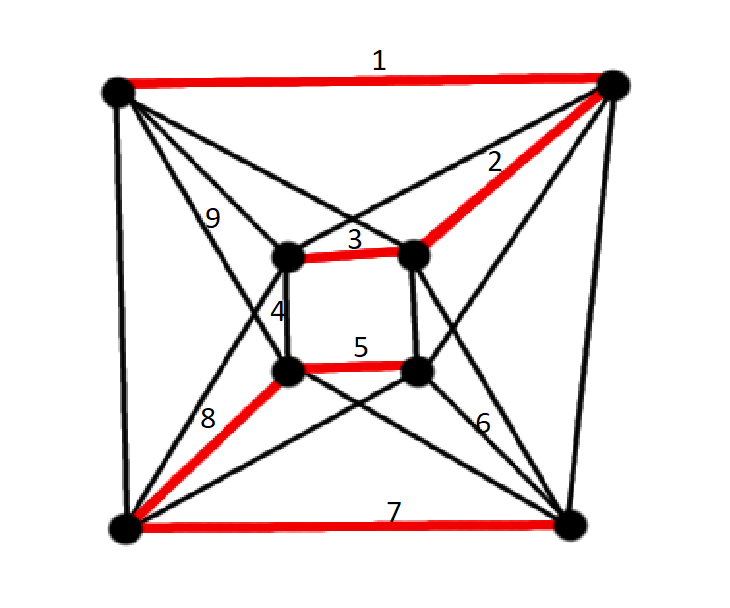 coral parcel
The bottom left vertex of the inner square is visited twice there.
 iron marsh
Sure, I don't see why not.
native dragon
pine canopy
https://i.imgur.com/rQee0cF.png
isn't this graph 5-regular tho
pine canopy
yeah? my example was wrong though
native dragon
pine canopy
yeah? my example was wrong though
wouldn't it have a hc by dirac's tho
pine canopy
native dragon
wouldn't it have a hc by dirac's tho
not on that particular path
(including all red lines)
native dragon
pine canopy
not on that particular path
oh yeah it can't always give you an hc for a specific path
pine canopy
the theorem(not dirac) states that every component of G[S] - where S is a subgroup of the edges, and satisfying d(G) >= ( n + |S| )/ 2 has a Hamiltonian cyle containing S
pine canopy
pine canopy
https://i.imgur.com/rQee0cF.png
So you can see the group S highlighted in red here
however d(g) isn't >= (8 + 6)/2 = 7 , so it's a counter example
native dragon
Ah I see
brave rock
neat pasture
If I had 2 problems and the inputs were (code, x) for problem 1 and just the code for problem 2, and the output of problem 1 is true/false depending on if it'll halt with the input x, and for problem 2 its if the code takes at least 1400 steps before eventually returning true on the inputs
can I prove that 1 is reducable to 2 simply by showing that the first is a true instance of itself if and only if the code inputted is a true instance of problem 2?
ivory badge
What if it takes fewer than 1400 steps
Or more, I’m not sure which direction this is in
You know what I mean
If it would give a true output on 1 but the steps are too big/small for 2
neat pasture
Problem 1
Input (code, x) where code is the source code and x in the input to pass to prgoram
Output is true/false depending whether the program in code will NOT halt on x
Problem 2
(code) is input without x
output -> true/false depending on whether the program in code takes at least 1400 steps before eventually returning true on every input. a step is execution of line of code
ivory badge
Well, iirc problem 1 is kinda infamous
neat pasture
wanna show that 1 can reduce to 2
ivory badge
You know, the halting problem
ivory badge
Being able to decide that does indeed imply you can decide the other since
Ya know
Undecidable
neat pasture
ivory badge
Being able to decide that does indeed imply you can decide the other since
wdym
ivory badge
False implies everything right?
ivory badge
I don’t think that’s what I’m saying
coral parcel
Reduction is not just "2 decidable implies 1 decidable".
ivory badge
Maybe I’m mixing up the direction of reducibility
coral parcel
It requires that theres a computable map from instances of 1 to instances of 2 such that every 1-instance maps to a 2-instance with the same answer.
(This is "many-one reducibility"; there are other related concepts also called "reducibility").
ivory badge
Ok since I’m an idiot and mixed things up, take an input to problem 1. Can you turn it into problem 2 with the same input
It sounds a little difficult to me
coral parcel
So we'll need to take a program and its input, and somehow produce another program, such that:
If program 1 diverges on input 1, then program 2 takes >1400 steps and halts with true on every input.
If program 1 halts on input 1, then there's an input to program 2 that either makes stop before >1400 steps, or diverge, or halt with false.
This doesn't immediately look particularly likely.
ivory badge
neat pasture
If I had 2 problems and the inputs were (code, x) for problem 1 and just the cod...
Also I think I just noticed the original question, uhhh no that’s not the way to do it, since you just need an algorithm to turn an input to problem 1 to one of problem 2 with the same result
It doesn’t have to be the literal same code inputs
coral parcel
In fact, it looks like if we had such a reduction, we could use that reduction to decide the halting problem: Given a program and its input, derive a program 2 with the supposed reduction, and then run the original program and program 2 in parallel until one of them terminates.
neat pasture
right but im just trying to PROVE it reduces
coral parcel
I've just argued that it doesn't.
ivory badge
I wouldn’t be surprised if it reduces
coral parcel
Can you show the exact text of that question? Perhaps I need to revise my assumption that we're talking about many-one reductions.
ivory badge
Since problem two is true iff the input code takes over 1400 steps and returns true on all inputs
which is a lot probably
coral parcel
Look, before you took it upon yourself to hide the example that showed leading zeroes were allowed.
I think we can say here that we need to actually see a picture of the same problem text you're looking at to be sure.
ivory badge
It’s always a good idea to give the explicit problem
Unless there’s a good reason not to, it’s good to prevent ambiguity or typos
Well, consider we had an input (c, x) to problem 1, that would be true iff c does not halt right?
coral parcel
Hmm, that's poorly phrased indeed. Do you have a definition of "reduces to"?
Alternatively it might be a typo in the problem statement, and one of the problems was actually supposed to return the negation of what is described here.
ivory badge
I was definitely getting my reducibility the wrong way around sorry 
I hate some phrasing
coral parcel
I meant the problem in Bananza's image is poorly phrased.
ivory badge
I am aware
coral parcel
Ah, okay then.
ivory badge
I am venting complaints on a related but dissimilar issue
coral parcel
Huh, why did the post with the problem text disappear?
ivory badge
What 
coral parcel
Bananza posted a screenshot of his reduction problem, but that's deleted now.
ivory badge
I’m just confused as to why it would be deleted
coral parcel
Oh. 🙂
ivory badge
it’s very concerning to me but
 jolly ledge


 brave rock
It means the first.
There is no set that contains all sets, so the 2nd thing you wrote is just “False <-> False”.
 next sail
brave rock
There is no set that contains all sets, so the 2nd thing you wrote is just “Fals...
next sail
brave rock
There is no set that contains all sets, so the 2nd thing you wrote is just “Fals...
i don't really understand how this relates with no set containing all sets
brave rock
“Forall x, x \in S n T” means that S n T contains all sets.
 south marten
Working through this right now https://www.statlect.com/mathematical-tools/k-permutations for deriving the Number of k-permutations without repetition to get ordered samplying without replacement why is it in general that it's n * (n-1) * ... * (n-k +1) (i.e) why does the author add + 1 ?
Definition and intuitive explanation of k-permutations. The number of all possible k-permutations. Examples.
Is adding +1 to avoid undercounting ?
south marten
Wait figured it out to get the last position in the list one needs to regonize before you get to the kth end of the list everything is (k-1) before you reach the end of the list
 weary tiger
I'm studying and I'm interested in graphs, which I believe is a part of discrete mathematics. Is there a website where I can find information about graph diameter and related concepts
this graph is huge

and it takes time to determine the diameter
iron marsh
@weary tiger , so in truth, this one is not that hard. The graph just looks all mangled up at the moment making it seem more complicated then it is.
Give me 5 minutes to show you what I mean
iron marsh
No not exactly. You're looking at the longest possible distance between any two points
weary tiger
without repetition
iron marsh
Distance of points x and y is defined as the shortest path between the two
iron marsh
You're looking for the longest possible distance you can find for every set of two points
weary tiger
okey for example A:7 is that good
iron marsh
You're misunderstanding what distance means. Give me a second
The diameter of this graph is 3 btw
weary tiger
howwww
 fossil mural
(...wait what's the path from D to H?)
iron marsh
If I did it right, we have this isomorphism

Also, bee, you are right
The right graph is much simpler to digest
fossil mural
iron marsh
If I did it right, we have this isomorphism
i also got that so yeah i think that's right
coral parcel
That makes the diameter 4 rather than 3, doesn't it?
iron marsh
Yes, bee caught that just a second ago
fossil mural
i did it myself, in ms paint so my version of the graph looks like this
 iron marsh
It looks beautiful
fossil mural
so i already knew the diameter was 4 and then you said 3 and i was confused
iron marsh
Nah, I just blundered, that's all
weary tiger
but don't I need two graphs for isomorphism?
iron marsh
Do you notice graph #2 on the right? 😅
fossil mural
weary tiger
this graph is huge
yeah we're saying that this graph is isomorphic to the graphs we drew
iron marsh
Point is, the way the graph looked originally just sucked, so we used an isomorphism to create a simpler graph
weary tiger
it then makes the task much easier
iron marsh
Yes, but you also weren't addressing distance correctly
To be fair, I made the same exact mistake with diameter myself at first
weary tiger
but I somehow count all 7 again
fossil mural
what are you counting 7 of?
iron marsh
We should first establish what distance is
weary tiger
i write ecc
coral parcel
Depending on the formalism you're using, we may be looking at not just isomorphic graphs, but the same graph drawn in two different ways,
iron marsh
The distance for vertices x,y is the total number of edges along the shortest possible path between x and y.
For instance, the shortest possible path between G and B is just G->B, which has exactly one edge. So d(G,B)=1
weary tiger
but isn't ecc max distance? between two points
iron marsh
$diam(X)=\max_{x,y\in X} d(x,y)$.
 vital dewBOT
dackid
 iron marsh
We'll denote d as the distance function
coral parcel
Diameter is the maximum distance between any two points. But each of those distances you take the maximum of is still defined by looking at shortest paths.
iron marsh
So we are looking at the largest distance we can have between any two vertices
Distance, not path, is the key here
fossil mural
weary tiger
i write ecc
what's "ecc"?
 haughty garden
probably eccentricity
weary tiger
fossil mural
what's "ecc"?
eccentricity or sm
iron marsh
Didn't realize this was a conic section
coral parcel
iron marsh
Ah, so it's the same thing here
weary tiger
waitt
the shortest path between two points? but then I have to write for each point separately
A b , a c a d
iron marsh
Each set of points separately. However, with the right graph it is pretty clear what the diameter is
coral parcel
Yes for each pair of points find the shortest path between them -- and then pick the longest among those shortest paths.
iron marsh
It's admittedly not an easy question
weary tiger
not sure
iron marsh
This graph wasn't half bad, but generally speaking, finding the diameter can be tricky
weary tiger
fossil mural
i did it myself, in ms paint so my version of the graph looks like this
let's go through the picture together
coral parcel
But, for example C-F-B-G-E-A doesn't enter into the diameter calculation because it is not shortest between C and A.
weary tiger
oh oki I make pairs and write the short number in the table
coral parcel
That's the systematic by-the-book way of doing it, yes.
iron marsh
You can if you want, but in the graph, notice that D,H have the largest distance.
fossil mural
radius...?
weary tiger
what if I need to determine the radius on that graph
iron marsh
Care to elaborate on what the radius is?
weary tiger
radius is min ecc
I did this 30 minutes ago and I somehow managed to solve it, but now I have no idea what's wrong with me
 shrewd obsidian
iron marsh
Point is, the way the graph looked originally just sucked, so we used an isomorp...
shrewd obsidian
iron marsh
Point is, the way the graph looked originally just sucked, so we used an isomorp...
I guess you can call that isomorphic; it's the same graph, just drawn differently
iron marsh
That's a graph isomorphism for ya
weary tiger
wait, if I'm looking for the distance between how it is here for A =2, shouldn't it be 3? a-->d

I also need to fill in the table ecc
weary tiger
for each point I write with a short way, I guess I understood well now
ivory badge
Distance between two points is the shortest path length
coral parcel
A, b, c, d, e, phi.
weary tiger
how is here h = 6? , h->g have 5
 ivory badge
What do you mean by h=6
iron marsh
No, the distance is a function for two points. The distance of a point does not make any sense
weary tiger
this is nonsense, first I do well and then I don't do well later
ivory badge
I think that might mean you don’t know it well?
fossil mural
producing the right answer sometimes probably means you don't know how to reliably arrive at the correct answer and you're just sometimes getting lucky
weary tiger
this is an example from the notebook and it says that for h =6
fossil mural
...what exactly does it say is 6 about h?
weary tiger
its ecc for point H
ivory badge
Eccentricity looks like the longest distance from H right?
 fossil mural
,rccw
vital dewBOT
 fossil mural
what's the distance between b and h?
weary tiger
ivory badge
Eccentricity looks like the longest *distance* from H right?
that's what i think too
i say its 5
but here we have 6
ivory badge
Are you sure you drew it right?
 fossil mural
does c->d exist?
weary tiger
yes
ivory badge
It’s drawn in pencil
ivory badge
It looks like h->a and c->d were added after the fact
weary tiger
Should I count from the beginning of the point
now then it makes sense
but e is 5 now
and d is 4
break
ivory badge
I’m pretty sure the two pencil lines aren’t supposed to be there?
weary tiger
now makes sense
ivory badge
ivory badge
Are you sure you drew it right?
Making sure you are looking at the right problem is important sometimes
weary tiger
ivory badge
Making sure you are looking at the right problem is important sometimes
it's 5 am and I have an exam at 1, I didn't get a good night's sleep
also stress
ivory badge
If you didn’t get it before tonight it’s probably not much help to cram
Sleep is better chief
novel ore
how does it "follow immediately" that $\pi_i\phi = \phi_i$ for all $i \in I$? If I'm not wrong, for any $c \in C$ we have $\pi_i\phi(c) = \pi_if_c$ and then for any $i \in I$, $\pi_if_c(i) = \pi_i\phi_i(c)$ but $\phi_i(c)$ is in $A_i$, so it doesn't map to the domain of $\pi_i$

oops used the wrong phi
vital dewBOT
okeyokay
 novel ore
oh is it because they're considering $f_c$ a tuple uniquely determined by c so it's in the domain of $\pi_i$
vital dewBOT
okeyokay
 ivory badge
novel ore
oh is it because they're considering $f_c$ a tuple uniquely determined by c so i...
ivory badge
novel ore
oh is it because they're considering $f_c$ a tuple uniquely determined by c so i...
Well f_c is in D so it’s definitely in the domain of pi_i
And it’s uniquely determined because functions equal at all points are equal as functions
@novel ore is this what you mean?
ivory badge
pi_i f_c = f_c(i)
ivory badge
Since the pi projection maps in the canonical product is just function application

Any other doubts?
novel ore
nop i'm still reading through the rest of the proof
ivory badge
It really do be like
yeah the product has this property
and because it does, it’s unique up to bijection
 gusty chasm
cool
gusty chasm
@weary tiger this is what the clusters look like if you're wondering:
it's an implementation of a definition for what i call "the collapsables of a node"
which is basically what you can see in the vid, if you "collapse a node", certain other nodes disappear
 crimson timber
i don't undertsand why the tri-connected node at the top is collapsible but the uniconnected node immediately below it is not
gusty chasm
you mean node F?
crimson timber
or how it decides which nodes out of a connected group to collapse
i can't read the labels, my eyes are too old
crimson timber
especially for thjat one node that has four neighbors, three of which are leaves and the fourth is the rest of the graph
gusty chasm
so it's actually a directed graph, i know it's hard to see, but the arrow heads are the red dots
crimson timber
what if you collapse the one at the bottom left
ivory badge
Looks like collapsing all successors of a node
crimson timber
that should be the entire graph if i'm right, but i'm not sure
gusty chasm
ivory badge
Looks like collapsing all successors of a node
sort of yea, except that it can collapse only one node in a cycle
gusty chasm
crimson timber
that _should_ be the entire graph if i'm right, but i'm not sure
yea it is
crimson timber
ivory badge
Looks like collapsing all successors of a node
i can't see the arrows either, which is a hindrance
gusty chasm
actually lemme give the definition, maybe that might make things more clear
gusty chasm
yea
crimson timber
ok, that helps
transitive successorship yes
so really it comes down to how you resolve cycles
gusty chasm
so, a node N is a collapsable of a node A, if:
- There exists a path from A to N
- Every reverse path from node N can be extended to contain A, or it already contains A
- All imports of N are collapsable
when i click "collapse" on a node, it finds all its collapsables, and makes them disappear from the editor basically
now, with the definition of collapsables, here goes the definition of clusters:
so, every cluster is basically the set of collapsables of a node, which are only the collapsables of that node, they may not be a collapsable of another node as well
so in this graph:

there are two clusters:
{A, B, C} and {C, E, D, F}
does that sorta make sense?
or am i forgetting something in my def? is it poorly defined? are there contradictions in it? any feedback is much appreciated
(feel free to ping me if you reply so i don't miss it)
 fleet cape
Hey guys does anyone know how to prove this or like how to approach it? Prove that when working modulo 4, it is not possible for a perfect square to be congruent to 2 or 3.
Hence (and not otherwise) prove that there do not exist three consecutive integer values of n for which 11n +5 is a perfect square.
coral parcel
The straightforward way would be to compute n² mod 4 for each of the four possible values of n mod 4.
next sail
does A=S n T considers as a statement (or proposition) in this case? I know that the whole biconditional does seem to be count as a statement

 regal gate

is this best possible?
well I know its not in some cases
assume that every vertex has degree delta
then in some cases you can have the bound n/(delta+1)
but idk if you can always have
regal gate
regal gate
then in some cases you can have the bound n/(delta+1)
mmh this is only on some special family of graphs tho
native dragon
regal gate
Is that Alon's probabilistic method
 latent raven
hi
I need some help
How many bit strings of length 8
- exactly three 0s?
- more 0s than 1s
- at least five 1s?
 latent raven
I'm not sure about my answer
coral parcel
Looks okay.
You could also shortcut and say the number of string with "more 0s than 1s" must be exactly half of those that don't have equally many, and then you only have to calculate one binomial coefficient for it.
latent raven
coral parcel
Looks okay.
You could also shortcut and say the number of string with "more 0s t...
What about this answer

I got this one from my friend
coral parcel
How does he justify including C(8,4) in (2)?
And in (3) it looks like he's counting strings with at most five ones.
latent raven
okay
latent raven
coral parcel
Looks okay.
You could also shortcut and say the number of string with "more 0s t...
btw, can you show me the shortcut?
coral parcel
Half of (2^8 minus C(8,4))?
latent raven
coral parcel
Half of (2^8 minus C(8,4))?
I got the same answer, 93, but I don't understand why 2^8 minus C(8,4)?
coral parcel
There are 2^8 possible strings in total. C(8,4) of them have equally many 0s and 1s. Of the remaining 186 strings there are equally many with more 0s than 1s as there are strings with more 1s than 0s, so half of them is what you're looking for.
latent raven
coral parcel
There are 2^8 possible strings in total. C(8,4) of them have equally many 0s and...
I get it now
thank you so much

 coral parcel
latent raven
they are not equivalent
coral parcel
latent raven
they are not equivalent
Indeed, they are not equivalent. For example plug in p=false, q=true, r=true.
latent raven
coral parcel
Indeed, they are not equivalent. For example plug in p=false, q=true, r=true.
So, the above solution is correct?
coral parcel
Well, yes, inasmuch at it can be a "solution" to a task that wants you to prove something false. :-)
latent raven
coral parcel
Well, yes, inasmuch at it can be a "solution" to a task that wants you to prove ...
Thanks again for your help
 shell jewel
I'm having trouble with factoring coefficients in a sum of sum. I have this polynomial in $(z - z_0)$ coming from a series expansion of a second order differential equation that is identically zero, and looks like
\begin{align*}
&\sum_{n=0}^\infty c_n (z-z_0)^n \left[ (n + \alpha)(n + \alpha-1) + (n + \alpha) \sum_{k=0}^\infty a_k (z-z_0)^k + \right. \
&+ \left. \sum_{k=0}^\infty b_k (z-z_0)^k \right] = 0
\end{align*}
I need a way to nicely factor out common powers of $(z-z_0)$ so that I can set all the coefficients order by order to 0. In the end I should get a recursive equation for the $j$-th coefficient. I'm having trouble doing this
vital dewBOT
.siupa

 unique dove
Is this not just saying A=R or are they somehow different
 iron marsh
Lol, yeah that's just R
 distant glade
unique dove
Is this not just saying A=R or are they somehow different
distant glade
unique dove
Is this not just saying A=R or are they somehow different
that’s my favorite definition of R
 chilly dew
Trying to think of an elegant proof of the following obvious fact: in an n x n x n cube composed of n^3 1 x 1 x 1 cubes, the furthest apart cubes are the opposite corners (where a path between two cubes A and B consists of list of consecutive (face) touching cubes starting with A and ending with B
and then the distance between A and B is one minus the length of the smallest path between them
for instance the distance between two opposite corners would be 3(n-1)
I guess am trying to prove that manhattan distance is the true distance in manhattan, or something
what happens when you find a path between A and B of length smaller then their manhattan distance… something must go wrong
oh ok I got it nvm that should’ve been obvious
shell jewel
$$n(n-1)c_n + \sum_{k=0}^n (ka_{n-k} + b_{n-k})c_k = 0$$
I should plug in $a_0 = c, b_0 = 0$ and $a_k = c-a-b-1, b_k = -ab$ for $k \geq 1$ to get
$$n(n-1+c)c_n - (n-1+a)(n-1+b)c_{n-1} = 0$$
How? Where did all the $c_k$ with $k< n-1$ go?
vital dewBOT
.siupa

 vagrant musk
I read about Matching Edge Set (or Independent Edge Set) recently and I was doing some problems. I'm supposed to find the value of matching number for a Bipartite Graph of the form Kₘ,ₙ . I am unable to think of the way to deduce a formula for it, can anybody help in this?
iron marsh
What is the matching edge set?
vagrant musk
a set of pairwise non-adjacent edges in a graph
coral parcel
Does it help if you assume m <= n?
iron marsh
vagrant musk
I read about Matching Edge Set (or Independent Edge Set) recently and I was doin...
So are you trying to figure out how many edges an edge in K_mn is not adjacent to?
vagrant musk
iron marsh
So are you trying to figure out how many edges an edge in K_mn is not adjacent t...
Matching number is the maximum number of elements we can keep in the Matching Edge set so yes but +1 to count for the egde itself as an element of the set
vagrant musk
coral parcel
Does it help if you assume m <= n?
i'm not sure
iron marsh
I think I understand, can you try answering my question first
Maybe that will help
Suppose you have a K_(mn) graph, which has mn edges. Choose an edge, we'll call it e, how many edges are not adjacent to e?
 amber totem
iron marsh
What is the matching edge set?
amber totem
iron marsh
What is the matching edge set?
an undirected graph is a set of edges without common vertices
coral parcel
Alternatively, try working it out by brute force for m,n both small (say, up to 3 or 4). A pattern ought to show pretty clearly.
iron marsh
iron marsh
Suppose you have a K_(mn) graph, which has mn edges. Choose an edge, we'll call ...
I personally found this useful because once you solve this, you'll learn that ||removing all the adjacent edges gives you a K_(m-1)(n-1) graph||. And with this ||reductive process||, it's not too difficult to get to your answer.
 vapid drift

 stray reef
are you gonna show us the original question or should we guess at what it was
@vapid drift
chilly dew
uh am I dumb or
if we know that for a function f with domain X and x, y as elements in the domain:
x < y implies f(x) < f(y)
then the reverse implication is automatically satisfied too
like if we had f(x) < f(y) and x >= y then it would contradict the premise
brave rock
It certainly would
chilly dew
no it wouldn’t I’m stupid nvm
brave rock
No it would
chilly dew
I edited
brave rock
x >= y means y = x or x > y
If y = x then f(x) = f(y), so that can't be true
and if x > y then f(x) > f(y), which is a contradiction
So yes, you're right.
chilly dew
brave rock
and if x > y then f(x) > f(y), which is a contradiction
how is this one a contradiction
oh I’m stupid
lol
brave rock
f(x) > f(y), but we assumed f(x) < f(y).
I'm assuming here that you're working with a totally ordered set. You didn't specify, so I'm guessing you're working with real numbers.
chilly dew
wait so is there anything special about this particular implication that let us get the reverse implication for free
like usually I’m suspect when that sort of thing happens
brave rock
For an arbitrary poset this won't be true. If you don't know what a poset is, don't worry.
brave rock
chilly dew
wait so is there anything special about this particular implication that let us ...
It is to do with the fact that for any two real numbers, exactly one of x < y, x = y, or x > y holds.
chilly dew
is it sorta like this
we were given a statement P implies Q, but also it happens to be that “not P” is tractable in that there are two relevant cases (trichotomy)
brave rock
Sure
chilly dew
Ok I was just going crazy that I proved the converse of a statement by using the original statement
unique dove
My textbook gave this pseudocode example of determining if a relationship R is transitive by giving a result value of T or F depending on whether or not the relation in transitive but then says that the algorithm doesn't report whether or not R is transitive
The logic seems sound, so I'm not sure what it means by that statement
 brave rock
Seems an odd statement but perhaps they're referring to the fact that they don't, at any point, say that "now the algorithm outputs the result"
Also I'm sure you can see that the algorithm will typically do a lot of unnecessary computation if a relation isn't transitive. Perhaps they're referring to this fact too
But yes I'm in the same boat, it seems a strange thing to say.
unique dove
Ok thanks
native dragon
Am I trolling here or does the bound on d get worse when k increases?
 haughty garden
Yes. $\mathsf{P} \subseteq \mathsf{NP}$, so it suffices to show the reverse containment. Suppose that $X \in \mathsf{NP}$. Then $\overline X \in \mathsf{co}$-$\mathsf{NP}$. Since $\mathsf{co}$-$\mathsf{NP} = \mathsf P$, this implies that $\overline X \in \mathsf P$. But this implies that $X \in \mathsf P$
vital dewBOT
 haughty garden
the crux is that, if the complement of a problem is solvable in poly-time, then the original problem is also solvable in poly-time. to see why, consider the turing machine that accepts the complement of X; we can simply switch the accept and reject states and this returns the complement of (complement of X) which is exactly just X
[note that this is different when a problem is in NP but not necessarily in P]
weary tiger
if i have a set $E={1,2,3}$ and a relation R such as for every $X,Y\in P(E) \hspace{1cm}XRY\iff X\subset Y$ what is the hasse diagram of $(P(E),\subset)$?
vital dewBOT
john.1970
 weary tiger
Help
 brave rock
People here aren't going to do your homework for you. Ask a specific question about a problem you're having in your attempt, and someone may help.
jolly ledge
yeah, what bowtie said
weary tiger
brave rock
People here aren't going to do your homework for you. Ask a *specific* question ...
not my homework lol
coral parcel
By its own heading, it's someone's homework, due tomorrow ...
weary tiger
Yes but I already took algo
jolly ledge
._. point being, we aren't just feeding the answer no matter who's homework it is.
weary tiger
this is for someone who's taking it over the summer
jolly ledge
Explain where you're stuck.
and if you did why would you be asking for help with the question ._.
weary tiger
jolly ledge
and if you did why would you be asking for help with the question ._.
we didn't focus on this aspect of DP
Algorithms is a huge field
jolly ledge
that's not my focus, my point is that you should elaborate on which part of the question is stumping you
weary tiger
jolly ledge
that's not my focus, my point is that you should elaborate on which part of the ...
figuring out the ordering
jolly ledge
?
weary tiger
jolly ledge
probably better suited for <#326138793650421760> ?
Not really a software question
jolly ledge
it's where most algorithm related qns go methinks? Or better yet use a CS server  eh whatever, just leave it here for someone more qualified to answer
coral parcel
Note that the j parameter decreases by one in each recursive invocation, whereas i and k do weird things.
weary tiger
the base cases are also very weird
 unreal stump
weary tiger
Help
unreal stump
weary tiger
Help
You use std:: vector
They key observation is that f(i,j,k) depends only on the f(_,j-1,_) stuff
So you can forget everything with middle term < j-1
Also this feels like convolution in a sense?
weary tiger
unreal stump
They key observation is that f(i,j,k) depends only on the f(\_,j-1,_) stuff
I understand the recursion but is there a neat way to say when it's 1 or 0, other than when those conditions like i=jk or j=1 hold?
unreal stump
Ok this looks like a generating function in a sense
weary tiger

unreal stump
Like the relation seems like the convolution formula in ordinary generating functions
weary tiger
the recursion's just f(i-1, j-1, 1) + f(i-2, j-1, 2) .. + f(i-k, j-1, k). So several values from the i and k axes but one from j-1.
At this point I'm more curious about where the 1's and 0's are in the 3d grid
you'd think the most obvious case is when j=1 fill everything with 1, but it could aslso be 0 depending on if the previous condition holds
and the i>jk is a pain to think about
unreal stump
nvm, I think this is a knapsack problem
weary tiger
Lowkey.
How would you compute it using for loops and memoization? Writing it recursively is simple enough
unreal stump
for(int q=1;q <= j;q++)
    for(int p=0;p <= i;p++)
       for(int r=1;r <= p && r<= k;r++)
         for(int w=1;w<=r;w++)
               dp[p][r] += dp[p-w][w];

 return dp[i][k];
Something like this
I am not gonna deal with the initialisation
Also this is most definitely wrong
weary tiger
oh right
 merry crest
looks like procrastinated homework to me lol
 mint salmon
I'm not sure this counts as discrete math, but you can do these problems on discrete modular fields so close enough maybe:
at my Uni there's an example test question that asks why you need to set a rule for elliptical curves if you want to use them for cryptography.
The rule is: 4a^3 + 27b^2 != 0 must hold for elliptical curves E: y^2 = x^3 + ax + b
The answer is (in short) that you need to be able to define a group operation if you want to use the curve for cryptography, and since that operation is defined as, for two points P and Q, P + Q = R with R being exactly one other point on the curve that we find by setting a line between P and Q and finding the other point where it intersects the curve. The rule ensures that the curve won't have repeated roots and that the operation + remains closed in the curve.
The weird part though is that the question is multiple choice, and among the possible answers are
a) So that the elliptical curve doesn't have repeated roots
...
d) So that p(x) = x^3 + ax + b doesn't have repeated roots
These seem like they're saying the exact same thing to me, but is there some subtlety I'm missing with the p(x) version?
I think I figured it out; p(x) is a normal polynomial, not an elliptical curve
 coral parcel
It doesn't really make sense to speak about the elliptic curve "having roots"; it is not a function. On the other hand, if the polynomial x³+ax+b has a double root, then the curve y² = x³+ax+b will have a point of self-intersection (the graph of the curve looks locally like y² = k(x-r)², which is two intersecting lines). At such a point, the definition of the group operation won't really work -- P+P could be anywhere on the curve.
 obtuse lance
should be noted there are other ways they can go wrong, having discriminant 0 can make it have a sharp corner or a free floating point. It also turns out that when the discriminant is 0 that it's easy to parametrize all their points
maybe other stuff too can go wrong I forget
 brave rock
What part are you finding tricky?
brave rock
U is the universal set, which is required to define the complement of a set.
It is not specified
When we have a universal set, we typically think of all other sets as being subsets of that set.
 odd garden
Then how did we replace it by B union complement B
brave rock
Well, what is the complement of B?
i.e., what are the elements of the complement of B?
odd garden
Nothing
brave rock
No that's not right.
The elements of the complement of B are the elements of U that are not in B
We would more generally write U\B
So ok, with this new understanding, can you tell me why U = B union the complement of B?
odd garden
Because the elements of the B union complement B is everything in U
Like if you draw a vienn diagram
brave rock
Yes, that's right
odd garden
You can see more clearly
odd garden
Yeah we’re going like backwards
brave rock
Sure, if that helps you see it better
 daring condor
My teacher asked me to do this without the binomial coefficient formula:

 worthy pivot
catsup?
 ember obsidian
ketchup
worthy pivot
I can't believe I hadn't seen that spelling before
coral parcel
The scare quotes around "burger joint" are important.
coral parcel
daring condor
My teacher asked me to do this without the binomial coefficient formula:
Hmm, how would you do it with binomial coefficients?
daring condor
coral parcel
Hmm, how would you do it _with_ binomial coefficients?
Hmm, it's a bit tedious but I would compute 9C0, 9C1, ..., 9C9 and add them all together
coral parcel
That's tedious indeed.
daring condor
Is there a better way?
coral parcel
Well, as a customer you have to choose
either with or without ketchup
either with or without mustard
either with or without mayo
...
either with or without mushrooms
You don't need to decide mow many "with"s you end up with before you start making choices.
coral parcel
Yes ...
coral parcel
Yes.
 tranquil estuary
daring condor
My teacher asked me to do this without the binomial coefficient formula:
tranquil estuary
daring condor
My teacher asked me to do this without the binomial coefficient formula:
a good way to do these kind of problems is to invent a simpler problem, say with like only mayonnaise, then add lettuce and then mayonnaise, lettuce and tomato and understands how the combination works/increase.
 true pelican
Hello, I'd like some help with the last part of this exercise from generatingfunctionology

I have found the variance

But I don't quite get what they want for the part "make an estimate that shows that the variance is in some sense very small"
I also calculated these using python and some seem very big

 primal turret
this is the place to ask about flow networks?
I try to write a formal definition of a layer graph , from dinic's algorithm

 inland raft
odd garden
inland raft
odd garden
how do you define a function?
odd garden
all i know is the domain should not have 2 pre images
but let's say 1/x
at 0 it's undefined
does that mean it's not a function
inland raft
preimage of the domain? 
can you give me the word for word definition as provided in your book?
inland raft
too bad, i gotta go, hopefully someone else is willing to help you
odd garden
odd garden
<@&286206848099549185>
iron marsh
@odd garden in its simplest form, a function is something that for every input has exactly one output.
iron marsh
Does every input have an output?
iron marsh
This is not true
 mental pecan
iron marsh
This is not true
mental pecan
iron marsh
This is not true
Is one-to-one defined for things that aren't functions?
If not he is technically right lol
iron marsh
I guess, but it's pretty clear they're just guessing at this point and hoping something sticks.
mental pecan
Ah i didn't even look at the previous messages sorry
mental pecan
odd garden
In this case the object f: {1, 2} -> {1, 2} defined by f(1) = 1 and f(2) = 2 is definitely a function
Its not a function from {0, 1, 2} -> {1, 2} though since it isn't assigned a value at 0 (this is being unncessarily precise with definitions that should be intuitively obvious)
And make sure you wait at least 15 minutes before pinging helpers.
fossil mural
i don't even know what "one-to-one" means
like, at all
iron marsh
A one-to-one function?
fossil mural
idk what that is
iron marsh
one-to-one and injective are the same thing.
Just different words to say the same idea
fossil mural
oh
brave rock
Many people use "one-to-one" to also mean bijection. It's frustratingly unclear terminology.
fossil mural
...oh
iron marsh
Like how onto also means surjective
1-1 and onto would be, you guessed it, bijective.
iron marsh
brave rock
Many people use "one-to-one" to also mean bijection. It's frustratingly unclear ...
I'm happy to say I've never encountered this
brave rock
"onto" is also unclear terminology. If I say "f is a function from A onto B" does that mean it's just a function f : A → B or is it necessarily a surjection? I say, use the clearer terminology injective/surjective instead.
brave rock
iron marsh
I'm happy to say I've never encountered this
Have you never encountered the phrase ‘there is a one-to-one correspondence...’?
iron marsh
Oh I have, and that definitely doesn't mean bijection.
fossil mural
yeah that definitely means bijection
iron marsh
I'm mainly familiar of it cuz of Galois Theory
iron marsh
brave rock
No that does!
I can't say I'm convinced 🤔
fossil mural
and this is why it's annoyingly ambiguous terminology
brave rock
I'm gonna find an example. Give me a moment.
ember obsidian
the "correspondence" part is good. the "one to one" part is junk
you can find any youtube video that talks about bijections without explicitly saying "bijection". theyll probably say "one to one correspondence" instead
iron marsh
Huh, I was mistaken. Wish I just wrote 'bijection' in all my Galois proofs 😅
brave rock
In this set of notes: https://www.mit.edu/~parrilo/cdc03_workshop/07_algebra_geometry_dictionary_2003_12_07_01_screen.pdf "This implies There is a one-to-one correspondence between radical ideals and varieties"
In this one: https://antonleykin.math.gatech.edu/math4803spr13/BOOK/chapter4.pdf
Prime ideals and irreducible varieties are in one-to-one correspondence.
ember obsidian
adding to the list https://www.youtube.com/watch?v=SrU9YDoXE88&t=190s

Support Vsauce, your brain, Alzheimer's research, and other YouTube educators by joining THE CURIOSITY BOX: a seasonal delivery of viral science toys made by Vsauce! A portion of all proceeds goes to Alzheimer's research and our Inquisitive Fellowship, a program that gives money and resources directly to growing science channels here on YouTube!...
brave rock
In this mathoverflow question: https://math.stackexchange.com/questions/813978/correspondence-theorem-for-rings
There is a one-to-one correspondence between the ideals of A that contain I and the ideals of the quotient ring A/I.
I'll stop now, but you get the point.
I just really think the terminology "one-to-one" and "onto" is really terrible and idk why it keeps getting taught. Are the words surjective and injective so bad?
ivory badge
Fr bro just use bijection, it’s a common term
And doesn’t have tons of context baggage on it
Or isomorphism, if it’s relevant structure preserving
iron marsh
I think that gets a bit tricky when topics mix and mingle.
ember obsidian
brave rock
I just really think the terminology "one-to-one" and "onto" is really terrible a...
i mainly like the shortness. i sometimes do "1-1" and "onto" in scribbles or informal convos
brave rock
valid tbh
ivory badge
Scribbles and rough conversations don’t need to be completely clear of ambiguity to a random observer
Textbooks are a lot less informal usually though
 meager prawn
ember obsidian
i mainly like the shortness. i sometimes do "1-1" and "onto" in scribbles or inf...
meager prawn
ember obsidian
i mainly like the shortness. i sometimes do "1-1" and "onto" in scribbles or inf...
I just do inj, surj and bij and it totally fine
mint salmon
If the order of an elliptical curve E is not a prime number, in this case |E| = 16, adding a point on the curve P to itself 18 times is equivalent to adding the point to itself 2 times; this idea resembles 18 === 2 (mod 16) but if someone were to ask me to explain why this holds, I'd be hard pressed. Is this because of Lagrange's theorem about group order? that is, a point P on the curve will be a generator of a subgroup of order that divides the order of E? But what if P generates a subgroup of order 2? then the equivalence would no longer hold?
obtuse lance
mint salmon
If the order of an elliptical curve E is not a prime number, in this case |E| = ...
why would it no longer hold
mint salmon
18%2 = 0
fossil mural
and 2%2 is also 0
obtuse lance
all that means is you're "wrapping around" more times than you need to
maybe think of just the group with 4 elements Z/4Z
2 is order 2, but the group is order 4
(order of the group) / (order of an element) = number of excess times you're "looping" around
mint salmon
obtuse lance
(order of the group) / (order of an element) = number of excess times you're "lo...
nice, that makes it clearer
thank you
obtuse lance
you're welcome
 cunning mason
if R is a partial order on A and A doesn't have a minimal element, is A infinite?
brave rock
Prove it by contradiction
Or I guess more accurately, the contrapositive is easy to prove, so prove it.
It should be noted that A must be nonempty to avoid the boring trivial case.

 tight hound
odd garden
can someone explain to me how we prove that a function is onto
tight hound
odd garden
can someone explain to me how we prove that a function is onto
A function f:A → B is onto if for all b ∈ B there exists a ∈ A such that f(a)=b
So for your problem, you need to check whether every integer is of the form n²-15 for some integer n.
odd garden
f(n)=0
tight hound
Yes, this equation has no solutions
odd garden
in Z
tight hound
Therefore the function is not onto
odd garden
is there like a formula instead of trying numbers..
odd garden
drawing the graph?
tight hound
Depends on the specific problem
tight hound
odd garden
drawing the graph?
That doesn't count as a proof, but maybe it could provide insights in specific cases
odd garden
Okay thank you
because you can prove a function to be one to one
by puting f(x)=f(y)
if x=y then it's one to one
tight hound
Yes
odd garden
if a function is one to one then it has an inverse correct?
brave rock
odd garden
drawing the graph?
Some functions have infinite domains and ranges – you can certainly try to draw an infinite graph in those cases!
brave rock
odd garden
if a function is one to one then it has an inverse correct?
No; if it is one-to-one and onto then it has an inverse. Neither condition alone is sufficient for a two-sided inverse to exist.
brave rock
tight hound
There is no general way to show that any function is or isn't onto
I defer to the wisdom here.
jolly ledge
Yeah it's um.... a tricky thing
brave rock
You need to understand this: you are starting to learn about math that has no method. You will have to use your creativity and careful thought to do some things here.
 odd garden
brave rock
You need to understand this: you are starting to learn about math that has no me...
odd garden
brave rock
You need to understand this: you are starting to learn about math that has no me...
🥲🥲🥲
brave rock
This is not a sad thing, this is actually wonderful. You are finally doing things that aren't glorified calculator work.
odd garden
usually it's a tricky question where they put a specific domain
so it does not become onto
right?
odd garden
brave rock
This is not a sad thing, this is actually wonderful. You are finally doing thing...
I will get used to it
jolly ledge
brave rock
This is not a sad thing, this is actually wonderful. You are finally doing thing...
Did Mr bowtie just describe all of HS math in 1 sentence?
brave rock
I have more sentences for HS math... grumble grumble
odd garden
Let U = {1, 2, 3, 4, 5} be the universal set.
Let A = {1, 2, 3}, B = {3, 4}, C = {1, 2, 4}. Find the following:
1 The power set of B; P(B).
what is the difference between B, P(B)
or it's the same
brave rock
That's correct, well done
odd garden
how do I begin with this type of question
 brave rock
The way to show two sets are equal is to show that every element of the first is an element of the second, and vice versa.
 brittle hollow
@stray reef does the order matter i,e is it permutation or combination in this question?
 stray reef
well it does matter who sits where yes
 brave rock
What do you think?
odd garden
it's false?
brave rock
Why do you think so, can you explain why?
brave rock
odd garden
because it is not in the set
So I think you've found the answer then
I should mention, there are cases in which the P(X) and X contain some of the same elements. You cannot genrally say that since y is in P(X), this means that y is not in X.
brave rock
Yes, it is true that {0}∈{0,{0}}
 lapis kiln
I dont understand the axiom of continuity and the real numbers:
In our class the axiom of continunity is: A non-empty set that is bounded above has a least upperbound..
And the real numbers are defined by being a commutative field, totally ordered, and satisfying the axiom of continuity..
But what if we have a set like {x in R | x <= 4}?? This would be bounded above... but how can it have a least upperbound??
fossil mural
the least upper bound is 4
(...are you sure that "discrete maths" is the right channel for a question about continuity?)
lapis kiln
maybe abstract algebra?
lapis kiln
fossil mural
the least upper bound is 4
how would the least upper bound be 4?
cuz 4 is in the set?
ivory badge
lapis kiln
how would the least upper bound be 4?
It bounds them and is the least such number
It doesn’t matter that it’s also in the set
lapis kiln
but the definition is an upper bound is a number greater than every other number in the set?
 opal crescent
lapis kiln
but the definition is an upper bound is a number greater than every other number...
opal crescent
lapis kiln
but the definition is an upper bound is a number greater than every other number...
the bound in question is not strict (doesn't have to at least)
lapis kiln
opal crescent
the bound in question is not strict (doesn't have to at least)
Ohhhh ic
I have another question...
what does the axiom of continuity mean conceptually?
Like it says that there will exist a least upper bound but why does that matter?
brave rock
It means that there are no 'gaps' in the reals
We can get rational numbers that as close as we like to sqrt(2), but we cannot find a square root of 2 in the rational numbers
Conversely, for the reals, with some work you can show that because of this LUB property the square root of two is present.
This 'gap' is filled.
lapis kiln
brave rock
We can get rational numbers that as close as we like to sqrt(2), but we cannot f...
sorry if this is a bit of a dumb question...
but how can we deduce this from a set being bounded --> least upper bound?
lapis kiln
oh ok lol
iron marsh
You can ask in #real-complex-analysis if you'd like
 turbid mason
I'm working on a set of problems on Alphabets and Palindromes and I'm a little bit stuck if anyone can help. Let A+ be an alphabet with non-empty strings such that xz=zy for all x,y,z in A+. I've shown already previously that (x^n)z=z(y^n) for all n greater than 1 and that there exists a unique n such that n|x|>|z|>=(n-1)|x| where |.| is just the length of the word.
I'm trying to prove the existence of u and v in A* (where they could be empty strings) such that z=(x^(n-1))u, x=uv and y=vu. I'm not sure how to exhibit them. All I got is that z=(x^(n-1))u=(uv...uv)u=u(vu...vu)=u(y^(n-1)). Feels close to what they want me to get at, but not quite. Any hints?
jolly ledge
fossil mural
(...are you sure that "discrete maths" is the right channel for a question about...

 jolly ledge
let $A$ and $B$ be sets. Then $A$ is a subset of $B$ if and only if all elements of $A$ are in $B$
vital dewBOT
Kiameimon | Welt Rene (glomed)
 distant glade
g is driving me nuts
distant glade
it’s cursed