#discrete-math
1 messages · Page 19 of 1
 kindred sand
 nimble pond
so here what I have to prove is VCover is poly time reducible to MinCover right
kindred sand
nimble pond
so here what I have to prove is VCover is poly time reducible to MinCover right
Yeah exactly
nimble pond
And to do it I have to prove both ways
kindred sand
yes
nimble pond
Which is Use VCover to get MinCover and use MinCover to get VCover
kindred sand
🎆
nimble pond
VCover is a decision problem
So I can just use MinCover, compare the value it returns with the k
and get my result
But MinCover is optimization
Minimization here exactly
How can I use it to get MinCover
wait
so call
kindred sand
It can still be reduced in polynomial time by iterating over values of k
kindred sand
As an example let algo A be O(n^2) and algo B be O(n^100). Both are still in P despite on being obviously way harder than the other
nimble pond
Yes
kindred sand
similarly mincover might be harder than vcover but both are in the same complexity class
kindred sand
sure
nimble pond
MinCover is an optimization problem and VCover is a decision problem
can we use the same metrics to classify them
kindred sand
Yeah. The definition of P is that the problem is solvable in polynomial time
nimble pond
Got it
So here to start my proof I have to assume that MinCover and VCover are working algorithms?
kindred sand
Yeah its an assumption that they are in P.
nimble pond
I have another question with this
My question states that MinCover gets a graph as input and outputs the mincover
and VCover gets a graph and k as input
but there is no output and instead a question
so I was wondering if I can assume that it will give me an asnwer
kindred sand
Yeah ig. They can both be formulated as questions or outputs. The vcover output is yes / no. The mincover question is what is the size of the minimum vertex cover.
nimble pond
Okay thanks a lot
that clears it for me
I was just not sure since it said question and not output
kindred sand
yeah could've been formulated better
nimble pond
I will also email my professor about it just to be sure I guess
Thank you so much for your help @kindred sand and @agile magnet
 steady moon
Meaning of this line?

 little prism
probably "divides" if I had to guess. more context would help
 grim tapir
Specifically, we consider the input and output
differences of the S-boxes in order to determine a high probability difference pair.
Combining S-box difference pairs from round to round so that the nonzero output
difference bits from one round correspond to the non-zero input difference bits of the
next round, enables us to find a high probability differential consisting of the plaintext
difference and the difference of the input to the last round. The subkey bits of the cipher
end up disappearing from the difference expression because they are involved in both
data sets and, hence, considering their influence on the difference involves exclusive-
ORing subkey bits with themselves, the result of which is zero
confused by this part at the end of 4.1
 indigo rapids
can someone explain to me how the cycle:
(1234) = (14)(13)(12) = (21)(24)(23) = (35)(14)(53)(13)(12)
little prism
wdym how
 regal ice
Does anybody know a good video resource (like youtube, coursera, udemy etc) that covers the topics above?
 indigo rapids
little prism
wdym how
indigo rapids
little prism
wdym how
nvm ignore that question i think i understand it. But any chance you'd be able to explain to me how to go from pi^2 to pi^3.

cuz from pi -> pi^2, i multiplied pi.pi. and then followed the cycles from right to left
little prism
well multiply pi.pi^2 and then follow cycles
there is no ^1.5 or something if that's what you are hoping for
indigo rapids
omg i see hahaha
i was just reading the cycles wrong hahahaha
thanks XD
would there be a quicker way to compute large cycles like these?
for example
if i was given the disjoint cycles for pi, and told to compute pi^7, would there be a quick way of doing it?
little prism
well really it's just about going 7 steps inside of each of those cycles
indigo rapids
or would i have to write out how many times until the id reforms
indigo rapids
little prism
well really it's just about going 7 steps inside of each of those cycles
what do you mean by that?
little prism
like doing 7 steps in (2359) for 2 is 3,5,9,2,3,5,9 and so 2->9
so it starts (29
then you'd do 7 steps from 9
and get 5
so (295. and then it obviously has to end on 3. so (2953)
of course here you could skip a few steps cause 7 is longer than the cycle
indigo rapids
omg you legend
actually saving my life sm rn
fkin awesome
thank you so much
damn
thats so simple hahaha
legend
Assume multiplication of permutations f,g obeys the rule (fg)(x) = f(g(x)) so (1,3)(1,2)=(1,2,3) not (1,3,2)
can someone explain to me how youd get (1, 3, 2) from (1, 3)(1, 2)?
ahh ones left to right a
little prism
by reading from the wrong side?
 river comet
can someone help me
?
i have the following equation: f(x)=-0,07x²+7 ; what is the vertex shape,general shape and factored form
regal ice
regal ice
Does anybody know a good video resource (like youtube, coursera, udemy etc) tha...
ATTENTION PLEASE
 hazy galleon
regal ice
ATTENTION PLEASE
hazy galleon
regal ice
ATTENTION PLEASE
Write trevtutor
hazy galleon
How many license plates can be made using either 2 uppercase letters followed by 3 digits or 3 uppercase letters followed by 2 digits?
Do you know how to do this one? by any chance I did (26^3 x 10^2)+(26^2 x10^3) = 2,433,600 but Im not sure if its right
 coral parcel
That sounds reasonable, if you accept that, for example, ABO23 and AB023 count as different plates.
 coral parcel
Yes, whatever {CSCE235} is, you can see it plain as day as the second of the two listed elements of the set.
 fathom lark
Thanks Im just triple checking
regal ice
hazy galleon
Write trevtutor
Unfortunately it is not complete it has only three videos on it:(
hazy galleon
regal ice
Unfortunately it is not complete it has only three videos on it:(
Try kimberely brehm
 leaden hinge
regal ice
Does anybody know a good video resource (like youtube, coursera, udemy etc) tha...
leaden hinge
regal ice
Does anybody know a good video resource (like youtube, coursera, udemy etc) tha...
This is computer science, but where did you find that page?
 weary tiger
Could anyone possibly give me an understanding of how to get different base decimal representations for a decimal?
 wheat mauve
i mean how do you tell if its a monomial,binomial,or trinomial
steady moon
To be able to tell if the relation is transitive or not, I need to find at least 1 example or every combination?
 real flame
p => q is equivalent to (~p)vq. The implication p=>q is true provided either p is false or q is true.
^^ why is this true?
wheat mauve
steady moon
To be able to tell if the relation is transitive or not, I need to find at least...
4y-5xz
steady moon
wheat mauve
4y-5xz
?
wheat mauve
you said you need a example
steady moon
wheat mauve
you said you need a example
I didnt
wheat mauve
my bad
 stray reef
@wheat mauve did i answer your question as to what the words "monomial", "binomial" and "trinomial" meant?
wheat mauve
yea thank you
steady moon
steady moon
To be able to tell if the relation is transitive or not, I need to find at least...
@stray reef do you know the answer to this?
stray reef
feels too slippery to answer
steady moon
stray reef
feels too slippery to answer
Because lets say I find one example that the relation is transitive and there is only this example, then would I say that the relation is transitive or not?
stray reef
depends on what you mean by "example" and also whether the set your relation is on has 3 points or more
like
one trio (a,b,c) such that (a,b), (b,c) and (a,c) are all in R
is not enough
steady moon
Would you say that this relation is transitive? A = {1, 2, 3, 4}
 steady moon
stray reef
you would need to check **every** pair of pairs of the form (a,b) and (b,c) thou...
steady moon
stray reef
you would need to check **every** pair of pairs of the form (a,b) and (b,c) thou...
okay thanks
 urban mantle
I need to find such a subset of edges of graph, that there is paths without common nodes (except E) between nodes (A,B,C,D) to node E. See second image as example.
In the end I need to have a tree, where only node E have degree >2.
So I have a starting end nodes(A,B,C,D) and common node (E), which is gonna connect everything else
I am trying to find if something like this was already solved.
It would be cool if I could do this using networkx

 urban mantle
Yeah, maxflow will do the work. I thought that max flow used in networkx using real-value measure for flow, but it is not the case.
It is discrete, so I can apply max flow to this one
 crimson thistle
can someone show me a youtube channel that can teach me how to get certain ideas so i can solve discrete math problems?
I feel like I don't have the necessary tools for solving them
and the answer is always something that i would never think about
weary tiger
I asked my students to compute the number of necklaces one can make with 3 colors having 6,4,2 marbles in each class.
The book answer considers the necklace as a line and computes 12!/(6!4!2!) necklaces. So far, so easy.
But the smart ones started asking questions about accounting for the cyclic symmetries on the possible necklaces... How would one go about that? I was thinking in the direction of Burnside's lemma, but how was that applied again?
Or is this essentially a programming exercise?
5,4,3 would be easy enough, since 5 and 12 are co-prime and there are no cyclic symmetries and I only have to consider reflections, yielding [12!/(5!4!3!)] / [5!/2!²]. but the cyclic symmetries you get for 6,4,2 make this kinda hard.
weary tiger
urban mantle
It is discrete, so I can apply max flow to this one
You can add an artificial source S connecting to all sources A-D with capacity 1.
Set all other edge-capacities to 1.
A max flow on this network then gives you a set of edge disjoint paths from S to E.
 vague island
anyone know how to solve these 3?

 ivory badge
For (d), what is required for R to be reflexive?
similarly for (e), what is the requirement to be symmetric
ivory badge
vague island
anyone know how to solve these 3?
What do you think the answer is/answers are?
vague island
Well for d I think the minimum number of ordered pairs are 4 having a,a b,b c,c and d,d
ivory badge
Reflexive is that x R x for all x terms on the set yeah
So you know it needs those pairs
vague island
For e if this is an empty relation (because there's no relation given) then the minimum number of ordered pairs could be 0 knowing that empty relation means it is symmetric and transitive
yea I know d but for e and f im not sure
ivory badge
Well, is the definition for symmetric that x R y -> y R x?
ivory badge
Well that is symmetric, but that’s definitely not minimal
Since (a, b) and (b, a) as elements is also symmetric
Empty relation would indeed kinda vacuously satisfy the requirements that x R y -> y R x
vague island
hmmm thats what im wondering, am i supposed to include all the elements?
or i dont have to
ivory badge
Time to list all the elements:
Done

But symmetric doesn’t have to include every element I believe
vague island
i see
oh then for transitive i can just include abc
for transitive are a,b b,a c,a a,c b,c c,b the minimal?
ivory badge
Well, transitive is (x R y and y R z) -> x R z yes?
vague island
yes
ivory badge
Well, that would be transitive, but so would the reflexive relation yes?
So clearly not minimal in element count
vague island
ivory badge
Well, that would be transitive, but so would the reflexive relation yes?
im not sure if its reflexive
but i guess its symmetric
(a,b) (b,c) (c,a) is enough i think
ivory badge
Im saying {(a,a), (b,b), (c,c), (d,d)} is reflexive, symmetric, and transitive
ivory badge
vague island
(a,b) (b,c) (c,a) is enough i think
This is not transitive
ivory badge
Well, is {(a, a)} transitive, is the empty set transitive?
ivory badge
vague island
this is a directed graph
Doesn’t matter
vague island
a,a is reflexive no?
vague island
ivory badge
Im saying {(a,a), (b,b), (c,c), (d,d)} is reflexive, symmetric, and transitive
its reflexive only
ivory badge
No?
For any pair such that x R y, we also have y R x yes?
Therefore symmetric
Similarly for the transitive condition
ivory badge
vague island
a,a is reflexive no?
If the only pair is (a, a), then it is also symmetric and transitive too. Not reflexive though
Is the empty relation symmetric, and is the empty relation symmetric?
vague island
ivory badge
Is the empty relation symmetric, and is the empty relation symmetric?
well by definition yes
vague island
vague island
For e if this is an empty relation (because there's no relation given) then the ...
ahh so this is correct
ok thank you!
 glacial radish
Let us consider the function g : R2 →R given by g(x, y) = |x|+ |y|.
(i) Describe the equivalence relation ∼ on R2 which is induced by the function g.
(ii) Describe (with proper arguments) the following equivalence classes of ∼ :
(a) [(0, 0)]
(b) [(1, 0)]
(c) [(1, 2)]
(d) [(0.5, 1.2)]
(iii) Find two different transversals for ∼.
Can someone help me with this
ivory badge
For (i), how would you make an equivalence relation out of g
ivory badge
Yes, that’s what I’m asking, that’s the first step in this
How would you make an equivalence relation out of a function
How would you suggest someone do so
ivory badge
glacial radish
How to make an equivalence relation out of g
Hint: consider when g(a) = g(b)
 drowsy verge
glacial radish
How to make an equivalence relation out of g
drowsy verge
glacial radish
How to make an equivalence relation out of g
Equivalence relation refers to relation that is reflexive, symmetry and transitive.
Prove it one by one.
 vital locust

i'm having trouble with these kinds of questions asking to find a recurrence relation
after listing J1,J2 and J3
i still dont see the pattern
vital locust
hmmmmmm i think i see the pattern now
Ou where u is in J(n-1)
or 10 where u is in J(n-2)
or 110u where u is in J(n-3)
 dawn gulch
This is my worst nightmare ever
Taking this class
And I have a midterm warning
Just out of curiosity is this class difficult
I have an intellectual disability and I have a hard time processing information from my professor and I feel like I need to be proactive and just idk
I’m having a mental breakdown
Is this hard is what I’m trying to figure out
Why is this so complicated for me
I think I know why
It’s not simple
You’re using letters and not numbers
ivory badge
dawn gulch
Just out of curiosity is this class difficult
You’re the one taking the class, so I feel like you’re the most qualified to answer that
dawn gulch
I feel like an actual idiot honestly
It’s hard for me to understand
It’s a requirement to take the class
@ivory badge well I feel like I’m at a disadvantage
I just want some insight
ivory badge
You are at a disadvantage
dawn gulch
How so
ivory badge
Well you did blatantly say “intellectual disability”
dawn gulch
Yea it’s nothing new
ivory badge
That sounds like a disadvantage to me
dawn gulch
How are you able to grasp at something that easy
ivory badge
Why are you taking it
ivory badge
For CS, for math, etc
dawn gulch
The thing that troubles me is breaking down material to understand and process
I feel like I am outcasted
Because
ivory badge
That’s a very vague issue
ivory badge
Yes
dawn gulch
Essentially if my professor is giving a lecture of some kind
I feel like I’m the outcast of the room
Apparently people in my class gets it
I’m the denominator
To be ironic
ivory badge
I don’t think the use of denominator there is correct but
ivory badge
That sounds like you’ve convinced yourself you’re “different” in a pejorative sense
ivory badge
dawn gulch
I feel like I’m the only person who can’t grasp the material
What material do you not get
dawn gulch
Well set theory I kinda get
But once you got into the complex things
Like the big E and the other variables
ivory badge
What is E
 vital dewBOT
The great Sharp
 dawn gulch
That
ivory badge
Sigma
dawn gulch
That’s the last things we learned
It’s like basic variables like that I don’t get
But then you have variables of letters you use for numbers
It’s substitution for them
ivory badge
I am curious as to why that’s showing up in discrete math, and why you wouldn’t see it in calculus
ivory badge
The sigma I usually see as a summation
dawn gulch
@ivory badge want me to put it in simple terms
ivory badge
That would be desirable
dawn gulch
I can’t break down certain aspects of things that we learned
And memorize them
Sometimes I feel like it’s basic algebra
And then it’s like what am indoing
*I
ivory badge
What’s an example of a problem you couldn’t figure out
ivory badge
Or a specific topic from a lecture you didn’t get
dawn gulch
Okay hold on
Okay remember truth tables
I can’t understand it
Sometimes I do
I sometimes forget that certain equations I can plug in
You know variables with numbers and that sort of thing
Or recursions
@ivory badge
ivory badge
Well truth tables are just substituting in variables with either true or false?
Or rather, substituting in all of the possible ones
dawn gulch
Again sometimes my brain doesn’t register to substitute
ivory badge
It’s just like graphing 3x+1 as a line
dawn gulch
I know what basic algebra is
I learned about linear, quadratic and exponential graphs
I learned basic geometry
ivory badge
You throw in all the possible values and collect it as the graph
Similarly with a truth table, the truth table for, say, $x\lor y$ is just substituting in either true or false for each of $x$ and $y$
vital dewBOT
The great Sharp
 ivory badge
Yes
dawn gulch
God help me
I feel stupid
So we essentially plug numbers in?
In simple terms
Right?
dawn gulch
You mean from the table?
ivory badge
That’s how you make the table
dawn gulch
Now I’m class we are learning about the circle thing
What’s the thing where you use the pyramid circle thing
I forgot what it’s called
*in
ivory badge
I have no idea what you mean by pyramid circle
 small temple
Sorry for interrupting you both, but i really need help on this, any clue??
 dawn gulch
Second order recursion @ivory badge
ivory badge
small temple
Sorry for interrupting you both, but i really need help on this, any clue??
!help
 lofty cloudBOT
small temple
Sorry for interrupting you both, but i really need help on this, any clue??
lofty cloudBOT
small temple
Sorry for interrupting you both, but i really need help on this, any clue??
Please read #❓how-to-get-help
ivory badge
I’m not quite sure how you get a pyramid from that, could you demonstrate?
dawn gulch
He was showing us a 3d model of some mind#
*kind
It’s like those circle stacks
And by circles I mean rings
You know what I’m talking about

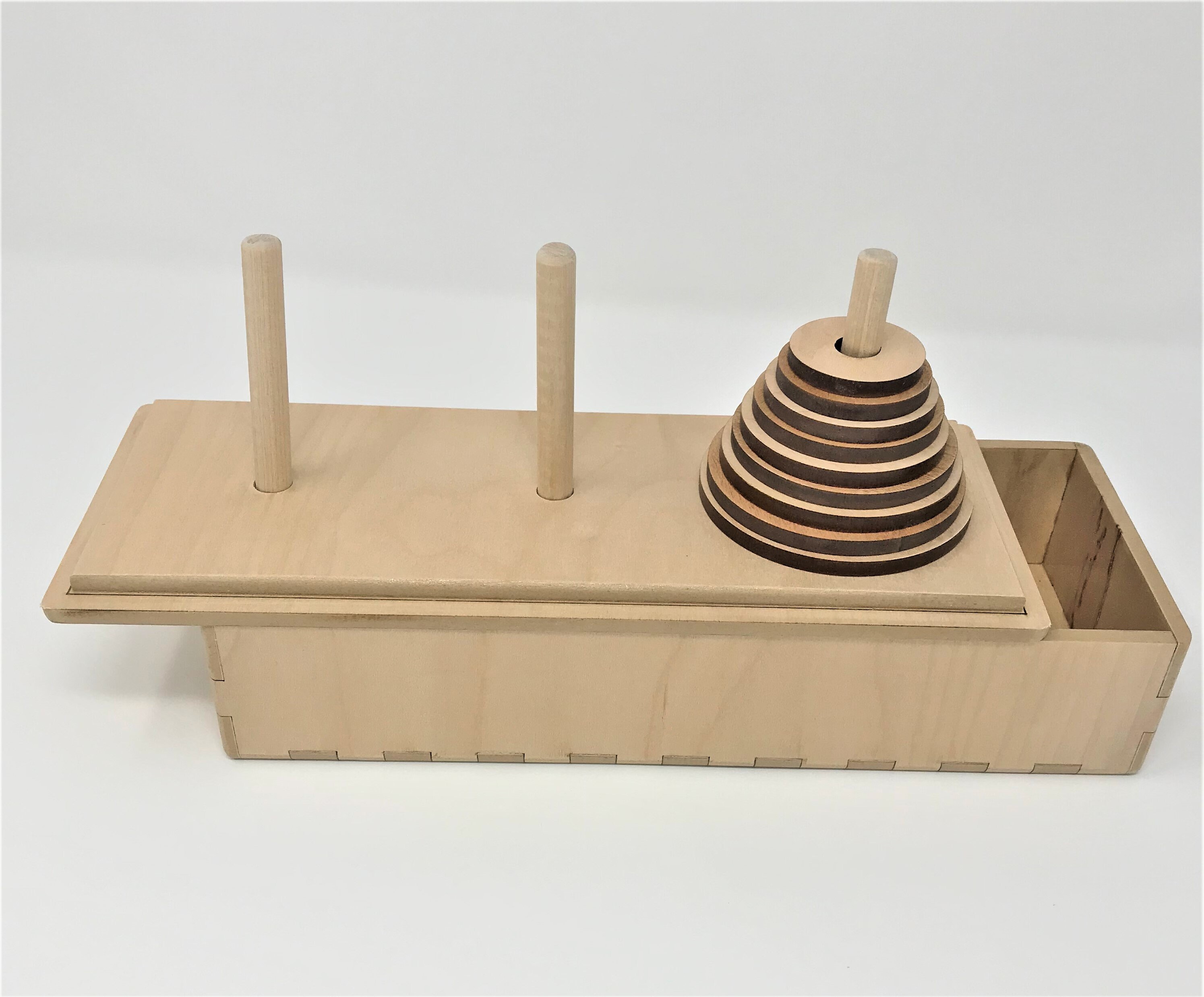
These @ivory badge
He was showing us about the stupid peg game
ivory badge
Tower of Hanoi
ivory badge
Why weren’t you following on why
dawn gulch
Because it looked complicated when he was talking
So I wasn’t sure where he was going
ivory badge
So you just stopped paying attention?
dawn gulch
So in my mind I was a bit confused
Well my brain
Goes off
It’s not that I don’t pay attention
Sometimes I am trying to get it
And I don’t ask for clarification
dawn gulch
Is it wrong not to
Or am I just being superstitious
Because I feel like im the elephant in the room
ivory badge
It’s wrong not to ask yes
dawn gulch
It sounds simple
But
I feel like I’m the only person that doesn’t understand things
 vale cairn
Wrong is perhaps the wrong word lol
dawn gulch
Even if it sounds stupid?
ivory badge
If you get your answer you’re less likely to have an issue
dawn gulch
Is it bad to be the only person that doesn’t get it
Like majority of the people in my class understands it but me
ivory badge
That’s speculation
I can tell you right now a good few people in every class don’t get it
Or almost every, at least
dawn gulch
What does that mean in layman terms
dawn gulch
Hm
 lofty patrol
Hi! Does anyone have resources that they found really helpful for better clarifying concepts in dicrete math? And just for extra practice (like youtube channels, websites, just direct links/pdfs lol, studying, etc.)

 spiral plinth
What is 5+4-3/7
 halcyon slate
got it
 lunar sentinel
Hi Could anyone help me to show that :
Show that an interval graph is the complementary graph of a comparability graph ?
 hoary halo
 weary tiger
Let n be an integer. Then n is not divisible by 3 if and only if n
2 −1 is divisible by 3.
 golden robin
$$\frac{(y+2)^2}{36} - \frac{(x-2)^2}{28} = 1$$
vital dewBOT
Synx


 unreal stump
 river garden
how can I prove that this language is CFL
river garden
how can I prove that this language is CFL
Try constructing a PDA
river garden
I can construt for i!=j
Similarly for 2j
But pda are not closed under intersection
 haughty garden
Try constructing a grammar that recognises the language. Consider the languages L_1 = {a^i b^j | i > 2j}, L_2 = {a^i b^j | i < j}, and L_3 = {a^i b^j | j < i < 2j}. Convince yourself that L = L_1 U L_2 U L_3. Grammars are closed under union; therefore, it is enough to find CFGs for each of these languages
weary tiger
is there a better/faster way of doing this problem?

 whole dust
eulers theorem
river garden
haughty garden
Try constructing a grammar that recognises the language. Consider the languages ...
Ty
 next sail
is the LHS logically equivalent to the RHS? where P and Q are predicate symbols, x is the predicate variable and D is the common domain.

also does the RHS count as a statement?
stray reef
yes they are logically equivalent
and i don't see why the rhs wouldn't count as a statement. it's a statement of set inclusion, after all.
next sail
stray reef
and i don't see why the rhs wouldn't count as a statement. it's a statement of s...
oh i see
thanks
 meager mural
hey can someone explain this to me? isn't both just proof by contradiction? it's just different forms of it right? for example, proof by contradiction on a statement P and proof by contradiction of a conditional statement
 vale cairn
Essentially the first is when you want to prove that P holds and you prove that assuming "not P" leads to a contradiction, which shows that not not P holds
In classical logic, that is the same as P
Whereas in the second, we want to prove that not P holds, so we show that P holding would lead to a contradiction
The difference is perhaps more clear if you consider actual examples
Say we want to show that x^2 + 1 =0 has no real solutions. Well we can suppose there is a solution and then we have 0 = x^2 +1 >= 1 > 0, absurd
meager mural
vale cairn
Say we want to show that x^2 + 1 =0 has no real solutions. Well we can suppose t...
This example is for the 1st one right?
vale cairn
Sorry yeah that's proof by negation
I was trying to think of a good example of a proof by contradiction lol
ivory badge
meager mural
hey can someone explain this to me? isn't both just proof by contradiction? it's...
Negation just uses something like: We want -P. We show P leads to contradiction, therefore -P
Contradiction is like this:
We want P. We show -P leads to contradiction, therefore -(-P), therefore P
The -(-P) -> P is the trick that makes it contradiction, and constructivist don’t really like it. A good few are fine, however, with -(-(-P)) -> -P
Basically it’s contradiction if you negate it twice
coral parcel
¬¬¬P -> ¬P is intuitionistically valid. Are there constructivists that reject it?
ivory badge
I am not aware of any which reject it, but I wouldn’t be surprised
 cyan plover
Hey guys, I'm trying to convert decimal numbers into two's complement binary numbers and adding them. I'm a little confused if I'm doing this right as I'm getting the decimal equivalent of 16 instead of 0 for 21-21.

 coral parcel
The addition at the bottom is wrong. You should get 0 with a carry out in the leftmost bit.
(Looks like you forgot to carry the one from the 8s place).
cyan plover
coral parcel
(Looks like you forgot to carry the one from the 8s place).
thank you... but 8s place? There's only 5 places right?
Oh wait do u mean the last 1
coral parcel
Counting from the right, we have the ones column, the twos column, the fours column, the eights column, and the sixteens column.
cyan plover
coral parcel
Counting from the right, we have the ones column, the twos column, the fours col...
thank you! I didn't know they were referred to that way. I'm getting 100000 now
coral parcel
But you're only working with a 5-bit word, so the carry out of the sixteens column is just thrown away.
cyan plover
coral parcel
But you're only working with a 5-bit word, so the carry out of the sixteens colu...
is that because of 'overflow'?
coral parcel
Well, yes and no. It would be overflow if you were adding unsigned 5-bit numbers, but if you're using 2's complement, detecting overflow is a bit more complex than that.
Wait, though, actually ...
cyan plover
Oh okay. I was wondering because idk how to choose the appropriate bit number to avoid overflow.
coral parcel
You can't represent 21 as a 5-bit 2's complement number -- that can only represent -16 up to 15. You need more bits if you want to speak about 21.
cyan plover
I just thought that because both the numbers were 5 bits, i didn't have to do anything?
cyan plover
coral parcel
You _can't_ represent 21 as a 5-bit 2's complement number -- that can only repre...
no I did it for -21
coral parcel
-21 is not in the representable range of a 5-bit signed number either.
cyan plover
Do i add more 1s behind the binary equivalent -21 then?
I'm just a bit stuck when it comes to calculations involving two's complement
coral parcel
Generally you don't let your word sizes vary with which numbers you're calculating with. (At least at the most basic level). You start by selecting your word size -- say, 8 bits would be good for a pen-and-paper example here, that lets you represent integers from -128 to 127 -- and then represent your input numbers with that many bits.
cyan plover
ok. So does that mean, I represent 21 and -21 as 8-bit numbers?
coral parcel
That's what I'm recommending, yes.
(6 bits would be enough for this particular task, but 8 bits is a much more usual width, so it makes the example feel a bit more realistic).
(Also, having more bits than strictly needed helps make it clearer how the system works).
cyan plover
coral parcel
(Also, having more bits than strictly needed helps make it clearer how the syste...
I'm now getting 1 0000 0000 as the answer to the addition
 coral parcel
That's more than the 8 bits you have room for!
cyan plover
🥹
coral parcel
Your adder only has an 8-bit output. The carry out of it disappears.
cyan plover
so disregard the 1?
cyan plover
coral parcel
Your adder only has an 8-bit output. The carry out of it disappears.
May i dm you about this question, please?
coral parcel
No.
cyan plover
just to clarify, do i disregard the 1 or not?
coral parcel
Well, yes, but it's better to think of it as "only the 8 rightmost bits even exist".
cyan plover
coral parcel
Well, yes, but it's better to think of it as "only the 8 rightmost bits even _ex...
ok thank you
 sacred fern
Hello
I was wondering how I might be able to find the “closed form” of the generating function for the sequence given by a_n = 2n
coral parcel
Start with the generating function for (1,1,1,...). Differentiate it to get (1,2,3,..), then multiply by x to make (0,1,2,...). Then hopefully you can see the final step to (0,2,4,6,..) yourself.
sacred fern
coral parcel
Start with the generating function for (1,1,1,...). Differentiate it to get (1,2...
That’s actually genius, thanks 😊
ivory badge
Just think for 5 seconds and follow what you do or don’t have access to
Also @noble parrot #❓how-to-get-help
 spiral aspen
The men-proposing variant of Algorithm 1 is man-optimal :
every man is matched to the best partner possible in any stable matching
can this be proved by showing the example below cant happen?
e.g: w prefers m', w' prefers m but m prefers w and m' prefers w'
in the end w gets matched with m' and w' gets matched with m
and that e.g cant happen because m will propose to his first preference first and so will m'
 prime dagger
I have a question. In how many ways can 8 people be seated on a round table if 4 people must sit next to each other?
The answer I am getting is 4! x 4! because we can group all the 4 people that must sit next to each other into one and then seat only 5 giving us 4! ways, then we can permute the 4 people within that group giving us 4! ways hence in total we are left with 4! x 4! ways
Is this how I should approach this problem
coral parcel
That sounds reasonable.
prime dagger
prime dagger
The answer I am getting is 4! x 4! because we can group all the 4 people that mu...
in this do we divide 5! by 5(like I did) or by 8?
coral parcel
How I would think of it is the 4 selected people sit on one side of the able and the other 4 on the other. We can choose where to place the dividing line between the two sides, but "round table" is usually code for "we don't count that difference", so there's no reason to count it just to divide it out afterwards. Just number the 8 chairs starting with "the rightmost of the 4 selected people, no matter where that is".
prime dagger
I see, so the approach I took should work?
coral parcel
I agree about the 4!4!.
 dense copper
if I have a semi-eulerian graph, do I have to start at an odd vertex to traverse it?
i seem to be getting that a lot
but is there a proof for this? is it even true? or am I assuming things?
 wet quartz
Hey, so i had this in help forum but i think it fits here a bit better.
I recently have been screwing around on desmos after having my interest piqued by a youtube video of all things, and have found an odd pattern to something.
Ive mocked up a mini setup describing in mathematical terms what ive seen

Im just wondering how the hell this has happened, and also what solutions or questions could i ask from this
because, what appears is regions between two square numbers contain twice a triangular number, based on the combination of both tau functions
actually, now thinking about if there are any similar representations which combine both sets of square numbers and triangular numbers to form this sort of representation.
 obtuse lance
wet quartz
Im just wondering how the hell this has happened, and also what solutions or que...
obtuse lance
wet quartz
Im just wondering how the hell this has happened, and also what solutions or que...
I don't really follow what you're asking for
wet quartz
obtuse lance
I don't really follow what you're asking for
i dont even know what im really asking
im feeling very confused on which topic to put this under and also how to structure my specific problem with it
because im not particularly sure if ive done something wrong or just stumbled across something quirky
obtuse lance
Idon't know what I'm looking at here, are you saying there's a triangular number between every pair of consecutive squares or somethin
wet quartz
yeah, i believe thats what the graph shows
well, what the graph shows is that for every square number, the value at which the root approximation functions have an equal inaccuracy is double a triangular number
math has my brain tired.
obtuse lance
can you back up and explain what you mean by root approximatino functions
wet quartz
so ill explain how i got to the graph, I saw on youtube a technique to "approximate" square roots of x, By finding the nearest integer square number and then some additional math which is in total defined by the function mu.
These approximation functions obviously dont work fully, so i created the tau function to represent how far off they are from the actual square root of x
But when given an x value that is twice the value of a triangular number, both mu functions are effectively off by the exact same amount and give the weird effects of this graph.
this also appears to give the user the ability to prove if a number is a triangular number or not based on what ive seen
i will be honest, im new to the entire area of asking about things in maths and my mental thing is where im not good at explaining at all about any problem i have
obtuse lance
wet quartz
because, what appears is regions between two square numbers contain twice a tria...
well I guess this on its own isn't too bad to prove, since twice a triangular number will be of the form n^2+n it will be between n^2 and (n+1)^2
not sure if this is part of what you're interested in or not, or you already knew that
wet quartz
ive sorta just been dipping into various possible things to do with this, but not investigating any singular one because well. I dont know if i fully comprehend the mechanics behind why what ive come up with shows this pattern
which is why idk where to really put this. When i put it into a general area like the problems thing i got someone completely derailing because it was way out of their league.
obtuse lance
to me it seems like you're just having fun playing around, which is fine but I don't see anything in particular to really latch on to
wet quartz
yeah im not sure if there really is anything to latch on to, other than maybe making a proof for any given number being triangular by using the math ive provided
obtuse lance
obtuse lance
not sure if this is part of what you're interested in or not, or you already kne...
you didn't really answer me on this
wet quartz
sorry, it didnt click in my brain
obtuse lance
do you know how to prove twice a triangular number is between two perfect squares
obtuse lance
why lol
wet quartz
i have massive misinterpretation issues, Not hiding behind them or anything but im on the brink of crying rn because my brain just feels blockaded by it.
wet quartz
wet quartz
i will be honest, im new to the entire area of asking about things in maths and ...
which is the reason for this
im literally at war with someone in my class rn because it makes me feel shit because i always feel behind them
but anyway, Yeah im not gonna say i feel completely out of my depth with this, but i will admit i didnt know there was a proof that the twice a triangular numbers lies between two perfect squares
obtuse lance
try to prove it I'll help you if you run into problems
I should have been more precise too: between two consecutive perfect squares
wet quartz
yeah, i used excel to reason that
wait let me quickly pull up what i found on excel
A is integer input, C is lesser of perfect square thats closest to value, D is upper instead. I is the floor version of the approximated square root squared again and J is the same but ceiling.
 obtuse lance
wet quartz
wait let me quickly pull up what i found on excel
obtuse lance
wet quartz
wait let me quickly pull up what i found on excel
sure no rush, I'll probably be hanging around in different browser tabs all evening
wet quartz
lmao, im in the GMT00 timezone so im pretty much just chilling in midnight
ignore 2.439E18, thats a massive triangular number that excel ran into a memory limit
obtuse lance
well the thing I have in mind for proving this doesn't really involve a bunch of data, we can prove it symbolically with algebra
wet quartz
yeah, i made the excel table to skip having to scroll around in desmos or get my writing pad out
obtuse lance
but collecting data is good for making conjectures
wet quartz
yeah
obtuse lance
one trick to try when you have something is try to reformulate all the words into symbols, and see if laying it out that way helps
wet quartz
spent way too long on word equation editor to do that
obtuse lance
specifically: "twice a triangular number is between two consecutive perfect squares"
just do it one step at a time, what's the form of a triangular number
wet quartz
i would probably use sets to define a triangular number based on its index
so the first few are 1, 3, 6, 15, 21, 28, 45
i imagine theres a function of some kind to convert a given index to a triangular number.
But a triangular number can be manually calculated by using the index as a side length of a triangle made up of dots, completing each side length and then filling that triangle. Then counting the total number of dots
In the end you get a quasi formula where the set indexed by n + 1 involves the value of the set indexed n and a constant based on n+1
Basically like the Fibonacci sequence
im horrible at explaining things
obtuse lance
it's ok
wet quartz
im visualising it but the words mannn
obtuse lance
I was looking for something like, you can represent perfect squares by n^2
what can you represent triangular numbers as
in terms of some algebra like that
wet quartz
well if the perfect square is n*n
that sounds like area to me
but my dumbass would say n^2 / 2
obtuse lance
there's a kind of nice trick if you've never seen it before by Gauss for how to find the form of triangular numbers
close, good guess
wet quartz
hm
obtuse lance
if you start plugging in integers to that you get .5, 2, 4.5, 8, ... which aren't too far off from the triangular numbers
you can think of the triangular numbers as building up layers like you were saying
1, 1+2, 1+2+3, 1+2+3+4, ...
and then we can simplify this further, a general term will look something like 1 + 2 + 3 + ... + (n-2) + (n-1) + n
does that make sense what I'm saying so far?
wet quartz
yeah
something sorta like this i had in mind

where U index 0 is 0, U index 1 is 1 and then it works providing n is greater than zero
obtuse lance
ok cool
wet quartz
wait im dumb, forget the n-1 part. I forgot how sets work
obtuse lance
it doesn't matter cause you didn't specify the base case, so it's not too serious where you index them by
the main trick to simplifying this is the Gauss trick I mentioned earlier
which involves writing it backwards and summing it up
let me just shwo what I mean here
1 + 2 + 3 + ... + (n-2) + (n-1) + n
n + (n-1) + (n-2) + ... + 3 + 2 + 1
pretend they line up one over the other
if you add up the pairs that way you get
(n+1) + (n+1) + (n+1) + .. + (n+1) + (n+1) + (n+1)
there are n of these, so
we have n(n+1)
and since we added it to itself we double counted so we can divide by 2
1 + 2 + 3 + ... + (n-2) + (n-1) + n = n(n+1)/2
obtuse lance
obtuse lance
just do it one step at a time, what's the form of a triangular number
cool, so now we know triangular numbers are of the form n(n+1)/2 and that sort of answers my original query here, so we can continue
obtuse lance
obtuse lance
specifically: "twice a triangular number is between two consecutive perfect squa...
we're wanting to reformulate the words here into symbols
we have a triangular number is n(n+1)/2, how would you represent twice a triangular number now
obtuse lance
yeah perfect
ok now if it's between two consecutive perfect squares, let's just try to make a guess at what those would be
is n^2 bigger or smaller than n(n+1)?
wet quartz
smaller
n(n+1) is equal to n^2 + n
so n^2 < n^2 + n < (n+1)(n+2)
or have i just gotten that wrong
obtuse lance
the last part looks suspicious, what's (n+1)(n+2)
wet quartz
sub in n+1 to n for n(n+1) gives (n+1)(n+1+1)
given a perfect square is where its root is an integer
obtuse lance
wet quartz
sub in n+1 to n for n(n+1) gives (n+1)(n+1+1)
this is a true statement but I don't see why you're doing it
wet quartz
because n^2 < n^2 + n < n^2 + 2n + 1
obtuse lance
we want to show n^2+n is between two consecutive squares
the first square is n^2, what's the next square after this?
obtuse lance
yeah
wet quartz
idk where my brain went wrong doing that
obtuse lance
I think you just subbed into the wrong expression that's all
obtuse lance
wait, what's (n+1)^2
wet quartz
im so tired rn
But ok i think i fixed it
i dont even know how im doing A Level further maths rn
obtuse lance
mistakes happen, plus you're tired, you can go easy on yourself lol
what helped me cut down on making mistakes was to just work problems very thoroughly and slowly making sure I made no error at any step of the way, and over time I got faster at doing that
my rationale at the time was, I would be reworking the same problem like 2 or 3 times and spending a lot longer over all
maybe that helps you, but anyways yeah that's it we're done
wet quartz
i forcibly use lambda and mu for implicit differentiation because v and u look too similar to me. Plus using those funny greek letters makes something in my brain go brr
Oh yeah i love doing the same thing multiple times
maths being unpredictable/new leads to my brain melting
obtuse lance
lol I don't love reworking something cause some minor mistake I made at the start forced all my work to be wrong
wet quartz
shhh, error carried forward only cuts off one mark in year 1
obtuse lance
wet quartz
so that means n^2 < n^2 + n < n^2 + 2n + 1
now something else interesting about this I think might be related to your problem too
notice that we can write it in a suggestive way as:
(n^2 + n) - n < n^2 + n < (n^2 + n) + n+1
twice a triangular number is basically as close to the middle between the consecutive squares as you can get
since n below and n+1 above are the squares
wet quartz
makes sense
yeah, i saw that in excel. When twice a triangular number is given, the approximation functions are the exact same
Which on the graph is between the consecutive squares
unreal stump
So does anyone here know about DES?(the block cipher)
obtuse lance
wet quartz
yeah, i saw that in excel. When twice a triangular number is given, the approxim...
cool, hopefully this kind of approach to data you collect and turning it into algebra in the future will help you solve your problems
I know that DES is insecure and outdated
wet quartz
i havent had to use anything other than MD5 and some Huffmann stuff
obtuse lance
so is triple DES (3DES)
unreal stump
Ok,do all DES implementations follow the same table for things like this
 coral parcel
The S-boxes have to be the same, otherwise it is not DES.
unreal stump
So the key and the mode of operation are the only things that are allowed to be different?(for standard DES)
coral parcel
"Allowed" is a curious word here. If you change any of the internal working you may or may not still have a cipher that is as secure as DES (which, as Merosity mentions, is not very), but it will not be the cipher that is called DES.
wet quartz
well im gonna go to sleep. Thanks Merosity for ur help.
unreal stump
Well like I am trying to do a linear cryptanalysis attack DES and I am trying to see what will be the things that will be varying
coral parcel
Oh. A cryptanalysis of DES with a modified S-box might still be an interesting learning experience. (Though if you change them to something more linear, most would probably consider that to be cheating).
obtuse lance
wet quartz
well im gonna go to sleep. Thanks Merosity for ur help.
you're welcome, goodnight
unreal stump
I think morally all such "DES"s will still be vulnerable to linear cryptanalysis
coral parcel
In any case, the only thing that's intended to vary is the key.
cyan plover
I'm trying to simplify a boolean expression into SOP form using K-map... could I simplify my expression more? How do you know if it's fully simplified?
 unreal stump
You can simplify it further
@cyan plover
Consider you can actually get a octets with 3 and 4
You have to do a wraparound for that
Well if you have 4 octets you can't really get a better simplification than that
In other cases, try to check if you can reduce your quads to octets, or pairs to quads,etc
unreal stump
unreal stump
Well if you have 4 octets you can't really get a better simplification than that
Well you can,but it's the case where everything is 1
coral parcel
There needs to be 4 terms, but the terms themselves can be simpler; does that count?
unreal stump
Well that's based on intuition. You can't consistently realise if a term can be simpler or not
Like here it's recognisable because a+a'b=a+b is a common identity
cyan plover
unreal stump
Well if you have 4 octets you can't really get a better simplification than that
Thank you. I've tried again with a different grouping...
 unreal stump
Yeah that is correct
cyan plover
 thank you
coral parcel
That's a also what you get if you just naively De Morgan not(ABCD).
cyan plover
what about this... I think it's in POS form? Not too sure how to use a k'map for this
 cyan plover
unreal stump
You group all the 0s
cyan plover
unreal stump
You group all the 0s
but do I make whatever is say, ~A = 0 and A = 1 in the squares?
cyan plover
unreal stump
https://dyclassroom.com/boolean-algebra/product-of-sums-reduction-using-karnaugh...
thank you. POS confuses me:/
unreal stump
Yeah it's weird
I don't know who cares about POS tbh
Well actually ig POS can give you simpler circuits than SOP in some cases
 lavish peak
i need help proving this inequality by induction
$\left(\frac{x+y}{2}\right)^n\le \frac{x^n+y^n}{2}$
vital dewBOT
silveh

 unreal stump
Well proving
$x y^k+x^k y \leq x^{k+1} + y^{k+1}$ is what you need prob
vital dewBOT
DraK

 coral parcel
unreal stump
Well proving
$x y^k+x^k y \leq x^{k+1} + y^{k+1}$ is what you need prob
coral parcel
unreal stump
Well proving
$x y^k+x^k y \leq x^{k+1} + y^{k+1}$ is what you need prob
That's not generally true, say, if x and y are between 0 and 1. Whoops misread it.
unreal stump
lavish peak
im stuck here
Look at the second last inequality
Now use C<=A+B and B<=D implies C<=A+D
coral parcel
Somewhere you'll need to use an assumption that x and y are both nonnegative -- since the final goal is not true if one or both can be negative and k is odd.
unreal stump
lavish peak
That's given here
cyan plover
cyan plover
what about this... I think it's in POS form? Not too sure how to use a k'map for...
what happens to the last term on the right side @unreal stump it looks like it isn't in POS form
unreal stump
Well the original thing was an intuition. That's why I asked for the exact constraints
coral parcel
Yeah, just saying that knowing you need to use that assumption can inform which kinds of steps to look for.
unreal stump
cyan plover
what happens to the last term on the right side <@734020733595942952> it looks ...
Well it's 3 terms actually
lavish peak
unreal stump
Now use C<=A+B and B<=D implies C<=A+D
hmm ill try but i doubt ill reach the final answer
cyan plover
unreal stump
Well it's 3 terms actually
yeah sorry three terms. This is what i have so far
 unreal stump
Ok you need to convert it into the canonical form
cyan plover
you mean the boolean equation on top?
lavish peak
okay i still dont know what to do
lavish peak
vital dew
**DraK**
does proving this prove that
unreal stump
Yeah
 unreal stump
Well right most term should be
$\frac{x^{k+1}+y^{k+1}}{2} + \frac{x^{k+1}+y^{k+1}}{2}$
vital dewBOT
DraK
 lavish peak
so just ${x^{k+1}+y^{k+1}}$
vital dewBOT
silveh
 lavish peak
ughh im kinda lost in the steps now
 lyric panther
Do you know about convex functions ?
lyric panther
Absolutely
coral parcel
If the problem had not explicitly wanted an induction proof, I'd definitely go via convexity here.
lavish peak
yeah i guess but this is practice for induction proving
lavish peak
lavish peak
im stuck here
okay so idk where to go from here
lyric panther
What is the step that you dont understand
lyric panther
lavish peak
This ?
lavish peak
lavish peak
i cant just say A<=B and B<=C so A <=C because B=>C
basically what i mean here is
lavish peak
lavish peak
^
lavish peak
lyric panther
This ?
yes
coral parcel
lavish peak
Isn't that missing the initial factor of 1/2?
lavish peak
I have multiplied the whole equation by 1/2
if u look at the left most term, it is divided by 2^k not 2^k+1 anymore
coral parcel
Oh. But then the LHS has been changed from what we were supposed to show something about.
lavish peak
yeahhhhhhhhhh...
i was kinda desperate to find anyway to solve this
as i said ikd what to do
lyric panther
X,y are positive ?
lavish peak
yes
lavish peak
lavish peak
^
coral parcel
We can definitely not just discard the cross terms, because if x=y they're necessary for getting even equality.
coral parcel
What about Drak's suggestion from :46?
lavish peak
yeah i looked into it and i either dont know how to prove it or i just simply dont know how it will benefit me
coral parcel
I'm not independently sure it can be done, but if it could be done, it would immediately solve your problem.
lavish peak
and how so?
because i still havent proved that the middle equation is smaller than the right most equation
coral parcel
You'd use it on the last term here.
 lyric panther
If you show what dirak proposed then youre done
lavish peak
vital dew
**DraK**
okay so given that this is true
how does that prove the main inequality?
its still a term that is added to the RHS
coral parcel
Apply. It. To. The. Last. Term. Of. What. I. Quoted.
lavish peak
ok
lyric panther
^^^^
unreal stump
coral parcel
I'm not independently sure it can be done, but if it _could_ be done, it would i...
Well that reduces to showing that (x^k-y^k)(x-y) is non negative which is true since (x^k-y^k)=(x-y) * (non negative term)
coral parcel
You'd get $$ \begin{array}{c} \left(\frac{x+y}{2}\right)^{k+1}
\le \frac12\left(\frac{x^{k+1}+y^{k+1}}{2} + \frac{x^ky + y^kx}{2}\right) \
\le \frac12\left(\frac{x^{k+1}+y^{k+1}}{2} + \frac{x^{k+1}+y^{k+1}}{2} \right)\end{array}$$
(sigh).
lavish peak
lmao
vital dewBOT
Troposphere
 coral parcel
What do you mean?
cyan plover
I'm stuck with this problem...I've tried converting it into canonical form but idk wat to do for the last 3 terms
 lyric panther
lavish peak
u replaced it like it is equivalent
lyric panther
lavish peak
u replaced it like it is equivalent
If you have A+B then if B<=C then A+B<=A+C
coral parcel
Or, in this case, ½(C/2 + A/2) <= ½(C/2 + B/2).
lavish peak
ohhhhhhh
okay that makes a lot of sense
okay it just clicked
alright thank you so much
appreciate the help
lyric panther
Maybe you can show the ineq of drak now ?
lavish peak
ill implement it but i dont think ill go with proving it as a lemma
ill just
state it
lyric panther
Its not hard
lavish peak
ill try doing it now
unreal stump
cyan plover
I'm stuck with this problem...I've tried converting it into canonical form but i...
The canonical form is really stupid for this
$\bar{A} = (\bar{A} + B + C + D)(\bar{A}+B+C+\bar{D})(\bar{A} + B + \bar{C} + D)...$
vital dewBOT
DraK
 unreal stump
Basically fix \bar{A} and take all combinations of B,C and D
You should get 8 terms
If you do not want to do this, note all the entries that will give you zero when applied to the expression.
For example A=1 ,B=0,C=0,D=0 will make \bar{A} zero. So mark a 0 in that box
Same for A=1, B=1 ,C=0 and D=1
cyan plover
unreal stump
Basically fix \bar{A} and take all combinations of B,C and D
why is ~A = to the canonical form?
lyric panther
@lavish peak if there is any issue ask
unreal stump
cyan plover
why is ~A = to the canonical form?
Well if you find canonical form for each term, you will just multiply all of them together to get the canonical term for exp
lavish peak
okay thank you
cyan plover
unreal stump
Well if you find canonical form for each term, you will just multiply all of the...
I understand that but why is the expression equal to ~A?
cyan plover
unreal stump
Well you have \bar{A} , \bar{B} and \bar{D} at the end
yes
unreal stump
So you have to find can(A), can(B) and can(D)
cyan plover
ohh okay
unreal stump
*can(\bar{A}),can(\bar{B}),can(\bar{D})
cyan plover
unreal stump
*can(\bar{A}),can(\bar{B}),can(\bar{D})
i'm still a little confused, how do you find can(A)
lavish peak
here is my attempt at proving the inequality 🧍♂️

this obviously requires y to be smaller than x
which is not what i want
lyric panther
When you have an inequality the first thing you should do is get everything on one side
lavish peak
im guessing i made a mistake
unreal stump
cyan plover
i'm still a little confused, how do you find can(A)
So you just find the values of A,B,C,D that make the expression 0
And then find the corresponding maxterm
And multiply all these maxterms
lavish peak
lyric panther
When you have an inequality the first thing you should do is get everything on o...
okay ill attempt that
lyric panther
Scrath that
unreal stump
So here
(1,0,0,0),
(1,0,0,1),
(1,0,1,0),
(1,0,1,1),
(1,1,0,0),
(1,1,0,1),
(1,1,1,0),
(1,1,1,1)
are the values of (A,B,C,D) that make the expression \bar{A} 0
So max term corresponding to (1,0,0,0) is (\bar{A}+B+C+D)
lavish peak
i can only factor by x+y if i do that
lyric panther
lavish peak
i can only factor by x+y if i do that
In fact your are done
Sorry that is my mistake
lavish peak
its okay dont worry
lyric panther
lavish peak
.
lavish peak
lavish peak
so i was done at this step?
lavish peak
but the inequality i found
the last one
is not always true if x and y are any positive real numbers
lyric panther
In fact it is
lyric panther
lyric panther
And x<y
Split cases
lyric panther
?
lavish peak
oops
lyric panther
You have minus
 lyric panther
Read my message
lavish peak
arent these 2 equivalent?
lyric panther
ahah
lavish peak
split cases?
unreal stump
Alternatively rewrite that as 0 <= (x^k-y^k)(x-y)
and factor out (x-y) from (x^k-y^k)
lavish peak
lavish peak
but really quickly can you explain why this cant be done?
cyan plover
unreal stump
So you just find the values of A,B,C,D that make the expression 0
sorry... how do you know if the expression is 0
lavish peak
lavish peak
but really quickly can you explain why this cant be done?
i feel like its a stupid mistake
thank you for everyone that helped heres my final answer

heres the question

appreciate it
unreal stump
cyan plover
sorry... how do you know if the expression is 0
You substitute the values in expression
Do you agree A=1, B=0,C=0,D=0 makes \bar{A} 0?
cyan plover
unreal stump
Do you agree A=1, B=0,C=0,D=0 makes \bar{A} 0?
I'm still a little confused with bar A tbh
but would this k'map be in the right direction?

I'm getting Y = (~A+~D)(~C+~B)
 swift gyro
Hey does anyone have any practice problems/ worksheets (with sol) for discrete Math topics - number theory , modulo congruence, propositional logic , predicate logic and induction.
 sour scarab
swift gyro
Hey does anyone have any practice problems/ worksheets (with sol) for discrete M...
sour scarab
swift gyro
Hey does anyone have any practice problems/ worksheets (with sol) for discrete M...
I'd recommend getting a textbook you enjoy to both study and work out the exercises in
 agile magnet
what textbook does your class use?
just work out of that
unless there is no text then people here probably have recommendations
swift gyro
agile magnet
what textbook does your class use?
They don’t use any . Just give notes and one worksheet which is not enough imo
swift gyro
sour scarab
I'd recommend getting a textbook you enjoy to both study and work out the exerci...
Which textbook do u recommend?
sour scarab
swift gyro
Which textbook do u recommend?
discrete math can vary in the material covered, so check your syllabus if it has a recommended textbook at the very least first. Otherwise, google is your friend.
This thread on math stack exchange has a lot of computer science focus but should be a decent resource for a variety of different books. again, google is your friend.
https://math.stackexchange.com/questions/1533/what-is-the-best-book-for-studying-discrete-mathematics

Mathematics Stack Exchange
As a programmer, mathematics is important basic knowledge to study some topics, especially Algorithms. Many websites, and my fellows suggest me to study Discrete Mathematics before going to Algorit...
swift gyro
sour scarab
discrete math can vary in the material covered, so check your syllabus if it has...
Got it . Thank you so much
spiral aspen
can someone explain how this works? i dont get the combinations


i can do it manually but not the formula way
so say length = 3 {001} {111}
this means i can have 1 (ways of arranging 111) + 3 (ways of arranging 001 is 3!/2!)
but then for length 5 we have {00000} {11111} {00001}
so 1+1+5!/(2!*2!) (ways of arranging {00001},
this is wrong though. wats the correct way of doing arrangement for 00001?
lofty patrol
Hey! I'm a bit confused on cardinality of sets relating to countability. Why would choice A be countably infinite? And same question for B: but what even is left after we subtract the rationals from the cartesian product? I'm confused on how to approach this.
 sour scarab
firstly A is countably infinite as you can list all of them in an infinite amount of time. More precisely, Q is countably infinite, so it must be that Q - N is countably infinite.
secondly, (Q x Q) - Q is just (Q x Q) as the two sets are disjoint. One is a set of tuples, and the other is a set of rational numbers.
is there something else I can help you with?
E should be uncountably infinite as it's a power set of real numbers
sour scarab
lofty patrol
Hey! I'm a bit confused on cardinality of sets relating to countability. Why wou...
does this help?
 cyan pecan

 hexed shore
How do I prove a solution of a recurrence relation?
lofty patrol
sour scarab
does this help?
Thank you! So for (Q x Q) - Q, we are subtracting out what is found in both (Q x Q) and Q? So, since there isn't any just rational numbers in the cartesian product, is that why we're left with the same thing?
lofty patrol
sour scarab
is there something else I can help you with?
And to confirm, for choice D: is it countably infinite because it's kinda just like the cardinality of positive integers? I got confused because i know that real number sets are uncountable. but here, we're just saying that the numbers in the set happen to be real. is that why/the difference?
sour scarab
lofty patrol
Thank you! So for (Q x Q) - Q, we are subtracting out what is found in both (Q x...
precisely. "-" isn't subtraction as much as it is a difference between the sets, i.e. "A - B" is whatever is in set A but not set B. in this case we're comparing a set of tuples to a set of rational numbers, which are two different objects.
sour scarab
lofty patrol
And to confirm, for choice D: is it countably infinite because it's kinda just l...
and yes it's because the cardinality is the same as the integers. I'm not sure if you've gone over functions yet, but any set that has a bijection between itself and the natural numbers (and by extension the positive integers and integers in general and also rational numbers) is countably infinite. the set in part D is very nearly defining that function but as a set
 coral parcel
The point of that example is tat you don't necessarily have x1=x2.
sour scarab
 iron sorrel
for x1 and x2
iron sorrel
for x1 and x2
it's to prove by definition that f is not one-to-one. f(x1) = f(x2) when it's not always the case that x1 = x2 means f is not one-to-one
f would be one-to-one iff f(x1) = f(x2) => x1 = x2
iron sorrel
sour scarab
it's to prove by definition that f is not one-to-one. f(x1) = f(x2) when it's no...
yea and we get x1andx2 = 1
so its not 1-1
i see
sour scarab
exactly
iron sorrel
sour scarab
exactly

would u know how we solve this
i dont get how to solve when they give us question like this
sour scarab
so this is a question for cardinality. have you guys gone over that yet?
iron sorrel
sour scarab
so this is a question for cardinality. have you guys gone over that yet?
cardinality?
sour scarab
like, how big a set is.
iron sorrel
could u give an example of what u mean
sour scarab
the cardinality of $ { a, b, c } $ is 3
whereas the cardinality of Z+ is countably infinite
iron sorrel
yea
sour scarab
ok cool and do you know what a power set is?
I'm essentially just trying to see if you know Cantor's theorem.
iron sorrel
sour scarab
ok cool and do you know what a power set is?
example?
sour scarab
a power set of set A is defined to be the set of all subsets of A
sour scarab
ok D isn't exactly a power set, but it might as well be one.
Cantor's theorem states that the power set of any set A is strictly larger than the set A itself
iron sorrel
sour scarab
Cantor's theorem states that the power set of any set A is strictly larger than ...
have not learnt this
sour scarab
I'll go and get a proof really quick but it's pretty simple
actually, let's work this out right here I think that's the point of the problem.
iron sorrel
i dont think we are supposed to do this if we havent leart that
sour scarab
yeah
so a function is one-to-one if we map every element of its domain at most once to some element in its codomain, right?
and likewise a function is onto if for every element in the codomain, we map something in the domain to that element.
in a way we're saying that a function is one-to-one iff $n(A) \leq n(B)$ where A is the domain, B is the codomain, and n(A) is just the number of elements in A.
vital dewBOT
Borger
 sour scarab
This is because we have to have every element in A mapped to B at MOST once. Some elements in B may not be mapped to, so there are cases where n(A) <= n(B).
iron sorrel
oh and for onto all n(A) = n(B)
sour scarab
Conversely, a function is onto iff $n(A) \geq n(B)$. Think of this as going in the opposite direction. Every element in B must be mapped to, but some elements in A can be mapped to more than one thing.
vital dewBOT
Borger
 sour scarab
but you're on the right track! n(A) = n(B) when?
if we have onto implying $n(A) \geq n(B)$, and one-to-one is $n(A) \leq n(B)$, what can we say about the function when $n(A) = n(B)$?
vital dewBOT
Borger
 iron sorrel
if onto implies all A go to b once
and 1-1 implies all B go to a once
n(a) = n(b) if all domain and codmain go to each other only
once
sour scarab
exactly. that's called a bijective relation, or a one-to-one correspondence
iron sorrel
yea i have learnt that
sour scarab
anyways that's off track from the question but I personally think it's important for this kind of math
iron sorrel
correspondense if onto and 1-1
sour scarab
yep yep
so right now we have that:
n(A) >= n(B) iff T is onto
n(A) <= n(B) iff T is one-to-one
and the power set is strictly larger than the original set
since D is, for all intents and purposes right now a power set, what can we say about T: Z+ -> D?
iron sorrel
sour scarab
since D is, for all intents and purposes right now a power set, what can we say ...
d is a subset of Z?
no
sour scarab
no D is a collection of subsets of Z+.
iron sorrel
idk then
sour scarab
remember the power set is strictly larger than the original set. If D were a tiny bit bigger and WAS the actual power set of Z+, what would D's cardinality be relative to Z+?
just for reference
iron sorrel
sour scarab
https://proofwiki.org/wiki/Cantor%27s_Theorem

wb this question

how is 2n not onto
sour scarab
iron sorrel
this is an exercise for just proving two different things, remember the definition for something being one-to-one and onto. See if you can prove it or find some counterexample that doesn't work.
haughty garden
Can you obtain odd integers?
iron sorrel
how is it not onto
haughty garden
If it’s onto, it should, for example, map an integer to 1
Is this actually possible though?
sour scarab
I actually thought this would be onto since there's a bijection between integers and even numbers...?
huh. I should review that
haughty garden
There is, this is not the bijection
The bijection would require the codomain to be 2Z
sour scarab
ah.
haughty garden
This function maps integers to integers, but it only hits even integers
sour scarab
that makes sense my bad
 sour scarab
there's an element in the codomain that isn't mapped to, e.g. 1
sour scarab
iron sorrel
because it only goes for even integers?
yes
iron sorrel
sour scarab
there's an element in the codomain that isn't mapped to, e.g. 1
so like 1,3,5.7
sour scarab
precisely
any odd number is not mapped to
like opengangs said, if the codomain were the set of even numbers instead, it would be onto
iron sorrel
sour scarab
like opengangs said, if the codomain were the set of even numbers instead, it wo...

ok im so confused
how are u supposed to tell if it is onto or one to one
like the examples my teacher is this
 sour scarab
that's admittedly hard to read. Trev tutor has some good videos on functions I'll send them here
iron sorrel
4n-5=y
sour scarab
Online courses with practice exercises, text lectures, solutions, and exam practice: http://TrevTutor.com
Looking for paid tutoring or online courses with practice exercises, text lectures, solutions, and exam practice? http://TrevTutor.com has you covered!
We introduce the concept of injective functions, surjective functions, bijective functio...
iron sorrel
sour scarab
https://youtu.be/bZred_Ksz2k
im using textboox
sour scarab
yeah but these are just some videos to follow along with if you want

 ebon berry
 chrome osprey