#point-set-topology
1 messages · Page 293 of 1
 grave fossil
 gritty widget
Why weird?
I mean topological embedding btw
Can we use something like $\exp(iA)$ where $A$ is diagonal for this?
 gentle ospreyBOT
Blitz
 gritty widget
Well maybe not this but I think exponential map might be useful somehow
gritty widget
Because we can embedd R into S^1 = SO(2) using exponential function
 vast estuary
Yep, works, thank you
gritty widget
I think I want to embedd R^n into U(n) instead
That's easy though
We can embedd R^n into (S^1)^n into U(n)
I feel kinda stupid now
 fathom shale
Doing more reading this morning in Ozsvath and Szabo. Wish me luck!
gritty widget
No idea what that is but good luck
 shy moss
gritty widget
Because we can embedd R into S^1 = SO(2) using exponential function
shy moss
gritty widget
Because we can embedd R into S^1 = SO(2) using exponential function
you mean the function $f(x)=e^{ix}$? this is not injective
gentle ospreyBOT
Or x1
 gritty widget
shy moss
you mean the function $f(x)=e^{ix}$? this is not injective
gritty widget
shy moss
you mean the function $f(x)=e^{ix}$? this is not injective
Generalization of it
Besides, I don't need it to be injective on all of R
If we were able to embedd R^n into SO(n+1) then that'd be pretty strong I think, but U(n) is alright too
I'm basically embedding R^n into (S^1)^n
gritty widget
I know, like I said, that's not the point
gritty widget
R and (0, 1) is the same thing
I can use that word
I never said I'm using exponential as an embedding
 marsh forge
gritty widget
I never said I'm using exponential as an embedding
marsh forge
gritty widget
I never said I'm using exponential as an embedding
Using
gritty widget
gritty widget
**using**
This is a crucial detail you missed
marsh forge
Using
marsh forge
I genuinely did not know what you mean
gritty widget
Oh
marsh forge
When we think of exponential as a map R to S^1 I usually think of the universal covering space
Which is certainly not objective
Injective*
gritty widget
I meant that I'm mapping R to (0, 2pi) homeomorphically and then use exponential to map it to S^1
marsh forge
Ah, sure
gritty widget
gritty widget
If we all know what is meant then this discussion is pointless
Yeah, sorry, I thought you were just being picky
Idk if picky is a good word
Bothered with details
marsh forge
No I think both me and or x1 had the covering map in mind
Exponential is the way most topology books define it
gritty widget
Anyway, in the same way I can embedd R^n into (S^1)^n which then embeds into U(n)
 honest narwhal
Why are you using the word "embed" for R^n to (S^1)^n? Do you mean cover?
 coral pivot
he is including R into S^1
honest narwhal
Why don't you include yourself into my foot?
coral pivot
thinking of S^1 as basically one point compactification
thats not how it works dami
infact thats the opposite
honest narwhal
But that wouldn't really be an embedding I don't think
If we're assuming you're not trolling me here
Or wait
No nvm that's not a problem
gritty widget
But I didn't say any maps
gritty widget
Yes, top spaces
gritty widget
I was thinking what kind of spaces have compactifications which are topological groups
So I was trying to see if I can come up with one for R^n
coral pivot
just any compactification?
gritty widget
coral pivot
just any compactification?
Yes, any compactification which admits a group structure
coral pivot
well a compactification requires like, R^n to be dense in it dami
honest narwhal
I see, I've never seen the term "compactification" on its own used actually
Usually either one point or one time I saw Stone-Cech lol
coral pivot
yeah its like, a compact space Xtilde with an inclusion of X in it
st the image is dense
I wonder if the C* perspective could be helpful to this
gritty widget
There's something called Bohr compactification for top groups but it's not an actual compactification
Well actually the question is:
What top spaces/top groups/other are such that some comp./any comp./Alexandroff extension/Stone-Čech comp. admits a top group structure
It'd be cool if any of this could be moved
 warped rover
So at least with regards to the Stone-Cech compactification, all X not pseudocompact are such that beta X are non-homogenous and hence, do not admit a group structure.
gritty widget
I see. So if we go further to metric spaces (say), then only Stone-Čech compactifications of compact spaces can admit a topological group structure
That's pretty cool
So iff such space is a compact top group

 flint cove
Does anybody kow common notation for the specialization preorder? something like SpP(X)? or SP(X)
gritty widget
I am given a covering map $p: S^1 \to S^1, z \mapsto z^4$ and a continuous map $f: S^1 \to S^1, z \mapsto z^5$ and I am asked to determine if there exists a lift $\hat{f}:S^1 \to S^1$ of f
gentle ospreyBOT
Entelechy
 gritty widget
but I am a bit struggling on this, I don't know where to start
marsh forge
Do you know the lifting lemma
If not, you can try to compute what such a lift would have to be at the level of the fundamental group
 weak narwhal
can someone sanity check my proof of sierpinski space is contractible

 bitter smelt
What is quotient space of square either opposite sides identified negatively
Like the mobius band square but with the other edges also identified in the same way
Klein bottle but reverse one of the double arrows
 weak narwhal
bitter smelt
Klein bottle but reverse one of the double arrows
weak narwhal
bitter smelt
Klein bottle but reverse one of the double arrows
I think its the real projective plane
bitter smelt
I can see how this might be simular to antipodal identification on disk
weak narwhal
@bitter smelt round it out, connect two opposite sides to get something that looks like wedge of two circles, then glue across the circumference after spinning one of them 180deg
 gritty widget
what is the free action of S^1 on S^\infty?
I know there is such an action since S^\infty is EU(1)
gritty widget
gritty widget
what is the free action of S^1 on S^\infty?
What's S^infinity? Hilbert cube?
gentle ospreyBOT
Blitz
 marsh forge
Actually I’m not sure that even makes sense
But it’s a colimit that’s well defined
I am speaking nonsense sorry
marsh forge
gritty widget
I know there is such an action since S^\infty is EU(1)
Sorry why do we know that it is EU(1)?
 gritty widget
pls try to distinguish your union Us and set Us
marsh forge
lol
yeah the handwriting is good modulo that
looks good otherwise
only other comment is to avoid using things like \exists randomly in a paragraph
 marsh forge
Prove it 🙂
 cursive flume
if $U_x \subseteq U, \forall x \in U \implies \cup_{x \in U} U_x \subseteq U$
gentle ospreyBOT
ProphetX
 marsh forge
It is straightforward to prove this with elements
cursive flume
let $x_1,\dots,x_n \in U$. Then $U_{x_1} \subseteq U, \dots, U_{x_n} \subseteq U$
gentle ospreyBOT
ProphetX
 gentle ospreyBOT
ProphetX
 cursive flume
i could generalize this for abritrary index set,but just for the sake of idea
cursive flume
gentle osprey
**ProphetX**
I actually omitted a step: $\cup_{n \in N} U_{x_n} \subseteq \cup_{n \in N} U$
gentle ospreyBOT
ProphetX
 cursive flume
but $\cup_{n \in N} U=U$, so this finishes it, right?
marsh forge
uh
gentle ospreyBOT
ProphetX
 marsh forge
I don't think you've really done anything
except re-index the union
?
What I had in mind was to like
cursive flume
I mean idk how to formally prove it
cursive flume
a=b iff a subseteq b and b subseteq a
marsh forge
how do you prove A is a subset of B
cursive flume
let a in A. Then a in B
marsh forge
okay
gentle ospreyBOT
i_hate_printers
 gritty widget
overloaded x 
marsh forge
Yes
gentle ospreyBOT
ProphetX
 cursive flume
right?
hm
i don't see how to do it. I get back to the previous point
it seems ciruclar
gritty widget
you can definitely do this
cursive flume
I mean $x \in U_x$, therefore $\cup_{x \in U} U_x \subseteq \cup_{x \in U} x =U$
but....
gentle ospreyBOT
ProphetX
 cursive flume
x is either in U_1, or U_2, or....
marsh forge
what does that mean
okay
great
now use that haha
Suppose $a\in \cup_{x\in U} U_x$. Then what do we know about $a$?
gentle ospreyBOT
i_hate_printers
 cursive flume
a is either in U_1,U_2,...
marsh forge
Well, $a$ is in $U_x$ for some $x\in U$ right?
gentle ospreyBOT
i_hate_printers
 marsh forge
Not necessarily naturally indexed
cursive flume
yes
gentle ospreyBOT
i_hate_printers
 cursive flume
U_x subset U
marsh forge
And finally?
marsh forge
great
 marsh forge
np
cursive flume

 still vessel
One of the proofs i am following says this: "$\forall n \in N \exists x_n \in A$ such that $d(x_o, x_n)< 1/n$", where A is a subset of a metric space and $x_0 \in \overline{A}$. Where does this come from? The proof just sort of says it like its obvious.
gentle ospreyBOT
FireLi0n
 gritty widget
@still vessel $x_0\in \overline{A}$ means that for any neighbourhood $U$ of $x$, $U\cap A \neq \emptyset$
gentle ospreyBOT
Blitz
 gritty widget
Pick an appropiate neighbourhood U for each n
still vessel
i understand that, but how do you get to distance being 1/n
is it just, there is always at least one that is exactly that distance?
nothing more than that
gritty widget
What are the most basic neighbourhoods of a point in a metric space that you can get?
gritty widget
still vessel
is it just, there is always at least one that is exactly that distance?
You never said you want them to be exactly 1/n distance apart
still vessel
okay yes, less than that
but the point is that you can put any distance there as an upper limit, right?
there will always be a point like that
still vessel
yeah, bound not limit. Okay i guess that makes sense, thanks
 coarse night
there's compact spaces and para compact spaces. Is there something as para normal space?
 lunar yoke
coarse night
there's compact spaces and para compact spaces. Is there something as para norma...
lunar yoke
coarse night
there's compact spaces and para compact spaces. Is there something as para norma...
every paracompact space is normal
or maybe im not understanding what you are asking
coarse night
It's a joke
lunar yoke
oof
coarse night
not a serious q
 unreal stratus
Lol
gritty widget
paranormal spaces are spaces that are not hausdorff
 wise walrus
I have a question about finding normal closures under the free group on 2 elements. How do I find the normal closure of the subset {a^2, b^2, (ab)^3} of the free group <a,b>? This is to subsequently find a presentation for this subgroup and create a corresponding 2-orientable graph.
marsh forge
The idea is most likely to avoid actually finding the normal closure
and instead realize that if you force a^2,b^2,(ab)^3 to be 0 you automatically force that on the normal closure
Oh sorry, you want the subgroup generated by those
Then the idea is to make those loops the nonzero ones
i.e. "a" should not be a loop in your graph but a^2 should be
and so on
wise walrus
yeah so I can just directly take those set elements directly to constructing the graph?
Well with those elements in particular I feel a bit stuck. the a^2 and b^2 elements feel like they "lock" me into a very rigid structure and I can't find a place to allow the last element

I feel quite locked into this structure, not understanding how to alter it to accommodate for the last element being cubed
marsh forge
The way I normally do this by trial in error is a draw a point
and then i draw an "a"
and then I try to draw another "a" and a "b" starting at the end point of the first "a"
and whenever the subgroup generators tell me i need to have a loop
i force it back to the starting point
wise walrus
yeah, so I guess just some hardcore trial and error
marsh forge
so for the one in the picture
i would draw a
and then see a^2 so my next a has to go to the start
then the ab also forces the b to go back to the start
and you're done
now you do the first b
and you repeat
until youve exhausted everything
its fairly algorithmic (and might actually be decidable?)
wise walrus
hmm yeah that does make sense, I guess I just have trouble visualizing everything
wise walrus

This seems somewhat like it, but it induces commutativity of the ab within the (ab)^3... which i don't think works. like it would give <a^2, b^2, (ab)^3, (ba)^3> i think
@marsh forge I hope a ping is okay
marsh forge
ababab=1 implies babab = a implies bababa=1
wise walrus
Oooohhhhh the a^2=1 allows for the inverse to be removed, amazing ! I didnt think of that. Thanks for all the help 😄
marsh forge
no worries
you could even think of your diagram as a "proof" of that extra relation
since you did everything right and still ended up with something extra
just be careful to actually check that the algebra works out
still vessel
so there is a theorem that says that in an inner product space $(X, <,>)$ for any $U \subseteq X$, the orthogonal complement $U^{\bot}$ is always a closed subspace of X. My question is doesn't that mean that U is also closed as its also a orthogonal complement of some other subset of X?
gentle ospreyBOT
FireLi0n

 rain ether
still vessel
so there is a theorem that says that in an inner product space $(X, <,>)$ for an...
rain ether
still vessel
so there is a theorem that says that in an inner product space $(X, <,>)$ for an...
The orthogonal complement of the orthogonal complement is not always the original subspace
It's the closure of the original subspace
gritty widget
rain ether
The orthogonal complement of the orthogonal complement is not always the origina...
It doesn't even have to be a linear subspace, just a subset
rain ether
gritty widget
It doesn't even have to be a linear subspace, just a subset
Yeah, in any case, the original subset does not necessarily have to be the orthogonal complement of some other subset
gritty widget
Hi!

I'm wondering how this is true
For example, take the closed real interval [0, 1]
There is no way 1/2 has a neighbourhood that intersects [0, 1] in 1/2 alone
Alright understood thanks
weak narwhal
fwiw accumulation point means the same but sometimes sounds better
 fair idol
Is $RP^2$ homotopy equivalent to a closed disk?
gentle ospreyBOT
limbostar
 wise walrus
I know that RP^2 minus a point/disk is equivalent to S^1
I don't know if that helps lol
I dont... think it's equivalent?
fair idol
wise walrus
I don't know if that helps lol
Yeah that's true, just by imagining removing the 2-cell away from a common CW structure for RP^2. Then keeping the 2 cell should give the interior of the S^1 I think. So yeah
wise walrus
the real projective plane has fundamental group Z/2Z, and any closed disk has trivial fundamental group. Ignoring base points because both spaces are path-connected.
fair idol
Ahh that's true. That is a problem
I think it must be the disk after identifying a pair of antipodal points along the boundary of the disk and identifying the remaining arcs of the boundary
wise walrus
well RP^2 itself is a sphere with all antipodal points identified, so yeah you can't just "collapse" the sphere down to a closed disk because you would be forgetting about some of the antipodal points and subsequently forgetting about some of the structure
@fair idol if you're comfortable with Van Kampen then this is a pretty approachable link that helped me a little while ago with understanding RP^2: https://www.math3ma.com/blog/the-fundamental-group-of-the-real-projective-plane
gritty widget
what does it mean that the top and bottom halves can be separated by a left-right mirror reflection?

 snow cobalt
Hello
What is the usual topology on R² ?
I'm new in topology
Is it the set of unions of open discs ?
 uncut surge
Yeah; that's the same as the topology induced by seeing it as a metric space with the Euclidean metric
Or any other metric on R^2 since they're all equivalent
snow cobalt
Okay so I can consider rectangles instead of discs ?
uncut surge
Sure, that's what you get with the infinity-norm
snow cobalt
for ||.||_infinite
 gaunt linden
gritty widget
what does it mean that the top and bottom halves can be separated by a left-righ...
gaunt linden
gritty widget
what does it mean that the top and bottom halves can be separated by a left-righ...
It doesn't say that; you're trying to continue reading after the end of one line at the beginning of the line you just finished ...
snow cobalt
uncut surge
Sure, that's what you get with the infinity-norm
okay thank you
gaunt linden
It says "top and bottom halves can be separated from each other by a two-sided Möbius strip".
The important point here is, I believe, that if the ambient space is not orientable, then a non-orientable surface can have two distinct sides.
gritty widget
gaunt linden
The important point here is, I believe, that if the ambient _space_ is not orien...
If I could explain it in my own words, would the left-right mirror reflection of the cube be the non-orientable ambient space since going through through the mirror would mean you would end up in the flipped surface?
gaunt linden
The left-right mirror reflection in the example is not a reflection of the entire cube; it's only there to describe which point on the front face each point on the back face is glued to.
So if you're standing inside the cube and step out through the back side a little left of center, you'll arrive into the cube through the front side, with your head still pointing up but a little right of center. (And you yourself become mirrored by stepping through the glued face, so your subjective experience would be of having stepped into right left side of a different cube that's the mirror image of the one you came from. But "really" according to the mathematical model there's only a single cube that you're now experiencing in a different way).
gritty widget
Yes so like this. But Im still confused about how the mobius strip is two sided. Would the mobius strip be 2 sided from the gluing of the two sides of the cube?
 gaunt linden
The Möbius strip is flat and horizontal, stretching from the front side of the cube to the back. Thus it has a top side and a bottom side.
gritty widget
Ah I see thank you!
gaunt linden
Alternatively you could stretch a pipe horizontally through the cube; it would then match up across the glued face to become a Klein bottle with a definite interior and exterior.
 solemn temple
If Y is a Hausdorff space then any two maps g, h : X -> Y are equal if they are equal on any dense subset of X. Is the converse also true? That is, if every two maps g, h : X -> Y that agree on a dense subset of X are equal, is Y Hausdorff?
lunar yoke
solemn temple
If Y is a Hausdorff space then any two maps g, h : X -> Y are equal if they are ...
If we set X = {0,1} with the indiscrete topology, then all functions out of X are continuous. Given two points y,y' in Y, we have maps f,g : X -> Y with f constant on y, and g(0) = y, g(1) = y'. Note that f and g agree on {0}, which is dense in X. Hence f = g. But that means y = y'.
This proves that every such Y is already a one-point space
thus in particular hausdorff
if you mean for a fixed and not arbitrary X, then the answer would be no since e.g. we can take X to be a one-point space where trivially all maps out of it that agree on a dense subset agree on X (the only dense subset is X itself)
solemn temple
Wait doesn't X have to be the discrete topology for all functions out of X to be continuous?
solemn temple
An algebraic topology person told me this is an iff and I am becoming increasingly skeptical
lunar yoke
i mean it still feels like a really strong condition
solemn temple
There's a standard exercise in Munkres along the lines of: let Y be a Hausdorff space and g h : X -> Y arbitrary maps into Y that agree on a dense subset of X. Show that g = h
I was told the converse is also true but struggling to prove it
My current idea is: suppose Y is not a Hausdorff space, so there exist x != y such that every pair of opens around x and y overlap. Then it suffices to find two maps g, h : Y -> Y that agree on a dense subset yet aren't equal. Note that at least one of Y\{x}, Y\{y} must be a dense subset (if they were both not dense, then {x} and {y} would be disjoint opens around x and y). wlog say Y\{y} is the dense one. If the closure of y is more than just {y} (I can't get rid of this condition) then the map
h(z) := if z = y then some arbitrary element of Cl({y}) other than y else z
is continuous and distinct from id : Y -> Y, but h and id agree on the dense subset Y\{y}
 grave maple
solemn temple
There's a standard exercise in Munkres along the lines of: let Y be a Hausdorff ...
grave maple
solemn temple
There's a standard exercise in Munkres along the lines of: let Y be a Hausdorff ...
You're having problems proving that if g = h, then they agree on a dense subset?
solemn temple
I'm having problems proving the converse of (Y hausdorff) implies (for all X and maps g, h : X -> Y, g and h agree on a dense subset of X implies g = h)
grave maple
Ah, OK.
gaunt linden
g and h need to be continuous rather than completely arbitrary, I trust?
solemn temple
Yes
solemn temple
solemn temple
An algebraic topology person told me this is an iff and I am becoming increasing...
This person sent me a proof, turns out it's much easier to show (for all X and g h, ...) implies the diagonal Delta(Y) is closed
gentle ospreyBOT
Blitz
 gritty widget
@solemn temple like this?
gaunt linden
Cool!
solemn temple
Yep
 hollow ermine
snow cobalt
Hello
What is the usual topology on R² ?
gritty widget
hollow ermine
snow cobalt
Hello
What is the usual topology on R² ?
gritty widget
I never thought of this as a real definition, but something informal
 sturdy notch
Hello
Does anyone here know of an explicit homotopy between $C(\vee_A S^1)$ and $\vee_A e^2$ which fixes the copies of $\vee_A S^1$?
gentle ospreyBOT
dadaurs
 sturdy notch
Basically, I need to show that the pushouts obtained from $C(\vee_A S^1) \leftarrow \vee_A S^1 \rightarrow \vee_I S^1$ and $ \vee_A e^2 \leftarrow \vee_A S^1 \rightarrow \vee_I S^1$ are homotopic which is equivalent to showing the above, but the parametrization of the homotopy seems non-trivial and when I asked my prof he didn't know it either
gentle ospreyBOT
dadaurs
 sturdy notch
where the right to left maps are always the trivial inclusions and the left to right maps are the same in both pushouts
 lament geode
for those who have studied degree theory
could u give me some insight
on how to get started
i plan to go through math 327 utoronto topology course (is it a good place to start with?)
bit about me: sophomore math student, taken real analysis courses, lin alg, odes and intro abstract algebra courses
hollow ermine
lament geode
for those who have studied degree theory
i'm sure that point-set topology is not enough for topological degree theory
math327 is an introductory course on point-set topology
lament geode
oh
sorry for the trouble
but do u know any course/ online resource/text to get started
hollow ermine
lament geode
but do u know any course/ online resource/text to get started
actually the origins of degree theory lies in algebraic topology but some people do degree theory in analytic viewpoint with point-set topology only.
a common introductory textbook for topology is munkres topology which covers both point-set topology and intro algebraic topology.
lament geode
hollow ermine
actually the origins of degree theory lies in algebraic topology but some people...
Thanks a lot!!!!!
have a great day!
hollow ermine
lament geode
bit about me: sophomore math student, taken real analysis courses, lin alg, odes...
I believe you are speaking of finite-dimensional topological degree theory since you don't know linear functional analysis.
You can go really deep into degree theory but for the basics you don't need algebraic topology actually
you should also mention why you want to learn degree theory.
lament geode
umm
i am doing a project under a prof
for my odes class
which requires proving schauders fixed point theorem
hollow ermine
lament geode
which requires proving schauders fixed point theorem
you would only need some basic concepts in point-set topology
lament geode
hollow ermine
you would only need some basic concepts in point-set topology
oh!
thanks for the information!
gritty widget
lament geode
i plan to go through math 327 utoronto topology course (is it a good place to st...
mat327 won't teach you enough topology (neither algebraic or differential) to be able to jump into degree stuff. you'd want to look at 1301 or 367/1300
source: took all these courses
1301 is algebraic topology, 1300 is differential topology, and 367 is the undergraduate version of 1300
hollow ermine
what he's looking for is applications of fixed point theorems to ODEs but not something deep in degree theory. He certainly only need the basic topology
lament geode
gritty widget
1301 is algebraic topology, 1300 is differential topology, and 367 is the underg...
ooo are u a grad student at uoft?
lament geode
oh damn!
u took all those grad courses in ur ug?
m only planning to do mostly 2, a grad ode n func analysis course
p scared about them
i am planning to apply to uoft/ uwaterloo n some unis in eu for my masters as well 😊
gritty widget
lament geode
u took all those grad courses in ur ug?
i did 367 instead of 1300
1300 really is differential topology, whereas 367 is like "here are manifolds, vector fields, etc etc, stokes"
general advice for taking graduate courses is: if it's a "core" course then it's going to be intense (exceptions apply, 1301 this semester was super easy), and if it's a seminar or topics course, it's not going to be very difficult workload-wise
ie the workload for topics courses is whatever you make it
lament geode
gritty widget
general advice for taking graduate courses is: if it's a "core" course then it's...
oh damn
yea the ode one is a core course
thanks for the advice
gritty widget
ah
lament geode
yeeee
gritty widget
assumed you were talking about uoft courses mb
gritty widget
the advice on grad courses still holds though
lament geode
and he often refers to those courses
lament geode
gritty widget
the advice on grad courses still holds though
yep thanks!!
 bright acorn
Suppose that we have a pair $(X,A)$, where $A \subset X$ is closed and the inclusion $\iota : A \rightarrow X$ is a cofibration. And let's assume that we have a self-homeomorphism $f : X \rightarrow X$ that restricts to a self homeomorphism $\tilde{f} : X \setminus A \rightarrow X \setminus A$ of the space $X \setminus A$.
\
\
If we know the fundamental group of the quotient space of $X$ obtained via the orbits of $f$ and we also know the fundamental group of $A$ (possibly of $X \setminus A$ too if such a hypothesis is necessary), can we recover the fundamental group of the the quotient of $X \setminus A$ by obtained from the orbits of $\tilde{f}$.
marsh forge
You are using setminus, do you mean quotient or set difference?
gentle ospreyBOT
MISTERSYSTEM
 marsh forge
I see, including the last statement?
you say quotient
Oh
I see now
sorry I was misreading
bright acorn
Yeah, I was also having a hard timing writing this down for some reason haha.
I hope this is not so confusing.
marsh forge
Hm
This seems tricky
Any time set differences show up in topology things get funky
at least algebraic topology
bright acorn
This might sound silly, but I thought about this more general question when trying to solve a really elementary problem.
Suppose that we have a linear automorphism f : R^2 -> R^2 given by (x,y) |-> (2x,y/2). Now, we know that this restricts to a self homeomorphism of R^2 \ {0} given by:
f' : R^2 \ {0} -> R^2 \ {0}, (x,y) |-> (2x,y/2)
One of my problem assignment questions was to prove that the quotient of R^2{0} by the action induced by f' is in fact a covering space map and also to calculate the fundamental group of the quotient of R^2 \ {0} by the action of f'.
And my idea to solve this problem was, precisely, to extend f' to a linear automorphism of R^2 (the f we had previously defined) and calculate the quotient of R^2 by this extended linear automorphism (which is in fact an easier problem).
And see what kind of information we can recover.
I actually could solve my assignment problem using this idea.
And I was thinking if like, there was a way to generalize this.
Idk, just giving some motivation for my question.
 cerulean oriole
solemn temple
This person sent me a proof, turns out it's much easier to show (for all X and g...
cerulean oriole
solemn temple
This person sent me a proof, turns out it's much easier to show (for all X and g...
But @Phil showed Y has to singleton (or empty), which is much stronger, anyway.
cerulean oriole
gentle osprey
**Blitz**
Although this do be very neat
gritty widget
All Hausdorff spaces are singletons?
gritty widget
cerulean oriole
But @Phil showed Y has to singleton (or empty), which is much stronger, anyway.
Phil was wrong, he even corrected himself later. It holds for any Hausdorff space Y
cerulean oriole
Oh right, my bad
 dawn sphinx
on what channel, do i ask doubts on lattice and linear algebra
gritty widget
Definitely not here if it's not topology related
 mystic reef
I'm having trouble with the following proof: Let $\mathcal{T}_1,\mathcal{T}_2}$ be two topologies on a set $X$. Suppose $\mathcal{S}_1$ is a subbasis for $\mathcal{T}_1$ and $\mathcal{S}_2$ a subbasis for $\mathcal{T}_2$. Show that $\mathcal{T}_1$ is finer than $\mathcal{T}_2$ if and only if for every $U\in\mathcal{S}2$ and every $x\in U$ there exists a finite collection ${V_1,\dots,V_n}\subset \mathcal{S}1$ such that $x\in\bigcap{i=1}^n Vi$ and $\bigcap{i=1}^n V_i \subset U$. I know that I need to show one implication and then the other, but I really dont know where to start..
gentle ospreyBOT
Ursus1234
Compile Error! Click the  reaction for more information.
(You may edit your message to recompile.)
 gritty widget
the intersection is a member of the basis generated by this subbasis
U needs to be union of such sets, so naturally, x is contained in some set of this form
now conversely this shows that any such U is open in the topology T1
so finite intersections of elements of S2 are also contained in T1
so arbitrary unions of finite intersections are
and this is precisely the topology generated by S2, that is T2
so T2 is contained in T1
mystic reef
thanks, I'll try wrapping my head around it. Still quite confusing to me
 sharp frost
Hi, my lecturer was showing the our very first example of computing homologies straight from the axioms when the lecture recording cut off. The example was to compute the homology groups $H_*(S^n,\text{pt})$ for the $n$-sphere. She started off by choosing the upper hemisphere of the $n$-sphere and using the homotopy and excision axioms to write this isomorphism down
gentle ospreyBOT
 sharp frost

and then she used the long exact sequence axiom to write down this sequence

and then the recording stopped. I can see that the homology groups of the lower hemisphere are going to be isomorphic to the homology groups of a point, but how do we use this sequence to obtain an expression for the object in the top right?
gritty widget
probably induction, so you can assume something about the homology of the intersection of the hemispheres (the guy on the left)
that's typically how the computation of the homology of S^n goes. note that the intersection of the two hemispheres is homotopy equivalent to S^{n-1}
sharp frost
gritty widget
probably induction, so you can assume something about the homology of the inters...
Ah yep, so the point is to get this kind of diagram?

these sequences still look like squiggly diagrams to me atm, the only cat theory I've learnt is the stuff I've accidentally inhaled from taking this algebraic topology course
so does this give us some sort of expression for $H_(S^n)$ in terms of $H_{-1}(S^{n-1})$
gentle ospreyBOT
 gritty widget
yeah, something like that. you should write down the homology of the point. in positive degrees it'll vanish, and you can use exactness to say something about the homology of S^n
sharp frost
gritty widget
yeah, something like that. you should write down the homology of the point. in p...
Okay I think I got it, thanks for the help!
 arctic relic
If I want to work out the set of bordism classes of dimension 10 manifolds, would the only possible choices be 10 copies of dimension 1 manifolds and a dissension 2 manifold Cartesian product a dimension 5 manifold
Or do I just have to enumerate all linear combinations of bordism classes with index i st that the sum of i’s = 10
arctic relic
Never mind I got it
gritty widget
Hi, I'm having a hard time getting the intuition of why the fundamental group of the real projective plane is isomorphic to Z/2Z. From what I understand, any loop based at x in RP^2 corresponds (via the quotient map) to either a loop based at x (or -x) in S^2 or a path from x to -x. But this is where I'm stuck
 plain raven
have you drawn a bunch of pictures
gritty widget
I have yes
plain raven
can you think of an example of a path that you're not super convinced should be homotopic to one of these
gritty widget
a path in RP^2 ?
plain raven
yeah
gritty widget
hmm no not really
plain raven
also like, i'm assuming you know the statement of van kampen's theorem but like
my recommendation would be to take the proof of van kampen's theorem and specialize it to the case of this theorem
so don't treat it as a black box
but see how it works in this situation
gritty widget
I have heard of this theorem though it's not in my course
plain raven
oh
ok
let p be like
the simplest nontrivial path
so it leaves the basepoint at p, leaves one side and comes back at the other
and joins the basepoint
do you understand intuitively why p^2 = 0?
gritty widget
let me think about it
plain raven
remember that when you multiply two paths, the new path becomes detached from the basepoint at the midpoint and we can move it freely near the midpoint
 plain raven
yeah, x and y should be glued together at the basepoint but y is no longer required to be attached to the basepoint when we homotope f * g
plain raven
that doesn't tell you itself, i'm just saying it's a helpful reminder lol
here's how i draw RP^2
i draw a circle with a dot in the middle
the dot is the basepoint
whenever a line goes out of the circle at one side it comes back on the other 180 degrees removed
so like
gritty widget
yea the boundary points are identified or something
plain raven
draw p so that it starts at the midpoint of the circle, goes up to 12 o clock, comes up from the bottom at 6 o clock and rejoins
gritty widget
okay, this is a bit different from representing RP^2 as a sphere and imagining all antipodal points are the same
plain raven
yeah it's easier to draw for me
gritty widget
well, it's equivalent in the end
plain raven
so p^2 can be drawn like:
- starts at the basepoint
- goes up to 12 o clock
- comes in the bottom at 6
- comes up but veers off a bit to the left instead of rejoining at the basepoint
- keeps going up and hits 11 o clock
- comes in at the bottom at 5 o clock
- rejoins at the basepoint
gritty widget
okay so the "veers off" part comes from what you just told me before
plain raven
yeah
i'm detaching the "midpoint" of the path from the basepoint
then like, what i'd do is homotope the point at 11 o clock/5 o clock in the counterclockwise direction
and you can eventually just pull the whole loop on the left hand side through the wall of the circle
idk if this makes any sense
gritty widget
okay

Mathematics Stack Exchange
I just recently know that there are topologies with finite nontrivial fundamental groups (homotopy curve). I just can't wrap my mind around it at all.
If you have a curve, and somehow cannot shrink...
that's what I just saw there earlier
but now I actually understand it aha
okay so now that p^2 = 0, it says that any non trivial loop is of order 2 (well, their class rather) so the group structure is the same as Z/2Z
plain raven
idk if that's a complete proof but basically like, i can't think of any simple nontrivial group elt that's not homotopic to p
and any more complicated element, imo intuitively it should be easy to break this down into the product of copies of p
gritty widget
alright I see, thank you for your time 🙂
mystic reef
I'm trying to solve following problem: Let $X$ and $Y$ be topological spaces and equip $X\times Y$ with the product topology. Define $\pi_X:X\times Y\rightarrow X$ by $\pi_X((x,y))=x$, and $\pi_Y:X\times Y \rightarrow Y$ by $\pi_Y((x,y))=y.$ Show that for every open set $U\subseteq X\times Y, \pi_X(U)$ is open in $X$ and $\pi_Y(U)$ is open in $Y$.
gentle ospreyBOT
Ursus1234
 mystic reef
I have a proposition that says something about if I have a subset of X that is open , then every open set in the subset is also open in X, but I dont know if that is usable here
sturdy notch
recall how you defined the product topology and notice you only need to show this result for a basis
basis of opens on X that is
mystic reef
so the basis that generates the product topology is $\mathcal{B}={U\times V|U\in\mathcal{T}_1,V\in\mathcal{T}_2}$ and since $U$ is an open subset of $X$ then $\pi_X(U)$ is also open in $X$?
gentle ospreyBOT
Ursus1234
 mystic reef
sturdy notch
recall how you defined the product topology and notice you only need to show thi...
mystic reef
sturdy notch
recall how you defined the product topology and notice you only need to show thi...
is that correct or didn't I understand it correctly
$\mathcal{T}_1$ is the topology on $X$ and $\mathcal{T}_2$ is the topology on $Y$
gentle ospreyBOT
Ursus1234
 sturdy notch
Seems right, you do have to show it is sufficient to show this for a basis
mystic reef
sturdy notch
Seems right, you do have to show it is sufficient to show this for a basis
Im not quite sure why that is true, but I would think it has something to do with the fact that a basis generates a topology, which means that the elements of a topology are unions and intersections and so on of the elements of the basis...
I dont know whether you would always just be able to show it for a basis, or its possible in this case because of how we have defined $\pi_X$ and $\pi_Y$...
gentle ospreyBOT
Ursus1234
 sturdy notch
mystic reef
Im not quite sure why that is true, but I would think it has something to do wit...
sturdy notch
mystic reef
Im not quite sure why that is true, but I would think it has something to do wit...
well you checked it for a basis of open sets, now to check it for any open set, you have to write this open set as a union of basis elements
gritty widget
mystic reef
Im not quite sure why that is true, but I would think it has something to do wit...
$f(\bigcup_i U_i) = \bigcup_i f(U_i)$
gentle ospreyBOT
Blitz
 gritty widget
It's just this fact applied
sturdy notch
was trying to hint at this, but yes, that's it
 cosmic beacon
Is it possible for two spaces to have pairwise isomorphic fundamental homotopy groups but different cohomology rings?
lunar yoke
cosmic beacon
Is it possible for two spaces to have pairwise isomorphic ~~fundamental~~ homoto...
by pairwise isomorphic fundamental groups, do you really mean just pi_1, or actually that pi_n(X) is isomorphic to pi_n(Y) for all n?
if you only need pi_1, then this is pretty easy; just take S^2 and S^3. They're both simply connected, but H^2(S^2;Z) = Z and H^2(S^3;Z) = 0
if you want that all homotopy groups are isomorphic this will be a lot harder, im not sure if its possible actually.
cosmic beacon
lunar yoke
by pairwise isomorphic fundamental groups, do you really mean just pi_1, or actu...
the latter
lunar yoke
The main point is that in you statement, the isomorphisms between the homotopy groups need not be induced by a map f : X -> Y on the level of spaces (such a map would be called a weak homotopy equivalence if it works for arbitrary basepoints)
if you had such a weak equivalence, then they also have the same cohomology groups
but this map need not exist if these groups are just abstractly isomorphic
cosmic beacon
cosmic beacon
Is it possible for two spaces to have pairwise isomorphic ~~fundamental~~ homoto...
I am trying to check: I think S^3 x RP^2 and S^2 x RP^3 would be a counterexample to this?
The cohomology ring of S^n with coefficients in Z/2 is Z/2[a]/(a^2) right?
lunar yoke
i would be really surprised if something as easy as this works
lunar yoke
cosmic beacon
The cohomology ring of S^n with coefficients in Z/2 is Z/2[a]/(a^2) right?
well yeah if you say a is degree n
cosmic beacon
Yea
lunar yoke
but i dont think these two spaces have the same cohomology ring, do they?
lunar yoke
oh yeah that way around
cosmic beacon
two spaces with same hty groups but different cohomology rings
lunar yoke
how are you going to compute the higher homotopy groups of your space though
this is generally so hard that its still open, even for spheres
cosmic beacon
so then by the K"unneth isomorphism:
[H^(\bR P^2\times S^3)\cong \bZ_2[\omega]/(\omega^3)\otimes\bZ_2[\alpha]/(\alpha^2)]
but
[H^(\bR P^3\times S^2)\cong\bZ_2[\omega]/(\omega^4)\otimes\bZ_2[\alpha]/(\alpha^2)]
those are different, right?
gentle ospreyBOT
@cosmic beacon
 cosmic beacon
lunar yoke
how are you going to compute the higher homotopy groups of your space though
cosmic beacon
lunar yoke
how are you going to compute the higher homotopy groups of your space though
For n >= 2
 lunar yoke
well pi_1(RP^n) is Z_2, so your thing only works for i > 1
cosmic beacon
lunar yoke
well pi_1(RP^n) is Z_2, so your thing only works for i > 1
yea sorry
but for i=1 it's easy
lunar yoke
but yeah the example works anyway
 cosmic beacon
Is it possible for two spaces to have pairwise isomorphic ~~fundamental~~ homoto...
cosmic beacon
cosmic beacon
Is it possible for two spaces to have pairwise isomorphic ~~fundamental~~ homoto...
lol "easy" is an overstatement, I had somehow convinced myself this was impossible, but then got confused when working with RP^2 x S^n and S^2 x RP^n, realizing it contradicted that
So I just wanted to make sure I didn't make any mistakes calculating
lunar yoke
easy in the sense that you can basically write and prove it in a few lines
cosmic beacon
But I didn't go looking for a counterexample, just one popped up
solemn temple
What's the expected solution here? I have a solution but it seems overkill. (If T' finer than T then id : (X, T') -> (X, T) bijective and continuous; T' compact and T Hausdorff so id closed; hence id is a homeomorphism)
 solemn temple
OK
gritty widget
lunar yoke
but i dont think these two spaces have the same cohomology ring, do they?
Is there just one way to talk about cohomology here?
lunar yoke
i think we were talking about singular cohomology with Z_2 coefficients
cosmic beacon
Is every Eilenberg MacLane space necessarily homotopy equivalent to a CW complex?
I know that any two CW complexes which are both K(G,n)'s are hty. equivalent
Nvm I don’t think that’s true
shy moss
cosmic beacon
Is every Eilenberg MacLane space necessarily homotopy equivalent to a CW complex...
Consider the Hawaiian earring
 sly mural
I'm trying to show that if X is homotopy equivalent to the one-point space {a} then X is contractible. By definition we have maps f: X -> {a} and g: {a} -> X such that their compositions are the respective id maps. I feel like this should be obvious but i just can't quite get it 😭
is there some way i can show the homotopy between id_X and the constant map on a using the transitivity of homotopy equivalence or do i need to specifically construct a homotopy
gritty widget
what's your definition of contractible
sly mural
X is contractible if id$_X$ is homotopic to a constant map
gentle ospreyBOT
rustyjpeg
 sly mural
iff*
gritty widget
think about what it means for the compositions of f and g to be homotopic to certain identity maps
maybe the one you want will pop out
(and by "think about" i mean write out every assumption you've made in this problem)
sly mural
my assumptions are that if $f: X \to {a}$ and $g: {a} \to X$ then $f \circ g \simeq id_{{a}}$ and $g \circ f \simeq id_X$. i'm also considering the fact that since $f: X \to {a}$ then we must have $f$ is the constant map to $a$
gentle ospreyBOT
rustyjpeg
 cosmic beacon
If M is a compact manifold with Euler characteristic 0, does its universal covering space also have Euler characteristic 0?
If the cover is of finite degree, yes, but is this also true for covers of infinite degree?
gritty widget
sly mural
my assumptions are that if $f: X \to \{a\}$ and $g: \{a\} \to X$ then $f \circ g...
you have a homotopy between id_X and something. what can you say about that something?
you are almost there
sly mural
are you referring to g \circ f?
im sorry im probably missing the obvious 😭 my brain is a little fried
gritty widget
i am
what is g \circ f?
you know id_X is homotopic to it. you want to say id_X is homotopic to...
sly mural
f is the constant map to a and then i think g is the inclusion of a into X?
gritty widget
so overall as a map from X to X, g \circ f is...
sly mural
the constant map to a!
sly mural
my only question is couldn't g send a to some other member of X - must it be the inclusion since its homotopic to the identity on {a}
gritty widget
ok well the claim about g \circ f being constant is still true
you caught me, i have lied
sly mural
hahahahahha
gritty widget
my brain may be a little fried too
sly mural
i think it still might be right that g circ f is homoptic to the constant map on a
ok no well actually


 gritty widget
and that's exactly what you want
sly mural
I was caught up thinking it had to be homotopic to the same constant map, but it just has to be any constant map
thanks for the help @gritty widget ❤️
cosmic beacon
I have an embedding $f : S^1 \times \mathrm{int}(D^2) \to S^3$, is $S^3 - \mathrm{im},(f)$ necessarily homotopy equivalent to $S^3 - \overline{\mathrm{im},f}$?
gentle ospreyBOT
@cosmic beacon
 cursive flume

here f is continuous bij. map
how can I conclude that all open sets in X are of the type f^{-1}(U)?
gritty widget
f^-1 is continuous iff (f^-1)^-1(U) = f(U) is open for any open U
And this is precisely what it means to be an open map
You don't need for f to be continuous for this
cursive flume
gritty widget
f^-1 is continuous iff (f^-1)^-1(U) = f(U) is open for any open U
I am on the direction. Let f^{-1} continuous. then f is open
cursive flume
gritty widget
f^-1 is continuous iff (f^-1)^-1(U) = f(U) is open for any open U
this is true
but in my argument i don't see how this helps
gritty widget
What you wrote is overly complicated
cursive flume
I mean I agree with what you write
but i'd like to fill in that. detail in my profo
cursive flume
cursive flume
here i'd still need to show that all open in X are preimages of opens in Y
gritty widget
Your proof is overly complicated and I don't see reason to work with it
So I guess I won't help you, sorry
cursive flume
nvm got it
 buoyant oasis
How can I get good at topology?
gritty widget
do topology
 river granite
work through a ton of examples and exercises, see how the general theory ties in with those
buoyant oasis
river granite
work through a ton of examples and exercises, see how the general theory ties in...
What chapters of math do I need to know before I get started with topology?
river granite
some real analysis is good to know
really you don't need a ton more than set theory and familiarity with reading and writing proofs
river granite
river granite
some real analysis is good to know
but many interesting examples come from this and other things you might've already seen in math
buoyant oasis
river granite
some real analysis is good to know
Real analysis? What school years is that done in?
river granite
depends on each math program
sometimes freshman calculus is taught as an analysis course right off the bat
and in some other programs there's a "real analysis" course in third year or something
buoyant oasis
river granite
and in some other programs there's a "real analysis" course in third year or som...
Then it’s a long way for me
mystic reef
hmm for our class tomorrow, our little assignment is to try to find an example of sets $X$ and $Y$ and subset $Z\subseteq X\times Y$ where 1: $\pi_X(Z)$ is open in $X$, 2: $\pi_Y(Z)$ is open in $Y$ but 3: $Z$ is not open in $X\times Y$ with respect to the product topology. I've been thinking about it, it confuses me how the 1,2 are open, but 3 is not...
gentle ospreyBOT
Ursus1234
 mystic reef
$\pi$ is defined as: $\pi_X:X\times Y\rightarrow X$, $\pi_Y:X\times Y\rightarrow Y$
gentle ospreyBOT
Ursus1234
 mystic reef
would appreciate some suggestions
plain raven
maybe narrow down the search space by looking for an example where X = Y
and look for a geometric space
one that's easy to visualize
mystic reef
plain raven
maybe narrow down the search space by looking for an example where X = Y
ahh yea, thank you
mystic reef
plain raven
maybe narrow down the search space by looking for an example where X = Y
hmm I've been thinking about it and I still cant see of $\pi(Z)$ would be open but $Z\subseteq X\times Y$ is closed...
gentle ospreyBOT
Ursus1234
 mystic reef
can you maybe enlighten me some more?
I was thinking about letting $X=Y=\mathbb{R}$ and $Z={(x,y)|x,y\in\mathbb{Z}}$ because the integers is a closed set in $\mathbb{R}$ but then $\pi(Z)$ would not be open either...
gentle ospreyBOT
Ursus1234
 mystic reef
Im a little confused
gritty widget
@mystic reef good thinking but instead of this take Z = {(x, x) : x in U} where U is your favourite non-empty open set
In fact the diagonal is open iff X is discrete
So for all non-discrete spaces you can just take the diagonal Delta(X) = {(x, y) : x = y}
In X x X
mystic reef
gritty widget
So for all non-discrete spaces you can just take the diagonal Delta(X) = {(x, y)...
Delta(X)?, should this be my Z?
mystic reef
ahh yea, and then pi(Z) is open but Z is not open in X x Y
gritty widget
Unless X is discrete
mystic reef
but the real numbers arent discrete are they?
gritty widget
Yeah they aren't
mystic reef
thanks a lot @gritty widget
 lament needle
The discrete topology on a space X is the topology that takes every subset of X. As I understand it.
But I mean would this mean if we took the real numbers in [0,1] and took every subset, we would have a discrete topolgy? Why would we think of this as discrete
sharp frost
lament needle
The discrete topology on a space X is the topology that takes every subset of X....
yeah it's discrete, the intuition is that if you look at any point x then every other point is far enough apart from x that you can draw an open neighbourhood around x that includes no other points
so you're taking [0,1] and yanking it apart so that each point is isolated from every other point
lament needle
sharp frost
yeah it's discrete, the intuition is that if you look at any point x then every ...
ohhh so you have all these singletons as open sets
sharp frost
yeah
lament needle
and thats why it differs from the metric intuition
I guess I just didnt think of real analysis in terms of sets LOL
sharp frost
if you like you can even define a metric that's consistent with the discrete topology, and think of it as a metric space
there's a "discrete metric" but I won't ruin your fun trying to find it
hey if X is a topological group and Y is a subgroup of X then does anyone know of a strategy to get the fundamental group of X/Y from the fundamental group of X?
lament needle
sharp frost
there's a "discrete metric" but I won't ruin your fun trying to find it
im familiar with the discrete metric
cosmic beacon
For $n\geq1$, does the quotient $q: X\sqcup Y\to X\vee Y$ induce an isomorphism
[H_n(X\sqcup Y)\xrightarrow[]{\sim}H_n(X\vee Y)?]
gentle ospreyBOT
@cosmic beacon
 cosmic beacon
sharp frost
hey if X is a topological group and Y is a subgroup of X then does anyone know o...
cosmic beacon
sharp frost
hey if X is a topological group and Y is a subgroup of X then does anyone know o...
I don't believe there is a strategy in general, what are the spaces in question? You should be able to say something if the quotient map X --> X/Y is a covering map
sharp frost
cosmic beacon
I don't believe there is a strategy in general, what are the spaces in question?...
I have SO(3), and the subgroup is A_4 embedded into SO(3) as the symmetries of the tetrahedron
since posting the question I think I found a proposition in Hatcher, Prop 1.40, that looks like it should do the job
though I haven't had time to work it out yet
cosmic beacon
sharp frost
since posting the question I think I found a proposition in Hatcher, Prop 1.40, ...
Yes this is what I was referring to, are you talking about the orbit space of SO(3) under the action of A_4?
sharp frost
yeah
or at least that's what I assume, the way the question is worded is a little ambiguous
cosmic beacon
Yea, if that action is properly discontinuous and free, then you have A_4 ~= pi_1(SO(3)/A_4) / Z_2
sharp frost
yaaay thanks for confirming
and then I can just undo the quotient with a semidir product right?
cosmic beacon
hmm I'm not exactly sure what to do from there tbh
sharp frost
probably need to argue that there's a short exact sequence $$1\to\bZ_2\to \pi_1(X)\to A_4\to 1$$
gentle ospreyBOT
 cosmic beacon
sharp frost
probably need to argue that there's a short exact sequence $$1\to\bZ_2\to \pi_1(...
cosmic beacon
sharp frost
probably need to argue that there's a short exact sequence $$1\to\bZ_2\to \pi_1(...
Interesting, how would this help? Also note A_4 isn't an abelian group, FWIW
sharp frost
cosmic beacon
Interesting, how would this help? Also note A_4 isn't an abelian group, FWIW
according to my classmates the answer should be $\bZ_2\rtimes A_4$ so my brain is just doing whatever it can to get that lol
gentle ospreyBOT
 sharp frost
a fallacy I know
and that short exact sequence would imply the semidirect product (I think)
 empty grove
cosmic beacon
For $n\geq1$, does the quotient $q: X\sqcup Y\to X\vee Y$ induce an isomorphism ...
empty grove
cosmic beacon
For $n\geq1$, does the quotient $q: X\sqcup Y\to X\vee Y$ induce an isomorphism ...
If the basepoints have neighbourhoods that deformation retract to those points, then that is an isomorphism for n > 0, and a (split) surjection for n = 0 with kernel ℤ
 vocal anchor
If I regard the component colour as an important property of links, then these two are not the same, right? I apparently have absolutely no visual thinking capacity, and I'm not sure if the Reshetikhin-Turaev invariant distinguishes them.

 lean cedar
It seems to me like I can just rotate the red ring 180° and get exactly the right picture
Dont know the invariant, but they seem highly the same
@vocal anchor
vocal anchor
oh dang you're right lmao
gritty widget
oh wait yeah
vocal anchor
I see it, but I can't prove it, because "rotate 180 deg" doesn't translate to Reidemeister moves for me. But I think I have found the proof
lean cedar
Like cant you literally write down an isomorphism of knots that leaves the components alone??
 lean cedar
why do you need the second row
isnt the firsy row exactly what you need
ah nvm
I look at it later
will leave the house now
vocal anchor
you read the second row from right to left, and then the 1st row from left to right 😄
Don't worry about it 🙂
thanks 👍
gritty widget
vocal anchor
I see it, but I can't prove it, because "rotate 180 deg" doesn't translate to Re...
you don't need those though?
those are two spaces in R^3
vocal anchor
Well, I'm not a topologist, so don't get me started with constructing explicit homeomorphisms 
 vocal anchor
Like, for me "rotate 180 deg" is not a proof, it's a topologist's proof.
gritty widget
rotate it a little bit not even really changing it in place
vocal anchor
gritty widget
I understand that, but I don't have a theorem that tells me this operation is good, and to be one the safer side of things, I'd rather use Reidemeister moves: I know they work, and I don't have to rely on intuition (in my case, topology intuition is usual quite wrong, so)
lean cedar
I mean link you fingers like that
and rotate both hands in the same way 180°
Its like literally a linear rotation of the whole R^3
More iso you wont get anywhere
vocal anchor
No, you only rotate one hand though, not the whole R^3
lean cedar
Oh I see
well yeah ok, in that case its hatder to write down the ambient iso
No actually
I will write it down when I'm home
gritty widget
why would you want to write it explicitly 
vocal anchor
gritty widget
why would you want to write it explicitly <:catThink:526983414226747393>
I'm an algebraist, I need to detail every step, and put equation numbers over equalities, when I use previously known facts.
gritty widget
if you say so
 thin girder
For the following subsets U ⊆ R 2, determine the closure, interior, and boundary. I couldnt understand what is meant with for example sin(x1)<x2
All examples I found had a set with points ... and a topology on the set, tau and a subset

I am new to topology so excuse me if my questions are to easy
gritty widget
thin girder
For the following subsets U ⊆ R 2, determine the closure, interior, and boundary...
It means $\sin(x_1)<x_2$
gentle ospreyBOT
Blitz
 gritty widget
I don't know what else to tell you
gritty widget
Did you try graphing those sets
thin girder
no do you have an advice for an online graph?
gritty widget
You can just use a piece of paper
thin girder
without understanding the given how can I do that
gritty widget
what do you not understand?
gritty widget
it means that sin(x_1) is less than x_2
thin girder
but in this question
gritty widget
how's it different in this question from its usual meaning
thin girder
ofc its not but what am I suppose to do with that
gritty widget
If you had x_2 = sin(x_1) instead, can you identify what U would be
thin girder
no
gritty widget
do you know what sin(x) means
thin girder
yes
gritty widget
okay, that's something
thin girder
-__-
gritty widget
{(x_1, x_2) : x_2 = sin(x_1)} is just the graph of sin(x)
it's a set of points (x, sin(x)) on the plane
thin girder
okay
lean cedar
@thin girder do you know what this set builder notation means?
thin girder
no
gritty widget
so now {(x_1, x_2) : sin(x_1) < x_2 } would be everything above that graph
{x : p(x)} where p(x) is some logical statement means the set of elements x such that p(x) holds
here it's meant that (x_1, x_2) is an element of R^2, which is the standard Euclidean plane
lean cedar
{x in A : phi(x) } is the set of all elements of A which statisfy phi. So {(x,y):x^2=y} is the set of all 2D points that satisfy x^2=y (ie the graph of a parabola)
gritty widget
yeah. Like A = R^2 in this case but the author didn't write it, which is a slight abuse of notation but it's forgivable
${x\in A : \varphi(x)}$
gentle ospreyBOT
Blitz
 gritty widget
just so you don't get confused by what we mean when writing it in text
thin girder
okay
gritty widget
it reads "the set of elements x belonging to A such that phi(x) holds"
lean cedar
Maybe try {(x,y): x^2>y} as an easy example first
Before going to your actual exercise
thin girder
alright
gritty widget
@thin girder are you trying to learn topology on your own?
thin girder
kinda
gritty widget
did you try learning some basic set theory first
it'll be a problem if you don't understand the notation
gritty widget
yeah, union, intersection, inverse images, images etc.
notation for a function
properties of functions
lean cedar
Yeah like topology is literally impossible otherwise
gritty widget
Well, that's used all over mathematics, so it should be learned
thin girder
lean cedar
Maybe try {(x,y): x^2>y} as an easy example first
so this would be the the area left on the parabola?
gritty widget
thin girder
so this would be the the area left on the parabola?
it's points below the parabola
thin girder
:/
gritty widget
{(x, y) : y < f(x) } are things below graph of function f, {(x, y) : f(x) < y } are things above it
thin girder
oh yeah
gritty widget
here f(x) = x^2 is a parabola
yeah, you just have to think about it for a little while
thin girder
thats what I thoughtt but I guess I saw the > wrong
ok but is x1 =x and x2=y necessarily?
gritty widget
it's irrelevant what we name those
in the set notation those are just dummy variables
lean cedar
thin girder
so this would be the the area left on the parabola?
Nope
thin girder
then how should I image the graph
gritty widget
{(a, b) : f(a) = b} = {(x, y) : f(x) = y } = {(x_1, x_2) : f(x_1) = x_2}
those are all the same
thin girder
okay
gritty widget
just we named those variables, in the set notation, differently
thin girder
yeah but since for example a is before b (a,b) it is f(a)=b
gritty widget
note that those aren't explicit numbers, it's more like a description for a method for obtaining an element of this set
thin girder
okay
lean cedar
{a:a>1} is the same set as {z:z>1}
gritty widget
I can help you with this question but you should read about set notation from a book asap
and then continue to read about topology
gritty widget
Oh, for topology? I have a book that I have sentiment for since I've learned from it but I don't know if it'll be suitable for you
Dugundji is the author
gritty widget
most of the book should be understandable but he omits a lot of details when it comes to simplicial approximations
gritty widget
thin girder
from 1978?
the math didn't change
thin girder
I guess
gritty widget
it just expanded
thin girder
okay then I will check it
but just to stop my suffering could you explain the question
just an example
gritty widget
thin girder
For the following subsets U ⊆ R 2, determine the closure, interior, and boundary...
Okay, maybe I will answer this question for c)
just to show you the logic behind it
thin girder
okay
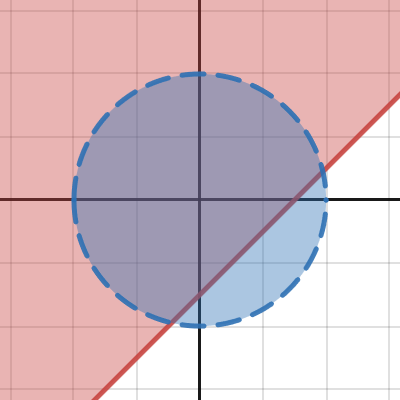 thin girder
yep
gritty widget
so to take the closure you think like this
which elements of the plane can you get by taking a sequence of elements from this area and then their limit
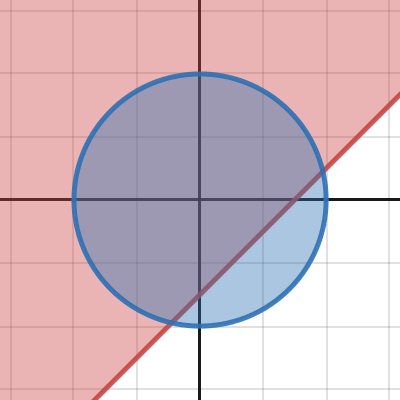
Desmos
and this will be intersection of those two areas
note how the top left part of the "boundary" of this area is now filled in
before it wasn't in this set
thin girder
yeah
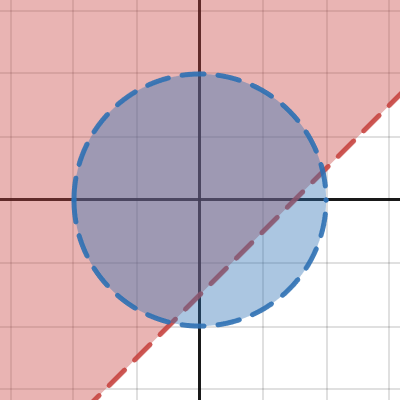 thin girder
so literally interior is the inside
gritty widget
yeah, something like that
thin girder
so one question
gritty widget
and now the boundary is the closure without the interior
thin girder
is closure just the boundaries or boundaries plus intersection
thin girder
gritty widget
and now the boundary is the closure without the interior
hmm so again literally bounds
gritty widget
gritty widget
https://www.desmos.com/calculator/udr1kheet6
closure is this whole thing
you have your set and then some more
gritty widget
yes
you can write them in terms of closed and open sets for example
or differently, there's a couple equivalent ways you could define them
(in this context)
thin girder
okay for example how would boundary look like
gritty widget
$\partial U = \overline{U}\setminus U^\circ$
gentle ospreyBOT
Blitz
 gritty widget
you could define it like this, closure without interior

 gritty widget
gentle osprey
**Blitz**
gritty widget
gentle osprey
**Blitz**
this is the closure
gritty widget
gentle osprey
**Blitz**
this is the interior
thin girder
I suppose these are in general , is there a way to add values given?
gritty widget
what do you mean exactly
thin girder
these are notations right
in general
what would these look like for our example
not all of the situations will be the same
what separates them
gritty widget
oh, like do you want me to write explicit formulas for boundary etc.
thin girder
dont know the name but might be what I mean
gentle ospreyBOT
Blitz
 gritty widget
so here the only thing changing is that one inequality is changed
thin girder
ah alright
gentle ospreyBOT
Blitz
 thin girder
gritty widget
this isn't really how it works in general though
thin girder
gritty widget
this isn't really how it works in general though
what do you mean
gritty widget
well I am explaining mainly based on intuition so if you don't understand then that's ok
thin girder
okay
gritty widget
and now the boundary is the hardest to write explicitly
thin girder
I understood the logic only thing I need to work on is the notations I believe
gritty widget
yeah
thin girder
so I can understand what a question asks : D
gritty widget
visit #book-recommendations and ask for some basic set theory book
thin girder
okay
thin girder
gritty widget
and now the boundary is the hardest to write explicitly
if thats not so hard how would it look like
or any example would be fine
doesnt have to be about our question
gritty widget
${(x, y) : x^2+y^2 = 16, x-y\leq 3}\cup {(x, y) : x^2+y^2\leq 16, x-y = 3}$
gentle ospreyBOT
Blitz
 gritty widget
gentle osprey
**Blitz**
gritty widget
gentle osprey
**Blitz**
in general I already wrote how to obtain it here
gritty widget
one last writing?
thin girder
gritty widget
$\{(x, y) : x^2+y^2 = 16, x-y\leq 3\}\cup \{(x, y) : x^2+y^2\leq 16, x-y = 3\}$
is there a way to write this without the union
the cup symbol you used in latex
${(x, y) : x^2+y^2 = 16, x-y = 3}$ maybe like this?
gentle ospreyBOT
Ege █▀█ █▄█ ▀█▀
 gritty widget
no, this is just two points
thin girder
okay
gritty widget
${(x, y) : x^2+y^2 = 16, x-y\leq 3\text{ or } x^2+y^2\leq 16, x-y = 3}$
gentle ospreyBOT
Blitz
 gritty widget
you can write it like this if you prefer
gritty widget
np
come back when you learn some set theory
gritty widget
Can $\mathbb{N} \cross {0, 1}$ have a one-point compactification?
gentle ospreyBOT
kaz
 gritty widget
every space has a one-point compactification, just it's not necessarily Hausdorff
😮
but here it is
My attempt: no, as limits of the sequences x_n = (n, 0) and y_n = (n, 1) are both not in closure of this set
the one point compactification of this space is homeomorphic to ${0}\cup {1/n : n\in\mathbb{N}}$
gentle ospreyBOT
Blitz
 gentle ospreyBOT
Blitz
 gritty widget
those spaces are homeomorphic
any bijection is a homeomorphism
Okay, could you tell me what's wrong with my approach?
you say "limits of the sequences" but they don't converge
even if they did converged, this doesn't show anything
So what I aimed for, if there was an one point compactification
Since N X {0, 1} would be metrizable
it is metrizable
Then it being compact is equivalent for it being sequentially compact right (compactification of N X {0, 1])
you don't know the compactification is metrizable a priori
ah I see, thanks
but here it is metrizable
lean cedar
Well first of all consider what a knot diagram actually is: A suitably nice projection of a knot onto a plane. Consider in $\mathbb R^3$ the two circles $S^1={x\in\mathbb R^3\colon (x_1-1/2)^2+x_2^2=2^2, x_3=0}$ and $\tilde S^1={x\in\mathbb R^3\colon (x_1+1/2)^2+x_3^2=2^2, x_2=0}$. Consider the projection as if you were at $\lambda\cdot (0, 1, 1)^\top$ for $\lambda\to \infty$. Then this is precisely your first diagram. If you view from $\lambda\cdot (0, -1, 1)^\top$ instead (or from the original viewpoint and rotating the whole $\mathbb R^3$ with the knot) you get your second diagram.
gentle ospreyBOT
MrMonday
 lean cedar
@vocal anchor

 rugged rock
Let $p: E \xrightarrow{} B$ be a covering map. Let $e \in E$ and $b = p(e)$. Let $A \subset B$ such that $b \in Cl(A)$. Show that $e \in Cl(p^{-1}(A))$.
gentle ospreyBOT
Évariste Galois
 rugged rock
while I understand the question, I'm not sure how to approach it
I could use a few hints
lean cedar
\xrightarrow{}???? My guy, \to???
rugged rock
lean cedar
\xrightarrow{}???? My guy, \to???
lmao my bad
lean cedar
Ok, now that I've complained let me look at the question lol
rugged rock
Constructive criticism 🙂
lean cedar
Is Cl(A) the closure?
rugged rock
Yup
rugged rock
Any updates?
lean cedar
By $p$ being a covering and $b\in B$ there is a neighborhood $U$ of $b$, such that $p^{-1}(U)$ is the disjoint union of some open sets $U_{E,i}$ all homeomorphic to $U$ via $p$. That is we have homeomorphisms $p\vert_{U_{E,i}}\colon U_{E,i}\to U$. Now from "closure in the relative topology" we have that the closure of $A\cap U$ in $U$ is $\overline{A\cap U}^U=\overline{A}^B\cap U$. But $b \in U$ and $b\in \overline A^B$ so $b\in \overline{A\cap U}^U$. Now let $e \in E$ such that $p(e)=b$. In particular $e\in p^{-1}(U)=\coprod_i U_{E,i}$. Thus we have a unique $j$ such that $e\in U_{E,j}$ and $e$ corresponds via the heomemorphism $U_{E,j}\cong U$ to $b$. Thus walking backwards through the homemorphisms we obtain from $b\in \overline {A\cap U}^U$ that $e\in \overline{p^{-1}(A)\cap U_{E,j}}^{U_{E,j}}$. By the same "closure in relative topology" we again have $\overline{p^{-1}(A)\cap U_{E,j}}^{U_{E,j}}=\overline{p^{-1}(A)}^E\cap U_{E,j}$. In particular we have $e\in \overline{p^{-1}(A)}^E$. I guess that should be it
gentle ospreyBOT
MrMonday
 rugged rock
That’s awesome. Clean argument. Thanks a lot 🙂
lean cedar
(Everybody please fact check this proof lol)
cursive flume

isn't there a typo?
shouldn't g: Y,S->Y,R?
how does f o g make sense like this?
lean cedar
I mean whats f? I think its just a weird rephrase of a universal property. Is there anything above missing?
Otherwise its just written very sloppily
 woven haven
If A is subspace of X ( both path connected) then does the inclusion map induce identity map on the first homology groups?
lean cedar
woven haven
If A is subspace of X ( both path connected) then does the inclusion map induce ...
Does this help: https://en.m.wikipedia.org/wiki/Relative_homology?
In algebraic topology, a branch of mathematics, the (singular) homology of a topological space relative to a subspace is a construction in singular homology, for pairs of spaces. The relative homology is useful and important in several ways. Intuitively, it helps determine what part of an absolute homology group comes from which subspace.
I guess you are talking about singular homology
woven haven
lean cedar
I guess you are talking about singular homology
yeah singular
woven haven
lean cedar
Does this help: https://en.m.wikipedia.org/wiki/Relative_homology?
i am sorry i dont get it
lean cedar
I mean I haven't solved your question yet, this was just a heads up
Thig is you get a long exact sequence $\cdots \to H^0(X)\to H^0(A)\to H^0(X,A)\to H^1(A) \to H^1(X)\to H^1(X,A)\to H^2(X)\to \cdots$. So if $H^0(X,A)=0$ and $H^2(X)=0$ then you have a short exact sequence with the first map your map in question, which then will be injective.
gentle ospreyBOT
MrMonday
 lean cedar
But I'd guess this holds much more often. But not sure about the general case
Eh
Oops, homology
make everything _n instead of ^n, let degrees decrease to the right and adapt the statements I guess lol
cursive flume
lean cedar
I mean whats f? I think its just a weird rephrase of a universal property. Is th...
it's the universal property yes
it's the universal property of induced topology
but isn't there a typo?
f is a map (Y,R)->(X,O_X)
it's the proof of uniqueness of induced topology
cursive flume
because the topologies don't match
lean cedar
Yes, g should have switched domain and codomain
cursive flume

cursive flume
cursive flume
g should be id_y: Y,S->Y,R
and thus f o g:Y,S->X,O, right?
lean cedar
yeah
cursive flume
lean cedar
yeah
how to show that the induced topology satisfies this universal property?
I only showed uniqueness
didn't show that the induced topo satisfies it
lean cedar
remind me tomorrow