#point-set-topology
1 messages · Page 281 of 1
 flint sonnet
 empty grove
oh fair, that works
 sonic hill
What is this "R^2 with the origin" and how is it not just R^2?
 blissful cedar
sonic hill
What is this "R^2 with the origin" and how is it not just R^2?
blissful cedar
sonic hill
What is this "R^2 with the origin" and how is it not just R^2?
idk trying to differentiate from a plane/square
since a square is a manifold
maybe it was just bad wording on my part
sonic hill
I'm confused what definition of "R^2" makes R^2 with the origin a cross
blissful cedar
idk having to define an origin so we dont have some affine space?
sonic hill
still confused
blissful cedar
same
 gritty widget
what do you think
 jagged sequoia
Do you know the defn of the product topology?
If yes, R^2 is equipped with the product topology and that gives you an answer
 tame lotus
Is there something like homology but with hyperbolas instead of circles? Based around spheres in hyperbolic space I guess? Not sure where one would start looking with this.
I have a hunch it might be nicer for directed spaces or for non-commutative stuff
 long hornet
tame lotus
Is there something like homology but with hyperbolas instead of circles? Based a...
long hornet
tame lotus
Is there something like homology but with hyperbolas instead of circles? Based a...
I don't know hyperbolic geometry but such thing would be fairly different from, say, singular homology, because it's all about homotopy type (not even homeomorphism type!) and the definition involves no geometry.
tame lotus
I would think you'd have some other higher geometric structure than simplices.
I know cubes are a common one.
I assume doing something based off of hyperbolas would correspond to some other weird geometry
But yeah some stuff would be different
long hornet
Yes, and very different, too: It won't be a homotopy invariant, because homotopy forgets all (?) geometry (in the sense of distance, angles, curvature, etc.)
tame lotus
Something I was thinking about was what a "pseudohyperbola" would be in analogy to the "pseudocircle"
long hornet
What is a pseudocricle?
tame lotus
Its a finite topological space equivalent to the circle
The point being is it's an abstract combinatorial sort of way of thinking of things
I have some ideas you might want to take a look at maps from hyperbolas to hyperbolas (not sure that makes sense)
Or maybe you'd find something to do with Anabelian groups as opposed to Abelian groups
 obtuse meteor
this does not feel like it passes the "makes sense" test
like
I can't see a way to make such a notion formal
long hornet
tame lotus
I have some ideas you might want to take a look at maps from hyperbolas to hyper...
When you say hyperbola do you mean xy = 1?
(as for the pseudocricle: I think it's only weakly homotopy equivalent to the cirlce)
tame lotus
long hornet
I don't know hyperbolic geometry but such thing would be fairly different from, ...
Homotopy type is circular. Two spaces are weakly homotopy equivalent if they have isomorphic homotopy groups.
You would want an alternative notion of equivalence kind of like homotopy equivalence but for hyperbolas instead of spheres in Euclidean space
long hornet
By Hom, do you mean modulo homotopy?
tame lotus
Homeomorphism
By + you mean coproduct right? Direct sum isn't right her right.
IDK are there any higher dimensional hyperbolas that are interesting and have loops in them?
Consider the sphere in R^1
You need S(R^2) for something interesting
S(C) for complex numbers gives you loops right away
So for low n S(Hn) being boring isn't necessarily a problem I think
IDK anything about higher hyperbolas though
Also I don't think hyperbola are related to circles in the hyperbolic plane
long hornet
tame lotus
IDK anything about higher hyperbolas though
I think when people mention "hyperbolic" things they are always talking about their geometry etc., which is why I said it won't be like singular homology (for example).
I understand now that you want a sequence of spaces (Riemannian manifolds?) P_n and want to study maps out of them, like how it's done for spheres. The reason it works for spheres is that they are cogroup objects in the pointed homotopy category of spaces, but here you aren't interested in this category because you want some kind of geometry.
If we look into the category of pointed Riemannian manifolds, for example, do we find cogroup objects there? I don't know, but it doesn't seem so.
long hornet
tame lotus
By + you mean coproduct right? Direct sum isn't right her right.
I meant topological sum (= coproduct), i.e., R + R is just two copies of the real line.
tame lotus
I think I want to look into stuff like cogroup objects
I've been meaning to look more into them.
Comonoid object makes sense as well right?
Just thinking about generalizations
And specifically for higher homotopy groups aren't they Abelian groups?
So I guess you could think of Abelian cogroup objects?
long hornet
tame lotus
And specifically for higher homotopy groups aren't they Abelian groups?
They might not be abelian. In fact, if you just pick a random sequence of cogroup objects P_n, there is no reason that the ordering is "better" than any other. We have an ordering on the spheres because the suspension of S^n is S^(n + 1).
tame lotus
Free monad on S I guess?
Some sort of graded monad ugliness { F : B nat -> Cat | F 1 = S }
long hornet
No idea! I'm unfamiliar with most similar concepts in category theory.
tame lotus
Fwiw suspension is wedge product
So it's adjoint
I feel like suspension ought to be thought of as dual, Sn /\ (X, x) and Sn -> (X, x)
So I'd want to take a look at Pn /\ (X, x) for some space I think
long hornet
It is thought of that way.
tame lotus
I need to go to sleep soon
long hornet
tame lotus
So I'd want to take a look at Pn /\ (X, x) for some space I think
I think the more important property is that S^n smash S^m = S^(m + n)
Or rather, that suspension is smashing with S^1
Its adjoint is the loop space functor, but the loop space of a manifold for example isn't a manifold (it's a very large space)
 glossy pine
yo I don't understand the concept of a limit point. if you have a ball (or neighborhood) centered around a point P with radius epsilon, and you shrink that ball a lot, you will eventually shrink it so much that any point other than P will not be included in that ball. this seems counterintuitive to the idea of limit points, would someone mind explaining this?
also I gtg now so I won't be here for a while
 viral atlas
glossy pine
yo I don't understand the concept of a limit point. if you have a ball (or neigh...
viral atlas
glossy pine
yo I don't understand the concept of a limit point. if you have a ball (or neigh...
Are you working inside R^n? If so, no matter how much you shrink a ball (positive radius, of course) it would have infinitely many points.
Reviewing relevant definitions might help.
 idle night
Can someone help me understand how the first simplicial homology group of this delta complex is calculated? The answers I've looked at get ker(del1)=(a, b-c, c) and im(del2)=(a+b - c, 2a), and I'm not sure how they arrive at either of those

In my calculations I get ker(del1)=(a,b,c), im(del2(U))=(a+b-c), and im(del2(L))=(c-a+b)
 pearl holly
idle night
In my calculations I get ker(del1)=(a,b,c), im(del2(U))=(a+b-c), and im(del2(L))...
pearl holly
idle night
In my calculations I get ker(del1)=(a,b,c), im(del2(U))=(a+b-c), and im(del2(L))...
this is right except that del2(L) = (c+a-b)
idle night
pearl holly
this is right except that del2(L) = (c+a-b)
Why would a be positive and b negative? Don't the signs alternate?
pearl holly
write c-b+a and now they alternate 😎
going c, then a and then b but in the opposite direction (-b) is the boundary of L
pearl holly
idk lol but when you take ker/im, whether you have im(del2)=(a+b-c,2a) or im(del2) = (a+b-c, c+a-b) doesn't matter
because the relations then are a+b = c and c+a = b
long hornet
What is a natural, but "small," basis of a CW complex X?
That is, I want an easy description for a basis that is not unnecessarily big. For example, if X is 2nd ctbl., it should give a countable basis.
glossy pine
viral atlas
Are you working inside R^n? If so, no matter how much you shrink a ball (positiv...
that's true ig, but what's so useful about limit points then?
empty grove
I don't get the homeomorphism B^Mi ~ Np (the definitions are the ones given there, Mi is the mapping cylinder of i). I am trying to use Yoneda, trying to show that the contravariant homs that these 2 represent are isomorphic, but don't get how to treat product with a pushout inside hom
 empty grove
glossy pine
that's true ig, but what's so useful about limit points then?
empty grove
glossy pine
that's true ig, but what's so useful about limit points then?
A limit point of a set A is like a point which is arbitrarily close to the set A. No mater how small a neighbourhood around that point you take, you can always find points of A in it
It is useful in topology because topology is all about talking about things being close together or far away using the open sets
 hollow harbor
glossy pine
that's true ig, but what's so useful about limit points then?
hollow harbor
glossy pine
that's true ig, but what's so useful about limit points then?
what is your reservation? a limit point is a point that is arbitrarily close to being in your set, even if it's not in it.
0 is a limit point of (0, 1] because if you give me an error epsilon > 0, then i can find you a point in (0, 1] that is within error epsilon of 0 - that is to say it's in the ball of radius epsilon about 0. i'd give you the point epsilon/2.
in a similar way, 0 is a limit point of the set {1/n : n in N} because if you give me an error epsilon > 0, then i can find you a point in this set so that it's in the ball of radius epsilon about 0. now it's a bit more complicated to write down that point: it's something like 1/(ceiling(1/epsilon)). but the idea is that there are points in my set which are getting closer and closer to 0, even though 0 is not a point in the set.
note that we consider points that are ARBITRARILY close but with positive error, but we don't require a point that's in the ball of radius 0. that's only the point itself.
moldi already gave a short response but hopefully my examples are also useful
empty grove
Maybe you got the feeling that they are useless because of the R^n example, where everything is the limit point of R^n 
hollow harbor
yeah it's more useful to look at subsets.
 spiral stratus
quick question: if i have a fiber bundle with CW base and CW fiber, does the bundle always admit a CW structure or can the glueing ruin it somehow? i cant think of ways how it would but im not sure
obtuse meteor
Throw the homotopy lifting property at it and try and build a CW structure
Feels like something one should be able to do
spiral stratus
hmm yeah maybe
tame lotus
long hornet
I think the more important property is that S^n smash S^m = S^(m + n)
That reminds me. One of the reasons I was thinking of hyperbolic space was because I was thinking about sphere as a functor. So given a normed vector space V
S(V) = { v in V | 1 = ||V|| }
So you have
S(R^n) /\ S(R^n) -> S(R^(m + n))
And I would assume a monoidal functor
S(u) /\ S(v) -> S(u * v)
where * is just product.
But I'm not sure how to prove that
And normed vector space is kind of ad-hoc as a domain
Sphere as a functor is awkward S: NormedVect -> Top
obtuse meteor
Errr
This feels very non-topological
I mean what you said there isn’t even a functor
Unless the linear maps preserve the norm in NormedVect
tame lotus
Yeah it's icky
obtuse meteor
Hyperbolas are not a good space to consider I think
It would so well to study like some other heneralizations of similar concepts
Like homotopy theory over other categories than top
glossy pine
hollow harbor
what is your reservation? a limit point is a point that is arbitrarily close to ...
ohhhhhhh I see now, makes sense why another name for it is accumulation points. tysm
glossy pine
empty grove
Maybe you got the feeling that they are useless because of the R^n example, wher...
yeah I see now, ty
hollow harbor
yep! the name limit points comes from the usage of the term "limit" in calculus. but it's not always a perfectly accurate translation.
accumulation is a better term for it.
empty grove
empty grove
I don't get the homeomorphism B^Mi ~ Np (the definitions are the ones given ther...
Need help with this still
The issue with the Yoneda approach seems to be that after using the product exponent adjunction on B^Mi, we have
Hom(-, B^Mi) ≈ Hom(- × Mi, B) but then Mi is a pushout, and I don't think it behaves nicely with the product? So don't see a way of simplifying this further
Mi is the mapping cone of i
I don't think we are supposed to work with the compact open topology  and with the universal property I don't see anything other than a yoneda approach
obtuse meteor
Push out Hom is like
Just defn of a colimit right?
A map out of a push out is two maps out of the components that equalize
The two legs
obtuse meteor
Hm? I don’t see what you mean
empty grove
Wait is Y × Mi ≈ Mj where j: Y × A → Y × X is id × i?
empty grove
obtuse meteor
A map out of a push out is two maps out of the components that equalize
We don't have map out of pushout though
It is - × pushout
empty grove
obtuse meteor
That seems reasonable no?
Ye lol
empty grove
obtuse meteor
By pushing the x to the right component
Oh damn true lol
obtuse meteor
Does that help?
empty grove
Let me see
obtuse meteor
Yeah that looks like it should do it
empty grove
Yes I'm pretty sure that does it, it gets both sides to be a subset of the same hom set with some equalizer condition, that should probably turn out to be the same lol
obtuse meteor
From a cursory check
empty grove
Nice, thanks a lot
obtuse meteor
Yeah by definition of p = B^i those are the same
empty grove
Right ye
obtuse meteor
Crucially this argument relied on us being in a nice category of spaces but point set topology is stupid
So no worries
empty grove
Ye May assumes we have Cartesian closed category
empty grove

obtuse meteor
So this tells us this is a categorical result! Wonder if it works in any closed monoidal category with an appropriate interval object
It totally should
Sigh I love yoneda arguments
Moldi have you seen the Eilenberg-Zilber map yet?
That is like one of the really nontrivial uses of heavy yoneda argumentation in algtop
Very cool
empty grove
obtuse meteor
Moldi have you seen the Eilenberg-Zilber map yet?
Nope, I'm still very much at the beginning of this book lol
This is ch7 I think, and the first 4 were fundamental group(oid) and covering space stuff
empty grove
obtuse meteor
Inducting on yoneda is based
Looking forward to it 
long hornet
Why does tom Dieck treat covering spaces SO categorically?
It didn't give me any new insight, and I don't remember that we used general theorems in cat theory to simpliy some steps
To be fair, I think neither E nor B were assumed to be connected
I had read about it in Lee, and liked the presentation more, but thought there must be some advantages in tom Dieck's approach which I might have missed.
obtuse meteor
What does he do that’s so categorical?
long hornet
He calls a space B "transport-simple" (iirc) if it satisfies the three connectivity properties that guarantee the existence of universal cover
long hornet
Now at first he gives the statement "transport-simple spaces have universal covers" as equivalence between two categories
 long hornet
Namely Cov(B) and Tra(B). Now Cov(B) is nice and intuitive, but Tra(B) is... the functor category Pi(B) to Set, where Pi is the fundamental groupoid
 gentle ospreyBOT
Nobody
 long hornet
obtuse meteor
This guy right?
long hornet
obtuse meteor
This guy right?
Yes
obtuse meteor
I mean this is reasonably intuitive imo
It’s saying a covering space is exactly a monodromy action on a choice of fiber
In a way respecting all the structure one could want
The key is one should really focus on what such a functor must look like
It’s a choice of a set F_x for each point in X, but bc of path connectedness each F_x is the same
This is the fiber of the covering space
I think this is the right way to phrase the result but dieck probs failed to exposit it well
long hornet
Oh, I think the construction of Fib did make sense to me when I first read it 
obtuse meteor
Good
long hornet
But I think overall it takes a lot of effort to reach the "standard" statements?
It feels like a lot because I'm not very comfortable with categorical arguments, maybe
obtuse meteor
I think it is a mature way to phrase the result
But not the first way one might want to see it
long hornet
I first saw it done the classical (?) way, but still didn't like this version. But maybe it's not really this version, but rather his presentation of it.
I see!
obtuse meteor
Same sort of meme :p
 long hornet
Unrelated question: I want to show that a locally finite, connected CW complex is metrizable..
I read that these conditions alone imply that X has countably many cells
By Urysohn, it actually suffices to show that X is second countable, but I have no idea how to proceed
glossy pine
the supremum and infimum of a sequence is a limit point, right?
if not, what's a counterexample?
long hornet
There are trivial issues when your sequence is finite, i.e., has finitely many distinct points
Like 1, -1, 1, -1, etc.
 gentle ospreyBOT

 shadow charm
I don’t see how r is the identity on S_1 when it’s not even a loop 
 shadow charm
Ah okay
I see
These arguments are pretty novel to me I have to wrap my head around them
obtuse meteor
Super based
shadow charm
Is this indicative of the fundamental group being being a functor from topological spaces with a base point to groups?

A covariant one at that
Okay I’m an idiot I probably should’ve finished reading the page lol
It’s written right there
 plain raven
nice
tame lotus
tame lotus
That reminds me. One of the reasons I was thinking of hyperbolic space was becau...
I'm a dork mostly homotopy stuff comes from the boundary operator
sphere(V) = bd(ball(V))
obtuse meteor
I don't see an immediate reason why this is true / this should be the important part
 maiden hazel
Let C be convex set. C is closed in weak topology if and only if it is closed in strong topology.
Proof finds a subset V of complement of C which is open in weak topology
Why does that show complement of C is open in weak topology?
This is 3.7. From brezis functional analysis which i am struggling to understand 😩
maiden hazel
I feel like i am missing some basic fact about topologies because i found two more proofs which do not clarify the final step 😭
 flint cove
maiden hazel
Let C be convex set. C is closed in weak topology if and only if it is closed in...
flint cove
maiden hazel
Let C be convex set. C is closed in weak topology if and only if it is closed in...
Didn't look it up, but perhaps the missing detail is that the proof finds a weakly open nbhd for every point in the complement?
Because one way to show a set S is closed is to show you can separate every point not in S by an open nbhd from S, ie showing every such point is in the exterior
B/c the closure is all the points you cannot separate from S
maiden hazel
flint cove
Didn't look it up, but perhaps the missing detail is that the proof finds a weak...
I feel so stupid to have missed that. Thanks
flint cove
maiden hazel
I feel so stupid to have missed that. Thanks
Np, feeling stupid is a sign of improvement and progress
Is there an elementary way (ie explainable to a non-maths-person) to see that the generator of \pi1(RP³) is not contractible?
I was thinking whether one could use the fact that it's contained in a mobius strip somehow. More specifically, if we identify RP³ with B_1(0) mod antipodes on the boundary, the generator is given by -1,1, which can be extended to a mobius strip in the xy-plane
Or is that not helpful because the actually relevant 3d neighborhood here just has the form of a solid cylinder
empty grove
when you go around sphere once you end up rotated
there's a 50 min yt video on this lol
flint cove
I mean visually it's clear because it will always have to penetrate the antipodal barrier so to speak
flint cove
flint cove
I mean visually it's clear because it will always have to penetrate the antipoda...
But I want an excuse to talk about Mobius strips to be perfectly honest
flint cove
empty grove
there's a 50 min yt video on this lol
Worth looking it up?
Sounds long for something elementary
empty grove
it is good, most is skippable because he defines fund grps and covers
flint cove
Hm, but does he actually prove that the generator must be nontrivial?
Because most people go out of their way to say that there is a cover making the curve contractible, but that's not sufficient to prove it was nontrivial in the first place
empty grove
if you just want intuition then he describes the belt thing in like 5 mins
flint cove
/brb then
empty grove
flint cove
Hm, but does he actually prove that the generator must be nontrivial?
Because mo...
why is that not sufficient?
oh like you need more theory
flint cove
Ah the proof by contradiction was what I needed
My mind forgot the lifting property and just straight went to SvK
Lol
Thanks for the video @empty grove !
Although I think I prefer the variant where we represent S³ as the one-point-compactification of the Ball of radius 2\pi
Then the double cover is obvious because we identify what represents the same rotation
empty grove
I think that's what the video roughly does too?
flint cove
Yes, just with different imagery
flint cove
It slices it up into north and south half
As in two different pieces
And the 1pComp approach would be to turn the second half inside out, so that the north pole gets stretched out to the surface sphere (like the hollow earth we live in lmao)
And then just stick the hollow second half onto the outside of the original south half
empty grove
need more brain for this 
flint cove
Take two copies of the 3-ball, whose boundaries we glue together
One way to „unify“ these two copies is to wrap one around the other
This procedure stretches out the 0 inside said second copy to the boundary sphere of the newly created abomination
empty grove
yeah I can't visualise this lmao
aren't we only gluing the boundary
why is 0 gluing to anything
I mean the 0s from the 2 spheres should just glue to each other
flint cove
No, you only glue the S² boundaries together, which becomes the equator of S³
The 0s in each copy are different (north and south pole)
flint cove
Yep, solids in R³
flint cove
I guess the observation with the Mobius strup might still be useful in a presentation, because with that you can motivate why you would want to look for a double cover in the first place (b/c every mobius strip arises as one from the cylinder, as we all know) instead of just dragging S³ out of your hat and saying „oh, it's a double cover, neato“
empty grove
May says that a based cofibration between nondegenerately based spaces is also an unbased cofibration
How proof
nondegenerately based = inclusion of basepoint is unbased cofibration
empty grove
ty
I just thought I was missing something super obvious because the book just says this without proof lol
maiden hazel
why is for convex sets weak closure = strong closure? i don't see how it follows from the fact that for convex sets weakly closed = strongly closed
shadow charm
Struggling to figure out what exactly beta_h is

Is it the map that sends every homotopy class of loops at phi_1(x_0) to that of the loops based at phi_0(x_0) made by attaching the path h and it’s inverse like in the proof of the lemma?
 cosmic beacon
How is the boundary map a natural transformation on the level of relative homology?

I thought natural transformations induce morphisms between functors applied to the same object
but here it says the boundary map is a natural transformation between H_i applied to (X,A) and H_{i-1} applied to (A,{})
which doesn't make sense to me
 lunar yoke
Well you can get (A,{}) from (X,A) in a functorial way
so call that F, then you have a natural transformation from H_i to H_{i-1} \circ F
 surreal ocean
I just started reading about manifolds and learned of coordinate charts. I am trying to mentally piece together my intuitional understanding of coordinates in our physical space (PS) vs the definition of a coordinate chart for a manifold.
Here are my thoughts:
Let's say that we have applied a coordinate system to our PS. To me, it seems natural to interpret this as providing a coordinate map from the set of physical points to R^3 with the standard topology. The problem with this interpretation is that it requires us to endow PS with a topology such that it is homeomorphic to R^3.
My question:
It seems to me that in order to rigorously use coordinate systems in PS we must first define the proper topology on PS. Is this true? If so how does one define this topology.
feel free to ping me as well
cosmic beacon
lunar yoke
so call that F, then you have a natural transformation from H_i to H_{i-1} \circ...
this makes sense, thanks
long hornet
surreal ocean
I just started reading about manifolds and learned of coordinate charts. I am tr...
It's not quite true. Given any set with a coordinate system on it, (satisfying some reasonable conditions), we can endow it with a topology making it into a manifold, and the given system will be its coordinate charts.
In fact, given any collection of set functions f_i : X --> S, there is a natural way to topologize S, making all of these continuous. Let X = Euclidean space and f_i = (inverses of) chart maps to arrive at this situation.
long hornet
I'm trying to follow the proof in Fuchs-Fomenko about how pi_n(X) is independent of base point
The crux of the proof is to define a map w from S^n to S^n v I, sending the basepoint s of S^n to 1 of I (where I has basepoint 0)
And then the composition (f v u) o w will be an element of pi_n(X, x1), if u is a path joining x0 to x1 and f is an element of pi_n(X, x0)
I don't know how to construct a nice w, though
long hornet
(it turned out that it's easier to think cubically)
 swift fjord
is it possible to use simplices of dimension >n to triangulate a dimension n manifold?
i'm assuming/hoping the answer is no
swift fjord
idk how i'd do that. I don't know anything about manifolds or topological dimension. i'm assuming there's some invariance of dimension under homeomorphism that would not let this occur
gentle ospreyBOT
Nobody
 swift fjord
Ah so it comes down to invariance of domain?
Thanks!
Yea ig it's not exactly the same but same concept more or less
flint cove
Well, if the average non-math person for the first time learns what the „rotation space“ is, I don't think they will find it obvious to make a connection to „projective space“. I mean one could explain that I guess, but that would take a lot of additional effort. From my personal experience, understanding how RP^n works took a lot of time (esp why the antipodal identification thing yields the same as the set of all 1d subspaces thing)
shadow charm
Tried to adapt the middle part of this to an exercise but I realized I don’t really see why f^-1(x) is compact

,rotate
gentle ospreyBOT
 shadow charm
I mean preimages of compact sets aren’t necessarily compact so I’m a bit confused
pearl holly
S^1 is Hausdorff tho
pearl holly
so you have f: I --> S^n and I is compact and S^n is Hausdorff. Now f^-1(x) is closed since x is closed and f is continuous and any closed subset of a compact space is compact right?
isn't that sufficient?
shadow charm
Right that makes sense
pearl holly
oof I thought I was going insane lmao
shadow charm
But why is hausdorff important here?
Oop yeah lol
Had a bit of a brain fart there
So as a sanity check to make sure I’m adapting this correctly
pearl holly
ye and more generally this should show that preimages of cont maps from a compact space to a Hausdorff space are compact right?
because compact subsets of Hausdorff spaces are closed if I remember correctly
long time ago I did point set
shadow charm
Fuck lemme switch to my laptop my phone is acting up
shadow charm
So i wanna show that paths in locally star shaped subspaces of R^n are homotopic to piecewise linear paths. So what I do is i consider the open cover of the path by star shaped neighborhoods of its points and take a finite subcover by compactness. Then for each of these neighborhoods i consider the preimage of its intersection with the path, which is possibly a union of infinitely many open intervals. I show this union is finite as by construction all parts of the path in the neighborhood must pass through the same point, namely the point that the set is star shaped with respect to, and so the preimage of that point lies in finitely many open intervals in I. Hence for each of these intervals i can homotope their image to the composition of two straight lines by definition of a star shaped neighborhood and the result follows?
the step im not too confident about is taking the preimage of that "central" point to argue that the preimage of the path in that neighborhood is a finite union of open intervals
shadow charm
pearl holly
oh frick the bald emote again lmao
maybe i am bald
shadow charm
but my baby is bald 
pearl holly
oh lmao 
shadow charm
shadow charm
So i wanna show that paths in locally star shaped subspaces of R^n are homotopic...
does this seem sound then?
empty grove
Is locally star shaped defined as every open neighborhood of a point contains a star shaped neighborhood?
That seems a bit hard to read but it looks like you are doing something legit
Rather than proving something about finite union of intervals
You could instead take the preimage of the covering
Then use the lebesgue number lemma
On the closed interval
To get n such that
0, 1/n, 2/n, ... , 1
is a partition of the interval with each part lying inside one of the open sets in the cover
And then do the homotopy to piecewise linear on each part
flint cove
shadow charm
maybe i am bald
Even if you are, I bet you don't look ZOTErrible (rimshot)
shadow charm
empty grove
Then use the lebesgue number lemma
I’m not aware of this lemma 😔
shadow charm
empty grove
That seems a bit hard to read but it looks like you are doing something legit
Yeah I mean I wrote it out more cleanly
It’s just to know of the idea of taking the preimage of the « central » point of the neighborhood to prove that the preimage of the path in the neighborhood is a finite union of open interval is legit
hollow harbor
LNL 
shadow charm
It sounds legit to me but idk
empty grove
shadow charm
I’m not aware of this lemma 😔
It's a very short proof see wikipedia
Like literally a 2 liner
empty grove
shadow charm
It’s just to know of the idea of taking the preimage of the « central » point of...
How define central point
Oh
shadow charm
I just mean the point that it’s star shaped relative to, which is a point of the path by construction
empty grove
I show this union is finite as by construction all parts of the path in the neighborhood must pass through the same point, namely the point that the set is star shaped with respect to, and so the preimage of that point lies in finitely many open intervals in I.
Don't get this
shadow charm
So the parts of the path in the neighborhood have preimage an open set that could be an infinite union of open sets. But each of them contains a part of the preimage of the central point. Since the preimage of the central point is compact and that these open intervals cover that preimage, there must be a finite subcollection that covers this preimage, but since the intervals are disjoint that must mean the collection of intervals is finite
obtuse meteor
Oh @empty grove it turns out May doesn't do Eilenberg-Zilber / Kunneth formula
I'd recommend checking it out on your own at some point
empty grove
I shall do that, ty
empty grove
shadow charm
So the parts of the path in the neighborhood have preimage an open set that coul...
The central points may not have a preimage right?
shadow charm
The central point is on the path
Oh I see what you mean
I didn’t necessarily have in the construction that the central points were on the path
I just sort of assumed since we were taking neighborhoods of them
Does w a having star shaped neighborhood not necessarily imply that it’s the point that this neighborhood is star shaped relative to?
empty grove
I wouldn't assume so, but maybe check definition
shadow charm
I’ll have to check again later doing something else rn
shadow charm
empty grove
Then use the lebesgue number lemma
Right okay I’ve read this and it definitely makes more sense to proceed that way thanks
Also I saw another proof which shows that the set ${t\in I: f|_{[0,t]}\text{ is homotopic to a piecewise linear curve}}$ is inductive
gentle ospreyBOT
𝓛ittle ℕarwhal ✓

 wheat gulch
I just made this. Are there any cool things about tori I should add?https://observablehq.com/@laotzunami/torus-polygon-and-circles?ui=classic
 empty grove
shadow charm
Also I saw another proof which shows that the set $\{t\in I: f|_{[0,t]}\text{ is...
empty grove
shadow charm
Also I saw another proof which shows that the set $\{t\in I: f|_{[0,t]}\text{ is...
What does inductive mean here?
shadow charm
Subset $S$ of $I$ is inductive iff \begin{enumerate}
\item $0\in S$
\item if $x \in S$ then $\exists y>x$ such that $[x,y]\subset S$
\item if $[0,x)\subset S$ then $x\in S$ \end{enumerate}
Ahhh
gentle ospreyBOT
𝓛ittle ℕarwhal ✓
 shadow charm
And I is the only inductive subset of I
I was thinking another to solve it could be to show that the same set is clopen
Oh wait
Lmao
That’s basically the same as inductive
Noice
flint cove
Is there any criterion for when an inclusion A->X induces an injective map in the fundamental group (or in Homology)?
Specifically asking because any embedding of a mobius strip into a 2D CW complex should maintain the nonorientability, and hence there should be 2-torsion in both \pi_1 and H_1
flint cove
Wait, nonsense. The mobius strip retracts to S¹, there's no 2-torsion
thinks
Perhaps I need to take relative cohomology wrt the zero section?
empty grove
What are you trying to do
flint cove
Still trying to justify the „we find a mobius strip in ℝP² hence it has 2-torsion in the fundamental group“ thing, and perhaps trying to generalize that observation to ℝP³
but perhaps it's stupid and there isn't really an underlying principle that could make this work
I mean we have more than this isolated mobius strip; it's S¹-parametrized, i.e. we have a surjection M × S¹ → ℝP²
To be perfectly honest I just try to exploratively think about these things to improve my understanding of the associated abstract machinery like π₁ and Homology
empty grove
Doesn't mobius strip have fundamental group ℤ
It should deformation retract to middle circle
So idk if mobius strip embedding says much by itself
flint cove
flint cove
Wait, nonsense. The mobius strip retracts to S¹, there's no 2-torsion
Yes, that's why I wrote this @empty grove
pearl holly
flint cove
Still trying to justify the „we find a mobius strip in ℝP² hence it has 2-torsio...
I read wikipedia and they say this: "If H1(S) denotes the first homology group of a surface S, then S is orientable if and only if H1(S) has a trivial torsion subgroup. More precisely, if S is orientable then H1(S) is a free abelian group, and if not then H1(S) = F + Z/2Z where F is free abelian, and the Z/2Z factor is generated by the middle curve in a Möbius band embedded in S." which is exactly what you're saying and this is pretty cool but I don't understand it
ping me if you find anything
obtuse meteor
guessing that for this to work
you need a closed surface
the mobius band has boundary
and that's fucking things up
shadow charm
flint cove
Is there any criterion for when an inclusion A->X induces an injective map in th...
i have no idea about the second paragraph but the for the first if A is a deformation retract of X then the homomorphism on the fundamental groups pi(X,x_0) and pi(A,x_0) with x_0 in A induced by the inclusion of A is an isomorphism
doubt that's of any help though 😔
idle night
What specifically is the universal property to be verified here?
 shadow charm
universal property of the colimit i suppose
idle night
But what would be the morphism associated with it?
Like putting it into this diagram, I assume Pi(X) would be X and Pi:O->GP would be F(A)->F(A'), but I don't know what A->A' would be
 empty grove
That's May right
Pi(X) would be X
That doesn't make sense
Pi(X) is a groupoid, X is a topological space
idle night
I mean Pi(X) would be where X is in the universal property diagram I posted, not that it's equivalent to X
empty grove
idle night
I mean Pi(X) would be where X is in the universal property diagram I posted, not...
No
The diagram you have posted is a bit hard to understand if you haven't seen universal arrows in category theory formally so maybe see another diagram
but in place of X
You would have the entire diagram of Pi(U_alpha)
all the open sets
and F is Pi
no wait
ah F is the diagonal functor from category of Groupoids to the category of diagrams
Point being that this is not the easiest way to think of a colimit so do as Nobody says lol
idle night
I know what a colimit is I'm just not sure how it would be expressed by a universal property
shadow charm
i think there's a way to express it as the diagram you showed in some weird category but the point is that "verify the universal property" just means verify the defining property of a colimit
empty grove
cool so you take the diagram that all the U form (along with their double intersections)
And X is the colimit of this diagram
shadow charm
just like if you very the universal property of a product you dont necessarily look at a 2-category and verify a universal property there (if that's how it translates, cant remember)
empty grove
empty grove
cool so you take the diagram that all the U form (along with their double inters...
ok I think he is assuming that the collection is closed under intersections or something
empty grove
empty grove
And X is the colimit of this diagram
And this theorem just says
That if the collection of open sets you have is good
Then the Pi functor preserves the colimit
ie you have a diagram of all these Pi(U)
with maps being the ones induced by inclusions
and Pi(X) is the colimit of this
So to verify the universal property
You would take some groupoid G
Assume there is a map from each Pi(U) to G such that whatever needs to commute commutes
And show that there is a unique map from Pi(X) to G that makes whatever needs to commute commute
What needs to commute is the stuff in the definition of a colimit
 jolly garden
c) is a 2-connected region, right? Is d) a 6-connected region? In general, how can I think of a n-connected space?
 jolly garden
Yeah, I know that definition too. In complex analysis book, it says: "A region $G\subset \mathbb{C}$ is called $n$-connected if the complement $C\setminus G$ has $n-1$ bounded connected components. OR: if the complement $\hat{\mathbb{C}}\setminus G$ on the Riemann sphere has $n$ connected components.
gentle ospreyBOT
Anton.
 empty grove
Then you just need to count no of holes and add 1
jolly garden
I suppose the definitions have nothing in common and the latter definition is rather unconventional. (?)
empty grove
If it's a bounded region then the definitions are equivalent
If it's unbounded then too nvm
Because infinity isn't included in the neighborhood anyway
So all the unbounded connected components connect together in the sphere to add exactly one component
Latter definition is not unconventional
You work with the Riemann sphere a lot when you complex analysis
jolly garden
So, it would be correct to speak of the region in d) as 5-connected? Seems a bit off, I don't know.
empty grove
6
jolly garden
Sure, sorry.
empty grove
That's what the definition says 
 finite heath
moldilocks on that pythagoras shit 💯 respect 🔥

my man's built different with the beans
 crude crater
lol
hollow harbor

finite heath
 swift fjord
i'm having a hard time understanding what the 0th homology group with coefficients in a general abelian group looks like
is it still going to be generated by the homology classes of connected components?
Basically, if k_1,...,k_n are representatives of the path components, is H_0(X;A) = A[k_1,...,k_n]?
plain raven
is that supposed to be a polynomial ring?
swift fjord
well, technically ig?
plain raven
it should be the direct sum of |F| many copies of A, where F is the set of connected components of X.
swift fjord
It can't just be A^n can it, since it needs to have n generators
but shouldn't the homology classes of path components generate it
swift fjord
what i'm saying is I don't see why a direct sum of A with itself would have these generators in general
plain raven
anyway your notation is confusing me. path components should generate it as an A module, linearly, not as an algebra, multiplicatively
swift fjord
yea sure
swift fjord
swift fjord
Basically, if k_1,...,k_n are representatives of the path components, is H_0(X;A...
i'm not allowing for multiplication between the k_i with this notation, so it's not exactly a polynomial ring
plain raven
ok
swift fjord
i'm just saying it's all formal linear combinations of k_1,...,k_n with coefficients in A
swift fjord
ok I guess that is equivalent to A^n if you consider it an A-module then yea
alright thanks
plain raven
ok. in the finite case yeah
swift fjord
yea ofc
swift fjord
plain raven
anyway your notation is confusing me. path components should generate it as an A...
wait no. wdym A module, A is a group not a ring
lunar yoke
I think you just view it as Z module then
swift fjord
I understand the point, the thing that always trips me up is that x1,...,xn in this example are generating H0(X;A) while not actually being elements in it. Ig if you wanted to say this formally you'd say that that every element is a formal linear combination of them and there are no relations between g1x1,...,gnxn for any g1,...,gn in A, right?
Well for gi not all 0 ofc
plain raven
ok. shin i feel like you're not working under a good definition of homology with coefficients so heres mine
let C be the ordinary chain complex of the space
singular
let C\otimes A be the chain complex which in degree n is C_n \otimes A
then define H0(X;A) to be H0(C\otimes A)
(C\otimes A)_0=C0\otimes A is isomorphic to the direct sum of |X| many copies of A, where |X| is the set of points/ elements of the space X
H0(X;A) is the quotient (C0 \otimes A) /(C1\otimes A)
you need to use the theorem that the tensor product of a free abelian group with A is the direct sum of copies of A indexed by a basis
long hornet
Let K_n be the set {1/r : r = 1, 2,..., n} and K_inf = union of all K_n's along with zero. I'd like to know a simple description of the homotopy type of X = R^2 - K_inf.
It feels like the higher homotopy groups of X should vanish, and that pi_1(X) is generated by countably many elements. It also feels free, so maybe X is K(F_inf, 1) and is thus the wedge of countably many circles?
Pick p = 2, for example. Then a circle of radius 3 which passes through p includes all the wholes, so it is represented by an infinite product. So I guess pi_1(X, p) isn't just F_inf (the free group on countably many generators.
plain raven
i wonder if this is htpy equiv to the hawaiian earring
long hornet
plain raven
i wonder if this is htpy equiv to the hawaiian earring
Seems plausible
plain raven
i think it should be. but it's hard to describe my handwavy geometric construction
expand the punctures on the positive real axis to go all the way around as arcs leaving only a point on the negative x axis
empty grove
Hatcher would totally just say "expand the nth hole in the interval [1/2^(n+1), 1/2^n]" and no one would bat an eye

hollow harbor
Sounds good to me moldilocks 
hollow harbor
plain raven
empty grove
<:frogS:813950775113809990>
so true
shadow charm
Here I assume the constant map is common to every map S^1 -> X?

Otherwise X wouldn’t even have to be path connected right?
(For 5a)
I’m basically asking if « a constant map » is independent of the for all quantifier or not
I’d say it is or X wouldn’t have to be path connected
Oh right because the fundamental group depends on a base point 🤦♂️
Yeah alright thanks
shadow charm
So my idea to show a implies b is to take F:S1xI -> X associated to our homotopy and to note that xt = ys implies that F(x,t) = F(y,s) (where the multiplication is in R^2 under the standard embedding of S1) so that F factors through the equivalence relation (x,t) ~ (y,s) iff xt = ys so that we get an induced map (S1 x I) / - to X, and since the former is homeomorphic to D2 we should get the extension we want right?
I think it works I just need a sanity check
empty grove
Yes
shadow charm

spiral stratus

Im looking at this proof of the cohomology ring of BSO in hatcher,vector bundles
You do induction odd-> even and even-> odd in the rank of the bundles
Coefficients are in a 2-torsion-free ring ( Z[1/2] ) and the ring of the n-1 grassmannian is assumed known
The issue i have is the statement in the last line of the page: There's the map eta, which is injective, sure. Its image is a subring of that polynomial ring it maps into.
But then they say that image contains this poly ring and is also torsion free
That's the part i don't see
Perhaps i'm missing an elementary ring theory fact
gritty widget
hey, i'm trying to figure out whether this statement is correct: if f: X to Y is injective and continuous and Y is normal, then X is also normal
i tried to prove it and I somehow need that f is closed (maps closed sets to closed sets)
because i couldn't prove it i suspect the statement is false
but I also can't think of a counterexample
so any help would be appreciated
shadow charm
Can’t you take the identity map Y to Y by giving the domain the discrete topology?
That would be a counter example no?
empty grove
Discrete topology is normal
gritty widget
Yes, i think it fails because discrete topology is normal
empty grove
This isn't even true for embeddings
The examples for embeddings are a bit complicated so there might be an easier thing for injection
The K topology is not normal
on R
But the identity map (R, K-topology) → (R, standard topology) is continuous
@gritty widget
gritty widget
hm let me check what K-topology is
ok thanks for help i will definitely remember this topology if it ever comes useful
spiral stratus
spiral stratus
The issue i have is the statement in the last line of the page: There's the map ...
I kind of need this proof for a presentation next week. Could someone help me out?
plain raven
empty grove
The K topology is not normal
what is the K topology
empty grove
Basic open sets are open intervals and open intervals minus all elements of the form 1/n for positive integer n
So we declare {1/n | n ∈ ℕ} to be closed in ℝ
And add in all that's needed to make this work
plain raven
ok
 fair idol
I'm going to take a class that is going to cover hatcher's algebraic topology first 4 chapters. Is there any specific questions that someone could recommend I keep in mind while encountering the material?
I'm just looking for recommended questions that might help me understand the content. I understand this is a bit of a broad question
plain raven
the whole book is four chapters
a good broad question is maybe-
what is the overarching strategy of algebraic topology and what is its characteristic method? can i describe this abstractly and give examples of it being carried out?
what is the essential structure of these complex constructions like homology, what is really going on. what kind of thing is homology? what is an algebraic invariant? what is a functor?
idk are you asking for more specific questions on important topics
these are all general conceptual questions
pearl holly
btw this is so cool https://en.wikipedia.org/wiki/Sphere_eversion
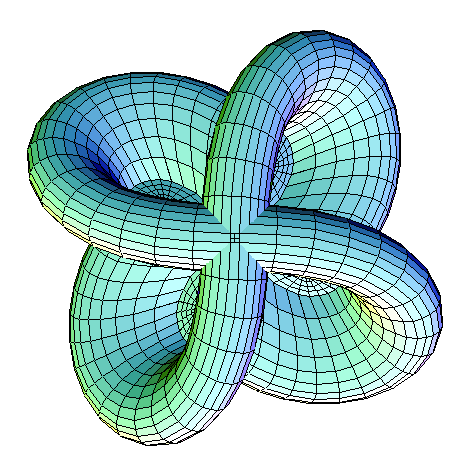
In differential topology, sphere eversion is the process of turning a sphere inside out in a three-dimensional space (the word eversion means "turning inside out"). Remarkably, it is possible to smoothly and continuously turn a sphere inside out in this way (with possible self-intersections) without cutting or tearing it or creating any crease. ...
fair idol
plain raven
idk are you asking for more specific questions on important topics
Thanks I appreciate that answer.
I mean that in the broadest possible way. Specific questions are welcome. I'm really just probing around for any recommendations available.
plain raven
pearl holly
btw this is so cool https://en.wikipedia.org/wiki/Sphere_eversion
i remember hearing about this when i had no idea of any pure math stuff and being blown away
 plain raven
my friend told me that originally the proof was nonconstructive, they just showed that the space of deformations was path connected
pearl holly
I don't even understand the proof lmao
pearl holly
pearl holly
btw this is so cool https://en.wikipedia.org/wiki/Sphere_eversion
is there any source that describes wikipedias proof in more detail?
shadow charm
pearl holly
https://www.youtube.com/watch?v=wO61D9x6lNY
that video is blessed
 tawdry widget
plain raven
my friend told me that originally the proof was nonconstructive, they just showe...
tawdry widget
plain raven
my friend told me that originally the proof was nonconstructive, they just showe...
What is the space of deformation?
Any book about it?
plain raven
im not a good person to ask about this
tawdry widget
😂
plain raven
in your opinion, what is a resolution
abstractly
also does anybody gave good exposition on fibrant/ cofibrant replacement
plain raven
ok lol so the first and second question are equivalent in your opinion that's fine
i'm not asking for a specific result, i'm asking for general exposition, what is cofibrant replacement and why do we care about it
gentle ospreyBOT
Nobody
 plain raven
can cofibrant replacement be done functorially in general
or functorially up to homotopy
 tight agate
There should be a way to motivate resolutions as "generalized filtrations"
breaking up objects into simpler objects is a pretty natural thing to do
and resolutions are somehow the right way to do it
the fibrant/cofibrant replacement philosophy came up much later to formalize resolutions, so idk if it's a good answer to "what is a resolution"
from Hilbert's POV a resolution is probably just a presentation of an object
plain raven
yeah but a presentation stops at generators and relations, to me the difference is why it keeps going after that. like why do we care about higher syzygies. i know it's naive but i just always come back to these questions hoping yo get a better understanding of why.
fair idol
Sorry if this belongs somewhere else but is there a popular alternative to hatcher?
plain raven
Maybe try the book by Tom Dieck.
I haven't read it.
Moth has been reading the book "Homotopical Topology" by Fuchs and Fomenko, he likes it.
 shy moss
fair idol
Sorry if this belongs somewhere else but is there a popular alternative to hatch...
shy moss
fair idol
Sorry if this belongs somewhere else but is there a popular alternative to hatch...
Rotman
plain raven
Rotman is really good.
fair idol
shy moss
Rotman
Thank you
spiral stratus
plain raven
Moth has been reading the book "Homotopical Topology" by Fuchs and Fomenko, he l...
Yea can recommend
Its called homotopical algebraic topology tho
hollow harbor
Fuchs Fomenko is pretty hard but covers so much ground. Also has a bit of a strange structure compared to typical alg top books.
 fading vale
I think it would have gone poorly if it was my first pass yeah
long hornet
Fuchs Fomenko also has pretty drawings
hollow harbor
etale animals
spiral stratus
ah true but its rly mostly algebraic top
hollow harbor
fuchs fomenko is a terrible choice for a first course, the best choice is definitely rotman according to server near-consensus
maiden hazel
i need help with proof of banach-alaoglu. at some point in the proof, we define a function which maps elements (functions) omega of R^E to omega_{x+y}-omega_x-omega_y (x,y are fixed). the claim is that this function is continuous, why is that so?
so this map just evaluates omega at 3 points and does basic arithmetic; i don't know what can i use to show that this is continuous,..
does this have something to do with the fact that product topology is the same as topology of pointwise convergence?
because if we have sequence of omega(n) converging to omega then we have sequence of omega(n)_x converging to omega_x so we get that the aforementioned map is heine-continuous (but do we need to consider nets?)
hollow harbor
maiden hazel
does this have something to do with the fact that product topology is the same a...
this is relevant
maiden hazel
i guess this would hold if R^E with product topology is first-countable but i have no idea how that works 😩
help, did rest of stuff i say make any sense?
hollow harbor
umm
well the topology is generated by a basis right? elements of the basis are sets where you restrict the function to open balls at finitely many points.
you can directly check continuity on this basis if you don't want to worry about size stuff
it's very similar
it's something along the lines of "if omega and lambda are close at x, y, and x+y, then the outputs of your function are also close"
but phrased in terms of this basis
hollow harbor
that's kind of the idea i suppose. I was gonna say something more local, but it's equivalent.
cause it's hard for me to think about the preimage of an interval under this map.
maiden hazel
hollow harbor
cause it's hard for me to think about the preimage of an interval under this map...
to me too
hollow harbor
hollow harbor
it's something along the lines of "if omega and lambda are close at x, y, and x+...
but i can see some open neighborhoods of each point in that preimage using this idea + the basis sets i mentioned. try toying with it.
(it's often very useful to work with these product topology / weak topology basis sets, since you have freedom to pick finitely many things that you care about and then can restrict them)
maiden hazel
i don't understand what are you trying to tell me; what basis set? if i show that images of basis sets are open i don't get continuity
basis sets in R are just intervals
maiden hazel

hollow harbor
maiden hazel
i don't understand what are you trying to tell me; what basis set? if i show tha...
the definition of continuity is "every open set has open preimage." this is exactly equivalent to "for every omega, if i look at any open neighborhood of f(omega), there is some neighborhood of omega which maps into the neighborhood of f(omega)"
this says nothing about open sets having open image
it's useful here because you understand what small open neighborhoods of points in R^E look like (the basis sets)
maiden hazel
i finally got it... just select z_1=x+y, z_2=x, z_3=y, ``U_1=<omega_{x+y}-eps, omega_{x+y}+eps>, U_2=<omega_x-eps, omega_x+eps>, U_3=<omega_y-eps,omega_y+eps>(for sufficiently smalleps) and then intersect {lambda : lambda(z_i) in U_i)}` holy shit how did i not see this 2 hours ago
aaa i'm too dumb for a math degree 😭
hollow harbor
nice!
this is particularly confusing and hard stuff to get
there's never a reason to feel bad about spending a lot of time trying to process this functional analysis stuff. it's legitimately very tough.
fair idol
plain raven
Moth has been reading the book "Homotopical Topology" by Fuchs and Fomenko, he l...
Who is moth?
plain raven
moth is just another user on this server, they're an admin. @\Moth
naywa
forget that
don't read fuchs fomenko
read Rotman
hollow harbor
*they
plain raven
Thanks, Ryc.
gritty widget
hey guys, i have a question about baire theorem for complete metric spaces. In it's proof we are choosing points from closed balls and we construct a sequence from those points. In my understanding, we are using axiom of choice to choose these points. However, I've read that we don't need AC, and that in the proof of Baire's Theorem we are actually using a weaker version, axioms of dependent choice (DC). DC states that we have a nonempty set A and relation R such that for every x in A exists some y in A such that xRy, then there exists a sequence (a_n) such that a_n R a_(n+1) for every n. I can't see how exactly this is used in the proof of baire's theorem though.
empty grove
Suppose X is the complete metric space. You want to show that the intersection of countably many open dense sets is dense. Choose an enumeration for the open dense sets U_n. We need to show that a given open set U intersects the intersection of all U_n. Let A be the set of triples ℕ × ℝ × X, where the first entry is supposed to keep track of how far into the inductive selection you are, the second keeps track of the radius of the ball at that stage, and the third is the center of the ball. Then you can relate (n, r, x) R (n+1, r', x') according to the rules you have seen. DC then gives you the sequence of these triples, from which you can then extract the sequence of closed balls that you need
gritty widget
so what exactly is the relation here?
empty grove
So replace ℝ with positive reals above
Otherwise this wouldn't work
Suppose you have a triple (n, r, x)
If closure of B(x,r) is not in the intersection of the given open set with the first n open sets then (n,r,x) is not related to anything
If it is in this intersection, then (n,r,x) R (n+1, r', x') iff
Closure of B(x',r') is contained in B(x,r) intersected with U_(n+1)
empty grove
empty grove
If closure of B(x,r) is not in the intersection of the given open set with the f...
This is already a problem for the given statement of DC oops
Ok so instead of ℕ × ℝ × X
Take the subset of this product which is
{(n,r,x) | r is positive and the closure of B(x,r) ⊂ intersection of U and U_1, ..., U_n}
empty grove
empty grove
If it is in this intersection, then (n,r,x) R (n+1, r', x') iff
Closure of B(x',...
On this, define the relation as this
Then because each U_n is open dense, and finite intersections of open sets are open, you can always find a triple related to any given triple
Then apply DC
gritty widget
hm ok there's a lot to think about
so in a way that this proof is normally formulated, does it use axiom of choice?
because it just says we can choose points
empty grove
Yes, if you use AC then you can use DC
You need some form of choice
Baire is equivalent to DC
gritty widget
ok, if I understand it correctly, the regular proofs use AC, but we can use just DC, if we reformulate the proof like you did
right?
empty grove
Idk what regular proof you have seen, because I've only seen the one I gave, except it wasn't written this way
If you are inductively constructing sa sequence by choosing each next point, then you are using DC
But using DC and using AC are not mutually exclusive
DC is a consequence of AC
gritty widget
the proof in my book was somehow similar to the proof here
page 2/3
except that it didn't use the nested set theorem
but it said we choose a point from each of these nested sets
and because this sequence is cauchy and the metric space is complete
we have the point in the intersection that we need
 empty grove
So they assume we've chosen sets up to n-1
And then show that a choice is possible for stage n
That's where they use DC
It's not direct from AC
AC is about simultaneously choosing all the things
DC is about choosing 1 thing, then choosing the next based on the first choice, and so on
Hence the dependent
Like here they use DC because they've only shown that you can construct arbitrarily large finite sequences
Given any finite sequence, you can add another thing at the end
But DC then says that there is an infinite sequence in such a case
gritty widget
but how is the next choice dependent on the previous one? Doesn't it only matter which set you are taking it from at every step, not what you chose previously?
empty grove
empty grove
You choose a point of U_n-1
Here's the dependence on the previous step
gritty widget
hm the proof in my book first constructed closed balls $\overline{U_1} \supseteq \overline{U_2} \supseteq \ldots$ v $X$, such that $\overline{U_i} \cap A_i = \emptyset$ for all $i$ and $\text{diam}(U_i) < \frac{1}{i}$. After that, it chooses $x_i$ in every $U_i$, gets a cauchy sequence $(x_i)$, which converges in $X$ because of completeness
gentle ospreyBOT
Matejp1
 empty grove
Then DC is used while constructing the balls
empty grove
DC is choice
gritty widget
i mean is any choice used at the step i sent
this last paragraph in constructing cauchy sequence
empty grove
Ah you can use choice there but it's not necessary
Because you could instead say "choose x_n to be the center of the ball U_i"
Choice is used when you choose points arbitrarily
If you pick a canonical thing then no choice
gritty widget
ooh ok great
but now i'm a little bit confused again
because the steps in constructing these balls
is similar to constructing sets for locally compact hausdorff spaces
do we also use dc to prove baire's theorem for those spaces?
gritty widget
ok seems like i had a lot of things wrong
empty grove
You could if you were constructing a finite sequence
gritty widget
just out of curiosity, is baire's theorem for locally compact hausdorff spaces also equivalent ot DC?
gritty widget
ok great thank you so much
 long coyote
Show that if $A$ is a retract of $X$ then $H^n(X;G)\approx H^n(A; G)\bigoplus H^n(X,A;G)$.
gentle ospreyBOT
亜城木 夢叶
 long coyote
Consider the long exact sequence,
$$\cdots\to H^n(A;G)\to H^n(X;G)\to H^{n}(X, A;G)\to H^{n-1}(A;G)\to\cdots$$
gentle ospreyBOT
亜城木 夢叶
 long coyote
the sequence is exact because retraction is surjective and inclusion is injective, not sure how to continue
lunar yoke
long coyote
the sequence is exact because retraction is surjective and inclusion is injectiv...
Since A is a retract of X, the inclusion A -> X is a split mono. Functors preserve these, so H^n(A;G) -> H^n(X;G) is a (split) mono as well. Then by exactness of your LES you get that the boundary morphism is 0, so you have a SES 0 -> H^n(A;G) -> H^n(X;G) -> H^n(X,A;G) -> 0 which is split since the first map is a split mono.
 vast estuary

(convention: domain = open set)

Why is h a homeomorphism?
Definition of polycircular
 shadow charm
vast estuary
shadow charm
vast estuary
The absolute map is closed and surjective so since h is the induced map it must be a homeomorphism I think
Maybe I’m is wrong because D being poly circular doesn’t impact the argument
For the => direction of the conjugacy part I want to say that f is homotopic (with base point preserved) to g after conjugating by the loop that follows the path of f_t(s_0) where f_t is a free homotopy from f to g

I’m having trouble justifying why this is true though even though it’s intuitive
empty grove
Just define the homotopy lul
x% along the homotopy, follow x% of the path, do what the circle do at x% of the circle homotopy, then come back along path
shadow charm
I’m not sure I understood that 🤔
empty grove
The homotopy is a function from the cylinder S^1 x I to X. You gotta define a basepoint preserving homotopy from the cylinder to X. On the cylinder itself, let C(t) circle at height t, and L the vertical line from the basepoint (1,0) to (1,1). Then the inclusion of C(0) is basepoint preserving homotopic to L C(1) L^-1. You should be able to see the homotopy from this hopefully 
This is all because I refuse to write
H(x,t) = { a bunch of cases
vast estuary
shadow charm
The absolute map is closed and surjective so since h is the induced map it must ...
Could you elaborate?
empty grove
empty grove
The homotopy is a function from the cylinder S^1 x I to X. You gotta define a ba...
but like if you can see this homotopy on the cylinder itself, then you can compose stuff to get this in general
shadow charm
So it’s because they’re homotopic within the cylinder that it induced a homotopy in X?
shadow charm
vast estuary
Could you elaborate?
By universal property of quotient if you have a surjective open/closed map f from X to Y such that x_0~x_1 implies f(x_0) = f(x_1) then X/~ is homeomorphic to Y
empty grove
Yes, you just want a map
S¹ ∧ I → X
Which is f on the bottom and pgp^-1 on the top where p is the path of the basepoint along the homotopy
And if you can do this for the cylinder then you have
S¹ ∧ I → S¹ × I
Which is C(0) on the bottom and LC(1)L^-1 on the top
And now compose this with the orginal homotopy to get exactly what was needed
Or you can literally just write down the homotopy explicitly
It shouldn't be S¹ ∧ I it needs to be I^+ which I plus extra basepoint
It's S¹ × I but you collapse the line L to signify that the whole line has to map to the basepoint
shadow charm
I’m struggling to see how S^1 smash I^+ is like collapsing L
Sorry I’m pretty uncomfortable with these operations on spaces
empty grove
It is cylinder disjoint union circle but you collapse the circle union L
shadow charm
Why the need for the extra circle though?
Can’t you just quotient along L straight away?
empty grove
Otherwise it's not a smash product lol
shadow charm
Yeah but why use a smash product in the first place
empty grove
It's just useful to write in terms of smash product because then you can use smash hom adjunction
vast estuary
shadow charm
By universal property of quotient if you have a surjective open/closed map f fro...

this is what the universal property says tho
empty grove
But yeah here I was just trying to make it shorter to write for myself
vast estuary
no mention of homeomorphism
shadow charm
vast estuary
no mention of homeomorphism
If the map is open/closed and surjective Y is also a quotient space with quotient map f so that you can induce the map between Y and X/~ both ways
vast estuary
hmm right
shadow charm
So lemme get this straight you take a map from S^1 x I to X by sending each point along the circle C(t) to where it would normally be sent for the homotopy map but send the points along L to x_0 so that we get an induced map from S^1 x I / L to X? @empty grove
Wait no I’m not making sense the first map wouldn’t be continuous
Ah no so it’s rather you have a base point preserving homotopy C_t from C(0) to LC(1)L^1 which gives us a map S^1 x I -> X by sending C(t) to where C_t (C(t)) would be sent via the free homotopy, and this induced a map S^1 x I / L -> X
empty grove
Yep
You do the homotopy on the cylinder to get a map into that then compose with the original free homotopy
shadow charm
This is cursed
empty grove
The way I've described it is cursed lmao
shadow charm
It’s annoying cause it makes intuitive sense that it should work 😭
empty grove
I was avoiding typing too much
But Hatcher does this same homotopy in a couple places in the text
So you have encountered it already probably
Lemme find
shadow charm
I mean this the first section of first chapter (I skipped the exercises from chapter 0 will get back to them when I’m more comfortable)
empty grove
Yes this is in 1.1
Lemma 1.19
I gave the same homotopy if you work out what is happening
empty grove
Nice
empty grove

empty grove
I don't get why that claim in the proof is true

Does colimit imply that all inclusions have open image?
But it feels like the colimit of [0,1-1/n] should be [0,1) so I am not sure what to do
lunar yoke
empty grove
I don't get why that claim in the proof is true <:catThink:526983414226747393>
Yeah I dont think this holds for general spaces
It does for hausdorff spaces tho

An even more general statement and i think counterexample to the case for arbitrary spaces is at the start of chapter 2.4 of Hoveys' Model categories
empty grove
Damn, I guess we are assuming all is compactly generated then
empty grove
lunar yoke
An even more general statement and i think counterexample to the case for arbitr...
I will look it up, thanks
lunar yoke
lunar yoke
It does for hausdorff spaces tho
I had to use this for an exercise sheet recently, what i wrote here is just a simpler version of his statement 2.4.2
lunar yoke
empty grove
I don't get why that claim in the proof is true <:catThink:526983414226747393>
you can make this work for general spaces though if you use the mapping telescope of the X_i instead of just X, we had this as an exercise
its definitely not a "follows directly" though imo
you have to take a lot of care with the basepoints
empty grove
Idk what a mapping telescope is
 empty grove
ok makes sense
lunar yoke
hmm im pretty sure i read somehwere the whole point of using the mapping telescope is that it doesnt work for X in general
may be mistaken tho
empty grove
So if all the inclusions are cofibrations then we can say that the mapping telescope is a retract of colimit x I? Something from that?
lunar yoke
oh yeah nvm if they are all cofibrations then the mapping telescope is homotopy equivalent to the colim
and yes i think you give a nice map into X x I or X x [0,infty)
lunar yoke
lunar yoke
and yes i think you give a nice map into X x I or X x [0,infty)
the idea for this is in hatcher on page 138, lower half
empty grove
lunar yoke
oh yeah nvm if they are all cofibrations then the mapping telescope is homotopy ...
Wait isn't that true always? Like the mapping cylinder always retracts to the codomain, this feels like the same thing?
oh no I see
The colimit itself doesn't really sit in the telescope
I will probably have to read more to understand everything that was said 🥴
Thanks 
lunar yoke
yeah i also still dont reallly know about homotopy limits and colimits, even though it kind of lurked in the background for a lot of exercises we had
 feral copper
Hi! Anyone having some reference in mind that deals with the Guillou-Marin congruence? Somehow I couldn't get access to the original paper...
It (supposedly) states that
sign(M⁴)-e(F²)=2K(F²) mod 16
where sign is the signature of the 4-fold, e is the Euler number and K is the Brown invariant, with F² an embedded surface
gritty widget
how would I go about determining the fundamental groupoid of the real number line with the discrete toplogy
 gaunt linden
Well, with the discrete topology the only paths are constant, so there won't be much going on ...
gritty widget
ahh okay
i'm quite unfamiliar with how the choice of the topology affects what paths are possible
 coarse night
in C say K is connected and K^c (complement) is also connected, can we say that K is simply connected?
 true garden
Hello. Can you please intuitively explain why a linear ordered topological space is normal?
empty grove
flint cove
Is there any criterion for when an inclusion A->X induces an injective map in th...
Quite simple really 
 lunar yoke
empty grove
Quite simple really <:smugsmug:812884290282848266>
lunar yoke
empty grove
Quite simple really <:smugsmug:812884290282848266>
is this May?
empty grove
Ye
flint cove
empty grove
Quite simple really <:smugsmug:812884290282848266>
Lol this reminds me of the „now apply HELP to this diagram“ in May
plain raven
empty grove
Quite simple really <:smugsmug:812884290282848266>
ah yes
gritty widget
Is there a (simple) example of a countable metric space thaz isn't locally compact?
Now that I think of it, Q with euclidean topology is not locally compact, right?
lunar yoke
gritty widget
Now that I think of it, Q with euclidean topology is not locally compact, right?
yes, since for example in every neighborhood of 0 you can find a cauchy sequence that does not converge
 sage agate
$D = {(x, y) \in \mathbb{R}^2 \ | \ (x, y) \neq (0,0)}$ is this set open ? closed ? both ? neither ?
my guess is that it's open (since every point is an interior point), and it's not closed (since it doesn't contain the origin which is a boundary point)
gentle ospreyBOT
Sacha
 lunar yoke
sage agate
$D = \{(x, y) \in \mathbb{R}^2 \ | \ (x, y) \neq (0,0)\}$ is this set open ? clo...
lunar yoke
sage agate
$D = \{(x, y) \in \mathbb{R}^2 \ | \ (x, y) \neq (0,0)\}$ is this set open ? clo...
yes thats correct
but saying that "every point is an interior point" is kind of just pushing the problem along, not really solving it
if this was an exercise, you'd probably have to explicitly give a neighborhood contained in D for each point in D
or some other argument
sage agate
yeah what i wrote isn't rigorous, i just wanted to be sure i started on the right track since my intuition is really bad haha
thank you!
gritty widget
i am trying to come up with a couple of examples - topological groupoids that are only one of topologically principle or effective but not the other (And perhaps one that is both) but I need some assistance lol
true garden
Hello. Can you please intuitively explain why a linear ordered topological space is normal?
 keen urchin
just finished an exam in topology, but I could not do part c) here. does anyone have an idea how to do this?

 glass ermine
you've already shown that it's a continuous surjection so you'd just need to prove that f^-1(V) is open => V is open
I think
empty grove
✓
hollow harbor
Is this different from showing f is an open map?
empty grove
Yes
hollow harbor
i guess that's harder
empty grove
Might not be true
hollow harbor
I never remember how any of these inclusions go
I thought a quotient map was essentially defined to be an open continuous surjection
empty grove
if only 
hollow harbor
Hmm, I guess it is the definition Wew gave according to wikipedia.
Just trying to see the counterexample
empty grove
Counterexample to?
hollow harbor
uhh, it's obviously just something that squeezes an open set down to a point. ok
hollow harbor
empty grove
Counterexample to?
to quotient map iff continuous open surjection
glass ermine
that's the only definition I know of for it really
empty grove
hollow harbor
uhh, it's obviously just something that squeezes an open set down to a point. o...
Not sure if this works then
hollow harbor
why not?
empty grove
Needs continuous
So not in R^n at least
Like you need to show existence of such a map
hollow harbor
if you quotient [0, 1] to [1/2, 1] by identifying everything in [0, 1/2), the map is the one that sends [0, 1/2] to 1/2, the map is not open, but as long as inverse images are open, so are the original sets in the target.
empty grove
Oh right nice
keen urchin
glass ermine
you've already shown that it's a continuous surjection so you'd just need to pro...
yes, but actually doing that was harder than it seemed for me.
I couldn't show that g is an open map, maybe a closed map?
glass ermine
rip, I'm not too sure how you'd go about doing it
yeah the condition f^-1(C) closed => C closed is equivalent so you could do that
keen urchin
if g is a closed map then C in X closed implies g(C) is closed
do i have to use hausdorff somewhere maybe?
empty grove
Perhaps try this
X → product_{R is good} X → product_{R is good} X/R
Since X is Hausdorff the first map is closed and then hopefully the second map is a quotient map by using naturality in some way and you'd be done
Wait X/R is Hausdorff not X
glass ermine
Moldi you can't just "natural" these things away
empty grove
watch me
glass ermine
keen urchin
maybe there's some missing information. that X is compact or something
empty grove
But for maps from compact to hausdorff spaces continuous surjection implies quotient in general
seems too easy
Maybe k-ify X then use this argument
keen urchin
we haven't learned what k-ifying is so thats doubtful
 zinc hearth
I think moldi is the only one who does
 wise walrus
Can someone help me understand how the uncountable infinite product topology of R, can also be identified by the set of all functions with domain/codomain R?
When I see this I really don't understand how single-variable functions relate to this massive un-indexable product of R
This isn't the exact same question, but this kind of explination kinda helped a little: https://math.stackexchange.com/questions/167630/infinite-product-space
I really have trouble thinking about uncountable product spaces
 rancid umbra
how is the uncountable product of R defined?
wise walrus
sorry, If my latex is right it's $\Pi_{i\in\mathbb{R}} \mathbb{R}$
gentle ospreyBOT
darkninja175
 wise walrus
yes, that's it
empty grove
wise walrus
Can someone help me understand how the uncountable infinite product topology of ...
Do you just have to show a bijection between these sets?
Because otherwise you gotta give a topology to the function space
rancid umbra
gentle osprey
**darkninja175**
but this has an actual definition
wise walrus
This is a preamble to a question I'm working on, so moreso I'm just looking for like how to think of it
The product topology is implied, at least in my course
I don't know if it's normally implied by convention
So for example, I understand in this context that by definition an open set in this product is the product of subsets of R, where only a finite number of them are proper.
empty grove
wise walrus
I don't know if it's normally implied by convention
It is
wise walrus
I'm wondering how this kind of open set could be represented in the context of representing $X = \Pi_{i \in \mathbb{R}} \mathbb{R}$ in the form of the set of all functions $f:\mathbb{R} \rightarrow \mathbb{R}$
gentle ospreyBOT
darkninja175
 wise walrus
empty grove
It is
wise walrus
empty grove
It is
thanks
empty grove
The bijection is like given a tuple in the product, define function f as f(i) = ith coordinate of the tuple
rancid umbra
typically, $\prod_{i\in I}X_i$ is defined as $$\left{f:I\to\bigcup X_i:\forall i\in I(f(i)\in X_i)\right}$$
gentle ospreyBOT
c squared
 rancid umbra
it should be immediate from there since I = R in this case
assuming the axiom of choice
wise walrus
I'm sorry c squared, but that formula kinda confuses me more I don't really understand the nested set inclusion notation on the right there, the $I(f(i) \in X_i)$
@empty grove that makes sense to me. So we are almost splitting every real value in the function's image into it's own dimension within $X = \Pi_{i \in \mathbb{R}} \mathbb{R}$? As a single (un-indexable) tuple?
gentle ospreyBOT
darkninja175
 empty grove
Yes
What c squared is saying is that usually tuples are defined to be functions in set theory
So the bijection I have given is actually just identity in that view lol
Like the spaces are equal by definition then
wise walrus
So, how would a single function $f:\mathbb{R} \rightarrow \mathbb{R}$ relate to the definition of an open set in $X = \Pi_{i\in\mathbb{R}}\mathbb{R}$?
Like if we wanted to express an open set in $\Pi_{i\in\mathbb{R}}\mathbb{R}$ via some set of functions. It can't just be one function right? Because an open set in $X$ can only have a finite number of indicies with proper subsets of $\mathbb{R}$.
gentle ospreyBOT
darkninja175
 empty grove
I do not understand the question
The open sets are the ones in the definition of a product topology
If you are asking what the open sets in the function space look like
I don't know what topology you are putting on that space (usually it would be the product topology itself so that's the answer in that case)
wise walrus
Hmm okay. So what I've been wondering is a preamble to the question I'm actually trying to answer, which is showing that the set of all $U_{f,\epsilon} = \Pi_{i\in\mathbb{R}}(f(i)-\epsilon, f(i) + \epsilon)$ Forms a basis for the set of all bounded functions (subset of the set of all functions of course).
So in my head at least there's this kind of mismatch between representing elements of the set as this infinite product, and representing them as a function. Does that make sense?
gentle ospreyBOT
darkninja175
 empty grove
Yes that's where the boundedness comes in
The set of bounded functions is a subset
So you have to take the subspace topology
And argue that then this is a basis
wise walrus
Yeah, so take the subspace topology of the product topology we mentioned. Then I guess I'd have to show what an arbitrary open set in the noted subspace topology looks like, and then show that it can be formed by $U_{f,\epsilon}$ sets
gentle ospreyBOT
darkninja175
 wise walrus
Oh, sorry. I just reread the question and the question states that it forms a basis for some topology on the set of bounded functions.
So.. a proof will need to be more abstract
empty grove
oh that makes it much easier
You just gotta check that this satisfies that definition of a basis
wise walrus
So I need to keep it super abstract, assume some general topology tau on our set of bounded functions. then go by the definition of a topology to pick out an element and use the definition of a basis to construct it from the given proposed basis elements
empty grove
Wait have you seen any criteria for a set to be a basis for some topology?
Union should be whole set, intersection of 2 elements should be a union of elements
wise walrus
... I've probably seen that yeah. That does make it easier
Yeah I think going back over my course notes will help a lot lmao, thank you @empty grove and @rancid umbra for your time !
 pallid lion
is anyone here aware of some type of factorization theorems for topological spaces that help to classify if factors of cartesian products are homeomorphic if the product is homeomorphic.
Like some type of condition that allows the implication
if UxV is homeomorphic to WxX and U is homeomorphic toW, then V is homeomorphic to X.
this statement as it stands has simple counterexamples using cardinalities, but maybe if one is able to work with some sort of path-connectedness ?
plain raven
it sounds very difficult to come up with such a theorem tbh
It doesn't sound plausible to me, tho i hate to be pessimistic
pallid lion
well, I assume you're probably right, or at least it seemed like sth that was just asking for countless pathologies one would have to work around, but maybe there was some similar statement out there...
plain raven
what about if $U \times V$ is homeomorphic to $W\times X$ and $U\cong W$ by a homeomorphism commuting with the obvious projections $U\times V\to U$, $W\times X\to W$
gentle ospreyBOT
diligentClerk
 plain raven
that's much stronger
gentle ospreyBOT
Nobody
 true garden
Hello. Can you please intuitively explain why a linear ordered topological space is normal?
empty grove
Well since you have asked thrice
Is there some part of the proof that you don't intuitively understand?
Suppose A and B are disjoint closed subsets, then write them as union A_i and union B_j of connected components. For each component you enclosed it in an open subset whose closure doesn't intersect B.
 west spindle
we don't require either union to be countable, do we?
empty grove
Nah
west spindle
hold on, how do we know that for each A_j there exists an open subset U_j containing A_j but disjoint from B?
empty grove
You gotta choose the 2 endpoints of the open interval containing this A_j. For the lower one, consider all the B_i which are below A_j. Take the set U of their suprema (uh oh might have to complete the order for this) and then the supremum of U is in B so is strictly smaller than the inf of A_j. Now pick something in between (or if there is nothing then inf of A itself)
Oh in the completion, A_j may no longer be closed
so it may happen that inf A_j = sup U
Wait if you take Q, then (-infty, pi) and (pi, infty) are closed disjoint but not open
Isn't that a counterexample?
wait
bruh they aren't closed ofc lul
no I am just confused
They are clopen
ok so this is doable by just handling these 3 or 4 cases
    define a = x.
there is nothing in between:
define a = inf A_j```That's actually just 2 cases lul
and then A_j is in (a, infty) whose closure is at most [a, infty) and so doesn't intersect any B_i that are less than A_j
Do this on the other side as well
And then intersect the 2 sets you get
So intuitive 
(a, infty) here is in the completion, but when you go back to the original space, (a, infty) intersected with that remains open
true garden
Thanks. However, I think I am not smart enough to understand your intuitive explanation.
cosmic beacon
I'm really struggling to get good intuition for what $H_1(S^1)$ looks like. I understand the proof by the homology LES that $H_1(S^1)\cong\bZ$, but I don't understand what the generator of $H_1(S^1)$ is. Could someone help me build some intuition?
gentle ospreyBOT
@cosmic beacon
 cosmic beacon
I'm referring to specifically singular homology if it isn't obvious
empty grove
It's the identity map as a singular simplex (the circle is homeomorphic to the standard 1 simplex)
cosmic beacon
For example, consider the $1$-simplices given by $\sigma_1:I\to S^1$ maps $t\mapsto e^{2\pi it}$ and $\sigma_1':I\to S^1$ maps $t\mapsto e^{4\pi it}$. Unless I'm doing something wrong, they're actually homologous, which is not something I'd expect. Specifically, we can write:
[\sigma_1-\sigma_1'=\partial\sigma_2-\partial\sigma_2']
where $\sigma_2:\Delta^2\to S^1$ has boundary $\sigma_1-\sigma_1'+c_1^1$ and $\sigma_2':\Delta^2\to S^1$ is constant at $1$ ($c_1^1$ is the constant path at $1$).
gentle ospreyBOT
@cosmic beacon
 cosmic beacon
empty grove
It's the identity map as a singular simplex (the circle is homeomorphic to the s...
cosmic beacon
empty grove
It's the identity map as a singular simplex (the circle is homeomorphic to the s...
How is the circle homeomorphic to the standard 1-simplex which is a closed interval?
empty grove
oops you're right