#point-set-topology
1 messages · Page 217 of 1
 sweet wing
 gentle ospreyBOT
a cute cat ٩(˃̶͈̀௰˂̶͈́)و
 sweet wing
this means your homotopy is a homotopy from a constant map to the evaluation at 1
 cold vine
Ah okay thanks!
cold vine
I have that the inclusion from A to X induces injective map between fundamental groups. From this should follow that $\pi_2 (X,A)$ is abelian, but I'm stumped on how to show this. I do have the exact sequence for a pair and bijection between the second homotopy group and $[ S^0, \Omega M i]$ where Mi is the homotopy fiber of the inclusion. But I don't see how these help
gentle ospreyBOT
PAHUS
 cold vine
Yeah
cold vine
All that I got was that subsequence $0 \rightarrow \pi_1 (A) \rightarrow \pi_1 (X) \rightarrow \pi_1 (X,A) \rightarrow \dots$ by the injectivity of the inclusion
 marsh forge
latex pls render
cold vine
magic words 😄
gentle ospreyBOT
PAHUS
 gentle ospreyBOT
bored and salty
 marsh forge
i shouldve labeled these lol
okay
so
whats the kernel of the first map
not a trick question haha
cold vine
It's the $\pi_2 (A)$ right ?
gentle ospreyBOT
PAHUS
 marsh forge
no
wait
what
im confused by the question
do you mean pi1A?
Sorry Sorry
last map
not the first map
i always read these backwards in my head
this is why i shouldve labeled lol
Okay whats the kernel of $\pi_1(A)\to \pi_1(X)$
gentle ospreyBOT
bored and salty
 cold vine
Ahhh right 😄 it's the trivial paths since it's an injection
gentle ospreyBOT
bored and salty
 marsh forge
So the kernel of the same map is?
cold vine
So its the whole group right?
gentle ospreyBOT
bored and salty
 cold vine
The kernel of the last map so it's surjective
gentle ospreyBOT
bored and salty
 marsh forge
(that is relevant to this problem in an obvious way)
cold vine
Abelian?
marsh forge
Yes!
Okay
So to summarize
$\pi_2(X,A)$ is recieves a surjection from an abelian group
gentle ospreyBOT
bored and salty
 marsh forge
Im not sure how your group theory is
but do you know why we can conclude the desired result?
I’ll post a lemma below if not
||If G is abelian and G->H is a homomorphism then the image of G is in the center of H||
cold vine
Ah alright I didn't remember that one but it does make sense
cold vine
Okay thanks a lot, that helped so much. These higher homotopy groups have so many definitions that I get overwhelmed 😄
marsh forge
Yeah my advice is like
even topologists are overwhelmed by a lot of it
so you should always try out all the algebraic tools first
cold vine
Yeah that seems to work more often than not. Thanks so much ^^
marsh forge
(its by design everything else is too hard lol)
 wanton marsh
marsh forge
||If G is abelian and G->H is a homomorphism then the image of G is in the cente...
wanton marsh
marsh forge
||If G is abelian and G->H is a homomorphism then the image of G is in the cente...
um what
marsh forge
what
wanton marsh
so what if I map Z/2Z into S3 by mapping 1 to one of the transpositions
marsh forge
Oh maybe I misphrased that
wanton marsh
Z/2Z is abelian but the center of S3 is trivial
marsh forge
@cold vine I tried to remember the correct statement but the important thing is a quotient of an abelian group is abelian
thanks zef, that was an oopsie
wanton marsh
I hope it doesn't break everything
marsh forge
no the proof is still perfectly correct by the first iso theorem
i tried to cite a weaker result so that he’d have to think about the algebra but i ended up mis-stating it lmao
my bad
cold vine
So here the pi(X,A) can be though of as a quotient group, or?
marsh forge
the result is that
$\pi_2(X)\to \pi_2(X,A)$ is surjective so by the first isomorphism theorem $\pi_2(X,A)=\pi_2(X)/kernel$
gentle ospreyBOT
bored and salty
 marsh forge
But $\pi_2(X)$ is abelian and all quotients of abelian groups are as well
gentle ospreyBOT
bored and salty
 marsh forge
so $\pi_2(X,A)$ must be abelian
gentle ospreyBOT
bored and salty
 cold vine
Ahhh true, true! Thanks!
gentle ospreyBOT
PAHUS
 cold vine
So I'm trying to calculate $\pi_k (S^n,S^n-1)$ when $k \leq n$. I'm making the LES for the pair, but in the case of n=k I only gain the sequence $\pi_n(S^{n-1}) \rightarrow Z \rightarrow \pi_n (S^n, S^{n-1}) \rightarrow Z \rightarrow 0$. Can I use this to calculate the group?
gentle ospreyBOT
PAHUS

 rotund thicket
Why is it in that font
cold vine
Yeah no clue 😄 woundered the same
marsh forge
my guess is its an early april fools joke
 gritty widget
seems like it
marsh forge
@cold vine yes you can do it
You need to use topology here though
You can reason about the map $\pi_n S^{n-1} \to \pi_n S^n$
gentle ospreyBOT
bored and salty
 marsh forge
Recall that how it works is it sends $S^n\to S^{n-1}$ to the map $S^n \to S^{n-1}\hookrightarrow S^n$
gentle ospreyBOT
bored and salty
 marsh forge
You want to show this has to be nullhomotopic
cold vine
marsh forge
You want to show this has to be nullhomotopic
Alright thanks! I'll try to get that
marsh forge
Here's a (correct) lemma that you might not know
||any nonsurjective map into S^n is nullhomotopic||
 sleek thicket
this is a good lemma
By combining it with Whitney approximation and sard's theorem you get an easy proof that πk(S^n) = 0 for k < n
cold vine
marsh forge
You want to show this has to be nullhomotopic
After showing that the map is nullhomotopic dont I have that the maps $Z \rightarrow \pi_n(S^n, S^{n-1}) \rightarrow Z$ the first is injective and the second is surjective and thus we have $0 \rightarrow Z \rightarrow \pi_n(S^n, S^{n-1}) \rightarrow Z \rightarrow 0$ so now I guess this is a splitting sequence but I can't seem to apply the splitting lemma. Maybe I'm lost here?
gentle ospreyBOT
PAHUS
 cold vine
Ahh, I don't think I've ever seen that one 🤔 I'll check that one out
marsh forge
you should be able to build the splitting map
from the second Z to the middle term
if thats easier
recall that as a free Z-module a Z-module homomorpshm from Z to the middle term
is fully determined by the generator
(here i keep saying Z-module rather than abelian group because it makes what is going on more clear)
cold vine
Ahh I think I see this makes sense
Thanks so much you've been a huge help! I was a bit overwhelmed this week 😛
marsh forge
np
happy to help
these are fun exercises ive not seen
but i very specifically remember learning this same splitting lemma im telling you
about a year or two ago
in the exact same setting
i was trying to get a sequence to split and someone next to me was just like its trivial
lol
cold vine
Yeah I really like our exercises, they have very nice solutions usually once you get them 😛
cold vine
marsh forge
i was trying to get a sequence to split and someone next to me was just like its...
haha thats wonderful 😄
marsh forge
okay so be nice to me
but this book i am reading asserts that there is a unique morphism from any scheme X to spec Z, which I am assuming is patched together from the maps Z->A f(1)=1 maps
but now my book is talking about schemes over a field k
but like, what kind of rings receive unital ring homs from a field?
i feel like im missing something obvious about why Sch_k makes sense to care about as a category ig
thank u for ur patience in advance
 frosty sundial
affine schemes over k are exactly k-algebras
 bitter yoke
algebras over a field for example, things like k[x]
frosty sundial
so imagine like, quotients of polynomial rings over k
frosty sundial
I think if you maybe imagine like, historically people were maybe interested in the geometry of classical varieties over the complex numbers
that would be the category Sch_C
marsh forge
Okay this makes sense to me
i think eventually Sch_C and R will be the only ones relevant to me
so ill keep this in mind
frosty sundial
yeah those are the most "concrete" in that they correspond to classical real/complex geometry
marsh forge
i cant believe that after years of getting used to S^n being in R^n+1
i have to deal with A^1_C-0 being S^1
(i see why this is true im just complaining for no reason)
marsh forge
Another question
Can someone explain the GL_n scheme
This book defines it as like
$k[...X_{ij}..., 1/det]$
gentle ospreyBOT
1547
 sleek thicket
so here's the idea max
sleek thicket
we want to define it to be the complement of the polynomial det in A^(n^2)
right?
like, what is GL(n, C) or GL(n, R)
bitter yoke
what are you even reading max
sleek thicket
it's the open subset of M(n,C) = C^(n^2) consisting of vectors (a11, a12,..., ann) where det(aij) != 0
marsh forge
Oh I see, so the zeroes of det are the things that shouldn't be in GL_n
marsh forge
okay so det is a polynomial in the X_ij and we are looking at k localized at det
sleek thicket
in scheme language, if X = Spec A is an affine scheme and f in A some function on it, we have a ring map A -> A_f which gives a scheme map Spec A_f -> X
marsh forge
bitter yoke
what are you even reading max
motivic stuff
sleek thicket
this is an isomorphism onto its image, which is the open subscheme U = { p in X : f(p) != 0 }
note: f(p) != 0 requires some interpretation, it means f is not an element of p
marsh forge
okay so Spec A_f is like, the ideals that don't get killed when we localize at f
marsh forge
Spec is proper ideals and localizing f makes the ideal all of the ring right?
sleek thicket
I think of it as like, if we make f be invertible we can't have any points where f would vanish
marsh forge
am I dumb
frosty sundial
Spec is prime ideals
sleek thicket
marsh forge
Spec is proper ideals and localizing f makes the ideal all of the ring right?
Prime ideals
And when we localize the ideals wont become 0
they'll become the whole ring A_f
marsh forge
prime ideals are proper by defn aren't they
sleek thicket
those that contain f I mean
frosty sundial
oh, yeah, sorry i thought you meant "all proper ideals"
marsh forge
no i see why thats confusing
i just mean like
it un-propers it
which is why i said kill
cuz spec wont see it
frosty sundial
yeah, ideals which contain f become unproper
sleek thicket
hopefully this gives some intuition
this is like how Gm = Spec k[x]_x = Spec k[x,y]/(xy-1)
the last term is k[x] but we're inverting the element x
in general A_f = A[y]_{yf - 1}
(compare the universal properties)
frosty sundial
I think he means A_f = A[y]/(yf-1)?
sleek thicket
in the Gm example, A = k[x]
marsh forge
nw hahaha
sleek thicket
that was really confusing lmao
Anyways point is
Spec A[1/f]
is the open subset of Spec A where f does not vanish
does that make sense?
frosty sundial
I always like to keep like, C[x] or C[x,y] in my head when thinknig of stuff like this
then I can think of C or C^2 (really, R or R^2)
and elements of the ring are sort of literally functions on the spectrum
(which justifies the notation of like, f(p) which sham used earlier for any ring A)
(elements of A are "functions" on Spec A, in analogy with the above example of polynomial functions on C^n)
marsh forge
please god tell me there is an intuition
for smooth maps
of schemes
im looking at a 5 part defn right now
sleek thicket
r i p
frosty sundial
so like if there is any good in the world
sleek thicket
idk this stuff, sorry max
frosty sundial
a map of schemes over C is smooth in the scheme sense iff it's smooth in the manifolds sense
marsh forge
that is honestly surprising
frosty sundial
err, to be safe, let me say "varieties over C" instead
a variety over C inherits a complex structure, which is automatically C^\infty because of the magic of complex geometry, so you can talk about smoothness
in fact there's a theorem which says the opposite is true -- every manifold with a complex structure is also algebraic
i.e. cut out by polynomials
(or, equivalent to one)
which isn't true for real manifolds
marsh forge
Thats cool
frosty sundial
In mathematics, algebraic geometry and analytic geometry are two closely related subjects. While algebraic geometry studies algebraic varieties, analytic geometry deals with complex manifolds and the more general analytic spaces defined locally by the vanishing of analytic functions of several complex variables. The deep relation between these s...
sleek thicket
wait
frosty sundial
see chow's theorem
marsh forge
oh no
sleek thicket
not every variety is a smooth manifold
or even a topological manifold
in the classical topology
think about y^2 = x^3
frosty sundial
oh yeah that is very true
sleek thicket
there's a notion of smoothness for varieties
which is probably a good place to start for smoothness of maps
a smooth projective variety should be a complex manifold in the classical topology
 tight agate
there's another characterization of smooth morphisms using kaehler differentials
sleek thicket
wait max I just want to stress
did my example of a singular variety make sense
like why that's not a manifold
marsh forge
i did not picture it but i would guess it self intersects or something do i need to pull up desmos
sleek thicket
,w plot y^2 = x^3
tight agate
it looks like how a kid would draw a bird
sleek thicket
yeah it's a cusp
gentle ospreyBOT


 Requested by shamrock#0598
marsh forge
tight agate
it looks like how a kid would draw a bird
Requested by shamrock#0598
marsh forge
tight agate
it looks like how a kid would draw a bird
this is also how i draw birds
marsh forge
is a smooth scheme over some other scheme or something just a scheme for which the "over" map is smooth
like all the other defns
sleek thicket
I think so?
but I only know smoothness for affine varieties lol
schemes are too hard
brofib should probably take point on smooth schemes and morphisms
@marsh forge for an affine variety, smoothness is basically the implicit function theorem
the jacobian of the defining equations has the right rank
marsh forge
maybe I should work these out at some point for intuition
tight agate
sleek thicket
the jacobian of the defining equations has the right rank
this is worth working out in detail
sleek thicket
yes i have forgotten the condition but keeping saying that slogan on here so maybe I should work it out in detail 
marsh forge
does etale also have a variety specialization thats easy to picture
tight agate
yes
tight agate
I think roughly
A --> B is etale
(A and B are rings btw)
if B is a finitely presented A-algebra
and a flat A-module
and B is a direct summand of B (x)_A B (we have an idempotent e in B (x) B with B(x)B[e^-1] iso to B)
sleek thicket
i would not call this particularly easy to picture
tight agate
hold on
now if we specialize to when A is a field
actually no
specialize to the case where we explicitly have B = A[x_1, ..., x_n]/(f_1, ..., f_k)
then A ---> A[x_1, ..., x_n]/(f_1, ..., f_k)
is etale
if the jacobian is invertible
it might help to work out the case R --> R[x]/(ax -1)
where 'a' is an element of R
it might also be useful to look at this in terms of derivations
If A --> B is etale, the the module of relative kaehler differentials is zero
tight agate
tight agate
and B is a direct summand of B (x)_A B (we have an idempotent e in B (x) B with ...
this can be interpreted geometrically by trying to understand the diagonal map Spec B --> Spec(B (x) B)
it should work out to something like the image is a union of connected components of Spec(B (x) B)
(tensor over A)
tight agate
tight agate
and a flat A-module
and this should be the 'fibers varying nicely' condition
marsh forge
Okay sorry I am digesting this slowly
 tough imp
why is Max trying to Grok AG all of a sudden
sleek thicket
motivitic homotopy theory
he wants to mentor me this summer so he's trying to learn topics he thinks I'll be interested in

tight agate
I might be interested in learning motivic homotopy 
marsh forge
So
im being a bit dense bc like
all the motivic homotopy i need
has actually been simplified so you can do it without really understanding schemes much
but deep down i kinda want to like
know what is going on
tight agate
it looks pretty cool
marsh forge
i don't need to know much but I want to know something
tight agate
the stuff about block-kato/milnor conjecture
marsh forge
smoothness is like the last condition i need
 fair idol
Can anybody vouch for or against this book?
 bitter yoke
It's good
sleek thicket
It's very good
fair idol
My geometry and topology quals are over this and Hatcher. But I had never heard of this. Glad internet ppl like it
 ivory dragon
its not an alg top book
sleek thicket
Makes sense, Hatcher and this cover two very different sides of topology
So they complement eachother
sleek thicket
Lmaooooo
Get fucked
You would not like uw quals max
There's like
A van kampen problem
Maybe a de rham coho problem
And the rest is smooth manifolds
sleek thicket
Past preliminary exams can be found here in PDF format. You can review and use them as practice for upcoming preliminary examinations. Hard copies of older preliminary exams are available in the library.
The most recent posted qual
Has 1 topology problem
And 7 manifolds problems
gritty widget
so much computation
marsh forge
jesus fuck
sleek thicket
lmao
sleek thicket
don't worry max, all the manifolds people are retiring
And the biggest AT person is too
So soon there just won't be any topology
I was actually really surprised when I looked at other schools' topology quals lmao
Since they like, actually cover algebraic topology
 shut moat
so possibly dumb question
let's say you had a topological manifold
and it's one that admits a smooth structure
if I make up a single non-global chart on some patch of the manifold
can I guarantee the existance of a smooth structure that contains it?
sleek thicket
this is an interesting question
So let's think about the case of an open set in R^n
Hmm, nevermind
I don't think that's simpler
So @shut moat what if we do a dumb thing
And say
Ah no that wouldn't work....
sorry haha
I was thinking you could look at all smoothly compatible charts
But they might not be mutually smoothly compatible
If everything is disjoint
Hmm so I'm thinking of something like umm
Somehow cover the boundary by a bunch of small open sets
then like uhh
Inside those, interpolate between the smooth structure inside and the original given one outside
Somehow
And then use the given smooth structure on the rest of the manifold
Ahhh this hard fails for S^2 with the stereographic projection chart
So maybe I only want to think about the case where your original chart is paracompact
hmmm....
How fucked up can you make a homeomorphism
Maybe something which doesn't preserve measure 0
Let me reframe this
Let M be a smooth manifold
And N some other smooth manifold
And suppose we have an open injection i : N -> M
can we factor this as N -> M' -> M, where M' is a smooth manifold and the first map is an open embedding and the second is a homeomorphism
This is making me feel decidedly unfroggy
shut moat
that sounds more complicated 
sleek thicket
It's global!
I'm trying to think of invariants
And failing
I think I'm gonna concede
gritty widget
This sounds like it can be totally hard, existence of smooth structure is not a simple matter at all, right?
sleek thicket
yes, but we're given that a smooth structure exists
marsh forge
virgin smooth charts vs chad take all topological homeos at once
sleek thicket
lol
shut moat
ty anyway sham 
intuitively it feels like the interpolation thing should work if some restrictions could be made
gritty widget
can anyone link or give a short proof that $S^m\cong \partial(D^{n+1}\times D^{m+n})$ for all $m,n\geq 0$?
gentle ospreyBOT
674429069

 quasi forum
Hey all, this proof was a bit tough to clarify. I was wondering if someone could read it to see if it makes sense to them.
 gritty widget

quasi forum
oh no
gritty widget
can you put it in analysis it probably belongs more there
sorry but I just asked a q here
quasi forum
Okay. This was an assignment in topology class, so that's why I asked here.
But I can do that too
gritty widget
thanks n.n
sleek thicket
gritty widget
can anyone link or give a short proof that $S^m\cong \partial(D^{n+1}\times D^{m...
Is this homotopy or homeomorphism? It seems like the dimensions don't line up?
like the dimension of the right hand side is n+m+n+1 - 1 right
gritty widget
typo sorry it’s D^m-n
sleek thicket
ahh
Makes more sense
okay sure so D^(n+1) × D^(m-n)
Now the dimensions line up
gritty widget
ya
gritty widget
ok yes
sleek thicket
Err
Sorry closed cubes
Probably closed lol
Does that make it seem obvious to you?
D^(n+1) × D^(m-n) ≈ I^(n+1) × I^(m-n) = I^(m+1)
gritty widget
ah no i see it now
sleek thicket
Is basically my thinking
gritty widget
tyty I was looking at ranicki and he pulled that out of thin air and I was like wtf
shut moat
@sleek thicket So I posted this question in my uni's math major discord and I got a response that started with
Suppose M has a unique smooth structure up to self-homeomorphisms. Then I take your question to be: given such an M with its smooth manifold structure, and a continuous map from the open ball f: B -> M which is a homeomorphism onto its image (your "non-global chart"), is there a homeomorphism g: M -> M (that one would use to pull back the given smooth structure) such that f \circ g is differentiable?
Which sounds fairly close to what you did. I guess the way I phrased it isn't quite natural
 sleek thicket
nah I think the way you phrased it is great
more concrete
the way they wrote it is kind of condescending lol
I think what they're saying is not quite right
idk what was wrong with your original question lol
yeah, this isn't right
it's assuming that the new global smooth structure is a pullback of the old one via a homeomorphism of M
which isn't obvious to me 
shut moat
hm yeah that doesn't sound necessary
Even with that probably stronger statement, the prof couldn't come up with a contradiction 
gritty widget
is it condescending? i can't really tell
sleek thicket
it seems very hard
wait hang on
i missed the first sentence
"Suppose M has a unique smooth structure up to self-homeomorphisms"
I don't think you wanted to assume that approx?
that's why they can do the thing later on
where they translate from existence of a smooth structure to a certain map pulling it back
shut moat
yeah I didn't initially assume that
presumably it was to make the problem easier to handle
sleek thicket
Hmm
This just seems super hard haha
I couldn't devote to much time to it
I was working out the solutions to the first two homeworks for the class in TAing
not super conceptually difficult but there's a couple tricky problems and I had to learn the programming language we're using
I would offer to think about it now but I need to sleep 💤
 sleek thicket
hahaha
there's a sample solution
so usually I wouldn't
but when I took this class they were experimenting with using a different theorem prover
so I never learned coq
the ideas are all the same but I need to build new muscle memory so I can help students
shut moat
oh icic
 supple locust
I want to determine if there exists a continuous surjection from $GL_2(\mathbb R) \rightarrow \mathbb R ^2 - {(x,1/x) | x\neq 0}$.
gentle ospreyBOT
2708
 supple locust
GL_2(R) is not connected so connectedness argument probably wont help
gritty widget
supple locust
I want to determine if there exists a continuous surjection from $GL_2(\mathbb R...
hint: is there a continuous surjection of GL(2, R) onto R\{0}? ignore this i misread
supple locust
yes the determinant map
gritty widget
right
oh wait fuck i missed the complement part
mb
GL(2, R) has two connected components, but the complement of the graph of 1/x has three? maybe you can turn that into something
gritty widget
Does anyone know if this is interesting? I've been trying to think about how open sets relate to "closeness". For a topological space we can define a metric* d(x,y) to be the min{number of elements in U: U is an open set containing x and y}. *we do not have d(x,x)=0 and if our top space is infinite this can take non finite values.
I thought it might be interesting since there also is this thing about some weak condition on top spaces being weak homotopy equivalent to a finite topological space
marsh forge
I think this function would be constant for most spaces wouldnt it
gritty widget
if it is a non finite topological space you are kind of fucked
for a cw complex this would always be infinite
marsh forge
i think that last line probably kills the idea
gritty widget
i was drawing pictures like this
marsh forge
for most topologists
because its not just always infinite, I think it is constant cardinality
gritty widget

i'm really trying see, can we see with some toy examples how open sets relate to "closeness"
two points are close if they are in lots of open sets together
okay this is dead
but is there a good way to think about open sets and "closness"
marsh forge
oh
finite CW*
I think you should view the open set-lattive on a space
as like
a sieve or a bunch of nets
for capturing points
the "more" open sets two points share the "closer" they are
ofc by my earlier comments this isn't rigorous
but its how i think about it
gritty widget
okay thanks
marsh forge
this idea isn't easily formalizable really, and for good reason
take a sphere
take two "close" points
we can homeomorphically warp the sphere
to make these two points farther apart than any others, basically
marsh forge
I think connectedness is probably a better intuition
than closeness
for topologies
you care about about the way in which things are connected than about any notion of distance
gritty widget
would you like to expand on this take
marsh forge
like if I have a bunch of playdough
I can stretch it without changing topological properties at all
so distance is not really related to topology outside of the conncetion to metric spaces
but isometries are a really restricted set of continuous maps anyway
even isometries up to scalar
gritty widget
and certainly being in the same open set does not imply two points are connected
*in the same connected component
marsh forge
Yeah, but its a lot more reasonable to ask like
define $d(x,y)$ to be the smallest number of connected components of any open set containing x and y
gentle ospreyBOT
15
 marsh forge
at least this is somewhat useful
gritty widget
I've been very thrown off by this https://en.wikipedia.org/wiki/Pseudocircle
The pseudocircle is the finite topological space X consisting of four distinct points {a,b,c,d} with the following non-Hausdorff topology:
      {

        {
        a
        ,
        b
        ,
        c
        ,
        d
        }
        ,
        {
  ...
although its almost as bad as the last one
okay
lime
any time you see the word
"non-hausdorff"
throw out that example
is it
gritty widget
it makes me feel like the definition of a topological space is just crap
marsh forge
it is
theres a reason why no algebraic topologists study all topological spaces
99% of these spaces
are thrown out in the intro paragraph
of most topology books
lol
or papers
basically, topologists who aren't set theorists in disguise recognize that what we intuitively think of as a space
is a lot more restricted
than what the basic defn of a topology gives
i dont mean that as an insult
but its true
set theorists or geometers*
oh sure
they just don't take the appropriate actions
of throwing out all the bad spaces
gritty widget
it some weird sense algebraic topology and morse theory feel like abstract data analysis
in that a top space or a manifold has a silly amount of information in its definition that we do not care to look at
marsh forge
?
i very much disagree, but I think the correct perspective is also in some ways the opposite side of the same coin
topological spaces are so complicated, that trying to use all of their data is unwieldy
we invent a lot of gadgets that help us see the forest for the trees
gritty widget
if we want to actually tell the difference between two top spaces its much better apply some algebraic topology tool like a homology group and see if these important bits of information are the same rather than trying to comb through the huge amount of data in a top space
marsh forge
yeah
in that sense I suppose it is like data analysis
but be careful
often times one does have to think about the actual spaces in question
for example there was a great pair of problems PAHUS posted earlier
the first could be solved entirely algebraically
but the second needed a significant reference to the topological properties of the spaces
even though both were simply questions about algebraic invariants
gritty widget
am i right in thinking, that because haussdorf is a condition defined wrt to points, we don't really have algebraic topology tools for checking if a space is haussdorf
marsh forge
we do not no
gritty widget
marsh forge
for example there was a great pair of problems PAHUS posted earlier
ill go look for these thanks
gritty widget
yeah R^n and the point kind of stop the whole haussdorf checking
marsh forge
I mean, to be honest, we really don't have many tools for investigating spaces up to homeomorphism
only up to homotopy types
theres a reason why the Poincare Conjecture is so hard
gritty widget
morse theory really makes manifolds seem so bloated
one thing that confused me for a while when i was first learning manifolds was this image in Guilleman and pollacks differential topology

Took me so long to realise that diffeomorphic was an intrinsic notion, but nots being equivalent is purely on the ambient space
marsh forge
this is a very very hot take
but i honestly think that learning smooth stuff at the same time as basic topological stuff
is bad
gritty widget
I would agree
left me not good at doing calculations
and gave me alot of confusions like above
 fading vale
im not sure if its intrinsically useful to study but i think its an example everyone should see to understand the limits of pi_1 as an invariant
i guess of homotopy equivalence in general
actually this reminds me i need to ask a stackexchange question
WTF @sweet wing you answered my stackexchange question
thats so bizarre
sweet wing
ooo
i was typing up notes haha
then i was like
wait wtf is the proof again
and i saw the qnHAHA
sweet wing
uwu
 quartz edge
what are some applications of the covariant derivative?
the text i'm reading just kinda shoehorned the notion of vector fields into the study of surfaces
gritty widget
an almost-complex structure is integrable if and only if its covariant derivative vanishes
the covariant derivative tells you how to differentiate one vector field with respect to another, which then leads you to the notions of parallelism (parallel transport) and curvature
quartz edge
well that structure is then parallel
oh lord the tangent vectors are themselves a vector field

i dont get this tho. i thought parallelism was a local property
doesn't the parallelism of V and W depend on the vector field they inhabit, and the curve in the surface along which they reside?
gritty widget

your concerns are right
the book phrased this question a little strangely in my opinion
maybe it means "parallel along the curve (latitudal circle) shown here," as in you can parallel transport V to W along it?
i'm not familiar with the use of the word "parallel" to refer to two different tangent vectors, only for vector fields along curves / on surfaces (like you mention)
maybe the book defines what it means by that?
marsh forge
if this isnt labeled as an exercise i might guess it is rhetorical
and that reading further might clarify
gritty widget
Let $M$ and $N$ be smooth manifolds and let $F\colon C^\infty(M) \to C^\infty(N)$ be an algebra homomorphism (isomorphism if necessary). Does $F$ come from the pullback of a smooth function $N \to M$?
gentle ospreyBOT
81027201

 uncut surge
oooh i've seen this in a paper recently
gritty widget
!
uncut surge
i think this is quite a hard problem
lemme see if i can find it again, but no promises
gritty widget
thanks
uncut surge
https://golem.ph.utexas.edu/category/2008/02/question_on_smooth_functions.html good old urs asked this 13 years ago
"Natural Operations in Differential Geometry has a simple proof of this statement. It is Corollary 35.10. The preceding material in Section 35 is overkill for this result; 35.9 has an elementary proof in the “short story” in the introduction to Chapter VIII."
gritty widget
so then if C^\infty M and C^\infty N are isomorphic, M and N are diffeomorphic 
lmao that book keeps coming up
thanks!
uncut surge
i've barely ever actively looked into that book, but maybe i should, lol
sleek thicket
Good question
uncut surge
gritty widget
so then if C^\infty M and C^\infty N are isomorphic, M and N are diffeomorphic <...
wasn't there a magic way of proving this directly by reconstructing the manifold from C^infty(M), something like looking at prime ideals or so
sleek thicket
Do you want an answer or to think about it on your own?
sleek thicket
uncut surge
wasn't there a magic way of proving this directly by reconstructing the manifold...
Yup, you can totally do this
gritty widget
uncut surge
wasn't there a magic way of proving this directly by reconstructing the manifold...
right, this was sort of in mind. check out nestruev's book
sleek thicket
In the compact case it's easy
gritty widget
"smooth manifolds and observables"
sleek thicket
gritty widget
right, this was sort of in mind. check out nestruev's book
Haha I was gonna mention this
gritty widget
uncut surge
oh yes that book also was on my desk for half a year once
sleek thicket
I got really into this stuff last year
uncut surge
i never made it past the first section but i think that was the important one for me lmao
oh no i got it confused with another one
marsh forge
what is a nisnevich bitch ill kill u
sleek thicket
Tterra do you know what a locally ringed space is
gritty widget
not really
fading vale
oh no
gritty widget
i've heard the term
sleek thicket
hahaha moth fear
gritty widget
while skimming an expository paper on sheaves (emphasis on skim)
sleek thicket
So like, what is a manifold really
It's a topological space with extra data
What extra data?
If you're a fucking nerd you say "a maximal smooth atlas" or some shit
fading vale
something something sheaf of ring
sleek thicket
If you're ag brained you say "a sheaf of rings"
fading vale
haha get punked
marsh forge
a manifold is a topological space with mod 2 poincare duality
fading vale
god hsamrock thanks for RUINING MY LIFE and making me want to learn more math
sleek thicket
So you ask for a space
M
With a sheaf of rings on M
Which is locally isomorphic to R^n with the standard sheaf of smooth functions
This is a bad explanation
I'm gonna cancel this explanation
sleek thicket
yes
marsh forge
ringed spaces are just spaces with a ring valued presheaf on the open set category that satisfies the sheaf cond wrt the standard groth topology
tough imp
Just replace space with site and you can say it’s a sheaf on that site
gritty widget
sleek thicket
Do you want an answer or to think about it on your own?
so what is like, the absolute most category-brained useless way to state this result
gritty widget
i see
sleek thicket
But it's actually more
gritty widget
!
gritty widget
bijection of hom sets
sleek thicket
like maybe some objects get collapsed together
But only if they're iso to start with
have you heard of equivalences of categories?
gritty widget
i don't know the precise definition
but i could probably figure it out if i had enough time
(tell me)
,nlab categorical equivalence
gentle ospreyBOT
Search results for categorical equivalence
21 results where query appeared in body. (Page 1/2)
sleek thicket
So there's two common definitions
frosty sundial
gritty widget
but i could probably figure it out if i had enough time
it's actually kinda tricky because there's also "isomorphism of categories" which is much stronger than equivalence and not generally a good notion
sleek thicket
One is
"has an inverse up to natural isomorphism"
Wow I fucked up that statement in two ways
gritty widget
i don't know what natural means but i'll believe it
gritty widget
ok
sleek thicket
between those categories we have functors
but!
between those functors we have natural transformations
 frosty sundial
welcome to the npov
gritty widget
yeah, evaluation
sleek thicket
Right
This is sort of the primordial example of a natural transformation
We define naturality in terms of a certain family of diagrams commuting
marsh forge
(Side note, for a good intuition for equivalence of categories, think homotopy equivalence. This is justified by saying that we want both GF and FG to be homotopic to the identity. The issue is that unlike homotopies not all natural transformations are invertible, so you need to impose that as well)
 frosty sundial
uh oh, we're losing him, doctor! give him some geometry, stat!
sleek thicket
 marsh forge
So, we have therefore shown that the category of categories is actually an $(\infty,2)$-category
gentle ospreyBOT
ʎʇlɐs puɐ pǝɹoq
 frosty sundial
bring in the christoffel symbols!
frosty sundial
and the, uhh, idk what else do you do in geometry
sleek thicket
Of natural transformations
After the defintion
Anyway tterra
Naturality is supposed to capture the idea that like
You're not working with the particular details of an object
marsh forge
naturality = good vibes
sleek thicket
So you want a map F(X) -> G(X) for all X, but ideally it shouldn't depend on X
Is the intuition
sleek thicket
sleek thicket
In the case of the double dual, consider this square
for any linear map T : V -> W
You can double dual it
And it behaves well with the evaluation map
gritty widget
map Hom(V, W) -> Hom(V^**, W^**) 
sleek thicket
Sure, so that's the double dual functor
And we're asking for a compatibility between that map and the evaluation map
anyways manifolds are good and they're pretty much just rings
That's the punchline
marsh forge
(A nice way to think about an equivalence of categories is that anything you can prove diagramatically in one holds in the other)
(which is a surprising number of things)
sleek thicket
Hmm I am going to make myself pancakes
There is an equivalence of categories between pancakes and π1(X) actions
fun fact
gritty widget
this is literally my first time seriously thinking about categories so i am going to take it slow
and write things down
marsh forge
is this supposed to be some evenly covered neighborhood joke
sleek thicket
Sorry yeah this is probably too much
sleek thicket
marsh forge
is this supposed to be some evenly covered neighborhood joke
yws
marsh forge
nice
gritty widget
sleek thicket
Sorry yeah this is probably too much
dw about it
i have a lot of time
sleek thicket
But yeah natural transformations are pretty important
sleek thicket
Oh here's an example: the tangent space functor has a projection TM -> M
This is a natural transformation too
preddy cool
Geometry
Naturality here isn't that interesting though, it's just saying that the total differential of f sends T_p M to T_f(p) N
Ah here's something interesting though
Do you recognize the formula d(f^*ω) = f^*dω
"naturality of the exterior derivative"
So consider two functors
For fixed index p
Ω^p sends M to the vector space of p forms on M
And same for Ω^(p+1)
These are contravariant functors via the pullback
Right?
gritty widget
yes
gritty widget
let me digest the previous example and then get to this one
i can very vaguely see where this is going so i want to see if i can get it with a bit of work
i wanna try to formulate it myself
sleek thicket
Yup
gritty widget
(well you told me the punchline for this example but i wanna try)
ugh i just got an email about more analysis hw
sleek thicket
sorry :/
 sleek thicket
I just skipped my French class
gritty widget
also i talked to some other people in the course and they share the EXACT same complaints
it's not just me!!
sleek thicket
Today I decided to start working on my CS homework because even though I'm not interested in the course I still wanted to give it a fair shot
And that was like 3 hours ago
And I found out it was due last night
Who makes homework due on the first Wednesday of the quarter lol
I swear I checked and it was due on Friday
So
Now I'm thinking of dropping the course
Also I'm glad your comrades are validating you
gritty widget
😌
i took my sweet time writing out the previous examples in some detail
"evaluation is a natural transformation from the identity functor to the double dual functor"
"projection is a natural transformation from the 'tangent bundle functor' to the identity functor"
"d is a natural transformation from the functor Ω^p to the functor "Ω^{p+1}" (the functors here are contravariant, unlike the first two, so just flip some arrows no biggie)
@sleek thicket ty for the explanations and examples
max too



ugct arc
sleek thicket
petthewolf
if you want to understand why natural transformations are really important/why naturality is the right condition
you need a lemma
gritty widget
is it yoneda
sleek thicket
yes
sleek thicket
but it's probably not a good idea to jump into rn
gritty widget
i'm not doing a ugct arc don't worry
"natural transformations in differential geometry"
oh no
gritty widget
well soon i'll have 4 months off
sleek thicket
If you do want to learn AG, knowing category theory helps
sleek thicket
there is an essentially endless depth of categorical masturbation you can do there, but knowing the basics is actually important
gritty widget
about functions on varieties...
how to category approach analysis
oh do you want to hear something extremely worrying about that class
sleek thicket
Whenever I post in #advanced-analysis all of my algebra and cat theory knowledge just disappears
Yes
gritty widget
so both last year and this year (same prof, TAs), the last 3-4 classes were used for some intro fourier stuff
according to some people
half of the exam last year was on fourier.
if not more.
gritty widget
"at least they wrote some good papers"
it's too bad that the course eval is due before the final exam
the final exam is worth a huge chunk of the grade, i think it should be factored into the evaluations professors get
sleek thicket
gritty widget
how to category approach analysis
I got mad at my TA and tried to make my homework as difficult to read as possible last quarter

 gritty widget
grey text
sleek thicket
Also this but it's not categoryy
 gritty widget
jesus
sleek thicket
I was full of rage
gritty widget
time to learn category theory just to spite my awful analysis ta

there's going to be homework in this course which is due after the final lecture.
sleek thicket
what the fuck
That's illegal
Well Ive had that but only when there's no final
that's dumb
gritty widget
this entire course is dumb
if the course's piazza was actually anonymous
i would put my course eval there
for everyone in the class to see
!!
i can post a poll "did you enjoy this class? votes are anonymous"
sleek thicket
okay but consider
Literally just do it
Post the eval
(don't listen to anonymous internet strangers)
 wide kayak
sleek thicket
Literally just do it
wide kayak
sleek thicket
Literally just do it
reminds me of timothy gowers' article on "just do it" proofs
(for those who haven't seen, it's cool - https://gowers.wordpress.com/2008/08/16/just-do-it-proofs/ )

This post is another sample Tricks Wiki article, which revisits a theme that I treated on my web page. Imre Leader pointed out to me that I hadn’t completely done justice to the idea, and tha…
gentle ospreyBOT
ǝlɔᴉsuᴉds
 gritty widget
disregard this figured it out
gritty widget
Wow, I newly have a crush on tim gowers for his blog
wide kayak
gowers is great
does anybody know if anything can be said about homotopy classes of maps $ S^1\times \cdots \times S^1-> Y$ in terms of $\pi_k(Y)$ ?
gentle ospreyBOT
ʎʇᴉsoᴉɹnƆploɟᴉuɐW
 wide kayak
like is this totally its own thing or somehow expressible in terms of usual homotopy sphere groups?
marsh forge
My guess is that in general it would be hard to find a strong relationship
One is tempted to try to think about the tensor-hom adjunction but in fact we care about pointed maps here
A good example here is to compare homotopy classes of maps from the torus to itself
versus homotopy classes of circles to the torus
there really isn’t an obvious relationship between these two groups unless someone else knows one
sleek thicket
well it's like integer matrices vs integers right?
or no
It's integer matrices vs Z^2 hm
marsh forge
That is toral automorphisms up to homotopy
its even worse if you allow non-surjections
(for example, you can wrap a torus Z times around the hole)
its worth noting that there isn't even an (obvious) group structure here
since the torus is not a suspension or a loop space
sleek thicket
Yeah but it's a group object right?
Also nah I meant general morphisms

I remember this problem from my topology class because it was really hard and I stayed up until 3am working on it with friends in the library
I think addition of matrices should be pointwise multiplication
This problem also shows something interesting I hasn't thought of before, which is that something is a homotopy equivalence T^2 -> T^2 iff it is homotopic to a homeomorphism
marsh forge
uh
oh my god
im so dumb
i forgot that "integer matricies" doesn't mean GL
some things are just not invertible
But yeah I suppose it being a group object suffices
sleek thicket
Lmfaoooo
 cedar pebble

 long hornet
In an exercise in Lee's ITP, the phrase "product of maps" is used. Should I interpret it as if we have functions f_i : X -> Y_i (with the domain fixed), and we are considering the induced function f from X to Y1 x Y2?
Because I think that's the "proper" interpretation
sleek thicket
It's either that or it's that you have X_i -> Y_i and consider the map on the product
I don't think ITP is a book though
long hornet
I meant Introduction to Topological Manifolds
long hornet
sleek thicket
It's either that or it's that you have X_i -> Y_i and consider the map on the pr...
Oh, I see
sleek thicket
It's probably what you said
long hornet
I have another question. If A is a closed subset of X (say X is Hausdorff), does the quotient map q from X to X/A have any nice properties?
What if A is compact, for example?
I tried writing q(V) = q(V - A) u q(V n A), where V is open. Then V - A is open and is "saturated" so q(V - A) is open, but I can't say a lot about the other set.
 tropic mango
I'm stuck on a hatcher question: https://math.stackexchange.com/questions/4086485/hatcher-1-1-6-counter-example-to-bijection-between-pix-x-0-s1-x?noredirect=1#comment8444623_4086485

Mathematics Stack Exchange
We think of $\pi(X, X_0)$ as homotopy classes of basepoint preserving maps $(S^1, s_0) \rightarrow (X, x_0)$. Recall that a map is basepoint preserving iff $f(s_0) = x_0$.
Define $[S^1, X]$ to be
Here's the question: https://i.stack.imgur.com/JVisX.png
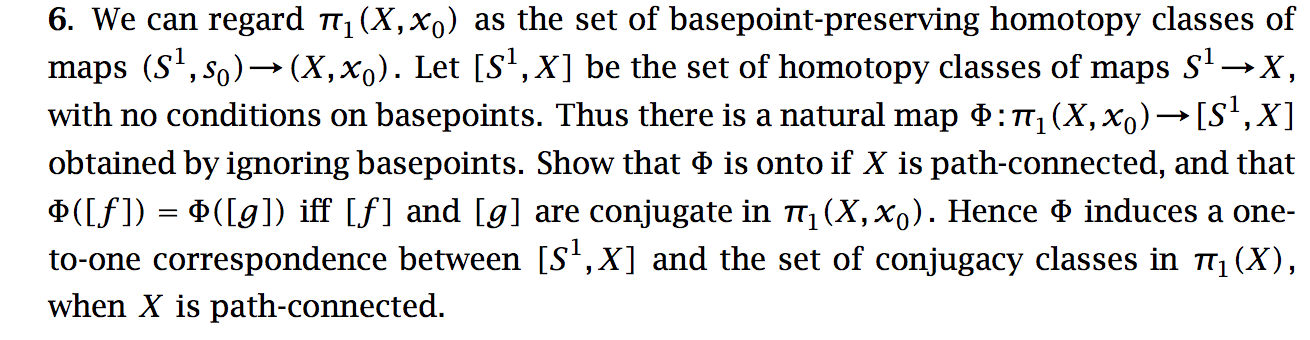
I don't understand the question, I think it is false.
For example, consider the wedge of two circles.
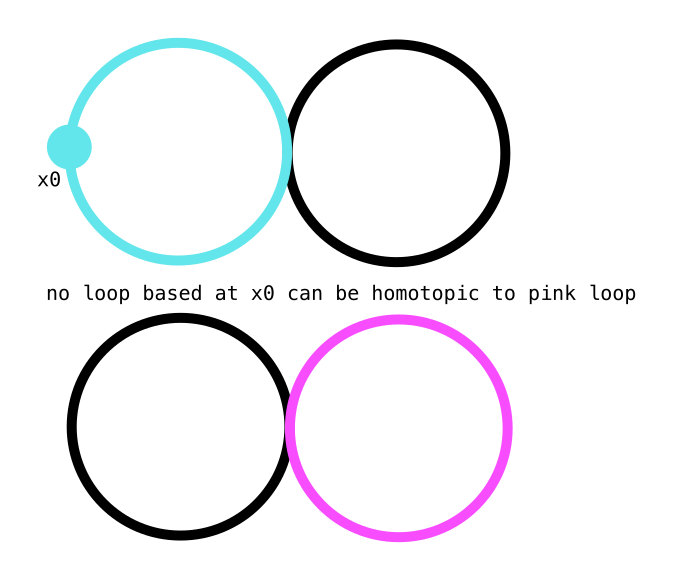
We can regard pi1(X, x0) to be all the loops based at x0.
See that the pink loop on the right is an element of [S^1, X]
but it can't be written as any loop in pi1(X, x0)
and thus Phi: pi1(X, x0) -> [S^1, X] is not surjective?
sleek thicket
I think if you go along the upper semicircle from x0 to the intersection of the circles, traverse the pink path, and then go back along the upper semicircle to x0 it'll be homotopic to the pink path
And this is a loop at x0
gritty widget
Is a subalgebra if a reductive Lie algebra abutomaticall reductive
uncut surge
https://math.stackexchange.com/a/2985608/79482 I guess by this answer, no; take some non-reductive finite-dimensional Lie algebra $\mathfrak{h}$; then by the statement in the link, it is contained in some $\mathfrak{sl}_n$, which is simple (hence reductive)
Mathematics Stack Exchange
Do subalgebras of simple Lie algebras have to be simple too?
gentle ospreyBOT
oʇɐɯoʇɹɐ˥
 gritty widget
hmm damn
uncut surge
I imagine one can find more explicit examples; But the takeaway is that simple/semisimple/reductive things are only nice with respect to their ideals, but not with respect to their subalgebras
gritty widget
I am trying to do this exercise

part (b)
exericse 1.9 tells use that L=[L,L]
so by part (a) its enough to show that L is reductive
I've found a solution on line that claims this follows form

hmm maybe i can just prove directly that Rad(L)=Z(L)
thanks
uncut surge
Yeah that may be the best approach, with the classical Lie algebras you can often do very explicit calculations
And for the simple classical ones, I think the standard proof of showing that they're simple (hence reductive) just goes by explicit calculations anyway... May not be very fulfilling tho
 fathom cave

I need help with these problems.
open sets for topology generated by subbasis in 12 are {plane itself, phi, closed disc with center on x axis, any set that is symetrical about x axis.}
i believe 11 should also generate the same topology because it contains all the circles from 12. then it follows that Basis of 12 is a subset of basis of 11
gritty widget
it really disturbs me calling them circles not discs
fathom cave
its not a disc
fathom cave
ya i can do that
fathom cave
ah my solution for 11 is wrong


 little shoal
I believe it is in Spivak’s book.
 cursive flume
little shoal
I believe it is in Spivak’s book.
cursive flume
little shoal
I believe it is in Spivak’s book.
can you refer to a page please? can't find it