#point-set-topology
1 messages · Page 209 of 1
 obtuse meteor
obtuse meteor
obtuse meteor
what happens to the topologies is given by like a certain universal property in a slice category

unironically this is the first thing I thought of I'm broken
 desert bloom
I dont' know what that is...
desert bloom
oh ok
I asked the professor on email and he told me to ask him on zoom, so I chickened out and asked here
yeah thanks
yeah
It does make sense if I don't think about topologies
Actually I think I don't really understand it, but I don't know what I don't know
so
I'll just ask the professor
he seems like a good guy, so I will probably be ok
 fading vale
obtuse meteor
what happens to the topologies is given by like a certain universal property in ...
fading vale
obtuse meteor
what happens to the topologies is given by like a certain universal property in ...
save urself
they r disjoint here anyway so introducing slice category stuff is unnecessary
desert bloom
This kind of feels like when I'm little and my parents are arguing
except this time the iq involved is significantly higher
fading vale
i cant marry faye we are both too gay for that
i guess depending on ur parents that might be accurate though
obtuse meteor
fading vale
they r disjoint here anyway so introducing slice category stuff is unnecessary
cringe
fading vale

currently having a gamer moment
it should be literally illegal to make me verify bijectivity
obtuse meteor
fading vale
i cant marry faye we are both too gay for that
but wait am I reading "Moth | not male" incorrectly???
fading vale
one or two in the sea
obtuse meteor
why pain?
obtuse meteor
fading vale
it should be literally illegal to make me verify bijectivity
please verify bijectivity of this parameterization of the genus g surface sitting in R^3 like this
have fUn
 gentle ospreyBOT
Moth | not male
 obtuse meteor
transport-simple??? This is a cringe terminology
gentle ospreyBOT
Moth | not male
 obtuse meteor
oof
fading vale
its for fiber reasons
obtuse meteor
this looks like covering space theory
fading vale
it is
fading vale
the cover comes later
obtuse meteor
actions of groupoids
fading vale

obtuse meteor
~ covering spaces
fading vale
pain
 quasi forum
Question: what does that upside down capital beta mean?
gentle ospreyBOT
Moth | not male
 quasi forum
Yea. That thing
fading vale
disjoint union
quasi forum
Ohhh. That had me confused, but that makes sense. Ty
 shut moat
also that's an upside down pi
fading vale
yea xd
anyway i have to show that $\Phi(w)(z) = \Phi(w')(z')$ implies $u = u'$ and $z = z'$ where $w$ and $w'$ are paths from $b$ to $u, u' \in U$ and $z, z' \in \Phi(b)$


 fading vale
but i mean its not like an arbitrary functor from the fund. groupoid to set has to be injective or anything...
well...
hm
ugh no idea


 obtuse meteor
have you ever considered that groupoids are fake?
fading vale
sadge
yeah idk how to show this
it doesnt even make sense to me tbh like why would Phi(w) be injective
 gritty widget
I am working through some details of SU(2) being a double cover of SO(3). I am having trouble seeing that this map is actually smooth
So we have phi:SU(2) to GL(R,3) which sends X to the matrix Ad(X)
Its make sense that this should be smooth because X is being sent to the Ad(X) and the map Ad(X) is smooth since it Y\mapsto XYX^-1 is just polynomials(/maybe rational functions since we are taking the inverse) in each coordinate
But this is just saying that the image of an element under phi is a smooth map, this doesn't imply that phi itself is a smooth map
 sinful pecan
fading vale
it doesnt even make sense to me tbh like why would Phi(w) be injective
sinful pecan
fading vale
it doesnt even make sense to me tbh like why would Phi(w) be injective
\Pi(B) is a groupoid so isn't this true by def'n of functor?
fading vale
no
functors are not by defn injective but thats not what this is saying
w is a path so its a morphism in Pi(B)
Phi(w) is a morphism in SET i.e a function between sets
but that doesnt imply that Phi(w) is an injective function
sinful pecan
ya but w as a morphism in Pi(b) is iso, so you have an iso in Set too right?
fading vale
is it?
i dont think ive ever seen a defn of isomorphisms in Pi(B)
i
i guess it is?
sinful pecan
its a groupoid so every morphism is an iso
fading vale
yea i guess that makes sense
so nvm ur right
ok checks out
blegh ok next up surjectivity
sinful pecan
same argument right?
fading vale
i guess this works likewise, for x in p^-1(U), x is in Phi(u) for some u in U and then we have a path w from b to u which gives a path Phi(w): Phi(b) -> Phi(u), Phi(w) is surjective so there is a z in Phi(b) with phi_U,b(u, z) = Phi(w)(z) = x
yea more or less
ok now time to put the topology on X(Phi)

i assume whats going on here is the coarsest topology that the phi_U, b are homeomorphisms?
 sinful pecan
it says its unique
fading vale
wouldnt it be generated by the subbasis with open sets bla bla bla
so that phi_U, b is both open and continuous for all U, b
which would be unique
sinful pecan
yes
fading vale
so yea we just have to verify that the phi_U, b and phi_V, c agree right?
like it does
agree might be the wrong terminology but u get what i mean
sinful pecan
yes gluing
fading vale
mhm
gritty widget
toe pology
 sleek thicket
simp
gritty widget
SYMPLECTIC TUBULAR NEIGHBOURHOOD
If $N \subseteq (M, \omega)$ is a Lagrangian submanifold, then there is a neighbourhood $U$ of $N$ in $M$, a neighbourhood $V$ of the zero-section in $T^*N$, and a symplectomorphism $U \cong V$ taking $N$ identically onto the zero-section. 
gentle ospreyBOT
(T*Terra, dqⁱ ∧ dpᵢ)
 gritty widget
flonshed629835071465062410
gritty widget
just diagram chase 4head
 tight agate
and compose it with another connecting homomorphism
gritty widget
just chase it backwards 5head
fading vale
gritty widget
SYMPLECTIC TUBULAR NEIGHBOURHOOD
feeling pretty tubular rn
sleek thicket
Let $E \to X$ be a vector bundle
gentle ospreyBOT
Shamrock (not a furry)
 tight agate
lol
sleek thicket
😌
Needed to get a smooth nonnegative function which vanishes iff some sections are linearly dependent
But in my problem I know there's an embedding into a trivial bundle
So I can write things wrt a frame for the trivial bundle and then take a matrix of coefficients
Err I guess the matrix isn't square
So I need to take all the minors of the matrix and then take a smoothed maximum
But it basically works
tight agate
petthecatwiggle
gritty widget
Let $F: {\mathbb{R}}^2 \to \mathbb{R}$ be a differentiable function and $ q $ a point such that $ F(q) = 0 $. If $ (\frac{\partial F}{\partial x}, \frac{\partial F}{\partial y})\rvert_{q} \neq 0 $, then there exists a neighbourhood N of point $ q $ in ${\mathbb{R}}^2 $ and a parametrized curve $ \alpha: (a, b) \to {\mathbb{R}}^2 $ such that $ { p \in N | F(p) = 0 } $ is a tray of curve $ \alpha $.
gentle ospreyBOT
Vanhousen
 gritty widget
What I've tried: I assumed without loss of generality that $\frac{\partial F}{\partial x}\rvert_{q} \neq 0$
gentle ospreyBOT
Vanhousen
 gritty widget
Then I have tried to write a definition of a limit point in $q = (x_1, y_1)$ and I got this $\lim_{h \to 0}{\frac{F(x_1 + h, y_1)}{h}} = p \neq 0 $
gentle ospreyBOT
Vanhousen
 gritty widget
But I can't seem to find a neighborhood of q such that all points in it have a value of zero
And I'm out of ideas how I shall move forward
 shy blaze
I have been trying to get an idea of how the fundamental group and the first homology group of a space are connected, and I read that the first homology group is the abelianization of the fundamental group. I was just wondering, how can you sort of visualize the elements of the first homology group?
They would have to be loops that are not commutative I guess
are 2 loops around different punctures in the punctured plane commutative? I would think not right?
gritty widget
Maybe someone has a better intution than me but I tend not to think about the actual elements in a homology group
The intutive facts you get are from looking at the dimension of the homology group in certain coefficents
shy blaze
I guess the only case Ill be looking at is the punctured disk, maybe theres some intuition on that specific case / similar cases?
gritty widget
Well the punctured disk pi_1(X)=H_1(X)=Z
shy blaze
well, not the singly punctured disk, the n-punctured disk haha
gritty widget
If map of lie algebras is an isomorphism can we conclude that the there is a surjective map between their lie groups\
gritty widget
at least if the lie groups are simply connected (there's actually an isomorphism then) but im not sure about the general question
ah yes thank you
I'm trying to work through the details of SU(2) being a double cover of SO(3)
fading vale
(here B is path connected locally path connected and semilocally simply connected)

at the end here, why does continuity of the transition maps follow from this?
 marsh forge
the preceeding statement is false, so continuity is a trivial consequence


 gentle ospreyBOT
Moth | not male

Moth | not male

Moth | not male

Moth | not male

Moth | not male
 fading vale
(w/ a map to E)
i know that E is the disjoint union of the fibers
but it shouldnt be the disjoint union of the path components of the fibers
and i dont see what the homeomorphism is here or how it can possibly be the identity
bc... path components vs points
 flint cove
Is there any reason why the classifying spaces for (say real) n-plan bundles is the classifying space of O(n), and not of GL(n)?
Or are these two homotopy equivalent and one of them is easier to deal with?
(side note: I know nothing about the homotopy theory involved, I only know classifying spaces exist some times and how to construct the grassmannians)
 cedar pebble
they are homotopy equivalent: GL(n) deform retracts onto O(n)
flint cove
That's what I thought. Is the deformation retract given by some Gram-Schmidt-orthogonalization?
Like, I would've guessed that you Take A = (a1, …, an) in GL(n) and gradually transform an into something orthogonal to span(a1, a2, …, an-1) etc, but I have no clue as to why that would be a retract
At least it preserves the flag associated to A
Ah wait, I would just need a homotopy, I already have the embedding O(n)→Gl(n,ℝ), there's not really much left to prove except for constructing that process formally as h: [0,1]×Gl(n, ℝ)→Gl(n,ℝ) and showing it's continuous
cedar pebble
yup, this is the deform retract
sleek thicket
imo it's fucked up
O(n) being a deformation retract of GL(n) is something which has never sat right with me
the next time we design math I'm changing it
obtuse meteor
it seems right?
what is bad about it?
I just want someone to appreciate how I used tikz for my algtop homework
https://estrogen.fun/i/qysj.png
https://estrogen.fun/i/z0lo.png
https://estrogen.fun/i/jpep.png

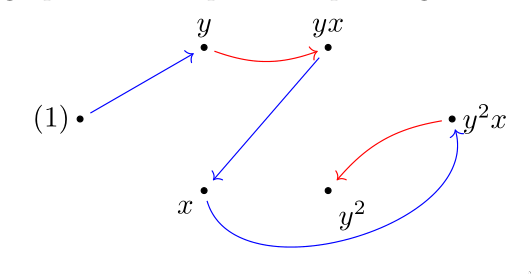

if anyone can guess what kind of question this is: you are a real gamer
marsh forge
if you use quiver
you can get rid of the arrows
oh wait maybe you want them i was thinking you were drawing universal covers but thats bc im dead tired
ignore me
gritty widget
Ah, I recall doing problems like this in kindergarten
It is "connect the numbered dots", right?
flint cove
obtuse meteor
I just want someone to appreciate how I used tikz for my algtop homework
https:/...
I have no idea how to use this in an algtop exercise, but that's a cayley graph of D_6 = <x,y | x², y³, (xy)²>.
I'm really not sure what all the „loops“ should represent; they don't seem to have too much in common.
obtuse meteor
marsh forge
oh wait maybe you want them i was thinking you were drawing universal covers but...
I want them bc I'm calculating generating sets for a kernel of a surjective group homomorphism h : F_n -> G
G in this case is S_3
and n = 2, picking generators a, b for F_2 the map sends h(a) to an order 2 element and h(b) to an order 3 element
You basically use some maffs to draw the correct universal cover with edges labeled and colored
then pick a spanning tree to get a generating set
very cool ^^
Yeah that's right. The reason this comes up is because if h(a) = x and h(b) = y then these are the relations you get from it being S_3
Also I used straight up tikz, not quiver or tikzcd because I'm a masochist
flint cove
Wait, so is the basic idea here that the kernel as a subgroup of a free group must be free?
I never did algtop formally so I may just know too little about F2
obtuse meteor
ye and you want to compute the generating set for the kernel
and you do that with covering space theory
flint cove
What does that mean?
I know what a simply connected space is and that in some instances there may be a notion of „universal covering“, but that's about it
obtuse meteor
do you know much about covering spaces?
ah cool I can explain it if you'd like!!!
there's a lot of cool stuff here
flint cove
sure
obtuse meteor
do you know the defn of a covering space?
flint cove
Surjection, locally the preimage decomposes into disjoint union of the image?
obtuse meteor
yep!
flint cove
then yes
obtuse meteor
And you know that they enjoy the homotopy lifting property?
flint cove
ah, yeah, I have heard that
obtuse meteor
how we'll use it here is the following fact
if you have a covering space p : Y -> X
and a path gamma in X, then picking a point y lying over gamma(0) there is a unique lift of gamma to Y which starts at y
furthermore if you start with two homotopic paths gamma, gamma' downstairs, you lift to homotopic paths upstairs
flint cove
Do you wanna introduce the monodromy action of π1 on the fibers?
obtuse meteor
yeah so that's like the first thing you do
pi1 acts on the fibers
but you actually get something even better
when the image of pi1(Y) in pi(X) is normal
pi(X) / p_ast(pi1(Y)) acts on the fibers
and it acts in the fibers in a way that's compatible with a bijection between pi(X) / p_ast(pi1(Y)) and a particular fiber
compatible in the sense that it's the same as the action of pi1(X) / p_ast(pi1(Y) on itself
flint cove
wait… so essentially curves which are pushed down from Y to X have trivial monodromy action? or what is that saying
obtuse meteor
yes
this should be clear
a curve pushed down from Y to X
is exactly a curve in X that gets lifted to a loop in Y
flint cove
Hm… let's say we have a double cover S^1 → S^1, and let γ be a loop on the left. this is a double loop on the right. However, that acts on the fiber as addition by two.
So this doesn't seem to be correct
(at least the initial statement that these curves have trivial monodromy action)
obtuse meteor
addition by two on the left is the same as addition by 0
for that double cover
non?
flint cove
Oh, right, the fiber is a two point set, and we're coming around again
obtuse meteor
mhm
flint cove
for some reason I forget that other covers of the circle exist and I equate everything with ℝ
obtuse meteor
lol it be like that
flint cove
even if I start the sentence knowing better, lol
obtuse meteor
so now the magic comes around
and what it essentially tells us is that
so well first we need this bijection
flint cove
obtuse meteor
so now the magic comes around
(pun intended I guess)
obtuse meteor
fix a basepoint y in Y, define phi(H[gamma]) as follows, lift gamma to a path in Y starting at y, and take its right endpoint
exercise: verify this gives a well-defined bijection from the right cosets of H = p_ast(pi1(Y, y)) with p^{-1}(p(y))
so how you do one of the problems like this where you're trying to find a generating set is
you know that the number of sheets in a cover (aka the number of vertices in your graph) is the index of H in pi1(X)
obtuse meteor
H = p_ast(pi1(Y, y))
phi is a map we're defining now
from right cosets of H to p^{-1}(x)
flint cove
right
obtuse meteor
lol
flint cove
I can assume that the lift is a aleft inverse to the pushdown, right? so elements π_*(δ) of H are lifted to δ (up to based homotopy)
because then left-multiplying with π_*(δ) does literally nothing to the right endpoint, as with δ we stop where we started
flint cove
I mean yes we can, as „being a lift“ is defined as „something in the preimage projected to our curve in X“ and the lifting property ensures precisely that this lift is unique
obtuse meteor
ye
flint cove
Wait can I assume that our cover is (path-)connected?
obtuse meteor
yeah
it's a theorem (tm)
that for nice base spaces
you can get a path-connected locally path-connected covering space
which has the correct fundamental group downstairs
this is the big theorem which makes this work
How I envision it is like
flint cove
isn't it locally path-connected already if it's guaranteed to be path-connected?
flint cove
uh dear god
obtuse meteor
although being a covering space over a locally path-connected space means you're guaranteed to be locally path-connected
welcome to topology
the reason I said nice base spaces
is the real condition on your base space is
path connected, locally path connected, semi-locally simply connected
but it doesn't matter bc any reasonable space is this
in particular this is true of any CW complex
flint cove
Yeah, okay, I should not research counter-examples, in AlgTop you ignore them anyway
obtuse meteor
yes
okay so like
how I envision it
is you use this big theorem to build your covering space which has ker(h) as your fundamental group
you use the index result to draw the number of vertices, since it will be the index, which is |F_n/ker(h)| = |G| by first isomorphism theorem
flint cove
The surjectivity is clear as we can just take the lift of the pushdown of the path to the point y
obtuse meteor
ye
we then like, try and fill in edges
and how we fill in edges is
we label each of our vertices by elements of G
and the upshot of like using this bijection and understanding how it interacts with the monodromy action
is it turns out that if you're lifting an edge alpha in your base space to find out how to glue it into the top space
flint cove
obtuse meteor
is you use this big theorem to build your covering space which has ker(h) as you...
Oh that is interesting
obtuse meteor
then if you glue the left edge to y_g
then you have to glue the right edge to
y_{gh(alpha)}
this allows you to understand exactly what graph this covering space is
(knowing that it already exists, so you can carry out this process without much worry)
and then you use the result about fundamental groups of graphs
to find a generating set for the fundamental group of this covering space
projecting it down will get you a generating set for ker(h)
it's a pretty awesome and powerful technique
flint cove
huh
That's a lot to swallow, but from a high-level this seems really intriguing
like, I always imagined presentations of groups to be the hardcore term-manipulating way of verifying properties, but this feels a lot more geometric
obtuse meteor
yeah this is intensely geometric
flint cove
and finding generators of things is rarely something you have a canonical method for
obtuse meteor
This is also like
totally an algorithm you could program
idk if it's what sagemath or stuff actually uses to compute certain generating sets
but like
flint cove
not sure, might be permutation group stuff (schreier sims)
obtuse meteor
¯_(ツ)_/¯
flint cove
(Not that I would understand what that does in particular, lol)
 flint cove
dark magic
fading vale
flint cove
uh dear god
anytime ur doing anything with path connectivity and you want to check counterexamples just look at the topologists sine curve 
wait
BRUH
i forgot that the fibers were discrete so the path components can be identified w/ the space
asdflkasdflk
obtuse meteor
wdym?
marsh forge
i assume moth is talking about a finite cover
sleek thicket
moth i regret to inform you that the fibers of the topologists sine curve are not discrete
i think you should be able to prove {0} x [0,1] is not discrete with some calculus (e.g. the intermediate value theorem) so I don't blame you for not seeing it
obtuse meteor
🧠
@flint cove for a counterexample

clearly path-connected
but not locally path-connected at (0, 0)
flint cove
ah, because there is a neighborhood basis that shrinks in a sort of „independent“ direction to where the connecting paths move
like, the ε-nbhds will go concentric while the paths go fucking everywhere and out of each neighborhood a zillion times
makes sense
obtuse meteor
🧠
flint cove
Hm, perhaps an example simpler to visualize might be a ladder with increasingly tiny step sizes
(i.e., union of [0,1] \times {2^{-n}} for all n plus vertical lines at x=0,1)
That surely is path-connected, but at (1/2, 0)it's not locally path-connected, right?
obtuse meteor
Yeah good intuition :)
 cobalt seal
Hi there,
I'm working through Einstein notation/early tensor stuff and am currently working through a question involving the below term:

I'm fairly new to this stuff, so it's entirely possible I've made a mistake, but am I correct in reaching a kronecker delta as below?
 gritty widget
you combined an x and an x' into a kronecker delta, doesn't seem right
that said i don't know that the x with one up index and one down index even is so
cobalt seal
we were taught this relationship. Is that not correct?

 chrome dew
well you just haven't defined what it is, it's not standard notation, x could be anything
cobalt seal
Right, sorry. x^i is the coordinate of a general point of a manifold, and x'^i is the same coordinate in a separate coordinate system
gritty widget
can you post some context @cobalt seal

also can anyone help me interpret this
i think here that they define the corresponding atlas on $M$ by taking charts $\varphi: U\to V$ and defining $U_0=\varphi^{-1}((\bR^n\times{0})\cap V)$ and $\varphi_0$ to be the restriction of $\varphi$ to $U_0$
gentle ospreyBOT
spinsicle
 gritty widget
specifically i'm not sure why $D(\eta\circ\varphi^{-1})$ needs to have that form
gentle ospreyBOT
spinsicle
 fading vale
sleek thicket
moth i regret to inform you that the fibers of the topologists sine curve are no...
fading vale
sleek thicket
moth i regret to inform you that the fibers of the topologists sine curve are no...
i hate u
anyway i was talking about another thing
equivalence of TRA_B and COV_B
and it relied on the functors being discrete for it to work
fading vale
marsh forge
i assume moth is talking about a finite cover
no it was a non sequitur but i had a revelation
also finished a tom dieck section
😌
 quick wing
Can anyone tell me why a dominant morphism from an integral scheme X to the projective line determines a rational function on X?
I have been stuck on this for ages and I think it should be simple
It is from Fulton's intersection theory if that is relevant, from 1.6 where is showing the alternative definition for rational equivalence of cycles
 trail ibex
Do you see why a dominant morphism to A^1 determines a regular function ?
Then just patch things together I guess
 long hornet
Can a proper closed subset of R^n be homeomorphic to R^n? I feel like this should be easy (at least, assuming invariance of domain)
gritty widget
at least this is false for R right? this proper closed subset must be connected, so it must be an interval, say [a,infty). but i can remove a from this set and it is still connected, but we cannot remove a point from R and it is still connected
long hornet
Yes
Using the same reasoning, C (our closed set) must be connected, so V = R^n - C must also be connected
gritty widget
oh, i guess you can also argue that every point of R^n is locally euclidean, but this is not so for a proper closed set
long hornet
Makes sense!
gritty widget
wait a second... is this circular lol
long hornet
Ah, I think this reduces to proving ball \cap C is not homeomorphic to R^n..
gritty widget
oh, is it really just a direct implication from invariance of domain? let f be a homeomorphism C->R^n. then f^{-1} satisfies the hypothesis of invariance of domain. it follows that C is open in R^n, which is a contradiction (grader: 0/10 for not addressing C=emptyset case)
long hornet
Is that what the invariance of domain says?
It is!
Apparently I only knew about invariance of dimension.
flint cove
Hope it's okay to ping @marsh forge for a delayed question about the SerreSS-talk.
Is there any setting where the idea of taking cohomology groups with values in another cohomology group naturally pops up? This seems like a really strange idea to me (who only knows basic singular cohomology up to the künneth formula).
I always imagined cohomology as assigning some number to a nontrivial chain in a way that reflects its nontriviality, like a winding number around a hole or an element of ℤ/2ℤ to measure something 2-graded or whatever.
But matching that metaphor to what we had as definitions in the E2 page would be like „I assign this chain the element flips pages in large book of cohomology classes x, where x is a canonical generator of H*(ℂP^∞). Of course, the natural choice!“, which doesn't really give me a hint of what's actually going on.
marsh forge
not an exact answer
but taking coho w coefficients in homotopy groups
is a key ingredient in obstruction theory
i think that you should think abt my univ coeff remark
namely that taking coho w coefficients in another coho
is up to torsion
the tensor of the two cohos
flint cove
Hm, so basically just „extension of scalars“ of \otimes ℤ to \otimes new fancy coho-group
I think I can accept that as a formal device.
 long coyote
Let X be T2 and suppose that K⊂X is compact. what is X/K
gritty widget
are you asking what properties the complement of K has?
e.g. compact sets in T2 spaces are closed, so it'll be open
sleek thicket
or the quotient?
gritty widget
that's why i'm asking lol
long coyote
its quotient
gritty widget
just wanted to be sure 
long coyote
is X/K T2 as well
gritty widget
i think it'll be
not entirely sure
the quotient is T2 iff the equivalence rln is closed in X x X, maybe you can look there not true unless the quotient mapping is open
flint cove
For Pairs of distinct points in X/K we have two scenarios: either both are not K, i.e. of the form {x1}, {x2} for x1, x2 in X\K, or precisely one is K
sleek thicket
The equivalence relation will be Δ union K×K
flint cove
So I'd say the question is whether K can be separated from {x}
gritty widget
 very nice
sleek thicket
(Δ = { (x, y) in X×X : x=y } is the diagonal)
@long coyote the relevant facts here are that a space is T2 iff it's diagonal is closed in the product and that compact sets are closed in a T2 space
So try to compute the diagonal of X/K
oh wait maybe there's a concern here
in that products of quotients maps may not be quotient maps
It's something like this anyway
flint cove
flint cove
So I'd say the question is whether K can be separated from {x}
Which is the case since open sets around K in the quotients are in bijection with open sets containing K in X. So we can separate x from k for every k in K by means of Uk around x, Vk around k. Picking a finite subcover Vi1, …, Vin gives a cover of K which is disjoint from the Ui1 cap … cap Uin, separating K from x
long coyote
sleek thicket
It's something like this anyway
thank you
sleek thicket
gritty widget
~~the quotient is T2 iff the equivalence rln is closed in X x X, maybe you can l...
I'm having trouble proving this
I think you additionally need the quotient map to be open
sleek thicket
long coyote
thank you
I don't think my proof is valid, sorry
check out what lux is doing
flint cove
So for the first case I mentioned, to separate {x1} from {x2} in the quotient it would be sufficient to have open sets separating x1, x2 which lie entirely in the complement of K, so they're corresponding to open sets in the quotient.
But taking open U1, U2 separating x1, x2, we can just take U1 \setminus K and U2 \setminus K – since x1, x2 not in K, U1, U2 still contain x1, x2, and since in T2 compacta are closed, subtracting a closed set from an open one remains open, ta-daa
(Huh, I never realized that in T2 spaces you can strengthen the separation to compact sets, learned something new)
gritty widget
sleek thicket
I think you additionally need the quotient map to be open
you are correct, sorry
tfw forgetting how to do math 
sleek thicket
you are a complete loser because you forget irrelevant gentop fact #10169420
gritty widget

 tough imp
You are a loser because you forgot the 5 adjectives you apply to a scheme map for this statement to be true
sleek thicket
"I'm chmonkey I do algebraic geometry"
tough imp

flint cove
hrr
tough imp
If I don't constantly remind ppl I do algebraic geometry then how will I remember to do algebraic geometry?
shut moat
why do we define the quotient topology using a quotient map? The equivalence relation definition feels much more intuitive
sleek thicket
what definitions are you thinking of specifically?
obtuse meteor
Are these not the same???
shut moat
idk maybe I haven't read into it enough lmao
but like one is the coareset topology with respect to which a map is a quotient map
and the other is basically the same but you're actively treating the codomain as an equiv class thing, which would be equivalent to a map X -->X/~
sleek thicket
i mean the equivalence relation one only works for a specific set
the quotient map business is essentially trying to detect when a surjection p : X -> Y is secretly X -> X/~ for some equivalence relation
i.e.\ when ie there an equivalence relation and a homeomorphism $h : Y \to X/\sim$ such that
$$
\begin{tikzcd}
& X \arrow[dl, twoheadrightarrow, "p"] \arrow[dr, twoheadrightarrow] \
Y \arrow[rr, "h"] & & X/\sim
\end{tikzcd}
$$
commutes
obtuse meteor
Yeah I usually think of the second one
sleek thicket
oof
obtuse meteor
lol
gentle ospreyBOT
SHAMROCK YELLING EMOJI
 sleek thicket
np! hope this helped
shut moat
so like, for some common examples I've seen informally in a knot theory seminar
you have like a square
and you identify the sides of the square to produce a cylinder or mobius strip or projective plane or something
sleek thicket
right
shut moat
would different "gluings" corrospond to different choices of p?
sleek thicket
Sure, and the codomain might change
if you want to think of the quotient as giving you a copy of the torus or something, that's saying there's a quotient map p : square -> torus
yeah?
and then maybe you glue the edges differently and get a quotient map square -> projective plane
 ivory dragon
quotient stuff is good because it annoys coq people
sleek thicket
Namington is a leanhead confirmed
shut moat
mniip harassed me with his coq one day in VC 😔
 summer jolt
Can someone explain what is meant by the union of two algebraic varieties?
 obtuse meteor
shut moat
ok this is much cooler than the previous point set stuff
obtuse meteor
shut moat
ok this is much cooler than the previous point set stuff
Yeah quotient stuff is good for your health. Point-set is generally garbage but quotients allow you to construct neat spaces quickly and efficiently
inb4 cw complexes "approaching me" meme
flint cove
obtuse meteor
Yeah quotient stuff is good for your health. Point-set is generally garbage but ...
You Refer to the „Rest“ in „Top is CompHauss and Rest“, right?
summer jolt
ivory dragon
set-theoretic union
So the definition I was given was the following: $V(I) \subset C^n$ consists of all points $P \in C^n$ s.t. $f(P) = 0 \forall f \in I$ where $I$ is an ideal in $C[x_1,...,x_n]$. Now I am unsure how to interpret this geometrically. I assume that by the union of two varieties we mean $V(I) \bigcup V(J)$ for some ideals $I,J$. However, what does their union look like? Like what is a typical element in the union?
gentle ospreyBOT
snypehype
 flint cove
It consists of points that vanish either on a p in I, or a q in J.
If you think hard enough you might find a ring-theoretic combination of I and J such that all elements in there vanish on every point on V(I) cup V(J) 🙂
summer jolt
@flint cove ok thanks I'll give it a go
flint cove
If you want a specific example you can take ||I = (x1), J = (x2) for the plane ℂ². What's V(I), V(J), and as what vanishing set can you describe their union?||
 hard wind

Brain hurty
I'm not sure exactly what facts about path-connected and simply-connected spaces i need to be taking for this proof
flint cove
My mind would go to existence of unique lift and that homotopic maps have homotopic lifts
hard wind
good idea, thank you -- we recently discussed unique lifting so that is probably right
so in this case we are lifting paths?
flint cove
Yes, I think the key point should be to notice that ||all loops in B are contractible, hence must have contractible lift ||
A similar argument: first show that ||π1(B) acts (at least in this case) transitively on each fiber||, and then you can use that ||π1(B) it's trivial, hence each fiber must be a singleton, giving injectivity ||
hard wind
Thanks for the spoilers, that was quite thoughtful
obtuse meteor
an alternative approach
the identity B -> B lifts to a map B -> E since Id_ast(pi1(B, x)) = pi1(B, x) = 0 is a subset of p_ast(pi1(E, xtilde))
more generally this shows something even better
cedar pebble
Faye out here enjoying AT more and more 
obtuse meteor
and that B is path connected (and hopefully locally path connected???)
we might not need the locally path connected
let's check
hm, we'd need locally path-connected as well
this is an L
well so there's a really nice result
that if the base space is path connected and locally path connected, then if pi1(B, x) = p_ast(pi1(E, xtilde)) then you get homeomorphism by applying lifting properties via meme
do we believe in simply connected but not locally path-connected spaces @cedar pebble
And yes I am very much enjoying AT
obtuse meteor
but do we believe in them nG
cedar pebble
really shitty
obtuse meteor
I expect there to be garbage examples but
cedar pebble
 cedar pebble
I mean sometimes people care about them, e.g. people that study shape theory
cedar pebble
but as long as you're doing relatively tame things then no we don't care about them
obtuse meteor
good
cedar pebble
I mean they are an artifact of the category of topological spaces being bad
they will never show up in more algebraic approaches to topology
obtuse meteor
in showing continuity of this lifting guy
you need local path connectedness of the left hand space
really garbage
sad
@cedar pebble is there a theory of killing generators of your fundamental group by inserting a wavy sin(1/t) kinda boi
cedar pebble

obtuse meteor
cedar pebble
that's why this is simply connected
cedar pebble
I mean it should exist
cedar pebble
but is this really something that should exist?
obtuse meteor
can you detect these using the techniques of algebraic topology at all?
cedar pebble
I mean any time you work with dreadful spaces like this you need to use something like shape theory, the usual techniques from AT start to fall apart a bit
obtuse meteor
idk what the fuck shape theory is lol
cedar pebble
shape theory is sort of a toolbox for actually working with really pathological spaces like this
obtuse meteor
like okay here's an example of what should be a nice (if dumb) invariant
this thing is simply connected or whatever but is not an interval
bc I can take more than three points out of this
and keep it connected whereas I can't do that with interval boi
at least one should be able to by removing from the line at 0 non?
cedar pebble
usual homotopy theory is to shape theory as singular cohomology is to something like Cech hypercohomology

 cedar pebble
Cech methods are like
 cedar pebble
so usually you compute something like cohomology by finding a nice open cover and then computing with that
obtuse meteor
you can detect this algebraic topologically
cedar pebble
Cech cohomology is sort of like
cedar pebble
you take the limit over all possible open covers ordered by refinement
obtuse meteor
tf
get back to me when I learn cohomology
we're starting homology on monday
am excited
 obtuse meteor
it's simplex hours
oh god this homework in algtop this week
is super duper spicy
no hints but
gritty widget
 obtuse meteor
Labeling hard lol
gritty widget
ah, i am a dumbass

 pastel linden
 flint cove
cedar pebble
you take the limit over all possible open covers ordered by refinement
flint cove
cedar pebble
you take the limit over all possible open covers ordered by refinement
Isn't a less scary way of formulating that to say “cech cohomology is looking at covers that are fine enough“?
But tbf I haven't rigorously gone through it yet; still need to write that down for the bundle classification at some point
cedar pebble
Yes in nice enough cases you can just look at fine enough covers
Once you go to fine enough covers the colimit stabilizes and you win
For really pathological cases this doesn’t happen, and moreover you need to consider hypercovers instead of just covers
obtuse meteor
cedar pebble
🥺
Imagine putting this at the end of a super long homework assignment
TLDR “this section is completely optional”
cedar pebble
practice self care! Also practice these 18 problems uwu
sleek thicket
fucking owned
Wait I have a better idea
Keep the title "well-being"
And the 2 questions
But add in a bunch of really awful tricky problems
not optional but still under "wellbeing"
cedar pebble

sleek thicket
"are you okay? Are you sleeping enough? Calculate the integral of sin(x)^3."
obtuse meteor
Lol
flint cove
Like Konfuzius said, if you have a choice, you can well-order your being every time
sleek thicket
"hey make sure to drink enough water and prove that (L^q)^* = L^p in this problem with parts a-f"
cedar pebble
Go take a walk! Speaking of walking, answer these five questions about the walking quiver and its category of representations
flint cove
Afer too many assignments like that I would start associating a healthy lifestyle with the darkest areas of mathematics and avoid it at all costs
obtuse meteor
cedar pebble
Go take a walk! Speaking of walking, answer these five questions about the walki...
Ohno
sleek thicket
Shamrock isn't reflexive but Shamrock** is
reflexive topological space
discuss
it's a space homeomorphic to C(C(X)) with the compact open topology
flint cove
Wait, is it a space X homeo to C(C(X)), or is it an arbitrary space that is homeo to C(C(X)) for some X, or is it a space X such that the embedding into C(C(X)) is a homeomorphism?
sleek thicket
should be last, you're right
For eg normed vector spaces you can have V** ≈ V but not via the natural map
I think there is no such X though lol
I can't think of one
marsh forge
C(\emptyset) has an element tho
unless im being dumb
I guess both interpretations are interesting
sleek thicket
well the double dual of the concept is interesting
yesss my prof just believed me when I said I forgot to turn in my homework on time
marsh forge
naturally
gritty widget
oh
sleek thicket
And then didn't realize it was due at 1:30pm instead of midnight
marsh forge
i feel like 95% of profs respond well to that for me
sleek thicket
yeah I mean one would hope
But the late policy on the syllabus is super strict
so /shrug
marsh forge
on one hand i feel like strict late policy on surface but nice in email is a good strat
but i know some people hate emailing profs for like
sleek thicket
eh it creates a lot of stress for the student
marsh forge
personal or cultural reasons
sleek thicket
Well there's that but also like
marsh forge
yeah see it creates very little stress for me so i have to empathize here
sleek thicket
hmm I think I might be able to ignore all the diff top on the last homework
Err
Diff geo
I did the diff top stuff
There's 2 topology-y bundles problems and 3 diff geo ones
And I have 208/210 on the homework so far
and need above an 80% to get a 4.0 in the class
I should probably learn this stuff
 meager python
quick wing
Can anyone tell me why a dominant morphism from an integral scheme X to the proj...
meager python
quick wing
Can anyone tell me why a dominant morphism from an integral scheme X to the proj...
So it is dominant map between integral schemes gives a field extension k(t) = k(P^1) -> k(X).
 alpine bolt

I created a function F: W --> R^1
W is a neighborhood of a point p, and p is in the image of g
Am I trying to show F(0)=0 or F(p)=0?
 rugged swan
you can prove that the tangent space at (0,0) isn't 1 dimensional
trail ibex
If you remove the self intersection point there are 3 connected components
whereas removing a point from an open interval only gives 2 connected components
gritty widget
Oh?
I thought it is 2 connected components
Ah sorry, I was being a dumbass. You obviously mean locally
 uncut surge
Ye I was confused too for a moment lol, but the argument is for a small neighbourhood of the point I guess
trail ibex
Yes
 jolly ice
Ayy I have to prove that the set of all condensation points in R^K is perfect
 thin bramble
Can anyone help? Prove that translations and halfturns map any line {x+tv : t in R} to a parallel line (same direction v)
jolly ice
Bro I already asked a question :/
Yell if x is in R^k
Then a translation is just adding (t,0,0,0...)
So just prove that it would preserve parallelness
Wait say that if x goes to x' the distance is a constant
Thus parallel
thin bramble
Thanks. I'll see what I can do from here
jolly ice
You have to show that is some way the distance is a constant
Best way is to use the map itself to show it since you already know what the map is
summer jolt
I was asked to prove that the intersection of two algebraic sets is an algebraic set. So an algebraic set is given by $V(I) = {p \in C^n | f(p) =0 ,\forall f \in I}$ where $I$ is an ideal in $C[x_1,..,x_n]$.
The way I approached it was to assumed that given two ideals $I$ and $J$ then $V(I) \cap V(J) = {p \in C^n | f(p) =0 ,\forall f \in I \text{ and } J}$. So then I thought that this could be given by $V(I) \cap V(J) = V(I+J) = {p \in C^n | f(p) + g(p) =0 ,\forall f \in I \text{ and } \forall g \in J}$. Since, if $p \in V(I)$ and $p \in V(J)$ then $f(p)=g(p)=0$ so $f(p) + g(p) = 0$. Hence it would follow that $p \in V(I+J)$ as $I+J$ is an ideal.
However, I'm having trouble proving the converse direction, that is given $p \in V(I+J)$, then $p \in V(I)$ and $p \in V(J)$.
Any help would be appreciated.
gentle ospreyBOT
snypehype
 jolly ice
Isnt this abstract algebra?
jolly ice
I think you might find better success in algebra?
summer jolt
Ok I'll post it there.
thin bramble
jolly ice
You have to show that is some way the distance is a constant
So I was given a hint to use $\tau_a (x) = x+a$ and $\sigma_a(x) = 2a-x$
gentle ospreyBOT
KillerWhale2498
 tough imp
jolly ice
I think you might find better success in algebra?
tough imp
jolly ice
I think you might find better success in algebra?
Algebraic Geometry stuff goes in here haha
If it’s in the form of pure algebra it goes there, but if it’s AG stuff it goes here is usually@how it goes. Tbf tho it’s kinda a grey area and it ends up in both
sleek thicket
I've posted very geometric stuff there and very algebraic stuff here
My metric is "which channel is open" 
jolly ice
I have a question on some perfect sets
In E (_ R^k all condensation points of E make a perfect set
So E is a subset
Actually wait nvm solved
jolly ice
If anyone wants to help me check the proof pls come to math voice
 candid mulch
Is (a, b) paracompact?
sleek thicket
candid mulch
Is (a, b) paracompact?
yes
It's homeomorphic to R, so you might as well ask if R is paracompact
 fervent citrus
every metric space is paracompact 
candid mulch
lol that came up a few minutes into the lecture once I posed the question
flint cove
definitely
This question only makes sense if taking the interior actually produces a cover, which is not the case in that example
Keep in mind that this imagery heavily uses that D is embedded into ℝ²
if you just take D as a metric space and ignore the surroundings the open balls around the radius one points are actually “half open” in the sense of the imagery
jolly ice
Couldn't you increase the radius of the closed ball by a size of epsilon and use that to create a finite subcover and then prove that the subcover must correspond to a sub cover of the closed balls
Since epsilon can be arbitrarily small all you have to prove such an epsilon exists
Yes but if you do so for an arbitrarily small epsilon you have to prove that the difference is insignificant
flint cove
I'm not clear about what you are referring to (what do you wanna prove / disprove?)
jolly ice
Prove that the enlarged balls subcover corresponds to the finite sub cover of closed balls
flint cove
Not sure what you mean by „correspond“. That they are equal? Because that they are not
jolly ice
Bijection
Because what I am proposing is a bijection between infinite covers
Yea That's what I want to prove
Can you reference it?
Isn't that a non question then?
 cosmic beacon
lmao
jolly ice
Oh ok nvm I was trying to look at another question
Isn't that one obvious tho? Since the radius does not converge and compact spaces have to be bounded I believe
Wait nvm I shouldn't say that
 prisma seal
it's not obvious imo, because it would hold with open balls, and so you might expect it to work with closed balls
jolly ice
It's non obvious but follows from compact sets
Oh I was referring to them being the same radius
No I think it's false because it follows from the being the same radius
Infinite covers with sets of the same radius cannot be compact
prisma seal
there is a pretty vacuous counterexample; take your favourite infinite compact metric space, and cover it with closed balls of radius 0 (all the points)
no finite subcover
yeah haha I did say vacuous
wait fr
Yeah I think the analysis course I took remarked that
jolly ice
Haha was that at waterloo @prisma seal
prisma seal
jolly ice
Haha was that at waterloo <@423999192122523648>
yes I'm a waterloo student!
jolly ice
I am in the same servers as you. You have answered my questions multiple times :)
prisma seal
that sounds right
Are you done with this question?
Ok awesome
I have a differential geometry question; what is the intuition/geometric meaning of the Gauss-Bonnet formula? This is how it was presented in the notes my course is using

On an assignment, I'm being asked to use this to find an area, but I don't actually understand what this is saying
marsh forge
my god thats painful to read
marsh forge
lmfao
prisma seal
I can honestly say that I'm gonna include it in my will to have someone project these notes at my funeral
everyone will understand what happened
prisma seal
this is a third year differential geometry course, you can do it in second year
marsh forge
yeah my suggestion nicholas
prisma seal
this course either provides no intuition or does this
 marsh forge
is to take that much better explanation
and then
try to see
how what your given
js a special case
so you can use it for hw
prisma seal
there is another statement later that's this

 flint cove
do you have a plan on how to proceed?
Not sure what kind of neighborhood you are trying to look for.
alpine bolt
tbh im not sure either im just trying to use this definition to arrive @ contradiction
 flint cove
oh, so you probably defined a manifold as a submanifold of ℝ^n
Did you prove a fact like „M is a submanifold iff around every point there is a local diffeomorphism to ℝ^n“?
flint cove
like, not you in particular, but the material to go to
As in, is it something you are „allowed“ to use 🙂
Because the intuition is that locally, it's not one dimensional, because the lines are not „horizontally isolated“
alpine bolt
what does the word "locally" mean in the mathematical sense?
flint cove
„something holds locally“ usually means „for every point there is a neighborhood satisfying something“
e.g. „Locally path-connected“ means „around every point there is a path-connected neighborhood“
And something is a smooth 1-manifold if and only if „locally“, i.e. for every point around some neighborhood, it is diffeomorphic to an open interval
So one way to disprove that this is a 1D Manifold would be to pick any point, wave your hands, and say „Hey, this doesn't look like an open interval, no matter how small I make the neighborhood!“
and if you prefer rigor to hand-waving you can use your favourite topological property that holds in the open interval but not in the space X you're given :>
sleek thicket
That's not what a locally path connected space is
If it was path connected would imply locally path connected
Locally has multiple meanings, one is "happens in a neighborhood of each point" and one is "happens in arbitrarily small neighborhoods of each point"
locally path connected is of the second type
flint cove
sleek thicket
If it was path connected would imply locally path connected
ah gosh, sorry for spreading lies, should've looked that up, thanks for correcting
sleek thicket
it's okay, I am constantly bearing false witness
flint cove
in my defense I wanted to write „has a neighborhood base of path-connected points“ but didn't want to explain what a nbhd base is
alpine bolt
maybe i should just find when [x y]=0 and just find the jacobian at that 0 point
marsh forge
@sleek thicket i think locally almost always means arbitrarily do you have a counterexample?
sleek thicket
"a section of a sheaf is zero if it is locally zero"
"a manifold is locally Euclidean"
I mean it's true in both cases that this happens in arbitrarily small neighborhoods
But what's being said is "happens on a cover"
Idk when I hear local my first instinct is "can be checked on a cover"
marsh forge
I think my point is like
if the two notions differ
its always the one o saod
said*
sleek thicket
Sure
sleek thicket
Sometimes diff geo is good
My bundles class started doing more diff geo type things
Lots of truly horrible computations
And we ran out of the prepared stuff in the book so there was only lectures
I couldn't follow it at all
But now I'm doing the homework and like
I can just do computations
And it works
I don't need to have a deep fundamental understanding
gritty widget
post computations
sleek thicket
Let E be a rank k vector bundle
Everything is in the smooth category
Say we have nonvanishing k form Ω on E
This gives a reduction to SL(k, T) or SL(k, C)
Oh and say we have a connection \nabla on E
Then $\nabla$ is compatible with the $SL$-structure iff $\nabla \Omega = 0$
gentle ospreyBOT
!!Shamrock!!**
 sleek thicket
Compatible meaning this

 gritty widget

shut moat
graduate then share 
marsh forge
how will he know u leaked it
sleek thicket
He might not know I leaked it but it's a pretty small class
It's also like a very incomplete draft copy
I'll leak it when it's published and more complete
gritty widget

it has made me wonder. there were some draft lecture notes/books that my professors in college wrote that we used in their class. they are still unpublished, after 5 or 6 years. i guess it takes a long time to flesh out/publish something
cosmic beacon
Would the set of all sequences that start with 0,1 be open in this metric space?
 gritty widget
as in, individually? (the set of all sequences that start with 0, and the set of all sequences that start with 1, are indiviudally open sets?)
cosmic beacon
no, the set of all sequences that go (0,1,something,something,etc.)
gritty widget
but every sequence starts with either 0 or 1 right?
so you are talking about the whole space?
ohh
i see
cosmic beacon
for example, the sequence (0,1,0,1,0,1,...) would be in my set. so would (0,1,1,1,1,1,1) or (0,1,0,0,0,0), etc.
It's supposed to be
but I cant express it as one is the thing
The "lowest" sequence is (0,1,0,0,0,0,...) which has a norm of 0.25. the "highest" sequence is (0,1,1,1,1,...), which is whatever the binary number 0.111111111.... is in decimal (0.49999999?). So, it's essentially the interval [0.25,0.5)?
 fast minnow
Might’ve helpful to check the distance between (0, 1, 0, 0, ...) and (0, 1, 1, 1, ...)
cosmic beacon
given the binary number 0.001111111..., the distance between the two is that number in decimal. So basically almost (but not quite) 0.25, right?
cosmic beacon
cosmic beacon
given the binary number 0.001111111..., the distance between the two is that num...
idrk what that tells me
yea, 1/8+1/16+1/32+1/64+...
ohh is it?
I forget it lol
👍
fast minnow
Another way to think about it “what is the closest point to (0, 1, 0, 0, ...) which does not start with 0, 1)”
cosmic beacon
fast minnow
Another way to think about it “what is the closest point to (0, 1, 0, 0, ...) wh...
0,0,1,1,1,1,1,1
fast minnow
Right, so what is that distance? Then make a guess for what the ball should be
cosmic beacon
the thing is, the norm of (0,0,1,1,1,1,1,1) is the same as the norm of (0, 1, 0, 0, ...)
so how can I have a ball which includes one but not the other?
fast minnow
You have to use the given metric to calculate distances
cosmic beacon
or, that's what I mean, the distance from any point to (0,0,1,1,1,1,1,1,...) is the same as the distance from that point to (0,1,0,0,0,0,...)
fast minnow
I don’t think that’s true, like (0, 1, 0, ...) is distance 0 from itself but it will have positive distance from the other one
cosmic beacon
well, compare it to the sequence 0 repeating. The first one is [\sum_{n=1}^\infty\left(\frac12\right)^n-\frac14-\frac12=\frac14.]
The second is also trivially $\frac14$.
gentle ospreyBOT
Isaiah
 cosmic beacon
wait, I think I see actually, ignore that
chrome dew
nice ultrametric space you got there
sleek thicket
oof
cosmic beacon
cosmic beacon
Would the set of all sequences that start with 0,1 be open in this metric space?
alright would it be the ball of radius 1/8 centered at 0,1,1,0,0,0,0,0,0,...?
fast minnow
If you mean (0, 1, 0, 0, ...) as your center then it should be something like that yeah
I think the radius might be 1/2 or something though
chrome dew
either sequence is a center, the radius of the "open" ball should be 1/4 in this case
but all balls are clopen so by "open" I mean with strict inequality not equality like this: d(x,(0,1,...)) < 1/4
cosmic beacon
how did you get that 1/4?
chrome dew
maybe I'm wrong about the radius actually I'm computing it off
we were talking about something similar a while back haha but yeah it's nt exactly thes ame one
cosmic beacon
i cannot gain any intuition for what sequences are "close together"
ok, i'm pretty sure the ball would be radius 1/4, but I wouldn't even know how to prove it. Mind you, I'm supposed to show all sets containing all sequence starting with some fixed entries can be expressed as an open set, and I can't get even one set
yep
yep
gentle ospreyBOT
slimvesus
 cosmic beacon
yes

 flint cove
Does any compact manifold admit a cover of contractible sets where every pairwise intersection is the disjoint union of contractible sets?
cosmic beacon
yes
flint cove
flint cove
Does any compact manifold admit a cover of contractible sets where every pairwis...
TIL it's called a „sufficient open cover”
cosmic beacon
yep
I can take unions of balls
I dont need to show its a ball in its own right
I just need to show its an open set
I see
Well, (0,0,1,0,0,0,...) has a distance of 1/4 away from (0,1,0,0,0,...), a problem.
oh wait
no thats wrong
its 1/4 + 1/8
so we pick a different midpoint in the set
but picking that midpoint is the problem as well
yes, I believe there is as well, but constructing the open balls is a PITA. The exact question is asking me to prove that the metric topology defined above is equivalent to the topology on the same set formed by taking all such sets containing sequences with fixed entries as a basis
do you just alternate the terms after the fixed terms?
cosmic beacon
im thinking maybe you pick the sequence thats farthest away from (0,1,0,0,0,0) and (0,1,1,1,1)
cosmic beacon
chrome dew
or that doesn't work
yea that doesnt work
lmao can you give me a hint
without giving it away
well, how did you figure out the radius if you dont even know the midpoint to pick?
or did you fully figure it out
you mean it'll be the same radius regardless of choice of midpoint?
but then what about thids
gentle ospreyBOT
slimvesus
 cosmic beacon
jeez
is it just the union of the two endpoints with radius 1/4?
what point would be in the ball of radius 1/4 centered at (0,1,0,0,0,...) that shouldn't be there?
Like if I take the ball of radius 1/4 centered at (0,1,0,0,0,0,...) and the ball of radius 1/4 centered at (0,1,1,1,1,1,...) wouldn't htat give me what I need?
wasn't (0,1,1,1,1,1,1,1,...) the only one that wasn't included in the ball of radius 1/4 centered at (0,1,0,0,0,0,...)?
yea it is
lol np
these suck lmao
I'm pretty sure what I described works
lol ty for the help
gentle ospreyBOT
slimvesus
 cosmic beacon
Lol I'll take your word for it, I'm too sick of this to be curious right now unfortunately
I'll take a look later
fast minnow
cosmic beacon
Like if I take the ball of radius 1/4 centered at (0,1,0,0,0,0,...) and the ball...
That sounds like it should work
Basically the metric tells you that if two things are within say 1/4, then they agree at the first 2 coordinates

 fading vale
wtf does this mean


 fading vale
or wait


 fading vale
i guess that makes sense
gentle ospreyBOT
Ted

 viral atlas
My visualisation is restricted to a continuous function from bR\to\bR, I'm having a hard time finding a counterexample
Like
Yeah, I need help here, I can't prove/disprove this
Aaahhh, okay, that makes sense.
fading vale
other counterexamples usually come from putting two metrics/topologies on the same space and taking the identity
like uh say Q' is the rationals with the discrete metric
and take the identity Q' -> Q
or you could do R' and R
mhm
viral atlas
I might have to think a bit more about this, but thanks for the help. :)
fading vale
(if it helps the geometric intuition here is that your domain has "finer" balls than your codomain)
viral atlas
In the discrete metric case?
fading vale
yes
sleek thicket
viral atlas
My visualisation is restricted to a continuous function from bR\to\bR, I'm havin...
This is a good thing
Because there are no such counterexamples
By invariance of domain
 viral atlas
Nice, at least one thing I got right lmao.
fading vale
yea monotonicity stuff
viral atlas
I'm trying to think more about what Moth said.
fading vale
the way i think about it Ted is that going from the discrete metric to the normal metric basically loses information right
sleek thicket
I don't think so?
viral atlas
Hmmmm, yeah, that does make sense
sleek thicket
Just add a gap



 sleek thicket
:slime:
fading vale
🟢
sleek thicket
fading vale
<:broosh:690014147919872024>
good emote