#point-set-topology
1 messages · Page 207 of 1
 bitter yoke
 ivory dragon
uh, the problem is that that statement is false
consider the trivial/indiscrete topology on a set X
then the only open sets are X and the empty set
so X - {a} cannot be open for any a (unless X only has one element)
are you referring specifically to the euclidean/standard topology on R^n?
bitter yoke
This is true if your space is hausdorff since finite sets are closed in hausdorff
ivory dragon
^
 fathom cave
okk so i worked out the transformation and that term in the parantheses transformed as $Z^{i'}_{j'}=Z^i_jJ^{i'}i J^j{j'}$ which i should have seen
 gentle ospreyBOT
Zero0

 thorny flare
Yeah it was just for R but I figured it out
 gritty widget
Can someone help me compute the hodge start of $sin\theta d\theta \wedge d\phi$?
gentle ospreyBOT
lime_soup
 gritty widget
so i know its going to be a one form and it will be f dr
but in trying to do this calcuation i need to know what the metric on a sphere in spherical coordinates is
 sleek thicket
the metric in spherical coordinates is dr^2 + r^2 dθ^2, you can compute this by pulling back the form dx^2 + dy^2 + dz^2 along the spherical coordinates map U -> S^2
So an orthonormal frame would be
\begin{align*}
X &= \frac{\partial}{\partial r} \
Y &= r^{-2}\frac{\partial}{\partial \theta}
\end{align*}
gentle ospreyBOT
Shamrock (not a furry)
 sleek thicket
oh wait sorry this is wrong
I've confused myself, this is the metric on R^2\{0}. Sorry lime_soup
I think it should be g = dr^2 + r^2 dθ^2 + r^2 sin(θ)^2 dφ^2. You should check that though
gritty widget
Okay
sleek thicket
sorry just to check, you want spherical coordinates on (an open subset of) R^3}{0} right?
Not on S^2?
gritty widget
Oh sorry yes
sleek thicket
So if my metric computation was right then an orthonormal frame would be
\begin{align*}
X &= \frac{\partial}{\partial r} \
Y &= r^{-2}\frac{\partial}{\partial \theta} \
Z &= r^{-2}\cos(\theta)^{-2}\frac{\partial}{\partial \phi}
\end{align*}
and you can use the definition of the hodge star in terms of an orthonormal basis to compute it for your form
I think it'll be sin(θ) dr but still not sure
gentle ospreyBOT
Shamrock (not a furry)
 gritty widget
Now does dr have a “singularity” at the origin
As in is dr not defined properly at 0
gritty widget
Surely you mean (0,\infty)
 sweet wing
r can take on 0 but dr doesnt make sende
 sleek thicket
Oops
Ah yeah sorry
I see exactly what I got wrong
I didn't convert dθ and dφ into my basis X, Y, Z
If you do that you'll get the answer here (probably)
gritty widget
One more think
Thing
How do you calculate the divergence of a differential form
I’m used to calculating divergence of a vector field
And I know differential forms are related to vector fields
 cold vine
Isn't a cone of any space X always semilocally 1-connected since cones are contractible?
(I guess sl1c and semi-locally simply connected are the same thing)
 uncut surge
Yeah "0-connected" and "1-connected" are the fancy big boy names for "path connected" and "simply connected"
cold vine
uncut surge
Yeah "0-connected" and "1-connected" are the fancy big boy names for "path conne...
Ok thanks!
Any hint on how to show that in a cone of the Hawaiian earring any nbd of (0,0,0) contains a non contractible loop`?
uncut surge
Can that be true? If I take the whole cone as the neighbourhood, that should be contractible and thus simply connected like you said earlier
My topology brain is rusty but idk
Maybe you're rather looking to prove that (0,0,0) has some neighbourhood in which not all loops can be contracted
cold vine
Ah that is correct. I was thinking that the Nbd would be H x [0,1/2)
but I'm not sure if this works since I think union of all half circles containing (0,0,0) cross the interval might be open here
 patent mural
I'm new to affine geometry, just had the first lecture, but i've received a list of problems. Can someone give me some intructions on how to solve, at least how to start?
Let a, b, and c tree distinct points in vectorial space V(dim V >4) and
p = a+<d1, d2> a plan.
Determine a linear 4-dimensional variety A witch contains the points a, b, c and is parallel with p.
 shut moat
gritty widget
How do you calculate the divergence of a differential form
shut moat
gritty widget
How do you calculate the divergence of a differential form
the keyword you're looking for is the exterior derivative
cold vine
Is it true in general that a path from x to -x pushes down to the generator of fundamental group instead of 0 when we have covering from sphere S^n to projective space RP^n ?

Mathematics Stack Exchange
Let $p:S^2\to P^2$ be the double covering of the real projective plane. Let $g:P^2 \to P^2$ be a map such that its induced homomorphism on fundamental group is not trivial.
I'd like to show that t...
gentle ospreyBOT
slimvesus
 cold vine
Ah I get this mostly
 marsh forge
As explcitly phrased
i think the answer is technically no
because it might be some multiple of the generator
you want like a nice straight path from x to -x
cold vine
The only thing I'm not seeing is why would some antipodal points mapping to a trivial loop lead to all of them being mepped to trivial loop
marsh forge
Oh wait I think you're correct because we are mixing paths and loops, and I think your claim about antipodals is also correct, my b
cold vine
Thanks so much! ^^ I mostly get it, I'll think some more to fully absorb it
marsh forge
Ok this is a bit geometric for me to spend much time on, but if you take S^2, do a partial projection so that you get D^2 (basically, fix a meridian, and quotient the hemispheres), and look at what happens to paths its a lot easier to see their homotopy class
And I think that this works out nicely
 thin bramble
So I'm having a hard time trying to find an example of an isometry which is not a linear map; 2) a linear map which is not an isometry
marsh forge
For paths that take place entirely in one hemisphere this works immediatley, and for more comlicated paths you need to think about what happens as hemispheres are crossed, but you should just see the paths enter the center of the disk on one of the two sides and then push the paths up to the border
Killerwhale: What have you tried
I think the second is probably you overthinking
and the first is you forgetting a very strict fact about linear maps
@thin bramble
thin bramble
marsh forge
and the first is you forgetting a very strict fact about linear maps
they aren't isometries?
thin bramble
A distance that preserves a pair of points
A transformation which preserves the distance between any pair of points is an isometry.
T(U+V) = T(U)+T(V) is this what you talking about simple description?
ohh that was the simple description
So will this work ? translation by (0,0)
marsh forge
does that preserve distances?
 pastel linden
I think a linear map is an isometry iff it is inner product preserving, so you can probably cook up an example in an inner product space pretty easily
gentle ospreyBOT
slimvesus
 sleek thicket
shut moat
the keyword you're looking for is the exterior derivative
sleek thicket
shut moat
the keyword you're looking for is the exterior derivative
No
Err
The divergence of a form isn't well defined as far as I know
But you can talk about the divergence of a vector field on a riemannian manifold
(and you get a smooth function)
My first thought would be slime means to take the divergence of the vector field paired with their form
marsh forge
pastel linden
I think a linear map is an isometry iff it is inner product preserving, so you c...
i think its easier than this if you want to preserve distances lol
youre overthinking
shut moat
sleek thicket
My first thought would be slime means to take the divergence of the vector field...
yeah that's what I was referring to
shut moat
like $d(F_z dx\wedge dy - F_y dx\wedge dz + F_x dx\wedge dy) = \text{div}(\mathbf{F})d^3\mathbf{x}$
gentle ospreyBOT
~S^1
 shut moat
I hope I got the signs right lmao
sleek thicket
oh sure that looks plausible
shut moat
so yeah it's not a literal divergence but it falls out of it right
sleek thicket
yeah I just meant you're not taking the exterior derivative of the form
gritty widget
physicist spotted 
 sleek thicket
lol
shut moat

shut moat
sleek thicket
But you can talk about the divergence of a vector field on a riemannian manifold
why do you need a metric?
sleek thicket
well, what's your general definition of the divergence of a vector field?
shut moat
hm, well it'd be the coefficient of the exterior derivative of det[V, . ,.] which is a top dim form
i think
sleek thicket
Right so the point is we need a distinguished top dim form
sleek thicket
Exactly!
So for notation, given a $(p+1)$-form $\omega$ and a vector field $X$, let $X\lrcorner \omega$ be the $p$-form $(X \lrcorner \omega)(Y_1,\ldots,Y_p) = \omega(X, Y_1,\ldots, Y_p) $
gentle ospreyBOT
Shamrock (not a furry)
 sleek thicket
does this makes sense? It's called interior multiplication
sleek thicket
the divergence of a vector field $X$ is then specified by the property that $d(X \lrcorner dV_g) = (\div X) dV_g$
gentle ospreyBOT
~S^1
Compile Error! Click the  reaction for more information.
(You may edit your message to recompile.)

Shamrock (not a furry)
 sleek thicket
Haha almost
shut moat

sleek thicket
Some care must be taken
The volume form only exists on an oriented riemannian manifold
but a general riemannian manifold does not come with an orientation
However it turns out that this definition of div X is well defined independent of the orientation, since swapping the orientation flips the sign of dV_g and dV_g shows up once on each side
So this is well defined for all orientable riemannian manifolds
Does that make sense S^1?
shut moat
yeah!
Could you extend it to any orientable manifold that has a volume form? Ik symplectic manifolds or whatever have volume forms attached to them
i don't see why you need a metric specifically
sleek thicket
Well hold on a sec lol
My next point was going to be we can extend to all riemannian manifold
shut moat
oh shit
sleek thicket
On any orientable open submanifold there's this function which is unique specified by some global equation
Right?
in a subset diffeomorphic to R^n, we can define the divergence as a local function
shut moat
I'm not sure what you're referring to
shut moat
what's this unique function specified by a global equation?
locally any mfld is orientable --> local divergence
yeah this makes sense
sleek thicket
div(X)
It's uniquely determined at each point by this equation d(X _| dV) = div(X) dV
shut moat
oh yeah, cool
shut moat
oop
sleek thicket
The whole point is we can't define dV globally
The important thing though is we have some kind of uniqueness
On an orientable riemannian manifold, for any choice of riemannian volume form we have this equality
yeah?
shut moat
yeah
sleek thicket
Okay cool
So what this implies is that if we have two orientable open subsets U, V of (M, g) the functions div(X|U) and div(X|V) agree on the overlap U \cap V
So we can use the gluing lemma to find a global smooth function div X
shut moat
oooh
doesn't gluing lemma require that U and V are closed
oh wait no that's pasting lemma
is that different lmao
sleek thicket
idk lol I just said gluing lemma to make sure you understand
I think it's only for continuous functions too
You certainly can't glue smooth functions on closed subsets, eg the absolute value isn't smooth
the point is if you have an open cover {Ui} and smooth function fi : Ui -> R such that fi(x) = fj(x) for x in Ui cap Uj there is a unique global smooth function f such that f(x) = fi(x) when x in Ui
because the collection of smooth functions forms a sheaf
thin bramble
pastel linden
I think a linear map is an isometry iff it is inner product preserving, so you c...
A linear map L: V --> V is an isometry if
<Lv, Lw> = <v,w> like this?

 thin bramble
gentle osprey
**slimvesus**
thin bramble
gentle osprey
**slimvesus**
what is that suppose to tell me?
cold vine
I'm trying to show that if S is the circle S^1 and f:S->S is continuous map then assuming (f(z))^n = z where n>1 leads to contradiction. So we know z^n is a covering and now f is a lift of identity map since the triangle S -f-> S -z^n-> S , S-id-> S commutes. Is this a good start and where do I go from here?
cold vine
Yeah I've used it a bit
sleek thicket
Then that's my hint, try to look at degrees
cold vine
ok cheers ^^
 gritty widget

sleek thicket
i literally have no idea what's going on
 obtuse meteor
Oop
sleek thicket
I saw this slide and my brain shut off
sleek thicket
yeah we're generally talking about connections on vector bundles
 tidal wadi
Jost's Geometric Analysis and Riemannian Geometry book is a good reference btw
His treatment of connections is quite nice in my opinion
If you want to challenge yourself, do what I did and learnt it via Kobayashi--Nomizu 😉
By the way, those notes just say that the covariant derivative is given by the flat Euclidean part (name the exterior derivative d) and the non-flat Euclidean part (which has curvature) given by the matrix varphi
The exterior derivative is a flat connection on the trivial bundle
gritty widget
good taste in books
shut moat
woah that looks really good
tidal wadi
By the way, the exterior derivative features in my video series on Euler's number
Although, I don't explicitly ever use the exterior derivative, you should try to find where it is lurking in the background: https://www.youtube.com/watch?v=rbmUqseGOOM

Given any conversation between two mathematicians in which π is discussed, sooner or later, Euler’s number e comes up. In this video, we want to address the question of whether Euler’s number admits a geometric interpretation. That is, in the sense that π is geometric, is Euler’s number geometric?
This is part 1 of a short series of videos in w...
#notsoshamelessplug
Can someone grant me permission to post these videos in the resources page?
I can't post there for some reason
tidal wadi
ah ok, sorry about that
gritty widget
geometry 
 tight agate

gritty widget

tight agate
catwiggle
gritty widget

fathom cave
lmao

can someone explain what am i missing? why i cant do the thing on the right side

oo lol
ivory dragon
what "thing" are you referring to, sorry?
fathom cave
the step i did right before going to the last step making it 0
ivory dragon
i dont really get what youre doing; are you trying to differentiate both sides wrt x'^k?
A presumably isnt necessarily a constant here
fathom cave
I am good with the first term in 3.42 but I dont understand why the second term cant be 0
$A^j\frac{\partial}{\partial x^p}\bigg(\frac{\partial x^{i'}}{\partial x^j}\bigg)\frac{\partial x^p}{\partial x^{'k}}$ which can be written as
$\frac{\partial^2 x^{i'}}{\partial x^j\partial{x^{'k}}}=0$?
oof
gentle ospreyBOT
Zero0
 fathom cave
ye
gritty widget
you're asking why the second derivative of the coordinate function vanishes?
let me tex something up
gritty widget
using primes on coordinates like this should be a felony
can you show us what the book says
i.e. the text below (3.42)

 gritty widget
can you show us what the book says
i.e. the text below (3.42)
 gritty widget
well it explains why the second term in (3.42) might not be zero, when the x' coordinates are not linear functions of the x coordinates
you do have to be a bit careful since in the second term there's an implicit sum
fathom cave
buut it should always be 0, should not it?
gritty widget
i don't understand how you went from the first thing to the second
 gritty widget
the second thing will always vanish, yes, because the derivative of any x' coordinate with respect to another is always 1 or 0, constant. but this rearrangement is not justified, as nami is probably typing
ivory dragon
you cant cancel partial derivatives like you (usually) can single-variable derivatives
the multivariate chain rule isnt quite that "nice"
fathom cave
i cant do chain rule with partial derivatives?
fuck i accidentletly deleted all the texits thing i was writtng
gritty widget
ctrl z
fathom cave
its gone
 nimble jolt
alt f4
fathom cave
lol
gritty widget
put a magnet on your hard drive, the magnetic power will pull the text back to life
 tough imp
Maybe your pc is thirsty. Try pouring water on it?
fathom cave
how is that different from this $\frac{\partial V}{\partial x^{j'}}=\frac{\partial V}{\partial x^{j}}\frac{\partial x^j}{\partial x^{j'}}$?
gentle ospreyBOT
Zero0
 tough imp
That’s not how function composition works
I’m assuming you’re saying that V is a function of the x^j
And then x^j and x^j’ are different variables in that?
Correct?
fathom cave
xj and xj' are different coordinates
tough imp
Right, so this doesn’t make sense because that’s not how function composition works right?
This would assert that x^j is a function which takes in x^j’ in one coordinate
tough imp
??

 versed pivot
Your statement and use of the chain rule is fine
The problem is when you commuted the partial derivatives corresponding to different coordinate systems
Keep the d/dx^k' on the outside, then you can fiddle with the product rule to get it into the form the book wrote
tough imp
Maybe I’m just a peanut brain
I will go back to swinging from vines
And playing with schemes
fathom cave
can we show me excatly where i commuted Seoin? i am not seeing it
versed pivot
gentle osprey
**Zero0**
This
On the left you have d/dx^j of x^i'
On the right you have moved the d/dx^j to the outside
Specifically on the left you have A^j d/dx^k' (dx^i' / dx^j) by the chain rule, and I'm assuming that from here you swapped the d/dx^k' and the d/dx^j
fathom cave
o yes i cant do that?
versed pivot
You can only commute partial derivatives from the same coordinate system
fathom cave
oooo
thank you. that makes sense
do you have anything that i can read that goes on detail about it?
versed pivot
Think about cartesian and polar coordinates for example
If you go a little bit in the x direction, and then a little bit in the theta direction, and then back the same amount in the negative x direction, and then back the same amount in the negative theta direction... you aren't going to end up back where you started
In contrast to if you go a little bit in the x direction, then a little bit in the y direction, then back in the x direction, then back in the y direction
fathom cave
ye
versed pivot
It just doesn't work if the other variables are not being held constant
Mathematics Stack Exchange
$\newcommand{\bs}[1]{\boldsymbol{#1}}$
$\newcommand{\xx}[0]{\boldsymbol{x}}$
$\newcommand{\XX}[0]{\boldsymbol{X}}$
$\newcommand{\pderiv}[2]{\frac{\partial{#1}}{\partial{#2}}}$
Hi!
I've come across a
fathom cave
ooo nice that helps. i have literally spent 2 days why tht thing was not a tensor
thank you
also i have another question if u dont mind

see this says the expression in the parantheses in tensor because its a component of a covariant vector

this is the section it is refrencing
but the component V^i is tensor only when V^iZ_i is an invariant right?
versed pivot
Right the component functions of a vector need to transform in the opposite way as the d/dx^j (the latter being determined by the chain rule)
fathom cave
I will come for ur help later sometime after i have poured few more time into it.
basically, this is the reasoning why V^i is a tensor but i am not sold with that big thing in the parantheses being a tensor when the term in the right side is not invariant

 drowsy trout
Hey, I am trying to learn étale cohomology and I have a question about inverse image of sheaves on sites.
I'm learning from Milne, here's the context :
We have two sites (C'/X')_E' and (C/X)_E, and a continuous morphism pi from X' to X, which defines a morphism of sites.
We consider a sheaf P on (C/X)_E and we define the pull back of P using a limit.
Now, the following pictures gives us a more concrete way to understand the constructions for some cases where finite inverse limits exist:

But I'm not sure I understand what type of morphism g is.
As a concrete example, take $X$ a scheme and $\pi = Id$ the identity on $X$.
We get a morphism of sites $X_{et} \rightarrow X_{zar}$.
Now, consider a zariski-sheaf $P$ over $X$.
$\pi^P(P)$ is a sheaf over $X_{et}$.
Taking $U'$ an étale $X$-scheme, a representent of $\Gamma(U',\pi^P(P))$ is a couple $g : U' \rightarrow U$ and $s \in P(U)$.
So $U$ is an object of $X_{zar}$, equivalently it is an open subset of $X$.
Does the definition ask that $g$ be étale ? Or just a scheme morphism over $\pi$ ?
gentle ospreyBOT
Dagnyr

 fading vale


so the thing in the second paragraph defines a map from the path components of the fiber of b to the path components of the fiber of c as stated
apparently this map is G-equivariant when G is a left-principal or right-principal covering
which is """"immediate from the definition""""
except its not immediate for me  so if anyone could explain why thatd be very cool
tight agate
Let $x \in F_b$ and $g \in G$. Let $V_x : I \rightarrow E$ be the lift starting from $x$. Let $V_{gx}$ be the lift starting from $gx$. Then $g \circ V_x$ is a path from $gx$ to $gV_x(1)$.
gentle ospreyBOT
Brofibration
 tight agate
So you get a path from $V_{gx}(1)$ to $g(V_x(1))$
gentle ospreyBOT
Brofibration
 marsh forge
group acts on fibers
fading vale
uh yea
marsh forge
so you stay in the fiber
fading vale
uh isnt the path brofibration said given by going from V_gx(1) to gx and then to gV_x(1)
marsh forge
im on mobile i can reread
fading vale
but also i think u can use like
tight agate
yeah my path doesnt stay in the fiber
fading vale
path lifting htpy conditions here or something
like if two paths starting at the same point E are htpic iff their images in B are homotopic
or something
tough imp
Have you tried looking at the definition to see why it’s immediate?
fading vale
i get it now
marsh forge
ah okay
fading vale
it follows from uniqueness of path lifting xd
tough imp
Moth what book is this again
fading vale
tom dieck
fading vale
its pretty good
tough imp
Moth book review time
fading vale
i like it
marsh forge
tough imp
Have you tried looking at the definition to see why it’s immediate?
to answer this question its immediate that gV_x is a lift from the definition
fading vale
its super category brained though
marsh forge
i think thats what dieck meant
fading vale
yea
fading vale
no :egg_hank:
marsh forge
moth finish dieck then read more concise with me
marsh forge
im dicking around w ravenel in the meantime
tough imp
For learning AT
marsh forge
concise is a good book
fading vale
tom dieck is hard but there are parts of it thats really nice
marsh forge
also it helps to read like
tough imp
marsh forge
riehl first
tough imp
For?
marsh forge
bc peters intro to categories is a meme
tough imp
Knowing cat theory?
marsh forge
concise
tough imp
I don’t think that should be a problem for me
marsh forge
like just a few chs of riehl
tough imp
Lol
tough imp
In general
marsh forge
for a young person
tough imp
Ah
fading vale
like it constructs a fiber sequence $\pi_1(F_b, x) \to \pi_1(E, x) \to \pi_1(B, b) \to \pi_0(F_b, x) \to \pi_0(E, x) \to \pi_0(B, b)$
marsh forge
who hasnt endured ag
tough imp
Fair
gentle ospreyBOT
Moth | not male

 fading vale
and it does universal cover stuff by showing how path connected base space or path connected total space or simply connected total space gives u more and more stuff in the sequence as trivial
marsh forge
homotopy groups of spheres go brrrr
tough imp
In Goertz and Wedhorn
My peanut brain cannot comprehend why I can give a sheaf an O_X-module structure locally
Cuz of gluing
marsh forge
the longer u take to read either the more or the less you are understanding material
tough imp
But Hartshorne says the same thing
fading vale
ur bible
marsh forge
your penance
fading vale
its ur zohar
tough imp
Too dangerous, but the folly of man leads them to open it anyway
fading vale
much like kabbalah magic it too, is not actually useful
tough imp
-_-
fading vale
 fading vale
is it tho
tough imp
Yes
fading vale

tough imp
Why are you talking to geologists
fading vale
summer program thingy
tough imp
And you lied to them
fading vale
noooooooooooooooooooo
its not a lie
i read a paper on it and everything it was cool
tough imp
Did you know that
A recent study found out that children who do too many memes without doing calculus have a 90% chance to end up as life-long memers
fading vale
thats literally not even true!
tough imp
No it is
fading vale
im not a category memer
tough imp
You will become one
fading vale
i dont even care about pure category mem estuff at all
tough imp
Unless you have vector calc to ground you
 fading vale
many such cases

 tidal cedar
tough imp
It’s like a human leather skin bound book
tidal cedar
tough imp
It’s like a human leather skin bound book
algenomicon
tidal cedar
fading vale
only applications to AT
AT is just category theory where every once in a while we check if an arrow is continuous
gritty widget

marsh forge
tidal cedar
AT is just category theory where every once in a while we check if an arrow is c...
no they are all trivially continuous
i havent checked continuity in a long time
sleek thicket
there was a nontrivial argument that a map was continuous on my last bundles hw
I will not forgive my professor
gritty widget
all maps are continuous, and smooth if you're on a smooth manifold
obtuse meteor
@sleek thicket since you're not working (twitter lol) I am going to complain at you about topology work
obtuse meteor
Casually just do homotopy lifting, sheets, universal cover, and galois correspondence in one homework

sleek thicket
(learning about spectra!)
sleek thicket
Holy shit this is so long
obtuse meteor
you can ignore the warm-up qs
sleek thicket
It's like the thing you do before you're a PhD candidate I think
obtuse meteor
ahhh I see
sleek thicket
A turning point in your PhD ig
obtuse meteor
we're at 12 pages currently and I haven't done any of Problem 4, parts (f)-(k) on Problem 3, the last part of Problem (2), or (d)-(f) on problem 1
it's due tomorrow night
this is a one-week homework????
Jenny wtf
 obtuse meteor
Like am I not wrong that this is two homeworks crammed into one???
obtuse meteor
at least we're like allowed to read hatcher for some of this
but still
I also haven't started any of my manifolds homework that's due Sunday
but I think that's going to be a weekend problem from here on out
due to spicy alg top
sleek thicket
oh no
sorry Faye
This sounds really hard
if you need help with manifolds or AT stuff due to time pressure or w/e feel free to ping me :C
obtuse meteor
¯_(ツ)_/¯
I'll vibe
hard classes are what I wanted out of this semester. And I'm surviving
and doing pretty well on homeworks / exams overall
sleek thicket
nice!
sleek thicket
yeah, I've had quarters like that
I'm going to be TAing a grad course next quarter which is very very weird... I feel like I shouldn't be allowed to do this
obtuse meteor
yeah that's a bit unreal
tight agate
sleek thicket
I'm going to be TAing a grad course next quarter which is very very weird... I f...
which topic?
sleek thicket
Programming language theory
sleek thicket
@gritty widget the milnor paper actually says any left invariant metric is complete!
The proof isn't so hard
A small metric ball around the identity will be diffeomorphic to the unit ball in R^n, so compact. By homogeneity any ball of radius ε is compact. Any cauchy sequence eventually lies in such a ball, so converges
sleek thicket
This paper seems very approachable so far
gritty widget
well that's complete as a metric space. does that give complete in the sense that all e.g. one-parameter subgroups exist for all time? 
if you're working with a bi-invariant metric that follows from hopf rinow
but what about here
i'll eventually sit down and read it, i don't have a lot of free time 
sleek thicket
why do we need bi invariance for hopf rinow?
oh one paramarer subgroups
Not geodesics
gritty widget
since for a bi invariant metric the geodesics at the identity coincide with 1 param subgroups
gritty widget
fug
sleek thicket
gritty widget
analysis midterm next weeek 
sleek thicket
I just like lie groups
gritty widget
who doesnt
sleek thicket
ooh spooky
My analysis course didn't have a midterm this quarter
It was nice
I just had a French oral exam this morning though and it was terrifying
gritty widget
horrifying

oh yeah the proof that left invariant v fields are complete is super easy too
analysis brain-rot
your brain on epsilon-N-delta's
sleek thicket
A lot of the basic vector field stuff is locked in a weird place in my brain
like I know it
gritty widget
how do you feel about lie derivatives 
sleek thicket
But I strongly associate it with the start of the pandemic
I feel a lot better about them than I used to
I think I have a better sense for them now
Cool objects
I need to liepill myself more
lie algebra classification stuff, lie group reps, lie groupoids and their connection to foliations
 quartz edge
the first fundamental form is a differential 2-form, isn't it?
how then do you write it out as a wedge product
given coordinates u, v
would it just be
gentle ospreyBOT
gristle
 gritty widget
"form" in the term "first fundamental form" refers to merely a bilinear form, not a differential form
what does it mean to say that a bilinear form is invariant under an adjoint action of SU(2)
I understand if we had some map f:\mathfrak{su}(2) to R, we would say it was invariant under the adjoint action if f(x)=f(ad(g)*x) for all g in SU(2)
but when we have a bilinear map im not sure what require
is it f(ad(g)x,ad(g)y), or f(ad(g)x,ad(h)y)?
quartz edge
o
nimble jolt
I would assume the former.
quartz edge
@gritty widget my mistake was in assuming that it acting on tangent vectors made it a diff form
nimble jolt
The latter seems pretty nuts if you say fix h and vary g arbitrarily.
fading vale
do physicists care about the conway knot
sadge
wait nvm
i no longer need you conway knot.
you are dead to me
gritty widget
physicists dont really use knot theory
 frigid patrol
Inb4 string theory
gritty widget
i said physicists
fathom cave
let me know if this transformation does not work this way
$$\frac{\partial V^{i'}}{\partial Z^{j'}}+\Gamma^{i'}{j'}{m'}V^{m'}=\Bigg(\frac{\partial V^i}{\partial V^j}+\Gamma^i_j_mV^m\Bigg)\frac{\partial Z^{i'}}{\partial Z^i}\frac{\partial Z^j}{\partial Z^{j'}}$$
gentle ospreyBOT
Zero0
Compile Error! Click the reaction for more information.
(You may edit your message to recompile.)
 fathom cave
@versed pivot
shut moat
I think there was some cool stuff with knotted currents in classical electrodynamics
fathom cave
we never know imao what we might end up using 😂
fading vale
neat
i went with this pretty cool paper on this weird other knot thing

Why is it that some knots seem to hold tight while others readily slip apart? Patil et al. develop a theoretical analysis of the stability of knots and find links between topological parameters (twist charge, crossing numbers, handedness) and mechanical stability. The theory is confirmed using simulations and experiments on color-changing fibers...
i literally just had to write this short essay on a recent discovery and i had no idea what id write about if not math
lmfao
gritty widget
there's some stuff that comes up
but usually it's more niche
there's also knots in polymers which can be classed as either chemistry or physics
but in general knot theory isn't used much
tidal wadi
Be careful with broad claims: You are not aware of the possibly vast applications. I've repeatedly found myself baffled by the number of applications a field of initially seeming abstract nonsense has had in the real world
 chrome dew
eh, fairly often it flows the opposite direction, people claiming things to have some grand applications but really being overhyped
gritty widget
usually <pet math concept/theory> in physics is hyped as groundbreaking and will revolutionize physics
gets a ton of articles and people think it's super relevant

 shadow ermine
Quick question about stereographic productions π: S² -> Σ between the unit sphere and the Riemann sphere C ∪ {∞}
I'm given a set of points on the unit sphere, A = {(x, y, z) ∈ S² : x + y + z = 1}
And I'm asked to find the image under stereographic projection π(A)
Now, I'll first note that (0, 0, 1) is in A, and π((0, 0, 1)) = ∞, so let's look at A\{(0,0,1)}
Picking (ξ, η, ζ) in A\{(0,0,1)}
I know there's a point z = x + iy ∈ C where
ξ = 2x/(x² + y² + 1)
η = 2y/(x² + y² + 1)
ζ = (x² + y² - 1)/(x² + y² + 1)
Now, using the fact ξ + η + ζ = 1
<=> 2x/(x² + y² + 1) + 2y/(x² + y² + 1) + (x² + y² - 1)/(x² + y² + 1) = 1
<=> 2x + 2y + x² + y² - 1 = x² + y² + 1
<=> x + y = 1
So I conclude that the image π(A) = { x + iy ∈ C : x + y = 1 } ∪ {∞}
My question is, is this adequate? Or would I need to do a more explicit "both ways set inclusion"?
shadow ermine
<@&286206848099549185>
shadow ermine
Came back to the problem, and just gave a little more care justifying the set equality π(A) = { x + iy ∈ C : x + y = 1 } ∪ {∞}
no need for help now
gritty widget

 gilded lance
Question. I'm a physics grad student studying gravitational wave sources. There's a comprehensive physics way of doing what I'm doing, but I feel like it seems outdated and brutish, but I don't exactly know what to be looking for in terminology used by the mathematicians. In short, I have spinning, compressible spheroid. For a given ratio of rotational to gravitational energies, this shape becomes unstable, and it morphs into an ellipsoid. There are greater complexities, but that's the basic idea. Anyone know of any maths texts or work that would contain ideas analogous to this process of sphere -> ellipsoid due to rotation?
marsh forge
My best guess is that this would fall under dynamics as far as mathematicians are concerned
But its also kind of an odd form of dynamics so I am not sure
 lyric wadi
Is singular cohomology a fibre bundle?
So for H^n(X;R), we have R\rightarrowX\rightarrow(sometotalspace)
I guess it might just be a bundle?
marsh forge
Sorry I'm not sure I am understanding
What is the map R->X here
how have you topologized R?
If you want R->X->B to be a fibration you want R to be some kind of subspace of X
which doesnt seem very natural
lyric wadi
oh R is just some sort of abelian group
marsh forge
No i know
but I'm asking why you think a nice map R->X should exist?
R needs a topology for this map to be continuous at all
you can always give it a discerete or trivial topology
lyric wadi
yeah, I've not 100% thought it through tbh, I just noticed that the association of an element group to every point of a space is fairly similar to how vector bundles are defined
marsh forge
If you want a fun preview of material you probably won't learn for awhile
lyric wadi
but since the groups used in the dualisation to cohomology aren't necessarily vector spaces, they would have to be fibers or something
marsh forge
While cohomology has nothing really to do with maps
R->X
There is a space called K(R,n) for all n
such that cohomology classes in H^n(X,R)
are the same thing as homotopy classes of maps
X->K(R,n)
Here I am thinking of R only as an abelian group
lyric wadi
is that K-theory
marsh forge
no hahaha
similar notation
but no
These are "Eilenberg Mac Lane spaces"
or EM Spaces for short
lyric wadi
oh
marsh forge
ironically K-Theory does get a sort of generalized version of an eilenberg maclane space
but this is even more advanced
lyric wadi
ok, let me try state the reasoning a little more clearly
if X is some space and G is an abelian group, then a (0-)cochain is a function which associates an element of a G to a point of X. If we take all the cochains at defined on a single point, then we can form a projection, p, from G to a point in X by using all of their inverses.
This next bit I'm not 100% sure on, but the requirement for local triviality seems to follow from how n-chains relate to 0-chains.
so we have a projection p:B->X which seems to satisfy the local triviality condition
ofc, it might be that I'm just misunderstanding the definition of a fibre bundle and that there's some issue with how the group G gets topologised or it's possible that I might even be missing some other necessary condition for fibre bundles
in fact, I'd put money on it
actually, they'd be 0-cochains of single points
marsh forge
Sorry I don't see that first construction yet
can you explain explicitly what f(g) is for f:G->X
I am not certain about your claims for local triviality. I also don't know what map you are calling a fiber bundle
Is it G->X? X->something?
lyric wadi
it's taking all the functions from a point x in X to G and then inverting them to get a function f(g)=x for all g in G (the first construction that is)
marsh forge
Can you be more explicit
All the functions?
The elements of C^0(X,G) are homomorphisms C_0(X) to G
lyric wadi
yes, so within each C_0(X), there are all the points of X?
lyric wadi
so for each point x in X and for each element of g in G, there is a homomorphism f(x)=g?
marsh forge
You can find a homomorphism for which that is true, but it is not necessarily unique
lyric wadi
hmm, I might just be finding a fibre bundle-like structure in singular cohomology then
rather than the cohomology forming a fibre bundle of sorts
marsh forge
I think you should be really careful about like
mixing maps G->X with topological stuff
If G has a discerete topology all such maps are continuous
but X looks nothing like G locally
in general
like the total space in a fiber bundle is suppose to look locally like Gx(something)
lyric wadi
Makes sense
marsh forge
but G is a terrible topology
That said there are lots of algebraic analogies that show up in topology!
so i dont mean to act like it was a bad idea
its just that the details in topology can be hard and if you find yourself handwaving you gotta be really careful
lyric wadi
Oh, I didn't take it as such
If anything, i was just wondering why I couldn't find any reference to the idea
So thanks for getting me to think it through :)
marsh forge
np
 median glade
If you take any group, is there always some (pointed) top space with that group as fundamental group?
Are all groups infinitely presented?
Well, some groups aren't finitely presented, which is sort of what you described
 cloud owl
if infinitely presented means what i think it means, a presentation is just a list of all the elements at worst?
under the operation
y/n?
gritty widget
Does the set of generators have to be minimal?
median glade
I just meant, not finite
cloud owl
i mean for finite groups can you really present them infinitely without duplicating elements, which you're technically not supposed to do for sets iirc
median glade
Nothing
I had just forgotten how to make every group presented
Yeah thanks :)
Another question: are infinity groupoids equivalent to spaces?
Or can two spaces that aren't homeomorphic share an inf groupoid of homotopies?
cloud owl
oh right, yeah, you can have all the relations in the world
sleek thicket
idk why you would overcomplicate things like this
I would simply use milnor's infinite join construction on the group with the discrete topology to get a classifying space
presentations? Who needs em
tight agate
sleek thicket
I would simply use milnor's infinite join construction on the group with the dis...
you don't even need to construct it
BG exists by Brown rep.
and then use fibration LES
obtuse meteor
idk why you would complicate this, the delooping of G is an infty-groupoid (aka a space) that stops at the 1-skeleton, and has pi1 G :)
tight agate
obtuse meteor
idk why you would complicate this, the delooping of G is an infty-groupoid (aka ...
this is almost the same thing as what Sham said tho right?
except you're using the nerve construction instead of Milnor's
obtuse meteor
shhhhhhhhh
 wicked matrix
okay
i am learning about continuity in Calculus
is that the same type of continuity that they talk about in topology?
ivory dragon
"continuity in calculus" is a specific case of metric space continuity
which is an equivalent condition to general topological continuity on metric spaces.
(considering the course was just called "calculus", i think i can guess how general it is)
impossible
tough imp
If you have a geometric vector bundle (in the context of schemes) X over Y, this is the data of a morphism f:X -> Y and some cover {U_i} of Y along with isomorphisms f^{-1}(U_i) -> A^n_{U_i} such that the transition functions are linear
To take a geometric vector bundle and get a locally free sheaf, we let F(U) be the collection of sections of the map f on the open set U, so the collection {g:U -> X: f\circ g = id}, and suitably locally this is identified with O_U^n so that this sheaf is locally free
One issue I get though is that I don't see how I'm supposed to glue these together, I can't figure out a global way to define an O_Y-module structure on F, and I don't see how I can glue the local module structures together
Every source I look at just says this is local, which sure, once you get a global O_Y-module structure you can check that it's locally free of rank n well... locally, but I don't see how you can even get that module structure to begin with
This has been gnawing on my neurons for two days now
tough imp
NVM I did it
 dim radish
asking for a friend: is there any point in defining a structure like a topological space, but instead of having arbitrary union of open sets be open, to only have finite union of open sets is open
cool
:D
 viral atlas
Was this supposed to be a pun? 
 quasi forum
Okay, so I really need help with 3i). I believe I know the answer (the relationship is a subset), but I am having a really hard time figuring out how to formalize my intuition here.
Any help would be really great

Oh?
Okay, so there are our definitions. Ignore the top bit

Yea. We are really only dealing with metric spaces right now
Did you also notice the max metric assunption?
That statement means nothing to me
Let me write it out real quick and let me get back to you.
This is what I have so far

I don't see how this helps
Yea, I altered that
I can agree to that
Wait, why does this tell us x is in cl(a)
Ohhh, okay. And then the other order is simply just reversing the idea
Alright. Let me get a shot at 3ii) before I ask for help again. Something tells me we have to use a different approach for it
So because the interior does not contain all the limit points, this is not an approach we can use, right?
Closure is the superset of the interior if that is what you mean
Tbh, I am not so sure
Ohhh, that one
Hold on. Is that 2nd part right?

I'm not sure how that implies (x,y) is in cl(AxB)
Oh. So should I actually make (x_n,y_n) in AxB
Gotcha! That makes sense now. Did that present an issue in the first problem?
I think the answer is yes
Okay got it! This makes a lot more sense now. Thank you for this? I was definitely not thinking about this approach, but it's really cool!
So with the closure interior relation, are you also suggesting they are equivalent again?
So correct me if I am wrong, but is A^CxB^C=(AxB)^C?
If so, we are in business
Oh. Then we are not in business
I'm not sure this approach will work then
@limpid vault I need to take a food break (haven't eaten yet). Will you be around in about an hour? This has been very helpful
Okay no worries. Thank you very much for the help
 long coyote
$A,B$ are connected subsets of $X$, if $\bar{A}\cap B\neq\phi$, then $\bar{A}\cup B$ is connected
gentle ospreyBOT
亜城木 夢叶
 long coyote
closure of union is union of closure, this is key i believe
obtuse meteor
manifolds homework actually ass
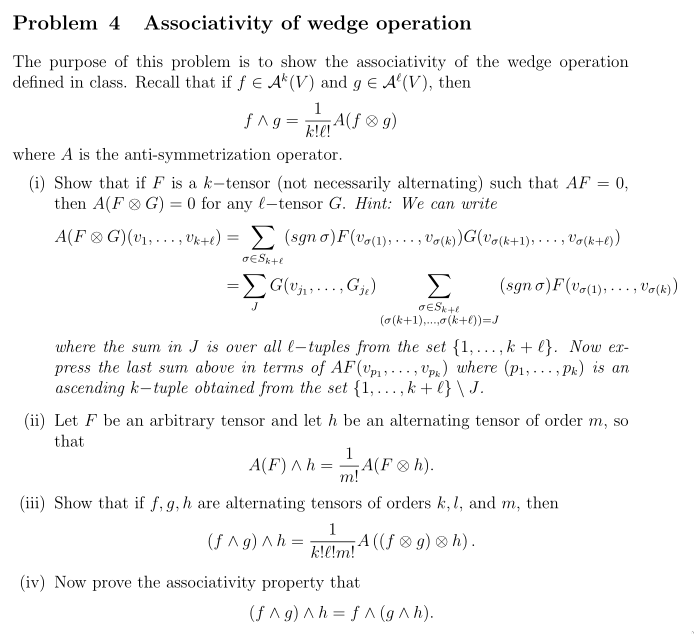
Anyone wanna compute
@sleek thicket gonna complain at you again about my classes
granted I left this till like
the day before it was due
so everything is my fault
but also
also there's this which while it's not conceptually difficult, we did it last year in Linear Algebra and I really don't wanna write up the proofs of these facts

and also like
it's not manifolds
why care about it
Angry woman noise
sleek thicket
Oh this stuff doesn't matter at all, it's so nasty
You check it once and then like
tada, associative
obtuse meteor
exactly
why assign this
as homework
when you could just like
say
"read Munkres"
?????
sleek thicket
Lol
sleek thicket
No I agree
obtuse meteor
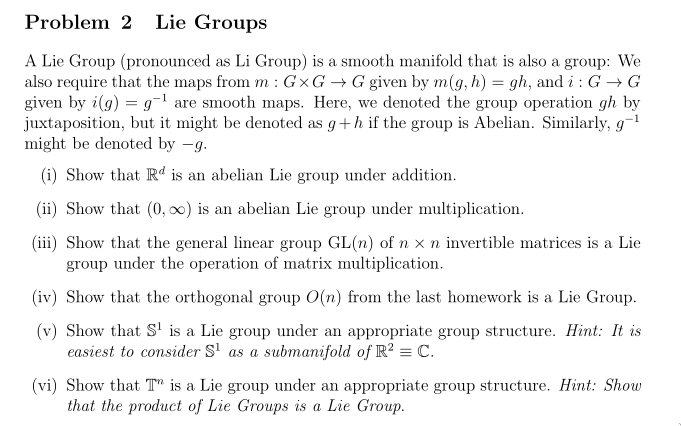
at least there's a problem about Lie groups too on here
it's basically just a "verify all these things are examples of Lie groups"
but that's a lot cooler than like
this shit
 marsh forge
i had a prof who would like
include a ton of problems that you didnt have to turn in
and was like
obtuse meteor
lol
marsh forge
i like that idea
marsh forge
like people should practice easy problems exactly as much as they need to but doing extra basic stuff is painful
obtuse meteor
I feel like why assign problems like this
it doesn't help me understand any of the concepts
it just makes me like
verify facts
and want to tear my eyes out bc of formalism
it's not as bad as the measure theory IBL
which is just "here's a bunch of basic properties of the Lebesgue integral that are like "verify this is <= this and linearity works and everything" that just relies on tracing back definitions through the last 4 worksheets about simple functions"
gritty widget
Hey guys, just a bit confused. is the topological space a topology within a topology?
or am i just way off?
elaborate
sounds off
marsh forge
A topological space is a set X with a topology T where T is a subset of the powerset of X subject to a bunch of axioms
Normally we just refer to the topological space as "X" where the topology T is obvious
or we specify T informally
sleek thicket
Does anyone know how to draw out a simplicial set like this in latex?

idk how to stack the arrows correctly
(would just use this picture but I prefer the one where you interleave the arrows)
hello @gritty widget feel free to post your question here
gritty widget
lol its ok
shut moat
$$\begin{matrix}\xrightarrow{\quad d_0\quad} \ \xrightarrow{\quad d_1 \quad} &&\\quad \dots\quad&&\end{matrix}$$
gentle ospreyBOT
~S^1
 shut moat
it's a bit hacked together but I think that technically works lol
 shut moat
np!
 topaz shuttle
 gritty widget
presumably not since n might not equal 2
 flint cove
Does anybody know off the top of their head how the classifying space construction G ↦ BG (i.e. the representing object of the „principal G-Bundles over -“ functor) gives rise to a functor G→H ↦ BG→BH?
I mean I would guess that EG→BG would somehow get an induced principal H-action, but I don't see how
 cedar pebble
@sleek thicket
$\begin{tikzcd}
X_0 \arrow[r,"s_0" description] & X_1 \arrow[l,shift right=3,"d_0" description] \arrow[l,shift left=3,"d_1" description] \arrow[r,shift left=3,"s_0" description] \arrow[r,shift right=3,"s_1" description] & X_2 \arrow[l,shift right=6,"d_0" description] \arrow[l,"d_1" description] \arrow[l,shift left=6,"d_2" description] \arrow[r,shift left=6,"s_0" description] \arrow[r,"s_1" description] \arrow[r,shift right=6,"s_2" description] & \hdots \arrow[l,shift right=9,"d_0" description] \arrow[l,shift right=3,"d_1" description] \arrow[l,shift left=3,"d_2" description] \arrow[l,shift left=9,"d_3" description]
\end{tikzcd}$
gentle ospreyBOT
nGroupoid
 cedar pebble
if you want the most compact possible
(this renders runny on TeXbot but it looks normal in a document)
sleek thicket
ty
cedar pebble

$\begin{tikzcd}
X_0 \arrow[r,"s_0" description] & X_1 \arrow[l,shift right=3,"d_0" description] \arrow[l,shift left=3,"d_1" description] \arrow[r,shift left=3,"s_0" description] \arrow[r,shift right=3,"s_1" description] & \hdots \arrow[l,shift right=6,"d_0" description] \arrow[l,"d_1" description] \arrow[l,shift left=6,"d_2" description]
\end{tikzcd}$
the more truncated version
gentle ospreyBOT
nGroupoid
 cedar pebble
there's a nice macro you can write that does all the arrows automatically but I would have to dig it up from somewhere
sleek thicket
flint cove
Does anybody know off the top of their head how the classifying space constructi...
this is a good question and I don't know off the top of my head
I think I would try to use an explicit construction of EG and BG like milnor's join or smth
I don't see how to get it abstractly
oh wait maybe I do
flint cove
Hm, okay, that might be a bit far off from what I know.
My whole background on this is that I know BO(n) and BU(n) from real and complex VBs via this grassmannian construction
cedar pebble
if you want this at the level of these infinite dimensional spaces that represent BG then this is a little annoying to write down explicitly
flint cove
At some point someone used that the embedding U(1)^n → U(n) lifts to BU(1)^n → BU(n)
I actually only want to understand where that comes from
Oh wait I just need to read one sentence further
sleek thicket
lol
cedar pebble
well so these maps say BU(1)^n → BU(n) really come from the maps Gr_1(C^k)^n->Gr_n(C^{nk}) sending subspaces to direct sums
and then you pass to the colimit
flint cove
Wait, don't you mean Gr_1(ℂ^k)^n?
cedar pebble
yes 😛
tight agate
flint cove
At some point [someone](https://math.berkeley.edu/~germans/Chern1.pdf) used that...
in this case, as the map is injective, you get a free action of BU(1)^n on EBU(n)
cedar pebble
So more generally like Gr_n(C^k)->Gr_n+1(C^k+1) passes to BU(n)->BU(n+1) in the colimit
and Gr_n_1(C^k_1)xGr_n_2(C^k_2)->Gr_n_1+n_2(C^k_1+k_2) passes to BU(n_1)xBU(n_2)->BU(n_1+n_2) in the colimit
sleek thicket
oh maybe you can yoneda it?
tight agate
sleek thicket
oh maybe you can yoneda it?
be very careful when you do this
sleek thicket
like, using the map to turn H-bundles into G-bundles
I was concerned about the action no longer being effective
not sure how to fix that
tight agate
maps into these things correspond to principal bundles when the domain is nice
you want something like compact
sleek thicket
ah this isn't how I've seen it presented
cedar pebble
I guess the way you can see the map U(n)->BU(n) is like
tight agate
you will need to write BG as a limit
cedar pebble
take the U(n) principle bundle U(n)->V_n(C^k)->Gr_n(C^k)
sleek thicket
which is preserved under pullback
cedar pebble
so you get a map U(n)->Gr_n(C^k)
tight agate
and look at the milnor sequence
cedar pebble
pass to the colimit
tight agate
and pray that the lim^1 term vanishes
cedar pebble
oh lord
sleek thicket
I don't see the concern?
BG represents the functor sending X to the set of iso classes of numerable principal G-bundles on X
(on the homotopy category)
tight agate
but X needs to be a finite CW-complex
sleek thicket
no, you can set it up as a condition on the bundle
tight agate
sleek thicket
this is how it's done in Lee's book and I'm suddenly very appreciative of it hahaha
tight agate
so no restrictions on the space at all?
cedar pebble
nlab has a decent coverage of this (don't worry, a lot of pages on nlab are written in a sane way now) https://ncatlab.org/nlab/show/classifying+space
sleek thicket
nope
cedar pebble
sleek thicket
it is kind of tedious proving all this numerable stuff
and like, not making assumptions on the base
but it does allow you to yoneda directly
sleek thicket
yeah!
tight agate
because if you prove existence of BG via brown rep
sleek thicket
also you don't need either compact or finite cw
tight agate
then you can't use yoneda directly
sleek thicket
just paracompact (so it works for any cw complex or manifold)
tight agate
because the representing object comes from a larger cat
cedar pebble
I really like the proof in the nlab Chern class article
since you really only need to understand BU(1) for this
tight agate
and this is the source of stuff like phantom maps and shit
cedar pebble
and then the rest is formal
sleek thicket
hey lux, is this discussion making any sense? sorry if we've been distracting you
flint cove
Huh, lot to unpack here.
I mean we can ignore what the assumptions on the base space are, let's just say paracompact hausdorff.
Perhaps something stronger if we still don't get a countable set of trivializations subordinate to whatever we have.
I'm just assuming that whatever (homotopy) cat T we work on, we have a functor Vec_{ℂ,n}: T→Set mapping base spaces to iso classes of bundles over that base space, and that this functor is represented by BU(n).
flint cove
sleek thicket
hey lux, is this discussion making any sense? sorry if we've been distracting yo...
Sure, just need to unpack stuff.
I haven't completely internalized the Gr-construction as well so it might take some time
sleek thicket
sure, we're not actually using a specific construction here
but you can trace it to get an explicit map
tight agate
yo lux in your case, as the map is an inclusion H --> G, you get a free action of H on EG
so you have EG/H
and then you get a map from EG/H ---> BG by quotienting out by G
ig you need H normal lol rip
for this to work
no you don't, I was being stupid


 tight agate
yes
sleek thicket
(the lie group condition is because G -> G/H might not even be a locally trivial bundle for H a closed subgroup of G if G is an arbitrary topological group)
tight agate
you probably just need the inclusion to be a cofib or something
this is why things can get messed up if H = {0} and G is the p-adics or something
I did not manage to prove it tho
sleek thicket
this lemma?
tight agate
no
tight agate
that (Segal's model) EG ---> BG is not locally trivial when G = Z_p
sleek thicket
the counterexample I was thinking of was (S^1)^infty -> (S1)^infty/{1,-1}^infty not being a locally trivial bundle (^infty meaning countable product)
flint cove
tight agate
yo lux in your case, as the map is an inclusion H --> G, you get a free action o...
okay, so in this case, U(1)^n acts freely on all the grassmannians and by the limit on EU(n), and (hopefully) in a fiber-preserving way, so the quotient is actually a bundle EU(n)/U(1)^n… but wait, this would be a bundle over BU(n). I want a bundle over BU(1)^n.
sleek thicket
tight agate
that (Segal's model) EG ---> BG is not locally trivial when G = Z_p
oh no this makes me sad
flint cove
Okay, so let me backtrack a bit. Just on representability grounds it would suffice to turn this embedding U(1)^n → U(n) into some induced bundle over BU(1)^n.
tight agate
lux look at the result shamrock posted
tight agate
sleek thicket
oh no this makes me sad
it works whenever the inclusion of the identity gives you an NDR pair
tight agate
flint cove
okay, so in this case, U(1)^n acts freely on all the grassmannians and by the li...
look at EU(n) ---> EU(n)/U(1)^n
it has fiber U(1)^n
tight agate
and the corollary shamrock posted shows that that bundle is a universal H-bundle
and you get a map to BG by "finish quotienting"
flint cove
sleek thicket
is this what you're thinking of brofib?
May I ask where that is from?