#point-set-topology
1 messages · Page 205 of 1
 tough imp
 trail ibex
MacLane proves the snake lemma without the embedding theorem in his book
He uses "generalized elements", which are equivalence classes of arrow to an object under a certain relation
 desert bloom
I'm stuck on ii
I feel like its a No, but I can't quite use the hint at all
My reasoning is because the topology of [0,1] contains every member of the topology of (0,1) but also contains more like (0.5,1]
so a bijective map cannot be continuous since each element must only be mapped to one element of the other set
but this feels like a super flawed argument
And I also cannot use the hint
 obtuse meteor
I don't think this is a valid argument
because like (0, 1) and (0, 2) are homeomorphic
but your argument would imply that they aren't
I would think about topological properties of a space that don't change under homeomorphism
(so called topological invariants)
You can use Q2 if you use a certain topological invariant that has to do with removing points
but imo there's an easier invariant
@desert bloom does this help?
desert bloom
hmm
I mean
What I really wanted to say was that [0,1] is compact and (0,1) is not
 tight agate
that works
desert bloom
but I cannot word it with the stuff he gave
tight agate
there's another way
desert bloom
and that isn't quite using the hint
tight agate
like cohomologay mentioned, think about how removing a point can behave differently for (0,1) and [0,1]
obtuse meteor
ye
desert bloom
yeah, I kinda saw that on stackexchange
obtuse meteor
I think compactness is best proof of this imo
desert bloom
but is that what it means by using Q2?
obtuse meteor
if you were dealing with like [0, 1) that's a different story
tight agate
desert bloom
but is that what it means by using Q2?
assume you have a homeomorphism, remove a point, restrict to subspace...
desert bloom
and the subspace is not continuous?
tight agate
(the image is not connected)
desert bloom
so contradiction?
I wanna say that too, but he didn't introduce connected to topology either...
That's why I felt a little distressed
Its an intro class to topology, and that purely topological thing he said at the bottom really threw me off
because I feel like I can't use any of the analysis stuff I've done
like compactness
desert bloom
yeah, but not introduced to me yet
Its the third week into the course
and the notes does not mention any of that
so I can only assume that he wants me to solve it another way
tight agate
maybe the property he wants you to find is connectedness
like after removing a point, one of them can always be written as a disjoint union of two open sets
this property is invariant under homeomorphism
tight agate
compactness is a much harder property to find on your own
desert bloom
yeah
tight agate
the definition in terms of open covers is pretty insane
desert bloom
I struggled to understand the idea of compactness back then
It feels off left field
tight agate
right
desert bloom
and its even weirder to think about how it is connected to sequential compactness back when I was doing analysis
tight agate
sequential compactness is easier to come up with
desert bloom
The two looks so different though...
tight agate
the abstract definition is the weird one
desert bloom
yeah
tight agate
desert bloom
The two looks so different though...
true
desert bloom
Some proofs that includes them are really fun to watch
its like magic
somehow it just works
tight agate
"Ultimately, the Russian school of point-set topology, under the direction of Pavel Alexandrov and Pavel Urysohn, formulated Heine–Borel compactness in a way that could be applied to the modern notion of a topological space. Alexandrov & Urysohn (1929) showed that the earlier version of compactness due to Fréchet, now called (relative) sequential compactness, under appropriate conditions followed from the version of compactness that was formulated in terms of the existence of finite subcovers. "
desert bloom
Ah
Say, if we are inventing mathematics
how would you think you can stumble across this definition?
tight agate
be smart idk
I don't think I could have come up with it hahaha

In mathematics, more specifically in general topology, compactness is a property that generalizes the notion of a subset of Euclidean space being closed (i.e., containing all its limit points) and bounded (i.e., having all its points lie within some fixed distance of each other).
Examples include a closed interval, a rectangle, or a finite set ...
the wikipedia page has a section on the history of the notion of compactness
desert bloom
I'll give it a read after I'm done with the problem sheet
tight agate
a lot of point-set shit is pretty insane
desert bloom
Right now, everything is insane
tight agate
one-point compactification for locally compact hausdorff spaces is super neat
tight agate
your class will probably talk about it in a few weeks
desert bloom
really?
desert bloom
You are right
desert bloom
in 3 weeks
 sleek thicket
@tough imp prove ag isn't cringe by helping me with this
this is the thing about closed subschemes of affine schemes in goertz and wedhorn
tough imp
@sleek thicket can u put the message link
I can’t click the thing u replied to scroll to it so idk where it is
sleek thicket
I can't get the message link on mobile lol
sleek thicket
Might be android vs iPhone? I don't see any option for it
Anyways just check the book
Near the end they say we can find a cover of a certain firm
*form
I don't get why
tough imp
Where in the book is this?
 drowsy trout
There exists an open U around x sur that $\phi(g)|U = 0$ because $\phi(g)_x = 0$ (this is the definition of the stalk)
Wlog, you can take then intersection of U and an affine subscheme so you may assume that U is affine.
Then I'm looking for the next argument to make sure that you can find a covering by affines $U \cup U_i$ s.t $x \ni U_i$ for all i
sleek thicket
yes, I understand how to choose U. I don't see how to exclude x from a covering by affines
 gentle ospreyBOT
Dagnyr
sleek thicket
since schemes have such weak separation properties
drowsy trout
Ah, so I haven't been helping much so far... :)
I'll see if I can think of something.
sleek thicket
so like, I thought about removing the closure of x but it might not be the case that φ(g)|y = 0 for any y in the closure of x
I think
drowsy trout
It will, because x is dense in its closure
sleek thicket
I don't understand why this implies what I want
tough imp
Err yeah I was making a wrong statement in my head
sleek thicket
drowsy trout
It will, because x is dense in its closure
I'm assuming cover here should be closure
drowsy trout
You can take U to contain the support of g and take U_i as a cover of D(g), can't you?
tough imp
g here being phi(g)
drowsy trout
Yes, sorry fir the lack of precision. I'm on my phone, if that may serve as an excuse :)
sleek thicket
why can I take U to contain the support of φ(g)? Doesn't the requirement on U tell us it's disjoint from the support of φ(g)?
desert bloom
Can I ask a quick question?
drowsy trout
sleek thicket
why can I take U to contain the support of φ(g)? Doesn't the requirement on U te...
I spoke too quickly I believe.
I haven't done scheme theory in a while.
sleek thicket
desert bloom
Can I ask a quick question?
Sure
desert bloom
Is it?
drowsy trout
Every polynomial has finite degree
sleek thicket
And yes, polynomials have finite degree by definition
tough imp
A polynomial has finite degree
desert bloom
oh?
tough imp
else it’s called a power series
sleek thicket
the cofinite topology on R is also called the zariski topology
Which is the fundamental topology in algebraic geometry
(this is why I say the question is algebraic geometry)
desert bloom
Sorry for interrupting
 gritty widget
you're algebraic geometry
gritty widget
im sorry i don't know sheaves or schemes i can't help
tough imp
Okay Sham so my thoughts right now
If you can show an affine U exists which contains the closure of x which has the “phi(g)|U = 0” property you’re done
Since then every point outside of U has a nbd which doesn’t contain x
So an affine
And then use quasi compactness
And if u can’t find such a U then the statement should be impossible
Since then some U_i necessarily will contain x
drowsy trout
Ah, I seem to remember doing an exercise like that in Liu.
tough imp
Z affine?
drowsy trout
It had to do with the map $spec(\mathcal{O}_{X,x}) \rightarrow X$
gentle ospreyBOT
Dagnyr
sleek thicket
Yes, X is assumed to be affine
and try to find a section which vanishes at x but not on its closure
drowsy trout
sleek thicket
and try to find a section which vanishes at x but not on its closure
But since a section is continuous, if it vanishes on x it vanishes on the closure of x
sleek thicket
I wasn't able to prove this ¯\_(ツ)_/¯
tough imp
Algebraically it seems a little backwards
Like you’re saying if s_p = 0 then for any q > p that s_q = 0
sleek thicket
Yeah, I worked it out for affine schemes and it's true the other way
sleek thicket
Oh no
drowsy trout
Isn't it direct, though?
The locus at which g vanishes is closed, so it should containt the closure of x.
Or do I really have everything backwards >_>
sleek thicket
why do I never fucking check the errata
tough imp
But it’s not necessary either
sleek thicket
drowsy trout
Isn't it direct, though?
The locus at which g vanishes is closed, so it should c...
You have the support and its complement backwards
tough imp
drowsy trout
Isn't it direct, though?
The locus at which g vanishes is closed, so it should c...
No, the place it’s non-zero is closed
Yeah so apparently you don’t need that part of it tho in order to do the proof
tough imp
Lmao
One issue with this book is the presence of a fair bit of errata. It’s not often it’s game breaking, but there’s a fair bit of typos
And occasionally just false things
sleek thicket
Yeah, I'll keep it in mind
drowsy trout
Damn, I guess it's time to get back to Hartshornes for me...
tough imp
Despite that I like the book a lot
tough imp
The exercises are doable from what I’ve seen
sleek thicket
Idk something about (locally) finite type and (locally) noetherian in Hartshorne just scared me
drowsy trout
Sorry, it looks like I brought more trouble than support in all this...
tough imp
You’re good lol
sleek thicket
The presentation
tough imp
Which one?
sleek thicket
drowsy trout
Sorry, it looks like I brought more trouble than support in all this...
We've all done it
Mutually distinguished opens
tough imp
Ah is this for this book?
tough imp
Ah okay yeah I haven’t read that part of it
So I’m not sure how it handles the earlier material
sleek thicket
I'm preferring it
tough imp
I just like that it has some of the more advanced but still often used topics Hartshorne doesn’t cover
As well as the functorial more modern ways to think about stuff
sleek thicket
and I can get the sheaf coho stuff elsewhere
That's the thing I'm least concerned about
tough imp
I mean honestly Hartshorne is good for sheaf coho
At least, I didn’t find t too bad (besides like 1 or 2 pretty tricky proofs)
And I used stacks for the čech stuff
 bitter yoke
hm
bitter yoke
Hm so I have a weird smooth manifolds calculation that doesn't seem to be working and I'm not sure if I'm understanding something wrong or if I can't calculate
So on S^n we have that antipodal map that sends p to -p and I was looking at the differential of this map
If you consider the like "paths" formulation of the tangent space, or just intuitively, it seems that the differential is just sending v in T_p to -v in T_f(p)
tough imp
obtuse meteor
using stacks
Stacks project
bitter yoke
But I was trying to write out the differential by computing charts and taking the Jacobian, and so I thought I'd just end up with negative the identity matrix, but that's not what I'm getting
So if we consider the stereographic projection from the north pole, the map from $\bR^n \to S^n$ is given by $$g(x_1, \dots, x_n) = \left(\frac{2x_1}{x_1^2 + \cdots + x_n^2 + 1} , \dots, \frac{x_1^2 + \cdots + x_n^2 - 1}{x_1^2 + \cdots + x_n^2 + 1} \right)$$
gentle ospreyBOT
Zopherus
sleek thicket
bitter yoke
If you consider the like "paths" formulation of the tangent space, or just intui...
Paths formulation meaning velocity vectors of curves?
bitter yoke
yeah
sleek thicket
And yeah that's the differential
bitter yoke
the antipodal map is just going to reflect your curve so you'll get the negative velocity
sleek thicket
It's the restriction of a linear map on R^n+1
And linear maps are their own differential
bitter yoke
Okay yes true, but you should also be able to do this by taking charts and then computing the jacobian of the "function in charts" right?
bitter yoke
Yeah, but the problem is that I'm not getting anything very nice
so the above is the map from R^n to S^n and then we take the antipodal map which just takes the negative of each coordinate
Then taking the inverse of this map, I get the function
sleek thicket
Inverse of the stereographic map?
bitter yoke
right
I'm assuming that we're not starting with (x_1, ..., x_n) = 0 here otherwise this doesn't work but
if we let A be the antipodal map, then I calculated that
$g^{-1} \circ A \circ g(x_1, \dots, x_n) = \left(-\frac{x_1}{x_1^2 + \cdots + x_n^2}, -\frac{x_2}{x_1^2 + \cdots + x_n^2}, \dots, -\frac{x_{n-1}}{x_1^2 + \cdots + x_n^2}, \frac{1 - x_1^2 - \cdots - x_n^2}{2x_1^2 + \cdots + 2x_n^2}\right)$
gentle ospreyBOT
Zopherus
bitter yoke
so if I'm understanding this correctly, the Jacobian of this map should be the differential which should be just negative the identity matrix, but its not that
sleek thicket
I'm going to redo your computation to make sure I agree
bitter yoke
Yeah, I'm using the formulas from https://en.wikipedia.org/wiki/Stereographic_projection#Generalizations
sleek thicket
Oh yeah I agree with the charts
bitter yoke
but using the last coordinate instead of the first coordinate
sleek thicket
I checked ISM just to make sure
bitter yoke
yeah okay
sleek thicket
I get a different formula
My last coordinate is just -xn/||x||^2
Like the other coords
Hmm this seems wrong actually, sorry
bitter yoke
hm, I'll check that again, but regardless, this doesn't give you negative the identity as your jacobian right?
sleek thicket
I'm not sure, seems unlikely though
I want to get the computation right before I try to understand what's going wrong
bitter yoke
I mean yeah, the derivative of the first coordinate with respect to x_1 would have to always be -1, but its not
sleek thicket
if $y = -x/|x|^2$ then $|y|^2 = |x|^{-2}$ so $g(y) = \left(\frac{-2x_1|x|^{-2}}{|x|^{-2} + 1} , \dots, \frac{-2x_n|x|^{-2}}{|x|^{-2} + 1}, \frac{|x|^{-2} - 1}{|x|^{-2} + 1} \right) = -\left(\frac{2x_1}{1+|x|^2} , \dots, \frac{2x_n}{1+|x|^2}, \frac{|x|^2-1}{|x|^2 + 1} \right) = - g(x)$
gentle ospreyBOT
Shamrock emoji ☘
sleek thicket
so yes it is $y = -x/|x|^2$
gentle ospreyBOT
Shamrock emoji ☘
sleek thicket
So now why is the jacobian wrong
hmm
Hmm I sort of have an idea
The basis on the domain and codomain are going to be different
I mean they're different vector spaces
right okay so $dA_p(v) = -v$ only makes sense if you embed in $\R^{n+1}$
gentle ospreyBOT
Shamrock emoji ☘
sleek thicket
Since without doing so the two sides of the equation live in different vector spaces
bitter yoke
Agreed, but both p and -p have canonical bases for their tangent spaces under the stereographic projection chart and so the linear map under those bases should also be the negative map?
sleek thicket
I don't see your reasoning
The stereographic projection basis won't look like the standard basis in R^n, which is where we're equating dA(v) and -v
abstractly we have vector spaces $V, W$ which have embeddings $i : V \to U, j : W \to U$ and a linear maps $A : V \to W$ such that $j(Av) = -i(v)$, right? choosing arbitrary bases for V and W won't necessarily make $A$ into the negation map
gentle ospreyBOT
Shamrock emoji ☘
sleek thicket
You'd have to use more specifics of the situation (ie properties of the stereographic projection bases) to say why it should look like negation
 cedar pebble
I don't think this is going to look like negation, unless I'm completely misunderstanding the setup of what you're doing. The setting I'm familiar with is the following: take π:S^n-{(0,...,1)}->R^n to be the usual stereographic projection, extend this to s:R^{n+1}-{x in R^{n+1}|1-x_{n+1}\neq 0}->R^n given by the following:
$s(x_1,\hdots,x_{n+1})=\Big(\frac{x_1}{1-x_{n+1}},\hdots,\frac{x_n}{1-x_{n+1}}\Big)$
gentle ospreyBOT
nGroupoid
sleek thicket
(It doesn't, the jacobian looks something like this)
cedar pebble
now s o π^{-1}:R^{n+1}->R^{n+1} is just the identity
passing to differentials one has
$\mathrm{d}s_{\pi^{-1}(x)}\circ\mathrm{d}(\pi^{-1})x=\mathrm{id}{\mathbb{R}^n}$
gentle ospreyBOT
nGroupoid
cedar pebble
so the relevant Jacobian here should be the identity, if I am not mistaken
cedar pebble
again there is a chance I am totally misunderstanding what Zoph is asking for and we might be talking past one another
oh lmfao very well then
sleek thicket
in stereographic projection charts on S^n\{0}
cedar pebble

well this misunderstanding has me feeling like this dril tweet https://twitter.com/dril/status/134787490526658561

"im not owned! im not owned!!", i continue to insist as i slowly shrink and transform into a corn cob
Retweets
14737
Likes
43693
 Twitter
·
Twitter
·
carry on then
bitter yoke
Okay I see what you're saying Sham. So the map is the negative map when we consider T_p and T_(-p) as subspaces of R^(n+1). But if we consider the basis for the tangent spaces coming from the charts, then the map isn't necessary the negative map there
sleek thicket
Right, exactly
Having differential the negation isn't intrinsic, it's a property of the embedding
And there's no reason the coordinate bases should respect this
which of these projects seems coolest http://pages.pomona.edu/~ehga2017/prime/projects.html
idk anything about elliptic curves
bitter yoke
Okay, I see. So in the smooth manifold world, this distinction doesn't really matter much, since everything is just abstractly isomorphic. But the problem I was doing was showing that the antipodal map is isometric, which is where this distinction matters
cedar pebble
the first of these looks the most interesting, Belyi maps are particularly interesting and the "shape" of these Belyi maps is often very interesting for modular curves
e.g. for the modular curves Y(3), Y(4), and Y(5) the relevant dessins are some of the platonic solids (the tetrahedron, octahedron, and icosahedron dessins respectively)
sleek thicket
👍
That's the one which I was leaning towards since it seemed to require the least background knowledge
cedar pebble
I remember trying to read about Belyi maps for general elliptic curves and it was frustrating lol
things that number theorists claim to care about
sleek thicket
I actually only found out about this program because Daniel tweeted about it
It seems cool, would be nice to do some number theory
cedar pebble
oh nice!
sleek thicket
and also they give you an iPad
cedar pebble
Yea dessin stuff is very very cool
I spent quite a while thinking about this kind of stuff as an undergrad
although I was a little less into the explicit computations that one can do with them and rather was into some of these lofty theorems about like
Gal(\bar{Q}/Q) acting faithfully on dessins (so in particular this gives you some combinatorical objects where you can visibly "see" the action of the entire absolute Galois group without losing information)
and how this implies we have an injection Gal(\bar{Q}/Q)->Out(\hat{F}_2) and so on
 little hemlock
This could be equivalently formulated as M is an embedded submanifold if the tangent map at each p in M has maximal rank, right?
sleek thicket
yup
gritty widget
implicit  theorem
little hemlock
where would you even start to find the values of t for which the intersection is nonempty?
 shut moat
you could find the distance from the plane to the origin. when that's greater than 1, the intersection is empty
little hemlock
oh yeah, true 
also, is the best way to apply implicit function theorem to this to solve the second equation for x,y, or z (depending on which A,B,C != 0) and plug it into the sphere equation to get an implicit function, or is there a better way to think about it?
shut moat
you could always do it directly with the function F: R^3 --> R^2 with components being the equations for the sphere and plane
but I don't think it matters much
little hemlock
ah yea ofc, then the level set is just F^-1(1,t).
gritty widget
just draw picture
shut moat
it's v good to build intuition for how this all works by visualizing the 3d cases
imo
for more complicated manifolds I like using https://www.geogebra.org/3d?lang=en or mathematica
little hemlock
i think i have the visual intuition. Its just a circular cross section of the sphere. but im just not that comfortable with all of the implicit function theorem details and stuff
shut moat
I like thinking about it as: linear approximation invertible ==> function is locally invertible
and that's p much all you need, I think. (although unironically ping me if you find a nice proof I'm still traumatized by the one I've seen  )
)
little hemlock
linear approximation invertible ==> function is locally invertible
inverse function theorem, right?
gritty widget
i think there's a nice proof of the inverse function theorem using uhhhh contraction principle?
its probably in pugh's analysis book
shut moat
hell yeah ty
gritty widget
ive never actually seen it but it's probably nicer than the thing in spivak's CoM
little hemlock
i think the contraction one is in the appendix of ISM too
gritty widget
everyone talks about contraction principle but what about expansion principle 
shut moat
little hemlock
> linear approximation invertible ==> function is locally invertible
inverse fun...
I think the two are linked conceptually but I forgot why I thought that 
shut moat
objectively right tbh
I honestly still can't believe Hubbard used Kantorovich's theorem to prove inverse func theorem
like wtf
gritty widget
what's that
shut moat
literally rigorous newton's method 🤢
gritty widget
based
obtuse meteor
I've had a lecture by hubbard
he taught a first year real anal class how to compute pi1 of the circle
shut moat
:o
gritty widget

sleek thicket
That's based
obtuse meteor
we didn't know what a metric space was
sleek thicket
wow it keeps getting better!!
gritty widget
there's a pun about based topological spaces somewhere here
obtuse meteor
we didn't have a definition of S^1
he defined S^1 as R/Z
and taught us about quotient spaces
shut moat
that sounds like a fun class 
sleek thicket
I would simply prove Whitney approximation and then develop the theory of winding numbers in complex analysis
sleek thicket
Actually Whitney approximation is probably easy here
obtuse meteor
but yes it was
gritty widget
id prove it by saying "this is true"
sleek thicket
oh shit
shut moat
big brane move
obtuse meteor
chad
gritty widget
then id also say "all these other things are true" and the students would be equipped to read hatcher
obtuse meteor
truly chad
gritty widget
didn't you know all of math is true? why are we wasting our time
sleek thicket
what about the false math
gritty widget
little hemlock
Okay, complete the $(df^i)_p$ to a basis for $T_p^*M$ (probably will need it later). Suppose that $\xi \in T_pS$. Then
$$\langle \xi, (df^i)p\rangle = \frac{d}{dt} (f^i\circ \xi)\big|{t= 0} = 0$$
for $i = 1, \dots, k-m$ since $f^i$ is constant in a small enough neighborhood of $p$.
gentle ospreyBOT
kxrider
little hemlock
but i don't understand why the other inclusion holds?
for example, just because the derivative along a particular tangent vector are 0, doesn't imply that the function is constant in a neighborhood of p
gritty widget
dimensions?
little hemlock
dimensions?
sleek thicket
Of the common kernel of all the df's and T_p S
So @little hemlock you've shown a certain inclusion yeah?
Which one
little hemlock
TpS \subset { .... }
sleek thicket
right
There's a nice trick to showing a subspace of a vector space is the whole thing
That tterra is hinting at
sleek thicket
use 2.1 on the left hand side
Apply bilinearity
use 2.2 on each term of the result
gritty widget
sleek thicket
tterra give me nitro so I can use animated emoji
tight agate
CATWIGGLE
sleek thicket
I need this
 sleek thicket
Okay deal if you get into fields it was because of me
gritty widget


tight agate
wait why
sleek thicket
tight agate
wait why
to get nitro
(i didn't actually withdraw it)
Pinned for posterity
Wait wtf
Pins are gone
😢 😢 😢
gritty widget
wow
sleek thicket
So many important messages
gritty widget
right after i pinned aeiou
sleek thicket
I'm gonna have to find drunken drake's pins
by coming together as a community and gifting eachother nitro
Oh it only removed pins by honorables
Since the pins in cat theory are still up
This is so cringe
little hemlock
(oh i understand my thing now lol
you can describe tangent vectors in the set on the right using the extended basis for TpM)
 sharp frost
when you say "apply bilinearity" I don't really see what we can do
sleek thicket
little hemlock
(oh i understand my thing now lol
you can describe tangent vectors in the set on...
I do not understand this but I'm glad you do
In my brain linear independence implies the intersection of the kernels has the same dimension as T_p S
little hemlock
wait now im not sure i do
sleek thicket
sharp frost
when you say "apply bilinearity" I don't really see what we can do
you can rewrite the left term of the bilinear form using 2.1
This gives you a linear combination of e_γ
sharp frost
OHH I think the einstein summation tricked me
sleek thicket
Bilinearity let's you pull the sum and scaling out of the inner product
sharp frost
my god
sleek thicket
Well i mean it works out here
sharp frost
I see it now thank you
sleek thicket
But you need to justify it
sleek thicket
little hemlock
wait now im not sure i do
Can you write out what you're thinking in more detail?
obtuse meteor
who pinged me?
obtuse meteor
were you telling me to do my homework
obtuse meteor
💙
sleek thicket
Check the pins
obtuse meteor
linear algebra
sleek thicket
Yeah they got deleted
I just repinned that
And it pinged you
Let $V = \bigcap_{i=1}^{m-k} \ker d(f_i)_p$
gentle ospreyBOT
Shamrock emoji ☘
sleek thicket
We know $T_p S \subseteq V$
gentle ospreyBOT
Shamrock emoji ☘
sleek thicket
I claim $\dim V = k$
gentle ospreyBOT
Shamrock emoji ☘
sleek thicket
yeah?
little hemlock
alright 
sleek thicket
is this not what you were saying?
this would imply T_p S = V, which is what we're trying to show
since they're the same dimension and one is contained the other
little hemlock
that makes sense, but is dim V = k any more obvious?
little hemlock
than showing the other inclusion by [some other way].
little hemlock
Extend the $(df^i)_p$ to a basis $(df^1)_p, \dots, (df^m)p$ of $T_p^*M$. Let $\xi$ belong to the set from the RHS. Then, since $\xi \in T_pM$, $$\xi = \sum{i=1}^m a_i \frac{\partial}{\partial f^i}.$$
For $1 \leq j \leq m - k$, $$0 = \langle \xi, (df^j) \rangle = a_j.$$ i.e. the first $m-k$ coordinates are 0.
gentle ospreyBOT
kxrider
little hemlock
and then, umm
sleek thicket
That sort of makes sense to me
I would phrase it a little differently
It's nontrivial that you can extend a basis like this, where the other covectors are differentials
but you can extend to some weird basis and then take covectors
little hemlock
are differentials different from cotangent vectors? I just used the (df) notation to be consistent, but I wasn't implying that i was extending to some special basis for Tp*M
the thing i want to conclude is that the set on the RHS is the span of the last k cotangent vectors.
sleek thicket
I think it's true that every covector is the differential of some function, but the definition of T_p^* M I'm familiar with is just the dual space of T_p M
so let's back up a bit
V is a subspace of a vector space cut out by m-k linearly independent conditions
what does your intuition from linear algebra tell you?
little hemlock
that its k dimensional
gritty widget
that is a really nice way to word that shamrock
sleek thicket
yup
I mean it's actually a proof
like
Define Φ : T_p M -> R^(m-k) by Φ(x) = (df_1|p(x),...,df_{m-k}|p(x))
The assumption implies this is full rank
So the kernel is k dimensional
little hemlock
and the kernel is supposed to be T_pS hmm
sleek thicket
Yeah
This shows the kernel is k dimensional and contains T_p S
if you choose a basis for T_p M
Any basis
then the rows of the matrix representation for Φ are linearly independent
yeah?
Because those are the coefficient vectors for the dual spade
so this is why it's full rank
little hemlock
thinking
little hemlock
yea, i think i follow.
little hemlock
yep. I'm understanding this a little better. thank you!
sleek thicket
It's just linear algebra in the end
gritty widget
as is all smooth manifold theory
you either have fiberwise linear algebra which is trivial, or local linear algebra enabled by some equivalent of the implicit function theorem
sleek thicket
pretty much
Or "this is an open property" which is related to the second one
eg linearly independent at a point => linearly independent in a nbhd
this is why vector bundles are supreme 😌
little hemlock
This is comforting. I think i can do linear algebra. I just need to make these connections
gritty widget
work with principal bundles if you want some weird stuff
sleek thicket
Yeah, it's tricky
I don't think I would have spotted the codimension thing before doing AG/manifolds stuff
But thinking in terms of "this is cut out by equations so it's dimension is X" becomes natural to you
Why would I work with principal bundles when I can simply take the associated bundle and reduce to vector bundles
imagine not having global sections
gritty widget
man
sleek thicket
horse
gritty widget
the whole thing about a principal bundle being trivial iff it has a global section is so weird to me
like i worked out the proof in detail and stuff
but im still like "wtf"
too much tangent bundle intuition left over
i guess that kind of thing will become more natural to me as i work with em more 😌
sleek thicket
yeah haha
I guess to me it's like
Line bundle intuition
Nonvanishing section iff trivial
you can just take that to be your special element at each point
gritty widget
that one i can see
sleek thicket
Yeah
like a fiber can be identified with the group
if you pick any element
To be the identity
gritty widget
!
sleek thicket
a section gives you a continuous way of doing this
gritty widget
sleek thicket
I think I just gave myself intuition for it lol
gritty widget
that is a really nice way to look at it
sleek thicket
yeah!
gritty widget
ty for the free intuition
sleek thicket
It came at negative cost to myself
gritty widget
if $\sigma\colon M \to P$ is a section then the map $(m, g) \mapsto \sigma(m) \cdot g$ is a trivialization
gentle ospreyBOT
(T*(Terra), -dτ)
gritty widget
this now makes much more sense
gritty widget
and does not feel like an asspull
sleek thicket
the puzzle is unraveling

 sleek thicket
☘️
sleek thicket
I was considering it
Writing up notes at leadt
It would be way too category brained though
gritty widget
what's wrong with that 
gritty widget
morphisms of principal bundles 
sleek thicket
boring :(
I was just thinking about that
Vector bundles have interesting maps
But principal bundles seem boring
I guess you can have nontrivial automorphisms
gritty widget
think about weird stuff like maps TTM -> TTM

iterate your vector bundle constructions
sleek thicket
hmm I feel like TTM should be simpler than TM somehow
idk TM is already sort of half linear
gritty widget
iterated tangent bundles 
sleek thicket
!
gritty widget
TTTM
 white laurel
So I was going through this pdf: https://www.math.ucla.edu/~petersen/Bianchi_Ricci_Identities.pdf, and in the pdf the professor says this
does anybody know how they got the second line. I seem to be able to derive the first line, but the second line's just hurting 😛
I got the first one by contracting $$(\nabla\nabla)_{xy} C(\nabla \otimes z)$$, but I'm not sure what the "other way" to iterate is. Any ideas?
gentle ospreyBOT
uncle-iroh
sleek thicket
good luck I would help but it seems deeply annoying, sorry
white laurel
no I can understand that. No judgement here 😛
tight agate
The Quillen-Suslin theorem says vector bundles over spec k[t_1, ..., t_n] are trivial, so k[t_1, ..., k_n] behaves like R^n when it comes to bundles.
Which homotopic properties of R^n don't "carry over" to Spec k[t_1, ..., t_n]?
(ig w/o "holomorphic" stuff ruining the analogy)
 delicate hollow
quick question
if a topological space X is hausdorff and you have x in X, is it true that:
the intersection of all V_i (where x in V_i/V_i is a neighborhood of x) is equal to the singleton set {x}?
I am thinking that if every V_i has an element other than x,say y, that would contradict Hausdroff condition because every neighborhood of x has a non-empty intersection with every neighborhood of y.
 marsh forge
Yeah
delicate hollow
i wish I had a lot of examples of everything
sleek thicket
This is true as long as all points in your space are closed
delicate hollow
the real question im showing is that the intersection of the closure of each V_i is equal to {x}
i think i just need to show that the set of limit points is empty?
the intersection of the set of limit points*
inclusion of what?
gentle ospreyBOT
slimvesus
delicate hollow
i think i need to show intersection of set of limit points of each neighborhood is empty.
I want to do this because im addicted to the fact that the closure is equal to the set and its limit points
sleek thicket
I never remember what limits points are lol
delicate hollow
i dont know any straightforward ways
sleek thicket
I would show that if every nbhd of y intersects this intersection then y = x
delicate hollow
oh
so i could ignore limit points stuff maybe?
i need the closure of the neighborhoods though
sleek thicket
What is your definition of $\overline{S}$?
gentle ospreyBOT
Shamrock emoji ☘
sleek thicket
Hi Faye topological vector spaces are based
delicate hollow
i was just gonna use the set and its limit points
sleek thicket
Fair enough
delicate hollow
but the definition the text uses is the intersection of every closed set that contains S
set and its limit points is just a theorem for closure
sleek thicket
Oh that's actually much easier
gentle ospreyBOT
slimvesus
sleek thicket
To show $\overline{\bigcap V} \subseteq {x}$ it suffices that ${x}$ is a closed set containing $\bigcap V$
gentle ospreyBOT
Shamrock emoji ☘
sleek thicket
Since the closure is the smallest such closed set
delicate hollow
also is it too unreasonable to prove that the set of limit points is empty?
i dont think thats true intuitively though
sleek thicket
For each V?
delicate hollow
yeah
sleek thicket
That's not true
Think about it in R^2
A ball is a nbhd of its center and has limit points
delicate hollow
yes
i meant the intersection of each V_i
damnit
the intersection of each V_i' where V_i' is the set of limit points for V_i
still doesnt seem true though
sleek thicket
I think it will be empty but it doesn't seem easy to prove
delicate hollow
intersection of closure of V_i?
sleek thicket
yeah, try to use that to reach a contradiction
delicate hollow
the thing that throws me off is the closure part
the closure of a set is always gonna be greater or equal to the set
I have 4 days so ill come back in a little bit with more progress.
sleek thicket
kk
Here's a definition of the closure that is similar to the limit point thing but easier for me to think about
It might help you
$\overline{S}$ is the set of points $y$ such that every neighborhood $V$ of $y$ satisfies $S \cap V \neq \varnothing$
gentle ospreyBOT
Shamrock emoji ☘
sleek thicket
it's like the definition of a limit point but we allow the possibility that S cap V = {y}
delicate hollow
i think i got the answer lol
yeah
@sleek thicket
Remember my logic from before for why the intersection of V_i = {x}
To recap, suppose every V_i contains another element other than x. (Say y)
Then the contradicts Hausdorff because that would mean that there exist no disjoint neighborhoods between x and y.
But I don't exactly know the proper negation of the statement Suppose every V_i contains another element other than x.
Nevermind I dont think a negation would do anything there
delicate hollow
Also in standard topology, is infinite intersection of nested open real intervals equal to some singleton set set?
obtuse meteor
intersection of nested open real intervals doesn't make sense in general / point-set topology
little hemlock
i think marlin meant the "standard" topology on R lol
little hemlock
not that the topology matters, depending on your def of "open interval"
gritty widget
take every set to be the same set then u have nested family with intersection big
obtuse meteor
little hemlock
not that the topology matters, depending on your def of "open interval"
yeah this is what was tripping me up
obtuse meteor
gritty widget
take every set to be the same set then u have nested family with intersection bi...
boring example
gritty widget
obtuse meteor
true analyst
gritty widget
delicate hollow
ye wasnt specific enuf
going for intersection of a collection of nested intervals each of which "decrease" to a point
and std topology
onr
so like 0,2
(0,2),(.5,1.5),(.75,1.25),...
me thinks if u take infinite intersection u wil b left with singleton set
not that the helps prove my problem
im just stuck on proving the set of limit points of neighborhoods of x is either empty or equal to {x} part
sleek thicket
obtuse meteor
so 0 1 or infinitely many points
Or empty
Oops
0≠2
Dunno how I misread that
delicate hollow
0,1 or ifinitely meny
sleek thicket
Yeah lol I just misread Faye's post
delicate hollow
happens to gods
i was thinking that for a point to be in V_i' (the set of limit points of neighbhorhoods of x), it needs to be such that every neighborhood of that point p in V_i', needs to have contain points other than p
So if we ask the question: is x itself in V_i' for every V_i?
If it is in every V_i' then each V_i(neighborhood of x) would contain points other than x for every V_i, which seems entirely possible?
obtuse meteor
delicate hollow
going for intersection of a collection of nested intervals each of which "decrea...
does (0, 1/n) not disprove this idea though?
delicate hollow
i meant to add stipulation that each open set needs to contain the point too
to break ur statement
obtuse meteor
👍
delicate hollow
no hard feelings
i hope my prof made a typo
because proving it for closure is hard af
sleek thicket
was very stuck on something the other day
Eventually cracked and asked chmonkey for help
He can't figure it out and in like half an hour thinks to check the errata
The claim I was stuck on is false in general and unnecessary for the rest of the proof!
gritty widget
reminds me of this:
obtuse meteor
https://estrogen.fun/i/iewk.png
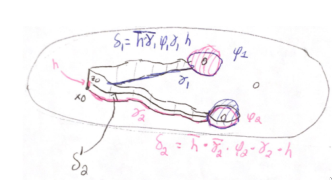
Truly it is algebraic topology time
 sleek thicket
this is based
 fathom cave
gritty widget
fathom cave
gritty widget
you're welcome
 fading vale
obtuse meteor
https://estrogen.fun/i/iewk.png
Truly it is algebraic topology time
fading vale
obtuse meteor
https://estrogen.fun/i/iewk.png
Truly it is algebraic topology time
omg is this the "gluing a 2-cell quotients out shit"
i remember this diagram
tom diecks approach is just "attaching is a pushout so slap van kampen on that shit" :p
fading vale
hatchers proof itself is pretty long iirc
at least by comparison
well each approach has ups and downs 
marsh forge
i mean maybe hatcher is technical about it
but literally like
just picture an annulus
then glue a dome around the hole
now you have a path 2 contract
Indeed a loop will be contractible if a representing map S^1->X extends to a map D^2->X. The space after gluing has a map D^2->X that is the inclusion of the added cell. Obviously it restricts to the S^1 map, so you're done.
(personally with all this stuff I think its easy to blackbox category stuff but that in general its better to learn how to do it geometrically first bc it makes the category theory make sense and obvious)
obtuse meteor
yeah I agree
I really like the geometric way of thinking about it
Hatcher is very technical about it
and his approach is to verify this with Van Kampen by like thickening up your space but choosing some interesting open covers
marsh forge
Yeah my advice re: that stuff is to like
have a good idea how hatcher deals w the technicals
but all you should really remember is the big idea
unless you need to prove something similar
 marsh forge
yeah i honestly think making people do stuff visually is cool and good
esp if the class isn't just for future homotopy theorists lol
obtuse meteor
half of our homeworks are
"this is a result that we need but is painful to prove. Read Hatcher and illustrate the proof and illustrate the computational tool gained from the proof in this example"
which unironically is based lol
 native raptor
hey! i'm trying to find a left-invariant metric on SL(2,R) and i'm getting stuck, anyone have hints on how to start?
gritty widget
can't u just take an inner product on the lie algebra and then translate it around
maybe easier said than done computation-wise
but it feels like it'd work (and since the matrices are only 2x2 it'd probably be nice)
gritty widget
ya this construction will always give you a left-invariant riemannian metric on a lie group
if $\langle \cdot, \cdot \rangle$ is an inner product on $\mathfrak{g}$, then you can define $g$ on $G$ by $g_a = d(L_{a^{-1}})_a^*\langle \cdot, \cdot \rangle$, for $a \in G$.
gentle ospreyBOT
(T*(Terra), -dτ)
gritty widget
then i guess for the case of SL(2, R) you have to unwrap what the inner product is and what the pullback of the differential looks like
native raptor
oooh thank you so much!!
gritty widget
 cold vine
Im reading Hatcher 1.39 and it mentions here H(x) := p*(pi(E,x))=p*(pi(E,y)) =: H(y) is equivalent to existance of a deck transformation taking x to y, which seems reasonable enough, but although "<=" seems obvious by the induced isomorphism of the deck tranformation, I can't quite reason through "=>". I'm thinking it's something like since H(x) and H(y) are conjugate we have a loop w in base which has a lifting f which takes x to y. Now for this conjugacy H(y) = [-w] H(x) [w] to be isomorphism we for some reason need an homeomorphism taking x to y?
It gives as a hint the lifting criterion
but doesn't it just give that w lifts to a path f from x to y
why does having a deck transformation lead to the conjugacy classes becoming equivalent
gentle ospreyBOT
slimvesus
cold vine
ah this should help yeah!
thanks a lot
Does the lifting not induce a homeomorphism since the lift is unique and we can lift (E,y) -> (E,x) and (E,x) -> (E,y) and thus the triangle commutes both ways
cold vine
Hmm true it might not in fact 🤔
sleek thicket
let $X$ be the projective line over $\mathbb{F}_p$. the frobenius map is an isomorphism on global sections since $\Gamma(X, \mathcal{O}_X) = \mathbb{F}_p$ but is not an isomorphism of schemes, since on a chart $\mathbb{A}^1 \subseteq X$ the map on sections is the frobenius $\mathbb{F}_p[x] \to \mathbb{F}_p[x]$, which is not surjective ($x$ is not a $p$th power)
does this sound good?
gentle ospreyBOT
Shamrock emoji ☘
 long coyote
if $\tau_1$ is finer than $\tau_2$, does $\tau_1\subset\tau_2$
gentle ospreyBOT
亜城木 夢叶
 tough imp
That’s backwards
Finer means it should have more open sets
So in particular every set open in tau_2 should be open in tau_1
long coyote
ok, thank you
marsh forge
(for the record i think that both meanings might show up in the literature or some other instance of coarse/finer)
(but chmonkey's right that is the current convention)
long coyote
Let $(X,\tau_1)$ be a compact Hausdorff space. Suppose $X$ is also compact in topology $\tau_2$ and assume that $\tau_2$ is finer than $\tau_1$. Show that $\tau_1=\tau_2$.
gentle ospreyBOT
亜城木 夢叶
 long coyote
am i suppose to show closed sets in tau1 are in tau2
little hemlock
since tau2 is finer than tau1, closed sets in tau1 are already in tau2
i.e. you technically want to show the opposite inclusion
long coyote
yep, that is what i mean
$E,F$ be closed sets in $X$ with respect to $\tau_2$ such that $E\cap F=\phi$. Let $U$ be the neighborhood of $E$ and $V$ be a neighborhood of $F$. Since $X$ is compact in $\tau_2$, $X$ has a finite subcover ${\mathcal{O}k}{k=1}^n$, $U=\cup\mathcal{O}_i$ and $V=\cup\mathcal{O}_j$. apply the finer assumption, basis of $\tau_2$ are in basis of $\tau_1$, so basis of $\tau_2$ generates $U$ gives us $U$ is an element of $\tau_1$
gentle ospreyBOT
亜城木 夢叶
 little hemlock
i don't quite follow. what open cover are you finding a finite subcover of? And U wasn't an arbitrary open set in tau2
long coyote
hm, let $C$ be a closed set in $\tau_2$, clased set in compact space is compact, then C has a finite subcover. These finite subcover generate by basis if tau2. basis of tau2 are contained in tau1, we have C in tau1. since tau1 is hausdorff, compact set is closed
gentle ospreyBOT
亜城木 夢叶
 little hemlock
you're on the right track, but I'm not sure where you are getting that a basis for tau2 is contained in tau1.
Let C be closed in tau2, so C is compact since X is is compact in tau2.
Now, you want to show that C is closed in tau1. Since tau1 is Hausdorff, it suffices to show that C is compact in tau1.
long coyote
tau2 is finer than tau1, basis generates tau2 also generate tau1
little hemlock
okay, fair enough, but this is just equivalent to saying that tau1 \subset tau2. Are you covering C by open sets in tau1?
long coyote
yes, from the book im reading, compact set has open cover
little hemlock
yes, but to be clear, if your goal is to show that C is compact in tau1, you need to cover C by open sets from tau1 and show that there is a finite subcover.
I think you have the right idea though. open sets in tau1 are open in tau2, so you can use compactness of C in tau2 to get a finite subcover of elements of tau1, so C is compact in tau1, and therefore closed
Have you learned any facts about continuous bijections between compact hausdorff spaces?
long coyote
have not
little hemlock
ah okay. its not too difficult to show that if X is compact and Y is Hausdorff, and if f : X to Y is a continuous bijection between X and Y, then f is a homeomorphism.
This exercise is just a special case of this.
long coyote
let f be an identity map
little hemlock
yeah, then you have to figure which of (X,tau1), (X, tau2) should be in the domain/codomain to get continuity of the identity map, and then you can just apply the theorem.
 sullen patio
hey guys not interrupt the convo but i wrote a proof i need feedback on


first ss is the question, second is my attempt
gritty widget
it seems like you're saying you can cover X by charts and then by taking all the charts contained in Y you get an open cover of Y? that doesn't seem like it'll always be true
you should probably use different notation for your atlas for X and the atlas you construct for Y
hint: ||restrictions||
sullen patio
right right
we were told to use restrictions for this hw assignment in general, thanks!!
gritty widget
ya u should try getting your coordinate charts for Y by restricting those of X
i.e. taking intersections wherever needed
sullen patio
also im unfamiliar with the term atlas, is an atlas just an open cover?
gritty widget
by atlas i'm referring to the collection of open subsets of X along with the diffeomorphisms into them
 gritty widget
so ya, it's an open cover, just every set in the cover is diffeomorphic to an open subset of euclidean space
sullen patio
ill try again
also while ur here, any tips on constructing an explicit diffeomorphism from the open triangle inscribed by x>0, y>0, and x + y < 1 to the open square (0, 1)^2?
gritty widget
hmm
sullen patio
something tells me i should multiply something by 2 because u can fit two of these triangles in (0, 1)^2
gritty widget
i'm imagining like, taking the midpoint of the hypotenuse of this triangle and "dragging" it up to (1, 1) but that's not explicit at all
hmmmmmmmmmmmmmmmmmmmmmmmmmmmmmmmmmmmmmmmmmmmmm
sullen patio
i defined a piecewise homeomorphism for the boundaries of the two shapes i can send it if u think itll be helpful
gritty widget
yeah i'm not really sure about this one
my advice is to just mess around with pictures until you find something that seems easy enough to write down explicitly
sullen patio
ill try that thanks a ton
differential geometry is my first advanced class
its so fascinating i love it
sullen patio
yup
so im rewriting this proof and im thinking i should invert the diffeomorphism given by unpacking the definition of a smooth k-manifold then restricting the inverse to Y, do u think this is a good direction to go?
sullen patio
yum
gritty widget
you just have to be careful to make sure that everything makes sense
and that you still have diffeomorphisms
sullen patio
the inverse of a diffeomorphism should also be a diffeomorphism then restricting it should also preserve the fact that its a diffeomorphism tho right?
gritty widget
yeah
 gentle ospreyBOT
Shamrock emoji ☘


 sleek thicket
indices taken mod n
and the maps in this sequence are sort of obvious
like
okay let me backtrack
oh hm maybe this does not work...
okay so basically what I want is like, $\Gamma(\mathcal{O}{\mathbb{P}^n_R}, U) \cong \Gamma(\mathcal{O}{\mathbb{P}^n_\Z}, U) \otimes_\Z R$ under some conditions
gentle ospreyBOT
Shamrock emoji ☘
 sleek thicket
it doesn;'t strictly make sense
gritty widget
sleek thicket
looks like tterra has neglected this so I'm gonna monopolize this channel
i was working on that tensor problem
sleek thicket
so maybe on the copies of A^n
you hadn't posted for like 2 hours!
and they were just waiting after asking for help
I guess I should probably have helped them since I work for this server
sullen patio
sullen patio
also while ur here, any tips on constructing an explicit diffeomorphism from the...
figured this out if anyone cares to know 
sleek thicket
ahh gotcha
gritty widget
(he btw)
sullen patio
he* ops
gritty widget
sleek thicket
i will always guilt he
sullen patio
will still accept feedback on my proof 👉👈🥺
sleek thicket
maybe it's the gay wolf pfp
there should be a map $\mathbb{P}^n_R \to \mathbb{P}^n_\Z$ I think
yeah
gentle ospreyBOT
Shamrock emoji ☘
 gritty widget
i haven't had the gay wolf pfp for very long
sleek thicket
you can glue it on the cover
sleek thicket
since we have a map $R[x_0/x_i, \ldots, x_n/x_i] \to \Z[x_0/x_i, \ldots, x_n/x_i]$
this makes sense
gentle ospreyBOT
Shamrock emoji ☘

 chrome dew
Terre, the reincarnation of Serre
sleek thicket
yeah okay it obviously makes the right diagram commute
so we can glue the maps to get a scheme map
obtuse meteor
@sarahzrf we used the fact that (k - 1)-injectivity is k-surjectivity in my topology office hours today
very unironically
keeping the @ because lol


 obtuse meteor
we were showing that the induced map from the inclusion X^2 -> X was an isomorphism
and the way we showed it was injective
was we showed it was surjective on homotopies
sleek thicket
yooo
obtuse meteor
which is unironically the same
sleek thicket
that is based
sleek thicket
no i get it
tough imp
sleek thicket
there should be a map $\mathbb{P}^n_R \to \mathbb{P}^n_\Z$ I think
You can define P^n_R the same way you do for any acheme S. You define projective space over S as the fibered product of P^n_Z and S over Z, and if you do this with Spec R you recover the usual P^n_R.
sleek thicket
that makes sense, but I'd like to try and do this directly
or like
with the definition in G&W
tough imp
A priori this isn’t obvious, but I think if you explore how you make a fibered product you get the same description
Fair
sleek thicket
(which occurs before fibered products)
tough imp
Yeah that’s fair
I just hate combing into the affine chunks to define maps
Altho if you map into affines you can make it work. It just took me hours to figure out how to do all that
sleek thicket
I'm trying to reduce my problem down to Z
tough imp
What’s the problem?
sleek thicket
and I think I see how
sleek thicket
gentle osprey
**Shamrock emoji ☘**
starts here
unions of the canonical A^n's in P^n have no nonconstant global functions
sleek thicket
I mean it's the case of all of P^n I care about
since it's like, familiar from varieties
tough imp
Right
sleek thicket
but yeah like I want to fit it into an exact sequence
bc of the sheaf condition
pull out a tensor with R
do the problem for R = Z
then since everything in the sequence is torsion free and we're over Z tensoring with R should preserve exactness
tough imp
Yeah